Team No Comments

Brooks MacDonald Daily Investment Bulletin: 11/02/2021

Please see below for the latest Brooks MacDonald Daily Investment Bulletin received by us today 11/02/2021:

What has happened

Markets were largely rangebound for the second day in a row as investors await any change to the vaccine narrative and the size and pace of US Fiscal Stimulus.

Fed Chair Powell

Yesterday Fed Chair Powell spoke to the Economic Club of New York. The two overall themes were an ongoing need for fiscal support and pushing back against concerns over inflationary pressures. Powell highlighted that the US market had struggled to generate inflation even when the jobless rate was at the multi-decade lows of 3.5% and that significant slack existed now. The Federal Reserve’s estimates of the true level of unemployment are c. 10% after the ‘hidden slack’ has been adjusted for. Powell weighed in on the stimulus debate stressing the headwinds to inflationary pressures and pushing back on the notion that larger stimulus would cause the US economy to overheat. These comments come as the various votes on the elements of the stimulus bill are moving through the House of Representatives with a vote expected on the full bill in a fortnight. On monetary policy, he stressed the need for ‘supportive monetary policy’ for the US to reach full employment again, calming fears that the Federal Reserve would look to reduce stimulus in the foreseeable future.

Vaccine update

The World Health Organisation recommended that the Oxford/AstraZeneca vaccine should be used on all adults even in countries where new variants are present. The WHO also endorsed the method, trialled by the UK government, to delay the second dose in order to provide a higher percentage of protection in the community at a faster rate. There has been some debate, particularly in European countries, over the efficacy of the Oxford/AstraZeneca vaccine in various demographic groups and the WHO’s support should help shift that debate. As we have mentioned previously, the Oxford/AstraZeneca vaccine is expected to be a workhorse for population wide protection due to its low cost and easier logistics, the WHO’s comments reduce the risk of countries needing to seek new supply sources.

What does Brooks Macdonald think

Fed Chair Powell’s comments yesterday very much played to the market’s narrative that the output gap (the gap between current output and potential output) will keep inflation under control for the time being. The debate on the overall size of the US Fiscal Stimulus package is being determined by a series of smaller votes on components of the broader bill. Powell’s comments yesterday may help calm concerns over the overall size of the bill as it progresses through Congress.
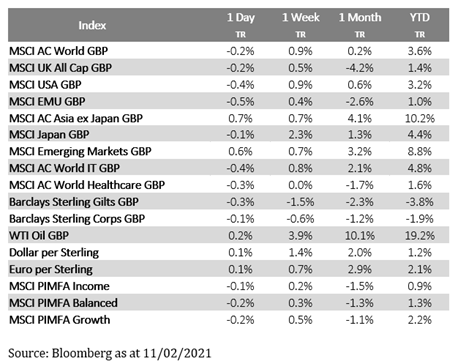
Markets globally will be responding to ongoing vaccination rollouts and keeping up to date with developments as they happen can, as ever, help inform your own views of the markets.  

Please utilise our blogs in keeping your own views of the market up to date.

Keep safe and well.

Paul Green 11/02/2021
Team No Comments

Will US dollar weakness last?

Please see below for Invesco’s article regarding the US Economy, received by us late Friday 05/02/2021:

A weak US dollar is commonly seen as a benefit to international stocks as foreign companies’ returns appear more attractive in dollar-denominated terms. So it’s no surprise that, as an equity strategist, I’m often asked about my outlook for the US dollar.

After a dramatic “risk-on” rotation beginning in early 2020, we greet the new year with a technically oversold US currency and overbought stock market. In other words, investor positioning has become lopsided, arguing that a countertrend bounce in the “greenback” and near-term drawdowns in stocks may be in store.

Looking further ahead, however, I believe the “buck” should continue to depreciate for a host of reasons, and expect the current weak dollar cycle to last for years to come.

A history of US dollar cycles

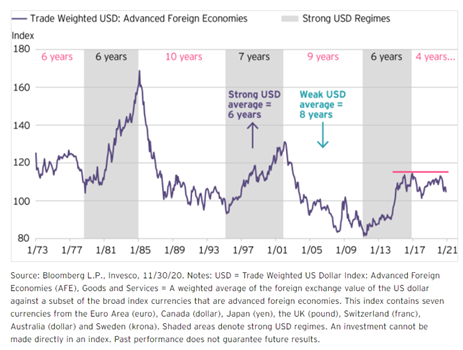
The trade-weighted US dollar Index measures the value of the United States dollar relative to other major world currencies. Since the early 1970s, the relative value of the US dollar has ebbed and flowed between long and well-defined periods of strength and weakness. As illustrated in Figure 1, it seems the “greenback” is only four years into the current weak dollar cycle. On average, such cycles have lasted about eight years, the longest having been roughly 10 years.

Figure 1. It seems the “greenback” is only four years into the current weak dollar cycle

Factors that support a weak US dollar

While past dollar cycles can offer clues about what the future may hold for the currency, history isn’t enough on its own. As such, I assembled a number of other factors that I believe support a weak dollar, including:

  • Valuations suggest that a swath of international currencies are trading at substantial discounts, especially in emerging markets (EM), meaning that they may have more room to strengthen compared to the dollar.
  • The Federal Reserve remains firmly in  monetary easing mode, which means the path of least resistance seems to be downward for the US currency. If quantitative easing (QE) represents a choice between the economy and  the “greenback,” the Fed has opted to save growth and jobs by opening the spigots and inflating the monetary base at the expense of the currency. From a long-term perspective, I think it’s reasonable to expect the US dollar to weaken further should the Fed keep such an abundant supply of currency in circulation.
  • The deep economic impact of the coronavirus pandemic has necessitated counter-cyclical government support to an unprecedented degree. In turn, ballooning twin deficits have become stiff fundamental headwinds for the US dollar. Why? When the US spends more than it earns, it floods the global financial system with US dollars, placing downward pressure on the value of its currency.

My recent chartbook – Seven reasons for a weaker US dollar and stronger international stocks – takes a deeper dive into these factors, as well as other reasons why I believe we may only be halfway through the current weak US dollar cycle.

Investment implications

In a global context, currency dynamics are an important component of investors’ total returns. For example, EM currency strength (the flipside of US dollar weakness) has boosted dollar-based investors’ returns on EM stocks (priced in US dollars).

Why have EM stocks moved in the same direction as their currencies? It’s a virtuous, self-reinforcing “flow” argument. Before foreign capital can flow into EM stocks, foreign currency-denominated assets must be sold in exchange for EM currencies.

Apparently, improving fundamentals versus 2015/16 have made the emerging market economies a more attractive destination for foreign capital, and the Fed’s dovishness is helping the situation.

For investors, this isn’t just an EM story. It’s a bigger message — one that I believe has positive ramifications for international stocks more broadly.

Learning about major players in the markets such as the US and their effect on the global markets as a whole can be useful and keep your holistic view of the markets up to date.

Please continue to check our blogs section for articles like these.

Keep safe and well.

Paul Green

Team No Comments

Brooks MacDonald Weekly Market Commentary | Vaccine distribution continues to be key focus for investors

Please see below for the latest Brooks MacDonald Weekly Investment Bulletin received by us yesterday 01/02/2021:

Vaccine nationalism raises its head as competing contracts and supply issues collide

A bout of risk off sentiment hit equities, bringing most European and US indices slightly negative for the first month of 2021. The risk of a vaccine trade war, less positive data from Johnson & Johnson’s vaccine and the risk of further COVID-19 restrictions all dampened the mood. Friday saw a bubbling over of increasingly hostile words between the EU and AstraZeneca. In short, the EU imposed the right to ban vaccine exports outside of the EU (and select countries) and effectively imposed a hard border between Northern Ireland and the Republic of Ireland. This proved only temporary, with the hard border reversed and the prospect of export bans to the UK played down as Friday and the weekend progressed. So called ‘vaccine nationalism’ has been a threat for several months as issues over regional supply chains combine with the sequencing of competing contracts and an increasingly frustrated populace. On Sunday, the UK announced that it had provided almost 600,000 vaccinations in one day (over 1% of adults), which may suggest that as supply increases, countries will be able to work quickly to inoculate their populations.

Markets look ahead to Friday’s US employment data after last month’s disappointment

This Friday sees the important non-farm payroll US employment figures released. Last month saw a decline of 140,000 jobs1 , the first decline since the first wave of the pandemic. This month economists are expecting a 50,000 increase and therefore for the headline 6.7% unemployment rate to remain stable2 . US economic data has shown resilience in the face of the current COVID-19 wave but there is still a large amount of spare capacity in the labour market, something that may curb any bubbling inflationary pressures. With employment a major item on President Biden’s agenda, it seems likely that the US Stimulus Package will move through Congress under the Budget Reconciliation rules. The downside of using this process is that there is a limit on the scope of the legislation and a limit on the number of times the process can be used.

US stimulus may progress using the budget reconciliation process but this has limits

The prospect of using the budget reconciliation process has dampened expectations of a bipartisan agreement that could leave the door open for further stimulus over the coming months. The reconciliation process means that the bill can pass with a simple majority in the Senate rather than being held up by the filibuster. The reconciliation process has historically only been used once per calendar year due to its inbuilt limitations, so there will be additional scrutiny on the proposed package if it is expected to be the only US stimulus in 2021.

Weekly investment bulletins like these are a good way to get regular input from market experts. 

The mass rollout of the vaccine is set to cause gradual change to the market outlook, hopefully life and economies will improve.

Please keep up to date with our blogs.

Keep safe and well.

Paul Green 02/02/2021

Team No Comments

Legal & General: Our Asset Allocation team’s key beliefs

Please see below for Legal and General’s latest Asset Allocation Team’s Key Beliefs article received by us the afternoon of 25/01/2021:

Bubble trouble?

Never have more people searched for the term ‘stock market bubble’ on Google. Data stretching back to 2004 show that January 2021 is set to eclipse January 2018, when searches for the term both preceded and followed a 10% drop in the S&P 500 over nine trading days. As we have highlighted before, investor optimism is pretty well inflated and, while most sentiment indicators don’t look stretched, many are elevated.

Burst case scenario

Not everyone is optimistic, though. One scholar of market bubbles, Jeremy Grantham, opened his new outlook: “The long, long bull market since 2009 has finally matured into a fully-fledged epic bubble.” Grantham has a good track record in predicting the moments when bubbles burst, so should we be worried? We think the famed investor may be right but, as he concedes, we believe the market could still run a lot further. Our own bubble index shows that the probability of a market bubble has indeed been rising. In fact, it is now the highest it has been since 2008.

What has driven this? We have seen an increase in capital raising through IPOs and SPACs, some of which echo the tech bubble of the late 1990s. US retail investor activity has also taken off, with easier access through investment platforms and, for some, new money to play with from stimulus cheques. However, we are just emerging from the COVID-driven economic recession. This means many macroeconomic indicators have improved, policy is supportive, and there is plenty more cash on the side lines ready to be deployed, regardless of further fiscal stimulus.

So while the market is definitely reminiscent of a bubble forming, it could easily still get much stronger from here. We therefore believe it’s too early to call a bubble now.

The moderates yield

If you weren’t able to watch any of the US presidential inauguration, I recommend viewing US National Youth Poet Laureate Amanda Gorman’s recital of “The Hill We Climb”, a powerful and gritty poem of hope for the future of the US, from a self-proclaimed presidential candidate for 2036.

In the more immediate future, the most relevant aspect of the new Biden administration to financial markets will be the prospect of more fiscal stimulus. The central case is for another virus relief package worth $1 trillion to be passed in the coming months, with an additional $1 trillion recovery package potentially following later. The quicker the economy recovers, of course, the smaller later packages will be.

Politically, though, we see the path of least resistance actually being for more fiscal spending rather than less. With a razor-thin majority, power accrues to the moderates, which means only consensus policies can pass. We expect it will be easier to build such a consensus on extra spending (giving things away) than on extra revenues (taking things away). While Democratic moderates have supported virus relief and the current package so far, several are not on record as supporting Biden’s tax proposals. Finally, voters don’t appear to care as much about deficits anymore, so senators probably won’t either.

Treasury yields could be the place where changing fiscal dynamics are priced, and indeed US yields have risen more than others in recent weeks after the Georgia runoffs, but as it stands we are comfortable with an overall neutral position on duration. In fact, we prefer US markets to UK gilts, which have only seen more modest yield rises despite the so-far successful vaccine rollout and expectations for a fiscally conservative budget.

Flexible recipe for fixed income

Multi-asset portfolios are like giant cakes, baked with multiple ingredients. We have decided to add a new ingredient to our cake: Chinese bonds. Technically it’s not new, as they are a growing part of emerging-market bond allocations in portfolios, but we have moved to an explicitly positive view.

We believe Chinese bonds add a lot of diversification to our fixed income holdings as China hums to a slightly different economic tune from the rest of the world, with a different monetary policy framework too. Historically, Chinese bonds have had a low correlation to other bonds. Their yields are relatively high, and we are particularly interested in bonds that could continue to provide protection in macro downturns as we believe many traditional bond markets will struggle to provide the defence they offered in the past.

This is just one of the steps we have been taking in portfolios to try to manage investor outcomes in a low interest-rate environment, with greater roles for non-traditional fixed income assets as well as defensive currencies and other strategies.

Regularly ‘picking the brains’ of investment managers and experts by reading articles like these can help update your own view of the markets and current global affairs.

Please keep reading these blogs to keep your view of the market well informed and up to date.

Stay safe and well

Paul Green 26/01/2021

Team No Comments

Brooks MacDonald Daily Investment Bulletin: 21/01/2021

Please see below for the latest Brooks MacDonald Daily Investment Bulletin received by us today 21/01/2021:

What has happened

Markets greeted the inauguration of Joe Biden with a rally driven by the tech heavyweights. Some markets concerns remained around the final handover of Presidential power from Trump to Biden so there will be an element of welcoming the calmer tone of the new President as well as removing a transition risk premium.

President Biden

Yesterday’s inaugural Presidential address saw President Biden attempt to change the tone in Washington by encouraging bipartisan debate rather than absolutism. This speech was followed by a series of executive orders as expected. This included the US re-joining the Paris climate agreement, ceasing the withdrawal from the WHO, ending the travel ban on a number of Muslin countries and a federal mask rule on interstate travel and within federal buildings. As a sign of the focus for the new administration’s economic goals, there were also some specific COVID support measures such as pausing federal student loan repayments and extending the federal eviction moratorium. Yesterday’s speech, coupled with that of Janet Yellen earlier this week, paints a market friendly picture where near term support remains the focus. Of course, the sting in the tail could be higher taxes down the line but we need to remind ourselves of the thin Senate majority and the fact the midterms are in November next year and this could change the power balance in Congress yet again.

Central bank decisions

Yesterday we heard from the Bank of Japan which left monetary policy unchanged whilst predicting economic challenges over the course of 2021. Today is the turn of the ECB and given the central bank announced a further easing package in December, little dramatic change is expected. The central bank meets under the cloud of Euro Area CPI estimates that showed the region in deflation (-0.3%) compared to the year before. Whilst forward looking CPI estimates have been rising, in line with the broad global market reflation narrative, even these future estimates remain well below the ECB’s 2% target. The central bank therefore likely has room to increase stimulus but it isn’t clear that simply doing more of what has been tried before (bank lending, negative rates and quantitative easing) will have the desired effect.

What does Brooks Macdonald think

Equities rose and volatility fell as power transitioned peacefully between President Trump and President Biden. It is interesting that yesterday’s rally was so tech focused given fears over regulation under a Democrat White House and Congress. The rally yesterday implies that investors are confident the new administration has its hands full with the COVID response and is unlikely to look towards market unfriendly reform within that context.

Daily investment bulletins like this could prove to be very useful in the near future. Yesterday’s Presidential Inauguration is sure to cause ripples in the markets globally and keeping up to date with developments as they happen can, as ever, be very beneficial to your own views of the markets.

Please utilise our blogs in keeping your own views of the market holistic and up to date.

Keep safe and well.

Paul Green 21/01/2021

Team No Comments

Weekly Market Commentary | Fiscal stimulus and vaccination goals on the agenda for Biden this week as presidency begins

Please see below for the latest Weekly Investment Bulletin from Brooks MacDonald, received by us yesterday 19/01/2021:

US markets are closed on Monday ahead of a busy week of politics, earnings and central bank meetings

Last week saw most major equity indices decline as risk appetite waned after a strong start to 2021. The primary drivers of this were concerns over Federal Reserve tapering and fears that the new Biden administration may struggle to deliver the proposed fiscal stimulus. More positively, Chinese Q4 GDP showed a beat to the upside with the country growing by 2.3% year-on-year in 2020, a stark contrast to most other G20 nations which are expected to see significant declines.

Wednesday’s inauguration of Joe Biden as US President begins the politically important first 100 days in office

The week starts slowly with Martin Luther King Day meaning that US markets are closed. When they reopen however, politics in both the US and in Europe will dominate the headlines. On Wednesday, Joe Biden will be inaugurated as the next President of the United States and with it the politically important first 100 days will begin. The response to the coronavirus pandemic will be high on the new administration’s agenda with ambitious fiscal stimulus and vaccination goals being mentioned ahead of Wednesday. In February, the new President is expected to unveil a more comprehensive economic plan which will include infrastructure investment as well as policies to tackle climate change. Meanwhile in Europe, reports suggest that Italian Prime Minister Conte will survive a vote of no confidence today due to several abstentions. If these prove correct, this will reduce the near-term risk of fresh elections. Staying in Europe, the German Christian Democratic Union (CDU) have elected Armin Laschet as the new party leader, however it remains to be seen whether Laschet will be nominated as the chancellor candidate for the ruling CDU/CSU (Christian Social Union in Bavaria) coalition for September’s federal election.

Earnings season begins to gain traction this week with a string of banks and tech firms reporting

While we had a small number of earnings releases last week, including J.P. Morgan, this week sees a ramp up across both the US and Europe. The US tends to reach peak earnings momentum a little earlier than Europe so that region will be the focus for the rest of January. This week we have Bank of America, Netflix, Goldman Sachs, Morgan Stanley, Intel and IBM, so a range of sectors but a technology/bank focus. Coming into the season, large cap US equities are expected to see a year on year earnings decline for Q4 2020.

After a quieter start due to the US holiday, this week is likely to become far busier as US politics, European politics, earnings and central bank meetings all arrive. The European Central Bank is the major bank meeting this week and while no material change is expected, markets will be watching the rhetoric closely to see if there are any signs of tightening ahead.

Weekly updates like these are a useful method of frequently updating your holistic view of the markets, especially given the way the world is rapidly changing with Coronavirus.

Please continue to utilise these blogs to help inform your own views of the markets.

Stay safe and well.

Paul Green

19/01/2021

Team No Comments

Market predictions and investment resolutions for 2021

Please see below for Invesco’s article on Market Predictions for the year ahead, received by us yesterday 06/01/2020:

Happy New Year! No one wants a year in review for 2020, but here is what I learned from the past year: History may not repeat itself, but it sure does rhyme. What we learned from 2020 is a repeat of the lesson we learned from the global financial crisis (GFC): Central banks are very powerful. They can’t cure viruses and they can’t create jobs, but they can boost confidence and move markets — a lot. That is the big similarity 2020 had with 2009: Central bank intervention mattered, especially by benefiting risk assets.

When I think of the New Year, I think of predictions and resolutions. And so today, I provide you with a little of both.

My New Year’s predictions

1. US-China relations may get warmer. There seem to be two factions emerging among Biden loyalists: “reformists” who want to push China aggressively on key issues and check its power, and “restorationists” who want to restore US-China relations to where they were in the Obama administration. I believe Biden will do what he typically does: land somewhere in the middle. I don’t expect US-China relations to return to what they were pre-Trump. However, I do expect the relationship between the two countries to improve and normalize. In particular, I expect more predictability and less volatility. While Biden may not unwind tariffs immediately, I do expect him to unwind the Trump administration tariffs after a “study” of their impact (which has obviously been negative for parts of the US economy, especially agriculture). The Biden administration will likely be aggressive on specific issues with China and pursue those issues multilaterally — but I expect that to occur within the context of a broader US-Sino relationship that is more cordial because the fortunes of many US businesses are tied to China. The Chinese economy is on pace to soon overtake that of the US, with the timeline expedited due to COVID, which gives China growing leverage. In fact, the Centre for Economics and Business Research recently released its forecast that China will overtake the United States by 2028 as the world’s largest economy, which is five years earlier than previously estimated due to the two countries’ very different recoveries from the pandemic.1 In addition, China has already begun to signal that it would like improved relations with the US. China’s Foreign Minister Wang Yi said in a recent interview with the South China Morning Post that both the US and China have been negatively impacted by the deterioration in their relationship over the past several years, and that US-China relations have come to a “new crossroads” with a “new window of hope” opening.2

2. Developed countries may have a better recovery than they did post-GFC. As COVID-19 vaccines are broadly distributed, I expect the economic recovery to be far more robust and inclusive than the economic recovery coming out of the global financial crisis. I believe the services industry will rebound with greater intensity, benefiting many lower income workers. That doesn’t mean that there won’t be more glitches in distribution — I fully expect there to be. And there will likely be more pandemic-related headwinds, such as the development of worse strains of the virus. However, once a substantial portion of the population is inoculated, I expect the economic recovery to be powerful. 

3. Oil may rise. Given my expectation for a strong economic recovery in 2021 as vaccines are distributed, I also expect demand for oil to increase significantly. I believe this will lead to a substantial increase in the price of West Texas Intermediate crude oil — even if we see a ramp up in oil production.

4. Bitcoin may fall. I know there is a lot of excitement over Bitcoin, but it’s starting to feel a bit like Tulipmania. Bitcoin rose more than 300% in 2020, with much of the gains made in the last few months of the year.3 I continue to believe gold is a far better choice for diversification into “hard assets” and as a hedge against geopolitical risk. Bitcoin might continue to run for a while this year, but I expect it to be volatile and to ultimately disappoint, as it has in the past after strong rallies.

5. The S&P 500 Index may have another double-digit return in 2021. With vaccine distribution beginning, a robust economic recovery anticipated in the not-too-distant future, as well as extraordinary accommodation from the Federal Reserve, I expect a continuation of the stock rally we saw in 2020, albeit with drops and pauses along the way. Better-than-expected corporate earnings should also help.

My New Year’s resolutions

1. Stay invested and well diversified. While I feel very confident about risk assets in 2021, that doesn’t mean there won’t be volatility and sell-offs in the coming year. I believe having adequate exposure to stocks, fixed income, and alternative asset classes is key to building a portfolio that may withstand volatility.

2. Look to Asia’s emerging markets. My outlook is especially bright for the emerging markets countries that have managed the pandemic well, such as China and Korea. These economies have a head start on the robust vaccine-fueled economic recovery that I expect in 2021.

3. Don’t overlook tech. While the economic rebound may result in strong performance by cyclical stocks in sectors such as energy and consumer discretionary, I don’t necessarily expect tech stocks to underperform. I continue to favor adequate exposure to the technology sector, as I believe many tech stocks may continue to benefit from trends that accelerated during the pandemic.

Although nothing is guaranteed for the future as proven by the year 2020, expert insight and opinion like this is a good way of seeing how actions and news developing worldwide could have an impact on the investment markets, and thus highlights good topics for discussion.

Please utilise blogs like these to aid your own informed opinions on what may lie ahead for the markets, but I reiterate that nothing is guaranteed for the future.   

Keep safe and well and all the best for 2021.

Kind Regards

Paul Green

07/01/2021

Team No Comments

Brooks McDonald Daily Investment Bulletin

Please see below for the Daily Investment Bulletin from Brooks McDonald, received by us today 05/01/2021:

What has happened

Markets started the day positively but the New Year jubilance faded as the US COVID outlook worsened and a tight Georgia run-off today could go either way. The US index started the day in positive territory before falling as much as 2.5% then settling 1.5% down at the close.

COVID’s new variant and restrictions

The new COVID variant has been responsible for a large quantum of the surge in the South East of England and news that it had now been detected in New York, Colorado, California and Florida did little to help the mood. Whilst there is no evidence that the new strain is more deadly it does appear to be transmitting aggressively, causing strain on the healthcare system. It is this strain that led to UK PM Johnson announcing that England would move into its third Lockdown with the new stay at home rules far more reminiscent of March 2020’s with schools closed and only essential journeys allowed. UK Chancellor Sunak is expected to unveil a fresh support package for UK companies in light of these new tough restrictions which are expected to produce a similar economic impact to that seen in March and April last year.

Georgia run-off

The other event keeping New Year optimism in check is the Georgia Senate run-off. This is clearly key in determining which party has control of the Senate and therefore whether a blue sweep can be achieved. Back in November the market’s base case was that the Democrats would win every race and this would give them the flexibility to launch substantial stimulus in Q1 2021. Once this didn’t immediately materialise, investors warmed to the idea of a split Congress as this would curb the chances of tax rises, tougher regulation and other less economically positive reforms. As we approach today’s election, the Democrats are ahead in both seats, albeit it narrowly, and investors are not entirely sure which side of the coin they want the race to land.

What does Brooks Macdonald think

A Democrat clean sweep or a split Congress both have benefits and negatives but our instinct is that a split Congress would be more market friendly as it retains the status quo and financial assets will look through the positives of US Fiscal Stimulus quite quickly as compared to broader reforms. Even if the Democrats do take both seats, and VP-Elect Harris is left with the deciding vote in the Senate, the current filibuster rules will stop contentious legislation. If we do see a blue sweep, markets will look very closely at any suggestions from the Democrats that they would look to remove the Filibuster from the next Senate session.

Regular daily updates like these are a useful method of frequently updating your holistic view of the markets, especially given the way the world is rapidly changing by the day with Coronavirus.

Please continue to utilise these blogs to help inform your own views of the markets.

Stay safe and well

Paul Green

05/01/2021

Team No Comments

Markets in a Minute: Markets rise over the week, but mood is soured by virus worries and Brexit

Please see below for the latest Markets in a Minute update from Brewin Dolphin, received yesterday evening 22/12/2020:

Global equity markets moved mostly higher over the past week, as the vaccines programme boosted optimism and an agreement on the US stimulus package edged closer. Eternal hope of a Brexit deal helped the more UK-centric shares and European markets. The FTSE100 has been an underperformer, however, as the dollar has been weakening relative to sterling, squeezing the earnings of FTSE’S multinationals, which gather most of their revenue in dollars. The ongoing dollar slide helped push commodity prices higher, and bitcoin briefly hit a record $23,000 amid a flurry of speculation, although nobody can really gauge its true value.

Last week’s markets performance*

• FTSE100: -0.26%

• S&P500: +1.25%

• Dow: +0.44%

• Nasdaq: +3.05%

• Dax: +3.93%

• Hang Seng: -0.02%

• Shanghai Composite: +1.42%

• Nikkei: +0.41%

*Data for week to close of business on Friday 18 December

Equity markets pull back at start of week

News of the virus mutation in the UK, and resulting restrictions on the movement of people and goods to numerous countries led to a sell off in many markets around the world on Monday. The FTSE100 closed down by 1.73% at 6,416.32, and the FTSE250 ended 2.11% lower at 19,962.11. In Europe, the pan-European STOXX 600 index fell 2.3% after the UK announced its tougher restrictions in response to the vaccine, and the EU’s largest market, the German Dax, fell by 2.82%. Reaction was more muted in the US, where the S&P500 lost just 0.4%, while the Nasdaq lost 0.10%. The Dow closed up by 0.12%.

US stimulus bill passed

The long-awaited US stimulus package to extend unemployment benefits and fund a range of other pandemic-related expenditure was passed on Monday night after nearly six months of wrangling. The package, worth $900bn in total, will send one-off cheques worth $600 to households, with extra payments for children. It will also extend unemployment benefit payments worth $300 a week for those who are out of work due to Covid-19. These payments will last until March and give the vaccination programme time to take effect. However, President-elect Joe Biden has signalled he will look to pass a larger bill once he takes office in January.

Markets sensitive to risk

There is a lack of liquidity in the market at the moment, as many traders have started their Christmas breaks and there is less money flowing into shares and bonds. This can make markets quite volatile, and there is no denying that the newsflow right now is quite alarming. We heard of the new strain of Covid-19 emerging from the UK, prompting Tier 4 containment measures in London, the south east and parts of eastern England over the weekend. In Europe, there are concerns surrounding movement of people and goods which has led to travel constraints. This could have an impact on the economy – and our lives – unless some resolution is reached quite quickly.

This bad news linked with a lack of progress on Brexit, with travel restrictions making negotiations harder, led to weakness in UK and European markets at the start of the week. However, the pound has recovered its losses, indicating that investors are perhaps taking stock and realising that this is probably not as frightening as the headlines first seemed. There were hopeful headlines on Tuesday morning about a compromise on fishing quotas, but there is no firm news of progress. We must wait to see how this plays out in the coming days, but markets will be jittery until the end of the year at least; even if a deal is agreed, it needs to be cleared by the EU member states which will not happen until the new year. The US, meanwhile, was far calmer, with the Dow even closing with a small gain, as the US stimulus bill was passed.

Economic resilience Taking a broader view, the global economy is holding up better than expected given such challenging circumstances. Many UK businesses had reported activity improving in December. The IHS/Markit flash composite purchasing managers index, which measures business levels compared to the previous month, rose to 50.7 in December from 49 in November. A reading above 50 indicates business is expanding. The services element of the index, which covers leisure and hospitality, rose to 49.9 in December from 47.6 in the previous month, suggesting business levels are still falling. Yet the data was still better than anticipated and shows the economy holding up relatively well. PMIs in the US were even stronger, with the businesses saying that activity levels were improving, especially in the manufacturing sector.

All in all, there is a sense of confidence that the global economy will get through this very challenging period and emerge to recover next year, as things return to normal. On a 12-month view, we remain optimistic on equities, although it could be a bumpy ride until as sentiment rises and falls along with the headlines.

Brewin Dolphin regularly give us their insight of the markets. Updates in this efficient manner are a quick but well-informed way to update your consensus view of the global markets.

Please keep using these blogs to regularly update your knowledge of current market affairs from around the world.

Keep well and all the best

Paul Green

23/12/2020

Team No Comments

Blackfinch Group Monday Market Update

Please see below for the latest Blackfinch Group Monday Market Update received by us today 21/12/2020:

UK COMMENTARY

  • Talks continued in the hope of finding a solution in the Brexit negotiations.
  • Data showed redundancies hit a record 370,000 in the third quarter of the year, with the unemployment rate rising to 4.9%.
  • UK inflation slowed again in November, to 0.3% from 0.7%, with prices weighed down by retailers cutting prices during ‘Black Friday’ sales.
  • The Bank of England voted to leave interest rates on hold and revised its expectations for the decline in gross domestic product in the fourth quarter, from 2.0% to a “little over 1%”.
  • UK retail sales fell 3.8% month on month in November, although economists had predicted a decline of more than 4%.

US COMMENTARY

  • Talks continued over a further stimulus package, with the deadline fast approaching.
  • The Electoral College ratified the November presidential election result, with each state voting in line with their electorate to confirm the upcoming inauguration of Joe Biden and Kamala Harris.
  • US retail sales fell further than expected in December, declining 1.1% month on month.
  • The US Federal Reserve announced it will buy at least $120bn of bonds each month until substantial further progress is made towards its maximum employment and price stability goals.
  • First-time jobless claims data came in above expectations in the week to 12th December, climbing to 885,000.

ASIA COMMENTARY

  • The Bank of Japan extended its virus-related corporate lending programme by six months to September 2021, while making no changes to its monetary policy.

COVID-19 COMMENTARY

  • The US began its vaccination programme, with the first three million doses of the Pfizer/BioNTech vaccine distributed for use across all states.
  • The US Food and Drug Administration approved the vaccine developed by Moderna for emergency use.
  • News broke of a new variant strain of COVID-19 that has become prominent in London, the South East and Eastern England.

These articles provide concise well-informed views that cover the whole of the market and are useful to maintain your up to date view of the markets globally.

Please keep reading our blogs regularly to give yourself a holistic and up to date view of the markets.

Keep safe and well.

Paul Green

21/12/2020