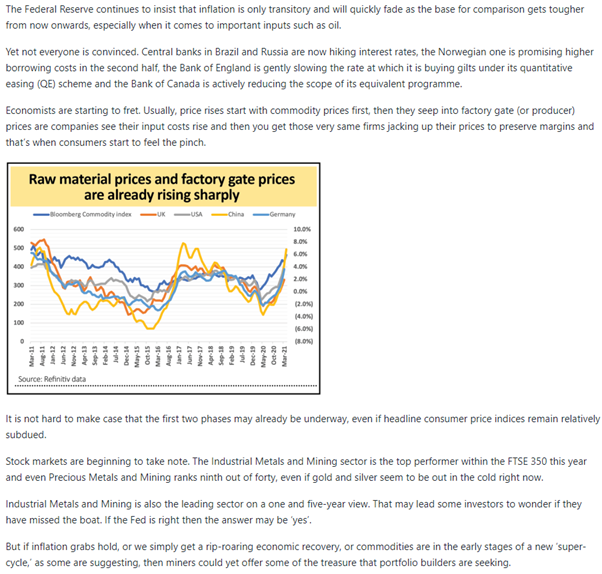
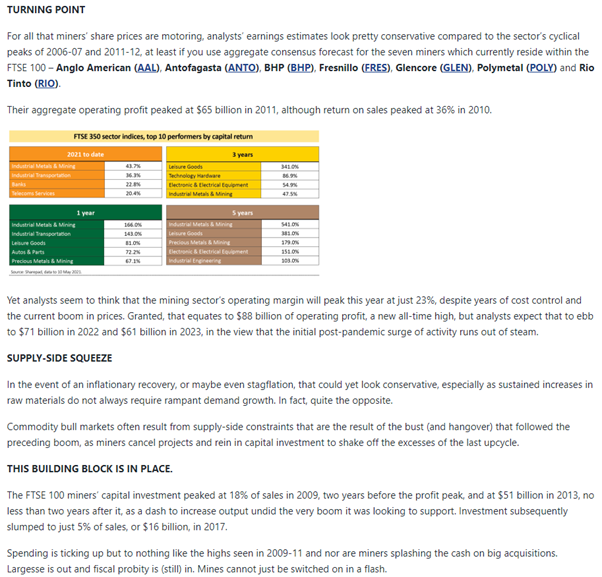
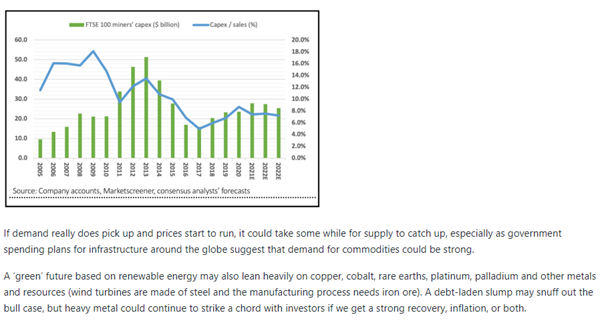
Please see below an article received from A.J. Bell which was received yesterday (16/05) and details their views on inflationary pressures and where industrial metals and mining could play a role:
Please continue to check our Blog content for advice and planning issues and the latest investment, markets and economic updates from leading investment houses.
Please see below for one of AJ Bell’s latest articles, received by us yesterday 13/05/2021:
WHAT IS THE UK STATE PENSION AGE?
The current UK state pension age is 66 for both men and women. It used to be the case that women received the state pension at age 60 and men at 65, but this was viewed as discriminatory and so successive Governments legislated to equalise the state pension ages of the sexes.
This happened in 2018, at which point the state pension age for men and women was slowly increased to 66 by 2020.
The state pension age is scheduled to rise again to 67 between 2026 and 2028. As with the increase to age 66, there will be a two-year transition where some people will have a state pension age somewhere between 66 and 67.
After 2028 the next intended increase in the state pension age is to 68 between 2044 and 2046. However, the Government has stated it wants to accelerate this move so it happens seven years earlier, between 2037 and 2039.
I RETIRED BEFORE 6 APRIL 2016 – HOW MUCH STATE PENSION WILL I RECEIVE?
For those who reached state pension age before 6 April 2016, there were two primary components: the basic state pension and additional state pension. This additional element consisted of:
Graduated Retirement Benefit built up between 6 April 1961 and 5 April 1975;
State Earnings Related Pension Scheme built up between 6 April 1978 and 5 April 2002;
State Second Pension built up between 6 April 2002 and 5 April 2016.
The full basic state pension is worth £137.60 a week in 2021/22 and rises each year in line with the highest of average earnings, inflation or 2.5% (the ‘triple-lock’). You needed at least 30 years’ National Insurance contributions to qualify for the full amount – for those with less than this, a deduction would have been made.
The triple-lock does not apply to any additional state pension entitlements you have, which instead increase each year in line with CPI (consumer prices index) inflation.
I RETIRED ON OR AFTER 6 APRIL 2016 – HOW MUCH STATE PENSION WILL I RECEIVE?
The Government decided the state pension system was too complicated and so, for those who reached state pension age on or after 6 April 2016, a reformed system was introduced.
Rather than having two tiers of state pension – the basic and additional state pension – people now build up entitlements to a flat-rate amount. In 2021/22 the full flat-rate state pension is worth £179.60 a week and also increases in line with the triple-lock.
You need to have at least a 10-year National Insurance contribution record to qualify for any state pension under the reformed system, and a 35-year National Insurance contribution record to qualify for the full amount.
Those who had built up state pension entitlements under the old system and had not reached their state pension age before 6 April 2016 had a ‘foundation amount’ calculated. This foundation amount was the higher of:
Total benefits built up under the basic state pension and additional state pension, with a deduction made to take account of any years the individual was ‘contracted-out’;
Total benefits the individual would have built up had the reformed state pension been in place at the start of their working life, with a reduction applied where the individual was contracted-out.
The idea behind this was to ensure those who had built up entitlements under the old system which were more valuable than the reformed state pension would not lose out.
Anyone with a foundation amount equal to the full flat-rate state pension at 5 April 2016 would not have been able to build up any extra state pension – even if they add more qualifying years to their National Insurance contributions record.
Those with a foundation amount below the full flat-rate state pension could continue to build up qualifying years via National Insurance contributions and boost their state pension entitlement.
People with a foundation amount worth more than the flat-rate state pension would receive the full flat-rate amount plus a ‘protected payment’ to reflect the extra entitlement built up under the old system. They would not gain any extra pension for further qualifying years they accrue.
While the flat-rate element of this pension will rise in line with the triple-lock, the protected payment increases by CPI inflation only.
WHAT IS ‘CONTRACTING-OUT’ AND HOW COULD IT AFFECT MY STATE PENSION ENTITLEMENT?
‘Contracting-out’ was an option previously open to people whereby, in exchange for lower National Insurance payments, employees agreed to opt-out of the additional state pension, meaning they would not build up an entitlement towards it.
For those reaching state pension age after 5 April 2016, any years they contracted-out will be deducted when figuring out your foundation amount.
You can check if you were contracted-out by contacting your pension provider or reviewing an old payslip. If you don’t have either, try the Government’s pension tracing service here.
CAN I DEFER TAKING THE STATE PENSION?
It is up to you to claim your state pension from the Department for Work and Pensions. However, it is also possible to defer taking your state pension – and you’ll receive an uplift for doing so. The level of this uplift will depend on when you reached state pension age.
For those who reached state pension age before 6 April 2016, the rate of uplift is 1% for every five weeks you defer, subject to a minimum deferral period of five weeks. This works out at a 10.4% increase in your state pension if you defer for 52 weeks.
Based on the 2021/22 basic state pension of £137.60 per week, this works out at an extra £14.71 per week if you deferred for one year.
For anyone who reached state pension age on or after 6 April 2016, the deferral rate is 1% for every 9 weeks they defer, or just under 5.8% for every 52 weeks.
This increase is applied to the flat-rate state pension. Based on someone receiving the full flat-rate state pension for 2021/22 of £179.20 a week, a person who deferred for 52 weeks would get an extra £10.42 a week.
Both of these examples assume there is no annual increase in the value of the state pension. If there is an annual increase, the amount you receive could be larger.
SHOULD I DEFER TAKING THE STATE PENSION?
Whether or not state pension deferral is the right option will depend on your personal circumstances.
For some it simply won’t be possible as they need the state pension income as soon as possible, while for others it might depend on their health and lifestyle. But if you are in good health then it could be worth considering.
Take someone who reaches age 66 in 2021/22 and is entitled to the full flat-rate state pension of £179.60 a week in 2021/22. If they defer taking this income for one year they will forgo £9,339.20 in return for an extra £10.42 a week for the rest of their life.
SO THE KEY QUESTION IS: AFTER HOW LONG COULD YOU ‘BREAK EVEN’?
Based on the state pension increasing by 2.5% each year, it could take 15 years to take as much total income via deferral as you could have done by taking the state pension at age 66.
For someone with a state pension age of 66, this implies the point at which they might be in ‘profit’ from deferring the state pension could be around age 81.
Given average life expectancy for a 66-year-old man is 85 and a 66-year-old woman is 87, this suggests that, provided you are in good health, delaying receiving your state pension could pay off financially.
State Pensions are a complex area as legislation has changed frequently over the last few decades. Whether or not you should draw on your State Pension at your State Pension age depends on your own specific circumstances. It’s a good subject to pick up with your I.F.A.
A great starting point would be to get an up-to-date State Pension forecast, these are the contact details for the dwp:
Please see the below article from Invesco received late yesterday afternoon:
Key takeaways
Covid-19 saw net savings of the US household sector surge to 20% of GDP
However, this increase was offset by an increase in net borrowing by both the corporate and government sectors
Is it plausible to argue that high savings will drive a strong economic recovery?
We believe the recovery following the Covid-19 pandemic will be stronger than, for example, the recovery following the GFC, and stronger than consensus forecasts. However, we do not sign up to the theory that this will be driven by excess savings.
High ‘savings rate’
A popular argument currently is that the relatively high ‘savings rate’ across advanced economies will provide powerful fuel for the economic recovery when the Covid-19 pandemic is finally under control.
On its face, this argument seems plausible; if people have forgone spending in the past and have accrued excess savings these can surely be spent in the economy when it is safe and legal to do so. We know that money has a fairly stable relation to income (known as the income velocity of circulation), but is the same true for savings?
There are two problems with the ‘excess savings will be spent’ argument; first, there is an empirical problem when the data is analysed and second there is a theoretical problem when the argument is considered rationally. Here, we focus on the US economy due to the availability of the data, but the analysis is equally as applicable to any economy.
First, we need to define which ‘savings rate’ we are talking about to be consistent. One can choose either an aggregate savings rate for the whole economy (either gross or net of capital consumption i.e. depreciation) or a sectoral (most often, household) savings balance.
An aggregate savings rate reflects overall investment rates (as opposed to consumption), whereas a sectoral savings balance reflects net borrowing and lending between sectors of an economy. These two different definitions are fundamentally different understandings of what ‘savings’ consist of and how they affect economic growth.
Both types of savings rates will be analysed empirically and theoretically.
The aggregate (or gross) savings rate
Gross savings rates have a moderately positive, statistically significant correlation with both real GDP growth and nominal GDP growth. Between 1950 and 2020 in the US, higher gross savings rates were associated with higher growth rates in both real GDP[1] and nominal GDP[2].
Furthermore, net savings rates also show a moderately positive, statistically significant correlation with both real GDP growth and nominal GDP growth.
For example, an increase of 1% in the gross savings rate relative to GDP roughly corresponds to a 46 basis point (bps) increase in real GDP growth, and an 81bps increase in nominal GDP growth (measured on a percent change on previous year basis).
The rationale behind this relationship is simple; if a person or economy chooses to invest their capital (either directly or indirectly via financial markets) in productive endeavours instead of consuming goods or services, this increases the productive capital stock and boosts potential economic output.
The personal (or household) savings rate and sectoral balances
In stark contrast, personal (household) savings rates have zero to low positive, statistically significant correlation with both real GDP growth and, to a lesser extent, nominal GDP growth. Between 1960 and 2020 in the US, higher personal savings rates were not associated with higher growth rates in either real GDP[3] or nominal GDP[4].
To understand why this is the case, consider Figure 1 which contains data taken from the US Financial Accounts.
Figure 1. US sectoral balances (% of GDP, 4-quarter moving average)
The chart tracks the net lending/borrowing between the four key sectors of the US economy, measured as a percentage of GDP (household, corporate – financial and non-financial — government, and external.
The household sector here represents personal savings; the corporate sector represents net lending/borrowing of corporations both financial and non-financial; for the government sector we show the fiscal balance (whether in surplus or deficit); and the overseas (or external) sector is represented by the current account balance (with the opposite sign to show capital inflows or outflows).
Net lending/borrowing across the whole economy (including foreign savings flows) must ultimately sum to zero, as any borrowing (a liability) must be matched by lending (an asset), and in double entry bookkeeping the two must balance.
When Covid-19 first hit the global economy in early 2020, the net savings of the US household sector rose to a historically high level of 20% of GDP. Simply put, spending by households collapsed as social restrictions were introduced and household savings rose commensurately.
Net savings vs net borrowing
However, this increase in net savings by households was reflected in an increase in net borrowing by both the corporate sector and the government sector. Corporates drew down credit lines in the dash-for-cash phenomenon experienced between March and May 2020.
At the same time, the government issued an incredibly large amount of securities to pay for the fiscal response to Covid-19, including unemployment benefits and public health spending relating to the virus.
To understand the effect on overall spending, whenever a particular sector increases its spending, we also need to know how this new spending is funded. If, for example, the government sector increases its spending, and this spending is funded entirely by less spending from the household sector (as was the case in 2020), overall spending is unchanged.
The same argument can be made for other sectoral balances. It is this key insight that undermines the argument that excess savings in the household sector will power the economic recovery.
As previously mentioned, there is nevertheless a relatively strong correlation between gross/net savings and real/nominal GDP growth. In contrast to personal savings, there has not been an increase in gross or net savings ratios, as evidenced in Figure 2.
Figure 2. US gross and net savings (% of GDP)
Since 1950, gross and net savings rates have closely tracked each other (albeit with a difference of about 16-17 percentage points) and have tended to fall as the US has developed into a more consumption-led economy.
The Covid-19 impact and recovery
Prior to the Covid-19 pandemic, gross and net savings ratios were stable at 20% of GDP and 3% of GDP respectively. Both gross and net savings ratios fell in the second quarter of 2020 to very low levels, which had only ever been reached or exceeded (on the low side) in the period following the GFC.
Since then, there has been a recovery in both savings ratios, but only to pre-Covid-19 levels of around 20% and 2.5% of GDP respectively. Therefore, there has been no material increase in gross or net savings during Covid-19, and the corresponding increases in real or nominal GDP growth cannot be expected to materialise.
In conclusion, analysing both aggregate savings and net sectoral savings yields little evidence that the economic recovery following the Covid-19 pandemic will be driven by excess savings.
We do believe, however, that the recovery following the Covid-19 pandemic will be stronger than, for example, the recovery following the GFC, and stronger than consensus forecasts. The stronger recovery will not be driven by excess savings, but by excess money balances relative to income (and technically by base effects also).
This will manifest firstly in strong real economic growth in 2021-22, and then, ultimately, in higher nominal growth. We believe this will also include a period of inflation in 2022-23 higher than the figures the US Federal Reserve is currently projecting.
Please continue to check back for our regular blog updates.
Please see below this week’s Markets in a Minute update from Brewin Dolphin – received late yesterday afternoon – 11/05/2021
Markets mixed as investors rotate out of growth stocks
Equities were mixed last week as strong earnings results competed with a renewed rotation out of growth stocks.
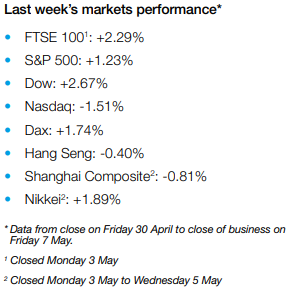
The shift to higher-yielding value stocks weighed on the technology-heavy Nasdaq, which slid 1.5% in its worst weekly performance in two months. The S&P 500 and the Dow rose by 1.2% and 2.7%, respectively, after a rally on Friday helped to erase losses from earlier in the week.
The pan-European STOXX 600 gained 1.7% following better-than-expected earnings results and encouraging economic data. Germany’s Dax added 1.7%, while the UK’s FTSE 100 surged 2.3% to end its holiday-shortened four-day week above the 7,000 mark.
In Asia, several indices were closed on Monday through Wednesday for public holidays. Japan’s Nikkei gained 1.9% amid optimism about the global economic recovery, whereas China’s Shanghai Composite ended the week 0.8% lower.
Sterling reaches highest level since February
The FTSE 100 slipped 0.1% to 7,124 on Monday after the pound surged to its highest level against the dollar since February. Some of the factors behind the surge were the upcoming easing of lockdown restrictions, dollar weakness following Friday’s disappointing US payrolls report, and the Conservative Party’s victories in last week’s local elections.
US stocks also closed lower on Monday as the rotation out of growth stocks continued. The Dow slipped 0.1%, the S&P 500 declined 1.0% and the Nasdaq slumped 2.6%, marking its worst session since March.
European markets were sharply lower at Tuesday’s open, with the STOXX 600 down 1.6% and Germany’s Dax and France’s CAC 40 both down 1.7%. The FTSE 100 tumbled 1.9% following losses in Asia-Pacific markets overnight. Engineering group Renishaw and airline group IAG were among the top fallers in the blue-chip index.
US jobs data disappoints
After a flurry of data that suggested the US economy was roaring back to life, last week’s jobs figures came as a disappointment. Non-farm payrolls increased by just 266,000 in April, far lower than the anticipated one million new jobs. The unemployment rate rose to 6.1%, which was worse than the expected 5.8% rate.
US non-farm payrolls
Although the figures were disappointing, they lend weight to the Federal Reserve’s case for maintaining its accommodative monetary policy. Stocks rallied on Friday after the data helped to ease fears about an imminent rise in interest rates.
Elsewhere, the Institute for Supply Management’s gauge of manufacturing activity stood at 60.7 in April, below consensus estimates of around 65.0 and four points lower than in March. US services also grew at a slightly slower pace in April, with the index falling to 62.7 from March’s all-time high of 63.7.
BoE upgrades UK growth forecast
On Thursday, the Bank of England increased its forecast for UK GDP growth to 7.25% in 2021, up from its previous forecast of 5.0%. This would be the fastest growth rate since 1941’s 8.7% expansion, but it follows a contraction of 9.9% in 2020 – the worst for more than three centuries.
Andrew Bailey, the Bank’s governor, told an online news conference that the strength of the economic recovery needs to be put into perspective.
“Let’s not get carried away,” he said. “It takes us back by the end of this year to the level of output we had essentially at the end of 2019 pre-Covid. So that is good news in the context of where we’ve been, but it still means that two years of output growth have been lost to date.”
The upgrade to forecasts followed a better-than-expected economic performance during the third national lockdown at the start of the year. The economy shrank by 1.5% in the first three months of 2021, better than the Bank’s forecast of a 4% contraction.
Eurozone retail sales beat forecasts
There was good news on the eurozone’s economic recovery last week, with the latest retail sales data revealing month-on-month growth of 2.7% in March, thereby beating consensus forecasts. This marked the second monthly increase in a row. Germany and the Netherlands saw particularly strong growth of 7.7% and 8.4%, respectively.
Meanwhile, IHS Markit’s eurozone composite PMI rose to 53.8 in April, the highest since July 2020. The services sub-index rose to 50.5 – moving above the 50.0 figure, which separates growth from contraction, for the first time in seven months.
Europe’s vaccination programme is also gathering pace. As of 9 May, 27.9% of the European Union’s population had received at least one vaccine dose. In Europe as a whole, the figure was 24.1%, according to Our World in Data.
Please continue to check back for our regular blog posts and updates.
Please see below commentary received from Brooks Macdonald yesterday evening, which provides analysis of the market’s response to political events in the UK and economic developments in the US.
A significantly weaker than expected US jobs report leaves markets baffled
Markets were left baffled on Friday as the US employment report sharply missed expectations, making a US Federal Reserve (Fed) taper of asset purchases in June less likely. Equity markets rallied, with technology performing after a difficult week for growth equities.
The market was expecting around one million new jobs to have been created in the US in April but the final number, 266,000, was far below those lofty expectations1. As commentators scrambled to explain the numbers, there are broadly two camps, one group concluding that this reflects difficulty in making hires, the other that the recovery has less momentum than hoped. The truth will likely lie between these two but President Biden cited the report as evidence of the need for the stimulus that the White House has planned for this year. One of the theories for why the jobs number was so weak is that fiscal support is so large, there is less incentive to take on work, effectively saying that fiscal spending is crowding out private sector employers. If this is the case, additional stimulus could make this imbalance even starker. This could of course just be another short-term demand and supply imbalance and one that will be resolved over the coming quarters, as things return closer to normality.
A strong showing for the Conservatives last week may open legislative policy options
Sterling has begun the week on a stronger note, as investors view the lack of Scottish National Party majority (just) as reducing the risk of an imminent independence vote. Pro-independence parties still have a majority in the Scottish Parliament, however the results, on the margin, reduce the urgency of this question for markets. Tomorrow sees the Queen’s Speech which, given the recent by-election successes from the Conservatives, may be more legislatively ambitious than previously imagined.
US CPI is released on Wednesday and is expected to contain some substantial year-on-year gains
Friday’s employment report has led to much confusion, particularly as the two interpretations end with contrasting inflationary and deflationary conclusions. This week we will see the unveiling of the April US CPI number which is expected to creep up to 3.6% year-on-year on a headline basis and 2.3% on a core basis (excludes energy and food)2. We are entering the period where the year-on-year comparison is flattering the inflation figures, but it will be interesting to see if bond markets can hold their nerve in the face of these figures, even if they ultimately prove transitory.
We will continue to publish market updates and relevant content as the UK approaches a further relaxation of lockdown rules. Please check in again with us soon.
Please see below for one of AJ Bell’s latest Investment Insight articles, received by us yesterday 09/05/2021:
In many ways right now, it looks like business as usual for the financial markets. Blow-out quarterly numbers from Google’s parent Alphabet, Apple and Facebook are taking their share prices to new highs and carrying the NASDAQ index along with them; the FTSE 100 is having another crack at breaking through the 7,000 barrier; and central banks seem in no rush to switch off the hose of cheap liquidity with which they are dowsing markets (unintentionally or otherwise).
And yet, as discussed last week, bonds are trying to rally, as is gold. This move in haven assets seems at odds with the prevailing optimism regarding global vaccination programmes, an economic upturn and higher corporate profits and dividends.
It can be too easy to read too much into such short-term moves, as nothing goes up (or down) in a straight line. One way to test the market mood is to check out what is going on at the periphery, as that is where advisers and clients are probably taking the most risk and therefore the asset classes and holdings they are most likely to liquidate first in the event that bullish sentiment starts to ebb.
Another is to look at the market darlings: the areas that are doing (or have done) best and are garnering the most coverage from analysts, press and commentators alike. If they are keeping on running, then all may still be well. If not, this may be the first inkling of trouble ahead, or at least a shift in the market mood.
Cryptic message
Both the Archegos hedge fund and Greensill Capital went down in March, despite the bullish market backdrop and expectations that the global economy is on the mend (see Shares, 29 March 2021). That still feels odd. Markets have so far done a good job of shrugging off those failures, however advisers and clients will remember markets kept rising after the first two Bear Stearns property funds collapsed in June 2008, but it did not take long for deeper problems to appear – so everyone must remain vigilant, especially as there are some signs that some of the hottest areas are starting to cool.
This can, for example, be seen in the fortunes of both Bitcoin and Special Purpose Acquisition Companies (SPACs), a phenomenon that has gripped the US market in particular. The Next Gen Defiance SPAC Derived Exchange-Traded Fund (ETF), which tracks a basket of over 200 SPACs, is down by more than a third from its high. This is perhaps less of a surprise when you consider the data from SPACinsider.com, which shows how 308 SPACs are looking for a target even though 263 have already floated. In the end, supply may be outstripping demand.
Setbacks in Bitcoin are nothing new and cryptocurrency supporters will be unperturbed, but the way the performance of Initial Public Offerings (IPOs) is tailing off around the world is worthy of note. Perhaps the quality of deals is going down as the prices are going up, or, again, supply is starting to catch up with demand.
Electric shock
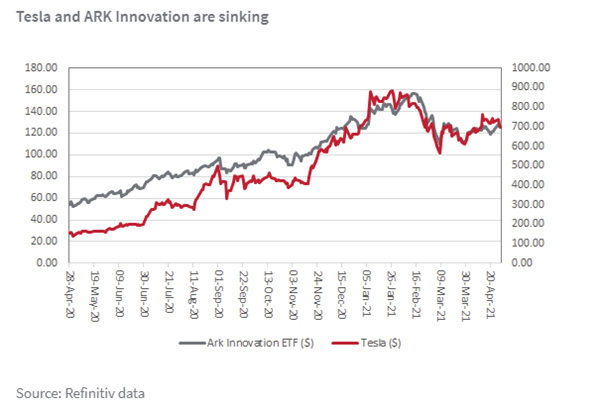
Advisers and clients are unlikely to have the time for, or interest in, the intricacies of stock-specific issues, but there can surely be no better proxy for the current bull market than Tesla. Yet even Elon Musk’s charge is, well, losing a bit of its power to impress and that is weighing on another momentum favourite, Cathie Wood’s ARK Innovation ETF, a $22 billion actively-managed tracker which aims to deliver the performance of 58 tech and growth stocks.
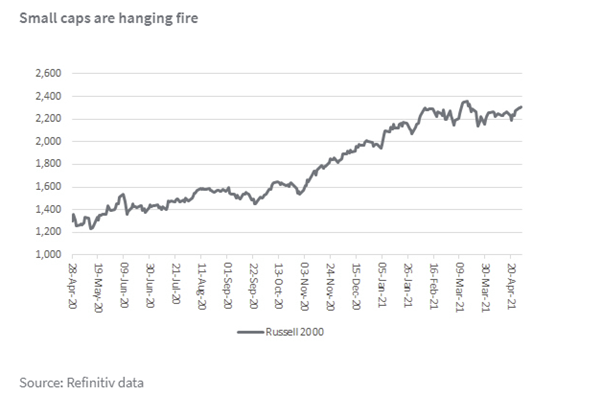
Even that classic gauge of both market sentiment and economic activity small-cap stocks are pausing for breath, although America’s Russell 2000 is yet to roll over.
All of this could be healthy. Again, nothing goes up in a straight line and some of these assets and securities were looking bubbly, at least in the eyes of some. A cooling-off may be no bad thing.
Equally, it could be just a sign that markets are moving on. Frontier and emerging equity markets still look to be showing upward momentum, a trend that would fit with the narrative of a global economic recovery and bullish investor sentiment – few areas are more peripheral than frontier arenas such as Vietnam, Morocco, Kenya and Romania.
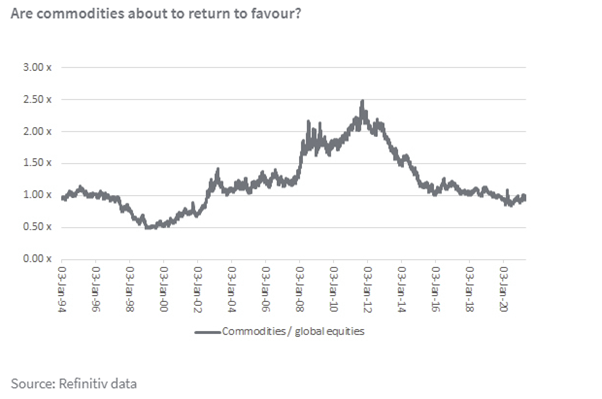
As such, we could just be seeing the next leg of the switch from defensives and growth to cyclicals and value. And if the upturn does prove inflationary, then there is a further trend to watch, one to which this column will return. This final chart shows the relative performance of commodities, as benchmarked by the Bloomberg index, against the FTSE All-World Equities index. Maybe real assets are on the verge of ending a decade’s worth of underperformance relative to paper assets, or at least paper claims on them?
Please continue to utilise these blogs and expert insights to keep your own holistic view of the market up to date.
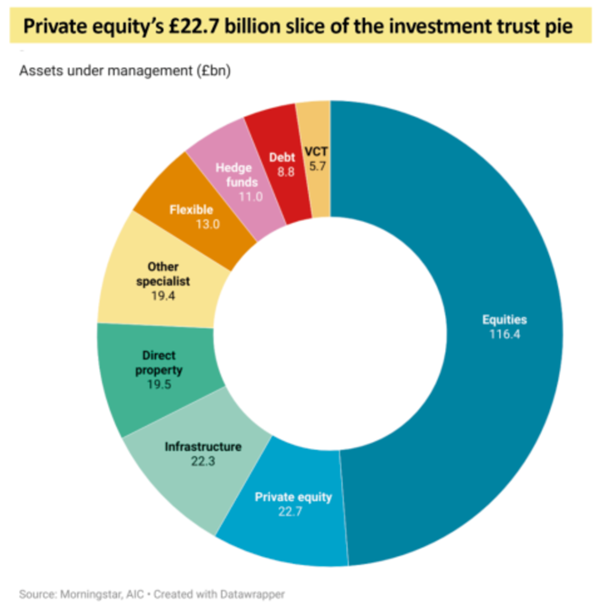
Please see below an article published by A.J. Bell yesterday (06/05) and details their views on how to gain access to unquoted companies with the potential for significant growth using Investment Trusts:
The above is a really good article and gives you an idea of how you may be able to gain exposure to unquoted companies within certain investment vehicles.
Notes on Investment Trusts:
Investment Trusts are higher risk in nature, they have the ability to gear (borrow) to leverage their position, this can be high risk
Your capital is at risk and will go down as well up in line with the underlying portfolio holdings
Investment Trusts should be held for a minimum period of 5 years or more
You can buy Investment Trusts at a premium or discount
It is also important to note that the shares and Investment Trust vehicles mentioned in this article are not recommendations and you seek Independent Financial Advice before investing.
Please continue to check our Blog content for advice and planning issues and the latest investment, markets and economic updates from leading investment houses.
Please see below this week’s Markets in a Minute update from Brewin Dolphin – received late yesterday afternoon – 05/05/2021
Stocks mixed as Fed points to ‘froth’ in equity markets
Stock markets were mixed last week as investors weighed largely positive first-quarter earnings reports against the Federal Reserve’s latest policy meeting.
US stock markets touched record highs but ended the week mostly lower, after Fed chair Jerome Powell referred to ‘froth’ in equity markets, sparking fears that economic growth would prompt a rise in interest rates. The Dow and the Nasdaq fell by 0.5% and 0.4%, respectively, while the S&P 500 was flat. Technology and healthcare stocks were weak, whereas energy stocks were boosted by an increase in oil prices.
The pan-European STOXX 500 slipped 0.4% as investors took profits and data showed the eurozone economy shrank by 0.6% in the first quarter, thereby sliding into a ‘double-dip’ recession. The UK’s FTSE 100 managed a 0.5% gain, buoyed by encouraging housing and retail sales figures.
In Asia, Japan’s Nikkei fell by 0.7% following weaker-than-expected earnings reports, and China’s Shanghai Composite declined 0.8% amid disappointing economic data and a regulatory crackdown on technology firms.
Last week’s market performance*
FTSE 100: +0.45%
S&P 500: +0.02%
Dow: -0.50%
Nasdaq: -0.39%
Dax: 0.94%
Hang Seng: -1.22%
Shanghai Composite: -0.79%
Nikkei: -0.72%
*Data from close on Friday 23 April to close of business on Friday 30 April.
Stocks tumble on interest rate fears
Fears about rising interest rates continued into Monday, sending shares in both the US and Europe tumbling. US treasury secretary Janet Yellen told The Atlantic that a ‘modest’ increase in interest rates might be needed to make sure the economy doesn’t overheat.
Market jitters were exacerbated by a shortage of computer chips, which weighed on stocks such as Volkswagen, Siemens, Microsoft, Amazon, Facebook and Alphabet.
At the end of trading on Monday, the tech-heavy Nasdaq Composite was down by 1.9%, and Germany’s Dax recorded its biggest fall of 2021 so far, slipping by 2.5%. The FTSE 100, which had started the day in the green following strong manufacturing and mortgage borrowing data, finished the session down 0.7%.
The FTSE 100 opened 0.6% higher on Tuesday, with mining companies boosted by rising commodity prices. BHP, Glencore and Rio Tinto were all up by nearly two percentage points.
US economy continues to rebound
Last week’s economic data suggests the US economy is continuing to rebound from the Covid-19 crisis. Gross domestic product (GDP) rose by 6.4% on an annualised basis in the first quarter – above the 6.1% growth forecast by economists and the quickest first-quarter growth since 1984.
US household income surged by 21.1% in March, boosted by the latest round of stimulus cheques. Meanwhile, weekly jobless claims fell to 553,000, the lowest level since the start of the pandemic, and The Conference Board’s index of US consumer confidence in April hit its highest level since February 2020.
Despite the economic rebound, the Federal Reserve voted to keep interest rates at near zero and maintain the pace of asset purchases. However, Fed chair Jerome Powell admitted in a press conference that some parts of the market “are a bit frothy, and that’s a fact.”
He added: “I won’t say it has nothing to do with monetary policy, but also it has a tremendous amount to do with vaccination, and reopening of the economy, that’s really what has been moving markets a lot in the last few months.”
UK housing market is booming
The latest research from Nationwide reveals the UK housing market boom is continuing, with the average house price in April 7.1% higher than a year ago at £238,831. On a monthly basis, prices rose by 2.1%, marking the biggest increase since February 2004. If prices are flat over the next two months, annual growth is expected to reach double digits in June.
Robert Gardner, Nationwide’s chief economist, said housing market activity is likely to remain buoyant over the next six months, thanks to the stamp duty holiday and additional support for the labour market. However, if unemployment rises sharply towards the end of the year, as most analysts expect, “there is scope for activity to slow, perhaps sharply”, Gardner added.
Elsewhere, Britain’s biggest retailers recorded the sharpest growth in sales since 2018, according to a CBI survey for the period 26 March to 15 April. For the first time in 2021, sales volumes were viewed as good for the time of year, with consumer confidence boosted by lockdown easing in England and Wales, and progress with the vaccination roll out.
Eurozone in double-dip recession
The eurozone’s economy shrank by 0.6% in the January to March period amid a renewed surge in Covid-19 infections and corresponding lockdown restrictions. This followed a 0.7% contraction in the last three months of 2020, plunging the eurozone into a technical recession.
Germany was Europe’s worst hit major economy, logging a 1.7% contraction, although this was largely owing to one-off factors such as the end of a temporary VAT cut and poor weather. France beat expectations with growth of 0.4%, helped by strong growth in construction and a slight rebound in household consumption.
The European Monetary Union’s economic sentiment indicator soared to 110.3 in April from 100.9 in March, with confidence improving in all the surveyed business sectors and among consumers, suggesting there is hope for the months ahead.
China cracks down on tech firms
Stocks in China suffered last week as the government’s crackdown on technology firms continued. Some 13 firms, including Tencent and TikTok developer ByteDance, have been ordered to adhere to tighter regulations in their financial divisions.
The People’s Bank of China said that while internet platforms are broadening access to financial services, some are running without licences and there are ‘serious rule violations’ which are damaging consumers’ interests. Firms have been told to set up financial holding companies and draft ‘business rectification’ plans to comply with regulations.
Weekly updates like this from Brewin Dolphin help us keep up to date with what is happening in the markets.
Please continue to check back for our regular blog posts and updates.
Please see the below article from Legal & General received yesterday afternoon:
Frothy markets
Froth. Nice on coffee, less nice on financial markets. While one variety can leave an embarrassing yet somewhat endearing moustache if not tackled properly, the other is a sign of late-cycle dynamics that can leave investors looking far more foolish if ignored. With stories of a New Jersey deli with $35,000 in sales over the past two years combined being valued at $100 million on the stock market and a cryptocurrency started as a joke being valued at $50 billion – Dogecoin is now the fifth-largest cryptocurrency by value – one might be forgiven for thinking that things have gone a bit too far.
Peak SPAC
One area of the market on our ‘froth watch’ has been special purpose acquisition companies, or SPACs for short. SPACs are listed companies with no commercial operations that exist to raise funds to acquire private companies, thereby making those companies public without the traditional IPO route. While by no means a new vehicle, a record 277 SPAC new issues were completed in the first quarter of 2021, with the SPAC index outperforming the S&P 500 by over 50% between July 2020 and February 2021.
Since then, SPACs’ fortunes have reversed, giving back much of that outperformance and there being only six new issues in the second quarter so far. Initially, a slowdown in retail flows was blamed. But the main factor has been a number of statements by the SEC that have created uncertainty around SPACs’ accounting treatment.
SPAC activity may well return, but SEC scrutiny and regulatory risk will remain and should serve to dampen future activity. Either way, the money raised by SPACs over the past few years is still out there looking for acquisition targets. So while one patch of froth has been blown away, temporarily at least, no doubt others are brewing, waiting to leave a stain on investors’ lips.
Take a breakeven
The gradual rise in inflation expectations (as measured by US 5y5y inflation swaps) over the past year has been a tide that has lifted most boats, not least nominal interest rates.
For inflation expectations to continue to rise, at some point there needs to be a sustained rise in realised core inflation. A near-term jump in core inflation is almost certain due to base effects from last year’s lockdowns and some additional normalisation as economies reopen. There are also other knock-on effects – such as supply-chain disruption and lean inventories – that could lead to an overshoot.
From the summer onwards, the picture is less clear. The risk for growth assets is that expectations become detached from reality, and the Federal Reserve (Fed) at some point has to step in to maintain its own credibility.
We believe the time has come for us to start leaning against the momentum in inflation expectations, and as such we have entered a short US inflation position. This is not to say that we think we are timing the peak; as discussed above, we expect a pick-up in US inflation and labour-market data from here. But we also expect the Fed to cap inflation expectations in the not-too-distant future, and are waiting patiently for the central bank to reveal its hand. We’d rather be too early than too late given that the recovery in inflation expectations has gone hand in hand with rallying credit and equity markets.
Data Minecraft
A new joiner in our team, who has a background in data science, recently voiced some confusion having heard from several team members about the need to ‘avoid data mining’. From a data scientist’s perspective, the confusion is warranted: data mining is a key component of machine learning, and refers to extracting information from patterns in large datasets. Why, then, does the term have a negative connotation when used in our team?
In an investment context, data mining means ‘finding relationships in historical data that appear causal, and building a model that assumes a continuation of that causation, where in reality that relationship was coincidental and unlikely to persist’. It is relatively easy to over-parameterise a model and to endlessly tweak it to get the best possible backtest; it is almost certain that such a model will underperform in the future when those specific circumstances do not repeat themselves.
The distinction we make between Alternative Risk Premia (ARP) strategies and the much broader universe of quantitative strategies is that for ARPs there must be either a behavioural or structural rationale as to why the strategy should work in the future, rather than being just a combination of signals that happen to have worked well together in the past and might work in the future. There are all sorts of reasons why that might not play out (e.g. crowding of the strategy, or a regime change that causes a structural shift and a breakdown of some prior imbalance), but where possible we try to rule out data mining as the cause of future failure by intentionally keeping the testing/design process as simple as possible.
For many applications of machine learning this is not an issue; data mining is appropriate where the output, rather than the model process, is the only thing that matters (e.g. improved cancer diagnosis) and the inputs are relatively stationary and unlikely to see a structural break (e.g. a large sample of humans). Financial time-series data are rarely as well behaved, and so we have to be extremely careful about how we make inferences.
Please continue to check back for our regular updates and blog posts.
Please see article below from J.P. Morgan received early this morning – 04/05/2021
It’s getting hot in here: Growth and inflation are heating up
The great unlock is underway and economic activity is surging back in major developed economies. Successful vaccine rollouts have paved the way to what looks like a sustainable reopening for the UK and US economies. In continental Europe, the vaccine rollout has proved more challenging, but vaccinations are now accelerating and Covid-19 cases are falling. This sets the scene for a stellar second half of the year for global growth, with two key sources of fuel: excess household savings and US fiscal stimulus.
Excess savings accumulated during the pandemic are vast. While the hardship that the pandemic has brought to many should not be understated, the swift and forceful action of policymakers to support businesses and consumers has successfully limited the damage to household incomes. With restrictions limiting households’ ability to spend, monthly savings soared to levels far above those observed in a “normal” recession. Totting up the excess household savings for 2020 – the amount saved last year above what consumers normally put away – the numbers are extraordinary (Exhibit 1).
Exhibit 1: 2020 excess household savings
% of nominal GDP
Source: BEA, Bloomberg, Eurostat, ONS, Refinitiv Datastream, J.P. Morgan Asset Management. Excess household savings are defined as the aggregate amount that the consumer saved in 2020, in excess of typical annual savings for a given economy. Data as of 30 April 2021.
On top of the excess savings accumulated in 2020, US consumers also benefit from the recently announced USD 1.9 trillion stimulus package, which is extraordinary in four ways. First, its size: it is worth about 9% of US GDP. Second, its speed. About 5% of GDP will be doled out before the end of September. Third, its timing. The stimulus is being delivered when the economy is recovering, rather than contracting. And finally, its nature. USD 400 billion of the stimulus is in the form of cheques in the post. For example, a family of five with a total income of under USD 150,000 will receive a combined USD 7,000 in stimulus cheques. The package will boost household incomes enormously in the first half of this year (Exhibit 2).
Exhibit 2: Selected US government benefits
% of nominal GDP
Source: BEA, Congressional Budget Office, Joint Committee on Taxation, Refinitiv Datastream, J.P. Morgan Asset Management. JPMAM forecast from Q1 2021 onwards. Data as of 31 March 2021.
Roaring growth and the risks
Disagreement among forecasters about whether these pots of excess household savings will be spent is leading to significant dispersion in forecasts (Exhibit 3).
Exhibit 3a: US real GDP quarterly growth forecasts
% change quarter on quarter (annualised)
Exhibit 3b: US headline CPI forecasts
% change year on year, quarterly average
Source: Bloomberg. J.P. Morgan Asset Management. CPI is consumer price index. Data as of 30 April 2021.
The unique nature of this crisis and the policy support that followed means that history provides little precedent. Some argue savings won’t be spent because they are concentrated in higher income groups, where the marginal propensity to spend is less. But this is a highly unusual situation in which consumers have been forced to save rather than choosing to save, so normal propensities to consume may not hold. We suspect the outcome will be towards the top end of estimates.
Is this a US or a global story? The US will almost certainly see more spectacular growth than its developed world peers this year. However, we expect it to be a global story by the end of the year. Not only are other regions reopening with considerable pent-up domestic savings, but some of the US fiscal stimulus will boost growth elsewhere.
As the saying goes, when the US sneezes the rest of the world catches a cold. But it is also true that when the US has a party the rest of the world gets an invite, so we expect this US spending to help fuel growth in regions where stimulus has not been so generous. European and Asian economies are both major beneficiaries of a pickup in US growth, accounting for over a fifth and over a third of total US goods imports, respectively.
Investment implications
How will markets react to roaring growth? It depends whether the bounce back is even more spectacular than the market already expects.
Consensus expects S&P 500 earnings to grow nearly 30% this year, and a further 14% next year. The fact that the S&P 500 sits on a forward price-to-earnings ratio of 22 may suggest that investors are more optimistic about the prospect for earnings than the analysts who provide estimates of forward earnings. Should 12-month forward earnings continue to rise as we expect, the market could climb higher. Declining valuations would moderate some of that upside, leading us to expect a more gradual pace of gains than we have seen so far this year.
The bond market is potentially more vulnerable to repricing, particularly if the bounce back is in inflation as much as growth.
The Federal Reserve (Fed) has already said it will tolerate what it expects will be “transient” inflation, but indications of a more persistent pickup would test its resolve. Under its new average inflation targeting scheme, the Fed has said it will not raise rates until three conditions are met: inflation has risen to 2%; is on track to moderately exceed 2% for some time; and the labour market has reached maximum employment. While the first condition is clearly objective, the other two contain a good deal of ambiguity.
Rising yields may generate broader asset market volatility and can also drive the equity market leadership. Periods of rising yields tend to occur when cyclical sectors outperform the broader index, while the more defensive sectors are prone to struggle. In particular, rising yields help financials that benefit from increased economic activity and improving net interest margins (Exhibit 4). However, areas of the market that have benefited most from low bond yields may struggle.
Exhibit 4: Correlation of S&P 500 sectors to us 10-year Treasury yield
10y correlation of sector rel. performance with US 10y Treasury yield
Source: Refinitiv Datastream, Standard & Poor’s, J.P. Morgan Asset Management. Correlation is calculated between the six-month change in US 10-year Treasury yield, and the six-month relative performance of each sector to the S&P 500. Past performance is not a reliable indicator of current and future results. Data as of 31 March 2021.
In summary, we believe the stage is set for a spectacular growth recovery in the second half of the year. This might suggest some caution about duration in fixed income. Within equity markets, we would expect to see an ongoing rotation towards cyclical sectors and value stocks.
A good input from J.P. Morgan, these regular market updates help us stay informed as to what is happening within the markets.
Please continue to check back for our latest blog posts and market updates.