Team No Comments

Artemis: Our view on regulatory changes in China

Please see below for one of Artemis’ latest articles received by us this morning 12/08/2021:

Regulatory changes in China continue to cause uncertainty. Raheel Altaf, co-manager of Artemis’ global emerging markets strategy, explains how the investment process has helped to provide downside protection. He shares his outlook and sets out why he believes exceptional value can still be found.

Over the past 12 months there have been a series of regulatory changes in China covering a range of industries.

Why is China doing this?

The main reason for this lies in the government’s determination to develop China into a modern socialist economy. The objectives of common prosperity, green development and independence in key technologies and industries are at the heart of their long-term agenda and are designed to achieve the nation’s rejuvenation by the middle of this century. The developments have mainly taken place in ‘new economy’ sectors, such as internet platforms and e-commerce. These have grown rapidly, in part because of lax regulations. The situation is changing now. The catch-up in regulation aims to address loopholes to ensure fair competition and sustainable growth.

Effects felt across multiple industries

These developments have led to sharp falls in share prices of former strong performers. For example, in February, anti-monopolistic laws targeting internet platforms were announced. This put pressure on some of China’s ‘mega-cap’ internet stocks, in particular Tencent and Alibaba. In July, China ordered education firms to go non-profit and banned foreign ownership. Shares of education stocks such as Tal Education and New Oriental Education fell around 70% as a result. More recently there have been reports that regulation on gaming may be increased, leading to jitters in that sector.

Our approach

We have been concerned for several years that the risks in popular (and often unprofitable) new economy stocks in China were not well reflected in their share prices, which had reached excessive levels. So we have avoided investing in these companies, which has at times been costly for our fund’s performance.

Is now the time to buy them?

We would argue that valuations have certainly moderated but fundamentals are deteriorating. Our proprietary screening tool SmartGARP has been indicating to us that the growth in ‘value per share’ (a combination of earnings, cash flows, dividends, operating profits and net assets) in these companies has been slowing. This is the result of new regulations, but also other competitive pressures. These risks can derail high-growth stocks at the end of their cycle. Share prices have corrected, but with the fundamental outlook heading downwards these stocks appear expensive and have the potential for further weakness.

Analysts continue to downgrade their profit forecasts in these mega-cap Chinese internet companies. With many Asian companies expected to report their Q2 earnings in August, we remain watchful for how the current environment has affected companies’ profits.

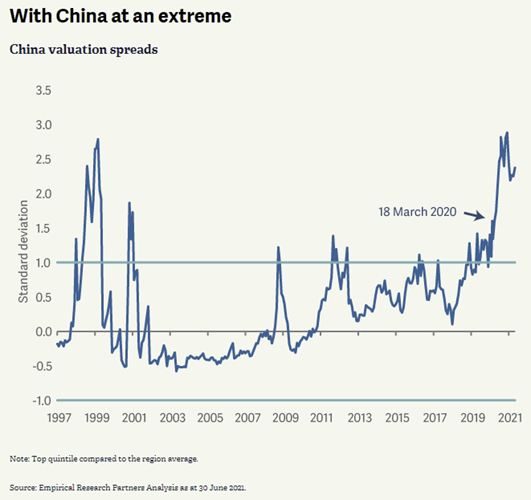
We have been commenting for some time on the stretched dispersion in valuations between low and high value stocks. The last six months have seen this start to reverse in many global markets.

In China, the valuation spreads reached extreme levels and the reversal only started at the end of January. There is therefore some way to go to catch up. Should China follow the same path as others, we expect a number of our holdings to see significant benefits.
Outlook

While continuing to avoid the mega cap internet stocks, we are still seeing attractive value in other less popular areas of the market, where the risk reward is highly favourable. Chinese banks (an overweight), as an example, have been a relatively safe haven recently. We expect markets to remain volatile, but remain confident that the favourable value per share of our holdings relative to the market is likely to be rewarded over time with better fund performance.

The fund’s value bias remains substantial. The Price/Book ratio of the fund is 0.8 and it offers a forward P/E of 6.3 vs 12.7 for the index (50% discount). The opportunity, in our eyes, remains an exceptional one.

Please continue to utilise these blogs and expert insights to keep your own holistic view of the market up to date.

Keep safe and well

Paul Green DipFA

12/08/2021
Team No Comments

Brewin Dolphin – Markets in a Minute

Please see below this week’s Markets in a Minute update from Brewin Dolphin – received late yesterday afternoon – 10/08/2021

Stocks rise on encouraging labour market data

Global stock markets rose last week on the back of promising US labour market data and strong corporate earnings reports.

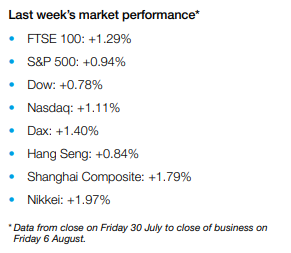
After a shaky start, US indices finished the week at new record highs following a better-than-expected July jobs report. The S&P 500 rose 0.9%, with an increase in longer-term interest rates boosting financial shares. The Dow added 0.8% while the technology-heavy Nasdaq climbed 1.1%.

The upbeat mood fed through to Europe, where the STOXX 600 surged 1.8% and Germany’s Dax added 1.4%. The UK’s FTSE 100 gained 1.3% after the Bank of England increased its 2022 gross domestic product (GDP) growth forecast from 5.75% to 6.0%.

Strong earnings reports boosted Japan’s Nikkei 225, which rose almost 2.0% despite the International Monetary Fund downgrading its 2021 GDP growth forecast for Japan from 3.3% to 2.8% amid the country’s tighter coronavirus restrictions.

China’s Shanghai Composite bounced back from last week’s rout to end the week up 1.8%.

Equities mixed as oil prices tumble

Equities were mixed on Monday as oil prices slid amid concerns that rising Covid-19 cases could result in a slowdown in demand for fuel.

The FTSE 100 edged up 0.1% whereas Germany’s Dax slipped 0.1% after data showed that while German exports rose by 1.3% in June from the previous month, imports fell by 0.6%. Miners underperformed after figures showed China’s export growth unexpectedly slowed in July, which weighed on commodity prices.

In the US, the Dow and the S&P 500 slipped 0.3% and 0.1%, respectively, as last week’s strong payrolls figures led to further speculation about when the Federal Reserve might begin tapering its support for the economy. The lacklustre performance on Wall Street resulted in a muted start for the FTSE 100 at Tuesday’s market open, with the blue-chip index flat at 7,133.8.

US payrolls report beats forecasts

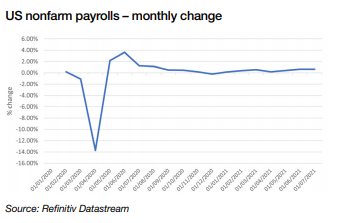
Last week’s economic headlines focused on the latest US jobs report, which revealed nonfarm payrolls increased by 943,000 in July from the previous month, better than the 845,000 new jobs expected by economists in a Dow Jones poll. The leisure and hospitality sector led job creation, adding 380,000 positions in July.

The figures from the Labor Department also showed the rate of unemployment declined from 5.9% in June to 5.4% in July. Economists surveyed by Dow Jones had forecast an unemployment rate of 5.7%. The unemployment rate has tumbled from a pandemic high of 14.8% but remains well above the 3.5% rate seen before the crisis hit.

The employment report led to a rise in longer-term Treasury yields, which had already been boosted earlier in the week by hawkish comments from Federal Reserve vice chair Richard Clarida, who suggested interest rate hikes could start in 2023.

US manufacturing growth cools

On a less positive note, data from the Institute for Supply Management (ISM) showed US manufacturing activity grew at a slower pace in July, thanks to a continuing shortage of raw materials. The index of national factory activity fell to 59.5, the lowest reading since January and down from 60.6 in June. Economists polled by Reuters had forecast the index would be little changed at 60.9.

Meanwhile, the measure of prices paid by manufacturers fell to 85.7 from a record 92.1 in June as commodity prices eased. This was the largest fall since March 2020.

BoE lifts GDP and inflation forecasts

Here in the UK, the Bank of England lifted its 2022 GDP growth forecast to 6.0% from 5.75%. The Bank said GDP is expected to grow by 3.0% in the third quarter of this year, which is weaker than its May forecast because of the recent surge in Covid-19 cases and the number of workers isolating.

The Bank also increased its inflation forecasts following two consecutive months of higher-than-expected readings. It now expects inflation to temporarily reach 4.0% in the fourth quarter of 2021 and the first quarter of 2022 because of higher energy and goods prices. These increases are expected to moderate in the medium term “as commodity prices stabilise, supply shortages ease and global demand rebalances”, the Bank said.

The base interest rate is anticipated to reach 0.5% in the third quarter of 2024, after hitting 0.2% in the third quarter of 2022 and 0.4% in the same period in 2023. Members of the monetary policy committee agreed to start tapering their support for the economy once the base rate has risen to 0.5%.

Japan’s service sector shrinks further

Over in Japan, a key measure of services sector activity contracted for the 18th consecutive month in July as the country introduced further restrictions to try to combat the resurgence in Covid-19 infections. The final au Jibun Bank Japan services PMI fell to a seasonally adjusted 47.4 in July from 48.0 the previous month. A reading below 50.0 signals contraction.

Household spending in Japan also fell in June by 5.1% from the previous year as the state of emergency reduced domestic demand and cuts to summer bonuses hit consumption. Economists had expected spending to rise by 0.1% from a year ago.

Please continue to check back for our latest blog posts and updates.

Charlotte Ennis

11/08/2021

Team No Comments

Weekly Market Commentary – All eyes on US inflation data

Please see below article received from Brooks Macdonald yesterday afternoon, which analyses the markets’ reaction to an increase in US employment figures and the prediction that inflation levels will begin to fall.

US Treasury yields reacted to the latest US jobs report showing a pickup in employment

The US jobs report caused some volatility in markets on Friday. However, equity markets still hit all-time highs last week. With the employment report released, all eyes this week will be on the US Consumer Price Index (CPI) number which, despite higher numbers being shrugged off in recent months, remains a critical test for the equity narrative.

The US jobs report, which was released on Friday, beat market expectations, showing that 943,000 new jobs had been created in July versus expectations of 870,0001. Last month’s reading was also revised up, meaning that the overall unemployment rate fell from 5.9% to 5.4%2. Given the recent focus of US Federal Reserve (Fed) Chair Powell on the employment numbers, and specifically the breadth of the jobs recovery, the report had a significant impact on the US Treasury market. After comments from Fed Vice Chair Richard Clarida last week, the US 10-year Treasury had already risen significantly from its Wednesday levels and currently trades just shy of 1.3%3. Earlier in the year, there was concern that labour supply issues were holding back the recovery. However, with the headline unemployment rate falling significantly over the month and demand for workers clearly evident, it was cyclical equities which rallied hardest in the aftermath of the report.

All eyes this week will be on Wednesday’s US inflation number which is expected to start to fall

The two biggest hurdles for equities at the moment are arguably the jobs report and the US inflation release. The US CPI figures come out on Wednesday, with the economist consensus pointing to a fall in the headline year-on-year rate from 5.4% to 5.3%. The core inflation figure (excluding food and energy) is expected to fall slightly more, to 4.3% versus 4.5% last month. The recent beats have been driven, in large part, by the blockbuster gains in used cars and trucks and ‘lodging away from home’. There are some signs that the pressure within used cars is starting to fade but this may take several months to feed through to the CPI figures. Should the semiconductor shortage continue to ease, this will affect this sub-component as well as many others, albeit to a lesser degree.

Close attention will be paid to the used car inflation index which has been a key driver of the recent data

The US CPI number will be another test of US Treasury yields after a week of significant moves. Economists are expecting the inflationary impulse to start to flatten so any sign of significant continued momentum could lead to a questioning of the transitory inflation narrative and cause equities to stir from their summer slumber.

Please check in again with us soon for further news and relevant content.

Stay safe.

Chloe

10/08/2021

Team No Comments

People with financial advice four times more likely to have high financial wellbeing

Please see the article below cut and pasted from MoneyAge last week covering research by Aegon.

People with a financial adviser are four times more likely than those without one to have high levels of financial wellbeing, a new study from Aegon has found.

The pension provider said that people discuss with their advisers what makes them happy and gives them purpose to identify meaningful financial goals.

Aegon’s Financial Wellbeing Index, based on a representative survey of 10,000 people across a range of sectors, company sizes and job roles, revealed that just 10% of people who have never had any financial advice are fortunate to combine healthy finances and “a positive money mindset”, compared to 44% of those who have an ongoing relationship with a financial adviser, and 23% who have occasionally used a financial adviser.

The research also highlighted that the average advised client reported nearly three times as much in pension savings at £246,000, compared to £95,000 for non-advised people. This pattern was repeated across a range of other finances, with advised clients reporting total non-pension savings of £65,000 versus £32,000, and lower unsecured debt at £3,700 versus £6,400.

“Financial advice can make a significant difference to your future financial wellbeing,” said Aegon pensions director, Steven Cameron.

“Advisers have always been very focused on making sure they can boost their clients’ wealth. But the boost to mindset, while less well recognised, can be just as important to financial wellbeing. There is a growing awareness of the benefits of incorporating financial wellbeing into financial advice processes among financial advisers and planners.”

Aegon also stated that many advisers now try to establish what motivates their clients in order to build financial plans that enable them to achieve meaningful goals in life. The research found that 79% of those with an adviser say they have a clear sense of what gives them joy or purpose, which can significantly influence how people prioritise their finances, compared to 68% without.

Cameron added: “It’s important for all of us to think about our relationship with money, our vision of our future self and most importantly what makes us happy in life. Discussing this with an adviser can make sure you are managing your finances not just to have ‘more money’ but to allow you to give your future self the happiness, joy and purpose you want in retirement.”

People and Business IFA comment

The role of the IFA today is multifaceted, helping you to grow your assets tax efficiently, manage risk, define your objectives and help you achieve your objectives tax efficiently on a holistic basis.

We achieve this by engaging fully with our clients, communicating the issues, educating our clients about markets, products and their options, and gradually nudging them in the right direction.

This is done by keeping a close eye on markets, tax and regulatory changes alongside product innovation and fund launches.  It’s a full time and fully engaging role to be a modern IFA.  It’s also rewarding when we help our clients achieve their objectives whether it’s early retirement, inheritance tax efficiency, or protecting their family and business – their staff and key people too.

It’s no surprise to me that advised clients are in a better place over the long term, this is logical.  I might have a bias as an IFA, but I really believe in what we do.

Steve Speed DipPFS

09/08/2021

Team No Comments

Will a lack of skilled and willing workers derail the UK economic recovery?

Please see the below article from AJ Bell received late yesterday afternoon:

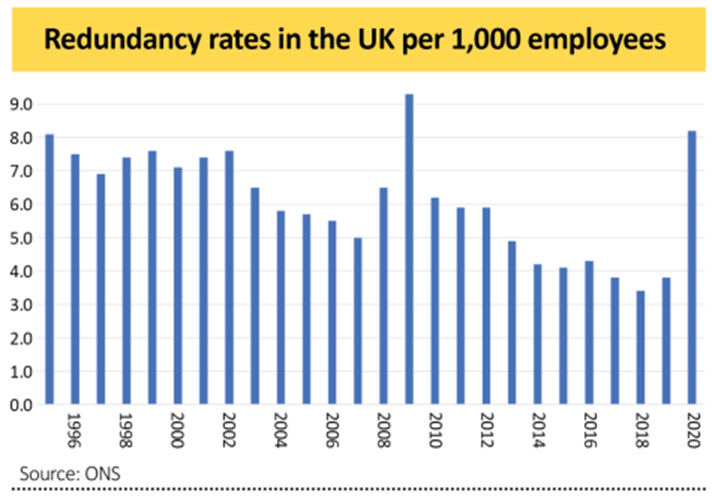
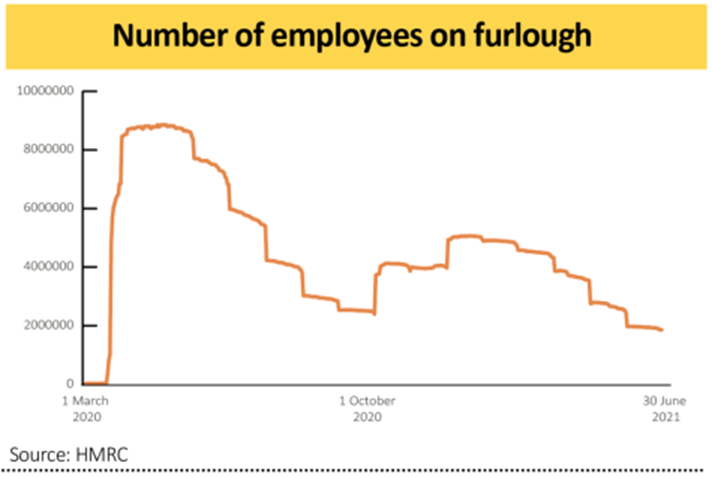
Sunday 1 August saw the last taper of the Government’s job retention scheme. For the final two months of furlough employers will have to stump up 20% of a worker’s salary as well as paying pension and national insurance contributions. We’ve been here before and the last go-around forced the hand of employers and the result was hundreds of thousands of redundancies.

This time is different. Restrictions have been removed in England and the vaccination programme is well underway with almost 90% of adults having received their first jab. This time the issue might not be too few jobs but too few workers, at least in the right geographical locations.

The latest data from the Recruitment and Employment Confederation shows the jobs market is stronger now than it was before lockdowns ravaged the economy. It tracks new jobs posted and found that in the week to 18 July there were 194,000 new advertisements compared with 179,000 in the first week of March last year. Cities, long silenced, are dusting themselves off, flipping the closed sign to open and discovering that finding staff is a struggle.

Strip out the temporary ‘pingdemic’ that’s disrupted businesses and decimated production lines and consider how Covid has upended the labour market. With shops and restaurants closed workers were either furloughed or sought employment in other sectors like manufacturing.

Some people moved either because they could no longer afford to pay the bills, or to take advantage of not having to go into the office, making it a pandemic perk.

THE FIGURES SPEAK FOR THEMSELVES

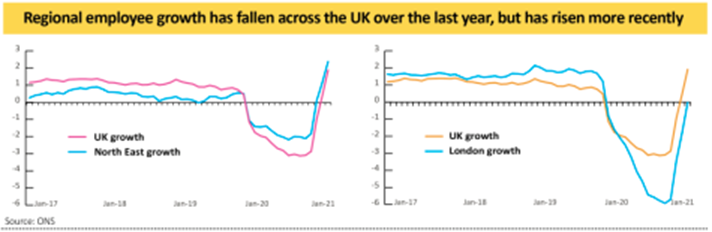
The latest PAYE figures illustrate the shift. Despite more than 200,000 fewer people being on payrolls in June than pre-pandemic, some parts of the UK actually have more workers than they did before the first lockdown.

Of those new job adverts analysed by the REC the lion’s share of demand comes from London boroughs. The bright lights of the city that used to more than make up for the lack of space have dimmed and wide open green spaces have become a precious bargaining chip.

Investors need to pay close attention to how different sectors and businesses deal with the labour conundrum. Areas to watch include construction companies as they cannot afford to deal with a skills shortage when demand is so strong. Hospitality chains will need to find ways to avoid cutting back on their service hours. Can they search out blossoming suburban high streets where staffing might be less constrained? City stalwarts may have to permanently embrace hybrid working as a hiring incentive which could be considered more lucrative to some employees than a hike in wages.

Tesco is so desperate for lorry drivers that it is offering a £1,000 joining bonus to lure people in. The Road Haulage Association (RHA) has estimated there is a 100,000 shortage in HGV drivers across the UK.

FINANCIAL IMPLICATIONS

A tight labour market usually means wage rises and that has an impact on employer pension contributions and by extension Government coffers. There’s also the prospect that the spectre of stagflation could push the Bank of England to raise rates sooner rather than later, a major issue for firms carrying boat loads of Covid-related debt.

But recovery has slowed and the current hiring boom could fizzle out under autumn’s grey skies. Sectors like travel and events carry deep scars and the summer salve won’t be potent enough to overcome months of hardship. The latest figures from HMRC showed workers were still being added to furlough numbers in May as it became clear the season’s earnings potential would be curtailed.

It is important to consider how many of the circa 1.9 million workers still being supported by the scheme in June are in ‘zombie’ posts? How many will fall on the 1.57 million active vacancies currently available? That’s the calculation that every staff hungry company will be watching.

CONCERNS OVER JOB SECURITY

One must question if Covid restrictions are really gone for good. Anecdotally we’re told that a lack of confidence is preventing people from returning to sectors like hospitality because it still feels precarious.

Staff shortages weren’t part of the conversation a year ago when unemployment had been predicted to peak at 10% but then the whole pandemic has thrown our lives and our economies on their heads.

The hiring boom might be viewed as a good thing but if jobs remain unfilled and businesses can’t capitalise on what little reopening bounce remains then it could be just as costly as long lines at the job centre.

Please continue to check back for our regular blog posts and updates.

Andrew Lloyd DipPFS

06/08/2021

Team No Comments

Brewin Dolphin Markets in a Minute: Markets mixed as US GDP growth disappoints

Please see below for Brewin Dolphin’s latest ‘Markets in a Minute’ article, received by us yesterday evening 03/08/2021:

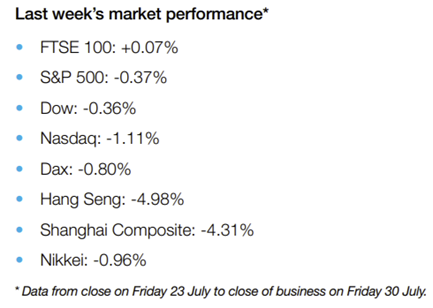
Global equities were mixed last week as weaker-thanexpected US economic data offset strong corporate earnings reports.

In the US, the S&P 500 and the Nasdaq slipped 0.4% and 1.1%, respectively, after gross domestic product (GDP) growth and durable goods orders missed expectations. Amazon’s warning of slower growth in the months ahead weighed on the consumer discretionary sector, whereas utilities and real estate stocks outperformed.

The pan-European STOXX 600 ended the week flat amid ongoing concerns about the spread of Covid-19. The UK’s FTSE 100 was also little changed after a spike in the number of people told to self-isolate continued to disrupt production.

Over in Asia, Japan’s Nikkei 225 lost 1.0% as new Covid-19 cases reached record levels, resulting in Tokyo’s state of emergency being extended until the end of August. China’s Shanghai Composite slumped 4.3% following the country’s regulatory crackdown on the technology and education industries.

Delta woes weigh on markets

US stocks closed slightly lower on Monday as concerns about the Delta variant were compounded by softer-than expected manufacturing growth. The Institute for Supply Management’s index of national factory activity fell from 60.6 in June to 59.5 in July, the lowest reading since January and the second consecutive month of slowing growth.

Asian markets followed Wall Street lower on Tuesday, with the Nikkei 225 and Hang Seng tumbling 0.5% and 0.4%, respectively, as fears about the spread of coronavirus overshadowed strong US corporate earnings.

In contrast, the FTSE 100 and the STOXX 600 added 0.7% and 0.6%, respectively, on Monday, following news that British engineering firm Meggitt has agreed a £6.3bn takeover by US company Parker-Hannifin. Shares in Meggitt surged 56.7% from Friday’s close.

Market gains continued into Tuesday, with the FTSE 100 and the STOXX 600 up 0.4% and 0.3%, respectively, at the start of trading.

US economic data misses estimates

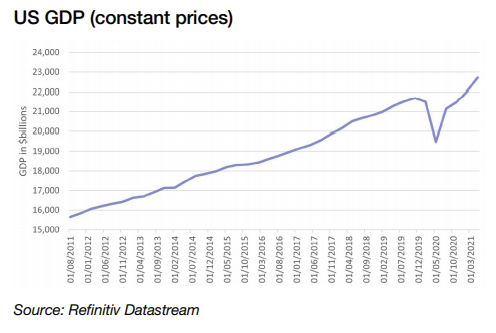
Last week’s headlines were dominated by the latest GDP figures from the US. According to preliminary data from the Commerce Department, the US economy expanded by an annualised rate of 6.5% in the second quarter. This was better than the 6.3% increase seen in the first quarter but was significantly below forecasts of 8.5% growth.

Personal consumption was the biggest driver of growth, as the stimulus cheques issued between mid-March and April fuelled an 11.8% year-on-year increase in household spending. This was partially offset by lagging property investments and inventory drawdowns.

Separate data from the US Census Bureau showed orders for cars, appliances and other durable goods in June were also weaker than expected. Orders rose by 0.8% from the previous month versus estimates of 2.2% growth, although May’s reading was revised up to 3.2% from 2.3%. It came amid continued shortages of parts and labour as well as higher material costs.

Meanwhile, the Labor Department reported that 400,000 people filed initial claims for unemployment benefits for the week ending 24 July, above the Dow Jones estimate of 380,000 and nearly double the pre-pandemic norm.

More positively, US consumer confidence was little changed in July, hovering at a 17-month high of 129.1. Economists polled by Reuters had forecast a decline to 123.9.

Inflation picks up in Europe

Over in the eurozone, inflation accelerated to 2.2% in July from 1.9% in June, according to figures from Eurostat. This was the highest rate since October 2018 and above the 2.0% reading forecast by economists. Higher inflation came amid faster-than-expected monthly GDP growth of 2.0% in the April to June period. Compared with the same period a year ago, GDP surged by 13.7%. The eurozone economy is still around 3% smaller than at the end of 2019, but the expansion marked a strong rebound from the 0.3% contraction seen in the first quarter of 2021.

Germany missed expectations with a quarterly expansion of 1.5%, as supply constraints left manufacturers short of materials such as semiconductors.

Half a million come off furlough

Here in the UK, more than half a million people came off furlough in June. The gradual reopening of the hospitality sector drove more than half the total fall in jobs supported by wage subsidies, according to data from HM Revenue & Customs.

Shortages of labour and materials and problems recruiting staff meant manufacturing output and order book growth slowed to its weakest level in four months in July. The manufacturing PMI stood at 60.4, down from 63.9 in June. IHS Markit said July’s performance was still among the best on record but would have been even better had it not been for supply constraints.

Nevertheless, the International Monetary Fund (IMF) upgraded its 2021 growth forecast for the UK to 7%, meaning that together with the US it would have the joint fastest growth of the G7 countries this year. In 2020, the UK’s economic contraction was the deepest in the group.

Please continue to utilise these blogs and expert insights to keep your own holistic view of the market up to date.

Keep safe and well

Paul Green DipFA

04/08/2021

Team No Comments

Brooks Macdonald – Weekly Market Commentary

Please see below this week’s market commentary from Brooks Macdonald received late yesterday afternoon – 02/08/2021

Weekly Market Commentary | Despite summer holidays, it’s a blockbuster week for key data releases

By Edward Park

  • There were strong gains for US and European equities in July, but Asia ex-Japan lagged due to concerns over Chinese technology regulation
  • This will be a key week for the US infrastructure bill, which lawmakers hope to pass ahead of the summer recess
  • The US employment report due on Friday will be the last before the Jackson Hole symposium

There were strong gains for US and European equities in July, but Asia ex-Japan lagged due to concerns over Chinese technology regulation

July closed out a strong month for European and US equities, while commodities continued to make gains even as the ‘reflation’ trade cooled. Asia ex-Japan equities underperformed, with Chinese indices not helped by risk aversion around tougher regulation being introduced by Beijing in strategically important sectors.

This will be a key week for the US infrastructure bill, which lawmakers hope to pass ahead of the summer recess

A series of central bank meetings are due to be held this week, as well as it being a key week for the US physical infrastructure bill which needs to gather momentum in Congress with the summer recess looming. On the infrastructure bill, US senators have now agreed the text of a bipartisan bill so, barring amendments, lawmakers are hopeful it can pass this week. 

In terms of central banks, the Bank of England’s meeting on Thursday will be the week’s highlight. While no change is expected at this meeting, it will need to address CPI inflation, which is currently above the Bank’s formal target. The Bank of England has been more hawkish than some other major central banks. Nonetheless, we expect this meeting to stick to a transitory inflation narrative with a nod to clearer guidance later in the year. The Reserve Bank of Australia is also meeting this week, and it is expected to pause its asset purchase tapering given the ongoing lockdowns in the country.

The US employment report due on Friday will be the last before the Jackson Hole symposium

In terms of data, all eyes will be on the US non-farm payroll report, which will be released on Friday. The US Federal Reserve (Fed) has clearly stated, from the start of the pandemic, that employment levels are a key metric and that space capacity in the labour market was a primary factor for ongoing support. The point often made by Jerome Powell, the Fed’s chair, is that headline employment has improved, but the experience has been very different for lower wage workers. By shifting the requirements to a more balanced jobs recovery, the Fed has caused the bond market to price in only a gradual withdrawal of support over the next 12 months. Given that the tapering discussions have begun, however, and the all-important Jackson Hole meeting is almost upon us, this will be a closely watched employment report.

Despite investors moving into peak holiday season, we have a blockbuster week of central bank policy, fiscal policy, US earnings and key data releases. We still believe the hurdle to shift markets away from their transitory inflation narrative is high, but this will be an important week to test sentiment in the quieter summer weeks.

Please continue to check back for our latest blog posts and updates.

Charlotte Ennis

03/08/2021

Team No Comments

The problem with cash – should you be investing more?

Please see below an interesting article received from Beinvest recently. Although Britain has become a nation of savers following lockdown, this article provides an insight into the disadvantages of cash savings and discusses more beneficial alternatives.

Unable to travel, socialise or do many of the other things that usually deplete their bank accounts, Britain has become a nation of savers. However, this welcome financial cushion may not be as protective as hoped if inflation takes hold.

Around £75 billion was held in ISA accounts in 2019 to 2020, an increase of £7.1 billion over 2018/2019. However, most of this rise – £4.8 billion – went into cash ISAs, while Stocks and Shares ISAs can only command a distant second place. (1.)

Cash has its role. If people have a short-term savings goal, such as a house deposit or a new car, cash is almost certainly the right place for their savings. Equally, it is always sensible to have a few months’ worth of expenses in a readily accessible cash account as a buffer against life’s various hiccups – redundancy, sickness, a leaky roof. But too much in cash for too long can be corrosive for long-term wealth, particularly today.

The impact of inflation

Rising prices will erode the real value of a saving pot. While cash may feel inherently safe – £10,000 goes in and, usually, it stays at £10,000 – if it only buys half as much, that is a real problem. This isn’t as unlikely as it sounds: a savings pot of £10,000 would be worth just £6,100 in real terms after 25 years with inflation at 2%, the current Bank of England target. If inflation rises to 3%, that drops to £4,780. At 4%, that savings pot is worth just £3,750. (2.)

This wouldn’t be a problem if savers were getting sufficient interest on their savings accounts to compensate. But the majority of savings accounts now pay less than 1%. The top-paying easy-access savings account pays just 0.5% (3.). In extreme cases, banks charge their customers to save with them. Low interest rates have, unfortunately, changed the landscape. Cash savers are often losing money in real terms and the longer they remain in cash, the more the problem compounds.

Inflation today

Inflation has been relatively benign in recent years, hovering around the Bank of England’s target rate. However, there are reasons to believe that a higher inflation environment may be imminent. There are short-term considerations: as the world emerges from the strictures of lockdown, there is pent-up spending. After a year confined to their home, people are keen to travel, socialise, shop. At the same time, production difficulties have created supply problems for certain commodities and key components such as semiconductors. This is creating shortages and pushing up consumer prices.

There are also longer-term reasons for structurally higher inflation. Governments are spending vast sums to ‘build back better’, pouring trillions into decarbonisation plans and infrastructure building. This is also creating significant demand in key areas and driving prices higher.

Equally, some of the deflationary forces that have curbed inflation over the past two decades are reversing. Deglobalisation, for example, brought cheap goods from China and lowered prices for everyone. But the fragilities exposed by the pandemic have shown the difficulties inherent in long supply chains that cross multiple borders. Global governments are now working to ‘reshore’ critical industries. This may raise the price of goods and services.

In normal circumstances, central bankers would simply put up interest rates in response to any inflationary pressure. However, the recovery is fragile and central banks, led by the Federal Reserve, have made it clear that they will look through short-term inflationary pressures until economic growth is firmly established. It is also increasingly difficult for central banks to raise rates: debt levels are higher, particularly for governments. High rates also risk real disruption to equity and bond markets, which have grown dependent on central bank liquidity. This means inflation will be allowed to ‘run hot’ for longer.

Potential solutions

Cash is not the only problem area. Other ‘safer’ assets can also struggle during periods of high inflation. Inflation is generally bad news for bonds, for example, because their income is fixed and therefore doesn’t keep up with higher prices.

Stock market investments can provide better protection against inflation, providing it doesn’t rise too quickly. 1970s-style inflation tends to be difficult for most asset classes. Companies should be able to put up prices in response to inflationary pressures, which in turn should be passed on to investors in the form of higher dividends or profit growth. Historically, savings held in a diversified portfolio of shares have kept pace with rising prices over the long term.

For savers who have managed to build up some spare cash over lock down, it is worth considering the risks of holding it in cash at a time of potentially rising inflation. The stock market can be a volatile place, but it has some natural advantages in today’s climate. A carefully blended and diversified portfolio can help protect the real value of a savings pot. Remember, investments carry risk and you can get back less than invested.

Cash has a variety of important uses; for short-term known expenditure, for unknown emergency expenditure and for emergency funds just in case you lose your income or need to ‘switch off’ investment or drawdown pension income. We recommend that you have at least one year’s expenditure in cash deposits.

Please check in again with us soon for more relevant content, analysis and news.

Stay safe.

Chloe

02/08/2021

Team No Comments

A.J. Bell – Emerging Markets: Views from the experts

Please see below a blog from A.J. Bell which was published and received yesterday (30/07/2021) and details the key areas that the Franklin Templeton Emerging Markets Equity Team are currently thinking about:

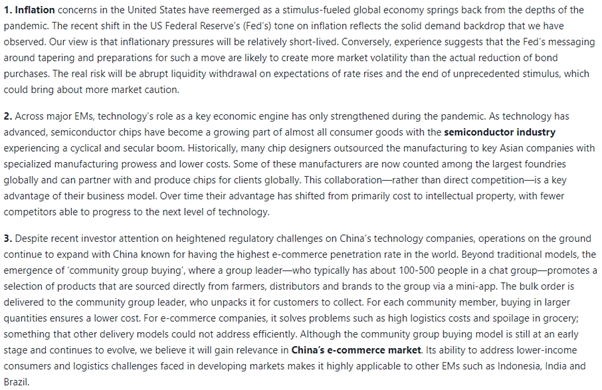
As you can see from the above, Franklin Templeton’s team believe the current inflationary pressures seen in markets are a temporary blip and should ease at some point.

Please continue to check our Blog content for advice and planning issues and the latest investment, markets and economic updates from leading investment houses.

Please keep safe and healthy.

Carl Mitchell – Dip PFS

IFA and Paraplanner

30/07/2021

Team No Comments

Brooks MacDonald Daily Investment Bulletin: 28/07/2021

Please see below for Brooks MacDonald’s Daily Investment Bulletin received by us yesterday 28/07/2021:

What has happened

Equities had a weaker session yesterday with defensive equities outperforming technology stocks in particular. Some of this weakness in technology can be attributed to the concerns that China might continue to expand regulation after their foray into educational technology earlier this week.

Chinese technology

Markets have long had a concern around technology regulation in the US where a Democrat White House could try to curb the perceived overreach of big technology. Investors had downgraded this risk due to the economic impact of the pandemic but also a belief that the US would be unlikely to do anything too aggressive in case Chinese companies gained a competitive advantage. With China ‘going first’ on technology regulation this not only increases risks around Chinese securities but removes one of the arguments as to why the US would stay quiet on technology regulation for now. Meanwhile in the US, technology earnings saw some winners and losers with Alphabet rising 3% in the after-market but Microsoft losing an equal amount after it’s cloud-services business saw less growth than expected.

Federal Reserve

Now to the week’s major event, the Federal Reserve’s latest policy statement which is due out at 7pm UK time tonight followed by Fed Chair Powell’s press conference. Policy risk is at its highest at points of transition and the Fed will need to tread a delicate path today. The tapering genie is out of the bottle and will almost certainly be a conversation topic at the meeting however the extent to which Powell majors on this will give an important steer to the market. The rising risks around the delta variant and lower global growth expectations have both contributed to a less positive market backdrop ahead of tonight’s announcement. The statement will also need to address inflation where we have seen another upside beat to price levels in the June CPI numbers but inflation expectations have been falling in the bond market. Some of this reduction in inflation expectations is due to a belief that the Fed will not be afraid of raising rates over the next two years so there is a complex interplay that Powell will need to consider.

What does Brooks Macdonald think

Due to the rising uncertainties around the pandemic and economic growth, we expect Powell to stop short of warning that tapering is imminent. This meeting may well therefore serve as a placeholder until either the Jackson Hole Economic Symposium in August or indeed the meeting in September.

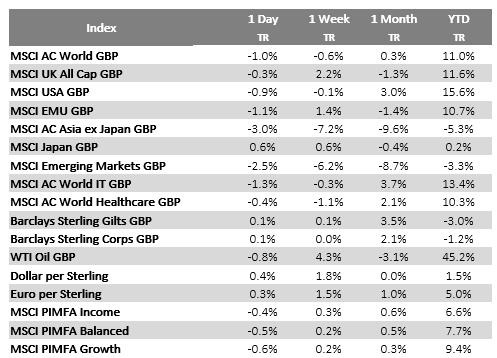
Source: Bloomberg as at 28/07/2021. TR denotes Net Total Return

Please continue to utilise these blogs and expert insights to keep your own holistic view of the market up to date.

Keep safe and well

Paul Green DipFA

29/07/2021