Team No Comments

Brewin Dolphin – Markets in a Minute

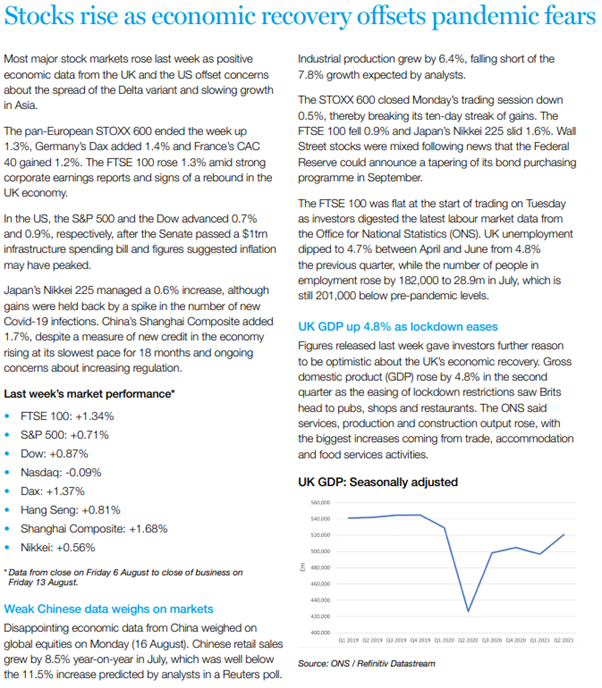
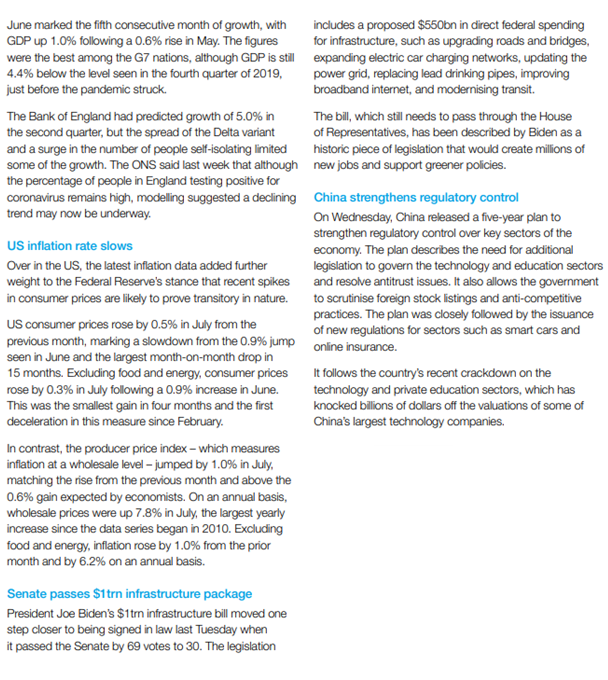
Please see below last weeks market summary from Brewin Dolphin, which was received late yesterday (24/08/2021) afternoon:

As you can see from the above, most markets suffered losses last week. China also suffered large losses last week. Some good news that can be taken from this article is that:

  • UK inflation seems to be in check which has been helped by cheaper clothing prices through summer sales on the high street
  • UK Job Vacancies hit a record high indicating a stronger UK economy, however staff shortages are starting to have an impact on the UK’s economic growth
  • On Monday and Tuesday the US and UK regained a little of last week’s losses

Please continue to check our Blog content for advice and planning issues and the latest investment, markets and economic updates from leading investment houses.

Please keep safe and healthy.

Carl Mitchell – Dip PFS

IFA and Paraplanner

25/08/2021

Team No Comments

Inching closer to the exit

Please see below article received from Legal & General yesterday afternoon, which reviews the markets’ reaction to the disorderly withdrawal of US and UK troops in Afghanistan and the ongoing global battle with coronavirus.

Last week, we received the minutes of the Federal Open Market Committee (FOMC) meeting held at the end of July. Tapering was the word of the day. A reduction in the pace of asset purchases is now overwhelmingly expected by the year’s end. When thinking about the risks to global markets posed by tapering, we believe it is worth remembering three things.

Minutes minutiae

First, never has a pending policy change been discussed so much, by so many, for so few insights. Market shocks tend not to be driven by things that are almost entirely predictable.

Second, aggressive tapering happened last year, and nobody really noticed. In the first three months of the COVID-19 crisis, from March to May 2020, the Federal Reserve (Fed) bought $1.6 trillion of Treasuries. In the subsequent 14 months, it has bought just over $1.1 trillion. The pace of asset purchases has slowed down by 85% since those early days. Since then, the S&P 500 is up over 50%, credit spreads are tighter, and real yields are lower. Anyone arguing that asset-purchase flows are the “only game in town” has a tough time explaining that.

Third, the 2013 taper tantrum was a stressful time for emerging-market investors, but a non-event for investors in US equities. The S&P 500 had a peak-to-trough drawdown of 5.5% in the middle of 2013. That’s it.

So, what could a genuine tapering surprise look like? The potential action is not in the timing but in the pace. Last time around, tapering took 10 months; formally announced in December 2013, it ran until October 2014. It was then another 14 months from the end of tapering to the first rate hike, so it was a two-year process before we reached the serious business of rate hikes.

We think the timelines can be compressed this time around, but still struggle to see the conditions for a rate hike before mid-2023. Even the most hawkish voices on the FOMC are talking about end-2022 as the likely “lift-off” date.

That means that the real yield on cash (almost certainly) and on government bonds (probably) will remain deeply negative for the foreseeable future. There is plenty of discussion about overvalued equity markets, but the forward earnings yield on the MSCI World is still in the region of 5%. That looks mighty tempting in a world with $16 trillion of negative-yielding debt.

Regime change in Afghanistan

The world has witnessed incredibly dramatic scenes in Afghanistan. But what pointers are markets taking from the collapse of the Western-backed government?

The Afghani currency has tumbled by nearly 10%, but it is too exotic for even the most high-octane frontier market funds. It is impossible to know how the unfolding tragedy will evolve, but the markets are adept at drawing dotted lines from one political theatre to others. We can think of three implications:

  • It raises immediate concerns about the pending withdrawal of US troops from Iraq. The combat mission there is due to end by December, with the remaining 2,500 US troops leaving. Given that Iraq produces the best part of four million barrels of oil per day, political instability there has a firmer transmission route to global risk sentiment than Afghanistan.
  • The effectiveness of the US deterrent in other parts of the world has arguably been undermined by the rapid withdrawal of support in Kabul. In particular, China’s state media have immediately drawn the link from Kabul to Taipei. The Global Times has been quick to play up the “unreliability of US commitment to its allies”, arguing that in the event of war “the island’s defence will collapse in hours and the US military won’t come to help”. This is not exactly subtle messaging, but it does force markets to think harder about the superpower tensions.
  • During the 2014-15 migrant crisis, the European Union received 1.6 million requests for asylum. We think of that migration wave being a consequence of the Syrian civil war, but roughly one-sixth of asylum seekers were from Afghanistan and Pakistan. Three years ago, we wrote about the potential for uncontrolled refugee flows to act as a catalyst for higher political risk premia across Eastern and Southern Europe. Asylum policy is set to become a divisive political issue once again, with worrying implications for French and Italian politics. “Le spread” and “lo spread” will be the centre of the market’s attention before long if refugee flows are not well managed.

Kiwi fails to take flight

New Zealanders are pioneers in many things: kiwifruit, rugby, manuka honey. But they are also world leaders in central-bank innovation. The Reserve Bank of New Zealand Act came into effect in 1990, and it wasn’t long before the innovation of “inflation targeting” spread all the way around the world.

Since the pandemic, its innovation has taken two forms: formally adding a housing concern to its policy mandate, and acting as the frontrunner in the move to normalisation. At the beginning of last week, the market assumed the first increase in rates since 2014 was a foregone conclusion. That confidence was derailed by COVID-19.

Since February last year, New Zealand has reported just under 3,000 COVID-19 cases with fewer than 30 deaths. The “zero COVID” strategy has been immensely successful but requires an aggressive response to even the smallest incidence of community transmission. Re-imposing a lockdown across the country triggered a 2.5% swoon in the New Zealand dollar and saw expectations of rate hikes pushed back to later in the year.

The risks here are evident across the Tasman Sea, where COVID-19 cases in New South Wales continue to double every 10 days despite a lockdown now entering its 10th week. Sydney is in a trap with no obvious escape route. The markets have to price the risk that Auckland will soon be stuck in the same bind.

This is a reminder that currencies remain pretty sensitive to developments in interest rates. Interest-rate differentials have not been a factor for several years because G10 interest rates haven’t been moving. That could change in 2022, with some early movers starting to normalise.

The skew of risks around the interest-rate path outlined by central bankers also remains to the downside. Despite lots of rhetoric about inflation concerns, last-minute worries about growth can still kibosh hiking plans.

Finally, zero-COVID strategies require constant vigilance. There’s an obvious read across here to China. The news there over the past week has looked better, with case numbers declining again, but trying to keep a highly infectious disease out of the country altogether will be an ongoing battle with economic collateral damage. Our China outlook for the rest of the year is notably more downbeat than the consensus as a result.

We will continue to publish relevant content and news as we enter the final couple of weeks of summer in the UK.

Stay safe.

Chloe

24/08/2021


Team No Comments

Weekly Market Update

Please see below “Investment implications of recent Chinese policy interventions” received from JP Morgan this morning, which provides details relating to recent changes made by Chinese regulators.

Having outperformed other regional stock markets for much of the pandemic, Chinese stocks have fallen sharply over the past few months (Exhibit 1). Concerns around the Chinese economy slowing were blamed for the initial move, but more recent declines have been triggered by regulatory tightening focused in specific sectors. This piece sets out why we remain positive on the medium-term outlook for Chinese assets, although we recognise that it may take some time for the scope of regulatory tightening to become clearer before sentiment towards the stock market improves.

Exhibit 1: Chinese and developed market equity returns

Source: MDCI, Refinitiv Datastream, J.P. Morgan Asset Management. Past Performance is not reliable indicator of current and future results. Data as of 16 August 2021. 

How should investors interpret the latest regulatory changes? 

Recent moves from policymakers are best understood in the context of Beijing’s efforts to balance short-term growth against longer-run policy objectives. 

In the technology sector, Chinese regulators are taking steps to address inappropriate use of market power, limit regulatory arbitrage opportunities and increase market competition. Cybersecurity is another emerging focus, with companies’ treatment of user data receiving particular attention. There are clear parallels to regulatory actions witnessed in developed markets in recent years. Companies that have chosen to pursue overseas listings – often Chinese technology names trading on US exchanges – are also coming under additional scrutiny and may be particularly vulnerable to future rulings. While broadly we are seeing technology regulators take a more active stance, we do not believe it is in China’s strategic interests to punish its domestic champions, particularly in the context of the longstanding US-China rivalry. Instead we think regulators want to ensure that technology giants are competing with the next cohort of innovators in a fair and well-functioning market.

The education sector has also seen significant regulatory changes. The Chinese government will no longer approve the setup of new private tutoring companies, and existing companies which tutor the school curriculum will be required to transform into non-profit institutions. While private sector tuition remains discretionary in most western countries, after-school tutoring has become so pervasive in China that authorities now view it as a key social policy challenge. The latest measures are designed to alleviate both the mental burden of extra tuition on students and the financial burden for parents, with a view to stemming the decline in China’s birth rate over time. In this context, we do not expect that the severe actions taken in the education sector will become widespread across the private sector. 

The tone of recent policy interventions has highlighted that Beijing is keen to ensure that corporate behaviour remains aligned with the administration’s long-term policy goals. That said, we do not believe this represents a fundamental shift in another key long-term objective: to open up Chinese markets to foreign capital. Substantial efforts to integrate both Chinese equities and bonds into international indices are ongoing. In our view, policymakers will be acutely aware that they do not want regulatory actions to undermine the attractiveness of Chinese assets to the global investment community. 

What do we expect next? 

The Politburo meeting at the start of August provided greater insight into the economic and regulatory policy direction for the rest of the year. 

Further reforms are still on the cards for some of the ‘new economy’ sectors where the Chinese authorities wish to achieve better social outcomes or improve the competitive environment. Regulatory uncertainty will remain elevated until the scope of reforms becomes clearer, particularly for politically or socially sensitive industries. It is important to recognise, however, that many of China’s new economy leaders will still have room to chart future growth; they have been working closely with the government for many years and will continue to do so. 

There will also be sectors that benefit from future policy changes. Examples include climate-focused technology to support greenhouse gas reductions, industries related to accelerating the rollout of electric vehicles, and sectors critical to achieving self-sufficiency within key parts of the technology supply chain. 

From an economic perspective, the Chinese government recognises the imbalances in the economic recovery, with small and medium-sized enterprises and low-income households having lagged to date. As a result, targeted fiscal stimulus is likely to be preferred to monetary policy in supporting growth for the rest of the year. Monetary policy has shifted to a more neutral stance following modest tightening in the first half of the year, although further easing is possible if growth momentum continues to fade. Broadly, Beijing appears to be fine-tuning growth back on to a more stable path, having gone through the “boom phase” of its recovery last year.

The impact of the spread of the Delta variant remains something of a wildcard. The Chinese government was highly effective at stemming the spread of previous variants, but cases have been on the rise again. Vaccine rollout is proceeding at pace, although real-world studies of the efficacy of different vaccines remain limited. This will be an issue to watch closely over the coming months. We don’t expect a repeat of the sharp slowdown witnessed in the Chinese economy last year, but given China’s desire to pursue a “zero-Covid” strategy, there is a risk that restrictions will be applied periodically. This could well have knock-on impacts in the global supply chain; recent shutdowns linked to Covid-19 in Ningbo-Zhoushan – the world’s third busiest port – are a prime example.

What are the investment implications?  The sharp declines over the past few months have served as a reminder that Chinese equities do come with a higher level of volatility than many other markets. Over the past 25 years, the annualised return from the Chinese stock market is over 5% in local currency terms, despite average intra-year declines of close to 30%. Calling the bottom of any market correction is an impossible task, although valuations have now fallen substantially, from over 18x 12-month forward earnings at the peak earlier in the year to below 14x today for MSCI China. While valuations may remain under pressure until the markings of the regulatory playing field become clearer, ultimately, we expect investor attention to gradually return to company-specific fundamentals. 

In our view, Chinese assets remain an essential part of both global equity and global bond allocations. Beijing has made a huge push to open its capital markets to international investors, and we expect this to remain a priority. Short-term volatility has not fundamentally changed the long-term investment opportunity in China, which is based on technological innovation and the rise of the domestic consumer. The key for investors is to access the Chinese markets in the right way: via a diversified portfolio of both onshore and offshore companies and with an active approach that can differentiate between the winners and losers of the government’s long-term policy goals. 

Please check in with us soon for further relevant content and market news.

David

23rd August 2021


Team No Comments

Brooks MacDonald Daily Investment Bulletin 19/08/2021

Please see below for Brooks MacDonald’s Daily Investment Bulletin received by us yesterday 19/08/2021:

What has happened

Markets spent much of Wednesday in a holding pattern ahead of the release of the Fed July meeting minutes. That changed when the minutes came out, as they showed that most officials looked to be favour of starting to taper bond purchases by the end of 2021. As a result, expectations around Fed Chair Powell’s speech next week at Jackson Hole will have gone up a notch or two, as investors await fresh clues on what a potential strategy for tapering might look like.  After the release, US 10-year Treasury yields gave up the day’s gains of around 3bps to finish broadly flat at around 1.26%, but in early trade this morning, have traded lower, below 1.25%. US equities, already small down on the day, moved lower after the report was published, with cyclical and growth sectors falling in broadly equal measure. Overnight Asian markets are following Wall Street’s lead, trading lower this morning. Separately, Wednesday also saw the latest UK Consumer Price Index (CPI) data for July, which came in at 2% year on year, below June’s 2.5%, and below expectations of 2.3%. However, such is the ongoing distortion from base effects and reopening imbalances that neither the ‘transitory’ nor ‘sustained’ inflation camp was able to claim the advantage.

Fed releases its July meeting minutes

The release of Fed meeting minutes doesn’t normally get this much attention, but such is the focus around when the US Fed might look to start tapering its asset purchase programme. Regarding the subject of the taper, the minutes showed that ‘most participants noted that, provided that the economy were to evolve broadly as they anticipated, they judged that it could be appropriate to start reducing the pace of asset purchases this year.’ The committee also discussed the method by which to taper asset purchases, with most participants wanting to taper purchases of Treasury securities and Mortgage Backed Securities ‘proportionally in order to end both sets of purchases at the same time.’ Finally, the minutes showed members wanted to emphasise the decisions between tapering and rate hiking would be separate and not dependent on each other, saying that ‘participants indicated that the standards for raising the target range for the federal funds rate were distinct from those associated with tapering asset purchases’. This last point seemed to fit with comments earlier in the day on Wednesday from St Louis Fed President Bullard, who said that he preferred that tapering were finished by Q1 2022, and that Q4 2022 was a ‘logical place’ for interest rate hikes to commence.

US health officials announce plan for widescale COVID vaccine booster shots

US health officials including Dr Fauci, Biden’s Chief Medical Advisor, came out with a joint statement on Wednesday, saying that subject to final FDA (Food and Drug Administration) and CDC (Centers for Disease Control and Prevention) approvals, the US would recommend booster shots to all Americans who had received the Pfizer or Moderna vaccines. The outlined plan on Wednesday suggested an booster dose should follow eight months after the second dose, and that the booster doses could begin during the week of 20th September. The drive to offer booster shots has come because of the rise in delta variant cases, as well as signs that the vaccines’ effectiveness is falling over time. According to CDC Director Walensky on Wednesday, ‘our plan is to protect the American people, to stay ahead of this virus’. As for those who had received the single-dose Johnson & Johnson (J&J) vaccine, health officials suggested they might also need booster shots, but that they were awaiting more data, principally because the J&J vaccine rollout had started much later than the other vaccines.

What does Brooks Macdonald think

Vaccines remain the ultimate game-changer in the fight against the pandemic. With concerns of falling protection over time, booster shots have been expected, but the fact that the US has formalised a widescale plan around this should be positive for markets. The flip-side is that for every Pfizer or Moderna vaccine given as a booster, it is potentially one-less shot available for those in poorer economies who have yet to get their first or second shots. Reiterating this point, the WHO (World Health Organization) on Wednesday objected to the US plan on the grounds that it could exacerbate vaccine-inequality especially for relatively poorer countries globally. If that assessment is right, then it probably lengthens the odds of seeing a synchronised economic recovery globally.

Please continue to utilise these blogs and expert insights to keep your own holistic view of the market up to date.

Keep safe and well

Paul Green DipFA

20/08/2021

Team No Comments

Daily Investment Bulletin

Please see below “Daily Investment Bulletin” received from Brooks Macdonald yesterday afternoon, which provides market analysis in relation to economic developments in the US.

What has happened

US equities snapped a 5-day rally in local US$ currency terms on Tuesday as weaker than expected US retail sales data for July sapped investor confidence. US Federal Reserve (Fed) Chair Powell held a virtual townhall meeting with US teachers and students on Tuesday; while he did not touch on monetary policy, Powell said that the COVID pandemic is ‘still casting a shadow on economic activity…It is still very much with us. We can’t declare victory yet on that.’ US 10-year treasury yields were broadly unchanged at 1.26%. Meanwhile, Asian markets this morning were on course to snap a four-day losing streak, with Japan, China and Hong Kong posting gains. Following Asia’s lead, US equity futures are currently pointing modestly higher this morning. On the pandemic, New Zealand, following its ‘elimination policy’ zero-tolerance of COVID cases, announced a 3-day nationwide lockdown on Tuesday, following the discovery of its first community case since February. Defending the decision, New Zealand PM Ardern said ‘Delta has been a game-changer, we’re responding to that…The best thing we can do to get out of this as quickly as we can is to go hard.’

US Retail Sales disappoints

US Retail Sales data for July were published on Tuesday, missing market expectations. US Retail Sales fell -1.1% month on month, whereas the market had been expecting a smaller fall of -0.3%. The prior month, June did however see a small positive revision from 0.6% to 0.7%. Within the data, autos was a drag, as the number for retail sales excluding autos registered a much smaller fall of -0.4%. Regarding the weakness in autos sales specifically, this would seem to fit with the drop in month on month auto price pressures that we saw from the July Consumer Price Index (CPI) inflation data from last week. Sales at ‘food services and drinking places’ (e.g. restaurants and bars), the only services-spending category in the retail report, rose 1.7% month on month, but this was the smallest advance in 5 months.

Fed July minutes are due later on Wednesday

Investors will be eagerly awaiting the release of minutes from the Fed’s July meeting later on Wednesday for any clues around the US central bank’s possible timing and contours of any asset purchase tapering. In recent weeks, Fed members have been much more openly debating this subject, so the minutes might reveal areas where the collective opinion might be shifting.

What does Brooks Macdonald think

The US economy is heavily reliant on the health of the US consumer. After all, according to estimates from the St. Louis Fed, personal consumption expenditures was 69% of US GDP in Q2 this year. That said, we shouldn’t overstate the weakness in this retail sales report; part of the drop is likely just reflecting an expected shift in spending away from goods, and towards services (much of which is not represented in the retail sales data), as the broader economy continues to re-open. Nonetheless, in the short-term this is still likely to push back on the hopes of those looking for a post-pandemic consumer-driven sustained reflationary impulse.

Index 1 Day1 Week1 MonthYTD
 TRTRTRTR
MSCI AC World GBP 0.1%0.4%1.9%13.5%
MSCI UK All Cap GBP 0.3%0.6%3.4%15.2%
MSCI USA GBP 0.2%0.9%3.2%18.1%
MSCI EMU GBP 0.1%0.8%3.8%14.5%
MSCI AC Asia ex Japan GBP -0.6%-3.1%-6.9%-3.9%
MSCI Japan GBP 0.0%0.7%0.1%0.7%
MSCI Emerging Markets GBP -0.4%-2.6%-5.7%-1.8%
Barclays Sterling Gilts GBP 0.1%0.1%1.9%-2.6%
Barclays Sterling Corps GBP 0.1%0.1%1.1%-0.8%
WTI Oil GBP -0.2%-1.7%-6.9%36.5%
Dollar per Sterling -0.8%-0.7%-0.2%0.5%
Euro per Sterling -0.2%-0.7%0.7%4.9%
MSCI PIMFA Income 0.1%0.3%2.0%8.4%
MSCI PIMFA Balanced 0.1%0.4%2.1%9.7%
MSCI PIMFA Growth 0.1%0.5%2.3%11.8%

Source: Bloomberg as at 18/08/2021. TR denotes Net Total Return

Please check in with us soon for further relevant content and market news.

David

19th August 2021

Team No Comments

Brewin Dolphin – Markets in a Minute

Please see below an update on how markets performed last week from Brewin Dolphin:

Please continue to check our Blog content for advice and planning issues and the latest investment, markets and economic updates from leading investment houses.

Please keep safe and healthy.

Carl Mitchell – Dip PFS

IFA and Paraplanner

18/08/2021

Team No Comments

New ‘Smoothed’ funds from Prudential with an ESG focus – PruFund Planet

Prudential have recently launched 5 new funds with an ESG (Environmental, Social and (corporate) Governance) focus, the PruFund Planet range of funds.  This is good news and indicates the general direction of travel for fund managers. We see existing funds moving in this direction as well as a constant stream of new funds being launched with an ESG label on them.

PruFund Planet’s fund range is different in that it has the unique ‘smoothing’ element and is managed by M & G’s Treasury & Investment Office, the same team that manage the existing PruFund range of funds that launched originally in 2004.  They have a good long term track record.

Prudential are gradually integrating an ESG focus into the old PruFund range of funds through engagement with the existing underlying businesses and funds they are invested in.  There are c 5,000 different investments in PruFund Growth.

PruFund Planet is being launched with £500 million in seed capital, £100 million per fund.  For standard funds (not multi asset smoothed) this might be a reasonable amount of money for a new fund to get started.  I’m not sure that this is enough for a ‘smoothed’ fund when compared to the scale of PruFund Growth.

The problem (or the good news!) is that PruFund Growth is exceptional in terms of scale, leverage and buying power in markets.  The investment fund can write big cheques for large infrastructure projects, private equity and private credit.  This differentiates the fund, and allows it to invest in assets that will provide a good return, in turn helping to hold up the Expected Growth Rate (EGR).

Pricing of PruFund Planet funds at 0.65% fund management charge is the same as the existing ‘smoothed’ funds.  This is competitive for this multi asset fund.  The Expected Growth Rates of PruFund Planet funds are in line with their existing (original) smoothed fund peers initially.  I can see divergence of these in the future.

Summary

We are still conducting our due diligence and undertaking additional research on these funds.  Ideally, I would like the comparable fund to perform similarly to PruFund Growth.  This would offer the best risk/reward potential.

For now, I think it would be very risky to wholly invest in one of the PruFund Planet funds.  Once we complete our research and due diligence, it might be appropriate to invest a small proportion of your invested assets into PruFund Planet funds.

It’s a nice option to have for the future, particularly for those of us with an ESG focus.

Steve Speed

17/08/2021

Team No Comments

Overcoming the ESG data challenge in China

Please see the below article from JP Morgan received this morning:

China’s ESG reporting is on an improving trend, but investors still need to do their own work and fill in the gaps left by third-party providers to get the full picture.

Data is critical in any investment decision process. For sustainable investing, the requirement goes beyond financial statements – we need specific and comparable ESG data. However, the availability and quality of such data is a major challenge for investors, particularly those investing in emerging markets, including China.

Third-party ESG data providers tend to take a broad-brush approach in emerging markets, and don’t always apply local nuance. In particular, they can lack local language skills and focus on data and information published in English, often leading to significant information gaps. Even more than in developed markets, it is necessary for investors to lead with their own analysis rather than with third-party ESG research. Standards are often better than many foreign investors suspect – but it’s necessary to do the fundamental work and to be selective.

Chinese companies do report information related to ESG, and the trend of ESG reporting is positive. In 2020, 1,021 A-share companies issued ESG reports, representing 27% of all. This number is much higher for bigger companies, with 86% of CSI 300 constituents producing ESG reports in 2020, up from 49% in 2010.1 However, the content of ESG reports in China is highly qualitative. Quantifiable metrics, which are vital for investment analysis, are limited. The transparency of the methodology and the consistency of disclosure are additional concerns for investors. As with third-party providers, overseas investors without local language resources may sometimes struggle to get the full picture as companies listed only on the onshore market tend to report only in Chinese.

Looking at E, S and G data separately, the quality and availability of governance data stands out in relation to the other two, as in other parts of the world. This makes sense as governance has been subject to investor scrutiny for much longer. Measurable and comparable environmental data is also increasingly available, helped by the strengthening of regulatory requirements and commitments made by the authorities. In 2020, China made a surprise pledge prior to COP 26 to reach carbon neutrality before 2060, which should further drive the introduction of policies supporting the transition to a low carbon economy. Social data is more limited, but here too we expect regulation to help.

Exchanges and regulators are major stakeholders that the investment community is looking to for help in uplifting ESG reporting. Hong Kong Exchange is among the exchanges in Asia actively promoting ESG reporting and has introduced mandatory disclosure requirements. In the domestic markets, the China Securities Regulatory Commission (CSRC) also plans to introduce new rules that could require more compulsory reporting of ESG data.

Environmental

Rapid development since China opened up and reformed its economy in 1978 has resulted in economic prosperity but also the environmental challenges we are seeing today. The authorities recognise the need to control pollution and to preserve the environment for a more sustainable economy. This has been underpinned by proactive measures on environmental protection over the past five to six years. The refinement of the Environmental Protection Law stated the responsibilities of companies and their reporting requirements related to matters such as emissions and discharge of certain pollutants. These mandatory reporting regulations help not only the China government but also investors to assess the environmental protection efforts of local companies. While the amount of mandatory environmental disclosure is relatively limited in terms of both breadth and depth, the content is comparable with global standards.

Following the carbon commitments made by China last year, investors are clearly expecting follow-through actions by the central government. Among the expectations for public companies is an uplift in the disclosure requirements of regulators and stock exchanges. Currently, the Shenzhen and Shanghai exchanges do not make environmental disclosure mandatory for all companies. With the global demand for higher standards of climate reporting, which is at the front and centre of environmental reporting, we see a trend towards more exchanges and regulators making certain climate data disclosures compulsory. While not every piece of data is material and relevant to all companies, investors are looking for some critical data points, including Scope 1 and 2 emissions, which are comparable and necessary for measuring the environmental performance achieved by companies. More importantly, China needs greenhouse gas emission data from all companies to track the national roadmap to peak carbon by 2030 and carbon neutral by 2060. On the back of the water crisis that China and many other countries are facing, investors are also looking for greater transparency in water data.

We want accurate static data about environmental footprint, but what we need even more is forward-looking commitments and action plans. We believe that the risks and opportunities related to climate change can have a financially material impact. Today, disclosure on strategies, risks and targets for climate management are uncommon in China. When we engage with companies, we encourage them to align their reporting to an internationally recognised framework, such as the Task Force on Climate-related Financial Disclosures (TCFD). We are looking for expansive adoption of the framework in China.

Social

The Chinese authorities increasingly recognise that robust ESG disclosures and practices are necessary. As a result, they are increasingly implementing regulation, not only on environmental issues, but also related to areas such as labour rights, product safety and diversity – although enforcement still varies by sector and by region.

One element of the motivation for this increased focus is to attract overseas investors to the market. As China’s markets continue to open up, these overseas investors are demanding increasing levels of transparency and positive engagement: a virtuous circle. A major internet company came under scrutiny in January this year following the deaths of two employees – one sudden cardiac death and one suicide. The company is a classic tech stock with a highly driven work culture and long working hours – 9am-9pm, six days a week, is the standard in the sector in China. The company issued its first ESG report in November 2020, which was welcome progress. However, as a result of the increased investor engagement, it has now committed to further improvements in its disclosures, as well as to an action plan on working conditions, including health checks and the establishment of a transparent communication channel for employees to register problems.

Disclosure standards on social issues for some Chinese companies may also be driven to a significant extent by the companies they supply. In sectors including tech and retail, large western companies are closely scrutinised for labour practices in their supply chains, and have therefore pushed for increased transparency on these issues in China. Simply being aware that a local manufacturer forms part of the supply chain for a western organisation with rigorous practices is not a replacement for detailed analysis by investors; however, such an awareness can contribute both reassurance and another potential source of information.

Among domestic investors, too, there is a rising awareness of ESG issues, and although such issues are generally not currently driving investment decisions, we expect them to play more of a role in the future.

Governance

For investors, governance is a foundational precept that underpins public markets. China presents investors with a large economy, in which the state is an active actor. State-owned enterprises (SOEs) offer investors a wide range of options, but are commonly subject to different governance norms and priorities versus privately owned enterprises. This dissonance requires a nuanced approach to mitigate potential risks. In some cases, privately owned onshore enterprises lag their state-owned counterparts around disclosure standards, especially around related party transactions. However SOEs are also not free of potential governance concerns: senior management positions are largely appointed by the Chinese government, with crossover between government officials and SOE boards implicitly raising risk of conflict with investor and creditor interest. The Chinese government has begun to make progress around SOE reform, introducing more professional management, but the scale of the challenge makes progress appear small, albeit determined. We note an increasing number of independent board directors, especially in listed SOEs, where awareness of external rating assessments are more pronounced.

In the private sector, Chinese regulators have been investigating accounting issues and forcing enhanced disclosure, with more public sanctions following evidence of wrongdoing. As a result, the depth of financial disclosure has improved. In response to the negative cost of capital impacts that follow scandal, Chinese family businesses are also showing improvement, through the hiring of professional management or other steps to reduce key employee risk.

We would still like to see increased transparency from both state and privately owned enterprises, including greater clarity around segregation of duties and evidence of awareness of ESG issues. We welcome companies and issuers making greater efforts around investor education, particularly those that make senior executive time available to investors. Overall, we note an improving governance framework evolving in China, with increased investor interaction an area of improvement. The overall standard remains lower than US companies, though improvements on the China side are narrowing the gap.

Conclusion

Overall, we consider ESG data disclosed by Chinese companies still to be insufficient. But this should not rule out sustainable investing in Chinese companies. With the help of on-the-ground fundamental analysis and alternative data, and through active corporate engagement, investment managers can still integrate ESG factors into investment research and create value for their investors.

With a stronger push from regulators, exchanges and investors, we expect Chinese companies to disclose more, better ESG data over time. Higher transparency through the ESG lens would allow investors to better understand the risks and opportunities of companies they invest in. This is critical in driving sustainable investing to the mainstream in China.

1 An Evolving Process: Analysis of China A-share ESG Ratings 2020 by SynTao Green Finance

Our Comment

The above article is interesting as accurate data is one of the key components for our ESG due diligence process.

The article highlights issues with China’s ESG data, but looking at the bigger picture, the rest of the world also has a way to go when it comes to data.

We have to watch out for ‘greenwashing’ which we have written about before, and make sure that the investment providers are doing what they say.

One of the key ways we avoid these data issues is by using multi asset or discretionary fund managers for our ESG offerings.

This makes sure that the investments we recommend are actively managed and that the investments have a strong ESG process built in, which is done by specific and experienced teams of fund managers.

This also helps us to reduce any concentration risk in one market sector and diversify an overall portfolio.

We have an ongoing dialogue with these fund managers and our due diligence is a constant ongoing process which helps us to ensure that the investments we recommend are managed exactly as the fund managers say they are.

As ESG stays under the spotlight and becomes an integral part of investing, the more accurate and reliable data reporting will become. ESG data reporting is in its infancy.

Keep an eye out for more ESG related content from us.

Andrew Lloyd DipPFS

16/08/2021

Team No Comments

Value is back, but growth is not out

Please see the below article from JP Morgan received this morning:

So far this year, value stocks have been able to recover some of their underperformance from the previous year. Nevertheless, the valuation gap between value and growth is still close to historical highs. A strong but uneven recovery in global growth, robust inflation, and active fiscal policy are all likely to continue to act as a tailwind for value stocks over the medium term. But investors should keep in mind that growth stocks also continue to benefit from strong structural tailwinds, such as technology adoption. With this in mind, we examine the basic drivers of value outperformance, and look at how value could perform in three different near-term economic scenarios.

Understanding recent market behaviour

Growth investors are looking back at a golden decade of returns. In the past 10 years, global growth stocks have outperformed value stocks by 146% in US dollar terms. This outperformance accelerated dramatically in 2020, as the change in consumer behaviour sparked by Covid-19 lockdown measures benefited growth companies in the technology, media and online-retailing sectors.

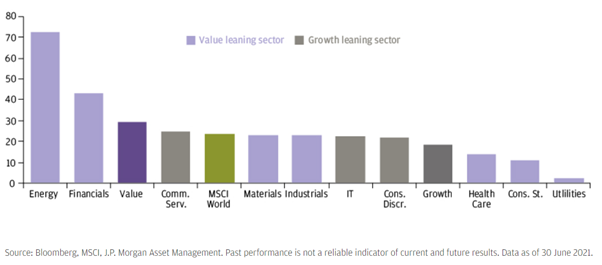
However, global style dynamics changed after the announcement that a Covid-19 vaccine had been developed and economies could begin to be reopened. Financials and energy stocks – two of the biggest sectors in value indices – have been the biggest contributors to value outperformance. But, as Exhibit 1 shows, the value universe is not homogenous. Within value there are highly cyclical sectors, but there are also defensive sectors, such as consumer staples and utilities, which have significantly underperformed this year. So not all value sectors have benefited equally from the improved economic outlook.

At the same time, cyclical growth sectors, such as communication services (media), IT (semiconductors) and consumer discretionary, have performed relatively well. So recent market performance suggests we need to take a nuanced view in the value vs. growth debate.

Exhibit 1: MSCI World sector returns since 9 November 2020

% total return in USD

The size of the opportunity

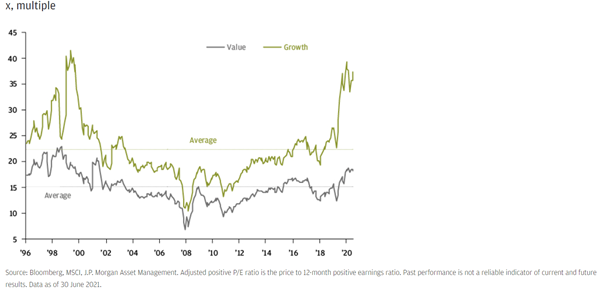
At the halfway point of this year, the price-earnings ratio (P/E) of global growth stocks stood at 36x adjusted earnings. This compares to 24x for the broad market, and a 25-year historical average P/E for global growth stocks of 22x. As Exhibit 2 shows, this degree of valuation premium was last seen during the technology boom of 1999–2000. The P/E differential between growth and value is now the widest in the last 21 years, and significantly above the average long-term differential.

Exhibit 2: MSCI World Growth and MSCI World Value adjusted positive P/E ratios

It’s tempting to argue that mean reversion will lead to a period of value outperformance. However, the evidence over a number of years suggests that betting solely on mean reversion in style investing can be treacherous if fundamentals don’t play out. For example, weak GDP growth, low bond yields and technology adoption were fundamental tailwinds for growth stocks throughout the last cycle.

The question now, therefore, is whether the underlying fundamental forces are changing. One of the best-known key variables for relative performance between value and growth is the 10-year US Treasury yield. In the past decade “lower for longer” in bond yields was a synonym for anaemic GDP growth and the failure of central banks to reach their inflation target. By contrast, periods of rising bond yields have been associated with reflation of the economy and value outperformance (see Q3 2021 Guide to the Markets – UK page 65 / Guide to the Markets – Europe page 63).

We emphasise that, historically, value outperformance has required both real GDP growth and rising inflation. In the past 15 years, the correlation between global manufacturing purchasing managers’ indices (PMIs), as a proxy for GDP growth, and the relative performance of value stocks is positive (Exhibit 3). But a current correlation of 0.15 is not significant enough to prove that value only needs economic activity to accelerate in order to outperform growth.

On this basis, investors who are sanguine on GDP growth should probably lean more into small caps than into value, while investors expecting falling PMIs should consider an overweight to large caps. From a regional perspective, eurozone equities have benefited more from periods of rising PMIs then UK equities, which makes sense if you consider the relatively higher weighting towards cyclical industries in the eurozone.         

Exhibit 3: Economic activity as a driver of relative performance

15-year correlation of style/region relative performance with global manufacturing PMI

However, when rising inflation expectations are added to the mix, the signal for value outperformance is more compelling.  As Exhibit 4 shows, the market’s expectation of five-year average inflation, starting in five years’ time, has had a significant positive correlation with the relative performance between value and growth. In reflationary periods, where excess demand and rising commodity prices have caused inflation expectations and bond yields to rise, value has tended to outperform growth.

The relatively high representation of financials, energy and materials stocks in the value universe helps to explain why value has reacted positively to reflationary economic outcomes. On a regional basis, therefore, rising inflation expectations would be expected to favour UK equities over US equities, due to the higher weighting of financials, energy and materials in the UK index.

Exhibit 4: Inflation expectations as a driver of relative performance

15-year correlation of style/region relative performance with US 5y5y inflation swap yield

A more reflationary post-pandemic policy mix

We believe that a reflationary backdrop is more likely than at any point in recent years. Growth and inflation are being stoked by what we perceive to be a lasting change in the attitude of governments towards fiscal policy in the wake of the Covid-19 pandemic. Having got a taste for spending, and encouraged by low financing costs, governments increasingly see fiscal policy as a tool to promote growth and achieve policy goals rather than simply as a tool to help stabilise growth across the economic cycle. Governments in the US and across Europe have plans for multi-year sizeable infrastructure plans. Today’s expansionary fiscal and monetary policy is not only promoting growth, but also inflation.

Economic scenarios and investment implications

While reflation is our central economic scenario, we acknowledge that the outlook is still highly uncertain. In our mid-year outlook we identified three scenarios, which are outlined below in order of probability, along with the potential ramifications for value and growth:

Synchronised global growth: In our core scenario the recovery broadens out globally and becomes more synchronised over time. Supply bottlenecks continue to cause rising commodity prices and inflation concerns linger. Central banks taper asset purchases in 2022 but keep rates low. Fiscal policy remains expansionary but pivots to infrastructure projects. Yield curves continue to steepen.

In the synchronised global growth scenario, value has the potential to continue to outperform. Financials should benefit from the improving economic outlook and rising bond yields. High oil prices and rising gasoline demand should help the energy sector to outperform. A change in the scope of fiscal policy from pandemic support to infrastructure and environmental spending should also be beneficial for value.

Goldilocks: Inflation moderates quickly as supply disruptions ease and wage growth slows. Commodity prices cool as spending tilts to services and China tightens policy. Central banks remain accommodative for longer, encouraging further fiscal expansion. Large asset purchases continue. There is no further curve steepening. US bond yields peaked in March.

In the goldilocks scenario, central banks are right that inflation is only transitory, while growth moderates from current levels. Falling commodity prices will hurt energy and materials stocks, while bond yields are no longer supportive for financials. Structural growth trends will return to the fore, and relative performance could swing back in favour of growth stocks.

Stagflation: Acute supply problems lead to an unpleasant mix of moderate nominal growth and high inflation. Central banks are forced to tighten more quickly than anticipated. Debt sustainability concerns in an environment of rising rates end the period of fiscal expansion. The yield curve bear flattens.

While a stagflation scenario is a clear negative for equity markets and for financials, the impact on value vs. growth performance is less clear. Defensive value stocks with stable cash flows, low operating and financial leverage, and high dividend yields – such as utilities and consumer staples – tend to outperform.

Summary

The global shift to a more active expansionary fiscal policy is changing the macro environment to one of higher growth but also higher inflation. This backdrop is providing investors with an opportunity to take advantage of the wide valuation discrepancies we are seeing between value and growth. In our central near-term economic scenario of synchronised global growth and rising inflation, we would expect the performance gap between value and growth to close further. However, we acknowledge the secular undercurrents to this cyclical narrative. Technology adoption will remain a tailwind for growth stocks and climate ambitions may act as a medium-term headwind for traditional energy stocks and certain industrials. As a result, we would argue for a rebalancing towards value, rather than a wholesale shift. Value is back in the game, but growth is not out.

Please continue to check back for our regular blog updates.

Andrew Lloyd

16/06/2021

Team No Comments

Could the state pension age hike be reversed?

Please see below article received from AJ Bell yesterday afternoon, which hints that chances of a u-turn on when you can take your entitlement look slim. At the end of the commentary, you will also find our view on the matter.

Today men and women in the UK have the same state pension age of 66. This has not always been the case, however.

Prior to 2010, women received their state pension from age 60, while men had to wait until age 65. The 1995 Pensions Act first put forward proposals to increase the women’s state pension age to 65 – bringing it into line with men – between 2010 and 2020.

The 2011 Pensions Act accelerated this timetable, meaning state pension ages were equalised at age 65 in 2018 before increasing to age 66 by 2020.

From here, plans are in place to increase the state pension age to 67 by 2028 and 68 by 2046 (although the Government has previously indicated this could be brought forward to 2039).

Campaigners have long argued the changes introduced under the 1995 and 2011 Pensions Acts were unfair to women born in the 1950s, with some forced to wait six years longer than expected to receive their state pension.

One of the central charges was that the Department for Work and Pensions (DWP) failed to adequately notify affected women so they could adjust their retirement plans.

This case was considered recently by the Parliamentary and Health Service Ombudsman (PHSO), which investigated complaints that since 1995 the DWP had failed to provide ‘accurate, adequate and timely information about changes to the state pension age for women’.

The Ombudsman concluded that the DWP did not adequately respond to research in 2004 which recommended information should be ’appropriately targeted‘ at those affected by the reforms. As a result, it found maladministration had occurred.

While the Ombudsman’s finding may feel like vindication to the so-called ‘WASPI’ (Women Against State Pension Increases) campaigners, it has no power to compel the Government to provide compensation or redress.

In 2019 the High Court heard arguments that the state pension age increase discriminated on the ground of age and/or sex and sought a judicial review of the Government’s ‘alleged failure to inform them of the changes’.

The Court dismissed the claim on all three counts, and an appeal to the Court of Appeal in 2020 was also thrown out.

The Government has previously said putting men’s and women’s state pension ages back to 60 could cost £215 billion. Given the impact coronavirus has had on the UK’s finances, it seems extremely unlikely the Government will cough up this amount of money – or anything at all for that matter – if it is not compelled to.

P and B Comment

From my point of view, I don’t think there is any chance of State Pension age being lowered. It makes great economic sense for the State to keep putting State Pension age back, age 68 or even age 70 at some point.  A later State Pension age saves money for the State by not paying it out as early and probably keeping the majority of people in work, therefore generating higher income tax receipts.

In context, when real State Pensions commenced in a similar format to todays a few years after the end of World War II, the average man would have retired at age 65 and would have died about 2 years later.  Now, we could be looking at an average of 15 years of inflation linked income with potentially another 10, 15 or 20 years for those with good longevity.

The cost to the State is enormous and as we live longer, it will increase.  The ageing demographic – you can also add to the healthcare cost too.

One of the key messages I believe is to educate people about the State Pension and other pensions such as Workplace Pension provision.  If the young working population join pensions early, and fund them at a good level, they won’t be as reliant on the State Pension.  This could really make a difference to your lifestyle in retirement.

Steve Speed DipPFS

13/08/2021