Please see below for the latest market update from AJ Bell:
The pound losing its recent strength and oil stocks responding to a higher commodity price could boost the index
Investors in UK stocks have been looking jealously (or frustratingly) at the performance of the US markets and wondering why the FTSE 100 has stubbornly refused to rebound as fast.
Year to date, the S&P 500 is up nearly 5% and the Nasdaq is up 25% whereas the FTSE 100 is down nearly 19%, all on a total return basis.
The answer is simple – the UK stock market is very under-represented by tech stocks which is the sector that has driven US markets this year.
The UK is also heavily weighted towards banks and energy stocks, two of the worst performing sectors in 2020.
The former has been depressed by a drop in interest rates, rising concerns over potential bad debts as consumers and companies struggle as a result of the pandemic, and the suspension of dividends.
The energy sector has been hit by a big decline in the oil price and a reduction in dividends making it less appealing to income investors.
Yet are we about to see a reversal of fortunes?
Recent strength in the pound versus the US dollar will have worked against the multitude of companies on the FTSE 100 which earn in the latter currency, but whose share price is quoted in the former. Those dollar earnings will be worth less when translated into sterling.
Approximately three quarters of the FTSE 100’s earnings come from outside the UK, so foreign exchange rates really matter to the performance of the index.
Bank of America this month turned bullish on UK equities, partly because it expects the pound to weaken again on the back of rising no-deal Brexit risks. If sterling weakens then dollar revenues, once converted back into sterling, are worth more.
The bank also believes the energy sector should catch up with recent strength in the oil price, thereby giving another support to the FTSE 100 with oil producers Royal Dutch Shell (RDSB) and BP (BP.) being major constituents of the index.
Such predictions would suggest investors are right to remain hopeful for better returns from the FTSE. However, performance is still dependent on economic activity picking up around the world and unfortunately there are some mixed signals.
Stock markets last week took a tumble after the US central bank expressed concern that the pandemic could greatly impact the US economy in the medium term.
The latest Eurozone PMIs disappointed while the US and China’s recent figures have been more upbeat. These are various indices which show confidence levels from purchasing managers and which are a good economic bellwether.
Against this backdrop, the latest Bank of America survey of fund managers shows that institutional investors remain bullish about markets despite a difficult backdrop.
It’s an ever-moving feast and investors would be best served by not fiddling with their portfolios in response to every bit of economic data that comes out. Stay diversified and accept that there may well be some parts of your portfolio lagging others – it’s just the nature of investing.
A brief but concise summary like this is an efficient way of keeping your views of the markets up to date.
If you read the previous blog you can see Jupiter’s Fund Manager, UK All Cap, James Bowmaker’s views on the FTSE too.
Please see below for this week’s market update received from Blackfinch Asset Management earlier today:
In the ever-changing world that we live in, we recognise the importance of regular and current communication. This weekly news update from our MPS Portfolio Managers provides you with a short summary of events around the world which we hope you will find useful.
Issue 5 | 24th August, 2020
UK COMMENTARY
The IHS Markit UK Household Finance Index fell to 40.8 in August from 41.5 in July.
UK retail sales increased by 3.6% in July and are now 3% above the pre-pandemic levels seen in February. Online sales numbers fell by 7.0%, but remain 50.4% higher than in February.
The IHS Markit Composite Purchasing Managers’ Index (PMI) for August rose to 60.3 from 57.0 in July, the fastest rate of business activity expansion since October 2013.
UK retail footfall showed a weekly increase of 0.8%, following a 3.8% increase the week before. Market research group Springboard suggest the slowdown in growth could be attributable to the hot weather.
Market research group Kantar released data showing that the grocery market grew by 14.4% in the 12 weeks to the 9th August, with households averaging 14 shopping trips per month.
Inflation, measured by the Consumer Price Index (CPI), rose unexpectedly to 1.1% in July, driven by an increase in culture and recreation costs, analysts had predicted a reading of 0.7%.
A Reuters survey of economists suggests that the UK economy will take at least two years to recover from the impact of COVID-19.
US COMMENTARY
US/China trade talks are cancelled, President Trump signs an executive order forcing TikTok developer ByteDance to sell off its US operations within 90 days and announces further tightening of restrictions on Huawei.
The S&P 500 reached record levels, stopping just short of closing above the 3,400 level.
Apple becomes the first company to reach a market capitalisation of US$2trn.
News on the next tranche of stimulus from the US government fails to materialise for another week.
Minutes from the Federal Reserve offer little encouragement, stating that the pandemic could have a ‘considerable’ impact on the US economic outlook for the medium term. The Federal Reserve also offer no further guidance on interest rates, reiterating that they will remain low for ‘a very long time’.
First-time unemployment claims rise by 135,000, counteracting the previous week’s fall.
ASIA COMMENTARY
The Chinese Central Bank added 700bn Yuan (c.£76bn) to their medium-term lending facility for commercial lenders in order to help liquidity, helping to boost sentiment.
Japanese Gross Domestic Product (GDP) shrinks at 7.8% on a seasonally-adjusted quarterly basis, the third consecutive quarter of negative growth.
These articles are useful for breaking down market input into sectors. This facilitates an all-round view of the markets from the experts in a quick and efficient format.
Please use these blogs to keep your own view of the markets up to date from a variety of different sources.
Please see below for Brewin Dolphin’s latest Markets in a Minute article received yesterday 18/08/2020:
Global equity markets pushed higher for most of last week on positive economic data, before an ugly session on Friday erased most of the gains. Markets dropped in the UK and Europe as France was added to the quarantine list, which hit travel stocks hard. Prior to that, the Nasdaq hit a new record high, as did the gold price, while the S&P500 briefly surpassed the record high it set back in February before closing slightly lower.
Last week’s markets performance*
• FTSE100: +0.95%
• S&P500: +0.64%
• Dow: +1.8%
• Nasdaq: +0.07%
• Dax: +1.8%
• Hang Seng: +3.84%
• Shanghai Composite: +0.2%
• Nikkei: +4.3% *
Data for the week to close of business on 14 August 2020
Mixed start to week on US/China tensions and virus concerns
Markets were mixed yesterday after digesting news that the US and China cancelled their weekend talks to assess how Phase 1 of the trade deal was progressing. It was blamed on “scheduling conflicts” but given the recent escalation in tensions, including banning WeChat and Huawei, perhaps a postponement is no bad thing. London equities rose, with the FTSE100 up by 0.6%. In the US they were mixed – the Dow closed down 0.3% at 27,844.91, while the S&P500 rose 0.27% to 3,381.99. The Nasdaq closed 1% higher at 11,129.73. Europe was also mixed, with the pan-European Eurostoxx up by 0.3%, alongside gains in Germany and France, but equities in Italy and Spain lost ground.
There are concerns that economies are reaching their maximum capacity for growth without further easing of restrictions, which could increase the chances of a second wave of coronavirus infections. However, surging cases in some European countries are leading to more containment measures, not less.
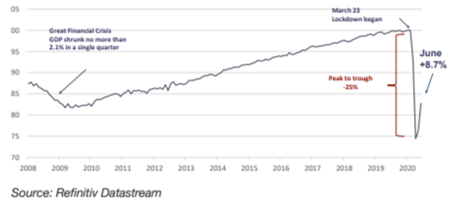
Level of UK GDP (February 2020=100)
UK recession
The standout headline last week was the UK’s record decline into recession in the second quarter. The -20.4% quarterly fall in GDP does look ugly. It is the largest quarterly decline on record, and it was the biggest quarterly fall amongst major economies. As a services-sector driven economy, the UK has been hit harder than other countries – there was a -23.1% drop in consumer spending, while business investment fell by -31.4% in the second quarter.
More encouragingly, GDP rose by 8.7% month-onmonth in June after 2.4% rise in May thanks to the easing in lockdown restrictions and there is good reason to think this will continue in the short term. For instance, wholesale and retail output rose by +27.0% in June compared with May. And with the reopening of pubs and restaurants in July and the “eat out to help out” scheme in August, we believe the unprecedented fall in GDP in quarter two will be followed by a recordbreaking double-digit growth in quarter three.
In addition, more current high-frequency data such as restaurant bookings, retail footfall and travel show normalisation in activity. However, the risk is that unemployment rises sharply once the furlough scheme ends in October. The ONS said last week that 730,000 fewer people were employed in July compared to March, based on data from HMRC, but with an estimated 5 million people still on furlough.
If such headwinds emerge later in the year, we think the Bank of England will expand its asset purchase program and further stimulus maybe announced by the Chancellor.
Japan follows UK into recession
Japan announced on Monday that its economy had contracted by 7.8% in the second quarter, which is less severe than the slowdowns in the UK, US and much of Europe. This is most likely because it had a less stringent lockdown. Still, the annualised rate of contraction of 27.8% for the three months to June is worse than Japan’s decline at the height of the financial crisis.
US retail sales and inflation
US retail sales rose 1.2% in July compared to June, below expectations for a 1.9% increase. While the sharper than expected slowdown was a disappointment, the good news is that US nominal retail sales have already surpassed their pre-Covid level, so a flattening off is to be expected. Also, there is uncertainty surrounding the unemployment benefits which account for a large part of the income for millions of unemployed Americans, and there is little sign of progress between Republicans and Democrats at the moment. This will be weighing on consumer confidence.
Meanwhile, the US consumer price index jumped 0.6% in July compared to June, which is the biggest monthly increase since June 2009 (vs +0.3% expected), while the core annualised rate rose to 1.6%. These numbers are clearly still very benign compared to the Fed’s inflation target of 2%, but the risk is that inflation could be a problem further down the road.
Chinese data hints at slowing recovery
Overall the China July activity data continued to show improvement but at a slower pace, not surprising given the lingering Covid threat. The talking point was the disappointment in retail sales given China is increasingly a consumption-based economy, retail sales were still down -1.1% on an annualised basis, perhaps due to a spike in cases and people being cautious about going out. However, the Chinese savings rate is over 40%, so consumers would appear to have plenty of spending power for when confidence returns.
We can use these blogs to keep an up to date consensus view of the global markets. Recent recession news may have come as a shock to many, but the background to situations like these can be more easily understood by reading widely on investment issues.
Please see below for the latest update from AJ Bell Regarding the housing market:
Both the property site and the wider space are likely to be tested in the autumn
Thursday 13 Aug 2020 Author: Tom Sieber
The resilience of the UK housing market has been one of the notable features as we moved out of lockdown and into the next phase of the pandemic.
This was reflected in recent first half results from property site Rightmove (RMV) which saw the company reveal that between the beginning of June and end of July demand for sales properties was 50% higher than the same period in 2019.
In lockdown there were predictions that estate agents would act on grumbles over Rightmove’s increasing level of fees and use a period when the market was effectively in hibernation to leave the platform.
However, membership numbers for agency branches and new home developments combined were down just 3.3% since the start of 2020 to 19,158.
It seems rather than driving agents away, a period of housing market volatility may have reinforced the network effect which has helped underpin the company’s impressive growth over the last decade or more.
Because the site has the most listings, it is therefore the one which prospective property buyers will go to when looking for their next home. This reinforces its position as a must-have product for estate agencies and gives it significant pricing power when it comes to securing subscriptions from agencies.
Agents are arguably more reliant than ever on Rightmove’s services and reach as they have to sell properties to stay afloat.
However, it will be interesting to see if this holds true if or when Rightmove looks to return to a pre-Covid pricing structure having offered discounts through the crisis.
Currently discounting has been extended until the end of September – although that month will see a reduction of just 40% compared with 75% when lockdown was at its height.
The foundations of the housing market may also come under pressure this autumn, assuming the furlough scheme comes to an end as planned in October.
This could lead to a material increase in levels of unemployment, which is likely to have a negative impact on demand for homes.
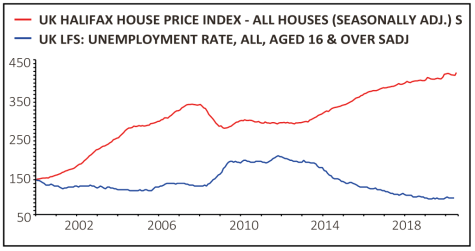
A look at house prices and unemployment over the last 20 years unsurprisingly indicates a significant negative correlation with house prices falling as unemployment rises and vice versa.
Please use these blogs to regularly update your view of the financial markets and remember to take a holistic view of your finances. Although liquid assets tend to take the headlines initially during market drops and grab the public’s attention, other assets, such as property, should not be left in the background of thought, as this article demonstrates.
Please see below for Invesco’s latest Investment Intelligence Update:
News flow last week, such as Non-Farm Payrolls and the ISM surveys in the US, was generally supportive of a positive tone in financial markets. “V” looks the shape of the recovery, for now at least. The virus news, however, remains mixed. New confirmed cases continue to roll over in the US, albeit still at elevated levels, while in Europe and DM Asia case growth remains relatively low, although it has risen in recent weeks. Case growth continues at elevated levels in Latin America. Central Bank dovishness remains very much the order of the day, with the Bank of England last week reiterating the uncertain outlook and the preparedness to do more if needed. Geo-political strains between the US and China refuse to go away, and in fact look as if they are escalating, while progress towards further US fiscal stimulus continues to frustrate.
Global equities hit their highest level since the bear market low during the week and are now back into positive territory for the year, now just 3% from their all-time high. Small caps and value/cyclical sectors led the way. In the UK further £ strength weighed on FTSE 100 relative performance, which dragged the All Share lower.
There was mixed performance in fixed income, with government bonds weaker at the margin, with the odd exception (Italy, EM). IG and HY continue to make progress. A new record low for yields for the former, while further declines in yields for the latter returned the asset class to positive territory for the year. Spreads for both still remain well above the lows seen earlier in the year.
The US$ halted its decline (see Chart of the week). Economic optimism helped boost economically sensitive commodity prices. China, the world’s biggest consumer of copper, saw record imports for the second straight month. Gold pushed to new highs as real yields declined to record lows and investor demand remained elevated.
Market performance last week (%)
Past performance is not a guide to future returns. Sources: Datastream as at 9 August 2020. See important information for details of the indices used.1
YTD market performance and YTD low (%)
Past performance is not a guide to future returns. Sources: Datastream as at 9 August 2020. See important information for details of the indices used.1
Chart of the week: US$ Index
Source: Datastream as at 8 August 2020.
One of the features of financial markets since the peak of the pandemic crisis dislocation in late March has been the weakness in the US$. In this chart we use the US$ Index (DXY) as a proxy for the currency’s performance (Fixed currency weights for DXY are Euro 57.6%, Yen 13.6%, £ 11.9%, Canadian $ 9.1%, Swedish Krona (SEK) 4.2% and Swiss Franc 3.6%).
At its YTD peak (late March) it had risen just under 7% on the back of its safe-haven, reserve currency characteristics and a shortage of US$ liquidity. Since then it has given up all those gains and more, declining 9.1% and now down just over 3% YTD. It is now at levels last seen in May 2018 and its 100-day decline has been the worst since November 2010. The major contributor to this weakness has been strength in the Euro (10.3%), given its high index weight, but other currencies have been stronger (SEK +18.7%, £ +11.1%). The Yen has been the weakest on a relative basis, but has still risen 4.6%.
Why has the US$ been so weak? A number of factors have contributed: the global rebound in growth has favoured more cyclical currencies, such as the Euro; an unwinding of safe-haven flows into the US$ on the back of this; real and nominal interest rate differentials between the US and another major markets have collapsed; aggressive Federal Reserve policy has alleviated US$ funding issues; fiscal and structural optimism in Europe on the back of agreement on the European Recovery Fund; the Federal Reserve and US government is happy to see a weaker currency; and finally, idiosyncratic US political and fiscal risk. All have weighed on a currency that on most measures was overvalued and where investor positioning was extended.
Can the US$ weaken further? Fundamentals are currently stacked up against the currency for now, but this is in the context where the DXY has moved from its most overbought level ever (relative to its 12m average) to its most oversold level since 1978. At the same time investor positioning (based on CFTC data) is now at a record short.
What does US$ weakness mean for financial markets? Historically it has benefitted global equites (and non-US stocks in particular), cyclical sectors, EM assets in general and commodity prices, such as Gold and Copper.
Key economic data in the week ahead:
A relatively quiet week ahead on the data front.
In the US there is July’s CPI reading on Wednesday. Headline inflation is expected to rise slightly to 0.7%yoy, off the pandemic lows, but still at the lowest level since 2015. Core inflation is expected to see a marginal decline to 1.1%yoy, its lowest level since 2011. The pandemic has been disinflationary. Initial jobless claims out on Thursday are forecast to show another 1.4m people receiving unemployment benefits, despite the better than expected Non-Farm Payroll data last Friday. Data on the strength of the US consumer is also out, with US retail sales for July published Friday and forecast to show a slowing recovery (1.9%mom vs 7.5%mom in June), while the preliminary reading of the University of Michigan Sentiment Index is expected to fall further and continue to hover around pandemic lows.
In the UK the most anticipated datapoint next week is the Q2 GDP release on Wednesday. If the forecasts of -20.5% prove right it would be the worst quarterly contraction of the UK economy on record. Broad-based weakness is expected, with the increase in government spending the only positive, depending on your point of view. Monthly GDP for June will also be released at the same time, which should show an underlying improving trend in the economy not seen in the quarterly numbers, with 8%mom forecast compared to May’s 1.8%mom. The latest UK unemployment report is published on Tuesday. The unemployment rate is expected to rise only slightly to 4.2% from 3.9% as the labour market continues to be underpinned by the government’s job retention scheme. The true health of the labour market will be seen away from the headline data in areas such as the number who are now economically inactive, hours worked and vacancy levels. These all point to higher levels of unemployment by year end, with the Bank of England’s Monetary Policy Report last week seeing it at 7.5%. Finally, there is July’s RICS house price data on Friday, which is expected to show a -5% drop in July, but up from -15% last month, highlighting the gradual improvement in the housing market in England and Wales.
China’s July data pipeline started last week and will continue throughout this week with figures on CPI (Monday) industrial production, fixed investment, retail sales, house price inflation and unemployment (all on Friday). Most indicators are forecast to post better readings than they did in June, suggesting that the third quarter is off to a relatively firm start.
Nothing of note during the week from either the EZ or Japan.
An insightful look into the markets by the experts at Invesco. These weekly updates are useful in terms of providing a regular overall view of the market.
Please use Invesco’s Investment Intelligence updates as well as our other blogs to refresh your view of current goings on in the global markets.
Please see article below from Brewin Dolphin’s ‘Markets in a Minute’ update received 15/07/2020.
China shares rally as state media declares bull market
Global share markets were mixed over the past week, although China has been a standout performer after investors piled in, encouraged by a state-owned newspaper that effectively declared a “healthy” bull market was on the way in Chinese equities.
Investors took the message to heart, and Chinese shares surged by almost 6% at the start of last week on trade volumes roughly double the average.
In the UK, a rally late in the week lifted the FTSE100 comfortably above the 6,000 level but performance in most markets was fairly muted due to the ongoing downbeat news around the coronavirus, worries about tensions between the US and China, and uncertainty around stimulus packages.
Last week’s markets performance*
FTSE100: -1%
Dow Jones: 0.95%**
S&P500: 1.75%**
Dax: 0.84%
Nikkei: -0.07%
Hang Seng: 1.4%
Shanghai Composite: 7.3%
*Performance in the week to Friday 10 July **Performance from close of business on 2 July to Friday 10 July due to Independence Day holiday.
A mixed start to this week…
Share markets largely continued their bullish run on Monday, with the FTSE100 gaining 1.33% and European markets hitting their best levels in almost a month as reports suggested progress on two vaccine candidates in the US. China and other Asian markets continued their strong run.
However, the S&P500 and the Nasdaq in the US both closed down yesterday amid worries about the rolling back of reopening plans in some states due to rising coronavirus cases. That led to Asian markets falling sharply today.
Chinese policymakers have also become uneasy about the rapid rise in Chinese stocks, leading to two state-backed funds to begin offloading equities in a bid to cool the overheating market. The Chinese government has also sought to dissuade investors from accessing unauthorised sources of margin financing. The Shanghai Composite closed down by 0.8% today. In early trading in the UK and Europe, shares were heading down.
Stimulus cliff-edge in US, knife-edge summit in Europe
There can be no doubt that both the US and Europe need more stimulus to maintain their recovery, or at least prevent a sharp deterioration. In the US, a central plank of March’s $2trn stimulus package is being debated; the extra $600-a-week in unemployment benefits, which is paid on top of each state’s existing unemployment benefits, is due to end on July 31. This means a potential cliff-edge income drop for around 20m unemployed Americans that would cause average unemployment payments to fall by about 60%. Also, cash payments to households have already been received, and probably spent.
Fortunately, both the Democrats and Republicans want the extra stimulus to keep flowing, so it is more than likely we will see these benefits extended.
This coming Friday the EU will debate the €750bn coronavirus recovery package at a special summit, and it is far from certain the fund, dubbed Next Generation EU, will pass in its current size or format – the current proposal is that the fund is made up of grants and loans, and more fiscally conservative states, particularly the Netherlands, are objecting to the grants element and also, reportedly, the size of the package.
Virus news
While the headline figures from case growth around the world, and particularly the US, still make dire reading, a glimmer of hope can be seen in the decline in Swedish cases, although this could be for any number of reasons (less testing, some more lockdown measures). Crucially, however, there was an important suggestion that immunity may have spread more widely than believed, which has global implications.
Marcus Buggert of The Centre for Infectious Medicine at Karolinska Institutet, Sweden, said: “Our results indicate that roughly twice as many people have developed T-cell immunity compared with those who we can detect antibodies in.”
Apparently, this could mean herd immunity is achievable with far lower infection rates of, say, 20% rather than the 60% suggested more commonly.
Overall the trends in Covid cases may be improving but it is hard to say due to fluctuations in testing and the distortion of the Independence Day holiday in the US. Even outside Sweden, European cases seem to have been suppressed for now. The case growth rate in Brazil could be peaking but there is little sign of any improvement in Mexico, South Africa or India.
In Asia, after a week in which Tokyo recorded 100 new cases per day, they subsequently jumped more than 200 on Thursday. Hong Kong will close its schools early for the summer holidays after finding 34 new locally transmitted cases on Thursday.
On the vaccine front, research into T-cell immunity is now being incorporated into vaccine development, in addition to the focus on antibodies we have seen so far. If successful, this could significantly boost any vaccination’s efficacy and the duration of immunity, though it is still very early days.
Summer statement boosts housing sector
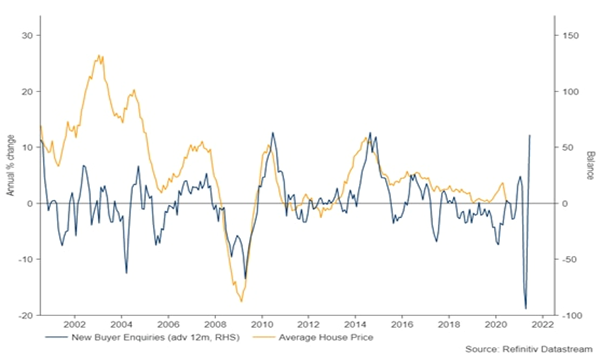
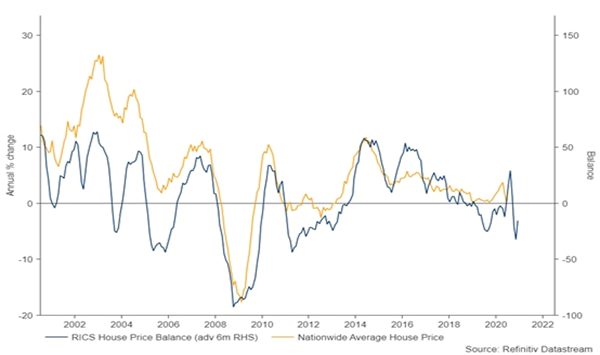
In his summer statement last week, Chancellor Rishi Sunak refused to extend the government’s furlough scheme past October as widely expected, but he announced a stamp duty holiday until next March for properties worth up to £500,000. That boosted shares in housebuilders, and it may prompt an uptick in housing transactions. New buyer enquiries at estate agents were close to record levels in June, according to last week’s survey from the Royal Institution of Chartered Surveyors. Its survey, which questions surveyors around the country, suggested a slight recovery in prices and a big increase in properties being listed for sale. But looking ahead, views were a little more negative, implying price declines of 5% over the remainder of the year.
New buyer enquiries vs Nationwide average house price
RICS House price balance vs Nationwide average house price
Make the most of higher-rate tax relief in your pension while you can
Sunak hinted that efforts to address the dire situation that is the national finances will begin in November’s Budget. This may finally sound the death knell for one of the most attractive tax breaks in the UK, namely higher-rate tax relief on pension contributions.
It’s hard to see any more obvious revenue-raising step that would be so effective, and it has been speculated about for a decade. It would suggest anybody who hasn’t taken advantage of this year’s allowance should seriously consider doing so before the autumn.
One of the main focuses of this update are the views on potential monetary and fiscal policy actions from governments, particularly the UK, EU, China and US. It now seems that market analysts have turned their attention to how governments will act to deal with the financial consequences of this pandemic in the long term and how that will affect the markets as they begin to recover.