Please see below detailed economic and market news update received from the in-house research team at Brooks Macdonald yesterday afternoon.
A far stronger than expected US employment report spurs gains in equities
While Europe was on holiday, a bumper US jobs report on Friday drove risk assets higher on both sides of the Easter weekend. Survey data also beat expectations, and this was enough to allow equities to look through the pickup in global COVID-19 numbers.
The closely watched minutes from the March Federal Reserve meeting are released on Wednesday
The number of new jobs created in the US in March hit 916,000, far in excess of expectations of 660,0001. Standout areas included leisure and hospitality sectors, which are both reopening after being the hardest hit areas from the curbs on activity. The broadest measure of US unemployment, U-6, which includes not only the unemployed but those that are underemployed or discouraged from the workforce, fell but remains in excess of 10%2. For context, this measure was at 6.9% in January 20203 before the pandemic hit and still points to a sizeable gap until the US economy returns to ‘full’ employment. This elevated level of broad unemployment is often cited by US Federal Reserve (Fed) Chair Powell as a sign of the economic output gap that needs to be filled before inflationary pressures could become sustained.
Since the Fed meeting in March, we have seen the market price in additional rate hikes as the vaccine rollout continues amidst the aforementioned stronger data. The Fed’s last statement said relatively little about how the bank would respond should benchmark Treasury yields continue to rise. As a result, this will be keenly watched for in the minutes released on Wednesday. The disconnect between what the market believes will occur and Fed guidance is widening by the day, so any sign that they will take concrete action will be important for the central bank to remain in the driving seat. This week also sees the European Central Bank minutes released on Thursday, where investors will be looking for further guidance on the pace of quantitative easing purchases over the next few months.
Third COVID-19 wave concerns continue in Europe as France enters lockdown
The counter to the data optimism is the third wave of the coronavirus pandemic which has caused Europe to move further towards lockdowns, with France beginning its lockdown over the weekend. This will remain a hot topic this week as the complicated interplay of vaccine rollouts and rising cases continues to muddy the short-term economic outlook.
Although the UK has been successful in its vaccine rollout so far, it is important for Europe and the rest of the world to achieve mass-vaccination as well. We will continue to publish relevant content as the lockdown rules continue to be relaxed.
Please see the below ESG case study article from Invesco:
The below case study pertains to engagement within our UK equities team, which are a part of the Henley Investment Centre. While guided by our central ESG team, all of our investment professionals ultimately have discretion in their ESG decisions, and do not all follow the same approach. Learn more about how we integrate ESG across our wide range of strategies here.
Responsible oil and gas companies have a critical role to play in being part of the solution to environmental problems: in helping enable the global economy to successfully transition as rapidly as possible, and in a sustainable manner, towards targets for much reduced global emissions.
This can be achieved through actions taken by companies to successfully manage down a sustained decline in output of oil & gas, while at the same time maximising cash flows from operations for investment in new low carbon energy businesses.
Investing in oil companies that set out to achieve these objectives – and holding them accountable – is we believe entirely consistent with true responsible investing, which incorporates environmental, social, and governance (ESG) criteria into the investment process.
Whatever the moral burden that should fairly be borne by UK-listed companies, such as BP and Shell, for their historical actions, what is important for investors to understand is how the oil companies themselves now fit into the global industry. Investors want to know what the impact of oil companies will be on that industry and on society, going forward: what role they have to play in the future.
How BP and Shell are transitioning towards a greener future
Although many investors focus on oil & gas producers as large Scope 3 emitters of carbon, if the world is to achieve net zero emissions in 2050 it ultimately requires reform of demand, and not just supply.
Supply in the industry (in the long run) very closely mirrors actual demand (the easiest place to store oil is still in the ground!). It is important here to also reflect that the global publicly quoted US and European oil companies only account for around 12.3 mb/d out of total current production of approximately 100mb/d, with US privately owned production around a further 8mb/d.
Put another way, state owned oil production (including Saudi Aramco) accounts for almost 80% of global production. The reality is that any cuts in production by any of the publicly quoted oil majors does not in itself affect global oil demand.
BP turning off the taps tomorrow would have a negligible effect on global carbon emissions. The same emissions will still be made but fuelled by output from another supplier who is less accountable to investors.
Responsible oil companies do, though, have a very significant role to play in accelerating a sustainable transition to low carbon alternatives that can reduce demand for fossil fuels by providing a viable substitute product.
For example, BP and Royal Dutch Shell are both actively involved in promoting the transition through defined strategies that look to maximise cash flows from existing carbon resources, and then re-allocate cash flows to low carbon alternatives.
Because of the many and varied uses for oil as a fuel, as a key component in a wide range of everyday products, and the practical limitations associated with various alternatives currently available, the process of transition is likely to be gradual. It is clearly both necessary and highly likely that demand for oil will reduce over time, however we do not foresee at any time in the next ten years at least, a “Kodak moment” for oil.
Our role as responsible shareholders will encourage positive change
An investor in BP or Shell who is willing to support, encourage and also hold the company to account during its transition period is, we believe, able to be well rewarded financially, through dividends and share buy backs, as well as by the prospect of owning a new “low carbon” and retail business whose growth has been fully funded from existing company resources.
Responsible oil & gas companies such as BP and Shell therefore have a critical role to play in being part of the solution: in helping enable the global economy to successfully transition as rapidly as possible, and in a sustainable manner.
This objective can be achieved through actions taken – with the support of shareholders – to successfully manage down a sustained decline in output, whilst at the same time maximising cash flows from operations for investment in new low carbon energy businesses.
We believe, investing in oil companies that set out to achieve these objectives, and holding them accountable, is entirely consistent with our philosophy of responsible investing, which focuses on engagement and dialogue with portfolio companies, and not simple divestment if there is something that we don’t like.
We expect big companies in this sector will be investing capital at scale in renewable energies and are well placed to manage large and complex engineering projects in hostile natural environments. Again, the sector is part of the solution rather than just part of the problem.
Our engagement and dialogue – in practice
As active fund managers, ESG integration and dialogue is an important consideration for us. Over the past three years we have regularly engaged with various members of the Boards and Management Teams of both BP and Shell, on ESG matters in general, and on carbon emissions in particular.
In the case of BP, for example, we have had meetings with the BP Chairman to discuss the risks and opportunities associated with their carbon transition plan.
We have also provided feedback to the chair of the remuneration committee to ensure management incentivisation is aligned to group strategy and their environmental targets.
Furthermore, we have engaged with independent board members and attended company strategy sessions. The enhanced monitoring of our BP position over the last three years means that we believed that the strategy and objectives the company was setting were achievable.
Our engagement enables us to measure the board and management against their strategy and objectives. We believe there are good returns to be made from businesses which transform to become fit for the future.
When it comes to ESG or socially responsible investments, its important not just to use the traditional ethical investment screening (i.e. staying away from certain companies/ sectors etc), but to engage with companies to help deliver positive change.
By engaging with companies and holding them accountable, it forces them to think about the future, their practices and operations and helps to guide them into a better way of thinking.
It’s not about steering clear of companies or disinvesting if something happens investment managers don’t like, but about engaging with them, providing feedback and guidance about how they want things to work.
Positive engagement will help everybody to learn and adapt to what seems to becoming (or will become) an industry standard in how ESG processes are embedded into companies and the industry as a whole.
Keep checking back for more ESG related content from us along with our usual market commentary, planning points and other key issues we like to keep you up to date with.
Please see article below from J.P. Morgan which looks at the impact of ESG factors on portfolio returns, received 29/03/2021
The ESG factors that we expect to drive markets are at their infancy in terms of both introduction and market impact.
Karen Ward
How does incorporating information on environmental, social, and governance factors affect the performance of a portfolio?
Does incorporating these factors put a portfolio on a better footing to cope with a changing world and enhance returns? Or does ‘doing good’ with your capital come at a cost?
What about volatility? Does accounting for a wider range of future risks reduce the bumps? Or, by excluding sectors and companies, do we end up with a more concentrated and therefore more volatile portfolio?
In this piece, we look at this deeply complex issue. Empirical backtesting to gauge relative performance is fraught with practical difficulties, largely due to the lack of quality historical data on which to score companies, though preliminary analysis suggests there is a relationship between ESG score and asset return.
There are also reasons to question whether historical analysis of this topic serves much purpose in thinking about future performance. Consumer preferences and regulatory and policy initiatives to tackle environmental, social and governance issues are moving at such pace that investors who are ahead of the change might be expected to see portfolio benefits, as certain recent events have demonstrated.
This paper lays out the issues that will be explored in more detail in our 2022 Long-Term Capital Markets Assumptions, which will be released in autumn this year.
Historically difficult to test
Before looking into preliminary results, it is worth pointing out some significant caveats to our ability to back-test the performance hypothesis. Problems arise in how to score a company on its E, S and G characteristics. There are external ratings agencies that provide company ‘scores’ but there are three issues worth remembering.1
First, methodology can be opaque and subjective and different providers often produce conflicting scores. A well-known electric vehicle producer is an oft-cited example: it is rated highly by one rating agency for its green credentials and poorly by another based on the agency’s assessment of its governance.
Second, coverage of companies isn’t always complete, and is particularly sketchy for smaller companies and in fixed income markets. In emerging markets, language issues can also be a barrier to the collection of accurate data.
Third and finally, the further we go back in time, the more likely it is that the scoring data does not adequately capture the real- time ESG challenges. The data may not have been available or disclosed at the time, and, more importantly, the data that is actually relevant to asset pricing has likely changed over time. Twenty years ago, governance may have been the biggest non- financial metric of concern for assessing the sustainability of corporate performance. Today, environmental issues are increasingly moving into sharper focus, as is the diversity of the workforce.
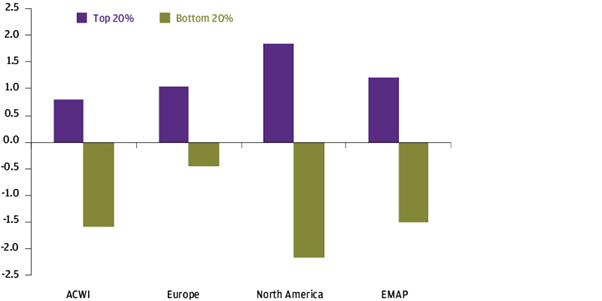
These data issues suggest we should be careful about leaning too heavily on backtesting. However, with these statistical caveats in mind, Exhibit 1 – which ranks companies using J.P. Morgan Asset Management’s proprietary ESG scores – suggests that there does appear to be a relationship between ESG score and performance relative to benchmark.
We will do future work on this question ahead of the publication of our Long-Term Capital Markets Assumptions, in order to assess the statistical significance of the relative performance, whether the relationship changes through time, and the relative importance of E, S, and G factors by region. Another important question requiring further exploration is whether it is the absolute ESG score or the change in the score that matters.
Exhibit 1: Mean active return by ESG quintile
% active return
Source: J.P. Morgan Asset Management. Charts show the mean active returns of the top and bottom quintile portfolios based on JPM proprietary quantitative ESG score, excluding transaction costs, in USD. Calculation periods are 31/12/2012 – 26/02/2021 for ACWI, Europe and North America and 28/02/2013 – 30/11/2020 for EMAP. Figures are shown as an annual rate. ACWI portfolios and benchmark constructed in the MSCI ACWI IMI universe filtered by market capitalisation > $1 billion, Europe portfolios are constructed using the Europe constituents of the aforementioned universe, North America portfolios are constructed using the North America constituents of the aforementioned universe, EMAP portfolios are constructed from the MSCI Emerging Markets index, stocks are weighted equally across the universe. Past performance is not a reliable indicator of current and future results. Data as of 28 February 2021.
It may be that the answer is ‘both’, with ‘good’ companies benefiting from macro news such as regulation and policy announcements and improvers representing company-specific or micro developments. We also need to evaluate the impact on portfolio volatility.
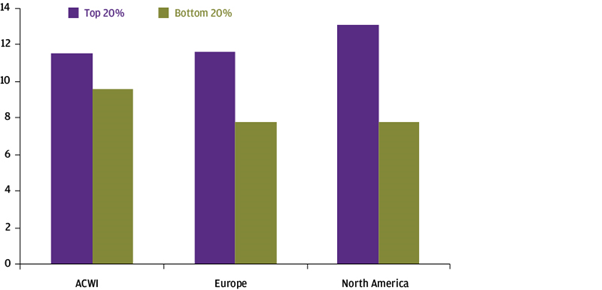
While it’s important to be careful about drawing conclusive evidence from past data, it is worth noting that we observe a relationship between ESG score and other traditional financial characteristics of ‘good management’, such as high return on equity (Exhibit 2), low leverage and low earnings variability. For this reason, incorporating ESG factors is often seen as an additional ‘quality’ screen. And the performance of companies screened on quality metrics is clear over the long term: MSCI Europe Quality has outperformed MSCI Europe by close to 4% annualised over the past 10 years.
Exhibit 2: Return on equity by ESG quintile
% return on equity
Source: J.P. Morgan Asset Management. Charts show the mean return on equity of the top and bottom quintile portfolios based on JPM proprietary quantitative ESG score, USD, ROE winsorised at plus / minus 100. ACWI portfolios are constructed in the MSCI ACWI IMI universe filtered by market capitalisation > $1 billion, Europe portfolios are constructed using the Europe constituents of the aforementioned universe, North America portfolios are constructed using the North America constituents of the aforementioned universe, stocks are weighted equally across the universe. Past performance is not a reliable indicator of current and future results. Data as of 28 February 2021.
Exclusions and short-term returns
The analysis above focuses on returns over long time periods. At certain points in the economic cycle, excluding certain companies – such as gambling, tobacco, nuclear power, weapons, alcohol and energy companies – for ESG reasons can have meaningful implications for relative performance. Most obviously, excluding traditional energy companies from a portfolio will likely lead to outperformance when oil prices are falling, but potentially underperformance when oil prices and energy prices are rising. If energy is a large proportion of a benchmark, the relative impact is even greater. Looking at the impact of excluding energy in the UK (where energy is over 10% of MSCI UK) vs. the US (where energy is 3% of the S&P 500) during the rollercoaster in energy prices in 2020 demonstrates this point (Exhibit 3).
Exhibit 3: Impact of excluding energy from an index
Relative total return index level, rebased to 100 at the start of 2020
Source: MSCI, Standard & Poor’s, J.P. Morgan Asset Management. Past performance is not a reliable indicator of current and future results. Data as of 18 March 2021.
In addition, companies that do not have good long-term growth opportunities or ESG scores can still generate good financial returns, when profits are returned to shareholders or when there’s a grab for yield. A notable example is American tobacco companies, which have returned 13% annualised (including dividends) over the last 20 years, compared with 8.5% for the S&P 500.
Of course, for many investors, any return sacrifice may be entirely acceptable given their broader investment ambitions beyond financial returns.
The asymmetries in fixed income
On top of the issues described above, it’s worth spending a moment thinking about ESG, returns and fixed income. An equity share does not have a predefined time horizon, so for an equity investor the return depends on the payout prospects for the life of the asset. A fixed income investor holding a bond to maturity is just concerned about getting the agreed coupons and then the principal returned over a fixed time horizon, and this creates an asymmetry.
For example, consider a company that is on the right side of a new government announcement (for example, the producer of an alternative to single-use plastics after an announcement of a ban on single-use plastics). The stock investor sees a jump in the stock value, reflecting the enhanced outlook for long-term profits. A bond investor planning to hold the bond to maturity would not see an enhanced coupon or dividend, and so would not receive the same benefit from the announcement.
Now consider the company that is on the wrong side of a government announcement, with the long-term viability of its current business model challenged. The stock investor loses out immediately. Whether the fixed income investor loses out over the lifetime of the bond depends on whether the coupons or principal are at risk. They may not be on a very short-dated bond, but would be on a longer-dated bond.
Given this asymmetry, incorporating ESG factors in a fixed income portfolio might be expected to affect returns. Incorporating ESG factors can limit downside risk in a portfolio by capturing a broader range of potential sources of default risk. However, it could lead to underperformance if the issuer doesn’t default within the time horizon of the bond and the investor has forgone the higher spread that resulted from the pricing in of that risk.
In addition, as with equities, high yield energy will likely underperform when oil prices fall and outperform when they rise, so ESG exclusions can lead to periods of underperformance as well as outperformance. Again, in both instances, any return sacrifice may be entirely acceptable to investors who are seeking sustainable outcomes as well as financial returns.
Most importantly, history is unlikely to be a guide to the future
Even if it were possible to draw firm conclusions using historical index data, we would argue that history is unlikely to provide a guide to the future. That is because the ESG factors that we expect to drive markets are at their infancy in terms of both introduction and market impact.
Below we list five specific areas in which we believe ESG considerations have the potential to create market winners and losers:
Government ambitions and regulatory policy – Encouraged by the demands of their electorates, governments are increasingly focused on tackling issues such as social injustice and climate change. Policymakers have a variety of sticks and carrots at their disposal to drive change. One example of a ‘stick’ policy being used to tackle climate change is carbon pricing, which exerts a cost pressure on less energy efficient companies. An example of a carrot policy is a scrappage scheme that encourages consumers to dispose of petrol-fuelled cars for electric vehicles.
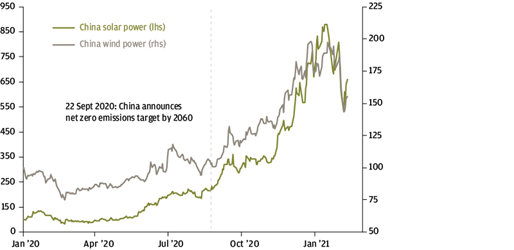
There is clear evidence that such political announcements have market implications. Take two examples from the last year. The surprise announcement by President Xi that China would commit to net-zero carbon emissions propelled solar and wind power companies higher (Exhibit 4). These companies are set to benefit from this positive policy support via an increase in subsidies as China moves to increase capacity, in line with its environmental goals of peak CO2 emissions in 2030 and net zero by 2060. This comes at a time when coal-fired producers are facing higher costs from rising coal prices and the cost of wind and solar are in decline. Renewable energy sources in China are expected to achieve grid-price parity with coal-fired producers in the next year.
Exhibit 4: Chinese renewables gain on policy announcements
Average of A and H share listed companies in each industry, rebased to 100 = 31 Jan 2020
Source: FactSet, J.P. Morgan Asset Management. Past performance is not a reliable indicator of current and future results. Data as at 12 March 2021.
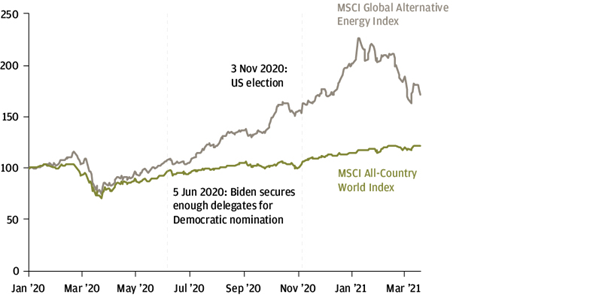
Clean energy stocks have significantly outperformed global equities on the prospect of increased policy support from a Joe Biden presidency (Exhibit 5). Following the announcement that Biden had secured enough delegates for the Democratic nomination, clean energy stocks began to rise with the prospects of a Biden win at the election, as investors anticipated more policy action to address climate change. The rally in clean energy took another leg higher following the US election result, when a future infrastructure package came into focus.
January and February of this year provided a timely reminder that, even with these key policy supports in place, these sectors can still prove volatile. Investors should also be cognisant of the price that they are paying to access these secular trends, now that the policy tailwinds have become starkly apparent. The 12-month forward price-to-earnings ratio for the MSCI Global Alternative Energy Index has risen from 17x at the beginning of 2020 to 30x at the end of February 2021.
Exhibit 5: Clean energy performance
Total return index level, rebased to 100 at the start of 2020
Source: MSCI, J.P. Morgan Asset Management. Indices shown are total return in local currency. Past performance is not a reliable indicator of current and future results. Data as of 18 March 2021.
In essence, what is happening is governments are internalising the externality of environmental damage. But, almost by definition, this will come at a cost to some businesses. The UN Climate Change conference (COP26) in early November is a date investors should watch for the potential slew of new market-moving initiatives.
Central bank asset purchases and regulatory initiatives – While government policy is increasingly influencing the macro landscape, central banks are being asked to support these endeavours by ensuring that private capital forms part of the solution. Indeed, increasingly central banks (for example, the Bank of England) are having green targets added to their mandates. This works through two channels: 1) central banks can tailor their asset purchases to favour climate friendly companies and sovereigns and 2) they can use their regulatory levers to direct capital towards higher scoring companies (for example, through pension fund requirements).
The ambition and the potential consequences for asset prices are made clear in a recent speech by Pablo Hernández de Cos, governor of the Bank of Spain:2
“If we succeed in incorporating these [climate] risks into the decisions of the financial sector, this will translate into a change in the relative prices of financial instruments. And, in turn, that will help to internalise those consequences originating from both transition and physical risks that affect directly providers and users of funds. This will be a powerful and much-needed complement to the use of the fiscal and environmental instruments that are needed to fight against climate change.”
Disclosures– Central banks, regulators and governments are increasing transparency about ESG factors by forcing companies to disclose more ESG information about their businesses, from diversity statistics and pay of their employees to carbon emissions. This allows both consumers and investors to make more informed choices.
Consumer choices – Attitudes and resultant behaviours among consumers are changing rapidly, with potential consequences for the long-term profitability and potential performance of companies. Areas where consumers are having a significant impact range from specific preferences (such as the increasing rejection of single-use plastics) to reputational risk from poor corporate ESG choices. The latter is increasingly important given that intangible capital (brand) is an increasingly large component of many companies’ market value.
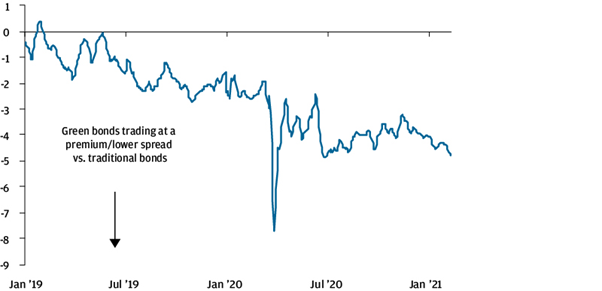
Cost of capital – All of the above factors have the potential to affect the revenue stream of companies. But there is also increasing evidence that they are driving corporate cost of capital (this yield premium has come to be known as the ‘greenium’). Therefore, from both revenue and cost sides, ESG factors are affecting the profitability and viability of companies.
Exhibit 6: Credit spread differential between green bonds and traditional bonds
Basis points, option-adjusted spread difference between green and traditional bonds
Source: Barclays Research, J.P. Morgan Asset Management. Data shown is for a Barclays Research custom universe of green and non-green investment grade credits, matched by issuer, currency, seniority and maturity. The universe consists of 94 pairs, 58 euro-denominated and 36 dollar-denominated, and 48 financials and 46 non- financials. Past performance is not a reliable indicator of current and future results. Data as of 9 February 2021.
Conclusion
Further work is required to demonstrate conclusively the extent to which E, S, and G factors have affected past performance. However, even when that analysis is complete, we would be cautious about using historical results as a guide to the future. We expect the shifts in government policy, regulation and consumer preferences to result in much larger leaps forward that will shift the macro landscape. It is by being ahead of those announcements in the coming years that we see the potential for investors to generate enhanced portfolio returns.
Please continue to check back for more ESG related articles and insights along with our usual blog posts and market updates.
Please see article below from Invesco received this morning – 31/03/2021
Why investors both love and fear the Fed
Kristina Hooper – Chief Global Market Strategist, Invesco Ltd
Key takeaways
Investors fear the Fed Stocks have been volatile due to fears about what the Fed would do if inflation rises.
But they also love its policies While stock market investors fear the Fed, they also love its easy money policies.
If you had to quickly describe the relationship status between investors and the Federal Reserve, your best bet might simply be: “It’s complicated.”
Stocks are moving up and down, and leadership in the stock market is rotating, based on market fears of inflation — or, to put it more accurately, fears about what the Fed will do if inflation does rise. But while stock market investors fear the Fed, they also love all the good things it has done for them. After all, the great stock market rally that began in March 2009 can be largely attributed to the Fed’s extraordinarily accommodative monetary policy — especially its quantitative easing. And the year-long rally that began in March 2020 has the Fed’s easy money fingerprints all over it. In other words, investors have developed a powerful bond — some might say a dependency — with the central bank.
The Fed’s reassurances have fallen flat
Now the good news is that the Fed is trying to be sensitive to investors’ wariness about what it might do next. Fed Chair Jay Powell doesn’t want stock market investors to worry. At every turn, he has tried to reassure them that the Fed will maintain its easy money policies for some time to come and that any rise in inflation will be transitory. Last week, for example, Powell was on Capitol Hill, providing comfort and reassurance. He made it clear that he wasn’t concerned about the rise in long-term bond yields, suggesting that they reflect growing optimism: “It seems that rates have responded to news about vaccination and ultimately about growth.” 1 Powell stressed that it has been orderly and that the Fed would only react if it is disorderly.
Powell reiterated that he doesn’t believe long-term price trends will be changed by the most recent fiscal stimulus package, supply-chain bottlenecks, or a surge in consumer demand, which is widely expected to come later this year as the economy re-opens. Powell said that while the Fed expects upward pressure on prices, he expects it will be transitory. He was emphatic: “Long term, we think that the inflation dynamics that we’ve seen around the world for a quarter of a century are essentially intact. We’ve got a world that’s short of demand with very low inflation … and we think that those dynamics haven’t gone away overnight and won’t.” 1. But investors didn’t believe him, based on the stock market reaction that day — they’re still wary that inflation will go up and the Fed will be forced to tighten.
It seems that market participants want to believe the worst of the Fed. They don’t believe Powell when he utters dovish words, but they latch onto any comments that can be perceived as hawkish. On Thursday, Powell gave an interview to NPR. He reiterated many of the reassurances he provided on Capitol Hill earlier in the week. He also shared his optimistic economic outlook for 2021. However, he also tried to be honest and transparent by stating the obvious: “… as we make substantial further progress toward our goals, we will gradually roll back the amount of Treasuries and mortgage-backed securities we’re buying.”2 He talked about raising interest rates in the longer run, but said that such tightening would be very gradual and transparent. However, that sent stock market investors into a panic. The NASDAQ Composite Index, S&P 500 Index, and Dow Jones Industrial Average all dropped significantly in just a few hours before investors regained their senses and started buying.
Investors have to wait and see how the Fed would respond to inflation
My best advice is that investors shouldn’t let the Fed — or any central bank — overly influence their long-term investment strategy. I believe the Fed will honor Powell’s pledges, but many market participants are clearly skeptical. These participants must come to terms with the fact that they won’t know if Powell will follow through on his assurances until inflation actually spikes and the Fed has the opportunity to insist it is transitory and sit on its hands. They won’t know if the Fed has really abandoned pre-emptive tightening until it proves to us that it has.
The silver lining of this environment — in which so many investors have allowed themselves to be dependent on the Fed — is that other investors can take advantage of “Fedspeak”-related sell-offs, which can create tactical buying opportunities for investors with a longer time horizon. And if markets actually become disorderly, I believe Powell will likely step in.
Is the Fed the only source of concern for investors? No, there are others. But the lesson is the same: Instead of parsing — and panicking about — every utterance from Powell and others, I believe investors’ time would be better spent focusing on fundamentals and long-term goals.
Looking ahead
In the coming week, I’ll be paying close attention to COVID-19 infections in Europe. The region is in the throes of a third wave of infections, which threatens to be the worst of the waves. This is not dissimilar to the third wave that the US experienced several months ago, which was its worst wave. Unfortunately, Europe’s vaccine rollout has been disappointing to say the least, and more infectious strains of the virus are spreading quickly. Lockdowns are being extended and could become more stringent as government officials warn that hospitals are being overwhelmed. This could further delay the eurozone’s economic recovery, which has already been delayed by the slow vaccine rollout. The ability to control infections in the eurozone is critical.
I’ll also be paying attention to China’s economy, with the government’s manufacturing and non-manufacturing Purchasing Managers’ Indexes (PMI) and the Caixin manufacturing PMI being released this week. China’s economic recovery has been strong thus far this year, and I want to make sure there are no negative surprises in the offing.
I’ll also be following the volatility in stocks created by the fallout from the Archegos hedge fund unwinding. I think this is not dissimilar to the volatility created by Reddit-related stocks such as GameStop that we experienced earlier this year: I don’t see this as a source of widespread contagion, although it will likely weigh down some specific stocks over the shorter term.
And finally, I will be paying attention to Friday’s US jobs report. I suspect non-farm payrolls will be very strong for the month of March, beating expectations, but could trigger a rise in the 10-year yield and concerns about inflation — and therefore stock market jitters — as investors are likely to worry again about whether the Fed will really sit on its hands …
Please continue to check back for our regular blog posts including market updates and insights like this article.
Please see below article received from Brewin Dolphin yesterday evening, which analyses the performance of markets in relation to the big news events of the past week.
Global equities were mixed last week after renewed lockdown restrictions in Europe dented hopes of a broad economic reopening.
Stock markets in Asia suffered the most, with Japan’s Nikkei declining 2.1% and Hong Kong’s Hang Seng falling 2.3%. In Japan, the recent lifting of the state of emergency in Tokyo provided some optimism, but this was outweighed by concerns that Europe’s third wave of Covid-19 infections could delay the global economic recovery.
France’s CAC 40 ended the week in the red after the country extended its lockdown to cover a third of the country. Germany’s Dax and the UK’s FTSE 100 posted gains of 0.5% and 0.9%, respectively, following a rebound on Wall Street and positive UK retail sales data.
In the US, the S&P 500 edged up 1.6% following Joe Biden’s pledge to vaccinate 200m Americans in the first 100 days of his administration – double his previous target. Energy stocks performed particularly strongly after the closure of the Suez Canal boosted oil prices. The Nasdaq declined 0.6% amid ongoing interest rate and inflation concerns.
Stocks flat after hedge fund fire sale
Stock markets were largely flat on Monday as investors turned their attention to the fall-out from the collapse of family office hedge fund Archegos Capital Management.
Archegos was forced to sell billions of dollars’ worth of shares after its positions turned sour, prompting a margin call from its prime brokers. Nomura and Credit Suisse, who were among the banks handling Archegos’ trades, warned of significant losses after Archegos defaulted on the margin calls, forcing brokers to dump shares.
So far, the impact of the fire sale has been limited to the stocks that were part of Archegos’ portfolio and its banking and brokerage partners. The Dow edged up 0.3% on Monday, while the S&P 500 and the Nasdaq ended the day down 0.1% and 0.6%, respectively.
European shares also managed to brush off the fall-out from Archegos, with the STOXX 600 adding 0.1% and Germany’s Dax gaining 0.5%. The FTSE 100 closed down 0.1% as the pound gained 0.03% on the dollar.
The FTSE 100 was up 0.7% in early trading on Tuesday, following encouraging news about the vaccine roll out in the UK and the US.
Suez Canal blockage disrupts trade
Last week’s headlines were dominated by the blockage of the Suez Canal – one of the world’s busiest trading routes. On 23 March, the 200,000-tonne ship Ever Given ran aground, resulting in a queue of approximately 370 ships either side. Some ships resorted to rerouting around the southern tip of Africa.
Around 12% of world trade flows through the canal, carrying more than $1trn worth of goods every year. Delays can cause severe disruption to supply chains, ultimately leading to a shortage of goods and higher prices. On the day after the ship ran aground, there was a 5.8% spike in the price of Brent crude oil.
The Ever Given was finally freed yesterday (29 March), but clearing the backlog of container vessels, tankers and bulk carriers is expected to take several days.
Europe extends lockdown restrictions
Last week also saw renewed lockdown restrictions in several European counties, as a third wave of Covid-19 infections spreads across the continent.
Data released on Sunday revealed the number of new Covid-19 patients in intensive care units in France has risen to 4,872 – close to the November peak but below the high of 7,000 in April 2020. In Germany, the incidence of the virus per 100,000 rose to 130 on Sunday, from 104 a week ago.
Rising infections, a slow vaccine rollout and renewed lockdown measures are threatening Europe’s economic recovery. The European Commission is calling for tougher controls on vaccine exports, after its own data suggested 77m doses have been exported outside the bloc, while 88m doses have been delivered to its members.
Vaccine rollout affecting services recovery
The speed at which vaccines are being distributed is having a profound effect on the recovery of the global services sector. In the eurozone, the manufacturing PMI has surged to a three-year high, whereas the services PMI is stuck in contractionary territory below 50. The recovery in services is expected to be pushed back because of delays in issuing the vaccine and the surge in new coronavirus cases.
In contrast, the UK’s services sector is outpacing manufacturing for the first time since the start of the pandemic. In March, the services PMI rose to a sevenmonth high of 56.8, while the manufacturing PMI stood at a three-month high of 55.6. The rebound in services suggests businesses are getting ready for a reopening from mid-April.
Meanwhile, the US manufacturing PMI rose to 59.0 in March, while the services PMI increased to 60.0 from 59.8. The University of Michigan revised its gauge of March consumer sentiment to 84.9, its highest level in a year, while weekly jobless claims fell more than expected to 684,000. Sales of existing and new homes tumbled in February, but this was largely because of severe winter weather.
We will continue to publish relevant content as lockdown restrictions begin to ease over coming the coming weeks. Please check in again with us soon.
Please see below the latest article received from Legal & General Investment Management’s Asset Allocation Team which was received yesterday afternoon and covers their views on a number of topics:
Please continue to check our Blog content for advice and planning issues and the latest investment, markets and economic updates from leading investment houses.
Please see below for one of AJ Bell’s latest Investment Insight articles, received by us yesterday 28/03/2021:
Small cap stocks are perceived to be riskier than their large cap counterparts and with good reason. As such, they can be used to judge wider market risk appetite – if small caps are rolling higher, we are likely to be in a bull market. If they are falling, we could be shifting to a bear market.
In general, small caps tend to be younger firms that are still developing. They are potentially more dependent upon certain key products or services, a narrower range of clients and even key executives.
Their finances might not be as robust as large caps and they are more exposed to an economic downturn, especially as they are less likely to have a global presence and be more reliant on domestic markets.
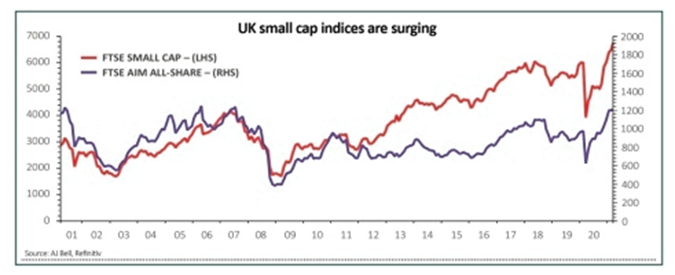
The UK’s FTSE Small Cap index currently trades at record highs, while the FTSE AIM All-Share stands near 20-year peaks. The latter is still well below its technology-crazed highs of 1999-2000. Equally, they are more geared into any local economic upturn.
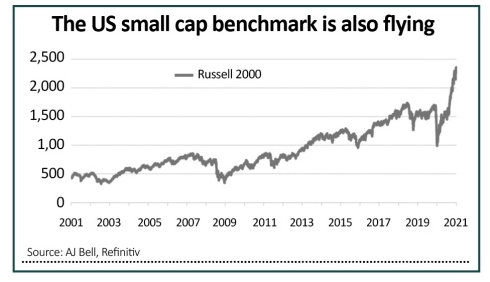
America’s Russell 2000 index, the main small cap benchmark in the US, is up 16% this year and by 116% over the past 12 months. That beats the Dow Jones Industrials, S&P 500 and NASDAQ Composite hands down on both counts.
In fact, the Russell 2000 now trades near its all-time highs, having gone bananas since last March’s low. Such a strong performance suggests that investors are in ‘risk-on’ mode and pricing in a strong economic recovery for good measure.
Rising Prices
One data point which does not sit so easily with the US small cap surge is the slight pullback in America’s monthly NFIB smaller businesses sentiment survey, which still stands 12 percentage points below its peak of summer 2018.
This indicator must be watched in case it does not pick up speed as America’s vaccination programme continues and lockdowns are eased. Further weakness could suggest the recovery might not be everything markets currently expect.
Equally, inflation-watchers will be intrigued by the NFIB’s sub-indices on prices. In particular, the balance between firms that are reporting higher rather than lower prices for their goods and services, and especially the shift in mix towards smaller companies that are planning price rises rather than price cuts.
If both trends continue, then bond markets could just be right in fearing that an inflationary boom is upon us.
Interest rates on the move
The number of interest rate rises continues to gather pace on a global basis. Last month there had already been five hikes this year in borrowing costs, in Zambia, Venezuela, Mozambique, Tajikistan and Armenia. There have now been six more – Kyrgyzstan, Georgia, Ukraine, Brazil, Russia and Turkey.
The 11 rate increases we’ve seen year to date is already two more than in the whole of 2020.
In contrast, the US Federal Reserve is content to sit on its hands despite what is happening elsewhere. Chair Jerome Powell continues to reaffirm the American central bank’s commitment to running its quantitative easing scheme at $120 billion a month, while any plans to increase interest rates from their record lows seem to be on hold until 2024.
Powell does not seem concerned about inflation and is seemingly willing to risk its resurgence to ensure that the economy gets back on track in the wake of the pandemic.
Yet financial markets are still taking the view that a strong upturn is coming, because US government bond prices are currently going down, and yields are going up, regardless of what the Fed says. That is a huge change from the last decade or so, when bond and stock markets have been happy to slavishly take their lead from central bank policy announcements.
Please continue to utilise these blogs and expert insights to keep your own holistic view of the market up to date.
Please see the article below from Invesco which we received on Friday afternoon – 26/03/2021
China to see significant growth in ESG investments
Highlights
+ Invesco Fixed Income expects responsible investing to accelerate in China in 2021.
+ Recent developments have encouraged Chinese issuers and investors to adopt social investing principles, including growing Chinese government support, large-scale green financing needs, and evidence that ESG-related investments have performed well relative to non-ESG investments.
+ Europe and the US have been early adopters of ESG principles, but we expect Asia, and especially China, to gain ground in the coming year.
Responsible investment has taken centre stage in the global investing and finance arena after years of evolution. The number of global investor signatories to the United Nations Principles for Responsible Investment (UN PRI)1 topped 3000 in 2020, up from 63 in 2006 (Figure 1). Total assets under management represented by the signatories exceeded USD100 trillion in 2020 (Figure 1). We expect responsible investment to grow exponentially in the next few years, reshaping the landscape of the global financial industry. Europe and the US currently play leading roles, but we believe 2021 will be an important year for environmental, social, and governance (ESG) adoption in Asia, especially in China.
In this article, we take a detailed look at the top-down drivers of growth in ESG adoption in China and their potential impact in the coming year.
Key themes for 2021
We have identified three key themes likely to drive momentum in responsible investing in China in 2021:
1. Chinese government and regulator-led efforts will likely gain traction among fixed income issuers and investors. An estimated USD100 trillion2 of climate-compatible infrastructure investment is required globally between now and 2030 to meet Paris Agreement greenhouse gas emission reduction targets. A large portion of these investments will likely take place in Asia and in China, in particular. We expect 2021 to be an important year in this effort. According to Governor Yi Gang of the People’s Bank of China (PBoC), the value of China’s onshore green lending and green bond issuance reached record levels in the third quarter of 2020, totaling RMB11.6 trillion3 (USD1.8 trillion) and RMB1.2 trillion4 (USD186 billion), respectively. Chairman Xi Jinping set a key milestone in September 2020 when he announced China’s objective to meet stricter greenhouse gas emission standards by 2030 and intentions to achieve a zero-carbon economy by 2060. This is the first time the Chinese central government has committed to a zero-carbon target. PBoC Governor Yi Gang later stated that China would work to enhance its green finance standards and explore the introduction of mandatory reporting of environmental risks by financial institutions. These announcements coincided with the government’s mid-year announcement of its economic stimulus package to combat the COVID-19 crisis. It emphasized advancing the adoption of green technology and upgrading urban infrastructure to mitigate the risks of pollutants and contaminants to the general public. Chinese regulators also set a goal for mandatory ESG disclosure by listed companies by the end of 2020, now expected to be 2021 due to the pandemic. These are major steps toward the development of ESG principles in China and the building of a green financial and clean energy system, especially since China’s state-owned enterprises and central planning play a significant role in the nation’s economic and financial activities. These PBoC and regulator-led efforts could narrow the gap that currently exists between Chinese domestic and international ESG reporting standards, which could attract international ESG investors.
2. Total ESG investment and financing will likely continue to set records globally. The issuance of green bonds will likely overtake the social bond issuance that took place following the impact of COVID-19 in Asia. The value of global assets that apply ESG data to drive investment decisions has almost doubled over the last four years to USD40.5 trillion in 2020, according to research firm Optimas.4 Morningstar has reported that sustainable funds broke records in Europe, the US, and Asia in the first nine months of 2020 (defined as ESG integration, impact, and sustainable-oriented funds) in terms of net inflows and total assets under management. Europe and the US attracted USD61.6 billion5 and USD30.7 billion6 in inflows, respectively, reaching USD1 trillion and USD179.1 billion in net assets (Figure 2). In terms of ESG bond issuance (green, social, sustainable, and sustainability-linked securities), the European, US, and Asian markets issued USD254 billion, USD79 billion, and USD77.2 billion, respectively (Figure 3), breaking records in their corresponding regions. These figures demonstrate a strong and consistent global trend in ESG asset growth and the potential for Asian nations, especially China, which is the largest ESG bond issuer in the region, to catch up with global leaders.
In 2020, Asia saw a pause in green bond issuance, largely due to the shift toward social bond issuance, as many countries issued social bonds to finance COVID-19 containment. We expect the decline of green bond issuance to reverse in 2021 as environmental issues and goals return to the forefront of long-term societal objectives. The sustainable investment think tank, Climate Bonds Initiative, expects China to require RMB3 trillion to RMB4 trillion6 (USD462 billion to USD620 billion) in green investment annually by 2030. Over the longer term, we expect China to play a leading role in green financing, especially considering the government’s commitment to carbon neutrality and clean energy in the coming decades.
3. ESG investments will likely be more resilient than, or outperform, non-ESG investments in 2021, based on empirical research. In a 2020 study, Invesco Fixed Income found that Asian green bonds outperformed the BofA Asian Corporate Bond Index by 120 basis points during the four-month window surrounding the March 2020 market sell-off.7 The general outperformance of green bonds globally has been studied by numerous other institutions as well. The Climate Bond Initiative, which published a quarterly study on green bond markets as early as 2016, found a general green bond premium across corporate bonds denominated in different currencies. A study by MSCI looked at corporate bond data from January 2014 to July 2020 and concluded that companies highly rated for ESG factors outperformed companies with low ESG ratings.
The outperformance of ESG-themed investments is broad-based and not limited to fixed income investments. ESG equity funds have generally outperformed in the Chinese domestic market, for example. The Ping An Insurance Group found that the annualized returns of ESG and pan-ESG concept equity funds were 47.1% and 56.4%, respectively, both outperforming the average return of 42.2% for overall equity funds.9 In the past 12 months, the MSCI China Environment Index rose 109%,10 driven by its holdings of electric vehicle makers.
We believe the growing empirical evidence of past outperformance of green bond and ESG-based investments will motivate investors to focus greater attention on responsible and ESG-themed investments. PricewaterhouseCoopers has suggested that ESG investment is likely to be the most significant development in money management since the creation of the ETF two decades ago. It forecasts that ESG will reshape finance and make up 41%-57% 11 of total managed investments by 2025. Given Asia’s potential to catch up to global peers, we believe ESG investing and finance will present a particular opportunity in Asia, and especially China.
Conclusion
We expect the trend toward responsible and ESG investment to accelerate globally, especially in China, over the next five to 10 years due in part to the world’s large-scale green financing requirements and a growing investor base and awareness. A high growth phase of responsible and ESG investment in China will likely be fueled by Chinese government policy support, substantial green financing requirements and the growing empirical evidence that ESG investments may be more resilient than and potentially outperform non-ESG investments.
A good input from Invesco, looking into ESG investment in China which is expected to increase significantly over the next 5 to 10 years, especially with evidence that ESG-related investments have performed well in relation to non-ESG investments.
Please continue to check back for further ESG related content, along with our usual market commentary and blog updates.
Please see below article received from AJ Bell yesterday afternoon, which presents the advantages of investing in emerging markets. The commentary advises that there is more scope for growth in this area due to large populations having no access to banking services.
In the developed world the banking and wider financial industry is very mature with limited avenues for rapid growth and the focus from an investment perspective is typically on the income they pay out – subject to regulators’ approval.
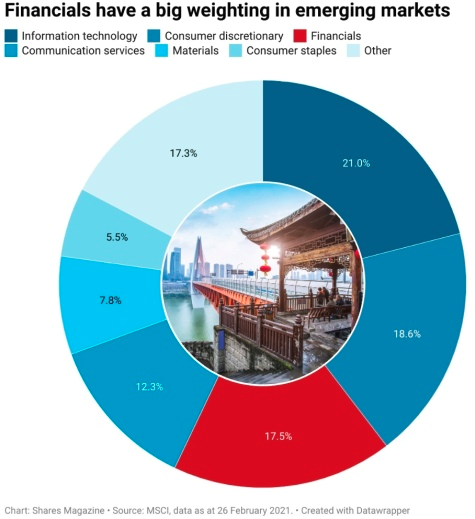
Financial stocks in emerging markets are, on the whole, quite different. While technology firms have increased in importance in recent years, financial stocks remain a key component of the emerging markets story with the MSCI Emerging Markets index having a 17.5% weighting to this sector.
In contrast the MSCI World developed markets index has a weighting of 13.6% to the financial sector.
According to a 2017 report from the World Bank about 1.7 billion adults globally and 58% of people in developing nations remained ‘unbanked’ – although there is considerable diversity across different geographic regions.
Capturing these customers should allow emerging market financial firms to grow more rapidly than their counterparts in the West. It explains why Prudential (PRU) has pivoted away from markets in Europe and the US to focus more on Asia.
The question of how these unbanked customers are reached is an interesting one with financial technology and mobile payments, in particular, likely to play an increasing role.
The same 2017 World Bank report commented: ‘The benefits from financial inclusion can be wide ranging. For example, studies have shown that mobile money services — which allow users to store and transfer funds through a mobile phone — can help improve people’s income earning potential and thus reduce poverty.’
Please check in again with us soon for further market analysis and news.
Please see the below article published by Royal London, then our closing comments in blue:
Setting aside money for a rainy day can help tide you over in difficult times and provide some financial security when you need it most.
What is an emergency fund?
This is money you save to pay for the unexpected, whether that’s a bill you hadn’t planned for or a change in your circumstances such as if you lose your job or are unable to work due to illness. This cash is often called rainy day money.
Why you should have an emergency fund
If you have money set aside for emergencies, you’re far less likely to experience financial difficulties or have to borrow at a high interest rate if things go wrong or your circumstances change. Knowing you’ve got some money tucked away might help you sleep better at night too.
Deciding how much you need
This depends on several things such as your circumstances, the sorts of emergencies you might face and how much insurance protection you already have.
For example, someone with a family, mortgage and loans is likely to need a larger emergency fund than a single person with no children who lives in rented accommodation and has no debts. This is because they have more financial responsibilities and dependants to look after. That’s not to say that if you’re single with no dependants you don’t need an emergency fund. Everyone should keep some spare money available – it’s just a question of how much.
If you have insurance to cover certain losses or expenses, this might affect how much you need in your emergency fund. For example, you may have house, car or dental insurance which would cover you for some emergencies and expensive bills. Or you may have insurance which would provide you with an income or pay some of your bills if you lost your job or were unable to work due to illness. In these cases you might only need enough in your emergency fund to tide you over until these payments kicked in.
But the general advice is to have enough money in your emergency fund to cover your expenses for at least three months. So, if your monthly expenses are £2,000 you might want an emergency fund of £6,000. If this seems like a daunting amount to aim for, don’t be put off. Remember that having some savings, however small, is better than having nothing. Why not try setting your own goal to save a set amount by the end of year? Aim for a challenging but achievable amount.
How to build an emergency fund
Saving regularly is a good way to build up an emergency fund. You’ll find that if you get into the habit of saving each month your savings will soon mount up. See our tips below to help you save.
Some people like to have more than one emergency fund. For example, one fund might be to replace income if you’re unable to work and another to cover any unexpected one-off or larger-than-expected bills. There’s no right or wrong way of doing this, just choose the method that suits you best.
Tips to help you save
Make it simple: Set up a monthly transfer so that money is automatically taken from your current account and put into a savings account.
Time it right: Set the transfer so it goes out of your bank account straight after you get paid or get your pension or benefits.
Keep your savings separate: By keeping your savings in a separate account from your everyday spending you’ll be less tempted to spend them.
Check your spending: If you don’t think you can afford to save, try closely monitoring your spending for a month or two. You may find areas you can cut back on. If you haven’t reviewed your bills like your house and car insurance or your energy or mobile phone deal recently, you may be able to free-up money by switching to a cheaper deal.
Save first: If you get a pay rise, think about saving some of it before you get used to having the extra cash.
Where to keep your rainy day money
Regardless of how many emergency funds you choose to have, the money should always be easily accessible such as in an easy access savings account or instant-access cash ISA. Avoid accounts where you have to give a long period of notice to take your money out.
If you are on certain benefits, you will qualify for the government’s Help to Save account which pays a generous tax-free bonus to help boost your savings. You’ll get 50p for each £1 you save over four years, although there are limits on the maximum bonus you can get. For example, you can only save up to £50 a month into the account. To find out if you’re eligible and for details of the bonus, go to Gov.uk.
What if I’ve got debts, should I still save?
It depends on what kind of debts you have. If your debts are manageable and low cost, this shouldn’t hold you back from starting a rainy day fund. Having some savings set aside will mean you won’t have to fall back on expensive borrowing if you do have an unexpected expense.
If you’ve got expensive debts such as credit card or overdraft debt, arrears on your mortgage or a payday loan, you might want to think about using any spare money you have to pay off these first. The Money and Pensions Service has some useful guidance on whether to save or pay off debts first.
This is a really good article from Royal London and highlights the importance of a rainy day fund.
Last year was the ultimate rainy day for some people who perhaps lost their jobs, were furloughed or the self employed whose income may have dropped.
Having money set aside in easily accessible accounts is key for emergencies and unforeseen circumstances.
Royal London suggest in this article having at least 3 months expenditure set aside however this should be your starting point, we would recommend aiming to have a years expenditure as your emergency fund, especially in the run up to retirement for example.
Look at what the past year taught us, nobody expected it and nobody was prepared so if you haven’t already got an emergency fund, start building one now, that rainy day could be just around the corner!