‘I have known Steve in a professional capacity for over 20 years.
He has always been a pleasure to deal with. When he ventured into his own business I was eager to place my pension provisions with him and to retain his expertise as my Independent Financial Adviser.
He is always very professional and totally objective, he treats me with dignity and respect, I totally trust Steve.
When dealing with the office staff, again they are always helpful and polite, if I am just leaving a message or asking for advice, the answer is professional and objective.
I have and will continue to recommend Steve and the company to friends and colleague who are in need of financial guidance and advice.
If any prospective client would like to speak to me directly I am happy to facilitate’
Please see below this weeks update on markets from Brewin Dolphin. This update was received late yesterday afternoon:
Please continue to check our Blog content for advice and planning issues and the latest investment, markets and economic updates from leading investment houses.
Please see below this week’s Market Commentary from Brooks Macdonald, received late yesterday afternoon – 22/03/2021
Weekly Market Commentary | EU leaders to meet this week as concerns continue over vaccination pace
Weekly Market Commentary
COVID-19 updates
By Edward Park
Bond yields remain the primary driver of risk assets as central bank meetings conclude
Purchasing Managers’ Index (PMI) data to be released on Wednesday will highlight the relative successes between Europe and the US
Thursday’s European summit is likely to focus on the vaccine rollout and COVID-19 cases
Bond yields remain the primary driver of risk assets as central bank meetings conclude
Bond yields continued to climb last week with the effect that the US index closed marginally down but the European market, with a greater weighting to cyclicals, eked out a small gain for the week.
Purchasing Managers’ Index (PMI) data to be released on Wednesday will highlight the relative successes between Europe and the US
With a week of major central bank meetings behind us (though Powell and Yellen are speaking to Congress on Tuesday and Wednesday), markets are likely to start taking their direction from economic data. On Wednesday, flash PMI (economic survey) data will be released from around the world. Of note will be the headline differential between the US and European PMI data. US data is expected to be helped along by imminent stimulus cheques and loosening COVID-19 restrictions. By contrast, European countries are moving the other way with their COVID-19 cases and lockdowns are being announced across the continent.
Thursday’s European summit is likely to focus on the vaccine rollout and COVID-19 cases
On Thursday, EU leaders are holding their latest European Council summit in Brussels and, more than likely, COVID-19 and the vaccine rollout will feature heavily on the agenda. Having previously been held as a beacon of European solidarity during the COVID-19 pandemic in 2020, the European Commission’s strategy of joint vaccine procurement and delivery continues to be judged by many as being too slow and bureaucratic. The shortfall of pace of immunisation among the EU member countries versus the likes of the US and UK remains stark. Risking a rise in vaccine nationalism, the European Commission President von der Leyen has refused to rule out using Article 122 of the EU treaty. Article 122 would, in theory, allow the EU to take control of the production and distribution of vaccines, potentially placing export controls on vaccines that had been destined elsewhere, such as the UK.
While ultimately our expectation is that the vaccine lag for the EU will last maybe one or two quarters at most, it risks keeping EU member countries’ economies in various degrees of more stringent lockdown. At the same time, the length of time it is taking to effect fiscal spending disbursements from the EU’s Recovery Fund, which was agreed in July 2020, is also risking a later recovery path than what is currently expected in some other countries globally.
A good update from Brooks Macdonald on recent economic data and market news.
Please continue to check back for our latest updates and blog posts.
Please see below for one of AJ Bell Youinvest’s latest Investment Insight articles, received by us yesterday 21/03/2021:
New consumer research* by Opinium for AJ Bell shows Cash ISA savers are holding high levels of cash, and aren’t switching accounts looking for better rates, partly because they think they’re getting more interest than they probably are.
We know that since the start of the pandemic, many savers have been all cashed up with nowhere to go. But our research shows that cash hoarding isn’t just a recent phenomenon, it’s been happening for some time, and reflects a natural aversion to taking risk with money that has been hard-earned.
It’s definitely prudent to build up a cash buffer to deal with any unexpected costs, particularly in uncertain times. But Cash ISA savers may well be doing themselves a disservice by holding too much money in cash, opening themselves up to inflation risk, and missing out on the potentially higher returns available from investments. As stock market investors need to avoid irrational exuberance, so cash savers should be wary of excessive prudence.
Over the last ten years, the average Cash ISA has turned £10,000 into £9,770 after factoring in inflation, while in contrast, an investment in the global stock market has turned £10,000 into £20,760 in real terms.** Looking at returns from 1899, Barclays found that over ten years, UK equities have beaten cash 91% of the time. Given that today cash interest rates are at record lows, it would have to be an extremely anomalous decade for the next ten years to buck that trend.
Cash ISA savers aren’t shopping around for the best rate a great deal either. Much of their apathy can be attributed to ultra-low interest rates, but part of it may simply be that they haven’t checked the rate they’re getting. Our survey found that on average Cash ISA holders hadn’t reviewed their rate for two and a half years, over which time the average Cash ISA interest rate has more than halved, from 0.9% to 0.4%.
Not all rates move in step though, and individual savers can suffer as a result of their provider slashing rates more aggressively than the rest of the market, hence why it continues to make sense to shop around. For instance, last November, savers in NS&I’s Direct ISA saw their interest rate cut from 0.9% to 0.1%, while the best rates on the market are around 0.5%.
Even the top rates on offer aren’t exactly going to set pulses racing, but switching can mean hundreds of pounds extra for those with large amounts held in Cash ISAs. At the very least Cash ISA savers should find out what rate they’re getting right now, to make an informed decision on whether it’s worth moving on.
All cashed up and nowhere to go
Our survey shows Cash ISA savers reported holding on average £27,727 in their accounts. That’s enough to pay for 11 months of household expenses, which come in at £2,538 on average according to the ONS.*** When you consider that many households will contain two Cash ISA holders, and may also own other cash products like savings accounts and Premium Bonds, that suggests that savers have enough built up to deal with any emergency spending, and then some. On top of that, 6 out of 10 (59%) or respondents said they intended to add more to their Cash ISA in this tax year or next, no doubt in part thanks to the pandemic savings turbo-charging cash balances, as spending options have dried up.
While this is encouraging from the point of view of short term financial security, it does mean savers are sitting on cash for the long run, missing out on potential returns from other assets, and seeing the buying power of their cash eroded by inflation. Clearly there is a balance to be struck here between having a robust safety net, and seeking higher returns by investing in the stock market, which can lead to a loss of capital in the short term. Typically, savers should seek to have 3 to 6 months of expenses in cash to deal with any emergencies, beyond that they should seek to tilt the balance between security and return more towards the latter.
Three to six months of expenses equates to £7,613 to £15,226 for the average household, which may well have two Cash ISA savers in it. This broadly ties in with the view expressed by the FCA in December, that those with more than £10,000 held solely in cash were missing out on the historically higher returns from investing their money, and opening themselves up to inflation risk.****
There are some reasons why you might want to hold more than six months of expenses in an ISA, namely if you are saving for a specific goal, for instance a house deposit. This probably explains a surprising kink in the data, which shows that younger savers actually have more held in Cash ISAs than older generations.
Broadly speaking, if you think you may need access to your money within five years, then cash might be the best option. If you’re putting money away for five to ten years, then you should start to think about putting at least some of it in the stock market. If you’re putting cash away for more than ten years, then an approach that invests more heavily in the stock market is likely to yield significantly better results.
Cash ISA inertia
Cash ISA savers aren’t paying a great deal of attention to the rate they’re getting, and who can blame them, seeing as picking cash products right now is about selecting the least worst option. Our survey found that on average Cash ISA holders hadn’t reviewed their rate for two and a half years, over which time the average Cash ISA interest rate has more than halved, from 0.9% to 0.4%, according to Bank of England data. Worryingly, almost a quarter of Cash ISA savers (23%) said they hadn’t reviewed their cash ISA rate for 5 years or more. This goes some way to explaining why 25% of Cash ISA savers reported getting over 1% interest, which looks unrealistically high in today’s market.
Despite holding a Cash ISA for an average of 8.5 years, 45% of Cash ISA savers said they have never switched provider. Half of these savers said it was because rates were so low, it didn’t seem worth it. That’s perfectly understandable, though for those with large sums in Cash ISAs offering poor rates, the difference can still be significant.
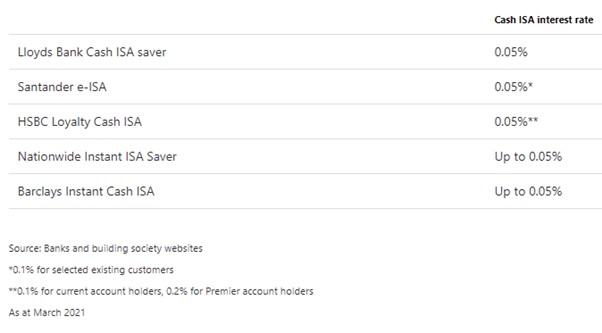
20% of Cash ISA savers said they held £50,000 or more in their Cash ISA. If they were picking up a high street rate of 0.1% (see table below) on £50,000, simply by moving to an account providing the average rate of 0.4% they could make an extra £150 a year. Not a king’s ransom, but worth having in your pocket rather than the bank’s. Particularly when you consider that at a rate of 0.1%, the total interest you are receiving is £50, and by moving to an account paying 0.4%, you would be quadrupling that amount to £200.
Selected high street instant access Cash ISA rates
Switching to a Stocks & Shares ISA
Half of Cash ISA savers surveyed (51%) said they had considered switching to a Stocks & Shares ISA. It used to be the case that you couldn’t cross the streams, but since 2014 you have been allowed transfer money from a Stocks and Shares ISA to a Cash ISA, and vice versa.
Doing so may be worthwhile if you feel you’ve got too much sitting in cash, earning next to nothing, and you’re willing to keep your money invested for the long term. You must be willing to tolerate falls in the value of your capital however, but the reward should be higher returns in the long run.
It’s important to always maintain a cash buffer for emergencies, three to six months of expenditure is the rough rule of thumb, but beyond this, you can start to think about investing in the market. Instead of transferring you might consider funnelling some of your new savings into a Stocks and Shares ISA, thereby gradually reducing your reliance on cash. Investing in the stock market bit by bit also helps to take the edge off the inevitable bumps in the road.
Please continue to utilise these blogs and expert insights to keep your own holistic view of the market up to date and for advice and planning tips.
As we reach the anniversary of the UK’s first national lockdown, please see below article received from AJ Bell yesterday, which reflects on how different parts of the market performed during the pandemic.
It was Warren Buffett’s mentor, Benjamin Graham, who once wrote: ‘The intelligent investor is a realist who sells to optimists and buys from pessimists.’ Such plain-speaking, common sense has yet again proved its worth over the past 12 months to offer a timely lesson to us all.
It is almost a year to the day (23 March 2020) since the FTSE 100 bottomed at 4,994 amid widespread fear over what the pandemic could do to global growth and corporate profits.
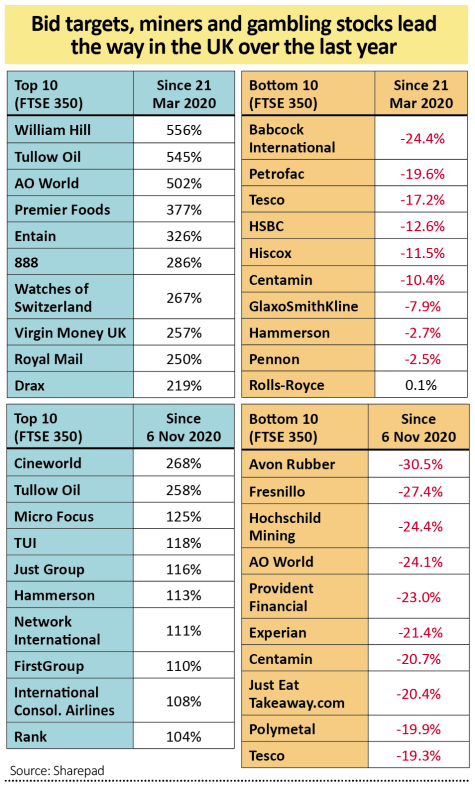
A year later and the picture is very different. Anyone brave enough to have started to take on more risk a year ago would have done remarkably well, as four data sets show. Investors now must decide whether these trends will continue, further changes in performance trends since ‘Pfizer Monday’ on 9 November will dictate or that a further shift in gear is imminent.
GLOBAL ASSET CLASSES
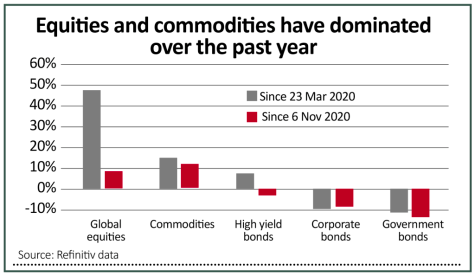
Fear may have dominated a year ago, but equities have been the best place to be over the past 12 months. As benchmarked by the MSCI All World index, global stocks have beaten commodities and bonds. Government bonds, in theory a port in a storm, have provided no shelter with capital losses more than offsetting any yield that they offered.
There have been subtle changes since November. Commodities have taken the lead from equities and high yield bonds have started to flag. Meanwhile, the rout still seems to be on when it comes to investment-grade corporate and government bonds.
STOCK MARKETS
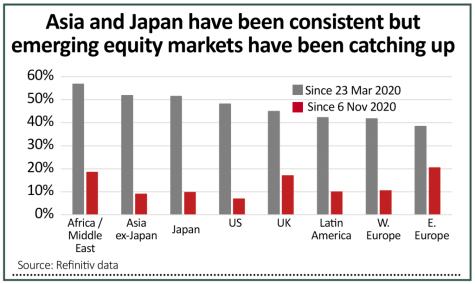
Unlike bonds, where all major categories have fallen on a one-year view, all geographic equities options have gained. Asia and Japan have performed consistently well, perhaps thanks to the relatively low number of pandemic cases they have suffered and their rapid, robust approach to test, track and trace as well as containment.
America’s domination of early 2020 has faded and it is prior laggards who have come to the fore – emerging markets and even the unloved UK equity market has put on a spurt, finding itself outpaced by just Eastern Europe and the Africa/Middle East region since November. This may be down to the perception that the UK is ahead of the game when it comes to vaccination programmes, having previously struggled to contain the virus.
EQUITY SECTORS
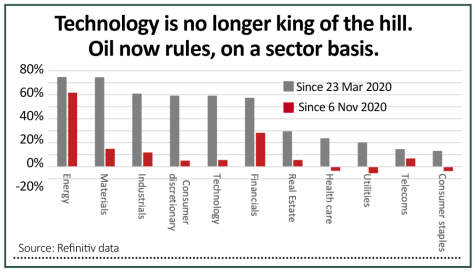
Technology continues to grab the headlines, especially as a raft of new initial public offerings tempts investors’ wallets. But miners, industrials and consumer discretionary stocks have all beaten tech over the past 12 months and oil has been the best performer of the lot, to reaffirm the adage that the darkest hour is before the dawn.
Meanwhile, sectors that looked reliable going into a pandemic – utilities, consumer staples and even healthcare – have lagged, a trend that has become ever-more noticeable since the Pfizer-BioNTech announcement of last autumn.
UK STOCKS
These ‘big picture’ trends – a switch from defensives to turnaround plays, from ‘growth’ (and promises of long-term secular growth, or ‘jam tomorrow’, almost regardless of the economic backdrop) to ‘value’ (cyclicals that offer growth now, or ‘jam today,’ in the event of a recovery), from pandemic winners to bounce-back candidates can be seen on a bottom-up basis in how individual UK-quoted stocks have performed
That said, it has been hard to lose money since last year’s panic. Just nine of the FTSE 350’s current membership have lost ground over the last 12 months.
These trends have become even stronger since Pfizer Monday. Beneficiaries of an economic reopening dominate the leaderboard, notably travel and leisure stocks. The laggards include online delivery plays, precious metal miners, pharmaceutical plays and previously dependable names where investors may have paid too high a valuation, and thus mistaken reliability of earnings for safety of share price. Pay the wrong valuation and nothing is safe.
CONCLUSION
No-one will time a market bottom or top perfectly and trying is a mug’s game. But the trends of the past year show how investors can calibrate risk and earn rewards over time by going against the crowd, focusing on valuation and not getting carried away.
The best approach now could be to heed the words of another investment legend, Sir John Templeton: ‘Bull markets are born on pessimism, grow on scepticism, mature on optimism and die on euphoria.’ It is perhaps time to once more research those areas of which investors are frightened and tread carefully where fear of missing out predominates.
It will be interesting to see how markets and economies react to the easing of restrictions over the next few months. Please check in again with us soon.
Please see the below article from AJ Bell received late yesterday afternoon:
German auto maker has grand plans for global EV market
In August 2020 we flagged German auto maker Volkswagen as a value play at €139, since when the stock has gained more than 40%.
Its shares have been particularly strong this year as the firm rolls out its electric vehicle strategy, culminating in this week’s ‘Power Day’.
In contrast, electric vehicle specialist Tesla has had a torrid time this year with shares tumbling from $900 in January to a 2021 low of $563.
VW has grand plans for a big electric vehicle push. As well as reducing the cost of ownership in the space it is investing heavily in new battery technology to improve range and in new charging networks to improve ease of use.
The company aims to reduce battery prices to below €100 per kilowatt hour through a combination of advanced cell design and lower manufacturing costs, all while using green energy.
Beginning with a €14 billion investment in Sweden with partner Northvolt, VW aims to have six gigafactories in Europe by 2030 with a combined capacity of 240 gigawatt hour.
More significantly, VW has partnered with BP, Spanish utility Iberdrola – a world leader in green energy – and Italian utility ENEL to install 18,000 new high-power charging stations across Europe.
The current lack of infrastructure is seen as a key reason for the slow mass adoption of electric vehicles. By working jointly to create a network of renewable-powered rapid-charging stations, each company gets closer to its net-zero goals to boot.
However, VW has even grander plans. All of its electric vehicles come with a home-charging station called Elli. When parked and connected to the Elli Cloud, a VW ID.3 becomes a ‘mobile power bank’ capable of feeding power back to the house for up to five days.
Using intelligent management systems, energy could be transferred to the vehicle during off-peak hours and transferred back to house when needed.
Not only would this save wasting renewable electricity – last year Germany wasted 6,000 gigawatt hours of renewable energy due to lack of storage – when rolled out to commercial and industrial customers it could drastically reduce the cost of expanding transmission networks.
Renewable energy is likely to be an area of rapid growth over the next few years. As the world navigates its way out of the Covid-19 pandemic, the world has been left with food for thought about how to make the planet better and how to sustain it. Companies around the world are adapting to renewable energy sources.
We regularly post a variety of ESG content, both our own and articles from a range of fund managers, and renewable energy is a key consideration in this (the E in ESG, E – Environmental).
This is definitely an area to watch!
Keep checking back for a range of blog content from us, from ESG outlooks, to market updates and insights, both our own original content and input from a wide range of fund managers and investment houses.
Please see below article received from Jupiter Asset Management yesterday afternoon, which comments on how major central banks are grappling with their reaction to rising bond yields, with the European Central Bank being the first to break ranks.
UK GDP shrank 2.9% in January, rather better than the 4.5%-5% contraction feared in the consensus estimate, bearing in mind not only the first full month of new Covid restrictions after Christmas but also the dislocation in the movement of imports and exports following Brexit on December 31st. The anecdotal ‘fast’ data, monitoring day-to-day consumer patterns (e.g., traffic congestion, credit card usage, electricity consumption etc) had suggested that Lockdown 3 would be less economically sensitive than its predecessors, and while a near 3% decline in normal circumstances would be a horror, it says much that it is a relative triumph of resilience when compared to the 20% economic decline recorded in April 2020.
Andrew Bailey, Governor of the Bank of England, still believes the economic outlook is good (the Bank’s “coiled spring”) but speaking at a symposium this week, he said that he would need to see evidence of prolonged excess inflation above 2% to require interest rates to be raised to cool any potential heat. In the meantime, he is still preparing the implementation of negative interest rates should the economy falter again. Among many mixed messages here, and despite markets’ scepticism reflected in higher bond yields (and therefore more expensive financing costs), he is effectively saying “I have all bases covered, and until anyone says otherwise, I propose to do nothing”.
The ECB, on the other hand, has broken ranks with the US Federal Reserve and the Bank of England and has responded to the challenge of rising bond yields (or more accurately, less negative yields in the case of Germany and Holland) and borrowing costs in the eurozone: it pledged to step up its QE programme with yet more incremental bond purchases on the simple premise that if demand exceeds supply, prices will rise and yields will fall. For the first time in two months eurozone yields have responded by moving in the opposite direction to their Anglo-Saxon counterparts.
The geopolitical risks of decarbonisation
As US Congress passes President Biden’s $1.9 billion Covid-recovery package, on top of the equally massive programmes implemented last year under Donald Trump’s administration, the political and fiscal spotlight is falling on the budgets of those departments which can be used to help fund such expenditure while relieving the pressure on government finances. Much the same is happening here in the UK, and in both instances defence spending is in the rifle crosshairs. As a barometer of the passion the subject excites, Bernie Sanders’ senate performance a few days ago was instructive: on full tub-thumping form, he made the social case for slashing defence dollars to “feed our people, put clothes on the backs of poor Americans”, to help realise their “expectations of, their right to, a better standard of living and higher wages!”. With Biden more understatedly making much the same case, the Chair of the Senate Budget Committee is clearly pushing on an open door among the Democrat leadership.
In the UK, Boris’s announcement in December of an additional £16 billion of spending on cyber and space defence comes at a price, largely thanks to the £17 billion ‘black hole’ in the MoD accounts. Robbing Peter to pay Paul, hence yet another Treasury-led defence review in the offing and a suggested reduction in the establishment of the Army from 82,000 to 72,000 (not quite enough soldiers to fill Old Trafford, let alone Wembley).
Why is this of relevance? Defence strategists are pointing to the opportunities and threats arising from the global decarbonisation programme. As the ice caps shrink at both poles thanks to global warming, Greenland and the Antarctic become viable for mining, being rich in the rare-earth minerals and ores increasingly in demand as the digital and decarbonisation revolutions gather pace. Not only those landmasses: it has also been suggested that mining the seabed in the deep, deep ocean, particularly in regions of high tectonic and volcanic activity where those same ores and minerals abound, is now a commercial possibility. And returning to the far north, as the pack ice retreats and becomes less enduring, so there is the possibility of year-round trans-polar maritime routes. The US, China and Russia are all sizing up the opportunities and the threats, each keeping a beady eye on the others’ movements, reading the signals of intent. Both China and Russia are investing heavily in naval capabilities (China now has the largest navy in the world, though lags well behind the US in aircraft carriers) and, while nobody is predicting a hot war, the potential for diplomatic or military stand-offs over strategic maritime assets is only likely to grow. While many treated Donald Trump’s unsubtle overtures to ‘buy’ Greenland from Denmark as a joke, in reality he was deadly serious. In the North Atlantic, Denmark becomes a key strategic player through its ownership of both Greenland and the Faeroe Islands, the latter already becoming one of the most secretive and sensitive of NATO’s watching and listening posts, keeping tabs on both the Russians and Chinese.
From an investment standpoint, while peripheral to current events and pre-occupations, however glacially and imperceptibly, these new and growing risks will be factored into longer-term risk premia.
We will continue to publish market updates and analysis, so please check in again with us soon.
Please see below the latest ‘Markets in a Minute’ article from Brewin Dolphin received late yesterday afternoon – 16/03/2021.
Equities reach new highs as bond yields retreat
Global equities performed strongly last week, as bond yields retreated and investors turned their attention to encouraging economic data.
Most of the major US benchmarks reached new all-time highs. The Dow soared 4.1%, while the Nasdaq gained 3.1% and the S&P 500 added 2.6%. Tesla and other high-growth stocks enjoyed strong gains as fears about higher interest rates subsided.
Stocks in Europe were boosted by the passing of US president Joe Biden’s $1.9trn stimulus bill, as well as the European Central Bank’s pledge to speed up its emergency bond purchasing programme to counter rising borrowing costs. The pan-European STOXX 600 gained 3.5% and Germany’s Dax surged 4.2%.
The FTSE 100 ended the week nearly two percentage points higher, after data showed UK economic output fell by 2.9% between December and January – less than economists’ forecasts of a 4.9% contraction. Over in Asia, China’s Shanghai Composite slipped 1.4% amid concerns that authorities could reduce stimulus measures as the economy recovers.
Last week’s market performance*
FTSE 100: +1.97%
S&P 500: +2.64%
Dow: +4.07%
Nasdaq: +3.09%
Dax: +4.18%
Hang Seng: -1.23%
Shanghai Composite: -1.40%
Nikkei: +2.96%
*Data from close on Friday 5 March to close of business on Friday 12 March.
Wall Street rallies ahead of consumer spending spree
US stocks rallied on Monday as the roll out of stimulus cheques over the weekend fuelled expectations of a consumer spending spree. After a whipsaw session, the S&P 500 ended the day up 0.64%, reaching a new all-time high of 3,968.77. The Nasdaq rose 1.1% after technology shares recovered lost ground.
European shares ended Monday on a mixed note, following negative headlines around the Continent’s vaccination efforts and the safety of the AstraZeneca-Oxford vaccine. The STOXX 600 was flat at 423.1, while Germany’s Dax slipped 0.3%.
The FTSE 100 dipped 0.2% as commodity stocks, including BP, Royal Dutch Shell and BHP, underperformed. Bank of England governor Andrew Bailey said he expected inflation to approach the 2% target soon, but that he was cautious about whether the trend was sustainable amid continuing economic uncertainty. Ipsos MORI’s latest political monitor found 43% of Britons think the economy will improve over the next 12 months, while 41% think things will get worse.
The FTSE 100 was up 0.6% at Tuesday’s open, with investors optimistic that the US Federal Reserve will maintain a dovish stance on interest rates at its meeting this week.
US economic data cheers investors
Last week saw a raft of encouraging economic data from the US. Initial weekly jobless claims fell to their lowest level since November, at 712,000. Continuing claims dropped to 4.1m, their lowest level in a year. This helped to fuel a jump in the University of Michigan’s preliminary consumer sentiment index from 76.8 at the end of February to 83.0 in March.
The US is also progressing well in its roll out of Covid-19 vaccines, administering a new high of five million doses over the 6-7 March weekend. On Thursday, Biden told states to make all American adults eligible for vaccines by 1 May and set a goal of 4 July for gatherings to celebrate ‘independence’ from the pandemic. On the same day, Biden signed into law the $1.9trn American Rescue Plan Act, which provides $1,400 direct payments to individuals making up to $75,000 annually, $350bn in aid to state and local governments, and $14bn for vaccine distribution.
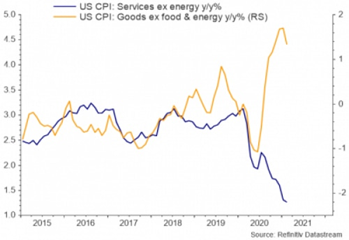
Last week’s US consumer price index (CPI) revealed an acceleration in the headline CPI, driven by rising commodity prices. Goods inflation rolled over slightly on a year-on-year basis in February, but services inflation continued to move lower.
The data highlights how the pandemic has, in aggregate, negatively impacted services demand while bolstering demand for tangible goods.
UK economy shrinks less than expected
The UK economy shrank by less than feared in January, despite the country re-entering lockdown. Gross domestic product was 2.9% lower than in December, according to the Office for National Statistics. Economists polled by Reuters had expected a contraction of 4.9%.
Following the latest data, economists are now predicted a 2% contraction in the first quarter of 2021 – half the 4% hit forecast by the Bank of England only last month. Retail sales figures also brought some cheer, with sales growing by 1.0% year-on-year in February following a 1.3% decline in January.
On the flipside, exports of goods to the EU slumped by 40.7% in January, while imports plunged by 28.8%. These are the largest drops on record, although there was a delay in gathering some data and there were signs of a pick-up towards the end of the month.
Chinese market continues sell-off
The sell-off in Chinese stocks continued last week, resulting in the CSI 300 posting its sharpest correction since the height of the Covid-19 crisis in March last year.
Alongside this sell-off has been a global rotation away from growth stocks into value stocks. In the last couple of years, China has increasingly become a growth-exposed equity market. Electric vehicle maker NIO has sold off almost 40%, and ecommerce companies Pinduoduo and Meituan have both sold off more than 30%.
Concerns about liquidity and credit stimulus are driving the sell-off. To prevent asset bubbles and contain ballooning debt, it is expected that the authorities will raise interest rates and restrict credit. However, with China heading into the centenary of the Chinese Communist Party in July, it is likely that the authorities will go slow in terms of withdrawing stimulus.
The so-called ‘national team’, which includes the sovereign wealth fund, state affiliated brokers, and the national social security fund, will also be on hand to limit the downside to major corrections.
Another quick update from Brewin Dolphin, regular market updates like this are useful for keeping up to speed with developments in the markets.
Please continue to check back for our regular blog posts and updates.
Please see below a blog received yesterday afternoon from Legal & General Investment Managers, which details their views on China and the bond markets in the US and Europe:
Please continue to check our Blog content for advice and planning issues and the latest investment, markets and economic updates from leading investment houses.
Please see below for AJ Bell’s latest Investment Insight article, received by us yesterday 14/03/2021:
In some ways, markets had little to digest in the immediate wake of the Budget, as so much of the chancellor of the exchequer’s speech had made its way into the newspapers the previous weekend.
Rishi Sunak did come up with a couple of surprises all the same, in the form of the superdeduction for capital investment and his plan for eight freeports, designed to boost the UK’s trade flows in a post-Brexit world. The key issues raised by the Budget, at least from an investment perspective, passed unasked:
Why should anyone lend the UK money (and therefore buy its government bonds, or gilts) when it does not have the means to pay them back?
Why should anyone lend money to someone who cannot pay them back in return for a yield of just 0.77% a year for the next ten years (assuming they buy the benchmark 10-year gilt)?
Why would anyone buy a 10-year gilt with a yield of 0.77% when inflation is already 0.7%, according to the consumer price index, and potentially heading higher, especially if oil prices stay firm, money supply growth remains rampant and the global economy finally begins to recover as and when the pandemic is finally beaten off?
Anyone who buys a bond with a yield of 0.77% is locking in a guaranteed real-term loss if inflation goes above that mark and stays there for the next decade.
In sum, do UK government bonds represent return-free risk? And if so, what are the implications for asset allocation strategies and investors’ portfolios?
GILT YIELDS ON THE CHARGE
The benchmark 10-year gilt yield in the UK has surged of late. It is not easy to divine whether this is due to the fixed-income market worrying about inflation or a gathering acknowledgement that the UK’s aggregate £2 trillion debt is only going one way – up. But the effect on gilt prices is clear, since bond prices go down as yields go up (as is also the case with equities).
This is inevitably filtering through to exchange-traded funds (ETFs) dedicated to the UK fixed income market. The price of two benchmark-tracking ETFs has fallen, albeit to varying degrees. The instrument which follows shorter-dated (zero-to-five year) gilts has fallen just 2% since the August low in yields.
Meanwhile, the ETF which tracks and delivers the performance of a wider basket of UK gilts (once its running costs are taken into account) has fallen 8% since yields bottomed last summer.
That 8% capital loss is at least a paper-only one, unless an investor chooses to sell now, but the yield on offer does not come even close to compensating the holder for that paper loss, which supports the view that bonds now represent return-free risk.
SAVING GRACES
However, the higher bond yields go, the greater the return they offer and that means at some point investors may decide that the rewards are sufficient compensation for the risks, especially as three arguments could still support exposure to UK gilts.
The market’s fears of inflation could be misplaced. Bears of bonds have been growling about record-low interest rates and record doses of quantitative easing would lead to inflation for over a decade – and it has not happened yet.
If the West does turn Japanese and tip into deflation, even bonds with small nominal yields would look good in real terms and possibly better than equities, which would do poorly into a deflationary environment, at least if the Japanese experience from 1990 until very recently is a reliable guide.
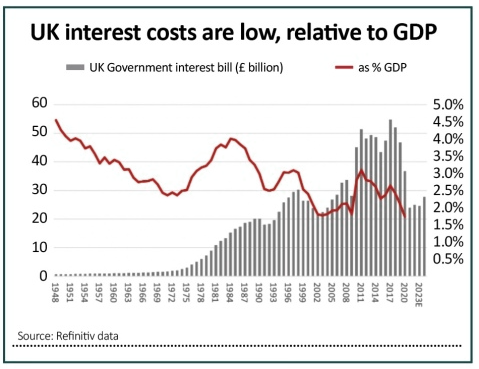
The UK’s financial situation may not be quite as bad as it seems. Yes, the national debt is growing but the Bank of England’s monetary policy is keeping the interest bill to manageable levels.
The Government’s interest bill as a percentage of GDP has hardly ever been lower. That buys everyone time and is also why Sunak is tinkering with taxes, to convince bond vigilantes and lenders alike that the UK can and will repay its debts, as it has every year since 1672 under King Charles II. A big leap in bond yields (borrowing costs) would be expensive.
The Bank of England could move to calm bond markets with more active policy. Whether that calms inflation fears is open to question but financial repression (see a recent edition of this column) could yet come into play, supporting bond prices and reducing yields.
In sum, no-one has a crystal ball. Therefore, bonds could yet have a role to play in a well-balanced portfolio over time, but it is inflation, rather than risk of default, that looks likely to be the greatest threat to any holder of gilts.
Please continue to utilise these blogs and expert insights to keep your own holistic view of the market up to date.