Please see article below from AJ Bell – received yesterday afternoon 08/07/2021
Cash is being drained from the banking system: why this matters
Is the Federal Reserve reversing course after all?
US journalist Edward R. Murrow may be known for the line which he used to end his broadcasts – ‘Good night, and good luck’ – but this column’s favourite comment of his goes ‘Anyone who isn’t confused really doesn’t understand the situation’.
There is one particularly confusing situation in financial markets right now, and that is the US overnight (reverse) repo market.
A reverse repo is the direct opposite of quantitative easing, in that it drains cash from the banking system. The US Federal Reserve is using reverse repos in vast quantities even as it continues to run QE at $120 billion a month.
That programme means the US central bank’s asset base now exceeds $8 trillion, or more than a third of US GDP, for the first time ever. But as fast as the Fed is pumping liquidity into the system it is taking it away with another. Confused? You should be.
A repo or repurchase agreement sees a financial institution sell government bonds to a bank or central bank on an overnight basis. It then buys them back the next day, usually at a slightly higher price.
The idea is the seller can raise immediate liquidity if required. It also enables the counterparty to make a financial return pretty much without risk, given the short time horizon involved and the collateral backing the trade.
The repo rate spiked suddenly in the US in autumn 2019 in a sign that the Fed’s then-quantitative tightening plan of raising rates and withdrawing quantitative easing was working well – so well that banks were scrambling for cash as the financial system began to creak.
Under Jay Powell, the US central bank backtracked on quantitative tightening and – as the pandemic hit – cranked up quantitative easing to ever-more dizzying levels in 2020. That tidal wave of liquidity means the US overnight repo rate is now 0.07%, down from a panicky 6.9% one-day spike two Septembers ago.
WHAT IS A REVERSE REPO?
A reverse repo or reverse repurchase agreement is when a bank or central bank sells government bonds in exchange for cash to a range of counterparties, over a pre-determined timeframe.
This drains cash out of the financial system, at least if a central bank is doing it and the Federal Reserve is hard at work here right now. At the last count, the Fed’s outstanding reverse repo liabilities were $791 billion, the equivalent to six and a half months of quantitative easing.
POLICY SHIFT
Perhaps the US Federal Reserve is laying the groundwork for tightening monetary policy after all and taking these initial steps to test how financial markets and the economy will react.
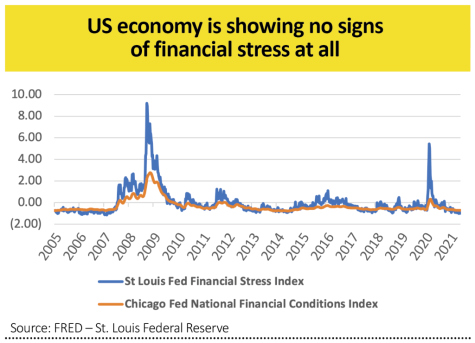
The answer appears to be ‘so far, so good’ on both counts. The S&P 500 index of US shares trades at record highs while there is no sign of financial stress anywhere in the system, at least according to the tried-and-tested St. Louis Fed Financial Stress and Chicago Fed National Financial Conditions indices. Both are trading close to their all-time lows.
As US equity markets trade at all-time highs, American unemployment ticks lower and wage growth reaches 5.7% on an annualised basis and US house prices rise at the fastest rate in nearly 30 years. Perhaps the Fed is getting nervous that there is too much cheap liquidity around.
This initial foray into tightening policy could be seen by Fed officials as a success since neither financial markets nor the economy appears to be wavering.
This is in stark contrast to autumn 2019’s repo rate spike, as that was when WeWork’s much-hyped stock market flotation fell apart, bitcoin sank 25% in a month and wider equity and bond markets both got the jitters, albeit very briefly.
It would surely be a good thing if financial markets could break their addiction to cheap Fed liquidity.
Any business model or asset valuation that is being goosed by zero interest rate policies and quantitative easing will face biggest tests if the Fed really is going to surprise the markets and tighten monetary policy, no matter how gently.
This ranges from loss-making so-called unicorns and equity growth stocks to private equity firms which are feasting off cheap money to make acquisitions.
In theory, tighter money could have negative implications for gold and other real assets. Equally, a fresh backtracking by the Fed and an end to the reverse repo scheme, while quantitative easing keeps running at $120 billion a month, could stoke fresh interest in precious metals and other perceived stores of value.
Gold did well when investors felt central banks were losing control (2007-11 and 2019-2020) and less well when they took the view the authorities had matters in hand (2012-18 and 2021).
Please continue to check back for our regular blog posts and updates.
Please see below for one of Invesco’s latest investment articles, received by us yesterday 07/07/2021:
A year and a half after the first reported cases of a new SARS-like virus in Wuhan, China, we can now look back with greater clarity on a period of some of the most dramatic volatility since the Asian and global financial crises. Here, we assess what this volatility and the associated policy responses have meant for China and emerging markets and plot a dotted line for the road ahead.
Looking up after locking down
At the time the pandemic hit, the unresolved US-China trade war loomed large and global manufacturing was in the early stages of restructuring to accommodate new trade patterns. Despite this, China stood out from other countries in terms of its fiscal, monetary and industrial policy response.
Beijing’s policy decisions focused on maintaining domestic productivity and employment with as little disruption on the demand side as possible. Manufacturers were given liberal access to capital to maintain operations, and refunds on social security tax and unemployment insurance incentivised businesses to retain staff without layoffs.
At the same time, the central bank lowered its reserve requirements and removed blocks on certain loan extensions and renewals. Investments were made in traditional infrastructure projects like housing and transportation, and spending on the nationwide 5G network was accelerated.
As a result, China moved from having a GDP contraction of almost 6% for the first quarter of 2020 to being the only major world economy to print a positive GDP growth number for the year.
A dolorous relationship?
While China’s growth in 2020 is unmatched, the road ahead is not unwinding, particularly when we consider the impact that US policy decisions could have on the US dollar.
The growth of the US fiscal balance sheet in 2020 (accommodated via easy monetary policy) appears to have stimulated real inflation in the US economy – an outcome which has led to talk of tightening. If asset purchase programmes are tapered or rates increased, the likely outcome is a stronger dollar.
Historically, a strong dollar has been negative for emerging markets, as it increases the burden of US dollar-denominated debt. This is less of a factor today than it was prior to the Asian and global financial crises. However, the fact remains that this could dampen growth prospects in some emerging market economies.
Commodities buck the trend
In spite of the observation noted above, it is likely that a stronger dollar will benefit firms selling commodities into US dollar-denominated markets, as long as there is global demand for these products. This factors into the dramatic outperformance we have seen from steelmakers, iron miners, commodity chemical companies, and even coal producers.
The demand behind this outperformance is not part of the same super-cycle seen after China’s admission to the World Trade Organisation, when investment in capacity and infrastructure facilitated the country’s transition to the so-called ‘world’s factory’.
Even when we account for the fact that some of this capacity has moved to other countries in the context of trade realignment, the overall demand for commodity materials is not in the same league as two decades ago.
Instead of a broad, sustainable growth in demand, we are seeing a short-term build-up of inventories that reflects ‘new normal’ uncertainties about tariffs and pandemic lockdowns. This goes all the way through the product cycle, from raw materials to finished goods.
Although these dynamics are almost certainly near-term and should subside in the medium-term, they do attract speculation that disrupts the market.
The road ahead
What does this disruption mean for emerging markets? In the absence of significant inflows, there is a conservation of capital within the asset class. The sharp and transitory shifts described above get funded by parts of the market that have outperformed — in this case growth companies, in particular those in China. In this sense, China has been a victim of its own success as far as its response to the pandemic is concerned, as some investors look to lock-in potential gains.
That said, in our opinion, these sharp transitions do not signify a change in the long-term view for emerging markets. The types of firms that create and capture value for shareholders remain the same.
Even with an ageing population, China remains a large economy with an outlook for sustained, high-speed growth. The growing middle class offers opportunities for investment in education, real estate services, and world-leading innovative technology platforms that facilitate consumption.
It is worth adding that the size and scale of the domestic market should make it less susceptible to external volatility than other markets in the asset class.
What these transitions offer, then, is the potential to invest in the best long-term opportunities at more attractive valuations than normal market conditions afford.
Please continue to utilise these blogs and expert insights to keep your own holistic view of the market up to date.
Please see below ‘Markets in a Minute’ article received from Brewin Dolphin yesterday evening, which provides an update on the markets’ response to the ongoing coronavirus pandemic, the rising UK housing market and economic developments in the US.
Stock markets were mixed last week as the spread of the Covid-19 Delta variant dented optimism about the global economic recovery.
In the US, the S&P 500 and the Nasdaq recorded a fifth consecutive week of gains, rising 1.7% and 2.0%, respectively. Investor sentiment was boosted by betterthan-expected labour market data and a surge in consumer confidence.
In contrast, the pan-European STOXX 600 slipped 0.2% amid concerns about inflation and a spike in coronavirus cases. The UK’s FTSE 100 also fell 0.2%, while France’s CAC 40 declined 1.1% and Germany’s Dax managed a 0.3% gain.
Fears about the rebound in infections spilled over to Asia, where Japan’s Nikkei 225 declined by 1.0%. The Japanese government is considering extending Covid-19 restrictions beyond 11 July, which could affect how many spectators are allowed in Olympic venues.
Morrisons bidding war boosts FTSE
The FTSE 100 rose 0.6% on Monday (5 July), led by an 11.6% surge in Wm Morrison shares after US buyout firm Apollo Global said it was considering making an offer for the supermarket chain. It came after Fortress Investment Group made a £6.3bn takeover bid over the weekend.
UK stocks were also buoyed by the latest IHS Markit / CIPS UK services PMI, which measured 62.4 in June, the second-highest reading since October 2013.
The pan-European STOXX 600 ended Monday’s trading session up 0.3% after figures showed eurozone business activity expanded at the fastest rate in 15 years in June. In contrast, markets in Asia were mixed after the latest Caixin / Markit services PMI showed a sharp decline from 55.1 in May to 50.3 in June.
Stock markets in the US were closed on Monday for the Independence Day public holiday.
The FTSE 100 started Tuesday’s trading session 0.1% lower after the pound rallied against the dollar on news the lifting of Covid-19 restrictions in England will go ahead on 19 July.
Cases rise in Europe for first time in ten weeks
A surge in coronavirus cases weighed on major European indices and bond yields last week. The World Health Organization (WHO) confirmed the number of new Covid-19 cases in Europe had risen for the first time in ten weeks because of increased mixing, summer travel and the rapid spread of the Delta variant.
Hans Kluge, the WHO’s regional director for Europe, said new infections had jumped by 10% and the variant was already causing increased hospitalisations and deaths. At least 63% of people in Europe are still waiting for a first dose of a coronavirus vaccine. Christine Lagarde, president of the European Central Bank, warned of the threat posed by virus variants to the economy, stating: “A Delta variant that spreads quickly is an uncertainty, and it is an uncertainty that will weigh on the balance of risks today.”
In the UK, where vaccination rates are higher, the number of daily deaths remains low despite a surge in infections. On Sunday, there were 24,248 coronavirus cases and 15 deaths, according to UK government figures reported by Sky News.
US consumer confidence at 16-month high
Over in the US, The Conference Board’s index of consumer confidence rose to 127.3 in June – the highest level since the onset of the pandemic in March 2020.
The present situation index, based on consumers’ assessment of current business and labour market conditions, rose from 148.7 to 157.7. The expectations index, based on consumers’ short-term outlook for income, business and labour market conditions, improved to 107.0 from 100.9.
“While short-term inflation expectations increased, this had little impact on consumers’ confidence or purchasing intentions,” said Lynn Franco, senior director of economic indicators at The Conference Board. “In fact, the proportion of consumers planning to purchase homes, automobiles and major appliances all rose – a sign that consumer spending will continue to support economic growth in the short term.”
US consumer confidence
US stock markets were also supported by stronger-thanexpected labour market data. According to the Labor Department, employers added 850,000 nonfarm jobs in June – the most since August 2020. Meanwhile, weekly jobless claims fell to a pandemic-era low of 364,000 for the week ending 26 June, a decline of 51,000 from the previous week.
UK house prices rise at fastest pace since 2004
House prices in the UK grew at the fastest annual rate in 17 years in June, according to the latest figures from Nationwide. The average price of a UK home rose by 13.4% from a year ago to £245,432. On a monthly basis, prices increased by 0.7%.
Northern Ireland and Wales saw the largest gains, up by 14.0% and 13.4% from a year ago. Scotland saw the weakest rate of annual growth at 7.1%, followed by London at 7.3%.
Robert Gardner, Nationwide’s chief economist, said some of the annual increase was due to base effects as June 2020 was unusually weak because of the first lockdown. However, the market continues to show momentum, with prices in June almost 5% higher than in March.
“Activity will almost inevitably soften for a period after the stamp duty holiday expires at the end of September, given the strong incentive for people to bring forward their purchases to avoid the additional tax,” said Gardner. “Nevertheless, underlying demand is likely to soften around the turn of the year if unemployment rises as most analysts expect, as government support schemes wind down. But even this is far from assured.”
We will continue to publish relevant content and news, so please check in again with us shortly.
Please see below the latest article from the Legal & General Asset Allocation Team which was received yesterday (06/07) and details their thoughts on markets:
Please continue to check our Blog content for advice and planning issues and the latest investment, markets and economic updates from leading investment houses.
Investors are often forced to divest when a stock fails their ESG criteria
This can be avoided through active and positive engagement with management
Greater engagement can sometimes lead to better outcomes and returns for investors
Selling a stock because it fails to comply with ESG criteria is not the only tool available to portfolio managers when encouraging companies to change for the better.
Ownership of a stock can give portfolio managers a certain amount of say in how a company is run. This is particularly important when investing for environmental, social and governance (ESG) themes or goals.
If a company fails to resolve significant ESG issues, should managers divest and abandon the company?
Oğuzhan Karakaş of Cambridge University’s Judge Business School said the decision to divest was not the only option available to ESG managers. Highlighting renowned economist Albert Hirschmann’s ‘Exit, Voice, and Loyalty’, Karakaş said investors were typically forced into one of two options – exit or voice – when faced with a difficult situation.
While divestment was an ‘exit’ option, engagement was one of ‘voice’, said the academic, and could be considered more of an art than a science.
“Divestment may look like an easy and obvious option, but it may have some unintended consequences,” he explained. “When we look at ‘sin’ stocks – companies that are involved in alcohol, tobacco or gambling – research shows those companies may outperform.
“One of the reasons is that [if] ‘sin’ stocks are shunned or divested by investors, their prices get depressed and hence offer much higher [potential] returns. In addition, once these companies are divested they are bought by investors that care much less about ESG and could therefore be counterproductive.”
Karakaş said successful engagement could also create value for investors.
“There are some sceptics that [believe] dealing with ESG may cause companies to lose value,” he said. He further noted that, while it could be costly, solving ESG issues could also lead to greater efficiencies and help attract longer-term investors.
Erik Esselink, an Invesco portfolio manager and co-manager of one of our European strategies, said engagement was crucial in the investment process and helped improve the sustainability of portfolio companies.
Using in-house data from Invesco’s proprietary tool – Invesco ESGintel – portfolio managers have access to many data points, insights, metrics, an internal rating and ‘direction of change’, and sector ranking from which they can take a view on ESG risks and opportunities.
Esselink said Invesco managers use ESGintel to engage with companies on issues, to aid their understanding of the magnitude and momentum of any problem, and to ascertain how likely the company is to engage with them.
“We set our price targets three years out based on certain earnings assumptions,” he said. “If we, through engagement, can improve the durability or sustainability of this company, the rating at which we can sell the security in three years’ time will be higher. And our shareholders will benefit in this case.”
According to Esselink, this is particularly true of the small-cap space where data quality is poor, which can lead to some companies with considerable valuation uplift being overlooked.
As an active owner, Esselink votes on every stock in the portfolios he oversees. His ability to put pressure on a company may be limited in some circumstances. However, this is where an asset manager like Invesco can use its considerable passive investment business to bring about positive ESG outcomes.
Matthew Tagliani, head of EMEA ETF product and sales strategy at Invesco, said while passive asset managers may have the scale to influence companies, they often don’t have the in-depth ESG knowledge of an active investment firm.
“We own a large portion of many companies, and we want to wield that strength in a responsible way,” he said. “If there is an active manager in the firm that also owns [a security] we effectively leverage the active portion of the business. It’s called echo voting.”
Despite this internal collaboration, there will still be occasions when divestment is the only option left available to portfolio managers.
“Most companies know when we ask something we want to have a dialogue,” Esselink said. “‘This is not me telling you what to do. This is me wanting to understand why it is you do what you do and to discuss if there is a better way’.”
However, if both parties are at opposites with little room for engagement, then it could mean divestment, he acknowledged.
Passive funds have little choice in this regard, said Tagliani, but they can decide to change the methodology to ensure that companies not meeting investor requirements are not held in the portfolio.
As such, portfolio managers must think carefully before wielding the divest option and consider whether engagement could yield better outcomes, for both the companies they invest in and their investors.
Please continue to check back for more blogs from us.
Please see below article recently received from AJ Bell, which warns of the potential impact that tax relief reform could have on pensions and investors.
Recent press reports suggest the Treasury is eyeing cuts to pension tax incentives to help pay the cost of COVID. Reforms said to be under consideration include introducing a flat rate of pension tax relief, cutting the lifetime allowance or taxing employer contributions.
Beyond the political fire and brimstone a pensions tax raid would cause among Conservative backbenchers and voters, there would be significant practical implications for any of the proposals floated by the Treasury.
Cutting tax relief for individuals risks undoing the groundwork laid by automatic enrolment and sowing mistrust in the stability of the retirement savings framework.
Hitting employers, meanwhile, might raise a fast buck for the Chancellor but would risk strangling off the UK’s pandemic recovery.
There were always going to be tough fiscal choices as the country slowly shifts away from dealing with the health emergency of Coronavirus and focuses on the financial hole blown in the Exchequer’s balance sheet.
It is critical any proposals for pension tax reform consider both short and long-term priorities, and in particular the challenge of ensuring current and future generations’ retirement prospects are not fatally damaged.
Introducing a flat rate of pension tax relief
Given the priority of the Government is to raise cash for the post-COVID economic recovery, a flat rate of pension tax relief would likely need to be set well below 30% to achieve this.
In fact, analysis carried out by the respected Pensions Policy Institute* suggested setting a flat rate of pension tax relief at 30% would actually cost the Government money, while a rate of 25% might save between £2-£3billion a year and 20% around £6-£8 billion a year.
Such huge savings would clearly come at a cost to individuals. For example, if a flat rate of 20% was introduced, a 35-year-old earning £60,000 and paying 4% of salary into a pension could miss out on £50,000 of retirement income by the time they are 67. Those earning more or making larger contributions would face an even bigger hit to their plans.
However, the big challenge in going down this road – both practically and politically – lies in the public sector, where some workers continue to enjoy generous guaranteed defined benefit pensions.
In order to apply a flat rate of relief to these pensions a tax charge would need to be calculated and applied directly to employees by HMRC.
Doctors and senior NHS staff who have been on the front line dealing with the pandemic would likely end up with tax bills running into thousands of pounds as a result.
Reduce the pensions lifetime allowance from £1,073,100 to £900,000 or £800,000
The lifetime allowance has been tinkered with relentlessly by successive Governments, reducing from £1.8 million a decade ago to just £1 million by 2016/17. Two years later it was pegged to CPI inflation – but this link was removed for the rest of this Parliament by Rishi Sunak in March. This constant tinkering has led to huge complexity and uncertainty for retirement savers.
If we were to get yet another cut to the lifetime allowance to £900,000 or even £800,000, as has been suggested, more diligent savers would be at risk of breaching the limit.
To put this in context, reducing the lifetime allowance to £800,000 would mean after tax-free cash has been taken the retirement income someone could take at age 66 would be well below the average salary in the UK.**
This would feel like an extremely low bar to set for people’s retirement aspirations.
Tax employer pension contributions
Of the pension tax proposals floated this was the one with the least amount of detail attached – which is saying something.
At the moment employer pension contributions are exempt from National Insurance, so it is theoretically possible the Treasury could reverse this position – or perhaps apply a limited charge – in a bid to raise revenue.
However, going down this road would cause uproar among businesses already struggling to deal with the fallout from the pandemic. It could also be counterproductive if landing these firms with extra costs forced them to hold off on investment.
Over the long-term, any increase in the costs of providing pensions would likely see a damaging levelling down of provision.
Comment
Pension tax reliefs have been under review since Gordon Brown was the Chancellor in 1997, remember his tax raid? Every government looks at them.
Whilst changing tax reliefs could save money for the State, we need to look at the bigger picture. What would be the impact on pension savings? If people save less in pensions, they will rely more on the State. This is not what any government wants.
I think tinkering with employer pension contributions tax relief would be particularly damaging. Employers need to help fund employee’s pensions.
Hopefully, we won’t see any change in this area, but we also know that we need money now too to support the country in key areas, covid debt interest payments (long term repayment?), to re-build the NHS/Social Services/Residential Care etc., and to help kick start the economy in the UK.
The other issue is timing, Rishi Sunak needs all of us to go out and spend money now to help the economy recover. He can’t scare us into not spending, we will fall back into recession.
Please see the below article from Invesco received yesterday evening:
Key takeaways
Structural changes post-Covid are diminishing the global deflationary narrative
At the same time, a combination of fiscal and monetary largesse are providing a new inflationary force
We believe cyclically sensitive stocks and European stocks in particular could benefit from this new regime
One of the most significant top-down discussions impacting asset prices (bonds and equities) today is inflation: are we heading into a period of inflation or not? The debate has been rumbling since the policy reaction to the Covid pandemic but is now reaching fever pitch as we’ve seen the first above trend inflation data.
As European equity investors, we believe we must have a view. While it would be nice to simply claim that we’re ‘bottom-up’ and ‘fundamental’, the fact is we can’t ignore the polarisation in markets of the last decade, underpinned by monetary dominance and fiscal repression.
Duration (defensive/Quality) assets have benefitted from the low inflation period and short duration assets (cyclical/Value) have suffered. This part is straightforward to understand: medium-term inflation influences the risk-free rate (RFR) and it’s the RFR that the market uses to discount future cash flows. If expectations are for sustained low inflation, then the discount rate is low and asset prices rise and vice versa.
The problem is that forecasting medium-term inflation isn’t straightforward. Nothing causes normally amiable economists to become more tribal than asking them to explain the causes of inflation. In this article, we explain why we believe the arguments for transitory inflation are something of a distraction and point to areas of the market that could do well as mid-term inflation emerges.
Monetarists vs Keynesians and the case for transitory inflation
Monetarists can ‘prove’ inflation is a consequence of broad money growth while Keynesians will eloquently explain that as the demand curve shifts (to the right) faster than the supply curve, then prices rise.
Given we can’t even agree on the definitive cause of price moves then it’s not surprising there’s debate at any moment in time as to what the price moves might be.
The Monetarist vs Keynesian arm wrestle has, we believe, become more visceral since the global financial crisis (GFC) because excess money supply hasn’t led to significant inflation1. This has empowered the Keynesians to look for other rational reasoning of deflationary forces such as demographic trends (declining workforce), technology (increased productivity and labour marginalised) and globalisation (lower cost supply) with post crisis austerity the final straw.
Accordingly, when looking at the post-Covid world, Monetarists have less voice and the Keynesians argue these same three structural trends persist and, hence, any inflation we are seeing today is purely transitory.
This transitory narrative is a function of the severity of the enforced downturn which has impeded but, importantly, not destroyed supply (capital still exists). Therefore, as demand has recovered (surprisingly) fast, supply is temporarily struggling to cope and prices have risen, if only temporarily.
The effects have been exacerbated by the Suez blockage, lack of belly capacity in air transport, low inventories and even the weather in Texas.
If one believes that inflation is ‘only transitory’, logic dictates that it won’t impact the discount rates and therefore duration assets aren’t at risk and short duration cyclicality assets remain value traps….
Time to address the long-term deflationary narrative
The irony is that transitory inflation believers would likely claim to be long term and not worry about the short-term noise. However, we believe they’re perhaps missing the more fundamental structural changes happening post Covid.
We will try to outline why and in doing so will intertwine both economic theories, which we appreciate may anger more purist economists.
Firstly, we need to address some of the structural deflationary points:
Demographics. These are hard to argue with. European demographic trends are unhelpful albeit, net of migration, the data to 2019 suggest population is broadly stable. An aging population likewise doesn’t help. To us it remains an ongoing pressure but not incrementally so.
Technology. Often touted as a deflationary force. It increases productivity and hence pushes the supply curve to the right (we can produce more for lower prices). However, importantly, this is nothing new, innovation has been a relative constant over time. We also wonder if, in the post-GFC period, dominated by monetary policy, corporates were rewarded for ramping shareholder returns (dividends and buybacks) at the expense of investment and so exaggerated the deflationary impact.
Globalisation. We believe this is most contestable as a structural cause of deflation. Transferring production to Asia has undoubtedly been a key deflationary force for at least the past 20 years. China has been both a source of cheap labour and then, through policy, a source of excess production assets. In addition, at times of stress, China has devalued its currency, thereby easing inflationary pressures.
We strongly believe that it’s no longer so obvious. Reaction against the offshoring of US manufacturing jobs to China was a key source of Trump’s appeal. His firmly anti-China policy is one of the few policies the Biden administration has continued to pursue and, with China GDP set to rival the US by 2030, it is unlikely to stop being a vote winner. Within China itself, policy has shifted from emphasising the producer economy towards the consumer with some producing assets being forced to close.
This has been aided by Environmentalism being part of the domestic policy agenda. Lastly, it’s perhaps notable that despite strong domestic wage inflation, and the recent Renminbi appreciation, there’s been no talk of China devaluing – could China actually be exporting inflation?
We should also be aware of emerging market monetary policy setting being more traditional than developed markets currently – it’s developed markets running the largest ever deficits, while China tightens.
Figure 1. The Covid crisis will lead to further de-globalisation
The key point is that these structural deflationary forces, while still present, are a less powerful backdrop than we’ve become accustomed to. Meanwhile, there is the incremental risk from emerging inflationary trends.
Inflationary structural trends – are they here to stay?
Covid has changed voter tolerances, which in turn affects policy. This then has an impact on the economic backdrop and, ultimately, inflation risk.
We believe the true impact of the pandemic goes beyond headline fiscal payments, which are only as inflationary as the next cheque/infrastructure project, and more towards a change in what people truly care about and will vote for.
The post-Covid regime shift is happening to address the issues of Inequality and Climate Change. The vulnerability exacerbated by the health crisis is creating tolerance of big government. Unlike after the GFC, when the response to a financial crisis was fiscal austerity, today the electorate want fiscal dominance. The newly created EU recovery fund, worth €750 billion, is such an example.
Figure 2. Grants and loans from the EU recovery fund (in 2018 prices)
These, we believe, are inflationary forces. Big government is historically a poor allocator of resources compared to the private sector – it curtails supply (the British auto industry in the 1970s is a good example of this).Addressing inequality at a micro level means a greater share of stakeholder profits going to wages rather than to shareholders and management. This would direct resources to lower income earners who have a greater propensity to spend and therefore drive demand.
Inequality at a macro level means infrastructure projects and providing incentives to invest, thereby driving full employment and reducing social scarcity. Full employment as a policy is inflationary.
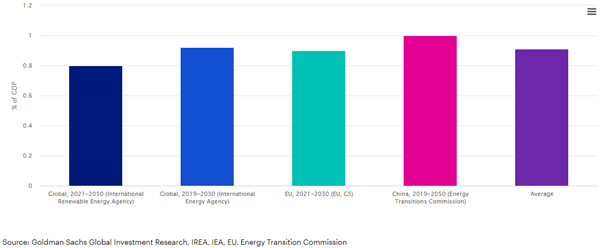
The climate agenda is a wrapper to digest the fiscal shift but it is also inflationary in its own right. Net neutrality requires capital investment: we need to build turbines, solar parks and transmission networks, which creates demand for physical assets.
Figure 3. A rise in green investment demand worth nearly 1% of GDP
However, we also need to build the infrastructure with renewable commodities meaning cement needs to be ‘green’ and steel needs to be low carbon. Some commodity producers will invest and take advantage, but others, previously running for cash, will be forced to close and hence we will finally see capacity come out of the market.
Consumers will be affected too with tolerance for higher prices (especially if wages are increasing) for greener products and replacement demand driven by policy – think replacing vehicles for hybrid or electric alternatives as internal combustion engine (ICE) cars are being banned from urban areas. This is inflationary.
Environmental policy is affecting capital availability already. Financial regulation means asset allocators need to disclose environmental data with the fastest growing asset class being ESG compliant funds.
These fund flows impact corporate capital allocation with environmental projects getting cheaper funding than brown projects. There simply isn’t cheap money available for coal, new oil or other environmentally challenging industries and, hence, over time, there will be a squeeze of supply. We know we are approaching peak oil at some point, however, what happens if peak supply comes first: prices rise – inflationary.
We believe there are some incremental inflationary forces at play, absorbing output gaps. These, combined with the perhaps abating ‘structurally’ deflationary forces will lead to net inflation, but on the condition of monetary complicity.
Monetarists believe money growth is key and MV=PT (or Money Supply times Velocity of money (rate of exchange)) is equal to Prices times Transactions. What does seem to be true is that without money growth, there’s no inflation. Simply because without new money, increased demand growth from, say, Government crowds out private sector demand and so net there’s no growth.
Importantly then, post-Covid, we have both fiscal dominance and monetary accommodation. Post-pandemic, broad money growth has been far greater than following the GFC and we also have a banking system that’s fully functional, i.e. neither deleveraging nor working out bad loans.
Monetary policy makers are shifting their mandate to remain accommodative for longer with targets of full employment and average “synchronised” inflation. This allows developed market central banks to stay ‘behind the curve’, meaning they do not feel the need to address the current inflation scenario.
There’s also consensus that central banks want fiscal cooperation in support of their tired monetary bazookas and will manage the interest costs through yield curve controls if required.
As per the Fischer equation, MV=PT, with ‘V’, the velocity of money, as the balancing item. The ‘V’ is probably best understood as how much the money in the economy changes hands. It has fallen over many years and fell more drastically post Covid as the saving rate has increased. However, we believe ‘V’ will increase as economies unlock, the savings rate falls and inequality falls (lower incomes have a lower propensity to save).
With abundant liquidity meaning banks will be able to lend (even as savings are reduced), central banks printing money and velocity increasing, then prices will rise: inflation.
Transitory inflation is just a distraction – cyclical stocks and Europe set to benefit
We believe that arguing about the short-term transitory inflation numbers misses the key point. Yes, short-term inflation is spiking because of bottle necks. However, asset prices are based on mid-term inflation forecasts, not crisis-related data. Therefore, it’s mid-term inflation we need to think about.
It’s our strong belief that mid-term inflation will be sustained at above central bank targets, albeit not rampant. Indeed, inflation-linked bonds are signalling as much. Yet, the ongoing polarisation of the equity market with preference for long duration and growth equities would suggest something different.
In our view, from a top-down perspective, the types of companies that could benefit from nominal growth are the short duration equities and these are the cheapest parts of the market. We believe they are cheap hedges to the mid-term inflation risk that we have argued for above.
In addition, from a bottom-up perspective, it’s the same sectors and companies that will be a direct beneficiary of the political shifts we’ve mentioned. The environmental agenda is pro-investment; it’s pro-cyclicality.
Companies in industries exposed to construction materials, utilities, automotive OEMs and even banks through volume growth, all might benefit. These are also where currently the most compelling valuations are.
Likewise, the impact from more re-balancing of stakeholder profit shares and fairer taxes with bigger government are less onerous on European companies. This is simply because they have been operating under a more egalitarian environment for longer than other global regions.
Generally, equities are owned with the aim of protecting you from inflation. However, many portfolios that have outperformed over the last decade, and more, have been ones that have benefited primarily from a lack of inflation – so one composed of bonds and long-duration/growth equities.
As we move into a new regime of inflation for the reasons argued, in our view, this type of portfolio is unlikely to do so well. On the contrary, our valuation discipline has resulted in our fund ranges being exposed to short duration or cyclical stocks, which we believe are well positioned in the more inflationary backdrop we have outlined.
Please see below this week’s Markets in a Minute update from Brewin Dolphin – received late yesterday afternoon – 29/06/2021
Stocks surge as US agrees $1trn infrastructure deal
Global equities rebounded last week after Republican and Democratic senators reached a bipartisan agreement on a huge US infrastructure package.
The S&P 500 and the Nasdaq reached new all-time highs, ending the week up 2.7% and 2.4%, respectively. Energy stocks outperformed as supply constraints pushed oil prices to their highest level since October 2018.
The UK’s FTSE 100 rose 1.7% after the Bank of England said that while inflation could reach 3% in the coming months, this would prove to be a temporary phenomenon. This sentiment was echoed by the European Central Bank, which helped to boost the pan-European STOXX 600 by 1.2%.
Over in Asia, Japan’s Nikkei 225 edged up 0.4% as the country’s vaccination drive helped to outweigh a decline in business activity. China’s Shanghai Composite gained 2.3% after the central bank increased its injection of shortterm cash into the financial system for the first time since March amid growing demand for liquidity.
Travel curbs weigh on European indices
UK and European stocks tumbled into the red on Monday (28 June) after Portugal, Spain and Germany introduced new travel restrictions in a bid to limit the spread of the Delta variant of Covid-19. Germany’s chancellor Angela Merkel reportedly urged the EU to designate the UK a ‘country of concern’ and introduce stricter quarantine measures for British travellers.
The FTSE 100 finished Monday’s trading session down 0.9%, with shares in British Airways owner IAG, travel company TUI and budget airline easyJet all falling by more than 5%. The pan-European STOXX 600 slipped 0.6% and Spain’s IBEX 35 lost 2.0%.
Over in the US, indices were mixed as technology stocks outperformed while some large energy stocks declined. The Dow slipped 0.4% whereas the S&P 500 and the Nasdaq gained 0.2% and 1.0%, respectively.
The FTSE 100 was up 0.3% at the start of trading on Tuesday, ahead of the release of the latest UK mortgage approvals and consumer credit data. The figures for May showed a record rise in mortgage approvals following the recent extension to the stamp duty holiday, and the first lending increase since August 2020.
Infrastructure bill passes first hurdle
Last week, US President Joe Biden and a group of Democratic and Republican senators agreed a $1trn bipartisan deal to upgrade the country’s infrastructure. The eight-year plan includes funding for roads, bridges, railways and public transport, as well as expanding access to broadband and upgrading the power grid.
The plan would be funded by $125bn in unused Covid-19 relief funds, returned state jobless benefits, and greater tax enforcement.
The deal is a significantly pared down version of Biden’s original proposal, however the Democrats hope to push through a separate spending bill worth around $6trn. This would tackle issues such as climate change, education and childcare benefits and potentially be funded by tax increases on corporations and the wealthy.
The announcement helped to boost industrial, energy and financial stocks and outweigh concerns about the most recent US inflation reading.
US core inflation hits 29-year high
The US core personal consumption expenditures price index, an important inflation gauge, rose by 3.4% in May from a year ago – the biggest increase since 1992. On a monthly basis, the index rose by 0.5%, which was slightly below expectations of a 0.6% increase. The Bureau of Economic Analysis said headline inflation, which includes volatile food and energy prices, rose by 3.9% from a year ago – the biggest increase since August 2008, just before the worst of the financial crisis hit.
The increase partly reflected base effects from a year ago, when prices were supressed by the pandemic, as well as supply chain disruptions and growing demand as the economy reopens.
Separate figures showed US house prices are also continuing to soar. The median existing home price rose by 23.6% in May from a year ago, with every region registering price increases, according to the National Association of Realtors. This was a record high and marked 111 consecutive months of year-over-year gains.
BoE views high inflation as temporary
Here in the UK, the Bank of England sought to calm fears about rising prices by stating that while inflation could exceed 3% in the coming months, the surge was temporary.
“The committee’s central expectation is that the economy will experience a temporary period of strong GDP growth and above-target CPI inflation, after which growth and inflation will fall back,” the Bank’s Monetary Policy Committee said.
The Bank said stronger demand, rising commodity prices, supply side constraints and transport bottlenecks were all factors that had driven increased inflationary pressures.
This was reflected in the latest input price component of the manufacturing PMI, published last Wednesday, which hit an all-time high.
Chris Williamson, chief business economist at IHS Markit, said record levels in the survey’s price gauges and further capacity constraints “hint strongly that consumer price inflation has much further to rise after already breaching the Bank of England’s 2% target in May”.
Weekly updates like this from Brewin Dolphin help us keep up to date with what is happening in the markets.
Please continue to check back for our latest blog posts and market updates.
Please see below for Legal & General’s latest ‘Asset Allocation Team’s Key Beliefs’ article, received by us late yesterday 28/06/2021:
There are still a few weeks until Q2 earnings season, but early indications point to mainly positive news when events kick off properly in July. In this week’s Key Beliefs, we also discuss the ‘meme’ stock phenomenon and whether the 1960s pose a historical parallel for inflation today.
We’re in the middle of pre-announcement season for corporate results. While this is always very anecdotal in nature, company comments have so far had a generally positive tone and, perhaps even more tellingly, there has been an absence of any high-profile negative pre-announcements. Results from early reporters, companies with different quarter ends, have had a similar positive tone.
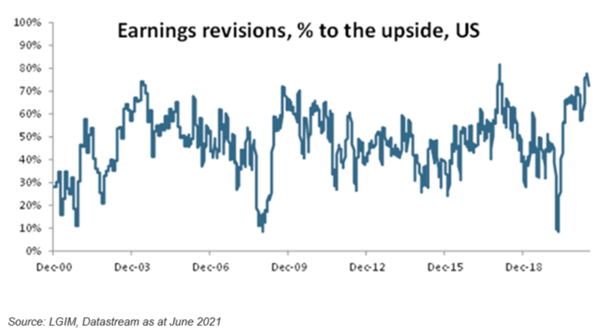
Another positive indicator is that earnings revision ratios have stayed at exceptionally high levels. There are always fewer forecast changes by analysts in between earnings seasons, but from the data that have come in, there have been far more upward than downward revisions. In May and the first few weeks of June, more than three quarters of revisions in the US were to the upside, a figure only matched in the immediate aftermath of recessions and after the corporate tax cut at the end of 2017.
All of this bodes well for the upcoming earnings season and adds confidence to the view that we’ll see another round of significant upgrades to analyst forecasts in the summer. And of course, significant analyst upgrades either put upward pressure on share prices or downward pressure on valuation multiples. We believe the truth will likely lie somewhere in between and continue the pattern of equities grinding higher at a slower pace than earnings estimates, which gradually deflates the high PE (price to earnings) ratios of the immediate recession aftermath.
Retail is here to stay
Retail investors and ‘meme’ stocks have been centre stage again in equity markets in recent weeks. Three things come to mind on the topic from a macro perspective.
First, the extreme moves continue to be limited to a handful of stocks. There are still no obvious signs of the volatility in affected stocks spilling over into the wider market. If you look closely enough, you can see the gyrations of Gamestop* and AMC* reflected in the relative intraday performance of US small cap indices like the Russell 2000. But the S&P 500 put together a long string of daily moves smaller than 1% in the last period of meme stock volatility.
Second, this most recent rally in retail favourites has been far weaker than what we saw in spring. This applies both to the magnitude of the outperformance of the stocks involved and to retail trading volumes. The share of TRF volumes (seen as a proxy for retail activity) of overall US volumes has stayed in the low-mid 40% range, which is far above pre-2020 levels, but a good bit below the nearly 50% mark regularly reached earlier this year. Overall, it’s still fair to say that the froth that was apparent in several retail-driven niches of the market in spring is much less of a concern today. Indeed, SPAC (‘special purpose acquisition company’) activity and prices have dropped a lot, as have prices in the digital asset sphere, like bitcoin.
Finally, if retail is a growing part of equity flows, then we are still in the early part of this story. The activity has so far been concentrated in Robinhood-type investors, who tend to be younger and less wealthy than the traditional retail investor base. US households own just under a third of US equities, but the top 10% of households own almost all of that, according to Goldman Sachs. Private client flow data from brokers show net purchases of equities this year, but their magnitude still pales into insignificance when compared with the previous decade’s net selling. So far, the increase in retail activity appears to have been driven by the smallest section of retail investors. The private client flow data suggest activity is spreading to traditional retail investors, but from today’s perspective we believe this theme remains much more of an upside than a downside risk.
Sounds of the ‘60s
In the mid-1960s, after years of subdued core inflation, there was a sudden increase which began a period of prices ratcheting higher. Unemployment fell through the first part of the decade, but as soon as it reached 4%, both wages and inflation moved up significantly. This suggested the economy was overheating and unemployment had probably breached the NAIRU a couple of years earlier. Indeed, it took a recession in 1970 to halt wage and price pressures temporarily, before the oil-shock induced big inflation of the 1970s.
The simultaneous increase in wages and inflation is a finding consistent with Ram’s econometric work, which shows that neither wages nor prices tend to lead one another; the wage and inflation process seems to happen simultaneously. So, if we wait for wages to move materially higher, we could be too late in spotting the inflation outbreak.
But there were some unique features of the ‘60s:
The Vietnam war played a crucial role. US Federal spending (entirely on defence) shot up by over 1% of GDP from mid-1965 to early 1967. The deployment of over 300,000 more troops served to tighten the domestic labour market further. This episode shows it is not a good idea to add stimulus to an economy already at full employment. The stimulus today has been in response to a large amount of slack, with unemployment still relatively high and participation low. We expect the current labour market demand and supply imbalances to be resolved later this year, but there are some risks if Congress passes a large deficit-funded infrastructure package
Unionisation exacerbated the wage-price spiral. The labour market appears much more flexible today, aided by an increasing number of ‘digital nomads’ or ‘work anywhere’ jobs
In the ‘60s, the Fed had far less sophisticated understanding of the role of inflation expectations (there was no TIPS market) and was less independent. We are confident that the central bank will take appropriate action, should the current wave of inflation not prove transitory
The increase in prices was broad-based. This is a clear difference from today, where the median CPI is still behaving well
In 1966, England last won a major football tournament (though I’m still convinced that the ball never crossed the line on England’s winning goal). This time round, however, we’ll need to wait a few more days to know whether it’s a unique feature of the 1960s or not…
Please continue to utilise these blogs and expert insights to keep your own holistic view of the market up to date.
Please see below article received from AJ Bell yesterday, which discusses the long-term picture after the latest US Federal Reserve meeting delivered a shock.
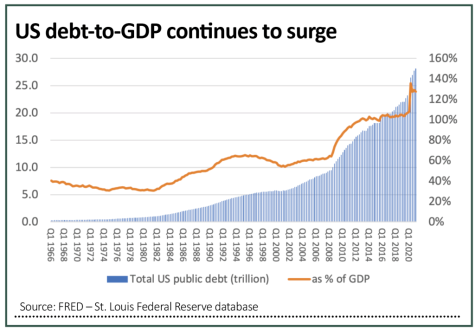
During the first 200 years of its existence, the US accumulated a cumulative federal debt of $1 trillion, the equivalent of 30% of its GDP (gross domestic product). In the last 40 years, that figure has surged to $28 trillion.
The good news is that the US economy has grown too, as annual GDP has advanced from around $3 trillion to $23 trillion. As a result, America’s national debt-to-GDP ratio has therefore grown from roughly 30% to 128% and that is bad news for two reasons.
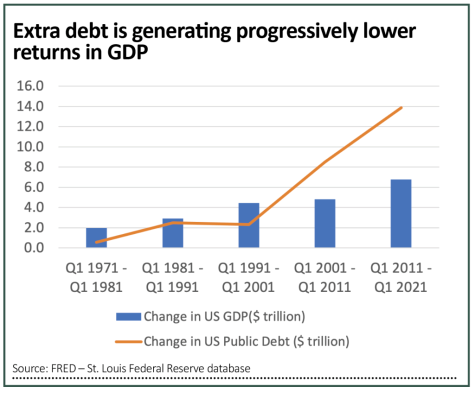
First, it means that it is taking ever-increasing amounts of debt to generate an extra dollar of GDP.
Second, it leaves the US sitting well above the 80% to 90% debt-to-GDP ratio described by economists Kenneth Rogoff and Carmen Reinhart as a key tipping point, whereby economic growth would slow thanks to (unproductive) debt servicing costs – although that research, used by many governments as the basis for austere fiscal policies in the last decade, has since been widely challenged.
Whether you side with Reinhart and Rogoff or their detractors, the challenge that faces the US Federal Reserve is undeniable.
The US central bank needs to keep interest rates as low as it can to help the US government fund its interest payments even as it maintains welfare programmes, spends on defence, education and other vital needs, such as investment in public infrastructure.
That may leave the Fed having to raise interest rates to fend off inflation, maintain the value of the dollar relative to other currencies and maintain its credibility with financial markets and also holders of US treasuries, since they are effectively bankrolling America’s economy.
Investors now have to assess which way they think the Fed (and the White House) will go and to what degree the central bank’s ultimate policy path is priced into bonds, equities, commodities and currencies.
In the end, every option available to the chair Jay Powell and president Biden may help in some areas but do damage in others, as if to confirm the view of Stanford University professor Thomas Sowell that: ‘There are no solutions, only trade-offs.’
Multiple options
To make a reasoned decision here – and then draw up an appropriate asset allocation – investors will need to think like the Fed and its officials. History is very clear that there are only four ways out once a national debt reaches America’s current levels, relative to GDP:
Rapid economic growth. This is the best option, but it is not proving easy, if the period from 2009 and the end of the financial crisis is any guide. This underpins the push toward Modern Monetary Theory and the argument that governments should spend on productive assets and focus on the long-term payback rather than worry about near-term borrowing.
Default. This is not ideal, as serial offenders like Argentina will attest. It leaves you locked out of international debt markets and means you must pay higher coupons even if you can persuade someone to lend to you. It can also prompt capital flight, hitting both your currency and value of other assets and financial markets. The US will not countenance anything that jeopardises the dollar’s status as the world’s reserve currency (although most other developed countries face the same dilemmas and policy options).
Inflate. This is more like it and is exactly what the US and UK did when debt ballooned thanks to the Second World War. Rebuilding programmes and public spending fuelled growth, interest rates were kept below inflation and lenders were repaid in effectively devalued currency as a result. Yet again, though, this leaves the Fed with the dilemma of stoking some inflation but not too much that investors take fright and both financial markets and the wider economy are destabilised, as happened in the 1970s.
War. This is the option that no-one in their right minds would consider, even if the new Cold War between China and America feels like it is getting steelier by the month, even if president Biden is now in the White House rather than Donald Trump. Taiwan is still a potential flashpoint for ‘Hot War’, both territorially and technologically, thanks to Taipei’s predominance in the global silicon chip supply chain.
Path of least resistance
If growth is unlikely (or least relies on wanton government borrowing and overspending) then inflation still appears the likeliest outcome, but the Fed will not want to tighten policy too far, too fast. Just look at how financial markets are welcoming talk of two Fed rate hikes to the far-from-challenging level of 0.75% by the end of 2023. Equity and commodity price wobbled and volatility indices such as VIX moved higher.
Yet the US 10-year treasury yield fell, the last thing you would expect if inflation is coming, especially when yields are already miles below the current rate of increases in the cost of living.
These trends may not be as mutually exclusive as investors might think. The Fed is still running QE (quantitative easing) flat out to massage yields lower. There is more uncertainty now over its policy direction than there has been for some time. Investors seek havens, like bonds, at times of concern.
Perhaps the bond and stock markets are getting ready for the return of volatility and bumpier times ahead. But then the chances of the Fed raising rates or hauling in QE may recede further, as the end of the debt-fuelled bull market and economic upturn would surely be seen as deflationary and any policy response would have inflation as its ultimate goal.
We will continue to publish relevant content, market updates and news as we optimistically push towards the end of lockdown restrictions in the UK.