Team No Comments

Brooks Macdonald – Weekly Market Commentary

Please see below this week’s market commentary from Brooks Macdonald received late yesterday afternoon – 02/08/2021

Weekly Market Commentary | Despite summer holidays, it’s a blockbuster week for key data releases

By Edward Park

  • There were strong gains for US and European equities in July, but Asia ex-Japan lagged due to concerns over Chinese technology regulation
  • This will be a key week for the US infrastructure bill, which lawmakers hope to pass ahead of the summer recess
  • The US employment report due on Friday will be the last before the Jackson Hole symposium

There were strong gains for US and European equities in July, but Asia ex-Japan lagged due to concerns over Chinese technology regulation

July closed out a strong month for European and US equities, while commodities continued to make gains even as the ‘reflation’ trade cooled. Asia ex-Japan equities underperformed, with Chinese indices not helped by risk aversion around tougher regulation being introduced by Beijing in strategically important sectors.

This will be a key week for the US infrastructure bill, which lawmakers hope to pass ahead of the summer recess

A series of central bank meetings are due to be held this week, as well as it being a key week for the US physical infrastructure bill which needs to gather momentum in Congress with the summer recess looming. On the infrastructure bill, US senators have now agreed the text of a bipartisan bill so, barring amendments, lawmakers are hopeful it can pass this week. 

In terms of central banks, the Bank of England’s meeting on Thursday will be the week’s highlight. While no change is expected at this meeting, it will need to address CPI inflation, which is currently above the Bank’s formal target. The Bank of England has been more hawkish than some other major central banks. Nonetheless, we expect this meeting to stick to a transitory inflation narrative with a nod to clearer guidance later in the year. The Reserve Bank of Australia is also meeting this week, and it is expected to pause its asset purchase tapering given the ongoing lockdowns in the country.

The US employment report due on Friday will be the last before the Jackson Hole symposium

In terms of data, all eyes will be on the US non-farm payroll report, which will be released on Friday. The US Federal Reserve (Fed) has clearly stated, from the start of the pandemic, that employment levels are a key metric and that space capacity in the labour market was a primary factor for ongoing support. The point often made by Jerome Powell, the Fed’s chair, is that headline employment has improved, but the experience has been very different for lower wage workers. By shifting the requirements to a more balanced jobs recovery, the Fed has caused the bond market to price in only a gradual withdrawal of support over the next 12 months. Given that the tapering discussions have begun, however, and the all-important Jackson Hole meeting is almost upon us, this will be a closely watched employment report.

Despite investors moving into peak holiday season, we have a blockbuster week of central bank policy, fiscal policy, US earnings and key data releases. We still believe the hurdle to shift markets away from their transitory inflation narrative is high, but this will be an important week to test sentiment in the quieter summer weeks.

Please continue to check back for our latest blog posts and updates.

Charlotte Ennis

03/08/2021

Team No Comments

The problem with cash – should you be investing more?

Please see below an interesting article received from Beinvest recently. Although Britain has become a nation of savers following lockdown, this article provides an insight into the disadvantages of cash savings and discusses more beneficial alternatives.

Unable to travel, socialise or do many of the other things that usually deplete their bank accounts, Britain has become a nation of savers. However, this welcome financial cushion may not be as protective as hoped if inflation takes hold.

Around £75 billion was held in ISA accounts in 2019 to 2020, an increase of £7.1 billion over 2018/2019. However, most of this rise – £4.8 billion – went into cash ISAs, while Stocks and Shares ISAs can only command a distant second place. (1.)

Cash has its role. If people have a short-term savings goal, such as a house deposit or a new car, cash is almost certainly the right place for their savings. Equally, it is always sensible to have a few months’ worth of expenses in a readily accessible cash account as a buffer against life’s various hiccups – redundancy, sickness, a leaky roof. But too much in cash for too long can be corrosive for long-term wealth, particularly today.

The impact of inflation

Rising prices will erode the real value of a saving pot. While cash may feel inherently safe – £10,000 goes in and, usually, it stays at £10,000 – if it only buys half as much, that is a real problem. This isn’t as unlikely as it sounds: a savings pot of £10,000 would be worth just £6,100 in real terms after 25 years with inflation at 2%, the current Bank of England target. If inflation rises to 3%, that drops to £4,780. At 4%, that savings pot is worth just £3,750. (2.)

This wouldn’t be a problem if savers were getting sufficient interest on their savings accounts to compensate. But the majority of savings accounts now pay less than 1%. The top-paying easy-access savings account pays just 0.5% (3.). In extreme cases, banks charge their customers to save with them. Low interest rates have, unfortunately, changed the landscape. Cash savers are often losing money in real terms and the longer they remain in cash, the more the problem compounds.

Inflation today

Inflation has been relatively benign in recent years, hovering around the Bank of England’s target rate. However, there are reasons to believe that a higher inflation environment may be imminent. There are short-term considerations: as the world emerges from the strictures of lockdown, there is pent-up spending. After a year confined to their home, people are keen to travel, socialise, shop. At the same time, production difficulties have created supply problems for certain commodities and key components such as semiconductors. This is creating shortages and pushing up consumer prices.

There are also longer-term reasons for structurally higher inflation. Governments are spending vast sums to ‘build back better’, pouring trillions into decarbonisation plans and infrastructure building. This is also creating significant demand in key areas and driving prices higher.

Equally, some of the deflationary forces that have curbed inflation over the past two decades are reversing. Deglobalisation, for example, brought cheap goods from China and lowered prices for everyone. But the fragilities exposed by the pandemic have shown the difficulties inherent in long supply chains that cross multiple borders. Global governments are now working to ‘reshore’ critical industries. This may raise the price of goods and services.

In normal circumstances, central bankers would simply put up interest rates in response to any inflationary pressure. However, the recovery is fragile and central banks, led by the Federal Reserve, have made it clear that they will look through short-term inflationary pressures until economic growth is firmly established. It is also increasingly difficult for central banks to raise rates: debt levels are higher, particularly for governments. High rates also risk real disruption to equity and bond markets, which have grown dependent on central bank liquidity. This means inflation will be allowed to ‘run hot’ for longer.

Potential solutions

Cash is not the only problem area. Other ‘safer’ assets can also struggle during periods of high inflation. Inflation is generally bad news for bonds, for example, because their income is fixed and therefore doesn’t keep up with higher prices.

Stock market investments can provide better protection against inflation, providing it doesn’t rise too quickly. 1970s-style inflation tends to be difficult for most asset classes. Companies should be able to put up prices in response to inflationary pressures, which in turn should be passed on to investors in the form of higher dividends or profit growth. Historically, savings held in a diversified portfolio of shares have kept pace with rising prices over the long term.

For savers who have managed to build up some spare cash over lock down, it is worth considering the risks of holding it in cash at a time of potentially rising inflation. The stock market can be a volatile place, but it has some natural advantages in today’s climate. A carefully blended and diversified portfolio can help protect the real value of a savings pot. Remember, investments carry risk and you can get back less than invested.

Cash has a variety of important uses; for short-term known expenditure, for unknown emergency expenditure and for emergency funds just in case you lose your income or need to ‘switch off’ investment or drawdown pension income. We recommend that you have at least one year’s expenditure in cash deposits.

Please check in again with us soon for more relevant content, analysis and news.

Stay safe.

Chloe

02/08/2021

Team No Comments

A.J. Bell – Emerging Markets: Views from the experts

Please see below a blog from A.J. Bell which was published and received yesterday (30/07/2021) and details the key areas that the Franklin Templeton Emerging Markets Equity Team are currently thinking about:

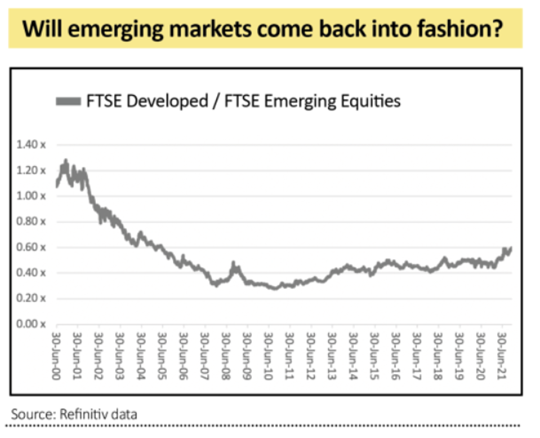
As you can see from the above, Franklin Templeton’s team believe the current inflationary pressures seen in markets are a temporary blip and should ease at some point.

Please continue to check our Blog content for advice and planning issues and the latest investment, markets and economic updates from leading investment houses.

Please keep safe and healthy.

Carl Mitchell – Dip PFS

IFA and Paraplanner

30/07/2021

Team No Comments

Brooks MacDonald Daily Investment Bulletin: 28/07/2021

Please see below for Brooks MacDonald’s Daily Investment Bulletin received by us yesterday 28/07/2021:

What has happened

Equities had a weaker session yesterday with defensive equities outperforming technology stocks in particular. Some of this weakness in technology can be attributed to the concerns that China might continue to expand regulation after their foray into educational technology earlier this week.

Chinese technology

Markets have long had a concern around technology regulation in the US where a Democrat White House could try to curb the perceived overreach of big technology. Investors had downgraded this risk due to the economic impact of the pandemic but also a belief that the US would be unlikely to do anything too aggressive in case Chinese companies gained a competitive advantage. With China ‘going first’ on technology regulation this not only increases risks around Chinese securities but removes one of the arguments as to why the US would stay quiet on technology regulation for now. Meanwhile in the US, technology earnings saw some winners and losers with Alphabet rising 3% in the after-market but Microsoft losing an equal amount after it’s cloud-services business saw less growth than expected.

Federal Reserve

Now to the week’s major event, the Federal Reserve’s latest policy statement which is due out at 7pm UK time tonight followed by Fed Chair Powell’s press conference. Policy risk is at its highest at points of transition and the Fed will need to tread a delicate path today. The tapering genie is out of the bottle and will almost certainly be a conversation topic at the meeting however the extent to which Powell majors on this will give an important steer to the market. The rising risks around the delta variant and lower global growth expectations have both contributed to a less positive market backdrop ahead of tonight’s announcement. The statement will also need to address inflation where we have seen another upside beat to price levels in the June CPI numbers but inflation expectations have been falling in the bond market. Some of this reduction in inflation expectations is due to a belief that the Fed will not be afraid of raising rates over the next two years so there is a complex interplay that Powell will need to consider.

What does Brooks Macdonald think

Due to the rising uncertainties around the pandemic and economic growth, we expect Powell to stop short of warning that tapering is imminent. This meeting may well therefore serve as a placeholder until either the Jackson Hole Economic Symposium in August or indeed the meeting in September.

Source: Bloomberg as at 28/07/2021. TR denotes Net Total Return

Please continue to utilise these blogs and expert insights to keep your own holistic view of the market up to date.

Keep safe and well

Paul Green DipFA

29/07/2021

Team No Comments

Brewin Dolphin – Markets in a Minute

Please see below this week’s Markets in a Minute update from Brewin Dolphin – received late yesterday afternoon – 27/07/2021

Markets hit record highs as earnings beat forecasts

Most major markets went up last week, as second-quarter earnings season in the US continued to demonstrate the robust profitability of the biggest companies.

In the US, the S&P 500 and the Nasdaq Composite went up 2% and 2.8% respectively. A raft of companies, including healthcare giant Johnson & Johnson and telecoms firm Verizon, reported second-quarter earnings that beat expectations. The benchmark more than recovered from the fall of the previous week, when inflationary concerns preoccupied the market.

The pan-European Stoxx Europe 600 rose 1.5%, also hitting a record high. Dutch technology company ASML was among those to report earnings that met with the market’s approval. ASML shares are up nearly 50% yearto-date.

The UK’s FTSE 100 edged up 0.3%. Outside the top flight, private equity firm Bridgepoint showed the strength of the market, rising 29% on the first day of its trading following its IPO in London.

China’s Shanghai index also edged up. However, the index fell back on Monday 26 July with regulation affecting education, property and technology sectors.

Shares were mixed on Monday, as investors braced for another slew of earnings.

British Airways owner IAG was among the risers in London. As the industry recovers from Covid-19, more flights are resuming. Normality may be some way off, but some investors remain optimistic about the industry’s prospects. The number of new Covid-19 cases in the UK has fallen for several days.

However, as the Guardian puts it, passengers “are arriving in countries where the Delta variant paralysing Britain is just becoming dominant – and Europe is responding by clamping down”.

Some countries have tightened border controls, with Malta barring entry to unvaccinated travellers and Germany bringing in stricter quarantine rules for people arriving from Spain and the Netherlands. More broadly, authorities from Greece to Italy and France to Portugal are bringing in what are effectively vaccine passports for a wide range of activities, although most are shying away from using that term, which has become incendiary.

Pingdemic

Meanwhile, concerns remain that some businesses are having difficulty operating because of the ‘pingdemic’, where people are unable to work because they have received notification on their phone saying they have to self-isolate.

Under pressure, the UK government changed its stance last week and said some double-jabbed staff at some critical organisations would be allowed to take tests to keep coming to work, rather than self-isolating.

Still, the EY ITEM Club forecasts that the UK will see GDP growth of 7.6% this year, the fastest growth since 1941. It forecasts 6.5% growth in 2022.

It said the expectations of a bounce-back in consumer spending and supportive macroeconomic policy contributes to the largely positive economic outlook.

But EY adds that questions remain over inflation prospects. It said inflation will be 3.5% by the end of 2021, adding that how consumers will tap into pandemic savings remains to be seen.

Shell, slew of techs to report

Oil giant Shell is among the companies scheduled to report second-quarter earnings.

The S&P 500 was little changed in early trade on Monday. It hit another record on Friday, buoyed by companies reporting strong second-quarter earnings. Among the major technology companies reporting after the close on Tuesday are Apple, Microsoft and Alphabet. Facebook and Amazon report on Wednesday and Thursday respectively.

Aon-WTW merger off

Meanwhile, in the insurance industry, Aon and Willis Towers Watson said they were scrapping their merger deal and would end litigation with the US Justice Department. The deal was first announced in March 2020. The companies said that, despite regulatory momentum around the world, including the recent approval of the combination by the European Commission, they reached an impasse with the US Department of Justice.

Aon shares increased about 7%, although it will have to pay Willis Towers a termination fee of $1bn. Both companies will provide further financial updates and outlook with their second-quarter earnings, reported MarketWatch. Aon is due to report on 30 July.

Regulation hits China shares

In China, the Shanghai Composite fell 2.3% on Monday. Some shares have been hit by new regulation in education, property and tech. Reuters reported that the CSI Education Index fell 9.6% to its lowest close in 16 months. The shakeout in China’s $120bn private tutoring sector follows Beijing’s announcement on Friday of new rules barring for-profit tutoring in core school subjects to ease financial pressures on families. The policy change also restricts foreign investment in the sector through mergers and acquisitions, franchises, or variable interest entity (VIEs) arrangements.

The weekend also brought new regulatory moves targeting technology and property, sparking selloffs in those sectors in Hong Kong and mainland markets on Monday, Reuters reported.

Another quick update from Brewin Dolphin, these updates are a good way of keeping up to speed with developments in the markets.

Please continue to check back for our latest updates and blog posts.

Charlotte Ennis

28/07/2021

Team No Comments

LGIM – Learning from the earning season

Please see below the latest article received from Legal & General Investment Management’s Asset Allocation Team which was received late yesterday (26/07/2021) afternoon and covers their views on a number of topics:

Please continue to check our Blog content for advice and planning issues and the latest investment, markets and economic updates from leading investment houses.

Please keep safe and healthy.

Carl Mitchell – Dip PFS

IFA and Paraplanner

27/07/2021

Team No Comments

Is a central bank liquidity drain to blame for market wobbles, rather than the Delta variant?

Please see below article received from AJ Bell yesterday, which highlights the effect that central bank policy and the Delta variant have on the volatility of global markets and economic recovery.

“Many investors are familiar with the saying that ‘markets like to climb a wall of worry,’ but few are less well versed with the opposite which is they ‘slide down the slope of hope.’ That is what may be happening right now as markets fret about the Delta variant and whether it could stop the global economic recovery from developing as quickly as the near-40% rally in the FTSE 100 from its lows would demand,” says AJ Bell Investment Director, Russ Mould.

“But another factor could be at work (besides the traditional light volumes and case of blues which can dog markets in summer), and that is central bank policy, because some leading monetary authorities seem to be draining liquidity rather than supplying the tidal wave of cheap money which, many argue, is a prime reason why asset prices are rising despite the difficult backdrop.

“The Bank of Canada has cut back the scope of its Quantitative Easing programme for the third time, the Reserve Bank of Australia has also eased the rate of asset purchases and New Zealand has stopped buying assets altogether. None of them are going as far as shrinking their balance sheet, but they are growing them more slowly or, in New Zealand’s case, finally holding it in check.

“Even the US Federal Reserve is getting in on the act. The American central bank is using reverse repos in vast quantities, even as it continues to run QE at $120 billion a month, with the result that it is siphoning liquidity away from the financial system with one hand even as it pumps it in with another.

Source: FRED – St. Louis Federal Reserve

“Without wishing to get too technical:

  • repo (or repurchase agreement) sees a financial institution sell Government bonds (in this case US Treasuries) to another one, either a bank or central bank, on an overnight basis. It then buys them back the next day, usually as a slightly higher price. The idea is the seller can raise immediate liquidity if they happen to need it. (It also enables the counterparty to make a financial return pretty much without risk, given the extremely short time horizon involved and the collateral that backs the trades).
  • The repo rate spiked suddenly in the USA in autumn 2019 in what was seen as a sign that the Fed’s then Quantitative Tightening plan (of raising rates and withdrawing QE) was working well – so well that banks were scrambling for cash as the financial system began to creak. Under Jay Powell, the US central bank backtracked on QT and – as the pandemic hit – cranked up QE to ever-more dizzying levels in 2020. That tidal wave if liquidity mean the US overnight repo rate is 0.07% – down from that panicky 6.9% one-day spike two Septembers ago.

Source: Refinitiv data

  • reverse repo (or reverse repurchase agreement) a bank or central bank sells Government bonds in exchange for cash to a range of counterparties, over a pre-determined timeframe (often overnight). This therefore drains cash out of the financial system, at least if a central bank is doing it and the Federal Reserve is hard at work here right now. At the last count, the Fed’s outstanding reverse repo liabilities were $860 billion, the equivalent to more than seven months’ worth of QE.

Source: FRED – St. Louis Federal Reserve

“In many ways it is hard to talk market talk of the Fed turning hawkish seriously – the dot plot of two quarter-point rate rises from a record-low by the end of 2023 is more like a budgie clearing its throat for a quick chirp rather than a vicious swoop from a bird of prey.

“But perhaps the US Federal Reserve is laying the groundwork for tightening monetary policy after all and taking these initial steps to test how financial markets (and the economy) will react.

“For the moment, there is no sign of financial stress anywhere in the system, at least according to the tried-and-tested St. Louis Fed Financial Stress and Chicago Fed National Financial Conditions indices. Both are trading very close to their all-time lows.

Source: FRED – St. Louis Federal Reserve

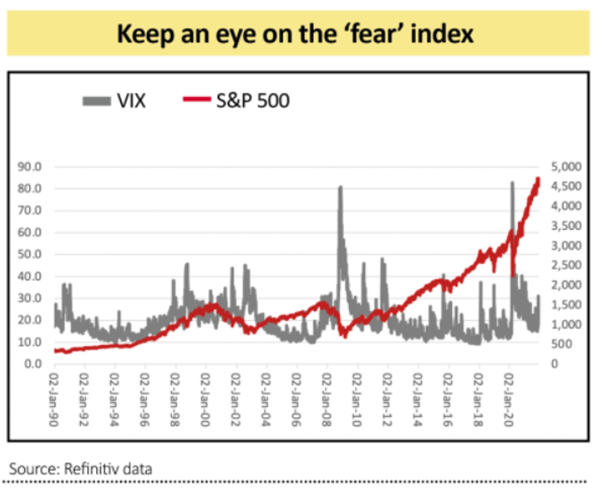
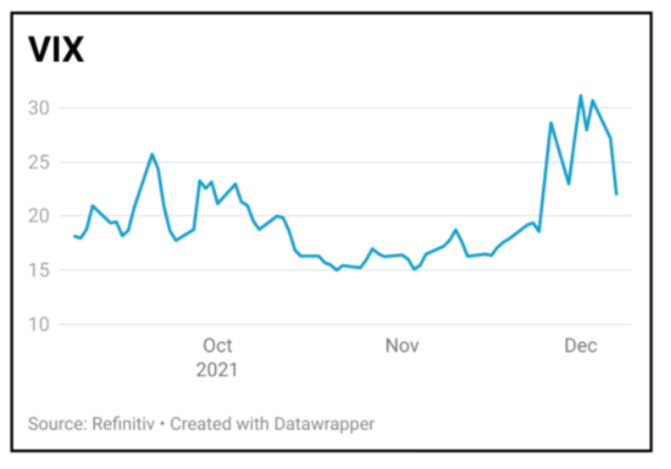
“The S&P 500 still trades close to all-time highs, so again the Fed will be hoping the turn in the liquidity tide does not rock too many boats here. A spike in the VIX and the stumble in the S&P will leave Fed officials on alert, though, as autumn 2019’s repo rate spike saw WeWork’s much-hyped flotation fall apart, Bitcoin sink 25% in a month and wider equity and bond markets both get the jitters, albeit very briefly.”

Source: Refinitiv data

Please check in again with us soon for further news and market analysis.

Stay safe.

Chloe

26/07/2021

Team No Comments

AJ Bell: Why Chinese stocks are still not partying

Please see below for one of AJ Bell’s latest articles, received by us yesterday afternoon 22/07/2021:

Tomorrow (23 July) heralds the one-hundredth anniversary of the first meeting of the Chinese Communist Party and the country’s leadership continues to mark its birthday with a series of high-profile events, speeches and actions

Whether the centenary is anything that investors can mark with pleasure remains more of a moot point, even if the benchmark Shanghai Composite index trades some 15% above the levels reached just before the news of the pandemic seeped out of the Middle Kingdom in early 2020. These doubts persist for three reasons:

First, the president and general secretary of the Communist Party, Xi Jinping, marked the anniversary of the party’s foundation on 1 July with what many in the West saw as an aggressive speech as he warned any foes would be met with a ‘wall of steel’.

Second, China continues to intervene in financial markets, often in not-so-subtle ways. The crackdown on internet giants such as Alibaba and Meituan, and cybersecurity investigation into ride-hailing app Didi immediately after its stock market flotation in the US looked like expressions of displeasure with a trend toward overseas listings and a reminder to entrepreneurs of who was really boss.

Finally, China’s second-quarter GDP growth figure of 6.7% year-on-year undershot economists’ forecasts. This perhaps serves as a reminder that China is trying to combat the economic fall-out of the pandemic and keep the economy going on one hand, yet seeking to avoid letting financial markets, asset prices and debt get out of hand on the other.

Beijing and president Xi are hardly on their own in this respect – the UK, US, the EU, New Zealand, Australia and Canada are also members of what is a hardly exclusive club – but political legitimacy perhaps rests most fundamentally upon economic progress, employment and increasing prosperity than it does in China than anywhere else, not least because the authorities really have no-one else to blame if anything goes wrong.

DEBT DILEMMA

The last point is perhaps the easiest to tackle. Granted, China has a relatively low government debt-to-GDP ratio of 67% but that number is rising quickly. Moreover, the opaque structure of Chinese State-Owned Enterprises, let alone the so-called shadow banking system, mean the overall national debt-to-GDP figure is a less healthy 270%, according to China’s own National Institution for Finance and Development.

China may therefore be generating growth, but the quality of that growth looks questionable, given its reliance on fiscal stimulus and cheap debt. This perhaps explains why the Shanghai Composite index is trading well below its 2007 and 2015 highs even as the economy keeps expanding. A timely reminder that investors should never use macroeconomic data alone when it comes to selecting stocks, indices and funds (be they active or passive) to research and follow.

In the interests of balance, it must be noted that China’s currency is trading relatively strongly against to the dollar, after a six-year slide, so markets may not be too worried about the economic foundations (although again the US faces the same challenges).

POWER PLAY

Geopolitical risk is something which with all investors must live but there is little they can do about it, barring factor it into the risk premiums they demand when buying assets in certain countries – or in plainer English, pay lower valuations to compensate themselves for the potential dangers involved.

Sino-American relations remain strained, to say the least, as Beijing and Washington wrestle for supremacy in key industries, notably mobile telecommunications and semiconductors.

This is prompting talk of a new Cold War, a view perhaps supported by president Xi’s powerful speech on 1 July. Investors will be hoping it does not spill over into a hot war over Taiwan, for example, whose strategic importance is only heightened by the global semiconductor shortage.

But if investors can do little about geopolitics, they can do everything when it comes to corporate governance, either on their own or by paying a fund manager to do the donkey work for them. And perhaps the greatest concerns lie here, at least when it comes to Chinese equities.

Beijing’s indifference to the damage done to Didi Chuxing’s share price in the wake of the security investigation and assertion that US regulators cannot check Chinese audits of firms with listings in America is a big red flag (if you will pardon the expression). No-one, from a private individual to a trained fund manager, can invest in a firm if audited, verifiable and reliable accounts are not available.

This reminder that China has its own agenda – one that is designed to preserve the Communist Party’s hegemony well beyond the first hundred years – affirms that investors’ needs are secondary.

They are welcome to keep buying stakes in Chinese firms, or funds which track Chinese indices or own Chinese equities, if they wish. But they need to be sure they are paying suitably lowly valuations to accommodate the potential risks, which should also be in keeping with their overall tolerance levels.

Please continue to utilise these blogs and expert insights to keep your own holistic view of the market up to date.

Keep safe and well

Paul Green DipFA

23/07/2021

Team No Comments

Brooks Macdonald – Daily Investment Bulletin

Please see investment bulletin below from Brooks Macdonald received yesterday afternoon – 21/07/2021

What has happened

Markets staged a rebound yesterday with the US index posting its best daily return since March. That said, there remains concerns amongst investors over the delta variant and some of the rally yesterday reflects expectations of Fed ultra-accommodative policy now being here to stay for the medium term.

Semiconductors

One of the big inflation stories of 2021 has been the chip shortage and the impact that’s had on supply costs for huge swathes of manufactured products. One of the highest profile areas is auto manufacturers where a shortage of new cars have led to soaring prices in the secondary used car market, driving US CPI higher. Yesterday the White House said that they were seeing signs of these shortages diminishing. US Commerce Secretary Raimondo said that CEOs from Ford and General Motors had said that the chip shortage was getting ‘a little bit better’ after moves to increase transparency over semiconductor production.

Latest on COVID

Yesterday saw further tightening of restrictions with Singapore suspending indoor dining and limiting group gatherings. The UK is seeing new cases off their peaks but week on week, cases are still up 41%. France announced that a ‘heath pass’ showing recent negative test or vaccination may be required for hospitality venues despite last Friday seeing a record 880,000 jabs in the country. Over in the United States, the CDC announced that of the COVID-19 cases sequenced, 83% of them are the delta variant versus only 50% at the start of July, in a further sign of the delta variant quickly becoming the dominant variant globally.

What does Brooks Macdonald think

The sell-off over the last week has been driven by the fears of the delta variant colliding with fears of imminent central bank tightening. Whilst the delta concerns are still there, and indeed may have even risen, investors have been quick to price in lower interest expectations and to push back on any expectations of imminent tapering of asset purchases. Central bank policy expectations were the key release valve for the markets at the height of the pandemic last year and this was playing out in yesterday’s trading session. Of course, with the Fed in its communication blackout window, next week’s meeting will need to deliver on these tweaked expectations.

Please continue to check back for our latest blog posts and updates.

Charlotte Ennis

22/07/2021

Team No Comments

Equities fall as inflation surges on both sides of Atlantic

Please see below ‘Markets in a Minute’ article received from Brewin Dolphin yesterday evening, which provides market analysis on a global scale. The commentary discusses rising inflation in the UK and US as well as Asia’s considerable economic recovery. 

Most major stock markets fell last week amid a higher-than-expected surge in inflation and increasing cases of Covid-19.

In the US, the S&P 500 and the Nasdaq slipped 1.0% and 1.9%, respectively, after data showed inflation jumped by 0.9% in June – almost double the figure forecast by economists. Federal Reserve chairman Jerome Powell reiterated his view that inflation pressures are temporary, which helped to moderate losses.

The pan-European STOXX 600 fell 0.6% after figures showed new Covid-19 cases in the EU and EEA had surged by 64.3% from the previous week, raising concerns about the continent’s economic recovery. The European Centre for Disease Prevention and Control said 20 countries had seen an increase in new cases, although hospitalisations remain stable.

The UK’s FTSE 100 also slid 1.6% as inflation fears resurfaced and rising infections outweighed optimism about ‘freedom day’.

Over in Asia, China’s Shanghai Composite ended the week up 0.4% after figures showed gross domestic product (GDP) rose by 7.9% in the second quarter from a year ago, while retail sales and industrial production in June surged by 12.1% and 8.3%, respectively, from a year ago.

Stocks slump as Delta variant spreads Equities slumped on Monday (19 July) as the spread of the Delta variant of Covid-19 weighed on investor sentiment. The Dow recorded its worst day in three months, sliding 2.1%, while the S&P 500 and the Nasdaq lost 1.6% and 1.1%, respectively.

The FTSE 100 posted its biggest one-day fall since May and finished below the 7,000 mark. Travel and leisure stocks suffered on news that fully vaccinated arrivals from France will still need to quarantine. British Airways owner IAG slumped 5.2% and easyJet declined 6.7%. Energy stocks also struggled after OPEC+ agreed to increase supply from August, leading to a decline in crude oil prices.

UK and European stocks rebounded at the market open on Tuesday, with the FTSE 100 and the STOXX 600 both adding 1.1%. Japan’s Nikkei 225 tumbled to a six-month low following Monday’s selloff.

US and UK inflation soars

Figures released last week showed inflation in the US and the UK accelerated in June, leading to renewed speculation that central banks could start to rein in their support for the economy.

In the US, headline consumer prices rose by 0.9% from the previous month and by 5.4% from a year earlier, marking the fastest pace of annual growth since 2008. Core inflation (excluding food and energy) rose by 4.5% from a year ago, the highest since 1991.

The surge was largely driven by the biggest monthly bounce in used vehicle prices for more than 60 years. Prices rose by 10.5% between May and June, meaning second-hand cars were being bought for around 45% more than a year earlier. Prices of new cars also rose by 2% month-on-month – the biggest increase since 1981.

Meanwhile, UK data showed the headline consumer prices index rose to 2.5% in the 12 months to June, the fastest pace for nearly three years, as prices continued to recover from their early pandemic lows. Higher food and fuel prices drove the increase, as did rises in the cost of eating and drinking out, clothing and footwear, and second-hand cars.

US retail sales beat expectations

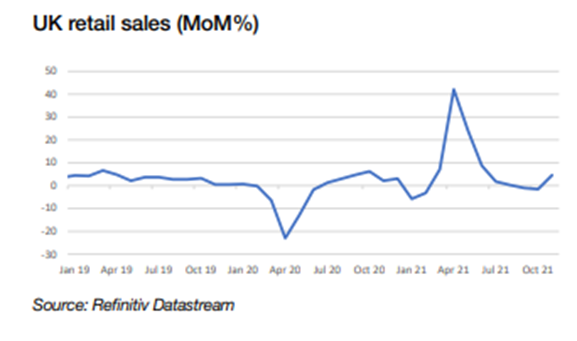
Last week also brought the latest data on US retail sales, which unexpectedly rose in June by 0.6% from the previous month, according to the US Census Bureau. Economists polled by Reuters had forecast a drop in sales of 0.4%. On an annual basis, sales surged by 18.0% and are now above their pre-pandemic level.

The rebound came despite purchases of motor vehicles declining for the second month in a row amid a lack of supply caused by the global semiconductor shortage. US retail sales are measured by receipts not volume, which meant higher prices from supply constraints flattered the figures.

Although consumers seem to be spending more, separate data released last week suggested they are also growing more cautious. The University of Michigan’s preliminary gauge of consumer sentiment fell to its lowest level since February, largely because of worries about inflation.

“Consumers’ complaints about rising prices on homes, vehicles, and household durables have reached an all-time record,” said Richard Curtin, the survey’s director.

Japan manufacturing index soars

Over in Japan, confidence among Japanese manufacturers rose in July to its highest level for twoand-a-half years, as global demand helped the country’s export-driven economic recovery. According to the Reuters Tankan poll, sentiment was boosted by strong confidence at car, chemical and metal products manufacturers, which offset poor conditions among textiles and paper.

However, the survey also showed service sector sentiment turned pessimistic in July, falling to -3 from a flat reading in June, as Covid-19 mitigation measures continued to curb spending. Tokyo is currently under its fourth coronavirus state of emergency, which is due to last until 22 August. On Wednesday (14 July), the capital recorded its highest number of new infections in almost six months.

We will continue to publish relevant articles and news, so please check in again with us soon.

Stay safe.

Chloe

21/07/2021