Team No Comments

Brewin Dolphin – Markets in a Minute Update

Please see this week’s Markets in a Minute update from Brewin Dolphin published yesterday (12/08/2020) and received late last night.

Please continue to check back for our regular blog posts for a variety of market and economic updates from a range of leading investment houses and fund managers, plus our own original content and views.

Andrew Lloyd

12/08/2020

Team No Comments

Legal & General – Asset Allocation Team Key Beliefs Blog

Please see article below from Legal & General’s asset allocation team – received 10/08/2020.

Legal & General Asset Allocation team’s key beliefs

American Express

This week, we take a tour of the United States – taking in the election, the economy, and the risk outlook for markets.

As with all Key Beliefs emails, this email represents solely the investment views of LGIM’s Asset Allocation team.

Biden: his time?

US presidential elections rarely lack drama, but it’s hard to recall one being carried out in such unusual circumstances as this year’s campaign. A few weeks ago it looked as good as it gets for Democratic candidate Joe Biden following months of terrible headlines for President Donald Trump, with polls and betting odds shifting in Biden’s favour. But then the polls stabilised and it seemed Trump was at his polling floor, making it difficult for Biden to gain more voters. With the potential for the news flow to normalise as new virus cases peak, the risks are skewed towards a tightening race.

The betting odds have barely moved, with the market average still giving Biden a 60% chance of winning. But polls have seen more movement, with Biden’s lead falling from an average of nine points to six over the past month. A few more polls in this direction and the narrative could escalate, pricing out some of the risk of a Democratic sweep.

The next major development is likely to be Biden’s pick for vice president. Betting markets suggest the contest is between Senator Kamala Harris and former national security advisor Susan Rice, with Senator Elizabeth Warren the only potentially market-moving – but low probability – option.

The focus then turns to party conventions over the second half of August. It remains to be seen how these translate as virtual events, how the press will cover them, and how voters will respond. Historically, a convention has given candidates a bump in the polls; they are likely to have a smaller effect than normal this time, but remain a wildcard, nonetheless.

Loan Concern

The US Senior Loan Officer (SLO) survey released last Monday night showed aggressive tightening across all categories, and by almost as much as during the financial crisis. The SLO survey has historically been a key metric for our economists in tracking bank lending standards, but how relevant is it this time round?

Lending standards tightened 2.8 standard deviations, not far away from the peak tightening of 3.4 standard deviations in October 2008. The tightening was broad based across all categories, with demand also weak for all loan types except mortgages.

But comparisons with 2008 are perhaps unfounded. Thanks to unprecedented support for corporate borrowers, strong bond sales have so far more than offset weak issuance of rated bank loans, meaning we are unlikely to see similar levels of bankruptcy, in our view – at least among companies with access to bond markets.

The key question is whether this tightening is bad news for the future or merely reflects a terrible second quarter. On the optimistic side, auto sales were not far from normal in July despite a huge apparent tightening in auto credit and very weak demand in this survey, while forward-looking housing market indicators look strong despite the tightening in mortgage credit availability in the second quarter.

The tightening nevertheless raises the risk that, without further large fiscal support, there will be economic scarring from bankruptcies as borrowers are not able to roll over loans. At a minimum, it is inconsistent with our most optimistic scenario which now will require some reversal of this tightening for the economy to return to trend growth by the end of next year. Employment data have also been mixed, with Friday’s non-farm payrolls just beating expectations following weaker PMI and ADP prints.

Risk Waiting

Last week saw us close out two of our more defensive tactical positions – long US Treasuries and short equities – following a cluster of near-term risks that appear not to have played out. New virus cases have slowed both in states that re-imposed harsh restrictions and those that did not, making further shutdowns less likely in the short term. Although we are seeing potential second waves in a number of other countries, nothing is spinning dramatically out of control, and vaccine news has added to a more positive tone of late.

In addition, incoming economic data last week had the potential to change the market’s assessment of what’s possible for growth over the next year, but have not proved to be a catalyst. And finally, concerns about US/China relations have so far failed to ignite. The South China Sea announcement came and went, while the forced sale of TikTok also seems unlikely to escalate tensions further.

This is not to say that all is rosy. Donald Trump may yet choose to fan the flames of Chinese resentment as an election tactic, while vaccine hopes and virus containment measures may not live up to the hype. As mentioned in previous editions of Key Beliefs, we now prefer to express our caution via selling investment-grade credit given the more stretched market positioning in that asset class.

A useful article from Legal & General’s Asset Allocation team on the United States election, the economy and the risk outlook for markets.

Please continue to check back for our latest updates and blog posts.

Charlotte Ennis

11/08/2020

Team No Comments

Invesco Investment Intelligence – weekly performance update

Please see below for Invesco’s latest Investment Intelligence Update:

News flow last week, such as Non-Farm Payrolls and the ISM surveys in the US, was generally supportive of a positive tone in financial markets. “V” looks the shape of the recovery, for now at least. The virus news, however, remains mixed. New confirmed cases continue to roll over in the US, albeit still at elevated levels, while in Europe and DM Asia case growth remains relatively low, although it has risen in recent weeks. Case growth continues at elevated levels in Latin America.  Central Bank dovishness remains very much the order of the day, with the Bank of England last week reiterating the uncertain outlook and the preparedness to do more if needed. Geo-political strains between the US and China refuse to go away, and in fact look as if they are escalating, while progress towards further US fiscal stimulus continues to frustrate.

Global equities hit their highest level since the bear market low during the week and are now back into positive territory for the year, now just 3% from their all-time high. Small caps and value/cyclical sectors led the way. In the UK further £ strength weighed on FTSE 100 relative performance, which dragged the All Share lower.

There was mixed performance in fixed income, with government bonds weaker at the margin, with the odd exception (Italy, EM). IG and HY continue to make progress. A new record low for yields for the former, while further declines in yields for the latter returned the asset class to positive territory for the year. Spreads for both still remain well above the lows seen earlier in the year.

The US$ halted its decline (see Chart of the week). Economic optimism helped boost economically sensitive commodity prices. China, the world’s biggest consumer of copper, saw record imports for the second straight month. Gold pushed to new highs as real yields declined to record lows and investor demand remained elevated.

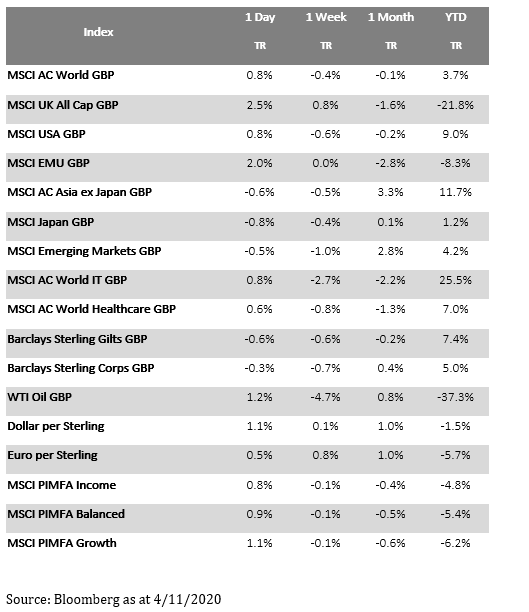
 Market performance last week (%)

Past performance is not a guide to future returns. Sources: Datastream as at 9 August 2020. See important information for details of the indices used.1

YTD market performance and YTD low (%)

Past performance is not a guide to future returns. Sources: Datastream as at 9 August 2020. See important information for details of the indices used.1

 Chart of the week: US$ Index

Source: Datastream as at 8 August 2020.

  • One of the features of financial markets since the peak of the pandemic crisis dislocation in late March has been the weakness in the US$. In this chart we use the US$ Index (DXY) as a proxy for the currency’s performance (Fixed currency weights for DXY are Euro 57.6%, Yen 13.6%, £ 11.9%, Canadian $ 9.1%, Swedish Krona (SEK) 4.2% and Swiss Franc 3.6%).
  • At its YTD peak (late March) it had risen just under 7% on the back of its safe-haven, reserve currency characteristics and a shortage of US$ liquidity. Since then it has given up all those gains and more, declining 9.1% and now down just over 3% YTD. It is now at levels last seen in May 2018 and its 100-day decline has been the worst since November 2010. The major contributor to this weakness has been strength in the Euro (10.3%), given its high index weight, but other currencies have been stronger (SEK +18.7%, £ +11.1%). The Yen has been the weakest on a relative basis, but has still risen 4.6%.
  • Why has the US$ been so weak? A number of factors have contributed: the global rebound in growth has favoured more cyclical currencies, such as the Euro; an unwinding of safe-haven flows into the US$ on the back of this; real and nominal interest rate differentials between the US and another major markets have collapsed; aggressive Federal Reserve policy has alleviated US$ funding issues; fiscal and structural optimism in Europe on the back of agreement on the European Recovery Fund; the Federal Reserve and US government is happy to see a weaker currency; and finally, idiosyncratic US political and fiscal risk. All have weighed on a currency that on most measures was overvalued and where investor positioning was extended.
  • Can the US$ weaken further? Fundamentals are currently stacked up against the currency for now, but this is in the context where the DXY has moved from its most overbought level ever (relative to its 12m average) to its most oversold level since 1978. At the same time investor positioning (based on CFTC data) is now at a record short.
  • What does US$ weakness mean for financial markets? Historically it has benefitted global equites (and non-US stocks in particular), cyclical sectors, EM assets in general and commodity prices, such as Gold and Copper.

Key economic data in the week ahead:

A relatively quiet week ahead on the data front.

In the US there is July’s CPI reading on Wednesday. Headline inflation is expected to rise slightly to 0.7%yoy, off the pandemic lows, but still at the lowest level since 2015. Core inflation is expected to see a marginal decline to 1.1%yoy, its lowest level since 2011. The pandemic has been disinflationary. Initial jobless claims out on Thursday are forecast to show another 1.4m people receiving unemployment benefits, despite the better than expected Non-Farm Payroll data last Friday. Data on the strength of the US consumer is also out, with US retail sales for July published Friday and forecast to show a slowing recovery (1.9%mom vs 7.5%mom in June), while the preliminary reading of the University of Michigan Sentiment Index is expected to fall further and continue to hover around pandemic lows.

In the UK the most anticipated datapoint next week is the Q2 GDP release on Wednesday. If the forecasts of -20.5% prove right it would be the worst quarterly contraction of the UK economy on record. Broad-based weakness is expected, with the increase in government spending the only positive, depending on your point of view. Monthly GDP for June will also be released at the same time, which should show an underlying improving trend in the economy not seen in the quarterly numbers, with 8%mom forecast compared to May’s 1.8%mom. The latest UK unemployment report is published on Tuesday. The unemployment rate is expected to rise only slightly to 4.2% from 3.9% as the labour market continues to be underpinned by the government’s job retention scheme. The true health of the labour market will be seen away from the headline data in areas such as the number who are now economically inactive, hours worked and vacancy levels. These all point to higher levels of unemployment by year end, with the Bank of England’s Monetary Policy Report last week seeing it at 7.5%. Finally, there is July’s RICS house price data on Friday, which is expected to show a -5% drop in July, but up from -15% last month, highlighting the gradual improvement in the housing market in England and Wales.

China’s July data pipeline started last week and will continue throughout this week with figures on CPI (Monday) industrial production, fixed investment, retail sales, house price inflation and unemployment (all on Friday). Most indicators are forecast to post better readings than they did in June, suggesting that the third quarter is off to a relatively firm start.

Nothing of note during the week from either the EZ or Japan.

An insightful look into the markets by the experts at Invesco. These weekly updates are useful in terms of providing a regular overall view of the market.

Please use Invesco’s Investment Intelligence updates as well as our other blogs to refresh your view of current goings on in the global markets.

Keep safe and well.

Paul Green

11/08/2020

Team No Comments

Blackfinch Asset Management – Monday Market Update

Please see below for Blackfinch Asset Management Monday Market Update – received today 10/08/2020.

Blackfinch Asset Management – Monday Market Update

In the ever changing world that we live in, we recognise the importance of regular and current communication. This weekly news update provides you with a short summary of events around the world which we hope you will find useful. 

UK COMMENTARY

  • The UK Manufacturing Purchasing Managers’ Index (PMI) for July was revised down slightly to 53.3 from initial estimates, with numbers supported by an increasing domestic demand. The survey of members also showed increasing confidence, with 62% expecting production to be higher in 12 months’ time, whilst only 12% forecast a contraction.
  • The latest Services PMI number came in strongly at 56.5, up from 47.1 in June, moving back in to expansion territory.
  • The Bank of England keep interest rates on hold at 0.1%, commenting that they expect the economy will shrink by a fifth and unemployment will double by the end of the year as the furlough scheme unwinds.

US COMMENTARY

  • Tensions between the US and China continue to escalate as President Trump announces a US ban on video-sharing, social networking service TikTok and multi-purpose messaging service WeChat.
  • The US jobs market appears to stall, with private payrolls adding only 167,000 jobs in July, against expectations of 1mln new jobs.
  • Weekly jobless numbers are, however, stronger than expected with first-time jobless claims falling by 249,000 to 1.2mln, ahead of expectations of over 1.4mln. Overall unemployment numbers also fell to 10.2% from 11.1% in June.

ASIA COMMENTARY

  • China PMI is reported at 52.8, ahead of consensus and further support for the existence of a strong economic recovery.
  • China’s exports were up 7.2% year-on-year after rising just 0.5% in June, with support from the textiles and electronics industries, not simply medical supplies which had dominated export numbers recently.

COVID-19 COMMENTARY

  • A rapid saliva-based COVID-19 antigen test in development by Avacta Group and Cytiva will receive clinical validation testing by the Liverpool School of Tropical Medicine.

Another useful article from Blackfinch Asset Management highlighting key events from around the world.

Please continue to check back for our latest blog posts and updates.

Charlotte Ennis

10/08/2020

Team No Comments

J.P. Morgan – Review of markets over July 2020

Please see below an article published by J.P. Morgan last week on 03/08/2020 and received today, providing their summary of markets throughout July 2020:

July provided further evidence that economic activity has improved since lockdowns were lifted, but high-frequency data pointed to a pause in the recovery, particularly in the US. The pace of increase in new infections also rose in most regions from the start of July, but appeared to slow towards the end of the month in the US, while rising, from much lower levels, in Europe and Japan. Hopes for a vaccine were boosted by positive early-stage trial results. Over the month, the MSCI Emerging Markets equity index rose by 9.0% and MSCI Developed Markets by 4.8%. Credit also rallied, while government bonds held on to their gains for the year and gold rose by 11%.

Major central banks took something of a back seat over the past month, having already flooded the market with liquidity and taken rates close to their lower bounds. However, governments have been under pressure to provide further fiscal support. Congress debated the extent to which unemployment benefits should be extended and whether further stimulus cheques should be provided, with a deal proving difficult to get over the line.

US

Daily new infections in the US began to rise again from mid-June, and that trend continued throughout most of July. The initial Covid-19 outbreak was mostly centred in the northeastern states, but throughout June and July infections began to rise rapidly across the rest of the country. As a result, many states have now begun to partly reverse or pause their reopening plans. The World Health Organisation recommends that the percentage of tests that are positive should remain below 5% for 14 days before starting to reopen an economy. Currently, the majority of US states are seeing positive tests in excess of this recommendation. Despite a higher number of daily new infections, the number of new daily deaths as a result of Covid is lower now than at the prior peak. This could be due to improved treatment and more social distancing among older age groups. However, hospitalisations have risen and will need to be monitored to assess whether new infections will lead to rising pressure on health systems and potential further business shutdowns in the worst-affected states.

US GDP for the second quarter fell by an annualised rate of 32.9% compared with the previous quarter. While this confirms the largest decline in GDP since the Second World War, investors have been more focused on the recovery in some of the economic data since April. US retail sales have rebounded by 27% since their low in April and are just 1% below their peak in January of this year. Not all the data is picking up at such a rate though. The high-frequency mobility data has begun to slow as the spread of the virus has increased. Small business revenue has partly recovered, but still remains around 20% below pre-Covid levels. The labour market recovery is also showing some signs of stalling. Initial jobless claims remain high and are no longer falling; meanwhile, the employment component of the July manufacturing purchasing managers’ index (PMI) remains below 50. July’s consumer confidence reading also fell.

Consumer incomes have so far been protected by support measures from the US government, which provided USD 1,200 stimulus cheques as well as a USD 600-per-week boost to unemployment benefits. Congress is negotiating another stimulus bill, which could see a second round of stimulus cheques as well as some extension to unemployment benefits, though probably at a less generous level than before.

We are in the midst of the US second-quarter earnings season, with expectations of roughly a 45% year-on-year decline. So far, with over 55% of companies having reported, earnings have come in a little stronger than expected. The S&P 500 rallied 5.6% over the month.

Europe

Europe looked to have managed the virus better than many other regions in the second quarter, though there are some concerns about rising cases more recently. Activity has been rising across the region, particularly in Germany, given new infections had remained low for some time. However, a recent outbreak in Spain, coming just before the peak of the summer tourist season, has cast some doubt over the potential for a swift economic recovery. The risk of an increase in Covid cases as economies reopen is leading to a potentially more stop-start and geographically differentiated recovery, though an effective vaccine would clearly be a strong catalyst for a more sustained economic rebound.

Second-quarter GDP fell by 12.1% compared with the previous quarter – the largest quarterly decline in the eurozone’s history. European consumer confidence also stalled after healthy gains in previous months, but the composite PMI improved significantly, to 54.8 versus April’s reading of just 13.6.

The European Union (EU) agreed a EUR 750 billion recovery fund in response to Covid-19. Importantly, the recovery fund will be backed by common bond issuance by the European Commission. This is a significant step toward potential fiscal integration across the EU and has increased appetite for European assets. Italian and Spanish bonds returned over 1%.

UK

Daily new cases of Covid-19 in the UK had been falling, but again concerns around a small increase in cases have surfaced at the same time as the government has lifted activity restrictions. A summer economic plan put forward by the Chancellor aims to introduce measures to get the economy back on its feet by reducing stamp duty, cutting VAT for the food and hospitality sectors and offering companies GBP 1000 for each furloughed staff member that they retain until the end of January. At the same time as giving with one hand, the Chancellor plans to take with the other as he rolls back the furlough scheme, which had helped protect the jobs of millions of UK workers. Some of those jobs could now be at risk if activity doesn’t recover before the scheme is wound down. UK assets have been somewhat out of favour compared with other regions over the past month. The FTSE All-Share fell by 3.6% in July.

Emerging markets and Asia

The increase in new cases in Brazil and India continued throughout July. Recent outbreaks in Hong Kong have also seen the reintroduction of restrictions, which will limit the number of people in group gatherings to just two, while mask-wearing is mandatory.

In China, GDP for the second quarter grew by 3.2% year on year. Travel app data shows that mobility in China and South Korea has recovered well without a significant rise in cases. Both countries appear to show, at least so far, that a recovery is possible without a vaccine if the virus can be brought under control with other measures. Chinese equities were up 8.7% over the month.

Conclusion

The policy response to Covid-19 from central banks and governments has been swift and sizeable and helped lift markets, as policymakers have aimed to build a bridge to the other side of the virus. However, a full economic recovery can only take place if rising activity doesn’t also lead to rising infections. Governments should therefore continue supporting consumer incomes and businesses until a vaccine is available or until the virus is brought under control by other means. The extent to which they do so will be key to the outlook from here. It appears progress is being made towards a potential vaccine, but it is too early to sound the all clear just yet. Given the high uncertainty around the outlook for the virus and a vaccine we continue to favour an up-in-quality approach across both stocks and bonds, along with a focus on valuations relative to fundamentals. Alternatives such as macro strategies may help diversify portfolios given the reduced diversification that government bonds are likely to provide at current yields. With the uncertain outlook so dictated by the virus, but also given the potential for a vaccine, we continue to believe it makes sense to aim for balanced and well-diversified portfolios.

Please continue to check our Blog content for advice and planning issues and the latest investment, markets and economic updates from leading investment houses.

Please keep safe and healthy.

Carl Mitchell – Dip PFS

IFA and Paraplanner

10/08/2020

Team No Comments

Andy Pearson

The one word that seems to me most relevant to my many years of involvement as a client of Steve Speed and People and Business is confidence.

Whether speaking to Steve and his team on matters relating to my business interests or my personal finances, having total assurance with regard to the objectivity of the advice provided and the clarity with which it presented is a constant and valuable – in all senses of the word – benefit.

What first impressed me with Steve was his ability to explain the most complex financial conundrums and to present the options and his recommendations in a succinct and totally professional manner.

That remains the case and the only thing that has changed over the many years that we have had dealings is my confidence, which has increased immeasurably.

Andy Pearson
10th August 2020

Team No Comments

AJ Bell Article: Bargain hunting investors still avoiding UK equity funds

AJ Bell Article: Bargain hunting investors still avoiding UK equity funds

Please see the below article which we received from AJ Bell yesterday 09/08/2020:

Investors returned to markets in force in the second quarter of the year, on the hunt for bargains following market falls earlier this year, according to the latest figures from the Investment Association. A total of £11.2bn was invested in funds in the three months to the end of June, helping to counteract some of the mass outflows seen in March when market volatility was at its peak.

In equity markets investors hedged their bets and invested in global funds, rather than pegging their hopes on one country getting out of the current pandemic in better shape than others. In the first six months of the year investors put £2.8bn into global equity funds, despite the sector seeing almost £700m of outflows in March alone. However, this is still a 20% drop in inflows when compared to the same period last year.

Investors’ view of the UK is not as rosy, with June seeing just over £1bn pulled from UK equity funds, and UK All Companies funds seeing the largest outflows at £662m. Worries about a second wave of the virus in the UK, fears about the nation’s economic outlook and the current drought of income in the market all turned investors away in search of better prospects elsewhere.

Tracker funds returned to favour, after investors had shunned them earlier this year in favour of active managers. During June they saw £2.1bn of inflows, making up the vast majority of inflows in the month. This is likely because active managers have failed to outperform on average in many sectors during 2020’s volatility and market recovery, leaving investors disappointed and switching back to cheaper rivals.

Absolute Return funds have now chalked up £3.5bn of outflows in the first six months of this year alone, with some funds shrinking in size dramatically during that time. Investors have been fleeing the sector for two straight years now, with 24 consecutive months of outflows totalling £11.4bn, as disappointing performance from some of the bemouths in the sector coupled with worries about how well the sector as a whole was performing mean investors have lost faith. The size of the sector, including the effect of performance, has shrunk from being the third largest at £80.7bn two years ago to £53.7bn today – a drop of more than a third.

As you can see, the impact from the still ongoing Pandemic continues to be very prominent in the markets, with the ‘second wave’ fears showing no sign of market stability in the near future.

We expect this volatility to continue for some time, however for long term investors, this can be used to their advantage as investing now can be seen as ‘good value for money’ (i.e. you are generally buying assets at lower prices).

We will continue to post our regular blog updates from a large variety of fund managers and experts to help keep you up to date with the market developments as the Pandemic continues.

Andrew Lloyd

10/08/2020

Team No Comments

Jupiter Asset Management – Active Minds Blog

Please see Active Minds article below from Jupiter Asset Management – received 06/08/2020

Summer warmth turns chilly for UK equities

In contrast to the warm, sunny weather in the UK at the moment, the UK equity market feels quite chilly and unloved in a global context, said Dan Nickols, Head of Strategy, UK Small & Mid Cap. The S&P 500 Index in the US is now up year-to date, while FTSE All-Share Index is down over 20% and the Numis Smaller Companies Plus AIM ex Investment Companies Index of UK small and mid-caps is down almost 18%.1

The reason why the UK has been so weak compared to other markets is partly compositional, as it contains fewer technology names, more financials, and more discretionary consumer stocks. Dan believes there is another layer too: the ongoing Brexit drama means that, for overseas investors, the UK can simply be filed under ‘too difficult’ and ignored for now in favour of other equity markets.

With an eye on the future, Dan is looking at real-time data around things such as credit card transactions, which indicate there was a good recovery until the end of June that then showed signs of slowing in July. Dan also highlighted a risk off unemployment picking up in the coming months, as the furlough scheme tapers off into a weak economy, bringing the importance of judicious stock and sector selection into sharp relief.

All of the above creates a challenging environment for UK equity investors. Dan highlighted that, in the UK small and mid-cap world, leadership in the market from a style perspective is very stark, as value continues to struggle badly while momentum, growth and revision factors remain relatively strong. Dan and the team are trying to navigate this by being purposefully overweight structural growth names, while tempering that with some exposure to what they believe are well-managed, conservatively financed stocks that are more geared into economic growth – although they have pared these back over the last few weeks, while retaining exposure to the stocks in which the team have highest conviction.

Large-cap tech stocks drive emerging markets

Emerging markets had a pretty good July, with the MSCI Emerging Markets Index finishing the month up around 3% (in sterling terms), noted Colin Croft, Fund Manager, Emerging Markets. Year to date, the index is almost flat, which is quite remarkable given the state of the global economy, said Colin.2  However, gains have been concentrated in a fairly narrow set of large-cap tech stocks, which now represent significant weightings in the index. These stocks are up significantly year to date, almost entirely driven by re-ratings, rather than seeing much in the way of earnings upgrades.

It is impossible to predict what the trigger could be for a change in the relative rating of these kinds of stocks. However, Colin suspects that as soon as there’s some sort of light at the end of the tunnel in terms of the pandemic, investors will want to take profits in these kinds of ‘haven’ stocks that have become so expensive, and could instead choose to move into stocks with more leverage to the recovery. It’s likely to be a bumpy road to get there though – for example, sentiment for recovery-dependent sectors such as financials and travel has been badly affected by a pickup in cases in countries that were previously looking much more encouraging, such as Spain and Australia. Elsewhere, the outbreak in Latin America shows no signs of abating – instead, it is plateauing at high levels.

Fortunately, there are some structural themes playing out that are more or less independent of the pandemic, highlighted Colin. One of these is the likely positive impact of the 5G rollout; another is the gas pipe reform we’re seeing in China. The latter has been under discussion for years, but finally some progress was made over the past month or so. Pipelines there were owned by the big three majors, which were also producers; however, now China is injecting all the pipe assets into a national company, which will then allocate the capacity in a strategic manner. Colin noted that this is happening on terms that have been surprisingly favourable to investors: they’re being injected at 1.2x or 1.4x book value; they’re also getting 40% cash payments for it, not just shares; and there’s talk about paying special dividends too.

Tech in the time of coronavirus 

The significant impact of technology across various sectors has been one key positive theme accelerated by the pandemic, says Makeem Asif, Fund Manager, Multi-Asset. Whether it is working from home, educating children online, retailers’ pivoting to online distribution or the need for more cybersecurity, the pandemic has led to a step change in the use of tech.

But, for Makeem and the global convertibles team, the biggest issue has been the valuation of some software companies where it is not unusual to see shares trade on 25x-40x revenues. In the semiconductor space, despite some initial supply chain disruptions, production in most factories in Asia is back on track. Earlier this week the semiconductor industry association published its monthly report which tracks sales and average selling prices of units. This highlighted how robust the semiconductor industry has been during the pandemic: in the twelve months to June, sales grew 7%, up from the 3% annual growth seen in May. The team expects chip sales to continue to rise driven by demand from data centres, autos, electric vehicles and other devices. In addition, says Makeem, such companies tend to have more reasonable valuations with good cashflow metrics.

In the fintech space, the hygiene requirements arising from the pandemic have acted as a catalyst to accelerate the uptake of digital payments with their clear advantage over cash. One of the dominant US card payment companies said it expected to reissue around 70% of its cards in the next 12-18 months. Although the switch to digital payments is not new, Makeem says there is still a significant amount of growth to come as some economies have been slow to adapt. Furthermore, there are still around 1.7 billion people worldwide who do not have a bank account.

1Source: FE, index returns in GBP to 31.07.2020
2Source: FE, index returns in GBP to 31.07.2020

Articles like this are useful for getting an insight to the market from market experts within their specified field.

The Coronavirus Pandemic has affected our lives in many different ways but as noted above a key positive theme has been the boost of the technology sector within the markets.

Please continue to check back for our latest blog posts and updates.

Charlotte Ennis

07/08/2020

Team No Comments

A.J. Bell – Property Fund Article

Please see below an article published by A.J. Bell yesterday, outlining why the reduced liquidity in property funds is not necessarily a bad thing:

Thanks to the introduction of technology, a competitive landscape for products and platforms and the general faster pace of 21st century life we have all got used to the idea of being to buy and sell our investments whenever we want.

The idea of giving six months’ notice to exit an open-ended property fund, a key recommendation put forward by regulator the Financial Conduct Authority in its latest response to the problems in this space (3 Aug), seems extremely onerous.

However, it is probably a move in the right sort of direction. Most open-ended property funds have been suspended anyway since March amid uncertainty over the valuation of their assets thanks to the Covid-19 pandemic.

Expectations of being able to buy and sell units in a fund which invests in an asset class which can take weeks or even months to sell was always liable to throw up problems.

These were particularly acute in the financial crisis and after the Brexit referendum, when facing a wave of redemptions as investors looked to sell out of the funds, managers ran out of cash and the funds had to be suspended.

THE DIFFERENCE BETWEEN TRADING AND INVESTING

Selling an asset during a period of intense volatility, when the kinds of liquidity issues seen with property funds are most likely to crop up, is not likely to be a good idea.

And while six months might seem like a hell of a time to wait, for an investor with a long-term horizon it is really the blink of an eye.

There are two main ways of profiting from the financial markets. The first is to buy and hold assets with the aim of achieving a reasonable and sustainable return. The second, higher risk approach, is to trade in and out of assets for a quick profit.

Only someone pursuing the former strategy could accurately be described as an ‘investor’ as opposed to a ‘trader’.

The biggest downside of the proposed 180-day notice period from this author’s perspective is that appears you would agree to sell at a price which you would only discover when the notice period came to an end.

If you want more flexibility and crucially transparency there are other options. You could buy a real estate investment trust or other property-related trust.

As these trade on the stock market you can buy and sell more or less whenever you like at a price you can see immediately but you also need to accept that trusts may trade at a discount to their net asset value, particularly in difficult markets.

As our clients are investors, not traders, we do not see this as an issue and generally the exposure to Commercial Property is nominal when you look at the average portfolio.

Please continue to check our Blog content for advice and planning issues and the latest investment, markets and economic updates from leading investment houses.

Please keep safe and healthy.

Carl Mitchell – Dip PFS

IFA and Paraplanner

07/08/2020

Team No Comments

UK Finance unveils ten Covid-19 and lockdown scams to be aware of

Please see below for the latest blog from UK Finance regarding scams:

UK Finance unveils ten Covid-19 and lockdown scams to be aware of

  • UK finance unveils ten Covid-19 and lockdown scams the public should be on high alert for and how to spot them
  • Criminals are preying on a worried public by tapping into their financial concerns due to coronavirus, asking for personal and financial information
  • New animation video from Take Five to Stop Fraud campaign warns people to remember criminals are sophisticated at impersonating other organisations

Using the coronavirus pandemic as an opportunity, fraudsters are using sophisticated methods to callously exploit people, with many concerned about their financial situation and the state of the economy. To coincide with the launch of its new animation urging people to follow the advice of the Take Five to Stop Fraud campaign, UK Finance today reveals ten Covid-19 and lockdown scams which criminals are using to target people to get them to part with their money.

 Some scams manipulate innocent victims, urging people to invest and “take advantage of the financial downturn”. Others impersonate well-known subscription services to get people to part with their cash and personal information. Criminals are even posing as representatives from the NHS Test and Trace service in an effort to trick people into giving away their personal details.

To remind people that criminals are experts at impersonating trusted organisations, UK Finance has launched a new animation video urging people to follow the advice of the Take Five to Stop Fraud campaign. Consumers are reminded to always take a moment to stop and think before parting with their money or information in case it’s a scam.

 The ten scams to be on the lookout for and how to spot them:

Covid-19 financial support scams

  1. Criminals have sent fake government emails designed to look like they are from government departments offering grants of up to £7,500. The emails contain links which steal personal and financial information from victims

  2. Fraudsters have also been sending scam emails which offer access to ‘Covid-19 relief funds’ encouraging victims to fill in a form with their personal information.

  3. Criminals have been targeting people with official-looking emails offering a ‘council tax reduction’. These emails, which use government branding, contain links which lead to a fake government website which is used to access personal and financial information.

  4. Fraudsters are also preying on benefit recipients, offering to help apply for Universal Credit, while taking some of the payment as an advance for their “services”.

Health scams

  1. One of the most shocking scams that has appeared during the pandemic has involved using the NHS Test and Trace service. Criminals are preying on an anxious public by sending phishing emails and links claiming that the recipient has been in contact with someone diagnosed with Covid-19. These lead to fake websites that are used to steal personal and financial information or infect devices with malware.

  2. Victims are also being targeted by fake adverts for Covid-related products such as hand sanitizer and face masks which do not exist.

Lockdown scams

  1. Criminals are sending fake emails and texts claiming to be from TV Licensing, telling people they are eligible for six months of free TV license because of the coronavirus pandemic. Victims are told there has been a problem with their direct debit and are asked to click on a link that takes them to a fake website used to steal personal and financial information.

  2. Amid a rise in the use of online TV subscription services during the lockdown, customers have been targeted by criminals sending convincing emails asking them to update their payment details by clicking on a link which is then used to steal credit card information.

  3. Fraudsters are also exploiting those using online dating websites by creating fake profiles on social media sites used to manipulate victims into handing over their money. Often criminals will use the identities of real people to strike up relationships with their targets.

  4. Criminals are using social media websites to advertise fake investment opportunities, encouraging victims to “take advantage of the financial downturn”. Bitcoin platforms are using emails and adverts on social media platforms to encourage unsuspecting victims to put money into fake investment companies using fake websites.

The banking and finance sector is working with the government and law enforcement to help identify scams and prevent people becoming victims of fraud. The industry is also encouraging everyone to remain vigilant and to follow the advice of the Take Five to Stop Fraud campaign, and to Stop, Challenge and Protect when they receive any messages out of the blue:

Stop: Taking a moment to stop and think before parting with your money or information could keep you safe.

Challenge: Could it be fake? It’s ok to reject, refuse or ignore any requests. Only criminals will try to rush or panic you.

Protect: Contact your bank immediately if you think you’ve fallen for a scam and report it to Action Fraud.

In order to spot a Covid-19 scam, people should be on high alert if:

  • The website address is inconsistent with that of the legitimate organisation
  • The phone call, text or emails asks for financial information such as PIN, passwords

  • You receive a call or email out of the blue with an urgent request for your personal or financial information, or to make an immediate payment

  • You’re offered a heavily discounted or considerably cheaper product compared to the original price

  • There are spelling and grammar mistakes, or inconsistencies in the story you’re given

Managing Director of Economic Crime at UK Finance, Katy Worobec, said:

“During this pandemic we have seen criminals using sophisticated methods to callously exploit people’s financial concerns, impersonating trusted organisations like the NHS or HMRC, to trick them into giving away their money or information.

“The banking and finance industry is tackling fraud on every front, investing millions in advance technology to protect customers and working closely with the government and law enforcement to stop the criminal gangs responsible and neutralise the threat.

“We would always urge people to follow the advice of the Take Five to Stop Fraud campaign to keep their  money and personal information safe from fraudsters.”

As the world rapidly changes, we have criminals adapting just as quickly to pounce on vulnerable situations. We post blogs like this to keep you up to date and aware of the latest scams you should be aware of, some of which even surprised us with their inhumanity.

We are all in this together, the way to battle this new wave of crime is to be vigilant and don’t be afraid to question anything that doesn’t seem normal, even by the most minor detail. Please remember if you receive these communications:

  • If it seems to good to be true, it probably is
  • If you were not expecting it, treat it with suspicion
  • Do NOT give away any personal details if communications make you think either of the points above

Anyone can be vulnerable to these scams. These criminals are career experts in what they do and can catch anybody off guard with devastating consequences, do not be afraid or embarrassed to discuss these matters or ask for help/advice.

Keep safe and well.

Paul Green

06/08/2020