As we deal with the health and economic impact of the second wave of the virus in the UK and Europe, markets have hit another patch of turbulence. We have seen heightened volatility over the last few days.
Why do we have this level of volatility?
The obvious answer is the global pandemic and the impact on our economies around the world. In addition to this we have the US election and Brexit too to name just a few issues.
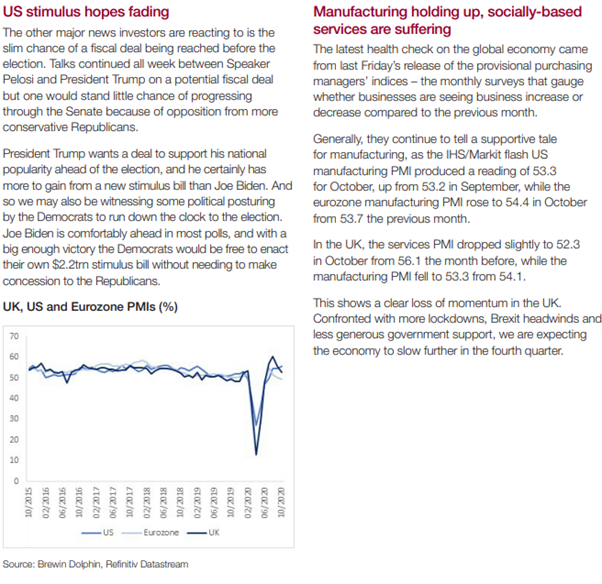
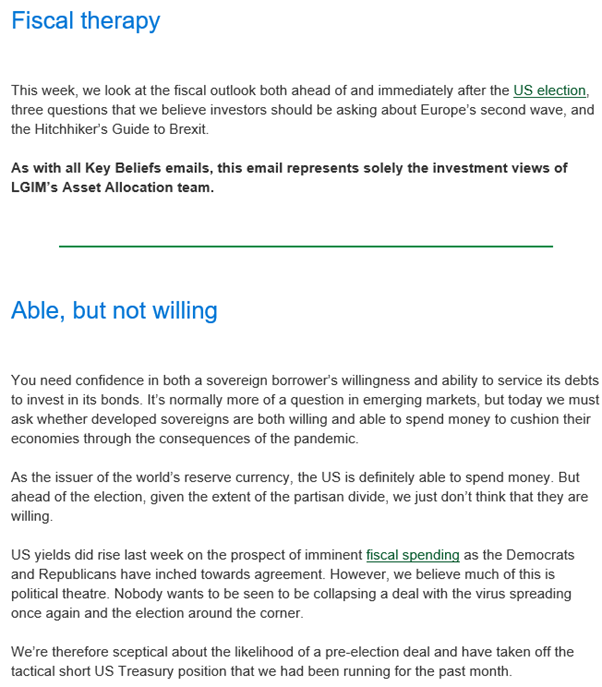
The US election has gridlocked the political system in the States and as a result badly needed additional fiscal support has not been forthcoming. If we get a ‘Blue Wave’ for the Democrats and they are fully in control this gridlock could be resolved fairly quickly and fiscal support could be put in place.
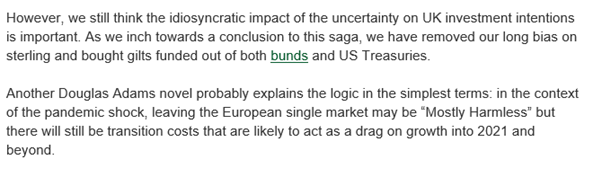
Brexit negotiations rumble on and we could do with a positive outcome. J. P. Morgan’s base case is that we will get a last-minute fudged deal but there is still a risk of a ‘No Deal’ Brexit.
Volatility could continue with further legs down even as economies and markets recover. Given time markets and funds will recover.
What is the outlook?
The vaccine (or vaccines) are a key issue. The consensus view appears to be that we will have a vaccine late this year or early 2021. This will be a game changer. Even if we can only protect our Health Workers and the vulnerable initially this should give consumers confidence to return to normal behaviour.
By the end of 2020 we should know who the next US President is, understand our Brexit position and hopefully have vaccines that are starting to be rolled out.
Are there any bright spots?
China and North Asia generally are doing well. In particular the data coming out of China is really good and they appear to have recovered economically and are growing. This could have a positive impact not just in the region but globally.
Some sectors have done well too, for example Technology. We are also seeing more intertest in ‘Green Energy’ as the world starts to grapple with climate change.
Vaccine development is progressing at a pace too.
What might help?
More support from Central Banks such as the Bank of England, the ECB, and the Federal Reserve. Generally, they look supportive and able to accommodate more help. The IMF recently indicated that more support should be forthcoming from Central Banks.
Policy support from governments globally will help too. We need to spend on infrastructure projects and focus on keeping people in work and getting back to work with training and apprenticeships etc.
A weaker dollar would be useful helping Emerging Markets trade and having a positive impact on global trade too.
As an investor what should I do now?
Maintain the status quo and stay invested in real growth assets. If you are funding pensions and investments keep on funding. Generally, asset values are low now and should show good returns over the long term.
If you have spare capital now is a good time to invest too if you have the risk appetite. Buying assets at the right price is the key determinant of long-term investment returns.
Don’t try and time the market, you need time in the market.
Summary
The quote ‘The darkest hour is just before the dawn’ seems appropriate. Said to emphasise that things often seem at their worst just before they get better. The English theologian and historian Thomas Fuller appears to be the first person to commit the notion that ‘the darkest hour is just before the dawn’ to print.
We don’t know how long this ‘hour’ will be, but progress is being made.
Just be patient, we should be on the way to a brighter future and hopefully with the aid of vaccines our behaviours will become more normal and economies and markets will recover as our activities increase and life returns to normal, a new normal?
Please see article below from Brooks Macdonald received today 28/10/2020.
Brooks Macdonald – Daily Investment Bulletin
What has happened
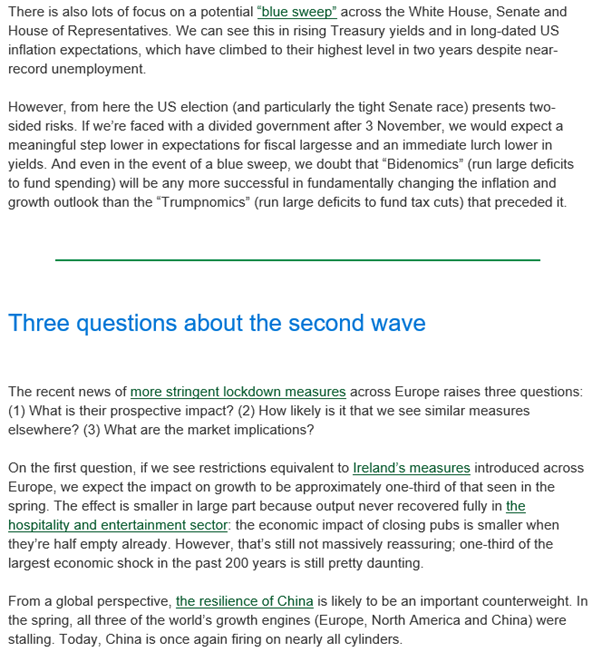
Coronavirus malaise continues to grip markets with European and US equities recording losses. European equities have been underperforming the US of late, in part due to Europe being the main focus of this second wave but also the cyclical tilt in the European indices which suffer as near-term economic activity looks more uncertain.
Coronavirus restriction update
The day by day movements in COVID-19 restrictions will likely dominate markets over the coming weeks, particularly if the US election proves to be a drawn-out affair. France and Germany are expected to move into a form of lockdown over the coming few days, this will represent the culmination of the relative willingness for tight restrictions on social activity and hospitality with bars and restaurants expected to be shut. The next step will be tough decisions over whether to close schools and businesses in a return to the restrictions seen earlier in the year, it is mainly this step that markets are worried about. Add in the fact we are moving into the colder months, and flu season, and the market is struggling to be optimistic about the coming 3/6 months.
‘Filibuster’ is the most important word in the US Election
With only a week to go until the US Election, much discussion focuses on the implications of any change at the White House. With Joe Biden’s current polling lead, and early polling which has likely already translated that into votes, the Senate is arguably far more important. Major legislative changes however require a House majority (which the Democrats have) and a filibuster-proof majority in the Senate. A filibuster is effectively a political procedure, through the medium of an exceptionally long speech, designed to slow down proceedings to a halt and prevent a vote on a piece of legislation. So, what can be done to prevent this? Either one party wins 60 Senate seats (highly unlikely), sufficient to pass a ‘cloture’ motion which effectively puts a time limit on any given debate or the new Senate votes to remove the filibuster for the entirely of the next session.
What does Brooks Macdonald think
Joe Biden has previously favoured a bipartisan approach to legislation and therefore may be intellectually against the idea of filibuster reform which hugely strengthens the incumbent party. That said, with the Supreme Court now having a 6/3 conservative majority, the Democrats may want the additional power to ‘pack’ the court to create a more balanced bench. This will arguably be the most important, and fascinating aspect of US politics in the coming months.
Source: Bloomberg as at 28/10/20
Philip Penrose Business Development Manager
A good brief commentary from Brooks Macdonald giving updates on the latest Coronavirus restrictions and the US election.
Please continue to check back for our regular blog posts and updates.
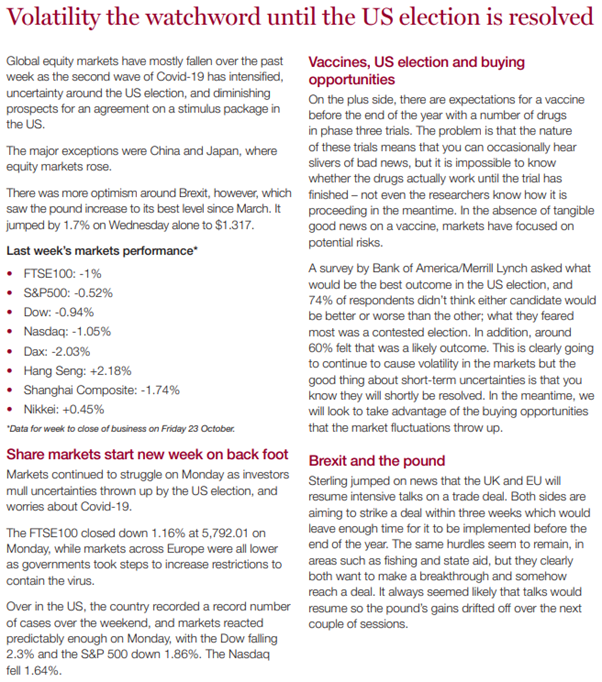
Please see this week’s Markets in a Minute update from Brewin Dolphin:
With one week left until the US Election, the surge of Covid infections worldwide, and the Brexit deadline looming we don’t expect the market volatility to subside just yet!
It’s still going to be a bumpy ride as we approach the end of the year.
Stay posted for our regular updates as we continue to keep you informed of market developments.
Please see below an article received late yesterday afternoon from Legal & General Investment Managers which provides their latest market views:
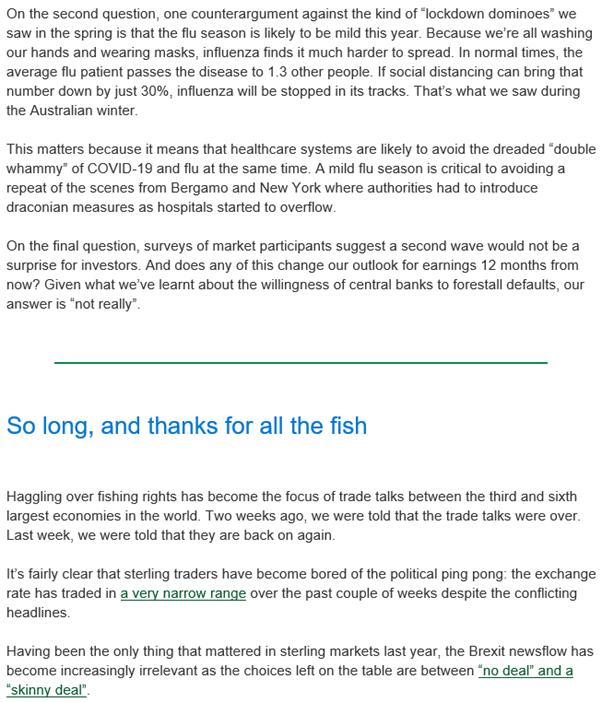
As mentioned in my LGIM blog last week, one of the key focuses remains the outcome of the upcoming U.S. election, more so than the ongoing Covid-19 pandemic and it looks like China is nearly back pre-pandemic activity. If stricter lock-down measures are introduced, it is anticipated that these are likely to have a lesser impact on markets than they did in Spring. This is mainly because markets didn’t fully recover from the impact of the first lockdown.
The good news here is that if markets do decline again, this will present a good buying opportunity for investors.
Opportunity is still out there for investors, but it remains important to have a long-term (minimum 5 years) view and a diversified portfolio, which is spread across a number of regions and sectors in order to benefit from these opportunities. The longer the investment term, the better.
Please continue to check our Blog content for advice and planning issues and the latest investment, markets and economic updates from leading investment houses.
Please see below for Brooks McDonald’s weekly market commentary, received late afternoon 26/10/2020:
In Summary
As coronavirus cases continue to rise in Europe and the US, fiscal stimulus needs will increase
The Oxford vaccine candidate is reported to have led to a strong immune response in elderly patients
Central bank season begins with the European Central Bank (ECB) and Bank of Japan meeting this week
As coronavirus cases continue to rise in Europe and the US, fiscal stimulus needs will increase
Over the weekend, the US and many European nations recorded their highest number of daily COVID-19 cases, as the blame game started between House Democrats and the White House over the stimulus impasse. With just over a week to go until the US presidential election, something fairly miraculous would need to occur to get stimulus over the line. US equity futures are trading down to reflect this probability.
The Oxford vaccine candidate is reported to have led to a strong immune response in elderly patients
Momentum remains behind the growing US and European case load. Italy has now approved a new national curfew as the country, which had previously fared well during the second wave, sees a sharp surge in cases. France also set a record high in new cases with the positivity rate of tests also rising to 17%1 . There were some positive vaccine stories over the weekend in relation to two front runners however. The University of Oxford/AstraZeneca candidate is reported to have led to a robust immune response in elderly patients which is critical for an effective vaccine. As the elderly are most at risk of serious illness from COVID-19, and have a weaker immune system than the young, there were concerns that a vaccine would fail to produce an effective immune response. The Oxford vaccine has also seen its trials restart in the US on Friday after being halted last month.
Central bank season begins with the European Central Bank (ECB) and Bank of Japan meeting this week
The ECB are meeting on Thursday, the same day as the Bank of Japan. We expect the ECB to warn of downside risks to the economic outlook as well as inflation. This comes as European coronavirus cases, and subsequent restrictions, have risen significantly since the last meeting. There is likely to be the (now traditional) attempt to hand the responsibility for further accommodation to governments, with the ECB stressing the limits of monetary policy in a negative rate environment. Regardless, we may well see some additional easing before the end of the year, particularly if European fiscal policy disappoints as expected. We are entering central bank season with the ECB and Bank of Ireland this week and the Federal Reserve and Bank of England next week. We are expecting the rhetoric to be very focused on the downside risks to the economy but for central bankers to try to put pressure on further fiscal policy more than promising additional easing. Quantitative easing is very effective at restoring order in financial markets but is less helpful in boosting the real economy. If coronavirus cases continue to escalate, fiscal policy will need to carry the weight of the second wave stimulus.
Articles like these provide an efficient way to receive well-informed views that cover the whole of market and are useful to maintain your up to date view of global market news.
Please keep reading our blogs regularly to give yourself a holistic and up to date view of markets.
Please see below update received from Blackfinch this morning. The bulletin provides world-wide commentary on market performance in response to events such as the ongoing Covid-19 pandemic and the upcoming US election.
UK COMMENTARY
The IHS Markit UK Household Finance Index for October was at 40.8. A value below 50 indicates that respondents believe their financial well-being is deteriorating.
UK consumer price inflation rose to 0.5% year on year in September, up from 0.2% in August. While the downward impact of the Eat Out to Help Out scheme was removed, the temporary VAT cut in the hospitality sector continued to help keep inflation low.
The Government borrowed £36.1bn last month, above consensus forecasts and bringing the total borrowing for the first half of the financial year to a record £208.5bn
Lancashire, Greater Manchester and South Yorkshire all joined Merseyside in tier 3 COVID-19 lockdown
The Business Impact of Coronavirus (COVID-19) Survey showed that 71% of businesses said they were at no or low risk of insolvency
Rishi Sunak announced the latest COVID-19 support package, including grants for businesses affected by tier-2 restrictions, a tweak in the job support scheme and extra support for the self-employed
UK retail sales rose by 1.5% in September from August’s level, the fifth consecutive monthly increase
The IHS Markit/CIPS Flash UK Composite Purchasing Managers’ Index (PMI) for October fell to a four-month low of 52.9
US COMMENTARY
Democrats and Republicans continued to debate the introduction of a further stimulus package ahead of the presidential election
First-time jobless claims fell to 787,000
Another presidential debate did little to clear up which candidate is likely to emerge victorious from next month’s election
Markit’s latest PMI survey showed that business activity rose at its fastest rate for 20 months in October
ASIA COMMENTARY
China’s third-quarter gross domestic product grew by 4.9% as compared to a year ago, falling just short of economists’ expectations
Retail sales of consumer goods in China rose by 3.3% in September
The International Monetary Fund downgraded its forecast for the Asia-Pacific region to -2.2% in 2020.
COVID-19 COMMENTARY
Pfizer said that it is ready to file for regulatory sign-off of its COVID-19 vaccine and has already manufactured ‘several hundred thousand doses’ to sell. This is if current clinical trials involving 44,000 people are successful.
Gilead Sciences’ COVID-19 treatment Remdesivir has been approved by the US Food and Drug Administration. The drug has now been renamed Veklury.
We will continue to source information from the research teams of reputable providers in order to publish the most relevant market data. Please check in with us again soon.
Please see latest ‘investment intelligence update’ from Invesco received today 26/10/2020.
Monday 26 October 2020 – update
The contrast between those economies seeing a severe re-escalation in the virus and those that have escaped relatively unscathed was clear to see in economic news flow last week. China’s economy continues to recover strongly (see chart of week), while declining flash PMIs in Europe, led by the more exposed Services sector, highlighted the increasing economic pressures being felt in the region from renewed containment measures. The EZ’s Composite PMI is now in contraction territory, below 50, and although it remains just above 50 (52.9) in the UK, it is well below the 59.1 level seen in August’s survey. And it is only likely to get worse as the full impact of lockdown measures start to hit home. A difficult winter ahead for these economies. Fortunately for the global economy, the US continues to defy any virus-related concerns with last week’s PMI hitting a post-pandemic high, led by the Service sector. Notwithstanding that, further fiscal support is deemed necessary there to underpin the recovery and bridge the gap to the widespread availability of an effective vaccine. The UK has already been forced down that route, with further policy support announced last week for businesses and the labour market. Alongside the virus, politics continues to hog the limelight. The US elections are just over a week away, while closer to home Brexit negotiations appear to be back on track. The outcome of both remains uncertain, bringing with it the potential for increased market volatility in coming weeks.
Against this backdrop, equity markets struggled to make any headway last week. The MSCI ACWI declined slightly, with EMs comfortably ahead of DMs. Japan was the only gainer amongst the major DM markets. Small Caps marginally outperformed. Value and Cyclicals were the best style factors. IT had a rare poor week and Financials a rare strong one, the latter helped by higher bond yields. It was a mixed week for UK equities, with decent gains from mid and small caps being offset by large cap weakness, with the FTSE 100 hitting its lowest level for five months. Improved Brexit sentiment was the key driver here, with a strengthening £ a headwind for the latter.
Government bond yields had a difficult week, with yields moving higher across the board. 10yr USTs hit their highest level (0.85%) since June but remain over 100bp below their YTD starting level (1.91%). Expectations of further stimulus was the culprit here. Improved Brexit sentiment was behind higher Gilts. Weakness in government bonds weighed on IG credit, even with spreads hitting post-virus lows. HY performed better, with yields edging lower.
In currency markets the US$ weakened across the board. £ had its strongest day since March during the week on Brexit optimism. Copper benefitted from a weaker US$ as well as strong economic news flow from China, hitting a YTD high during the week. Gold remained below $1900. Oil weakened on expectations of increased Libyan output and virus-related demand concerns.
Market performance last week (%)
Past performance is not a guide to future returns. Sources: Datastream as at 25 October 2020. See important information for details of the indices used.1
YTD market performance and YTD low/high (%)
Past performance is not a guide to future returns. Sources: Datastream as at 25 October 2020. See important information for details of the indices used.1
Chart of the week: China Real GDP and forecasts (yoy%)
Source: Datastream as at 23 October 2020. Forecasts are red dashed line based on Bloomberg median quarterly yoy%.
China announced its Q3 GDP number last week. While these numbers always need to be treated with a degree of caution given the speed in which the second largest economy in the world can produce its “final” estimate (the US by contrast does not produce its first estimate until late October and its final estimate until late December) they are the only official numbers available as to understand the overall state of the Chinese economy. And for 2020 at least the lack of an official growth target means there has been less political pressure to massage the figures this year.
In Q3 the economy grew by 4.9%yoy. This was disappointing relative to the consensus expectation of 5.5%, due to below trend growth in the services sector, but was still an acceleration from Q2’s 3.2%yoy. A “good” pandemic, substantial fiscal and monetary support and strong foreign demand have clearly been important contributors to this rapid recovery back towards “normality”. And a continuation of the recovery in Q4 should take real GDP growth back to its pre-virus 6% trend. This puts the median consensus expectation for 2020 at 2.1% growth, which would leave China as the only major economy to see positive growth this year (by contrast the US is expected to contract by 4% and the EZ by 7.9%).
The strong relative performance of the Chinese economy has had a positive knock-on effect on the performance of Chinese assets. The MSCI China and MSCI China A Onshore (large and mid cap stocks just listed on Chinese domestic exchanges) have returned 20% and 17% respectively, while the Renminbi has risen 4% against both the US$ and China’s preferred Trade Weighted measure (CFETS RMB index).
In terms of longer-term prospects, Chinese leaders will discuss the next 5 Year Plan (2021- 2025) at the 5th Party Plenum meeting this week. The main theme of this FYP will be the “dual circulation” strategy, which calls for more emphasis on the domestic economy as a source of growth, compared to earlier export-driven growth strategies. This is against a backdrop of a steady economic slowdown, driven by an ageing population and slower productivity growth, rising geo-political tensions and a slowing down of globalization. Key to this will be a focus on boosting domestic consumption and further market opening measures. While any growth target is unlikely to be announced until March next year, expectations are that it will be in the range of 5-5.5%, which compares to the 6.5% target in the previous FYP.
Key economic data in the week ahead
A fairly busy week on the data front, with the highlights being Central Bank meetings in the EZ and Japan alongside the first look at GDP performance in the former as well as the US. Outside the data news flow, developments on the virus front, the final run-in to the US elections and Brexit progress will all be closely watched by investors.
Preliminary US Q3 GDP data is published on Thursday and forecast at an annualised 31.9%qoq – the sharpest rebound in the history of post-WW2 GDP. However, this will still see the overall economy behind where it was at the end of March, following the 31.4%qoq contraction in Q2. On Wednesday the Conference Board Consumer Confidence index is expected to show a slim improvement in October at 101.9 from September’s 101.8, but this would still leave it well below the 130+ level at the start of the year. The impact of the virus on consumer confidence remains plain to see. Following last week’s surprise drop in US Initial Jobless Claims at 787k, this week is forecast at 785k when released on Thursday.
In the UK, the housing market takes centre stage, with Wednesday’s Nationwide House Price Index for October. House price inflation is expected to have slowed to 0.3%mom from 0.9%mom in September. Year-on-year house prices are estimated to have increased 5.2%yoy from 5.0%yoy. This would be the strongest growth since 2016. Mortgage Approvals for September on Thursday are expected to confirm the current robustness of the housing market, even if new approvals are forecast to be lower, at 76.1k from August’s 84.7k. This is still comfortably above the 60k 10-yr average pre-pandemic.
The EZ publishes its first estimate of Q3 GDP on Friday. A strong rebound to 9.5%qoq is forecast, but again insufficient to redeem the -11.9%qoq drop of the previous quarter. Year-on-year this leaves growth at -7%, compared to -14.7% last quarter. On Thursday the ECB monetary policy meeting is expected to keep the policy stance unchanged, but the press conference should be of interest as ECB members discuss their updated economic outlook. The latest Inflation and Unemployment data is published on Friday. For the former, no improvement is expected in October, with Headline and Core forecast to remain at -0.3% and 0.2% respectively. The latter is expected to see a small uptick from 8.1% to 8.2% – still low in the context of the past decade – as government support schemes continue to underpin the labour market.
The Bank of Japan meets on Thursday, with no change in policy expected there either. A busy day on Thursday also sees Industrial Production data for September, expected at 3%mom and -9.8%yoy, and September’s Unemployment numbers, where expectations are for 3.1% compared to 3% in August. The Jobs-to-Applicants ratio is likely to remain close to 1 – well below the 1.6x level seen at the start of the year. Retail Sales for September on Wednesday are forecast to show a significant -7.9%yoy drop from -1.9%yoy in August, but this is largely a function of consumers looking to beat the sales-tax hike in October 2019 rather than pandemic-related weakness.
Official PMI data is released in China on Saturday. Following last week’s Q3 GDP results, the Manufacturing PMI for October is expected to continue to point to expansion, remaining at 51.8, while the Non-Manufacturing PMI is forecast to fall marginally to 52.8 from 53 in September.
A useful article from Invesco, reviewing current market issues and highlighting the key economic data in the week ahead.
Please continue to check back for our regular blog posts and updates.
Good Money Week kicks off on Saturday 24 October, in the midst of a bumper year for ethical fund sales and a snowballing spotlight on investing sustainably. But does investing according to your principles mean accepting a lower financial return?
To address this question AJ Bell has analysed funds with a 10 year performance record in the IA UK All Companies and IA Global sectors. These are the two most popular sectors with retail investors by far, accounting for approximately £190bn of assets.
Key findings:
The average UK ethical fund has outperformed the average non-ethical fund, and the FTSE All Share
This has been a result of luck as well as judgement
The average global ethical fund has performed better than the average UK ethical fund
BUT it has underperformed the benchmark MSCI World Index
Investors in some UK ethical index trackers have been left behind
A record amount of money is being invested in ethical funds by UK retail investors
Ethical fund picks
These numbers show investing ethically is perfectly compatible with getting an exceptional return over the long term. The number of ethical funds on the market has been growing rapidly and that means investors can now afford to get a bit more picky when it comes to choosing a fund with performance pedigree.
UK ethical funds have done particularly well compared to the market with the average fund showing a clean pair of heels to the benchmark FTSE All Share Index. As ever the devil is in the detail and some funds have let the side down, in particular some of the older UK tracker funds where returns have been eroded by high charges.
On average global ethical funds have done even better in the last ten years than their UK counterparts. But they have fallen behind the MSCI World Index which has been driven relentlessly upwards by the remarkable performance of the US stock market.
On the one hand then, global ethical investors might feel short-changed, but the delivery of high absolute returns while meeting an ethical investment policy should quell any major concerns. The global sector is also heterogenous in its make-up and some ethical funds are pursuing specific investment themes like clean water and urbanisation, which make comparison with the index and the sector less meaningful.
Some global ethical funds have managed to beat the benchmark index which demonstrates that even against the high bar of the MSCI World Index it’s possible to post outperformance while following a responsible investment framework.
Performance of ethical funds in the IA UK All Companies sector
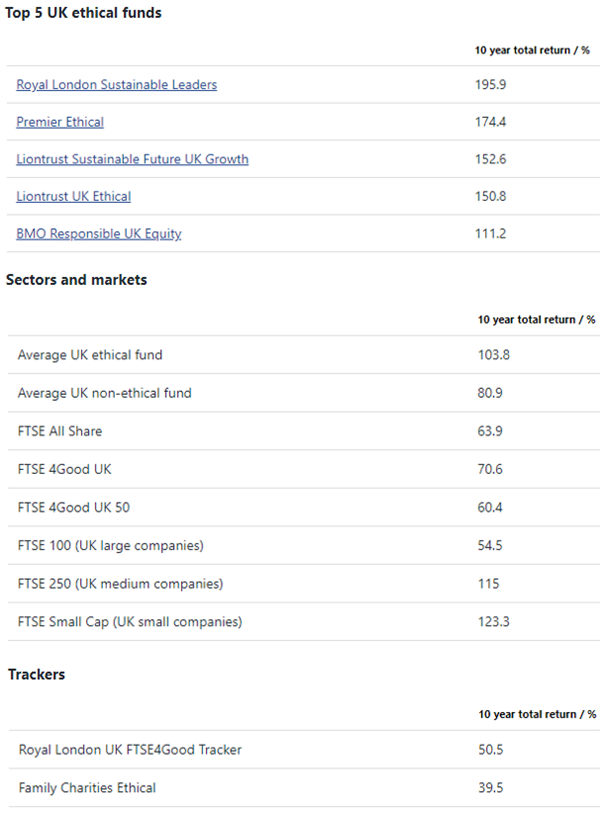
The average UK All Companies ethical fund has outperformed the FTSE All Share by 40% over the last 10 years. It’s also outperformed the average non-ethical fund by 23%. The top performing ethical fund over 10 years is Royal London Sustainable Leaders trust, which has returned 196%, compared to 64% from the FTSE All Share*.
Over half of UK ethical funds sit in the top quartile of performance for UK All Companies funds overall. The top performing ethical fund (Royal London Sustainable Leaders) is the 8th best performing fund in the UK All Companies sector over ten years (i.e. 7 funds bettered it).
Strong ethical outperformance has been achieved by a combination of luck as well as judgement. That’s because responsible funds tend to have less invested in the big blue chips, which have underperformed compared to medium sized and smaller companies (see table below).
On average the top 5 performing UK ethical funds have 31% invested in large companies compared to the UK market index (the FTSE All Share) which has 66% invested in the big blue chips. The top 5 have on average 32% invested in midcaps and 37% invested in small caps, compared to 23% and 11% respectively in the FTSE All Share*
There are some notable laggards in the sector though. Bringing up the rear of the performance table are two passive funds. Passive funds replicate the performance of the index they are tracking, but lag after charges are deducted. The size of the lag depends on the level of charges and the time investors hold the fund. Where charges are high and the investment horizon is long there can be a damaging drag on performance.
The Family Ethical fund is the worst performer, underperforming the FTSE All Share by 24.4%. More relevantly it’s underperformed the index it tracks, the FTSE 4Good UK 50 index, by 20.9%. Over 10 years it’s turned £1,000 invested into £1,390, compared to £1,600 from the FTSE 4Good UK 50 index and £2,040 from the average UK ethical fund. That’s simply a reflection of the compound effect of annual charges of 1.5%, which eat into the fund’s performance year after year. Investors do get an ISA wrapper into the bargain, but that still doesn’t look like great value compared to other options available to investors.
Sources: FE to 30/09/2020
Averages for ethical and non-ethical funds are based on the performance records of those funds with a ten year record only.
Performance of ethical funds in the IA Global sector
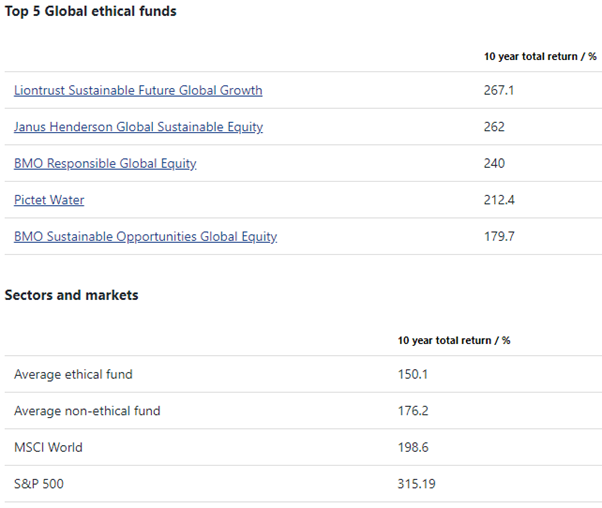
The picture is more nuanced for ethical funds in the global sector. The average global ethical fund with a 10 year performance record has outperformed the average UK ethical fund providing a total return of 150.1% since 2010 compared to 103.8%.
However the bar is set higher in the global sector because of the relative performance of the benchmark index, the MSCI World Index, which itself has been driven higher by an extremely hot US market. Compared to this index the average global ethical fund has underperformed, returning 150.1% compared to 198.6%, and has also failed to match the average non-ethical fund in the sector, which has returned 176.2%.
Given the extremely strong absolute performance of ethical funds in the global sector, it’s difficult to say investors should be disappointed but technically as a group they have underperformed.
There have been some funds which have managed to outpace the racy MSCI World Index though. The Liontrust Sustainable Future Global Growth fund tops the performance chart; it has turned £1,000 invested into £3,670, compared to £2,990 from the MSCI World Index.
There has been a glut of new fund launches in this sector in recent years, and there are now 57 funds available in the sector, which means there are now many more options for investors, albeit with shorter track records.
Source: FE to 30/09/2020
Averages for ethical and non-ethical funds are based on the performance records of those funds with a ten year record only.
A record-breaking year
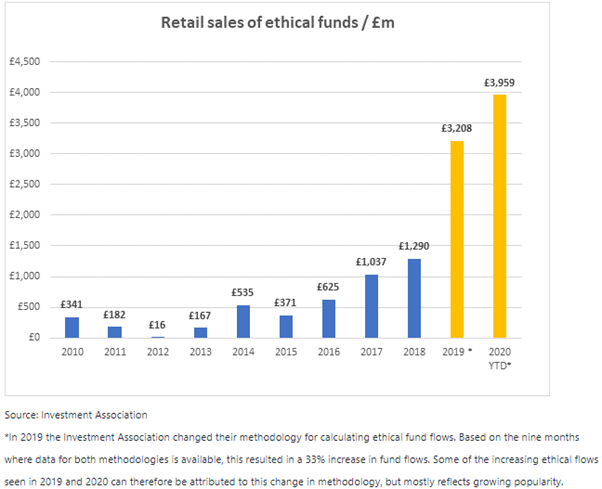
Unless there are heavy withdrawals from the sector in the next few months, ethical funds are on course to have a record-breaking year in terms of retail fund sales, as the chart below shows. And that’s after a bumper 2019.
£3,959 million has been invested so far this year compared to £3,208 million last year according to Investment Association data. Still less than 3% of all Investment Association retail assets sit in ethical funds however which leaves plenty of scope for further growth.
Ethical funds will hope to emulate the success of tracker funds in hitting the mainstream of retail investing. In 2010 less than £7 in every £100 was held in passive funds- that now stands at £18.
As more ethical funds launch on the market, and reach the critical three year performance record which is often used as a bare minimum by professional and retail investors, we can expect flows into these funds to continue to blossom.
Ethical fund launches
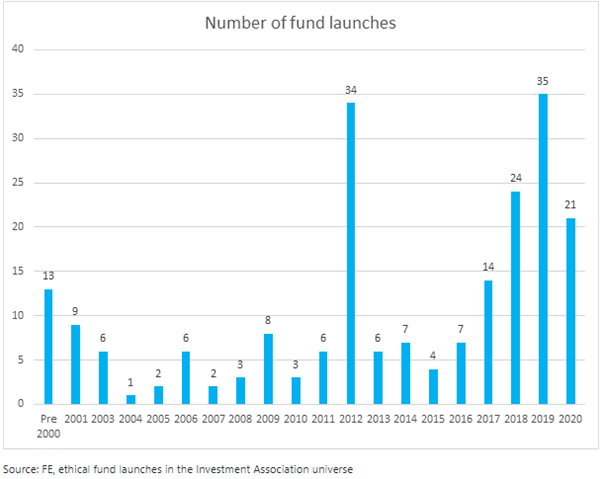
Ethical fund launches have slowed down this year compared to 2019, probably a reflection of the practical difficulties COVID restrictions have thrown up for fund groups. With a few months left to go however, it’s still looking like a strong year for new funds hitting the market.
Looking back 2012 was an anomalously heavy year for ethical fund launches and was only recently bettered in 2019. That can probably be attributed to two big changes which swept through the investment industry in that year. The Retail Distribution Review led to new share classes being introduced after funds were prohibited from paying ongoing commission and at the same time the arrival of pensions auto-enrolment opened up the door for fund groups to lodge new funds in pension plans.
Peter Michaelis, head of the sustainable funds team at Liontrust, has been investing in sustainability since 2001. This fund invests across the global stock market in companies that are driving sustainable growth. The fund doesn’t use negative screening – it selects companies on their positive societal benefit, based on around 20 sustainable growth themes identified by the Liontrust team.
Manager Mike Fox has been involved in this fund since 2003 – it actually started life at the Co-op. It invests exclusively in the UK stock market and seeks to invest in companies which demonstrate a net benefit to society. The portfolio is constructed using a quantitative and qualitative approach which scores companies according to their sustainability and financial credentials.
The fund invests across the globe in companies that are positioned to benefit from the sustainable development of the countries in which they operate. Manager Nick Edgerton has been managing the fund since 2012 (as co-manager until 2016). He assesses companies based on their social utility and environmental impact, as well as the quality of the management and financial performance.
These articles are for information purposes only and are not a personal recommendation or advice. Past performance isn’t a guide to future performance, and some investments need to be held for the long term.
Comment
This article echoes what we have been talking about recently, that ethical and sustainable investing has gone mainstream and that you no longer have to accept lower performance with ethical investments (compared to standard investments).
Whilst this has been an interesting year, to say the least, one of outcomes of the year has been that ethical and socially responsible investing has become a bigger topic of discussion. We now have more clients than ever asking us about ethical investing.
Keep a look out for more ESG and ethical investment content.
Please see the below update from some of the Fund Managers at Jupiter Asset Management received earlier today:
Mark Nash
Fund Manager, Fixed Income
Markets take bad news in stride but need fiscal spending
Markets have run aground in the last few weeks as Covid-19 cases rise in Europe, including Germany, and in the US, and this second wave damages growth prospects, said Mark Nash, Fund Manager, Fixed Income.
The risk-on, reflation trade needs a continued upward trajectory in global growth and central bank support, he said. Central banks remain supportive, but what is lacking is fiscal stimulus, which is needed as a bridge to support growth through the winter before a vaccine arrives. There has been some negative news on a vaccine, with some experts reducing the likelihood of a significant vaccine rollout in Q1 to 45% from 75% previously, he added.
The market’s reaction to the negative news hasn’t been huge, however. The Treasuries market has weakened a little, but risk assets remain reasonably buoyant, and the dollar hasn’t softened, as would be expected in a risk-averse market, Mark said.
There hasn’t been the big risk-off move and dollar scramble seen in recent years when the market panics over dollar liquidity, and Mark highlighted a few reasons for the muted reaction: the Federal Reserve (Fed) is providing liquidity so access to dollars is easier. Also China is doing well, with growth coming from fiscal support, exports and rising consumer spending. This suggests to Mark a more even and sustainable recovery in China, and it’s helping the global economy, with the renminbi acting as a conduit to remove some dollar strength.
The US current account deficit is starting to bite, with the country consuming more than it is producing, and requiring more dollars to buy overseas goods. But as the Fed keeps rates low, overseas investors are less interested in buying US assets, also preventing dollar strengthening, and that’s quite a big structural change, Mark said.
If the bad news stops, Mark expects additional dollar weakness and a continuation of the Treasury market underperforming the rest of the world. He anticipates any risk-off moves as being reasonably shallow, however, and he expects there to be buying opportunities. Mark doesn’t expect an exaggerated move upward in the dollar that does much damage to the risk market, as the Fed would step in to prevent this and there will be more government fiscal support eventually.
Ross Teverson
Head of Strategy, Emerging Markets
Enablers reduce the guessing game in emerging tech trends
Ross Teverson, Head of Strategy, Emerging Markets, drew attention to what he calls the ‘tech enablers’ in emerging markets. These are companies that are key to a lot of the big changes happening in technology, because they supply key components or services to the headline-grabbing companies that get people excited in fields like the cloud, 5G, the Internet of Things and even electric vehicles.
Ross argued, however, that these companies differ from those more glamorous names in a few important ways. Not least is that their share price valuations are generally lower, but also because – as suppliers to entire sub-sectors of the industry – they can benefit whichever of their customers ultimately ends up winning the battle for the public’s wallets.
By way of example Ross highlighted the mobile phone handset market, which is seeing fierce competition, but where semiconductor companies can sell to the market as a whole regardless of which handset manufacturer is currently on top. The autos sector is another example, as clearly there are a lot of people very positive about the potential for electric vehicles (EVs), as reflected in the share price performance of dedicated EV auto firms this year.
A recent forecast from Morgan Stanley put EV penetration at 31% by 2030, although Ross’s own view is that is still too conservative a figure. We are not far from seeing the cost of an EV fall to that of a comparable internal combustion engine car, and all of the concerns people have about charging will begin to fall away as range improves, charge times decline and charging networks expand.
Picking the winner in the EV race from the legacy auto manufacturers or the pure EV newcomers is a process fraught with risk. From an investment standpoint Ross sees a more appealing opportunity in the ‘tech enablers’ serving the EV sector. This includes companies involved in, for example, mining raw materials for the batteries, making the batteries themselves, developing autonomous driving software, or providing testing equipment and services.
Paul Pulickal
Credit Analyst, Fixed Income
Active primary market for credit management services
Paul Pulickal, Credit Analyst, Fixed Income, explained how Covid-19 has impacted the credit management services space. The sector is made up of two primary operating models: debt purchasing, where businesses buy non-performing loans (NPLs) or assets from banks, utilities and telecoms at deep discounts to face value; and debt servicing, where businesses don’t own the underlying loan, but earn a fee on the collected amount on non-performing debt.
The larger operators in Europe tend to use a hybrid model – the servicing segment allows them the opportunity to survey the investment landscape without putting up capital straight away; once they understand the best collection strategy for a specific asset, then they tend to enter as buyers. These businesses have become an integral part of the market structure post-2008/9 when it allowed banks a way to deleverage their balance sheets.
In terms of Covid-19 disruption, we’ve seen real divergence in collection performance driven by the regional exposure, and therefore secured vs unsecured nature of the underlying assets, said Paul. On the secured side, these assets tend to be found in Southern Europe, where NPL markets are relatively young and there’s an existing stock of legacy NPLs that remains on bank balance sheets. Covid-19 lockdowns had the greatest impact on these assets due to closures of court systems and frozen real estate markets, as they often require some form of litigation to extract value.
On the other side are unsecured assets, which are more typically found in the UK and Northern Europe, which have better-developed NPL markets, under which consumers may sign up to payment plans or be offered a haircut on the value of the obligation as to accelerate a lump-sum payment. These assets have held up relatively well – they’ve not had problems with court closures, and there’s a backdrop of government support.
On the servicing side, there has been some marginal weakness as banks and other credit originators pass forbearance measures onto the underlying borrower. But the guidance seems to be for a strong pipeline – Europe not only has an oncoming NPL wave, but legacy issues to be worked out too, especially in Southern Europe. And though regulators’ measures have delayed NPL formation, at some point that insolvency phase will work its way through bank balance sheets, and these services and purchases are set to benefit, said Paul.
Moving into 2021, as the world returns to a more normalised cost base and NPL supply starts to pick up again, Paul expects re-leveraging and this is a key reason why he and the team think it is important for investors to be selective, but this is nevertheless an interesting sector given the opportunity set these businesses will have in the wake of the pandemic.
Please note: Market and exchange rate movements can cause the value of an investment to fall as well as rise, and you may get back less than originally invested. The views expressed are those of the individuals mentioned at the time of writing, are not necessarily those of Jupiter as a whole, and may be subject to change. This is particularly true during periods of rapidly changing market circumstances.
Views from fund managers like this help us to get a handle on what is happening in the markets. We do expect the market volatility to continue as Covid-19 cases continue to surge in the UK and across Europe and with the US Election now less than 2 weeks away.
Please continue to check back for more updates as we help post brief and informative updates to help guide you through these challenging times.
Please see below an interesting article published by the Association of Chartered Certified Accountantswhich explains how innate human behaviour effects investment decision-making.
Behavioural finance attempts to explain how decision makers take financial decisions in real life, and why their decisions might not appear to be rational every time and, therefore, have unpredictable consequences. This is in contrast to many traditional theories which assume investors make rational decisions.
One aspect to understand is the market paradox. This occurs because in order for markets to be efficient, investors have to believe that they are inefficient. This is because if investors believe markets are efficient, there would be no point in actively trading shares –which would mean that markets would not react efficiently to new information.
Herding refers to when investors buy or sell shares in a company or sector because many other investors have already done so. Explanations for investors following a herd instinct include social conformity, the desire not to act differently from others. Following a herd instinct may also be due to individual investors lacking the confidence to make their own judgements, believing that a large group of other investors cannot be wrong.
If many investors follow a herd instinct to buy shares in a certain sector. This can result in significant price rises for shares in that sector and lead to a stock market bubble.
There is also evidence to suggest that stock market ‘professionals’ often do not base their decisions on rational analysis. Studies have shown that there are traders in stock markets who do not base their decisions on fundamental analysis of company performance and prospects. They are known as noise traders. Characteristics associated with noise traders include making poorly timed decisions and following trends.
Some investors may have loss aversion, avoiding investments that have the risk of making losses, even though expected value analysis suggests that, in the long-term, they will make significant capital gains. Investors with loss aversion may also prefer to invest in companies that look likely to make stable, but low, profits, rather than companies that may make higher profits in some years but possibly losses in others.
There may be a momentum effect in stock markets. A period of rising share prices may result in a general feeling of optimism that prices will continue to rise and an increased willingness to invest in companies that show prospects for growth. If a momentum effect exists, then it is likely to lengthen periods of stock market boom or bust.
Behavioural finance shows that individuals may not necessarily make decisions on the basis of a rational analysis of all the information. This can lead to movements away from a fair price for an individual company’s shares, and the market as a whole to a period where share prices are collectively very high or low.
This insight is certainly food for thought. Please check in again with us soon for market updates and advice-related content.