HM Treasury and HMRC quietly launched additional proposals on 11/02/2021 with the potential to have a much greater effect on retirement planning over the coming years.
The proposals
The main proposal is this: anyone who was a member of a registered pension scheme on 11 February 2021 (the date of the consultation) and had a right to take pension benefits before age 57 on that date, would keep that right as a protected pension age. That protected pension age (which in most cases would be 55) would be scheme specific and work similarly to existing protected pension ages. This would mean:
Anyone joining a new pension scheme from 12 February 2021 onwards would have an NMPA of 57 from 2028 for that scheme, although they may have other pensions that they could still access before age 57.
From 12 February 2021, anyone who transfers to a new scheme would lose the right to take benefits from that pension before age 57 (assuming the original scheme offered that right), unless they completed a block transfer.
One key difference highlighted between the rules for existing protected pension ages and these proposals, is that clients would not need to crystallise all the benefits within a scheme on the same date in order to keep their protected pension age.
Next steps
The timing of proposals like these is always difficult. The consultation doesn’t close until 22 April, and we don’t expect to see draft legislation from the Treasury until the summer. However, if the proposals do go ahead as they stand, transfers that take place from today could affect when clients are able to take benefits. While many people may not expect to retire at 55 or 56 (and until yesterday might have assumed it simply wouldn’t be an option), it still adds an additional consideration into people’s pension planning.
It’s still early days, and I’m sure you’ll see more about the industry’s thoughts about the proposals over the coming weeks. What seemed like a very straight forward upcoming pension change has suddenly become something to keep a keen eye on.
Our Comment
We need to see what the outcome is in the summer, but this is one to watch for those who are considering retiring early at age 55 or if you thought you might access your pension benefits, typically tax free cash, early at age 55 from 2028.
In real terms this will only be a few people, most in the UK haven’t got the pension assets they need for early retirement and shouldn’t access their pension funds too early either.
However, if you are one of the few that may have a plan to retire early or access your pension benefits early, at age 55, from 2028 you now need to be careful about any pension switching or consolidation. Let’s see what we get at the end of the consultation, hopefully draft legislation in the summer. Watch this space.
Steve Speed
03/03/2021
Technical content cut and pasted from Curtis Banks Technical Update.
Please see below the latest ‘Markets in a Minute’ article from Brewin Dolphin received late yesterday afternoon – 02/03/2021
Equities slide as rise in bond yields sparks tech sell-off
Global equities fell sharply last week after a steep rise in long-term government bond yields led to the worst technology sell-off in four months.
In the US, the S&P 500 recorded its biggest weekly drop in a month, falling 2.5%. The Nasdaq Composite suffered its worst decline since October, down 4.9%, as investors continued to rotate out of highly valued growth stocks into value and cyclical stocks. A rise in oil prices saw energy shares outperform, whereas consumer discretionary stocks were weak.
Stock markets in Europe also fell, with the pan-European STOXX 600 ending the week down 2.4%. The FTSE 100 dropped 2.1% as the pound rose to its highest level in almost three years, fuelled by the rapid roll out of the Covid-19 vaccine and hopes of economic recovery.
The global sell-off fed through to Asia, where the Nikkei fell 3.5% and the Shanghai Composite tumbled 5%. China’s large-cap CSI 200 recorded its worst weekly performance since October 2018, falling 7.7% as profit-taking hit companies in sectors such as semiconductors and electric vehicles.
*Data from close on Friday 19 February to close of business on Friday 26 February.
Budget leaks boost FTSE 100
The FTSE 100 rebounded on Monday, gaining 1.6% following a series of leaks about Wednesday’s budget. Housebuilders rallied on news that the government will launch a mortgage guarantee scheme to help buyers, with small deposits, onto the property ladder.
In the US, the S&P 500 gained 2.4% in its best session since June 2020. The Nasdaq surged 3% after vaccine optimism boosted risk assets and Treasury yields retreated. The Bank of England echoed sentiments from the Federal Reserve about accommodative monetary policy.
The rebound began to falter on Tuesday, with the Hang Seng and CSI 300 both declining by around 1% overnight. A top Chinese banking regulator said he was ‘very worried’ about bubbles in overseas financial markets and in China’s property sector. The FTSE 100 opened flat, with energy and mining stocks among the worst performers amid fears of slowing demand for commodities in China. Taylor Wimpey was the biggest gainer, adding 3.4% after it revealed the 2021 selling season had started positively.
Economic data stronger than anticipated
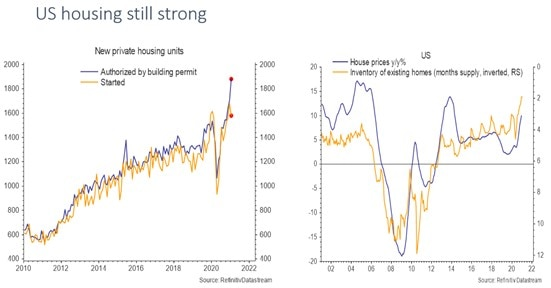
The yield on the ten-year US Treasury note increased to its highest level in over a year last week, as stronger-than-expected economic data fuelled fears about rising inflation. In the US, data revealed continued robustness in the housing market, with building permits hitting a new high and house prices continuing to surge.
Sales on new single-family homes increased by 4.3% in January to a seasonally adjusted annual rate of 923,000 units. Sales were helped by historically low mortgage rates and a shortage of previously owned houses on the market. The median new house price rose by 5.3% from a year earlier to $346,400.
The housing data added to solid PMIs published the week before, which showed a 1.3% increase in the prices that businesses receive for their goods and services – the biggest gain since the index was launched in 2009. Weekly jobless claims also hit their lowest level in three months at 730,000, while personal incomes increased by 10.1% in January following payments from the coronavirus relief package.
On Wednesday, Fed chair Jerome Powell sought to allay investors’ fears that stronger economic growth will result in monetary stimulus being removed sooner than expected. Powell said inflation remains soft and confirmed the Fed’s dovish stance. Stocks briefly recovered on Wednesday, but began their descent again the following day, suggesting Powell’s comments have done little to quell investors’ concerns.
UK consumer confidence creeps higher
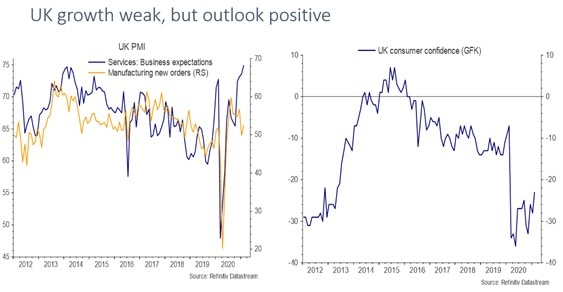
There is also optimism in some of the UK’s economic data. Manufacturing new orders remain in expansion territory, and the expectations component of the services PMI hit the highest level in over a decade. UK consumer confidence is also starting to creep higher.
Lockdown restrictions will start to ease in England from 8 March, with nearly all sections of the economy due to be reopened in late May. In Wednesday’s budget, Rishi Sunak is expected to announce that the furlough scheme will be extended until at least May. Around 20 million people in the UK have now received their first dose of the vaccine.
The vaccine rollout continues to lag in Europe, with just 6.4% of the European Union’s population receiving a jab. Despite this, the eurozone Economic Sentiment Indicator increased to 93.4 in February from 91.5 the month before – the highest level since March 2020. Fourth-quarter German GDP data was revised to a growth rate of 0.3% from an initial estimate of 0.1%, following strong exports and construction activity.
Over in Japan, the Reuters monthly Tankan Index, which tracks the Bank of Japan’s quarterly Tankan survey, recorded a positive reading among manufacturers for the first time since 2019, thanks to improving demand from overseas. Japan is also seeing a decline in the Covid-19 infection rate, which will see the state of emergency status being lifted for six prefectures a week earlier than planned.
Weekly updates like these from Brewin Dolphin help us keep up to date with what is happening within the markets. This week’s ‘Markets in a Minute’ article focuses on exploring some of the reasons behind the tech sell-off.
Please continue to check back for our regular blog posts and updates
M&G plc (M&G) is today joining the Powering Past Coal Alliance (PPCA) and announcing it wants to end investment in thermal coal by 2030 for developed countries and 2040 for emerging markets.
M&G’s coal phase out plan is a key step towards achieving its goal of net zero carbon emissions across its investment portfolios by 2050 at the latest, and helping to restrict global warming to 1.5 degrees in line with the Paris Agreement on climate change.
As stewards of long term capital, actively managing the savings of millions of people around the world, M&G will use its influence to accelerate the transition to a greener, cleaner economy with ambitious plans to cease all investment in new coal mines and coal-fired plants and to exclude public companies which cannot commit to a complete phase out of coal by 2030 in developed countries and 2040 in emerging markets.
As an asset owner, M&G will be implementing this approach to coal-related investments across its own internal portfolios over the coming year. As an asset manager, M&G will be working with clients to align existing mandates and funds to this position.
At the same time, through its growing range of sustainable investment funds, M&G is giving institutional clients and individual customers the opportunity to invest in technologies, infrastructure and services which offer financial returns as well as making a positive difference to the environment.
Speaking at PPCA’s Global Summit today, M&G plc Chief Executive, John Foley, said: “An accelerated phase-out of coal is essential if we want to limit global warming and ensure a sustainable future for our planet. We are delighted to join the PPCA and fully support its work to encourage businesses, governments and other organisations to commit to a transition away from coal in the run up to COP26 later this year.”
Welcoming M&G’s commitment to the PPCA, Nigel Topping, COP 26 High Level Climate Champion, adds: “Phasing out thermal coal is a critical early step on the race to net zero. PPCA is a key part of the COP 26 Energy Transition Campaign, and it is fantastic to see M&G making this commitment in response to attending the PPCA ministerial round table co-hosted by the UK and Canada.”
As our clients will know, Prudential’s PruFund range of funds are managed by M&G’s multi asset team, Treasury & Investment Office (T&IO) – one of the largest and most well resourced in the UK.
This is great news, and another step along the ESG road for M&G.
M&G plc aim to be carbon net zero as a corporate entity by 2030. Further, they aim to achieve 40% female and 20% ethnicity representation in their leadership by 2025.
Prudential Assurance Company aims to achieve net zero carbon emissions across AUMA (assets under management and administration) by 2050, of which the PruFund range is a material part, in line with the Net Zero Asset Owners Alliance.
The scale of PruFund allows the management team to use segregated mandates to apply a variety of implementation techniques for their ESG views, up to and including, exclusion of certain stocks or sectors from portfolios.
Currently their policy excludes investment in certain controversial weapons companies, namely cluster munitions and anti-personnel mines.
M&G look to the asset managers they select to engage with companies as active owners that help foster a more sustainable economy, participate in voting on key issues such as Climate Change and ensure that ESG is integrated into their investment processes. The majority of PruFund assets are managed by M&G, whose Responsible Investment team provide issuer and sector specific ESG risk and opportunity analysis and education on sustainability themes to portfolio managers and analysts.
Investments have recently been made with the PruFund range by purchasing a solar power plant in the Nevada desert.
Keep checking back for more ESG related content along with our usual market updates and outlooks from a variety of fund managers.
Please see below for Brooks MacDonald’s latest weekly market commentary received by us late afternoon 01/03/2021:
In Summary:
Yield rises remain the major driver of equity markets
Johnson & Johnson’s single shot vaccine is approved in the US, adding to the breadth of vaccine supply
Israel eases some restrictions as the UK is set to lay out its reopening plans
Yield rises remain the major driver of equity markets
Last week saw a large uptick in volatility as higher yields caused a sell-off in markets that focused on secular growth sectors such as technology. Meanwhile, previously unloved sectors such as banks performed strongly on the back of steepening yield curves and lower expected defaults in the future as the economy recovers.
Johnson & Johnson’s single shot vaccine is approved in the US, adding to the breadth of vaccine supply
The theme of the last few days has been a tightening of restrictions, rather than loosening, as several European countries needed to roll back liberties and Auckland, New Zealand entered a fresh lockdown. More positively, the Johnson & Johnson (J&J) vaccine has been approved in the US with the company saying they can ship 100 million doses in H1 2021. While the efficacy data was less compelling for the J&J vaccine, it is recommended as a single dose vaccine which makes the rollout of logistics simpler.
The change in yields has had an outsized impact on technology companies
The ‘price’ of a financial asset is the sum of its future cashflows adjusted for a discount rate. In practice this means the sum of a company’s future earnings which are adjusted for interest rates plus an extra company specific risk premium on top. Value companies tend to produce higher earnings now but less exciting earnings in the future. Growth companies, by contrast, produce little now but are expected to make outsized earnings in the future. Because the earnings in growth companies tend to be further away, the discount rate is more important. Due to the power of compounding, a small change in interest rates can significantly reduce the present value of future earnings 10 or 20 years away. This is exactly what happened last week when a pickup in interest rate expectations caused high growth companies to look less attractive. The moves were relatively small, with the US 10 year rising around 7bps to just over 1.4% but with valuations richer in the technology space, this was enough to catalyse a sell-off.
Of course, the question is whether central banks will let further yield rises happen. So far, the Federal Reserve have pushed back against expectations for sustained inflation but have broadly welcomed the pickup in yields, saying it is reflective of an improved economic backdrop. The next Federal Reserve (Fed) meeting is on 16-17 March, however this week we hear from a series of members including Fed Chair Jerome Powell. Should rapid rises in yields continue to be a theme, we expect the Federal Reserve to step in, at least verbally, to steady further rises. Yield rises can impact both financial stability and damage the economic recovery so central banks will be paying close attention.
Please continue to utilise these blogs and expert insights to keep your own holistic view of the market up to date.
Please see below an article from Legal & General Investment Managers Asset Allocation team, which was published late yesterday afternoon and details a variety of views on Bond Yield movements and their potential impact on markets:
As you can see from the above article, there are various factors to be considered when trying to assess how Bond Yield movements will impact on markets. I believe LGIM are saying that short-term bond yield increases may be unwanted, and there are fiscal tools (i.e. Quantative Easing) to help dampen demand and keep rates lower. Also, any potential equity sell-off which has stemmed from rate increases could be seen as a buying opportunity.
Other fund manager views could differ from the above.
I think the key message regardless, is to keep calm and remain invested for the long-term, markets will recover from short-term dips.
Please continue to check our Blog content for advice and planning issues and the latest investment, markets and economic updates from leading investment houses.
Fund managers Invesco published a paper last week called ‘Appetite for change: food, ESG and the nexus of nature’ which looks at the impact of the Covid pandemic on ESG considerations.
We have picked out some of the key points from this paper below and added our own commentary in blue.
ESG Recap
Before we look at Invesco’s paper and the points they raised, lets recap on what ESG is.
ESG stands for Environmental, Social and Governance. Investopedia definition for ESG is; ‘Environmental, social and governance (ESG) criteria are a set of standards for a company’s operations that socially conscious investors use to screen potential investments.’
The key points raised by the Invesco paper are as follows:
The COVID-19 crisis has demonstrated that humanity’s understanding of its own relationship with the natural world remains inadequate – often dangerously so.
The pandemic has particularly exposed the interconnectedness of numerous existential threats, all of which might be described as components of the “nexus of nature”.
One of the most perilous yet underappreciated of these threats is the unsustainability of prevailing attitudes towards food production and consumption.
From the use of resources in developing countries to policies and practices around factory farming in the industrialised world, this issue affects the entire value chain.
Guided by the idea of materiality and initiatives such as FAIRR (Established by the Jeremy Coller Foundation, the FAIRR Initiative is a collaborative investor network that raises awareness of the environmental, social and governance (ESG) risks and opportunities caused by intensive animal production), investors are increasingly applying environmental, social and governance (ESG) principles in this sector.
As well as promoting and protecting sustainable investments, these efforts are showing how positive change in one area can benefit the nexus of nature more widely.
Interconnectedness means that the ripple effects can encompass concerns including deforestation, biodiversity loss, waste pollution, climate change and human health.
The ‘nexus of nature’
The longer-term survival of our planet and its inhabitants is strongly connected to various existential threats that are themselves highly interrelated. They include climate change, overpopulation, deforestation, loss of biodiversity and – perhaps least appreciated – the ways in which food is produced and consumed. In turn, each of these has a major influence on our health and wellbeing.
The World Economic Forum’s latest Global Risks Report underlines this. Eight of the 10 potentially most impactful risks over the next decade can be linked to humanity’s tendency to take the natural world for granted. Only weapons of mass destruction and cyber-attacks can reasonably be thought of as removed from the nexus of nature.
Why is it so important to grasp how food production and consumption might fit into this picture? The short explanation is that many of the practices that have become commonplace in the face of ever-rising demand for animal protein have consequences that are both far-reaching and deleterious. There may be no better illustration than the circumstances behind the advent of COVID-19.
As has been extensively documented, one of the likeliest sources of the outbreak was a “wet market” where livestock was reportedly kept in close proximity to dead animals. Here, originating either in bats or pangolins, the virus is believed to have been transmitted to humans via a process of zoonosis.
Something analogous happened in the late 1990s, when the emergence of the Nipah virus provided a salutary demonstration of how the nexus of nature can function. Native fruit bats were driven from their traditional habitats by deforestation; they started foraging in trees near farms; through their bodily fluids, they infected land used for raising pigs; and the pigs duly passed the disease on to farmers and abattoir employees.
Similarly, the SARS virus of 2002 is now thought to have come from horseshoe bats, eventually reaching humans via consumption of cat-like mammals known as civets. This, too, was an ominous warning of our collective vulnerability to a type of natural hyperconnectivity that is often woefully underestimated or wilfully ignored.
At first glance, given the circumstances surrounding these examples, it may be tempting to infer that the nexus of nature is at its most threatening in relatively rural settings or in developing economies. In fact, this is far from the case. As we explain in the next chapter, the phenomenon is present throughout the value chain of food production and consumption and represents a genuinely worldwide concern.
According to the World Economic Forum (WEF), risks related to the natural world now dominate the existential threats confronting humanity. They have gradually displaced economic, geopolitical and societal concerns in recent years, particularly since 2011.
The top 10 potentially most impactful global risks over the next decade, as collated in the WEF’s latest report, are shown below. Note that even those classified as societal are in some way linked to nature.
Intensive food production through the lens of material ESG risk
The FAIRR initiative is a collaborative investor network that raises awareness of the ESG risks and opportunities caused by the intensive farming of animals. Through its research, it helps investors integrate such factors into their decision-making and active stewardship processes. FAIRR has identified 28 material ESG issues that could affect factory farms’ financial performance and returns. Set out below, they include community health impacts and infectious diseases.
Conclusion
The COVID-19 crisis has underlined the hyperconnectivity of multiple existential threats, all of them constituents of the nexus of nature. It has also highlighted the position within the nexus of food production and consumption, and in doing so it has provided a stark warning that many of the prevailing policies and practices within this arena are likely to prove unsustainable.
Of course, investors have no more entitlement than anyone else to pass judgment on what is right or wrong. They are not self-appointed saviours or heroes. They do not constitute a deus ex machina for this sector or any other.
Relatedly, investors do not have all the answers. In food production and consumption, as in so many corporate spheres, progress and transformation stem in the main from the companies themselves and from the gathering weight of scientific evidence.
What investors do have, though, is capital; and it is capital that enables positive, lasting change to take place. This has already been demonstrated in a variety of settings, and it is now increasingly being demonstrated in reshaping how we meet the challenges of feeding an ever-growing global population – as we will explore in more detail in our next paper.
By applying ESG principles, investors can make a difference – one likely to have far-reaching impacts. This is the essence of responsible investing and shareholder capitalism, as is already well known, but it is also the essence of the nexus of nature. Positive, lasting change in one area should lead to positive, lasting change in many others – just as the bleak effects of taking the natural world for granted in one area have been felt in many others in the past.
Deforestation, biodiversity loss, waste pollution, climate change, human health – responsible investments in food production and consumption can play a part in addressing all these issues and many more. Nature’s boundless imagination, as so admired by Richard Feynman, guarantees as much.
Feynman once also memorably remarked: “Nature cannot be fooled.” This truth has become all too obvious in recent decades and during 2020 in particular. By engaging with companies and policymakers and by supporting initiatives that prize sustainability, transparency and accountability, investors can go a long way towards helping ensure that humanity does not fool itself.
Our Comments
We have been talking about ESG for a while now, and as we have noted before, the pandemic has really put this topic under the spotlight. As you can see from the key points of the Invesco paper that we have picked out, ESG is a wide-ranging topic and is much more than just ‘being a ‘good’ investor.
The principles behind ESG need to be embedded in an investment framework which encourages positive change.
We build ESG into our ongoing due diligence process to ensure we have a wide range of ‘core investments’ for our clients, which not only seek to provide good returns, but also to drive ESG forward and make lasting and positive impacts in the world.
More investment managers and fund houses are launching ESG investments or starting to move in the right direction with their existing investment offerings, engaging with businesses they invest in.
The demand for ESG and socially responsible investments is growing. Even in the past few months, the term ESG is seen much more in the financial press now than it was.
One thing investors and we as an independent financial advice firm need to watch out for is ‘greenwashing’.
Greenwashing is the process of conveying a false impression or providing misleading information about how a company’s products are more environmentally sound. Greenwashing is considered an unsubstantiated claim to deceive consumers into believing that a company’s products are environmentally friendly.
This can be an attempt to capitalise on growing demand for socially responsible investments.
We recently watched a webinar by Royal London on responsible investing and they highlighted that 85% of funds labelled ‘green’ have misleading marketing* (*Source: 2degrees investing initiative, 2020).
We try to avoid ‘greenwashing’ by doing thorough due diligence, such as asking investment providers questions such as ‘what are their responsible investment policies?’ and ‘how is ESG integrated into investment decisions?’
Our due diligence process is also ongoing, we make sure we stay in regular contact with any of the investment providers we recommend ensuring we understand their investments and investment decisions on an ongoing basis.
The Invesco paper looked at here in this post, gives some food for thought. Invesco are a large investment house and we rely on their input and updates to help us get a handle on key investment issues alongside their peers. We quickly understand the consensus view.
Stay tuned for more on ESG and socially responsible investing along with our regular blog content providing updates and insights from a range of fund managers to help you understand what is happening in the markets and the world.
Please see below article received from AJ Bell yesterday afternoon, which provides a global review of bond markets and offers recommendations for potential future investment winners.
Zambia, Venezuela, Tajikistan and Armenia do not make a habit of featuring in this column, not least as they are a bit off the beaten track, even for the most intrepid adviser or client. But they catch the eye because each member of this quartet has seen an increase in interest rates this year, to take the total for 2021 so far to five increases and two cuts from global central banks (Mozambique is the fifth for those who are interested).
Five central banks have raised rates so far in 2021
“Many advisers and clients are unlikely to be stirred by events in Zambia, Venezuela, Tajikistan and Armenia but they may need to pay attention for three reasons.”
Those who are not interested will ponder the relevance of this possible trend, but they may need to pay attention for three reasons.
It could be an early ‘risk-off’ sign in financial markets. When markets become incrementally more cautious, they tend to cut their riskiest positions first. Frontier markets such as these, or even more generally, would fit that bill. Their central banks may be raising rates to try and lure capital back or at least reaffirm their credibility with overseas lenders.
It could be a sign that markets are, at the periphery, starting to deleverage or at least balk at the tidal wave of debt that continues to build – Bloomberg data shows that the total of global bonds in issue now stands at a record-high $67.6 trillion. And, generally speaking, when markets turn cautious, it is the peripheral markets that show distress first, rather than the core ones, as it is in the latter that the bulls always have the greatest faith and thus where they make their final stand before they capitulate and make way for the bears.
It could be a sign that inflationary worries are seeping into Government bond markets the world over (see this column, SHARES, 11 February 2021). Bloomberg research reveals that the value of global bonds with negative yields has dropped by $3 trillion this year so far, although that still leaves a total of some $14 trillion.
None of these things may come to pass. It could be that the deflationary force of interest payments, demographic trends and central bank intervention keep fixed-income investors in clover as they combine to keep interest rates and inflation well and truly anchored, to the benefit of the bond portion of any portfolio, especially the long-duration segment. Yet if any of the above three trends keeps running, then the meagre coupons offered by most fixed-instruments would leave them looking like return-free risk and speak in favour of short-duration exposure for anyone seeking bond-like ballast in their asset allocation plan.
“If any of the above three trends comes to pass, then the meagre coupons offered by most fixed-instruments would leave them looking like return-free risk and speak in favour of short-duration exposure for anyone seeking bond-like ballast in their asset allocation plan.”
Turning tide
A quick look at the benchmark 10-year bonds of key emerging markets might suggest that investors are taking risk off the table. Selling bonds here means yields are creeping up and prices creeping down. They might not look like big moves, but the very right-hand side of those lines show an upward shift in bond yields – to 6.59% from 6.15% in the last month alone in Russia.
Emerging market bond yields are moving higher
A look at developed market bonds suggests concerns over gathering debt. In Europe, for example, benchmark 10-year bond yields are creeping higher, despite the European Central Bank’s quantitative easing (QE) scheme. No wonder, when advisers and clients consider that the world’s debt pile soared by $24 trillion to a record $281 trillion in 2020, according to the Institute of International Finance. That was an extra 35 percentage points of GDP to take the debt/GDP ratio to 355%. Remember that the Global Financial Crisis started in 2008 when the global debt was ‘just’ $187 trillion.
Developed market bond yield are going up
Even the yield on 10-year Japanese Government Bonds (JGBs) stands at 0.10%, the top of the Bank of Japan’s target range and no different from late January 2016. Perhaps even loyal holders of JGBs are contemplating the return of inflation after 30 years.
10-year JGB yield sits at top of BoJ’s target range
China syndrome
“In a worst-case scenario, central banks may want to raise rates to curb inflation, if it really does run hot, but struggle to do so, because of the immediate impact this would have on economic growth – and financial asset prices.”
Again, all of these trends could yet fizzle out. In a worst-case scenario, they become more pronounced. Central banks may want to raise rates to curb inflation, if it really does run hot, but struggle to do so, because of the immediate impact this would have on economic growth – and financial asset prices. In this context, China is an interesting test case.
China did not hike overnight lending rates for long
The People’s Bank of China jacked up overnight borrowing costs in late January but quickly backed off as the Shanghai Composite index wobbled. As soon as policy was eased, share prices rose. The monetary authorities have a delicate balancing act ahead of them.
We will continue to publish market analysis and thought-provoking financial news, so please check in again with us soon.
Please see article below from Artemis, received yesterday afternoon – 25/02/2021
Do equities protect investors from inflation?
Economists are divided over what comes next for inflation. Simon Edelsten assesses the threat of inflation in the East versus the West. He explains why investing in strong companies with high margins may reduce capital risk, should inflation overshoot.
In the past decade, inflation has grown by a compound rate of just 1.8% a year. By comparison, measured in sterling, global equities have risen by 177% – an impressive 10.8% a year.
It might surprise those whose faith lies purely in bricks and mortar that the average UK house price rose by just 30-40%, depending on which index you use, during the same period. That is equivalent to an annual rate of around 3%.These low levels of inflation have surprised monetarist economists who predicted sharp rises after the introduction of quantitative easing in 2008. According to Milton Friedman’s theory: ‘Inflation is always and everywhere a monetary phenomenon.’ So this expansion of money supply should have caused inflation. It clearly did not.
Today economists are once again raising the alarm. Money supply growth in the US is now twice what it was in the aftermath of the global financial crisis. And now the new Democrat administration has proposed a stimulus package of a further $1.9tn (£1.4tn). Meanwhile, regulators are encouraging looser bank lending, and the Federal Reserve has moved from a target of capping inflation at 2% to ‘average inflation targeting’ – in other words, it will now let inflation rise further before it raises interest rates.
What next for inflation?
Economists are divided over what comes next. Many have reverted to Keynesian-type discussions about supply constraints. They note that China no longer has an abundant, inexpensive labour supply and is falling under the lengthening shadow of the one-child policy that ran from 1980 to 2015. That might point to wage inflation, but we are currently seeing higher levels of unemployment in the West, so that seems unlikely.
Rates offered on government bonds also seem far too low to suggest a sharp spike in inflation is imminent – the UK 10-year bond currently yields 0.28%, and CPI inflation for 2020 was just 0.8%.
However, some cynical souls warn that western governments have a vested interest in letting inflation loose. It is the only way they can rid themselves of the debt they have built.
In the circumstances, taking measures to protect one’s savings and investments against an unexpected rise in inflation seems prudent. That is not a forecast of high inflation – we have seen too many of those prove wrong. Rather, it is recognition that the risks of this threat to wealth have risen.
Lessons from history
As equities give stakes in the real economy, they have long been seen as a way to protect savers from inflation. This theory was at its height in 1972. Over the succeeding three years inflation rose to an eye-watering peak of 24%. And equities? The UK equity market fell 73% between May 1972 and December 1974. The charts then show markets recovering, but in real terms these rises amounted to little. Cost-of-living rises above 20% a year and punitive capital gains taxes took their toll.
The inflation of the early 1970s was caused by the US taking the dollar off the gold standard and by the sharp rise in oil prices – rather different threats to those likely today. All the same, lessons from history on which sectors fared well and badly may be useful.
The 1970s market started from much higher valuations than we see today – perhaps a result of overconfidence in the ability of equities to cope with inflation. Some sources quote the then FT30 index traded at 19 times earnings compared with the FTSE 100’s forecast price-earnings (P/E) multiple today of 15.5.
In those days the index was made up of companies with rather less international exposure and often rather more debt. Inflation drove lending rates higher, leaving banks and property companies worst affected. As their loans matured, companies were forced to refinance at much higher interest rates.
Today’s equity market is notably different in how well-financed and internationally successful our larger companies have become. They have generally reduced their debt exposure since 2008, and many have much greater power to pass on cost increases than in the 1970s.
In the 1970s equity market the best shares to hold were oil companies (which benefited from the creation of the Opec cartel) and, in the latter part of the decade, nickel miners. These enjoyed the recovery combined with supply restrictions from environmental rules introduced by Jimmy Carter. Similarly, today we would argue that only the world’s largest industrial mining companies are keeping up with increasing environmental regulation and able to invest in automation to improve productivity.
It is also striking that some of the best – or least bad – equities to hold through the 1970s were technology companies, such as Racal. Even though markets may have valued future earnings less highly (given the way the cost of living was expected to rise while you waited), companies that produced very high revenue growth and high margins delivered acceptable returns. Racal rose from 137p and a P/E of 11.7 in 1974 to 208p and 17.5 P/E at the end of 1976.
History suggests that ‘growth’ stocks with good pricing power can do well as inflation rises and that many ‘value’ stocks, such as banks and property, may not – the converse of some current recommendations.
The strong response
We always favour companies with high barriers to entry. These should give a company pricing power, whether inflation comes or not. We also avoid companies with large amounts of debt (rising cost of debt often causes the most trouble in times of inflation). Our selection process also tends to favour companies with high margins – therefore companies that will generally cope well with higher labour costs or increases in the cost of raw materials.
Such investments have performed well over the past 10 years. They may lack the cyclicality the market currently prefers as economies recover, but longer term such strong companies will benefit as much as others from the more normal economic prospects ahead. As we stand, it seems likely that 2021 will be an easier year in which to manage a business than 2020. However, as we were reminded last year, predictions are vulnerable to the unexpected.
Governments have very large stimulus packages prepared and would prefer to prioritise creating work and income over worrying much about inflation.
As asset managers, we must capitalise on the growth opportunities but be alert to the risk of inflation. We believe a balance of strong companies, diversified globally and across different sectors, should reduce capital risk. We will know if it works only if inflation does overshoot. We hope it does not, but it is best to be prepared.
Please continue to check back for our latest updates and blog posts.
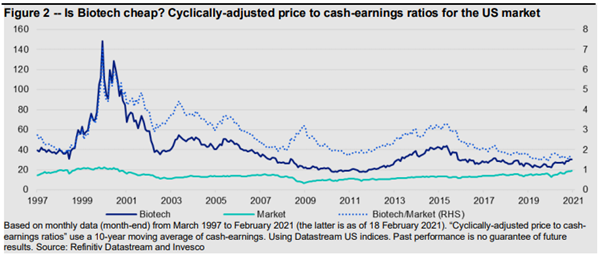
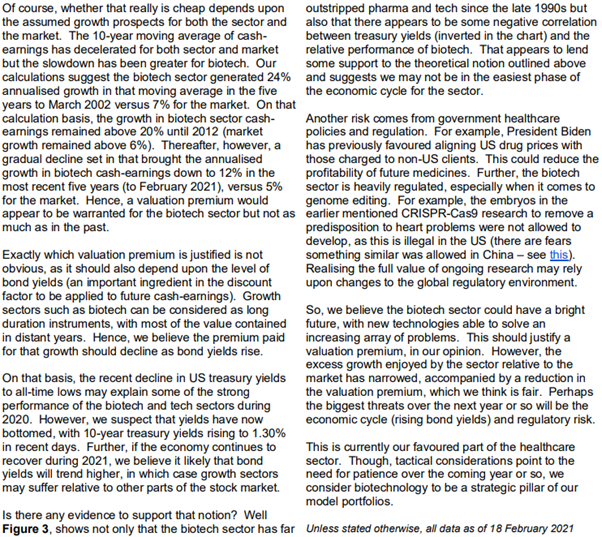
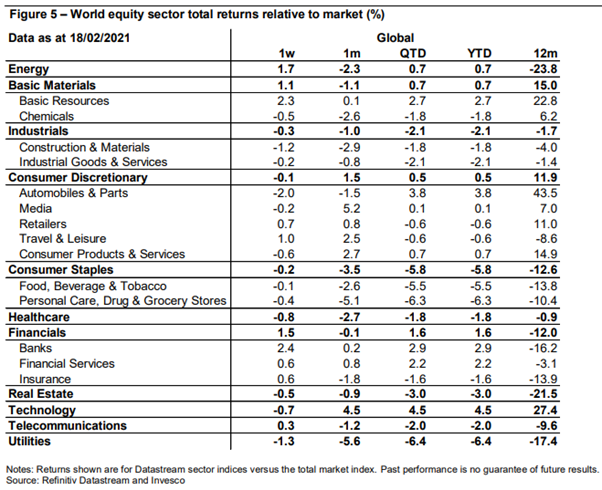
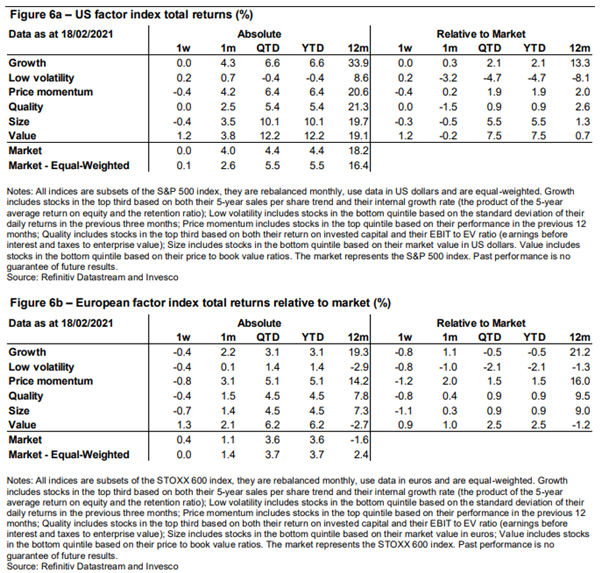
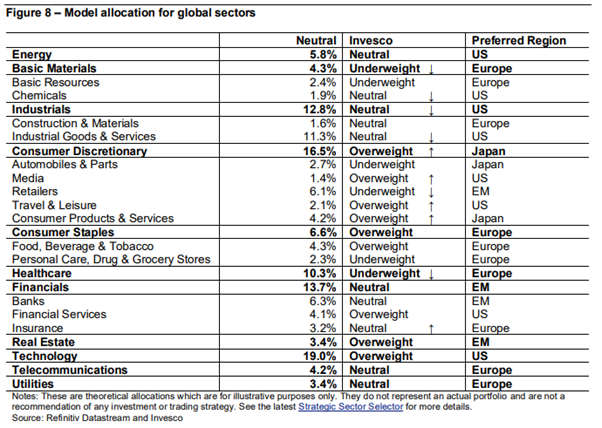
Please see below an article from Invesco, which was published on Tuesday (23/02) and received yesterday, which details Invesco’s views on the Biotech sector:
Please continue to check our Blog content for advice and planning issues and the latest investment, markets and economic updates from leading investment houses.
Please see below for this week’s Markets in a Minute update from Brewin Dolphin:
Equities mixed as inflation offsets vaccine optimism
Global stock markets gave a mixed performance last week, as encouraging quarterly earnings and vaccine optimism were offset by concerns about rising inflation.
Most major US indices ended the week lower, with the Nasdaq down 1.57% amid an increase in longer-term interest rates. The S&P 500 also fell by 0.71%, as inflation fears returned and the yield on the benchmark ten-year Treasury note increased to its highest level in almost a year.
In Europe, the benchmark STOXX 600 ended the week up 0.21%, following news that the UK and Switzerland are set to ease lockdowns and the European Commission has signed a deal for a further 200 million vaccine doses. Gains were held back by concerns that higher inflation could result in central banks tightening monetary policy. The FTSE 100 added 0.52%, whereas Germany’s Dax declined by 0.4%.
In Asia, Japan’s Nikkei 225 topped the 30,000 milestone for the first time in more than 30 years, ending the week up 1.69% after the country started its vaccination roll out. In China, where trading reopened on Thursday following the Lunar New Year holiday, the Shanghai Composite gained 1.12% whereas the large-cap CSI 300 slipped 0.5% after the People’s Bank of China drained RMB260bn ($40.2bn) of liquidity from the financial system.
Last week’s markets performance*
FTSE 100: +0.52%
S&P 500: -0.71%
Dow: +0.11%
Nasdaq: -1.57%
Dax: -0.40%
Hang Seng: 1.56%
Shanghai Composite: +1.12%
Nikkei: +1.69%
*Data from close on Friday 12 February to close of business on Friday 19 February.
FTSE boosted by UK reopening plans
The FTSE 100 recovered from Monday’s early heavy losses to end the day up 0.18% after details of the UK’s reopening plan were revealed.
The first step will see all pupils in England return to school from 8 March, with some outdoor gatherings allowed from 29 March. Outdoor hospitality could open from 12 April, and indoor hospitality and hotels may open from 17 May. Stocks across hospitality, retail and travel all rallied on Monday, with JD Wetherspoon gaining 8.7%, Mitchells & Butlers adding 4.5% and WHSmith rising 6%.
In the US, a sell-off in technology shares led to the Nasdaq posted its biggest drop in a month, down 2.46%. The S&P 500 declined 0.77%, marking its fifth consecutive day of losses and the longest losing streak in a year, amid expectations of higher inflation.
In Hong Kong, technology stocks suffered their biggest sell-off since mid-November, dragging the Hang Seng down 1.1% on Monday. The Shanghai Composite also slipped 1.5% in its worst day since 28 January.
UK stocks opened higher on Tuesday despite figures revealing a rise in unemployment to 5.1% in the three months through December. InterContinental Hotels added 3.9%, whereas HSBC declined 1.9% after reporting a 34% drop in annual profit.
UK retail sales slump in third lockdown
The latest retail sales figures laid bare the impact the UK’s third national lockdown is having on the economy. Data released on Friday showed spending in stores and online fell by 8.2% between December and January, with all sectors other than food and online outlets affected by Covid-19 restrictions. The decline was 3% worse than analysts’ forecasts.
Separate figures from the Office for National Statistics revealed public borrowing reached £8.8bn last month – the highest January figure since modern records began.
A small increase in tax receipts was outweighed by the £20bn annual rise in spending, which included £5.1bn of expenditure on coronavirus job support schemes.
The UK’s retail sales figures are in stark contrast with those of the US, which saw sales increase by 5.3% between December and January – the highest jump in seven months and far higher than economists’ predictions. It is thought the government’s second round of stimulus cheques played a big part in boosting consumer spending.
US consumer spending to stay firm The US coronavirus relief package, which was signed in December, also restarted enhanced weekly unemployment benefits, which means household spending could stay relatively firm until the next Covid-19 recovery bill becomes law.
Once the next package is passed, there could be another boost to growth from fiscal stimulus, which is likely to coincide with more of the US economy reopening, enabling households to deploy the roughly $1.5trn in ‘excess savings’ they have built up since April last year. Indeed, the preliminary service sector PMI for February, which was released on Friday, recorded its highest readings since 2014.
PMIs beat forecasts
Last week saw positive PMIs in the UK and Europe, suggesting businesses are becoming more optimistic about a pick-up in activity over the coming months.
In the UK, the IHS Markit/CIPS flash composite PMI jumped to 49.8 in February from 41.2 in January – a bigger improvement than anticipated. Hotels, restaurants and travel companies reported steep falls in activity, but at a slower pace than in January. Financial and business services firms enjoyed modest growth.
“Although the data hint at a renewed contraction of the economy in the first quarter, business expectations for the year ahead improved to the highest for almost seven years, suggesting the economy is poised for recovery.” said Chris Williamson, IHS Markit’s Chief Business Economist.
Meanwhile, the IHS Markit flash German manufacturing PMI rose to a three-year high of 66.6, up from 57.1 in January, while the corresponding index in France gained 3.4 points to 55. A figure above 50 indicates most businesses reported growth in activity from the previous month. However, the German and French services PMIs both declined to 45.9 and 43.6, respectively.
The eurozone’s manufacturing sector is benefiting from demand from Asian countries, whereas many services businesses have been closed in an effort to control the spread of Covid-19. The pan-eurozone manufacturing PMI rose to 57.7, whereas the services PMI fell to 44.7, its lowest reading in three months.
This weekly update from Brewin Dolphin is a useful short look at the Global markets for the past week.
Articles like these help us stay informed as to what is happening within the markets.
Please continue to check back for further blog content from us.