Team No Comments

As the midnight hour draws near, how will Brexit conclude?

Please see below the latest market insight from Karen Ward at JP Morgan, with particular reference to the ongoing complexities of Brexit.

An American colleague joined me on a call recently and was perplexed by the fact that I was talking about Brexit. “Isn’t Brexit done?”, he asked me. Alas, no. While the UK did officially leave the EU on 31 January, for the economy nothing actually changed since the UK entered into an 11-month period of transition. During this period, the UK and EU were supposed to agree on a future trade arrangement to commence on 1 January 2021. The clock is well and truly ticking.

Negotiations are proceeding slowly and significant differences still remain. At the root of the problem is the same issue that has plagued the discussion for the last four years. The UK wants to regain control – to become fully sovereign – setting its own rules and regulations overseen by British courts. However, the EU is not willing to grant significant access to the single market without guarantees that standards will not be undercut to gain competitive advantage.

So what happens next? Either the next six months will see a breakthrough and a free trade agreement (FTA) will be established or the UK will leave and trade on World Trade Organisation (WTO) terms.

Trading on WTO terms has been used synonymously with ‘hard Brexit’. What exactly does that mean? The short answer is potential tariffs, more customs paperwork for businesses that trade with the EU and potentially the need for the UK to be removed from EU supply chains if regulatory conformity cannot be guaranteed. It is these nontariff barriers that we would expect to have the most economic impact. There could also be significant ramifications for financial firms since the UK would lose its passporting rights – its ability to serve EU clients from the UK. Advocates for a hard Brexit argue that a clean break would allow the UK more flexibility in negotiating future trade deals with other trading partners, although any benefit from these agreements would still only be seen once these trade deals had been implemented, which is often a lengthy process.

What will happen and what will be the implications for markets? In our view, the announcement of a comprehensive FTA might see sterling rise to 1.45 against the US dollar. By contrast, in a no-trade deal scenario we see sterling closer to 1.10 against the dollar. Much weaker sterling would partially help the UK to cope with new trade frictions.

Our central expectation is that despite ongoing near-term sabre-rattling, by year end pragmatism will prevail and a relatively narrow trade deal will be agreed. When ‘Brexit’ was added to the English dictionary, the word ‘fudgery’ should also have been included.

We expect a significant amount of ‘fudgery’ in order to get a partial trade agreement done. This may, in fact, involve highlevel agreements that disguise what is essentially a transition to iron out the finer details. Such a narrow trade deal will likely still be disruptive to economic activity in the EU and the UK over the long term. But we expect various arrangements to ease the near-term burden of the change for both sides. We expect that both sides will want to minimise the day 1 disruptions given the extent to which both economies are still struggling to overcome the Covid-19 recession. Therefore, changes may well be phased in over time, spreading the economic cost over a number of quarters if not years. The UK could thus claim the sovereignty to set their own rules and standards without initially making substantial disruptive changes.

While this outcome is our central expectation, there are significant risks around it that investors should be mindful of. Sterling may be particularly volatile and, with almost 80% of revenues coming from abroad for the FTSE 100, this will also have implications for the stock market, since higher sterling could put downward pressure on earnings and vice versa should sterling fall, all other things being equal. However, we caution against relying too heavily on the FTSE rallying in the event of a hard Brexit as a disorderly Brexit would be likely to impact both UK and EU activity negatively, depressing some of the overseas earnings that matter to UK companies.

We will continue to provide the most up to date information on the markets and economy. Please check in with us again soon.

Stay safe.

Chloe

24/09/2020

Team No Comments

Weekly Market Update

Please see below a useful update received from Blackfinch Group which covers this week’s events from around the world.
UK COMMENTARY
Restrictions on social gatherings are reintroduced along with some tighter local restrictions. The government does not rule out another national lockdown if necessary.

MPs voted to back the Internal Markets Bill that will give the government the power to override parts of the Brexit agreement with the EU. The bill passed by 340 votes to 263. 

Data from the Office for National Statistics (ONS) shows that the UK has lost 700,000 jobs since March, with a further 5 million people still temporarily out of work.

Four-week grocery sales growth slowed by 8% in August, the lowest since April, with shoppers spending £155mln less in supermarkets. The data showed the impact of the hospitality sector reopening, with alcohol sales falling and personal grooming sales increasing. 

Inflation, measured by the Consumer Price Index, fell to 0.2% in August, from 1.0% in July, impacted by the Eat Out to Help Out scheme and the reduction in VAT on the hospitality sector.

The Bank of England policy committee votes unanimously to leave interest rates on hold, noting that UK economic growth in July was around 18.5% above its trough in April, but remained 11.5% below the fourth quarter of 2019. The bank ‘stands ready’ to adjust interest rates, bond buying and other monetary policy measures if necessary.

UK retail sales volume, including petrol, rose by 0.8% month-on-month in August according to the ONS, meeting analysts’ expectations. Year-on-year growth increased to 2.8%.
US COMMENTARY
The Federal Reserve makes no changes to policy at its latest meeting, although it did guide that it intends to keep interest rates low until 2023. The central bank also implicitly ruled out the possibility of negative interest rates.

Weekly initial jobless claims rose by 860,000, marginally above estimates, with continuing claims at 12.63mln.

Donald Trump reportedly gives his ‘blessing’ to a partnership between TikTok and US firms Oracle and Walmart, easing talk of a ban on the service in the US.
ASIA COMMENTARY
The Bank of Japan leaves monetary policy unchanged and upgraded its assessment of its economy, stating that data was improving after the shock caused by the COVID-19 pandemic.
GLOBAL COMMENTARY
The Organisation for Economic Cooperation and Development (OECD) predicts that the global economy will shrink by 4.5% in 2020, better than the 6% collapse it has forecast in June. The data suggests that should the pandemic be contained then global Gross Domestic Product (GDP) will rise by 5% in 2021, but if there are major second and third waves of infection, then this will likely reduce the growth to 2-3%.

Oil prices came under pressure after OPEC downgraded its outlook for global oil demand for the rest of the year and the International Energy Agency (IEA) cut its oil demand forecast for 2020 for the second month running.
COVID-19 COMMENTARY
The total number of daily cases reached new heights, but the number of daily deaths remains below April’s peak.

Pfizer announce that the effectiveness of its COVID-19 vaccine could be confirmed by October.

Novavax Inc announces expansion of its deal with India’s Serum Institute to produce 2bn doses of its COVID-19 vaccine annually, with all planned capacity to be brought online by mid-2021.

Moderna Inc states that it may soon submit its COVID-19 vaccine for emergency authorisation for people at high-risk, should the latest trials prove at least 70% effective.

We will continue to provide the most relevant articles and original blogs so please check in again with us soon.
 
Chloe

23/09/2020
Team No Comments

Brewin Dolphin – Markets in a minute

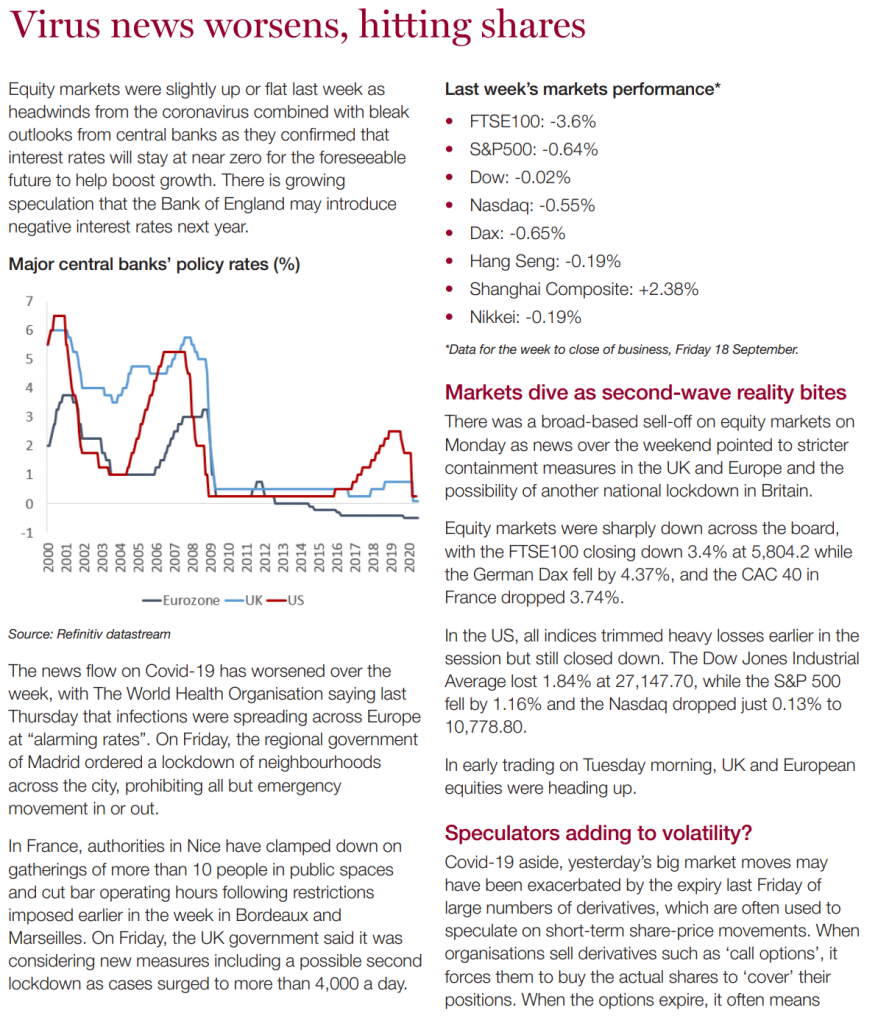
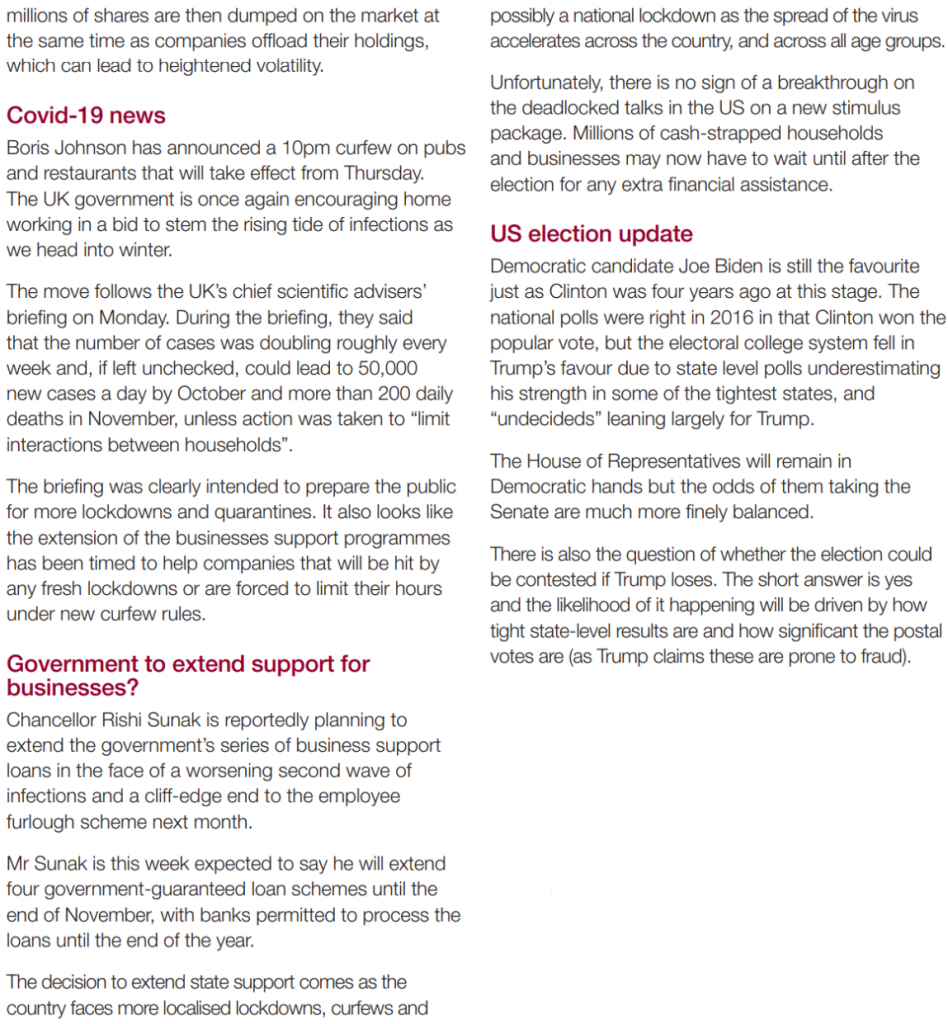
Please see below this week’s market commentary update article from Brewin Dolphin, which was received late yesterday afternoon:

Please continue to check our Blog content for advice and planning issues and the latest investment, markets and economic updates from leading investment houses.

Please keep safe and healthy.

Carl Mitchell – Dip PFS

IFA and Paraplanner

23/09/2020

Team No Comments

Markets sell off as further restrictions expected to be announced this week

Please see below weekly market commentary received from Brooks Macdonald yesterday afternoon following developments in the ongoing Covid-19 crisis.

  • Equity market sentiment is rattled by rising European coronavirus cases and expected restrictions
  • The nomination of a new US Supreme Court Justice ahead of the US election may create a substantial conservative skew in the court
  • Flash Purchasing Managers Index figures on Wednesday will be closely watched for any change in sentiment around the economic outlook

Equity market sentiment is rattled by rising European coronavirus cases and expected restrictions

Markets in Asia and Europe are selling off this morning as coronavirus cases in Europe continue to rise, prompting expectations of further restrictions being announced in the coming days.

European governments are again stuck between desires for a change in the viral trajectory but also no further national lockdowns. An increase in hospitalisations within France and Spain, thought to be a few weeks ahead of the UK, has concerned UK policymakers who are wary of the backlash after being seen as ‘behind the curve’ in March. LBC radio reported that London Mayor Sadiq Khan may recommend tightening rules for London as soon as today with further nationwide restrictions possible over the coming days. Further afield, South Korea will be trialling a tightening of social distancing rules for a fortnight at the end of the month to reduce the level of carriers which is a similar principle to the ‘circuit breaker’ being discussed by UK Prime Minister Boris Johnson.

The nomination of a new US Supreme Court Justice ahead of the US election may create a substantial conservative skew in the court

Whilst the focus in the US has been the Presidential Race, with the death of Justice Ginsburg, the nomination of a new Justice is taking centre stage. With the Senate being aligned to the Republicans, it is highly likely that Donald Trump’s eventual nominee will have a vote on the floor of the Senate before the election. Should this be successful, the US Supreme Court will have a 6 to 3 skew towards conservative/Republican Justices. Given the Supreme Court is used, in part, to set gradations to controversial laws around abortion and gun law, any skew will have a lasting impact regardless of who wins the Presidential election in November. Whilst arguably there was a precedent set in 2016 to wait for the new President to choose a Justice, with the White House and Senate aligned in 2020 this is unlikely to be repeated.

Flash Purchasing Managers Index figures on Wednesday will be closely watched for any change in sentiment around the economic outlook

The flash Purchasing Managers Index (PMI) on Wednesday will be an important temperature check of business sentiment as economic and social restrictions mount in Europe. With restrictions ramping up over the last fortnight it may be too soon to see this feed into the data. Forward looking data such as the PMIs is particularly sensitive to shorter term changes in sentiment, therefore any uncertainty around the future of European economic growth under new restrictions will likely feed through to that dataset in the next month.

Please continue to visit our blog for the latest information on financial matters and the markets.

Please stay safe in these uncertain times.

Chloe

22/09/2020

Team No Comments

Is oil still on a slippery slope?

Please see the below article received by AJ Bell late yesterday:

A report from BP suggests demand for crude has already peaked.

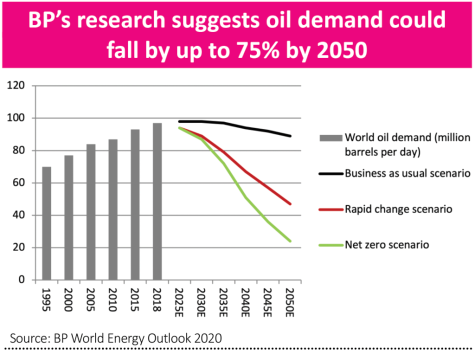
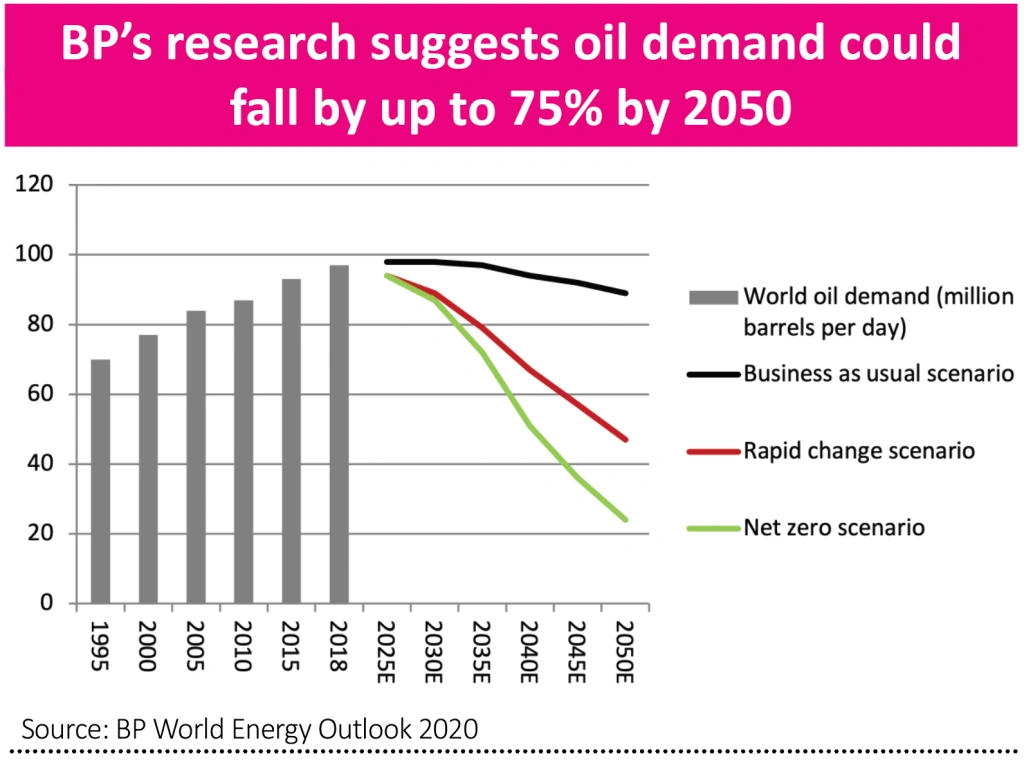
Oil major BP’s (BP.latest annual World Energy Outlook, released in conjunction with a three-day presentation from chief executive Bernard Looney and team outlining the oil major’s new strategy, offers three scenarios for demand for crude oil in 2050.

They range from 89 million barrels a day, barely 10% below 2019’s peak of 98 million as nothing much changes politically or socially, all the way down to 24 million, as the world goes carbon neutral.

The possibility that oil demand could go down by three-quarters between now and 2050 means Looney’s desire to prepare BP for a zero-carbon world is perfectly understandable.

It also leaves investors with a decision to make. Those willing to select individual securities on their own must now decide whether to place their faith in Looney and the company’s ability to reinvent itself. Its plan is made all the more complicated by weak oil prices depriving BP of vital cash flow, just when it needs to invest heavily in both its new strategy and the maximisation of value from hydrocarbon assets where there are already considerable sunk costs.

Those who wish to avoid the rough and tumble of stock-specific risk and prefer to use active or passive funds must still assess their potential for exposure to BP and other oil stocks.

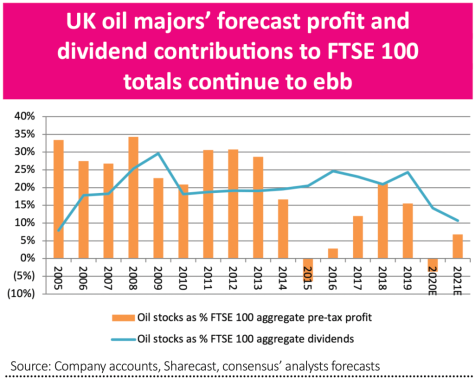
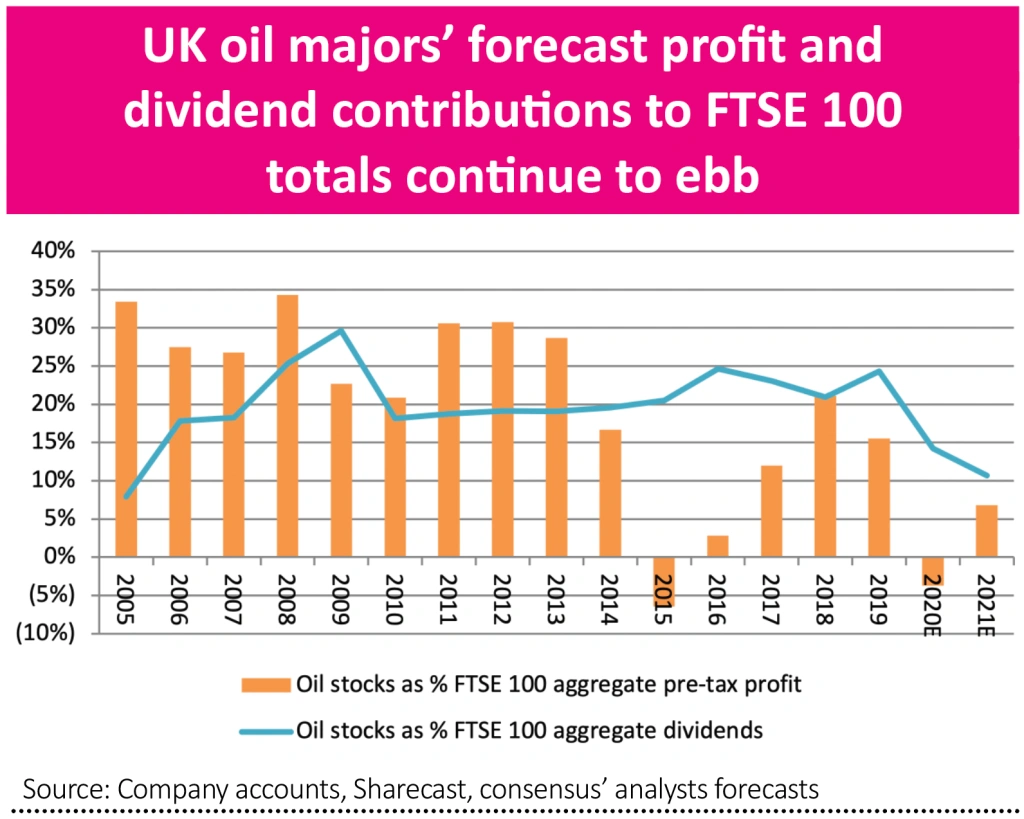
This is particularly the case in the UK, where analysts’ consensus forecasts for 2021 assume that BP and Royal Dutch Shell (RDSBwill generate between them 7% of total FTSE 100 profits and 11% of the headline index’s total dividend pay-out.

WANING WEIGHTING

Whether such forecasts are reliable, too optimistic or too conservative will be especially important for investors in FTSE 100 tracker funds, as they indirectly own BP and Shell whether they like it or not.

For those investors who do not wish to embrace oil stocks, for financial or philosophical reasons (or both), it is worth considering the following:

  • From a dividend perspective, the oil majors’ combined forecast pay-out represents its lowest portion of the FTSE 100 total since 2005;
  • From an earnings perspective, BP and Shell’s contribution is way lower than it was in 2005, when they generated one-third of FTSE 100 profits between them.

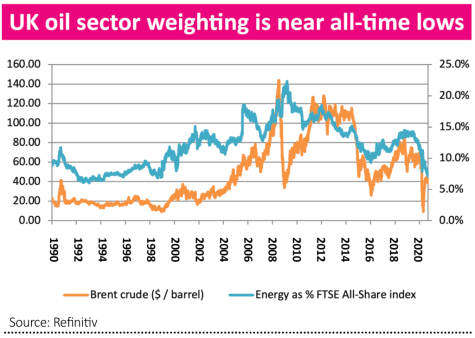
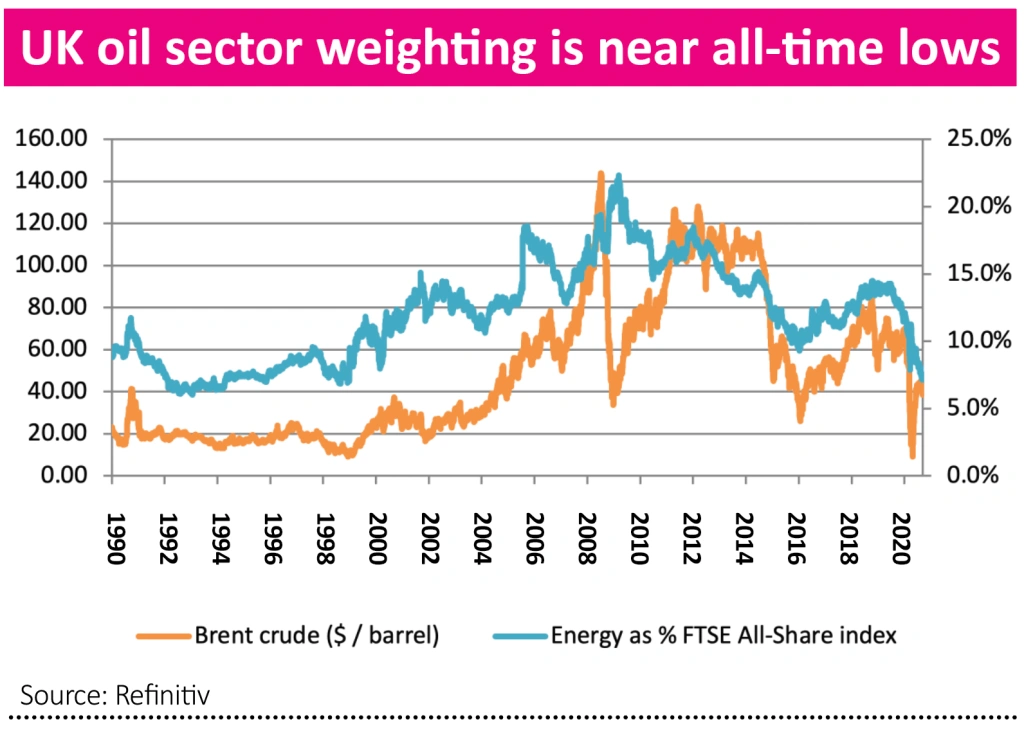
These numbers at least explain why oil shares are doing so badly. The FTSE All-Share Oil & Gas Producers sector is now worth just 7.1% of the FTSE All-Share itself, a fraction above 1992’s modern-day low of 6.3% and almost identical to 1998’s cyclical trough of 7.0%.

Those dates are interesting because BP cut its dividend in 1992 (just as it has done this year), while crude oil prices dipped briefly below $10 a barrel in late 1998, just as they did this spring.

CRUDE CALCULATIONS

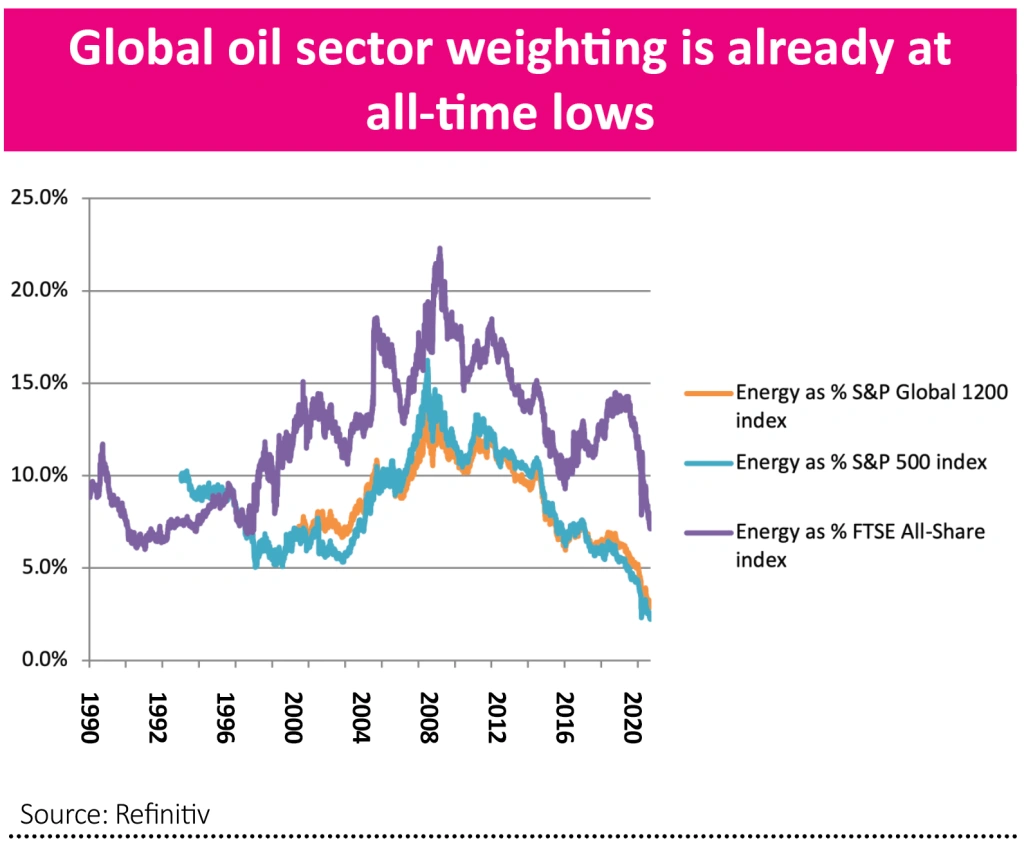
On a global basis, oil shares’ weighting in the S&P Global 1200 index and America’s S&P 500 benchmark stands at record lows of 2.9% and 2.2% respectively. The S&P 1200 Energy index’s valuation of $1.3 trillion means the industry currently carries a lower price tag than Microsoft and is worth barely four times more than Tesla, whose current car volume sales are tiny, at least for now, at around 100,000 units per quarter.

Investors with exposure to individual oil firms, specialist energy funds (be they active or passive) or geographic stock indices with a hefty exposure to oil companies (which would include the FTSE 100) must now decide if this marked bout of oil stock underperformance is merely cyclical or the result of something more structural.

If BP’s zero-carbon scenario holds true, even the most wilfully contrarian investor may struggle to make a case for exposure to oil stocks, at least until the earnings mix begins to truly slant away from hydrocarbons, as it is hard to divine what could be a catalyst for higher oil prices and thus higher earnings.

Yet if the ‘no change’ case pans out, owing to political or social inertia, the picture could be very different. Demand could recover in a post-pandemic world and do so just as oil majors cut investment, US shale output falls and global oil rig activity is down more than 50% year-on-year.

That could make for a surprise cyclical comeback from an industry that financial markets seem to be writing off – the FTSE All-Share Oil & Gas Producers index rose 50% in 2016, the year after BP and Shell last made a combined loss, just as they are forecast to do in 2020.

Whilst hard to predict, as you can see from the above article, the suggestion is that oil demand could go down by three-quarters between now and 2050 as the world strives to be ‘zero-carbon’. The lockdowns imposed by governments due to the pandemic have shifted peoples focus more than ever to a ‘green’ ‘zero-carbon’ world.

Please continue to look out for our regular blog posts.

Andrew Lloyd

21/09/2020

Team No Comments

AJ Bell – High yielding trusts: are the rewards worth the risks?

Please see article below from AJ Bell received 17/09/2020.

High yielding trusts: are the rewards worth the risks?

Investors hungry for income could find some opportunities once they’ve fully understand the business models of alternative investment trusts

Thursday 17 Sep 2020 Author: Hannah Smith

 Investment Trusts

Many investment trusts offer high yields which might tempt some investors in the current environment. But are they more trouble than they’re worth?

Some may be worth pursuing, while others can have complex investment models and come with underappreciated risks.

HOW MUCH CAN YOU GET?

Data from the Association of Investment Companies implies there are numerous investment trusts offering yields of 8% to 12% or even more, but the areas in which they invest are quite esoteric.

Doric Nimrod Air Two (DNA2) and Doric Nimrod Air Three (DNA3), for example, are trusts which buy aircraft and then lease them to airlines, while Tufton Oceanic Assets (SHIP) leases ships.

While investing in the Doric funds is really a binary bet on the survival of its main customer, state-owned airline Emirates, the Tufton fund has a more diversified portfolio of ships, although it has been affected by changing supply and demand and disrupted global trade due to Covid-19.

Miton fund manager Nick Greenwood owns Tufton in his portfolios, benefiting from its 8.6% yield. He says the assets have ‘residual value’ as scrap steel even if their value depreciates.

SPECIALITY FINANCE

Many high-yielding trusts borrow money to increase the pool of cash available to invest (known as ‘gearing’) and then use that money to invest in other people’s or companies’ debt. This web of involvement in the debt space may not appeal to risk-averse investors.

Volta Finance (VTA) is involved in corporate credit, mortgages, and auto and student loans, while Honeycomb (HONY) focuses on asset-backed consumer, property and small business loans.

Blackstone/GSO Loan Financing (BGLP) and Volta are among those trusts investing in collateralised loan obligations (CLOs), a single security backed by a pool of debt. Investors get geared exposure to leveraged loans which amplifies the risks.

Packaged loans played a key role in the events that caused the global financial crisis, so they will sound unpalatably risky for a lot of investors. But Sachin Saggar, an analyst at Stifel, says CLOs held up quite well throughout past crises.

‘If you look at how CLOs behaved in 2008, they actually came through quite well. They ultimately recovered all their losses plus more. But what you get with them is more volatility and risk.’

Greenwood at Miton says he is ‘nervous’ about some alternative lenders which have relatively new and untested business models. ‘Some of them seem to have run into problems lending money to people that decided they didn’t want to pay it back in benign conditions, so I wonder what’s going to happen in tougher conditions,’ he comments.

FURTHER USES OF GEARING

More mainstream trusts that offer high yields are Aberdeen Standard Equity Income (ASEI)Merchants Trust (MRCH) and Chelverton UK Dividend (SDV), in the UK Equity Income sector; and Acorn Income (AIF), in the UK Equity & Bond Income sector.

These trusts can pay high yields because of their use of gearing. Greenwood comments: ‘If a trust draws draw down some debt, they can actually pay out a much higher yield using the investment trust capital structure, but obviously that speeds up the rise or fall in the net asset value. You should always look at the leverage.’

HIGH YIELDS FROM PROPERTY

There are also property funds in the list of high-yielding trusts, such as Regional REIT (RGL), which was, until recently, yielding more than 11% through investing in commercial property such as offices and industrial building outside the M25.

Unfortunately, last month it reduced its quarterly dividend by 21% after adopting a more conservative approach during the pandemic. That still leaves it on an 8.9% yield based on guidance for dividends for the rest of the year and the ones already declared.

Real Estate Credit Investments (RECI)Starwood European Real Estate Finance (SWEF), and ICG-Longbow Senior Secured UK Property Debt Investments (LBOW) also feature among the highest-yielding trusts. They provide loans to commercial and residential assets at low loan-to-values.

Saggar notes it is currently hard to value property assets, so these trusts have traded down, however, he thinks their yields ‘seem relatively robust at this point’.

‘NOT A FREE LUNCH’

So how reliable have these funds been in terms of the track record of their yields, and how sustainable are these sky-high payouts?

Some trusts suspended or reduced their dividend payments in Q1 but have since restarted them, explains Saggar.

In a recent note on CLO funds, Stifel said there were ‘good reasons’ for funds to amend their dividend policies, namely the impact of coronavirus, but that many were trying to sustain payouts. ‘We highlight Blackstone and Volta as being the most cognisant of shareholders’ desire to continue to receive an income,’ it said.

In July, Stifel said Doric Nimrod should be able to keep up 20%+ yields on its funds for longer than expected, despite an uncertain environment.

Payouts overall have been relatively stable across the sector, says Saggar, although discounts to net asset value have widened on some trusts.

‘There are some bargains to be had because people have got rather nervous about some of these very high-yielding trusts, so there are some discounts around,’ notes Greenwood. However, the reason for wider discounts is that investors perceive rising risk, and this is something to bear in mind when looking for high yields.

‘If something’s yielding 8%-plus, there’s a reason why and it’s not without risk. It’s not like it’s a free lunch,’ adds Saggar.

So does holding a high-yielding trust mean investors are signing up for a wild ride? Not necessarily.

‘There is an argument that the high yield will actually smooth the volatility in the share price,’ says Greenwood. ‘But when you get events like the global financial crisis and the Covid-19 crisis, you’re reminded that anything can happen in the short term.’

Please continue to check back for our latest updates and blog posts.

Charlotte Ennis

18/09/2020

Team No Comments

UK equities outperform as sterling drops sharply

Please see below up-to-date commentary from Brewin Dolphin, received late yesterday. The article provides insight into mixed market performance with Covid-19 and Brexit developments noted as current contributing factors. 

Equity markets were mixed last week as markets struggled to gain traction amid a flow of (mostly) worrying news. There was the worsening second wave of Covid-19 in Europe and the announcement of tighter restrictions on socialising in the UK. Then, a potential hitch with the AstraZeneca vaccine, added to increasing worries of a no-deal Brexit. On the financial front, perhaps the most remarkable development was the 3.5% fall in sterling which likely helped the FTSE100 outperform its international peers over the past week.

Last week’s markets performance*

• FTSE100: 4%

• S&P500: -2.5%

• Dow: -1.66%

• Nasdaq: -4%

• Dax: +2.8%

• Hang Seng: -0.77%

• Shanghai Composite: -2.83%

• Nikkei: +0.86%

*Data for the week to close of business, Friday 11 September.

A mixed start to the week

Equity markets in the UK and Europe turned in a mixed performance on Monday despite encouraging news about the resumption of the AstraZeneca/Oxford University vaccine trials in the UK.

The FTSE100 closed 0.1% down on Monday and the more domestically focused FTSE250 rose by 0.7%. Sterling rose 0.76% against the dollar to $1.289, and by 0.42% against the euro to €1.085.

In Europe, the pan-European Stoxx600 gained 0.15%, the German Dax fell by 0.07% while France’s CAC-40 closed up by 0.35%.

In the US, however, the positive vaccine news from the UK helped boost sentiment, as the Dow closed up by 1.2%, the S&P500 rose by 1.27% and the Nasdaq rebounded by 1.87% to 11,056.65.

Analysts said hopes about an early vaccine were tempered by concerns about rising Covid-19 cases in the UK and Europe leading to tighter suppression measures, with a consequent dampening of economic activity.

In early trading on Tuesday morning, UK shares were heading up.

Brexit is back

The developments over the last week have suggested an increased risk of a no-deal departure. And just as in previous bouts of Brexit-related stress, the worse things go, the greater the pressure is on the pound. The fortunate thing from an investment perspective is that this tends to be supportive of UK bonds (which perform inversely to the UK economy), and also UK equities, because of their inverse sensitivity to the level of the pound. In other words, when the pound falls, all other things being equal, most UK equities rise.

This might seem counterintuitive, but the reality is that the sensitivity of even UK equities to the UK economy is generally low and mostly limited to a small number of sectors, such as retail, real estate, home construction and banks. More broadly, the overall market tends to be more exposed to the overseas currencies in which its revenues are denominated. For example, around 75% of the earnings for companies in the FTSE100 come from overseas and so are denominated in foreign currencies. Therefore, when the pound falls, these earnings are worth more in sterling terms and this helps UK equities.

Overseas equities, unsurprisingly, are even more inversely sensitive to the level of the pound as they are both denominated in foreign currency and economically linked to revenues received in other currencies.

Below we show the % change in trade weighted currency, the top graph shows 2015 to present and the bottom chart shows the period from 15 May 2020 to present.

What this means

All of which means that, ultimately, we don’t see Brexit as a material investment risk. Paradoxically, the greater issue for us is how to protect wealth when Brexit risks subside because, under those circumstances, we would expect to see the pound rise and bonds (and possibly equities) fall – again, all other things being equal.

So how do we see Brexit developing? It seems likely that the current standoff is another episode of the brinksmanship that has been exhibited throughout the last four years. The intention of the government is to pressure the EU into making some concessions on fishing and, most notably, state aid. Most outstanding issues between the EU and the UK seem reconcilable, but the state aid point is one the UK government seems to want to push. Why? It seems like the government wants to ensure it can do everything it can to support strategically sensitive industries such as technology and renewables. This idea of a “Made in UK” strategy to match the “Made in China 2025” strategy is what the European’s are afraid of. It seems likely that, when push comes to shove, the UK will be forced to find a way of discreetly backing down – but we can’t be sure.

Covid-19 developments

This also comes with an adverse trend in relative Covid-19 performance as well. America’s renewed surge in cases which began in the Midwest has failed to gather pace while some large states are seeing further improvement. Progress is not universal, however, and as we can see from Europe, a true second wave is likely in the US at some point. But for now, the US case growth numbers are improving which is helpful for Donald Trump as we approach the election in November.

Case growth in the UK, on the other hand, has accelerated. This prompted the government to impose new restrictions that came into effect from Monday to great consternation from the back benches. Evidence continues to point to Covid-19 as a continuing threat with the low rate of hospitalisations during France’s second wave now beginning to pick up. The concern here is that young people are spreading the virus amongst themselves and then introducing it to older generations of their families.

Covid-19 and your investments

Regarding the investment risks of a second wave of Covid-19, we believe that investors already expect successive waves until such time as there is a widely available vaccine. The question from an investor’s perspective therefore is not so much whether further waves come, but what the impact is on perceived valuations.

Understanding how the market reacts to that is not trivial. However, we should distinguish between what we saw in the early part of 2020 which was a shock, from what we might see in future periods, which will be more of an evolution of a known risk.

When we had the shock in March it was largely because the structure of the policy environment and the market were both set up for late-stage economic expansion. That is quite typical for the entry into a recession and is the reason that equity markets react so poorly to the onset of recessions.

On a valuation basis, the loss of a year or two’s worth of earnings is bad news but would not justify the falls seen earlier in the year – hence markets were able to rebound substantially.

With Covid-19 much more of a known-unknown, and with market expectations of ebbing and flowing regional measures to try and slow those waves, we acknowledge that Covid-19 remains an important factor for the market, but it should form part of the ‘wall of worry’ that markets often find themselves climbing.

Wall of worry

The cliché about climbing the ‘wall of worry’ describes the way in which markets are often resilient in the face of known risks. It assumes investors gradually become resigned to the fact that these issues will be resolved in due course and reflects the way in which the overly cautious gradually get sucked into the improving narrative. It is helped by such circumstances also tending to coincide with periods when monetary policy is very supportive.

One more handhold on that wall came from the news that the testing of AstraZeneca’s vaccine has been paused. Although one of the front runners, this was not the only candidate. However, over the weekend it emerged that the trial would resume in the UK and India, but it remains paused in the US.

Also providing a great deal of angst is the planned end to the furlough scheme next month. Chancellor Rishi Sunak is under a great deal of pressure from lobbyists and trade unions to extend the scheme further to prevent a “tsunami” of job losses this autumn.

An extension would not be without international precedent. Germany has announced an extension to its Kurzarbeit scheme, which gives financial aid to employers while allowing them to reduce employees’ hours. It had been scheduled to finish in March 2021 but has been extended for another year. France has also extended its version of the furlough scheme but has tweaked the rules so that employers must reduce hours for workers rather than keep them off work altogether. If the British government is going to follow suit, it is leaving it late.

We strive to update our blog content regularly in order to provide the most relevant and accurate data so please check in again with us soon.

Stay safe.

Chloe Speed

16/09/2020

Team No Comments

Responsible Investing

Responsible investing, socially responsible investing, ESG, Ethical investing, these are all terms you will have seen us use this year in our blog content. You may have also seen these terms in the press lately, as the impact of the Covid-19 pandemic has really accelerated these issues and brought them to the forefront.

Research shows that demand for Environmental, Social and Governance (ESG) and sustainable investment focused portfolios has hit record levels.

As we have stated before, this is something that we believe this is going to become a long-term trend and our aim with our blog posts on this area is to help you understand what this is and keep you updated with movement in this area.

Ethical investing has been a traditionally niche market with limited options however with ESG (environmental, social and (corporate) governance) investment become ever more prevalent and the Covid-19 pandemic, there now seems to be turning point for accelerating client interest in this area.

Brooks Macdonald recently conducted a survey in which they asked 188 advisers whether they thought the current pandemic would speed up a transition to a greener, more equitable society.

The response was an overwhelming yes with 90% responding positively.

Global fund data provider FE fundinfo, also did some research and found that 55% of IFAs increased the amount of client money in ESG investments in 2019 and that more than four-fifths of advisers expected demand for ESG options to rise in the coming year.

Many ‘ethical’ or ‘ESG’ screened funds now outperform the more traditional (aka ‘non ethical’) funds and portfolios. Morningstar data examined almost 5,000 Europe-based funds and found that around 60% of sustainable funds have done better than their non-ESG peers over one, three, five and 10 years.

The focus on ‘greener’ investments may suggest that it’s just the ‘E’ in ESG that is currently in the spotlight however if you look at the impact of the Covid-19 pandemic and even the recent Black Lives Matter movement, these also put the spotlight on the ‘S’ and ‘G’, putting diversity and social equality (including employment conditions and healthcare) up at the forefront and may make people think about aligning their investment preferences (i.e. investing into companies which support diversity and equality) with their own personal views.

Brooks Macdonald also did some research last year in which 800 individuals were surveyed on their views on responsible investing. One of their findings was that interest was high across all age groups, however, it was the individuals under 40 that were the most engaged with this with 94% saying they already used a responsible investment solution or would be interested in doing so.

Responsible investing therefore gives us an opportunity to connect with the next generation of clients. As it’s the future generations who will feel the benefit of living on a ‘greener’ planet.

We have noted recently in our ESG blogs that we expect the regulators to hone in on ESG matters and that assessing client’ sustainability preferences be a key conversation topic when discussing investments.

The FCA has already indicated that sustainability risks should be appropriately considered in the advice process that investment objectives should include the understanding of clients’ responsible investing.

Hopefully, this is further ‘food for thought’ for you to start thinking about how can your personal views and beliefs align with your investment strategy?

We are already actively discussing ESG issues with clients on a regular basis and will continue to develop these conversations and use the feedback in our processes within the business.

Please keep an eye out for more posts on these themes in the future, this is something we are committed to as a business and to help our clients understand.

Andrew Lloyd

16/09/2020

Team No Comments

Brooks Macdonald – Weekly Market Commentary

Please see below this week’s market commentary update article from Brooks Macdonald, which was received late yesterday afternoon:

Please continue to check our Blog content for advice and planning issues and the latest investment, markets and economic updates from leading investment houses.

Please keep safe and healthy.

Carl Mitchell – Dip PFS

IFA and Paraplanner

15/09/2020

Team No Comments

Legal & General Asset Allocation Team Key Beliefs Blog

Please see article below from Legal & General’s asset allocation team – received 14/09/2020.


Our Asset Allocation team’s key beliefs

Recurring patterns

The day after the UK voted to leave the EU – more than 1,500 days ago – we wrote in our Key Beliefs that “Brexit will now dominate markets for a while longer and be a market factor for years to come”. This week, we cover the latest developments in that ongoing saga and two other recurring issues for markets.

As with all Key Beliefs emails, this email represents solely the investment views of LGIM’s Asset Allocation team.

Rule Britannia, Britannia waives the rules

The result of last year’s election reduced the probability of a soft Brexit outcome, in our view. Since then there has been no real progress in discussions with the EU, so the chances of a comprehensive deal have dwindled further.

The new Internal Market Bill, and the news that the state-aid regime will not be ready until mid-2021, further lower the likelihood of securing a deal. This means that – barring a Parliamentary block, a policy U-turn, or a significant softening in approach from Brussels – we are probably now looking at a narrow range of outcomes between a hard exit and a slightly less hard exit. The difference in economic impact between the two is relatively small, and is likely to be swamped in the current environment by COVID-19 developments and fiscal and monetary policy.

This news is not particularly shocking, as negotiations with the EU have been going back and forth for a while, but investors have woken up to Brexit risks again in the past few weeks. With the market probability of a no-deal exit reaching approximately 80% in our estimates, sterling fell by around 4% against the euro and US dollar.

Looking forward, the narrowing Brexit outcomes should mean sterling’s range is more limited too, so we wouldn’t expect the wild swings in the currency of recent years. We believe the tail risks are also skewed to the upside from here: a no-deal scenario may see a touch more weakness, but a sniff of a deal could stoke a greater recovery.

Israel: the first domino?

The unsettling news for Israel is that COVID-19 dynamics in the country are deteriorating on all fronts, with the government announcing a second lockdown on Sunday. Many had supposed that the economic pain of shutdowns would deter politicians from re-imposing them, but Israel has demonstrated that we shouldn’t rely on that.

The question we need to ask ourselves is whether Israel is the first domino to fall and if Spain and France are the next ones to topple. There are some idiosyncratic differences between Israel and continental Europe, such as in party politics, demographics and behavioural tendencies, but equally it is possible to draw some parallels.

Spanish and French ICU capacity per person is greater than Israel’s but, at current rates of case-load expansion and growing ICU occupancy rates, Spain looks like it may become stretched by the end of September and France potentially a month or so later. That said, the head of the Spanish health-emergencies department believes Spain has already turned a corner for the better in its latest wave.

We believe further full-country lockdowns in Europe are not part of the consensus thinking in markets, so there is a downside risk, but more lockdowns could mean more stimulus too.

Fiscal fail

Hopes for any further fiscal stimulus in the US before the elections darkened last week as a deal proposed by the Republicans failed to pass a Senate vote. Negotiations have become increasingly difficult of late and a failure to pass a deal soon puts millions of Americans in jeopardy.

While there is a wide range of outcomes over the next few months, the risk of the economy stalling in the fourth quarter has risen. The consensus probability of a stimulus deal stood as high as 90% a month ago but, with those odds plummeting, economists will need to embark on a series of forecast downgrades if Congress fails to act. This was also a likely driver of weaker equity markets in the past week, hidden somewhat by the headline news of the technical squeeze in tech stocks.

Both sides still seem far apart on reaching agreement on another round of fiscal stimulus. Republicans do not wish to provide state and local government aid to ‘bail out’ Democrat states, while there is disagreement within the party on the type of stimulus and whether another round is even necessary. Democrats meanwhile voted against the proposals as they contained some ‘poison pills’, such as funds for the coal industry and a tax break for private school costs.

Additionally, the Federal Reserve is having problems with its Main Street Lending programme, designed to help small firms, with only $1 billion of loans out of a total capacity of $600 billion made so far. This means the central bank’s ability to offset an underwhelming fiscal stimulus could be reduced.

The drag on the economy is building, but not yet apparent in the data. The blockages in approving further stimulus should not be seen as a cliff, but an increasingly steep downhill ride the longer the standoff continues.

Another useful article from Legal & General covering the latest developments with regards to Brexit and other recurring issues for markets.

Please continue to check back for our latest updates and blog posts.

Charlotte Ennis

15/09/2020