
Team No Comments

Vaccine Update

Please see the below updates from AJ Bell regarding this week’s news on the Pfizer vaccine:

Is the vaccine news a game-changer or just a good start?

There are high expectations for Pfizer and BioNTech to win with their Covid-19 vaccine following the latest trial update which triggered a global stock market rally and installed hope in people around the world.

The two companies will collate data until the third week of November before submitting to the regulators for approval. Safety is very important given the scale of deployment with potentially billions of perfectly healthy people being given the vaccine.

Assuming more data confirms the 90% effectiveness of the vaccine there are other considerations as more news arrives over the coming weeks.

The first big question is for how long the vaccine will provide immunity because there is no guarantee that vaccine-induced immunity will be any better than that afforded by infection.

Second, the science behind this vaccine is known as mRNA and it has never been commercialised which means no one knows for sure how to manufacture it at scale. The technology involves injecting a blueprint of the vaccine into the cells of the body so that they can make copies of the vaccine.

The vaccine needs a cold storage supply-chain because it has to be stored at minus 80 degrees centigrade. The lack of available cold refrigeration infrastructure, especially in poorer areas of the globe, may hinder distribution of the vaccine.

According to Shore Capital it is unclear at this point whether the study included patients with severe symptoms which is very important because if it didn’t it would mean the vaccine can so far only make mild cases more mild and not prevent hospitalisations.

Pfizer has targeted production of around 50 million doses for 2020 and 1.3 billion next year.  Various countries have already secured agreements with Pfizer including the UK with 30 million doses. Shore Capital points out that because two doses are required and assuming wastage this would only cover around 12 million patients. It takes 28 days from the first injection to attain immunity.

The broker notes that the world will need more than one vaccine because a range of sub-groups are likely to respond differently to vaccines. Mark Brewer, analyst at FinnCap, argues that global herd immunity requires 60% to 70% of the population to become immune which given the huge numbers involved could take years to achieve.

In short, don’t expect the economy to open up quickly even if a vaccine is approved.

Two late-stage trials with results expected in the next few weeks are University of Oxford’s and AstraZeneca’s (AZN) study of compound AZD1222 and Moderna’s vaccine candidate mRNA-1273.

Both these studies include patients with severe Covid-19 symptoms and so a positive result may be more meaningful in terms of reducing hospitalisations.

Where we stand after markets’ vaccine boost

he near-5% gain for the FTSE 100 on 9 November reflected news of extremely positive results for the vaccine being developed by Pfizer and BioNTech.

This was the biggest gain since the index surged 9.1% on 24 March when investors reacted to a rescue mission by central banks during the wild trading seen at the outset of the global pandemic. Even this, more modest, November movement ranks among the 10 highest one-day percentage gains for the index.

In the spring there was considerable uncertainty on the path out of the coronavirus crisis and just how damaging it might be. Now the situation on both these variables is a little clearer and that helps explain why market rallied so strongly. Although it is not quite true to say the market has come full circle.

Has the ftse fully recovered?

As we write the FTSE 100 is still 15% below its pre-Covid levels – we take 20 February as being when investors really began to price in a material impact from the pandemic.

In contrast, the S&P 500 which, thanks to a combination of the US presidential outcome and the vaccine news, broke new record highs this week.

The gains across the Atlantic were less substantial than those enjoyed by the FTSE 100 and that hints at the changes in stock market leadership we are seeing in the wake of Pfizer’s big announcement.

Losers become winners and vice versa

While Wall Street is dominated by the big technology companies, the UK market has plenty of the old-world economy in its ranks, many of which have seen their valuations smashed on the rocks of the Covid crisis.

These beaten down ‘value’ stocks were suddenly in fashion and we saw some quite spectacular moves, while tech, which sits very much in the ‘growth’ category, and traditional safe havens like government bonds and gold were sold off.

Tech has been one of the few places to find earnings growth in 2020 and so investors have been happy to pay high prices in this area. Many investors now look to be taking the view that some of the worst-performing stocks this year now have a greater chance of earnings recovery, which means they can find growth at a cheaper price and so tech becomes less appealing as valuations start to become more important.


Travel Rebound

Drilling down to specific sectors, travel was clearly a big winner including British Airways owner International Airlines Group (IAG) which enjoyed intra-day gains of 40%.

Aircraft engine maker Rolls-Royce (RR.) continued the dizzying ascent it has enjoyed since addressing its own financial problems with a recent £2 billion rights issue. Hotels, as well as leisure and hospitality businesses, also soared on hopes they might be able to return to more normal levels of business in the not too distant future.

However, as the graphic shows many stocks remain some way below the levels they were trading at before the pandemic erupted, demonstrating just how far they have fallen in 2020.

Other Sectors Rising

Oil majors BP (BP.) and Royal Dutch Shell (RDSB) were also in demand as oil prices spiked, though again both their share prices and the Brent crude benchmark remain way below pre-Covid levels.

Housebuilders were fired by hopes of an improved economic picture as well as surprisingly punchy guidance from Taylor Wimpey (TW.) that 2021 would be materially ahead of expectations – confidence underpinned by an order book up from £2.7 billion a year earlier to £3 billion. Real estate investment companies, particularly those with exposure to shops and offices, also soared.

Left Behind In The Rally

Perceived lockdown winners like Just Eat Takeaway (JET) and DIY-firm Kingfisher (KGF) were losers on the day. The biggest faller in the FTSE 100 was online groceries firm Ocado (OCDO) which fell 16.1% to £22.83.

Consumer goods giant Reckitt Benckiser (RB.), which had done well earlier this year after receiving a boost from demand for health and hygiene products, also gave up some of its recent gains.

What Happens Next?

Let’s assume the most bullish assumptions are true and there will be a return to some normality by the spring. With very loose monetary policy in play and a possible spending splurge by those consumers which still enjoy a disposable income, there is the possibility of inflation increasing fairly rapidly.

This might see central banks execute a handbrake turn as they look to gain control of rising prices and begin withdrawing stimulus or even increasing ultra-low rates. In this article we talk about the investments which could do well if inflation returns.

Conversely, if there are unexpected delays in the development and distribution of the Pfizer vaccine and others potential vaccines, will investors be patient, or will they look to sell Covid-impaired names once more?

One must also consider the unresolved risks which persist around Brexit and the transfer of power in the US.

This week’s vaccine news is positive news, however it’s by no means the end of the road, its just a step in the right direction.

We may see further drops in the market and setbacks in terms of the Pandemic, but this is a very good start.

Stay posted for further market updates and blog content from us.

Andrew Lloyd

13/11/2020
Team No Comments

Vulnerable Clients

The FCA have always had a focus on Vulnerable Clients – in particular, how firms manage and deal with Vulnerable Clients.

Following Covid-19, this focus was heightened given the significant impact of Covid-19 on people’s health (both physical and mental) and finances (stock market drops or possible furlough/job loss).

A key element of the FCA’s focus is on the importance of protecting vulnerable clients at this time and firms should expect to receive continued and increased scrutiny on what they are doing to identify and deliver good outcomes for their vulnerable consumers.

What is a ‘Vulnerable Client’?

FCA Definition: A vulnerable person is someone who, due to their personal circumstances, is especially susceptible to detriment, particularly when a firm is not acting with appropriate levels of care.

In 2018 the FCA Estimated that 50% of adults display 1 or more characteristics that show potential vulnerability. This means that 24m adults in the UK showed signs of vulnerability.

Following COVID-19, it is now estimated that 1 in every 6 adults show signs of vulnerability.

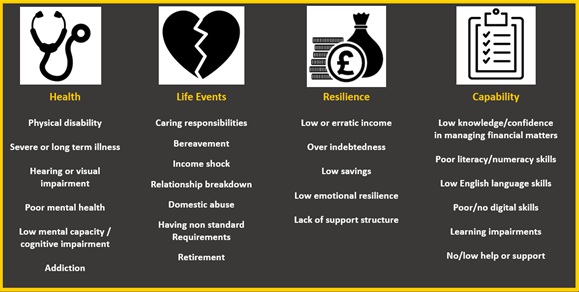
What are the 4 key drivers?

Given the broad scope of the drivers, it’s likely that most people will experience one or more of these drivers at some point in their life.

How do we support Vulnerable Clients?

We have implemented a Vulnerable Client Policy which details how we spot the signs of vulnerability and how we manage and support our client’s needs.

In addition to our policy, we regularly provide training to all staff regarding Vulnerable Clients to highlight our requirements as a firm, the drivers and impact of vulnerability and how to spot and manage vulnerability.

We have a Vulnerable Client Champion (that’s me!), to help make sure that we support clients in the best possible ways and to constantly review and challenge our own internal processes to make sure we are strong in our focus in delivering the right outcomes.

We make it our goal to make sure the fair treatment of Vulnerable Clients is properly embedded into our culture, policies and processes to make sure that we can provide clients with any additional support needs that may be required which helps us deliver the best outcomes for our clients.

Ensuring that this as embedded into our firm’s culture helps us support our clients during periods of vulnerability which is the time when they need it most.

This year has been challenging in many ways and we have recently reviewed our internal training and policies to ensure that we take the potential impact of Covid-19 in how we help provide the best advice and support for our clients.

As a firm, we don’t just look at helping our Vulnerable Clients as a regulatory issue, we do it because we support our clients at all times, no matter what life may throw at them.

We are all likely to be more vulnerable now following the pandemic and its important to remember, we are all in this together!

Andrew Lloyd

Vulnerable Client Champion

09/11/2020

Team No Comments

Weekly Market Update

Please see below a useful update received from Blackfinch Group which covers this week’s events from around the world.
UK COMMENTARY
Restrictions on social gatherings are reintroduced along with some tighter local restrictions. The government does not rule out another national lockdown if necessary.

MPs voted to back the Internal Markets Bill that will give the government the power to override parts of the Brexit agreement with the EU. The bill passed by 340 votes to 263. 

Data from the Office for National Statistics (ONS) shows that the UK has lost 700,000 jobs since March, with a further 5 million people still temporarily out of work.

Four-week grocery sales growth slowed by 8% in August, the lowest since April, with shoppers spending £155mln less in supermarkets. The data showed the impact of the hospitality sector reopening, with alcohol sales falling and personal grooming sales increasing. 

Inflation, measured by the Consumer Price Index, fell to 0.2% in August, from 1.0% in July, impacted by the Eat Out to Help Out scheme and the reduction in VAT on the hospitality sector.

The Bank of England policy committee votes unanimously to leave interest rates on hold, noting that UK economic growth in July was around 18.5% above its trough in April, but remained 11.5% below the fourth quarter of 2019. The bank ‘stands ready’ to adjust interest rates, bond buying and other monetary policy measures if necessary.

UK retail sales volume, including petrol, rose by 0.8% month-on-month in August according to the ONS, meeting analysts’ expectations. Year-on-year growth increased to 2.8%.
US COMMENTARY
The Federal Reserve makes no changes to policy at its latest meeting, although it did guide that it intends to keep interest rates low until 2023. The central bank also implicitly ruled out the possibility of negative interest rates.

Weekly initial jobless claims rose by 860,000, marginally above estimates, with continuing claims at 12.63mln.

Donald Trump reportedly gives his ‘blessing’ to a partnership between TikTok and US firms Oracle and Walmart, easing talk of a ban on the service in the US.
ASIA COMMENTARY
The Bank of Japan leaves monetary policy unchanged and upgraded its assessment of its economy, stating that data was improving after the shock caused by the COVID-19 pandemic.
GLOBAL COMMENTARY
The Organisation for Economic Cooperation and Development (OECD) predicts that the global economy will shrink by 4.5% in 2020, better than the 6% collapse it has forecast in June. The data suggests that should the pandemic be contained then global Gross Domestic Product (GDP) will rise by 5% in 2021, but if there are major second and third waves of infection, then this will likely reduce the growth to 2-3%.

Oil prices came under pressure after OPEC downgraded its outlook for global oil demand for the rest of the year and the International Energy Agency (IEA) cut its oil demand forecast for 2020 for the second month running.
COVID-19 COMMENTARY
The total number of daily cases reached new heights, but the number of daily deaths remains below April’s peak.

Pfizer announce that the effectiveness of its COVID-19 vaccine could be confirmed by October.

Novavax Inc announces expansion of its deal with India’s Serum Institute to produce 2bn doses of its COVID-19 vaccine annually, with all planned capacity to be brought online by mid-2021.

Moderna Inc states that it may soon submit its COVID-19 vaccine for emergency authorisation for people at high-risk, should the latest trials prove at least 70% effective.

We will continue to provide the most relevant articles and original blogs so please check in again with us soon.
 
Chloe

23/09/2020
Team No Comments

UK equities outperform as sterling drops sharply

Please see below up-to-date commentary from Brewin Dolphin, received late yesterday. The article provides insight into mixed market performance with Covid-19 and Brexit developments noted as current contributing factors. 

Equity markets were mixed last week as markets struggled to gain traction amid a flow of (mostly) worrying news. There was the worsening second wave of Covid-19 in Europe and the announcement of tighter restrictions on socialising in the UK. Then, a potential hitch with the AstraZeneca vaccine, added to increasing worries of a no-deal Brexit. On the financial front, perhaps the most remarkable development was the 3.5% fall in sterling which likely helped the FTSE100 outperform its international peers over the past week.

Last week’s markets performance*

• FTSE100: 4%

• S&P500: -2.5%

• Dow: -1.66%

• Nasdaq: -4%

• Dax: +2.8%

• Hang Seng: -0.77%

• Shanghai Composite: -2.83%

• Nikkei: +0.86%

*Data for the week to close of business, Friday 11 September.

A mixed start to the week

Equity markets in the UK and Europe turned in a mixed performance on Monday despite encouraging news about the resumption of the AstraZeneca/Oxford University vaccine trials in the UK.

The FTSE100 closed 0.1% down on Monday and the more domestically focused FTSE250 rose by 0.7%. Sterling rose 0.76% against the dollar to $1.289, and by 0.42% against the euro to €1.085.

In Europe, the pan-European Stoxx600 gained 0.15%, the German Dax fell by 0.07% while France’s CAC-40 closed up by 0.35%.

In the US, however, the positive vaccine news from the UK helped boost sentiment, as the Dow closed up by 1.2%, the S&P500 rose by 1.27% and the Nasdaq rebounded by 1.87% to 11,056.65.

Analysts said hopes about an early vaccine were tempered by concerns about rising Covid-19 cases in the UK and Europe leading to tighter suppression measures, with a consequent dampening of economic activity.

In early trading on Tuesday morning, UK shares were heading up.

Brexit is back

The developments over the last week have suggested an increased risk of a no-deal departure. And just as in previous bouts of Brexit-related stress, the worse things go, the greater the pressure is on the pound. The fortunate thing from an investment perspective is that this tends to be supportive of UK bonds (which perform inversely to the UK economy), and also UK equities, because of their inverse sensitivity to the level of the pound. In other words, when the pound falls, all other things being equal, most UK equities rise.

This might seem counterintuitive, but the reality is that the sensitivity of even UK equities to the UK economy is generally low and mostly limited to a small number of sectors, such as retail, real estate, home construction and banks. More broadly, the overall market tends to be more exposed to the overseas currencies in which its revenues are denominated. For example, around 75% of the earnings for companies in the FTSE100 come from overseas and so are denominated in foreign currencies. Therefore, when the pound falls, these earnings are worth more in sterling terms and this helps UK equities.

Overseas equities, unsurprisingly, are even more inversely sensitive to the level of the pound as they are both denominated in foreign currency and economically linked to revenues received in other currencies.

Below we show the % change in trade weighted currency, the top graph shows 2015 to present and the bottom chart shows the period from 15 May 2020 to present.

What this means

All of which means that, ultimately, we don’t see Brexit as a material investment risk. Paradoxically, the greater issue for us is how to protect wealth when Brexit risks subside because, under those circumstances, we would expect to see the pound rise and bonds (and possibly equities) fall – again, all other things being equal.

So how do we see Brexit developing? It seems likely that the current standoff is another episode of the brinksmanship that has been exhibited throughout the last four years. The intention of the government is to pressure the EU into making some concessions on fishing and, most notably, state aid. Most outstanding issues between the EU and the UK seem reconcilable, but the state aid point is one the UK government seems to want to push. Why? It seems like the government wants to ensure it can do everything it can to support strategically sensitive industries such as technology and renewables. This idea of a “Made in UK” strategy to match the “Made in China 2025” strategy is what the European’s are afraid of. It seems likely that, when push comes to shove, the UK will be forced to find a way of discreetly backing down – but we can’t be sure.

Covid-19 developments

This also comes with an adverse trend in relative Covid-19 performance as well. America’s renewed surge in cases which began in the Midwest has failed to gather pace while some large states are seeing further improvement. Progress is not universal, however, and as we can see from Europe, a true second wave is likely in the US at some point. But for now, the US case growth numbers are improving which is helpful for Donald Trump as we approach the election in November.

Case growth in the UK, on the other hand, has accelerated. This prompted the government to impose new restrictions that came into effect from Monday to great consternation from the back benches. Evidence continues to point to Covid-19 as a continuing threat with the low rate of hospitalisations during France’s second wave now beginning to pick up. The concern here is that young people are spreading the virus amongst themselves and then introducing it to older generations of their families.

Covid-19 and your investments

Regarding the investment risks of a second wave of Covid-19, we believe that investors already expect successive waves until such time as there is a widely available vaccine. The question from an investor’s perspective therefore is not so much whether further waves come, but what the impact is on perceived valuations.

Understanding how the market reacts to that is not trivial. However, we should distinguish between what we saw in the early part of 2020 which was a shock, from what we might see in future periods, which will be more of an evolution of a known risk.

When we had the shock in March it was largely because the structure of the policy environment and the market were both set up for late-stage economic expansion. That is quite typical for the entry into a recession and is the reason that equity markets react so poorly to the onset of recessions.

On a valuation basis, the loss of a year or two’s worth of earnings is bad news but would not justify the falls seen earlier in the year – hence markets were able to rebound substantially.

With Covid-19 much more of a known-unknown, and with market expectations of ebbing and flowing regional measures to try and slow those waves, we acknowledge that Covid-19 remains an important factor for the market, but it should form part of the ‘wall of worry’ that markets often find themselves climbing.

Wall of worry

The cliché about climbing the ‘wall of worry’ describes the way in which markets are often resilient in the face of known risks. It assumes investors gradually become resigned to the fact that these issues will be resolved in due course and reflects the way in which the overly cautious gradually get sucked into the improving narrative. It is helped by such circumstances also tending to coincide with periods when monetary policy is very supportive.

One more handhold on that wall came from the news that the testing of AstraZeneca’s vaccine has been paused. Although one of the front runners, this was not the only candidate. However, over the weekend it emerged that the trial would resume in the UK and India, but it remains paused in the US.

Also providing a great deal of angst is the planned end to the furlough scheme next month. Chancellor Rishi Sunak is under a great deal of pressure from lobbyists and trade unions to extend the scheme further to prevent a “tsunami” of job losses this autumn.

An extension would not be without international precedent. Germany has announced an extension to its Kurzarbeit scheme, which gives financial aid to employers while allowing them to reduce employees’ hours. It had been scheduled to finish in March 2021 but has been extended for another year. France has also extended its version of the furlough scheme but has tweaked the rules so that employers must reduce hours for workers rather than keep them off work altogether. If the British government is going to follow suit, it is leaving it late.

We strive to update our blog content regularly in order to provide the most relevant and accurate data so please check in again with us soon.

Stay safe.

Chloe Speed

16/09/2020