Team No Comments

Restart of dealings in Legal & General UK Property Fund and the Legal & General UK Property Feeder Fund

An update received today from Legal & General about their intentions to re-open their UK property fund:

We wrote to you on the 18 March 2020 to tell you that we had suspended dealings in our property funds. We are now pleased to say that we are intending to re-open the funds. We intend the timeline for re-opening to be:

1. From 12 October 2020, 12.00 noon – you will be able to place buy, sell or switch instructions through My Account or by calling us on 0370 050 2617;

2. On 13 October 2020 – the first trading in the funds will take place at the valuation point of 12.00 noon.

3. From 13 October 2020 – the funds will be open for dealing as normal. In line with our normal procedures, we will not be able to process online or telephone instructions submitted before 12.00 noon on 12 October.

If you send us postal instructions before the 13 October, we will hold these and trade them at the valuation point of 12.00 noon on the 13 October. After that, we will deal any postal instructions at the valuation point immediately after we receive your instructions.

We’ve provided some more information below about the funds. We recommend you speak to a financial adviser if you are unsure whether this investment remains suitable for your personal circumstances, investment goals and risk appetite.

Why did we suspend dealing in the funds? Given the global COVID-19 outbreak, on 18 March the funds’ independent valuer, Knight Frank LLP, introduced a “material uncertainty clause” to its valuations of the properties held in the funds. This meant we could not be confident about the value of the properties held in the funds and the prices we set to enable you to buy, sell or value your existing investments. Without a reliable price, we took the difficult decision to suspend dealing in the funds, taking into consideration our regulatory responsibilities and the overall best interests of investors. We wrote to all investors on 18 March to inform you of this decision.

Why are we re-opening the funds? As financial markets have begun to stabilise, the independent valuer has removed the material uncertainty clause from almost all properties. We are confident that the funds now meet the following key criteria. Providing no new material issues come to light and it remains in the best interests of investors, we can re-open the funds on 13 October:

1. Material uncertainty clauses now apply to well below 20% of the properties in the funds and the risk of going over 20% following re-opening is limited

2. We are satisfied that valuations from the independent valuer remain accurate and are supported by transactions taking place in the market

3. The funds’ available cash position remains well-placed to meet investor intentions and still has sufficient cash to manage the funds

IMPORTANT INFORMATION The value of an investment and any income taken from it is not guaranteed and can go down as well as up, you may not get back the amount you originally invested. Legal & General (Unit Trust Managers) Limited. Registered in England and Wales No 1009418. Registered office: One Coleman Street, London EC2R 5AA. Authorised and regulated by the Financial Services Authority.

Having considered all relevant factors, we now consider that the exceptional market circumstances that drove suspension no longer apply and that it is in the overall best interests of investors to re-open the funds. We are pleased to be in a position where we can again rely on the accuracy of property valuations from the independent valuer. These values reflect discounts arising from the impact of COVID-19. We decided to resume trading in the funds on 13 October 2020 so as to allow sufficient time to communicate the decision to all investors in the funds in writing, and particularly to allow you to consider and potentially take advice on your investments.

Cash levels Over the course of suspension, we have proactively engaged with many investors, whilst closely monitoring and recording their intentions to hold, redeem, or add units in the funds. In view of these conversations, we believe the funds are currently well placed to pay investors who wish to cash in their investments, and retain sufficient cash to manage the Funds on an on-going basis. Currently the funds hold 26% cash, in addition to 3% held in Real Estate Investment Trusts (shares in other property funds). We will continue to engage and monitor the amount of cash we need, reviewing this up to the point of re-opening the funds.

The funds’ investments We believe the funds are well placed for investors looking for long-term investment in the UK property market. They are well diversified across sectors and geography, with property in locations we believe to be strong. The funds’ investments are currently weighted more towards industrial and alternative properties which we believe to have better long-term prospects, and less weighted to retail properties, which is currently the weakest part of the market.

Our outlook for the funds Although COVID-19 has resulted in many short-term challenges, we believe that the vast majority of this has already been felt. Whilst some sectors will take longer to recover than others, the stimuli put in place by the UK government have served to limit the damage. The funds’ investment manager, Legal & General Investment Management Limited, has many on-going initiatives which we expect to create value for investors over the short-term and we expect UK property to continue to deliver positive returns over the next five years. We believe that property is still an attractive diversifier in any balanced portfolio and is well positioned for investors with long-term horizons. We will provide further information and inform you once dealing in the funds has resumed via https://www. legalandgeneral.com/investments/investment-content/property-fund-suspension-notice / our website

Not all Fund Managers are in the same position with their property funds in the UK.  A lot of ‘bricks and mortar’ funds are still suspended from trading to protect the underlying asset values for investors.

The other option is to buy a share based property fund but this does not have the same qualities for diversification, using a range of assets for volatility control/lower volatility overall.  Share based property funds correlate to typical equity funds and will demonstrate similar volatility to them.

Steve Speed

02/10/2020

Team No Comments

JP Morgan: Will trade hostilities undermine the investment case for Chinese assets?

JP Morgan provides an interesting insight into China’s current trading conflicts and the effects of this on the investment market.

On 14 February 2020 the US and China agreed to a trade agreement, known widely as the “phase one trade deal”. As part of the deal, China agreed to increase purchases of US goods by USD 200 billion over the next couple of years, helping to defuse an escalating trade conflict between the two nations.

Although welcomed by markets as a first step to prevent further damage to world trade, the phase one deal was quickly overshadowed by the Covid-19 pandemic. However, trade data from the US Bureau of Census, which is tracking China’s compliance with the phase one deal, has recently raised concern, with China’s additional purchases of US goods standing at only 48% of the year-to-date target by the end of July (Exhibit 1).

Demand disruption due to the pandemic and rising political tensions have contributed to China’s non-compliance. However, in the midst of a polarised US election campaign, the trade truce could be more fragile than investors would wish, and new trade hostilities are an increasing risk for markets.

Exhibit 1: Phase one deal tracker

US goods exports to China with phase one deal targets for 2020 and 2021

USD billions

Source: USTR, US Census Bureau, J.P. Morgan Economic Research, Refinitiv Datastream, J.P. Morgan Asset Management. 2020 and 2021 targets are shown for illustrative purposes and we assume a smooth path toward the year-end target. Chart displays only goods exports and for goods not covered by the phase 1 deal we are assuming they remain at similar levels in 2020 and 2021 as they did in 2017. The phase 1 deal outlines an increase in US exports of $200bn over 2020 and 2021. The breakdown is for roughly $160bn additional goods exports and an additional $40bn of services exports. Past performance is not a reliable indicator of current and future results. Data as of 16 September 2020.

Could a renewed trade conflict undermine the investment case for Chinese assets? When considering this question, we think investors need to look at three aspects: China’s trade dependencies, the impact of an economic de-coupling, and structural growth opportunities.

Trade dependencies: A growing domestic economy overshadows possible trade disruption 

The trade conflict and the implementation of tariffs was a big topic and headline risk for markets in 2018 and 2019. However, when we look at equity market performance following the announcement of new tariffs by the US administration, the reaction appears to have been rather moderate. On the six occasions when the US announced new tariffs, the average drawdown of the local Chinese A-Share market was -2% in the five business days after the announcement, with a maximum drawdown of -3.9% in June 2018 (Exhibit 2).

The impact on global markets was also limited. One of the reasons for the lack of market reaction is that China’s dependence on global trade is in decline. Between 2010 and 2019, China’s share of exported goods and services relative to GDP fell from 28.5% to 18.8%, with the US share falling from 4.7% to 2.9%. China’s economy is increasingly driven by domestic consumption, which makes it less prone in total to export shocks, such as the imposition of tariffs.

Exhibit 2: Market impact of trade hostilities

Five-day equity market performance during trade hostilities

% price return

Source:  Bloomberg, MSCI, Standard & Poor’s, J.P. Morgan Asset Management. Time periods show the price change in the 5 trading days after a notable trade escalation. Past performance is not a reliable indicator of current and future results. Data as of 16 September 2020.

Nevertheless, vulnerabilities still exist at the sector level. For example, computer hardware, cell phones and telecommunication equipment, which make up the largest Chinese exports to the US, represent 9% of China’s domestic A-Share market, as represented by the CSI 300 Index. So, any further deterioration in trade relations could have a negative effect on these sectors.

The biggest threat to the Chinese economy is not to be found in its exports to the US, however. Instead, China’s most crucial trade dependency is its imports of US semiconductors, which by volume make up the third largest imported good from the US. Most of China’s technology industry, including its 5G, mobile internet and artificial intelligence companies, depend on US microchip technology. A full ban on technology exports to China by the US administration could be very disruptive for the Chinese economy and therefore would also likely cause significant disruption to equity markets. A US technology export ban is therefore probably the worst case in a rising trade conflict scenario.

Whether the current US administration is willing to risk a full escalation of trade tensions before the election in November, risking turmoil in capital markets, is at least questionable. Although surveys show that an increasing number of Americans have an unfavorable view of China regardless of their political preference, recent polls also show that China is a low priority with voters, far behind economic, health, and social issues.

Economic de-coupling: Assessing the risks and opportunities 

Despite rising trade tensions with the US, and Beijing’s push to be more self-reliant and de-couple from global value chains, investors should not overlook the investment opportunities presented by local Chinese assets, which look attractive relative to the rest of the world in the aftermath of the Covid-19 pandemic (Exhibit 3).

Following the opening of the USD 15 trillion local renminbi bond market to foreigners, yield starved international bond investors now have the opportunity to invest in government bonds with yields north of 3%. As well as providing access to higher yields, local renminbi bonds have a relatively low correlation to developed market bonds and zero return beta to global equities, helping investors to enhance diversification and target enhanced risk-adjusted returns.

In the past 12 years, monthly return correlations between renminbi bonds and global developed market bonds have been 0.06, compared to a correlation range of 0.43 to 0.72 between developed market bonds themselves. Just like with past performance, there is of course no guarantee that past correlations will be repeated. However, with China’s early success in containing the Covid-19 pandemic knocking its economic cycle out of sync with the rest of the world, and with the Chinese central bank providing a less expansionary central bank policy response compared to developed economies, we would expect correlations to remain low for the time being.

Exhibit 3: Relative attractiveness of China bonds

Fixed income yields

in %

Source: Bloomberg, Bloomberg Barclays, J.P. Morgan Economic Research, Refinitiv Datastream, J.P. Morgan Asset Management. Beta to MSCI World is calculated using monthly total returns since 2008. Indices used are as follows: Euro IG: Bloomberg Barclays Euro-Aggregate – Corporate; Global IG: Bloomberg Barclays Global Aggregate – Corporate; UK IG: Bloomberg Barclays Sterling Aggregate – Corporate; US IG: Bloomberg Barclays US Corporate Investment Grade; Euro HY: Bloomberg Barclays Euro High Yield; Global HY: Bloomberg Barclays Global High Yield Corporate; US HY: Bloomberg Barclays US Corporate High Yield; EMD Corporate: CEMBI Broad Diversified; EMD local: GBI-EM Global Diversified: EMD local – China: GBI-EM China: EMD Sovereign: EMBI Global Diversified. Past performance is not a reliable indicator of current and future results. Data as of 16 September 2020.

Structural growth opportunities: Chinese equities

After a period of strong outperformance investors might look at Chinese equities with a certain amount of skepticism, especially against a background of rising trade tensions and valuations. But in the short term the economic tailwind for the equity market is strong, particularly for domestic-oriented businesses.

China’s containment of the pandemic should enable its economy to recover faster than the rest of the world, and this relative advantage is likely to persist unless a medical solution to Covid-19 is found, which itself is still hard to predict (Exhibit 4a). However, the factor that makes the case for domestic China A-shares even more compelling is, counterintuitively, the fact that economic stimulus measures have been much smaller this round than in the past two downturns (Exhibit 4b). Therefore, we should not expect a massive stimulus-driven Chinese expansion to lead to stronger demand for imports from Asia and the rest of the world, making local Chinese investments relatively more attractive. 

Exhibit 4a: China’s recovery – earlier and faster

China vs. developed markets, real GDP

Index level, rebased to 100 at 1Q 2006

Source: BEA, Eurostat, National Bureau of Statistics of China, ONS, J.P. Morgan Economic Research, J.P. Morgan Asset Management. Forecasts are from J.P. Morgan Securities Research. Past performance is not a reliable indicator of current and future results. Data as of 16 September 2020.

Exhibit 4b: Less stimulus compared to prior downturns

China M1 money supply and import growth

% change year on year

Source: China Customs, IMF, PBoC, Refinitiv Datastream, J.P. Morgan Asset Management. Past performance is not a reliable indicator of current and future results. Data as of 16 September 2020.

In the long-term, China’s transition from the workshop of the world into the largest domestic market in the world still demands that Chinese equities are given a significant strategic representation in globally-diversified investment portfolios. And with corporate earnings growth in the China A-Share market providing a better representation of nominal Chinese GDP growth over the last 10 years than the MSCI China, investors may continue to look to domestic stocks for their Chinese exposure (Exhibit 5).

Exhibit 5: Domestic equity market earnings – a better proxy of gdp growth

China nominal GDP and equity market earnings

12 month forward EPS, GDP; Index level, rebased to 100 at start of 2006 

Source: Bloomberg, IBES, National Bureau of Statistics of China, Refinitiv Datastream, J.P. Morgan Asset Management. Fwd EPS is next twelve months’ earnings estimates in USD. China nominal GDP is in USD. Shenzhen and Shanghai include all listed A-share stocks and is combined using a market-cap weighted average. Past performance is not a reliable indicator of current and future results. Data as of 16 September 2020.

Summary

A trade conflict between the world’s largest economies is disruptive to established value chains and will certainly be negative for global growth. So, investors should rightly pay attention to any further escalation in tensions.

However, it would in our view be a mistake to single out China as the clear underdog in such a conflict and therefore shun investments into the local markets. As we have shown, the direct impact of the trade tensions on the Chinese economy is limited. Even if there is a further de-coupling between China and the US, the case for local investment in China may strengthen because of the diversification benefits provided by Chinese assets.

Equity investors should find comfort and confidence in the fact that in the past 10 years, Chinese A-share earnings have reflected the strong growth in China’s GDP. In contrast, a less cooperative international trade backdrop in the coming years could see non-Chinese companies lose out on some of their own profits from China’s economic expansion. 

We endeavour to publish the most up to date blogs and data on all things markets, advice and planning-related. Please check in again with us soon.

Stay safe.

Chloe

Team No Comments

Brewin Dolphin – Markets in a Minute

Please see this week’s Brewin Dolphin – Markets in a Minute Update:

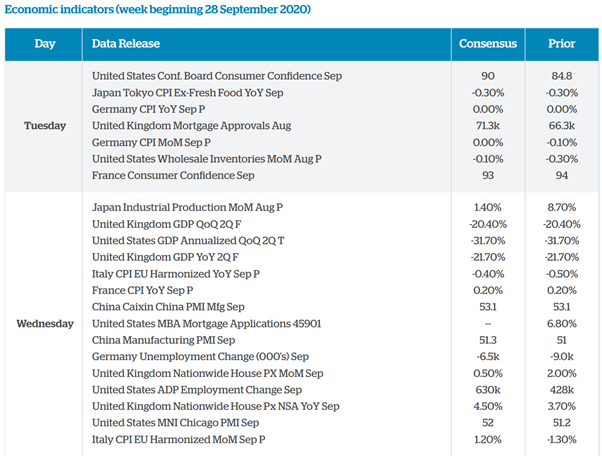
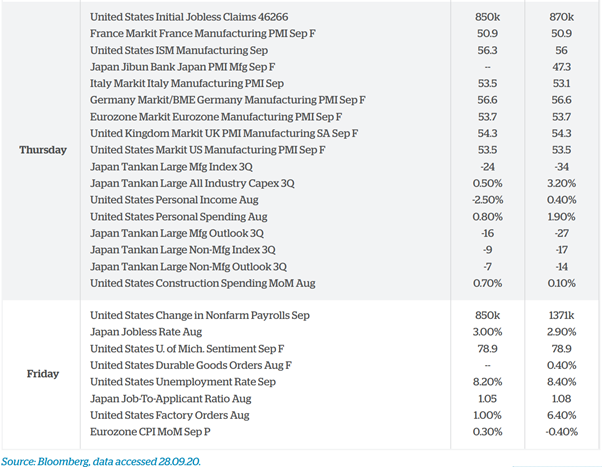
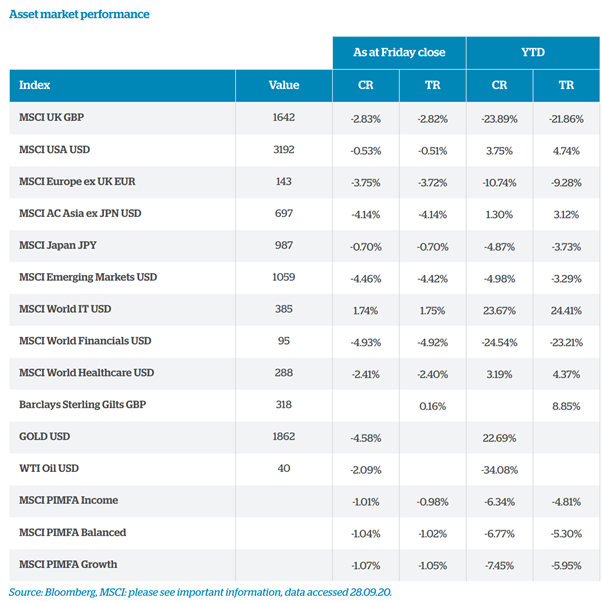
As you can see from the above, the volatility continues and is likely to do so for a while yet.

Please keep checking back for a variety of updates and content sourced from some of the best investment houses in the industry, short regular updates like this aim to help you understand what is going on in the ever changing markets.

Andrew Lloyd

30/09/2020

Team No Comments

Legal and General: Of Gilts and Gold

Please see below for the latest blog from Legal and General’s Investment Management Team regarding their ‘key beliefs’ in relation to the markets:

This week, we look at the investment case for three strategies that should in theory be defensive: holding UK sovereign bonds, owning gold, and diversifying by equity factor.

As with all Key Beliefs emails, this email represents solely the investment views of LGIM’s Asset Allocation team.

A furlough bar to clear

We have been tactically underweight UK gilts for almost exactly six months now. This has been largely based on our view that: (1) a furlough extension was inevitable; (2) negative rates were not on the cards; and (3) the distribution of potential returns was likely to be negatively skewed given those first two factors.

Thursday saw Rishi Sunak extend the furlough scheme for another six months, but the new version is considerably less generous than its predecessor. Employees must now work a minimum of a third of normal hours and employers and workers must bear a greater share of the burden. This incentivises companies to retain one full-time employee rather than two employees working reduced hours, and we believe it will result in further redundancies and pressure on household incomes in the coming months.

Meanwhile, the debate on negative rates has ebbed and flowed at the Bank of England without much clear direction. The latest hints from Governor Andrew Bailey have seen the short end of the curve price out negative rates in the near term, but the Bank’s inconsistent communication on this issue makes it hard to have much confidence in the outlook.

Given these two developments, the third argument above has become harder to defend. While we maintain a negative view on gilts over the medium term, the changing balance of risks has led us to call time on our tactical position.

Going for gold

Given its perceived status as a safe-haven asset, gold is never far from our thoughts when assessing the multi-asset opportunity set. While we maintain a positive long-term bias on the metal, we need to stay price sensitive too. Having closed a tactical overweight back in July, at current levels we believe it’s time to scale back in again.

With interest rates close to zero in most developed markets and increasingly limited space for monetary policy against an uncertain backdrop, finding candidates to diversify the cyclical nature of equities and other risky assets has rarely been more challenging. Gold is, in our view, less exposed than many assets to innovative, unconventional future measures to ease policy, and we therefore believe it offers something different from fixed-income assets in that regard.

No investment is without risk, however. Gold price movements have historically closely tracked a combination of real yields and the US dollar, but there is the possibility that this relationship could be changing. In particular, with yields pinned close to zero it could be that inflation expectations and realised inflation become the more important future drivers of fair value. Given inflation expectations have tended to behave similarly to equities, that would seem at odds with gold’s expected role as a safe haven and diversifier.

Factor fiction?

A wide range of equity risk factors (or styles) have been identified in the academic literature, yet there remain relatively few that are both compensated (i.e. deliver a positive risk premium over time) and transparent (i.e. there is a plausible and widely accepted rationale for their persistence). Five factors have historically exhibited both characteristics: value, low volatility, quality, size, and momentum.

While individual factors can go through sustained periods of relative under- or outperformance, they are likely to do so at different times, so it follows that a balanced portfolio of factor exposures should provide a diversified and cost-effective way to gain exposure to the range of equity risk premia over time.

This year has nevertheless been tough on US equity factor portfolios, largely because of the outsized influence of technology stocks. The outperformance of the largest stocks in the market-cap weighted index has weighed heavily on the returns of any diversified equity strategies which move away from the ‘tallest trees’ in the index. Some of that underperformance has reversed recently as some of the froth in tech has been removed, but we believe it is too early to call a sustained rotation in the US.

The same cannot be said of factor portfolios outside the US, however, where there is much less of a tech bias. The recent bout of risk aversion has seen non-US factors behave more in line with expectations, with quality and low-volatility stocks outperforming, while value has been relatively flat. Where we have allocated to a basket of non-US equity factors, their positive contribution has been an effective diversifier over the past couple of weeks.

Detailed and focused opinions from market leading investment managers such as Legal and General can be a useful addition to your overall view of the markets.  

Please keep reading our blogs to ensure your holistic view of the markets is well informed, diversified and up to date. 

Keep safe and well.

Paul Green

29/09/2020

Team No Comments

Brooks Macdonald – Weekly Market Commentary

Please see below this week’s market commentary update article from Brooks Macdonald, which was received late yesterday afternoon:

Please continue to check our Blog content for advice and planning issues and the latest investment, markets and economic updates from leading investment houses.

Please keep safe and healthy.

Carl Mitchell – Dip PFS

IFA and Paraplanner

29/09/2020

Team No Comments

Tax & Politics

I listened to a technical webinar at the end of last week presented by Prudential and their senior political and technical staff here in the UK.  Following the cancellation of the Budget (was this previously a pre-Budget debate?) they were discussing what taxes might change when and the politics behind it.

Basically, it is a trade-off between what value any new tax might have (how much will it raise for the State?) balanced against the potential political damage any specific tax change may do.

Thankfully, on this basis a lot of the potential tax changes were discussed and dismissed as unlikely.  I don’t think this is the end of the matter, we will need additional tax for the State to pay for the support during the pandemic and strengthen our recently exposed weak spots, the NHS, residential care, social services etc.

We will also need more money to kick start the economy and help us deal with Brexit, fudged deal, or no deal.  As this is the case, when the economy is recovering, and the consumer is spending freely again (post vaccine?) we will see changes to the tax system.

Given the state of our economy and the outlook, the only thing we know with certainty is the tax position and legislation we have in place right now.  If you have the means, why not take advantage of the tax reliefs and planning opportunities that are available today?

It makes good sense to press on with any beneficial planning now using what reliefs are available today, we know the rules now.  For example, pension funding with higher rate tax relief within the pension contribution limits we have currently.

If you would like to discuss your own personal situation, please get in touch.

Steve Speed

29/09/2020

Team No Comments

Monday Market Update

Please see below weekly news update provided by Blackfinch earlier this afternoon, which provides a summary of current global events.

UK COMMENTARY
The UK Government lifted its COVID-19 alert system to its second-highest level following an announcement about a potentially tough autumn and winter period for the country 

New restrictions were imposed on business activity and movement of people, with PM Johnson confirming that they are ’likely to remain in force for six months’

The main restrictions are: office workers to work from home if they can; all pubs, bar and restaurants to operate a table service and close by 10pm; face coverings to be worn by retail staff, users of taxis and cabs, all staff and customers in indoor hospitality venues except when eating or drinking; COVID-secure guidelines to become legal obligations in all retail, leisure, tourism and ‘other’ sectors; no more than 15 people to attend weddings or wedding receptions; and that the ‘rule of six’ has been extended to all adult indoor team sports

The restrictions have more to do with social distancing and health precautions, and the economic impact is unlikely to be as bad as initially thought

The Rightmove House Price Index indicated house prices rose 0.2% in September from August and were up 5.0% on September 2019

The Flash UK Manufacturing Purchasing Manager’s Index (PMI) registered 54.3 in September, down from 55.2 in August

The Flash UK Services PMI had the weakest performance in three months, coming in at 55.1 in September, down from 58.8 in August

The latest data from the Office of National Statistics (ONS) suggests that around three million workers – around 12% of the workforce – were still on furlough or partial furlough in early September

Rishi Sunak, Chancellor, acknowledged that he cannot save every job as he announced a new support scheme to enable companies to save viable jobs 

Under the scheme announced, people can work a third of their normal hours and to be paid the normal hourly rate for those hours, with the Government and the employers covering lost pay. All employers will be allowed to apply for the new arrangements from November, regardless of whether they used the furlough scheme

The Government extended the 15% VAT cut for tourism and hospitality sectors to the end of March 2021

UK retail sales volumes grew at the fastest rate since April 2019 in the year to September, according to the Confederation of British Industry’s (CBI’s) Distributive Trades Survey

The Bank of England governor has ruled out negative rates in near future

National Savings & Investments announced a series of dramatic cuts to its rates and premium bond prizes. The premium bond prize fund interest rate is to be cut from 1.40% to 1.00% from December. Their income bonds will be cut from 1.16% AER to just 0.01% from 24 November.
US COMMENTARY
Technical changes to data methodology in Arizona and Texas for calculating confirmed cases and a rebound in testing activity helped explain a jump in cases at the start of the week

The latest US weekly jobless claims data showed a slight increase for the week ended September 19th, which showed that 870,000 Americans filed for unemployment. This was 4,000 higher than the prior week and in contrast to market expectations of a fall to 850,000.

Continuing jobless claims showed some more positive signs, falling to 12.58m from 12.75m but still above estimates of 12.28m

Goldman Sachs halved its growth forecasts for US economic growth in Q4 to 3% from 6%. This is in recognition of the fact that Congress is unlikely to attach additional fiscal stimulus to the continuing resolution. 

Federal Reserve chairman Jerome Powell conveyed yet another downbeat assessment of the US economy to Congress. US lawmakers are yet to push out fiscal changes that central bankers see as needed.

US housing sales hit a 14-year high as America’s housing market continues to shrug off the Covid-19 crisis, and high unemployment
EUROPE COMMENTARY
Indices struggled in Europe due to pandemic fears as there were a record number of cases reported in the Netherlands and France

Eurozone business growth ground to a halt as services data stumbled. The Markit’s flash Eurozone Composite PMI was just 50.1, barely above stagnation, from 51.9 in August. This suggests the summer recovery is petering out.

Markit’s flash German PMI report showed that service sector activity has hit a three-month low, while manufacturing is growing at the fastest pace in over two years.

The jump in Covid-19 cases in France over recent weeks has dragged Markit’s preliminary French PMI down to 48.5 for September, from 51.6 in August
ASIA COMMENTARY
Shares in Australia were buoyant as the two-week average of new infections in the city of Melbourne fell below 30

The Kospi in South Korea fell 2.61% in afternoon trade after South Korea’s defence ministry said North Korea had killed a missing official from the South earlier this week
GLOBAL COMMENTARY
With fears riding high of tougher lockdown restrictions returning and the corresponding effect on the economy, the oil price fell heavily
COVID-19 COMMENTARY
US firm Novavax is set to start late-stage trials for its COVID-19 vaccine candidate in the UK. It will enrol up to 10,000 participants aged 18-84 over the next six weeks, with half receiving the formulation and half receiving a placebo.

People & Business IFA Limited recognises the importance of communication in the ever-changing world we live in. Please continue to check in with us for the most up-to-date information and data.

Stay safe.

Chloe

28/09/2020

Team No Comments

Why bank stocks are getting bashed (again)

Please see the below article from AJ Bell, published late last week:

The sector is one of the worst performing over the last 12 months and past decade.

Fresh allegations from the International Consortium of Investigative Journalists (ICIJ) about money laundering at HSBC (HSBA) and Standard Chartered (STAN), among other leading global banks, may pertain to wrong-doing which is already covered by previously-paid regulatory fines, according to the lenders themselves.

But even if that is the case, the story gives investors another reason to wonder whether banks stocks are worth the bother, given their complex business models, the danger that loan books are harbouring a lot of debt that might be about to go sour if the economy turns down again and the threat posed by central banks’ monetary policy.

This is not how central banks see it. They argue that cutting interest rates and quantitative easing (QE) lower borrowing costs, creating demand for loans and credit that keep economies going.

But equity investors are clearly not convinced. Within the FTSE 350, banks are the third-worst performing sector over the last 12 months (ahead of only Oil Equipment & Services and Oil & Gas Producers) and the second-worst over ten years (beating just Oil Equipment).

This is a serious matter for holders of the Big Five FTSE 100 banks’ shares and those investors who get access to UK equities via passive, tracker funds – those same five banks represent 7% of the FTSE 100’s market capitalisation and, according to consensus analysts’ forecasts, are set to generate 12% of the index’s 2021 profits and 14% of its dividends.

Mangled margins

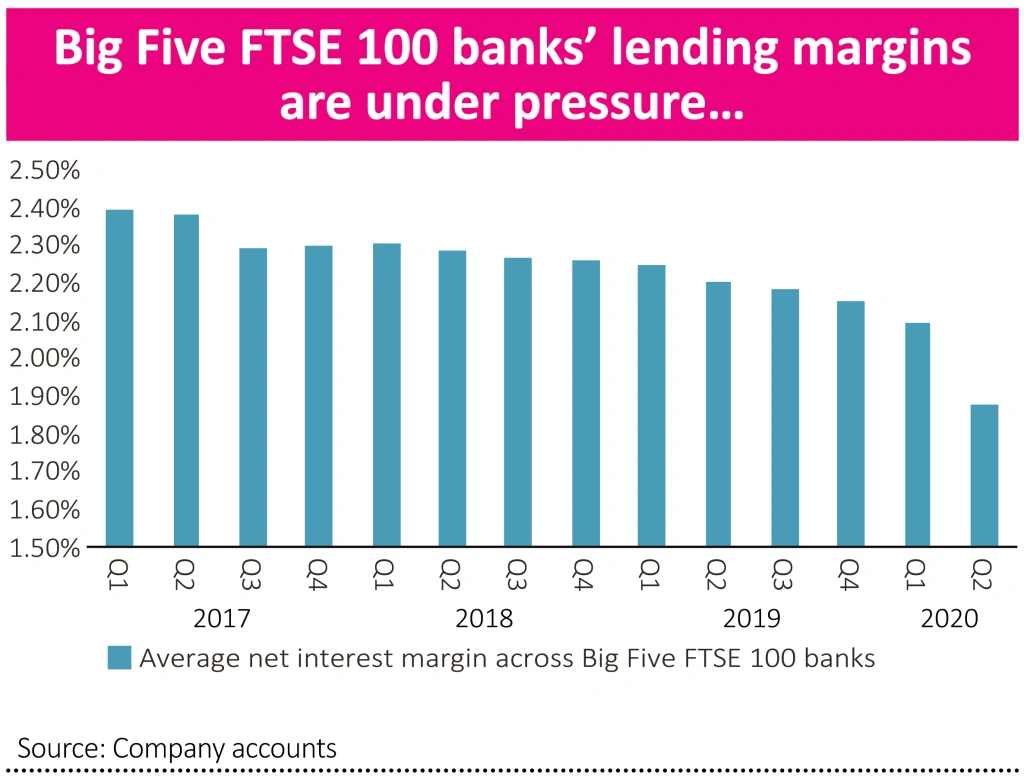
The problem, at least in the near term, is that low base rates drag down the interest rates that banks can charge on loans. Quantitative easing is designed to flatten out borrowing costs, too, so that credit spreads (the premium in interest rate paid by a company to a government) are also relatively narrow.

The net result is that the net interest margin on banks’ loan books is under fierce pressure, seriously undermining banks’ profitability and their ability to earn decent returns on equity.

An average decline in the net interest margin across the Big Five FTSE 100 banks of 52 basis points (0.52 percentage points) since Q1 2017 might not sound a lot. But that represents a 22% drop in the lending margin and on their current aggregate loan books of £2.2 trillion. That is the equivalent of £10 billion in interest a year – profit which could have been used to make fresh loans, perhaps, buffer balance sheets or even pay dividends to shareholders.

Some investors could be forgiven that the Bank of England’s monetary medicine is making banks feel worse, not better.

Global trend

In Europe, the European Central Bank has been tinkering with zero interest rates (and negative deposit rates) for some time, to no great effect so far as its 2% inflation target is concerned, but with deleterious consequences for banks’ profits and the returns on offer to their equity holders.

Unfortunately, investors in banks had already been warned of what might come their way. After all, the Bank of Japan has been fighting the effects of the bursting of a debt-fuelled stock market and property bubble since 1990, some 17 years before a similar fate befell the UK, Europe and America.

The effects of three decades of QE and ZIRP upon Japanese banking stocks are all too clear to see in the miserable share price peformance, and the Bank of Japan’s record in promoting consistent economic growth and 2% inflation, in line with its target, is spotty at best.

Only US banking stocks have shown any real signs of life in the past few years but the pandemic, a recession and reversal of Fed policy from tightening to easing appear to have taken care of that in 2020.

American dream

The disconnect between the market cap weighting and the estimated profit and dividend contribution means that either the FTSE 100 banks are too cheap or market doesn’t believe the analysts’ forecasts for 2021.

The experience of America’s investors suggest that banks’ profits and share prices need rising bond yields, as that may help lending margins, so that may be the catalyst that contrarian value seekers crave, although what it could do to their loan books when it comes to sour loans and impairment charges is another matter.

Economic growth and (some) inflation would be potential triggers for bond yields to rise. Central banks continue to strive for both and are now calling for further fiscal stimulus to help.

Until governments sanction more spending and higher deficits, banking stocks may continue to recoil from central bank policy statements which promise low interest rates for longer or even the dreaded prospect of negative interest rates, to the detriment of individual bank stocks and perhaps the wider FTSE 100 index.

Please continue to check back for our latest updates and blog posts.

Andrew Lloyd

28/09/2020

Team No Comments

Active Minds – Would another market slump be the time to turn bullish?

Please see the below update from a few of the fund managers at Jupiter posted late yesterday afternoon:

Would another market slump be the time to turn bullish?

It was only relatively recently that share prices of the high-profile US technology stocks, known as the ‘FAANGs’, were going parabolic. That’s not a good sign because it usually doesn’t end well, said Richard Buxton, Head of Strategy, UK Alpha. Indeed, the last couple of weeks have seen a notable pullback in those stocks. It’s the sort of move that makes the chartists get very excited and talk about prices returning to ‘key support levels’, he said.

Richard finds it very interesting that this setback has happened at a time when the Federal Reserve (Fed) has been very vocal in its commitment to prioritise employment over inflation targeting, and has said interest rates should be expected to stay on the floor until 2023 at least. And yet, he highlighted, the one thing the Fed hasn’t done is further expand its balance sheet. The next six weeks will be interesting in the run up to the US election, after which a lot will naturally depend on who will be inaugurated as President in January.

In the UK, the government are determined to both halt the continued spread of Covid-19 and keep the wheels of the economy turning. Whether such an outcome is achievable remains to be seen, but the new direction involves selectively re-applying some of the restrictions seen during lockdown, including a tightening up of rules for restaurants, pubs and bars.

Travel and leisure stocks would be among the losers from a return to some of the lockdown restrictions, and their share prices have been hit as a result. In Richard’s view, in times of crisis it is often the second plumbing of the depths that provides investors with an opportunity to become an aggressive buyer, as others capitulate and despair of there ever being a turnaround in fortunes. In this instance, Richard points out that the world is by definition six months closer to a vaccine now than when the pandemic first took hold around the world, so he would say this is not the time to abandon all hope for travel and leisure stocks. That said, he isn’t particularly bullish on the sector either and for example has elected not to take part in a rights issue for an airline group held as a small position in his strategy. For Richard, this is a time to assess company results as they are announced, take another close look at the balance sheets and cash burn, and decide which stocks will be able to survive through to at least the spring.

Richard Buxton – Head of Strategy, UK Alpha

Are there storms brewing in high yield markets?

High yield bond markets have experienced strong new issuance, although some struggling sectors are seeing a few deals pulled, said Leon Wei, Credit Analyst, Fixed Income. In the US, total new issuance is around $340bn which is 70% higher year-on-year. In Leon’s view, it’s clear that issuers are taking advantage of the fact that yields in the US high market are not far from their pre-Covid heights.

However, some of the more challenged sectors within high yield, and even investment grade, have lately had more trouble arise in completing deals. Leon highlighted the recent example of a German office and retail real estate business that tried to price a BBB bond a few weeks ago, but the deal got pulled partly because of the poor market perception of commercial real estate.

In the energy markets, he noted that the rally in high yield energy has gone slightly ahead of both the oil price and energy equities. This is despite the fact that credit fundamentals in the sector still remain relatively fragile. For example, according to Moody’s, five out of the ten high yield companies which have defaulted in August were in the energy sector. In the strategy, Leon says the team are focused on high quality energy credits and, apart from some short-dated yield-to-call special situations, they have not added to their exposure for some time.

Leon Wei – Credit Analyst, Fixed Income

Defensive sectors hit in emerging market sell-off

Emerging market equities had a strong start to the month, but month-to-date gains were wiped out by the wide market sell-off earlier this week, said Colin Croft, Fund Manager, Emerging Markets. Predictably, some of the worst impacted sectors included banks and commodities, as well as countries like Turkey, which are dependent on external funding.

What is more, some of the defensive sectors in emerging markets (EM) that previously held up well in previous bouts of volatility also got hit hard this time round (e.g. gold miners, computer game producers and convenience stores). Valuations in some of these areas were starting to look quite stretched, so Colin said this could be partly down to profit-taking. In addition, some of these names had been attracting lots of retail money, and retail investors may have been spooked by the headlines about the ‘second wave’ of Covid-19 and the greater restrictions that were being introduced in Europe.

In terms of commodities, oil prices were the worst impacted, partly on news of the imminent resumption of Libyan oil exports. Currently, Libya is only pumping 90,000 barrels a day (bpd) , but Colin said this could ramp up to 500,000 bpd by year-end and 1m bpd by next summer. At the same time, demand for oil is also taking a bit of a knock from tougher Covid-19 measures. While demand has returned in places like China, we’re likely to see a fall in demand in Europe at least going into year-end, in Colin’s view, which would push back recovery of oil prices further into next year.

Meanwhile, the energy transition in the transport sector seems to be accelerating, said Colin. We’ve seen strong sales forecasts from some car producers, and several governments such as the UK are bringing forward their targets for the abolition of new combustion engine sales. This should be positive for battery makers and producers of electric vehicle components, many of which are based in EM countries. As most EM countries are oil importers, overall, this transition in motor fuels ought to be positive for EM, in Colin’s view, though he acknowledges it would undoubtedly cause some problems for EM oil-exporting countries like Russia. Russia has sizable currency reserves providing some insulation, but it’s starting to look for new sources of revenue to allow it to maintain its fiscal discipline, including raising extraction taxes in oil and mining sectors.

Colin Croft – Fund Manager, Emerging Markets

Taking a shine to midcap gold miners

The best way to understand the investment opportunities today in midcap gold miners and the potential benefits of consolidation is to look back at the last bull market for gold, when the price rallied around 600% between 2001 and 2011, said Chris Mahoney, fund manager in the Gold & Silver team.

Back then, miners of the precious metal became overly bullish and undisciplined, taking on excessive debt and pursuing ill-conceived acquisitions and unsuitable projects, he said. When the price of gold fell in 2011, these companies were exposed. What followed, said Chris was a painful period of impairments, dividend cuts, cost reductions, management shakeouts and slumping share prices.

Today, the midcap gold miners in particular are well run, cost-conscious companies with low debt levels, and this was evident in the sector’s strong 2Q results even with the Covid-19 impact. In Chris’s view, midcap gold miners also are cheap relative to their large-cap peers on most valuation metrics, but that spread should narrow as investors shift focus from better known and bigger companies to the midcap names.

Chris expects to see additional consolidation in the industry, with benefits for investors, as larger gold miners acquire midcaps to boost reserves. Exploration spending was massively cut in the period of austerity after 2011, leaving gold miners with an average of 10 years of reserve life, half as much as copper miners. Buying assets of other companies is the fastest way to boost gold reserves, Chris said, adding that takeover premiums have typically exceeded 30% over the last decade and may move higher as demand for these golden assets triggers bidding wars.

Chris Mahoney – Fund Manager, Gold and Silver

Please keep an eye out for a variety of content updates from us, ranging from insights and views of some of the worlds leading fund managers, to general market updates and our own original content blogs.

We try to keep you updated with a wide range of different content to keep you updated, informed, and engaged.

Andrew Lloyd

25/09/2020

Team No Comments

Financial Advice and The Young Single Woman

Research conducted by Royal London found that people without a financial adviser were more likely to be female, single, earning around £20-£30,000, and under the age of 35. As a 27-year-old single woman, I fall smack-bang into the middle of this category and was disappointed (but not surprised) when the statement presented itself to me. After some research and a lot of self-reflection, I now feel obligated to provide an insight into the intricacies of this finding from a personal standpoint.

‘I don’t earn enough to seek financial advice.’

Talking about money does not come easily for most of us. It is a personal matter and can feel uncomfortable to discuss. Despite this, it is very important that we do talk about the ‘m’ word. At times, my perception of my own finances has made me feel that I did not earn enough money to warrant financial advice. I did not have enough self-confidence to approach a professional from the financial industry. I think my pre-disposed view of a testosterone-fuelled, overly male-dominated Wall Street had led me to believe that investing was not particularly catered towards women.

I am now aware, however, that specialised advice from a professional adviser can help me set realistic financial goals – and reach them. Ironically, my previous perception of my financial status meant that I denied myself the opportunity to strategically grow my wealth in the first place. To back this up, Royal London and the International Longevity Centre UK (ILC) found that, in the space of just 10 years, customers who had sought financial advice were, on average, £47,000 better off than those who had taken care of things themselves.

‘I don’t have time to seek financial advice.’

A young woman living in the 1950’s and 60’s was typically expected to marry, have children, and assume the role of primary caregiver. Times have (thankfully) changed and for the most part, women can now progress into further education and a career of their choice – should they wish to do so.  The ‘modern woman’ is her own person, has her own money, and can have it all. The only downside of this is that many women are required to perform a constant juggling act between family, friends, and career – often prioritising the needs of others before their own. Perhaps women of this day and age are just so busy living a full life, that they do not have time to seek financial advice?

As it turns out, we have plenty of time. On average, women live 5 years longer than men. Therefore, it makes sense for us to prepare for long-term financial stability and the best way to do this is with professional, preferably long-term, financial advice. One of Royal London’s key findings was that those who fostered an ongoing relationship with their adviser were up to 50% better off than those who had only received advice once.

‘I don’t believe that financial advice would benefit me.’

Money makes the world go round and most of us will experience ‘money worries’ at some point in our lives. New statistics from Fidelity International show that 47% of young women have had their mental health affected by financial worries, but only 12% surveyed would ask for help from a financial adviser. When I feel stressed or over-whelmed, I typically tend to seek advice from friends, family or even a work colleague. To improve my general well-being, I might go shopping, force myself to attend a spin class at the gym or perhaps even visit my GP if necessary.

This year, more than any other, has made me realise the importance of looking after my mental health. I recently realised that when I feel positive about my financial situation, I feel positive about myself. Good quality financial advice can improve emotional as well as financial well-being and the practice of sound financial planning in our 20’s and 30’s builds a strong foundation for a secure future.

And the uncertain times that we now find ourselves in makes the prospect of a secure future all the more appealing.

The year of 2020 has been challenging to say the least. Due to the Covid-19 crisis, the UK went into its first national lockdown on the 23rd March, and, by the end of April, my days had blurred into one self-isolated Groundhog Day. I had lost all sense of routine and was struggling to work productively from home. To add to this, my only form of contact with friends and family was via repetitive virtual quizzes. I was then furloughed and spent my days attempting DIY, and my nights battling anxiety caused by a looming threat of redundancy. It is now apparent that my concerns were not without rationale. New findings from the European Institute for Gender Equality and our Institute for Fiscal Studies indicate that women will be disproportionately affected by job losses as a result of the current economic conditions.

Bottom line; women have never been more in need of financial advice than they are now.

Women of the past fought for our right to vote. Today, we are still striving for equality in relation to the gender pay gap, and it now appears that we are stuck in a pensions gender gap too. Research undertaken by NOW: Pensions and the Pensions Policy Institute has revealed that women in their 60’s have an average of £100,000 less in their pension than men do. 

For me, when it comes to a lack of women receiving financial advice; the worst part of it is that this time, we have nobody to blame but ourselves. I, therefore, implore all women to seek financial advice. You may just unlock your financial potential…

Chloe Speed

24/09/2020