Team No Comments

Will food prices fuel inflation?

Please find below an article from AJBell Investcentre, received Sunday afternoon, exploring whether food prices could be a source of inflation.

“If music be the food of love, then play on; give me excess of it that, surfeiting, the appetite may sicken and so die,” is a very famous line spoken by The Duke of Orsino, in Shakespeare’s Twelfth Night.

Investors may or may not care for the work of the Immortal Bard. But they will be interested – even concerned – to ascertain whether food prices will be the source of a sustained bout of inflation and one which may do damage to consumers’ ability and desire to spend.

Central bankers will want to know too, in case inflation forces their hand and requires a tightening of monetary policy in the form of a tapering of Quantitative Easing and higher interest rates.

“The United Nations’ FAO Food Price Index requires attention. The benchmark, which spans key agricultural materials such as cereals, vegetable oils, meat, dairy products and sugar, is up 33% year-on-year. That is the fastest rate since 2011.”

In this context, the United Nations’ FAO Food Price Index requires attention. The benchmark, which spans key agricultural materials such as cereals, vegetable oils, meat, dairy products and sugar, is up 33% year-on-year. That is the fastest rate since 2011.

Global food prices are surging

Source: Food and Agricultural Organisation of the United Nations

History play

“There do seem to be some one-off factors involved in the food price surge. These range from global shipping and port bottlenecks, to a shortage of truck drivers, to bad weather in countries such as Brazil, where drought and then unseasonal frost is badly affecting supply of oranges and coffee to the global market.”

No doubt central bankers, to defend their view that the current spike in inflation is ‘transitory,’ will be keen to point out some of the factors involved in the food price surge. These could range from global shipping and port bottlenecks, to a shortage of truck drivers, to bad weather in countries such as Brazil, where drought and then unseasonal frost is badly affecting supply of oranges and coffee to the global market.

But even the comparison against two years ago, before the pandemic struck in 2020, shows a 36% increase, so the current surge may not just be the result of a (low) base effect, even allowing for the role of these one-off factors.

In many cases, the best cure for high prices of a product is high prices, as they either choke off demand or encourage additional supply. The latter may happen in time, if the weather helps, but it is not easy for people to stop eating, as they need their daily calorific intake. (In this context investors may need to keep an eye on the political situation too. Food shortages and soaring prices helped to spark the Arab Spring protests and uprisings in 2011, the Chinese Tiananmen Square protests in 1989 and before that the Russian and French Revolutions of 1917 and 1789).

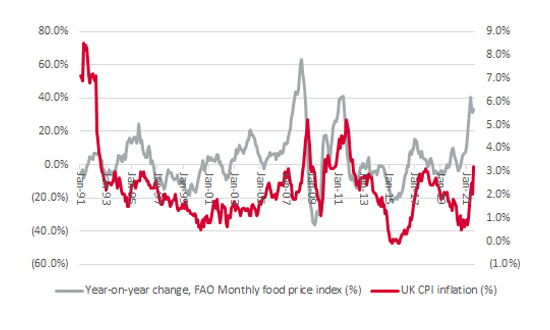
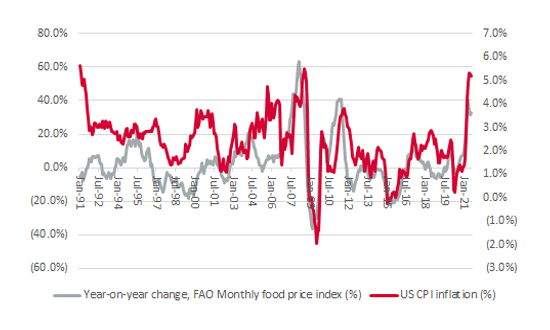
There appear to be some grounds for arguing that food prices are fuelling the current spike in inflation on both sides of the Atlantic, even if the UK CPIH inflation basket has a weighting of just 8.9% toward food and soft drinks (with a further 10.4% weighting toward alcohol, tobacco and restaurants and hotels), and the US equivalent weighting is 7.6% (with a further 6.2% from eating out and 1.6% from alcohol and tobacco). These weightings reduce food’s overall influence and that helps to explain why the UK headline rate of inflation is 3.2% and America’s 5.4%, along with how grocers and suppliers decide to handle cost increases, either by passing them or taking the margin hit themselves.

Rising global food prices may be nudging UK inflation higher…
Source: Food and Agricultural Organisation of the United Nations, Office for National Statistics

…and they could be fuelling US inflation too
Source: Food and Agricultural Organisation of the United Nations, US Bureau of Labor Statistics

Emerging problem

It may be of little comfort to consumers that the way in which baskets of goods are constructed to measure inflation is limiting the impact of rising food prices. Leave the economists’ desks behind and get out in the real world and this issue matters, especially to those who are less well off and where a greater percentage of income is spent on life’s essentials.

“The apparent correlation between the cost of foodstuffs and an indicator inflation may explain why emerging markets such as Brazil, Russia and Mexico are leading the charge when it comes to interest rates rises in 2021.”

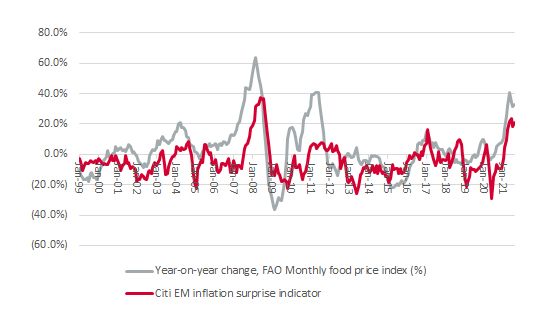
Emerging markets are a case in point. It is possible to argue that food prices are a much bigger issue, if the apparent correlation between the cost of foodstuffs and an indicator inflation surprises is any guide. It is therefore no wonder that emerging markets such as Brazil, Russia and Mexico are leading the charge when it comes to interest rates rises in 2021. According to www.cbrates.com, there have been 52 individual hikes to borrowing costs around the world this year and all but two (first moves from Iceland and South Korea) have come from emerging markets.

Rising food prices are a big issue in emerging markets
Source: Food and Agricultural Organisation of the United Nations, Refinitiv data

End game

It may well be that the weather comes to the rescue and the combination of rising supply, an end to shipping chaos and 2021’s higher base for comparison means that food price inflation (and price rises more generally) ease in 2022, to the relief of investors and central bankers alike. But caution is needed. If consumers start to accept higher prices, and get higher wages so they can pay them, inflation can become entrenched.

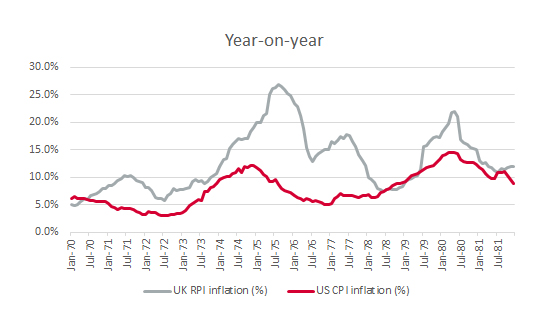
Inflation came in three waves in the 1970s
Source: Office for National Statistics, FRED – St. Louis Federal Reserve database

“There were three distinct waves of inflation in the 1970s and the last one was the worst of all.”

There were three distinct waves of inflation in the 1970s and the last one was the worst of all. Only then did the Paul Volcker-led Federal Reserve and the UK’s Conservative government set about dealing with inflation by jacking up interest rates to double-digit levels, something that neither consumers nor financial markets will want to see in a hurry.

Past performance is not a guide to future performance and some investments need to be held for the long term.AuthorProfile Picture

Please continue to check our Blog content for advice and planning issues and the latest investment, markets and economic updates from leading investment houses.

David Purcell

27th September 2021

Team No Comments

What do the UN Global Compact Principles mean for investors?

Please see the below article that we received from fund managers Quilter Investors yesterday afternoon:

With climate-related risks and environmental challenges seemingly at the forefront of investors’ minds, it’s important that all those involved in the investment industry adopt a broad approach when assessing the major risks facing corporate sustainability today. This should include human rights abuses and forced labour and corruption, as risks to corporate sustainability affect not only shareholders and bondholders but also other stakeholder groups including customers, suppliers and employees.

The UN Global Compact is one of the many tools that can help investors assess threats to sustainable business across the companies in which they invest.

The UN Global Compact – what is it?

Launched in 2000, the UN Global Compact is the world’s largest corporate sustainability initiative aimed at promoting corporate sustainability and encouraging innovative solutions and partnerships through 10 guiding principles.

The UN Global Compact supports companies in responsibly aligning their strategies and operations, in addition to helping them to advance broader societal change, through initiatives such as the UN Sustainable Development Goals.

It also sits alongside the Organisation for Economic Co-operation and Development (OECD) Guidelines for Multinational Enterprises, which is another voluntary initiative to support sustainable business.

The UN Global Compact’s principle-based framework is broadly split into four key areas – human rights, labour, environment and anti-corruption – to help guide businesses in their activities in these areas. The framework is derived from numerous international declarations for companies and countries, such as the Universal Declaration of Human Rights and the Rio Declaration on Environment and Development.

The 10 Principles

Human Rights

  • Principle 1: Businesses should support and respect the protection of internationally proclaimed human rights.
  • Principle 2: Businesses should make sure that they are not complicit in human rights abuses.

Labour Standards

  • Principle 3: Businesses should uphold the freedom of association and the effective recognition of the right to collective bargaining.
  • Principle 4: Businesses should uphold the elimination of all forms of forced and compulsory labour.
  • Principle 5: Businesses should support the effective abolition of child labour.
  • Principle 6: Businesses should uphold the elimination of discrimination in respect of employment and occupation.

Environment

  • Principle 7: Businesses should support a precautionary approach to environmental challenges.
  • Principle 8: Businesses should undertake initiatives to promote greater environmental responsibility.
  • Principle 9: Businesses should encourage the development and diffusion of environmentally-friendly technologies.

Anti-corruption

  • Principle 10: Businesses should work against corruption in all its forms, including extortion and bribery.

Protection of human rights

Principles one and two relate to the importance of businesses to both support the protection of human rights and ensure that they are not complicit in human rights abuses.

A company that may be deemed to be in violation of the human rights principles could have revenue exposure to jurisdictions or authoritarian governments where human rights abuses are prevalent.

These companies are frequently flagged across emerging markets. For instance, an Indian port infrastructure company was flagged for being in violation of the principles given its financial ties to the Myanmar military.

However, a violation of the principles can be more explicit than this. For example, an Asian engineering and construction company was recently deemed to be non-compliant following a collapsed dam in Laos resulting in fatalities and the displacement of local communities.

Human rights is one of the main areas where investors can see which companies violate the UN Global Compact. It poses a higher risk across sectors such as aerospace and defence where businesses may be involved in the manufacture of controversial weapons.

The UN Global Compact is one of the many tools that can help investors assess threats to sustainable business across the companies in which they invest.

Labour best practice

Principles three, four, five and six are concerned with how sustainable businesses should uphold the effective recognition of the right to collective bargaining, eradicate all forms of forced (including child) labour and eliminate occupational discrimination.

Companies tend to fall foul of these principles less commonly. Following an investigation by Norway’s Council on Ethics, the forced labour risk has been particularly high in the Middle East over recent years. Migrant workers coming from India, Pakistan and Nepal face little hope of paying off the debt they owe to ‘recruitment agencies’ who have charged workers a fee for access to jobs in countries such as Qatar and the UAE.

As a result, there has recently been significant reputational damage to companies allegedly practicing forced labour in the Middle East.

Environmental responsibility

Principles seven, eight and nine provide guidance on how businesses should consider the negative impact of environmental damage, as well as the cost to a company’s reputation should a negative environmental event occur.

The principles also encourage investment in research and development around the long-term benefits of environmentally-friendly technologies.

Companies that are commonly deemed to be in violation of the environmental principles operate across the materials and utilities sectors.

For instance, an Indonesian aluminium business was found to be non-compliant given its interests in a mine that uses riverine tailings disposal (using rivers for mine waste disposal), a practice banned in many countries due to its severe environmental impacts.

Only four mines in the world engage in riverine tailings disposal, and in the case of this business, the mine in question has impacted one of the world’s most bio-diverse regions, Lorentz National Park, a UNESCO World Heritage Site.

Anti-corruption guidance

Principle 10 targets corruption in all forms, including extortion and bribery. The financial services sector is a particularly high-risk area of the market for exposure to corruption, specifically in relation to failings in anti-money laundering procedures.

Money laundering scandals have thrown the spotlight on the major Nordic banks in recent years, particularly those with exposure to the Baltic region, which has been beset by allegations of financial crime.

Our Comments

We have written about these UN Global Compact Principles in the past.

This is one of the key ESG processes that investment managers use to form their ESG screening process in relation to sustainable investments.

These principles are the foundation for investment firms who wish to bring ESG on board within their investments.

The main 2 methods of screening that investment managers use to assess whether or not the companies they choose to invest in are considered compatible with the 10 principles are positive and negative screening. Some firms go above and beyond this and look deeper, some use a combination of both.

Positive Screening is Investment in sectors, companies or projects selected for positive ESG performance in comparison to industry peers. This involves selecting firms that show examples of environmentally friendly and socially responsible business practices. This also includes avoiding companies that do not meet certain ESG performance thresholds.

Negative Screening is the exclusion from a fund or certain sectors or companies involved in activities deemed unacceptable or controversial (e.g. tobacco, arms, gambling etc). This involves avoiding companies that create negative impacts considered incompatible with the UN Global Compact Principles.

Just using these screening methods isn’t enough to ‘change the world’ so to say. It’s important that fund managers engage with the firms they are investing in, to challenge their practices to move them further along the ESG journey and ensure they are adhering to the UN principles.

ESG investing is still a new world, however, since we first started talking about it over a year ago, the ESG landscape has already moved forward, and fast.

We have more of our clients now engaging and starting the discussions around ESG and sustainable investing.

Interestingly, we listened to a compliance update earlier this week from our compliance partners, Paradigm. In this update there was a comment made that the view from MSCI is that they believe that clients will have to opt out of ESG investing in the future, rather than opt in, as they do now.

This supports the view we have had for a while now, that ESG investing will become the new normal.

Andrew Lloyd DipPFS

24th September 2021

Team No Comments

Brooks MacDonald Daily Investment Bulletin: 22/09/2021

Please see below the Brooks MacDonald Daily Investment Bulletin received by us yesterday, 22/09/2021:

What has happened

European indices posted strong gains yesterday, offsetting much of Monday’s weakness, however US bourses performed less well remaining mostly flat from Monday’s close.

Evergrande

Whilst Evergrande has been at the centre of the financial world this week, Chinese markets have been on holiday. When the equity markets opened for trading this morning shares dipped however the People’s Bank of China injected CNY 90bn of liquidity into the system to steady investor nerves. Reports are suggesting that Evergrande will make the domestic coupon payment due tomorrow however there has been no word yet as to payments on the foreign dollar denominated bond. The interest payments due on bank loans at the start of the week are reportedly yet to be paid so plenty of moving parts to this story. Expectations are pointing to a restructuring orchestrated by Chinese authorities and for the government to allow Evergrande itself to default but to take steps to ensure there isn’t extensive contagion into either Chinese property prices or the property investment sector.

US Infrastructure

The bipartisan $500bn physical infrastructure bill that passed the Senate vote but was held up in the House is now said to be moving to a House vote on Monday. This has less to do with any movement on the broader ‘social infrastructure’ bill but more to do with the proximity of the debt ceiling which is now demanding the focus of Democrats and the White House. Should the Republicans not support the government funding bills the White House will be forced to use budget reconciliation to pass the bills. Given there are procedural limits on the number of reconciliation bills in a Congress year, this risks Democrats having to hastily incorporate the least contentious parts of the $3.5 trillion social infrastructure bill, effectively watering down the size and scope quite considerably.

What does Brooks Macdonald think At 7pm UK time we will receive the latest policy statement from the Federal Reserve followed by a press conference by the Fed Chair. Expectations are for the bank to continue to guide to tapering this year but with the caveat that the economy must remain on track for the central bank to pull the taper trigger. This optionality will be important for market sentiment as if the Fed leaves a delay of taper on the table, even if it’s likely they won’t use it, this will provide a release valve for market concerns over the coming months.

Please continue to utilise these blogs and expert insights to keep your own holistic view of the market up to date.

Keep safe and well

Paul Green DipFA

23/09/2021

Team No Comments

Brewin Dolphin – Markets in a Minute

Please see below Brewin Dolphin’s latest market summary, which was received late yesterday (21/09/2021) afternoon:

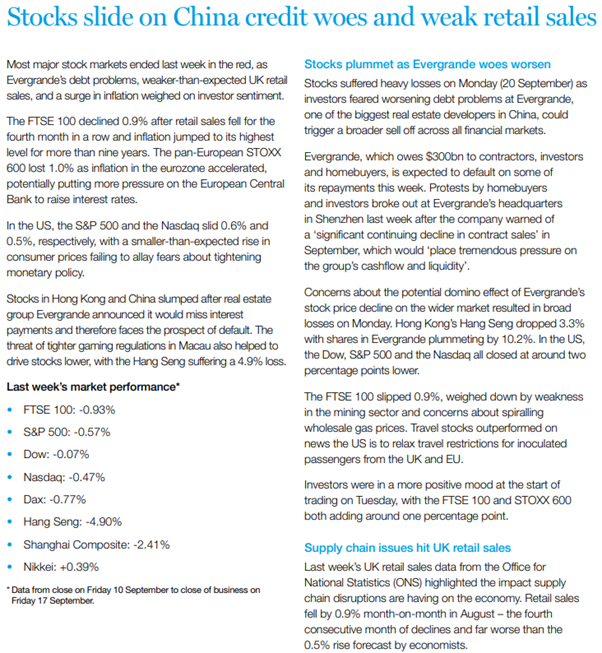
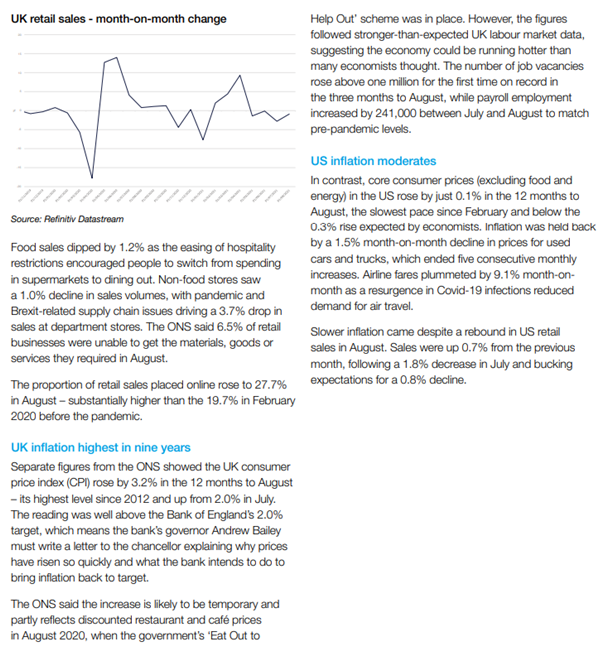
As you can see from the above, markets suffered losses last week. China also suffered large losses last week due to the Evergrande property business situation. Inflation and supply chains remain an ongoing issue, but hopefully these are just transitory trends.

Negative sentiment towards China at the moment is likely to present buying opportunities in Chinese Equities.

Please continue to check our Blog content for advice and planning issues and the latest investment, markets and economic updates from leading investment houses.

Please keep safe and healthy.

Carl Mitchell – Dip PFS

Independent Financial Adviser

22/09/2021

Team No Comments

Evergrande a grand problem?

The impending default or restructuring of Evergrande, China’s second-biggest property developer, dominated China’s news last week. Please see below article received from Legal and General yesterday afternoon, which discusses the effects of this on the broader market.

Localised, so far

Evergrande accounts for 6.5% of liabilities in China’s property sector, and its sales make up roughly 10% of all property transactions in the country. Evergrande could therefore pose a systemic risk, but so far stress in the financial sector has been localised. Interbank spreads are not elevated and the renminbi has held up well.

After a string of incidents that have given equity investors concerns about China – such as regulation of tech, education and casinos – its stock market has slipped behind international peers, but over a longer-term perspective it remains close to recent highs.

Evergrande’s problems could still affect the broader economy beyond the financial channel. People are no longer buying off-plan properties from the company; if this feeds through to Evergrande’s building activity, it could leave a noticeable impact on GDP. August property sales and starts were already in contractionary territory, and GDP is under pressure from Covid-19 outbreaks and lockdowns.

We believe the authorities have the levers to steady the ship, however, and will do so soon. This would likely involve a liquidity provision via a reserve requirement ratio (RRR) cut, fine-tuning of property financing policies, and measures to ensure Evergrande can continue its regular operations.

There is a manageable path forward, in our view, but China’s history of managing delicate situations in financial markets is not unblemished, so this remains a risk to watch in the weeks ahead.

Blockages but not stoppages

The release of the Federal Reserve’s Beige Book earlier this month led to discussion about the effects of supply-chain disruptions on corporate earnings. Last week’s Goldman Sachs US Industrials conference was an opportunity to hear directly from the companies in the middle of the supply-chain issues.

Five things caught our eye:

1. Overall, there was a very consistent message across companies. All are dealing with supply-chain challenges, but all are also talking about strong demand and a growing order backlog, which bodes well for 2022.

2. There is no uniform picture of the disruptions across individual companies and sub-sectors. Some are reporting supply-chain issues getting better than they were in the second quarter; others are seeing things deteriorate. It really seems to depend on your very specific sub-sector.

3. Pricing-power optimism is high. That matches the strong pricing-power sentiment evident in other data sources, and suggests most companies think they can pass on higher input costs if needed.

4. Companies did not take the opportunity to guide lower or to issue a profit warning, so they seem confident they can hit third-quarter numbers despite supply-chain issues.

5. There was a muted market reaction to all the supply-chain commentary. Most stocks were down over the week, but that’s not materially different from the wider market. The comments didn’t shock investors, so expectations for the third quarter appear to have largely adjusted.

It’s too early to sound the all-clear on that front, as there are clear blockages, but it seems there are no economy-wide stoppages, which we believe makes for a good start to the traditional ‘profit warning’ season.

Currency market at a standstill

One of our currency traders told us last week that she has been seeing the same spot levels in developed currency markets for months now. It’s not that we love volatility, but there is a lack of action in the currency space. Idea generation is easier when prices are on the move as momentum traders will enforce the trend up to the point where positioning and sentiment become stretched, and a contrarian approach starts to look more promising.

We know volatility is low across financial markets, reflected in the realised volatility of assets and implied volatility in option markets having dropped sharply since the pandemic peak in March last year. But where equity volatility (e.g. the VIX index) and bond volatility (e.g. the MOVE index) have recently moved more sideways, currency volatility in developed markets continues to grind lower (e.g. the CVIX index).

The impact on prices of this low-volatility environment is quite different too. It’s a boon to equity markets, with one market after another reaching new all-time highs; a blessing for credit issuers keeping spreads historically tight; and a godsend to bondholders, with longer-end yields reversing much of the sharp increase from earlier this year despite high inflation prints. Stable spreads and yields may sound dull, but they allow fixed-income investors to continue earning that credit spread and capture the rolldown of longer-dated bonds.

In currencies, things are different. Carry is almost non-existent with interest-rate differentials at a historical bottom, while spot prices have stopped moving. To quantify our trader’s observation, we calculated the average distance between today’s spot price and the six-month trailing average across all 45 developed crosses. That average is just 1%, close to its lowest point over 20 years, which illustrates that developed currency markets are stuck.

We don’t have many active currency positions open and don’t take much risk in this asset class at the moment. It’s tempting to chase smaller and smaller movements, but in our view it wouldn’t be good portfolio management and so we prefer to be patient and wait for bigger opportunities to come.

We will continue to publish relevant content and news as we head into Autumn in the UK.  

Stay safe.

Chloe

21/09/2021

Team No Comments

Merits for a dedicated China allocation

Please see the below article from Invesco received over the weekend:

The economic success of China presents appealing investment opportunities in a broad range of sectors. Not only that, but efforts to loosen the reigns have enabled much easier access to its financial markets.

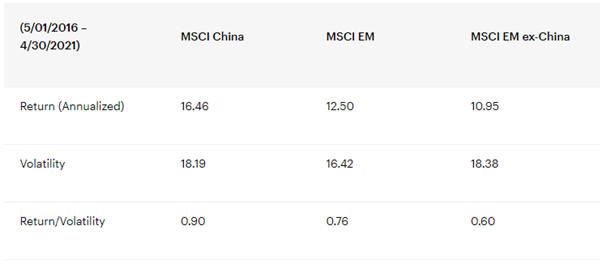
But how can investors gain exposure to China? Most international investors do so via a multi-country portfolio or index, however we believe this may not provide the best exposures, given China’s economic rise, strong risk- adjusted returns (see Table 1), and unique opportunities. Our view is that investors should consider a standalone China allocation.

In our view, China is an exceptional emerging market

Though it’s classified as an emerging market, we believe China warrants its own allocation. Its equity market is the second largest in the world – well ahead of the third largest, Japan, which is only around 40% of China’s size. Japan is already treated as a distinct asset class.

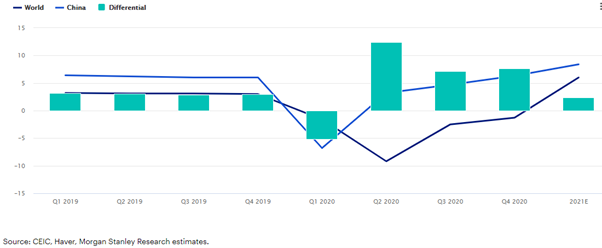
China’s GDP is now higher than that GDP of India, Russia, Africa, and Latin America combined, and we believe it’ll continue to deliver premium growth going forward. The COVID-19 crisis has served to strength China’s economic leadership (Figure 1). Thanks to effective containment, it has managed to emerge strongly from the pandemic. Real GDP expanded +2.3% year-on-year in 2020 – the only major economy globally that delivered positive growth. Economic activities were strong entering 2021, benefiting from continued recovery in both domestic and external demand. This contrasts with other emerging markets whose outlooks remain clouded by uncertainties surrounding the pandemic.

Figure 1. China is expected to deliver premium GDP growth over the world

In our view, the Chinese economy is poised for long-term structural growth. The strengths we see from a broad range of economic indicators will likely continue. China is also repositioning its growth drivers towards consumption and services, which are already the largest contributors to GDP growth. We expect its consumption market to hit US$17 trillion by 2030, supported by an expanding middle class and sustained income growth. Policy support is expected to be strong given consumption’s strategic importance to the government’s long-term growth plan. These can enable China to generate sustained expansion going forward and to remain the largest driver of global growth.

Historic appealing risk-adjusted returns

China’s strong economic prospects have been reflected in its equity market performance (Figure2). We compared the return and risk profile of Chinese equities and Emerging Markets ex-China equities on a five-year basis. Chinese equities delivered a much higher annualized return, and even after adjusting for risk, they offered a premium over Emerging Markets ex-China equities (Table 1).

Figure 2. Equity market performance of China relative to EM (April 2016=100)

Position into the future

China’s importance in the MSCI EM index has risen in recent years. Its index weight has increased to around 40% now from below 25% five years ago. We expect its index weight to keep rising given faster economic growth and further A share inclusion. Over the past 20 years, we’ve seen the return correlation between China and Emerging Markets structurally rising to around 0.9 from 0.6 (Chart 3). Once China’s weight exceeds a certain threshold, we believe emerging market equities could become almost indistinguishable from China alone.

Figure 3. Historic return correlation between China and EM

A dedicated China allocation could make it easier for investors to capture the entire opportunity set in China, discover new names as well as alpha sources.

Unique domestic opportunities

The growth of the Chinese economy means that there are now more than 5,500 competitive Chinese enterprises, across a broad range of sectors, listed across mainland China, Hong Kong, and the US. We believe they provide a large selection of alpha sources for investors to choose from when constructing their portfolios.

Compared to other emerging markets (except Taiwan and Korea) that remain dominated by traditional growth sectors, the communication services, consumer discretionary and healthcare sectors together account for above 60% of the MSCI China Index. They make up just 17% of the MSCI EM ex-China index (Chart 4).

In our view, this is another compelling argument for a dedicated China allocation. Given the structural changes the pandemic has made to the way we work and live, it provides investors with the chance to position for the future.

Figure 4. China may offer abundant investment opportunities in structural growth sectors that have been strengthened by COVID-19

What factors could challenge our views?

Pushback 1: COVID-19 will have long-lasting impact on employment and income growth in China

As consumption becomes more important to its economic growth, there’s a concern as to whether China can generate the employment and income growth needed to support ongoing strength in domestic consumption. Considering the uncertainty caused by COVID-19, this is valid.

In fact, the government’s surveyed unemployment rate rose to +6.2% in February last year and urban households only saw an increase of +0.5% in their disposal income in the first quarter. These data points are however improving as the economy recovers.

Unemployment rate fell to +5.1% in April this year. On the income side, growth also picked up to +12.2% in the first quarter of 2021.1 We expect further improvement in 2021 as economic activities are on track for normalization.

Long-term, the government continues to focus on the quality of growth rather than quantity. Employment is being prioritised in various policy decisions – with the goal of promoting and stabilising it.

Meanwhile, income inequality is on top of the policy makers’ agendas as well. China released its new Five-Year Plan this year and there is strong emphasis on social welfare and improving income equality in the document.

Challenge  2: Geopolitical tensions with the US will derail its long-term growth

Our team believes the geopolitical tensions with the US will be an ongoing topic. This is in line with many investors’ views. That said, we don’t expect this tension to derail China’s long-term economic progression.

Our view is that it’s worth investing in China, even with the ongoing tensions. It’s large and expanding domestic market is a valuable feature of its economy allowing it to enjoy unique economic and business cycles. These cycles rely on its domestic strength, helping to shield it from geopolitical complications. On a corporate

level, Chinese companies derive over 90% of their revenues from the domestic market and less than 5% from the US.2

Challenge 3: ESG standards are low in China

ESG development is gaining traction in China. An upward trend in disclosure rates of environmental, social and governance indicators is gradually catching up with global and regional standards.

During the United Nations General Assembly last year, China also pledged to reach carbon neutrality by 2060. We believe this ambitious commitment exemplifies China’s desire to pursue long-term sustainable growth and will propel the wave of ESG development going forward.

Regulators are a powerful force in China, which should drive further improvement in ESG disclosures among Chinese companies. The China Securities Regulatory Commission (CSRC) is expected to publish guidelines for mandatory corporate disclosure on ESG issues soon. We believe continued financial liberalization to attract more foreign investors will also drive ESG development in China. Increased focus on ESG by international investors should lead to rising awareness and improvements in ESG practices.

Conclusion

It’s for these reasons that we believe investors should consider a dedicated China allocation. Besides premium growth, the country may also offer the benefits of abundant, attractive investment opportunities. Its investment universe is deep and diverse and thanks to structural growth, may provide investors with ample compelling opportunities.

We believe investors can consider adopting an all-share approach when investing in Chinese equities. This means selecting opportunities irrespective of listing locations. Both onshore and offshore Chinese markets have unique listed companies and together, they represent the complete opportunity set for investors. We believe investors can look to experienced managers to make the best stock selection choices.

We have various views on China, please see Friday’s blog about Alibaba and Apple and regulatory scrutiny.  From my point of view I think it’s a time for ‘Active’ fund management in China and the region. 

Keep checking back for more of our regular blog content including market insights and views from some of the world’s top investment managers.

Andrew Lloyd DipPFS

20/09/2021

Team No Comments

Alibaba and Apple face increasing regulatory scrutiny

Please find below details in relation to the market values of Alibaba and Apple, received from AJ Bell, yesterday afternoon.

The tide seems to be turning against large tech no matter where they are listed as regulators hit back

Thursday 16 Sep 2021 Author: Martin Gamble

E-commerce giant Alibaba has lost roughly half its market value since founder Jack Ma criticised China’s financial regulators last October.

That has led to the current backlash against not just the technology sector but also the gaming, education and entertainment industries. A Goldman Sachs basket of US-listed Chinese shares has halved since peaking in early 2021.

For Alibaba, all roads seem to lead to its mobile payment platform company Ant whose initial public offering, thought to be worth around $37 billion, was suspended last November.

On 13 September 2021, Alibaba’s shares were again under pressure after state regulators said they wanted to break up Alipay, Ant’s leading mobile payment app which has over 1 billion users.

Beijing wants to create a separate independent app for the loans business which issued around 10% of the country’s non-mortgage consumer loans last year.

In addition, it is requiring Ant to share user data in a new credit scoring system which would be partly state-owned, according to the Financial Times.

The real issue for the regulators is maintaining control of the monetary system, argues current affairs magazine The Diplomat.

Alipay customers use a currency issued by the platform’s parent company Alibaba, rather than the state currency renminbi, when they use their phones to make a transaction.

It just happens that the Alipay currency has a one-to-one exchange rate with the state currency (renminbi) and is backed by reserves held by Alibaba. The problem is that Alibaba isn’t regulated as a commercial bank and therefore operates outside the financial system.

The Chinese central bank is looking to solve this problem by being one of the first to issue its own digital money and integrating Alipay and other private payment systems, regaining control of the currency.

It’s not just China cracking down on large technology companies. Phones and computer giant Apple lost a pivotal case against gaming company Epic Games, maker of the hugely successful Fortnite. Apple had blocked the game after Epic tried to bypass the Apple app store payment system.

While US District Judge Yvonne Gonzalez Rogers stopped short of calling Apple a monopolist and found that the commission it charged app developers (30%) wasn’t a violation of competition law, Rogers said Apple’s conduct was anti-competitive.

The ruling means Apple is forbidden from stopping other companies’ apps including buttons or external links that direct customers to purchasing mechanisms as well as in-app purchases.

Benedict Evans, an independent technology analyst, says Apple generated around $15 billion last year from app commissions which only represents 5% of company revenue, so even if they were to eventually disappear it would be small beer in the bigger picture.

Please continue to check our Blog content for advice and planning issues and the latest investment, markets and economic updates from leading investment houses.

David Purcell

17th September 2021

Team No Comments

Brooks Macdonald – Daily Investment Bulletin

Please see investment bulletin below from Brooks Macdonald received yesterday – 15/09/2021

What has happened

Despite a decline in bond yields, triggered by the US CPI release, equities failed to make ground with the US index falling driven by value sectors such as banks. Those sectors which are more sensitive to the pricing of longer-term rates, such as technology, outperformed.

US CPI

Whilst it may feel like every US CPI release this year has been a surprise to markets, yesterday’s release was the first downside surprise since November last year. The month on month headline number came in at 0.3% vs expectations of 0.4%, with some of the key transitory sub-components retreating. Used cars and trucks saw their first decline in 6 months after driving much of the month on month increase earlier in the year. Not every component slowed however and energy picked up, driven by gas prices. The US core CPI number that excludes this energy element (as well as food) rose just 0.1% month on month compared to the 0.3% expected. Whilst there are signs of a deceleration of inflationary pace, energy and commodities more generally are likely to cloud the near term numbers even if they ultimately prove transitory. Over in the UK, the CPI release this morning showed inflation of 3.2% year on year, against market expectations of just 2.9%, a sign that the deceleration may not be a global phenomenon yet.

The Winter Plan

England’s Chief Medical Officer announced that ‘winter is coming’ as the UK government unveiled its toolkit for fighting COVID during the colder months in the Northern Hemisphere. Plan A is to effectively stick to the current guidance and use the vaccination driver (first/second doses and boosters) to increase population level immunity. Plan B would see a reversal to the status quo earlier in the summer with masks and work from home advice amongst the options. The UK Prime Minister was keen to stress that lockdowns remained available to the government but this looks increasingly unpalatable politically which may mean the government leans into Plan B earlier to avoid needing to make that decision.

What does Brooks Macdonald think

The US CPI number is the most hotly anticipated of the inflation releases, partially because the US is the world’s largest economy but also as it is being used to predict the path of inflation in other developed nations. Yesterday’s deceleration points to an easing of some of the transitory factors that have muddied the data over the summer but with commodities hitting decade highs, it is unlikely to entirely reverse short term.

Another quick update from Brooks Macdonald, these regular investment bulletins help us keep up to date with what is happening in the markets.

Please continue to check back for our latest blog posts and updates.

Charlotte Clarke

16/09/2021

Team No Comments

Brewin Dolphin Markets in a Minute: Stock markets ease as inflation fears return

Please see below for Brewin Dolphin’s latest Markets in a Minute Article, received by us yesterday evening 14/09/2021:

US and European stocks fell last week as the prospect of higher inflation and slower economic growth weighed on investor sentiment.

The S&P 500 and the Dow ended their four-day trading week down 1.7% and 2.2%, respectively, amid a higher than-expected rise in producer prices and concerns about the Delta variant’s impact on the economic rebound.

The pan-European STOXX 600 eased 1.2% as the European Central Bank (ECB) said it would trim its emergency bond purchases. The FTSE 100 also fell 1.5% on concerns the Bank of England could start increasing short-term interest rates.

In contrast, Japan’s Nikkei 225 extended the previous week’s gains, adding 4.3% amid ongoing optimism that the new prime minister will bring further fiscal stimulus. China’s Shanghai Composite rallied 3.4% after newspapers reported ‘candid’ talks between the country’s leader Xi Jinping and US President Joe Biden.

S&P 500 ends five-day losing streak

The S&P 500 added 0.2% on Monday, ending its five-day losing streak, as rising oil prices boosted energy stocks. Airlines and cruise line operators also performed strongly, after the seven-day US Covid-19 case average fell to 144,300 from 167,600 at the start of the month.

UK and European stocks also edged higher, after a top European Central Bank official said recent gains in inflation did not yet pose a risk, and that the extremely low level of inflation seen in 2020 needed to be taken into account.

The FTSE 100 opened Tuesday’s trading session down 0.3%, after the Office for National Statistics reported that while UK company payrolls have returned to pre-pandemic levels, the recovery is uneven and labour shortages are likely to persist for the rest of the year.

US producer inflation accelerates

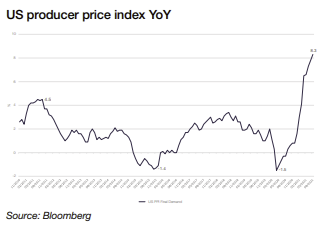
Last week saw the release of the latest US producer price index, which is a measure of inflation based on input costs to producers. The index rose by 0.7% in August from the previous month, which was a slowdown from July’s 1.0% increase but above estimates for a 0.6% rise.

The index rose by 8.3% on an annual basis, which was the biggest yearly increase since records began over a decade ago. This followed a 7.8% annual increase in July.

The data, which comes amid supply chain issues, a shortage of goods, and heightened demand related to the pandemic, suggests inflationary pressures are persisting despite the Federal Reserve’s insistence they will prove temporary and ease through the year.

Firms are also facing cost pressures from the tight labour market. The closely watched US Jobs Openings and Labor Turnover Survey (JOLTS), released last Wednesday, showed there were a record 10.9 million positions waiting to be filled in July, up from 10.2 million in June. It marked the seventh consecutive month of increased job openings, fuelled by factors such as enhanced unemployment benefits, school closures and virus fears.

ECB to trim bond purchases

Over in Europe, the ECB said it would move to a ‘moderately lower pace’ of pandemic emergency bond purchases following a rebound in eurozone economic growth and inflation. ECB president Christine Lagarde sought to reassure investors by stating that the shift to a slower pace of purchases was not tapering. This contrasts with the US Federal Reserve and the Bank of England, which have signalled they plan to start tapering asset purchases this year.

In comments reported by the Financial Times, Lagarde said the economic rebound was ‘increasingly advanced’, but added: “There remains some way to go before the damage done to the economy by the pandemic is undone.” She pointed out that two million more people are out of work than before the pandemic, and many more are still on furlough schemes.

Lagarde added that a fourth wave of infections could still derail the recovery, while supply chain bottlenecks could last longer and feed through into stronger-than-expected wage increases.

BoE split over rate increase

BoE governor Andrew Bailey gave a speech last week in which he revealed the central bank’s policymakers were evenly split between those who thought the minimum conditions for considering an interest rate hike had been met, and those who thought the recovery wasn’t strong enough. According to Reuters, Bailey said he was among those who thought the minimum conditions had been reached, but that they weren’t sufficient to justify a rate hike.

The comments have led to speculation that the next vote could skew towards raising the base interest rate, which currently stands at 0.1%.

Bailey also said there were signs that the UK’s economic bounce back from the pandemic was showing some signs of a slowdown. Indeed, data published by the Office for National Statistics on Friday showed monthly gross domestic product (GDP) grew by 0.1% in July – lower than the expected 0.5% rise and the 1.0% growth seen in June. Output in consumer-facing services fell for the first time since January, driven by a 2.5% decline in retail sales. Output from the construction industry also dropped amid a shortage of building materials and higher prices.

Please continue to utilise these blogs and expert insights to keep your own holistic view of the market up to date.

Keep safe and well

Paul Green DipFA

14/09/2021

Team No Comments

LGIM Blog

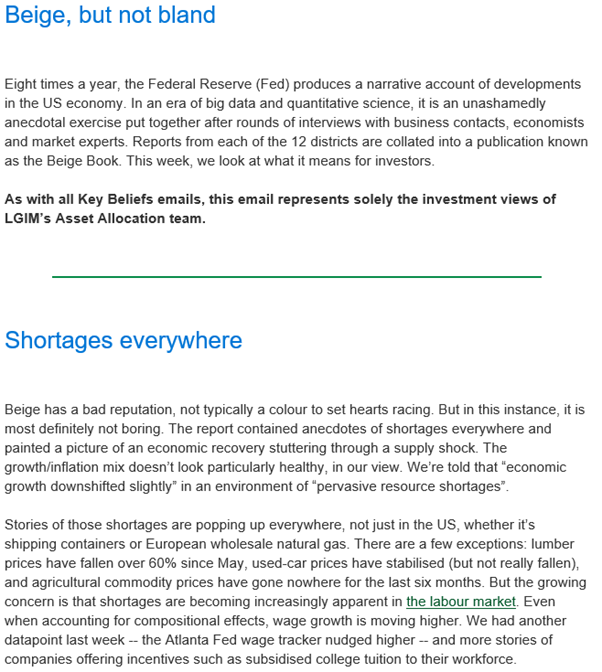
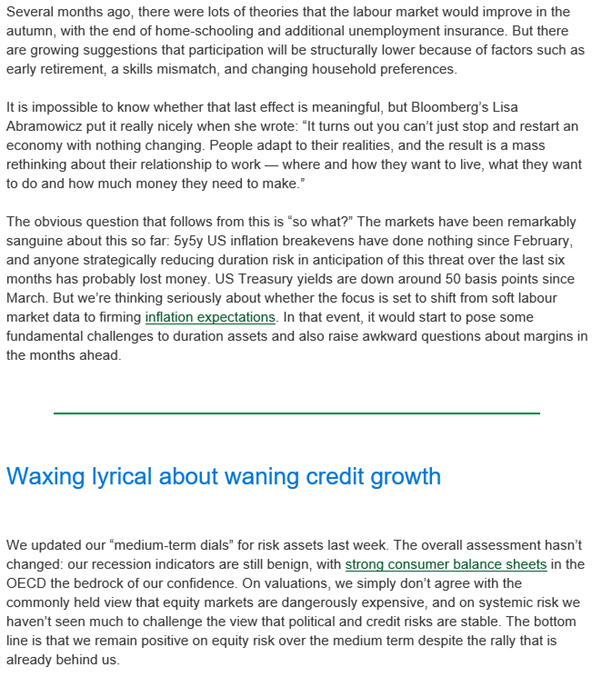
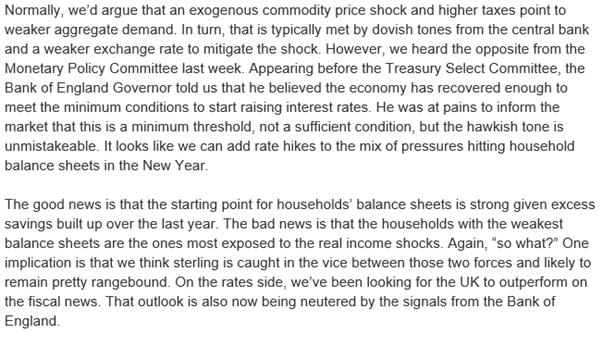
Please see below the latest article received from Legal & General Investment Management’s Asset Allocation Team which was received late yesterday (13/09/2021) afternoon and covers their views on a number of topics:

As you can see from the above Shortages are being felt globally and the initial thoughts on the labour market improving in Autumn have been curtailed slightly as a result of people reassessing their work/life balance.

They also disagree with the consensus that equity markets are heavily over-priced and their recession indicators remain benign. They believe there are still investment returns to be achieved despite the market rally being behind us.

These views represent the LGIM Asset Allocation Team and other providers views could differ.  

Please continue to check our Blog content for advice and planning issues and the latest investment, markets and economic updates from leading investment houses.

Please keep safe and healthy.

Carl Mitchell – Dip PFS

IFA and Paraplanner

14/09/2021