Team No Comments

Brewin Dolphin – Markets in a Minute

Please see below the latest ‘Markets in a Minute’ article from Brewin Dolphin received yesterday – 26/01/2021

US equities strengthen on stimulus plans

Global equities performed relatively strongly last week, as fresh hopes of US stimulus outweighed concerns about extended lockdowns in Europe.

The Nasdaq was the strongest performer among the main markets, rising by an impressive 4.19% thanks to a comeback from the FAANGs. The S&P 500 and the Dow also recorded gains, with investors celebrating Joe Biden’s inauguration and Janet Yellen’s call for Congress to ‘act big’ on stimulus measures.

Renewed coronavirus concerns weighed on the UK’s FTSE 100 as well as several European indices. Over in Asia, hopes of better relations between China and the US boosted the Shanghai Composite by 1.13%, while the Nikkei remained relatively flat.

Last week’s markets performance*

  • FTSE100: -0.60%
  • S&P500: +1.94%
  • Dow: +0.59%
  • Nasdaq: +4.19%
  • Dax: +0.63%
  • Hang Seng: +3.06%
  • Shanghai Composite: +1.13%
  • Nikkei: +0.39%

*Data from close on Friday 15 January to close of business on Friday 22 January.

Merck abandons vaccine

News that pharmaceutical giant Merck is abandoning its vaccine development efforts have dampened last week’s gains. The FTSE 100 slipped a further 0.8% yesterday amid fears that Merck’s decision could delay the global rebound from the pandemic. Airlines, who could face severe travel restrictions, struggled the most, with shares in International Consolidated Airlines 7.2% lower.

In the US, the S&P 500 and the Nasdaq briefly turned negative yesterday, but the Nasdaq ended up closing at a record high, gaining 0.69% ahead of quarterly results from Apple, Microsoft and Facebook this week. The Dow, in which Merck is a component, ended yesterday 0.12% lower.

US celebrates Biden and the FAANGs

Following his inauguration last Wednesday, Joe Biden wasted no time in unveiling details of how he intends to support the US through the pandemic. His proposed $1.9 trillion Covid-19 fiscal package includes another round of direct payments, an increase in the federal weekly unemployment insurance benefit and, somewhat controversially, a hike in the national minimum wage to $15 per hour.

Biden also repeated his goal of one million vaccinations a day for the first 100 days of his presidency, and reversed Trump’s decision to withdraw from the World Health Organization and Paris Agreement on climate change.

The fact that Biden’s inauguration took place without any significant violence helped to calm nerves, as did strong provisional services PMI and better-than-expected housing data.

Although Biden’s election has brought some comfort to investors, it is worth noting that his Cabinet appointments are less market-friendly than Trump’s were. His appointments for the head of the Securities and Exchange Commission, the Consumer Financial Protection Bureau and the Senate Banking Committee could result in tougher regulations for the financial sector.

Last week also saw the return of big mega-caps in the US, which helped to drive up the Nasdaq and S&P 500. Netflix, which reported robust earnings, gained 13.5%, while Apple, Google and Facebook all rose 9%. A strong start to the US reporting season added to investor optimism for the new president.

Lockdowns extended in Europe

Over in Europe, investor sentiment was more subdued as renewed coronavirus concerns took hold. Germany’s Xetra DAX Index edged up by 0.63%, whereas France’s CAC 40 and Italy’s FTSE MIB both declined by 0.93% and 1.31%, respectively. The UK’s FTSE 100 Index fell 0.60%.

There are growing concerns that social distancing restrictions in the UK could last until the middle of the year, after Boris Johnson announced it is ‘too early’ to say when the national lockdown will end. Germany extended its restrictions until 14 February, and The Netherlands introduced its first nationwide curfew since World War II.

Disappointing economic data did not help matters. A Purchasing Managers’ Index revealed business activity in the eurozone contracted at a faster rate in January, while the UK’s quarterly CBI business optimism index plunged from 0 to -22, largely driven by fears about the impact of Covid-19 on British businesses.

Q1 is shaping up to be a bad quarter for the UK economy

In contrast, gilt yields increased after Bank of England governor Andrew Bailey said he anticipated a pronounced economic recovery in the UK later in the year as vaccines are rolled out.

Japan trims GDP forecast

In Japan, the Nikkei rose 0.39% following the country’s first positive exports data since November 2018. The government also announced it has agreed to buy additional vaccines for 12 million people, meaning it will have enough to vaccinate more than half of the country’s population.

On the flipside, Japan’s monetary policy committee lowered its gross domestic product (GDP) growth forecast for the current fiscal year from -5.5% to -5.6%. Although it increased its growth target for 2021 from 3.6% to 3.9%, it warned that the outlook was highly uncertain.

In China, where stocks rallied following Biden’s election, forecasts revealed the economy grew by 2.3% in 2020 – a clear sign that, unlike much of the rest of the world, it has largely recovered from coronavirus lockdowns. Fourth quarter real GDP growth increased to 6.5%.

Markets show impressive resilience

Overall, global stock markets are showing remarkable resilience during the pandemic, underscoring the case for exposure to risk assets. Markets are on course for a third consecutive month of gains, and more stocks are hitting their 52-week highs.

Now, all eyes are on this week’s raft of US corporate earnings figures. Investors will be looking for insight into whether tech stocks can continue their strong growth trajectory over the coming year.

Please continue to check back for our regular blog posts and updates.

Charlotte Ennis

27/01/2021

Team No Comments

PruFund Growth Series E Upwards Unit Price Adjustment

Yesterday afternoon Prudential announced ‘upwards’ Unit Price Adjustments, details cut and pasted as follows:

PruFund Series E fund announcement 

Today we announced there’s six upward UPAs for the Series E PruFund range of funds at this month’s PruFund Investment Date.

FundUPA applied 
Prudential PruFund Growth Pension – Retirement Account Series E +3.18%
Prudential PruFund Cautious Pension – Retirement Account Series E +2.16%
Prudential PruFund Risk Managed 2 – Retirement Account Series E +2.24%
Prudential PruFund Risk Managed 3 – Retirement Account Series E +2.93%
Prudential PruFund Risk Managed 4 – Retirement Account Series E +3.41%
Prudential PruFund Risk Managed 5 – Retirement Account Series E +3.97%

This is good news and I had hoped for this following positive recent developments for markets, the US election outcome, the last-minute Brexit trade deal and the approval of vaccines and the start of distribution and vaccination.

President Biden has laid out his plans, revoked quite a few of Trump’s policies and appears to be on a mission to change the USA.  This should help the world and global trade although the USA will still be struggling with China and trade with them, but relationships should be more diplomatic.  President Biden is after all, a career public servant.

A cautionary note, whilst we still have headwinds in the market, (the end of furlough, rising unemployment and business failure in the UK to name a few), markets are still volatile as the vaccine battles the virus and economies struggle to build momentum, we could see further UPAs down as well as up.  However, over the long term I would expect returns to be reasonable and for all PruFund investors to benefit from a truly diversified multi asset approach.  This is what we need when asset values over the next decade in ‘standard’ investment assets are forecast to be lower for longer.

J. P. Morgan’s Long Term Capital Markets Assumptions Report for 2021 (25th anniversary edition) details the lower longer term returns from standard asset classes.  Multi Asset diversification will be key.  Prudential have long term experience in this area of fund management and have the scale, expertise and leverage to access non standard higher returning assets that will help sustain higher returns than standard portfolios of assets will offer at a similar risk profile over the long term.

As ever, our key advice is for you to remain invested, we are not out of the woods yet, but things look a lot brighter in comparison to just a few months ago.  Funding investments now whether it is on a single/ad-hoc basis or on a regular monthly basis should be good value over the long term too.

Please see below the ‘A step-by-step guide to the PruFund smoothing process’, which aims to show the long-term characteristics and how the PruFund series of funds function:

https://www.pruadviser.co.uk/pdf/PRUF1098101.pdf

Please take care of yourselves and stay out of trouble until the vaccination program helps make the UK and the world a safer place again.

Carl Mitchell – Dip PFS

IFA & Paraplanner

26/01/2021

Team No Comments

Monday Market Update

Please see below commentary received from Blackfinch Group this morning, which provides market analysis as Lockdown 3.0 continues in the UK and Joe Biden is inaugurated as 46th President of the United States.

UK COMMENTARY

  • The Office for National Statistics released labour productivity data showing that output per hour, the UK’s headline measure of labour productivity, increased 4.0% year-on-year in the third quarter of 2020, the largest increase since the fourth quarter of 2005. The Coronavirus Job Retention Scheme continued to impact output per worker productivity, which fell 7.9%.
  • Inflation, measured by the Consumer Price Index, rose 0.6% in November, pushed higher by transport and clothing costs.
  • Average house prices in the UK jumped 7.6% in the year to November 2020, to reach a record high of £250,000.
  • Retail footfall fell 10.9% in the week to the 16th of January, with year-on-year footfall down 67.5%.
  • Retail sales data showed volumes fell 1.9% in 2020, with clothing sales the hardest hit, falling by a quarter from the previous year.
  • IHS Markit/CIPS flash UK composite purchasing managers’ index (PMI) in January fell to an eight-month low of 40.6, down from 50.4 in December.

US COMMENTARY

  • Joe Biden was inaugurated as 46th President of the United States and got straight to work, using executive orders to reverse some of Donald Trump’s more controversial actions, including returning the US to the Paris Climate Agreement.
  • President Biden also moved forward with his plans to launch a further stimulus package, but investors await final confirmation of the deal.
  • Incoming Treasury Secretary Janet Yellen called on Republicans to back the stimulus package and urged the US to “act big” to revive the economy.
  • US initial jobless claims fell to 900,000 last week, but remain at elevated levels. Continuing claims also fell marginally by 127,000 to 5.18mn.

ASIA COMMENTARY

  • Official data showed Chinese gross domestic product was 2.3% in 2020, having expanded by a better-than-expected 6.5% in the fourth quarter.

COVID-19 COMMENTARY

  • New research by BioNTech found that its vaccine, jointly produced with Pfizer, is effective against the new variant of COVID-19 originally identified in the UK. The results echo those from a previous Pfizer study that showed the vaccine was effective against virus mutations identified in the UK and South Africa.

The ever-changing world we live in reinforces the importance
of regular up-to-date communication. Please check in again with us soon for further market updates and news.

Stay safe.

Chloe

25/01/2021

Team No Comments

What does Biden’s presidency mean for the global climate agenda?

Please see the below article from JP Morgan received this morning:

The election of Joe Biden has fueled expectations of an increase in global momentum on tackling climate change. Climate action was one of Biden’s key campaign promises and, according to exit polls, the main reason that 74% of his voters voted for him. Having control of the Senate gives the Democrats more scope to deploy their (climate) programme, but they will still need to compromise given that they fall well short of the 60 seats required to easily pass major legislation. Business groups will also be active in lobbying Congress to oppose the pieces of legislation they find the least acceptable.

Biden’s climate proposals

In his Plan for a Clean Energy Revolution and Environmental Justice, President Biden set out his central ambitions on climate, including:

  1. “Rally the rest of the world to meet the threat of climate change”: The president has stated that rejoining the Paris Climate Agreement will be a day one priority. He also wants to fully integrate climate change into US foreign and trade policies in order to get every major country to further ramp up their domestic climate targets. From a global climate policy perspective, greater US support could be a game changer, as the US is the second-largest CO2 emitter in the world and the carbon intensity of its economy is three times higher than the global average. Quite how the president intends to work with the international community should become clearer following COP 26, the United Nations Climate Conference due to take place in Glasgow in November. At that point, we could see a new Grand Climate Accord. One possibility investors should look out for is that Biden makes climate policy central to ongoing trade tensions with China.
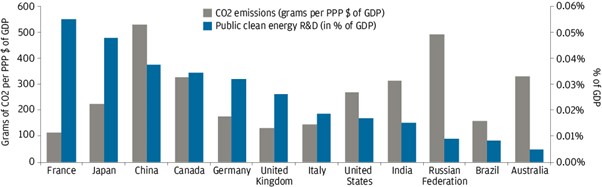
  2. “Ensure the US achieves a 100% clean energy economy and reaches net-zero emissions no later than 2050”: Biden’s pledge to achieve net-zero emissions by 2050 has already been made by more than 110 countries, accounting for more than 50% of global GDP and carbon dioxide emissions. To achieve the net-zero goal and ensure that the US becomes a 100% clean energy economy, Biden plans, among other policy measures, massive public investments (USD 400 billion) in energy- and climate-related research and development (R&D), an area where the US is lagging compared to Europe and China (see Exhibit 1).
  3. “Build a stronger, more resilient nation”: In addition to supporting R&D, Biden has promised significant investments in low-carbon infrastructure, committing to “a federal investment of USD 1.7 trillion over the next ten years, leveraging additional private sector and state and local investments to total to more than USD5 trillion”. This is probably the aspect of Biden’s climate plan that has generated the most enthusiasm in the US as there is a bipartisan consensus about the need to invest in infrastructure. The American Association of Civil Engineers estimates that to close its investment gap, the US “must increase investment from all levels of government and the private sector from 2.5% to 3.5% of US GDP by 2025”. Infrastructure spending will be part of a broader agenda of easy fiscal policy to promote the post-Covid 19 recovery.

 As well as these key climate commitments, other parts of Biden’s programme could further support the sustainability agenda. For example, changes to the Employment Retirement Income Security Act could redirect pension capital flows to encourage private capital to be part of the climate solution.

Exhibit 1: Government investment in greening the economy and level of CO2 emissions

Source: IEA, OECD, World Bank, Mission Innovation, J.P. Morgan Asset Management. R&D budgets for Brazil, Russia, India and China are estimates. Note: R&D numbers from public sector data and may not reflect private sector or joint venture research initiatives. Data as of 2019 or latest available.

Implications of climate policy initiatives for the (global) economy

The economic impact of the transition to a low carbon economy generally depends on whether it is “sticks-based”, with private businesses bearing the bulk of the cost of the transition, or “carrots-based”, with governments supporting the transition through subsidies and other forms of fiscal stimulus.

The carrots-based approach, on which Biden focused in his campaign, is of course the most popular in the current economic environment as it could support the recovery while also addressing the longer-term threat of climate change. Even though he inherits the highest debt/GDP ratio since the second world war, Biden aims to maximise the fiscal impulse of his policies by leveraging public-private partnerships. Similar approaches, such as the European Fund for Strategic Investments, launched in 2015, have delivered strong results in terms of economic growth and energy transition while also generating opportunities for private investors.

However, to be most effective from a climate perspective, this approach should be combined with a sticks-based approach. The most common such approach is the implementation of a carbon tax, or more generally of a carbon price that can be set either through taxes or preferably through Emissions Trading Schemes (ETSs) to incentivise carbon producers to reduce their carbon intensity.

Although Biden has refrained from formally mentioning carbon pricing in his programme, his Treasury Secretary, Janet Yellen, has made clear in the past that she sees carbon pricing as a key element of any climate policy package. Yellen has also advocated so-called “carbon border tax adjustments”, which would ensure that ambitious carbon pricing does not undermine a level playing field globally. As already discussed, this may contribute to ongoing trade tensions with China.

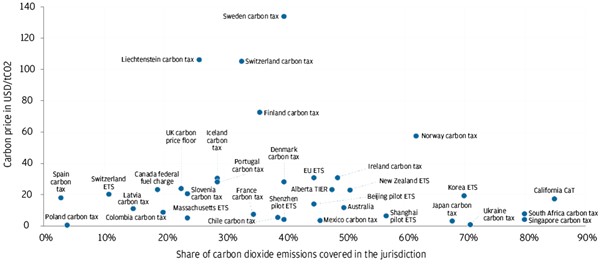
Conviction in the need for border tax adjustments is shared by many countries that have already launched their ETSs, but so far emissions coverage and price levels remain heterogeneous, and too low to reach our climate goals (Exhibit 2).  The US could be tempted to leverage its experience with state-level ETSs, such as those in California and Massachusetts, to support the creation of a global level playing field for carbon prices.

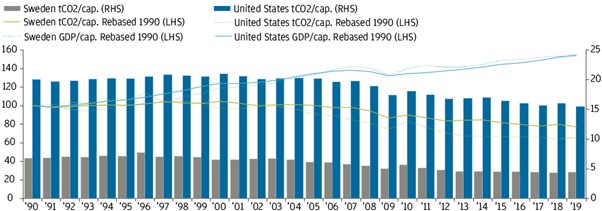
Contrary to the general belief, moving towards a fairer carbon price globally should not necessarily be negative for the global economy. The example of Sweden is striking in this respect. Although Sweden introduced the world’s highest carbon tax (Exhibit 2) in 1991 and joined the EU ETS in 2005, its GDP per capita grew by 53.5% between 1990 and 2019, or slightly less than the 54.6% posted by the US. In the meantime, Sweden’s carbon intensity has dropped from 6.8 tonnes of CO2 per capita (tCO2/cap) in 1990 to 4.45, a third of US carbon intensity (Exhibit 3).

Exhibit 2: Carbon pricing initiatives around the world

Carbon prices in USD (as of 1 November 2020) and % share of carbon dioxide emissions covered in the jurisdiction.

Source: World Bank Carbon Pricing Dashboard, National Bank of Belgium, J.P. Morgan Asset Management. Data as of 20 January 2021.

Exhibit 3: Economic and carbon performances of Sweden compared to the US, 1990-2019

Economic and carbon performances of Sweden compared to the USA 1990-2019

Source: National Bank of Belgium, Refinitiv Datastream, Emission Database for Global Atmospheric Research, Crippa, M., Guizzardi, D., Muntean, M., Schaaf, E., Solazzo, E., Monforti- Ferrario, F., Olivier, J.G.J., Vignati, E., Fossil CO2 emissions of all world countries – 2020 Report, EUR 30358 EN, Publications Office of the European Union, Luxembourg, 2020, ISBN 978-92-76-21515-8, doi:10.2760/143674, JRC121460. , J.P. Morgan Asset Management. GDP per capita based on purchasing power parity (PPP), 2011 international dollars. Data as of 20 January 2021.

Investment implications

Biden’s climate policy is likely to be part of a package of broader fiscal measures to support growth and speed up the energy transition of the country. It should also generate opportunities for investors in asset classes including real assets and global renewables, all of which have rallied over the last couple of weeks.

Internationally, the US is likely to re-embrace a more multilateral approach, after rejoining the Paris Climate agreement and committing to net zero carbon emissions by 2050. While US support for global carbon pricing initiatives remains uncertain, Biden’s administration may support carbon border tax adjustments, which could lead to a level playing field globally for carbon prices.

This is not necessarily negative from an economic perspective, as shown by the Swedish example, but carbon policy will need to be monitored by investors as carbon intensity is going to be an important non-financial parameter of economic and corporate performance. 

Its good to see President Biden’s positive impact already showing through, from re-joining the Paris Climate Agreement to his recent repeal of Trump’s former transgender military ban. These are all elements which come under the heading of ESG.

Along with his more pro-active efforts to tackle the coronavirus, hopefully these positive moves will all help the markets move in the right direction.

Please keep checking back for more ESG related content along with a range of investment and market updates.

Andrew Lloyd

25/01/2021

Team No Comments

Brooks Macdonald – Investment Bulletin

Please see investment bulletin below from Brooks Macdonald received this morning – 22/01/2021

Brooks Macdonald Investment Bulletin

What has happened

A tech fuelled rally drove the US index marginally higher yesterday. Interestingly the cyclical stocks, which outperformed at the start of the month are losing some momentum. One of the explanations for this is the disconnect between market expectations around demand, i.e. the oil price and forward looking equities, i.e. oil majors – until expectations of a cyclical rebound is reflected across the board, cyclical equities may have bouts of weakness. That said, the reflation narrative remains alive in fixed income with US inflation expectations picking up yet again yesterday.

ECB

Whilst there were no changes to policy levels at the ECB meeting yesterday, investors were left feeling more uncomfortable as the bank stressed the ‘symmetrical’ nature of the pandemic quantitative easing programme. Specifically, this means that if the bank feels that it does not need to use all of the QE budget it will not do so. This is fairly logical and reiterates what was said in the December meeting but the fact there was a new section in the statement to reiterate this, concerned markets. Central bank watchers pore over the specific words in a statement so the inclusion of a full section is a strong emphasis from the ECB. Investors decreased their expectations of monetary policy accommodation as a result which saw the Euro rise against the dollar and sovereign bond yields rise amidst fears that the major buyer of sovereign bonds would be less active in purchases going forwards.

US COVID response

With President Biden’s first full day in office we saw a series of executive orders in relation to vaccine supply chains and vaccine deployment. The President did note however that stimulus was required to change the trajectory of the vaccine rollout, but the administration remains committed to the 100m vaccines in the first 100 days. Dr Fauci, Chief Medical Advisor to the President, welcomed news that Johnson & Johnson’s vaccine expected to have early stage results during the start of February and would have data available for an emergency use review during that month.

What does Brooks Macdonald think

The ECB is in a tough spot as financial markets want to hear that tapering is off the table however more fiscally conservative member states such as Germany, want the pandemic QE programme to slow as the economy recovers. Last year we saw the challenge by the German Constitutional Court over the ECB’s QE programme and the inclusion of a statement around the symmetrical nature of QE is probably principally designed to calm the fiscal hawks amongst member states.

Source: Bloomberg as at 22/01/2021

Please continue to check back for our latest updates and blog posts.

Charlotte Ennis

22/01/2021

Team No Comments

The return of inflation

Please see below article received from AJ Bell yesterday afternoon, which provides an insight into what rising prices mean for value stocks and emerging markets.

One theme which continues to exercise financial markets is whether inflation is primed to make a comeback and – if so – what this could mean for asset allocation and portfolio strategies.

The five-year forward inflation expectation in the US now stands at 2.11%, its highest level since December 2018, and financial markets are beginning to react: bond yields are ticking higher, bitcoin is going bananas while gold holds relatively firm. Within equity markets cyclical growth (or ‘value,’ for want of a better word) is again trying to cast off a decade of underperformance relative to perceived secular growth sectors such as technology.

As this column has suggested before, the battle for portfolio style (and performance) supremacy within equities can be seen by comparing the returns provided by two exchange-traded funds (ETFs) in the US: the QQQ Invesco Trust, which follows the price of the biggest non-financial stocks on the NASDAQ, and the Russell 2000 Value ETF.

If the line on this chart goes up, ‘growth’ is outperforming. If it goes down, ‘value’ is outperforming. As can be seen, cyclical growth outperformance stretches to summer 2020.

But this trend can be seen in another way too, this time on a geographic basis. Over the past decade, investors have adapted to the low growth, low inflation, low interest rate environment by buying long-dated assets such as bonds and equity growth (such as technology stocks), and forgetting about commodities, cyclical equities (‘value’) and emerging markets.

Yet as inflation creeps back onto the radar, perhaps for the first time in 40 years since then Fed chairman Paul Volcker set about wiping it out, emerging markets are coming back into fashion too.

This can be seen using the same technique as before, this time by dividing the performance of America’s S&P 500 index by the MSCI Emerging Markets benchmark. American outperformance peaked in September, since when emerging arenas have done better.

Clear pattern

This return to form for emerging markets coincides with a period of strength for commodity prices and dollar weakness. Whether it lasts may hinge to a great degree on those two trends, which also tie into the inflation narrative.

If those three continue to coincide, then we could see a third major period of emerging market outperformance relative to the US (and by implication developed markets), to match those of 1988-1994 and then 2000-2010, so this EM resurgence must be monitored closely. If it proves to be no mere flash in the pan, then it could have profound portfolio implications.

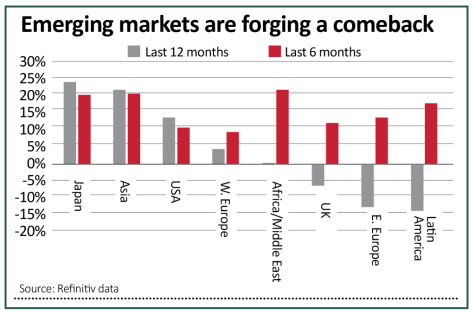
The resurgence of EMs can be seen by digging deeper into geographic performance trends, too.

Japan may be the best performer, in total return, sterling-denominated terms over the past 12 months, but Asia is a close second. The data from the past six months, when cyclical growth, or value, began to try and forge its latest comeback, show outperformance from not just Asia, but the Middle East and Africa, Latin America, and Eastern Europe, too.

East of Eden

Global export plays like South Korea and Taiwan have done well of late, but tourism and travel destinations like Thailand and Hong Kong are clear laggards. Perhaps South East Asia becomes the next leg of the post-vaccine, global upturn story.

There may be other reasons for the return to form of emerging markets, beyond commodity strength, dollar weakness and markets’ preoccupation with inflation and a near-term economic recovery, as this column hinted just under a year ago.

Perhaps Asia’s outperformance reflects the view that region was first in and first out when it comes to the global pandemic (even allowing for recent local flare-ups). Given the experience of SARS in 2002-03, Asia may have been better prepared and equipped to deal with such a situation.

In addition, Asian nations learned harsh lessons about debt during their currency crisis of 1997-98 and as a result aggregate government borrowing levels are generally much lower as a percentage of GDP than they are in the West.

Such facets could help to shape long-term outperformance too, especially as soundness of finances usually wins out in the end.

We will continue to publish news and market analysis. Please check in again with us soon.

Stay safe.

Chloe

22/01/2021

Team No Comments

Brooks Macdonald – Daily Investment Bulletin

Please see below an article received yesterday from Brooks Macdonald which provides a brief overview of the Biden Inauguration and what the transfer of power could mean for markets:

Please continue to check our Blog content for advice and planning issues and the latest investment, markets and economic updates from leading investment houses.

Please keep safe and healthy.

Carl Mitchell – Dip PFS

IFA and Paraplanner

21/01/2021

Team No Comments

Brewin Dolphin Markets in a Minute

Please see the below update from Brewin Dolphin received late last night:

Most global markets fell back slightly over the past week, retreating from record highs set in the first trading week of the year. The falls came after a strong run for global markets that has, unsurprisingly, led to some profit taking. Also weighing on markets has been some disappointing economic data caused by new or expanded lockdowns.

For example, UK retail sales figures released last week saw the worst annual growth since 1955. US initial jobless claims increased sharply last Thursday, hitting their highest level in five months. US retail sales declined for a third straight month and manufacturing activity in the New York state slowed. Then the University of Michigan consumer sentiment index was weaker than had been expected. It is no surprise that markets have adopted a little more of a ‘risk off’ tone.

Last week’s markets performance*

  • FTSE100: -2%
  • S&P500: -1.47%
  • Dow: -0.91%
  • Nasdaq: -1.54%
  • Dax: -1.86
  • Hang Seng: +2.49%
  • Shanghai Composite: -0.10%
  • Nikkei: +1.35%**

*Data from close on 8 January to close of business on Friday 15 January.

Inauguration week starts on a cautious note

It was a quiet start to the week yesterday, as US markets were closed for Martin Luther King Jr Day. In Europe, markets were mostly higher; the pan-European STOXX 600 rose by 0.20%, France’s CAC 40 closed 0.44% higher at 13,848.35 and the Italy’s FTSE Mib gained 0.53% to 22,498.89.

In Asia, most markets lost ground, but China was the exception. The Shanghai Composite and Hang Seng indices both rose after China reported robust GDP data that confirmed it was the only major economy to expand in 2020.

In the UK, the FTSE100 closed down 0.22% at 6,720.65, while the FTSE250 eked out a gain of 0.12%.

China leads global recovery

China’s ongoing recovery continued apace at the end of last year. It recorded GDP growth of 2.3% for 2020 as a whole but growth accelerated in the fourth quarter, with its economy expanding by 6.5% compared to a year earlier. It was its fastest rate of growth in two years.

China’s growth was largely export driven, although government support for infrastructure projects also gave the economy a boost.

But even China is showing signs of pain during these difficult days. Retail sales came in below expectations, rising by 4.6% in December from a year earlier. While this is impressive by global standards, it was below expectations for 5.5% growth.

We expect China to continue to lead the global recovery in 2021, although growth should be more evenly spread around the world, assuming the roll out of vaccines proceeds smoothly.

Bond yields rising

Yields were a little lower on the back of this news, but not much. That is despite the very sharp increase in yields we have seen so far this year. This has been a topic of much speculation as the prevailing narrative had been that rates will stay low for the foreseeable future. However, very recently the market has begun to anticipate that monetary policy cannot remain this accommodative forever.

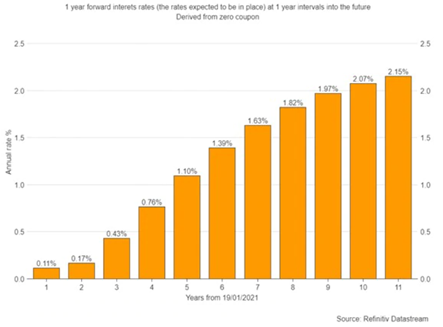
Currently forward interest rates presume that rates stay on hold for the next two years, but then begin to steadily rise. Implied rates have increased significantly over the beginning of the year, mainly in the US. Now those expectations have nudged outside the upper end of the Fed’s forecast range. The chart below shows the market implied interest rate for each year into the future.

Adding to the pressure on bond yields recently has been the fact that some forecasters have brought forward their expectations around the timing of the Fed beginning to slow down its bond purchases, or quantitative easing (QE).

Atlanta Fed president Raphael Bostic, who is about to become a voter on the FOMC, recently said that if the economy bounces back quickly, the Fed may be able to start paring back QE later this year. During the so-called ‘taper tantrum’ of 2013, the 10-year Treasury shot up around 130 basis points in just a few months. There are certainly some parallels between then and the backdrop today, so the bond market is highly sensitive to any discussion about the Fed altering the pace of its bond buying, which is currently at $120 billion per month.

Biden’s stimulus proposal

One of the factors weighing on the bond market is the prospect of extra fiscal stimulus. President-elect Biden announced his plan for spending, and it is eye-watering, at $1.9trn.

He has said he wants $2,000 stimulus cheques for individuals in addition to the $600 cheques already passed by Congress. It also includes $400 a week in emergency unemployment benefits, payable until September, and preventing a cliff-edge cut-off for jobless payments previously scheduled for March.

More controversially he also wants to more than double the minimum wage. This probably isn’t a serious proposition. It’s more of an effort to establish an anchor from which he can give a little ground and still be left with something meaningful at the end of the negotiation.

Inflation expectations on the up

Fundamentally, it has been rising inflation expectations that have been the driving force behind higher yields. Inflation is likely to look as if it is increasing over the coming months, but appearances will be misleading. Year-on-year energy prices will appear to have risen sharply in March when current oil prices are compared to those from a year ago, when prices actually went negative! But this is just a base effect.

There will also be some inflation caused by the reimposition of VAT in some jurisdictions. Statistical factors even imply that there is wage inflation in the current market because job losses in a large number of low-paid roles means that average wages are higher now than they were in 2019. None of these are real inflation, and policy makers will be able to safely ignore them – although headline writers may not.

Overall core inflation remains subdued, but it would be very unusual for it not to rise a little given the increase in manufacturing activity we have seen. In the longer term, more inflationary pressures may build, but for now a gentle increase in inflation gives us a preference for inflation-linked bonds over conventional bonds and reinforces the importance of having some precious metals exposure as a useful hedge.

Brief market updates like this help us get a quick overview of the markets and we share them in the aim of keeping our readers informed.

Today will be a historic day given that, across the pond, it is President Biden and Vice President, Kamala Harris’ Inauguration. VP Kamala Harris will today make history as the first female, first black and first Asian-American US Vice President, a great step towards a more inclusive and diverse future!

Hopefully, we could see positive market movements on the back of this, however, the markets are unpredictable (as have been the events of the world over the past 12 months).

Keep checking back with us for more updates like this.

Andrew Lloyd

20/01/2021

Team No Comments

Daily Investment Bulletin

Please see below update received from Brooks MacDonald earlier today, which analyses global market performance over the past few days.

What has happened

With US markets closed yesterday, equity moves were fairly small and we saw more of a consolidation than any momentum one way or another. That said, European and Asian markets did gain ground with the latter helped by the strong Chinese GDP data at the start of the week.

Yellen’s confirmation hearing

Later today, Janet Yellen, former Fed Chair will set out her plan to the Senate finance committee ahead of her confirmation as Treasury secretary. The prepared remarks have already been leaked and the highest profile phrase is that ‘the smartest thing we can do is act big’. Yellen is expected to reiterate the need for fiscal spending saying that the downturn in the economy could lead to a ‘longer, more painful recession’ if stimulus bills such as that proposed by President-elect Biden falter. The first test for the new President will be the passing of $1.9 trillion of relief measures which may prove challenging given the tiniest of working majorities in the Senate. There will inevitably be questions about the longer-term funding of the deficit created by these measures and the interactions between the Fed and Treasury given Yellen’s former role.

COVID Update

Cases remain elevated across Europe but there are signs that the tougher restrictions are starting to work with Italy seeing its daily cases fall below 10,000 for the first time this year and the UK dipping below 40,000 as Lockdown 3.0 takes effect. Germany is also expected to extend its lockdown further due to concerns over the new variants after being in heightened restrictions for several months. On the vaccine there continue to be impressive numbers out of the UK which is one of the fastest moving of the major economies. The EU are also seeking 70% of the bloc’s population to have had the vaccine by the summer so signs of momentum, or at least ambition, building. In less positive news, California’s state epidemiologist has recommended the pause of the rollout of the Moderna vaccine after severe allergic reactions.

What does Brooks Macdonald think

Yesterday saw a brief lull in market activity after an eventful start to 2021, with central bank meetings, politics and earnings this is unlikely to last too long. Against this backdrop the vaccine rollout has begun in earnest which means that with each passing day the economic risk of reopening marginally reduces. Of course, the question for governments will be what proportion of the population needs to be vaccinated before the risk of the virus is ‘acceptable’, expect this to be a major debate in Q2 2021.

Please check in again with us soon for further relevant content and news.

Stay safe.

Chloe

19/01/2021

Team No Comments

J.P. Morgan – When will the vaccines allow for a sustained economic recovery?

Please see article below from J.P. Morgan received this morning – 18/01/2021

When will the vaccines allow for a sustained economic recovery?

15-01-2021

For months, the question on everyone’s lips has been, ‘When can we start getting back to normal?’ The short answer is, ‘When the vulnerable have been vaccinated and the healthcare systems are comfortably coping with Covid-19 cases’. The more complete answer is a little more complex. Protecting the vulnerable will facilitate the process of a sustainable reopening but caution will still be required until a broader group are vaccinated, and the timetable will differ around the world. Our base case for major developed economies is that the process of sustainable reopening begins in the spring, and in the latter months of the year we see a meaningful bounce in economic activity as pent-up demand is unleashed.

The charts in this report will be updated twice a week in our tracker for readers to follow the progress of the vaccine rollout.

Vaccinating the vulnerable should drastically reduce mortality and hospitalisations from Covid-19

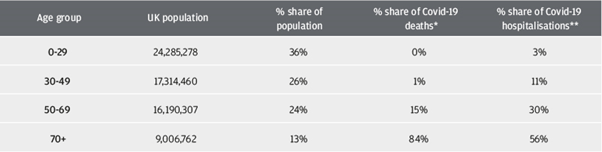
Governments around the world are adopting strategies to vaccinate the most vulnerable first, which should reduce mortality from the virus but also ease the burden on healthcare services. This approach makes sense given Covid-19 causes a disproportionate level of deaths and hospitalisations among older cohorts. In the UK, there are nine million people aged over 70, accounting for 13% of the total population, but 84% of the total Covid-19 deaths and over 50% of total hospitalisations (Exhibit 1).

Exhibit 1: Demographics and Covid-19 in the UK

Source: Office for National Statistics, British Medical Journal, J.P. Morgan Asset Management. 
*Based on deaths in England and Wales where Covid-19 is mentioned on the death certificate.
**Based on an analysis of the first wave published in the British Medical Journal. Data as of 14 January 2021.

Throughout the Covid-19 pandemic we have seen how the health and economic crises have been inextricably linked. If vaccinating the vulnerable significantly reduces the number of new hospital admissions, then governments will feel more comfortable about relaxing restrictions, allowing economic activity to begin normalising.

The pace of vaccine rollout is key

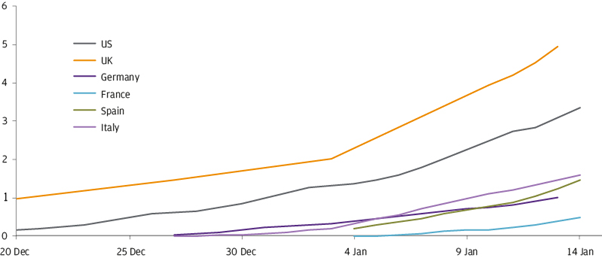
At the time of writing, the UK and US have made solid starts in vaccinating their populations, while the major European economies are off to a slower start (Exhibit 2). 

Exhibit 2: Covid-19 vaccine rollout
Cumulative doses administered per 100 people

Source: Our World in Data, J.P. Morgan Asset Management. Data as of 14 January 2021.

The UK government has announced an ambitious plan to offer vaccinations to its top four priority groups – amounting to 15 million people – by 15 February. These groups include those over the age of 70, frontline workers and those that are clinically vulnerable. The time between first and second dose of vaccines administered in the UK has been extended to 12 weeks to allow as many people as possible to receive at least the first dose, which the government’s advisers view as the best way to reduce mortality and the strain on the health system.

How feasible is it to vaccinate such a large group of people in such a short space of time? In the 2019-20 flu season, the UK vaccinated over 14 million people over a five-month period. The UK health system already has significant experience in vaccinating millions, but it needs to do it around five times as fast as normal. Several mass vaccination centres are planned around the country to meet this ambition, with some vaccinating 24/7. The government has expressed confidence that this will provide sufficient distributive capacity to allow it to meet its goal, and that distribution needs will be met by the supply of approved vaccines, of which the UK now has three.

We think the target is broadly achievable. Whether or not it is achieved exactly to the day is primarily a political concern, but the proposition of having the majority of the UK’s vulnerable with some protection by the beginning of March ought to be a game-changer (as Exhibit 1 suggests) and allow for a process of sustained economic recovery to begin in the second quarter.

The rollout in the US and EU is likely to continue to lag the UK, but both should still have vaccinated the most vulnerable in the first half of the year. Both the Pfizer and Moderna vaccines are approved in the US and the EU, and sufficient doses have been secured to vaccinate the vulnerable population.

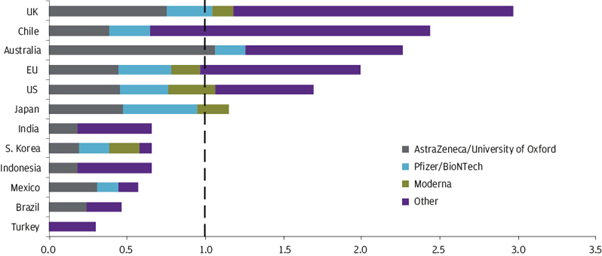
The EU, in particular, will benefit considerably if its regulators approve the AstraZeneca/University of Oxford vaccine in the coming weeks, since it has ordered doses to cover more than 40% of its population and this vaccine is logistically easier to handle (Exhibit 3).

Exhibit 3: Confirmed orders for vaccinations per head of population
Complete vaccination courses per head of population

Source: Duke Global Health Innovation Center, World Bank, J.P. Morgan Asset Management. This chart shows the number of complete vaccination courses that a given country has confirmed orders for. Data as of 9 January 2021.

The success of the three pioneering Covid vaccines will have a huge impact in taming the pandemic, but there are also many other vaccine candidates that could be approved in the coming months that would bolster the world’s supply. Novavax and Johnson & Johnson (J&J) are two of 20 vaccine candidates currently in phase III trials, and have large orders confirmed.

However, it is clear that the vaccine rollout will be unequal. The deep pockets of developed governments have allowed them to secure vaccinations to more than cover their populations. Lower-income emerging market countries have order books that fall short of their populations, giving them less room for error in their rollout strategies. As a result, many will have to rely on the COVAX scheme – a consortium set up by the World Health Organisation and others to ensure that all countries have access to Covid-19 vaccines – and can expect a slower return to normality. COVAX has large orders for the AstraZeneca/University of Oxford and J&J vaccines.

One part of the emerging world is less reliant on vaccines for its economic recovery: North Asia. Through effective testing, contact tracing and strict border controls, the region has been able to recover quickly without the help of vaccines. For investors in emerging markets, this disparate outlook calls for a selective approach. 

We are optimistic on the path of vaccine rollout, but mindful of tail risks

The rollout of vaccines in the developed world should allow economies to recover sharply in the second half of the year as normality returns and consumers are finally free to unleash their pent-up savings. We expect that the UK and US will have vaccinated over half their populations in the first half of the year, and the EU will reach that milestone during the summer.

The strong rebound in developed market activity should be supportive of risk assets, and in particular stocks that stand to benefit the most from a rotation from the Covid winners to those that lost out from the pandemic. Europe, the UK and the value style stand out in this respect. The emerging markets could also perform well in this environment, driven by continued strong economic performance in Asia and a gradual decline in the US dollar.

Of course, there remain risks. We are less concerned about the vaccine timetable slipping for logistical reasons, and think that plans could even be accelerated. Governments are under tremendous pressure to at least keep up with their neighbouring counterparts. And given the fiscal cost of maintaining economic restrictions, no expense will be spared in driving the rollout. 

Uncertainty around take-up is a hurdle for all countries, and surveys suggest a significant degree of scepticism for the Covid-19 vaccine in Europe. Experience in the UK suggests that as the vaccine rollout is proceeding, public confidence is growing, and many may feel increasingly confident of taking up the vaccine as time progresses.

The key risk is that the virus mutates to a new variant that makes the currently approved vaccines ineffective. There is also the risk that vaccine efficacy is lower than initially reported, either among the older population, or across the population from altering the time between first and second doses. Data from trials hasn’t been completely comprehensive in these areas. Many of these risks could be addressed – and rather than derailing the recovery completely, could just provide a setback while new formulations are found. However, we think it prudent for investors to maintain tail-risk protection such as through long-duration government bonds or dynamic fixed income and macro strategies.

A good update from J.P. Morgan with more positive news on the vaccine roll out.

Vaccinating the most vulnerable should drastically reduce mortality and hospitalisations from Covid-19. Hopefully, once the most vulnerable are vaccinated, governments will feel more comfortable about relaxing restrictions, allowing economic activity to begin normalising.

Please continue to check back for our latest blog posts and updates.

Charlotte Ennis

18/01/2021