Team No Comments

The energy transition is too important to get wrong

Please see the below article from Jupiter Asset Management:

The global climate change train to limit the rise in average temperatures to ‘well below 2 degrees Celsius and preferably to no more than 1.5 degrees by the end of the century’ is heading firmly down a single-line track. Even the Americans who temporarily jumped off under Trump are aboard again with Biden. But while its accelerating momentum is inexorable, as it approaches a major junction there seems to be confusion, indeed disagreement, about the ultimate destination.

For some, particularly hard-line climate change activists and carbon nihilists, the aim of absolutely zero carbon emissions at all is the only acceptable terminus and for whom the arrival date of 2050 is years too late; for others it is the Paris Climate Accord target of net-zero emissions by 2050 which is the destination even if there is further to go beyond that. Using the analogy of Orwell’s Animal Farm, the danger is that in an immensely complex and sensitive environment, for many the debate is no more sophisticated than “four legs good, two legs bad”: “green good, brown bad”.

What does not help is the casual interchangeability of nomenclature, sometimes deliberate, sometimes merely the sloppy use of language, between the terms “zero carbon” and “net-zero carbon”. Whichever, the effect is insidious. They are very, very different. The key is that word ‘net’.

Zero emissions assumes the total elimination of all fossil-based or fossil-consuming processes; not only would this include traditional coal, oil and gas extraction, and oil refining with all its implications for energy production and transport fuels, it would also mean that significant outputs of the petrochemicals industry would have to be replaced including all plastics. Net-zero on the other hand says yes, CO2 emissions must be reduced but allowance is made for those CO2 emissions which remain unavoidable: an equivalent tonnage must be offset or ‘removed’ elsewhere (carbon credits, carbon capture, tree-planting etc). But the fundamental presumption is that a zero-carbon cliff-edge is neither feasible nor compatible with the demands of 21st century economic, political and social systems.

Ahead of COP26, the global climate policy forum in Glasgow this autumn with the UK in the chair, expectations for further change are rising. President Biden’s new climate envoy, John Kerry, has already labelled it “the last chance to save the planet”. It is notable just how much faith is being placed in this summit to deliver (bearing in mind its forerunner, COP25 in 2019 was dominated by the phenomenal political effect of Greta Thunberg); the spotlight has particularly been thrown on Glasgow thanks to many western governments explicitly linking Covid economic recovery packages to the acceleration of green infrastructure plans. The green project has been turbocharged.

From an investment standpoint, the green revolution presents significant opportunities. But every revolution has its casualties. The most obvious so far has been the coal industry. Now oil is firmly in the crosshairs. While the global oil companies and the oil ‘majors’ in particular (otherwise known as the ‘integrated’ companies, their activities stretch all the way from up-stream exploration and extraction, to mid-stream refining, moving downstream to wholesale distribution and service station retail, they include such names as EXXON, Chevron, BP, Shell, Total and others) have been some of the biggest, most successful and most enduring companies in history, the most reliable payers of dividends, they are now under concerted threat.

Investors have always been free to invest according to their principles and consciences, regardless of under what badge such investing has taken place over the years (ethical; SRI; ESG etc). But the deep politicisation of the climate change debate adds new dimensions. Just in the US in the past two weeks, President Biden in addition to re-committing the US to the Paris Climate Accord, has issued Executive Orders for the abandonment of the half-complete US/Canadian oil pipeline and declared that there will be no new drilling licences issued for Federal-owned land or waters. In the UK, a group of 50 MPs has written to the Bank of England demanding that the green bond element of its QE programme should specifically exclude any benefit to oil companies.

Going further back, warning about the risks posed by climate change to the banking and insurance sectors, the then Governor, Mark Carney, highlighted the risks to lenders and insurers of oil companies’ ‘stranded assets’  and the potential vulnerability of their balance sheets should those oil reserves prove significantly less than stated, or even worthless (while highlighting the risks for the right reasons, Carney’s motives were called in to question when, after leaving the Bank, he was immediately appointed the United Nations Climate Change Ambassador). The UK Pensions Regulator has issued warnings to pension fund trustees about their over-reliance on oil companies as significant sources of dividend income; it is a brave trustee who takes a different view, however considered. In Europe Christine Lagarde has also raised climate change policy to the top of the ECB’s strategic agenda, explicitly aligning it with the Paris Accord and the European Green Deal with the emphasis on facilitating the finance of green projects through green bonds while particularly highlighting the risks to banks of lending to legacy industries. This is all leaving aside institutions such as colleges and trust-and-grant charities being persuaded or leaned upon to abandon investing in certain companies and sectors, including oil.

The travails of the industry itself aside, since 2014 when the oil price hit its all-time high before two significant bouts of volatility, first due to slackening Chinese demand and more recently Covid, the longer-term effect of the factors described above is pernicious. As many investors drift away, filing oil in the ‘too difficult’ bucket, remaining capital providers and lenders need a higher rate of return (a risk premium) on their investment to compensate. The International Energy Agency (IEA) estimates oil demand to peak in about 2030 after which it will be downhill. But will it be a managed decline, or chaotic? Reality will be determined by a combination of political and populist pressure balanced by the extent to which new energy, motive and materials technologies can be successfully developed to replace those provided by fossil-based materials now, all the while keeping people and goods supplied and moving at a reasonable cost. While electric technology is already provenly viable for road vehicles (even if the infrastructure is not currently there to support it as a workable mass-transportation system) fully switching from petrol/diesel will take at least a decade beyond the date that the sale of new combustion-engine vehicles is banned (2030 in the UK, one of the earliest); in the absence of workable solutions, air and maritime transport will continue to rely on oil-based fuels for the foreseeable future.

In context, world crude consumption is currently 100m barrels per day, forecast by the IEA and others to reach 110mbpd in 2030; even if all the world’s hydro-carbon fuelled passenger vehicles and trucks were removed, global oil demand would still be in the range of 70-80mbpd. The danger is that if the oil companies’ cost of capital is pushed up excessively by the risk premium, over and above the sustainable returns companies are able to make, long-term decline and eventual extinction are virtually assured even if future needs are not able to be met.

Then there are the geopolitical effects. For a century, national ownership of oil reserves has conferred political power and leverage (or conversely posed a national threat from those who have designs on your assets!); undeniably in some cases it has fostered widespread corruption. Even if not wholly dependent on oil revenues and many have already frittered away the economic benefits, the fortunes of some are highly sensitive to the industry’s prospects: Russia, Nigeria, Algeria, Libya, Venezuela, Iran and Iraq, a number of the Gulf states to name but a few could potentially see their prospects alter with significant consequences.

No company or industry has a God-given right to survive. However, swap the word ‘energy’ for ‘oil’ and the possibilities for the oil sector take on a different perspective. Surely these global oil companies should be part of the solution to future energy and fuel needs rather than purely perceived as the problem. The managements of the big oil companies recognise the existential threat to their businesses; if they haven’t already (and many including BP have), most are turning their investment attentions towards renewable, sustainable energy development and are committing significant capital. Critics point to the sums as miserly compared to the capital invested in their current ‘legacy’ technology and assets. But in nominal terms they add up to significant amounts: BP alone, for example, is budgeting $5bn pa investment to achieve an installed renewable capacity base of 50 gigawatts (gw) by 2030; ENI (Italian) plans 55gw by 2050, Total (France) 30gw by 2025; there are many others. These figures are meaningless without context: Drax, the UK’s largest power station, has a generating capacity of 3.9gw;  marginal capacity added to the entire UK renewable energy fleet (encompassing all renewable sources) in 2020 totalled 1.2 gw. Far from being stigmatised and demonised, arguably such companies should be positively encouraged, incentivised even, to help the transition. It is too important to get wrong!

Sustainable/ renewable energy is something that we have mentioned before when talking about ESG. Sustainable energy is energy produced and used in such a way that it “meets the needs of the present without compromising the ability of future generations to meet their own needs.”

The global economy is slowly but surely switching power sources toward cleaner and renewable alternatives. These green energy sources include wind, solar, hydro, geothermal and biomass.

Since the start of the pandemic, climate change has become a common topic for discussion and investment managers are all now being forced to look at their propositions to either build in ESG processes or develop new ESG or ethical investment solutions.

Renewable energy is growing very fast. The International Energy Agency (IEA) have said that this type of energy reached 30% of global electricity generation in 2020, and they forecast that renewable energy is on track to overtake coal to become the largest source of electricity generation worldwide by 2025, supplying one-third of the world’s power.

The growth in this sector provides investment opportunities for investors as nobody expects this growth to slow down any time soon.

Please keep an eye out for more ESG related content from us, along with our usual market update content.

Andrew Lloyd

09/02/2021
Team No Comments

Investment Intelligence Update

Please see below commentary received from Invesco this morning, which provides analysis on the UK economy and global markets.

The challenges posed by the current raft of virus containment measures were all plain to see last week, with EZ Q4 GDP down -0.9%qoq and a second consecutive disappointing US Non-Farm Payrolls report (while headline unemployment actually fell from 6.7% to 6.3%, the lowest level since the pandemic started, the fall in the participation rate means that unemployment could realistically be much closer to 10%). However, liquidity remains plentiful, fiscal/monetary support is still robust, with more on the way, the vaccine rollout continues to accelerate and the current earnings reporting season has come through better than expected, heralding a much better year ahead on the earnings front. Barring any hiccups on the vaccination front, an easing of lockdown measures as the current wave of the pandemic dissipates should open the door to a gradual return to normality and the likelihood of a strong economic recovery in the second half. That’s certainly what economists are forecasting and financial markets are discounting.

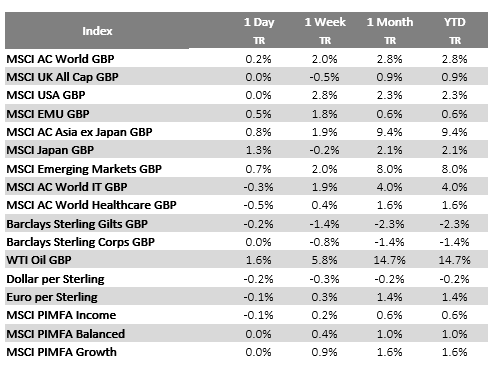
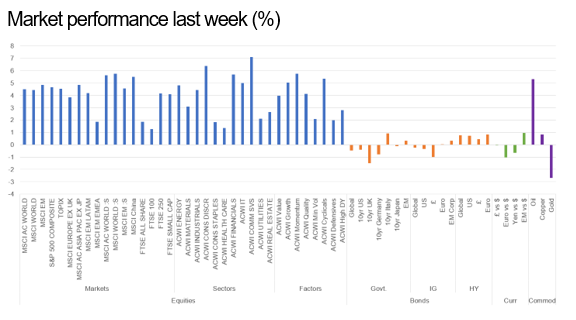
After the worst week since late October, equity markets rebounded strongly with the MSCI ACWI rising 4.5% – its best week since US election week in early November. This rapid swing in performance was reflected in volatility declining sharply, with the VIX index of implied volatility falling from an elevated 37 last week back down to 21, almost back at its post-bear markets lows. EM (4.9%) led the rally, marginally outperforming DM (4.5%), where the US was at the forefront, closely followed by Japan. Small caps outperformed, led by DM markets and are well ahead on a YTD basis, now up 98% from their late-March low, nearly 20% ahead of large caps. Other than a strong performance from Financials the sector leadership board was led by tech-related sectors, with Communication Services (7.1%) at the forefront. Growth defensives (Consumer Staples and HealthCare) were the main laggards, both returning under 2%. That left Cyclicals over 3% ahead of Defensives. Growth’s margin of outperformance versus Value was far less (1%) and it is now nearly 2% ahead YTD. The UK was the major DM regional laggard, as large caps (FTSE 100 1.3%) underperformed mid and small caps materially (both over +4% for the week), held back by their exposure to commodity sectors and defensive growth, which underperformed their global peers.

Government bond markets had a mixed week. At one extreme Italian BTPs benefitted from the prospects of a Draghi-led government, removing recent political uncertainty with the 10yr yield falling 11bp and almost back to its all-time low. Gilts, on the other hand, were hurt by the removal of near-term negative rate risk following last week’s MPC meeting. The 10yr yield rose 16bp and at 0.48% is at its highest level since March.  USTs and Bunds also saw modest rises with the former at its highest level since February last year. Rising government yields weighed on the closely correlated IG credit market. Sterling markets were hit hardest where, despite spreads declining, yields rose 10bp. HY, where correlations are much closer with equity markets, fared much better. Consequently, the Global HY index hit new all-time highs as yields hit record lows (4.67%).

The US$ made further small gains, with the US$ Index increasing 0.5%, as it rose against both the Euro and Yen. It was flat against £. A rising $ didn’t prevent economically sensitive commodities from appreciating. Oil was the standout as supply continues to tighten and demand increases and at $59 is back to where it was last February. Gold has fared less well and recent declines means that it is now back at late-November levels and down nearly 5% YTD. $ strength and recovery optimism aren’t helping.

Past performance is not a guide to future returns. Sources: Datastream as at 7 February 2021. See important information for details of the indices used.1

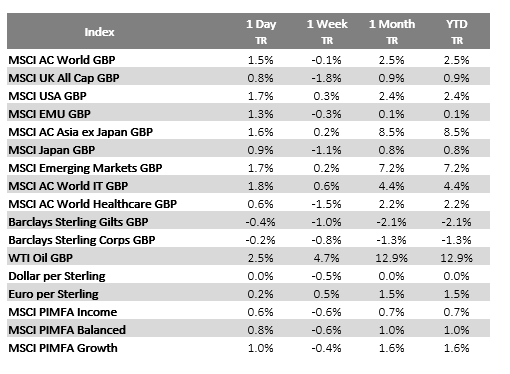
Past performance is not a guide to future returns. Sources: Datastream as at 7 February 2021. See important information for details of the indices used.1

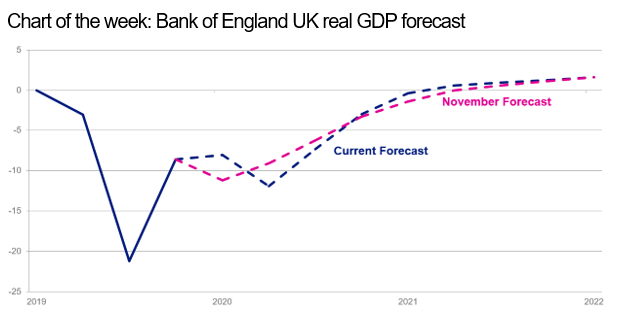
Past performance is not a guide to future returns. Source Bank of England Monetary Policy Report February 2021. Rebased 0 = 31 December 2019. Dashed lines are forecasts.

  • Last Thursday, in conjunction with the MPC meeting, the Bank of England published its latest forecasts for the UK economy in its Monetary Policy Report. The chart shows the current forecast alongside the forecast from November, both rebased to 0 at Q4 2019.
  • The COVID restrictions in place at present and the new trading arrangements with the EU will mean that activity will likely be impacted more in Q1 than in Q4, with GDP forecast to decline by 4%qoq, weaker than the current Bloomberg consensus expectation of -2.4%qoq and a very different profile to that expected in November. But in subsequent quarters GDP is projected to recover rapidly over 2021 towards pre-COVID levels on the assumption that a successful rollout of the vaccination programme will lead to an easing of virus-related restrictions and a normalisation of economic activity (by the end of Q3). Rising consumption and business investment alongside continued substantial fiscal and monetary support will all underpin this recovery. On the former the Bank estimate that £125bn+ of “excess” household savings have already been built up over the past year, although their (rather pessimistic?) forecast only sees 5% of that being spent. So for 2021 the forecast overall is weaker near term, but with a stronger recovery thereafter, leaving growth back at pre-pandemic levels by around the end of the year. Further out, the pace of GDP growth slows as the boost from these factors is expected to fade. Despite the strong recovery, unemployment is still expected to rise to a peak of almost 8% (current 5%) in Q3 before falling to 4.5% by the end of 2022.
  • On the inflation front, CPI is expected to rise sharply towards the 2% target in the spring on the back of the reduction in VAT for certain services coming to an end and rising energy prices. With spare capacity forecast to be eliminated by the end of the year CPI is projected to be close to 2% over the remainder of the forecast period, with fading cost pressures and policy stimulus keeping a lid on any upside risk. 
  • Against this backdrop the MPC, as expected, kept their policy stance unchanged (Base Rate at 0.1% and QE at £895bn). For now at least no further easing would appear necessary. Consequently, while the use of negative rates remains in the policy toolbox (the Bank has told financial firms to start preparing so that they could “implement a negative rate at any point after 6 months”), the potential for its deployment in the near term has been removed. In terms of when monetary accommodation is removed there appears little risk of that happening anytime soon either and certainly not until the Bank is “achieving the 2% inflation target sustainably”. Currently the market is not pricing in a rate hike for a number of years, while the current £150bn round of QE is expected to run until the end of the year.

Key economic data in the week ahead

  • A quiet week ahead on the data front with UK GDP and US inflation the main highlights.
  • In the US Inflation data for January is published on Wednesday. Headline CPI is expected to remain at 0.4%mom, while Core is expected marginally higher at 0.2%mom. That would leave them both at 1.5%yoy. Last week’s Initial Jobless Claims improved to 779k, the lowest level since the end of November. Thursday’s release is forecast to remain largely similar on Thursday at 775k. On the consumer confidence front the preliminary University of Michigan Sentiment data for February is published on Friday and expected to be slightly higher at 80.5 from 79, comparable to October levels, but well below the 100+ levels seen pre-pandemic.
  • The UK sees the Q4 and December monthly GDP numbers published on Friday. An easing of lockdown measures for part of the month will see the economy grow 1%mom in December, compared to -2.6%mom in November. Services is forecast to have risen 1.1%mom with Industrial Production at 0.5%mom and Construction at 0.2%mom. This would leave Q4 GDP at 0.5%qoq and -8.1%yoy. With a negative quarter forecast in Q1 this outturn would ensure that the UK economy does not suffer the ignominy of a double-dip recession, something that their neighbour, the EZ, is unlikely to avoid after Q4’s -0.9%qoq. Stronger imports, driven by stockpiling prior to the ending of the Brexit transition period with the EU, mean December’s Trade Balance is expected to have weakened to -£6bn from -£5bn previously. Sentiment in the housing market will be reflected in Tuesday’s RICS House Price Balance for January. It is expected to remain elevated at 60%, just below its recent high of 65%. 
  • In China January’s Inflation data on Wednesday is forecast to show a setback following increased movement restrictions due to an increase in coronavirus cases. A fall of 0.1%yoy is expected following the 0.2%yoy increase in December.
  • Nothing of major significance this week from either the EZ or Japan.

We will continue to publish relevant market content and news, so please check in again with us soon.

Stay safe.

Chloe

08/02/2021

Team No Comments

Pfizer sales boost puts vaccine economics under the spotlight

Please see the below article from AJ Bell received late yesterday afternoon:

AstraZeneca and Johnson & Johnson say they don’t intend to profit from the pandemic.

The price of Covid-19 vaccines have been put under the spotlight after Pfizer said it should generate around $15 billion in sales during 2021 from its Covid-19 vaccine, higher than its previous estimate. Pfizer’s global vaccine sales before the pandemic were around $33 billion.

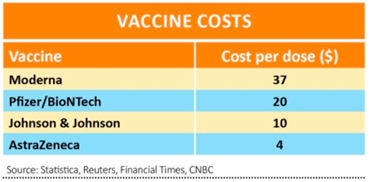
AstraZeneca (AZN) has always maintained that it will supply its vaccine at cost in perpetuity to low and middle-income countries. For other countries, the company has priced its vaccine at under $4 per dose, the cheapest of the three approved mainstream drugs, although South Africa revealed it had paid $5.25 compared with the $2.15 paid by the EU.

Johnson & Johnson’s vaccine has a price tag of $10 a dose which is competitive with AstraZeneca if only one dose is needed.

The Pfizer/BioNTech vaccine is priced at $20 a dose while Moderna’s is the most expensive at around $37 or close to 10 times the cost of AstraZeneca’s.

Rich nations would reap huge economic benefits if they paid the approximate $27 billion costs to vaccinate developing nations against Covid-19, according to a study commissioned by the Chamber of Commerce Research Foundation.

The report concluded that failure to act would cost the global economy $9.2 trillion, half of which would fall on rich nations.

This puts into perspective the spat between the UK and the EU over a shortfall in deliveries of AstraZeneca’s Covid vaccine.

AstraZeneca warned the EU that it could only supply a quarter of the initial 100 million doses in the first three months of the year due to supply chain issues. The EU has ordered 300 million doses with an option for a further 100 million. The EU Medicines Agency approved the AstraZeneca vaccine for emergency use on 29 January.

US biotech firm Moderna caused dismay after it told France and Italy it was delivering 20% fewer doses than promised. Similarly, the UK’s first approved vaccine from Pfizer/BioNTech has suffered delivery delays highlighting the logistical challenges faced by companies in meeting demand.

The good news is that two new vaccines could be available soon after Johnson & Johnson’s vaccine showed 66% effectiveness in phase three trials and Novavax’s vaccine was said to 89% effective according to interim trial data.

The Johnson & Johnson vaccine is potentially game changing because it only requires one dose and can be stored and transported at normal refrigerator temperatures. Novavax said its vaccine performed well against the new, more virulent strains.

Data from the National Audit Office shows the UK has secured 267 million doses of five different vaccines at a cost of $2.9 billion.

Please keep checking back for more updates.

Andrew Lloyd

05/02/2021

Team No Comments

Brooks Macdonald – Daily Investment Bulletin

Please see investment bulletin below from Brooks Macdonald received this afternoon – 04/02/2021

What has happened

After a volatile week where vaccine news varied and retail trades in specific stocks raised concerns of bubbles, global equities had a relatively quiet day. Risk sentiment was helped with growing expectations that former ECB President Draghi would succeed in forming a government and this heralded a significant outperformance from both Italian bonds and the Italian equities index.

Stimulus update

US Treasury yields continued their rally yesterday with the 10-year nudging up to 1.137% as expectations for stimulus increased and therefore expectations for, on the margin, higher inflation and higher interest rates down the line. President Biden told House Democrats that his concern was that the next round of stimulus would risk under-stimulating rather than over-stimulating the economy. This comes as Democrats have opened budget reconciliation measures to put pressure on Senate Republicans to revise their stimulus proposals. Biden’s comments suggest that should the Democrats be forced to the use the reconciliation process, knowing that this is probably their only chance for significant stimulus in 2021, they may increase the size of the stimulus. Despite the relatively quiet market at an index level, these comments helped support cyclical equities, which were previously out of favour due to the mixed COVID narrative, with Energy and Banks performing strongly.

European inflation

Inflation data from the Euro Area surprised to the upside yesterday with headline inflation up 0.9% year on year (vs 0.6% expected) and core inflation up 1.4% (against 0.9% expected). This brings an end to the deflationary period that the Euro area has been experiencing for more than half a year, but this data did support a pro-cyclical tilt to yesterday’s markets. This surprise pick-up in inflation led to the market revising expectations of future inflation levels with the 5y5y (expectations of 5-year average inflation levels in 5 years’ time) up to 1.38%, the highest level since the pandemic begun.

What does Brooks Macdonald think

We would be wary of reading an excessive amount into the inflation data from the Euro Area yesterday. There are some specific factors at play here such as the end of a temporary VAT cut in Germany and equally 0.9% headline inflation is not a particularly exciting number. Looking forward we see COVID as having created a significant output gap due to higher unemployment rates, indeed in some countries stimulus measures have masked the true level of unemployment. Until there is active competition for labour driven by fuller employment, wage inflation will remain subdued and that should calm expectations of a rapid and sustained rise in inflation above the ECB’s target.

Source: Bloomberg as at 04/02/2021

Please continue to check back for our latest updates and blog posts.

Charlotte Ennis

04/02/2021

Team No Comments

Daily Investment Bulletin

Please see below Daily Investment Bulletin received from Brooks Macdonald earlier this afternoon. The commentary provides analysis of the markets following a promising start to the mass-vaccination rollout in the UK.

What has happened

Equities continued their positive start to the week as critical earnings beats justified another leg higher in valuations. Alphabet (Google) and Amazon both beat market expectations with the latter rising in after-market trading despite CEO Jeff Bezos announcing that he will step down to become executive chairman. Even Exxon, which had its first annual loss in 40 years, saw its shares rise as it recommitted to its dividend pay-out in a yield hungry world.

Italian twist

The market’s base case was that former Italian Prime Minister Conte would be able to form a new Italian government by utilising a range of independents and a myriad of smaller parties. In fact, the former ECB President Mario Draghi is reportedly in line for the role and is meeting President Mattarella to discuss the formation of a new government. Betting odds have also shifted with Draghi now the front runner. Draghi’s tenure at the ECB is most famous for embarking the ECB on its quantitative easing programme as he pledged to do ‘whatever it takes’ to save the Euro during the European sovereign debt crisis. As a result, markets have taken this news quite positively as it suggests a maintenance of the political status quo between Italy and the EU, a perpetual tail risk for European politics.

Vaccine news

There were two big unknowns around the vaccine rollouts, would the vaccine be effective after one dose and would the vaccine slow transmission rates. A study yesterday showed positive news on both of these points. The study showed that the Oxford/AstraZeneca vaccine had 76% efficacy after a single dose (day 22-90 after vaccination) and that the level of protection was fairly constant. This builds the narrative for a quicker reopening of national economies even as the rollout is still continuing. Secondly, test results showed a 67% reduction in positive COVID-19 PCR tests amongst those vaccinated addressing a key concern that the vaccination might not slow the speed of transmission.

What does Brooks Macdonald think

Yesterday’s report on the ongoing efficacy of the AstraZeneca vaccine provides some comfort to markets that are struggling to effectively price in the risks of the new variants. We expect this tug of war to continue however if the variants are emerging within the context of higher vaccination levels (the vaccine still being effective against the South African variant of the virus, but less so) and continued COVID restrictions, the probabilities of a more normal state by the summer rise.

Source: Bloomberg as at 03/02/2021

Please check in again with us soon for further market analysis and news.

Stay safe.

Chloe

03/02/2021

Team No Comments

Brewin Dolphin Markets in a Minute

Please see this weeks Markets in a Minute update from Brewin Dolphin:

Trading frenzy sees US equities post worst week since October.

Global equities posted sharp declines last week, as heightened volatility added to fears about the efficacy of the vaccine roll out. The S&P 500 recorded its worst week since October, falling 3.74%. The trading frenzy in GameStop and other targeted stocks led to the VIX, or ‘fear gauge’, ending the week at 32.4, well above its historical average. This fed through to Europe, where the VSTOXX, another measure of volatility, climbed to its highest level in almost three months. The FTSE 100 slid 4.3%, while the Dax declined by 3.79%. Investor jitters also affected stock markets in Asia, with the Nikkei down 4.63% and the Hang Seng down 4.39%. In China, where there are growing fears of a stock market bubble, the Shanghai Composite slipped 3.61%.

Last week’s markets performance*

  • FTSE100: -4.30%
  • S&P500: -3.74%
  • Dow: -3.70%
  • Nasdaq: -3.91%
  • Dax: -3.79%
  • Hang Seng: -4.39%
  • Shanghai Composite: -3.61%
  • Nikkei: -4.63%

*Data from close on Friday 22 January to close of business on Friday 29 January.

Markets rebound from last week’s rout

US equities rounded on Monday, posting their biggest rally in ten weeks, after analysts said the explosion of speculative buying would not cause a significant setback for markets. Tech stocks performed particularly strongly ahead of Tuesday’s earnings figures from Amazon and Alphabet. The S&P 500 climbed 1.6% and the Nasdaq jumped 2.6%.

Wall Street’s strong open led to the FTSE 100 closing up 0.9% on Monday, with JD Sports Fashion rising 7% to 799p on news it has agreed to buy American rival DTLR Villa. Retail investors turned their attention to silver, which hit $30 for the first time since 2013. The pan-European STOXX 600 increased 1.2%, with shares of miners surging by between 5% and 20% on the back of silver’s rise.

The FTSE 100 was up 0.6% in early trading on Tuesday, on growing hopes the US will agree an economic stimulus package. Virgin Money was one of the strongest gainers, rising 2.7% after announcing it had returned to profit in the first quarter.

Short squeezes dominate the headlines

In ordinary circumstances, last week would have been dominated by the raft of quarterly financial results from major S&P 500 stocks. Instead, the bulk of investor and media attention was on extreme fluctuations in the prices of small retail stocks. GameStop posted a weekly gain of 400%, resulting in major losses on short positions.

Trading in heavily shorted names resulted in historic trading volumes, with more than 23.6 billion shares of US stocks exchanged on Wednesday, according to Bloomberg. The Goldman Sachs Hedge Industry VIP index, which seeks to replicate the favoured long positions of hedge funds, suggests hedge funds have had to trim their longs to cover losses or deleveraging on their short books.

After Robinhood and other brokers restricted trading on Thursday, the US Securities and Exchange Commission announced it would review the restrictions and that it was “closely monitoring and evaluating the extreme price volatility”.

The trading frenzy overshadowed the generally good start to the US earnings season. We are about a third of the way through the season and, so far, 80% of companies have beaten expectations. Microsoft, Apple and Facebook all released strong quarterly results, yet Apple and Facebook declined by around 5% last week, while Microsoft edged up 2.4%.

Economic data continues to disappoint

Last week saw grim economic data from several countries around the world. Although the US economy experienced a strong rebound in the second half, this wasn’t enough to prevent it shrinking in 2020 for the first time since the financial crisis. Growth is expected to pick up once the pandemic is under control, but there is still a long way to go. Consumer spending slowed to 2.5% in the fourth quarter, down from a 41% rebound in the third quarter. Overall spending on goods also slowed.

Across the pond, UK retail sales for December were lower than expected, rising by just 0.3% versus a 1.2% forecast. In 2020 as a whole, retail sales plunged by 1.9%, marking the worst year for consumer spending on record. The strong pound also weighed on the FTSE 100, which derives around 70% of its earnings from overseas. Pearson was one of the few bright spots, rising by 13.7% last week.

Continuing lockdowns resulted in the German government cutting its 2021 GDP growth forecast from 4.4% to 3%, despite the economy expanding by 0.1% in the fourth quarter. France’s economy shrank by 1.3% in the fourth quarter, but this was better than expectations of a 4.1% contraction.

Vaccine roll out in jeopardy

Concerns about the economic impact of the pandemic and slow vaccine roll out continued to weigh on major European stock markets last week. The EU’s vaccination strategy is in disarray and many countries have had to suspend vaccinations because of shortfalls. Rolling out the vaccine is seen as a critical part of global economic recovery.

The World Bank has warned of double-dip recessions in Japan, the eurozone and the UK, partly because of ongoing lockdown measures. In Japan, three quarters of companies across 32 industries have trimmed their capital expenditure plans by an average of 2.9%, and manufacturers have reduced their forecasts by 3.8%.

Data released yesterday also signalled a slowdown in China’s economic recovery, with the Caixin manufacturing PMI falling from 53 to 51.5 in January, the lowest level since July. The official manufacturing and non-manufacturing PMIs also fell by more than expected. This came after a week in which a senior adviser to China’s central bank warned of the increasing risk of an asset bubble unless monetary policy was not tightened.

More positively, the International Monetary Fund has upped its global economic growth forecast by 0.3 percentage points to 5.5%, although it warned emerging markets’ limited access to vaccines could harm global financial stability.

As market volatility continues, please keep checking back for further market commentary and updates shared by us to help keep you informed.

Andrew Lloyd

03/02/2021

Team No Comments

Blackfinch – Monday Market Update

Please see below this week’s Monday Market Update from Blackfinch Investments – received today 01/02/2021


Blackfinch Group – Monday Market Update – Issue 27 | 1st February, 2021

UK COMMENTARY

• The International Monetary Fund (IMF) downgraded its forecasts for the UK economy for 2021, revising its previous prediction of 5.9% to 4.5%. This follows the contraction of 10% in 2020, the biggest fall of any G7 economy.
• According to the Office for National Statistics (ONS), the unemployment rate in the three months to November 2020 was estimated at 5.0%, 1.2 percentage points higher than one year ago and 0.6 higher than the previous quarter. Over the same period, the redundancy rate hit a record high of 14.2 per thousand.
• The Prime Minister said there is “not enough data to know when it will be safe to reopen our society and economy”. MPs will set out a plan to exit lockdown when they return from the half-term break on 22nd February, based on the number of infections and vaccinations. As a result, children in England are not expected to return to the classroom until 8th March.
• Footfall at UK retail locations recovered, up 9% on the previous week. Data revealed that footfall over the whole of 2020 was down 39.1% on 2019.
• The UK Government introduced its ‘red list’ for mandatory hotel quarantine, which will mostly affect UK citizens and residents, since nationals from most high-risk countries are not allowed to enter Britain. It will apply to inbound travellers from 22 countries including South Africa, several countries in South America and also Portugal, because of its ties with Brazil.

US COMMENTARY

• Market commentators relished a widely publicised battle between multi-billion-dollar hedge funds and a group of retail traders from a Reddit chat room. The latter have been pumping the price of GameStop (and others), which some hedge funds had heavily shorted. The result was a ‘short squeeze’ resulting in extraordinary moves in share prices.
• US lawmakers continue to debate the $1.9 trillion stimulus plan put forward by President Biden.
• The declining trend rate of COVID-19 cases remains steady, with cases falling by about 22% per week. The seven-day average has fallen 32% from its 8th January peak, and is now below its pre-Thanksgiving level.
• GDP data showed the US economy grew 4% in the fourth quarter, but shrank 3.5% for the whole of 2020, its worst annual performance since 1946.

EUROPE COMMENTARY

• The European Union (EU) warned it will tighten exports of COVID-19 vaccines to non-member countries, such as the UK. The warning came after AstraZeneca, which was due to provide 80 million vaccine doses to EU member countries in the first quarter of 2021, announced it would only be able to deliver around half of the agreed quantities. The row comes amid a fall in supplies of the Pfizer/BioNTech vaccine, which is also slowing down the European rollout.
• France and Germany announced their fourth quarter GDP flash readings. The French estimate showed a contraction of 1.3% on a quarterly basis, but economists were expecting a decline of 4.0%, a drop from the 18.5% growth registered in the third quarter of 2020. Over the same period, the German economy expanded 0.1%, just topping the 0.0% consensus estimate. This was also a fall from the 8.5% growth posted in the third quarter.

GLOBAL COMMENTARY

• The IMF revised its 2021 global growth forecast to 5.5%, up from its 5.2% prediction in October, but cautioned that new variants of the virus are a concern for 2021’s outlook.

COVID-19 COMMENTARY

• Johnson & Johnson announced its vaccine candidate was 66% effective in preventing moderate to severe COVID-19, 28 days after vaccination. Although it falls short of its competitors in terms of efficacy, the Johnson & Johnson vaccine only needs to be administered with one shot, making its rollout easier.
• The row between AstraZeneca and the EU over COVID-19 vaccines culminated in approval on Friday afternoon as the European Medicines Agency recommended granting conditional marketing authorisation for use in adults aged 18 or over. It is the third COVID-19 jab approved in the bloc.

A good input from Blackfinch, providing a summary of global events over the past week. These updates are useful for keeping up to speed with developments in the markets.

Please continue to check back for our latest blog posts and updates.

Charlotte Ennis

01/02/2021

Team No Comments

A.J. Bell – US stocks as expensive as before the 1929 and dot-com crashes

Please see below an article published by A.J. Bell on Thursday, 28th January and received Sunday morning which provides an overview of the U.S. Stock Market:

As you can see from the above, U.S. equities remain expensive and there are arguments for both holding and not holding U.S. Equities. There could still be some upside to be captured in this market, but it is worth reminding you of the importance of holding a diversified portfolio, which is invested in multiple sectors and geographies so that all your eggs are not in one basket.

Please continue to check our Blog content for advice and planning issues and the latest investment, markets and economic updates from leading investment houses.

Please keep safe and healthy.

Carl Mitchell – Dip PFS

IFA and Paraplanner

01/02/2021

Team No Comments

Normality might come slowly, but sustainability is here to stay

Please see below articles received yesterday afternoon, written by the Head of Sustainable Investing at Jupiter and Head of Strategy at UK Alpha. The first commentary offers tips on investment opportunities for the year ahead and the second provides an update on the UK’s economic recovery.

Abbie Llewellyn-Waters, Head of Sustainable Investing, noted that in recent months the largest impact on sustainable investing, including her own strategy, was the value rotation. Abbie believes that the most attractive sustainability investment opportunities are to be found in high quality stocks. Reporting season is starting soon, and that will provide more context about how these quality stocks are navigating this environment.

From a broader perspective, Abbie doesn’t share the optimism in the market based on an economic reopening, which has been in full swing since the first vaccine announcements in November last year. She’s concerned that a normalisation is further away than the market is currently pricing in. In recent discussions with a world-leading company in the field of viral vaccines, they pointed to more prolonged timeframes, with normalisation closer to years rather than months away.

As such, Abbie believes it is important for investors to be disciplined and focused on businesses that can survive and prosper through this period and into the longer term, especially in defensive sectors such as healthcare and consumer goods. Among the more cyclical parts of the market, Abbie continues to see strong sustainable investing opportunities within the digitalisation theme.

Fundamentally, however, Abbie sees sustainable investing as a structural theme and many of the drivers that emerged in 2020 (including addressing climate change, where Biden’s appointment of John Kerry as special climate envoy shouldn’t be underestimated, in her view) will continue throughout 2021 and beyond.

Market whipsaws as recovery optimism weakens

At the start of the year, the market trusted in the post-vaccine recovery trade and expected that by the summer the economy would be getting back to normal, noted Richard Buxton, Head of Strategy, UK Alpha. That view has been undermined by a complicated pandemic with new virus variants and data suggesting some people are reluctant to be vaccinated, he said.

Now the market is whipsawing daily, he said. He cited a company that operates concessions in airports and train stations that said two weeks ago it was expecting a strong summer of trading as consumers rush back to travel after the lockdown. That outlook now seems overly optimistic, he said, noting that testing requirements would complicate a family of four’s holiday to Spain, for example.

Richard said he is following closely the debate about reopening UK schools. The government will be forced to make a political judgement about when to ease the lockdown and let students return to the classroom in order to end potential long-term damage to young people, especially those in disadvantaged areas, whose education has been disrupted, he said.

While a return to normal will take longer, it makes sense on a 2-year view to invest in companies that will benefit from the economy reopening, Richard said. In the meantime, his investment team is looking at adding to defensive holdings, such as including pharmaceutical companies, he said.

The recovery will happen, but like in comedy, it’s all about the timing, Richard said.

It will be interesting to see where opportunity presents itself as we make positive strides to achieve mass vaccination in the UK and worldwide.

Stay safe.

Chloe

29/01/2021

Team No Comments

Market Update: Economic headwinds pressure the US, UK and Europe

Please see the below market update from Invesco received late yesterday afternoon:

Overview

Europe: Europe is clearly at risk of a double-dip recession, albeit a modest one.

The UK: The UK appears to be at even greater risk than the eurozone of a double-dip recession in the current quarter.

The US: US markets seem to have focused recently on the potential for additional fiscal stimulus.

What a week — both the S&P 500 and NASDAQ Composite Indexes reached all-time highs last Thursday, but we also saw a reversal of the rotation from growth/defensives to cyclicals in both European and US markets. Markets are clearly reacting to the problems that many economies are facing as COVID-19 continues to impact growth. Recent data shows evidence of these problems.

Europe may face a modest recession

Europe is clearly at risk of a double-dip recession, albeit a modest one. The IHS Markit Flash Eurozone Composite PMI (Purchasing Managers Index) clocked in at 47.5, down from December’s 49.1.1 And it’s not just services that drug down that number; there was also a decline in manufacturing PMI, which actually fell to a seven-month low. And the weakness was spread throughout Europe.

This should come as no surprise. The Oxford Blavatnik Stringency Index, which tracks the level of economic lockdowns in various countries, indicates that stringency in many European countries is at or near the highest levels that have been experienced since the start of the pandemic. In other words, first-quarter economic activity could contract again, although if it does, I would expect this to be a very shallow contraction. More fiscal support is coming, and I expect the European Central Bank to remain supportive.

And so Europe just needs to get through this “fifth quarter of 2020,” and then I expect the situation to improve. I think that by later in the second quarter we will see improvement in economic activity as vaccine distribution becomes widespread.

The UK get more bad news

The UK is in a worse situation, at an even greater risk than the eurozone of a double-dip recession in the current quarter. The preliminary reading of the IHS Markit/CIPS UK Composite PMI fell like a lead balloon, dropping from 50.4 in December to 40.6 in January.1 Chris Williamson, chief economist at IHS Markit, explained the drop in the composite: “Services have once again been especially hard hit, but manufacturing has seen growth almost stall, blamed on a cocktail of COVID-19 and Brexit, which has led to increasingly widespread supply delays, rising costs and falling exports.”

What’s more, on Friday UK Prime Minister Boris Johnson shared more bad news: 1) the UK strain of the virus is not only more contagious but appears to be more deadly; 2) lockdowns might last until this summer. And so we should not expect economic strength in the near term, although I maintain that the economy is very likely to rebound substantially as vaccines are distributed.

Japan suffering too

Flash PMI readings for January indicate Japan is facing some headwinds too. Also last week the Bank of Japan warned of increasing risks to the economic outlook for Japan, and that efforts to control the virus could have impact beyond just the services sector. And while COVID-19 has been well-controlled in Japan relative to many Western countries, Japan has not yet rolled out any vaccines. They are still in clinical trials, but rollout is expected to start by late February

The US awaits the fate of fiscal stimulus

The US is also facing serious economic headwinds due to COVID. US markets seem to have focused recently on the potential for additional fiscal stimulus. Janet Yellen, President Joe Biden’s nominee to be US Treasury Secretary, made a strong case for more fiscal stimulus last week. She recognized concerns about growing debt levels, but also argued that there’s no time like the present to borrow since rates are so low. However, by the end of the week there was concern that President Biden would not have enough support to get his proposed $1.9 trillion package passed.

On days when markets are encouraged by the likelihood of more stimulus and a stronger rebound, cyclical stocks have outperformed. But when markets are worried that no more stimulus is forthcoming, or when economic data disappoints, secular growth stocks — especially tech — have outperformed.

Key takeaways

I expect this “seesaw” stock market behavior to continue in the near term. While I still believe a strong economic rebound is in the offing later in 2021, there are likely to be glitches before we get there, as I have warned before. The tech sector has recently exhibited defensive qualities that I expect to continue and which I believe could be valuable in the next few months as we slog through what is likely to be a difficult time for the economy. Low interest rates help this situation given that tech valuations are admittedly stretched; investors have historically been more forgiving of valuations with rates so low.

The other side of the seesaw is exposure to cyclicals. I am most excited about one sector in particular: consumer discretionary. I think the global economic recovery will be robust and inclusive, creating and restoring jobs — and spurring consumers to spend. And in many countries, consumers have built up impressive savings because of a lack of spending during the pandemic. This could be deployed rather quickly once vaccines are distributed broadly and there is a return to something akin to “normalcy.”

I expect that, in a world awash in monetary stimulus, with significant fiscal stimulus as well, there will continue to be an upward bias for stocks. That doesn’t mean we won’t see a stock sell-off in 2021. It could be triggered by the 10-year US Treasury yield rising (we could see a sell-off if it rises too quickly) or fears about inflation increasing — even though I expect the Federal Reserve to reiterate this week its commitment to remain very accommodative and tolerant of a spike in inflation over its target. There could be other triggers — a continued rise in infections, especially more serious strains, or a slowdown in vaccine rollouts. We don’t know when this could occur — and while I believe it would be short-lived, I also believe it’s very important to be broadly diversified both across and within stocks, bonds and alternatives.

While broad diversification is critical, investors could consider overweighting both the technology and consumer discretionary sectors within their equity sleeve. Both could serve different purposes in a portfolio — one offering some defensive qualities while the other offering the potential to participate in the recovery.

Please keep checking back for more market updates, investment commentary and a range of different blog content from us.

Andrew Lloyd

28/01/2021