Please see this week’s Markets in a Minute update from Brewin Dolphin received today (30/08/2023):
Please continue to check our Blog content for advice and planning issues and the latest investment, markets and economic updates from leading investment houses.
Please see below, the ‘Tuesday Digest’ from Tatton Investment Management providing a brief analysis of the key factors affecting global markets. Received this morning – 29/08/2023
Growth divergence between Europe and the US widens
After a global bond sell-off over the last few weeks that drove up bond yields they ended last week lower due to unexpectedly weak business sentiment reported through the ‘flash’ Purchasing Manager Indices (PMI) survey results. While the worst figures come in from the services sector in Europe and the UK, the US services PMI at 51.0 was also weaker than expected but still managed to remain above the neutral 50 level. Indeed, recent US data may have felt mixed but the combination indicators suggest growth is solid to strong.
Some of the divergence can be traced back to energy prices still remaining more of a burden for Europe’s manufacturers, especially for natural gas and electricity. Sentiment improved through the first half of this year as gas prices declined but the recent uptick in both oil and gas prices is a blow. Meanwhile, the auto sector (much more important in Europe than the US) is also feeling a sharp pinch, with Chinese electric vehicle manufacturers gaining substantial market share at home and getting an easier ride in Europe than in the US.
Economic divergence between regions is not unusual, and Europe is prone to having bouts such as the euro crisis. We don’t think something as serious as that is about to happen, but there is little doubting that Europe has less resilience than the US currently, due to the conspicuous lack of growth momentum. This probably means pressure on the US dollar to strengthen at least for a time and, historically, that has coincided with increased global risks. Over the weekend, central bankers were gathered in Wyoming’s Jackson Hole, focusing their attention on longer-term “Structural Shifts in the Global Economy”. Our hope the meeting would bring more clarity on how central banks view their current policy options was somewhat disappointed, although markets took the relative calm of central bankers as a sign that we have or are close to ‘peak rates’.
EU and UK both shocked by disappointing sentiment surveys
We wrote last week that, after being the best performing currency of the year so far, sterling looked vulnerable. As if like clockwork, the pound fell against the US dollar into midweek. As mentioned, the fall was incited by unequivocally bad business sentiment surveys for August painting a very gloomy picture of the British economy. A PMI above 50 usually suggests expansion ahead, while anything below that points to contraction. So it was somewhat alarming that the composite PMI fell to 47.9, its lowest level in 31 months. Manufacturing recorded a dour 42.5, below both the projected level and last month’s figure. Meanwhile, the all-important services sector – which represents around 75% of the UK economy – fell to a downbeat 48.7, against expansionary expectations of 51. This weakness has thankfully gone hand-in-hand with reduced inflation expectations, causing markets to reassess the likelihood of further Bank of England (BoE) rate rises. But as we wrote last week, this puts downward pressure on sterling, since an aggressive BoE seemed to be the key factor supporting the currency.
Meanwhile, European PMIs were their worst in nearly three years, amid a sharp deterioration in consumer confidence. The preliminary Eurozone composite PMI for August fell to 47, below expectations of 48.5 and the lowest figure since November 2020. Manufacturing actually surprised to the upside, though the reported 43.7 was still very firmly in contractionary territory. Services were expected to post a practically neutral 50.5, but instead delivered the first contraction in eight months, with a reading of 48.3. This puts the European Central Bank (ECB) in an unenviable position. Just like the Bank of England (BoE), a deteriorating growth outlook has decreased expectations of an interest rate hike at the September meeting (which markets now price as roughly 50/50). But again like the BoE, labour shortages – particularly in Europe’s peripheral nations – mean the economy is vulnerable to persistent inflationary pressures from the wage-price spiral effect. If input prices were to increase again, as we have seen some signs of already, inflation could easily increase once more.
Is Japan’s central bank ‘ice age’ thawing at last?
The yield on 10-year Japanese Government Bonds (JGBs) rose to their highest level in nine years last week, at 0.68%. UK and US investors would be forgiven for being underwhelmed by this, as 10-year US Treasury yields, peaked above 4.3% at the start of last week, while UK 10-year gilts reached higher than 4.7% last week.
Historically, low growth, inflation and interest rates have kept JGB yield volatility almost non-existent for years. Stability was officially enshrined in 2016, when the BoJ began its policy of ‘Yield Curve Control’ (YCC), restraining the yield on the benchmark 10-year JGB to a ‘target’ rate around 0% and from rising above a specific yield level – previously 0.5%. But at the end of July, BoJ Governor Kazuo Ueda announced the 0.5% margin around the official zero target would stop being treated as “rigid limits”, and now merely be “references” for bank operations. Many analysts suggest this is effectively the end of Japan’s YCC, but according to Ueda the policy remains in place, just with a little more leeway. The shift may have looked rather technical, but marked quite a change in the pace of monetary injection, effectively slowing the central bank’s liquidity push.
A few economists have warned inflation in Japan could become ‘sticky’ unless the BoJ tightens quickly. Headline inflation has been holding steady at or around the 3.3% mark for most of the year, in a marked change to decades of deflation. But price rises have been consistently above the BoJ’s stated 2% target and for the last two months actually higher than US inflation. That said, Japan still lacks the main inflation pressure that has worried western central bankers for so long: rising wages. Japanese core inflation – excluding volatile elements like food and energy – was lower in July than the month before, with many analysts suggesting the country’s inflation impetus had already peaked. Indeed, in stark contrast to the US and UK, the BoJ has been actively trying to encourage wage rises to spur its economy.
It is therefore far too early for the BoJ to think about tightening policy in earnest, despite fears about abandoning YCC. It knows full well that a weaker currency and lower financing rates are improving Japan’s attractiveness both as an exporter and an investment destination. Policymakers also know inflation could quickly give way to deflation if global financial conditions change. A tweak to YCC is far from the end of Japan’s accommodative policy. This is good news for western investors, as JGBs so often act as an anchor in global bond markets. Higher Japanese yields are an important sign for the global economy, and thankfully one that is unlikely to destabilise markets.
Please check our blog content for advice, planning issues and the latest investment, market and economic updates from leading investment houses.
Please see below article received from EPIC Investment Partners this morning, which reports on yesterday’s Republican debate in Milwaukee.
Last night, eight of the nine Republican presidential hopefuls took to the stage in Milwaukee for the first time. There was a sense that it would be a bit of a damp squib without former president Trump. However, that was not the case. There were various attacks on President Biden’s policies and each other whilst they attempted to close the gap on the GOP frontrunner Donald Trump.
The hopefuls also sparred over abortion, leadership experience and climate change.
As the debate progressed, they did diverge on the question of whether they would back Trump as the party’s nominee in the event of his conviction in any of his four legal cases. Six of the eight indicated they would still support him even if he is convicted of a crime.
Trump, who leads the GOP field by double-digit margins, chose not to participate in the debate, effectively treating his potential nomination as a foregone conclusion. Instead, the current frontrunner shared a pre-recorded interview with former Fox host Tucker Carlson, which was broadcast on X, the platform formerly known as Twitter. Trump is also not planning to participate in the next debate, due to be held at the Ronald Reagan Presidential Library in Simi Valley on September 27.
Trump, who has spent years claiming that the 2020 election was rigged, is already floating groundless claims that 2024 will be stolen from him too.
He was asked by Carlson, “If you’re saying they stole it from you last time, why wouldn’t they do the same this time?” Trump replied: “Oh, well they’ll try. They’re going to be trying, yeah. And not only me.”
Whilst Trump was not on the stage in Milwaukee, both he and President Biden used the debate to try to raise cash for their respective campaigns. Biden’s fundraising committee ran ads on Facebook during the debate, calling the GOP candidates a “threat to our democracy.”
Trump’s campaign set out his pitch saying that as long as there are still other GOP candidates in the race, the party is wasting resources that could be spent attacking Biden.
Please check in again with us soon for further relevant content and news.
Please see the below article from Brewin Dolphin commenting on the latest stock market movements, received after close of business yesterday.
Stocks fall as China’s economy impacts sentiment
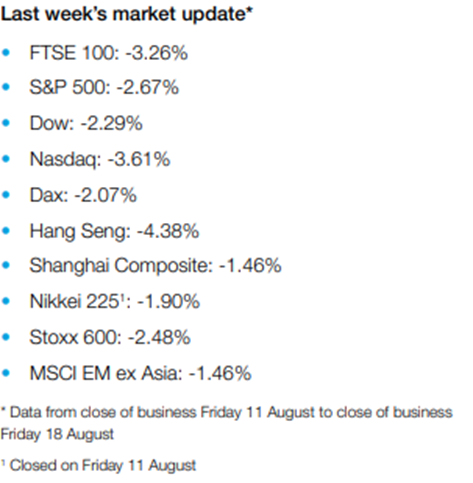
All major indices ended the week in the red as fears over China’s economic recovery impacted investor sentiment.
The FTSE 100 dropped 3.3% as UK core inflation remained flat and wage growth accelerated, indicating the Bank of England may need to raise interest rates further. In Europe, the Dax fell by 2.1% and the Stoxx 600 declined 2.5% amidst fears that interest rates may remain high for a prolonged period.
Over in the US, the S&P 500 fell by 2.7%, the Nasdaq dropped 3.6% and the Dow lost 2.3% as the benchmark ten-year US Treasury yield reached its highest level since October.
Meanwhile in Asia, Hong Kong’s Hang Seng lost 4.4%, China’s Shanghai Composite dropped 1.5% and Japan’s Nikkei 225 declined 1.9% after disappointing economic data out of China.
China reduces key interest rate
Markets were mixed on Monday (21 August), with sentiment affected in part by the People’s Bank of China reducing its key interest rate for the second time in three months.
The central bank reduced its one-year prime loan rate, which is primarily used for corporate lending, by 10 basis points to 3.45%. The bank’s five-year loan prime rate remained unchanged. The decisions surprised economists, who had anticipated a 0.15 basis point reduction to both rates. Investors will now be looking ahead to the Federal Reserve’s annual Jackson Hole Symposium conference, which will run from Thursday to Saturday.
Over in the UK, house prices fell by 1.9% in August to an average £364,895, the sharpest decline so far this year, Rightmove’s House Price Index shows. The average five[1]year fixed mortgage rate has fallen to 5.81% from 6.08% three weeks ago.
UK public sector net borrowing (which excludes public sector banks) was £4.3bn in July, £3.4bn less than in July 2022, and below economists’ forecasts of around £5bn. It was the fifth highest July borrowing since records began in 1993.
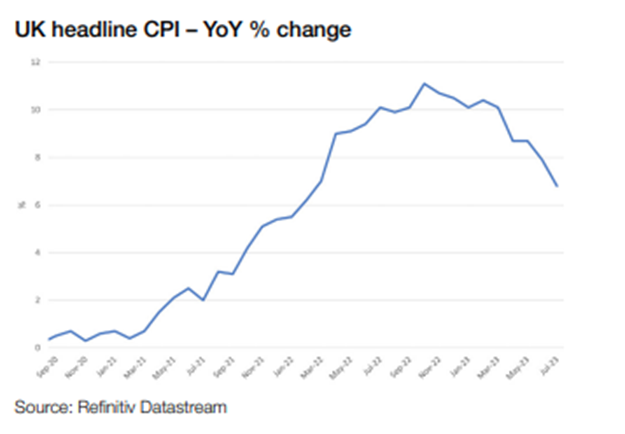
UK headline CPI – YoY % change
Core CPI, excluding energy, food, alcohol and tobacco, rose by 6.9% in the 12 months to July, remaining unchanged from June.
Producer price inflation (PPI) also fell in July, with input prices declining 3.3% in the year to July, down from a fall of 2.9% in the year to June, according to the ONS.
Producer output prices also declined by an annualised 0.8% in July, down from a rise of 0.3% in the 12 months to June. It is the first time that output PPI has been negative since December 2020, and the twelfth consecutive month that the annual inflation rate has slowed.
On a monthly basis, input prices fell by 0.4% while output prices rose by 0.1% in July.
UK Labour market cools
The UK job market has shown signs of cooling as employment rates fell and unemployment rates increased in the three months to June compared to the previous quarter, according to the ONS.
The employment rate was estimated at 75.7%, a 0.1 percentage point decline on the first quarter of the year and 0.8 percentage points below pre-pandemic levels. The decrease was largely driven by a decline in full-time employees and self-employed workers.
The unemployment rate was estimated at 4.2%, up 0.3 percentage points than the previous quarter and 0.2 percentage points above pre-pandemic levels. This was primarily driven by those unemployed for up to six months.
Meanwhile, annual growth for regular pay (which excludes bonuses) was 7.8% in the three months to June, the highest level since records began in 2001. Average weekly earnings for regular pay were £613 in June, up from £610 in May.
China’s economic recovery weakens
China’s retail sales rose by 2.5% in July, falling short of an expected 4.5% increase. Industrial production also fell short of expectations, rising by 3.7% in July. Economists had predicted an increase of 4.4%.
Real estate investment fell by 8.5% year-on-year in July, with investment in residential buildings seeing a decline of 7.6%. Meanwhile, turmoil in China’s property sector continued as new home sales declined 19% year-on-year in July, while overall house prices fell by 0.2% month-on-month.
Please check our blog content for advice, planning issues and the latest investment, market and economic updates from leading investment houses.
Please see below the ‘Daily Update’ from EPIC Investment Partners, which was received this morning (22/08/2023) and provides their views on S&P downgrading the credit rating on a number of US banks and speculation about what to expect from Jerome Powell’s (The Federal Reserve Chair) speech later this week:
S&P Global Ratings yesterday followed Moody’s Investors Service in cutting ratings in a slew of US banks and darkened the outlook for several more, citing the same mix of pressures, making life tougher for lenders. In a statement, S&P said it lowered ratings by one notch for Comerica Inc, KeyCorp, Valley National Bancorp, Associated Banc-Corp, and UMB Financial Corp, noting the impact of higher interest rates and deposit moves across the industry.
S&P also lowered its outlook for S&T Bank and River City Bank to negative and said its view of Zions Bancorp remains negative after the review. In the release with the downgrades, S&P said: “Many depositors have shifted their funds into higher-interest-bearing accounts, increasing banks’ funding costs”. Adding: “The decline in deposits has squeezed liquidity for many banks while the value of their securities, which make up a large part of their liquidity, has fallen.”
We also hear speculation about the topic of Powell’s speech at Jackson Hole this coming Friday, specifically whether the Fed chair would discuss the prospect of a higher short-term neutral rate of interest. Nick Timiraos, The Wall Street Journal’s “Fed whisperer” has as usual weighed in, noting in a series of tweets that the Fed embracing a higher short-term neutral rate as a guide for policy may be inconsistent with recent Fed commentary.
He tweeted: “Despite the Federal Reserve’s raising interest rates to a 22-year high, the economy remains surprisingly resilient, with estimates putting third-quarter growth on pace to easily exceed its 2% trend. It is one of the factors leading some economists to question whether rates will ever return to the lower levels that prevailed before 2020 even if inflation returns to the Fed’s 2% target over the next few years”. He added, “At issue is what is known as the neutral rate of interest”.
Please continue to check our Blog content for advice and planning issues and the latest investment, markets and economic updates from leading investment houses.
Please see below, Tatton’s ‘Monday Digest’ which provides a weekly update on markets and the key news from global economies. Received this morning – 21/08/2023
Bonds are back
Last week was another difficult one for both equity and bond markets. As a result, the positive returns of July have mostly been erased so far in August. Overall, world markets are largely unchanged from a year ago. Many commentators have pointed to the rise in global bond yields as a big driver of the reversal in sentiment, or at least the underlying cause of a renewed re-rating of equities on the back of higher bond yields. The US 10-year bond yield has risen to 4.3%, higher than at any point going back to July 2008, while the UK 10 year gilt yield has risen to 4.7%, the highest since June 2008.
At first glance, investors may think the rising yields are building in higher long-term inflation expectations, but this current move does not appear to have been spurred by a worsening inflation backdrop. Inflation expectations – as implied by the pricing of inflation-linked bonds – for the next two to three years seem to have fallen back a little. Therefore, what has changed is the ‘real’ yields, which have turned more positive after spending many months (even years) near or below zero. Real yields matter, and the rise in US real yields has come at a point when US economic data suggests ever more strongly that reasonable and persistent growth – rather than looming recession – may force rate cuts.
So, capital markets appear to be undergoing a rather technical shift, based on the re-rating on the back of higher-for-longer bond yield expectations, making recently extended equity valuations untenable, even if the earnings outlook has marginally improved. Given that August is a month with low trading volumes, it could continue to be negative, especially if the momentum trading funds start to add to the flows. However, a valuation adjustment would be no bad thing in the medium term, as it would alleviate some of the recent market nervousness.
Sterling strength nothing to write home about
You might be surprised to learn that, on a trade-weighted basis, the best performing major currency of the year so far is none other than the Great British pound. Sterling has gained 5.13% against the UK’s trading partners since the start of 2023. Moves in currency values are normally seen as reflecting confidence – or lack thereof – in regional economies. But the commentary around Britain’s economy this year has been nothing but glum. Although the UK has not officially dropped into recession, growth has been effectively zero for over a year. And yet, sterling has gained against its peers. So what’s behind sterling’s strength?
After a series of rate rises from the Bank of England (BoE) and the recent fall back in implied inflation expectations, the real yield on 10-year gilts is now just under 1.5%. Should we read this also as an expectation of higher growth? It is possible, but unlikely, given the wider pessimism about the UK economy. More likely, the move up in real yields is a consequence of the BoE’s aggressive stance – necessitated by persistent and UK-specific supply-side problems – together with an extended bond market sell-off. Nominal UK gilt yields are now above where they were during October’s ‘mini budget’ crash, and have risen much more steeply than German yields, for example.
Moreover, while a rising pound has helped ease input costs, Brexit-driven changes mean the goods and services British consumers buy from abroad (which are still overwhelmingly from Europe) are structurally more expensive now than a few years ago. The flipside of being able to buy more from trading partners with your pound is that those partners can buy less from you – making British firms less competitive. This might not be much of a problem if the economy is vibrant enough to handle it, but it does mean that both UK assets and its currency have become more expensive relative to economic fundamentals. Put another way, sterling looks vulnerable in the medium term. Over the coming months, we might see a slide – particularly against competitive currencies like the yen. The pound is strong now but, unfortunately, this may not be a good thing for the British economy.
Is Russia struggling to shift its oil supply?
Oil traders are feeling bullish. In July, international oil benchmark Brent crude was one of the best performing indices, gaining 11.9% in sterling terms. Last week’s jitters came after further economic disappointment in China, but some industry analysts see them as just a hiccup. Thanks to meaningful production cuts from OPEC+ (which includes Russia), predictions of $90 per barrel (pb) or even $100pb are being floated. That would be quite the turnaround. Brent has not settled above the $90 mark since mid-2022. Since then, supply side fears have faded, and global demand has become the key concern.
Saudi Arabia, the world’s largest crude exporter and OPEC’s de facto leader, recently extended its voluntary production cut of 1 million barrels per day to September and noted that cuts may deepen in the future. Russia also promised to export 300,000 fewer barrels per day in September, showing the cartel’s commitment to maintaining high prices. According to one recent survey, the total production output of OPEC+ hit its lowest point since August 2021.
For us, the most interesting player in this supply tightening is Russia. Despite some near-apocalyptic warnings when Moscow launched its invasion of Ukraine, the aggregate effect of Russia’s war and the ensuing western sanctions on global oil supplies has been relatively small. This was – as widely suspected – down to a rerouting of Russian supply to Asia, most notably the large energy-intensive economies of India and China. That is why, in the early part of last year, Russia’s trade balance (exports minus imports) stayed surprisingly healthy despite its apparent supply cuts.
In the last few months though, Russia’s trade balance has deteriorated significantly. This is clear from the slide in foreign currency reserves, which threatens to bubble over into a full-blown rouble crisis as widely reported last week. Last Wednesday, Moscow hiked interest rates by an extraordinary 3.5% to stop the bleeding, and its finance ministry is reportedly proposing tough capital controls. One of which would force Russian exporters to sell up to 80% of their foreign currency revenue within 90 days of receiving it or risk being banned from government subsidies.
It is particularly jarring that the rouble has slid so much while oil prices (including Russia’s discounted offering) have climbed, as the former is unequivocally a petrocurrency. It puts further pressure on Russia’s economy and finances, though as always, the question is whether this pressure reaches the inner circle. Optimists might suggest this leads to ceasefire talks, although the more likely outcome is increased friction between Russia and Saudi Arabia over production cuts, with the former needing revenues to fund its damaging war. In either case, oil prices could struggle to go higher over the medium term.
Please check our blog content for advice, planning issues and the latest investment, market and economic updates from leading investment houses.
Please see below article received from EPIC Investment Partners this morning, which provides a detailed overview of the FOMC meeting last month.
The minutes released yesterday from last month’s FOMC meeting offered little new insight to the path for future rate hikes, reiterating the Fed’s data-dependent stance. They did, however, show that two Fed officials favoured holding rates steady last month – others saw significant upside risks to inflation that could require further tightening.
The minutes noted that “uncertainty about the economic outlook remained elevated and agreed that policy decisions at future meetings should depend on the totality of the incoming information and its implications for the economic outlook and inflation, as well as for the balance of risks. Participants expected that the data in the coming months would help clarify the extent to which the disinflation process was continuing, with product and labour markets reaching a better balance between demand and supply.”
In regards to the two officials favouring a pause, the minutes said: “A couple of participants indicated that they favoured leaving the target range for the fe deral funds rate unchanged or that they could have supported such a proposal. They judged that maintaining the current degree of restrictiveness at this time would likely result in further progress toward the Committee’s goals while allowing the Committee time to further evaluate this progress”.
There is uncertainty around the economic outlook though. “Participants noted that real GDP growth had continued to exhibit resilience in the first half of the year and that the economy had been showing considerable momentum. A gradual slowdown in economic activity nevertheless appeared to be in progress, consistent with the restraint placed on demand by the cumulative tightening of monetary policy since early last year and the associated effects on financial conditions,” the minutes noted.
Members acknowledged the tick down in inflation ahead of the meeting but remain concerned. They stated that “most participants continued to see significant upside risks to inflation, which could require further tightening of monetary policy. Participants did cite several tentative signs that inflation pressures could be abating. Nonetheless, several participants commented that significant disinflationary pressures had yet to become apparent in the prices of core services excluding housing. Participants stressed that the Committee would need to see more data on inflation and further signs that aggregate demand and aggregate supply were moving into better balance to be confident that inflation pressures were abating, and that inflation was on course to return to 2% over time.”
Please check in again with us soon for further relevant content and market news.
Please see below the ‘Daily Update’ from EPIC Investment Partners, which was received this morning (15/08/2023) and provides their views on Argentina devaluing its currency and hiking interest rates:
Argentina devalued its currency and hiked up interest rates following a shock primary election win by the far-right outsider Javier Milei, who has vowed to “burn down the central bank”. The South American central bank devalued the peso by 18% to around 350 pesos versus the dollar and hiked interest rates by a shocking 21%, to 118%, in a drastic policy shift as it runs short of funds to defend its currency. Milei has been riding a wave of popular discontent, and is seen as a libertarian who supports dollarising the economy. He has also called for massive cuts in government spending.
The central bank also intends to ask the International Monetary Fund (IMF) to increase a payment planned for later this month by an unspecified amount, government officials said. The Fund agreed to give Argentina nearly USD11bn in loans for the rest of the year as part of a refinancing agreement brokered by the Economy Minister Sergio Massa, who is also running for president in October’s election. The first payment of USD7.5bn is expected by the end of August, after approval of a staff-level agreement by the Fund’s executive board. Argentina is the largest debtor to the IMF, after securing USD44bn last year to refinance a 2018 loan.
Of course, defaults, devaluations and crippling recessions are not unusual for Latin America’s third-largest economy. Argentina is on the brink of its sixth recession in the last decade. Milei has been a vocal critic of what he calls the “corrupt political class”, saying the country’s leaders have thrown it from one crisis to another. He believes replacing the peso with the dollar, along with eliminating the central bank, and cutting government spending “so large that austerity measures demanded by the IMF would look tiny in comparison” would all help turn the economy around.
Please continue to check our Blog content for advice and planning issues and the latest investment, markets and economic updates from leading investment houses.