Team No Comments

Brewin Dolphin – Markets in a Minute

Please see the below article from Brewin Dolphin commenting on the latest stock market movements, received after close of business yesterday.

Stocks fall as China’s economy impacts sentiment

All major indices ended the week in the red as fears over China’s economic recovery impacted investor sentiment.

The FTSE 100 dropped 3.3% as UK core inflation remained flat and wage growth accelerated, indicating the Bank of England may need to raise interest rates further. In Europe, the Dax fell by 2.1% and the Stoxx 600 declined 2.5% amidst fears that interest rates may remain high for a prolonged period.

Over in the US, the S&P 500 fell by 2.7%, the Nasdaq dropped 3.6% and the Dow lost 2.3% as the benchmark ten-year US Treasury yield reached its highest level since October.

Meanwhile in Asia, Hong Kong’s Hang Seng lost 4.4%, China’s Shanghai Composite dropped 1.5% and Japan’s Nikkei 225 declined 1.9% after disappointing economic data out of China.

China reduces key interest rate

Markets were mixed on Monday (21 August), with sentiment affected in part by the People’s Bank of China reducing its key interest rate for the second time in three months.

The central bank reduced its one-year prime loan rate, which is primarily used for corporate lending, by 10 basis points to 3.45%. The bank’s five-year loan prime rate remained unchanged. The decisions surprised economists, who had anticipated a 0.15 basis point reduction to both rates. Investors will now be looking ahead to the Federal Reserve’s annual Jackson Hole Symposium conference, which will run from Thursday to Saturday.

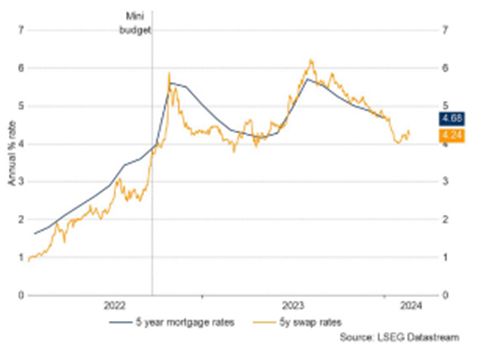
Over in the UK, house prices fell by 1.9% in August to an average £364,895, the sharpest decline so far this year, Rightmove’s House Price Index shows. The average five[1]year fixed mortgage rate has fallen to 5.81% from 6.08% three weeks ago.

UK public sector net borrowing (which excludes public sector banks) was £4.3bn in July, £3.4bn less than in July 2022, and below economists’ forecasts of around £5bn. It was the fifth highest July borrowing since records began in 1993.

UK headline CPI – YoY % change

Core CPI, excluding energy, food, alcohol and tobacco, rose by 6.9% in the 12 months to July, remaining unchanged from June.

Producer price inflation (PPI) also fell in July, with input prices declining 3.3% in the year to July, down from a fall of 2.9% in the year to June, according to the ONS.

Producer output prices also declined by an annualised 0.8% in July, down from a rise of 0.3% in the 12 months to June. It is the first time that output PPI has been negative since December 2020, and the twelfth consecutive month that the annual inflation rate has slowed.

On a monthly basis, input prices fell by 0.4% while output prices rose by 0.1% in July.

UK Labour market cools

The UK job market has shown signs of cooling as employment rates fell and unemployment rates increased in the three months to June compared to the previous quarter, according to the ONS.

The employment rate was estimated at 75.7%, a 0.1 percentage point decline on the first quarter of the year and 0.8 percentage points below pre-pandemic levels. The decrease was largely driven by a decline in full-time employees and self-employed workers.

The unemployment rate was estimated at 4.2%, up 0.3 percentage points than the previous quarter and 0.2 percentage points above pre-pandemic levels. This was primarily driven by those unemployed for up to six months.

Meanwhile, annual growth for regular pay (which excludes bonuses) was 7.8% in the three months to June, the highest level since records began in 2001. Average weekly earnings for regular pay were £613 in June, up from £610 in May.

China’s economic recovery weakens

China’s retail sales rose by 2.5% in July, falling short of an expected 4.5% increase. Industrial production also fell short of expectations, rising by 3.7% in July. Economists had predicted an increase of 4.4%.

Real estate investment fell by 8.5% year-on-year in July, with investment in residential buildings seeing a decline of 7.6%. Meanwhile, turmoil in China’s property sector continued as new home sales declined 19% year-on-year in July, while overall house prices fell by 0.2% month-on-month.

Please check our blog content for advice, planning issues and the latest investment, market and economic updates from leading investment houses.

Alex Clare

23/08/2023

Team No Comments

EPIC Investment Partners: Daily Update – S&P Lowers US Banks / Jackson Hole Speculation

Please see below the ‘Daily Update’ from EPIC Investment Partners, which was received this morning (22/08/2023) and provides their views on S&P downgrading the credit rating on a number of US banks and speculation about what to expect from Jerome Powell’s (The Federal Reserve Chair) speech later this week:

S&P Global Ratings yesterday followed Moody’s Investors Service in cutting ratings in a slew of US banks and darkened the outlook for several more, citing the same mix of pressures, making life tougher for lenders. In a statement, S&P said it lowered ratings by one notch for Comerica Inc, KeyCorp, Valley National Bancorp, Associated Banc-Corp, and UMB Financial Corp, noting the impact of higher interest rates and deposit moves across the industry.

S&P also lowered its outlook for S&T Bank and River City Bank to negative and said its view of Zions Bancorp remains negative after the review. In the release with the downgrades, S&P said: “Many depositors have shifted their funds into higher-interest-bearing accounts, increasing banks’ funding costs”. Adding: “The decline in deposits has squeezed liquidity for many banks while the value of their securities, which make up a large part of their liquidity, has fallen.”

We also hear speculation about the topic of Powell’s speech at Jackson Hole this coming Friday, specifically whether the Fed chair would discuss the prospect of a higher short-term neutral rate of interest. Nick Timiraos, The Wall Street Journal’s “Fed whisperer” has as usual weighed in, noting in a series of tweets that the Fed embracing a higher short-term neutral rate as a guide for policy may be inconsistent with recent Fed commentary.

He tweeted: “Despite the Federal Reserve’s raising interest rates to a 22-year high, the economy remains surprisingly resilient, with estimates putting third-quarter growth on pace to easily exceed its 2% trend. It is one of the factors leading some economists to question whether rates will ever return to the lower levels that prevailed before 2020 even if inflation returns to the Fed’s 2% target over the next few years”. He added, “At issue is what is known as the neutral rate of interest”.

Please continue to check our Blog content for advice and planning issues and the latest investment, markets and economic updates from leading investment houses.

Carl Mitchell – Dip PFS

Independent Financial Adviser

22/08/2023

Team No Comments

Tatton Investment Management: Monday Digest

Please see below, Tatton’s ‘Monday Digest’ which provides a weekly update on markets and the key news from global economies. Received this morning – 21/08/2023

Bonds are back

Last week was another difficult one for both equity and bond markets. As a result, the positive returns of July have mostly been erased so far in August. Overall, world markets are largely unchanged from a year ago. Many commentators have pointed to the rise in global bond yields as a big driver of the reversal in sentiment, or at least the underlying cause of a renewed re-rating of equities on the back of higher bond yields. The US 10-year bond yield has risen to 4.3%, higher than at any point going back to July 2008, while the UK 10 year gilt yield has risen to 4.7%, the highest since June 2008.

At first glance, investors may think the rising yields are building in higher long-term inflation expectations, but this current move does not appear to have been spurred by a worsening inflation backdrop. Inflation expectations – as implied by the pricing of inflation-linked bonds – for the next two to three years seem to have fallen back a little. Therefore, what has changed is the ‘real’ yields, which have turned more positive after spending many months (even years) near or below zero. Real yields matter, and the rise in US real yields has come at a point when US economic data suggests ever more strongly that reasonable and persistent growth – rather than looming recession – may force rate cuts.

So, capital markets appear to be undergoing a rather technical shift, based on the re-rating on the back of higher-for-longer bond yield expectations, making recently extended equity valuations untenable, even if the earnings outlook has marginally improved. Given that August is a month with low trading volumes, it could continue to be negative, especially if the momentum trading funds start to add to the flows. However, a valuation adjustment would be no bad thing in the medium term, as it would alleviate some of the recent market nervousness.

Sterling strength nothing to write home about


You might be surprised to learn that, on a trade-weighted basis, the best performing major currency of the year so far is none other than the Great British pound. Sterling has gained 5.13% against the UK’s trading partners since the start of 2023. Moves in currency values are normally seen as reflecting confidence – or lack thereof – in regional economies. But the commentary around Britain’s economy this year has been nothing but glum. Although the UK has not officially dropped into recession, growth has been effectively zero for over a year. And yet, sterling has gained against its peers. So what’s behind sterling’s strength?

After a series of rate rises from the Bank of England (BoE) and the recent fall back in implied inflation expectations, the real yield on 10-year gilts is now just under 1.5%. Should we read this also as an expectation of higher growth? It is possible, but unlikely, given the wider pessimism about the UK economy. More likely, the move up in real yields is a consequence of the BoE’s aggressive stance – necessitated by persistent and UK-specific supply-side problems – together with an extended bond market sell-off. Nominal UK gilt yields are now above where they were during October’s ‘mini budget’ crash, and have risen much more steeply than German yields, for example.

Moreover, while a rising pound has helped ease input costs, Brexit-driven changes mean the goods and services British consumers buy from abroad (which are still overwhelmingly from Europe) are structurally more expensive now than a few years ago. The flipside of being able to buy more from trading partners with your pound is that those partners can buy less from you – making British firms less competitive. This might not be much of a problem if the economy is vibrant enough to handle it, but it does mean that both UK assets and its currency have become more expensive relative to economic fundamentals. Put another way, sterling looks vulnerable in the medium term. Over the coming months, we might see a slide – particularly against competitive currencies like the yen. The pound is strong now but, unfortunately, this may not be a good thing for the British economy.

Is Russia struggling to shift its oil supply?


Oil traders are feeling bullish. In July, international oil benchmark Brent crude was one of the best performing indices, gaining 11.9% in sterling terms. Last week’s jitters came after further economic disappointment in China, but some industry analysts see them as just a hiccup. Thanks to meaningful production cuts from OPEC+ (which includes Russia), predictions of $90 per barrel (pb) or even $100pb are being floated. That would be quite the turnaround. Brent has not settled above the $90 mark since mid-2022. Since then, supply side fears have faded, and global demand has become the key concern.

Saudi Arabia, the world’s largest crude exporter and OPEC’s de facto leader, recently extended its voluntary production cut of 1 million barrels per day to September and noted that cuts may deepen in the future. Russia also promised to export 300,000 fewer barrels per day in September, showing the cartel’s commitment to maintaining high prices. According to one recent survey, the total production output of OPEC+ hit its lowest point since August 2021.

For us, the most interesting player in this supply tightening is Russia. Despite some near-apocalyptic warnings when Moscow launched its invasion of Ukraine, the aggregate effect of Russia’s war and the ensuing western sanctions on global oil supplies has been relatively small. This was – as widely suspected – down to a rerouting of Russian supply to Asia, most notably the large energy-intensive economies of India and China. That is why, in the early part of last year, Russia’s trade balance (exports minus imports) stayed surprisingly healthy despite its apparent supply cuts.

In the last few months though, Russia’s trade balance has deteriorated significantly. This is clear from the slide in foreign currency reserves, which threatens to bubble over into a full-blown rouble crisis as widely reported last week. Last Wednesday, Moscow hiked interest rates by an extraordinary 3.5% to stop the bleeding, and its finance ministry is reportedly proposing tough capital controls. One of which would force Russian exporters to sell up to 80% of their foreign currency revenue within 90 days of receiving it or risk being banned from government subsidies.

It is particularly jarring that the rouble has slid so much while oil prices (including Russia’s discounted offering) have climbed, as the former is unequivocally a petrocurrency. It puts further pressure on Russia’s economy and finances, though as always, the question is whether this pressure reaches the inner circle. Optimists might suggest this leads to ceasefire talks, although the more likely outcome is increased friction between Russia and Saudi Arabia over production cuts, with the former needing revenues to fund its damaging war. In either case, oil prices could struggle to go higher over the medium term.

Please check our blog content for advice, planning issues and the latest investment, market and economic updates from leading investment houses.

Alex Kitteringham

21st August 2023

Team No Comments

The Daily Update: FOMC Minutes

Please see below article received from EPIC Investment Partners this morning, which provides a detailed overview of the FOMC meeting last month.

The minutes released yesterday from last month’s FOMC meeting offered little new insight to the path for future rate hikes, reiterating the Fed’s data-dependent stance. They did, however, show that two Fed officials favoured holding rates steady last month – others saw significant upside risks to inflation that could require further tightening.

The minutes noted that “uncertainty about the economic outlook remained elevated and agreed that policy decisions at future meetings should depend on the totality of the incoming information and its implications for the economic outlook and inflation, as well as for the balance of risks. Participants expected that the data in the coming months would help clarify the extent to which the disinflation process was continuing, with product and labour markets reaching a better balance between demand and supply.”

In regards to the two officials favouring a pause, the minutes said: “A couple of participants indicated that they favoured leaving the target range for the fe  deral funds rate unchanged or that they could have supported such a proposal. They judged that maintaining the current degree of restrictiveness at this time would likely result in further progress toward the Committee’s goals while allowing the Committee time to further evaluate this progress”.

There is uncertainty around the economic outlook though. “Participants noted that real GDP growth had continued to exhibit resilience in the first half of the year and that the economy had been showing considerable momentum. A gradual slowdown in economic activity nevertheless appeared to be in progress, consistent with the restraint placed on demand by the cumulative tightening of monetary policy since early last year and the associated effects on financial conditions,” the minutes noted.

Members acknowledged the tick down in inflation ahead of the meeting but remain concerned. They stated that “most participants continued to see significant upside risks to inflation, which could require further tightening of monetary policy. Participants did cite several tentative signs that inflation pressures could be abating. Nonetheless, several participants commented that significant disinflationary pressures had yet to become apparent in the prices of core services excluding housing. Participants stressed that the Committee would need to see more data on inflation and further signs that aggregate demand and aggregate supply were moving into better balance to be confident that inflation pressures were abating, and that inflation was on course to return to 2% over time.”

Please check in again with us soon for further relevant content and market news.

Chloe

17/08/2023

Team No Comments

Evelyn Partners Update – July UK CPI Update

Please see below article from Evelyn Partners providing their views on this morning’s UK inflation announcement for July. Received today – 16/08/2023.

Please check our blog content for advice, planning issues and the latest investment, market and economic updates from leading investment houses.

Adam

16/08/2023

Team No Comments

Brewin Dolphin – Markets in a Minute

Please see the below article from Brewin Dolphin commenting on the latest stock market movements received late yesterday:

Please check our blog content for advice, planning issues and the latest investment, market and economic updates from leading investment houses.

Andrew Lloyd DipPFS

16/08/2023

Team No Comments

EPIC Investment Partners: Daily Update – Argentina Devalue

Please see below the ‘Daily Update’ from EPIC Investment Partners, which was received this morning (15/08/2023) and provides their views on Argentina devaluing its currency and hiking interest rates:

Argentina devalued its currency and hiked up interest rates following a shock primary election win by the far-right outsider Javier Milei, who has vowed to “burn down the central bank”. The South American central bank devalued the peso by 18% to around 350 pesos versus the dollar and hiked interest rates by a shocking 21%, to 118%, in a drastic policy shift as it runs short of funds to defend its currency. Milei has been riding a wave of popular discontent, and is seen as a libertarian who supports dollarising the economy. He has also called for massive cuts in government spending.

The central bank also intends to ask the International Monetary Fund (IMF) to increase a payment planned for later this month by an unspecified amount, government officials said. The Fund agreed to give Argentina nearly USD11bn in loans for the rest of the year as part of a refinancing agreement brokered by the Economy Minister Sergio Massa, who is also running for president in October’s election. The first payment of USD7.5bn is expected by the end of August, after approval of a staff-level agreement by the Fund’s executive board. Argentina is the largest debtor to the IMF, after securing USD44bn last year to refinance a 2018 loan.

Of course, defaults, devaluations and crippling recessions are not unusual for Latin America’s third-largest economy. Argentina is on the brink of its sixth recession in the last decade. Milei has been a vocal critic of what he calls the “corrupt political class”, saying the country’s leaders have thrown it from one crisis to another. He believes replacing the peso with the dollar, along with eliminating the central bank, and cutting government spending “so large that austerity measures demanded by the IMF would look tiny in comparison” would all help turn the economy around.

Please continue to check our Blog content for advice and planning issues and the latest investment, markets and economic updates from leading investment houses.

Carl Mitchell – Dip PFS

Independent Financial Adviser

15/08/2023

Team No Comments

Tatton Investment Management – Monday Digest

Please see the below article from Tatton Investment Management detailing their views on global economic news from the past week.

Overview: Summer markets lukewarm on good news

On the face of it, last week contained many of the positive headlines  market optimists had been waiting for, but the response to those headlines received was tepid at best. On Thursday, the US Bureau of Labor Statistics released its consumer price index (CPI) inflation data for July, and it was relatively benign. In particular, the core CPI measure (with food and energy taken out) was +0.16% for the month, the same as in June. For the two months, annualised core CPI is now running below 2%, at +1.92%. Commentators reiterated the June narrative: that the US Federal Reserve (Fed) will be able to stop raising rates and then begin cutting next year. In the bond market, the 10-year yield went from 3.95% as the CPI data was published to 4.10% by the close on Thursday. Meanwhile, the S&P500 was pretty much unchanged. So, for equities and bonds, what was once a bullish driver has become less so now, and corroborative data is not new information.

Back at home, the Royal Institute of Chartered Surveyor’s report on the housing market continued to flag the prospect of further house price falls which, in earlier years, would be a harbinger of very difficult economic times. Yet the UK economy put in yet another quarter of growth, albeit anaemic, at +0.2%. The really surprising aspect was that July manufacturing and construction output was very strong at +2.4% and +1.6% month-on-month, respectively. That echoed the construction purchasing managers’ index (PMI) from last week, which showed a totally surprising shift into growth territory at 51.7 (50 marks the divide between contraction and expansion). Perhaps unsurprisingly, bond yields shifted sharply higher on Friday after the data, with the 10-year testing 4.5% and the two-year back at 5%. Neither has yet broken beyond the highs of the past month, however.

August is generally a quiet month, with holidays the priority for many. In recent years, it has felt more like business-as-usual, but market liquidity can still be somewhat reduced and, if news is really important, can lead to sharp dislocations. So far this month, the stories are not unimportant, but neither are they earth shattering, and while volatility has picked up, remains way down from last year and even the first half of this year.

China’s growing pains continue

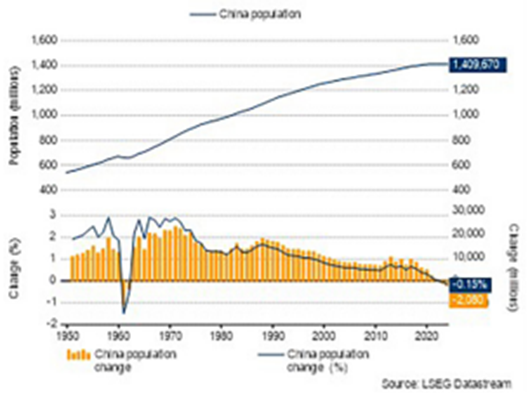
China’s economy has sputtered again. CPI inflation fell 0.3% year-on-year in July. Producer prices were even lower, falling 4.4%. That might sound like a strange thing to complain about, given the West’s ongoing battle with high inflation; but China did not experience the same wave of post-pandemic inflation, and now deflation is a bad sign for the world’s second-largest economy. It shows weakness in consumer demand, which will likely mean slower growth down the line. Moreover, businesses competing with Chinese exporters are losing pricing power, while suppliers of commodities to China are experiencing a sharp slackening in demand. Thus, weak growth in China may be transferring to the rest of the world.

As we wrote recently about China, its economic problems have never been about lacking potential. The question is whether the government is willing or able to unlock it, and as yet that question remains unanswered. At the end of July, Beijing called for strong countercyclical measures to arrest a recent decline, but as (by now) usual, the details on what this means are lacking. Policymakers want to boost short-term growth, but are unwilling to loosen their grip on the private sector to do so.

China still has potential for a near-term rebound. But for foreign investors, the longer term returns on Chinese assets are hard to assess. Even though economic growth will come through, there is no guarantee this will translate into enough profit to justify investment, thanks to the unpredictability of central government. There are growth opportunities in China; Beijing only needs to decide if they are in its interest.

Is US earnings supremacy on the wane?

American companies are leading the way again this year, with 12.8% year-to-date returns as of the end of July. With the benefit of hindsight going back a decade, there are few better bets any international investor could have made than the US and its tech giants. Over the 20 years from 1989 to 2019, the S&P delivered an average real (inflation-adjusted) return of 5.5% a year excluding dividends.

However, a June discussion paper written by US central bank staff for the Federal Reserve Board of Governors in Washington argues that much of the growth in the value of US investments is explainable by different, more straightforward factors. The paper posits that exceptional US stock market performance over the last three decades was a consequence of changes to tax and interest rates. Moreover, it is very hard to see either of these trends continuing into the next decade or beyond. Short-term government interest rates have already increased from around 0% at the start of 2022 to above 5%, and markets expect these to come down over the next year or so. But as we have noted before, the economic environment – and particularly labour relations – mean we should not expect a quick return to the pre-pandemic norm of low inflation and growth.

Tax rates are a similar story. Effective taxation is already as low as it has been since corporate taxes were introduced, and the historically high levels of government debt are coinciding with an historically small tax base.

Equity prices change because of earnings growth and the rate investors are willing to pay for those expected earnings. Essentially, long-term US performance from here could be capped given that valuations are no lower than the average, an average based on net income growth which has had exceptional factors since 1989. It is possible that investors could show an even stronger bias for American assets, and accept a lower return because they feel US equities are less risky than other countries. This is not unthinkable but, in the current environment, it is hard to see the US outperforming to the level it has before.

Please check our blog content for advice, planning issues and the latest investment, market and economic updates from leading investment houses.

Alex Clare

14/08/2023

Team No Comments

Brooks Macdonald: Daily Investment Bulletin

Please see below, the ‘Daily Investment Bulletin’ from Brooks Macdonald providing a brief summary of the key factors currently affecting global markets and economies. Received this morning – 11/08/2023

What has happened

US equities were unmoved yesterday after US CPI came in line with market expectations but the US 30-year Treasury auction struggled. Over in Europe, equities rose more than three-quarters of a percent as the market closed before the later US sell-off. Travel and luxury goods companies did particularly well after China announced that it would be ending its ban on outbound international group tours.

US CPI

The monthly July US CPI print came in line with market expectations but taking the readings to two decimal places there was even better news. Headline CPI expanded by just 0.17% month-on-month with core CPI expanding by just 0.16% over the same period. These very low monthly figures brought headline annual inflation to 3.2% whereas core stayed at 4.7%, reflecting the stickiness of monthly core CPI earlier in the year. The monthly numbers will receive the most attention with both the core and headline readings now near the 2% Fed target for a second month in a row. In terms of contributors to this, airfares were down 8% over the month, building on a similarly sized decline the month prior.

Bond market reaction

We have a while until the next Fed meeting therefore there were Fed speakers immediately available to comment on the CPI. President Daly welcomed the numbers but said that the monthly reading was ‘not a data point that says victory is ours’. In terms of timing of any interest rate cuts, Daly said that she expected those conversations to wait until 2024, pushing back against market hopes for a December 2023 cut. The major bond market news came with the 30-year Treasury auction however as strong demand failed to materialise, causing the bonds to be issued at 4.189%, this then catalysed further concern over the sheer size of the US deficit and its linked funding needs.

What does Brooks Macdonald think?

Stripping out some of the more volatile disinflationary contributors, such as airfares, we still see a stickier inflation backdrop in the US. That said, these volatile components can be lead indicators of wider moves within the inflation basket, just as we saw in 2021 and 2022 when inflation was on its ascendency. The overall reading will support the case for a pause in US interest rates when the Federal Reserve meet in September.

Please continue to check our blog content for advice and planning issues and the latest investment, markets and economic updates from leading investment houses.

Alex Kitteringham

11th August 2023