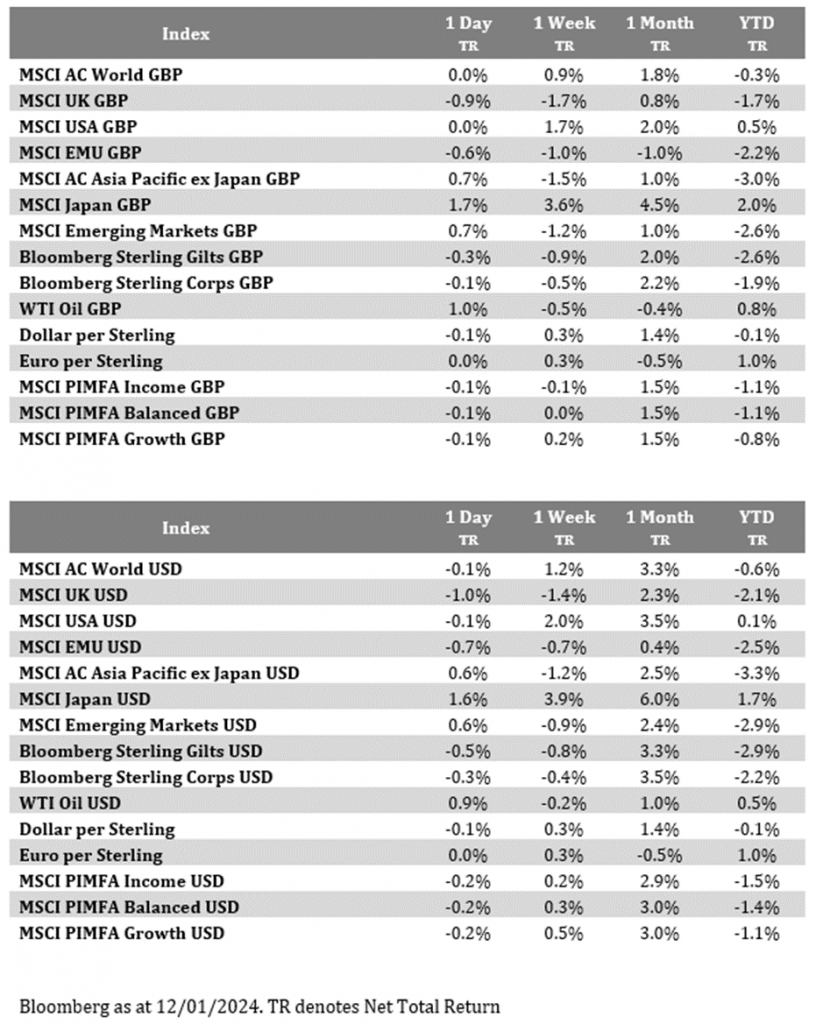
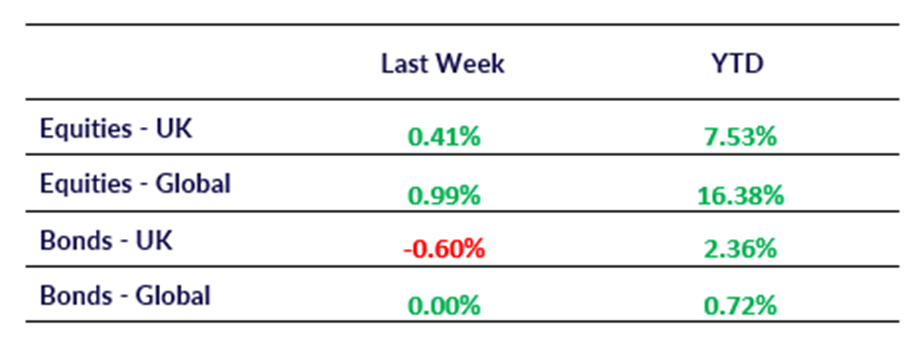
Please see below, Brooks Macdonald’s ‘Daily Investment Bulletin’ providing a brief analysis of the key factors currently affecting global markets. Received this morning – 12/01/2024
What has happened?
Overnight the news that the US and UK have launched air strikes on Houthi rebels in Yemen is the main geopolitical story, however yesterday’s trading session was dominated by the US CPI release. US equity markets initially suffered after CPI came in above market expectations, however those losses were ultimately erased for the index to close only a few basis points lower.
Houthi air strikes
President Biden announced the strikes overnight saying that he would ‘not hesitate to direct further measures to protect our people and the free flow of international commerce as necessary.’ Oil prices rose as a result of this action and the market will also keep a close eye on container freight costs which will have inflationary impacts if they remain elevated.
US CPI
Starting with CPI, the monthly and annual headline CPI figures both surprised to the upside by 0.1%, meaning that the monthly figure expanded by 0.3%. For core CPI, the month-on-month expansion was also 0.3%, but that was in line with market expectations, although the year-on-year number fell less than hoped. The CPI readings were not disastrous for the soft landing narrative but continue to suggest that it will prove difficult to shift some of the stickier CPI subcomponents. In terms of those components, shelter is still running at 0.46% month-on-month which is important given its weight in the CPI basket. Interestingly, the PCE inflation measure, which the Fed officially targets, has a lower proportion allocated to shelter so may see less stickiness from this driver.
What does Brooks Macdonald think?
One of the logics behind the market rally later in the session was the realisation that if PCE continues to fall, despite CPI remaining sticky, this could give the US Federal Reserve the justification to cut interest rates should it want to. A surprising outcome from the day was the market’s expectations around a Fed interest rate cut by March which actually increased above a three-quarter percentage point probability. This occurred despite Fed speakers continuing to push back against such a certainty, with President Mester saying ‘I think March is probably too early in my estimate for a rate decline because I think we need to see some more evidence.’
Please continue to check our Blog content for advice and planning issues and the latest investment, markets and economic updates from leading investment houses.
Please see the below article from Evelyn Partners detailing their thoughts on the US CPI inflation announcement for December 2023. Received this afternoon 11/01/2024.
What happened?
US December annual headline CPI inflation rose at 3.4% (consensus +3.2%) and compares with +3.1% in November. On a monthly basis, CPI rose 0.3% (consensus +0.2%), compared to an increase of 0.1% in November.
Turning our attention to the core figure, which excludes volatile food and energy prices, the annual number came in at 3.9% (consensus 3.8%), compared to 4.0% in November. In monthly terms, core CPI increased 0.3% (consensus 0.3%), which compares to 0.3% in November.
What does it mean?
December’s inflation report came in slightly above forecasters expectations with headline CPI re-accelerating slightly to 3.4%. However, core inflation continued to ease, falling below 4% for the first time since May 2024 with today’s figure of 3.9%.
The index for shelter continued its recent trend upwards rising by 0.5% on the month, shelter accounted for over half of the overall monthly inflation figure. However, on an annual basis shelter inflation has slowed to 6.2% from its peak of 8.2% in March 2023. Having decelerated dramatically during October and November the index for energy increased by 0.4% for the month of December, as increases in electricity and gasoline were large enough to offset the decrease from natural gas.
The faster than expected deceleration of inflation seen during the final quarter of 2023 has prompted money markets to start to anticipate rate cuts as early as March 2024. This change in market sentiment was provided some credibility by dovish communication from the Federal Open Market Committee (FOMC). Despite holding the base interest rate unchanged at 5.25-5.5% during their December meeting, the committee changed its forward guidance to signal it now expects to cut rates three times during 2024. This marks a considerable change in tone from the September meeting, when the committee did not expect to cut interest rates at all this year.
Despite Non-farm payrolls beating consensus estimates in December and the unemployment rate remaining low at 3.7%, wage growth appears to be normalising to levels consistent with 2% inflation over time. At the start of November, Federal Reserve (Fed) chair Powell stated that wage increases have come down significantly and are now “substantially closer to that level that would be consistent with 2% inflation over time”. On top of this, US productivity has been improving, with annualised Q3 productivity growth at 5.2%. So, despite annual wage growth remaining elevated at 4.1%, companies are still being rewarded by higher levels of output per unit labour cost. This should mitigate some of the inflationary pressures typically expected from heightened wage growth.
Immediately following the report bond yields rose with the US 10-year treasury note gaining ~7bps
Bottom Line
Despite today’s report showing in aggregate, limited new disinflationary progress, over recent months there have been three key macro trends that, in our view, have reduced the likelihood of a US economic hard landing. First, the labour market has started to soften without a notable step up in the unemployment rate. Second, wage growth is starting to moderate towards levels that would be consistent with the Fed’s 2% inflation target. Third, inflation has been decelerating faster than many forecasters had expected.
Money markets are currently pricing in rate cuts as early as March, in our view, that may be too soon, but if the labour market and inflation data softens further over the coming months, then we think US interest rates are likely to begin falling as we get towards the summer.
Please check our blog content for advice, planning issues and the latest investment, market and economic updates from leading investment houses.
Please see below the latest ‘Markets in Minute’ update from Brewin Dolphin, which covers their views on recent events in markets and was received late yesterday (09/01/2024) afternoon:
At the end of 2023, everything rallied – and at the start of 2024, everything has sold off. This has not been an enormous shock. The fabled Santa Rally means that the S&P500 has risen in 15 out of the last 20 years. The flipside of this is that only ten of the last 20 Januarys have provided gains. When taking into account the currency exposure a UK investor suffers, this drops to eight out of the last 20 Januarys. The UK equity market is even more stark. 17 of the last 20 Decembers have seen gains, and only seven of the last 20 Januarys.
Seasonal trends do not form the bedrock of a reliable investment strategy. On average, January has been the worst month for the UK equity market but last January, stocks jumped 4.4%. As the influential investor Howard Marks remarked, “Never forget the six-foot tall man who drowned crossing the stream that was five feet deep on average.”
So, while the odds are generally slightly more favourable for December than January, this particular December saw a rally so strong and so broad that it pushed a number of stocks into overbought territory (when companies have rallied particularly sharply, they are overbought and often need to slow down or even reverse their gains).
Markets also seemed to suffer from a form of selective blindness, in which they took great cheer from the dovish central bank and were less concerned by signs of inflation persevering.
All of this meant that the early days of January were likely to see profit taking, as seems to have been the case
Middle Eastern escalation
Another issue the markets have been comfortable overlooking is the rise of geopolitical risk. The 7 October attacks on Israel saw a sharp rise in the oil price, reflecting the risk that the attacks could begin a cycle of escalation that might eventually disrupt energy supply. In the final months of the year, though, this risk was overwhelmed by the greater risk that the Organization of the Petroleum Exporting Countries (OPEC) might be oversupplying energy to the global economy, and that it might struggle to restrict supply in the face of price falls. During 2023, Saudi Arabia restricted its own supply to support prices for OPEC as a whole, but continuing to do so indefinitely would undermine the point of the OPEC operating as a cartel.
So, oil was weak at the end of last year, contributing to the increasing hopes of a soft landing for the global economy. But it picked up over the last week as the threat of escalation in the Middle East has returned. Prior to last week, we already understood that Houthi rebels, who have been fighting a civil war in Yemen for the last decade, had begun harassing shipping navigating the Red Sea through missile and drone attacks and attempted boardings. Over the New Year’s weekend, the US Navy intervened to defend shipping, was fired upon, and ended up sinking Houthi vessels. However, this action has not deterred Houthi attacks.
As discussed, the risk to oil is that a broader Middle Eastern conflict emerges from the current proxy wars involving Iranian-backed groups operating throughout the region. Over the course of last week, aside from activity in Yemen, the US struck Iran-backed militia in Baghdad with a drone strike and two bombs were detonated in Iran.
Fretting over freight rates
There are, however, more direct consequences of the Houthi harassment of shipping. The Red Sea is the gateway to the Suez Canal, which forms a well-travelled shipping artery between Asia and Europe. 12% of global trade travels this route each year and disruptions (as occurred when the vessel Ever Given blocked the canal in 2021) have serious repercussions for supply chains. It can mean that shipping either has to travel a further ten days around the southern cape of Africa, or for urgent transit, shippers will redemand higher transit fees to compensate them for the heightened risk of navigating the Red Sea.
Freight rates have risen sharply, despite the good fortune that these attacks began as the peak season was drawing to a close. Demand will, however, pick up, particularly ahead of Chinese New Year in mid-February. Unfortunately, they also come at a time when the water level in the Panama Canal is unusually low, restricting its use for pan-American transit. Anecdotal reports have suggested that freight rates have risen to multiples of the rates being charged a few weeks ago.
Should this trend continue, those costs will be reflected in consumer goods prices. Consumer goods have been an important source of disinflation over the last few months despite services costs seeming to remain persistently high. As a rule, goods prices in developed economies will likely reflect some combination raw material, transport and currency costs (recent weakness of the dollar will push up imported goods costs). Beyond this, goods may be over or under supplied, and after the surge of pandemic demand, consumer goods production outstripped demand, leading to a need for destocking, a process which seems to be coming to an end.
By contrast, a lot of services prices reflect wages. These have moderated in some regions (the US) more than others (the UK and Europe). But services prices have been slower to decline.
January’s jobs report
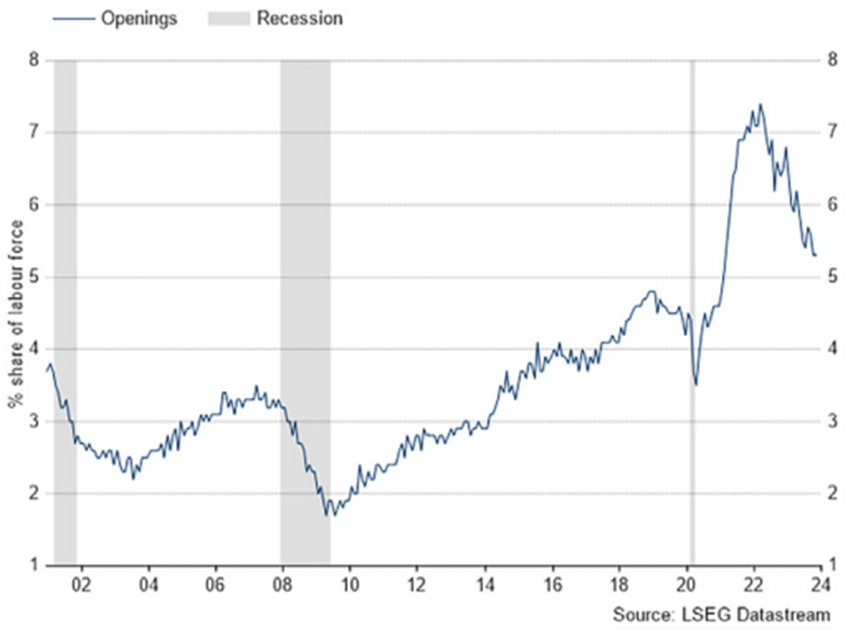
The US labour market was the main source of economic news last week. An ideal scenario would be one in which the inflationary pressures (slowing wage inflation) ease whilst employment levels remain high enough to keep the economy going. Early last week, we learnt that the number of job openings continued to decrease (albeit marginally), consistent with the idea of a loosening jobs market and a gradual decline in wage pressures. Last Thursday’s jobless claims data suggested that very few people were losing their jobs. This was all in keeping with the case for soft economic landing.
Friday saw more employment data which muddied the waters a little. Jobs growth was strong and should be good for growth, as long as it isn’t inflationary. But in December, wages did rise faster than expected and the unemployment rate stayed low at 3.7%. The labour force participation rate fell to its lowest in almost a year. These data will give the Federal Reserve some reason to fret over how fast inflation will decline in the future.
So, it has been a rough start to the New Year, but that would be expected given the strong finish to last year. Looking ahead, investors will be looking for evidence that tensions de-escalate in the Middle East. At home, they will want reassurance that the US labour market is not too hot to drive to prompt inflation, whilst also not being too cold so it provokes a recession.
Please continue to check our Blog content for advice and planning issues and the latest investment, markets and economic updates from leading investment houses.
Please see below this week’s Weekly Market Commentary from Brooks Macdonald, received yesterday afternoon – 08/01/2024
In summary
The US Equity Index posts its first weekly loss after nine weeks of consecutive gains
The headline US employment report pointed to a robust labour market backdrop
This week the market will focus on the US Consumer Price Index (CPI) report, released on Thursday
Markets began 2024 in a downbeat mood with equities suffering as bond investors pushed back their expectations for US interest rate cuts based on the US Federal Reserve (Fed) commentary and strong economic data. The highest profile of these strong data points was the headline US employment report on Friday. This week the main event will likely be the US CPI report which is released, unusually, on Thursday.
The headline number of new jobs created in the US was 216,000 versus market expectations of just 160,000. With that stronger number, the overall unemployment rate remained steady at 3.7% compared to the consensus expectation of a rise to 3.8%. Lastly, the average hourly earnings was expected to slow to 0.3% however it actually still expanded by 0.4% month-on-month. Within the data there were some signs of a slowdown including the household survey which showed a loss of 686,000 jobs, the highest since April 2020. Last month that same survey saw a gain of 586,000 so clearly volatile, but one to keep an eye on. Later in the day, the US Institute of Supply Management (ISM) services survey pointed to a significant weakening in job prospects with the employment subcomponent back to levels last seen in 2020. The combination of the ISM survey and non-farm payroll report shows a mixed picture. However, markets latched onto the headline number of new jobs created, creating a sombre mood even if the US Equity Index did manage to post a very small gain by the end of the day.
Thursday will see the US CPI report released for December, with market expectations pointing to a headline 0.2% month-on-month gain and a 3.2% year-on-year gain. For the core CPI figures, the consensus expects 0.25% month-on-month and 3.8% year-on-year. The year-on-year numbers continue to fall, however it is clear that the ‘last mile’ to bring the CPI numbers back to the Fed’s target are going to be difficult.
With the US equity market having had a negative week, after a very impressive nine consecutive weeks of gains, sentiment is clearly a little shaken ahead of the US CPI release. This week, alongside the CPI report are a series of Fed speakers, a number of Treasury auctions which will test appetite for US Treasuries at the current yield levels and also the latest New York Fed 1-year inflation expectations.
Please continue to check our blog content for advice and planning issues and the latest investment, markets and economic updates from leading investment houses.
Please see this week’s Tatton Monday Digest update received this morning:
Overview: After the party, the hangover
After the Christmas party, January perhaps started with a bit of a hangover. After an exceptional last two months of 2023, both equity and bond prices fell back last week as trading volumes normalised. UK and US yields were up quite sharply on the week, at 3.80% and 4.05%, respectively. Equities also responded in their usual way of falling back some 1%-2% through the course of the week, with some notable underperformance from tech-related stocks.
Professional investors, like us, seem to have looked at the lower yields on bonds and larger cap equities and decided to take the near-term profit. In part, this may well be because they are making space in portfolios for potential new investment positions. Companies are seeing the lower cost of capital as an opportunity to finally replenish funds with new bond issues, and equity issues in the form of initial public offerings (IPOs) and convertible bonds offering the appealing combination of bond-like downside protection with equity upside.
Such behaviour is born of optimism rather than pessimism. Companies want to raise capital because their business can generate a better return than the cost of that capital (even at these relatively higher rates than in the past few years) and investors believe in the new opportunities. It also suggests that capital markets are more in balance now than they were in December, when optimism rose but corporate treasurers wanted to wait until the new year.
The real news of the week was that the narrative of global policy rates being cut sometime in the second quarter took a hit. European inflation data was in line with – but not below – expectations while US December employment data was the same as November’s very surprising low of 3.7%. Indeed, the evidence suggests employment tightened at the end of the year, something that should bolster consumption but will do nothing to reduce robust wage growth. Low inflation data may help for this month, and possibly next, but rate cuts in March and April look as far-fetched as we thought they did at the tail end of last year.
US election: will a Trump candidacy shake markets?
When America votes, the world watches. Ever since Donald Trump announced his first presidential campaign in 2015, melodrama has given global audiences another reason to tune in. And with criminal charges piling up against the former president – but not even scratching his campaign for his party’s candidacy – the 2024 election is sure to be Trump’s most dramatic yet.
Strangely, though, that established truth does not usually extend to investors. Looking back, the 2020 election had little impact on the US stock market either before, during or after the fact. This was despite an extremely politically volatile campaign that ended in accusations of fraud and an attempted insurrection. Trump’s shock victory in 2016 initially knocked US equities, as investors feared the destabilising effects of a divisive political novice in the White House, but this downturn was recovered within days and markets later surged in what was wryly called the ‘Trump rally’.
The big question as we head into this election year is: can markets ignore US politics again? Judging by market reactions – or lack thereof – to Trump’s myriad legal troubles in 2023, it seems possible they can, but it is hard to analyse because of a lack of clarity about implications regarding market expectations. Many think that Trump gaining the Republican Party candidacy, and thereby featuring on national presidential ballots, is inevitable, but while Trump has a dominant lead over Republican rivals, his legal battles – in particular cases relating to his attempts to overturn the 2020 election result – could still sink his campaign.
That said, there is a growing feeling that, if Trump makes it onto the ballot, he will likely win in November. This is supported by his polling lead against President Biden, both nationally and in key swing states. Again, there are many unknowns here – including whether Biden himself will feature on the ballot, and whether economic improvements might rescue his dire popularity ratings before polling day. But a second term for Trump is certainly enough of a likelihood that investors and American citizens have to seriously consider it. For many Americans, the thought is extremely unpalatable, to put it mildly. There is a large group of liberal-leaning highly educated urban-dwelling citizens who think a second Trump presidency – combined with a radically conservative Supreme Court – could destroy the liberal democratic institutions that keep the republic running. That demographic tends to skew wealthier than rural less educated counterparts and, as such, makes up a much larger proportion of US domestic investors.
We have written much recently about the prolonged outperformance of the US, and whether it can continue now that its assets have become much more expensive compared to Europe and EMs. A change of market fortunes, as we argued before, needs a catalyst. Half the US fearing the death of democracy could be such an event.
Please continue to check our Blog content for advice and planning issues and the latest investment, markets and economic updates from leading investment houses.
Please see below article received from Brewin Dolphin yesterday evening, which discusses the markets’ strong end to 2023.
The Santa rally continued broadly last week, albeit at a more moderate pace, after an ascent of over 15% on the MSCI World Index since late October.
The last trading day of the year was uneventful. The S&P 500 index fell 0.3% on the day, though miniscule compared to the +24.2% gain in 2023 and after nine consecutive weeks of gains. The Nasdaq 100 index had its best year since 1999 and the global bond market experienced its biggest twomonth gain on record.
It is a reminder that market volatility is normal, and that staying invested and strategically adding to investments during periods of market weakness can benefit portfolios over the long term.
To the markets. And as you can imagine, the festive period and the last trading week of the year is usually a quiet one. However, while western markets saw dull trading sessions, the Chinese stock market experienced some hefty moves in the positive direction.
Unpredictability continues in China
You may recall in our last Weekly Round-up, we wrote about how Chinese authorities were imposing strict regulations on the gaming industry that could challenge companies’ revenue models. This stance has since softened, which may have something to do with the $80 billion market rout led by Chinese tech companies like Tencent and Netease. Chinese authorities have now said they will listen to feedback from both companies and players on how to improve the new rules. But that wasn’t all. In what was seen as a further boost for the gaming industry, China also approved 105 domestic games.
Chinese stocks surged on the back of the change of tone. There was also a boost for investors hunting for bargains, as the mainland’s stock market is set for an unprecedented third consecutive year of declines.
So, are Chinese stocks sustainable in 2024?
We cannot rule out that Chinese stocks may go higher in the near term due to momentum and a reversal of extreme pessimism. And for those of us who are superstitious, 2024 is the year of the dragon, which is perceived to be a powerful and positive zodiac animal.
However, for long-term investors, the challenges that come with investing in China haven’t changed. Yes, the Chinese authorities may have sounded a bit more forgiving with the gaming sector, but that just shows the extreme and unpredictable nature of the policy setting. Policy risks and politics are making China borderline un-investible, with significant market volatility and high risk becoming the norm. The property market also remains a source of concern – especially the risk of a financial contagion.
China is not the only place sending mixed signals to investors though.
Japan – land of the rising rates?
Seen as the laggard of developed market central banks in terms of policy normalisation, the Bank of Japan (BOJ) has kept traders guessing on when it will exit the world’s last negative interest rates. It has been moving towards policy normalisation, notably with the near abandonment of yield curve control. With inflation in Japan at 2.8% and the official interest rate at -0.1%, higher rates seem justifiable; the BOJ just wants to be sure inflation is persistent.
The annual wage negotiations in spring will be crucial for the BOJ to gauge the inflation outlook, with speculation it will consider policy changes following the event. However, the BOJ’s governor, Kazuo Ueda, said this week they may not need to wait for the full results of the wage data, raising expectations that the BOJ may move before April. That said, the latest BOJ board minutes indicate that some members see no rush to exit its ultra-loose policy. The Japanese yen has reacted on these noises and Japanese stocks have displayed their usual negative correlation with the yen.
It is unlikely the BOJ will pre-commit or provide clearer guidance like the US Federal Reserve (the Fed). As a result, markets will have to live with confusing signals from the BOJ for the time being. For those of us choosing to ignore the more immediate market noises, the BOJ exiting negative interest rates is a matter of when, not if.
The Japanese bond markets have priced in a more than 50% chance of a rate hike by April 2024. If that happens, the BOJ will be tightening policy while other major central banks are cutting interest rates – potentially a key macro theme of policy divergence. This will have significant implications and present opportunities to market participants such as macro traders and asset allocators. One market dynamic will be via the yen and Japanese assets’ sensitivity to it. Another dynamic will be the cross-asset implications of higher Japanese government bond yields.
We watch Japanese policy developments closely because Japan is not only part of our regional exposure, but it has the potential to impact global markets. We have been paying particular attention to the possible knock-on impact of higher Japanese government bond yields on global bond yields. So far – and to our relief – the impact has been more on its currency rather global bond yields. This suggests the removal of the last anchor of low interest rates in Japan may not be an obstacle to the sustainability of a rally in global bonds in 2024.
2024 – the year of the soft landing?
At the end of the day, the elephant in the room for global assets remains the Fed. Like us, the Fed is watching the incoming data closely to decide on its next steps. In a week of limited economic data releases, we saw US data continue to broadly lean towards a soft landing. One notable data release was the personal consumption expenditure price indices, which are the Fed’s preferred measures of inflation. Both headline and core measures of the inflation gauge came in lower than expected in November. Notably, the headline Personal Consumption Expenditures Price Index has contracted by 0.1% month-on-month.
Meanwhile, US personal spending adjusted for inflation rose by 0.3% on the month, suggesting US consumers remain in spending mode going into the holiday season. US consumers have been supported by excess savings, resilient job market conditions and falling gasoline prices. For the labour market, the latest release of initial jobless claims figures hovered around the low 200,000s; a pace consistent with the low and stable unemployment rates seen in recent times. In summary, it is no surprise markets are feeling buoyant as we wave goodbye to sharp interest rate hikes (well, maybe not in Japan), expectations rise of the Fed pivoting to easier monetary policy in 2024, and US data points to a higher chance of a soft landing.
Please check in again with us soon for further relevant content and news.
Please see below, a short update from Copia:Capital which illustrates key recent figures from financial markets. Received this afternoon – 03/01/2024
Last Week:
Global stock markets recorded their strongest year since 2019 after markets rallied for the last two months of the year. The MSCI World Index, which is a measure of the world’s developed equity markets, finished up 22 per cent over the course of 2023. This was largely led by the S&P 500 index was up 24 per cent over the year and rose 14 per cent since October.
Asset managers launched the lower number of funds in the UK in 20 years. Morningstar reported that 397 funds were launched during 2023 which was down a quarter from the year before and much lower than the 899 launched at the peak in 2010. The drop in demand for funds came after investors shifted towards cash funds to avoid higher volatility.
There was record inflows into US money market funds in 2023 as investors were drawn to the high risk-free yields offered. Asset passed $6.3trn in US money market funds and US money market fund providers collectively earnt $7.6bn in fees over the year from these funds. The rates in money market funds have been much higher than previous years as a result of higher interest rates while the added volatility in equity markets have pushed more investors into money market funds.
Coming Up:
US Initial Jobless Claims data released, Thursday 4th January 2024 at 1:30pm.
EU December CPI data released, Friday 5th January at 10:00am.
Please continue to check our blog content for advice and planning issues from leading investment houses.
Happy new year to all! Please see the below article from AJ Bell providing their insight on the five themes to watch for investors in 2024. Received last week.
No adviser or client knows what is coming next, and whether inflation, stagflation or deflation will result from the combination of the interest rate pauses, Quantitative Tightening, pay increases, rising debt and elevated geopolitical tensions.
Basing investment strategies on just one scenario is probably not going to be good idea and portfolio construction may need to address range of outcomes, especially as we have elections to be fought (and electorates to be influenced) on both sides of the Atlantic in the next twelve months.
Carefully following five major investment themes may help advisers and clients sense which way the wind is blowing so they can try to obtain the best possible risk-adjusted returns for their portfolios, especially once they take the all-important issue of valuation into account.
Debt
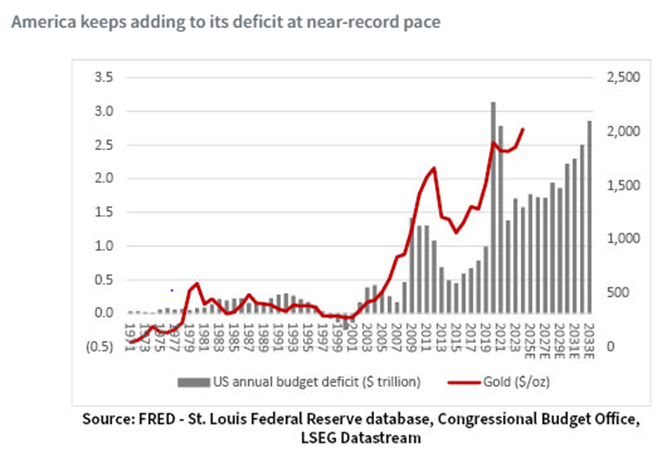
Debt-to-GDP is one barometer to watch, but according to the Bank of International Settlements it should be studied in conjunction with the percentage of tax income that is used to meet the interest costs. When that latter figure got to around 20% in 2007 (and was still rising), the financial markets buckled and nearly took the global economy with them.
FRED – St. Louis Federal Reserve database, Congressional Budget Office, LSEG Datastream
China and France are the two countries in this invidious position now, but the USA is catching up fast, as the Biden administration spends like fury on the CHIPS and Inflation Reduction Acts.
America’s latest annual fiscal deficit was $1.7 trillion, in the year to September 2023, the third-worst number on record, and the annualised interest bill has hit $1 trillion, or 20% of tax income. America cannot afford to keep interest rates where they are for long and there is a risk that the Fed has to cut rates to keep the burden manageable and take risks with inflation. This may be why gold (and Bitcoin, for that matter) are on a roll. Markets are pricing in five rate cuts from the Fed in 2024, but because inflation is cooling and growth benign, not because debt is a problem and interest costs are squeezing economic growth.
Wages
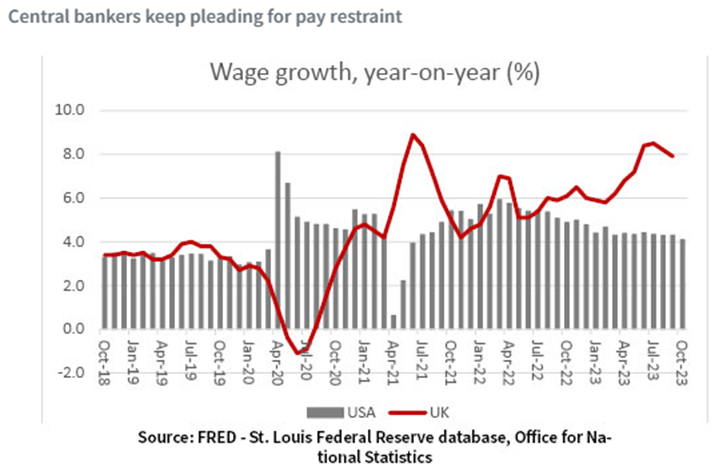
The 1970s’ inflationary outburst may have been prompted by loose monetary policy in the UK (and loose fiscal policy in the USA), followed by 1973’s oil price shock, but a vicious circle of higher pay demands, higher prices, higher pay demands, and higher prices then developed.
FRED – St. Louis Federal Reserve database, Office for National Statistics
Financial markets may therefore cheer a modest increase in unemployment, and central bankers accept it, as higher joblessness could help to put a lid on wages and inflation and thus provide scope for rate cuts. Equally, a sharp rise in the jobless rate could signal economic trouble, or at least more than is currently factored in by consensus earnings forecasts, so policymakers have a tricky balancing act here.
The Magnificent Seven
The stock
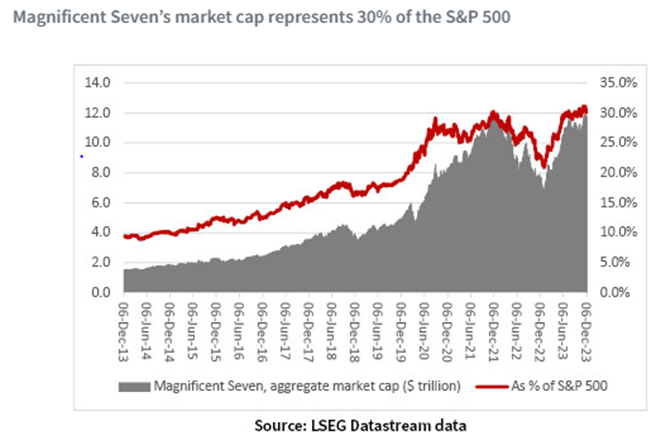
markets’ rally in 2023, and the return to favour of Alphabet, Amazon, Apple, Meta, Microsoft, NVIDIA and Tesla, suggests equities are pricing in an economic soft landing and a return to the low-growth, low-inflation and low-interest-rate environment of the 2010s that did so much to help the performance of long-duration assets like bonds and growth sectors, such as technology.
LSEG Datastream data
They might be right. But if they are wrong – and those five Fed rate cuts do not appear on schedule in 2024 – then the Magnificent Seven’s aggregate $11.8 trillion market cap could look exposed, for all of their dominant positions in their respective industries. Their share price and profit wobbles of 2022 showed they are not entirely immune to the economic cycle, so an unexpected recession could be one challenge. Sustained inflation could be another if it keeps rates higher than expected and boosts nominal growth from downtrodden cyclicals and value stocks. Again, only a perfect middle path may do.
The yield curve
Bond yie
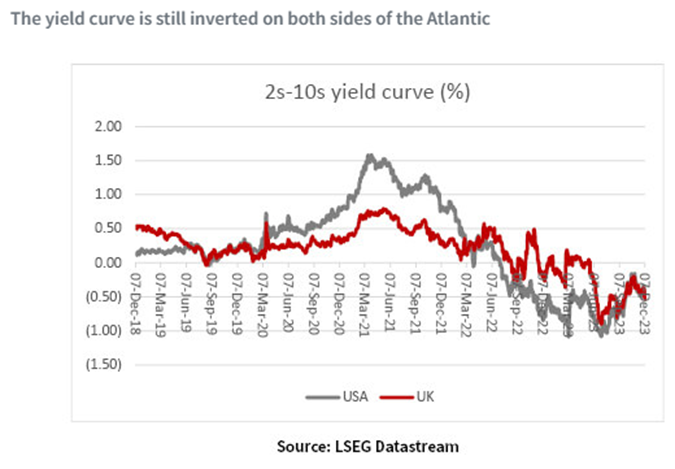
lds are falling again, but the yield curve remains inverted, whereby ten-year yields on Government bonds are lower than those on the two-year in the UK and USA. This is seen as a warning that a recession is on the way, as it means bond markets are factoring in interest rate cuts (the ten-year would usually have to offer a higher yield to compensate holders for the extra risk scope for things to go wrong over the longer lifespan of the debt).
LSEG Datastream data
It is not an infallible signal, but examples of soft economic landings are hard to find and stock markets are currently doing their best to ignore the bond market’s quite different message.
Oil and copper
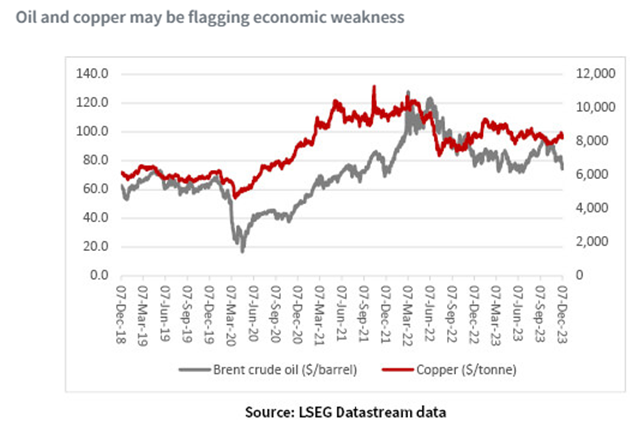
If equities are pricing in a soft landing and fixed-income markets a harder one, commodity traders are even more confused. Oil’s renewed weakness may speak of recession. Copper, a reliable indicator of global economic health due to its many uses, is doing nothing. Gold looks to be fretting about debts and stagflation.
LSEG Datastream data
The messages from stocks, bonds and raw materials are therefore contradictory. But such are the globe’s debts that it seems likely central banks (and politicians) would rather play fast and loose and risk inflation or stagflation than recession and deflation. The experiences of 2007-09 and 2020-21 would suggest as much, anyway.
Past performance is not a guide to future performance and some investments need to be held for the long term.
Please check our blog content for advice, planning issues and the latest investment, market and economic updates from leading investment houses.
It has been another really interesting (probably too interesting?) year for us with markets, economies and invested assets being challenged again throughout 2023.
Although it has been a very bad year for conflicts globally and the ongoing human cost, this has not been the main focus for investors. Central bank’s policies globally has been the focus for investors. We continue to watch and interpret the data around inflation, interest rates, productivity and employment in particular. Keeping a close eye on wage inflation.
The good news is that central banks such as the Fed, the Bank of England and the European Central Bank (ECB), look like they may have stopped increasing interest rates. Interest rates may have plateaued. Markets are now looking at when interest rates might fall, and this could be as early as the second quarter of 2024 for the UK perhaps? And the second half of 2024 for the Fed and the ECB?
When interest rates do fall, we should see an improvement in investments. In J P Morgan’s view (Long Term Capital Markets Assumptions Report and webinar launch 30/10/2023), we are in a better position for investment returns than we have been for a few years, in a more normalised market.
J P Morgan state the need for a well diversified portfolio given the current outlook, with both ‘active’ and ‘tactical’ fund management.
This appears to be the broad consensus view, although as ever, we have both Bears and Bulls. A few fund managers are sitting on the fence and making provision for either outcome.
However, over the long term, history has proven that invested assets significantly outperform cash. You just need to remain invested and focus on your long-term objectives.
Business Update
We have had a busy year again here at P and B IFA. Our focus remains on servicing our existing clients and keeping them up to date with what is going on in our world and anything that might have an impact on our clients’ plans.
This year we have had significant legislative change for pensions in the Spring Budget with further clarification in the Autumn Statement and in the detail in the Autumn Finance Bill. These changes are generally good news for our clients but not without complexity.
However, from a tax point of view we continue to see reductions in allowances and stealth taxes as some allowances and tax thresholds remain frozen, and other thresholds lowered. This all results in a bigger tax take for the State.
Being tax efficient and using your allowances is more important than ever.
In addition regulatory change moves at a pace with the implementation of Consumer Duty regulations at the end of July. These changes are as ever about protecting our clients, this time they come with significant time cost to the business.
Thankfully, the use of digital technology for meetings, cutting out a lot of travel time, has allowed me to deal with the legislative and regulatory changes without working 24/7, although I don’t think I’ve ever worked harder.
We continue to work on the business and I’ve taken input from several external consultants over the year as we continually strive to offer a great service to our clients. This is to the benefit of our clients and our staff. I’ll keep you posted on any developments.
Consumer Duty regulations apply more broadly than to just IFAs like ourselves. The good news here is that we hope that the new regulations will help us receive a better service from providers, life offices and platforms etc. Now we spend too much time as the buffer working on behalf of our clients. This year we have had to educate the staff at life offices and platforms about the new pension legislation changes, so that they can understand our instructions on behalf of our clients.
It was worthwhile in the end. From a pension legislation point of view, we are in a better place than at the start of 2023.
Summary
It has been a busy year for all of us, but I think we are in a better place now. Things have moved on for economies, markets and invested assets and I feel like we are making progress, although risks remain, and volatility could continue for a while.
We have improved pension legislation too, that is good news and should help us keep our pension funding at the right level as for most of us it is extremely tax efficient.
Compared to this time last year, I’m feeling more positive about the new year. It won’t be straight forward, but I think we are starting to see improvements to the outlook.
Politically it will be an interesting year, hopefully with a normal democratic process, particularly in the US.
Wishing you and yours a healthy, happy and prosperous New Year. I’d love to see an outbreak of peace and goodwill globally.
Please see below an article published by Brooks Macdonald which was received yesterday afternoon and outlines their outlook for markets in 2024:
Glass half empty or full? Outlook 2024
As we near the end of 2023, we are at a crossroads for both economies and investments. During 2023 sentiment has oscillated between two different investment scenarios, the glass-half-full camp, and the glass-half-empty camp. The challenge is to construct portfolios while recognising that either scenario could occur. Given the uncertainty which prevails, we believe that maintaining a balance is key.
2023 has been a year in which investment markets have encountered cross winds. On the positive side, equity markets have benefited from a new age in technology, driven by generative artificial intelligence (AI). At the same time, geopolitical risks have heightened with Russia’s ongoing invasion of Ukraine alongside the conflict in the Middle East between Israel and Hamas. Furthermore, China-US relations remain fraught, despite recent efforts to improve them.
Inflation is the key focus for policy makers and with interest rates clearly in restrictive territory, the glass-half-empty camp is waiting for the full impact of higher interest rates on consumers and companies. At the same time, any worsening of the situation in the Middle East or tightening of supply by the OPEC+ members would lead to a rise in the oil price, causing further upward pressure on inflation.
The glass-half-full camp believe that given labour markets remain tight, wage growth will be robust. In the US, many consumers still have post-pandemic savings to spend and unlike in the UK, for example, have 30-year fixed rate mortgages meaning they are insulated from the recent rate rises.
The key question for both camps is whether consumers and companies will remain solvent while policy makers wait for inflation to fall back to the Central Banks’ targets.
How did we get here?
After a tough 2022 when both equities and bonds posted negative returns, 2023 has seen a recovery, at least in equity markets. At the time of writing, government bonds are still in negative territory, despite the fall in yields (and corresponding rise in prices) seen since the peak of mid-October. The MSCI All Country World Index is up 10.4% in total return, sterling terms. However, the same index adjusted on an equal-weight basis (where each stock has an equivalent weight in the index, removing the dominance of so-called ‘mega-cap’ stocks), is down -1.4%. This difference highlights the impressive performance of a small number of technology-related names which are perceived to be beneficiaries of AI.
The age of Generative AI
The new age of AI started with the launch of Chat GPT in November 2022. Chat GPT is what is known as a large language model-based chatbot developed by Open AI, enabling users to generate media (be it text, code, pictures and more). By January 2023 it had over 100 million users per month and was the fastest growing consumer software application in history. Investor attention turned to companies believed to be the enablers of AI, particularly those focused on designing the necessary
The picture in Euro Area and the UK is less robust, with the IMF forecasting growth of less than 1% in 2023 and an only modest recovery in 2024.
semiconductors: Nvidia, the US chip designer, has risen by comfortably more than 200% year to date. The key question is the size of the productivity gains across the broader economy. The US National Bureau of Economic Research looked at a staggered introduction of a generative AI-based conversational assistant using data from over five thousand customer support agents and found that access to the tool increased productivity, as measured by issues resolved per hour, by 14% on average. Clearly gains of this magnitude will help mitigate the effects of higher interest rates and wage costs.
Corporate earnings growth remains robust
After the boost from the post pandemic recovery, corporate earnings growth expectations are lower but still in positive territory. Data from Factset indicates that companies are delivering better than expected earnings-per-share numbers at an historically high rate. Looking ahead to 2024, current consensus estimates point to an expected annual US company earnings growth rate of over 11%. The operating environment is also becoming more favourable: post pandemic supply chain disruptions have ceased and trade volume growth of 3.3% in 2024 is expected, compared to 0.8% in 2023*.
Economic growth picture still mixed
Central Banks continue to face the challenge of bringing down inflation while avoiding a recession. They also must ensure financial stability and avoid a situation such as the failure of regional US banks in Q1 2023. The three main regional drivers of growth are the US, Europe (including UK) and China. The US reported annual real GDP growth of 4.9% in Q3 2023, well ahead of the Fed’s own estimate of long-term real GDP growth of 1.8%. Growth in China remains healthy, with the IMF forecasting China’s real GDP growth in 2024 of 4.6%.
However, the picture in Euro Area and the UK is less robust, with the IMF forecasting growth of less than 1% in 2023 and an only modest recovery in 2024. These differences illustrate the importance of using an asset allocation framework that can adjust for regional settings.
Investors face three outcomes for economic growth. First, a hard landing, which is a contraction in economic activity, sharply rising unemployment, and a collapse in consumer spending. Second, a soft landing, with a gradual slowing of growth, a recession avoided and a moderate rise in unemployment. Third, no landing, with economic growth continuing at the current rate. The first outcome would imply we should reduce equities and add to longer duration bonds, given the likelihood that interest rates would then be cut significantly. If the third were to materialise, we should add to equities and reduce more defensive assets such as fixed income. Over the course of the year, the soft landing outcome has become more likely but far from certain, so we aim to maintain a balance within portfolios for investors.
Bonds: income is back
Over the course of the past two years, the rise in bond yields has meant that bonds can once again provide a counterbalance to other asset classes within portfolios. This increase in yields available from longer dated bonds gave us the opportunity to increase slightly the duration within the bond portfolios, thereby locking in higher yields. We believe it is too soon to increase duration significantly though, given the risk that inflation may persist for longer. Within corporate bonds we continue to prefer higher quality investment grade bonds over the more speculative high yield, as we believe the additional yield available does not adequately compensate us for the additional risk of the latter.
The equity barbell remains in place
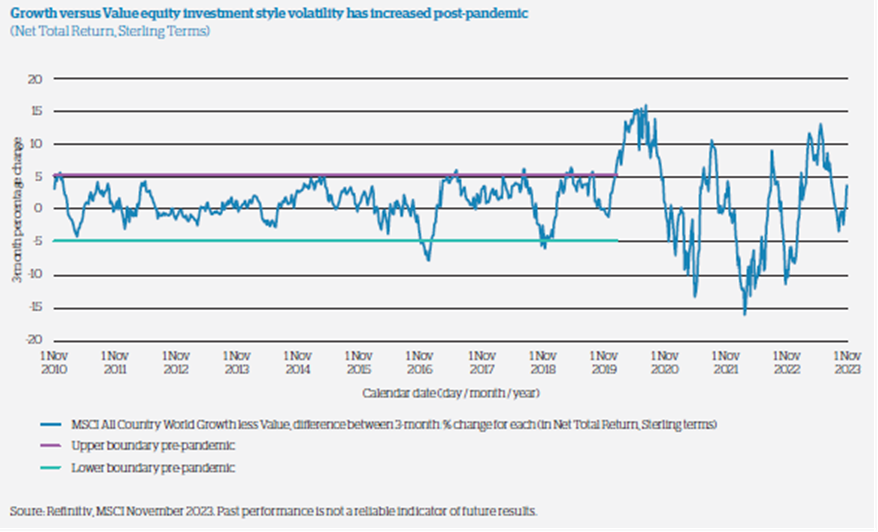
The graph below shows how, since the pandemic, the style leadership of the equity market has changed more frequently and become more pronounced. For this reason, we have implemented a barbell approach in the equity portfolios, whereby we aim to achieve an equal weighting of both value and growth investment styles. Given the range of possible economic scenarios together with current heightened geo-political risks, the barbell approach remains. Despite this balance, we continue to take conviction views on a geographical basis, emphasising the different investment styles through our core equity and thematic exposures.
Conclusion
As we weigh up the investment outlook, the challenge for asset allocators is how to take a calculated position to keep exposure to more than one economic scenario materialising. There is currently insufficient visibility for us to back a single sustained outcome. Instead, staying invested but keeping balance continues to be our goal.
Please continue to check our Blog content for advice and planning issues and the latest investment, markets and economic updates from leading investment houses.