Team No Comments

Tatton Investment Management: Tuesday Digest

Please see below, an article from Tatton Investment Management, providing a brief analysis of the key factors currently affecting global investment markets:

Volatility drops but uncertainty remains 

Markets were calmer last week but there was no strong rebound. Falling government bond yields were welcome, after the previous week’s spike in US treasury yields. It now looks like markets once again see tariffs primarily as a growth negative. 

Federal Reserve Governor Waller backed that up by suggesting the Fed may have to cut interest rates – but his boss Jerome Powell prefers a wait-and-see approach. Powell’s caution earned him a full-throated attack from Donald Trump, setting up a fight over Fed independence that could rattle bonds once again. They could also be rattled if China uses its nuclear option of selling its vast stock of US treasuries – made likelier by the ban on Nvidia H20 chip sales to China. 

Lower yields mean greater liquidity, easing credit pressures and lower implied market volatility. Those conditions help build investor risk appetite, and should mean people are more willing to buy stocks. We saw some of that appetite after Taiwan’s TSMC beat its profit forecasts. The chipmaker’s results cheered on tech stocks, proving there is life in the AI boom yet. 

We should remember, though, that lower implied volatility (measured by the VIX index) doesn’t mean markets will actually be less volatile. Contrary to the risk-on interpretation, gold prices – the stereotypical safe haven – reached a new all-time high. Returning liquidity will only flow to stocks if they’re seen as profitable, and Trump’s policy chaos undermines that profit outlook. Even TSMC admitted that its earnings could have been driven by a rush to buy ahead of tariffs. 

Uncertainty is bad for corporate outlooks, as other company earnings are showing. But the worst may not happen – and there are some encouraging signs: resilient consumer demand everywhere, lower UK and European inflation, and internal opposition to Trump’s economic disruption. Long weekends can sometimes make for nervous trading, but we hope markets are still calm when we return.

Britain on the path to lower rates

UK inflation fell more than expected in March, giving the Bank of England (BoE) scope to cut interest rates. Encouragingly, prices were softer for both goods and services. Revisions to employment data also showed that Britain’s labour market isn’t as tight as feared – and in fact may be seeing layoffs. That relieves inflation pressure and should make the BoE more in line with the dovish European Central Bank (ECB). UK bond markets (gilts) moved to price in a 25 basis point cut at the BoE’s meeting next month, and two more by the end of the year. 

Britain’s economy is, of course, Trump-sensitive, but US tariffs will likely mean lower inflation and weaker growth for the UK. This isn’t just due to lost US demand, but redirected goods flooding UK markets (British retailers have warned of Chinese ‘dumping’ because of Trump tariffs). Tariffs would only be inflationary if Britain retaliated, but Downing Street shows no appetite for a tit-for-tat. In fact, it’s more likely the UK tariffs China to sweeten a US-UK trade deal, which would also align with the government’s desire to protect British Steel. Any such tariffs would likely be designed to counterbalance the influx of Chinese goods, and hence are unlikely to be inflationary on balance. 

Many have worried about government spending potentially pushing up inflation – leading to sporadic gilt tantrums in the last six months. That perception doesn’t match actual fiscal policy, which has tightened. In any case, the higher ‘risk premium’ for gilts can give you the wrong impression of markets’ inflation expectations. Mortgage rates have fallen, suggesting softer prices and ultimately lower BoE rates. 

The government seems to view lower rates as the best economic support, rather than fiscal policy. The BoE is likely to give it to them, which is why we think long-term gilt yields look attractive. 

Please continue to check our blog content for the latest advice and planning issues from leading investment management firms.

Andrew Lloyd

22nd April 2025
Team No Comments

EPIC Investment Partners – The Daily Update

Please see the below article from EPIC Investment Partners detailing their discussions on the factors weakening the US Dollar. Received this morning 17/04/2025.

Some clients have been asking whether the United States could lose its two star rating under our Net Foreign Assets (NFA) framework. While a formal downgrade to one star (the lowest rating) remains unlikely, this perspective illuminates how capital reallocates under stress and explains why the US dollar has been weakening in the current volatile markets—despite its traditional safe haven status—and highlights vulnerabilities to sudden outflows that conventional indicators may miss.

NFA measures a nation’s cumulative current account deficits adjusted for valuation shifts—such as changes in exchange rates, equity prices, and other asset values. When a country’s deficit roughly matches its nominal GDP growth, the NFA to GDP ratio stays stable; larger deficits weaken it, while surpluses or faster growth strengthen it. As the world’s reserve currency, the US benefits from dollar denominated liabilities that are largely insensitive to foreign exchange swings. Nevertheless, valuation changes—particularly equity market movements—still matter. Relative strength in US stocks inflates external liabilities, while sharp sell offs can moderately improve the NFA position.

Beneath these valuation effects lie deeper structural pressures. Chronic under saving relative to investment, persistent fiscal deficits, and a national debt exceeding 100% of GDP make US debt servicing increasingly burdensome. Demographic headwinds—slower growth in the working age population—further constrain potential output, limiting the extent to which productivity gains can offset fiscal and demographic drags.

However, the most decisive driver of capital flows during stress events is the mathematics of Value at Risk (VaR) models. Widely used by institutional investors, VaR algorithms attempt to cap expected losses by automatically adjusting portfolio risk to market volatility. In calm markets, VaR permits greater leverage, encouraging risk taking and asset-price appreciation. When volatility spikes, it forces systematic deleveraging to meet stricter risk thresholds.

This mechanism is entirely mechanical: as volatility inputs rise, risk metrics tighten, compelling portfolio managers to sell assets until they comply with VaR constraints. Since the largest providers of capital are institutions based in creditor nations, this forced deleveraging translates directly into capital withdrawals from debtor economies—including the US.

The currency effects are predictable. During recent stress episodes, the dollar weakened sharply while the Japanese yen, Swiss franc, Canadian dollar, and euro appreciated. For example, the Canadian dollar’s rally reflected Canada’s superior external position and stronger NFA standing. These moves result directly from VaR driven risk limits interacting with underlying NFA fundamentals.

The same principles apply to sovereign bond markets. Creditor nations with robust NFAs generally enjoy lower yields, while debtor nations face higher borrowing costs. The NFA differential fully explains the gap between US and Canadian government bond yields, and the same principle applies across the sovereign bond market—provided you know each country’s relative NFA standing.

Monitoring volatility indicators—such as the VIX index and credit-spread levels—provides early warning of impending capital shifts. VaR driven flows can override traditional safe haven assumptions: as volatility rises, capital systematically migrates from larger debtor nations (now including the US) into high NFA currencies and high credit-quality bonds. Recognising this dynamic—and acknowledging the gradual deterioration of the US NFA position—is essential for positioning portfolios during this and the inevitable next wave of market stress and capital repatriation.

Please continue to check our blog content for advice, planning issues and the latest investment, market and economic updates from leading investment houses.

Alex Clare

17/04/2025

Team No Comments

Brewin Dolphin – Markets in a Minute

Please see this week’s Markets in a Minute update below from Brewin Dolphin, received yesterday afternoon – 15/04/2025.

How have U.S. tariffs affected the markets

We examine the market response to the latest tariff announcements

Trade wars are good and easy to win

Trade Policy

Source: LSEG Datastream

The infamous quote from U.S. President Donald Trump, made during his first term, maintained that trade wars are “good and easy to win”. But last week, the opposite looked true for the trade war. 

The announcement made a couple of weeks ago of a 10% universal tariff, and individual tariff rates of up to 50%, put America’s weighted average import tariff on a path towards 28% and hit the stock market hard. It raised concerns for U.S. growth, questions over the judgement of the Trump administration, and indicated prices for goods in the U.S. would rise.

Last week, these concerns moved from the equity market to the bond market. Bond markets have a history of ending misguided policies. In September 2021, a riot in the bond market brought down Liz Truss’ doomed UK premiership, as she unveiled an expansionary budget at a time when UK spare economic capacity was very low. Going back even further, it was the currency market that caused the UK to leave the European Exchange Rate Mechanism at the behest of market vigilantes, led by American billionaire George Soros.

U.S. Secretary of the Treasury Scott Bessent cut his teeth working for Soros. He’s on record as deriding tariffs as being inflationary and causing dollar appreciation. However, towards the end of 2024, while in contention for his current role, he acknowledged their worth as a negotiation tool.

Bessent spoke to President Trump a couple of weekends ago, urging him to take a more measured approach that would give him more leverage. Finally, the respected head of J.P.  Morgan, Jamie Dimon, expressed his concerns about the measures on Fox News. 

We may never know which of these factors led President Trump to change course on tariffs, but that’s what he did.

Individual tariff rates will be deferred for 90 days to allow time for negotiation, according to the administration. The logistics of negotiating more than 60 trade deals seem incredibly challenging, and so most investors expect that these 90 days will inevitably be extended.

The market reaction was violent, with stocks rising nearly 10% in the following session – the NASDAQ actually rose more than 12%. However, investors are under no illusion about an enduring universal 10% tariff still being a headwind – and not all countries were spared.

China saw wild fluctuations in the anticipated tariff rates last week. At the end of the week, some categories of consumer electronics were exempted from the measures. Over the weekend, President Trump confirmed that this exemption was related to the fact that the entire semiconductor value chain would be subject to additional measures, which are scheduled to be announced this week and come into force over the next month or so. Plus ça change…

US Consumer Price Data

Source: LSEG Datastream

Tariffs raise prices for consumers, and although it may seem like we’ve been talking about nothing else for months, we’re still at least a month away from seeing the first impact in official inflation data. Taming inflation is consumers’ top economic priority, a point that the president’s advisers will surely have made in arguing for a more measured range of import taxes.

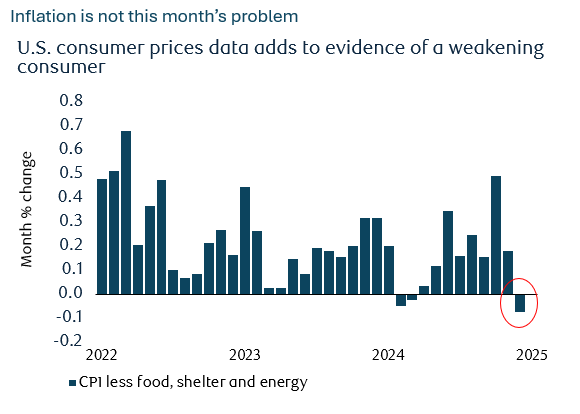
Meanwhile, inflation data for March was a little weaker than expected.

This was partly due to gasoline prices, but there was also a weakness in used cars and core services (with airfares and hotel rooms being the key categories). This suggests that consumers may be cutting back in anticipation of a weaker economy.

It won’t last, of course. From next month, prices should start to reflect tariffs and are likely to rise to a pace of 4% this year.

The persistence of inflation is hindering hopes that the Federal Reserve might provide some relief for the embattled U.S. consumers and markets. However, the odds of a rate cut in the early May meeting have dropped sharply since the tariff U-turn.

Chinese Inflation

Source: LSEG Datastream

Away from the U.S., news that some tariffs will be deferred reduces the headwinds for growth.

It’s true that many non-U.S. countries are far more open than the U.S., meaning that trade – both imports and exports – forms a large share of gross domestic product (GDP). But these countries are only suffering a big increase in tariffs on the U.S. portion of their trade, unlike the U.S. itself, which is suffering tariffs on all its trade. So, lower tariffs affecting a share of their growth is incrementally good news, which means the headwind to growth is lower. Meanwhile, any weakness in demand from the taxed U.S. import market seems likely to weigh on prices in other international markets.

China is the exception; its individual tariff rates weren’t reduced. In fact, they were raised further to 145%, making China more of an isolated target than had been the case at the beginning of the week. However, as mentioned above, following this latest increase, there was some considerable relief given in the form of exemptions for some consumer electronics.

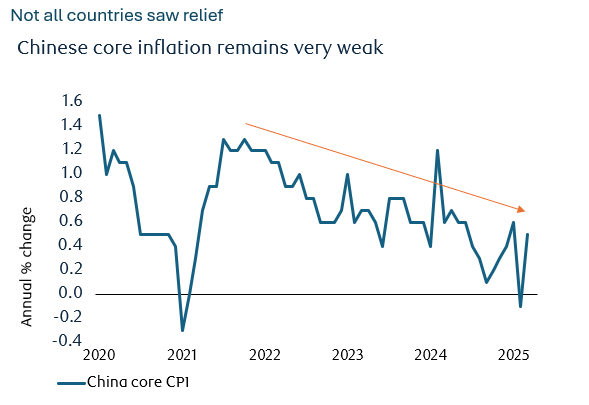
This will likely weigh heavily on Chinese growth but could present an investment opportunity. The Chinese authorities are not fighting inflation like other central banks, meaning that they can deliver stimulus to their consumers without risking high prices.

Furthermore, President Trump has signalled a willingness to negotiate with China. So, low expectations, the likelihood of stimulus measures, and the possibility of trade deals in the future that could see a sharp cut to tariffs could combine quite powerfully to revive flagging Chinese stocks.

Please continue to check our blog content for advice, planning issues and the latest investment market and economic updates from leading investment houses.

Charlotte Clarke

16/04/2025

Team No Comments

Brooks Macdonald: Daily Investment Bulletin

Please see the below article from Brooks Macdonald, analysing the key factors currently affecting global investment markets. Received today – 15/04/2025

What has happened?

The relief rally continued. The S&P 500 climbed 0.79%, securing its first back-to-back gains since the 2 April tariff announcement. The decision over the weekend to exempt smartphones and electronics from tariffs fuelled investor optimism for further tariff reductions, creating a positive backdrop for stocks and signalling that market stress is starting to ease. Tech hardware leaders like Apple (+2.21%) and ASML (+2.20%) outperformed, while automakers also rallied after President Trump’s comments hinted at softer auto tariffs. Broad market strength saw 85% of S&P 500 stocks advance. Volatility continued to fall back too, with the VIX index coming down to its lowest since April 3. On the other side of the Atlantic, Europe’s STOXX 600 gained 2.7%, and UK’s FTSE 100 gained 2.1%.

Bond market breathes a sigh of relief

While stocks rallied, the bond market offered perhaps the biggest relief for investors. Last week, fears of financial turmoil spiked as the 10-year Treasury yield jumped 50 basis points (the largest weekly increase since 2001). But yesterday, those concerns began to fade as the yield fell from 4.49% to 4.37%. Additional reassurance came from the New York Fed’s latest Survey of Consumer Expectations, released for March. The survey showed that long-term inflation expectations remained stable, with the 5-year measure even dipping slightly to 2.9%. This contrasted sharply with the University of Michigan’s survey, which reported a surge in long-term inflation expectations to multi-decade highs. Fed Chair Jerome Powell has often emphasized the importance of keeping long-term inflation expectations “well anchored,” so the New York Fed’s data was a welcome signal for policymakers and markets alike. While the New York Fed’s 1-year inflation expectation rose to 3.6% (up 0.5%), it was far less alarming than the University of Michigan’s figures, which hit 5.0% in March and 6.7% in April.

What does Brooks Macdonald think?

The pullback in Treasury yields has provided a much-needed boost to market sentiment, especially after last week’s sharp rise dented the appeal of bonds as a safe haven asset. Treasury Secretary Scott Bessent has downplayed concerns about systemic risks, dismissing fears that foreign governments might offload US Treasuries en masse. Instead, he attributed recent bond market volatility to investors unwinding leveraged positions. Given the potential for ongoing yield fluctuations, we favour a relatively shorter duration stance in our fixed income portfolios, which helps limit exposure to these swings and provides a prudent strategy amid persistent tariff and market uncertainties.

Please continue to check our blog content for the latest advice and planning issues from leading investment management firms.

Alex Kitteringham

15th April 2025

Team No Comments

Tatton Investment Management: Monday Digest

Please see below, an article from Tatton Investment Management, discussing the ongoing impact of Trump’s Liberation Day. Received this morning – 14/04/2025

Ceasefire, not truce, in global trade war
Last week had eye-watering ups and downs. US bond yields spiked, prompting Donald Trump to pause his “reciprocal” tariffs for 90 days on all countries except China, which faces a whopping 145% – although somewhat lessened with the exceptions to smart phones and other electronics. Markets welcomed all tariff relief, but the overall average tariffs are still high. The dollar slid, despite higher yields, suggesting the US may no longer be a safe haven.

Trump eventually bowed to pressure from markets and his allies. This was mostly about the US bond selloff – which felt like Trump’s ‘Liz Truss moment. The Truss episode required Bank of England intervention in 2022, and the Federal Reserve may yet have to step in, considering yields haven’t fully recovered. In any case, it’s comforting that the bond vigilante remains powerful. 

We will hope for some policy calm, but the Trump show must go on. This weekend sees high stakes negotiations with Iran, and Trump has threatened force if they fail. We must watch this space. The 90-day tariff reprieve could also obstruct tax cuts, as tariff revenues were supposed to fund them. If Trump pushes ahead anyway, a second ‘Donald Truss’ moment could ensue in bonds. 

After Trump’s capitulation, investment banks are divided on whether a US recession is coming this year. Even with smart phone exceptions the 145% Chinese tariff means huge disruption to global trade and can seriously hurt both the world’s largest economies. The current Q1 earnings season has started well, but markets’ focus is all on what happens from here. We could actually see a short-term consumption boost if Americans rush to buy in the 90-day window, but that wouldn’t change the fundamentally weaker outlook. Companies’ forward guidance statements are therefore important. 

It’s a challenging environment for equities – with weaker growth prospects and more risk-averse markets. Washington stepping back from the brink is positive, but businesses and investors will be wary of putting their money to work. That likely means lower trading volumes and choppy price action. 

US exceptionalism has a credit problem 
Trump’s obsession with ‘fixing’ the US trade deficit causes such allergic reaction in US markets, in part because the trade deficit is to some extent why so much global investment flows toward the US. The dollars Americans spend on imports often return to buy US capital assets – considered the world’s strongest and safest. Part of that reputation is the “exorbitant privilege” of owning the world’s reserve currency, and part of it is the America’s track record for profit growth. That has led to a tremendously negative Net International Investment Position (NIIP), the amount of US assets owned by foreigners. The capital flow into the US markets has benefitted asset valuations, and hence US companies. 

Some call this a virtuous cycle, but the NIIP isn’t all rosy. Assets are supported by continual flows, which you might cynically call a Ponzi scheme. Even disregarding cynicism, it means a big chunk of US profits go to foreign stockholders rather than Americans. Trump has even called this a national security concern, with regards to Chinese ownership.

Cutting trade deficits stops the flow of dollars out – but that also means reducing American consumption, which has been the lynchpin of US growth. Profits become less exceptional and so valuations fall.

This adjustment has been made worse by Trump’s chaotic execution. Investors started panicking that high US valuations were built on sand. This was initially a problem for equities and the dollar, but last week the panic spread to bond markets – a sign that the trade war had uncovered landmines in global finance. There is now a risk that the dollar loses its reserve status. This is still unlikely, but it gets more likely the worse the policy outlook (and markets’ reaction) gets. 

Central banks have already been swapping dollars for gold since Russia’s SWIFT exit. If Trump is not careful, he might get the weaker dollar he wishes for. 

Anatomy of a bond rout
Spiking government bond yields last week felt like Donald Trump’s ‘Liz Truss moment’. The equity selloff after “Liberation Day” originally pushed bond yields down, as global growth prospects dwindled, but that suddenly reversed last week. China was rumoured to have started the bond selling, but it snowballed due to leveraged traders (hedge funds) selling bonds to cover their equity losses. The problem in US bonds spread to the closely correlated UK market – while European yields reacted more mildly. 

People call government bonds “risk free” but we have two important measures of their risk: the spread between long and short-term yields (term premium spread) and the spread between government yields and interbank swap rates (the swap spread). These measures have been worsening for a while. 

If we think central banks will print money for their governments in a pinch, then higher swap spreads make bonds look cheap. Hedge funds have been able to make money off this spread, but last week’s yield spike wiped out the differential and forced them to close their positions – including one highly leveraged Japanese fund that reportedly went bust. This short squeeze on yields doesn’t show weakness in the bonds themselves, but rather that overleveraged hedge funds didn’t have enough cash to meet margin calls. That’s the same problem UK pension funds had during the Liz Truss fiasco. 

The end result is that bonds look cheap – particularly in the UK, where the spike seemed to purely be a reaction to the US. You could argue US government debt has a “moron premium” right now, but that’s not the case for the UK, which has consistently displayed fiscal resolve and has funding options available. If we step back from the panic and stay level-headed, long-term UK bonds look like a buying opportunity. And when markets lose their heads, keeping yours often pays off. 

Please continue to check our blog content for the latest advice and planning issues from leading investment management firms.

Marcus Blenkinsop

14th April 2025

Team No Comments

Brooks Macdonald The Daily Investment Bulletin

Please see the below article from Brooks Macdonald detailing their discussions on Trump Tariffs and the ongoing impact this continues to have on markets. Received this morning 11/04/2025.

What has happened

Equity markets continued their recent bout of volatility yesterday, with the US S&P500 equity index only narrowly missing out on extending its 5-day run of intraday moves of more than 5%. The US S&P500 equity index on Thursday moved in an intraday range of 4.65% between the day’s low and high. That intraday range is still huge, but it reflects just how uncertain markets are currently that the move was less than half of the intraday range that we saw the day before on Wednesday. One catalyst for market gyrations yesterday was the US clarifying even higher tariffs on China, with that news overshadowing a welcome lower-than-expected US annual consumer inflation print of +2.4% for March.

A tariff clarification

The US White House issued a memo yesterday to clarify that tariffs on China were actually at 145%, not 125%. The 20-percentage-point hike was, the White House clarified, because the US President Trump administration was adding on top of the latest reciprocal 125% tariff rate, the 20% tariffs imposed from earlier this year related to Beijing’s alleged role in the production and supply of fentanyl into the US. With renewed fears of a disorderly economic decoupling between the world’s two biggest economies, it sent the US S&P500 equity index down -3.46%. European equity markets might have looked better yesterday (with the pan-European STOXX600 equity index up +3.70%), but that is only because Europe was playing catch-up with an even better US evening trading session the day before (all in local currency price return terms).

Are US Treasury government bond markets still in charge?

Since Trump’s 2 April reciprocal tariff ‘Liberation Day’, we have seen US equities, US bond markets and the US dollar all under pressure. While there might be technicals at play, and some news reports have suggested the recent moves are in part down to hedge-funds unwinding leveraged positions, the risk is that if this continues this could collectively resemble capital flight out of the US – as a case in point, it is notable that US 30-year Treasury yields are currently on course for their biggest weekly rise since the 1980s. The US Treasury market has long-been considered the ultimate safe-haven asset off which everything else is priced – so when earlier this week US government bond prices fell alongside weak demand for a Treasury 3-year bond auction, one theory is that it was this that triggered Trump’s rapid U-turn, and his partial tariff 90-day pause.

What does Brooks Macdonald think

At this point in the US-China trade war, any further hike in tariffs is meaningless – with US tariffs on China at 145%, and China tariffs on the US at 84%, at those rates it effectively amounts to a double-sided trade embargo in all but name. The hope in markets is that Trump, just like he did with other tariffs earlier this week, might walk-back the tensions with a ‘pause’ on US-China’s trade war too. If US Treasury government bond markets push back against Trump’s plans as they appear to have done earlier this week, a Trump ‘blink’ might well come sooner rather than later.

Bloomberg as at 11/04/2025. TR denotes Net Total Return.

Please continue to check our blog content for advice, planning issues and the latest investment, market and economic updates from leading investment houses.

Alex Clare

11/04/2025

Team No Comments

Brooks Macdonald: Daily Investment Bulletin

Please see below, an article from Brooks Macdonald analysing the key factors currently affecting global investment markets. Received today – 10/04/2025

What has happened?

Yesterday saw equity markets move from despair to euphoria. While European equity markets had already closed down for the day trapped under fears of ever-escalating tariff wars, the later-trading US equity markets rocketed when the announcement came at 6.18pm UK-time from US President Trump on his ‘Truth Social’ social media network that he was immediately pausing reciprocal tariffs above a 10% baseline for 90-days for most countries excluding China (while separate Canada and Mexico tariffs would be left unchanged). The US S&P500 equity index notched up its fifth day in a row of intraday moves over 5%, with yesterday’s intraday range at over 10%, as the index jumped from losses at the start of the session, to finish up +9.52%, its biggest one-day gain since 2008. The US Nasdaq technology equity index finished up +12.15% to post its biggest one-day gain since 2001, all in local currency price return terms.

A 90-day Trump partial tariff pause fires up markets, but US-China trade war escalates

While Trump’s 90-day tariff pause news fired up markets, the US-China trade war has ratcheted up another notch. After a rapid tit-for-tat trade war escalation over the past week, where we now stand is that the US is levying 125% tariffs on Chinese goods coming into the US, while China is levying 84% tariffs on US goods going the other way. Even here, though, Trump offered some hope that the stand-off between the world’s two biggest economies might yet get resolved. Signalling that the US President was open to a conversation with Chinese President Xi Jinping, Trump said yesterday that “we will get a phone call at some point and then it’s off to the races.”

Bank of England warns of “the probability of adverse events”

Yesterday saw a warning from the Bank of England’s (BoE) Financial Policy Committee about second-order market impacts following Trump’s tariffs over the past week. In minutes released across two meetings held on 4th and 8th April, the BoE warned that “the risk of further sharp corrections remains high”, and that “the probability of adverse events, and the potential severity of their impact, has risen. The BoE went on to warn that “heightened global uncertainty and perceived higher economic risk could translate into tightened financing conditions”, while “vulnerabilities [such as leverage and credit market interconnections] could amplify shocks.”

What does Brooks Macdonald think?

A 90-day pause of the worst parts of Trump’s reciprocal tariffs is a huge relief for markets, but we are not out of the woods. While major US bank Goldman Sachs has overnight dropped its call for a US recession, this might be premature: the pause in some tariffs is still only a delay and not a cancellation, the blanket 10% tariffs are still in force, and the US-China tariff war looks worse not better, for now at least. The longer that Trump’s tariffs (whether in force or paused) remain, the greater the risk that something might ‘break’ in global financial markets, which could in turn impact economies more broadly. Over the past 24-hours, Trump has once again proved his proclivity for changing his mind on policy but with the tariff genie out of the bottle, restoring the confidence of businesses to invest or consumers to spend could be a lot harder to turn-around.

Please continue to check our blog content for the latest advice and planning issues from leading investment management firms.

Alex Kitteringham

10th April 2025

Team No Comments

Brewin Dolphin – Markets in a Minute

Please see this week’s Markets in a Minute update below from Brewin Dolphin, received yesterday afternoon – 08/04/2025.

Understanding the global stock sell-off

We examine the market response to President Trump’s trade offensive.

Liberation ‘Obliteration Day’

‘Liberation Day’ arrived on Wednesday, and the measures announced were at the more severe end of expectations. We understand from leaks that the Trump administration was still debating at what level to set tariffs until the eleventh hour, but they seemed pretty set by the time President Donald Trump spoke in the White House Rose Garden.

Although the president ordered a review of all unfair trade restrictions, the actual tariffs were set at half the level of each country’s trade surplus against the U.S. If that seems arbitrary, what was even more so was the fact that countries in deficit to the U.S. were still hit with a tariff, undermining any credibility to the spurious claim that surpluses are evidence of protectionism.

It’s an outrageous opening offer from a president who prefers making deals to policies. As he says in his book ‘The Art of the Deal’, “I always go in with a very low offer, and I always assume that the other side will negotiate.” But has he overplayed his hand?

After the Trump bump, the Trump hump and into the Trump slump

Trump's Tarrifs

Source: LSEG Datastream

U.S. equities have noticeably underperformed European stocks, with individual companies reflecting the folly of protectionism. Apple has a business model in which its manufacturing is done in China and Vietnam – two countries at the more severe end of U.S. tariff announcements. Maybe this is activity the U.S. would like to be conducted at home, but it doesn’t have the capacity to do so. Nike is a great example of an iconic American brand whose high value-added activities take place in the U.S., while the manual and laborious manufacturing activity takes place where labour is cheaper. Bringing those jobs to the U.S. relies upon American workers being willing to do the work.

President Trump is ready to make deals, but whether there’s any scope to reduce the baseline 10% tariff seems highly questionable, and some potential growth has been diminished. For decades, he has lauded the tariff and bemoaned America’s trade deficit, so he sees tariffs as here to stay, and they’ll be oppressive until the U.S. trade deficit comes into balance. However, tariffs won’t achieve that objective, and so will remain in place. The scope of them is likely to be reduced somewhat, though, due to the president’s fondness for making deals.

Coupled with his clampdown on immigration, some of the key tenets of U.S. exceptionalism are being undermined, and it definitely makes sense to look more widely for investment opportunities.

U.S. added 209,000 jobs in March

The backdrop for last week’s tariff announcements was pretty supportive of a tough Trump bargaining position.

The most obvious data point was Friday’s non-farm payroll report, which showed that a consensus-beating 209,000 new jobs were created in March. This was a surprisingly strong figure, which suggests an acceleration of hiring relative to previous months – quite at odds with the depressed business surveys that have been prevailing recently. In terms of caveats, the last two months did see downward revisions, but they weren’t huge. een signs from the latest shunto (annual spring wage negotiations) that companies are willing to countenance higher payments.

U.S. jobs growth was surprisingly strong in March

Trump's Tarrifs

Source: LSEG Datastream

The unemployment rate rose slightly more than expected, which always seems unintuitive when jobs growth has been strong. This can sometimes be reflective of immigration, although that seems less likely at the moment. Instead, more Americans are entering the job search, which is reflected in a slight recovery in the labour force participation rate.

It’s a little surprising to see these data strengthen. Whilst surveys can be unreliable, particularly at emotional times when there’s a lot of partisanship, there are some distinct reasons for employment to weaken this month that seem incontrovertible; the Department of Government Efficiency (DOGE)’s federal spending cuts, for example.

Whilst it’s difficult to trust the accuracy of the cost-cutting achievements DOGE has published, executive outplacement firm Challenger, Grey and Christmas estimated this week that over 200,000 federal workers had been laid off during March alone. The official data only showed a few thousand job losses, so it may be that the bulk of them appear in next month’s revisions.

Whether accurate or not, President Trump will be emboldened by the apparent strength of the labour market, which will make him a tougher negotiator for trade partners. The good news is that the rise in the unemployment rate, relatively subdued wage growth, and increased labour participation will help make the case that the Federal Reserve should cut interest rates.

(Almost) all that glimmers is gold

Gold sold off on ‘Liberation Day’ as investors took profits, reflecting the fact that bullion is one of a handful of goods that are exempted from tariffs (the others are critical minerals).

The new government is thinking strategically about access to natural resources, and they won’t be the only ones. Central banks have been building up their non-dollar reserve assets in anticipation of a time when requiring a lot of dollars may be less of a priority.

That has been the trend that has pushed gold higher and, aside from the exemption, ‘Liberation Day’ should encourage reserve managers that their diversification strategy is appropriate.

Gold has performed strongly as trade uncertainty has built

Trump's Tarrifs

Source: LSEG Datastream

Please continue to check our blog content for advice, planning issues and the latest investment market and economic updates from leading investment houses.

Charlotte Clarke

09/04/2025

Team No Comments

EPIC Investment Partners The Daily Update | Tariffs, Turmoil, and the Tipping Point

Please see below article received from EPIC Investment Partners this afternoon, which provides further input on the effects of Trump’s tariffs.

The Trump administration’s sweeping tariff regime is creating a perfect storm of economic challenges that could fundamentally reshape global finance. With weighted-average import duties soaring from 3% to approximately 25%, the US economy faces an imminent stagflation crisis—one the Federal Reserve appears ill-equipped to counter. 

This economic predicament will likely manifest itself as US inflation is expected – by some commentators- to reach as high as ~5% within the year, driven by both direct import price increases and opportunistic pricing from domestic producers shielded from competition. Simultaneously, economic growth faces severe headwinds as businesses delay investments amidst trading uncertainty and consumers cut spending. 

The economy’s structural capacity is further undermined by aggressive deportation policies and immigration restrictions shrinking the labour force, while productivity growth stalls. These factors could slash sustainable GDP growth from last year’s 2.5-3.0% to a projected anaemic 1.0%.  

The Fed’s traditional toolkit may prove inadequate for this scenario. While Chair Powell has suggested patience on rate hikes if inflation proves temporary, this approach carries substantial risks. Inflation has already exceeded the 2% target for four consecutive years—a fifth year with accelerated price growth could permanently unanchor inflation expectations, potentially requiring drastic intervention reminiscent of Volcker’s 20% fed fund rates in the early-1980s. 

Compounding these domestic challenges, global de-dollarisation could accelerate, particularly if the Fed withholds dollar liquidity during financial stress. While such a move would require an exceptionally high threshold, it could trigger serious global and domestic repercussions. A dollar shortage might initially strengthen the currency but could ultimately destabilise US markets. Though the Fed is independent, political pressure could steer decisions, with swap lines used as leverage. The irony is clear: isolationist policies and tariff threats may end up accelerating the very de-dollarisation they aim to prevent. 

Despite these concerning developments, significant opportunities remain. Countries accelerating de-dollarisation efforts create openings in alternative currency markets, while companies adapting supply chains present investment prospects in emerging manufacturing hubs. Additionally, the volatile environment offers strategic entry points for value investors as market overreactions create mispriced assets across various sectors. 

Please check in with us again soon for additional relevant content and market news.

Chloe

08/04/2025

Team No Comments

Brooks Macdonald Daily Investment Bulletin

Please see below article received from Brooks Macdonald this morning, which provides a global market update for your perusal.

What has happened

The closing levels in yesterday’s markets disguised some huge intraday swings, highlighting just how febrile the current market sentiment is. As an example of the extreme volatility yesterday, while the US S&P500 equity index closed the day ‘only’ down -0.2%, intraday the index recorded a massive 8.5% intraday swing in local currency price return terms. The catalyst for the huge swing in price action was attributed to a subsequently-proved ‘fake news’ social media post that US President Trump was mulling a 90-day delay to some of his reciprocal tariffs.

A huge intra-day swing in equity markets

A fake news headline that US President Trump was considering a 90-day delay to some of his reciprocal tariffs for countries excluding China sparked a huge rollercoaster move in markets yesterday. The headline appears to have originated from an interview that US National Economic Council Director Kevin Hassett gave on Fox News yesterday, during which he was asked if the US administration would consider a 90-day pause, to which Hassett responded that “I think that the president is going to decide what the president is going to decide.” As a measure of the move, the US S&P500 equity index in local currency price return terms went from a -4.7% drop shortly after the start of trading on Monday, to surge at one point to an intra-day gain of +3.4%, before subsequently unwinding those gains. In percentage terms, the 8.5% swing was the biggest intraday swing in over 5 years for the US S&P500 equity index, since March 2020.

Is Trump still in negotiation mode?

While investors are split on whether US President Trump’s tariffs are a permanent fixture going forwards or just a negotiating tactic, comments from Trump yesterday suggested it might yet still be more the latter potentially. Trump yesterday said that “we have many, many countries that are coming to negotiate deals with us, and there are going to be fair deals”, that “negotiations with other countries [excluding China], which have also requested meetings, will begin taking place immediately”, and later adding that “there can be permanent tariffs and there can also be negotiations because there are things that we need beyond tariffs”. Separately, US Treasury Secretary Scott Bessent yesterday said that “everything is on the table” when asked about the possibility of tariffs being lowered.

What does Brooks Macdonald think

When markets are this volatile, it pays to take a step back from the noise, to try to understand what we do know but perhaps more importantly what we don’t yet know. We know the scale of Trump’s tariffs and we know their planned implementation dates, as well as some retaliatory tariff plans from other countries. However, what we don’t yet know is whether these tariffs will actually end up sticking, and at what rates if at all – as we saw yesterday, even a glimmer of hope that Trump might only delay tariffs saw massive intraday moves in markets. Given Trump’s proclivity for changing his mind, and the range of tariff outcomes that are still “on the table”, it makes sense to stay calm and not to make any rash decisions that one might later regret.

Please check in again with us soon for further relevant content and market news.

Chloe

08/04/2025