
Please see this week’s Markets in a Minute update below from Brewin Dolphin, received yesterday afternoon – 20/10/2026
Earnings season: what’s next for markets
Semiconductors are getting cheaper despite record profits – what does earnings season reveal about the road ahead?
Key highlights
- AI trade: The semiconductor index fell by 10% as Broadcom’s chief executive questioned AI investment returns.
- U.S. inflation: Core CPI overshot for a second month, driven by the owners’ equivalent rent category.
- UK interest rates: Markets are pricing in one rate hike before the end of the year and three more in 2027, which strikes us as aggressive.
No crying in the casino
The biggest controversy in finance at the moment relates to the strength of the AI trade. The latest chapter in that story has centred around the longevity of the so-called ‘picks and shovels’ plays – investment strategies that target the companies providing the tools, equipment, infrastructure or services an industry needs to operate. In this case, that means semiconductors and the associated ecosystem.
AI models could establish monopolies – or they could be highly competitive.
If it’s the former, the benefits of AI will accrue to them. If it’s the latter, prices will fall and the benefits will accrue to their users. Regardless, there’ll be a lot of infrastructure built to serve these masters.
Now, there are constraints to that build-out. Political opposition to data centres has been growing due to their impact on local electricity prices. The funding available for new data centres has also been dwindling. This is due to the available cashflow of hyperscalers (large cloud computing firms) being fully deployed, and technology and consumer services becoming the second and third largest sectors in the investment-grade bond universe (and amidst the highest yielders).
The argument about AI spending was conducted at unusual volume last week and it began with an unlikely critic. Broadcom’s Chief Executive, Hock Tan, likened some AI investment to betting in a casino, questioned whether the developers of frontier models can make money and observed that genuine productivity leaps remain scarce, while most companies are still experimenting. That’s candid talk from a business whose own order book depends on exactly that spending. As a chief executive with a track record of colourful commentary, this probably wasn’t the driver of the semiconductor correction, but the remarks certainly capture the mood.
The Philadelphia Stock Exchange Semiconductor Index, the SOX index, which has become the bellwether for the theme, fell more than 10% in just over a week. Meanwhile, SK Hynix, the Korean memory giant, has fallen 30% in a fortnight.
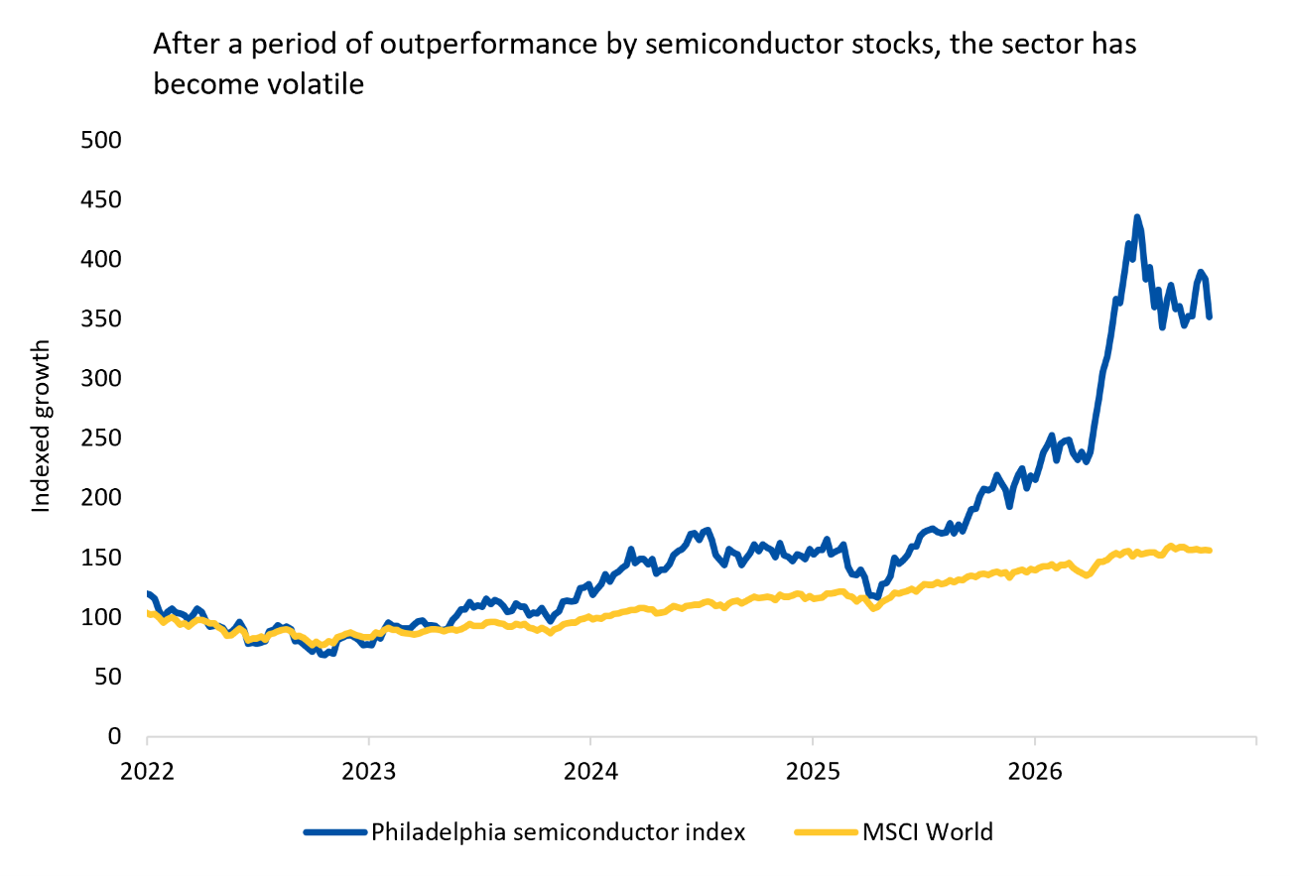
Source: LSEG Datastream
The counterevidence came from the companies that sell the equipment and make the chips. ASML is supply-constrained rather than demand-constrained: tool supply for 2027 is unchanged and 2028 offers limited upside, which disappointed some. Yet, its installed-base business, which maintains machines and provides recurring revenue, grew 70% over the year.
TSMC raised its revenue growth guidance from 40% to 44% in dollar terms for 2026. Third-quarter revenue rose 40%, which was driven more by the richer mix of AI wafers than by volume. Capital spending of $60 billion to $64 billion looks likely to land at the upper end, with roughly 20 fabrication plants (fabs) under construction worldwide, as well as a possible new cluster in Texas. Discussions with Elon Musk’s TeraFab venture are also underway.
We’re also interested in what this implies about the shape of the cycle. Semiconductors have historically been violently cyclical, with upswings traditionally driven by a single product category – first the PC and then the smartphone. The demand base is broader now and the fabs being built today take years to arrive, which argues for a longer and smoother cycle.
TSMC has typically been conservative with capital. Its commitment speaks louder than its commentary.
So, industry fundamentals look solid and valuations have fallen, mostly by companies growing into them, but over the past couple of weeks, share price falls improved them even further.
AI’s claim on real resources is also starting to show up where investors feel it most directly: in prices.
Dwindling disinflation
Underlying U.S. price pressure is proving stubborn. Core consumer price index (CPI) data surprised to the upside for a second consecutive month, the first back-to-back overshoot since 2024, and the heavily weighted owners’ equivalent rent category did most of the work. That’s significant because new property lease rates have been rising.
High mortgage rates are keeping would-be first-time buyers in rented accommodation and high new-build costs are restricting supply. Slow net migration should limit demand, but a reliable source of disinflation has gone.
Core goods posted their biggest rise since the start of President Donald Trump’s second term and did so despite a continued large fall in prescription drug prices. This could reflect a delayed impact from tariffs or second-round effects from the rise in energy prices.
Core services excluding shelter is the better gauge of home-grown, persistent inflation, and it has been running near 3% for a year and a half. This is the indicator suggesting that underlying domestic economic strength is a source of inflationary pressure and that interest rates should rise as a result. The reassurance, though, is that wages have decelerated markedly, suggesting there’s limited benefit to weakening the labour market further.
Food prices were quiet in this month’s CPI report, but pressures are building in wholesale markets, which will find their way through to consumer markets in the coming months. A strengthening El Niño is likely to disrupt global food supply through a dispersed pattern of drought, flooding and erratic monsoons – even if it warms the European winter and marginally eases pressure on gas reserves.
The Federal Reserve (the Fed) restarted its hiking cycle last month and last week’s data makes a further increase before the year-end rather likely. Its next meeting falls less than a week before the midterm elections, which sets a high bar for acting then.
One hike, not four
Policymakers here face a gentler version of the same problem. Bank of England (BoE) Governor Andrew Bailey noted that the second-round effects of higher energy prices have been more subdued in the UK than feared, and while he remains cautious about what follows, that’s an encouraging message for now. Gilts (UK government bonds) outperformed on the back of it.
Markets treat a November rise as a near certainty and price in three more over 2027, which strikes us as aggressive. Our expectation, and that of most economists, is a single precautionary increase, one the BoE would be keen to unwind if the energy consequences of the war in the Strait of Hormuz begin to resolve.
A similar situation is true in the U.S., where Federal Reserve Chairman Kevin Warsh refused to offer forward guidance but still managed to downplay the chances of a rate hike in the last meeting before the midterms.
Steady customers, nervous shareholders
The start of earnings season offered another opportunity to check in on the banks. The sector has been weak in recent weeks and the reaction to the volley of results was mixed. Beyond that, the trends were good.
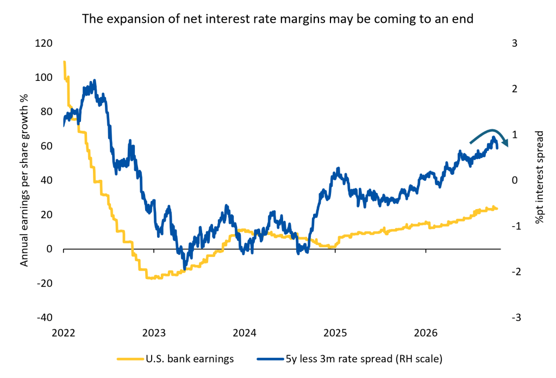
Source: LSEG Datastream
Balance sheets are growing healthily rather than recklessly, credit quality is sound and payment spending across debit and credit cards rose 5%, with no visible increase in delinquencies. The concern doesn’t appear to be deteriorating credit quality but rather net interest margins. As interest rate expectations have risen, the yield curve has flattened, making banks’ ‘borrow short and lend long’ business model less profitable.
Fixed-income trading was weaker and corporate activity merely fine, held back by the absence of the jumbo listings anticipated earlier in the year. Equities and equity financing were strong, which is usually a late-cycle signal and much of that strength sits in the prime broking businesses that fund the multi-manager hedge funds.
In other words, it’s another limb of the same AI trade now seeping into every corner of markets.
Please continue to check our blog content for advice, planning issues and the latest investment market and economic updates from leading investment houses.
Charlotte Clarke
21/10/2026