Team No Comments

Electric vehicle adoption relies on investment into infrastructure

Please see the below article from Tribe Impact Capital received yesterday afternoon:

Driven by changing consumer behaviours, increasing choice and affordability, recent net-zero pledges by governments and the desire to ‘Build Back Better’ after the pandemic, the demand for electric vehicles (EVs) continues to grow. According to Bloomberg New Energy Finance, EV sales will rise to nearly 60% of the global auto market by 2040, a huge shift from almost 0% in 2010. With consumer consciousness on the rise and market forces gaining momentum, EVs are quickly becoming the future of the automotive industry and a target market for investors.

However, before any serious adoption of EVs can take place there needs to be significant investment in the infrastructure that supports EVs. This includes the charging points but also the entire electricity grid.

EV charging points

The issue of sufficient access to electric charging points for those who don’t have the access to off-street parking needs to be addressed if there is to be widespread adoption of EVs. A report by the European Automobiles Manufacturers association in October 2020 showed that while EV sales in Europe had increased over 100% during the last 3 years, the number of public charging points had grown by just 58%. Similarly, in the UK, all-electric cars went from 1.6% of the market in 2019 to 6.6% in 2020. The report found the UK is likely to need around 400,000 public charge points by 2030, a considerable increase from the existing 35,000.  The current installation rate of 7000 a year is not enough to meet requirements if the UK is to be ready for the ban on sales of cars with an internal combustion engine in 2035. Installation will need to occur five times faster at a cost of between £5 billion and £10 billion by 2030.

Providing enough residential on-street charge points and charging facilities in public spaces will be critical in high-density residential areas where it’s simply not feasible for every property to have cables running from their electricity supply to their vehicle. National Grid points out that with 20 million EVs on the road there will be at least 8.6 million vehicles that will not have the facilities for charging at home.

This is not just an issue for the UK though. The quantity of public chargers is growing the fastest in China, followed by Europe and then the US. China still has the largest network of public chargers. They had more than 500,000 chargers by 2019, accounting for more than 50% of the global total. However, a large number of chargers does not mean an ideal vehicle-to-charger ratio. While China’s passenger electric vehicle-to-public charger ratio (8.5 to 1) is lower than that of the United States (17 to 1), some European countries have even lower EV to public charger ratios (France: 7 to 1; Germany: 5 to 1; and the Netherlands: 4 to 1).

Electricity demand

The second major infrastructure to consider is the supply and distribution of the electricity itself. At their current trajectory EVs are set to double domestic electricity demand. At scale, this would present significant challenges to the distribution network. As we see increased adoption of intermittent renewable energy sources we might start seeing large imbalances between supply and demand in terms of power provision. Not only do we need to build out our existing network capacity and reinforcement we need to get better at managing system stability, energy storage and smart charging. 

What does this mean for investors?

The UK government recognises that widespread adoption of EVs is key to achieving their climate goals with the Chancellor announcing in the government’s spring Budget that £500 million will be invested into a rollout for charging hubs. Whilst this investment will help play a role in piecing together the UK’s fragmented infrastructure and easing the pressure on public sector organisations, more capital for wider and faster deployment of a national charging grid is needed. Many supermarkets are now providing electric charging hubs in their car parks in partnership with others. Many supermarkets in the UK have increased their commitments to sustainability and investors are now starting to look at these companies with renewed interest.

Despite the noise and potential in companies like Tesla, Nio and others, for example, Volkswagen, the EV story also represents plenty of opportunities for investors outside the main car manufacturing segments. Charging points are the next logical step but looking at the sector more broadly there are opportunities in smart metering, battery storage, network improvement, smart cities and core technology (for example semiconductors, and artificial intelligence). The shift to EVs will have major implications not just for the way we travel, but the way we build cities and our consumption of electricity itself. With this in mind, the opportunities for investors further increase.

For example, smart meters (electronic devices that accurately monitor electricity use and send this information to the user or the utility company to effectively manage and optimise energy consumption) are key to driving efficiency in energy usage. They can potentially manage the demand on the grid by notifying consumers of the best time to charge, helping reduce consumer costs. Renewable electricity providers are also starting to provide ‘free’ tariffs for EV owners to manage potential cost implications.

The market for smart meters is growing rapidly and in 2019 US electric companies installed over 98 million smart electric meters, covering more than 70% of US households. The global smart meter market size was valued at $21.13 billion in 2019 and is projected to reach $39.20 billion by 2027, an annualised growth rate of 9%. Utility companies are keen to install meters, they enhance the energy grid’s resilience and operations and help provide visibility into the system operations, thereby avoiding outages.

Similarly, the battery storage market is set to double over the next 5 years. Batteries provide a critical role in our future power systems as they provide the flexibility required by the grid to support the variability of power generation from renewables when environmental conditions are not favourable for power generation. Not only is demand going up, but input costs are coming down. By 2030, total installed costs could fall between 50% and 60% (and battery cell costs by even more), driven by optimisation of manufacturing facilities, combined with better combinations and reduced use of materials. Battery lifetimes and performance will also keep improving, helping to reduce the cost of servicing. Improved batteries will help support the grid by providing flexibility to store energy and release it when demand for EV charging is high.

With all investment opportunities, however, comes risk. The widespread adoption of electric vehicles comes with some stings in the tail, most notably the use of rare earth and precious metals used in the battery and technology embedded in the vehicles themselves. Complex supply chains, sometimes in politically unstable geographies and/or where the rule of human rights may be less robust, increase the risk of human rights abuses, as well as environmental degradation. As investors it is essential to be aware of and manage these risks. Doing so can uncover solution opportunities, for example, in businesses dedicated to the recycling of these rare earth minerals at end of life in many rechargeable battery applications.

Global governments have built widespread adoption of EVs into their carbon neutral plans which will have major implications not just for the way we travel but the way we build cities and our consumption of electricity itself. For investors, it’s important to look at the bigger picture and recognise that the opportunity set is much wider than a few automobile names.

This is an interesting look at the investment opportunities within the electric vehicle landscape looking beyond just investing in the vehicles themselves or the big EV companies (i.e. Tesla), but looking at the infrastructure around this, charging points, smart metres, clean energy etc.

The pandemic not only changed the world itself, but how people think about the world, the environment and what the future will look like.

This is a growing investment space and another key indicator that ESG has gone mainstream.

Andrew Lloyd DipPFS

04/06/2021

Team No Comments

The Implications of Carbon Pricing Initiatives for Investors

Please see the below article received from JP Morgan this morning:

‘In our view regulatory interventions will increase, and these interventions will underpin carbon prices not only in Europe, but also globally.’ – Vincent Juvyns

European policymakers have been focused on tackling climate change for many years. The launch of the European Union’s (EU’s) Emission Trading System (ETS) in 2005, the first carbon market in the world, has been the cornerstone of the bloc’s policy efforts. Since then, the ETS has been upgraded several times to reflect the EU’s growing climate ambitions and changes are now accelerating further since the EU has agreed to reduce its greenhouse gas (GHG) emissions by at least 55% by 2030. These regulatory initiatives at least partly explain why prices for CO2 emissions allowances in Europe have recently reached an all-time high of 56 euros per tonne of carbon dioxide equivalent (tCO2e).

The EU’s example is being increasingly copied, with several individual countries launching their own emission trading systems. At present, global carbon prices remain well below those seen in Europe. If they fail to move in line with what the EU deem to be acceptable, the subject of carbon taxes at the EU border will be an increasing reality. This is why we believe investors should be aware of the impact of higher carbon prices on their portfolio.

What drives carbon prices? Europe case study

There are two main types of carbon pricing mechanisms: a carbon tax, which is the most direct way to set a price on carbon, but which doesn’t set a pre-defined emission reduction target; and an emissions trading system, which caps the total level of GHG emissions, but doesn’t set a pre-defined price.

The EU chose the second approach when it created its ETS in 2005. The EU’s ETS is the world’s first and also the largest emissions trading system as it covers 45% of the EU’s GHG emissions produced by three sectors within the European Economic Area: electricity/heat generation, energy-intensive industry, and commercial aviation.

Companies in these sectors are allocated a free emissions allowance. Those with lower emissions than their allowance can sell their “unrequired” emissions to other companies in the sector (Exhibit 1). The balance between supply and demand for emissions creates a market price.

The EU can influence supply and demand dynamics to raise the carbon price in three ways: by reducing the emissions cap; by increasing the industries subject to the scheme; and/or by reducing the allocation that is deemed free.

In its recent directive, the EU decided that the aggregate emissions cap will fall by 2.2% per year from 2021 onwards (vs. 1.74% before). The EU is still deciding whether to include new sectors, such as transportation and buildings. The percentage of free emissions allowances, which had already fallen from 80% in 2005 to 43% in 2020, is to gradually decrease to 30%.

As a result, while some of the recent surge in the carbon price may reflect strong demand for emissions allowances as firms meet rising demand, there is a structural underpinning to higher carbon prices from regulatory interventions.

The balancing act between internal drive and external competition

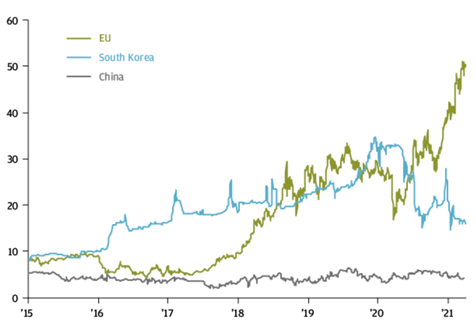
EU authorities are mindful of the delicate balancing act they face between meeting domestic climate ambitions while at the same time not damaging corporate profitability and competitiveness compared to international competitors that are not subject to similar regulatory standards. Encouraging international peers to keep up with the EU’s efforts is bearing some fruit: other regions are beginning to launch their own emissions trading schemes and 25% of global GHG emissions are now covered by carbon pricing initiatives compared to just 5% in 2005 (Exhibit 2). However, the carbon price in these regions is much lower than in Europe (Exhibit 3).

Coverage of global emissions trading schemes and the impact on carbon prices

Exhibit 2: Global emissions covered by carbon pricing initiatives

% of global greenhouse gas emissions

Exhibit 3: Emissions trading system prices

USD per tonnes of CO2 equivalent

Carbon prices internationally are not only lower than those in the EU, they are also below those required to meet the global climate objective of reaching net zero emissions by 2050 according to many climate scientists and policymakers. Although the estimate is wide, a range of between USD 40 and USD 80 per tCO2e is often argued as necessary to limit global warming to less than 2°C.

Carbon prices will no doubt be a key topic of conversation when global leaders convene at COP26 in November. If the EU, China and the US cannot agree on a path towards a common carbon price, the EU may need to find a short-term solution to ensure that its climate efforts do not disadvantage European businesses.

One solution that appears to be growing in appeal is a carbon border adjustment mechanism (CBAM). This import tariff would be designed to ensure that the environmental footprint of a product is priced the same whether it is manufactured locally or imported. The CBAM is one of the key measures discussed as part of the EU’s Green Deal. The proceeds of the tax would form part of the EU’s budget, which would be used to finance the EU’s recovery and green transition.

At this stage the CBAM is a threat to international peers, but the credibility of that threat has been strengthened given the legislation that would be required has been approved by the European Parliament. It is now up to the European Commission to decide whether to use it.

Investment implications

In our view regulatory interventions will increase, and these interventions will underpin carbon prices not only in Europe, but also globally. The result will be an increase in the cost base of companies in a growing number of sectors.

One of the key investment implications is that increased business costs may serve to raise consumer prices, adding to growing inflationary pressures from loose monetary and fiscal policies. If firms are unable to pass on higher costs the higher carbon prices may dent profitability.

If the CBAM is activated, companies that export a lot of their carbon-intensive products to the EU may suffer from higher carbon prices, even if their home country does fairly little in terms of carbon regulation. The price of carbon is therefore a risk that needs to be monitored.

On top of traditional financial analysis, investors may look to evaluate non-financial parameters, such as the carbon intensity of companies, as we believe that minimising the carbon intensity of a portfolio should help improve its risk/return profile over the long term. This is what we have already observed over the last couple of years when comparing the MSCI World index with the MSCI World Climate Change CTB Select, a Climate Transition Benchmark under the EU Benchmark Regulation, which reweights securities based upon the opportunities and risks associated with climate transition risks.

Indeed, the MSCI World Climate Change CTB Select Index has a Weighted Average Carbon Intensity (which represents the number of metric tonnes CO2 equivalent emissions per USD million enterprise value including cash) that is almost 40% lower than the MSCI World Index, while it has also outperformed the latter by 150 basis points since its inception in November 2013, and has a better Sharpe ratio over the last three and five years.

With global carbon prices set to increase further in the future, minimising the GHG emissions of a portfolio should not only contribute to the fight against global warming, but it should also lead to better risk-adjusted returns in the long run.

Please continue to check back for a range of blog content, from ESG focused pieces like this one to market updates and insights from a variety of the worlds’ leading investment houses.

Andrew Lloyd

01/06/2021

Team No Comments

Sustainable fashion: Why it matters, and how to identify the winners

Please see the below article from JP Morgan received yesterday, 26/04/2021:

The concept of sustainability is rapidly rising up the agenda within the fashion industry. Yet while consumers are increasingly interested in sustainable fashion, they are not willing to pay a premium for it. Still, sustainability can be a competitive advantage. We have seen companies delivering a sustainable message, but identifying the true leaders from the potential greenwashing takes research.

Consumers care about sustainabilty, but not at any price

As the global population grows, the negative environmental impacts of our demand for fashion are becoming more apparent. The industry is responsible for 10% of global carbon emissions and 20% of global wastewater, as well as producing significant amounts of waste. The equivalent of one garbage truck of textiles is dumped in landfill or burned every second.

75% of consumers view sustainability as ‘extremely’ or ‘very important’ in their fashion purchasing decision. And over 50% of consumers would switch for a brand that acts in a more environmentally and socially friendly way. But in practice, are consumers really willing to pay? Not yet, it seems. Only 7% of consumers say sustainability is the most important factor in their decision making.

Exhibit 1: Consumers care about sustainabilty, but not at any price – most important factors in decision making

Consumers continue to rate ‘high quality’ and ‘good value for money’ as the most important factors in their decisions. This is backed up by our engagements with fashion companies, who claim that consumers are not willing to pay a premium for sustainability, although at the same price point they would choose the more sustainable offering.

To us, this signals that consumers have a preference for sustainability and it can be a competitive advantage for retailers. But companies need to see it as a way to maintain or grow their market share rather than a way to increase prices. Sustainable leaders should be investing in innovation and scale for sustainable solutions to bring prices down and maintain their brand position.

Case study 1

Re:NewCell: Driving down costs for sustainability in fashion

Re:NewCell is a Swedish company driving down the costs of sustainable materials through innovation. The company has developed and patented Circulose, a high quality material made from recycled clothes. We expect Circulose – which has already been adopted by the likes of H&M and Levi’s – to see increasing uptake within the fashion industry, helping to lower the cost of sustainable materials and improve the industry’s environmental footprint.

Case study 2

Adidas: Leading the charge on sustainability

Adidas, the well-known sportswear brand, is at the forefront of sustainability within the fashion industry. The company particularly stands out on circularity, which is embedded in its strategic priorities: by 2024, Adidas has committed to replace virgin polyester with recycled polyester. The company already partners with the environmental organisation Parley for the Oceans to use recycled polyester made out of plastic collected from the coastline. All of Adidas’s cotton is sustainably sourced via the Better Cotton Initiative, earning Adidas the top spot in a 2020 independent ranking on sustainable cotton sourcing. Adidas has committed to reducing greenhouse emissions across its entire value chain by 30% between 2017 and 2030, and then achieving climate neutrality by 2050. As a further validation of Adidas’s sustainability efforts, these goals were submitted for external verification by the Science Based Target initiative in February 2020.

Sources: Adidas and the Sustainable Cotton Ranking 2020 (77 companies).

The companies above are shown for illustrative purposes only. Their inclusion should not be interpreted as a recommendation to buy or sell.

Distinguishing the real from the fake

The fashion industry is highly fragmented, and sustainability standards are still in their infancy. More and more companies are reporting on both their environmental and social impacts. But with different companies focusing on different disclosures, metrics and measurement methodologies, how can we identify the best? For us, fundamental research and company engagement are key, allowing us to assess whether fashion brands are paying lip service to sustainability or whether they are truly committed to it.

What do we look for in a sustainable fashion leader? 

  • Has the company signed up to measurable targets to reduce its negative environmental footprint?
  • Is the company abiding by external certifications to demonstrate the sustainability of its products?
  • Is the company accurately measuring and reporting its entire carbon footprint?

The last of these requires particular research focus as only about 5% of a fashion retailer’s carbon footprint comes directly from its own operations (scope 1 emissions) or indirectly from generating the energy used by the company (scope 2). The vast majority of carbon emissions occur in the company’s value chain (scope 3). This includes production, processing and transportation of fibres and fabrics, transportation of the end product to its final destination, and emissions related to use, care and disposal. Unsurprisingly, this complexity means that emissions are currently underreported, with many companies only reporting on transportation of the end product. Fundamental research is therefore key to understand the supply chain picture and determine what companies are really doing to reduce their total emissions.

Conclusion

While price sensitivity remains key for consumers in the fashion industry, evidence points to sustainability becoming more important in purchasing decisions and ultimately to long-term brand value. This implies a material opportunity for sustainable leaders to stand out while unsustainable fashion brands lose out. Yet the potential for greenwashing is rife in the industry, making it difficult to distinguish between leaders and laggards in the transition to sustainable fashion. Company research and engagement is key.

Our Comments

This is another example of sustainability and ESG themes filtering down to everyday life.

The fashion industry, particularly the problematic ‘fast fashion’ companies seem to hit the headlines on a regular basis for all sorts of issues, from waste to poor working conditions so the sustainability of the fashion industry is starting to be questioned more often.

With fund managers now also becoming increasingly more concerned with ESG and sustainability issues, the fashion industry will have to also adapt to these changes in the way consumers and investors are thinking and what it is they are looking for when investing or purchasing their products.

Shopping for items such as clothes became pretty much an online only occurrence for a large proportion of the past 13 months, I have myself noticed that sustainability is being used a selling point, whether it be statements on the companies website or even noted in the products description. Some companies plant a tree for every item of clothing purchased.

As this article highlights, a lot of people would consider switching to more environmentally and socially friendly brands, but they may not be willing to pay an extra premium for it. Personally, I don’t think it will be long until paying extra won’t be an issue, as the world changes and now has ESG principles under a microscope, these companies will have to adapt to remain competitive in the marketplace.

From a personal experience perspective, I recently purchased an item of clothing having no idea it was part of a ‘sustainable’ line until I was checking the label for the washing instructions only to find out that the item was made out of 100% recycled plastic bottles and textile waste that had been processed and melted down into new fibres in an effort to save water, energy and reduce greenhouses gases.

The item was no more expensive than a ‘non sustainable’ item and the quality was probably better than products that use ‘virgin’ or non-recycled materials.

As consumers, if you don’t have to compromise on cost or quality, then why wouldn’t you choose more sustainable options?

Andrew Lloyd

27/04/2021

Team No Comments

Engagement with BP and Shell on the transition to a greener future

Please see the below ESG case study article from Invesco:

The below case study pertains to engagement within our UK equities team, which are a part of the Henley Investment Centre. While guided by our central ESG team, all of our investment professionals ultimately have discretion in their ESG decisions, and do not all follow the same approach. Learn more about how we integrate ESG across our wide range of strategies here.

Responsible oil and gas companies have a critical role to play in being part of the solution to environmental problems: in helping enable the global economy to successfully transition as rapidly as possible, and in a sustainable manner, towards targets for much reduced global emissions.

This can be achieved through actions taken by companies to successfully manage down a sustained decline in output of oil & gas, while at the same time maximising cash flows from operations for investment in new low carbon energy businesses.

Investing in oil companies that set out to achieve these objectives – and holding them accountable – is we believe entirely consistent with true responsible investing, which incorporates environmental, social, and governance (ESG) criteria into the investment process.

Whatever the moral burden that should fairly be borne by UK-listed companies, such as BP and Shell, for their historical actions, what is important for investors to understand is how the oil companies themselves now fit into the global industry.  Investors want to know what the impact of oil companies will be on that industry and on society, going forward: what role they have to play in the future.

How BP and Shell are transitioning towards a greener future

Although many investors focus on oil & gas producers as large Scope 3 emitters of carbon, if the world is to achieve net zero emissions in 2050 it ultimately requires reform of demand, and not just supply.

Supply in the industry (in the long run) very closely mirrors actual demand (the easiest place to store oil is still in the ground!). It is important here to also reflect that the global publicly quoted US and European oil companies only account for around 12.3 mb/d out of total current production of approximately 100mb/d, with US privately owned production around a further 8mb/d.

Put another way, state owned oil production (including Saudi Aramco) accounts for almost 80% of global production. The reality is that any cuts in production by any of the publicly quoted oil majors does not in itself affect global oil demand.

BP turning off the taps tomorrow would have a negligible effect on global carbon emissions. The same emissions will still be made but fuelled by output from another supplier who is less accountable to investors.

Responsible oil companies do, though, have a very significant role to play in accelerating a sustainable transition to low carbon alternatives that can reduce demand for fossil fuels by providing a viable substitute product.

For example, BP and Royal Dutch Shell are both actively involved in promoting the transition through defined strategies that look to maximise cash flows from existing carbon resources, and then re-allocate cash flows to low carbon alternatives.

Because of the many and varied uses for oil as a fuel, as a key component in a wide range of everyday products, and the practical limitations associated with various alternatives currently available, the process of transition is likely to be gradual. It is clearly both necessary and highly likely that demand for oil will reduce over time, however we do not foresee at any time in the next ten years at least, a “Kodak moment” for oil.

Our role as responsible shareholders will encourage positive change

An investor in BP or Shell who is willing to support, encourage and also hold the company to account during its transition period is, we believe, able to be well rewarded financially, through dividends and share buy backs, as well as by the prospect of owning a new “low carbon” and retail business whose growth has been fully funded from existing company resources.

Responsible oil & gas companies such as BP and Shell therefore have a critical role to play in being part of the solution: in helping enable the global economy to successfully transition as rapidly as possible, and in a sustainable manner.

This objective can be achieved through actions taken – with the support of shareholders – to successfully manage down a sustained decline in output, whilst at the same time maximising cash flows from operations for investment in new low carbon energy businesses.

We believe, investing in oil companies that set out to achieve these objectives, and holding them accountable, is entirely consistent with our philosophy of responsible investing, which focuses on engagement and dialogue with portfolio companies, and not simple divestment if there is something that we don’t like.

We expect big companies in this sector will be investing capital at scale in renewable energies and are well placed to manage large and complex engineering projects in hostile natural environments.  Again, the sector is part of the solution rather than just part of the problem.

Our engagement and dialogue – in practice

As active fund managers, ESG integration and dialogue is an important consideration for us. Over the past three years we have regularly engaged with various members of the Boards and Management Teams of both BP and Shell, on ESG matters in general, and on carbon emissions in particular.

In the case of BP, for example, we have had meetings with the BP Chairman to discuss the risks and opportunities associated with their carbon transition plan.

We have also provided feedback to the chair of the remuneration committee to ensure management incentivisation is aligned to group strategy and their environmental targets.

Furthermore, we have engaged with independent board members and attended company strategy sessions. The enhanced monitoring of our BP position over the last three years means that we believed that the strategy and objectives the company was setting were achievable.

Our engagement enables us to measure the board and management against their strategy and objectives. We believe there are good returns to be made from businesses which transform to become fit for the future.

When it comes to ESG or socially responsible investments, its important not just to use the traditional ethical investment screening (i.e. staying away from certain companies/ sectors etc), but to engage with companies to help deliver positive change.

By engaging with companies and holding them accountable, it forces them to think about the future, their practices and operations and helps to guide them into a better way of thinking.

It’s not about steering clear of companies or disinvesting if something happens investment managers don’t like, but about engaging with them, providing feedback and guidance about how they want things to work.

Positive engagement will help everybody to learn and adapt to what seems to becoming (or will become) an industry standard in how ESG processes are embedded into companies and the industry as a whole.

Keep checking back for more ESG related content from us along with our usual market commentary, planning points and other key issues we like to keep you up to date with.

Andrew Lloyd

06/04/2021

Team No Comments

VW charges up for electric vehicle push

Please see the below article from AJ Bell received late yesterday afternoon:

German auto maker has grand plans for global EV market

In August 2020 we flagged German auto maker Volkswagen as a value play at €139, since when the stock has gained more than 40%.

Its shares have been particularly strong this year as the firm rolls out its electric vehicle strategy, culminating in this week’s ‘Power Day’.

In contrast, electric vehicle specialist Tesla has had a torrid time this year with shares tumbling from $900 in January to a 2021 low of $563.

VW has grand plans for a big electric vehicle push. As well as reducing the cost of ownership in the space it is investing heavily in new battery technology to improve range and in new charging networks to improve ease of use.

The company aims to reduce battery prices to below €100 per kilowatt hour through a combination of advanced cell design and lower manufacturing costs, all while using green energy.

Beginning with a €14 billion investment in Sweden with partner Northvolt, VW aims to have six gigafactories in Europe by 2030 with a combined capacity of 240 gigawatt hour.

More significantly, VW has partnered with BP, Spanish utility Iberdrola – a world leader in green energy – and Italian utility ENEL to install 18,000 new high-power charging stations across Europe.

The current lack of infrastructure is seen as a key reason for the slow mass adoption of electric vehicles. By working jointly to create a network of renewable-powered rapid-charging stations, each company gets closer to its net-zero goals to boot.

However, VW has even grander plans. All of its electric vehicles come with a home-charging station called Elli. When parked and connected to the Elli Cloud, a VW ID.3 becomes a ‘mobile power bank’ capable of feeding power back to the house for up to five days.

Using intelligent management systems, energy could be transferred to the vehicle during off-peak hours and transferred back to house when needed.

Not only would this save wasting renewable electricity – last year Germany wasted 6,000 gigawatt hours of renewable energy due to lack of storage – when rolled out to commercial and industrial customers it could drastically reduce the cost of expanding transmission networks.

Renewable energy is likely to be an area of rapid growth over the next few years. As the world navigates its way out of the Covid-19 pandemic, the world has been left with food for thought about how to make the planet better and how to sustain it. Companies around the world are adapting to renewable energy sources.

We regularly post a variety of ESG content, both our own and articles from a range of fund managers, and renewable energy is a key consideration in this (the E in ESG, E – Environmental).

This is definitely an area to watch!

Keep checking back for a range of blog content from us, from ESG outlooks, to market updates and insights, both our own original content and input from a wide range of fund managers and investment houses.

Andrew Lloyd

19/03/2021

Team No Comments

UK Equities: What does ESG mean to us?

Please see the below article from Invesco which we received late yesterday afternoon:

Key takeaways

  1. Investing in stocks which have the right ESG momentum behind them can be a positive way for our funds to potentially generate alpha
  2. We draw upon ESGintel, Invesco’s proprietary tool, which helps us to better understand how companies are addressing ESG issues
  3. Engaging with companies to understand corporate strategy today in order to assess how this could evolve in the future

Our focus as active fund managers is always on finding mispriced stocks and ESG integration underpins our investment process at every stage.

The incorporation of ESG into our investment process considers ESG factors as inputs into the wider investment process as part of a holistic consideration of the investment risk and opportunity, from valuation through investment process to engagement and monitoring.

The core aspects of our ESG philosophy include materiality; ESG momentum; and engagement.

  • Materiality refers to the consideration of ESG issues that are financially material to the corporate or issuer we are analysing.
  • The concept of ESG Momentum, or improving ESG performance over time, indicates the degree of improvement of various ESG metrics and factors and help fund managers identify upside in the future. We find that companies which are improving in terms of their ESG practices may enjoy favourable financial performance in the longer term.
  • Engagement is part of our responsibility as active owners which we take very seriously, and we see engagement with companies as an opportunity to encourage continual improvement.

Dialogue with portfolio companies is a core part of the investment process for our investment team. As such, we often participate in board level dialogue and are instrumental in giving shareholder views on management, corporate strategy, transparency, and capital allocation as well as wider ESG aspects.

ESG integration is an ongoing strategic effort to systematically incorporate ESG Factors into fundamental analysis. The aim is to provide a 360-degree valuation of financial and non-financial materially relevant considerations and to help guide the portfolio strategy.

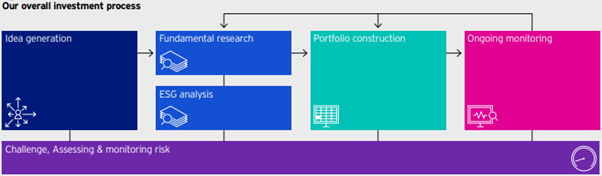
Our investment process has four stages. In this note we go through in detail how ESG is integrated into each stage of our process.

Idea Generation

Ideas come from many sources – our experienced FMs, other team members or investment floor colleagues, various company meetings, and by exploiting the intellectual capital of our sell side contacts. We see it as important to spread our nets as wide as possible when trying to come up with stock ideas which may find their way into our portfolios. We remain open minded as to the type of companies we will consider. This means not ruling out companies just because they happen to be unpopular at that time and vice versa.

ESG can create opportunities too – for example, the benefits of moving towards more sustainable sources of energy like wind, solar and hydroelectric power generation. This was one of the reasons we became interested in some of our utility holdings which are held across several portfolios. This highlights the importance of opportunities brought about by ESG and not just the risks. ESG can also influence the timing and scale of a mispricing being corrected in the market.

To be clear, at this early stage of the investment process we typically would not rule out companies with a sub-optimal ESG score. Investing in stocks which have the right ESG momentum behind them – by focussing on fundamentals and the broader investment landscape – can be a unique way for our funds to potentially generate alpha.

Fundamental Research & ESG Analysis

Research is at the core of what we do and is what the investment team spends most of its time doing. The key is to filter out those ideas which aren’t aligned with our investment philosophy and concentrating on those where we see the strongest investment case. Our fundamental analysis covers many drivers, for example, corporate strategy, market positioning, competitive dynamics, top-down fundamentals, financials, regulation, valuation, and, of course, ESG considerations, which guide our analysis throughout. The key drivers will differ according to each stock.

We use a variety of tools from different providers to measure ESG factors. In addition, at Invesco, we have developed ESGintel, Invesco’s proprietary tool built by our Global ESG research team in collaboration with our Technology Strategy Innovation and Planning (SIP) team. ESGintel provides fund managers with environmental, social and governance insights, metrics, data points and direction of change. In addition, ESGintel offers fund managers an internal rating on a company, a rating trend, and a rank against sector peers. The approach ensures a targeted focus on the issues that matter most for sustainable value creation and risk management.

This provides a holistic view on how a company’s value chain is impacted in different ways by various ESG topics, such as compensation and alignment, health and safety, and low carbon transition/ climate change.

We always try to meet with a company prior to investment. Based on our fundamental research, including any ESG findings, we focus on truly understanding the key drivers and, most importantly, the path to change. This helps us better understand corporate strategy today and how this could evolve in the future. Today, the subject of ESG is increasingly part of these discussions, led by us.

Portfolio Construction

We aim to create a well-diversified portfolio of active positions that reflect our assessment of the potential upside for each stock weighted against our assessment of the risks. Sustainability and ESG factors will be assessed alongside other fundamental drivers of valuation. The impact of any new purchases will need to be considered at a fund level. How will it affect the shape of the portfolio having regard to fund objectives, existing positions, overall size of the fund, liquidity and conviction?

We do not seek out stocks which score well on internal or third party research simply to reduce portfolio risk. We ask the question, “Why does the idea deserve a place in the portfolio?” We ask this because there is a competition for capital, a new idea will require something else to be sold or reduced so that it can be included.

Ongoing Monitoring

Our fund managers and analysts continuously monitor how the stocks are performing as well as considering possible replacements. Are the investment cases strengthening or weakening? Are their valuations reflecting the companies’ prospects appropriately? Is the company performing from an ESG perspective and are the valuations fairly reflecting the progress being made or not? Are the anticipated key drivers playing out or not? These questions, and their answers, are all of equal importance to us.

How do we monitor our holdings from an ESG perspective? Again, the same resources used during the fundamental stage are available to us. Our regular meetings with the management teams of the companies we own provides an ideal platform to discuss key ESG issues, which will be researched in advance. We draw on our own knowledge as well as relevant analysis from our ESG team and data from our previously mentioned proprietary system ESGintel which allows us to monitor progress and improvement against sector peers. Outside of company management meetings we constantly discuss as a team all relevant ESG issues, either stimulated internally or from external sources.

Additional ESG analysis is carried out by the team, when warranted, on particular companies. Depending on the particular case this is often in conjunction with the ESG team. Such cases would be those that are more controversial, considered to be higher risk and viewed poorly by ESG providers, resulting in a valuation discount. We don’t just look at the specific issue considered to be higher risk either, for example the environmental risk of an oil company, but all areas of ESG. This means undertaking extensive analysis of social and governance policies and actions at the same time. We would note that this analysis is an ongoing process, typically involving multiple engagements with the company over a long period of time. All ESG discussions and interactions are written up – including our views and thoughts – with a section solely dedicated to ESG. Likewise, research undertaken by the ESG team is available to the entire Henley investment floor, and wider business. Further analysis could be warranted as a result of these discussions.

Challenge, Assessing & Monitoring Risk

In addition to the above, there are two more formal ways in which our funds are monitored:

There is a rigorous semi-annual review process which includes a meeting led by the ESG team to assess how our various portfolios are performing from an ESG perspective. This ensures a circular process for identifying flags and monitoring of improvements over time. These meetings are important in capturing issues that have developed and evolved whilst we have been shareholders. It is our responsibility to decide if it is appropriate, or not, to investigate these issues in more detail. We may ask the ESG team to assist in undertaking more analysis or discuss such issues with the company themselves or external brokers.

There is also the ‘CIO challenge’, a formal review meeting held between the Henley Investment Centre’s CIO and each fund manager. Prior to the meeting, the Investment Oversight Team prepare a detailed review of a portfolio managed by the fund manager. This review includes a full breakdown of the ESG performance using Sustainalytics and ISS data, such as the absolute ESG performance of the fund, relative performance to benchmarks, stocks exposed to severe controversies, top and bottom ESG performers, carbon intensity and trends. The ESG team review the ESG data and develop stock specific or thematic ESG questions. The ESG performance of the fund is discussed in the CIO challenge meeting, with the CIO using the data and the stock specific questions to analyse the fund manager’s level of ESG integration. The aim of these meetings is not to prevent a fund manager from holding any specific stock: rather, what matters is that the fund manager can evidence understanding of ESG issues and show that they have been taken into consideration when building the investment case.

Conclusion

The regulatory landscape is rapidly evolving, which increasingly compels organisations and investors alike to clearly demonstrate their awareness of ESG issues in their decisions. Landmark initiatives such as the European Union’s new Sustainable Finance Disclosure Regulation (SFDR) are at the forefront of this shift.

We believe that our approach is honest, coherent and pragmatic. The principles behind ESG deserve to be embedded in an investment framework which encourages positive change. Coupling this with a focus on valuation is, to our minds, the best way to deliver strong investment outcomes for our clients’ long term. This reinforces our fundamental belief that responsible investing demands a long-term view and that a stakeholder-centric culture of ownership and stewardship is at the heart of ESG integration.

This is a good article and insight into how Invesco integrate ESG into their investment process. We would expect more fund managers to start publishing their ESG process (if they haven’t already!).

Please keep an eye out for further ESG related content from us, along with our usual market commentary and blog updates.

Andrew Lloyd

11/03/2021

Team No Comments

The case for ESG integration when investing in Emerging Markets

Please see the below article from JP Morgan received this morning:

‘Emerging markets pose particular ESG challenges. But factoring ESG considerations into decision making can benefit performance, and demand for more sustainable investments is helping to drive change.’ – Tilmann Galler

In our 2021 Investment Outlook, we outlined that one of the key imperatives for investors in 2021 was to understand how the global policy and regulatory initiatives behind environmental, social and governance (ESG) factors are likely to increasingly affect the macro landscape and financial sustainability of companies.

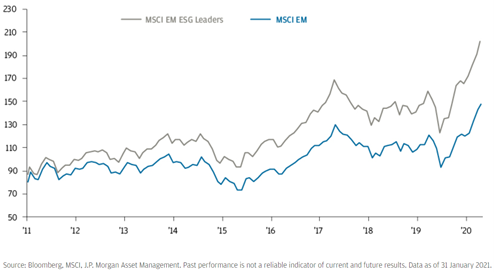
In this context, should investors shy away from investing in emerging markets given lower standards? In this piece we consider the diverse array of ESG challenges that exist in emerging markets and argue that selecting companies that are rising to the challenges and navigating a changing ESG landscape can lead to significant return opportunities, as we have already seen in recent years (Exhibit 1).

Exhibit 1: ESG leaders outperformed in emerging markets

Index level in USD, rebased to 100 at December 2010

Environment (E):

Preserving the environment and fighting climate change are becoming increasingly pressing global policy priorities. With President Biden now in the White House, the Paris Climate Agreement has been invigorated, and the discussion is likely to intensify ahead of the important regroup at the COP26 meeting in November.

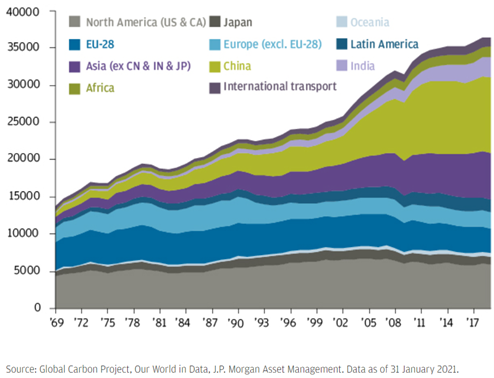
Reducing carbon emissions and aiming for carbon neutrality have been identified as important milestones. Fifty years ago, today’s developed countries contributed two thirds of global carbon emissions and emerging markets only one third. Today, total CO2 emissions have tripled, but the ratio has reversed and emerging markets contribute almost 70% (Exhibit 2).

Exhibit 2: Emerging markets are the biggest contributor to CO2 emissions

Annual total CO2 emissions by region from fossil fuels and cement production only; million tonnes

Europe and the US have committed to achieving carbon neutrality by 2050, while China has given itself an additional 10 years. Reaching these goals will require a significant alteration to the business fundamentals of corporations in carbon- intensive sectors such as energy, materials and utilities, but also for fossil fuel-dependent economies such as Russia, Saudi Arabia and South Africa. Business and economic models that fail to adjust will likely face increasing sanctions from investors and climate-committed governments.

A prominent example is the carbon border adjustment mechanism, which is currently being discussed in Europe and the US with the aim of avoiding regulatory arbitrage.

The adjustment would take into account the carbon intensity of goods sold. Countries that did not set a sufficient carbon price would be perceived to be gaining a competitive advantage and so would face tariffs at the border. But implementation is complex. Any carbon border adjustment has to be embedded into existing obligations under the World Trade Organisation and should also relate to local emissions trading schemes. There is also a risk that such a mechanism could fuel further trade conflicts and in the end evolve as a new frontier in the US-China trade war.

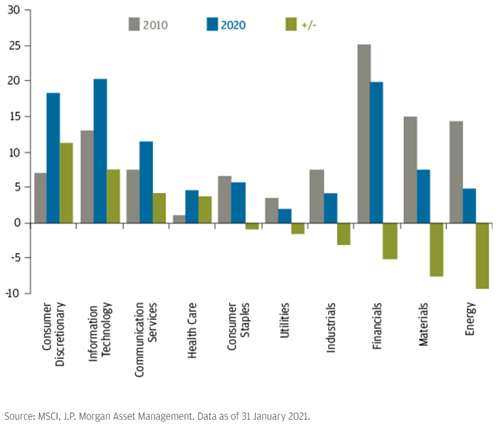
As emerging economies mature and services become a larger part of their economies, their CO2 footprints will naturally improve. We have already seen a significant decline in the market cap weighting of carbon intensive sectors in the MSCI Emerging Markets Index (Exhibit 3). Nevertheless, challenges remain, particularly in manufacturing, food processing standards, and water and waste management. Governments may be resistant to change if it is perceived to be an impediment to GDP and income growth. But emerging market companies that are part of an international supply chain will have to improve their standards, because large multinational companies are beginning to optimise their value chains for ESG criteria. Failing to adapt will be a significant disadvantage in the global competitive landscape. We therefore expect that transition will, in many cases, be faster on a corporate level than in government policy.

Exhibit 3: MSCI Emerging markets sector weights

Social (S):

Human rights, labour and health conditions, and diversity are social criteria on which businesses operating in emerging markets are facing increased scrutiny. Growing awareness from consumers and investors worldwide is putting governments and corporates under pressure to improve – with social media bringing increased visibility of the issues. The Foxconn labour abuse controversy is a good example. Reports of poor working conditions in the company’s Chinese factories, where it manufactures products for Apple, created a very negative global feedback loop. Companies exploiting employees and the communities they operate in are risking significant reputational damage on a global basis.

Governance (G):

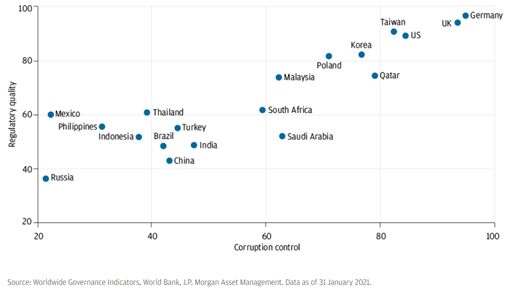
While environmental and social factors are gaining prominence, governance issues such as regulation, corruption, transparency and share-/bondholder rights have long been important considerations for investors in emerging markets. World Bank Indicators provide a useful top-level indication of the countries that require particular investor vigilance and those that already have higher standards in place (Exhibit 4). However, it’s important to keep in mind that these indicators provide just a snapshot of the current status and that the dynamics in corruption and regulation are quite different across the regions. In the past 10 years, Asian countries, on average, have showed significantly more improvement than Latin American, where the situation has deteriorated. Even if countries are engaging in more sustainable policy and introducing stewardship codes, like Korea,Taiwan, and Brazil in 2016, results can differ widely. The investment world will watch China’s next five-year plan closely to see whether financial sector reform and stricter environmental regulation will also improve government stewardship.

Exhibit 4: Corruption control and regulatory quality per country

Percentile rank indicates the country’s rank among all countries covered by the aggregate indicator, with 0 corresponding to lowest rank, and 100 to highest rank.

A key issue in emerging markets on a corporate level is ownership. The free float of the MSCI Emerging Markets is only 50%, compared to nearly 90% for developed markets. Investing in emerging markets generally means that you are in a minority position, because the entity is controlled by either the state, individuals or families. The risk for investors is that the company management is not only pursuing economic goals. Close relationships to government officials are also detrimental to efforts to fight anticompetitive practices, corruption and bribery and protect shareholder rights. Engagement is crucial to get a clearer picture of the management’s commitment to improving governance. Compared with developed markets, the power to induce change through voting in shareholders’ meetings is more limited.

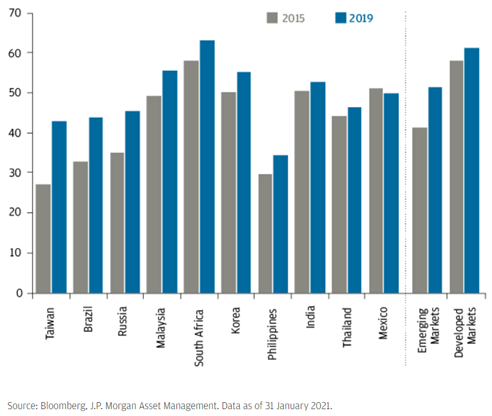
However, policymakers in emerging markets are reacting to the increased demands for better governance. For instance, the introduction of corporate governance codes in Taiwan (2010), Brazil (2016), and Russia (2014) improved the representation of independent directors on boards. In emerging markets overall, such representation has increased by 10 percentage points to 51% in the past four years. Governance standards in South Africa are already close to those in developed markets.

Exhibit 5: Governance is improving in emerging markets

Average % of independent directors in selected emerging markets

Conclusion

Emerging markets and ESG represent the place where two investment mega-trends come together. The dynamic growth of emerging markets will lead to a significantly higher representation in portfolios in the next 10 years. At the same time, due to investor preferences and developed world capital regulation, we are seeing a growing preference for investments that meet ESG criteria.

Emerging markets are not homogenous on a country nor a corporate level. But growth and sustainability can be reconciled through careful company research and engagement. Companies that are the beneficiaries of fast growth in their local markets, but which at the same time demonstrate an awareness and desire to meet global ESG standards, have sustainable business models. Indeed, ESG characteristics often serves as a proxy for quality, since companies that screen well are often managed with a long-term view, with higher levels of broad R&D and innovation.

In summary, we do not see that investing in emerging markets sits in opposition to the world’s broader ESG ambitions – the opposite might be the case. By demanding higher ESG standards, investors are helping to accelerate the pace of change. The scope for improvement in sustainable outcomes is significant and the consideration of ESG factors in this asset class provides ample return opportunities for long-term investors.

Please continue to check back for more ESG related insights along with our usual market updates and commentary.

Andrew Lloyd

08/03/2021

Team No Comments

M&G joins Powering Past Coal Alliance; plans to phase out coal

Please see the below press release from M&G:

M&G plc (M&G) is today joining the Powering Past Coal Alliance (PPCA) and announcing it wants to end investment in thermal coal by 2030 for developed countries and 2040 for emerging markets.

M&G’s coal phase out plan is a key step towards achieving its goal of net zero carbon emissions across its investment portfolios by 2050 at the latest, and helping to restrict global warming to 1.5 degrees in line with the Paris Agreement on climate change.

As stewards of long term capital, actively managing the savings of millions of people around the world, M&G will use its influence to accelerate the transition to a greener, cleaner economy with ambitious plans to cease all investment in new coal mines and coal-fired plants and to exclude public companies which cannot commit to a complete phase out of coal by 2030 in developed countries and 2040 in emerging markets.

As an asset owner, M&G will be implementing this approach to coal-related investments across its own internal portfolios over the coming year. As an asset manager, M&G will be working with clients to align existing mandates and funds to this position.

At the same time, through its growing range of sustainable investment funds, M&G is giving institutional clients and individual customers the opportunity to invest in technologies, infrastructure and services which offer financial returns as well as making a positive difference to the environment.

A link to M&G’s full position on investment in coal can be found here. https://www.mandgplc.com/responsibility/coal

Speaking at PPCA’s Global Summit today, M&G plc Chief Executive, John Foley, said: “An accelerated phase-out of coal is essential if we want to limit global warming and ensure a sustainable future for our planet. We are delighted to join the PPCA and fully support its work to encourage businesses, governments and other organisations to commit to a transition away from coal in the run up to COP26 later this year.”

Welcoming M&G’s commitment to the PPCA, Nigel Topping, COP 26 High Level Climate Champion, adds: “Phasing out thermal coal is a critical early step on the race to net zero. PPCA is a key part of the COP 26 Energy Transition Campaign, and it is fantastic to see M&G making this commitment in response to attending the PPCA ministerial round table co-hosted by the UK and Canada.”

As our clients will know, Prudential’s PruFund range of funds are managed by M&G’s multi asset  team, Treasury & Investment Office (T&IO) – one of the largest and most well resourced in the UK.

This is great news, and another step along the ESG road for M&G.

M&G plc aim to be carbon net zero as a corporate entity by 2030. Further, they aim to achieve 40% female and 20% ethnicity representation in their leadership by 2025.

Prudential Assurance Company aims to achieve net zero carbon emissions across AUMA (assets under management and administration) by 2050, of which the PruFund range is a material part, in line with the Net Zero Asset Owners Alliance.

The scale of PruFund allows the management team to use segregated mandates to apply a variety of implementation techniques for their ESG views, up to and including, exclusion of certain stocks or sectors from portfolios.

Currently their policy excludes investment in certain controversial weapons companies, namely cluster munitions and anti-personnel mines.

M&G look to the asset managers they select to engage with companies as active owners that help foster a more sustainable economy, participate in voting on key issues such as Climate Change and ensure that ESG is integrated into their investment processes. The majority of PruFund assets are managed by M&G, whose Responsible Investment team provide issuer and sector specific ESG risk and opportunity analysis and education on sustainability themes to portfolio managers and analysts.

Investments have recently been made with the PruFund range by purchasing a solar power plant in the Nevada desert.

Keep checking back for more ESG related content along with our usual market updates and outlooks from a variety of fund managers.

Andrew Lloyd

03/03/2021

Team No Comments

ESG: Lessons from the COVID crisis

Fund managers Invesco published a paper last week called ‘Appetite for change: food, ESG and the nexus of nature’ which looks at the impact of the Covid pandemic on ESG considerations.

We have picked out some of the key points from this paper below and added our own commentary in blue.

ESG Recap

Before we look at Invesco’s paper and the points they raised, lets recap on what ESG is.

ESG stands for Environmental, Social and Governance. Investopedia definition for ESG is; ‘Environmental, social and governance (ESG) criteria are a set of standards for a company’s operations that socially conscious investors use to screen potential investments.’

The key points raised by the Invesco paper are as follows:

  • The COVID-19 crisis has demonstrated that humanity’s understanding of its own relationship with the natural world remains inadequate – often dangerously so.
  • The pandemic has particularly exposed the interconnectedness of numerous existential threats, all of which might be described as components of the “nexus of nature”.
  • One of the most perilous yet underappreciated of these threats is the unsustainability of prevailing attitudes towards food production and consumption.
  • From the use of resources in developing countries to policies and practices around factory farming in the industrialised world, this issue affects the entire value chain.
  • Guided by the idea of materiality and initiatives such as FAIRR (Established by the Jeremy Coller Foundation, the FAIRR Initiative is a collaborative investor network that raises awareness of the environmental, social and governance (ESG) risks and opportunities caused by intensive animal production), investors are increasingly applying environmental, social and governance (ESG) principles in this sector.
  • As well as promoting and protecting sustainable investments, these efforts are showing how positive change in one area can benefit the nexus of nature more widely.
  • Interconnectedness means that the ripple effects can encompass concerns including deforestation, biodiversity loss, waste pollution, climate change and human health.

The ‘nexus of nature’

The longer-term survival of our planet and its inhabitants is strongly connected to various existential threats that are themselves highly interrelated. They include climate change, overpopulation, deforestation, loss of biodiversity and – perhaps least appreciated – the ways in which food is produced and consumed. In turn, each of these has a major influence on our health and wellbeing.

The World Economic Forum’s latest Global Risks Report underlines this. Eight of the 10 potentially most impactful risks over the next decade can be linked to humanity’s tendency to take the natural world for granted. Only weapons of mass destruction and cyber-attacks can reasonably be thought of as removed from the nexus of nature.

Why is it so important to grasp how food production and consumption might fit into this picture? The short explanation is that many of the practices that have become commonplace in the face of ever-rising demand for animal protein have consequences that are both far-reaching and deleterious. There may be no better illustration than the circumstances behind the advent of COVID-19.

As has been extensively documented, one of the likeliest sources of the outbreak was a “wet market” where livestock was reportedly kept in close proximity to dead animals. Here, originating either in bats or pangolins, the virus is believed to have been transmitted to humans via a process of zoonosis.

Something analogous happened in the late 1990s, when the emergence of the Nipah virus provided a salutary demonstration of how the nexus of nature can function. Native fruit bats were driven from their traditional habitats by deforestation; they started foraging in trees near farms; through their bodily fluids, they infected land used for raising pigs; and the pigs duly passed the disease on to farmers and abattoir employees.

Similarly, the SARS virus of 2002 is now thought to have come from horseshoe bats, eventually reaching humans via consumption of cat-like mammals known as civets. This, too, was an ominous warning of our collective vulnerability to a type of natural hyperconnectivity that is often woefully underestimated or wilfully ignored.

At first glance, given the circumstances surrounding these examples, it may be tempting to infer that the nexus of nature is at its most threatening in relatively rural settings or in developing economies. In fact, this is far from the case. As we explain in the next chapter, the phenomenon is present throughout the value chain of food production and consumption and represents a genuinely worldwide concern.

According to the World Economic Forum (WEF), risks related to the natural world now dominate the existential threats confronting humanity. They have gradually displaced economic, geopolitical and societal concerns in recent years, particularly since 2011.

The top 10 potentially most impactful global risks over the next decade, as collated in the WEF’s latest report, are shown below. Note that even those classified as societal are in some way linked to nature.

Intensive food production through the lens of material ESG risk

The FAIRR initiative is a collaborative investor network that raises awareness of the ESG risks and opportunities caused by the intensive farming of animals. Through its research, it helps investors integrate such factors into their decision-making and active stewardship processes. FAIRR has identified 28 material ESG issues that could affect factory farms’ financial performance and returns. Set out below, they include community health impacts and infectious diseases.

Conclusion

The COVID-19 crisis has underlined the hyperconnectivity of multiple existential threats, all of them constituents of the nexus of nature. It has also highlighted the position within the nexus of food production and consumption, and in doing so it has provided a stark warning that many of the prevailing policies and practices within this arena are likely to prove unsustainable.

Of course, investors have no more entitlement than anyone else to pass judgment on what is right or wrong. They are not self-appointed saviours or heroes. They do not constitute a deus ex machina for this sector or any other.

Relatedly, investors do not have all the answers. In food production and consumption, as in so many corporate spheres, progress and transformation stem in the main from the companies themselves and from the gathering weight of scientific evidence.

What investors do have, though, is capital; and it is capital that enables positive, lasting change to take place. This has already been demonstrated in a variety of settings, and it is now increasingly being demonstrated in reshaping how we meet the challenges of feeding an ever-growing global population – as we will explore in more detail in our next paper.

By applying ESG principles, investors can make a difference – one likely to have far-reaching impacts. This is the essence of responsible investing and shareholder capitalism, as is already well known, but it is also the essence of the nexus of nature. Positive, lasting change in one area should lead to positive, lasting change in many others – just as the bleak effects of taking the natural world for granted in one area have been felt in many others in the past.

Deforestation, biodiversity loss, waste pollution, climate change, human health – responsible investments in food production and consumption can play a part in addressing all these issues and many more. Nature’s boundless imagination, as so admired by Richard Feynman, guarantees as much.

Feynman once also memorably remarked: “Nature cannot be fooled.” This truth has become all too obvious in recent decades and during 2020 in particular. By engaging with companies and policymakers and by supporting initiatives that prize sustainability, transparency and accountability, investors can go a long way towards helping ensure that humanity does not fool itself.

Our Comments

We have been talking about ESG for a while now, and as we have noted before, the pandemic has really put this topic under the spotlight. As you can see from the key points of the Invesco paper that we have picked out, ESG is a wide-ranging topic and is much more than just ‘being a ‘good’ investor.

The principles behind ESG need to be embedded in an investment framework which encourages positive change.

We build ESG into our ongoing due diligence process to ensure we have a wide range of ‘core investments’ for our clients, which not only seek to provide good returns, but also to drive ESG forward and make lasting and positive impacts in the world.

More investment managers and fund houses are launching ESG investments or starting to move in the right direction with their existing investment offerings, engaging with businesses they invest in.

The demand for ESG and socially responsible investments is growing. Even in the past few months, the term ESG is seen much more in the financial press now than it was.

One thing investors and we as an independent financial advice firm need to watch out for is ‘greenwashing’.

Greenwashing is the process of conveying a false impression or providing misleading information about how a company’s products are more environmentally sound. Greenwashing is considered an unsubstantiated claim to deceive consumers into believing that a company’s products are environmentally friendly.

This can be an attempt to capitalise on growing demand for socially responsible investments.

We recently watched a webinar by Royal London on responsible investing and they highlighted that 85% of funds labelled ‘green’ have misleading marketing* (*Source: 2degrees investing initiative, 2020).

We try to avoid ‘greenwashing’ by doing thorough due diligence, such as asking investment providers questions such as ‘what are their responsible investment policies?’ and ‘how is ESG integrated into investment decisions?’

Our due diligence process is also ongoing, we make sure we stay in regular contact with any of the investment providers we recommend ensuring we understand their investments and investment decisions on an ongoing basis.

The Invesco paper looked at here in this post, gives some food for thought. Invesco are a large investment house and we rely on their input and updates to help us get a handle on key investment issues alongside their peers. We quickly understand the consensus view.

Stay tuned for more on ESG and socially responsible investing along with our regular blog content providing updates and insights from a range of fund managers to help you understand what is happening in the markets and the world.

Andrew Lloyd

01/03/2021

Team No Comments

The energy transition is too important to get wrong

Please see the below article from Jupiter Asset Management:

The global climate change train to limit the rise in average temperatures to ‘well below 2 degrees Celsius and preferably to no more than 1.5 degrees by the end of the century’ is heading firmly down a single-line track. Even the Americans who temporarily jumped off under Trump are aboard again with Biden. But while its accelerating momentum is inexorable, as it approaches a major junction there seems to be confusion, indeed disagreement, about the ultimate destination.

For some, particularly hard-line climate change activists and carbon nihilists, the aim of absolutely zero carbon emissions at all is the only acceptable terminus and for whom the arrival date of 2050 is years too late; for others it is the Paris Climate Accord target of net-zero emissions by 2050 which is the destination even if there is further to go beyond that. Using the analogy of Orwell’s Animal Farm, the danger is that in an immensely complex and sensitive environment, for many the debate is no more sophisticated than “four legs good, two legs bad”: “green good, brown bad”.

What does not help is the casual interchangeability of nomenclature, sometimes deliberate, sometimes merely the sloppy use of language, between the terms “zero carbon” and “net-zero carbon”. Whichever, the effect is insidious. They are very, very different. The key is that word ‘net’.

Zero emissions assumes the total elimination of all fossil-based or fossil-consuming processes; not only would this include traditional coal, oil and gas extraction, and oil refining with all its implications for energy production and transport fuels, it would also mean that significant outputs of the petrochemicals industry would have to be replaced including all plastics. Net-zero on the other hand says yes, CO2 emissions must be reduced but allowance is made for those CO2 emissions which remain unavoidable: an equivalent tonnage must be offset or ‘removed’ elsewhere (carbon credits, carbon capture, tree-planting etc). But the fundamental presumption is that a zero-carbon cliff-edge is neither feasible nor compatible with the demands of 21st century economic, political and social systems.

Ahead of COP26, the global climate policy forum in Glasgow this autumn with the UK in the chair, expectations for further change are rising. President Biden’s new climate envoy, John Kerry, has already labelled it “the last chance to save the planet”. It is notable just how much faith is being placed in this summit to deliver (bearing in mind its forerunner, COP25 in 2019 was dominated by the phenomenal political effect of Greta Thunberg); the spotlight has particularly been thrown on Glasgow thanks to many western governments explicitly linking Covid economic recovery packages to the acceleration of green infrastructure plans. The green project has been turbocharged.

From an investment standpoint, the green revolution presents significant opportunities. But every revolution has its casualties. The most obvious so far has been the coal industry. Now oil is firmly in the crosshairs. While the global oil companies and the oil ‘majors’ in particular (otherwise known as the ‘integrated’ companies, their activities stretch all the way from up-stream exploration and extraction, to mid-stream refining, moving downstream to wholesale distribution and service station retail, they include such names as EXXON, Chevron, BP, Shell, Total and others) have been some of the biggest, most successful and most enduring companies in history, the most reliable payers of dividends, they are now under concerted threat.

Investors have always been free to invest according to their principles and consciences, regardless of under what badge such investing has taken place over the years (ethical; SRI; ESG etc). But the deep politicisation of the climate change debate adds new dimensions. Just in the US in the past two weeks, President Biden in addition to re-committing the US to the Paris Climate Accord, has issued Executive Orders for the abandonment of the half-complete US/Canadian oil pipeline and declared that there will be no new drilling licences issued for Federal-owned land or waters. In the UK, a group of 50 MPs has written to the Bank of England demanding that the green bond element of its QE programme should specifically exclude any benefit to oil companies.

Going further back, warning about the risks posed by climate change to the banking and insurance sectors, the then Governor, Mark Carney, highlighted the risks to lenders and insurers of oil companies’ ‘stranded assets’  and the potential vulnerability of their balance sheets should those oil reserves prove significantly less than stated, or even worthless (while highlighting the risks for the right reasons, Carney’s motives were called in to question when, after leaving the Bank, he was immediately appointed the United Nations Climate Change Ambassador). The UK Pensions Regulator has issued warnings to pension fund trustees about their over-reliance on oil companies as significant sources of dividend income; it is a brave trustee who takes a different view, however considered. In Europe Christine Lagarde has also raised climate change policy to the top of the ECB’s strategic agenda, explicitly aligning it with the Paris Accord and the European Green Deal with the emphasis on facilitating the finance of green projects through green bonds while particularly highlighting the risks to banks of lending to legacy industries. This is all leaving aside institutions such as colleges and trust-and-grant charities being persuaded or leaned upon to abandon investing in certain companies and sectors, including oil.

The travails of the industry itself aside, since 2014 when the oil price hit its all-time high before two significant bouts of volatility, first due to slackening Chinese demand and more recently Covid, the longer-term effect of the factors described above is pernicious. As many investors drift away, filing oil in the ‘too difficult’ bucket, remaining capital providers and lenders need a higher rate of return (a risk premium) on their investment to compensate. The International Energy Agency (IEA) estimates oil demand to peak in about 2030 after which it will be downhill. But will it be a managed decline, or chaotic? Reality will be determined by a combination of political and populist pressure balanced by the extent to which new energy, motive and materials technologies can be successfully developed to replace those provided by fossil-based materials now, all the while keeping people and goods supplied and moving at a reasonable cost. While electric technology is already provenly viable for road vehicles (even if the infrastructure is not currently there to support it as a workable mass-transportation system) fully switching from petrol/diesel will take at least a decade beyond the date that the sale of new combustion-engine vehicles is banned (2030 in the UK, one of the earliest); in the absence of workable solutions, air and maritime transport will continue to rely on oil-based fuels for the foreseeable future.

In context, world crude consumption is currently 100m barrels per day, forecast by the IEA and others to reach 110mbpd in 2030; even if all the world’s hydro-carbon fuelled passenger vehicles and trucks were removed, global oil demand would still be in the range of 70-80mbpd. The danger is that if the oil companies’ cost of capital is pushed up excessively by the risk premium, over and above the sustainable returns companies are able to make, long-term decline and eventual extinction are virtually assured even if future needs are not able to be met.

Then there are the geopolitical effects. For a century, national ownership of oil reserves has conferred political power and leverage (or conversely posed a national threat from those who have designs on your assets!); undeniably in some cases it has fostered widespread corruption. Even if not wholly dependent on oil revenues and many have already frittered away the economic benefits, the fortunes of some are highly sensitive to the industry’s prospects: Russia, Nigeria, Algeria, Libya, Venezuela, Iran and Iraq, a number of the Gulf states to name but a few could potentially see their prospects alter with significant consequences.

No company or industry has a God-given right to survive. However, swap the word ‘energy’ for ‘oil’ and the possibilities for the oil sector take on a different perspective. Surely these global oil companies should be part of the solution to future energy and fuel needs rather than purely perceived as the problem. The managements of the big oil companies recognise the existential threat to their businesses; if they haven’t already (and many including BP have), most are turning their investment attentions towards renewable, sustainable energy development and are committing significant capital. Critics point to the sums as miserly compared to the capital invested in their current ‘legacy’ technology and assets. But in nominal terms they add up to significant amounts: BP alone, for example, is budgeting $5bn pa investment to achieve an installed renewable capacity base of 50 gigawatts (gw) by 2030; ENI (Italian) plans 55gw by 2050, Total (France) 30gw by 2025; there are many others. These figures are meaningless without context: Drax, the UK’s largest power station, has a generating capacity of 3.9gw;  marginal capacity added to the entire UK renewable energy fleet (encompassing all renewable sources) in 2020 totalled 1.2 gw. Far from being stigmatised and demonised, arguably such companies should be positively encouraged, incentivised even, to help the transition. It is too important to get wrong!

Sustainable/ renewable energy is something that we have mentioned before when talking about ESG. Sustainable energy is energy produced and used in such a way that it “meets the needs of the present without compromising the ability of future generations to meet their own needs.”

The global economy is slowly but surely switching power sources toward cleaner and renewable alternatives. These green energy sources include wind, solar, hydro, geothermal and biomass.

Since the start of the pandemic, climate change has become a common topic for discussion and investment managers are all now being forced to look at their propositions to either build in ESG processes or develop new ESG or ethical investment solutions.

Renewable energy is growing very fast. The International Energy Agency (IEA) have said that this type of energy reached 30% of global electricity generation in 2020, and they forecast that renewable energy is on track to overtake coal to become the largest source of electricity generation worldwide by 2025, supplying one-third of the world’s power.

The growth in this sector provides investment opportunities for investors as nobody expects this growth to slow down any time soon.

Please keep an eye out for more ESG related content from us, along with our usual market update content.

Andrew Lloyd

09/02/2021