Team No Comments

What does Biden’s presidency mean for the global climate agenda?

Please see the below article from JP Morgan received this morning:

The election of Joe Biden has fueled expectations of an increase in global momentum on tackling climate change. Climate action was one of Biden’s key campaign promises and, according to exit polls, the main reason that 74% of his voters voted for him. Having control of the Senate gives the Democrats more scope to deploy their (climate) programme, but they will still need to compromise given that they fall well short of the 60 seats required to easily pass major legislation. Business groups will also be active in lobbying Congress to oppose the pieces of legislation they find the least acceptable.

Biden’s climate proposals

In his Plan for a Clean Energy Revolution and Environmental Justice, President Biden set out his central ambitions on climate, including:

  1. “Rally the rest of the world to meet the threat of climate change”: The president has stated that rejoining the Paris Climate Agreement will be a day one priority. He also wants to fully integrate climate change into US foreign and trade policies in order to get every major country to further ramp up their domestic climate targets. From a global climate policy perspective, greater US support could be a game changer, as the US is the second-largest CO2 emitter in the world and the carbon intensity of its economy is three times higher than the global average. Quite how the president intends to work with the international community should become clearer following COP 26, the United Nations Climate Conference due to take place in Glasgow in November. At that point, we could see a new Grand Climate Accord. One possibility investors should look out for is that Biden makes climate policy central to ongoing trade tensions with China.
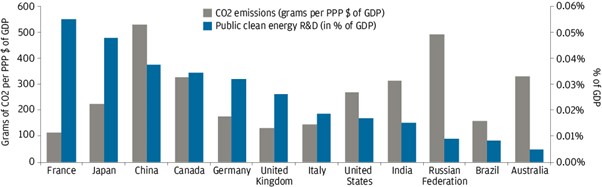
  2. “Ensure the US achieves a 100% clean energy economy and reaches net-zero emissions no later than 2050”: Biden’s pledge to achieve net-zero emissions by 2050 has already been made by more than 110 countries, accounting for more than 50% of global GDP and carbon dioxide emissions. To achieve the net-zero goal and ensure that the US becomes a 100% clean energy economy, Biden plans, among other policy measures, massive public investments (USD 400 billion) in energy- and climate-related research and development (R&D), an area where the US is lagging compared to Europe and China (see Exhibit 1).
  3. “Build a stronger, more resilient nation”: In addition to supporting R&D, Biden has promised significant investments in low-carbon infrastructure, committing to “a federal investment of USD 1.7 trillion over the next ten years, leveraging additional private sector and state and local investments to total to more than USD5 trillion”. This is probably the aspect of Biden’s climate plan that has generated the most enthusiasm in the US as there is a bipartisan consensus about the need to invest in infrastructure. The American Association of Civil Engineers estimates that to close its investment gap, the US “must increase investment from all levels of government and the private sector from 2.5% to 3.5% of US GDP by 2025”. Infrastructure spending will be part of a broader agenda of easy fiscal policy to promote the post-Covid 19 recovery.

 As well as these key climate commitments, other parts of Biden’s programme could further support the sustainability agenda. For example, changes to the Employment Retirement Income Security Act could redirect pension capital flows to encourage private capital to be part of the climate solution.

Exhibit 1: Government investment in greening the economy and level of CO2 emissions
Source: IEA, OECD, World Bank, Mission Innovation, J.P. Morgan Asset Management. R&D budgets for Brazil, Russia, India and China are estimates. Note: R&D numbers from public sector data and may not reflect private sector or joint venture research initiatives. Data as of 2019 or latest available.

Implications of climate policy initiatives for the (global) economy

The economic impact of the transition to a low carbon economy generally depends on whether it is “sticks-based”, with private businesses bearing the bulk of the cost of the transition, or “carrots-based”, with governments supporting the transition through subsidies and other forms of fiscal stimulus.

The carrots-based approach, on which Biden focused in his campaign, is of course the most popular in the current economic environment as it could support the recovery while also addressing the longer-term threat of climate change. Even though he inherits the highest debt/GDP ratio since the second world war, Biden aims to maximise the fiscal impulse of his policies by leveraging public-private partnerships. Similar approaches, such as the European Fund for Strategic Investments, launched in 2015, have delivered strong results in terms of economic growth and energy transition while also generating opportunities for private investors.

However, to be most effective from a climate perspective, this approach should be combined with a sticks-based approach. The most common such approach is the implementation of a carbon tax, or more generally of a carbon price that can be set either through taxes or preferably through Emissions Trading Schemes (ETSs) to incentivise carbon producers to reduce their carbon intensity.

Although Biden has refrained from formally mentioning carbon pricing in his programme, his Treasury Secretary, Janet Yellen, has made clear in the past that she sees carbon pricing as a key element of any climate policy package. Yellen has also advocated so-called “carbon border tax adjustments”, which would ensure that ambitious carbon pricing does not undermine a level playing field globally. As already discussed, this may contribute to ongoing trade tensions with China.

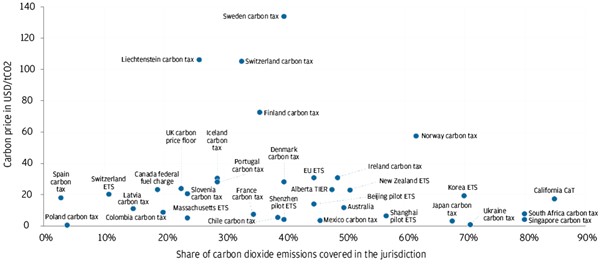
Conviction in the need for border tax adjustments is shared by many countries that have already launched their ETSs, but so far emissions coverage and price levels remain heterogeneous, and too low to reach our climate goals (Exhibit 2).  The US could be tempted to leverage its experience with state-level ETSs, such as those in California and Massachusetts, to support the creation of a global level playing field for carbon prices.

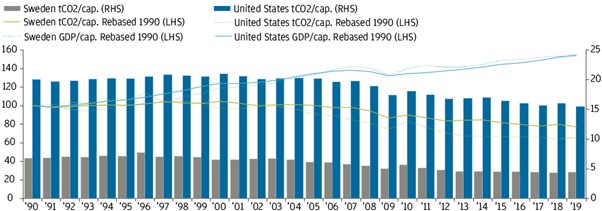
Contrary to the general belief, moving towards a fairer carbon price globally should not necessarily be negative for the global economy. The example of Sweden is striking in this respect. Although Sweden introduced the world’s highest carbon tax (Exhibit 2) in 1991 and joined the EU ETS in 2005, its GDP per capita grew by 53.5% between 1990 and 2019, or slightly less than the 54.6% posted by the US. In the meantime, Sweden’s carbon intensity has dropped from 6.8 tonnes of CO2 per capita (tCO2/cap) in 1990 to 4.45, a third of US carbon intensity (Exhibit 3).

Exhibit 2: Carbon pricing initiatives around the world

Carbon prices in USD (as of 1 November 2020) and % share of carbon dioxide emissions covered in the jurisdiction.
Source: World Bank Carbon Pricing Dashboard, National Bank of Belgium, J.P. Morgan Asset Management. Data as of 20 January 2021.

Exhibit 3: Economic and carbon performances of Sweden compared to the US, 1990-2019

Economic and carbon performances of Sweden compared to the USA 1990-2019
Source: National Bank of Belgium, Refinitiv Datastream, Emission Database for Global Atmospheric Research, Crippa, M., Guizzardi, D., Muntean, M., Schaaf, E., Solazzo, E., Monforti- Ferrario, F., Olivier, J.G.J., Vignati, E., Fossil CO2 emissions of all world countries – 2020 Report, EUR 30358 EN, Publications Office of the European Union, Luxembourg, 2020, ISBN 978-92-76-21515-8, doi:10.2760/143674, JRC121460. , J.P. Morgan Asset Management. GDP per capita based on purchasing power parity (PPP), 2011 international dollars. Data as of 20 January 2021.

Investment implications

Biden’s climate policy is likely to be part of a package of broader fiscal measures to support growth and speed up the energy transition of the country. It should also generate opportunities for investors in asset classes including real assets and global renewables, all of which have rallied over the last couple of weeks.

Internationally, the US is likely to re-embrace a more multilateral approach, after rejoining the Paris Climate agreement and committing to net zero carbon emissions by 2050. While US support for global carbon pricing initiatives remains uncertain, Biden’s administration may support carbon border tax adjustments, which could lead to a level playing field globally for carbon prices.

This is not necessarily negative from an economic perspective, as shown by the Swedish example, but carbon policy will need to be monitored by investors as carbon intensity is going to be an important non-financial parameter of economic and corporate performance. 

Its good to see President Biden’s positive impact already showing through, from re-joining the Paris Climate Agreement to his recent repeal of Trump’s former transgender military ban. These are all elements which come under the heading of ESG.

Along with his more pro-active efforts to tackle the coronavirus, hopefully these positive moves will all help the markets move in the right direction.

Please keep checking back for more ESG related content along with a range of investment and market updates.

Andrew Lloyd

25/01/2021
Team No Comments

Jupiter: Views from the House

Please see the below look back at 2020 from Jupiter Asset Management’s Chief Investment Officer:

Jupiter’s Chief Investment Officer reflects on the longer-term implications of a year most unlike any other.

In a year overwhelmingly dominated by the pandemic, it could be tempting to dwell on the challenges that have been presented to businesses and to global society.

Long before any of us had heard – let alone uttered – the words “COVID-19,” there was a trend towards more flexible working in many sectors of the economy, including in asset management. Some in our industry were embracing growing requests for more flexible working arrangements, while others may have viewed them with a certain degree of scepticism, pondering whether fund management was the kind of industry that could accommodate such arrangements at scale.

As much of the world went into lockdown, personal opinions on the merits and disadvantages of remote working became largely irrelevant; a significant policy decision that would, historically, have been the preserve of individual businesses was essentially taken for them.

Simultaneously, the important question as to whether a firm like ours could operate effectively with virtually all employees working remotely for a prolonged and potentially open-ended period was answered; we could, and we did. Indeed, a recent conversation with our head of dealing, Jason McAleer indicated that our industry as a whole has not only coped with the challenges presented, but has seen no perceptible increase in operational errors or issues.

In my view, the changes we have seen have the potential to make asset management a fundamentally more inclusive industry. Put simply, it now feels reasonable to hope that many of those who – for oft-cited reasons, including perceptions of long hours, punishing travel schedules and reconciling the demands of a challenging career with family life – might never have considered a career in fund management, will feel newly emboldened to take a closer look.

If, like me, you believe that more diverse investment teams are better performing ones, then this can only be a welcome development from the perspective of our clients.

Inclusivity leads to diversity

The pandemic and associated changes to working patterns and practices have also reminded us of the value of the office environment, as evidenced by numerous requests from colleagues for permission – which was generally denied, in line with the official guidance at the time – to continue to work from the office as the second UK-wide lockdown came into force.

This all begs a question: how quickly will the potential benefits of changes to working patterns in our sector filter through into the reality of the make-up of our workforce? Naturally, in a profession like fund management, hiring cycles are relatively lengthy. For this, there can be no apologies; the business of taking fiduciary responsibility of other people’s money is a serious one, and it is right that those charged with this duty should first have to prove their aptitude.

Of course, recruitment decisions are largely devolved to hiring managers; while this makes it difficult to “force” change in hiring practices from above, as CIO I am committed to continuing to challenge ourselves.

Changing behaviours: impact on markets and innovation

For a business like Jupiter, one of the more testing trends to emerge over the last year has been a tangible increase in direct participation in financial markets by retail investors. The exact cause of this change in behaviour is difficult to pinpoint, but we can reasonably speculate that it may have much to do with a combination of increased market volatility creating perceptions of attractive entry points, and the simple reality of the increase in available time many people have found in lockdown.

Whatever the cause, there is no doubt that such a sharp increase in activity in stock markets among individual retail investors has had an impact not only on stock prices, but also on liquidity and on sources of liquidity.

For asset managers, this potentially disruptive trend should act as something of a wake-up call; as retail investors in growing numbers show signs of exploring different ways to put their money to work, we must remain relevant, and continue to demonstrate that our products offer value.

As a firm, we place great emphasis on the importance of fostering innovation. A particularly exciting development for us in this regard was the formalisation earlier in the year of our strategic partnership with US-based NZS Capital, LLC (“NZS”), a highly innovative investment boutique which itself focuses on identifying disruptive businesses with the potential to generate favourable outcomes simultaneously for investors, customers, employees, society, and the global environment.

2020: when ESG became truly “mainstream”

Our partnership with NZS also serves as a timely reminder of our commitment to innovation and leadership in the field of ESG investing, a topic that has enjoyed a meteoric rise in prominence over the course of the last year. Indeed, I would be unsurprised if, in the future, social anthropologists looked back on 2020 as the year ESG investing became truly “mainstream.” This is an overwhelmingly positive development, and one to be embraced.

From a fund management perspective, I believe that ESG in the years ahead will be a refinement, evolution and re-categorisation of many of the assessments managers already make when looking at an investment case. How is a company run? Do its activities and/or products cause detriment to the environment? Are its employees mistreated or endangered? Does it mistreat its customers in a way that is detrimental to them and unlikely to build long-term loyalty? Has it taken on excessive leverage in pursuit of short-term shareholder returns that might undermine its longer-term viability? For us, these are not new questions, but they are being asked of us by a broader range of clients and other stakeholders, and with a frequency and determination not before seen.

Such focus on these issues is having a marked effect on markets, and on the way in which capital is being allocated to investment managers. This, in turn is undeniably changing and disrupting perceptions of the characteristics of a business most prized by investors.

The “what” and the “how” of asset management

I believe that the single most important thing we can do as a business is to generate strong and sustainable investment returns for our clients. As the end of every year approaches, we take the time to reflect on our performance; for a year that is likely to stand out in the collective memory for many of the “wrong” reasons, in this particular regard, 2020 has been a year much like any other.

The change, challenges and uncertainties we have all faced notwithstanding, it is pleasing to see that many of our strategies have performed very well throughout this period. Meanwhile, the new colleagues who joined Jupiter through our acquisition of Merian Global Investors have already made a significant contribution to Jupiter, bringing fresh energy, ideas, and perspectives to our debates.

But investment and performance are not the only things about which we hear from clients, who increasingly want to know how a firm like Jupiter manages its money managers. This is perhaps the most important part of the role of the CIO office, and it has been a privilege to speak with so many clients over the course of the year about how we seek to hold our fund managers to account. Put another way, it might be said that in 2020, what we seek to do (generate strong, sustainable investment performance), and how we go about it have become first among equals in the pecking order of clients’ priorities.

In truth, nobody knows how 2021 will play out. With the promise that vaccine programmes may be imminently deployed, a final end to the next chapter of Britain’s exit from the EU in sight, and a the potential for a more stable geopolitical scenario, it is tempting to look forward to the coming year with a great sense of optimism. At the same time, none of us must be under any illusion over the scale of the challenges facing the global economy as the world emerges from the pandemic. Whatever happens, our focus in the CIO office will be on seeking to ensure we deliver the best performance we can, in the most sustainable way we can; it is this pursuit, I believe, that gives us our real licence to operate.

As the end of every year approaches, reflections on the year we are about to leave behind tend to come naturally to everyone.

Look backs at the financial world and investment markets pour out from fund managers followed by outlooks, predictions, and goals for the year ahead.

2020 was a year that nobody could have predicted, and a year I’m sure nobody will look back fondly on.

One of the (positive) key points that can be taken away from this year (as demonstrated in the article above) is something we have been talking about for a while now, ESG is now mainstream.

It’s real, it’s important and it’s here to stay.

From firms and fund managers beginning their ESG journey, to the ones talking about how they already factor in a strong ESG process within their operations.

Whatever our industry takes away from this year, one thing is for sure, ESG is now firmly on everyone’s radar.

Andrew Lloyd

08/12/2020

Team No Comments

Janus Henderson ESG Thought Pieces and Our Thoughts

Investment Management House Janus Henderson recently published some thought pieces on ESG and Socially Responsible Investing. Please see the key takeaways from these pieces below:

Sustainable equities: the future is green and digital

  • The pandemic has accelerated investment into digitalisation, which we consider to be a key enabler of sustainability.
  • We expect support for sustainable development to gain momentum as countries embrace the need to be low carbon and as Joe Biden takes his seat in the White House.
  • Investment into electric vehicles is expected to surge in 2021 as innovators ‘race’ to the top.

Sustainable design in consumer products

  • The apparel sector is well known for its detrimental effects on the environment. However, as consumers become more aware of their own environmental footprints, there has been a surge in demand for sustainable goods.
  • A circular economy is based on the principles of designing out waste and pollution, keeping products and materials in use, and regenerating natural systems.
  • Companies including Nike, Adidas and DS Smith have incorporated a circular approach to the design and production of their goods, creating durable and long-lasting products with a reduced environmental footprint.

Investing in Diversity: analysing the investment risks and opportunities

  • Companies are increasingly being held accountable by consumers who reward brands aligned with their values.
  • For many global businesses, matters of diversity and inclusion go beyond the workplace, and efforts are made to address discrimination in the countries in which they operate.
  • Investors should be wary of companies that fail to futureproof themselves in terms of diversity. Socially conscious brands that make inclusivity a central part of their business strategy and brand ethos are more likely to succeed.
  • What gets measured, gets improved. Investors should focus on company disclosure, diversity-related targets, and meaningful initiatives in place. A list of suggested investor questions can be found at the end of this paper.

Janus Henderson are ahead of the game with ESG policies and started factoring this in back in 1991 shortly following the 1987 United Nations Report, ‘Our Common Future’ which I mentioned recently in an ESG blog. Their philosophy is below;

‘We believe there is a strong link between sustainable development, innovation and long term compounding growth.

Our investment framework seeks to invest in companies that have a positive impact on the environment and society, while at the same time helping us stay on the right side of disruption.

We believe this approach will provide clients with a persistent return source, deliver future compound growth and help mitigate downside risk.’

As I wrote about in our blog, as a firm we undertake regular due diligence with regards to the investments we recommend to our clients. This an ongoing process and we are constantly monitoring the market, and this year ESG has become a key factor in what we look for in the due diligence process.

Of course, many businesses may have a broad and generic ESG statement, but having a strong and well defined ESG process embedded into a businesses culture and investment process is definitely one of our key determining factors in the companies we choose to recommend.

We start off with an investment houses ESG statement, but then we dig deeper, to make sure these investments do exactly what they say they do, in terms of ESG, then factor this into the rest of our research i.e. investment returns, track records, cost etc.

It’s good to see so many investment houses now openly talking about and promoting ESG and demonstrating their views and philosophies.

Now could be a great time to invest whilst asset prices are still generally low, all whilst taking a responsible approach to investing!

As always, keep checking back for a variety of blog content from a wide range of investment houses, fund managers and our own original pieces.

Andrew Lloyd

04/12/2020

Team No Comments

ESG… the ‘new normal?’

Firstly, yes, this blog is called ‘the new normal’ and yes, I know you may be fed up of this phrase (believe me, I am too!), but dare I say it? Is ESG ‘the new normal’ when it comes to investing?

You may have seen some of our posts over this past year on ESG and sustainable investing.

We posted a 3 part series over the summer called ‘What is ESG? – An Introduction’, this was written by us to help our clients really understand what ESG is, and it’s a good thing we did… a recent study was undertaken in this industry and it was found that the majority of clients didn’t understand what ESG was, in fact it was found that people thought it stood for ‘ethically sourced goods’.

Google searches also show an increase of 216% in the term ‘ESG’ since 2018. This shows if people don’t know what it is, they want to learn.

Over the summer we wrote;

What does ESG stand for?

ESG stands for Environmental, Social and Governance

But what is it?

Investopedia definition for ESG is;

‘Environmental, social and governance (ESG) criteria are a set of standards for a company’s operations that socially conscious investors use to screen potential investments.’

ESG is more of a theme or a set of principles to follow rather than a single set principle.’

In case you missed it, please revisit this blog series using the following links: What is ESG? – An Introduction – Blog Series – Part 1, Part 2 and Part 3.

One Planet, One Society, One Economy

ESG is a set of principles throughout not just investing, but throughout the world.

Climate change is a factor within ESG principles, but why is it important to focus on climate change?

Well we are one planet. We are one society and one economy. Yes, I am aware that sounds very ‘tree hugger-ish’… but look at how issues caused by climate change can affect society and the economy.

You will have seen hurricanes, floods, the wildfires in California and Australia on the news over the past few years. These are all driven by global warming. Since 1980, the cost of weather related catastrophises has been over $4,200Billion.

Boris Johnson recently announced that the aim is for the UK to have no sales of new fossil fuel cars by 2030.

Climate change is not an abstract future concept anymore and ESG isn’t just the latest trend, it is a future state of being, it’s an input into the outcomes of the future and it’s about companies embracing opportunities and making changes now to invest in the future.

The concept of ‘ESG’ or ‘ethical’, ‘socially responsible’ isn’t new.

Over 30 years ago, in 1987, there was a study by the Brundtland Commission called ‘Our Common Future’ which said that;

‘Sustainable development meets the needs of the present without compromising the ability of future generations to meet their own needs, guaranteeing the balance between economic growth, care for the environment and social well-being’

ESG has been gaining momentum for a while now as climate change and other social issues presented themselves but then of course, the pandemic hit.

Many investors probably assumed that the ESG focus would fade however it was only strengthened, with people looking at how everybody working from home would reduce carbon emissions, international travel was halted which again contributed to the drop in carbon emissions and early on in the pandemic when companies had to send employees off to work at home or on furlough and their mental and physical wellbeing became a focus.

Sustainable investments were once few and far between and usually meant sacrificing returns in order to stand by your beliefs, but these days, you would be hard pressed to find a company or an investment that doesn’t have some form of ESG policy or statement. Of course some may just be doing this to ‘tick the boxes’ but some will be actively involved in ‘doing the right thing’.

ESG has momentum now, we no longer think you have to sacrifice returns either!

As we have said before, ESG is not a tangible ‘thing’ that you can see or hold, it is in fact a complex interconnected system of ideas and processes.

Think of it as a journey, rather than a destination.

Andrew Lloyd

27/11/2020

Team No Comments

Do Active Managers Truly Deliver in Volatile Times?

Please see the below content from Blackfinch Asset Management:

The role of an active manager is to make investment decisions based on analytical research, forecasts, judgement and experience with the aim of outperforming a specific benchmark or achieving a target return. This is as opposed to passive management, which involves tracking a market index.

The optimal environment in which active fund managers should thrive is when there are heightened levels of stock market volatility. Large swings in market direction create attractive investment opportunities as well as compelling exit points for profit taking. Arguably, markets have rarely been more volatile than in 2020. As a result, we’ve been extremely vigilant in assessing and monitoring the actively managed funds to which we allocate within our portfolios.

Our Approach to Active and Passive Managers

We’re whole-of-market investment managers, meaning we have the luxury of being able to make investment decisions freely, without fear of compromise. We’re unbiased in our investment selection. This extends not only across underlying fund houses, geographic regions and asset classes, but also when it comes to selecting between active and passive mandates.

We blend active and passive strategies within our portfolios, recognising the benefits that both approaches bring. When selecting an actively managed fund, we expect to clearly see value being added over and above an equivalent passively managed fund.

It’s important to establish whether a fund is delivering outperformance versus its selected benchmark. We’re also just as concerned about how it’s performing against its comparable peer group. This helps us to ensure that our investment screening process enables us to identify active managers with the ability to deliver attractive risk-adjusted returns versus other similar mandates.

Active Equity Managers

Equities are the main driver of performance in most portfolios. Our most recent assessment showed that, out of all actively managed equity funds to which we allocate, 84.6% have outperformed their respective benchmarks this calendar year. Perhaps even more comforting is that when compared to their peer groups, an impressive 92.3% of our underlying funds have outperformed their peer groups.

North America

Notably, within the North American equity sector, one of our core active equity funds has delivered a year-to-date return of 84.5%. This is some 71% ahead of the base market and equivalent passive mandate.

Asia and Emerging Markets

China, emerging markets and Japan have also been areas where our active managers displayed strong returns over equivalent passive and sector comparators. Of course, past performance should not be used as a guide for future returns. These impressive returns do mask some periods of significant volatility. However, when used at the correct weight and managed appropriately, these funds can be a fantastic component in a portfolio.

UK

On the flip side, within our UK equity allocation the margin of outperformance from active managers was far less, particularly in the large cap space. While outperformance was achieved, the difference between active managers and their passive equivalents was around just 2-3% after fees. We feel this performance differential is down to the notable challenges that the UK market has faced this year above and beyond the pandemic. For this reason, we remain comfortable in maintaining our current underweight to the region.

Ongoing Assessment and Monitoring

As ever, we’re conscious that the investment backdrop can change at a moment’s notice and we remain vigilant in our allocation to active managers. This is reflected in how we stick to our established process and also highlights the importance of regularly screening and assessing both active and passive mandates. This discipline helps us to ensure we don’t become wedded to ‘star’ managers and continually focuses attention on selecting the correct strategy depending on the particular stage of the market cycle.

As you may have seen with some of our other blog content, we regularly share updates from Blackfinch Asset Management as we believe they are a very good investment management firm. They have a good solid ESG proposition built in to their investments and as you can see in this article, they have a very good approach to investments and are varied in their methods to help deliver the right returns depending on the clients circumstances.

As Blackfinch note in the article, they are conscious that the investment backdrop can change at a moment’s notice and remain vigilant in their allocation to active managers.

We share the same view, and one of the ways we remain vigilant is by staying up to date on markets by taking in a wide range of views from across markets to help us get a handle on what’s going on.

We are also vigilant with the investments that we recommend to our clients and review these on an ongoing basis to ensure that they are doing exactly what they say they will and looking after clients assets in the right way. This is part of our ongoing research and Due Diligence.

Please keep an eye out for further updates from both us and from a range of different fund managers and investments houses.

Andrew Lloyd

19/11/2020

Team No Comments

The Government’s New Climate Governance Objectives

Blackfinch Comments on The Government’s New Climate Governance Objectives:

It has been quite a week in financial markets with the announcement of a potential vaccine for COVID-19. In a joint effort by Pfizer and BioNTech, the promising vaccine candidate is stated to have an initial success rate of 90%. The announcement was met with a wave of relief across markets. Cyclical sectors, being most closely tied to economic change, began to outperform those that have benefited greatly from stay-at-home policies.

Positive Developments on Climate Governance

While the vaccine candidate took the spotlight, there were some positive developments from the UK Government regarding its commitments to green finance and sustainability goals. Spearheaded by the Chancellor, Rishi Sunak, the UK has set out to “bolster the dynamism, openness and competitiveness” of the financial services sector.

The focus is on ensuring that the sector can continue helping to combat the effects of climate change. This can include reducing carbon emissions in the face of global warming, and increasing investment in renewables, for a greener economy and world.

In seeking to achieve these objectives, the UK Government will issue the first ever Sovereign Green Bond in 2021. It will also become the first country in the world to make the recommendations of the global Task Force on Climate-Related Financial Disclosures (TCFD) an official requirement.

TCFD-aligned disclosures will be mandatory for UK businesses including those within financial services. Companies will be required to disclose their climate-related risks on a regular and transparent basis.

The Chancellor also added further comment around ensuring that the UK will continue to pioneer new technologies and shift sector activity towards a future of net zero carbon dioxide emissions.

Helping to Meet Targets Through Investing

Blackfinch’s investment goals are fully aligned with these new proposals and objectives from the UK Government. We’re a signatory to the Principles for Responsible Investment. This reflects our commitment to environmental, social and governance (ESG) principles, with these central to our investment processes. We recognise that financial services plays an important role in the drive for net zero emissions.

The issuance of a Sovereign Green Bond will help the UK to meet its 2050 net zero target and other environmental objectives. The money raised from the bond can help to finance projects to tackle climate change and to invest in related infrastructure such as buildings, roads and power supplies.

There’s a great opportunity for Blackfinch to support this target via the portfolios offered by Blackfinch Asset Management. We seek to allocate funds to this exciting and growing sector of the sovereign bond markets.

Meanwhile, at Blackfinch Energy, our investment focus is on real assets such as wind and solar farms. Similarly, at Blackfinch Property, we invest across sectors, including in eco-living developments. These are all sectors the Government is actively targeting in its push to address climate change and invest in the UK’s infrastructure. We will continue investing in these areas in pursuit of these common goals.

A New Era for Climate Governance Reporting

The TCFD was created to improve and increase reporting of climate-related financial information. The commitment from the UK Government to make disclosures mandatory is an important development. The standards set by the TCFD can allow investors and businesses to better understand the material financial impacts of a firm’s exposure to climate change. This is something we wholeheartedly support.

There’s still work to be done as the mandatory disclosure for firms doesn’t come into effect until 2025. Nevertheless, it’s a key step forward and UK businesses, including those in financial services, can look to adopt it. For us, any such requirement would become an integral part of our ESG process.

In a further show of commitment by the Government, it also outlined a new related system of classification. Once implemented, this can provide a framework for determining which of a firm’s activities can be defined as environmentally sustainable. Again, the aim is to improve understanding of the impacts that firms and their activities and investments have on the environment. This is as the UK transitions to a sustainable economy.

These developments towards sustainable finance and greater disclosures will help to ensure that the UK is a global leader in working towards a sustainable future. We fully support the Government’s objectives and look forward to investing in opportunities arising from these initiatives.

This is good input from Blackfinch. As we wrote over the summer in one of our ESG blogs, Blackfinch have a very good ESG proposition within their investments and this is something we recommend to our clients.

They are ahead of the game in terms of ESG as we have been reporting on, we expect the rest of the industry to continue movement towards good ESG propositions.

Keep an eye out for further content on ESG from fund managers such as Blackfinch and our own original content.

Andrew Lloyd

16/11/2020

Team No Comments

UK sustainable fund returns show performance doesn’t have to cost the earth

Please see the below article from AJ Bell:

Good Money Week kicks off on Saturday 24 October, in the midst of a bumper year for ethical fund sales and a snowballing spotlight on investing sustainably. But does investing according to your principles mean accepting a lower financial return?

To address this question AJ Bell has analysed funds with a 10 year performance record in the IA UK All Companies and IA Global sectors. These are the two most popular sectors with retail investors by far, accounting for approximately £190bn of assets.

Key findings:

  • The average UK ethical fund has outperformed the average non-ethical fund, and the FTSE All Share
  • This has been a result of luck as well as judgement
  • The average global ethical fund has performed better than the average UK ethical fund
  • BUT it has underperformed the benchmark MSCI World Index
  • Investors in some UK ethical index trackers have been left behind
  • A record amount of money is being invested in ethical funds by UK retail investors
  • Ethical fund picks

These numbers show investing ethically is perfectly compatible with getting an exceptional return over the long term. The number of ethical funds on the market has been growing rapidly and that means investors can now afford to get a bit more picky when it comes to choosing a fund with performance pedigree.

UK ethical funds have done particularly well compared to the market with the average fund showing a clean pair of heels to the benchmark FTSE All Share Index. As ever the devil is in the detail and some funds have let the side down, in particular some of the older UK tracker funds where returns have been eroded by high charges.

On average global ethical funds have done even better in the last ten years than their UK counterparts. But they have fallen behind the MSCI World Index which has been driven relentlessly upwards by the remarkable performance of the US stock market.

On the one hand then, global ethical investors might feel short-changed, but the delivery of high absolute returns while meeting an ethical investment policy should quell any major concerns. The global sector is also heterogenous in its make-up and some ethical funds are pursuing specific investment themes like clean water and urbanisation, which make comparison with the index and the sector less meaningful.

Some global ethical funds have managed to beat the benchmark index which demonstrates that even against the high bar of the MSCI World Index it’s possible to post outperformance while following a responsible investment framework.

Performance of ethical funds in the IA UK All Companies sector

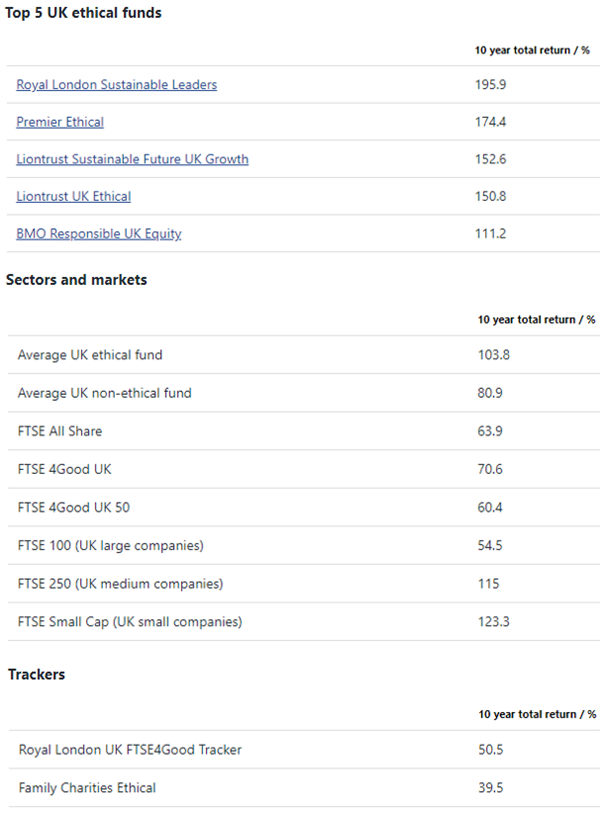
The average UK All Companies ethical fund has outperformed the FTSE All Share by 40% over the last 10 years. It’s also outperformed the average non-ethical fund by 23%. The top performing ethical fund over 10 years is Royal London Sustainable Leaders trust, which has returned 196%, compared to 64% from the FTSE All Share*.

Over half of UK ethical funds sit in the top quartile of performance for UK All Companies funds overall. The top performing ethical fund (Royal London Sustainable Leaders) is the 8th best performing fund in the UK All Companies sector over ten years (i.e. 7 funds bettered it).

Strong ethical outperformance has been achieved by a combination of luck as well as judgement. That’s because responsible funds tend to have less invested in the big blue chips, which have underperformed compared to medium sized and smaller companies (see table below).

On average the top 5 performing UK ethical funds have 31% invested in large companies compared to the UK market index (the FTSE All Share) which has 66% invested in the big blue chips. The top 5 have on average 32% invested in midcaps and 37% invested in small caps, compared to 23% and 11% respectively in the FTSE All Share*

There are some notable laggards in the sector though. Bringing up the rear of the performance table are two passive funds. Passive funds replicate the performance of the index they are tracking, but lag after charges are deducted. The size of the lag depends on the level of charges and the time investors hold the fund. Where charges are high and the investment horizon is long there can be a damaging drag on performance.

The Family Ethical fund is the worst performer, underperforming the FTSE All Share by 24.4%. More relevantly it’s underperformed the index it tracks, the FTSE 4Good UK 50 index, by 20.9%. Over 10 years it’s turned £1,000 invested into £1,390, compared to £1,600 from the FTSE 4Good UK 50 index and £2,040 from the average UK ethical fund. That’s simply a reflection of the compound effect of annual charges of 1.5%, which eat into the fund’s performance year after year. Investors do get an ISA wrapper into the bargain, but that still doesn’t look like great value compared to other options available to investors.

Sources: FE to 30/09/2020

Averages for ethical and non-ethical funds are based on the performance records of those funds with a ten year record only.

Performance of ethical funds in the IA Global sector

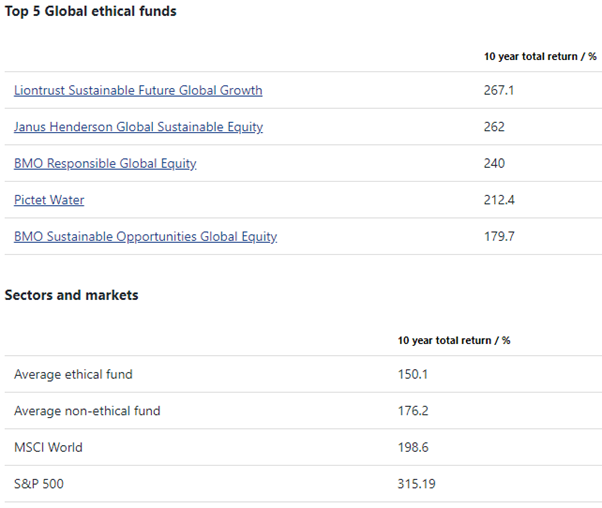
The picture is more nuanced for ethical funds in the global sector. The average global ethical fund with a 10 year performance record has outperformed the average UK ethical fund providing a total return of 150.1% since 2010 compared to 103.8%.

However the bar is set higher in the global sector because of the relative performance of the benchmark index, the MSCI World Index, which itself has been driven higher by an extremely hot US market. Compared to this index the average global ethical fund has underperformed, returning 150.1% compared to 198.6%, and has also failed to match the average non-ethical fund in the sector, which has returned 176.2%.

Given the extremely strong absolute performance of ethical funds in the global sector, it’s difficult to say investors should be disappointed but technically as a group they have underperformed.

There have been some funds which have managed to outpace the racy MSCI World Index though. The Liontrust Sustainable Future Global Growth fund tops the performance chart; it has turned £1,000 invested into £3,670, compared to £2,990 from the MSCI World Index.

There has been a glut of new fund launches in this sector in recent years, and there are now 57 funds available in the sector, which means there are now many more options for investors, albeit with shorter track records.

Source: FE to 30/09/2020

Averages for ethical and non-ethical funds are based on the performance records of those funds with a ten year record only.

A record-breaking year

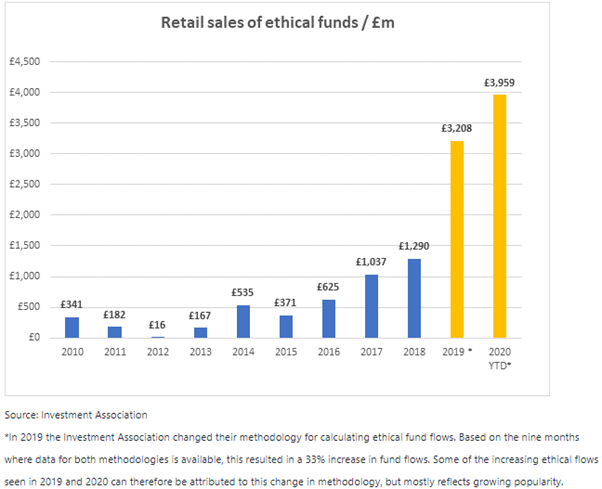
Unless there are heavy withdrawals from the sector in the next few months, ethical funds are on course to have a record-breaking year in terms of retail fund sales, as the chart below shows. And that’s after a bumper 2019.

£3,959 million has been invested so far this year compared to £3,208 million last year according to Investment Association data. Still less than 3% of all Investment Association retail assets sit in ethical funds however which leaves plenty of scope for further growth.

Ethical funds will hope to emulate the success of tracker funds in hitting the mainstream of retail investing. In 2010 less than £7 in every £100 was held in passive funds- that now stands at £18.

As more ethical funds launch on the market, and reach the critical three year performance record which is often used as a bare minimum by professional and retail investors, we can expect flows into these funds to continue to blossom.

Ethical fund launches

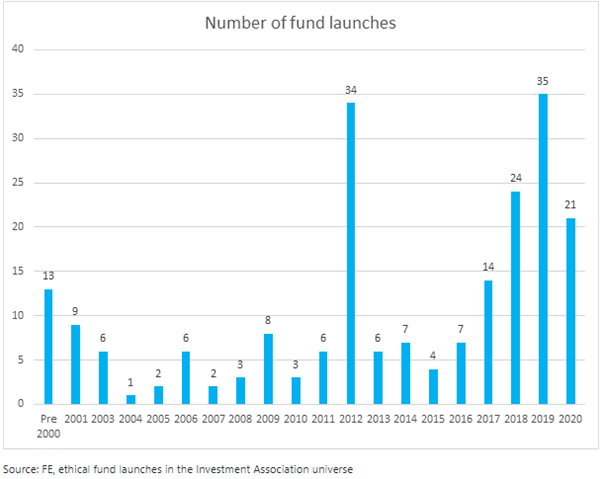
Ethical fund launches have slowed down this year compared to 2019, probably a reflection of the practical difficulties COVID restrictions have thrown up for fund groups. With a few months left to go however, it’s still looking like a strong year for new funds hitting the market.

Looking back 2012 was an anomalously heavy year for ethical fund launches and was only recently bettered in 2019. That can probably be attributed to two big changes which swept through the investment industry in that year. The Retail Distribution Review led to new share classes being introduced after funds were prohibited from paying ongoing commission and at the same time the arrival of pensions auto-enrolment opened up the door for fund groups to lodge new funds in pension plans.

Ethical fund options

Liontrust Sustainable Future Global Growth

Peter Michaelis, head of the sustainable funds team at Liontrust, has been investing in sustainability since 2001. This fund invests across the global stock market in companies that are driving sustainable growth. The fund doesn’t use negative screening – it selects companies on their positive societal benefit, based on around 20 sustainable growth themes identified by the Liontrust team.

Royal London Sustainable Leaders

Manager Mike Fox has been involved in this fund since 2003 – it actually started life at the Co-op. It invests exclusively in the UK stock market and seeks to invest in companies which demonstrate a net benefit to society. The portfolio is constructed using a quantitative and qualitative approach which scores companies according to their sustainability and financial credentials.

Stewart Investors Worldwide Sustainability

The fund invests across the globe in companies that are positioned to benefit from the sustainable development of the countries in which they operate. Manager Nick Edgerton has been managing the fund since 2012 (as co-manager until 2016). He assesses companies based on their social utility and environmental impact, as well as the quality of the management and financial performance.

These articles are for information purposes only and are not a personal recommendation or advice. Past performance isn’t a guide to future performance, and some investments need to be held for the long term.

Comment

This article echoes what we have been talking about recently, that ethical and sustainable investing has gone mainstream and that you no longer have to accept lower performance with ethical investments (compared to standard investments).

Whilst this has been an interesting year, to say the least, one of outcomes of the year has been that ethical and socially responsible investing has become a bigger topic of discussion. We now have more clients than ever asking us about ethical investing.

Keep a look out for more ESG and ethical investment content.

Andrew Lloyd

26/10/2020