Team No Comments

Brooks Macdonald Daily Investment Bulletin

Please see below article received from Brooks Macdonald this morning, which provides a market update with specific reference to the US and the UK.

What has happened

The US stock market experienced a notable rebound, with the S&P 500 climbing 1.25% and largely offsetting the previous day’s 1.61% drop. Despite a second consecutive day of losses for US regional banks, which saw a 2.28% decline, and ongoing concerns about New York Community Bancorp, the broader market appeared to recover.

Big tech earnings continue

After the market closed, tech giants Apple, Amazon, and Meta reported earnings that surpassed expectations. Meta’s shares soared approximately 15% after hours, buoyed by higher-than-anticipated revenue forecasts for the first quarter and the announcement of further share repurchases and its inaugural dividend. Amazon’s shares rose 7%, reflecting a robust profit forecast for the first quarter, despite its sales guidance falling slightly short of expectations. Apple’s shares, however, dipped nearly 3% after hours due to a significant sales decline in China, which overshadowed an otherwise modest earnings beat.

Bank of England

In the UK, the Bank of England maintained its interest rates, in line with market expectations. The Monetary Policy Committee (MPC) was divided, with the majority opting to keep rates steady, two members advocating for a 25 basis point hike, and one member favouring a 25 basis point reduction. Governor Bailey emphasized the need for more evidence of inflation trending towards the 2% target before considering rate cutes. Similar to the Federal Reserve, the MPC’s stance appeared to be gradually shifting towards the possibility of rate cuts, as indicated by the removal of the previous explicit tightening bias and the statement that the MPC is prepared to adjust policy as necessary. Market expectations for a rate cut by May decreased, but the likelihood of significant rate reductions by the end of 2024 remained high.

What does Brooks Macdonald think

Looking forward, the focus will be on the US jobs report for January, which will provide early data for 2024 and could influence the Federal Reserve’s rate cut decisions, with March’s outcome still uncertain despite recent comments from Fed Chair Powell. Recent macroeconomic indicators suggest the possibility of a ‘soft landing’ for the US economy. However, historical patterns remind us that the effects of a rate hike cycle can be delayed and unpredictable, often culminating in significant economic impacts.

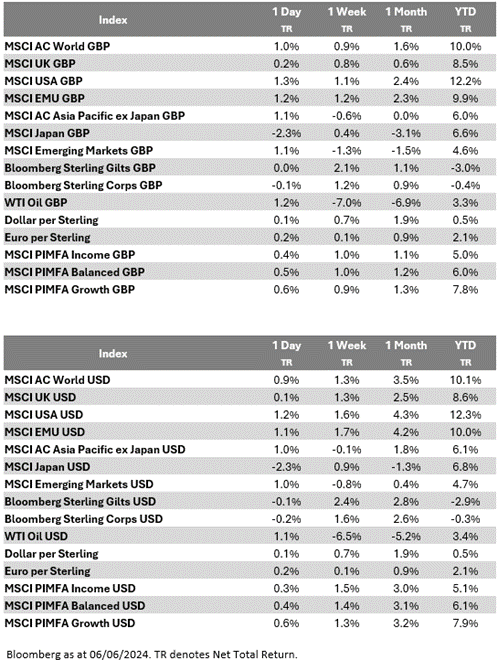
Index 1 Day1 Week1 MonthYTD
 TRTRTRTR
MSCI AC World GBP 0.5%0.0%1.5%1.5%
MSCI UK GBP -0.1%1.3%-1.3%-1.3%
MSCI USA GBP 1.1%-0.1%3.0%3.0%
MSCI EMU GBP -0.4%0.7%0.2%0.2%
MSCI AC Asia Pacific ex Japan GBP -0.1%-1.3%-4.5%-4.5%
MSCI Japan GBP -1.0%0.6%4.0%4.0%
MSCI Emerging Markets GBP 0.5%-1.0%-3.9%-3.9%
Bloomberg Sterling Gilts GBP 0.5%1.9%-1.9%-1.9%
Bloomberg Sterling Corps GBP 0.3%1.6%-0.8%-0.8%
WTI Oil GBP -2.8%-4.9%3.2%3.2%
Dollar per Sterling 0.1%0.4%0.0%0.0%
Euro per Sterling -0.1%0.0%1.8%1.8%
MSCI PIMFA Income GBP 0.4%0.9%0.1%0.1%
MSCI PIMFA Balanced GBP 0.5%0.8%0.2%0.2%
MSCI PIMFA Growth GBP 0.6%0.7%0.7%0.7%
Index 1 Day1 Week1 MonthYTD
 TRTRTRTR
MSCI AC World USD 0.7%0.4%1.2%1.2%
MSCI UK USD 0.1%1.7%-1.5%-1.5%
MSCI USA USD 1.3%0.3%2.8%2.8%
MSCI EMU USD -0.2%1.1%0.0%0.0%
MSCI AC Asia Pacific ex Japan USD 0.1%-0.9%-4.7%-4.7%
MSCI Japan USD -0.8%0.9%3.8%3.8%
MSCI Emerging Markets USD 0.6%-0.6%-4.1%-4.1%
Bloomberg Sterling Gilts USD 0.1%1.7%-2.4%-2.4%
Bloomberg Sterling Corps USD -0.1%1.5%-1.3%-1.3%
WTI Oil USD -2.7%-4.6%3.0%3.0%
Dollar per Sterling 0.1%0.4%0.0%0.0%
Euro per Sterling -0.1%0.0%1.8%1.8%
MSCI PIMFA Income USD 0.6%1.3%-0.1%-0.1%
MSCI PIMFA Balanced USD 0.6%1.2%0.0%0.0%
MSCI PIMFA Growth USD 0.7%1.0%0.4%0.4%

Bloomberg as at 02/02/2024. TR denotes Net Total Return

Please check in again with us soon for further relevant content and market news.

Chloe

02/02/2024

Team No Comments

Evelyn Partners Update – Bank of England MPC decision

Please see the below update from Evelyn Partners Investment Strategy team on today’s Bank of England MPC decision to continue to hold interest rates at 5.25%:

What happened?

The Bank of England (BoE) held the base rate at 5.25% at their meeting today. This was consistent with market expectations and marks the fourth consecutive meeting where rates have been held at this level.

Interestingly, the committee vote was split three ways, with two members voting for a hike, six voting to hold, and Swati Dhingra voting for a 25 basis point cut.

What does it mean?

As expected, the BoE held interest rates at 5.25%. Markets are now focused on when the Bank will cut interest rates and how far they will go. And perhaps Swati Dhingra’s vote to cut the base rate signals that the tide is set to turn. This was the first vote for a cut since the pandemic started almost four years ago. Although clearly this will continue to depend on the incoming data, which has been favourable since the Monetary Policy Committee (MPC) last met in December.

December CPI came in at 4.0% year-on-year, which was well below the Bank’s forecast of 4.6%. The headline figure was helped by services inflation, which was 0.5% percentage points below the Bank’s November forecast of 6.9% year-on-year. Similarly, the latest wage data shows further deceleration. The direction of travel seems encouraging, so much so, that the consensus forecast is that CPI will be 2.1% by the second quarter of this year.

The guidance published today by the MPC provided more hints on how they see the economic outlook. Compared to December’s guidance, the MPC dropped the language mentioning the risk of further interest rate tightening, signalling they are less concerned about inflation remaining stubbornly high. We also received the Bank’s latest forecasts. It expects GDP growth of 0.25% in 2024 and 0.75% in 2025. Similar to the consensus view provided in the Bloomberg survey of economists, the Bank sees inflation decelerating to 2% in Q2 2024, before it picks up again in the second half of the year.

This should give the Bank the ammunition it needs to cut rates around the middle of the year. Money markets are split on whether the base rate will be cut in May, but they have more conviction that we will see at least one cut by June. They are also pricing 100 basis points of cuts by the end of 2024.

Bottom Line

The BoE held interest rates at 5.25%. We expect to see the first rate cut around the middle of the year as inflation decelerates to the 2% mark.

Please continue to check our Blog content for advice and planning issues and the latest investment, markets and economic updates from leading investment houses.

Andrew Lloyd DipPFS

01/02/2024

Team No Comments

EPIC Investment Partners: Daily Update – FOMC / US Banking Concerns

Please see the below update from EPIC Investment Partners about the current movements with the US Economy received earlier today:

As expected, the Fed left its policy rate unchanged at the 23-year high range of 5.25%-5.5%. However, the accompanying statement did acknowledge the more balanced risks to inflation, and the suggestion that whilst further rate hikes are off the table, the committee was not ready to cut yet. The statement said that the FOMC “does not expect it will be appropriate to reduce the target range until it has gained greater confidence that inflation is moving sustainably toward 2%”. 

Fed Chair Jerome Powell acknowledged that whilst progress has been made in reducing inflation, a March cut is unlikely. “Based on the meeting today, I would tell you that I don’t think it’s likely that the committee will reach a level of confidence by the time of the March meeting to identify March as the time to do that. But that’s to be seen,” Powell said. He added: “We believe that our policy rate is likely at its peak for this tightening cycle and that, if the economy evolves broadly as expected, it will likely be appropriate to begin dialling back policy restraint at some point this year”. “We are prepared to maintain the current target range for the federal funds rate for longer, if appropriate”, he said. 

However, the FOMC’s rate decision was overshadowed by renewed concerns in the US banking system. New York Community Bancorp, one of the big winners after the collapse of Silicon Valley Bank and First Republic Bank last year, saw its stock fall a record 46% after it cut its dividend, and massively increased its provision for loan losses to over USD550m due to its exposure to US commercial real estate.

Within hours a second lender announced huge losses due to its exposure to the sector.  Aozora Bank Ltd, Japan’s 16th biggest bank by market value, said it expects to post a net loss of USD191m for the fiscal year, compared with its previous forecast of profit. Shares sank more than 20% (limit down) in Tokyo.

According to a report from the University of Southern California, Northwestern University, Columbia University and Stanford University, as of Q3 last year, US banks alone held about USD2.7tn in commercial real estate debt. Green Street, a real estate analytics company reported commercial property values have fallen over 20% since Q1 2022, with office prices down a massive 35% as demand for desk space weakened following the wide adoption of remote working. 

So, the question now is whether New York Community Bancorp and Aozora Bank are canaries in the coalmine?

Please continue to check our Blog content for advice and planning issues and the latest investment, markets and economic updates from leading investment houses.

Andrew Lloyd DipPFS

01/02/2024

Team No Comments

Brewin Dolphin – Markets in a Minute

Please see this weeks Markets in Minute update from Brewin Dolphin below, received late yesterday afternoon:

Please continue to check our Blog content for advice and planning issues and the latest investment, markets and economic updates from leading investment houses.

Andrew Lloyd DipPFS

01/02/2024

Team No Comments

EPIC Investment Partners: The Daily Update | Qatar’s Upgrade

Please see below, an article from EPIC Investment Partners which focuses on the economic strength of Qatar and the potential investment opportunities. Received this morning – 31/01/2024

 We have often mentioned to clients that we believe the rating agencies are behind the curve, so we were pleased to hear that Moody’s Investor Service recently upgraded its long-term rating for Qatar by one notch, from Aa3 to Aa2, its first upgrade since 2007. The already high rating for the wealthy nation now sits on par with the UAE, South Korea and France, and is now in-line with S&P Global’s AA rating. Fitch rates Qatar one notch lower, at AA-, with a positive outlook, signalling a potential upgrade.   

Moody’s analysts attribute the upgrade to Qatar’s improved fiscal metrics, which have been “achieved during 2021-2023”, and are expected to be “sustained in the medium term”. The government’s commitment to fiscal prudence (the IMF estimates the nation’s debt to GDP is ~40%, from 73% in 2022), including the gradual reduction of infrastructure spending (linked to preparations for the 2022 FIFA World Cup), is seen as a contributing factor to the upgrade.  

The rating agency further recognises Qatar’s major investments in liquefied natural gas (LNG) production capacity as credit positive. Qatar, the world’s third-largest LNG exporter, is investing substantially to boost its output by about 60% over the next three years, in a move to meet rising global demand growth, particularly given the significant role the fuel plays in the transition to cleaner, more sustainable power sources.   

Given the rising frictions in the Red Sea and Qatar’s dependence on the export route, S&P Global recently commented that diverting LNG carriers away from the Red Sea would minimally affect Qatari oil and gas entities, since most of their customers are located in Asia. The agency went on to add that barring risks of regional war, the impact of tensions on rated Qatari energy firms like Nakilat, and QatarEnergy’s LNG project is manageable. 

Away from hydrocarbons, Qatar has made impressive strides in diversifying its economy, driven by the Vision 2030. Thanks to sustained investments and policy support, Qatar’s non-oil sectors now comprise over 50% of real GDP. Thriving industries such as financial services, tourism, and manufacturing are fast emerging as new engines of economic growth. Qatar is also expanding output in high value sectors like chemicals and technology, which leverage its natural gas resources. With huge investments allocated to transport infrastructure and private sector stimulation, Qatar’s economic base is rapidly broadening. Prudent economic management has translated this diversification into solid GDP growth rates despite hydrocarbon price volatility. 

We also remain cognisant of Qatar’s diplomatic mediation initiatives. Driven by a desire to establish itself as an independent and progressive player on the world stage, Qatar has embraced diplomatic mediation as a cornerstone of its foreign policy. 

We have long favoured Qatar’s sovereign and quasi-sovereign bonds. Through our investment process, we have identified Qatar as having a 7-star NFA score, defined as a “wealthy nation”. Then, using our proprietary relative value model, we have identified undervalued bonds issued by the government and government-owned entities. A good example of a bond we favour is the Qatar 6.4% 2040s. This bond is currently trading ~45 bps wider than similarly rated bonds with a ~10-year duration and offers a risk-adjusted return and yield of ~10%.   

Qatar has not issued international bonds in around four years, simply because it does not need to. So, its first green bond offering, which is coming “soon” according to the nation’s finance minister, Ali Al-Kuwari, will attract much attention, and will further demonstrate its commitment to sustainability funding.  

We continue to believe Qatar’s economy will maintain its positive trajectory, supported by rising LNG exports and diversification efforts, and through its mediation efforts will continue to bring it to the fore as a global ally. Therefore, as long as the bonds offer attractive risk-adjusted returns, or alpha, Qatar will remain a high conviction investment in our Next Generation Bond Strategy.

Please continue to check our blog content for advice and planning issues and the latest investment, markets and economic updates from leading investment houses.

Alex Kitteringham

31st January 2024

Team No Comments

Brooks Macdonald – Weekly Market Commentary

Please see below this week’s Weekly Market Commentary from Brooks Macdonald, which was received yesterday afternoon – 29/01/2024:

Please continue to check our blog content for advice and planning issues and the latest investment, markets and economic updates from leading investment houses.

Carl Mitchell – DipPFS

Independent Financial Adviser

30/01/2024

Team No Comments

Tatton Investment Management – Monday Digest

Please see the below article from Tatton Investment Management providing a brief analysis of markets and the key news from global economies over the past week. Received this morning 29/01/2024.

Overview: Positive growth sentiment returns

After January’s bumpy start, and the volatile two weeks that followed, it looks like investors are finding their feet again. Almost entirely across the board, regional equity markets are up another healthy amount, with even China managing another positive week. And as suspected, bond markets are having an extremely busy January.

Government debt yields have declined by around 1%, but for riskier corporate borrowers, the turn in sentiment in both markets and economies has resulted in reduced fears of defaults – which has additionally driven down the risk premium (spread), they have to pay above the government. In the US dollar bond market, the US government was paying 10-year interest of just less than 3% in September 2018. Now the yield is about 4.1%. A borrower with a credit rating just below investment grade (BB-rated) was paying just over 6% in September 2018, and now will pay interest of around 6.5%, according to Bloomberg. Only three months ago, that BB-rated borrower was looking at paying over 8%. Perhaps it is no wonder corporate borrowers feel current yield levels are reasonably attractive enough to replenish their loan capital side. The story is similar in the Eurobond market, which has already seen record issuance for January.

It is a good sign for markets and economies that more companies think this is a good time to borrow money. This rise in spirits is getting some backing from moves in the commodities markets (which we write about below) and from business sentiment surveys like the ‘flash’ purchasing managers’ index (PMI) surveys from across the world, released last week. Perhaps sentiment is not racing ahead, but the broad composite measures – which include both manufacturing and service sector companies – are now generally heading above the 50 level, which signals the difference between companies thinking they are in growth or decline. Indeed, the US, UK and even China are at or above the 52 level (which aligns with activity at a normal level and optimum capacity usage).

So, markets have returned to the frame of mind where optimism is slight and risks have been high but are falling. The European Central Bank (ECB) did its bit to keep confidence stable last week. Nobody expected a rate cut (and none was forthcoming) but President Christine Lagarde said there was “stabilisation” in some wage indicators and that companies were currently absorbing wage hikes, reducing the risk of second-round effects on prices. She also gave little pushback when asked about a spring rather than summer start to cutting rates. Next week is the turn of the US Federal Reserve and then the Bank of England. Again, nobody is expecting rate cuts, it will be all about the comments.

Will Xi allow China to profit?

Last year’s prolonged decline in Chinese stocks continued well into January, but last week, Hong Kong’s Hang Seng index rose more than 6% during midweek trading, after news that the Chinese government would step in to stop the rout. On Tuesday, Premier Li Qiang called for “more forceful and effective measures to stabilise the market and boost confidence”. On Wednesday, the People’s Bank of China (PBoC) cut bank reserve requirements, thereby unleashing a trillion Yuan of lending headroom into the banking system. Both the Hang Seng and the CSI 300 – mainland China’s benchmark stock index – rallied in response.

Perhaps Beijing is willing to put its money where its mouth is and – crucially – wants markets to know it. Its words and actions are certainly a step in the right direction and, coming so soon after Premier Li’s speech, will soothe some investor concerns. Ultimately, though, attempts to support short-term confidence in the economy or financial system do not address the core reason for why businesses and investors lack confidence to begin with.

During the crackdowns of the last few years, there has been a growing sense that President Xi Jinping is against not just excesses but private sector profit altogether. He has made it clear that private power cannot be allowed to rival the state (as in the case of Alibaba founder Jack Ma) but this seems to have filtered through to profit-making in general. People are willing to take advantage of the short-term market opportunities the Party hands out, but to truly invest in long-term private sector growth investors need to know they will be allowed to profit without negative comeback. This needs consistent messaging, ideally from Xi himself. Without that, the decline will be hard to stop.

Commodities and growth

The Dow Jones Commodity Index has been virtually flat since the beginning of the year. That is either a good or bad sign, depending on how you look at it. Considering the intentional slowdown in global growth recently, a stable if unspectacular patch should be welcomed. On the other hand, this comes after a protracted downturn for the commodity sector. Dow Jones commodities have lost nearly 9% on a one-year basis at the time of writing. Staying flat is less impressive if the level is already low

Of course, much of that downturn was about oil, but oil is no longer a great indicator of general economic conditions. Metals, in particular industrial metals, are arguably a better signal. The S&P Industrial Metal index has been flat for some time, currently at the same level it was in May last year and with only a narrow trading range since then. But metals became detached from energy prices last year, and that detachment is ongoing. Again, stable metals prices are encouraging, all things considered. Global manufacturing has been struggling for a long time, and despite improvement across the board, manufacturing PMIs still point toward contraction in the UK and Eurozone. The only exception is the US, where the manufacturing PMI unexpectedly jumped to 50.3 in January. US resilience and outperformance is nothing new, though, and is offset by weakness elsewhere – particularly the disappointing China.

The problem for metals is that they cannot sustainably rise on hope alone. Like all commodities, metals futures are subject to short-term speculation but are ultimately physical materials that need to be financed, stored, transported and used. The cost of storage has risen dramatically in recent years thanks to the massive step-up in developed market interest rates which led to a big increase in the cost of the tied-up capital. That means inventories are generally lower, which means prices are much more sensitive to final demand. As such, we are unlikely to see a sustained pick-up in metals prices until growth and demand actually come through.

Please check our blog content for advice, planning issues and the latest investment, market and economic updates from leading investment houses.

Alex Clare

29/01/2024

Team No Comments

Invesco Quarter 4 2023 – The big headlines

Please see below article received from Invesco this morning, which summarises the market-moving events from Q4 2023.

Oil slick

SF: “After a yearlong decline, oil prices enjoyed an impressive recovery from June 2023, to reach highs for the year in September at low to mid $90s for both WTI and Brent. Subsequently, however, and despite the terrifying developments in the Middle East, sentiment turned relatively bearish through the end of December. Though there are many important variables driving the oil price, our analysis informs that price weakness likely stemmed from the market’s reassessment of US supply strength, coinciding with seemingly slowing demand growth.

“Perhaps more positive for US geopolitical clout, yet evidently a headwind for global oil prices, was the upward revisions to US second half 2023 supply, driven by improved drilling efficiencies and oil well productivity in shale. Indeed, according to the International Energy Agency December 2023 Oil Market Report, the US will have been accountable for 2/3rds of the non-OPEC (Organization of the Petroleum Exporting Countries) expansion (Canada, China, Brazil and Russia are other notable names). Simultaneously, OPEC’s output is expected to decline, reducing its global market share to 51% in 2023 – the lowest since the bloc’s creation in 2016.

“A subdued macro outlook heading into 2024 is driving downward revision to global oil consumption forecasts. This will likely be seen most acutely in Europe, whose economy is looking relatively weaker as the old continent suffers the strain of a broad industrial and manufacturing slump.

“Overall, the first three quarters of 2023 saw relative strength for oil as the Russia/Ukraine conflict continued into its second year, delivering ongoing disruption to the supply status quo. However, given the impressive supply response from the US, along with the apparent slowing in demand, the oil price has fallen back.

Moving forward, we would conclude that bold oil price forecasts have a tendency to take reputations to an early grave, so better to take hedges in either direction. To the upside UK equities and their preponderance of oil majors look a sound option. To the downside we would expect the disinflationary narrative to grow more certain, leaving bonds well placed to perform.”

Interest rates reach a summit

DA: “Our central case is that most monetary policymakers have reached the end of their tightening cycles, with the next step likely to be easing across major developed market economies. However, we are mindful that the path towards lower rates will likely be a choppy one. While the recent re-assessment of the market’s rate cut expectations will drive short term volatility, a peak in rates environment has generally been a good one for investors provided that a recession is avoided.

“In terms of what this means for asset allocation, we believe 2024 will be a good year for bonds. While painful, the string of aggressive rate hikes from central banks over the last two years have put the “income” back in “fixed income”. At these levels, it makes sense for investors to increase the maturity of their portfolios to lock in the current high-income levels. Absent a recession, equity markets have also generally done well in the run-up to, and after, the first rate cut. With this said, keeping a close eye on fundamentals and being selective about geographical and sectoral exposures will be key. The BoJ is the exception. We expect a gradual normalising of policy here and yields in Japan to edge higher in 2024.”

Recession fears fade

DA: “Given the more supportive inflation/interest rate backdrop in Q4, fears of recession have faded among market participants, providing another tailwind for financial market performance.

“In our view, any economic slowdown is more likely to be relatively brief and shallow (as opposed to pronounced and prolonged) as inflation continues to moderate and monetary policy tightening eases. Households and corporates are, in aggregate, in good shape having strong balance sheets and are less rate sensitive than they have been in the past. The US will likely continue to engage in fiscal spending as the election approaches further supporting growth. There will continue to be some economic damage, with some sectors and firms feeling the pain of higher rates as they refinance this year. However, we stress that different markets and sectors are at different points in the cycle and will have varying degrees of weaker or stronger activity. An official recession therefore may not occur in most regions, but some sectors and countries will go through technical recessions.”

Return of the Magnificent 7

DA: “The final quarter of 2023 delivered a welcome Christmas present for investors with exposures to Alphabet, Amazon, Apple, Meta, Microsoft, Nvidia and Tesla – the so-called ‘Magnificent 7’. They accounted for c. 80% of the gains of the S&P 500 index in 2023. Excluding these names, the remaining S&P 493 was up only c. 7%, struggling with sharp interest rate rises, cost inflation and weakening economies. In contrast, the Magnificent 7 were up 96% (total returns in GBP). Although these moves were certainly extreme, they need to be viewed in context. In many ways, the Magnificent 7’s stellar performance is a rebound from the large declines of 2022, when they were collectively down c. 40%. They accounted for almost as much of the S&P 500’s decline in 2022 as they did the gains in 2023.

“While returns have been strong, the sheer size of the Magnificent 7 demands special consideration. Collectively, these tech stocks make up almost 30% of the S&P 500 index, the highest index concentration level in years. Apple and Microsoft alone, boast market valuations greater than the entire UK stock market. To evaluate the sustainability of their performance, investors should eschew reliance on charts of share price performance and focus instead on business fundamentals and valuations. While not unassailable these companies have large moats, very strong balance sheets, and many have revenue streams that are far less cyclical than tech companies of the past. They are however trading at lofty valuations which increases risk.”

UK – don’t call it a comeback

BG: “Whether it was the release of a stunning new Beatles’ track, David Tennant’s reprisal of The Doctor, or David Cameron’s return to cabinet, it’s fair to say the final quarter was brimming with UK comeback stories. Though less culturally significant, it was a similar story for investors, as after a tricky late summer selloff, and an equally weak October, UK stocks enjoyed a smart recovery, rounding out a rewarding year for the UK bourse. Despite delivering cash beating returns, however, those close to investment markets will know it has been another year of relative disappointment for the UK stock market. Unfortunately, for our domestic bourse, performance woe stems from a dual narrative, relating just as much to what is ‘not’ in the index, as to what is.

“As is well understood, a key determinant of global market strength this year has been the outsized returns of the mega cap US Technology names (known as the Magnificent 7), particularly given their association with the Artificial Intelligence growth engine. For the UK, however, at first blush there is very little Technology to get excited about, which seems to have contributed to a general disinterest from asset allocators. But beyond a headline categorisation level, such analysis looks a little misguided. Just a modest research effort would reveal several domestic businesses utilising A.I. technology extremely successfully within their businesses, improving the client offering and experience along with. Specific areas of success include high profile names within online retail, online education, and retail financial services. Antipathy towards the UK as ‘Non-Tech Player’ looks misplaced, therefore, rendering the valuation mismatch a little too stretched and representing an opportunity for the patient investor.”

Please check in again with us soon for further relevant content and market news.

Chloe

26/01/2024

Team No Comments

EPIC Investment Partners – The Daily Update – AI’s Threat to Global Workforce

Please see today’s daily update from EPIC Investment Partners below:

Earlier this month the IMF issued a report warning that almost 40% of jobs globally could be lost due to the rise of artificial intelligence (AI), adding that the technological revolution could have a greater detrimental effect on developed countries than emerging ones.  

Along with the release, the IMF’s managing director Kristalina Georgieva, said: “We are on the brink of a technological revolution that could jump-start productivity, boost global growth, and raise incomes around the world. Yet it could also replace jobs and deepen inequality”. 

The report explored the effect AI could have on the global job market. While there have been numerous reports warning AI will replace jobs, the IMF’s findings are notable: unlike previous automation trends that primarily affected routine tasks, AI will also influence high-skill jobs, posing greater risks and opportunities in advanced economies compared to emerging nations. 

In developed countries, about 60% of jobs could be impacted by AI, with half potentially benefiting from AI integration to boost productivity, while the rest might face job replacement.  

The IMF also warns that AI’s influence could lead to an increased polarisation of income and wealth within countries. Workers that are adept at utilising AI will see improved productivity and income, while others lag behind. AI can accelerate productivity for less experienced workers, offering opportunities particularly to younger workers, while older workers may find adaptation challenging. 

The impact on income will largely hinge on AI’s role in augmenting high-income workers. If AI substantially enhances the output of these workers, it could lead to an uneven increase in labour income. Additionally, firms adopting AI are likely to see higher capital returns, favouring wealthier individuals. Again, intensifying both national and global inequality. 

As the report states: “In most scenarios, AI will likely worsen overall inequality, a troubling trend that policymakers must proactively address to prevent the technology from further stoking social tensions. It is crucial for countries to establish comprehensive social safety nets and offer retraining programs for vulnerable workers. In doing so, we can make the AI transition more inclusive, protecting livelihoods and curbing inequality.” 

We have long felt here at EPIC that the advent of AI could lead to a new industrial revolution. We wrote recently about Microsoft announcing it would be adding a button to its Windows keyboard to activate its AI Copilot service.  

This is just the beginning. At the moment, many see AI as just a “thing”, however, as it is embraced by the masses, AI will reshape societies, economies, and the future of work, driving a seismic shift in how society approaches technology as a whole and its impact on our daily lives. 

Please check our blog content for advice, planning issues and the latest investment, market and economic updates from leading investment houses.

Charlotte Clarke

25/01/2024

Team No Comments

Brewin Dolphin Markets in a Minute

Please see below article received from Brewin Dolphin, which discusses global market performance following the S&P 500 surpassing its previous all-time high.

Last week was a tumultuous week for investors but it ended on a bright note. Markets saw a slight pickup in volatility and a mixed performance over the week. There was plenty of news flow, enough that you might ordinarily have expected a more adverse reaction. Investor sentiment is a complex beast. There are gauges which suggest bullish sentiment amongst some shorter-term investors, but in general, institutions are gradually overcoming their risk aversion. Often when markets climb, we describe them as climbing the wall of worry, rising as investors anxiety dissipates.

One of the longstanding risks for the market is that of China invading Taiwan. The stakes would be high due to China’s 13% share of world trade, but the chances are low. The challenges faced by Russia when invading Ukraine, with which it shares a land border, would pale in comparison to an amphibious assault across the Taiwan strait, landing on largely mountainous terrain with only a handful of viable landing sites. There are more challenges too. Russia’s military was exposed as being underprepared despite having seen action over recent years. China’s military has grown but remains untested, and is perceived to be riddled with corruption and vested interests which are symptomatic of the party-controlled state. Recent months have seen evidence of a purge of the Chinese military as president Xi Jinping has found it to be unfit for purpose despite billions having been spent on modernisation.

The restructuring is believed to push back the potential date of any viable intervention in Taiwan.

Last week also marked China’s failure to make progress on the diplomatic front, with Taiwan’s incumbent president strolling to re-election, albeit with a plurality that was well down on the majority achieved by his predecessor. The Democratic Progressive Party (DPP) is a Taiwanese nationalist and anti-communist party that is opposed to stronger links with China. This year’s election was seen as an opportunity to break the DPP’s rule, but infighting amongst the opposition allowed the DPP a relatively clear path to re-election.

Chinese economy

It was an inauspicious start to last week, which contained little cheer for China. Internationally traded Chinese stocks underperformed. A release of Chinese economic data provided mixed news. An eye-catching headline was the decline in the population growth rate. This was broadly expected and simply a continuation of a trend of slowing, and now reversing, population growth, which has been in place for a decade and was accelerated by COVID. The Chinese population contracted by two million people (or just 0.15%) last year. That contraction will accelerate over the coming years.

The more timely measures of Chinese activity were reasonable, but property prices declined for the seventh straight month, and with most Chinese wealth tied up in property assets, declines in property prices have a big impact on consumer balance sheets.

The likely result is that China will step up economic stimulus after a year in which it took many piecemeal measures that failed to address weak demand. Leaks from policymakers’ deliberations suggest that China is expecting to increase the budget deficit to try and recover growth momentum.

Inflation

For the rest of the world, the very well-ingrained hopes are for monetary stimulus during 2024. But the start of the year has suggested that it might be premature to expect rate cuts. Inflation has generally been higher than forecast in December (as seen in numbers released in January).

There are explanations of course; in the UK, many forecasters failed to account for an increase in tobacco duties. We find it useful to look at a measure of the median price level, looking further than the normal weighted average price level. On this basis, UK inflation has been between 0.2% and 0.3% each month for the last seven months. That’s much more stable than the official core inflation metric, although still slightly higher than the Bank of England (BoE) would want it.

So, inflation is a little too high and the housing market showed signs of life. Rightmove’s house prices improved nationally, and the RICS (Royal Institution of Chartered Surveyors) house price balance also ticked higher. House prices will reflect the declines in expected interest rates, which have dragged five-year swap rates down and led to lower rates on mortgages. The fly in the ointment for the UK is the labour market, where the latest payrolls numbers suggest a net decline in employment. These data are volatile and subject to revision, so should be treated sceptically, but wouldn’t seem out of place with the longer trend of declining UK employment growth.

It provides a dilemma for the BoE’s Monetary Policy Committee (MPC), which is replicated around the world. If inflation is currently still too high, can it respond to tentative signs of a slowing economy?

The Red Sea

It is particularly hard to do so when inflationary pressures are rising. Shipping costs continue to rise as the Yemeni Houthi rebels attack freights navigating the Red Sea. Conflict has intensified but remains a series of proxy wars rather than a hot Middle Eastern war, which might disrupt oil supply. But there seems a reduced path of free navigation of the Suez Canal now that the US and UK launched airstrikes against the Houthis. Far from discouraging them, the rebels now see US shipping as legitimate targets. Freight rates continue to rise.

Houthis activity is facilitated by Iranian weapons supplies. The Iranians themselves launched attacks on militants in Iran and Pakistan, as well as what they claimed was a Mossad facility in Syria.

With the prospect of ongoing Houthi disruption, and a complex web of proxy conflicts taking place within the Middle East, foreign policy is likely to become a topic of the upcoming US election.

Interest rates

Around most of the world, expected interest rate cuts have been pushed back with economic news still seeming to be reasonably upbeat and inflation slightly higher than expected. A couple of weeks ago, we referenced JP Morgan CEO Jamie Dimon’s comments, which he had just made when delivering the company’s Q4 results. He said, “The US economy continues to be resilient, with consumers still spending, and markets currently expect a soft landing. It is important to note that the economy is being fuelled by large amounts of government spending and past stimulus. There is also an ongoing need for increased spending due to the green economy, the restructuring of global supply chains, higher military spending and rising healthcare costs.”

These factors would suggest that inflation and real interest rates should be higher than they have been previously, as we have discussed in the past.

Earnings season

Finally, we can check in on the US earnings season. Although only 45 companies have reported at the time of writing, the earnings season has already settled into a ratio of 80% positive earnings surprises. Regular readers will know that this is normal and not as bullish as it might seem. With the banks sounding upbeat on economic activity, it will take another view to be able to draw more meaningful conclusions from a good spread of non-bank companies.

Please check in again with us soon for more relevant content and market news.

Chloe

24/01/2024