Team No Comments

AJ Bell – Why the sinking Yen is a big market story

Please see the below article from AJ Bell detailing their insights into the depreciation of the Yen and its potential effect on markets. Received 26/02/2024.

The world’s biggest stock market by market capitalisation, America, is making headlines as it sets new all-time highs and the second-largest arena, China, is making them for the wrong ones, as the Shanghai Composite index is no higher now than it was in 2007, thanks to a soggy economy and a spectacular property bust. But perhaps the biggest surprise to many advisers and clients will be the renaissance of the world’s third most valuable market, Japan, where the Nikkei 225 is on the verge of regaining the all-time high set all the way back in late 1989.

  • The bigger the bubble, the bigger the hangover is likely to be. Japan’s debt-fuelled equity and property party in the 1980s was a whopper and it has taken the Nikkei just over 34 years to recover. By contrast it took the NASDAQ ‘only’ 15 years to get back to its 2000 peak once the technology, media and telecoms bubble burst (something fans of the Magnificent Seven may need to ponder, at some stage).
  • Even the most unloved market can return to favour. Perhaps something to ponder in the context of the UK and emerging markets, which remain out in the cold.
  • Valuation really does matter. Strategists regularly flagged Japan as being extremely cheap, especially on the basis of book value (where a big chunk of the net assets was made up of net cash positions) and eventually that value has attracted buyers as catalysts have emerged to crystallise it, in the shape of the Abenomics reforms, activist investors and improved corporate governance (something the UK should consider as it considers watering down some of its listing requirements).

But there are other factors at work, which may have implications for global markets and not just those in Tokyo, namely the Bank of Japan’s ongoing use of ultra-loose monetary policy and the continued decline in the yen.

With its heavy weightings toward information technology (26%) and industrials (17%), the Nikkei 225 taps into the key themes of artificial intelligence and deglobalisation, and Japanese firms may be primed to benefit from sanctions against China as a valuable alternative source. A low weighting toward financials (3%) is also noteworthy, as banking stocks in the USA and UK continue to flounder.

But Japan also has things in its favour, which may be lacking elsewhere, notably:

A central bank which remains committed to ultra-loose monetary policy, in contrast to those in the West. While the US Federal Reserve, European Central Bank and Bank of England have jacked up interest rates and started to shrink their balance sheets, the Bank of Japan has stuck with a negative interest rate since 2016 and continued to run a Qualitative and Quantitative Easing (QQE) bond-buying scheme, designed to suppress bond yields and borrowing costs and pump liquidity into Japan’s economy and financial system.

A currency that continues to slide. The yen is back down to ¥150 to the dollar, pretty much an all-time low. This helps to attract overseas buying (as the cheap currency is an added bonus on top of what may be cheap stocks) and boosts exporters at the same time (like those technology and industrial companies in which Japan specialises).

One reason for the yen’s weakness is the interest rate differential between the greenback and the Japanese counter. But another is how international investors (and particularly hedge funds) use the yen as a funding currency for other positions. It costs nothing to short the yen, given the negative interest rate that prevails in Japan, and that cheap cash can be used to generate returns elsewhere (or so the theory goes). Data from America’s Commodity Futures Trading Commission (CFTC) shows that short positions are again piling up against the yen.

It may therefore not be entirely a coincidence that global equities are surging along, buoyed by the USA, which represents some 60% of the FTSE All-World index. Other factors are helping here, too, notably Bidenomics and free-spending fiscal policy, but a plentiful supply of cheap funding might be helping, too.

This matters because the Bank of Japan is, in theory, inching its way towards a first interest rate hike, just as the western central banks are laying the groundwork for their first cuts. A reduced interest rate differential could spark buying of the yen, prompt a closure of short positions against it and turn off the tap on one important source of global liquidity. Watch this space.

Past performance is not a guide to future performance and some investments need to be held for the long term.

Please continue to check our blog content for advice and planning issues and the latest investment, markets and economic updates from leading investment houses.

Alex Clare

27/02/2024

Team No Comments

Tatton Investment Management: Monday Digest

Please see below, Tatton Investment Management’s ‘Monday Digest’ providing a brief analysis of global economic news and markets data. Received this morning – 26/02/2024

M&A activity sets growth against value 

Equities moved higher again last week, with gains made across global markets. Even China put in another week of positive returns following the largest ever cut to the five-year housing loan prime rate (admittedly only 0.25%). Government bonds fared less well, with yields rising slightly after a small rebound in general economic growth optimism. Corporate bonds did better, with yields broadly unchanged, on the back of that optimism of credit risks likely to recede even further.

Last week, some of the data releases reinforced the previous week’s pessimism about the potential for near-term UK economic growth, with GfK’s Consumer Confidence Index falling from -19 to -26 in February. And yet… UK business confidence has been picking up. February’s interim ‘flash’ Purchasing Manager Indices (PMIs) estimates showed services doing particularly well, with manufacturing less well but still better than January. The PMIdata is definitely welcome news, with companies getting more positive on their outlooks and therefore on their hiring and business investment intentions. Overall, for the rise in optimism to be maintained, we think rate cuts in relatively short order are still needed on this side of the Atlantic. The good news is that China may well be starting to show more optimism as well. We will get its PMI data at the start of March.

Elsewhere, the talk in markets was all about merger and acquisition (M&A) activity, which tells us about a gradual shift in investment sentiment. In the UK, electricals retailer Currys received a cash bid (ultimately rejected) from activist investor Elliott Partners. Chinese retail internet platform JD.com said it would bid as well, although there are yet to be any details. Meanwhile, in the US, credit card company Capital One announced an all-share agreed offer for Discover Financial Services, another credit card and payment system company. At $35 billion, this deal would easily be the largest of the year so far.

M&A activity has interesting implications for investors. Here at Tatton, we leave the business of picking particular shares to our selected fund managers. Since the start of 2023, ‘quality growth’ companies have been the clear winners, both in revenue and profit performance and in share price valuation terms. Now though, rising M&A activity could mean that investors will start to look for value.

Into the Questverse: Is AI analysis changing market patterns?

According to JP Morgan Research’s February ‘Questverse’ report, the most central investment themes right now are artificial intelligence (AI) and inflation. This will surprise no one, but a notable thing about this observation is that it came from an AI program itself. JPM’s Questverse uses a natural language processing model along with machine learning. It does so in a rather complex way, but the basic premise is that the program tries to recognise patterns in large datasets. The program’s architecture means it is very good at recognising patterns. Therefore, it is no surprise that the Questverse system can detect investment themes and their prominence more consistently than a human.

JPM is far from being the only company applying AI to investment information or decisions. In fact, many of the AI investment programs currently in use are not that different to programs that have been around for many years – high-frequency trading (HFT) for example. But when it comes to using those themes in investment decisions, on their own they give no information about underlying value. Discerning themes and trends might give you some hint about whether an asset’s price is going to go up or down, but they give you no sense of the asset’s fundamental value. We wrote last week about asset bubbles – and ironically the current bubble talk is all about AI stocks – which are defined as instances where an asset’s price systematically deviates from its fundamental value. If everyone is looking for price patterns and not value, bubbles are more likely – and hence, so are sharp unpredictable corrections.

Of course, humans are just as susceptible to feedback loops as machines. But machines are able to process massively more amounts of information several times quicker than any human – meaning the feedback effects can be much larger and sharper. This is exactly the criticism regulators and campaigners have made against HFT programs for years – demanding that regulation be brought in to address growing problems. That brings us tothe question of what should be done. Clearly, the AI genie cannot go back in the bottle, and it would be foolish to try and stop the use of AI investment tools. What we can do – as with any investment strategy – is to better educate ourselves on the risks involved. Ideally, this would be mirrored at the regulatory level too. Without it, ever-bigger feedback loops and sharper price movements will likely be a feature of markets under the influence of AI.

Uranium prices go nuclear

Uranium is in a bull market. Triuranium octoxide – also known as ‘yellowcake’ uranium – cost $87 per pound at the start of this year, but has risen to $103 at the time of writing. If trading carries on like this, we will edge closer to the astonishing peak seen before the Global Financial Crisis of 2008.

As the only source of fuel for nuclear fission reactors, uranium is and has long been a vitalcommodity. Moreover, nuclear power’s inevitable role in the global energy transition away from fossil fuels is clearly acknowledged by politicians and, in many instances, is being backed up by strategy and investment. At last year’s COP28 summit, 22 countries, including the US and UK, pledged to triple nuclear energy capacities by 2050. This global structural push inevitably means more uranium demand, at least in the future. But perhaps there are other factors driving prices in the near term. One reason might be the strategy of ‘fast investors’ capitalising on a flaw in how utility companies structure their contracts. Utility companies often secure supplies with longer-term contracts with producers. These contracts often peg the price to the spot market at the time of delivery, plus a premium. This makes sense when utility companies expect falling – rather than rising – prices going forward. Fast investors have tightened spot market conditions and now a demand surge has put a ‘short squeeze’ on the utility companies.

Fortunately, the potential physical supply of uranium – the amount it is actually possible to mine and enrich – is not a problem in the long term. There are plenty of mines and potential deposits throughout the world. However, near-term supply and demand is tighter, and geopolitics is clearly involved. Crucially, the uranium price squeeze is likely to be short term and will not stop the transition to nuclear energy – or the broader decarbonisation strategy of which it is a part.

Please continue to check our blog content for advice and planning issues and the latest investment, markets and economic updates from leading investment houses.

Alex Kitteringham

26th February 2024

Team No Comments

The Daily Update | FOMC Minutes and Icelandic Authors

Please see below article received from EPIC Investment Partners this morning, which reviews the FOMC minutes from the January 30/31 meeting.

The FOMC minutes from the January 30-31 meeting revealed little on monetary policy direction. The minutes reiterated the Fed’s intention to wait for “greater confidence” in inflation moving sustainably towards a 2% target and emphasised the need for patience. Only a “couple” of officials seemed inclined to cut rates earlier due to the current restrictive policy stance compared to their colleagues.  

The minutes stated: “Most participants recognised the dangers of easing policy too hastily and stressed the need to carefully evaluate incoming data to determine if inflation is consistently moving towards 2%. However, a couple of participants highlighted the economic risks of maintaining a too restrictive policy for an extended period”. This was echoed in the press conference when Powell was asked about the possibility of a March cut: “that’s probably not the most likely case or what we would call the base case.”  

Furthermore, the minutes highlighted the progress towards the Fed’s dual mandate but cautioned that economic uncertainty could jeopardise this progress. “Members judged the risks to achieving the Committee’s employment and inflation goals were moving into better balance. Members considered the economic outlook uncertain and concurred that they were highly attentive to inflation risks.”  

Regarding inflation, the minutes detailed several risks, noting that the committee “saw inflation’s upside risks as diminished” but observed that inflation remained above the Committee’s longer-term goal. Some participants worried that progress towards price stability might halt, especially if demand increased or the healing of the supply side slowed more than anticipated. However, they also noted downside risks to inflation and economic activity, including geopolitical risks that could significantly reduce demand, potential adverse effects from slower growth in certain foreign economies, the risk of prolonged restrictive financial conditions, or the impact of weaker household balance sheets on consumption deceleration more than expected.   

Lastly, if you have ever thought about writing a book and want to be around like-minded people, then Iceland is your place. About one in 10 Icelanders publishes a book in their lifetime; by comparison, in the US only one in 5,000 have. The average Icelander reads more than two books a month. Remarkably, a blockbuster title can sell as many as 14,000 hardback copies in a country with a population of just 375,000. One reason for the prolific writing could be the country’s ancient storytelling tradition, going back some 800 years to the Icelandic sagas.   

Or it could just be needing something to do during those long 21-hour winter nights.   

Please check in again with us shortly for further relevant content and market news.

Chloe

23/02/2024

Team No Comments

Brooks Macdonald Daily Investment Bulletin

Please see below article received from Brooks Macdonald this morning, which provides a global market update following Nvidia’s earnings announcement.

What has happened

The market saw a surge of optimism, largely fuelled by Nvidia’s robust earnings report. This positive sentiment propelled the S&P 500, Nasdaq 100, and Dow Jones indices to record new all-time highs. The S&P 500 soared by 2.11%, marking its most significant single-day advance in over a year, with the IT sector leading the charge, gaining 4.35%. Additionally, the lower-than-expected weekly jobless claims in the US bolstered confidence in the economy’s resilience. As a result, the expectations for rate cuts by the Federal Reserve in 2024 dipped to a three-month low of ~80 basis points, less than half of the peak levels observed in mid-January.

Nvidia’s post earnings rally

Nvidia’s stock had a remarkable day, climbing 16.40% after its earnings announcement. This surge augmented Nvidia’s market capitalization by an unprecedented $277 billion, eclipsing the previous record for the largest single-session market cap gain held by Meta, which earlier this month saw a $197 billion increase. This leap propelled Nvidia to the fourth position among the world’s largest companies by market capitalization and to third place within the S&P 500. Nvidia’s year-to-date returns stand at an impressive 58.59%, outperforming all other S&P 500 constituents.

What does Brooks Macdonald think

During a week devoid of major economic data releases, the spotlight has been on Nvidia’s earnings announcement. There were reservations about possibly overstating the significance of Nvidia’s earnings. Nonetheless, the strong market response has confirmed the initial hype, demonstrating the substantial impact that the financial performance of a single company can have on broader market trends.

Please check in again with us soon for further relevant content and market news.

Chloe

23/02/2024

Team No Comments

Brooks Macdonald: Daily Investment Bulletin

Please see today’s Daily Investment Bulletin from Brooks Macdonald received this morning, 22/02/2024.

What has happened

Nvidia’s announcement of strong guidance has positively impacted the markets, with the company’s shares experiencing a gain of 9% in after-hours trading. This surge has contributed to a broader market uplift, a 0.74% rise in S&P 500 futures. Elsewhere, Japan’s Nikkei index has achieved a historic milestone by surpassing its previous all-time intraday high from 1989, marking a continuation of its impressive performance with a 16.5% gain throughout 2024.

Nvidia’s impressive earnings

Nvidia has surpassed expectations for both revenue and earnings in the fourth quarter, with Data Centre revenue notably exceeding projections. The company announced $22.1 billion in Q4 revenue, a substantial 265% increase from the previous year, which was well above the $20.4 billion anticipated by analysts. The company’s guidance for the current quarter’s revenue and gross margin has also surpassed expectations. Nvidia’s management has expressed a confident outlook on Generative AI, highlighting the strong and growing demand that is outpacing supply. The anticipation surrounding Nvidia’s financial results has been evident in the options market, which indicated a significant move in the stock price following the earnings announcement.

What does Brooks Macdonald think

The 2024 earnings revisions are outperforming historical trends, with the market still anticipating low double-digit percentage growth in S&P 500 earnings. However, this growth is primarily driven by the top seven companies, the ‘Magnificent 7,’ while the remaining 493 companies in the index have experienced downward revisions in earnings and margins. This situation certainly exacerbates concerns regarding market concentration.

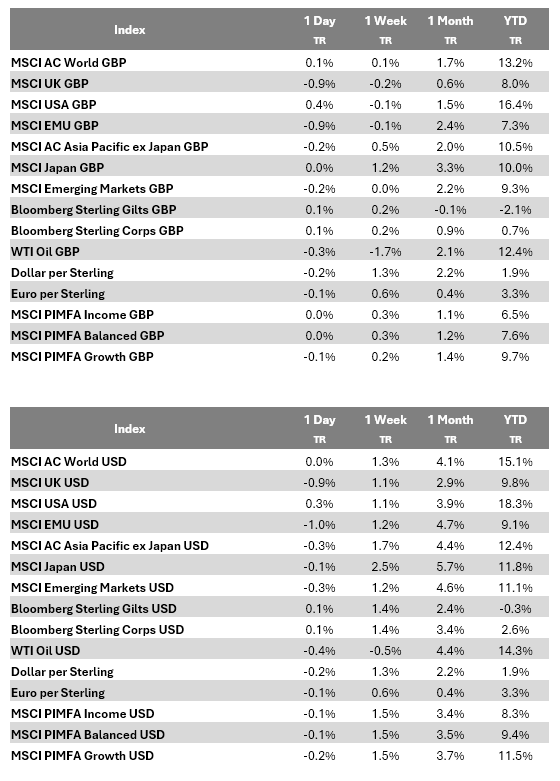
Bloomberg as at 22/02/2024. TR denotes Net Total Return

Please continue to check our Blog content for advice and planning issues and the latest investment, markets and economic updates from leading investment houses.

Charlotte Clarke

22/02/2024

Team No Comments

Brewin Dolphin – Markets in a Minute

Please see below this yesterday’s global market round-up from Brewin Dolphin, which was received late yesterday afternoon – 20/02/2024:

Please continue to check our blog content for advice and planning issues and the latest investment, markets and economic updates from leading investment houses.

Carl Mitchell – DipPFS

Independent Financial Adviser

21/02/2024

Team No Comments

Brooks Macdonald Daily Investment Bulletin

Please see todays Daily Investment Bulletin from Brooks Macdonald providing a brief analysis of markets:

What has happened

Global markets have been rather quiet over the last 24 hours given Presidents’ Day holiday in the US. The STOXX 600 index edged up by 0.16%, continuing its four-week streak of gains and reaching a new two-year high. The index now hovers just shy of its record high from January 2022, suggesting the potential for a new milestone in the near future.

A big week for corporate earnings

Attention is turning to a series of corporate earnings reports. Walmart is anticipated to report at noon London time today, setting the stage for Nvidia’s highly anticipated report after market close tomorrow. Nvidia’s performance is particularly noteworthy as it leads the S&P 500 with an impressive 46.6% surge this year, contributing to the ‘Magnificent 7′ stocks’ collective 10.65% year-to-date advance. In the UK, major banking institutions such as Barclays, HSBC, Lloyds, and Standard Chartered are scheduled to report earnings throughout the week. It’s expected that the UK’s five largest banks will announce a combined record-breaking £50 billion in profits, reaping the benefits of increased borrowing costs. While last year’s results hold importance, the focus is likely to shift towards future outlooks, especially with the Bank of England’s anticipated rate cuts. Despite a positive valuation outlook from analysts, the UK banking sector faces challenges from broader economic concerns and regulatory and political pressures.

What does Brooks Macdonald think

While this week may be characterized by a scarcity of macroeconomic data, it is nonetheless punctuated by a series of critical earnings reports that are likely to capture the attention of investors. We will see the market narrative shift from a macro-level, top-down approach to a micro-level, bottom-up analysis as investors seek to dissect the granular details of company reports. The guidance and forward-looking statements provided by these companies will serve as a barometer for the underlying economic health and could potentially offer insights into future market trends and corporate strategies.

Please check our blog content for advice, planning issues and the latest investment, market and economic updates from leading investment houses.

Andrew Lloyd DipPFS

20/02/2024

Team No Comments

Tatton Investment Management – The Monday Digest

Please see the below article from Tatton Investment Management providing a brief analysis of markets and the key news from global economies over the past week.

Overview: The UK is not growing in real terms or nominal terms

The UK is in a technical recession, defined as two quarters of real growth contraction. Meanwhile, last week’s release of UK jobs market data for December showed surprising tightness. The unemployment rate fell back to 3.8% rather than the expected rise to 4%. Both labour force data and GDP data are suspect, but price data are a bit more reliable. The measure of prices used to compute GDP data on a real basis is called the deflator and differs from the more usually quoted consumer price indices. Last quarter’s deflator growth was very low at less than +0.7% quarter-on-quarter annualised, indicating that nominal growth is now very weak as well.

The market is pretty convinced interest rate cuts will have happened on or by the 20 June Bank of England Monetary Policy Committee (MPC) meeting. We think there is enough fuel for a rate cut either at the meetings scheduled for 21 March and 9 May, but the dynamics of the MPC make this unlikely. As we discuss later, there is a high probability that tax cuts will happen on 6 March and that the ensuing small fiscal boost might lead the MPC to delay.

A number of emerging market central banks have already started easing rates. but developed markets are being dominated by the path of US rate expectations. Perhaps the similarities in the tightness of labour markets in the UK and Europe might cause one to think this is reasonable. Yet the paths of domestic inflation and money supply growth are differing enough to suggest that the European Union and the UK will have to forge their own paths, and that the US be stuck at higher rates.

Meanwhile, for Europe and the UK, energy prices are a big factor in business input costs. The rise in oil prices might make one think things are going badly, and that energy costs are rising. The good news is that natural gas prices continue to decline, and that is a decisive factor in the downswing in electricity prices. This will benefit manufacturers as long as demand holds up. Signs are that manufacturers are feeling less awfully negative, but there’s a long way to go to get to outright positive. Part of the story ought to be that central banks recognise the declining inflation environment and don’t allow real interest rates to become higher through neglect.

The anatomy of asset bubbles

Since the release of ChatGPT in late 2022, the tech-heavy Nasdaq index has gained nearly 50%, and no stock encapsulates the AI (artificial intelligence) fever better than Nvidia. If you had bought Nvidia stock in 2019 and held on, your stake would currently be up 17-fold. As in any bull market, sustained price increases make investors nervous that stocks are, or will soon become, overvalued. But AI-related companies keep pushing ahead, with the Nasdaq already up 6.6% year-to-date at the time of writing. Naturally, warnings of an AI bubble abound in financial media.

The biggest fear with bubbles – indeed, the reason people call them bubbles in the first place – is that they will suddenly burst, leaving investors with severe losses. Even if the current AI craze is a bubble, it could fizzle out or gradually unwind. That might take some time, and in the meantime, AI investors may well be in for some more stellar returns. This is not to say that all is well. US stocks, particularly the mega-tech sector, are extremely expensive even if they have solid fundamentals. The best strategy for the long-term, as usual, is diversification. We have to keep an eye on AI stocks, and particularly their volatility. But without any glaring warning signs usually observed with bubbles, there is no reason to think things are about to burst.

The UK’s fiscal bind tightens

With the Spring Budget fast approaching, tax cuts are reportedly top of Chancellor Jeremy Hunt’s agenda. According to multiple news outlets, these giveaways might have to be funded by additional public spending cuts – though the latter would likely be delayed beyond an upcoming UK election. Hunt will not want to do anything that might get in the way of Bank of England (BoE) interest rate cuts. Even so, the UK will almost certainly need to tighten fiscal policy after the election. According to the Institute for Fiscal Studies (IFS), Britain is in a fiscal bind and needs tough action. High public debt means spending is severely constrained which, in turn, means that public institutions are stretched thin. These institutions might just about cope in normal times, but when shocks and crises break, there is no more capacity to pick up the slack. This can be clearly seen in the long-term stresses on the National Health Service (NHS), for example.

Tight funding makes budget rebalancing extremely difficult. The Labour Party has said it wants to divert more funds to preventative services if elected, but doing so would either mean spending increases or cuts to non-preventative services – neither of which politicians are willing to do. Whether money is being reallocated across departments or to different regions of the country, rebalancing will inevitably mean short-term costs that no one seems willing to bear. Again, these decisions would be so much easier if the UK could generate strong growth. That needs investment in productive sources – both public and private. But according to Oxford Economics, the UK’s public and private investment over the last three decades ranks 32nd out of 34 major economies. Only the severely constrained economies of Argentina and South Africa see less investment as a percentage of GDP than our 17.4%.

Unfortunately, the dire state of public finances means investment is likely to fall in the short term, rather than rise. Both Labour and the Conservatives have made promises to increase or incentivise investment, but these plans are usually the first to go when confronted with difficult budgetary decisions – as seen in Labour’s abandonment of its green investment targets. These moves stave off short-term pain and, hence, might increase electoral chances. But they make the longer-term problems worse. Addressing Britain’s long-term malaise requires bold changes – but these are extremely hard to implement thanks to a cocktail of fiscal and political realities. Heading into an election, both parties are preaching caution when courage is arguably needed more. With finances already so tight, politicians will have to confront these issues sooner rather than later.

Please check our blog content for advice, planning issues and the latest investment, market and economic updates from leading investment houses.

Alex Clare

19/02/2024

Team No Comments

Brooks Macdonald: Daily Investment Bulletin

Please see below, Brooks Macdonald’s ‘Daily Investment Bulletin’ which covers the key factors currently affecting global markets. Received this morning – 16/02/2024

What has happened?

Yesterday’s US retail sales delivered a surprising contrast to economic narrative. The report for January indicated a bigger than expected decline in retail sales, with a 0.8% m-o-m decrease (vs consensus 0.1% drop). Factors such as seasonal adjustments and inclement weather in January may have contributed to this weakness. Additionally, revisions to the data from the previous two months prompted some analysts to revise their Q4 GDP projections downward, signalling a potential deceleration in growth as we move into early 2024. Despite these conflicting messages, market sentiment remained positive, with the S&P 500 rising by 0.58% to close at a new record high, and the small mid cap Russell 2000 index climbing 2.45%, reaching its highest point this year, just two days after experiencing its most significant decline since June 2023.

 UK already on the road to recovery?

 In the UK, retail sales experienced a robust recovery in January, posting a 3.4% month-on-month surge, which exceeded consensus expectations. The Office for National Statistics (ONS) noted that this was the most substantial monthly increase since April 2021. Y-o-y, sales saw a modest 0.7% increase, which stands in stark contrast to the forecasted 1.4% decrease and the previous 2.4% decline. This data lends support to the analysis and the Bank of England’s (BoE) projections that the UK economy is on the mend from the recession experienced last year, which was confirmed by contraction in GDP figures released earlier in the week.

What does Brooks Macdonald think?

Although individual economic indicators could sometimes provide insights into the economy’s underlying strength, they can often be clouded by extraneous fluctuations such as seasonality. The Federal Reserve’s primary gauge in assessing the disinflationary trajectory is the Personal Consumption Expenditures (PCE) inflation. The forthcoming release of the US Producer Price Index (PPI) later today is poised to be especially telling. This PPI report is anticipated to shed light on key aspects of PCE inflation, particularly in healthcare, air travel, and portfolio management services.

Please continue to check our blog content for advice and planning issues and the latest investment, markets and economic updates from leading investment houses.

Alex Kitteringham

16th February 2024

Team No Comments

Brooks Macdonald: Daily Investment Bulletin

Please see today’s Daily Investment Bulletin from Brooks Macdonald received this morning, 15/02/2024.

What has happened

Yesterday saw a more subdued trading session as the market attempted to recover from the Consumer Price Index (CPI) driven sell-off on Tuesday. This rebound aligns with the prevailing belief that the broader trend of disinflation is still in play, and the orderly nature of the market’s pullback, which lacked any signs of panic selling, indicates that investors are still optimistic, focusing on a potentially less aggressive Federal Reserve pivot and a more robust US economic outlook.

UK GDP

The UK concluded 2023 in a recession, but the emphasis is now on recovery prospects. The latest UK Gross Domestic Product (GDP) figures revealed a 0.3% contraction in the fourth quarter, which was more severe than the 0.1% decline anticipated by analysts and followed a 0.1% decrease in the third quarter. Despite this, the economy is estimated to have grown by 0.1% compared to the previous year. The Governor of the Bank of England, Andrew Bailey, has pointed to more positive signals from forward-looking indicators, such as Purchasing Managers’ Indexes (PMIs), as well as rising consumer confidence and business sentiment.

What does Brooks Macdonald think

In light of the lower-than-expected inflation figures and the contracting economy, there is mounting pressure on the BoE to consider reducing interest rates. During a recent session with UK lawmakers, Governor Bailey maintained a cautious stance, noting that inflation in the services sector and wage growth remain concerningly high. The probability of a 25 basis point rate cut by June, as inferred from market data, is now over 50%, and the market anticipates roughly three rate cuts by the end of the year.

Bloomberg as at 15/02/2024. TR denotes Net Total Return

Please continue to check our Blog content for advice and planning issues and the latest investment, markets and economic updates from leading investment houses.

Charlotte Clarke

15/02/2024