Team No Comments

Brewin Dolphin – Markets in a Minute

Please see this week’s Markets in a Minute update below from Brewin Dolphin, received yesterday afternoon – 07/04/2026.   

Markets steady as Iran deadline approaches

As another President Trump deadline approaches, markets remain calm despite dwindling energy reserves.

Key highlights

  • Oil supply crisis deepens: An extended closure would push energy prices to levels where demand destruction begins, weighing on growth alongside demand for aluminium and other industrial metals.
  • Market volatility driven by contradictory White House messaging: Claims of deals and “two week” wind-downs drives volatility as conflict continues.
  • 6 April deadline forces market risk reduction: Iran’s response to a peace plan fell over Easter weekend, forcing risk reduction ahead of the break, particularly in European markets.

Markets remain distracted by a world in conflict

Gas and oil product prices have soared outside the U.S. since the conflict began

Source: Bloomberg

Markets return from the Easter break facing another key deadline in the U.S.–Iran war. President Trump’s original deadline for reopening the Strait of Hormuz passed over the weekend and was extended to today at 8pm local time (1am tomorrow in the UK) after which he’d promised to target desalination and power plants (the emphasis seems to have shifted to bridges and power plants).

The threat of further military escalation is real, and equity and bond markets have made and held small gains over the last week. Markets are dispassionate and consider only economic consequences rather than political or humanitarian ones.

Even so, it might seem surprising that markets have remained calm, despite depleting energy reserves and system redundancy tightening the market further. From an economic perspective, an escalating conflict and a deadlocked one have largely the same implications. In both scenarios, the Strait of Hormuz (the Strait) is already largely closed with only a few vessels passing through on Iranian terms.

An escalation of the conflict, therefore, wouldn’t necessarily impede transit any more than the current situation already does. What matters is whether it moves the situation closer to, or further away from, an open Strait. With or without escalation, the Strait can reopen shortly after the end of hostilities, which can occur whenever the U.S., as the dominant military power in the region, chooses.

With the original aims of the action having been quite loosely defined, a form of regime change has occurred, as has a form of disarmament, though the recovery of enriched uranium seems like a far harder hurdle to clear. If the U.S. were to cease hostilities, Iran might continue disrupting shipping briefly as a deterrent against future action, but would ultimately benefit more from allowing normal service to resume.

So, as long as the economic impact of the war doesn’t worsen and the economy keeps moving, maintaining hedges and short positions becomes increasingly costly, allowing markets to gradually stabilise. Most equity markets have recovered from their lows, indicating that technical support is kicking in, with last week’s sharp mid-week rally driven more by deeply oversold positioning than by any substantive change in the conflict’s trajectory.

The more consequential risk remains the Strait. An extended closure would push energy prices to levels where demand destruction begins, weighing on growth alongside demand for aluminium and other industrial metals. Brent crude traded above $115 per barrel last week, and investors are now attempting to price in the growth implications.

The oil supply picture remains precarious. Research suggests that beyond mid-April, once de-sanctioned Russian and Iranian floating crude and strategic reserve stocks are drawn down, the oil deficit could rise from 4.5/5 million barrels per day to approximately 9/9.5 million barrels per day.

On prediction markets, roughly 50% of participants expect more than 20 ships to transit the Strait by the end of April, with only about 40% expecting 30 or more – well below the pre-war average of approximately 100 ships per day. Even 30 ships per day, combined with activated pipelines in Saudi Arabia, the UAE, and Iraq, wouldn’t restore pre-war supply levels. This implies oil prices would need to remain significantly elevated to balance the market.

Elsewhere, the Houthis’ entry into the broader conflict last week – threatening Saudi oil infrastructure – prompted retaliatory strikes on two of the world’s largest aluminium smelters in the region. The producer stated it had sustained significant damage and it would take “considerable time” to bring capacity back online. For context, the Middle East accounts for approximately 9% of global aluminium production, and the two affected smelters produce around 3.2 million tonnes per year.

Gas prices have returned to levels last seen at their January peak, though they remain well below the 2022/23 extremes. The feed-through to consumer prices will take time but is now a clear risk to the inflation outlook.

European markets must now wait until tomorrow’s 1am deadline to see how the next phase of the conflict develops.

Market performance over the last quarter

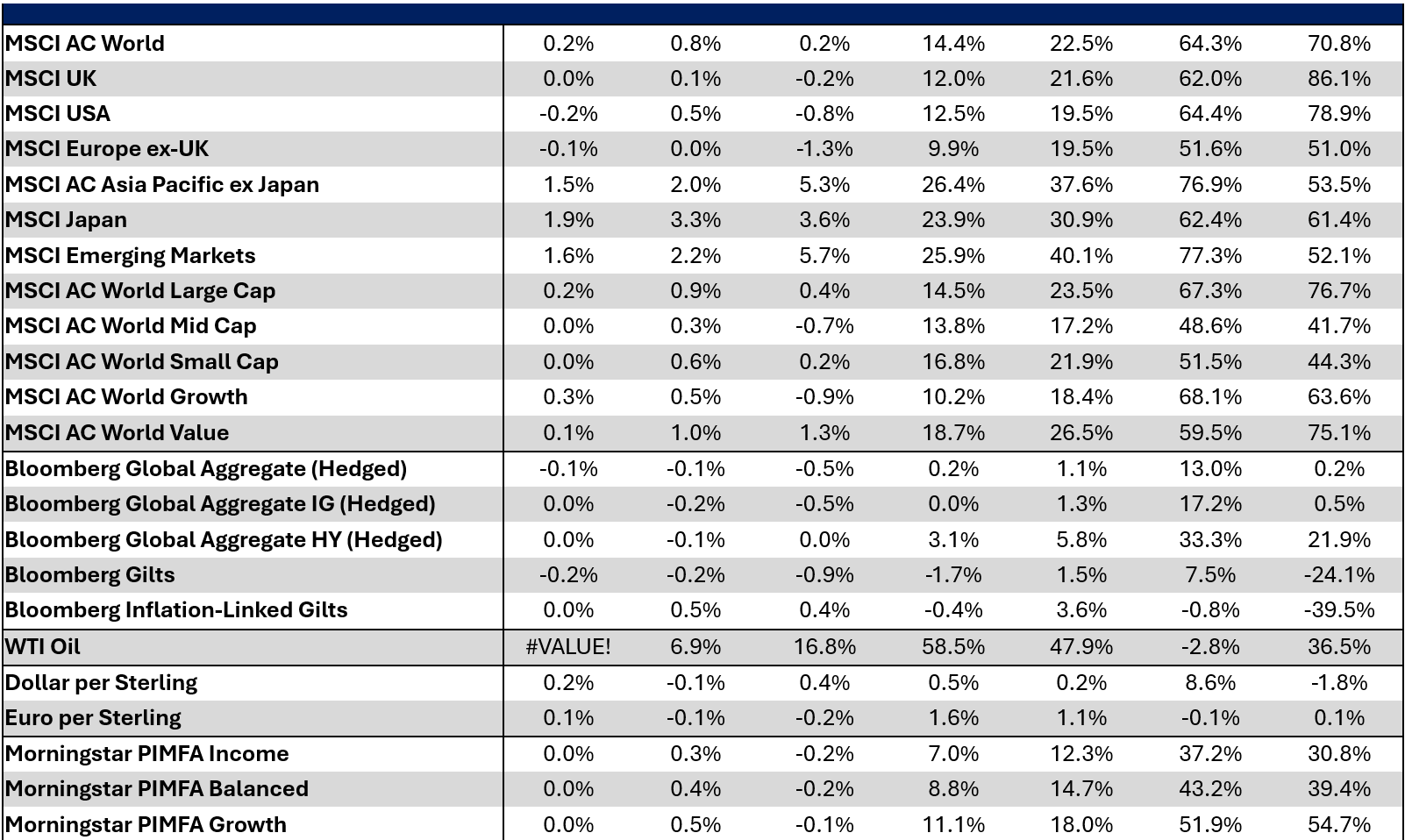
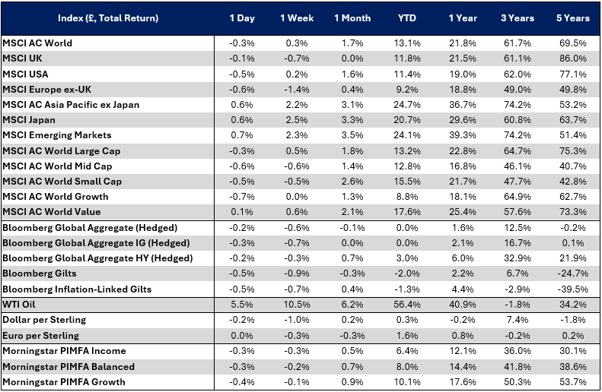
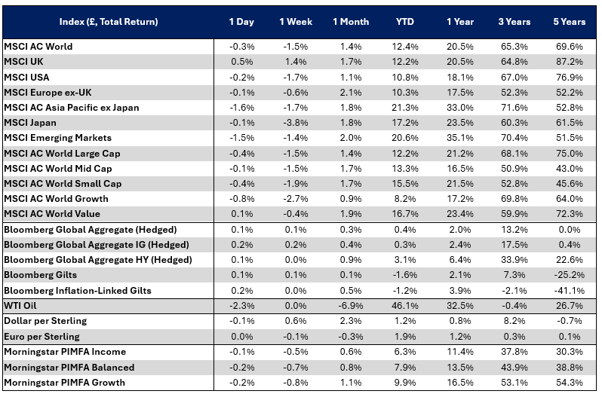
Major market performance during quarter ending 31 March 2026

Source: LSEG

  • Quarterly performance (to 31 March): Emerging markets were the best-performing major region over the quarter, while the U.S. was the weakest. Currency effects were material – the S&P 500 underperformed in local currency terms over the final month but outperformed in sterling total return terms due to dollar strength.
  • UK motor finance: The FCA announced motor finance payouts of approximately £7.5 billion, nearly £2 billion below original estimates, with 12.1 million loans eligible for compensation of up to £829 each. This should benefit domestically focussed banks and lenders that had provisioned for higher figures.

Please continue to check our blog content for advice, planning issues and the latest investment market and economic updates from leading investment houses.

Charlotte Clarke

08/04/2026

Team No Comments

Tatton Investment Management – The Tuesday Digest

Please see the below article from Tatton Investment Management detailing their discussions on markets over the past week. Received this morning 07/04/2026.

A seasonal central bank pivot

We start April, and the new quarter, still very much dealing with the consequences of March. Both equity and bond prices are better since the close on the last Friday in March. Perhaps surprisingly given that the spot Brent crude oil price is back above $111 per barrel, equity indices are a little better than last Thursday’s close. However, bond prices are weaker (and yields higher). The situation remains as febrile as at any point since the conflict began, with Trump’s deadline for an effective ceasefire set for Wednesday 1am BST. It does not seem likely that Iran will acquiesce.

Time is not on our side. With less than 10% of the usual shipping flow through the Straits of Hormuz, oil and gas reserves are coming under increasing pressure — particularly for Asian buyers. European diesel prices have topped €150 per barrel equivalent, double February’s levels and approaching the 2022 peak.

There has been some “good” news from central bankers this week, even if it didn’t necessarily sound that way. The Bank of England had been perceived as one of the most hawkish rate setters in this cost shock environment. On Wednesday, Andrew Bailey told Reuters that businesses currently have less ability to raise prices, and that the Bank must act in a way that doesn’t harm the economy or jobs. Of rate hike pricing, he said markets are “getting ahead of themselves.”

The noises from western central bankers have generally been less hawkish, reflecting growing concern about growth. Markets were most under pressure when funding liquidity was particularly tight early last week, as hedge funds appeared to be offloading risk positions. Things have since eased a little, with US and European high yield credit spreads around 30 basis points below their March peak.

At Tatton, we do not pretend to be geopolitical experts. Economic and financial system outcomes tend to be structural, while political outcomes derive from a relatively small number of decisions that can change quickly. The narrative will tend to present “worse-and-worser” cases — and these are only realised when problem-solving fails.

Investors have navigated many crises over the past twenty years. Perhaps they have not become complacent, but rather more realistic about the inherent positive skew in longer-term outcomes.

Using MSCI Developed World Index data since 1970, a monthly fall of 5% has occurred 61 times. The following six months have averaged a return of +4.3% across all such occasions — a reminder that the long-term return path has remained quite consistent, even if volatile in the shorter term.

Market asset returns review

Overall, March will rank as a bad month for both bonds and equities. Using the MSCI World Index as a guide, global equity performance of -5.4% places it in the bottom 10% of months since 1970. Global bonds provided some offset but still did not have a great month.

Almost everything changed the day after February markets closed. Israel and the US began the Iran campaign over the last weekend of February, and both equity and bond markets opened March trading with an immediate fall. The pattern of major weekend US-Israeli actions repeated throughout the month, leaving investors especially nervous on Fridays.

Initially, investors suspected this might resemble the 12-day war of March 2024. However, Iran’s resilient ability to reestablish command structures, halt shipping in the Straits of Hormuz, and launch damaging attacks on Gulf infrastructure changed perceptions continuously. Oil and gas prices surged to their monthly peak on the 19th, though both sides subsequently backed off the strategy of creating longer-term damage to one another.

Despite a clear move in the second half of March from Trump’s administration to seek a negotiated exit, it was only at month’s close that investors sensed a shorter-term path to the end of hostilities — and, most importantly, a resumption of oil and gas tanker shipments.

In some senses, markets fared better than one might expect. Initially, investors focused on the inflationary consequences, with bond yields rising sharply — most acutely in UK gilts, where traders suspected the UK was both more inflation-prone and fiscally more exposed to energy price rises. The major central banks kept rates unchanged but were deemed somewhat hawkish, which worsened trading liquidity. The most active participants throughout the month were hedge funds, whose large positions required significant borrowing; as borrowing costs rose, positions were reduced regardless of profitability.

US equities fell considerably less than other regions. Europe, developed Asia and emerging markets were all under greater pressure, reflecting both prior hedge fund positioning and genuine fossil fuel supply sensitivity.

Gold, having performed well as geopolitical risks were rising, fell as those risks became reality — likely a combination of leveraged speculation unwinding and liquidity needs from Middle Eastern sovereign wealth funds. The price stabilised at around $4,500.

Markets personified – insight article

Investment professionals often talk about capital markets as though they are people, with beliefs, expectations and even desires. Markets might “expect” lower interest rates or get “excited” about fiscal stimulus. This personification is ubiquitous in financial media — and in the words of philosophers Lakoff and Johnson, it is one of the “Metaphors We Live By” in the investment industry. So why do we do it?

The most famous example comes from Ben Graham’s 1949 book, The Intelligent Investor. Graham likens markets to a manic-depressive business partner called Mr Market, who in his manic episodes pays a premium for your shares, and in his depressive episodes sells his own at a discount. The calm investor can profit from his mood swings.

It is tempting to think this is just a useful analogy. Some even argue it could be socially harmful, by removing autonomy from individuals in favour of some amorphous will of the market. But it would be wrong to think of markets’ beliefs or desires as mere fiction.

Markets are dynamic information processing systems — one of the central ideas of Austrian economist Friedrich Hayek, who argued that market prices reflect the aggregate of all participants’ local and limited knowledge through a process of “spontaneous order”. This idea was highly influential on the Efficient Markets Hypothesis, which holds that it is exceptionally hard for individuals to consistently beat the market, because prices already reflect all available information.

Whether markets truly have beliefs or intentions depends partly on what you think beliefs and intentions are. Philosopher Dan Dennett argued that we can describe any system as if it has beliefs and desires, but this description is only genuinely useful for certain systems — humans, animals, governments, computers. Markets, I would argue, belong in that category.

Viewing financial markets as having beliefs — based on aggregate probabilities of future outcomes — is a very good way of predicting how they will react to new information. That does not mean what the market “thinks” is always rational or consistent. But then, are people any different? Most people predictably behave according to what they want and believe most of the time. The same, it turns out, is true for markets.

Please continue to check our blog content for advice, planning issues and the latest investment, market and economic updates from leading investment houses.

Alex Clare

07/04/2026

Team No Comments

Brooks Macdonald – The Daily Investment Bulletin

Please see the below article from Brooks Macdonald detailing their discussions on markets. Received this afternoon 02/04/2026.

What has happened?

Global equity markets extended their rally yesterday, led once again by US tech stocks. The S&P 500 rose +0.72%, with the NASDAQ (+1.16%) and the Mag 7 (+1.37%) outperforming. European markets played catch up to Monday night’s US gains, recording sharp advances across the region. The STOXX 600 (+2.50%), DAX (+2.73%) and FTSE 100 (+1.85%) all posted their largest daily gains since last April. The risk on mood also spilled over into bond markets, helped by easing energy prices. Natural gas prices fell sharply, with front month TTF futures down -5.49% to €47.51/MWh, the lowest level since early March. As a result, government bond yields declined, with 10 year bund yields falling -1.8bps to 2.98%, while UK gilt yields dropped more sharply after a downward revision to the UK manufacturing PMI. Elsewhere, euro area manufacturing data was revised slightly higher, pointing to resilience despite recent energy price volatility.

Trump rhetoric offered little reassurance

Market sentiment has weakened overnight after President Trump’s widely anticipated address offered little clarity on the timing or conditions for ending hostilities with Iran. While suggesting the military operation was “very close” to completion, he also warned of further escalation if negotiations fail, with no clear signal of an imminent off ramp. The US again emphasised that safeguarding shipping through the Strait of Hormuz should fall largely to other nations. In response, Brent crude rose sharply and is trading above $107 this morning. Meanwhile, the UK is set to convene talks with around 35 countries to discuss restoring shipping routes, highlighting the growing role of US allies in managing regional fallout. Separately, renewed commentary around a potential US withdrawal from NATO briefly drew attention, though significant political hurdles remain.

What does Brooks Macdonald think?

Attention now turns back to US economic data, particularly the labour market, which remains a key anchor for market expectations. After yesterday’s firmer than expected ISM manufacturing reading and stronger ADP employment data, investors will be watching today’s weekly jobless claims and Friday’s non farm payrolls report closely, even as many global markets are closed for Good Friday. With inflation pressures still present and energy prices volatile, incoming labour market data will be important in shaping views on the resilience of the US economy and the path for monetary policy.

Please continue to check our blog content for advice, planning issues and the latest investment, market and economic updates from leading investment houses.

Alex Clare

02/04/2026

Team No Comments

Brewin Dolphin – Markets in a Minute

Please see this week’s Markets in a Minute update below from Brewin Dolphin, received yesterday afternoon – 31/03/2026.   

Economic uncertainty continues amid Iran war

With inflation above target and limited fiscal room, policymakers face tough choices ahead.

Key highlights

  • Mixed signals over the Iran war: Contradictory statements coming from the U.S. and Iran, along with the capricious nature of President Trump, continue to make it challenging to predict outcomes in the Middle East.
  • The economic impact is yet to be fully felt: Anticipated inflationary pressures and predictions of interest rate rises are set against a backdrop of general uncertainty and reduced opportunity for fiscal stimulus, leaving investors in something of a holding pattern until more clarity emerges.
  • Input prices start to rise: Some indicators, most notably the purchasing managers indices, show that businesses are beginning to feel the pinch as the cost of inputs has started to rise, with a potential knock-on effect on outputs to follow.

The Iran war

The dominant theme of the last week was the Iran war and its far-reaching consequences for global energy markets, risk assets and central bank policy. Europe saw sharp equity declines as escalatory rhetoric from both Washington and Tehran rattled markets.

This followed President Trump issuing a 48-hour ultimatum, demanding the reopening of the Strait of Hormuz (the Strait) and threatening strikes on Iranian power plants. But markets rallied as this was later extended to a five-day deadline and subsequently a ten-day deadline, reflecting the president’s assertion that progress is being made in negotiations between the two parties. Iran, however, was characteristically defiant: issuing counterthreats targeting U.S. military bases, energy infrastructure of nations perceived to be assisting the U.S. war effort, desalination facilities and – notably – financial institutions holding U.S. Treasury bonds.

As the week progressed, a familiar pattern emerged: brief risk-on rallies on hints of diplomacy, followed by renewed pessimism as the facts on the ground failed to improve. Last Tuesday, President Trump posted a lengthy statement claiming “advanced negotiations” with Iran toward a “complete and total resolution of hostilities.” Iran’s foreign ministry acknowledged that messages had arrived via intermediary countries but denied any direct negotiation with Washington, stating that its stance on the Strait “has not changed.”

By last Wednesday, a 15-point plan had reportedly been transmitted via Pakistan, prompting a modest risk-on session. Iran eventually confirmed it had rejected a U.S. proposal. By Friday, the consensus among the geopolitical experts remained decidedly pessimistic regarding the scope for near-term de-escalation.

Helima Croft, Managing Director and Head of Global Commodity Strategy and MENA Research at RBC Capital Markets, noted that despite a minor uptick in vessels transiting the Strait, she doesn’t expect anything close to a normalisation of flows. The appointment of hardliner Mohammad Bagher Zolqadr, the former commander of the Islamic Revolutionary Guard Corps (IRGC), to head Iran’s Supreme National Security Council could signal a further coalescence within the regime around an uncompromising stance.

Helima Croft, Managing Director and Head of Global Commodity Strategy and MENA Research at RBC Capital Markets, noted that despite a minor uptick in vessels transiting the Strait, she doesn’t expect anything close to a normalisation of flows. The appointment of hardliner Mohammad Bagher Zolqadr, the former commander of the Islamic Revolutionary Guard Corps (IRGC), to head Iran’s Supreme National Security Council could signal a further coalescence within the regime around an uncompromising stance.

Escalation and leverage

A consensus exists among many observers that Iran does need to end the conflict, as it’s inflicting considerable pain on both the regime and the populace. However, the Iranian leadership wouldn’t accept a deal if they can avoid it, without first demonstrating their ability to inflict economic pain through their control of the Strait. The ability to frustrate that waterway would be the strongest means of discouraging further acts of aggression against the regime.

Historically, energy spikes and erratic acts by President Trump have been good entry points into markets ahead of what can be sharp rallies as conditions normalise. But the signs are not yet there that this is a great buying opportunity. While classic risk gauges such as the VIX have risen, they aren’t excessively elevated given the severity of the downside scenario – a possible sign that investors are reluctant to abandon their positions ahead of a possible rebound.

There are some lasting concerns too. Policymakers have significantly less bandwidth to provide support than in previous crises. Inflation has been above target in both the UK and the U.S. for approximately five years. Higher-for-longer energy prices risk de-anchoring inflation expectations, constraining central banks from easing even as growth deteriorates. There’s now an expectation that central banks will raise interest rates.

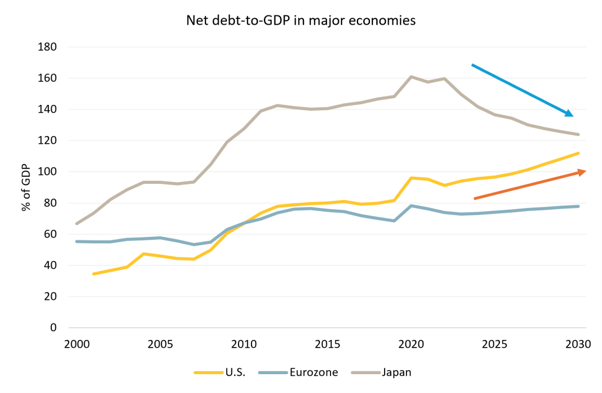
Meanwhile, elevated government indebtedness in many countries limits the scope for fiscal stimulus. In a recession, falling tax revenues and rising automatic stabiliser spending (welfare benefits) would compound the debt problem further. For now, back-channel talks continue with the hope of de-escalating the tensions.

Troop movements, however, suggest that the U.S. could be prepared to seize some territory (perhaps Kharg Island, through which most of Iran’s oil exports flow) or enriched uranium supplies, or to clear the coastal areas from threats to shipping. This could just be posturing, but recent history has suggested that troop movements do tend to precede deployments.

UK firms start to feel a costs pinch

European markets remain understandably pre-occupied by the Middle Eastern conflict, and specifically the impact on energy prices, which makes the UK’s official consumer price index statement seem less important overall. However, some data, such as the purchasing managers indices (PMIs), remain relevant.

Because they’re based upon companies’ surveyed responses since the outbreak of the conflict, the PMIs confirm that businesses are experiencing the fastest acceleration in input prices since 2023. This was most pronounced in manufacturing, but services output prices were affected too, although not enough to immediately offset the higher input costs.

The tone from policymakers has remained hawkish. Bank of England Chief Economist Huw Pill discussed how uncertainty shouldn’t be used as an excuse not to act to contain inflation. Fellow Monetary Policy Committee member Megan Greene discussed how there will be lasting inflationary effects from the conflict even in a “best-case” scenario.

More UK firms raised output prices in March

Source: Bloomberg

By contrast, Deputy Governor Sarah Breedon did acknowledge that second-round effects would be less likely now than in 2022, due to the weaker labour market. That is unquestionably true, but, having spent most of the last four years missing the inflation target materially to the upside, policymakers feel compelled to err on the side of the hawks.

Sectors to be impacted differently?

Throughout Europe, the pass-through of higher energy prices affects companies via changes in monetary policy and more directly as well. High bond yields mean lower real estate valuations as well as less deal flow, because the financing costs for new deals have risen. European real estate sector yields, which had fallen to their lowest since 2022, have risen to their highest since 2023.

Sectors such as consumer services and retail, on the other hand, will see less volume growth because of the real income compression from energy price inflation. Price earnings ratios are at the lower end of their range but don’t currently stand out.

All these factors combine to affect auto sales, where financing costs, running costs and general economic confidence are all relevant considerations.

Please continue to check our blog content for advice, planning issues and the latest investment market and economic updates from leading investment houses.

Charlotte Clarke

01/04/2026

Team No Comments

Brooks Macdonald Daily Investment Bulletin

Please see below article received from Brooks Macdonald this afternoon.

What has happened?

Energy markets remained a focal point, with Brent crude ending the session broadly flat but still edging up +0.2% to $112.78/bbl, which was its highest close since July 2022. Equity markets were initially more constructive. European stocks outperformed, with the STOXX 600 (+0.9%), FTSE 100 (+1.6%) and DAX (+1.2%) all posting solid gains, helped by a firmer energy sector and resilient financials. That positive tone did not carry through to the US close. The S&P 500 finished -0.4% lower, leaving the index around 9% below its late‑January peak and within touching distance of technical correction territory. Yesterday’s weakness was narrowly concentrated, led by a sharp sell‑off in semiconductor stocks (the Philadelphia Semiconductor Index fell -4.2%) even as the majority of S&P 500 constituents ended the day higher. Sentiments improved overnight, with futures markets responding positively to reports suggesting the US may be open to end its military campaign against Iran.

Hints of de‑escalation but uncertainty remains

Overnight sentiment was buoyed by a Wall Street Journal report indicating that President Trump is willing to end US military operations against Iran even if the Strait of Hormuz remains partially disrupted. According to the report, US officials judged that a sustained effort to reopen the strait would risk prolonging the conflict beyond a four‑to‑six‑week horizon. Instead, the apparent focus is on degrading Iran’s naval and missile capabilities while increasing diplomatic pressure to restore trade flows. Markets took this as a modest positive, as it raised the perceived likelihood of a contained conflict and reduced the risk of more severe outcomes, such as widespread damage to regional energy infrastructure. That said, the messaging has been mixed. Yesterday, President Trump posted that the US could target Iranian power plants, oil fields and Kharg Island if negotiations fail, while also signalling that discussions were under way with a potentially more accommodating regime. Adding to the diplomatic complexity, Pakistan’s foreign minister is due to visit China following meetings with Middle Eastern counterparts, prompting speculation that Beijing could play a future role in supporting any ceasefire process.

What does Brooks Macdonald think?

Amid heightened geopolitical noise, monetary policy signals offered a measure of reassurance. Fed Chair Jerome Powell struck a dovish tone, noting that inflation expectations remain “well anchored beyond the short term.” This reinforced the view that central banks remain attentive to growth risks and are unlikely to overreact to near‑term volatility in energy prices or markets more broadly. We continue to monitor developments around energy supply, diplomatic progress, and financial conditions, but we would caution against drawing strong conclusions from short‑term market moves driven by rapidly evolving newsflow.

Please check in again with us soon for further relevant content and market news.

Chloe

31/03/2026

Team No Comments

Tatton Investment Management – The Monday Digest

Please see the below article from Tatton Investment Management detailing their discussions on markets, gas supply chain, and gold. Received this morning 30/03/2026.

Markets hold their breath

Donald Trump’s ‘peace plan’ for Iran and the negotiations via Pakistan gave markets a smidgen of positivity. TACO traders were not surprised that Washington postponed last weekend’s ultimatum (reopen the Strait of Hormuz or see energy infrastructure destroyed) but it suggests the existence of a boundary around attacking energy infrastructure. Still, a halt to escalation doesn’t mean de-escalation: the US is still sending thousands of troops to the Middle East, and Tehran clearly doesn’t believe the peace plan is real (neither do betting markets). It’s a soggy TACO at best, and in the meantime oil and gas still can’t clear the Strait. As the week’s trading begins, Brent has reached a new recent high, just above $116 per barrel for the front month delivery of May. If this continues, energy prices will climb even further and global growth will be harder hit.

The first business sentiment surveys since the war began confirmed that European and Asian companies are worse hit than their American counterparts – as you’d expect with sharply different supply dependencies. Lower growth expectations should mean lower bond yields but, with the exception of China, the opposite has happened. Bond traders are pricing in a big inflation shock, but a curiously low growth impact (judging by real yields). That could change. Even though central banks two weeks ago sounded the inflation alarm, last week they turned more growth conscious and so long-term yields might take the hint and fall in due course.

That easier central bank messaging loosened the liquidity squeeze, which is another reason stocks found some relief early last week. We saw that in gold prices too (covered below). Holders of speculative assets are under less pressure – even the ailing private credit sector. Thankfully, there’s no sign of contagion to publicly traded bonds from recent private credit fund closures. This is all good news, but could change this week. It’s the quarter-end, financial year-end, and Easter weekend to boot. Light trading means tighter liquidity, potentially amplifying small selloffs. Things could therefore get nervy this week, if only for technical reasons. For now, markets are in stasis.

Europe’s surprising gas supply

European natural gas prices have risen around 55% during Iran war – but US prices are about the same. Europe’s gas premium over the US fell through 2025, but disrupted Middle Eastern flows have left Europe paying more than six times the US. Since 2022, Europe has become increasingly reliant on Liquid Natural Gas (LNG) imports, mostly from the US. (Norway provides more gas overall, but US LNG is often the swing factor). Now, LNG shipments across the Atlantic seem to be at capacity. That means oversupply in the US, and undersupply here and on the continent.

And yet, Europe’s gas storage position has actually improved, on a seasonally-adjusted basis, in the last few weeks. European gas storage was running at the low end of its seasonal range pre-war – partly due to a cold snap and partly due to LNG shipments allowing a ‘just-in-time’ model of gas provision. We noted in February that Europe’s underlying supply balance was improving, and that’s continued despite everything. That’s all about the weather. An early spring lessens heating needs and ends the dreaded ‘Dunkelflaute’ (no wind or sun), meaning renewables have been able to pick up more of the slack.

That suggests Europe’s gas price spike is more about fear of disruption than disruption itself. However well-founded those fears, this means that de-escalation in the Middle East (without long-term production damage) would see gas prices flip back toward oversupply. Russian gas flow has also been relatively undisturbed in the last few weeks, as Washington seems more relaxed about Russian oil and gas exports. European leaders won’t like that, but it does point to a better gas price outlook than feared.

Energy prices are crucial to Europe’s outlook. Comparatively low US prices have seen US stocks fare relatively better in recent weeks, but de-escalation could quickly turn that around.

Gold’s not-so-safe haven

Gold, the stereotypical ‘safe haven’ asset, has fallen sharply since the outbreak of the Iran war. This might be the natural disaster effect: if you hold safe assets for a rainy day, you sell them when it starts to rain. That’s why gold often sells off in market panics – and it’s exacerbated by the previous two-year rally. It’s become correlated with speculative assets, making prices more volatile. An inflationary oil shock should mean higher gold prices but higher expected interest rates counteracts that. Gold has become something of a liquidity drain post-pandemic. Central bank tightening would mean less liquidity, hence weaker gold.

Speculative trading amplified the fall, but what triggered it? It seems to have been the rumour that central banks or sovereign wealth funds might sell gold reserves – most likely gulf nations needing liquidity while oil exports are blocked. That’s the opposite of what happened post-Ukraine. From 2022, central banks (particularly emerging markets) built gold reserves out of fear they, like Russia, might be frozen out of the global dollar system. But historically high gold prices are a good opportunity to cash in. There’s no evidence that’s actually happening (though there wouldn’t be) but the rumour prompted selling.

Volatility doesn’t undermine gold’s safe haven status. A safe haven asset is something real you can sell in a disaster; a safe haven trade is a bet that something will make you money in times of panic. Recent gold price volatility certainly doesn’t take away gold’s safe haven status, and history suggests the safe haven trade rarely works anyway. This is the same reason we have always argued against gold as an investment (even when it was surging): it’s impossible to value in the same way as stocks or bonds. There’s a good chance gold recovers from the selloff, but we will continue to prefer traditional investment assets.

Please continue to check our blog content for advice, planning issues and the latest investment, market and economic updates from leading investment houses.

Alex Clare

30/03/2026

Team No Comments

EPIC Investment Partners: The Daily Update

Please see the below article from EPIC Investment Partners, discussing the recent concerns around liquidity within private credit and how current market volatility may impact investors, received today – 27/03/2026.

Private credit’s liquidity illusion

Financial markets are beginning to hint at something more troubling than a simple inflation scare.

The first explanation for the pressure on short-dated US Treasury yields is obvious enough. Higher oil prices raise inflation fears, make central banks less willing to cut rates quickly and push the front end higher. That much is entirely reasonable.

But it is not the whole story.

If the move were only about inflation and a later path for rate cuts, it would feel cleaner than it does. Instead, volatility has risen, liquidity has worsened and the front end has remained under pressure in a way that suggests something more than a straightforward macro repricing. The market is not just adjusting to higher inflation risk. It also appears to be adjusting to a lower tolerance for leverage, illiquidity and risk.

That matters because once volatility rises and stays high, the consequences spread quickly. Risk models tighten. Leverage looks less comfortable. Positions that seemed manageable in a calmer market suddenly appear too large. At that point, portfolios do not adjust elegantly. Investors sell what they can sell.

That is where private credit comes in.

Private credit has long been sold as a calmer corner of finance: higher income, fewer daily price swings and a patient investor base. But that calm has always depended on an awkward fact being ignored. The assets are illiquid, while the investors still need cash. Pensions have liabilities. Insurers have capital to manage. Wealth managers and family offices may need liquidity precisely when markets are under pressure.

This is why gating matters. Gating is simply the industry’s term for limiting withdrawals when too many investors ask for their money back at once. In practice, it means a fund can tell investors they may receive only part of their cash, and not necessarily when they want it.

The important point is that the need for cash does not disappear. If investors cannot raise money from private credit, they have to raise it somewhere else. That usually means selling listed assets instead. Seen that way, private-credit gates are not a niche sideshow. They are the illiquid mirror image of the same de-risking already visible in more liquid markets.

The problem deepens because private assets are slow to reprice. When public markets fall but private credit is still carried at stale valuations, the illiquid allocation can suddenly look too large and use up more of the portfolio’s risk budget than intended. Investors who might otherwise buy cheaper public assets are then unable to do so. If they need liquidity or need to cut risk, they are forced to sell what they can sell instead — often more liquid risk assets such as high-yield bonds or equities. The diversifier does not absorb the shock; it displaces it.

That is why this matters beyond the world of alternatives. Ultimately, a gate is an admission that a fund’s stated value and its true clearing price are no longer the same thing. So long as the Treasury market remains trapped in this bear-flattening stress, the pressure on those gates is likely to intensify. Private credit may not be the next subprime, but it is becoming the next place where the system discovers its true liquidity limits.

Please continue to check our blog content for the latest advice and planning issues from leading investment management firms.

Marcus Blenkinsop

27th March 2026


Team No Comments

Brooks Macdonald – The Daily Investment Bulletin

Please see todays Brooks Macdonald Daily Investment Bulletin received this morning, 26/03/2026:

What has happened?

Iran continued to reject messages from the US aimed at de‑escalation, raising doubts over whether a credible off‑ramp to the conflict exists in the near term. That uncertainty pushed oil prices sharply higher, with Brent crude rising from around $97.30/bbl during the European session to close at $102.22/bbl in the US, before extending gains this morning to over $104/bbl. Despite higher energy prices, broader risk sentiment was relatively resilient. US equities advanced, with the S&P 500 up +0.54%, leaving it on track for its first weekly gain since the strikes began and up +1.31% over the past three sessions. Gains were supported by strength in the Mag-7, while smaller companies also performed well, with the Russell 2000 reaching a two‑week high. European equities posted similarly strong returns, with the STOXX 600 rising +1.42% to record its third consecutive daily gain and its highest level in a week.

Mixed diplomatic signals keep volatility elevated

Markets are weighing up mixed signals on the prospects for de‑escalation. US officials have pointed to ‘productive’ discussions and possible engagement via regional intermediaries, supporting hopes that diplomatic channels remain open. It has also been widely reported that the US has outlined a 15‑point plan, which could include dismantling Iran’s nuclear facilities and reopening the Strait of Hormuz. However, this has been met with pushback from Tehran. Iranian officials and state‑linked media have rejected indirect talks, reiterating that any end to hostilities would depend on Iran’s own terms, including security guarantees and recognition of its authority over the Strait of Hormuz. This mismatch in rhetoric has left oil prices highly sensitive to headlines and prone to sharp moves.

UK data reinforces a fragile mood

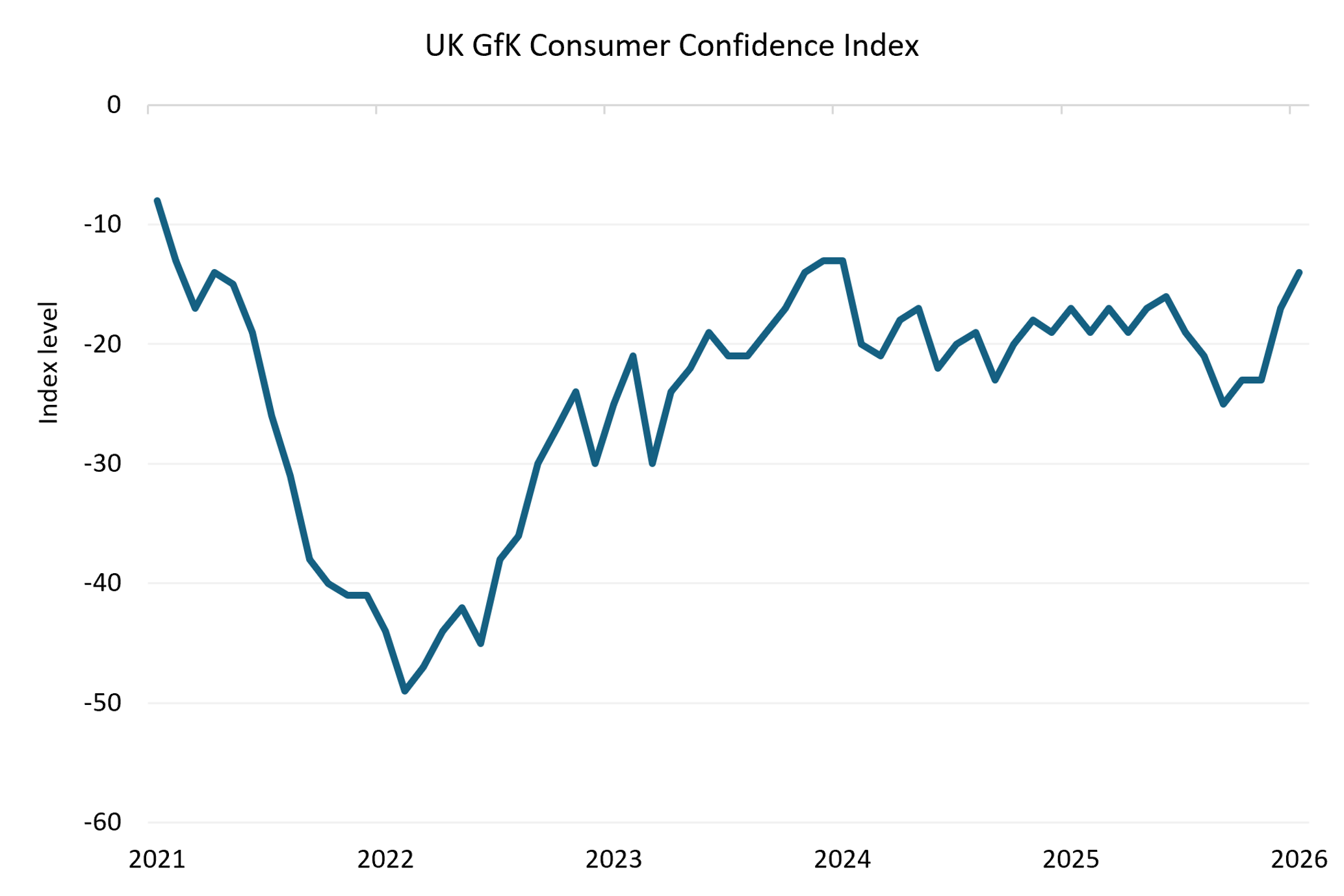
Away from geopolitics, UK economic data continues to point to a fragile domestic backdrop. Consumer confidence deteriorated sharply in March, with the British Retail Consortium’s expectations indicator falling to its weakest level since the survey began. Perceptions of the economic outlook over the next three months worsened notably, reinforcing signs that households remain cautious. Forward‑looking PMIs also slipped to six‑month lows, pointing to slowing activity alongside persistent cost pressures. Given that household consumption accounts for around two‑thirds of UK GDP, these indicators suggest demand may remain subdued in the near term.

What does Brooks Macdonald think?

Market attention is increasingly focused on the approaching end of President Trump’s five‑day deadline, announced on Monday, to delay potential strikes on Iranian power and energy infrastructure. With that window set to close in the coming days, and reports of an increased US military presence in the region, the risk of further escalation remains firmly on investors’ radar. At the same time, yesterday’s market behaviour highlights a degree of resilience, with equities holding up despite rising energy prices and geopolitical uncertainty.

Please continue to check our blog content for advice, planning issues and the latest investment, market and economic updates from leading investment houses.

Andrew Lloyd

26/03/2026

Team No Comments

Brewin Dolphin – Markets in a Minute

Please see this week’s Markets in a Minute update below from Brewin Dolphin, received yesterday afternoon – 24/03/2026.   

Central banks stand ready to act

We analyse how the extended Iran war is driving energy shocks and forcing central banks worldwide to reassess rate cuts.

Key highlights

  • Energy infrastructure attacks escalate Middle East tensions: Strikes on Qatar’s LNG facilities and Iran’s South Pars gas field have severely disrupted the Strait of Hormuz tanker traffic.
  • Central banks shift to hawkish stance in unison: The Federal Reserve, Bank of England, and the European Central Bank have all revised inflation forecasts upward and effectively ruled out near-term rate cuts.
  • UK gilt yields approach 5% amid fiscal concerns: The 10-year gilt has reached post-financial crisis levels as markets price in persistent inflation and fiscal sustainability risks.

The Iran war: Duration, energy prices and market implications

The current overarching theme is the evolving Iran war and its impact on global energy markets. Market participants have materially pushed out their expectations for the duration of the crisis. RBC Capital Markets commodity strategist Helima Croft, following meetings in Washington, extended her estimated timeline for the conflict and associated energy disruption. Even if the White House seeks an early exit due to rising economic costs, an emerging consensus suggests Iran would likely continue fighting for some time to deter future Israeli and U.S. strikes.

Energy prices have fluctuated in rhythm with the ebb and flow of attacks on energy assets. Israel struck Iran’s South Pars gas field – the world’s largest natural gas reserve – prompting Iran to intensify attacks on Qatari LNG facilities. Qatar Energy confirmed missile strikes on several facilities early last Thursday morning, with sizeable fires reported (since contained) and extensive further damage. Attacks on energy assets seemed to reduce after intervention from President Trump.

The Strait of Hormuz remains a focal point. Reports suggest Iran may have begun laying mines, though this is unconfirmed. Notably, Iran appears willing to negotiate safe passage with individual countries – India, Turkey, France, and Italy have all reportedly opened discussions – suggesting the Strait hasn’t been aggressively blocked at this stage. Tanker traffic, however, remains severely disrupted.

How central banks are responding

As war continues, the big development was hearing from all the major central banks about how it’s affecting their thinking.

Source: Bloomberg

The Federal Reserve (Fed)

The Fed held rates steady for the second consecutive meeting, as widely expected. The real substance came from updated projections and Chair Powell’s press conference, which together amounted to a hawkish hold.

Core personal consumption expenditure (PCE) inflation forecasts for 2026 and 2027 were both revised upward, reflecting sticky inflation and energy price pressures, with the target now not expected to be reached until 2028.

Long-run gross domestic product (GDP) growth was upgraded to 2% – the highest on record – and the long-run neutral rate rose to 3.1%, the highest since 2016, both signalling optimism around AI-driven productivity gains.

The median Federal Open Market Committee (FOMC) member still projects one rate cut this year, but Powell stressed this hinges on inflation progress that looks increasingly uncertain. Notably, he declined to call the current energy shock transitory, given the succession of supply shocks in recent years – a theme echoed across central banks globally.

The productivity upgrade aligns with the views of Kevin Warsh, Trump’s nominee for the next Fed chair, who argues AI will act as a disinflationary force. However, several FOMC members have cautioned that such gains could raise the neutral rate rather than facilitate cuts. With core PCE at 3.1% and above target for nearly five years, the bar for easing remains high.

The Bank of England (BoE)

The BoE held rates in a unanimously hawkish decision – a surprise, as markets had expected two dissenting votes in favour of a cut. Even the typically dovish Swati Dhingra acknowledged that a prolonged supply shock could warrant tighter policy.

Mechanical estimates suggest even a modest 10% rise in gas and petrol prices would add roughly half a percentage point to the consumer price index including owner occupiers’ housing costs (CPIH), with larger increases producing proportionally greater effects. These are the direct effects on prices, but if they should push inflation to the psychologically important 4% threshold, history suggests more aggressive household inflation expectations would follow.

The labour market offers some comfort, with the vacancy-to-unemployment ratio below the BoE’s equilibrium estimate and surveys pointing to relatively loose conditions. Ironically, the early signs of stabilisation in unemployment earlier this year and the strongest payrolled employee growth since October 2024, could end up tipping the BoE’s hand towards tighter policy.

Source: Bloomberg

The 10-year gilt yield has approached 5% – levels not seen since the financial crisis. The move in gilts has been larger than in most major eurozone sovereign markets, reflecting both inflation concerns and heightened anxiety around UK fiscal sustainability. There’s a clear relationship between the rise in a country’s 10-year yield and its debt-to-GDP ratio. The UK’s persistent inflation problem – worse than the eurozone’s – and expectations that the government may respond to the crisis with more deficit-spending (both potentially inflationary policies), are compounding the sell-off.

The European Central Bank (ECB)

As expected, the ECB held rates steady for a sixth consecutive meeting.

President Lagarde highlighted the Iran conflict as creating upside risks to inflation and downside risks to growth and notably avoided repeating that the ECB is in a “good place,” instead describing it as “well positioned” to navigate uncertainty.

Staff economists significantly raised their 2026 inflation forecast to 2.6%, although they still expect a return to target by 2027–28. The ECB also published alternative scenarios given the uncertain outlook, with the worst case projecting a euro-area recession accompanied by a sharp spike in inflation.

The Bank of Japan (BoJ)

The BoJ held its key rate at 0.75% in an 8:1 decision, with the sole dissenter in favour of a hike to 1%.

The bank cited the Middle East situation and rising oil prices as a new risk, though Governor Ueda said he needed more time to assess the impact. He noted that spring wage talks are expected to yield solid results, with attention now on whether higher wages spread to smaller businesses.

Unlike other major regions, there has been little change in Japanese interest rate expectations.

Please continue to check our blog content for advice, planning issues and the latest investment market and economic updates from leading investment houses.

Charlotte Clarke

25/03/2026

Team No Comments

Tatton Investment Management: Monday Digest

Please see the below article from Tatton Investment Management, discussing recent developments in the Iran conflict and how these are affecting global markets, received this morning – 23/03/2026.

Escalation precedes de-escalation
The marked escalation in the Iran conflict, which began with Israeli-US strikes against the Iranian Pars gas field followed by reprisals against Qatari gas sites and other neighbours’ key oil producing assets, has now become even hotter. This weekend has seen both threats of a yet worse escalation and an increase in actual strikes, with Iran firing ballistic missiles at an Israeli Nuclear power plant. Trump has set a deadline of Monday night for Iran to cease blocking the Straits of Hormuz. Iran has made no sign of complying and threatened a devastating and long-lasting cost on its neighbours.

Interestingly, spot Brent crude oil is opening this morning still below Wednesday’s high although European and Asian natural gas prices are making new highs since the peak of the Ukraine invasion.

This has forced markets to reconsider their optimism about the extent of the war. Both stocks and bonds are struggling. This is a disruptive phase for markets, but there are reasons to be hopeful. The subtext of Trump’s threat to “blow up” South Pars was disapproval of Israel’s initial strike – backing up the idea that Trump wants an off-ramp, and further evidenced by a Friday White House briefing that the objectives were nearly achieved and they wanted to reestablish diplomatic dialogue. Israel has its own objectives – potentially conflicting with the US and Arab allies – but the US has a strong incentive to de-escalate. It’s nervy for markets regardless; every day without resolution looks like a bigger economic threat.

The fear factor is having strange effects on currencies and gold. Prices for the stereotypical ‘safe haven’ have dropped 10% since the war. Recent speculative gold buyers might wonder what’s going on, but we suspect it’s a liquidity grab: if gold is an insurance policy, you cash it in in emergencies.

Bonds have been mixed. Government yields are up – consistent with an inflation spike but inconsistent with a growth scare. Credit spreads are not faring badly, again inconsistent with a growth scare (excepting worse-hit Europe). It looks like some of the weaker credits were already squeezed out ahead of the oil shock.

The Fed, the BoE and the ECB all issued inflation warning – the BoE even suggesting it could raise interest rates. That’s probably more inflation expectation management than actual policy signal. The BoE will welcome marginally higher wages from February, but past data is basically irrelevant now. The Fed is projecting stability (and one rate cut this year) despite the fact the US looked more inflationary than expected even before the war.

Higher risks and tighter monetary policy mean a market liquidity squeeze, even if geopolitics improve. But underlying growth still gives reason for optimism. If energy infrastructure avoids extensive damage – and countries invest in closer and cleaner energy – it could reverse the current stagflation narrative.

China projects stability
China’s new five-year plan, unveiled at this month’s National People’s Congress (NPC) set a national growth target of 4.5%-5%, meaning 4.5%. That’s the lowest since 1991, but if the world’s second-largest economy achieved it amid population decline, it would be impressive. The NPC recognised a need to better stimulate domestic demand with a ¥100 billion “fiscal-financial coordination fund” and “appropriately accommodative” monetary policy (deficit spending is still capped at 4% of GDP). Alongside consumption support, the NPC committed to growing R&D spending 7% annually over the next five years, as Beijing accelerates its “AI+” initiative for widespread AI adoption.

We shouldn’t doubt Beijing’s commitment to boosting demand, but its ability to do so is still debatable. Its typical growth lever – production – has only worsened China’s oversupply, and an R&D push could do the same if it doesn’t change the excess savings problem. The property market overhang looks like it’s clearing up at least (back orders being completed and prices projected to stop falling) and company pricing power is finally improving. Beijing’s fiscal support is a welcome addition, but we shouldn’t overstate the spending. Much of the recent debt expansion has just been the central government taking over local government ‘shadow loans’.

Overall, the five-year plan is about stability: consumption support but no ‘bazooka’; monetary accommodation but no 2010s credit bubble. Stable is how China presents itself internationally too, amid erratic US policy. Beijing keeps talking about Taiwan, but an invasion in the medium-term would degrade China’s ‘adult in the room’ image. A strong renminbi is part of this. Beijing has guided it higher for a while, and it’s now clear that the pressures on the currency to fall are dropping away. That lessens deflationary pressures and ‘dumping’ allegations from the west. That’s helping capital inflows. Beijing will want this to continue.

Structural weakness in UK government debt
UK government bonds (gilts) are seen as more inflation-sensitive. That’s largely about the gilt market’s structural weakness: historical pension fund demand for long-dated gilts caused the government to shift issuance long-term (exacerbated by quantitative easing), leaving the UK with one of the highest average weighted maturities of any big economy. The decline of defined-benefit pension schemes lessened demand for long-term gilts, setting the scene for the ‘Liz Truss episode’ (exacerbated by quantitative tightening). The imbalance pushed the government to issue more at the short end, but that increased the refinancing risk – making government finances more sensitive to interest rates and inflation.

Then there’s the fact that around a quarter of outstanding gilts are inflation-linked – much higher than other countries. The feed-through from inflation to inflation-linkers is complicated. A short-term inflation shock doesn’t actually increase short-term debt repayments too much (they are smoothed to maturity) but it does push up the current accounting value of those repayments. An inflation shock in 2026 would be recorded, by the OBR, as a big increase in UK debt repayments, even though extra cash payments in 2026 would be small.

Volatility in reported debt repayments increases the sense that UK finances are fragile. The UK’s actual debt metrics are relatively favourable compared to other economies, but volatile perceptions mean volatile gilts. Of course, gilt pessimists might tell you it’s about flawed government policy (indeed, our measure of implied credit risk is higher for the UK than elsewhere) or propensity to increase debt amid an energy crisis. But that doesn’t make much sense when you compare likely UK policy to France or Japan, whose bonds haven’t swung as much.

Basically, the underlying metrics suggest that gilt traders overreacted to the oil shock – compared to other bond markets. You’d expect gilts to calm down, but the market is undeniably fragile.

Please continue to check our blog content for the latest advice and planning issues from leading investment management firms.

Marcus Blenkinsop

23rd March 2026