Team No Comments

Brewin Dolphin – Markets in a minute

Please see the below article from Brewin Dolphin detailing their discussions on US-Iran negotiations, US inflation jumps and UK growth. Received yesterday afternoon 21/04/2026.

Blockades to breakthroughs

The Middle East conflict remained the focus last week. Following the breakdown of U.S.-Iran negotiations, last week the U.S. imposed a naval blockade on Iranian ports and coastal areas. This represented a shift in strategy from the previously threatened strikes on domestic Iranian energy infrastructure. This pivot was reportedly driven by U.S. Central Command’s concerns over the depletion of munitions stocks required to sustain a prolonged bombing campaign.

The blockade’s practical enforcement was tested early in the week, with markets closely watching the passage of the Rich Starry – a Chinese-owned, Malawian-flagged vessel previously blacklisted for sanctions violations through the Strait of Hormuz. The ship ultimately turned back, suggesting the blockade is, for the time being, holding. Tanker traffic through the Strait has effectively been curtailed.

The geopolitical calculus remains complex. Helima Croft of RBC Capital Markets cautioned against assuming China would pressure Iran toward a deal. She noted that Beijing has amassed significant energy stockpiles and may view the redeployment of U.S. military assets away from Asia – and the running down of American missile inventories – as a net strategic benefit. On the other hand, the blockade imposes real economic costs to the Chinese energy supply, which doesn’t improve the already strained bilateral relationship between Washington and Beijing.

By mid-week, however, sentiment shifted materially. President Donald Trump indicated that Iran had reached out to resume peace negotiations, with reports suggesting face-to-face talks would occur before the current ceasefire expires next week.

Over the last week, negotiations have continued on a number of official and unofficial fronts. Specific parameters related to Iran’s nuclear programme remain contentious, but as both parties are evidently able to restrict access to the Strait of Hormuz, it becomes harder for either one to use that as leverage. Over the weekend, the Strait appeared to have been reopened by Iran, but it was closed again as the U.S. failed to lift the blockade. These developments serve as a reason for optimism regarding a mutually beneficial agreement potentially being reached this week.

The market reaction to these developments was notably restrained throughout the week. Equity volatility indices fell back to levels consistent with those prevailing before the conflict’s onset, and an increasing number of global indices moved into positive territory relative to the start of hostilities.

Brent crude, while still elevated at approximately $94 per barrel, eased from its highs as the prospect of a diplomatic resolution introduced fresh supply expectations.

There’s no question that markets appear complacent considering the significant economic risks that remain. It seems likely that the market reaction has more to do with the continued flow of new funds into markets, driven mainly by employment compensation, than with an appraisal of the earning potential of most companies.

The weekly employment data released, which runs up to 11 April, showed that there has been no discernible increase in job losses since the conflict began. While employment remains reasonably strong, pension contributions will continue to push stocks higher.

Companies that had stopped buybacks ahead of their earnings releases will be able to return to the market once they’ve reported, which will likely provide additional support for the markets. The earnings season properly began last week and will step up this week.

The main concern for investors has been the risk of inflation. It detracts from growth and increases potential interest rates.

In the U.S., CPI data for March has shown an acceleration in headline inflation, jumping to 3.3% year-on-year. Unsurprisingly, the primary driver was a spike of over 20% month-on-month in the energy commodity category. This represents the largest increase in the history of the data series, which extends back to the late 1950s. There were early signs of energy cost pass-through, most visibly in airfares, but critically, there has been no evidence yet of broad-based contagion.

The conflict isn’t the only factor affecting inflation. AI, for example, is both disinflationary and inflationary. While there’s an expectation that AI will suppress ‘white collar’ wages and, thus, services inflation, AI-related demand has driven computer memory prices up over 2,000% in the past year and therefore maintained upward pressure on tech hardware prices.

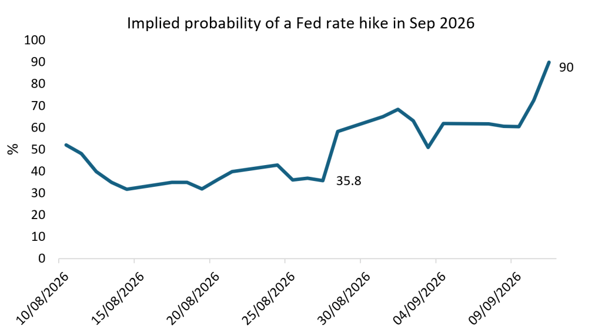
What will the implications of this be for Federal Reserve (the Fed) policy? Markets are now pricing in the possibility of a single cut in the Fed funds rate through year-end. With inflation accelerating from an already elevated level, and having missed its target for an extended period, the Fed will require clear, sustained evidence of economic weakening before cutting rates.

Two factors will be decisive.

First, the consumer: spending growth has held up at 2.5% year-on-year, but income growth has weakened to just 1%, pushing the savings rate down to a historically low 4%.

Bank of America deposit data reveals a stark K-shaped divergence – higher earners are seeing wage growth near 6%, while lower earners are at approximately 1%. Given that lower income households have a higher marginal propensity to spend, this divergence represents a meaningful risk to the consumption outlook.

Second, inflation expectations: market-based measures, such as five-year forward expectations, remain well-anchored, and survey-based measures show only a modest uptick – nothing alarming thus far.

UK Growth remains resilient, but headwinds are gathering

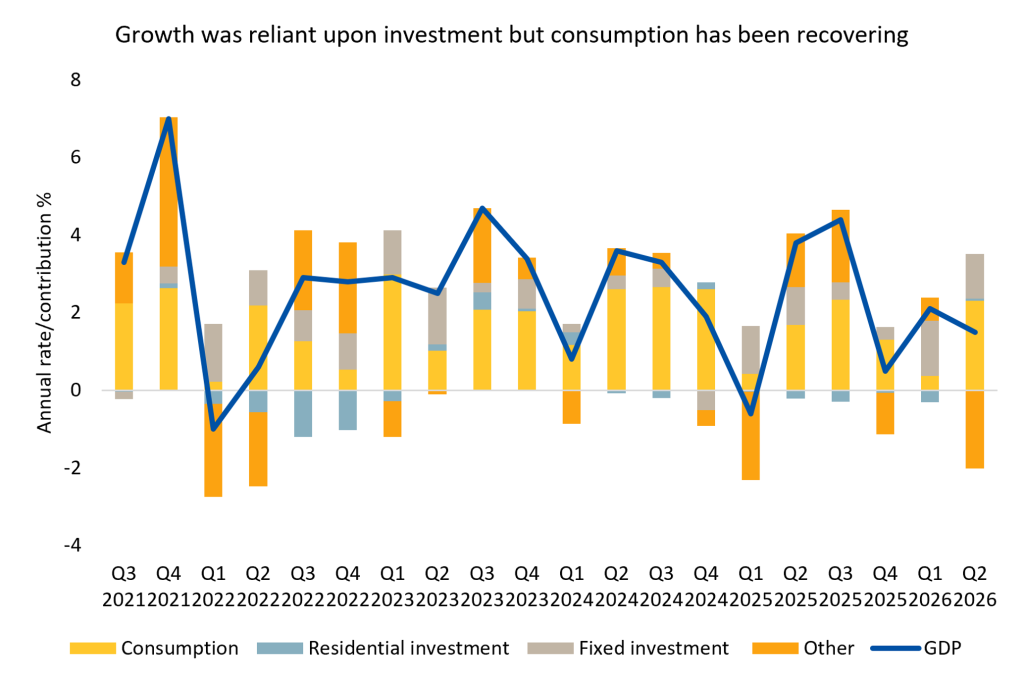
UK monthly GDP data for February came in surprisingly strong at 0.5% monthon-month, reflecting an improvement in household confidence following the widely feared Autumn Budget.

However, this pace isn’t considered sustainable, and the data pre-dates the onset of the Middle East conflict. Purchasing Managers Indices (PMI) readings have already softened, and elevated energy costs are expected to take the sting out of the year’s strong start.

The government announced a £600 million package of deferred costs for manufacturing businesses to help manage higher input cost inflation – a modest but directionally positive measure.

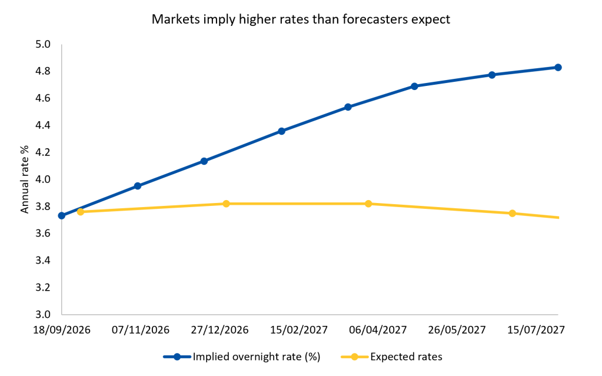
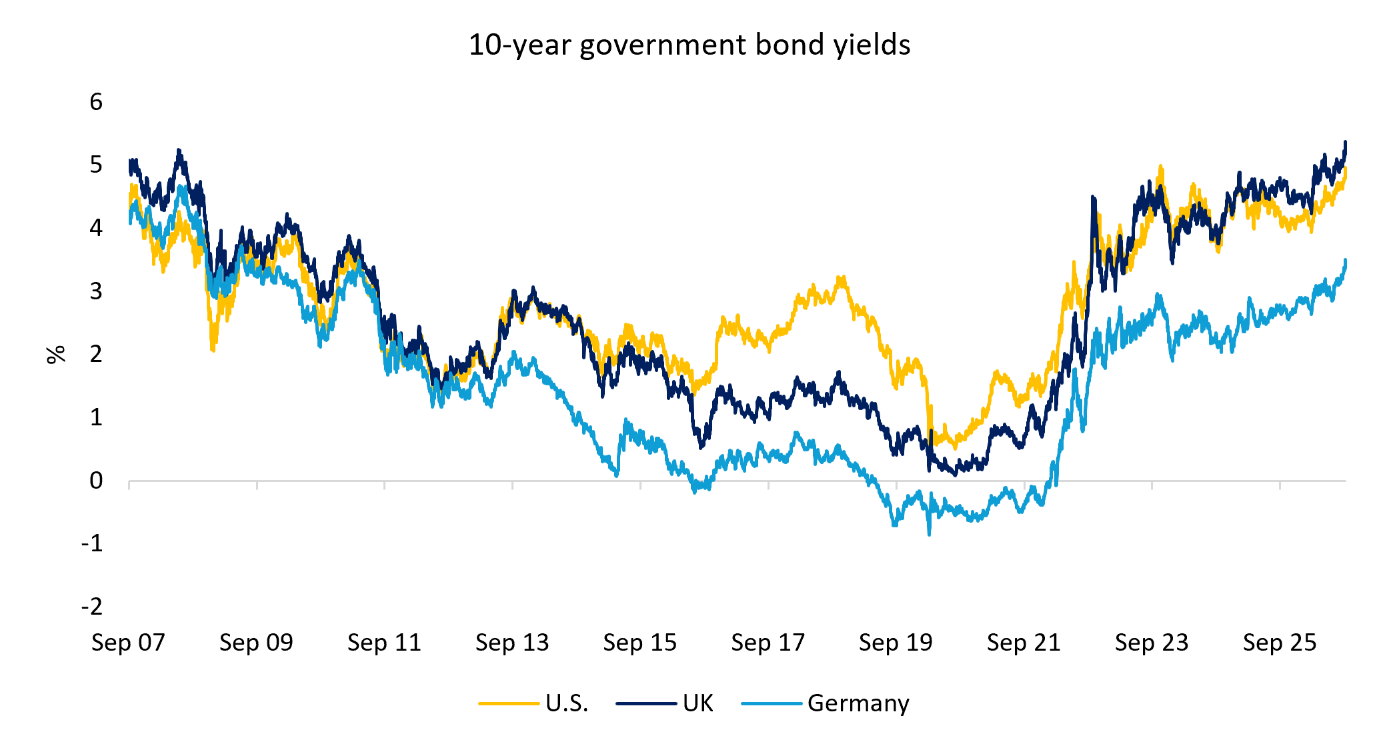
UK wage growth remains stubbornly above levels consistent with the Bank of England’s 2% target, effectively ruling out near-term rate cuts. Markets now expect one to two rate hikes by year-end, and gilt yields have risen accordingly. Sterling has maintained a firm footing near $1.35, supported by the expectation of sustained higher rates.

Political risk has also entered the frame. The revelation that former U.S. ambassador Peter Mandelson failed the vetting process has placed additional pressure on Prime Minister Sir Keir Starmer. Prediction markets are now seeing the probability of Sir Keir’s departure by year-end jump from approximately 40% to 55–60%. This uncertainty contributed to gilts underperforming other European sovereign bonds.

Please continue to check our blog content for advice, planning issues and the latest investment, market and economic updates from leading investment houses.

Alex Clare

22/04/2026

Team No Comments

Brooks Macdonald – Daily Investment Bulletin

Please see the below article from Brooks Macdonald detailing their discussions on markets, received this morning, 21/04/2026:

What has happened?

Markets retreated on Monday as the weekend’s lack of progress on US-Iran talks sent Brent crude up 5.64% after Trump warned he would not reopen the Strait of Hormuz until a deal was signed. The Nasdaq ended a 13-day winning streak, its longest since 1992. This morning sentiment has improved on reports that both sides are sending delegations to Islamabad ahead of the ceasefire’s expiry on Wednesday, with US futures recovering most of Monday’s losses and Polymarket’s implied probability of Hormuz normalisation by end of May rising to 69%.

Who will lead the Federal Reserve?

Today also brings the Senate Banking Committee nomination hearing for Kevin Warsh as the next Fed Chair. Warsh has emphasised that monetary policy independence is “essential” while noting the Fed must earn it by staying within its mandate, a careful balance ahead of questions on the near-term rate path. Republican Senator Thom Tillis has threatened to block all Fed appointments until the DOJ probe into Powell concludes, and with only a 13-11 Republican majority on the committee, his vote could prove pivotal.

What does Brooks Macdonald think?

Wednesday’s ceasefire expiry is a clear binary, a deal or extension would likely extend the risk rally and push oil lower, while a breakdown could quickly reverse recent gains. The Warsh hearing adds a further layer of uncertainty, and with inflation expectations already edging higher on both sides of the Atlantic, we continue to favour diversified positioning and are watching the geopolitical and policy newsflow closely.

Please continue to check our blog content for advice, planning issues and the latest investment, market and economic updates from leading investment houses.

Andrew Lloyd

21/04/2026

Team No Comments

Tatton Investment Management: Monday Digest

Please see the below article from Tatton Investment Management, discussing market reactions to the Iran conflict, improving liquidity, resilient growth, and emerging inflation risks, received this morning – 20/04/2026.

Getting back on track
Last week ended with what can only be described as market euphoria, after Iran declared the Strait of Hormuz “completely open”. Markets effectively decided the war to be over (even before Iran’s declaration), with the exception of oil perhaps: one-year Brent crude futures still traded above $75pb, implying longer inflation and a bigger growth hit than markets are pricing in. Even that assumed that de-escalation continued. Many rightly remained sceptical and sure enough, the conflicts re-escalation over the weekend quickly reversed most of the oil price decline.

The recovery from last year’s “Liberation Day” proved the risk of investors getting too negative, which helps explain current positivity, as do improving liquidity conditions with the Fed now a net bond purchaser. If the war had happened when liquidity was tight last Autumn, market reaction would have been worse. Liquidity is improving too: both the dollar and short-term yields fell. It’s no surprise that market sentiment on Iran shifted after central banks dialled back their hawkish rhetoric.

Liquidity allows investors to focus on the positives, and there’s plenty. US Q1 earnings look good, proving that consumers are still spending. The US economy in aggregate is insulated from higher energy prices, as they result in an internal money flow to US oil producers, rather than an outflow. UK growth (from before the Iran war) came in higher than expected, showing Britain started the war in a decent place.

It’s a little odd that during Friday’s euphoria the dollar dropped, and the renminbi gained, despite strong US growth and sluggish Chinese growth. Energy relief helped the euro gain, but we suspect Viktor Orbán’s loss in Hungary played a role too. The departure of the EU’s saboteur-in-chief mean less disruptive European politics. Markets think the same for the world.

Strong bank earnings show no credit contagion
US banks posted strong earnings growth in Q1 2026 (Morgan Stanley +30%, Citigroup +42%, JPMorgan +13%). That shows US consumers are spending despite gas price worries. Geopolitical shocks actually boosted trading profits too, helping Morgan Stanley in particular. Executives expressed concerns about inflation and the hit to growth from higher energy prices, though. Wells Fargo highlighted a split in consumer spending, continuing the “K-shaped economy” theme. JPM noted that corporate activity could stall thanks to geopolitical uncertainty. Bank stocks rallied on the strong results – but actually underperformed non-financials last week.

That’s partly because of the private credit (PC) elephant in the room. Fears of 2008-style contagion have grown after PC funds halted redemptions. The FT wrote last month that distorted EBITDA metrics might be making PC leverage ratios look better than they are – and some fear that firms might be hiding debts off balance sheet altogether. But the bank reports all said PC isn’t a systemic problem, even the PC-critical JPM boss Jamie Dimon. The PC market is a fraction of public debt markets, and the loans are structured so that PC firms and investors take the hit, rather than banks.

We’ve long argued that PC’s inability to create money, like banks can, prevents it causing another 2008. PC losses hurt PC investors, but the house of cards only comes down when bank money, backed by deposits, gets destroyed. Of course, banks have lent to PC firms (JPM’s exposure is $50bn, Wells Fargo $36.2bn, Citi $22bn) but these exposures are structured so that PC firms take the hit, and banks only lose if defaults spiral. Banks have also increased loan loss provisions – a healthy sign of money being stored away to protect against systemic issues. It’s not all fine in PC, but nothing in the latest reports vindicates the doomsayers.

Iran war a problem for food prices
The Iran war is pushing up food prices, according to the UN Food and Agriculture Organization (FAO). Global food prices rose 2.4% in March, with higher energy prices impacting all subcategories of the FAO’s index. Food prices declined in late 2025, and we started this year with decent supplies. That’s why soft commodity futures haven’t reacted as sharply to the Iran war as oil or gas. If Iran declaring the Strait of Hormuz “completely open” is really the end, there should be enough food supplies to last until production returns to normal. If talks fail and the Strait shuts again, though, time will not be on our side.

The biggest problem is fertiliser, 30% of which transits through the Strait of Hormuz. Fertiliser prices were already high before the war and have shot up, blindsiding farmers ahead of the spring planting season. Even if the Strait stays open, it will take months for production and shipping to return to normal levels – keeping food inflation high until next year at least. The UN has warned about potential humanitarian crises from this, particularly in sub-Saharan Africa, which imports 90% of its fertiliser.

Higher food prices will hurt consumers but are unlikely to create a wage-price spiral (given recent labour market softness). Currently, businesses want to pass on higher costs but are struggling to do so and that’s probably why markets aren’t as worried about food as about energy. Supposedly ‘one-off’ price shocks did create an inflation spiral after the pandemic, but that was exacerbated by central bank easing. In contrast, monetary policy has remained restrictive in 2026, and central banks seem to be warning governments against spending through the cost shock. This is why markets aren’t worried – but that’s no comfort to consumers. They desperately need the Strait of Hormuz to stay open.

Please continue to check our blog content for the latest advice and planning issues from leading investment management firms.

Marcus Blenkinsop

20th April 2026

Team No Comments

EPIC Investment Partners: The Daily Update | A Strait Choice: Why the Dollar is Losing Its Inevitability

Please see below, an article from EPIC Investment Partners which discusses the possible effects of the US-Iran conflict on the long-term strength of the US Dollar. Received today – 17/04/2026

Even if the US-Iran ceasefire holds, the dollar will not emerge from this episode untouched. Diplomats are still trying to turn the truce into something more durable, but no date has yet been fixed for a second round of talks, while Washington continues to mix negotiation with sanctions pressure and military threats. Israel and Lebanon now have their own separate ceasefire, a reminder that the region’s conflicts overlap rather than resolve in neat sequence. The immediate panic around the Strait of Hormuz may fade. The wider lesson will not.

For years, predictions of the dollar’s decline have run ahead of events. The reason was simple: no other currency offered the same combination of liquidity, legal protection and market depth. There were plenty of complaints about American sanctions, fiscal looseness, and financial power. But oil supplies could be disrupted while money still moved through dollar channels. The dollar endured not because it was beyond criticism, but because there was nowhere else to go.

That is why Hormuz matters for more than crude. The point is not that a few cargoes settled outside the dollar would overturn the system. It is that a conflict over a trade route has become bound up with a broader question about settlement, sanctions, and the extent to which countries can reduce their dependence on the western financial system.

Iran offers a useful example. Its oil trade with China has for years relied at least in part on yuan and other non-dollar arrangements, largely because sanctions left Tehran with few conventional options. What has changed is not the existence of those workarounds, but the context around them. China is now by far the main buyer of Iranian oil, taking more than 80 per cent of its shipped crude last year. In that setting, renminbi settlement no longer looks like a niche sanctions dodge. It starts to look like part of a wider shift in how politically sensitive trade is financed.

That does not make the renminbi a true successor to the dollar. China still has capital controls, limited convertibility and financial markets that lack the openness behind reserve-currency dominance. In a real crisis, investors still run into dollars. The Treasury market remains in a class of its own.

But that is not quite the point. If a country wants to reduce its reliance on the dollar without stepping outside global trade altogether, what realistic state-backed alternative does it have? The euro has scale, but not the same strategic freedom. Gold is not a payments system. Crypto offers workarounds, but not sovereign depth. On that basis, the renminbi is increasingly the only alternative with enough weight to matter.

The contradiction is plain. Washington wants the dollar to remain central not just to the existing financial system, but to newer forms of finance as well, while continuing to use access to that system as a tool of pressure. The talks with Iran are a case in point: diplomacy on one side, sanctions, and naval pressure on the other. That may strengthen America’s hand today. It also gives others a clearer reason to route around it.

The likely outcome is not a neat handover from one reserve currency to another. It is a more fragmented system, in which the dollar remains dominant but less universal, while renminbi-based channels take a larger share of politically sensitive trade. Oil has already eased on hopes that talks may resume and the war may cool. Markets may move on. But the dollar’s aura of inevitability has taken another knock.

Please continue to check our blog content for the latest advice and planning issues from leading investment management firms.

Alex Kitteringham

17th April 2026

Team No Comments

EPIC Investment Partners – The Daily Update: Safe Harbour

Please see todays Daily Update from EPIC Investment Partners received this morning (16/04/2026):

For much of the past decade, the $24 billion LAPSSET corridor, linking Lamu Port to South Sudan and Ethiopia, was widely dismissed as an overambitious “white elephant,” long on vision but short on relevance. That perception has shifted decisively. What once looked like a speculative infrastructure bet has become a strategic hedge against mounting instability across traditional Middle Eastern shipping lanes.

Recent disruptions have forced a rethink of global logistics. As security risks and insurance costs surge across key maritime chokepoints shipping lines are actively seeking alternatives. Lamu, positioned outside the immediate volatility of the Red Sea and Strait of Hormuz, has emerged as an unlikely but critical beneficiary. Cargo throughput has surged dramatically, with major carriers rerouting shipments that would historically have passed through Gulf hubs. The shift is not marginal, it is systemic.

This is best understood as a form of “asset displacement.” When established routes become constrained, global trade flows do not stop, they adapt. Underutilised infrastructure in more stable geographies suddenly commands a premium. Lamu’s appeal lies not just in geography, but in capability. Its deep-water berths, reaching 18 meters, allow it to accommodate large, modern vessels that many regional ports cannot handle. Combined with aggressive incentives, discounted handling fees and extended storage terms, it has quickly become a viable transshipment hub rather than a fallback option.

The numbers reinforce the narrative. Vessel traffic has accelerated sharply in early 2026, while cargo volumes have increased nearly tenfold over the past year. Large scale diversions, including vehicle carriers rerouted from Gulf destinations, underscore how quickly supply chains can reconfigure when risk thresholds are breached.

Crucially, this maritime shift is being reinforced inland. The LAPSSET corridor’s land bridge, linking Kenya to Ethiopia’s vast consumer base, is gaining credibility as security coordination improves along key routes. This creates a more resilient, integrated alternative to strained sea lanes.

None of this signals a permanent displacement of Gulf logistics, which remain central to global trade. Rather, it marks a structural rebalancing. The era of relying on a narrow set of chokepoints is giving way to a more diversified system.

Amid the current environment, the most valuable attribute in global trade is not speed, but reliability, specifically, insurability. Lamu’s transformation reflects that shift. What was once a costly gamble is now functioning as a strategic “Plan B,” quietly redrawing the map of global trade flows along the East African coast.

Please continue to check our blog content for advice, planning issues, and the latest investment, market and economic updates from leading investment houses.

Andrew Lloyd

16/04/2026

Team No Comments

Brewin Dolphin – Markets in a Minute

Please see this week’s Markets in a Minute update below from Brewin Dolphin, received yesterday afternoon – 14/04/2026.   

U.S.-Iran negotiations fail – what’s next?

As the weekend saw failed negotiations between the U.S. and Iran, we examine what this means for investors.

Key highlights

  • The Strait of Hormuz remains contested: Despite a ceasefire agreement, commercial shipping hasn’t fully resumed as Iran demands transit fees and reparations for war damage.
  • Markets remain resilient: Equity and credit markets stayed strong despite the ongoing conflict, suggesting many investors reduced risk early in the crisis.
  • UK bonds stand out: UK bonds offer the highest yields in the G7 and stand to benefit directly from any easing of Middle East hostilities.

The Iran war: A fragile ceasefire

Credit spreads narrowed close to their historic tightest despite the Middle East conflict

Source: Bloomberg

Last week, markets gained for a second consecutive week, and credit spreads narrowed despite the single most important driver of market sentiment – the evolving situation in the U.S.-Iran war.

When European investors departed for the Easter weekend, President Trump’s deadline for the reopening of the Strait of Hormuz was hanging over markets. The president had promised to unleash a wave of strikes against power and desalination plants if the Strait wasn’t reopened by Easter Monday. That deadline was extended to 8pm local time last Tuesday (1am on Wednesday in the UK).

Shortly before that deadline, it was announced that a ceasefire agreement had been reached, which became the week’s defining moment. The ceasefire, agreed between the U.S. and Iran, is conditioned principally on the reopening of the Strait of Hormuz to commercial shipping. Iran confirmed the Strait would be ‘navigable’, but the details remain deeply contested.

The Iranian idea of an open Strait seemed to require transit fees, which is something that multiple regional and global consumers of Gulf oil have refused to consider, complicating the path to a durable resolution.

By the time European markets opened, it was clear that this ceasefire was imperfect. There was confusion over the terms, suggestions that the parties had agreed to different drafts and disputes over whether the ceasefire extended to action in Lebanon. Several countries have refused to negotiate transit with Iran, and President Trump has made clear that transit fees are not part of the agreement. As a result, shipping didn’t meaningfully resume in the Strait ahead of scheduled talks between Iran and the U.S. in Islamabad, Pakistan over the weekend.

Disagreements extend beyond the issue of transit fees, with Iran also demanding reparations for war damage.

By the beginning of this week, the emphasis had changed, with President Trump instead choosing to impose a blockade on vessels bound for Iranian ports. U.S. officials announced this has prompted Iran to make contact again, and new talks are rumoured to be taking place this weekend.

What are the possible outcomes?

Helima Croft of RBC Capital Markets outlined three possible scenarios:

  • The divide between Washington and Tehran’s negotiating positions proves too difficult to bridge and fighting resumes.
  • A deal is reached that largely meets Iran’s established enrichment and missile priorities and comes with the added bonus of control of the Strait of Hormuz.
  • A no-peace, no-hot-war pause of indeterminate duration emerges that renders the ultimate security of the region’s waterways unsettled.

The resilience of equity and credit markets would suggest that investors are not positioned for the first option. The extending deadlines, erratic social media posts, and lack of response to reports of ceasefire violations suggest that the U.S. is reluctant to escalate military action further, possibly due to the humanitarian or political consequences.

The central purpose of the initial action was to prevent Iran from achieving the capability to produce a nuclear weapon, but Iran now demands the right to enrich uranium without supervision. It seems inconceivable that the U.S. could agree to that, as it would mark a huge backward step from the Joint Comprehensive Plan of Action (JCPOA) agreement, which President Trump pulled America out of in 2018.

By Friday, there had been no meaningful commercial traffic transiting the Strait of Hormuz since the ceasefire was announced. Oil prices remained within touching distance of $100 per barrel, underscoring the continued tightness in energy markets.

Equity and credit markets remain strong

It may be surprising against this backdrop that equity and credit markets have remained resilient. For context, markets found stability prior to the ceasefire agreement, reflecting the fact that many investors reduced risk during the early weeks of the war.

Markets continue to enjoy inflows from relatively robust employment levels and companies are buying their shares back. Under such circumstances, the risks facing investors start to shift, with the potential for them to be under exposed to any good news – for example, Friday’s story that Ukraine’s top negotiator believes a potential peace deal with Russia is within reach.

European currencies and bonds all directly benefit from any easing of hostilities. UK bonds in particular offer the highest yields in the G7 because of the tendency to have higher interest rates. Policy is slightly restrictive already, so there’s a weaker case for interest rate increases.

Despite such high yields, the predominantly long-dated funding of the UK means that it has been protected to some extent from the sharp increases of bond yields in recent years. So, despite its bond yields being the highest in the G7, the rate it pays (the coupon on its bonds) is close to average.

Yields for investors and costs for issuers

Source: Bloomberg

As we’ve previously noted, the UK bond market and sterling closely reflect the economic reality of the UK economy, however the UK equity market is more international and very diversified across sectors. The relatively high weightings in defensives and energy mean that it will remain more defensive than other equity markets if conflict intensifies, and it will benefit less than other major European markets from an easing of hostilities.

Please continue to check our blog content for advice, planning issues and the latest investment market and economic updates from leading investment houses.

Charlotte Clarke

15/04/2026

Team No Comments

EPIC Investment Partners – The Daily Update: Chokepoint

Please see the below article from EPIC Investment Partners detailing their discussions on the disruption caused by the US-Iran war and supply chain pressures. Received this morning 14/04/2026.

The current disruption in the Strait of Hormuz is often framed as an energy shock. In reality, it is a far broader economic fracture, one that exposes a sharp divide between infrastructure-rich exporters and highly vulnerable importers, with consequences rippling from Asian factories to European skies and global food systems.

At the centre sit Saudi Arabia, the UAE and Qatar, no longer just commodity exporters, but increasingly “fortress economies.” Years of investment in bypass infrastructure, from Red Sea pipelines to Fujairah’s offshore hub, have insulated core revenue streams from chokepoint risk. As flows tighten, these producers are not paralysed; they are repricing scarcity. The result is counterintuitive: disruption reinforces their market power, allowing them to sell less volume at higher margins while much of the world scrambles for alternatives.

What makes the disruption particularly acute is the lack of viable substitutes. The Gulf holds a structural dominance over specific high-grade commodities and specialised infrastructure. Supply chains for liquefied natural gas and high-nitrogen fertilisers are built on multi-decade contracts and tightly calibrated technical specifications, making substitution both slow and capital intensive. The region accounts for roughly 33% of global urea production and around 20% of ammonia, much of which is tied to Hormuz-linked flows, meaning disruption feeds directly into global food pricing. Replacing Qatar’s ~30% share of global helium or sourcing equivalent grades of Saudi sulphur would require years of new investment that simply does not exist in a ready state. At the same time, the region’s scale, accounting for nearly one-fifth of global petroleum liquids, exceeds the spare capacity available elsewhere, creating a supply vacuum that cannot be quickly filled.

The burden therefore shifts to import-dependent economies. India stands out as one of the most exposed, reliant on the Strait for around 40% of its crude imports and heavily dependent on Gulf fertilisers. This creates a dual shock, rising energy costs alongside pressure on agricultural output and food inflation.

Japan and South Korea face a different but equally acute risk sourcing around 70–90% of their crude imports via the Strait, leaving them highly sensitive to prolonged disruption. Their exposure extends beyond energy into industrial inputs such as helium, critical for semiconductors and medical technology, turning logistical disruption into a broader manufacturing constraint.

Regionally, the asymmetry is just as stark. Bahrain, for example, lacking the bypass routes of its neighbours, remains physically and economically trapped within the Gulf. Its aluminium exports and broader trade flows are acutely sensitive to shipping constraints and insurance spikes. By contrast, Saudi and UAE retain strategic optionality, maintaining export routes even as conditions tighten.

Beyond energy, the wider spillovers are increasingly visible. Europe and Asia face rising costs and capacity constraints, while Gulf hubs leverage refining and rerouting advantages to capture upside. In aviation, Europe depends on the region for 25–30% of its jet fuel, while airlines across Asia are already reducing capacity as prices surge.

The net effect is a profound economic decoupling. Import-dependent economies absorb inflation, shortages and industrial strain, while Saudi Arabia, the UAE and Qatar emerge not just resilient but indispensable, positioned at the centre of energy, food and industrial supply chains the global economy cannot easily replace.

Please continue to check our blog content for advice, planning issues and the latest investment, market and economic updates from leading investment houses.

Alex Clare

14/04/2026

Team No Comments

Tatton Investment Management: Monday Digest

Please see the below article from Tatton Investment Management discussing market reactions to the Iran ceasefire alongside risks from energy prices, AI supply chains and US fiscal policy, received this morning – 13/04/2026.

Brief relief

Markets burst up on the ceasefire news but that optimism, yet again, has had to be tempered. The Strait of Hormuz now are not only closed but “blockaded, perhaps a risky attempt to create more pressure on China to press Iran for a deal. Meanwhile, even if Iran does make concessions, Israel’s leadership seems to prefer further action. Vice-President Vance said there had been a “legitimate misunderstanding” over whether or not the ceasefire included Lebanon, pointing to a split between the US and Israel.

There’s a disconnect between markets’ relief and the real-world scramble for resources. Spot dated crude oil prices for June are nearly 40% above current near-contract futures, reflecting an extreme supply crunch. Even if the ceasefire holds, the war has already raised fuel prices enough for US CPI to show a 0.9% rise in March and it will affect broader prices from April onwards.

Still, markets have been optimistic throughout, and have shown remarkably little downside as Monday starts. Stocks have not entered full bearish territory and there has been little impact on credit spreads. Looking at the US economy, that’s understandable. There’s no sign of labour market stress and no real sign of companies suffering from the war – exemplified by accelerating corporate earnings growth. That’s brought down equity valuations, given US stocks are roughly where they were last October. With the dollar now strengthening, US stocks look very attractive to international investors.

Higher bond yields make equity valuations a little less attractive – and yields haven’t come down as much as you might expect since the ceasefire. If US growth keeps going strong, yields (and interest rates) could remain high, especially given Trump’s desire to borrow more (see below). The push for defence spending could mean fiscal indiscipline around the world. The UK has tried to maintain discipline with its fiscal rules, but the government’s commitment to those rules will be tested by bruising local elections. There’s still potential for yields to fall, in line with other asset gains. It’s just not a given.

The bond reaction will impact how markets deal with their previous anxieties: AI and private credit. With any luck, we’ll be worrying about the old themes by May.

Pax Silica – NATO for AI

Despite Trump’s misgivings about NATO, his administration is spearheading a NATO-of-sorts for AI. Washington launched Pax Silica in December, grouping allies under an AI supply chain umbrella, securing everything from mining to chips and infrastructure. It took shape after China’s export controls on rare earth metals, but is arguably an overdue response to Beijing’s Belt and Road Initiative (BRI). Around 150 countries have signed BRI agreements with Beijing since 2013, helping China dominate the rare earth sector. Trump would never admit it, but Pax Silica also builds on Biden’s CHIPS Act, encouraging US chip manufacturing (like TSMC’s “gigafab” in Arizona).

Washington is playing catchup in securing supply chains against China. It’s not just rare earths; China beats the US in several AI areas, according to ASPI. Taiwan is (unofficially) part of Pax Silica due to chipmaking giant TSMC, but reliance on Taiwan isn’t a great way of China-proofing your supply chain. Indeed, Taiwan has a strong incentive to delay TSMC’s cutting-edge production in Arizona, or else risk losing its ‘silicon shield’. Then there’s the fact that no amount of alliance-building can change the fact that so much of the world’s minerals are in Chinese earth.

Perhaps Pax Silica is too little too late, but securing supply chains is always better than not doing so. It shows that important matters of state can carry on, despite Trump’s scorched earth approach to international relations. The most interesting Pax Silica member is India, which, despite its own gripes with China, has never been keen to throw its lot in with the west. One has to wonder how much Pax Silica benefits its non-US members. Supply chain security is good, but Trump’s second term has proven that reliance on the US can be a major vulnerability. That might limit how committed countries are to Pax Silica.

Trump’s budget throws caution to the wind

Axios summarised President Trump’s 2027 budget plans as “all guns, no butter”. The White House wants roughly $500bn in extra defence spending and a cut of around $73bn to non-defence discretional funding (a 10% cut). Clearly, $73bn doesn’t outweigh $500bn, and yet White House proposals imply falling debt-to-GDP by 2026. That’s thanks to the administration’s assumption of 3% annual growth over the next decade. That’s in line with Treasury Secretary Bessent’s “3-3-3” plan, but no one else thinks it’s realistic. The Congressional Budget Office and the Fed both predict US growth under 2%.

The president’s budget is a statement of priorities rather than a policy plan; it’s up to Congress to form and pass those. Frankly, the 3% growth assumption is a fantasy. The only periods of sustained high growth in US history have been associated with population growth – but Trump cracking down on immigration. The plans therefore show the president’s disregard for fiscal constraint.

The Republican party has often given Trump a free pass on the deficit, but that could run out. Presidents tend to lose party influence in their final years, and the cracks are already appearing over the Iran war. We expect more Republicans to challenge Trump over the deficit in the years ahead.

The budget’s fiscal laxity didn’t move US treasury yields at all (they fell, thanks to the Iran ceasefire) showing that markets don’t attach much importance to it. If the budget is substantially changed though, it will likely mean a disruptive budget battle later this year. Strangely, Trump’s proposal assumes treasury yields falling to 3.5% next year – a strong assumption that contradicts the White House’s own assumption about faster growth. This is a risk for US bonds. Bond traders tend to be more forgiving of US indiscipline than other nations, but that will be tested if Trump expands a stretched deficit.

Please continue to check our blog content for the latest advice and planning issues from leading investment management firms.

Marcus Blenkinsop

13th April 2026

Team No Comments

Brooks Macdonald: Daily Investment Bulletin

Please see below, Brooks Macdonald’s Daily Investment Bulletin providing a brief analysis of the key factors currently affecting global investment markets. Received today – 10/04/2026

What has happened?

The prospect of continued de‑escalation supported a risk‑on tone across markets yesterday. The S&P 500 rising +0.62% to reach a one‑month high. This marked the index’s 7th consecutive gain, leaving it less than 2.5% below its late‑January record high. Leadership came from the Mag-7 (+1.58%), while gains were broad‑based across most sectors. The main exceptions were software & services (‑2.18%) and energy (‑1.19%). Improved sentiment also fed through to rates markets. Investors grew more confident that the Federal Reserve could still deliver rate cuts later this year, with markets now pricing a 33% probability of a cut by the December meeting. In contrast, European equities underperformed modestly, giving back some of Wednesday’s strong gains. The STOXX 600 slipped -0.15%. Renewed concerns around the inflation outlook pushed the 1‑year euro inflation swap up 12.2bps to 3.23%, while Brent oil price had risen +1.23% to $95.92/bbl.

Ceasefire optimism gains traction

Markets were buoyed primarily by geopolitical developments. Reports that Israel would begin direct talks with Lebanon as soon as possible, alongside comments from President Trump suggesting Israel was scaling back operations, helped ease fears of a broader regional escalation. Lebanon had been viewed as a potential flashpoint, particularly following evacuation orders issued in parts of Beirut and sharp rhetoric from Iranian officials. Against that backdrop, tentative progress toward dialogue reduced the risk that the ceasefire could unravel ahead of this weekend’s talks.

Backward‑looking data offers limited reassurance

US economic data released yesterday highlighted lingering inflation pressures. February PCE inflation, the Fed’s preferred measure, came in as expected at 0.4% m‑o‑m for both headline and core. Year‑on‑year, headline PCE held at 2.8%, while core eased slightly to 3.0%, which is still comfortably above the Fed’s 2% target, even before recent energy‑related disruptions. Elsewhere, initial jobless claims rose more than expected to 219k, while Q4 GDP growth was revised down again to an annualised 0.5%, highlighting a slowing backdrop.

What does Brooks Macdonald think?

Although oil prices have eased since the ceasefire announcement, inflation concerns remain elevated. That keeps the focus firmly on today’s US CPI release for March, which is the first inflation print to include the period since the Iran conflict began at the end of February. The data will be closely watched for signs of renewed energy‑driven price pressures and potential second‑round effects. While markets have welcomed tentative geopolitical progress, inflation dynamics remain the key constraint for central banks. This reinforces the importance of maintaining balanced portfolios and avoiding over‑reaction to short‑term market optimism.

Please continue to check our blog content for the latest advice and planning issues from leading investment management firms.

Alex Kitteringham

10th April 2026

Team No Comments

EPIC Investment Partners – The Daily Update: Solar Oil

Please see todays Daily Update from EPIC Investment Partners received this morning (09/04/2026):

With Pakistan successfully brokering a fragile peace, the relief rally we have seen across asset classes points to some hope of a return to a more recognisable macro environment.

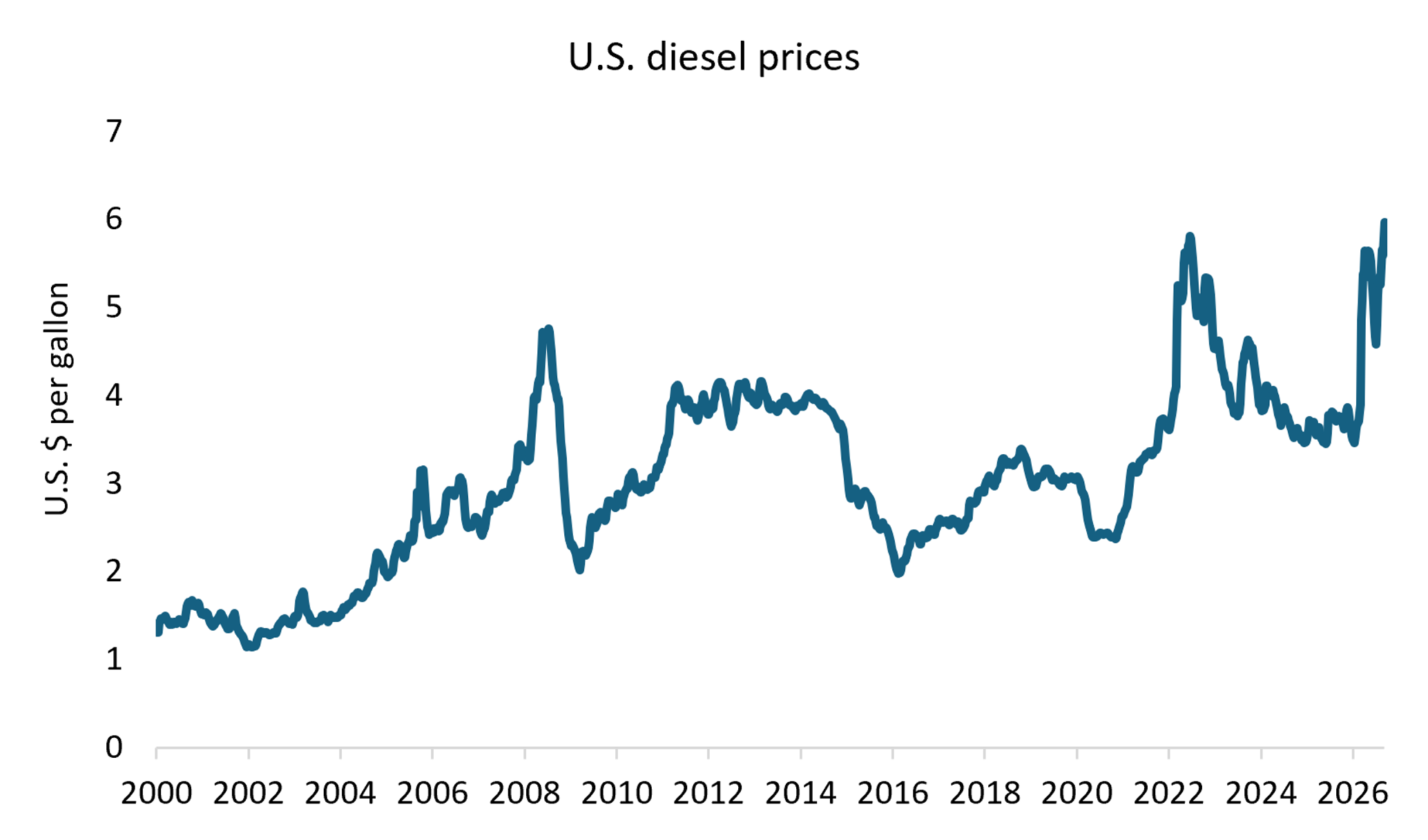
The main market focus remains on oil and LNG supplies (or lack of them) and the immediate impact on petrol and diesel prices. However, there are a host of other oil and gas derived products which, unsurprisingly, have also seen sharp price rises.

One of the more obvious is fertiliser, much in the headlines. China, India, Brazil, and the US are the largest consumers.

Elsewhere the production cost of various plastics has soared. The conflict pushed up the cost of solar-grade ethylene-vinyl acetate (EVA) by 43% in March while polyolefin elastomer (POE) resin increased 7%. These two materials are the downstream derivatives of the petrochemical product ethylene which saw a 66% price surge in March.

The solar industry accounts for more than half of the annual EVA demand, among a wide range applications including shoes, cables, and packaging. Some Chinese suppliers can produce ethylene using coal and natural gas and, in total, these sources account for roughly one third of China’s EVA requirements.

Solar module costs and pricing remain highly uncertain in the near term. The severity of the disruption depends entirely on the swift resumption of the supply chain.

For better or worse, plastic products remain crucial to most industries.

Please continue to check our blog content for advice, planning issues, and the latest investment, market and economic updates from leading investment houses.

Andrew Lloyd

09/04/2026