Team No Comments

Forced sellers and other distractions

Further Input from one of our investment houses that we use below, Tatton:

Disorderly divestments create confusing market dynamics

Last week could be characterised as an “orderly” repricing of equity markets to the consequences of COVID-19 disruptions. This week has seen second-order market dynamics, driving valuations down to levels which do not seem particularly rational anymore.

Are we back to a systemic crisis, the return of a global financial system teetering on the brink of collapse as it did back in 2008/2009? The answer is a firm and resounding ‘No!’.

This time the source of the stock market downdraft is not the financial system itself, but an external shock to global economic activity. Given such shocks happen far more frequently than banking crises and the resilience of the financial system is stronger following the financial crisis of 10 years ago, we see far less stress across the financial system overall.

Nevertheless, stock and bond markets are displaying levels of apparent disorientation as they bounce between brutal sell-offs and staggering recoveries, suggesting that distressed sellers are dominating the markets. The double whammy of the oil price collapse adding to the growth downgrades from COVID-19 counter-measures has clearly worsened the situation, but not to the extent that it can explain some of the market action we are currently experiencing.

Instead, it is likely that a number of large investors who entered this rapid sell-off with geared/ leveraged investment positions (to catch the growth rebound that was predicted at the start of 2020), are now scrambling to reduce their positions because their leveraged market exposure has put most of their capital at risk (needless to say that Tatton portfolios do not hold geared investment exposures). To quote Warren Buffet: “Only when the tide goes out, do you discover who has been swimming naked.”

This may provide some explanation why markets are driven down to valuation levels that appear to price in a sustained fall in company earnings – as would result from a lasting recession – even though it is by no means clear that this is the most likely outcome. In other words, we cannot currently gain much insight from market action, except that no-one has more insight than anybody else.

What is very encouraging is the willingness for concerted action between governments (fiscal support) and central banks (monetary intervention). It is easier to agree to protect society as a whole from virus disruptions than bailing out the ‘fat-cats’ of the banking sector as was required 11 years ago. On that note we commend the new chancellor, government and Bank of England on taking the lead amongst the western nations in announcing bold action plans to prevent long lasting economic damage from what increasingly looks like an inevitable but temporary public health crisis.

We read from the UK’s actions, but also some of the extraordinary steps taken by the Italian government to contain the economic fallout at household level, that we may well experience, not only a virus inflicted pause to public live and economic activity, but also a pause to the financial rules and obligations that private households and small businesses normally have to live by. This will feel very uncomfortable for most of us and is likely to confuse markets again, but such action is absolutely what may at some point be required to address this formidable challenge.

In all of this we will not lose sight at Tatton of the fact that such extraordinary times also lead to some extraordinary opportunities in investments, as too much focus on the very short term leads to buying opportunities for those with a longer term perspective. Historical precedent tells us that this virus crisis will pass and lead to a strong recovery, because the recessionary conditions are related to a passing condition, rather than a sustained deterioration in the general direction of travel the global economy was on before the virus crisis struck.


My message remains the same – stay invested, keep calm and carry on. If you have spare cash now is a great time to invest.

Steve Seed

12/03/2020


Article courtesy of Tatton Investment Management

12/03/2020
 

Team No Comments

Budget Summary

Not many fireworks in the financial planning world. A fairly neutral Budget with infrastructure spend that should help boost business in the UK as we struggle with the Coronavirus.

BUDGET SUMMARY

Rishi Sunak’s first Budget took place against the backdrop of the global outbreak of COVID-19.  Not surprisingly the UK’s response to this was the initial focus – providing some much needed short term financial measures in the current uncertainty, from ensuring the NHS has sufficient budget to cope, to extending statutory sick pay rules that affect millions of workers.

The new Chancellor set out a Budget which supports the government’s ambition for a ‘fair and sustainable tax’ system.

Many rumours didn’t quite come to pass, we did not see an overhaul of inheritance tax, scrapping of Entrepreneurs Relief or an announcement of a wide spread review of pensions tax relief. But as expected we did see an increase in the Tapered annual allowance, and the good news was it was significantly more than expected, saving many from significant tax bills and the hassle of carrying out complex calculations.

Income tax

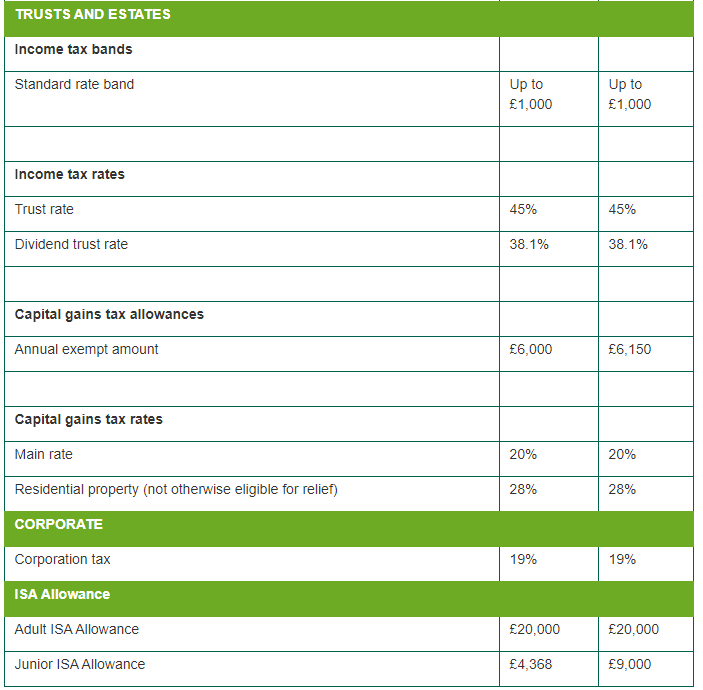
Starting rate for savings tax band – form savings income that is subject to the 0% starting tax rate remains at £5,000.

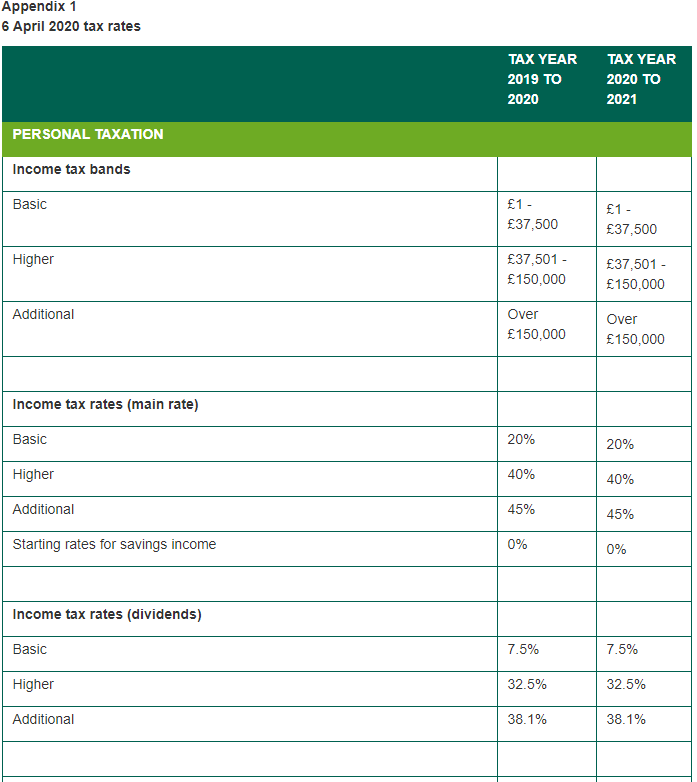
Income tax bands and Income tax rates remain unchanged
Income tax band for 2020/2021:
Basic Rate                          £1 – £37,500
Higher Rate                        £37,501 – £150,000
Additional Rate      Over    £150,000

National Insurance

The threshold at which employees will begin paying class 1 National Insurance increases from £8,632 to £9,500 from 6 April 2020.

Corporation Tax

The Government has decided not to reduce the rate of corporation tax from the planned 19% to 17% and instead it will remain unchanged at 19% from 1 April 2020.

Capital Gains Tax

Capital Gains Tax: Reduction in the Entrepreneurs’ Relief lifetime limit

From 11 March 2020, the lifetime limit on gains eligible for Entrepreneurs’ Relief (which offers a reduced 10% rate of Capital Gains Tax on qualifying disposals) will be reduced from £10 million to £1 million. There are special provisions for contracts for disposals entered into before 11 March 2020 that have not been completed and for certain exchanges of shares and securities made before 11 March 2020. The change ensures the Government continues to encourage genuine risk takers and entrepreneurs’ in a fair way, with over 80% of those using the relief unaffected.

Inheritance Tax

Other than the planned increase to the Residence Nil Rate Band (from 150,000 to 175,000 from 6 April 2020), there are no other changes to Inheritance Tax.

Pensions

Changes to annual allowance

The standard annual allowance in 2020/21 will remain at £40,000.

However, to support the delivery of public services (particularly health services) the two tapered annual allowance thresholds will be raised by £90,000.
Therefore, from 2020-21 the:

a)   ‘threshold income’ will be increased from £110,000 to £200,000; and

b)   ‘adjusted income’ will be increased from £150,000 to £240,000.

For those with a threshold income above £200,000 and an adjusted income above £240,000, their annual allowance will be reduced by £1 for every £2 that their adjusted income exceeds £240,000, down to a minimum (tapered) annual allowance of £4,000 (£10,000 in 2019/20).

This means that anyone with a threshold income above £200,000 and an adjusted income of at least £312,000 would have a tapered annual allowance of £4,000 in 2020/21.

There is no associated proposal to offer greater pay in lieu of pension benefits for senior clinicians in the NHS pension scheme.

This measure is primarily designed to enable most clinicians to work more hours without incurring pension tax charges.

Change to lifetime allowance

The standard lifetime allowance (SLA) will be revalued (in line with the annual increase in the consumer prices index (CPI) to September 2019) from £1,055,000 in 2019/20 to £1,073,100 in 2020/21.

Call for evidence on pension tax administration

There is a tax relief inconsistency for those earning around, or below, the level of the personal allowance depending upon whether they are contributing to a:

a)   relief at source (RAS) registered pension scheme, such as a personal pension; or

b)   net pay arrangement.

Those contributing to a RAS  scheme currently benefit from UK basic rate income tax relief whilst those contributing to a net pay arrangement scheme do not.  Therefore, the government will consult regarding how to address this unequal treatment.

Inheriting a State Pension from an opposite sex civil partner

The Civil Partnerships (Opposite-sex Couples) Regulations 2019 gave opposite-sex couples the choice of entering into a marriage or a civil partnership.

The Budget provides funding to ensure that opposite-sex individuals who enter into a civil partnership can derive, or inherit, a State Pension from their (opposite-sex) civil partner.

Universal Credit: Additional support for claimants transferring to pension credit

This measure allows Universal Credit payments to be extended until the end of the assessment period in which the household reaches the qualifying age for Pension Credit and pensioner Housing Benefit.  This removes the potential gap in benefit entitlement that exists at the moment.

Consultation on the reform of Retail prices index (RPI) methodology

The method for calculating the RPI, which is widely used in the pensions industry, for instance in relation to revaluing pension benefits in deferment and pension income payments, has been reviewed by the UK Statistics Authority (UKSA).  A consultation will now run until 22/04/2020 with regard to making any changes at some point between 06/04/2025 and 06/04/2030.

Other than the planned increase to the Residence Nil Rate Band (from 150,000 to 175,000 from 6 April 2020), there are no other changes to Inheritance Tax.

Individual Savings Accounts (ISA)

There are no changes to the adult ISA annual subscription limit for 2020-2, it remains unchanged at £20,000.

The Junior ISA subscription will increase from £4,368 to £9,000.

Top Slicing Relief

Following Marina Silver v HMRC, new legislation has been introduced to clarify the top slicing calculation for gains made on or after 11 March 2020. The new legislation confirms:

For the purpose of the top slicing calculation reliefs and allowances are to be set against other income as a priority. Only if there are allowances remaining are they to be set against the chargeable event gain(s)

When assessing the tax due on the annual equivalent (the gain(s) divided by the years made over) the availability of the personal allowance should be assessed using the annual equivalent not the full gain(s).

This applies to both Onshore and Offshore life assurance and redemption policies.

Read our Knowledge direct article for more information

Stamp Duty

Non-UK resident Stamp Duty Land Tax (SDLT) surcharge

A 2% surcharge on non-UK residents purchasing residential property in England and Northern Ireland will be introduced from 1 April 2021. The surcharge is in addition to the standard Stamp Duty rates as well as the 3% surcharge that the Government previously introduced for buy to let properties and second homes.

Housing co-operatives: Annual Tax on Enveloped Dwellings (ATED) and SDLT

The government will introduce a relief for qualifying housing co-operatives from the ATED and 15% SDLT on purchases of dwellings over £500,000.  The SDLT relief will take effect in England and Northern Ireland from the Autumn Budget and the UK-wide ATED relief from 1 April 2021 with a refund available for 2020-21.

Tax evasion and promoters of tax avoidance schemes

HMRC’s continues to push its Promoter strategy.  HMRC will publish a new strategy for tackling the promoters of tax avoidance schemes with an aim of driving those who promote tax avoidance schemes out of the market, disrupt the supply chain to stop the spread of marketed tax avoidance, and deter taxpayers from taking up the schemes.

Not a bad Budget overall with little change for the majority of people. The increase in the National Insurance minimum threshold for employees could be useful and high earners could benefit from the new tapered annual allowance rules.

Steve Speed

12/03/2020


Article and tax tables courtesy of Old Mutual Wealth.

11/03/2020


Team No Comments

Oil price plunge adds to stock markets pressures from Coronavirus

One of the investment houses we use has promptly issued this update at 9.52 this morning:

While most people spent the weekend dealing with the prospect of the COVID-19 epidemic taking hold of UK life, the financial community woke up this morning to another, different – even if slightly more familiar – type of upset: an oil price shock that unfolded over the weekend.

Oil prices have plunged by more than 30% since last week. Together with recent declines, this means that the price of oil has more than halved since the beginning of the year. At the same time, a flight to the perceived safety of government bonds has pushed up bond prices, leading to the lowest yields ever seen on US Treasuries as a result of the inverse relationship between bond prices and their yields.

As a consequence of the double whammy, the already highly nervous stock markets have reacted with what can only be described as panic selling. After falls of around 5% in Asia, European stock markets are opening down by at least as much and in some cases more.

Altogether this news flow will lead many to feel slightly apocalyptic – or at least as anxious as they might have during the darkest days of the financial crisis back in 2008/2009.

But pause for a moment and it becomes clear that this oil price collapse is a total reverse of the most significant oil crisis that took place in the 1970s. This time around, the Saudis decided to push the oil price down, not up, and falling yields take pressures off borrowers, rather than increase it.

This is very different territory compared to previous oil price shocks. So, what is going on?

Following the already significant declines in the oil price since the beginning of the year, there had been widespread expectations that OPEC (plus Russia) would agree to production cuts to stabilise the oil price. It therefore came as a shock to oil traders and their positioning towards rising prices when the opposite outcome occurred over the weekend. Essentially, this means that Saudi Arabia and Russia opted for a resumption of the price war of 2015/2016. Just as now, this strategy was aimed at decimating the competition of US shale oil and gas producers, which require a higher oil price threshold than Saudi and Russia to remain profitable. Just as Trump pursued a strategy of ‘kick ‘em when they are down’ with China last year, it appears the same tactic is now being applied to US oil producers.

Given that the shale producer defaults and the resulting stress in credit markets caused a stock market correction back in Q1 2016, it is not overly surprising that capital markets are following the same script now. Is it likely then that history repeats itself and we are about to witness an even bigger crash than 2016, due to the double whammy of Coronavirus disruptions and oil market upset?

Well, that’s possible in the very short term, but the overall financial, political and economic environment is a different one compared to four years ago. First and foremost, a repeat of the oil price war tactics from back then will no longer carry the same surprise factor. We can expect a much better-informed reaction by the US central bank and government to this renewed onslaught.

Back then, the biggest issue was that mass defaults across the US oil industry would increase the yield costs of corporate credit for all US businesses. Therefore, it is reasonable to expect the Fed will react very quickly to minimise this risk and use its immense quantitative easing (QE) firepower to sell US government and mortgage bond holdings and buy corporate credit to counter any selling pressures. This would also have the effect of easing any ‘flight to safety’ induced supply shortages within government bond markets.

What is more, neither commodity markets nor commodity producers are coming from bubble territory as they did four years ago. This time, there is unlikely to be a similar demand decline from resource industries for manufactured goods, which have already been forced to scale back expansion plans. On the other hand, a halving of the oil price, together with a significant reduction in the cost of borrowing, constitutes a significant stimulus for the global economy and in particular emerging markets, which will additionally benefit from an accompanying fall in the US$.

Our take on this morning’s stock market rout is that faced with this shock surprise action by oil exporters, market participants have become overwhelmed by a doubling up of concerns from the virus disruptions and memories of what happened the last time when oil prices traded at these levels.

We expect some decisive actions from central banks, or at least announcements in this direction. Such actions are unlikely to amount to another round of monetary QE from the Fed, but rather a swapping of government bonds already on its balance sheets with direct purchases of corporate bonds, given that the big falls in government yields from the increased demand in bonds allows them to take supportive action without pushing up yield levels. The Fed has the means to put out this specific fear driven ’fire’, while the economic stimulus effect from the lower cost of energy and of capital should prove to be a very welcome relief over the coming months for the virus disrupted global economy.

At the end of a tumultuous time for stock markets last week, the US stock market rallied hard into the close, leading to a slight weekly gain in those markets overall. This week may well prove similar as there are many more seasoned investors sitting on vast amounts of uninvested cash following years of overextended prices for risk assets.

Perhaps it is worth mentioning that due to unattractively high valuation levels, Warren Buffet’s Berkshire Hathaway fund was at the beginning of the year sitting on uninvested cash of around £130billion. As Warren Buffett is fond of saying: “Price is what you pay; value is what you get. Whether we’re talking about socks or stocks, I like buying quality merchandise when it is marked down.”

As you can see volatility is extreme, you need to remain invested as you are until the volatility subsides. It is also a buying opportunity for anybody sitting on cash.


Steve Speed

09/03/2020


Article courtesy of Tatton Investment Management Ltd.

Team No Comments

Transition into Retirement

One of the key areas we advise on is retirement planning, preparing for retirement, retiring and living your retirement.  As we could now live for 30 years or more in retirement it’s important to get it right.

There’s a good quote that says ‘Retirement is about waking up with enough purpose and going to sleep with enough money’.

For the transition into retirement to be successful you need to have both ‘the emotional capacity to retire and the financial capacity’.

A good transition into retirement for many is to semi-retire for a few years first.  This allows you the time to build up other interests outside of work and perhaps a new network of friends.

You need to have not just the wealth to retire but also the capacity to handle the emotional or psychological impact of leaving the world of work.

In general, people need to start thinking earlier about what comes next.  It’s useful to have these discussions years before you retire.  Understanding what you might do in retirement should help you to plan to have the means to retire (to do what you want).

Be flexible with your retirement, it’s very likely that you will change direction and you will have to adapt your original plans and keep adapting them.  Your retirement plan has to be pliable.

Quite often people either carry on working or return to work after a few months off.  This can be a retirement option for those that have the means to fully retire.  I have also had clients who have been pretty much full time voluntary workers.  The most important outcome is that you are happy with your retirement.

Summary

Think about your retirement, what do you want to do?  How will you spend your time?  Have you factored in what your partner and family want or what you’d like to do for them in retirement?

What will it cost to live the life you want to live?

Will your new life be engaging and intellectually stimulating?  Plan with your partner if you have one.

As mentioned earlier you need both the financial and emotional capacity to retire.


Steve Speed

09/03/2020


Thought provocation from Nucleus Illuminate 06/03/2020

Team No Comments

Coronavirus (Covid-19) in context

As the global news and local news about the spread of coronavirus grows we need to remain calm and ignore a lot of the background noise.  The best option in the circumstances is to remain fully invested and not change anything when volatility is high.

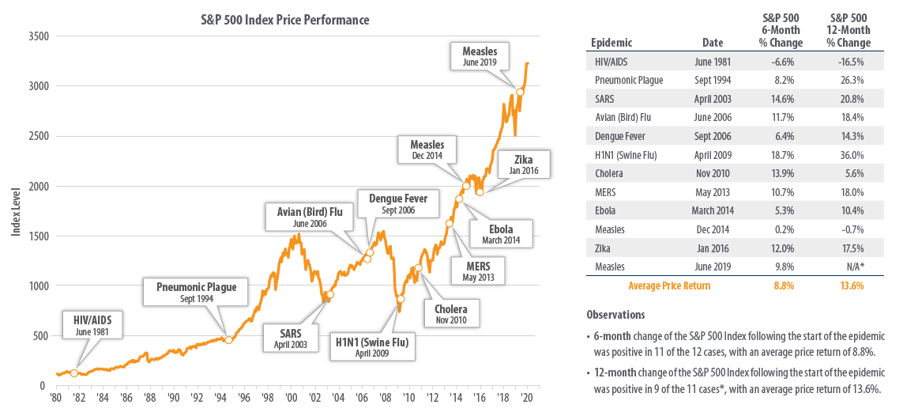
Please see the chart below that outlines the impact of various health scares on the S & P 500:


As you can see from the above chart when you look back historically the impact on markets has been minimal as the recovery can be quite sharp in the majority of cases.  If you zoom in (and listen to market analysis) most recoveries are V shaped.

So to precis, remain invested, ignore the noise and keep calm and carry on.  For those of you with liquid cash this could be a great time to invest!

As ever, if you are unsure please call me.


Steve Speed

06/03/2020


Chart cut & pasted from one of the investment houses we use, SEI, from their email dated 05/03/2020.

Team No Comments

Coronavirus Market Update

One of the investment houses we use, Brewin Dolphin, put this content out on email last night:

With the market’s interpretation of the risks of the coronavirus shifting greatly as at the end of February, our Head of Research, Guy Foster has given the following update. 

The real risk to the economy and therefore the lasting impact on people’s savings is likely to be through the efforts to limit the spread of the virus. These measures will cause short term but potentially quite dramatic curbs on economic activity. 

We are confident the economy will recover and strengthen once these curbs can be removed, but we can’t be as confident about exactly when that will happen. In the last few days central banks have announced policy measures to offset some of the deterioration in outlook. 

Investing, unfortunately, does involve shouldering these and other risks, but with a focus on long-term investing we can ride out temporary disruptions to markets and the economy. 

Brewin Dolphin 02/03/2020 17.24

Comment

The key message from a variety of sources, commentaries and webinars digested over the last week is to remain invested.  This is nothing new.  In times of heightened volatility, the big risk is coming out of your investments.

If you remain invested at some point in the future markets will recover and you will feel the benefit.

It’s slightly different if you are drawing an income from your invested assets, for example in Drawdown from your pension fund in retirement.  The action you would take depends on how you are invested, what the underlying investment funds are, and what your overall position is.

It might be appropriate to stop drawing income from your invested assets for now and switch to drawing income, perhaps at a lower level, from your cash reserves.

If you are not sure please get in touch and ask for advice.  Your likely best response to this volatility is to do nothing with your underlying investments, stay invested as you are and be patient.


Steve Speed                                                                                                                                                              03/03/2020

Team No Comments

State Pensions – What you need to understand well before you retire

When the new State Pension was introduced for those reaching State Pension age on or after 6th April 2016, the intention was to simplify the old system which was a State Pension system with multiple different aspects (i.e. the basic state pension, state earnings-related pension (SERPS), the second state pension (S2P) and the graduated retirement benefit).

The new State Pension is a single benefit paid to individuals who have made (or been credited with) 35 years National Insurance contributions.

Unlike the old system it replaced, the new pension is based solely on the contributions of the individual, with no extra amounts awarded based on contributions made by a spouse or civil partner and no inheriting of rights after the death of a spouse or civil partner.

This loss of the death benefits is just one of the major issues with the new system. Unfortunately, this is not widely known by the general public. Government should publicise this issue.

Apart from the obvious issues regarding longevity and possible legislation changes to the State Pension (including the possible loss of the ‘triple lock’*), one of the biggest issues is incorrect State Pension forecasts.

We wrote about this in a blog back in February 2017, https://www.pandbifa.co.uk/state-pension-forecast-wrong/.

Last year the former pensions minister Steve Webb (in partnership with the ‘This is Money’ website investigated this further and found that in some cases, new forecasts were more than £1,000 a year higher than had previously been expected. These cases were raised with DWP who initially said that these were isolated errors which had now been corrected.

However, there still seems to be issues, particularly around people who were members of Defined Benefit pension schemes that had been contracted out.

Commenting on the findings at the time, Steve Webb (who was also the Director of Policy at Royal London at the time) said: “People are increasingly encouraged to use online services to help plan their retirement, and the new pensions dashboard will rely heavily on such data. It is therefore very worrying that hundreds of thousands of people may have received incorrect state pension forecasts and in some cases will have taken decisions about their retirement plans on the basis of incorrect information. Now that the Government is aware of the scale of the problem, it must put an urgent stop to the issuing of incorrect statements. Individuals need to have confidence that the information they receive from the government is accurate and should not have to live with the uncertainty that a statement they have already received may be seriously incorrect”.

If you haven’t already, please visit https://www.gov.uk/check-state-pension to request a State Pension Forecast or call the Future Pension Centre helpline on 0800 731 0175 and request a paper copy.

We will issue new updates on the future of State Pensions regularly and we take this into account at each of our clients annual reviews.

Comment

In general terms the levelling out of the State Pension in April 2016 was beneficial to a lot of low earners and carers. This is good news.

However, for those of us who have lost significant death benefits from the State Pension, the spouse’s pension element from April 2016, advice should be taken to ensure that our long term partners have enough pension provision (or replacement for it) as soon as possible.

Don’t leave it too late, until just before you draw your State Pension. This could be a mistake that you can’t rectify at this stage.

If you wish to discuss any aspect of the State Pension or retirement planning, please contact us at enquiries@pandbifa.co.uk or call us on 0151 546 1969.

Andrew Lloyd 02/03/2020


*The triple lock is the method under which the State Pension increases each year. This is in line with whichever is the highest of consumer price inflation (CPI), average earnings growth or 2.5%.

Data Source: Royal London Press Release – ‘Minister forced to admit ‘significant’ problems as a third of a million incorrect state pension forecasts issued’ – June 2019

Team No Comments

Good News for Prudential ‘PruFund’ Investors

An announcement released by Prudential yesterday afternoon included the following message for our PruFund Growth investors:

If your plan is invested in PruFund:

  • Your plan is made up of units, and you’ll get an increase to unit prices.
  • We increased your unit price by 0.9% on 26 February 2020. From then, your unit price will continue to move in line with the normal smoothing process of PruFund. You can find out more at pru.co.uk/investments/investment-fund-range/prufund/
  • You need to have been invested in the PruFund funds on 26 February 2020 to get the unit price increase. But any money you have in the holding account at that time won’t get the increase.

Comment

Prudential have more money than they need in their With-Profits Sub Fund, their inherited estate built up over many years.

They have these excess funds in their inherited estate and have decided to share it. This is not a regular occurrence, far from it.

This is great news – as markets drop substantially due to coronavirus (hopefully short term) Prudential add a little value for our ‘smooth’ investors! (pun)


Steve Speed                                                                                                                                                         27/02/2020

Team No Comments

Coronavirus and the reaction of markets to pandemic fears

One of the investment houses we use, Tatton Asset Management, has produced this update on coronavirus today (26/02/2020)  Steve Speed.

Coronavirus and the reaction of markets to pandemic fears

Global equity markets have taken a significant hit this week, as investors started to take news of COVID-19 spreading beyond China to the rest of the world more seriously. We thought it would be a good time to consider the historical impact of previous pandemics on global investment markets, as well as assessing some of the likely outcomes we can expect this time round.

The chart below (from Alpine Macro and Charles Schwab) shows when those episodes occurred in relation to global equity market returns. The data suggests that past epidemics have not resulted in any significant or long-lasting damage to global stock prices. While certain economies and markets have been negatively impacted for short periods, most of these potential worldwide pandemic threats have proven to be just that – potential.


Make no mistake, those threats listed were severe, with some truly pandemic. According to research from the World Health Organisation (WHO), the 2009 H1N1 Mexican Swine Flu affected up to 1.4 billion people (at least one in five people worldwide were infected), and had a death rate of 0.2% and an ultimate fatality count in excess of 160,000.

So what’s different this time?

In comparison to those flu-type outbreaks, the news coverage and the extent of preventative action from governments have been of a different order. Indeed, it is the preventative action that mostly affects economies and financial markets. Global manufacturing supply chains have been affected by much of China’s extended lay-off since the beginning of the year. That said, the clearest global impact of the COVID-19 outbreak so far has been on travel and events. The Six Nations Championship rugby match between Italy and Ireland (due to be played in Dublin on 7 March) is expected to be postponed, while several Serie A football matches in Italy are likely to be played behind closed doors. Conferences a month from now, especially those involving international participation, have been cancelled. There are even questions being asked as to how the Tokyo Olympics in August might be affected.

Companies are revising down expectations, and investors expect policymakers to show their hand

The revenues and profits of many companies will be lower in the coming months. Today, Diageo has warned investors that revenues will be lower than expected for this fiscal year, a decrease of about 1-2%.

Some highly-leveraged companies are particularly vulnerable. The most obvious ones are in the logistics, travel and airlines industries. Energy and resource companies, which were stressed by slow global growth before the outbreak began, are facing even higher financing costs.

However, while bank share prices have fallen slightly more than the overall markets, they are not yet signalling fears of a systemic credit issue. Indeed, government bond yields have experienced a sharp fall, accompanied by a growing expectation of interest rate cuts and monetary intervention from central banks. Institutional investors now see a high likelihood that US rates will be cut by 0.25% within two months.

The probability of policy action to offset economic weakness is likely to support markets in the short-term and potentially provide fuel for a sharp bounce in future activity, most likely in the second half of 2020. That, in turn, should see company earnings expectations return to the levels that were expected a few weeks ago, and perhaps surpass them.

Reasons to remain calm and stay positive

Yes, COVID-19 is worryingly contagious. However, most flu-type viruses are seasonal, dissipating through spring in the northern hemisphere. Despite the widening of the infected area in recent weeks, the rate of infection has slowed overall and the WHO has not changed its view that COVID-19 will follow this path, even if it may yet be classed as a pandemic. Action to prevent its spread will continue, and will be a necessary burden on the global economy. Markets may be both hurt and supported by those actions.

China provides a lot of reasons for optimism, having taken those actions. Activity is rebounding across the country already, while infection rates have declined substantially. This positive news has been overwhelmed by cases from other countries, but does suggest that the impacts can and do pass if robust action is taken.

Summary: we still see a case for positive returns in 2020

This bout of volatility will take some time to pass, and further stock market falls are certainly possible, even likely given the nature of the newsflow. However, there is good medium-to-long-term potential for stocks. Developments may well be positive rather than negative (perhaps the arrival of an effective drug) and trying to time any risk reduction (and increase) threatens to destroy value for investors rather than protect them.

At Tatton, we always aim to keep abreast of current risks but recognise that long-term investment must mean not over-reacting to them. Selling into a panic is never a good strategy. What is certain is that when this crisis is blown over (and we have every reason to assume it will), the world economy will be left with plenty of monetary and fiscal stimulus, and much reduced interest rates. The global economy started this year with expectations of positive growth, and we expect that this will still be the case even if it faces a delay.


Tatton Asset Management


Team No Comments

It’s a confidence thing – potential pension legislation changes

We have heard a lot in the media recently about potential pension legislation changes.  The removal of higher and additional rate income tax relief on pension contributions, lower levels of tax-free cash to be drawn from pensions etc.

Why would any government do this?  To raise income or save spending as much, to reduce or limit state spend.  For short term political gain.  We need long-term cross-party policy on pensions, messing with pensions for a quick political win is a mistake.

Pensions can be funded for 30, 40 or 50 years, we need stable pension legislation for the very long term.  You can’t fund pensions on one basis and then somebody moves the goalposts just before you want to retire or draw your pension benefits.

The state (both major political parties) want us to fund our own pensions to take the onus of State Pension provision.  Auto Enrolment introduced in 2012 was another step in the right direction as far as the State is concerned, trying to get everybody to have a pension.

If you keep changing pension legislation the key issue for me is that you will erode confidence in pensions and this in turn would lead to lower rates of pension funding.  You need a lot more than Auto Enrolment levels of pension funding to get a reasonable level of pension income in retirement.

If you get the opportunity please ask your local MP to leave your pension alone, we need to maintain the status quo, or we will erode confidence in the pension system in the UK – this will probably lead to people falling back on the State.  Our politicians need to understand this.

We need long term plans for pensions with a cross party consensus, they are not a short-term issue or piggy bank to raid.


Steve Speed

24/02/2020