
Team No Comments

The Value of Financial Advice

Royal London recently published a report on the value of financial advice, this was based on the findings by the International Longevity Centre, who conducted this research on Royal London’s behalf. The results were quite interesting, and support what we already know and our company’s values.

As we know, in an ageing society its important that people are able to plan for their ‘financial security’ in retirement.

In the UK, there are a number of problems relating to the provision of an adequate income in retirement.

The ageing population means that less people are paying tax and national insurance contributions than the current working population, which adds strain to the provision of State Pensions (meaning the benefits could be reduced and the ages deferred).

This along with the fact that the State Pension is unlikely to provide an adequate income alone, highlights the need for private provision.

Another issue of the ageing population is that people are more likely to need their pension/investment assets to last longer.

The volatile markets are also a key issue and financial advice can help navigate around these issues.

The report published demonstrated that expert advice provided by financial advisers delivers real value in improving peoples financial positions.

There is widespread evidence of people failing to plan and save for retirement, participate in the stock market and to diversify their investments appropriately.

An ongoing relationship with a financial adviser has been demonstrated to help in each of these areas.

Receiving professional financial advice between 2001 and 2006 resulted in an increased wealth of £47,706 in 2014/16 (in pensions and investments).

The evidence suggests that an ongoing service provided by a financial adviser leads to better financial outcomes, and those who receive financial advice have nearly 50% higher average pension assets than those who only received ‘one off’ advice (from data complied in 2001/2006 and again in 2014/2016).

The findings clearly demonstrate that financial advice from professionals is valuable to individuals and there is potential for a wider group of people to benefit from advice than do so currently.

Andrew Lloyd 31/01/2020

Data Source: Royal London/ILC: ‘What its worth, revisiting the value of financial advice’ report, published December 2019. The International Longevity Centre (ILC) is the UK’s specialist think tank on the impact of longevity on society.
Team No Comments

Woodford Equity Income – Fund Update Blog

History

As you may recall, it was announced on the 15th October 2019 that Neil Woodford’s flagship fund, namely the Woodford Equity Income fund is to be wound up with effect from 17/01/2020.

Latest

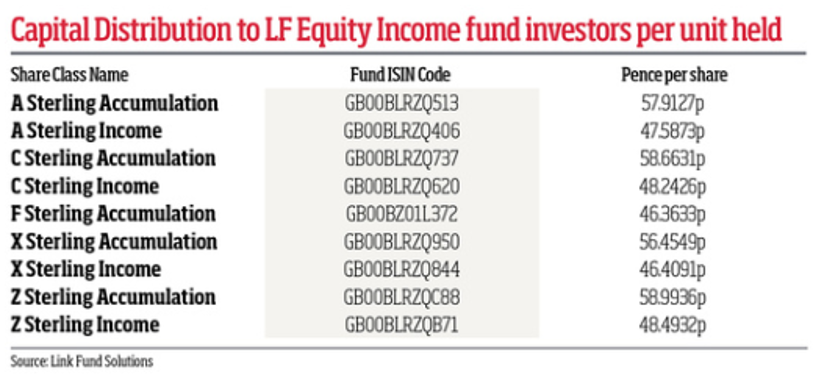
It has today been announced that investors in the LF Equity Income fund (Woodford has been removed from the title), will receive between 0.46p and 0.59p per unit they hold in the fund for the first capital distribution according to Link Fund Solutions (the Fund administrators). Please see the full share class distribution list below:

The payment equates to approximately 70% of the fund’s total value, representing the liquid part of the portfolio that BlackRock Advisers Limited has offloaded already.

Investors will receive confirmation of the total amount they are due by 28/01/2020. The payment will be made “on or around 30 January”, with investors who hold the fund through a platform set to receive theirs “a few days after 30 January due to the time it may take for your platform to process your payment”.

Our Thoughts

This is a good first step for investors in getting some of their capital back. As stated in my original Blog back on the 16th October 2019, the major factor is how will the sale of assets under the less liquid portion of the portfolio be handled. It is important that these assets are not just sold at a lower value to raise capital, as this would impact on the amount of capital investors get back. PJT Partners (UK) Ltd need to take their time in negotiations in order to attempt to get the true worth of the underlying assets held within the portfolio, which they have indicated they will be trying to do.

We will continue to monitor the position and will issue another blog when an announcement is made. As noted previously, our clients are well diversified and are likely to have only a nominal holding in this fund if anything. Diversification helps control the risk.

In the meantime, should you have any queries on this matter, or would like to undertake a financial review of your holdings to better understand how you are invested, please feel free to give us a call on 0151 546 1969.

Carl Mitchell 28/01/2020

Team No Comments

Graham Bower

“I was first introduced to Steve Speed several years ago soon after having received notice of my redundancy after working for the same Bank for over 35 years. Whilst I considered myself to be good with money I had very little idea of my pension options and how they worked.

Coming from a working environment that dealt with financial risk, I have to admit that initially, I was extremely cautious with my dealings with Steve and undertook a lot of due diligence in checking him and his company out.

However, he came highly recommended by other colleagues who had used him and I also utilised a large pension company to undertake a comparison of advice given.

The stand-out difference with Steve from the outset was that he has such a professional way but also takes time to get to know you on a personal level. On the strength of his advice I made what I consider to be the biggest financial decision of my life which will also ensure security for my wife and family in time to come.

From a professional point of view Steve is one of the most motivated, well organised and ‘happy to help’ people I have known in my 40 years of working. In addition, he also displays a willingness to ensure that the wealth of his knowledge and experience in pensions and investments are shared with you. Whilst I would not consider myself an expert on these subjects; I do know enough now to make informed choices about my future financial planning.


Steve – I cannot thank you and your team enough for your help, advice and support over the last 3 years!”


Graham Bower                                                                                                                             3rd January 2020

Team No Comments

Goodbye 2019 Hello 2020!

If we look back on the last year, we have had an eventful time.  If we expand that time horizon to the last c 4 years who would have believed the following would happen:

  • We vote to leave the EU as a nation
  • Donald Trump becomes the US President
  • Boris Johnson is the Prime Minister of the UK
  • John Bercow as Speaker frustrates democracy with the aid of c 75% of MPs
  • Labour voters turn against Jeremy Corbyn and his policy (lack of policy?) on Brexit

We have had our fair share of political drama in the UK recently, but I think it’s important that we look more globally too.  The biggest issue impacting on markets is the progress (or lack of it) that the US and China are making on their trade deal.

As the US and China move into Phase Two of their trade negotiations they will get immersed in the detail on export and import controls, investment restrictions, and sanctions rather than with tariffs.  The key case to watch will be how the US deal with the global technology business Huawei.  Huawei are a major issue for the US on 5G telecoms technology.  5G will open the door to a wide range of new technologies – a ‘game changer’.

Other technologies such as Quantum Computing and AI/Machine Learning could have a big impact on our lives too.  The investment opportunities are numerous.

There are also plenty of risks. The effects of climate change will continue to be felt globally, and populist politics show no sign of receding. Currently it looks like the barriers to international trade being erected in the US and the UK will be long-term features and may even be added to by other countries. In the 2010s we saw an acceleration of globalisation, the 2020s could well see a reversal. The potential effects of that are unclear.

The slow breaking up of the global trade order would not be good news for China, but it would not stop its rise. It has now reached a size and maturity which allows it – like the US – to rely more and more on domestic demand. Regardless of the global trade picture, we would expect Chinese economic rate of growth to slow from its recent pace over the long term – if only for demographic reasons. The country’s place in the global economic order is entrenched. We expect this to lead to increased confrontation between the US and China, particularly if populism prevails in the former.

The 2020s bring promises and risks, like any new decade. Themes that have been ongoing for decades (globalisation, financialisation, environmental degradation, etc.) could well be set in reverse. Be wary of predictions too, the last few years has shown us all that it’s difficult to predict what will happen next.

In this volatile market the FTSE 100 is not in a bad place and other indices are in a good position too.  With the global political backdrop, the markets look reasonable right now.  But hold onto your hats – it could be a bumpy ride!

If we do experience high volatility, please remember the following:

  • Remain invested in real growth assets
  • Diversification helps, be well diversified
  • Ignore short term volatility if you can
  • Investing is for the long term

Wishing you all a happy, healthy and prosperous New Year!


Steve Speed

30/12/2019


Includes some content from FP & Tatton.

Team No Comments

Post General Election Update 13/12/2019

Whilst exit polls bring about a certain degree of clarity, the moment Blyth Valley went blue just after 11:30pm it was obvious this wasn’t going to be any normal election night. As we sit and digest the full implications of the election result, it is impossible not to conclude that this result is extraordinary no matter your political leanings.

Right now, in the aftermath it is important for us to cut through the rhetoric and political posturing to get to the heart of what matters to investment markets.

A strong majority for the government brings with it clarity, something that markets have been longing for. Investors, both at home and abroad, have largely sat on their hands waiting for the day that the country could move forward with some degree of certainty, which had stymied investment and had put the UK at a significant discount to the majority of its developed market peers.

Initial market euphoria on the morning of the result has been refreshing. Sterling has strengthened substantially and the FTSE 100, that all too often finds itself moving in the opposite direction to the currency due to the prevalence of overseas earners it counts as its constituents, rallied over 1% (nearer 2%). Whereas the FTSE 250, a much more domestically focused index, found itself up over 5% in early trading. The removal of the risk of market unfriendly policies also brings good news for specific sectors, with utilities, property and banks all rallying strongly.

It may be difficult for investors not to get dragged along for the ride, assuming that this election result means that everything is now rosy in the UK. We must, however, remember that this is not the end of the Brexit process, it simply means that the starting pistol has been well and truly fired.


Summary

Volatility is likely to continue as Brexit is negotiated.  We also need to remember that the UK is only a small proportion of global GDP production and economic activity.  In reality, the US/China trade deal is far bigger and the impact on global markets much more significant from this trade deal.

The top geo political risks include major cyber-attacks, rising authoritarianism and trade wars.

However, lets enjoy today as this was the right outcome for markets and the City of London.


Steve Speed

Team No Comments

Investment Update 06/12/2019

I had the benefit of good investment input in a live seminar with Invesco on Tuesday, called ‘Investment Intelligence’ and a couple of webinars from Prudential as they outline their current views for asset class returns in their ‘smoothed’ funds range and celebrate 15 years of investment in PruFund Growth.

Both Fund Managers are substantial in terms of their technical input and capability.  We will take note of their input and views on the markets and consider this alongside other views, JP Morgan for example.

J P Morgan on 05/11/2019 thought that we were finely balanced, and a recession could start in the US and then spread around the world.  It was a 50/50 call.

Thankfully things look like they may have moved on slightly and Invesco have said that the markets have priced in all the good news, we just need to deliver against the good news priced into markets.  Invesco’s view on Monday was the recession risk is decreasing and that we have a 65% chance of not having a recession.

Invesco also stated that an economic downturn is unlikely next year although economic and political uncertainties remain elevated.  However, equities are still more attractive than other investment assets.

Key issues for Invesco are as follows:

Issue Low Risk Medium Risk High Risk
Trade X
Brexit X
Bond Bubble X  
Policy Effectiveness X  
Political Risk X  


The top Geo-Political risks according to Invesco are:

  1. Major cyber attack
  2. Rising authoritarianism
  3. Trade wars

Prudential have a slightly different fund management style as they manage their multi asset fund with ‘smoothing’ but they also stated that a lot of the good news is priced in to markets.  Prudential also re-stated that they expect lower returns for longer.  This has been a theme for quite a while now and not surprising given how low yields have been on fixed interest and cash deposits over the last decade.


Summary

As long-term investors we need to remember the following:

  • Remain invested, it’s about time in the markets not timing the markets
  • Be well diversified
  • Think long term
  • Try to ignore short term volatility, it’s just a function of markets

There is a lot going on in the world and we get bombarded with negative news flow about Brexit and UK politics but don’t be too concerned.  Whatever has happened over the last c 30 years, (man and boy as an adviser – I’m only 21!), the markets have always recovered.

The investment world is far more global today too.  Our key concern now when you invest globally (as most of us do) is for the US and China to do a trade deal.  This would be good for all of us.

Happy Christmas and have a happy, healthy and prosperous New Year from all of us at People and Business IFA!


Steve Speed

Team No Comments

Fund Suspension for M & G Property Portfolio & M & G Feeder of Property Portfolio

M & G temporarily suspended the property funds listed above from trading from midday yesterday, 04/12/2019.  This means that you can’t invest any new money or withdraw any current investments from these funds.

Brexit related uncertainty and ongoing structural shifts in the UK retail sector have prompted unusually high outflows from retail investors for M & G.

M & G have temporarily suspended dealing in the interests of protecting their customers (our clients too).

Commercial property and property funds should be bought and held for the long term.  Property is a long-term investment asset and it is not as liquid as other assets, for example shares.

Suspending the funds now will give the fund managers time to restore the cash levels by selling assets in an orderly manner and preserve value for investors.

Whilst suspended M & G are waiving 30% of its annual charge on the two funds.  Hopefully this will help any frustrated customers of the fund.  The funds will still be maintained and managed actively by M & G during the suspension.


Perspective

The majority of our clients are in tactically and actively managed portfolios or multi asset funds.  This suspension should not impact on these clients.

If you are invested directly in one of the two property funds named above, don’t be concerned.

You should note the following:

  1. Only a small proportion of your total investment will be in commercial property
  2. Over the medium to long term commercial property is a great asset to invest in
  3. Commercial property has a place in a diversified portfolio, it helps reduce risk overall


Summary

Maintain the status quo, think long term.  Investing is about long term returns.  When the suspension is lifted your portfolio can be reviewed.  Over the long-term commercial property is a great asset.


Steve Speed 05/12/2019

Team No Comments

Sustainable Withdrawals in Retirement – Blog

Investors expect to take ‘10.30%’ a year from retirement savings

According to a new recent global study, namely the ‘Schroders Global Investor Study 2019’, investors believe the will be able to withdraw, on average, 10.30% a year from their retirement savings without running out of funds (based on 25,000.00 in 32 locations around the world).

Typical Industry Opinion

It was argued in the early 1990’s that 4% should be considered a safe withdrawal rate for drawing an income from retirement assets, this came to be known as the ‘4% rule’. However, the 4% rule did not account for the effect of ongoing charges within the relevant pension product. There has since been numerous debates suggesting that the safe withdrawal rate is actually somewhere in the region of between 2 – 4% a year.

According to an article published by The Guardian on 28/09/2019, it states that the average pension pot at retirement is valued at £61,897.00. If we apply the safe withdrawal rate of between 2 – 4% a year, this means that the average income generated from a pension from a sustainable point of view would between £1,237.94 and £2,475.88. You have to ask yourself, could you realistically live on this level of income in retirement?

If you were to apply the investors expected withdrawal rate of 10.30% a year, this would give you an income of £6,375.39 a year. This obviously looks a little bit more appealing than the industry standard, however, this level of income based on the average pension pot size at retirement is simply not sustainable over the long-term.

What does this all mean?

My observations from these publications indicates there is a real disconnect between investors and understanding the limitations of their pension savings. I would encourage you to review your total asset position and compare this to your desired lifestyle in retirement.

We are happy to help you plan for retirement and help you understand how achievable your goals are and what actions may need to be taken in order to help you meet these goals with confidence.

Everybody is different and your requirements unique. If you are reading this at a young age, the message I would take from it is you need to start paying a lot more into your pensions.


Carl Mitchell

21/11/2019

Team No Comments

Retirement Living Standards

The Pension and Lifetime Savings Association

Retirement Living Standards

I’ve just been reading an industry article in today’s ‘New Model Adviser’.  This is a magazine for advisers by Citywire.  The article was headlined ‘UK adults in dark about retirement reality’.

As we work for most of our clients in both pensions and planning for retirement generally, I found the article interesting and thought I’d share some of the key data with you.  The Pensions and Lifetime Savings Association (PLSA) looked at retirement income needs.

The PLSA’s retirement income recommendations are as follows:


Lifestyle needs Annual income amount
Minimal for an individual £10,000.00
Moderate for an individual £20,000.00
Comfortable for an individual £30,000.00
Minimal for a couple £15,000.00
Comfortable for a couple £45,000.00


The article didn’t state if these are net or gross figures but looking at the figures, I would assume they are net.  Please note that these are figures for today and they would need inflation linking to any future retirement dates.

In terms of what people want from their retirement years these are the findings from another PLSA survey:

Retirement objectives Percentage of respondents
Not to have to worry about money 38%
To maintain my standard of living 34%
To be debt free 30%
To have a regular income 29%
To be mortgage free 17%


Respondents were allowed to select more than one answer.

Comment

Whilst the above is useful background information for ‘averages’ and ‘normal’ views in the UK based on this sample surveyed, I don’t think they are a useful guide for most of us.


Surely what you want depends on how you have lived, worked and earned throughout your working life?  If you have a great standard of living you wouldn’t want a minimal or even a moderate retirement lifestyle.

As this is the case you should look at your lifestyle now and decide what you would like in retirement.  The longer you have to plan and position yourself (or yourselves) tax efficiently for retirement the better.

It may just take a bit more planning now or you might need to look at your priorities and direct some more of your earned income/s into assets for your retirement.  Once you stop earning income most of us will live on our accrued assets (pension funds, cash, Stocks & Shares ISAs & other investments) for the rest of our lives.  You don’t want a shortfall!


Steve Speed

05/11/2019

PLSA data from New Model Adviser 04/11/2019


Team No Comments

Behavioural Bias- How Are You Affecting Your Investments?

As investors, we’re all human. All individuals with our own characteristics, attitudes, beliefs and behavioural patterns. These different aspects affect our actions in day to day life in many ways to varying degrees. So why would we disregard ourselves as individuals when it comes to our behaviour in the investment market? The short answer is, we shouldn’t.

This belief has been reiterated lately in a report from Schroeders titled ‘The Bias of UK Investors That Could Lead to Lower Returns’. Over 23,000 investors have taken the Schroeders investIQ test with the aim of understanding these behavioural biases and how they affect investment actions and returns.

It was found that UK investors were most likely to suffer from what is known as ‘Ambiguity Aversion’. However, just because this is the most frequently occurring of the behavioural biases in the UK, doesn’t mean that we as investors should focus solely on controlling one behavioural bias. Each investor is human, and as humans we each have a unique combination of behavioural biases which make us individuals.

In a time when people are free to express themselves as individuals more than ever, psychology and a tailored appreciation of a person’s personality have become second nature. It is appropriate that this attitude is transferred into the world of investment. Below are the biases as listed by Schroeder:

Herd Bias: As humans we can be influenced by the thoughts and behaviours of those around us (The Herd). We tend to assume that the herd collectively knows something we don’t. As a result, we irrationally follow others, ignoring the information we have and what’s right for us as individuals.

Over Confidence: Overconfidence is the tendency to believe in yourself without considering factors beyond your control. This may lead you to overestimate your ability to make rational investment decisions. As a result, you might think investment markets cannot surprise you, you might take on more risk than necessary, and move investments around too frequently.

Ambiguity Aversion: Investors with ambiguity aversion tend to choose investments that will provide them with more of a known possible outcome over ones that are more uncertain. This could lead to investors taking less risk, which might lead to lower potential returns. However, taking on more risk is subject to greater losses.

Loss Aversion: Investors with loss aversion bias tend to feel losses more sharply than the equivalent gains. This can impact our ability to make rational decisions and we end up trying to avoid losses at all costs rather than logically considering the alternatives.

Projection: This is the tendency to believe that your current views, feelings and needs will stay the same over time although statistically this is highly unlikely.


Over Optimism: This is the tendency to overestimate the likelihood of success without focussing on any potential pitfalls. In investment terms, you may be too focussed on the positive potential outcomes and not realistically consider the possibility of incurring losses. As a result, you may take on more risk than you can sustain.

Anxiety: This is when you tend to be easily influenced by the short-term ups and downs of the market and feel compelled to take action. This may lead to irrational investment decisions that undermine your long-term financial objectives.

Regret Aversion: This is the fear that your decision will turn out to be wrong in hindsight. Your anticipation of feeling regret rules the choices you make and even when you’ve made a choice, you can still feel uncomfortable and you continue to dwell on your decision. The worry of not getting it right can also lead you to avoid taking any action altogether. In you desire to avoid regret, you may be tempted to follow the crowd, even if what others are doing isn’t appropriate to your circumstances. You believe that if things go wrong, you will have less regret if others have done the same.

Impulsivity: This is the tendency to focus on the here and now rather than the future and favour immediate rewards rather than future ones. For example, given the choice between receiving £100 today, or £120 in two weeks’ time, you would choose to have the money today. As a result, you can overvalue immediate rewards to the detriment of your long-term goals. In financial terms, this means you could find it difficult to change your short-term spending habits, in order to save sufficiently for the future.

Awareness of Behavioural Bias can now more than ever help us understand our clients as people. We can better manage and coach our clients to balance and control each of these behaviours and not allow them to affect investment performance. The overall goal is that investors feel fully satisfied that they have acted without unnecessary psychological hinderance and have maximised investment performance based on logical financial objectives.