Team No Comments

J.P. Morgan – Market Update

J.P. Morgan – Market Update

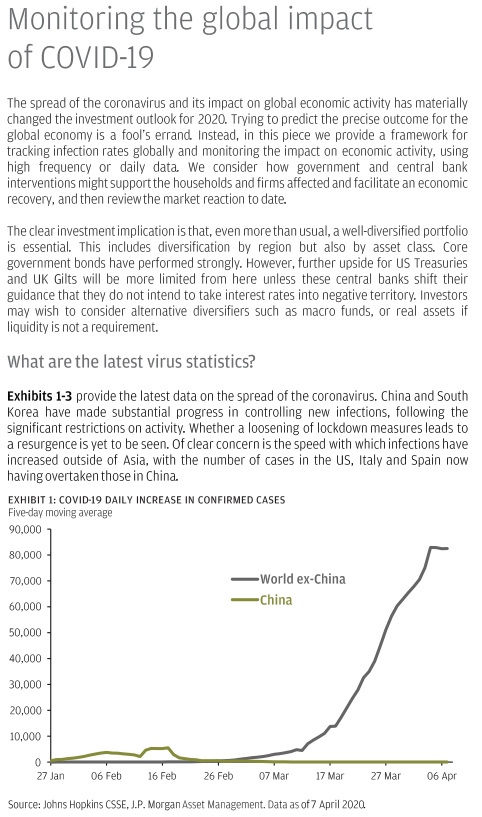
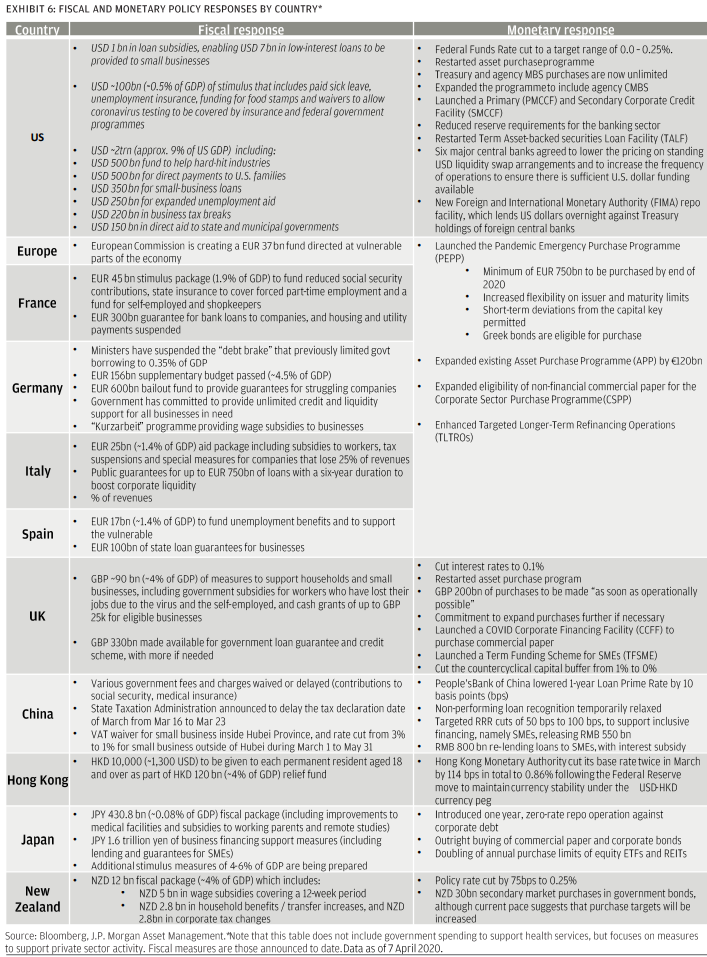
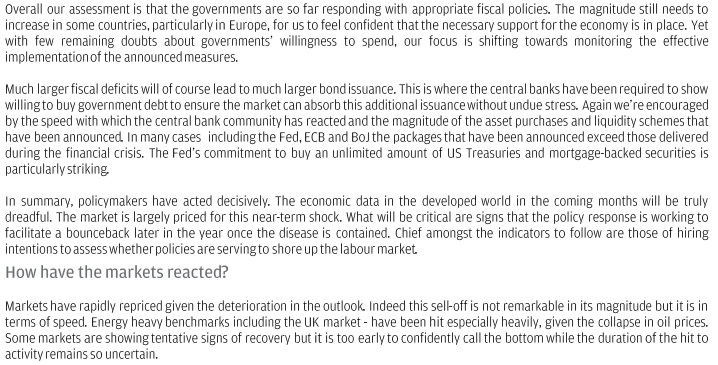
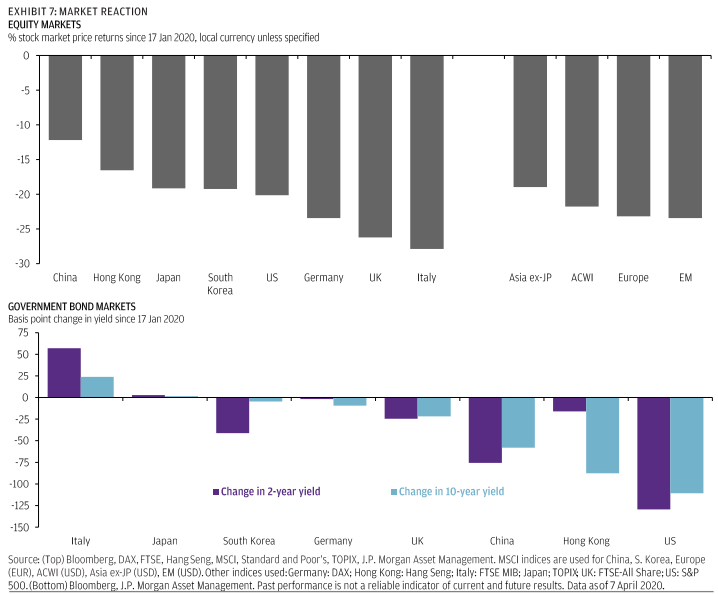
Please see below yesterday’s (08/04/2020) market commentary update from J.P. Morgan Asset Management who have great technical and market resources available to them:

We will continue to deliver market commentary from leading fund managers from around the country.

In the meantime, please keep safe and healthy.


Carl Mitchell – DipPFS

IFA and Paraplanner

9th April 2020

Team No Comments

The Value of Long-Term Investing


Comment from Brewin Dolphin yesterday (06/04/2020) on long term investing:

The value of long-term investing

Investing for the long term gives your money the greatest chance of growing in value. But this means holding your nerve during periods of significant stock market volatility – and remembering that, as history shows, markets will recover.
Here are four reasons why investing over the long term is the wisest strategy.

1. Staying invested

As the old investment adage goes, it’s time in the market – not timing the market – which is key to returns. By delaying, or cashing in your investments, you risk missing out on the best days in the market.

The global economy has endured plenty of adversity over the decades, and yet the stock market has continued to climb, given time.

Brewin Dolphin have the time and expertise to help you make the most of your investments.

2. Compounding – time is everything

Compounding is extremely powerful when it comes to investing. Albert Einstein apparently described it as the eighth wonder of the world. It is, simply, earning returns on your returns.
For example, somebody earning a 5% return in year one would see their investments grow by a compounded return of 63% after 10 years. After 20 years, this rises to 165%, and over 25 years it balloons to 239%. This demonstrates the cumulative effects that compounding has on capital. £

3. Investing typically beats cash

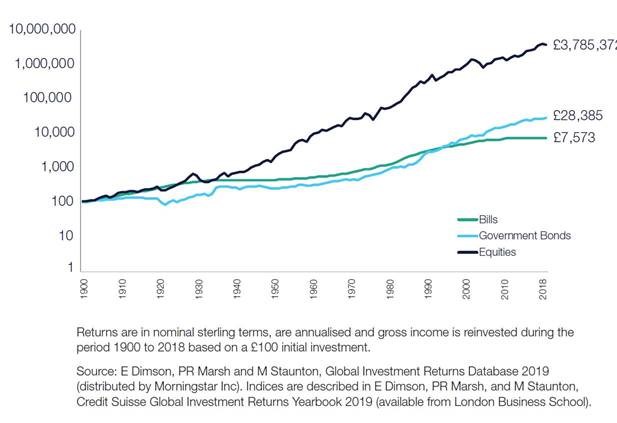
Savings accounts typically struggle to keep pace with inflation, seeing savers lose value in ‘real’ terms. In the graph below, bills are short dated bonds which give an indication of what returns on cash might have been.

If you are prepared to accept the risk that comes with investing, and have time on your side, you give your wealth the greatest chance of growing and beating inflation over the long term.

4. You benefit from diversification

Our portfolios are well diversified. This means that your investments (and risk) is spread across different assets, across the globe – including equities, bonds and cash.

The value of investments and any income from them can fall and you may get back less than you invested.
Past performance is not a guide to future performance.
No investment is suitable in all cases and if you have any doubts as to an investment’s suitability then you should contact us.
The information above is believed to be reliable and accurate, but without further investigation cannot be warranted as to accuracy or completeness.

As long term investors we shouldn’t focus on or worry too much about short term volatility. Time in the markets works, trying to time the markets is virtually impossible.

We need to think as long term investors, not traders.

Steve Speed

07/04/2020

Team No Comments

Royal London Asset Management Economic Viewpoint

Investment input hot off the press from Royal London Asset Management this afternoon (06/04/2020):

RLAM Economic Viewpoint

Although there has been some encouraging news from countries where the growth in new cases has been slowing, it is clear from incoming case numbers that we are still some way off being able to contemplate easing social distancing measures in Europe, let alone the US. In the meantime, therefore, levels of economic activity remain well below pre-crisis norms.

Data has underscored the challenge facing policymakers. Over the week, the latest US weekly initial jobless claims number showed another a record jump of more than 6 million. Benefit claims have risen sharply in the UK too and incoming March survey data reflects a large hit to business activity and confidence in Europe and the US.

Economic activity data in China has improved as social distancing measures have eased and March business surveys show significant improvement. However, business surveys generally ask firms whether activity has increased or decreased, not by much. That is important in the current context where the level of economic activity is likely still significantly below pre-crisis levels. Export-related components of the surveys still signal contraction, consistent with weak global demand now holding back China’s recovery.

Meanwhile reminders that things aren’t normal, and that social easing can’t be unwound in one easy move while there is reinfection risk, came in the shape of some reversals of social easing (e.g. cinemas shutting again and lockdown being re-imposed in Jia county). In the US unemployment numbers this week highlight the scale of the challenge policymakers face in trying to limit the long-term economic damage from this crisis.

The good news is that policymakers globally continue to step up and introduce measures that improve the likelihood of economic activity being able to pick up robustly once social distancing measures ease. Again, we’ve seen measures designed to keep the financial system working (e.g. Fed’s announcement this week of a repo facility for overseas central banks), limit damage to household finances (e.g. the direct wage subsidy scheme announced by Australia at the start of the week) and keep viable businesses afloat. Other highlights included a 50bps rate cut in Canada late last Friday and a policy easing message from Chinese authorities.

Royal London are one of the key Workplace Pension providers in the UK offering innovative strong default investment options with ongoing governance.

Steve Speed

06/04/2020

Team No Comments

Entrepreneurs Relief – The Turning of The Tide

Entrepreneurs Relief – The Turning of The Tide

Over the years, when speaking to some clients and asking them about their existing pension provision, some have responded ‘my business is my pension’. This was always a fairly speculative position to take because there is no guarantee of being able to sell the business for what you believe it to be worth, or there being a demand to buy the business at the time you would like to retire.

Entrepreneurs Relief was certainly a benefit for this approach as the rules allowed business owners of two years or more to pay less Capital Gains Tax (10% rather than 20%), when they sell their business, up to a lifetime limit of £10million. However, in the Chancellor’s budget on 11th March 2020, he announced that he would be reducing the lifetime limit to £1million immediately with limited transitional arrangements.

How Does Entrepreneurs Relief Work?

To summarise, Entrepreneurs Relief results in a tax rate of 10% on the value of the sale of the business. There’s no limit to how many times you can claim, however, from 6th April 2020, you can only claim up to £1 million of relief during your lifetime.

You have to meet other criteria too for Entrepreneurs Relief to apply.

What does this mean?

Prior to the reduction, business owners could have had a primary focus, which was to grow the value of their business as much as possible prior to selling the business for as much as possible, possibly to retire?

Summary

The change in rules effectively means, business owners may now need to reconsider their options and start to take advantage of planning opportunities available to them in order to maximise the value they get out of their business now, prior to the eventual sale. Your options could include the following:

  • Maintain a ‘lifestyle’ business for the long-term;
  • Maximising pension funding;
  • Investing surplus capital; or
  • Paying a higher level of salary or dividends
    • Invest proceeds in a tax efficient manner
  • Using a core business to build a network of ‘family’ satellite businesses

If you are a business owner and you would like to know more about the changes in Entrepreneurs Relief and how this will impact you and your plans, please do not hesitate to contact us.

In the meantime, keep healthy and safe.

Carl Mitchell – DipPFS

IFA and Paraplanner

02/04/2020

Team No Comments

In The Midst of Every Crisis Lies Opportunity

In the midst of every crisis lies opportunity

I’ve cut and pasted this input from an email received from the Jupiter European Growth fund management team yesterday (31/03/2020):

The pandemic has obliged many people to make significant changes to their daily habits. We can even expect an acceleration in some secular growth trends as a consequence of the crisis. We highlight three areas which could benefit over the longer term.

Clinical diagnostics: Expect an acceleration in some secular growth trends as a consequence of the crisis. In the diagnostic testing space, lab equipment companies such as Diasorin, Tecan and bioMerieux are all seeing a short-term increase in demand for their instruments. However, in our view, the real benefit is likely to come in the future as a consequence of their much larger installed base of customers and the greater revenues from the consumable reagents they will be selling to labs, once we get beyond the crisis. Our growth thesis on these companies has hinged on the cost-benefit to national health systems of being able to have faster, more encompassing diagnostic testing services. The coronavirus crisis clearly highlights the need for more investment into this area.

The industrialisation of the food supply chain: Governments will deem it critical to maintain food and farming industries during the worldwide battle against the Covid-19 pandemic. Before the coronavirus, China had already seen African Swine Fever (ASF) wipe out 50% of the country’s pig herd. Here, Genus, the global leader in providing porcine and bovine genetics could be a long-term beneficiary; it receives royalties for each commercial pig weaned. That’s not to say the company hasn’t had short-term problems. In February, owing to transport restrictions within the supply chain, it did not sell a single pig in China. Nevertheless, we have actually become more positive about the outlook for the business. Following the ASF and coronavirus crises we are likely to see a rapid and more professional rebuilding of the highly-fragmented domestic pork supply through the creation of large-scale integrated pork producers. This is a key priority for the Chinese government and should drive significant demand for the company’s products as they will improve productivity in food production.

The Digital World: Following the crisis, we will all migrate back to the physical world. But the current lockdowns are likely to introduce vast swathes of populations to the opportunities in the digital world, such as accelerating the adopting of online shopping, home delivery and other digital produce such as gaming. One of the attractions of Ubisoft Entertainment, a French gaming company, is the growth and superior economics of its digital offering (very low distribution costs, broadband getting even faster) over the sale of physical discs, which are more expensive to produce and distribute. We expect the rate of digitalisation to see a material step up and bring forwards the benefits we had previously anticipated for the business over the next few years.

As the Jupiter European Growth fund management team have outlined above even in the face of this adversity opportunity arises. The fast thinking entrepreneurs of the world will lead, and we could see a new generation of businesses and business leaders coming to the fore.

Steve Speed

01/04/2020

Team No Comments

Weekly update from Brewin Dolphin

Weekly update from Brewin Dolphin

Further comment and update below from Brewin Dolphin below as this pandemic continues and the world adjusts to the coronavirus:

As we enter week two of lockdown in the UK (is that all its’s been?!) the UK government has given the clearest indication yet that measures could be extended beyond the current three-week period. Deputy Chief Medical Officer, Dr Catherine Calderwood, has suggested restrictions on movement may be necessary for at least 13 weeks whilst the UK deputy chief, Dr Jenny Harries, has warned resumption of normal life may be six months away, stressing the importance of phasing out restrictions over time to avoid a second peak down the line. For the NHS, meanwhile, the return of 20,000 staff to the workforce should prove a welcome boost as they come under pressure with up to a quarter of staff off work in some wards as doctors and nurses affected by the virus, either directly or indirectly, self-isolate.

In the US, Donald Trump conceded the US would not be open for business as usual by Easter after all, extending the current social distancing measures until the end of April amidst warnings from a leading infectious disease expert that 200,000 Americans could die. The US now has the most cases of any nation and the President’s handling of this crisis could well become a key determinant in his bid for re-election in November.

Meanwhile, as China looks to re-emerge from lockdown, their central bank unexpectedly cut the rate by 20 basis points, the largest in nearly five years, in a bid to relieve pressure on their economy as they pick up the pieces post-pandemic.

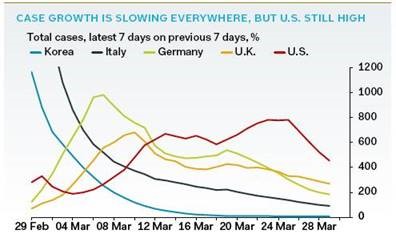
Finishing on a hopeful note, the chart below put together by Pantheon shows that case growth is slowing in some of the most impacted countries, perhaps an indication that the social distancing and lockdown measures in place are beginning to bear fruit though some are further down the curve than others.
Dollar Outlook

The dollar is the world’s major funding currency. Earlier this month, as the coronavirus crisis intensified, companies began to get worried about a sharp drop in revenues and a seizing up in funding markets – both of which would impact their access to dollars.  As a result, companies started to max out their dollar credit lines, which pushed the dollar sharply higher earlier this month. Last week, we saw the dollar pull back.  There are a couple things causing this: –

First, the Fed stepped in by offering swap lines to the world’s central banks, which has eased dollar funding concerns.

Second, risk assets bounced in the middle of last week.  As the chart shows, the dollar has been moving inversely with stock prices, as it did during the Global Financial Crisis, as the chart on the right shows.

It’s too soon to say the dollar rally is over, but on a 12m view, even after the sharp decline of the last few days, the dollar probably has more downside, for three main reasons: –

  1. Although the economic pain will be severe and this crisis will leave scars, the current consensus suggests the global economy is most likely going to snap back strongly in Q3, possibly Q4, this year.  This backdrop, combined with ultra-accommodative monetary policy and currently depressed risk appetite suggests investors spend most of the next 12m in risk on mode, which benefits higher risk currencies.
  2. The second reason to expect downside in the dollar is interest rate differentials.  The 2-year rate spread in the UK, Eurozone, Japan and China have all moved sharply against the dollar.  This didn’t matter when markets were tanking, but it should matter more once the volatility stabilizes and the pound, euro, yen and RMB all appear to have upside versus the dollar based on the historical correlation with interest rate spreads, which are unlikely to move much over the next 12 months.
  3. Commodity prices are depressed now, but should move higher over the next 12 months as the economy starts to pick up.  It’s true that the US has higher commodity exposure now given the rise in shale, and UK, Euro area, China and Japan have very little commodity exposure. But the rise in commodity prices should give much more of a boost to the Russia’s, South Africa’s, Brazils, Norway’s, Canada’s and Australia’s of the world.

In addition to these 3 drivers, the dollar is also expensive, market sentiment on the dollar is bullish, which has negative implications from a contrarian perspective, and its already massive current account and budget deficits are set to balloon even further.

Markets in a Minute

– The oil price plunged further over the weekend to its lowest level since 2002 with West Texas Intermediate falling as low as $19.92 a barrel due to vanishing demand and a continuation of the Russia-Saudi price war, heaping pressure on high cost producers such as US shale.

– Businesses are rising to the challenge of creating the tens of thousands of ventilators required to help those most at risk patients with Airbus, BAE, Ford, Rolls Royce and Siemens forming the “VentilatorChallengeUK” Consortium to help meet the demand.

– easyJet has grounded their entire fleet and given no indication when they can restart commercial flights.  Virgin Atlantic, meanwhile, look set to request a government bailout with other carriers likely to join the queue. Grounded crew meanwhile have been asked to help staff field hospitals.

Thanks to Brewin Dolphin for the input above emailed to me yesterday afternoon (30/03/2020). If this needs a little interpretation for you or you would just like to catch up, please phone me on 0151 546 1969.

Lines could be busy, but we are fully operational to date with all other staff working remotely as I ‘isolate’ in the office.

Steve Speed

31/03/2020

Team No Comments

Thoughts from Global Expert Investors

Thoughts from Global Expert Investors

As I’m sure everyone is aware, volatility in investments markets is currently at an extreme high and we have been helping our clients understand the implications that this level of volatility is having on their portfolios.

This blog is aimed to help investors understand how some of the most successful investors from around the world operate in trying market conditions and take the opportunity to invest as assets are lowly priced. It also aims to try and help reassure investors why now is not a time to panic, but to maintain the status quo or to take advantage of the low asset prices.

What the experts say

These quotes from some of the most successful investors illustrate how investing in stock markets can be a challenging yet rewarding venture, requiring strong research skills, a rational, dispassionate mindset, a long-term horizon and patience in equal measure.

Summary

As can be seen from the quotes above which are from some of the most successful investors from around the world, adverse market conditions should not be seen as a moment to run and hide, but as an opportunistic time to be invested and to make additional investments.

We are confident that fund managers in the market are already looking ahead and looking to purchase investments that might have looked too expensive to buy a couple of weeks ago.

To be invested in real growth assets, means you are willing to take a level of risk with your invested capital in order to have the potential to achieve greater levels of capital appreciation over the medium to long term than would otherwise be available by remaining in pure cash assets.

Time and patience are an investors friend at the moment, and it’s important that investors remain invested in order to reap the rewards of the eventual market recovery that will come, it’s just a matter of time.

If you would like to discuss the impact on your investment further, or perhaps want to invest additional capital, please do not hesitate to contact us.

Please keep safe and healthy.


Carl Mitchell – DipPFS

IFA/Paraplanner

27/03/2020

Team No Comments

Reprieve for the Self Employed – With a sting in the tail?

Reprieve for the Self Employed – With a sting in the tail?

Our Chancellor Rishi Sunak outlined a rescue package that could help the majority of self-employed people over the next few months. These are the basic details:

Self-employment Income Support Scheme

UK Chancellor Rishi Sunak announced yesterday evening help for the self-employed at the daily Government briefing. Here are the details:

What is it?

The Government’s new Coronavirus Self-employment Income Support Scheme is open to those who were trading in the last tax year and are planning to continue to do so. The scheme will be open to those with a trading profit of less than £50,000 in 2018-19, or an average trading profit of less than £50,000 for tax years 2016-17, 2017-18 and 2018-19. More than half of the taxpayer’s income needs to come from self-employment to qualify for the relief.

What help is available?

If a loss in income has been suffered due to the Coronavirus crisis, a taxable grant will be paid to the self-employed individual or partner, worth up to 80% of profits, and capped at £2,500 per month. The grant will be initially available for three months, payable in one lump-sum, and is anticipated to be paid at the beginning of June.

How do I claim the help?

The Chancellor said this will cover 95% of the UK self-employed population.

This is how it works:

  • HM Revenue and Customs (HMRC) will use existing information to identify those potentially eligible and will invite applications
  • The application form will require confirmation that eligibility requirements are met
  • Payment will be made directly into the recipient’s bank account, details of which will need to be confirmed on the application form
  • There is no need to contact HMRC now. Those potentially eligible will be contacted by HMRC directly

If a tax return for 18/19 has not yet been submitted the Chancellor has stated that there will be a four-week grace period to allow returns to be filed.

Sting in the tail?

Rishi Sunak went on to say (and I precis) that there would be a levelling of the contributions from self-employed people as they would enjoy similar benefits now to the employed during this crisis.  In fact, the self-employed are potentially better off as they are encouraged to carry on earning too in addition to claiming from the Self-employment Income Support Scheme.

What might this mean? I think the Chancellor was indicating that national insurance contribution levels could be increased.  Now there is a significant difference in what we pay:

Self-employed rates

  • Class 2 if your profits are £6,365 or more a year
  • Class 4 if your profits are £8,632 or more a year

You work out your profits by deducting your expenses from your self-employed income.

How much you pay

Class          Rate for tax year 2019 to 2020

Class 2         £3 a week

Class 4         9% on profits between £8,632 and £50,000

2% on profits over £50,000

Employee National Insurance rates (standard)

This shows how much employers deduct from employees’ pay for the 2019 to 2020 tax year.

Category letter £118 to £166 a week (£512 to £719 a month) £166.01 to £962 a week (£719.01 to £4,167 a month) Over £962 a week (£4,167 a month)
A 0% 12% 2%

Employer National Insurance rates (standard)

This shows how much employers pay towards employees’ National Insurance for the 2019 to 2020 tax year.

Category letter £118 to £166 a week (£512 to £719 a month) £166.01 to £962 a week (£719.01 to £4,167 a month) Over £962 a week (£4,167 a month)
A 0% 13.8% 13.8%

Different categories of employees pay different rates of national insurance, but the above employee and employer rates would be applicable to the majority.

You can see that if you combine the rates below £50,000.00 per annum earnings that employed people generate 25.8% contribution for the State in comparison to 9% for the self-employed.


 Summary

If you are currently trading as self-employed once we (the country) have recovered from COVID 19 you might need to consider how you trade.  Your options could be:

  • Increase your charges to cover the extra cost of national insurance
  • Earn less
  • Trade as a limited company

This is only my opinion but given the debate around self-employed national insurance for the last few years I think changes to self employed national insurance contribution rates are a likely outcome.


Steve Speed

27/03/2020


Team No Comments

Workplace Pension Blog

Useful input from Royal London about Workplace Pension schemes.  Further clarification is expected shortly from The Pension Regulator (TPR).

It’s worth saying that this is our current understanding of the position for employers, we are expecting TPR to make an announcement about the ongoing responsibility for employers soon.

Question Answer
Can employers put their scheme on a contribution holiday?


Although TPR have not given a definitive view as to whether employers can apply a contribution holiday to their scheme, we would encourage employers if they can, to continue making contributions in the normal way.


If employers are concerned about whether they can meet their ongoing duties, we suggest they speak to TPR.


Should employers continue making pension contributions if members are off sick? Yes.  Employers will need to continue deducting contributions from the members’ salaries.  Statutory sick pay is part of the qualifying earning rules for automatic enrolment.
What should employers do if any members want to stop paying into their pension?


Members can stop/restart their contributions at any time.


Automatic enrolment rules also give employers the option of stopping their contributions.  However depending on the schemes rules for occupational pensions schemes, or contracts of employment, there may be a legal obligation for employers to continue paying them.


What should employers do if any members stop paying into their pension, but they want to continue contributions?


If the member’s contribution stops, employers will need to stop deducting contributions from their salary.


And similar to above, employers will need to check to see if there are any conditions that apply to minimum/matching contribution amounts.  And then ensure they update their schedules to reflect the new contribution

Do employers still need to make pension contributions if employees’ take unpaid leave? If the employer is not paying any salaries, then they

wouldn’t need to make any pension contributions.


If employers need to reduce salaries, do they still need to make the pension contributions? If the salary has been reduced, any pension contributions the employer makes, should be based upon the revised salary.  It’s important employers check that any reduced pension contributions are still in line with any specific arrangements they have with employees.


Can employers change the certification

basis of their scheme?


If the scheme’s contribution basis meets the statutory minimums then yes they can change the scheme’s basis.


If they decide to make the change, they’ll need to let us know as well as keep a record of this in case TPR ask for evidence and they’ll also need to let their employees.


If the employers are taking on any new employees, should they still enrol them into the scheme?


Yes.  Until TPR provide any other advice around new joiners, employers should continue to enrol any new employees into the scheme in the normal way.


If the current situation means employers can’t make their pension contributions on time what are their options?


We appreciate that current circumstances will be challenging for employers, however until TPR tell us otherwise, employers should try to make their pension contributions as soon as they can.


If employers are concerned about whether they can meet their ongoing duties, we suggest they speak to TPR.

What information is available for scheme trustees? To help trustees meet their ongoing responsibilities, TPR have issued a guidance note

Thanks to Royal London for this Q & A sheet.  Handy guidance for employers.


Steve Speed

26/03/2020

Team No Comments

Brewin Dolphin Market Comment

Brewin Dolphin with further comment written yesterday (25/03/2020) and received later in the day.  It’s good to read a variety of views so that you can get a better understanding of the current situation.

The UK has now entered full lockdown mode, joining our European neighbours and a growing host of other nationalities, including 1.3bn Indians, confined to their homes in order to stem the merciless march of COVID-19. It is hoped that by introducing these strict rules now, the UK may be spared some of the tragic scenes which have befallen the likes of Spain and Italy where health services are creaking under the strain and the death tolls continue to rise.

In the US, markets have been buoyed by the Fed’s latest announcement whereby they have committed to “unlimited” bond-buying and have expanded their mandate to corporate and municipal bonds that analysts estimate will deliver $4 trillion-plus in loans to non-financial firms. Basically, this is a commitment that the Fed are willing to do whatever it takes to sustain the US economy and support business through the turmoil. Following a weekend of fractious negotiations in Congress, Treasury Secretary, Steven Mnuchin, has finally confirmed that that a deal to unleash a $2 trillion U.S. stimulus has been struck, adding further ballast to weather the storm.

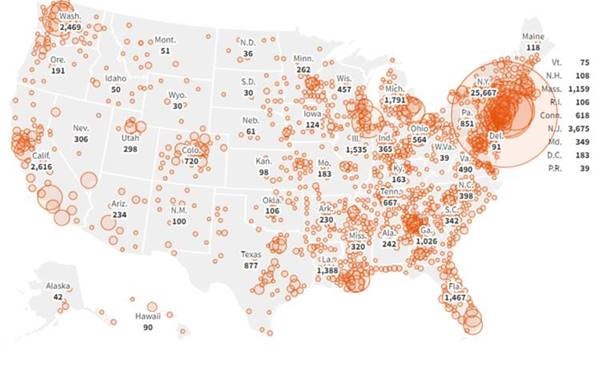
Despite intimations by Trump that US citizens could be back out working by Easter, New York Governor, Andrew Cuomo, has warned that the spread in New York will soon overwhelm health services without significant Federal aid as cases top 25,000 in the state alone. The map by Thomson Reuters below illustrates how the virus has infiltrated all areas of the US but it is most concentrated on the east coast.

Finding the Bottom

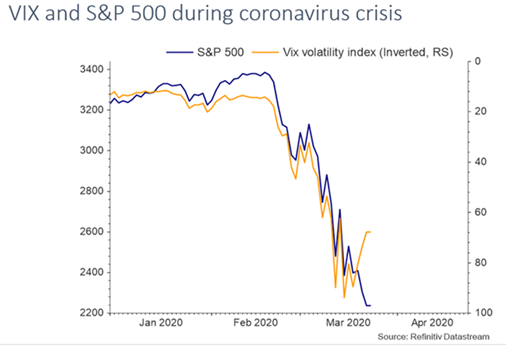
In markets, investors are grappling with the new environment, trying to establish if we have reached “the bottom”. One key metric which we pay close attention to in this regard is volatility. Historically, when the volatility index (VIX) – aka the fear index – peaks this can often suggest a suitable entry point. Below is a chart showing the performance of US equities (S&P 500) year to date and the VIX peaking on 16th March (on an inverted scale).

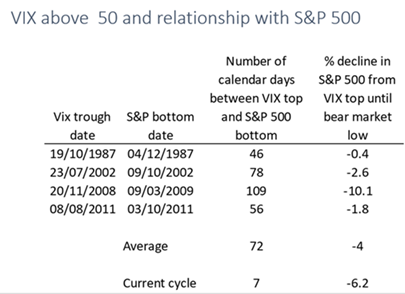
However, in previous crises there has often been a lag between the VIX peak and the US market trough. The table below shows the number of calendar days that it took before the S&P bottomed after the VIX peaked in four previous crises – the average has been 72.  The last column shows the average decline in the S&P 500 from the date the VIX peaked – the average has been 4%.

This time round, the S&P has fallen -6.2% since the VIX peak last week (before rising on more positive US stimulus news) which suggests we could be approaching the seabed as we plumb these uncharted depths, however it is still too early to tell and there could still be choppy waters ahead!

Markets in a Minute

  • ITV became the latest company to cancel their dividend and suspend guidance.
  • JD Sports announced all US , European and UK stores are now closed.
  • Mike Ashley had a PR nightmare when he claimed Sports Direct and Evans Cycles would remain open as essential businesses before u-turning following public backlash.


My advice remains the same, stay invested and ride out the volatility.  It could still be pretty rough, and we may see further drops in value before markets recover.  Remaining invested is the only way you can benefit fully from the recovery.

We will keep posting blogs to give you a wide variety of input from different Fund Managers and providers.  Hopefully the consistency of the input will help you at this time.

Steve Speed

26/03/2020