
Please see below, an article from Brooks Macdonald which highlights the key factors currently affecting global investment markets. Received today – 16/10/2026
What has happened?
After a period of pressure, tech stocks found their footing yesterday as Nvidia CEO Jensen Huang publicly defended the long-term AI investment story. The improved sentiment helped the S&P 500 rise +0.33%, leaving the index within 1% of its record high. Market gains were also broader than recent sessions, with the equal-weighted S&P 500 outperforming the cap-weighted one by around one percentage point. Semiconductor stocks remained under pressure, although the Philadelphia Semiconductor Index recovered from losses of more than -4% early in the day to finish down a more modest -0.88%. The improvement in risk appetite also supported bonds, with the 10-year Treasury yield falling -12.7bps to 5.06%. Earlier in the day, European markets were relatively resilient, having been less exposed to the recent AI-related volatility. The STOXX 600 rose +0.38% for a second consecutive session, reaching its highest level in three weeks.
A resilient US economy keeps inflation concerns alive
The latest US economic data continued to paint a picture of resilient growth and persistent inflationary pressure. September retail sales rose +0.8% m-o-m, comfortably ahead of expectations, while producer prices also surprised to the upside. Headline PPI increased +1.3% m-o-m, boosted by higher energy prices, while core PPI rose +0.7%, more than double consensus forecasts. The release followed Wednesday’s firmer-than-expected core CPI reading and reinforced concerns that inflation may prove more persistent than policymakers had hoped. Although higher energy prices played a role, strength in services prices and consumer spending suggests underlying demand remains healthy.
What does Brooks Macdonald think?
Overnight, Fed Chair Kevin Warsh struck a notably constructive tone at the IMF conference. Despite a string of stronger-than-expected inflation releases this week, Warsh declined to push back against market expectations for the upcoming Federal Reserve meeting, noting that he does not “prejudge meetings” ahead of the Fed’s blackout period. Instead, his comments focused on the strength of the US economy, highlighting a substantial investment cycle and the potential productivity benefits of artificial intelligence. Markets interpreted the absence of a more hawkish message as reassuring, with expectations for an October rate rise falling materially during his remarks. While it remains too early to draw firm conclusions, markets currently appear more willing to focus on the growth opportunity than the inflation risk.
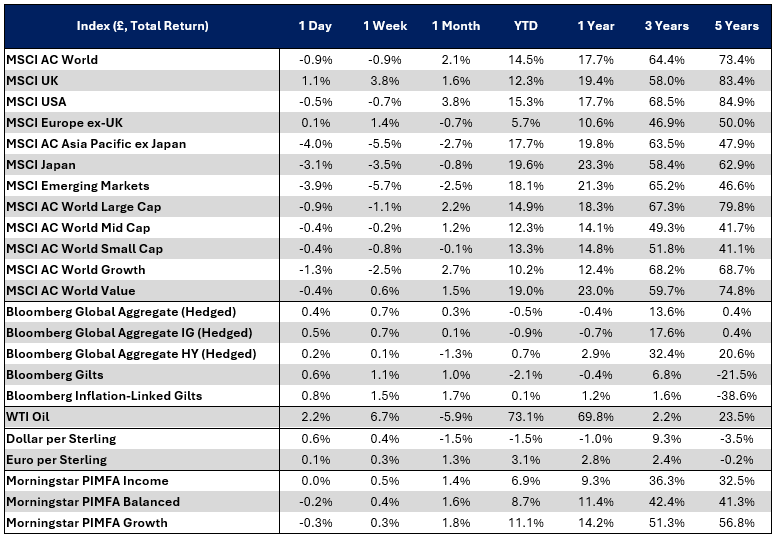
Bloomberg as at 16/10/2026.
Please continue to check our blog content for the latest advice and planning issues from leading investment management firms.
Alex Kitteringham
16th October 2026