Team No Comments

Why markets have rebounded and what could happen next

Interesting input from Russ Mould of A J Bell written on Thursday and received on Saturday lunch time (25/04/2020). I am conscious of the dates of articles as some of what we receive is out of date by the time we receive it!

Why markets have rebounded and what could happen next

Short-term viral implications for investors to ponder

At the time of writing, Italy’s MIB-30 index is up by 15% from its 12 March low, a trend from which this column, looking at it solely from the narrow perspective of investments, can draw some modicum of encouragement.

It is impossible to be dispassionate about, or comfortable with, such matters, but the Milan market benchmark’s steady recovery reflects a peak in the number of new daily cases across Italy on 21 March at 6,155 and in the number of fatalities at 919 six days later.

At the time of writing the last reading for those numbers are 3,047 and 433 respectively and it is to be hoped that the trend remains down, for humanitarian reasons above all others.

As suggested here three weeks ago, this shows that equity markets are responding to changes in the curve of the coronavirus outbreak.

A slowdown in the number of cases was always going to be seen as good news, given how investors would interpret this as a sign that things were getting less bad, and that as a result the outbreak would eventually stop getting worse and once it stopped getting worse it would eventually start getting better.

This is where markets are now. The number of new cases is growing much more slowly, even if the aggregate number of those unlucky enough to catch the dreadful virus is still growing overall. This has been enough for equity markets to start pricing in what might happen if, as and when the government-imposed lockdowns are brought to an end and economic activity resumes.

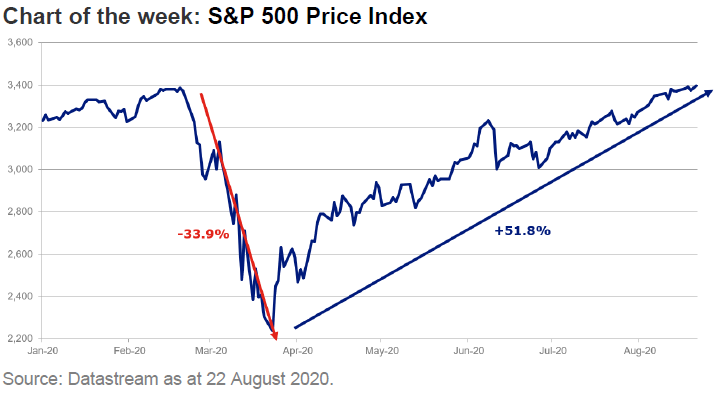
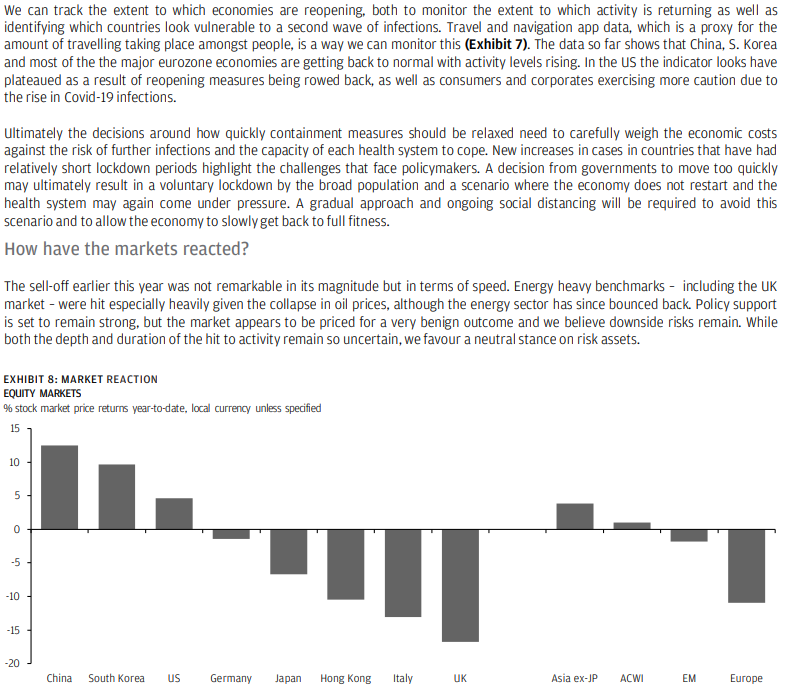
As a result, several benchmarks are looking even sprightlier than that of Italy. The UK’s FTSE 100 is up 16% from its 23 March nadir of 4,994, while Germany’s DAX and America’s S&P 500 are back in bull-market territory, with gains of more than 20%.

The question now is whether these gains can be maintained or extended and in the short term a lot of that will depend upon the shape of the upturn. The latest Bank of America institutional investor sentiment survey suggests that U-shaped is the current favourite, over W, V, L, ‘bathtub’ or tick-shaped (or any other options that you could think of).

ALPHABET SOUP

What is interesting to note is how a V-shaped recovery is only third choice, according to that Bank of America monthly survey. This suggests some degree of circumspection among the professional investment community and it is easy to see why, as Spain, New Zealand and the UK, to name but three, extend their lockdowns and other nations such as Italy ease them at a very steady pace.
When it comes to judging what sort of recovery might ensue, investors can ask themselves the following questions:
1 When will I first want to use public transport?
2 When will I first want to eat in a restaurant or drink in a bar or pub?
3 When will I first want to board an aeroplane or cruise ship?
4 When will I first want to attend a public event at a cinema, theatre or sports stadium?

The answers could be informative. In addition, you can then imagine that you have been furloughed or even lost your job and see if the answers change at all. The assumption that all of those unlucky enough to find themselves in that position walk straight back into full-time employment could be an optimistic one as unfortunately some firms are going to fail, no matter how much support they receive from the government, management, staff and customers alike.

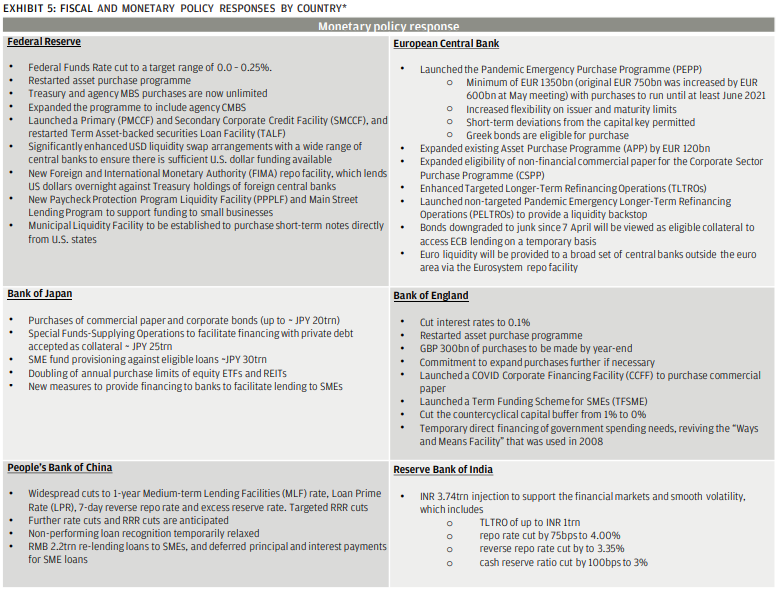
These questions are very difficult, if not impossible, to answer. As such, investing money on the back of them could prove a fraught exercise, even if markets do seem to have one very powerful ally in the form of central banks, notably the US Federal Reserve. The value of the assets held on the American central bank’s balance sheet has swollen by $2.2tn, or 53%, since the end of February.

That tidal wave of liquidity looks to be carrying US stocks higher. Students of history will however remember that the first round of quantitative easing that began in autumn 2008 had a similar initial effect, only for the S&P 500 to buckle in face of weak macroeconomic data and corporate earnings reports and only bottom five months later.

This column will revisit the issue of central bank intervention in an analysis of long-term potential implications of the coronavirus outbreak for financial markets next week. Before then there is one further short-term indicator of note: whether the FTSE 100 can reach (which it did very briefly on 20 April, only to fall back) and stay above 5,816, the high reached after the three-day rally that followed the low on 23 March.

If so, that could break the traditional ‘bear’ market pattern of a series of lower highs and lower lows and give investors real grounds for hope, at least from a portfolio point of view.

A J Bell offer products in the pension SIPP, SSAS and investment areas. They have a Stockbroker within their business too. Russ Mould is quite often heard commenting on Radio 4.
Steve Speed
27/04/2020

Team No Comments

Lessons Learned from the ongoing Pandemic

Lessons Learned from the ongoing Pandemic

We are currently in the midst of an ongoing Global Pandemic, but I’m sure that everybody is already aware of this, as this blog is coming ‘Live from Lockdown’ and I know the majority of you will be reading this in ‘Lockdown’ at home and are probably fed up with hearing about it by this point, from one news bulletin to the next.

We are posting regular blog updates to keep you informed on the developments within the markets as they change with the Pandemic response, so I won’t go into this here, however what I will talk about and what I want you take away from reading this, is what lessons can we learn from this situation?

Other than the obvious lessons we have learned, such as to wash our hands more and never take a trip to the pub for granted! What can we take away from this with regards to financial planning?

Ask yourself the following question,

‘If a situation like this ever arises again, what position financially would I like to be in?’

Whilst this might vary from person to person, I’m sure the answer would generally have the same theme, to have the necessary financial resources to ensure that you wouldn’t be affected by market drops or being unable to earn for a short period of time.

Now you should have an answer to the first question in your mind, ask yourself the next question,

‘What steps can I take to help move towards being in this position?’

Again, this will vary but should follow the same themes.

Do you have an adequate emergency cash fund? The guidance is generally to have around 3 to 6 months emergency fund in an easily accessible cash account for unforeseen circumstances. This would be particularly useful, if not necessary, during a time like this. This was certainly an unforeseen circumstance.

Do you have any expensive debts/ liabilities such as credit cards and loans? What can you do to reduce these? (We should all be spending less now without the freedom to go the pub, go out for a meal and casually stroll around the shops spending too much!). Reducing expensive debts and liabilities will free up more cash for you to build up your emergency funds, Pensions/Investments etc.

Do you have other assets to fall back on? We advise our clients to have a ‘3 pot approach’ which is having a range of different assets such as Pensions, Cash and Stocks & Shares or Investment ISAs to help manage risks in and in the run up to retirement. For example, switching to cash assets from drawing on Pensions/Investments during a market crash (like now!) to allow the funds to have time to recover.

Protection

We have now all seen how fragile life really is. At times like this we think about what life cover, Income Protection and Critical Illness cover we have in place. Do you have enough cover in place to protect your family?

At People and Business IFA we are happy to audit your protection for you and take a holistic view that takes account of your assets, liabilities and employee benefits.

Summary

The aim of this post is to give you some ‘food for thought’ and to get you thinking about how you can improve your financial position to help you generally, not just in times like these.

I will also take this opportunity to once again to remind you to please remain calm and stay invested. Keep funding your pensions/investments if you can (the market downturns give great opportunity for investing and buying assets at low prices!).

Keep calm, stay safe and we will hopefully all get through this together.


Andrew Lloyd

24/04/2020

Team No Comments

The Great Glut: A historic supply and demand shock in the oil market

The Great Glut: A historic supply and demand shock in the oil market

JP Morgan posted a great article earlier this week about the current oil situation (see below);

Rising production and collapsing demand due to the COVID-19 pandemic is creating an unprecedented glut in the oil market. As a result, we are currently witnessing a pronounced supply and demand shock that has driven oil futures below zero for the first time.

At the current pace of production, the world will run out of storage for oil by the middle of the year compounding the imbalance in the market and adding to the pressures faced by producers to slash prices to sell their inventories. As a consequence, energy stocks have been the worst performer year-to-date in global equity markets, while credit spreads of sub-investment grade energy companies have widened dramatically, signaling increasing concerns about the solvency of the sector.

The major oil producing countries, known as OPEC+, have now agreed to cut production starting in May to try to avert the crisis. But will their action be enough to balance the oil market? And what are the implications for investors?

An unprecedented drop in oil demand

The COVID-19 pandemic has led to the implementation of rigorous measures globally to contain the spread of the virus. Travel restrictions, social distancing and stay-at-home orders have reduced global oil demand by an estimated 5.6 million barrels per day (mb/d) in the first quarter of 2020 compared to the same period last year. With the full force of the containment measures expected to continue into May the situation in the oil market may deteriorate further in the near term.

Peak destruction in oil demand is expected in April and May, with an average decrease of 20mb/d. Even in a scenario where global COVID-19 containment policies are gradually lifted by the end of May, the U.S. Energy Information Agency (EIA) is estimating a loss of oil demand in 2020 between 5.2mb/d to 9.3mb/d. To put this number into perspective, in 2009 – the year of the last global recession – oil demand decreased by 0.8mb/d.

Exhibit 1 shows that almost 58% of global oil demand is derived from fuel for transportation. The impact on demand, and thus the oil market, is significantly worse than in normal recessions because of the widespread implementation of travel restrictions, which has reduced global air traffic by 30%. Quarantine measures have also caused a significant drop in road traffic, by roughly 40%, leading to a large drop in demand for petrol and diesel.

EXHIBIT 1: GLOBAL OIL CONSUMPTION BY SECTOR
% of total oil demand

Source: British Petroleum, J.P. Morgan Asset Management. Data shows an estimate of global oil consumption by sector for 2020 from the BP Energy Outlook 2019. Data as of 31 March 2020.

Storage capacity issues in the U.S. created a previously unknown experience of a negative price in the oil futures market. Futures for the month of May 2020 fell sharply as producers effectively paid others to take their oil inventories. Halting production is not feasible for some producers since it could permanently damage their oil fields. Giving, or paying others to take, away their oil for one month may have been the preferred option for the long run health of their business.

Record deal to cut production

The imbalance in oil markets came to the fore in early March, when Russia and Saudi Arabia couldn’t agree on production cuts. In fact, quite the opposite took place as Saudi Arabia, in retaliation, started a price war by giving rebates on their crude oil exports and announced an increase in production starting in April. However, the steep fall in oil demand and rapidly rising inventories have now convinced the world’s top producers to reverse course.

On Easter Sunday, the members of the Organization of the Petroleum Exporting Countries (OPEC) and the main non-OPEC oil producing countries (known as OPEC+) agreed to a historic cut in production to contain the oil glut. Oil production will be cut by 9.7mb/d beginning on 1 May. After that, the group will taper the cuts in July by 2.1mb/d and in January 2021 by another 2.0mb/d. The remaining 5.6mb/d cut will be in place until the agreement expires in April 2022. To put the cuts into perspective, Exhibit 2 shows the main oil producers and their level of current production.

EXHIBIT 2: CRUDE OIL PRODUCTION BY COUNTRY
Million barrels per day (mb/d)

Source: EIA, Refinitiv Datastream, J.P. Morgan Asset Management. 2020 and 2021 data using dotted lines are J.P. Morgan Asset Management estimates based on announced cuts. Data as of 15 April 2020.

Despite the historic size of the announcement it is only a partial step towards the drop in oil consumption as the world’s major economies grind to a halt. An immediate rebalancing of the oil market was never realistic since many higher cost non-OPEC producers would have avoided a large share of the required production cuts. Oil inventories will therefore continue to rise in the short term, likely putting further pressure on storage capacity and oil prices over the next couple of months.

If producers stay compliant to the agreement, and if the major global economies start to ease containment measures form mid-year then fuel and oil demand should start to rise and oil market fundamentals could improve in the second half of the year. However, there remains a large ‘if’.

Even if virus containment measures ease in the coming weeks, the world is going to be awash in oil for some time – economies may be slow to get back up and running to a pace that would warrant a strong increase in demand, especially when it comes to international travel.

What does this mean for investors?

Equity and credit investors in energy can expect a couple more difficult months ahead, with fundamental headwinds and challenging newsflow. Corporate earnings will likely have further to fall and preserving liquidity will remain a main task for the time being.

While sectors such as airlines, logistics and selected industrial (such as chemicals) traditionally benefit from low energy prices, they also face bigger challenges on the demand side of their businesses. Low oil prices will also put pressure on commodity-exporting emerging markets, such as Russia, the Middle East and Latin America. However, this benefits importers in Asia, especially India, whose current account deficit position could benefit from cheaper oil.

It is often in challenging times like these when the foundations of the next upswing are laid. The weak players are dropping out and exploration companies are significantly reducing their capital expenditure. Today’s cancelled projects will be missed in three years’ time. So, companies that survive the “Great Glut” may be able to look forward to a more balanced oil market in the next five years than they have experienced in the previous five.

A good update from JP Morgan giving us an insight to the current oil situation. JP Morgan have great technical and market resources available to them and continuously provide useful insights.

Hopefully now we’ll see a drop in prices at the pumps!

Andrew Lloyd

23/04/2020

Team No Comments

A New World? What Will Happen After The Recovery?

A New World? What Will Happen After The Recovery?

We are living in interesting times now; you couldn’t have made it up. Apparently planning at the highest level in the UK dismissed talking about this global pandemic risk as it was too far-fetched. Things look different now.

I don’t need to describe the current situation as we are all living in it, let’s just say it’s a nightmare. But will any good come of it?

What happens next?

The health crisis will diminish with time and hopefully an anti-virus, ample testing and a vaccine. Globally, economies and markets will recover and life will return to normal or a new version of normal?

Personally, I think it will be the latter. The NHS and other Key Workers are our heroes, Boris owes his life to the skill, professionalism and dedication of the NHS. We will have massive debt as a country. This makes the 2008/2009 global financial crisis look like a stroll in the park!

A few points to consider:
1. We will have to raise taxes to pay for some of the accrued debt. This may not be straight away as the recovery will be fragile. Businesses will have to get back to normal and the consumer will need to start spending and increase spending as the majority of our economy is based on the consumer spend.

2. Some families (consumers) will have debt and very little or no income and will have to find new jobs or ways to generate income.

3. Businesses may have found different ways to do business with technology aiding many of their staff to work from home. Some businesses may decide they don’t need as many staff.

4. On the other hand, entrepreneurs and the technology used may have created new businesses or new sources of business for existing business helping them expand and grow as the UK recovers.

5. The NHS, Social Services and residential care need better funding. We have seen that the NHS has struggled with a lack of essential equipment (PPE) and some other countries appear to have been better resourced and able to cope with the virus with far lower mortality rates, for example Germany.

Societal Change?

Given all of the above are we likely to see a better society; one in which we value our NHS heroes and other Key Workers? I hope so.

Will this mean that we all pay a little more tax for the benefit of everyone? A society that is a little fairer? I don’t mean soft, if you are able to work ideally you should be working and contributing to society.

A society that doesn’t focus too much on money and what you can buy but genuinely values everybody for what they do or what they have done? We may also find it easier to make changes to combat global warming now we understand the damage nature can wreak on us and the power nature still has.

Although what we are dealing with now is pretty awful, hopefully the outcome, the world we live in after this crisis has gone or been controlled sufficiently, will be better for more people.

What do you think?

Steve Speed
20/04/2020

Team No Comments

Market Outlook and Economic Viewpoint

Market outlook and Economic Viewpoint

Market outlook and Economic Viewpoint below from Royal London’s perspective just arrived by email today (20/04/2020).

Market outlook, Trevor Greetham, Head Multi Asset Funds, RLAM

“Sustained recovery in markets will probably have to wait until there is more confidence regarding the coronavirus being under control globally, shuttered parts of the world economy are re-opened and consumer confidence rises from its lows as people are allowed to return to work. We expect our Investment Clock model to reflect this situation by moving quickly from disinflationary Reflation, with weak growth and inflation, and to Recovery as global growth recovers. We intend to make full use of our active tactical asset allocation risk budget to add to equity exposure when we judge the time is right.

Our investment process has weathered difficult markets in the past and we added significant value over the 2007-9 Global Financial Crisis. We believe a disciplined and active approach to both risk control and tactical asset allocation will be crucial in portfolios, as markets respond to the current crisis and policy responses being implemented.”

RLAM Economic Viewpoint

Even while the UK has just extended its lockdown, policymakers in a number of countries elsewhere in Europe are starting to ease social distancing measures or are planning to do so in coming weeks. What that means for their economies isn’t completely straightforward, but – taken at face value – allowing more economic activity to take place boosts GDP and employment. However, while policymakers continue to do their best to limit the damage to businesses and households so that the economy can fire up again, the strength of the recovery will – to a large degree – also depend on how confident people are that the virus (and a second wave of lockdowns) is no longer a threat, as well as depending on what is happening in other countries.

In the meantime, a wealth of recent data is making clear how big the challenge is for economic policymakers and how deep this downturn is. Jobless claims numbers in the US remained awful this week, with another week of initial jobless claims above 5 million. Many data series for March and April have now hit record lows or declined by record amounts. This week, that included the biggest one month fall in US industrial production since 1946 and a record plunge in the broad definition US retail sales measure. In China, data this week showed Q1 GDP fell some 9.8% QoQ, awful by any country’s standards, let alone China’s.

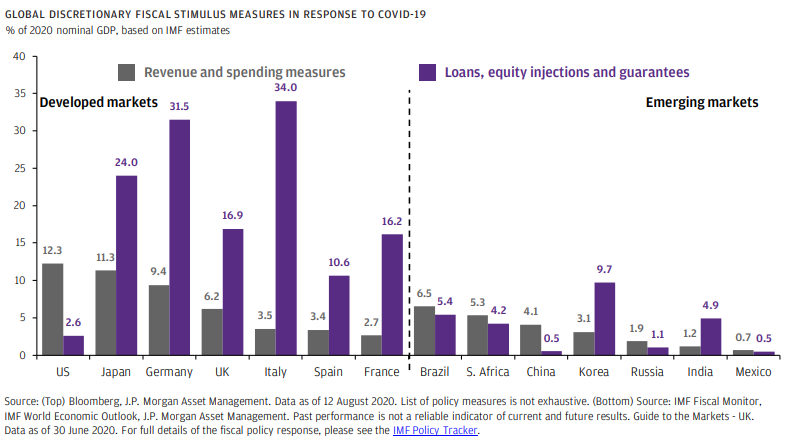
Economists do not expect consumer or business behaviour to instantly jump back to what it was once social distancing substantially eases, especially without an effective treatment and or vaccine for COVID-19. China data shows retail sales, for example, lagging the recovery there. The IMF this week forecast that the global economy will shrink by 3% in 2020, i.e. worse than 2009. However, central bank support for the economy, markets and governments has continued to step up over the last week or two, including an important expansion of Federal Reserve facilities. Fiscal packages continue to be announced, France being one of the latest economies with new expanded budget plans. Such policymaker support is essential for prospects of economic activity returning to pre-crisis levels over a few quarters, rather than several years as was the case during the financial crisis.

You can see from Trevor Greetham’s input he is waiting for opportunities to arise as markets recover and refers to the (useful) experience of 2007 to 2009 Global Financial Crisis.

Royal London run a significant proportion of pension assets and are key in the company pension scheme market in particular. Their default investment proposition is strong.

Steve Speed

20/04/2020

Team No Comments

Prominent Investment Themes


Input from Jupiter’s Fund Manager Amanda Sillars received yesterday (15/04/2020) below as she outlines the four prominent themes in the market today:

Amanda Sillars

Fund Manager, Independent Funds

Quality and technology reign supreme in markets

Four prominent themes have emerged over the last few weeks, said Amanda Sillars, Fund Manager, Independent Funds: reduced dividends, exceptional innovation, and the supremacy of quality and technology stocks.

The first two themes are new. Firstly, it has been reported that over 40% of UK companies so far have ditched their dividends. On a more positive note, the second new theme is the exceptional innovation that is being unleashed in response to the crisis, particularly within the pharmaceutical, medical, monitoring and testing sectors.

The two other themes existed before the coronavirus, but have been supercharged as a result. The supremacy of quality has now gained even more momentum as fund managers unpick the balance sheets of companies they own and stress test for low or no earnings for Q1 and Q2. Many managers have sold weak companies and added to existing quality holdings: companies that are leaders in their fields, with strong balance sheets and long-term, responsible management. Owning quality stocks is seen as essential for survival: the strong companies are getting stronger, seizing new opportunities and investing while their competitors are struggling.

The final supercharged theme is technology, which has been described as the new defensive sector. The shift from physical to digital has accelerated at supersonic speed and is one of the primary outcomes of the global lockdown.

While a return to pre-coronavirus economic activity may well be several years, not several quarters, away Amanda believes that truly active, forensic fund managers can capture the huge opportunities emerging through these extraordinary changes and can identify the best companies, to the benefit of their clients.

For the right Fund Managers, they can see opportunity and select the right kind of stocks not just to survive but that will thrive in the current market.

Carl Mitchell

16/04/2020

Team No Comments

Invesco Investment Intelligence – Weekly Performance Update

Invesco give a good overview of markets in their weekly Performance Update issued today (14/04/2020) below:

With the early stages of a severe winter hitting the global economy, financial markets have decided it’s spring, preferring to focus on the green shoots of further central bank (particularly from the Federal Reserve) and government support (the EU finally came up with a €500bn package), as well as occasional snippets of good news on the coronavirus front. Consequently it was very much risk-on last week with some significant upward moves in both equity and credit markets.

Global equities had their strongest week (+10%) since 2008, but the real standout in Developed Markets was the performance of the FTSE 250 (UK Midcaps), which rose 16.3%, the biggest weekly gain since index data became available (1986). Global small caps had a record week too (+14%). Strong equity markets translated into declining volatility, although the VIX index (1m implied volatility of S&P 500) at 42 still remains at very elevated levels (it was at 14 when the S&P peaked on 19 Feb). In credit markets, HY, and US HY in particular, was boosted by the Federal Reserve expanding its asset purchase to include HY ETFs.

Market performance last week (%)

Past performance is not a guide to future returns. Sources: Datastream as at 13 April 2020. See important information for details of the indices used.1

Key observations on last week’s performance:

  • Global equities rose sharply as highlighted earlier. DM (+10.6%) delivered almost double the return of EM (+5.8%) as US equities were particularly strong (+12.2%). A similar picture was seen in small caps (DM +14.7%, EM +7.5%). UK equities were also robust with the All Share having its best week’s performance since 2008, led by mid and small caps.
  • At a sector level, risk-on invariably means that the more cyclical / value areas of the market outperform and last week was no exception. Financials, Consumer Discretionary and Materials were strong performers, while Consumer Staples and Communication Services were the main laggards. Exceptions to the rule were the defensive Utilities sector on the upside and Energy on the downside, although the latter probably exceeded expectations given the decline in the oil price. At a factor level there was little difference between Growth and Value, with the latter winning out marginally. Momentum and defensives were the weakest sectors.
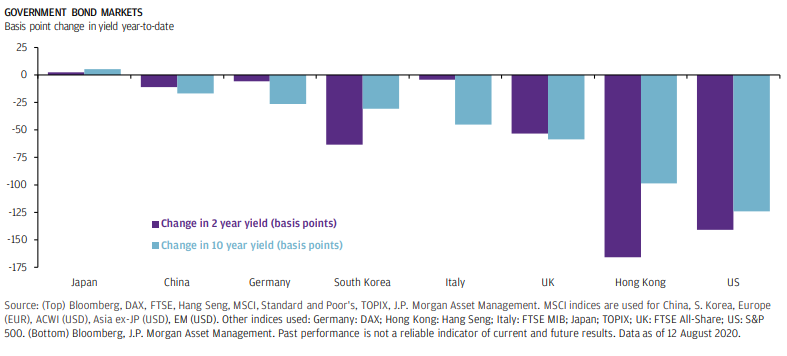
  • Developed Market government bond returns generally weakened at the margin on the back of a small uptick in yields, with the 10yr UST and Bund both rising 13bp. The 10yr Gilt yield was unchanged at 0.31%. EM sovereign bonds were the best performer, with yields falling 23bp.
  • Global credit markets had a good week, particularly High Yield. Yields and spreads fell across the board, -30bp and -38bp respectively for IG and a more substantial -105bp and -122bp for HY. The lower the credit rating the better, with BBBs the best performer in IG and CCCs and below in HY. US credit outperformed on the back of Federal Reserve support.
  • The risk-on backdrop weighed on the US$ with £, the Euro and EM currencies all appreciating versus the US$.
  • Despite the OPEC+ agreement to cut oil production by 10mbd, along with additional support measures from the G20, making it overall the largest oil supply agreement in history, that was not seen as enough to offset the dramatic collapse in global demand. Consequently Brent fell -7.3% to just below $32. Copper, on the other hand, benefitted from the more optimistic tone in markets and the weaker US$. Gold too was strong, a beneficiary of a weaker US$, and at $1682 is at its highest level since early 2013.

YTD market performance and YTD low (%)

Past performance is not a guide to future returns. Sources: Datastream as at 13 April 2020. See important information for details of the indices used.1

This week you will note that I have shown the maximum YTD drawdown as well. This is from the start of the year, not the peak to trough decline during the year so far.

Key observations on YTD performance:

  • As the chart highlights it’s been a tough start to the year, but almost every asset class is now some way above their YTD lows, which were invariably seen in late March. There have been some significant rallies. The S&P 500 is +24.8% above its lows, the All Share +18.4% and US HY +12.4%.
  • In equities EM (Asia best region) have marginally outperformed DM, with little performance differentiation between regions in the latter other than the UK, where the All Share is still down -24.5%. There has been a 10% performance divergence between large caps relative to small caps, a similar picture for Growth versus Value, while defensive sectors are ahead of cyclical ones by just under 5%.
  • A fairly mixed bag from government bond markets. USTs have been the star performer with the 10yr UST YTM falling 119bp and returning 13.7%. Gilts have also been strong, with the 10yr down 52pts. EZ performance has been mixed. 10yr Bund yields (-15bp) have performed better than EZ peripheral bonds. The 10yr Italian BTP, for example, has seen yields rise +17bp. EM external sovereign yields have risen a massive 172bp, pushing returns down – 11.5% YTD.
  • Despite the recent rally, credit markets remain firmly in negative territory. Global yields and spreads have widened dramatically (Yields IG +53bp HY +311bp, Spreads IG +144bp, HY +459bp). IG has outperformed HY materially. US and £ credit outperformed in IG, £ and Euro in HY. The weaker the credit rating the weaker the relative performance in both IG and HY.
  • £ (-5.4%) and EM currencies (-13.4%) have been the main losers against the US$. Yen remains broadly unchanged, with the Euro slightly weaker.
  • The oil price has halved (-51.8%). Economically sensitive Copper has also been very weak. Meanwhile gold (+8.6%) proves to be a robust safe haven.

Chart of the week: UK GfK consumer confidence survey

Source: Datastream as at 13 April 2020.

  • GfK normally publishes its UK consumer confidence survey index once a month (at month end), having completed the survey during the first two weeks of the month.
  • Last week they published a special flash survey, conducted in the last two weeks of March, to capture the impact of new restrictions on British life. It fell from -9 in the initial March survey to -34. This was not quite as low as the trough in the GFC (-40), but in terms of the economic outlook over the next 12m there was a new record low at -56 (GFC low -52).
  • With unemployment expected to rise sharply, expectations on personal finances also slumped and are just above their GFC low (-17 vs -18).
  • The current headline reading is consistent with household spending falling sharply. Last week’s car registrations give a foretaste of this. They are usually high in March due to the bi-annual plate change system. They fell 44.4%yoy from 458k in March 2019 to 255k in 2020, the lowest March number since the late 1990s.

Key economic data in the week ahead:

  • Another relatively quiet week ahead in terms of economic news flow from the major economies.
  • In the US, focus yet again will be on initial jobless claims (Thursday) after a rise of just under 17m in the past 3 weeks. Another “big” week is expected, with consensus at 5m. On Wednesday March’s retail sales will be published, where a record decline is expected. On that day a close eye will also be kept on the Federal Reserve’s Beige Book, a report published eight times per year ahead of the FOMC meeting (next one is 29 April), which provides anecdotal information on current economic conditions. Expect a material deterioration in the outlook.
  • The highlight in China is the Q1 GDP report due on Friday. Remarkably for the second largest economy in the world, China manages to produce its final number (there are no revisions) well ahead of even provisional numbers for other major economies (the first reading for the US is not until 29 April). Consensus is for a -11.2%qoq decline and -6%yoy, by far and away the worst quarter ever experienced by the Chinese economy, reflecting the coronavirus lockdown shock. This will also impact trade numbers for March due on Tuesday. All a foretaste of what is to come in Europe and the US.
  • A light week for data in the UK. With the BRC Retail Sales number for March (Thursday) we will get a first glimpse of how steep retail sales dropped, while the BoE Credit Condition Surveys on the same day will provide insight into the degree to which banks are ramping up supply of credit, given the expected jump in demand.

As you can see all focus is on the data coming out over the next c two weeks.  We will experience ongoing volatility based on how Covid 19 is progressing/being controlled (how measures are working), the pathway out and the impact on global economies as outlined in the data we receive.

We need to remain invested as we are and be patient.  Ongoing regular monthly contributions into pensions and investments will help over the medium to long term.  Expect heightened volatility.

Steve Speed

14/04/2020

Team No Comments

Brewin Dolphin – Scam Warning Blog

Brewin Dolphin have put this guidance in an article on their website. Unfortunately, criminals see the current crisis as an opportunity. Please take precautions and keep your cash and invested assets safe.

With the entire world focused on coronavirus (Covid-19), fraudsters are taking advantage of the situation to target potential victims.

These scams can take many forms and could be about pensions transfers or high-return investment opportunities.

Scammers are sophisticated, opportunistic and very likely to target the vulnerable. Typically, scammers use fraudulent emails, phone calls, text messages or social media posts to offer help to customers by suggesting their service or product provides a ‘safe haven’ for money, investment opportunities ‘too good to miss’ or even expert medical guidance.

Using coronavirus as a cover story, criminals can also attempt to persuade recipients to disclose personal or financial information or click on links that may contain malware.

To help protect yourself you should:

  • Reject out of the blue offers
  • Beware of adverts on social media channels and paid for/sponsored adverts online
  • Refrain from clicking on links or opening emails from senders you don’t know
  • Avoid being rushed or pressured into making a quick decision
  • Call back existing providers who call you unexpectedly
  • Refuse to give out personal details (bank details, address, existing pensions or investment details) to unexpected callers or online requests

Remember, we, your bank, the FCA or the police will NEVER ask you to transfer money or move it to a safe-haven account.

To be safe, follow the advice of the Government and UK Finance led “Take Five to Stop Fraud” campaign. If you suspect a scam, call Action Fraud straight away on 0300 123 2040.

We endorse the protective measures outlined above by Brewin Dolphin. If you think your invested assets are at risk (lost, stolen or misplaced passwords?) please let us know immediately. We can instruct pension, investment and product providers to increase security measures.

Steve Speed

14/04/2020

Team No Comments

J.P. Morgan – Market Update

J.P. Morgan – Market Update

Please see below yesterday’s (08/04/2020) market commentary update from J.P. Morgan Asset Management who have great technical and market resources available to them:

We will continue to deliver market commentary from leading fund managers from around the country.

In the meantime, please keep safe and healthy.


Carl Mitchell – DipPFS

IFA and Paraplanner

9th April 2020

Team No Comments

The Value of Long-Term Investing


Comment from Brewin Dolphin yesterday (06/04/2020) on long term investing:

The value of long-term investing

Investing for the long term gives your money the greatest chance of growing in value. But this means holding your nerve during periods of significant stock market volatility – and remembering that, as history shows, markets will recover.
Here are four reasons why investing over the long term is the wisest strategy.

1. Staying invested

As the old investment adage goes, it’s time in the market – not timing the market – which is key to returns. By delaying, or cashing in your investments, you risk missing out on the best days in the market.

The global economy has endured plenty of adversity over the decades, and yet the stock market has continued to climb, given time.

Brewin Dolphin have the time and expertise to help you make the most of your investments.

2. Compounding – time is everything

Compounding is extremely powerful when it comes to investing. Albert Einstein apparently described it as the eighth wonder of the world. It is, simply, earning returns on your returns.
For example, somebody earning a 5% return in year one would see their investments grow by a compounded return of 63% after 10 years. After 20 years, this rises to 165%, and over 25 years it balloons to 239%. This demonstrates the cumulative effects that compounding has on capital. £

3. Investing typically beats cash

Savings accounts typically struggle to keep pace with inflation, seeing savers lose value in ‘real’ terms. In the graph below, bills are short dated bonds which give an indication of what returns on cash might have been.

If you are prepared to accept the risk that comes with investing, and have time on your side, you give your wealth the greatest chance of growing and beating inflation over the long term.

4. You benefit from diversification

Our portfolios are well diversified. This means that your investments (and risk) is spread across different assets, across the globe – including equities, bonds and cash.

The value of investments and any income from them can fall and you may get back less than you invested.
Past performance is not a guide to future performance.
No investment is suitable in all cases and if you have any doubts as to an investment’s suitability then you should contact us.
The information above is believed to be reliable and accurate, but without further investigation cannot be warranted as to accuracy or completeness.

As long term investors we shouldn’t focus on or worry too much about short term volatility. Time in the markets works, trying to time the markets is virtually impossible.

We need to think as long term investors, not traders.

Steve Speed

07/04/2020