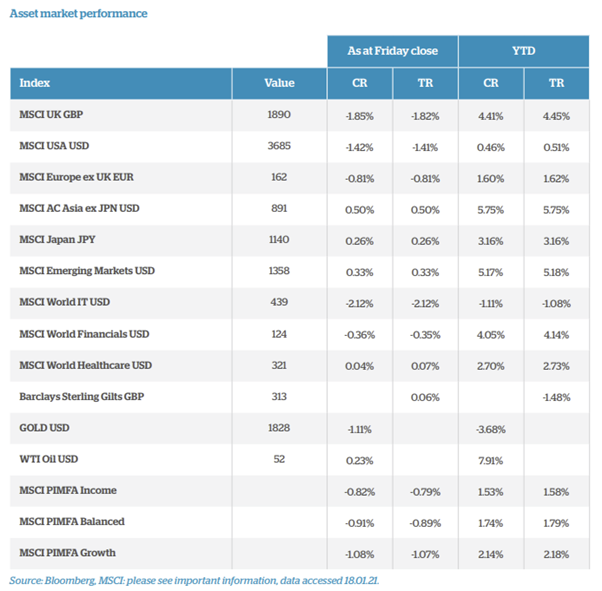
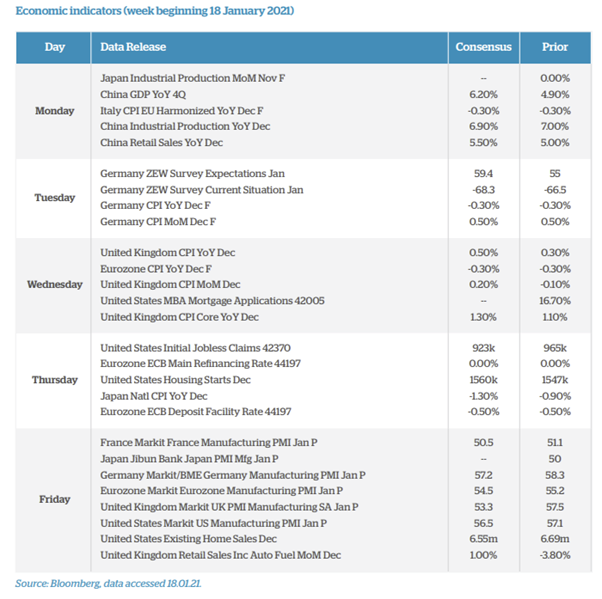
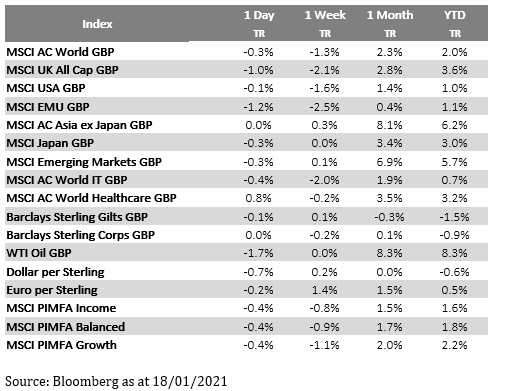
Please see investment bulletin below from Brooks Macdonald received this morning – 22/01/2021
Brooks Macdonald Investment Bulletin
What has happened
A tech fuelled rally drove the US index marginally higher yesterday. Interestingly the cyclical stocks, which outperformed at the start of the month are losing some momentum. One of the explanations for this is the disconnect between market expectations around demand, i.e. the oil price and forward looking equities, i.e. oil majors – until expectations of a cyclical rebound is reflected across the board, cyclical equities may have bouts of weakness. That said, the reflation narrative remains alive in fixed income with US inflation expectations picking up yet again yesterday.
ECB
Whilst there were no changes to policy levels at the ECB meeting yesterday, investors were left feeling more uncomfortable as the bank stressed the ‘symmetrical’ nature of the pandemic quantitative easing programme. Specifically, this means that if the bank feels that it does not need to use all of the QE budget it will not do so. This is fairly logical and reiterates what was said in the December meeting but the fact there was a new section in the statement to reiterate this, concerned markets. Central bank watchers pore over the specific words in a statement so the inclusion of a full section is a strong emphasis from the ECB. Investors decreased their expectations of monetary policy accommodation as a result which saw the Euro rise against the dollar and sovereign bond yields rise amidst fears that the major buyer of sovereign bonds would be less active in purchases going forwards.
US COVID response
With President Biden’s first full day in office we saw a series of executive orders in relation to vaccine supply chains and vaccine deployment. The President did note however that stimulus was required to change the trajectory of the vaccine rollout, but the administration remains committed to the 100m vaccines in the first 100 days. Dr Fauci, Chief Medical Advisor to the President, welcomed news that Johnson & Johnson’s vaccine expected to have early stage results during the start of February and would have data available for an emergency use review during that month.
What does Brooks Macdonald think
The ECB is in a tough spot as financial markets want to hear that tapering is off the table however more fiscally conservative member states such as Germany, want the pandemic QE programme to slow as the economy recovers. Last year we saw the challenge by the German Constitutional Court over the ECB’s QE programme and the inclusion of a statement around the symmetrical nature of QE is probably principally designed to calm the fiscal hawks amongst member states.
Source: Bloomberg as at 22/01/2021
Please continue to check back for our latest updates and blog posts.
Please see below article received from AJ Bell yesterday afternoon, which provides an insight into what rising prices mean for value stocks and emerging markets.
One theme which continues to exercise financial markets is whether inflation is primed to make a comeback and – if so – what this could mean for asset allocation and portfolio strategies.
The five-year forward inflation expectation in the US now stands at 2.11%, its highest level since December 2018, and financial markets are beginning to react: bond yields are ticking higher, bitcoin is going bananas while gold holds relatively firm. Within equity markets cyclical growth (or ‘value,’ for want of a better word) is again trying to cast off a decade of underperformance relative to perceived secular growth sectors such as technology.
As this column has suggested before, the battle for portfolio style (and performance) supremacy within equities can be seen by comparing the returns provided by two exchange-traded funds (ETFs) in the US: the QQQ Invesco Trust, which follows the price of the biggest non-financial stocks on the NASDAQ, and the Russell 2000 Value ETF.
If the line on this chart goes up, ‘growth’ is outperforming. If it goes down, ‘value’ is outperforming. As can be seen, cyclical growth outperformance stretches to summer 2020.
But this trend can be seen in another way too, this time on a geographic basis. Over the past decade, investors have adapted to the low growth, low inflation, low interest rate environment by buying long-dated assets such as bonds and equity growth (such as technology stocks), and forgetting about commodities, cyclical equities (‘value’) and emerging markets.
Yet as inflation creeps back onto the radar, perhaps for the first time in 40 years since then Fed chairman Paul Volcker set about wiping it out, emerging markets are coming back into fashion too.
This can be seen using the same technique as before, this time by dividing the performance of America’s S&P 500 index by the MSCI Emerging Markets benchmark. American outperformance peaked in September, since when emerging arenas have done better.
Clear pattern
This return to form for emerging markets coincides with a period of strength for commodity prices and dollar weakness. Whether it lasts may hinge to a great degree on those two trends, which also tie into the inflation narrative.
If those three continue to coincide, then we could see a third major period of emerging market outperformance relative to the US (and by implication developed markets), to match those of 1988-1994 and then 2000-2010, so this EM resurgence must be monitored closely. If it proves to be no mere flash in the pan, then it could have profound portfolio implications.
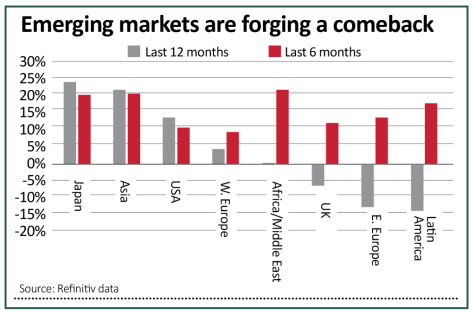
The resurgence of EMs can be seen by digging deeper into geographic performance trends, too.
Japan may be the best performer, in total return, sterling-denominated terms over the past 12 months, but Asia is a close second. The data from the past six months, when cyclical growth, or value, began to try and forge its latest comeback, show outperformance from not just Asia, but the Middle East and Africa, Latin America, and Eastern Europe, too.
East of Eden
Global export plays like South Korea and Taiwan have done well of late, but tourism and travel destinations like Thailand and Hong Kong are clear laggards. Perhaps South East Asia becomes the next leg of the post-vaccine, global upturn story.
There may be other reasons for the return to form of emerging markets, beyond commodity strength, dollar weakness and markets’ preoccupation with inflation and a near-term economic recovery, as this column hinted just under a year ago.
Perhaps Asia’s outperformance reflects the view that region was first in and first out when it comes to the global pandemic (even allowing for recent local flare-ups). Given the experience of SARS in 2002-03, Asia may have been better prepared and equipped to deal with such a situation.
In addition, Asian nations learned harsh lessons about debt during their currency crisis of 1997-98 and as a result aggregate government borrowing levels are generally much lower as a percentage of GDP than they are in the West.
Such facets could help to shape long-term outperformance too, especially as soundness of finances usually wins out in the end.
We will continue to publish news and market analysis. Please check in again with us soon.
Please see below for the latest Brooks MacDonald Daily Investment Bulletin received by us today 21/01/2021:
What has happened
Markets greeted the inauguration of Joe Biden with a rally driven by the tech heavyweights. Some markets concerns remained around the final handover of Presidential power from Trump to Biden so there will be an element of welcoming the calmer tone of the new President as well as removing a transition risk premium.
President Biden
Yesterday’s inaugural Presidential address saw President Biden attempt to change the tone in Washington by encouraging bipartisan debate rather than absolutism. This speech was followed by a series of executive orders as expected. This included the US re-joining the Paris climate agreement, ceasing the withdrawal from the WHO, ending the travel ban on a number of Muslin countries and a federal mask rule on interstate travel and within federal buildings. As a sign of the focus for the new administration’s economic goals, there were also some specific COVID support measures such as pausing federal student loan repayments and extending the federal eviction moratorium. Yesterday’s speech, coupled with that of Janet Yellen earlier this week, paints a market friendly picture where near term support remains the focus. Of course, the sting in the tail could be higher taxes down the line but we need to remind ourselves of the thin Senate majority and the fact the midterms are in November next year and this could change the power balance in Congress yet again.
Central bank decisions
Yesterday we heard from the Bank of Japan which left monetary policy unchanged whilst predicting economic challenges over the course of 2021. Today is the turn of the ECB and given the central bank announced a further easing package in December, little dramatic change is expected. The central bank meets under the cloud of Euro Area CPI estimates that showed the region in deflation (-0.3%) compared to the year before. Whilst forward looking CPI estimates have been rising, in line with the broad global market reflation narrative, even these future estimates remain well below the ECB’s 2% target. The central bank therefore likely has room to increase stimulus but it isn’t clear that simply doing more of what has been tried before (bank lending, negative rates and quantitative easing) will have the desired effect.
What does Brooks Macdonald think
Equities rose and volatility fell as power transitioned peacefully between President Trump and President Biden. It is interesting that yesterday’s rally was so tech focused given fears over regulation under a Democrat White House and Congress. The rally yesterday implies that investors are confident the new administration has its hands full with the COVID response and is unlikely to look towards market unfriendly reform within that context.
Daily investment bulletins like this could prove to be very useful in the near future. Yesterday’s Presidential Inauguration is sure to cause ripples in the markets globally and keeping up to date with developments as they happen can, as ever, be very beneficial to your own views of the markets.
Please utilise our blogs in keeping your own views of the market holistic and up to date.
Please see below an article received yesterday from Brooks Macdonald which provides a brief overview of the Biden Inauguration and what the transfer of power could mean for markets:
Please continue to check our Blog content for advice and planning issues and the latest investment, markets and economic updates from leading investment houses.
Please see the below update from Brewin Dolphin received late last night:
Most global markets fell back slightly over the past week, retreating from record highs set in the first trading week of the year. The falls came after a strong run for global markets that has, unsurprisingly, led to some profit taking. Also weighing on markets has been some disappointing economic data caused by new or expanded lockdowns.
For example, UK retail sales figures released last week saw the worst annual growth since 1955. US initial jobless claims increased sharply last Thursday, hitting their highest level in five months. US retail sales declined for a third straight month and manufacturing activity in the New York state slowed. Then the University of Michigan consumer sentiment index was weaker than had been expected. It is no surprise that markets have adopted a little more of a ‘risk off’ tone.
Last week’s markets performance*
FTSE100: -2%
S&P500: -1.47%
Dow: -0.91%
Nasdaq: -1.54%
Dax: -1.86
Hang Seng: +2.49%
Shanghai Composite: -0.10%
Nikkei: +1.35%**
*Data from close on 8 January to close of business on Friday 15 January.
Inauguration week starts on a cautious note
It was a quiet start to the week yesterday, as US markets were closed for Martin Luther King Jr Day. In Europe, markets were mostly higher; the pan-European STOXX 600 rose by 0.20%, France’s CAC 40 closed 0.44% higher at 13,848.35 and the Italy’s FTSE Mib gained 0.53% to 22,498.89.
In Asia, most markets lost ground, but China was the exception. The Shanghai Composite and Hang Seng indices both rose after China reported robust GDP data that confirmed it was the only major economy to expand in 2020.
In the UK, the FTSE100 closed down 0.22% at 6,720.65, while the FTSE250 eked out a gain of 0.12%.
China leads global recovery
China’s ongoing recovery continued apace at the end of last year. It recorded GDP growth of 2.3% for 2020 as a whole but growth accelerated in the fourth quarter, with its economy expanding by 6.5% compared to a year earlier. It was its fastest rate of growth in two years.
China’s growth was largely export driven, although government support for infrastructure projects also gave the economy a boost.
But even China is showing signs of pain during these difficult days. Retail sales came in below expectations, rising by 4.6% in December from a year earlier. While this is impressive by global standards, it was below expectations for 5.5% growth.
We expect China to continue to lead the global recovery in 2021, although growth should be more evenly spread around the world, assuming the roll out of vaccines proceeds smoothly.
Bond yields rising
Yields were a little lower on the back of this news, but not much. That is despite the very sharp increase in yields we have seen so far this year. This has been a topic of much speculation as the prevailing narrative had been that rates will stay low for the foreseeable future. However, very recently the market has begun to anticipate that monetary policy cannot remain this accommodative forever.
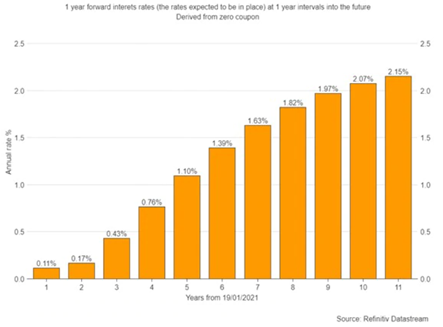
Currently forward interest rates presume that rates stay on hold for the next two years, but then begin to steadily rise. Implied rates have increased significantly over the beginning of the year, mainly in the US. Now those expectations have nudged outside the upper end of the Fed’s forecast range. The chart below shows the market implied interest rate for each year into the future.
Adding to the pressure on bond yields recently has been the fact that some forecasters have brought forward their expectations around the timing of the Fed beginning to slow down its bond purchases, or quantitative easing (QE).
Atlanta Fed president Raphael Bostic, who is about to become a voter on the FOMC, recently said that if the economy bounces back quickly, the Fed may be able to start paring back QE later this year. During the so-called ‘taper tantrum’ of 2013, the 10-year Treasury shot up around 130 basis points in just a few months. There are certainly some parallels between then and the backdrop today, so the bond market is highly sensitive to any discussion about the Fed altering the pace of its bond buying, which is currently at $120 billion per month.
Biden’s stimulus proposal
One of the factors weighing on the bond market is the prospect of extra fiscal stimulus. President-elect Biden announced his plan for spending, and it is eye-watering, at $1.9trn.
He has said he wants $2,000 stimulus cheques for individuals in addition to the $600 cheques already passed by Congress. It also includes $400 a week in emergency unemployment benefits, payable until September, and preventing a cliff-edge cut-off for jobless payments previously scheduled for March.
More controversially he also wants to more than double the minimum wage. This probably isn’t a serious proposition. It’s more of an effort to establish an anchor from which he can give a little ground and still be left with something meaningful at the end of the negotiation.
Inflation expectations on the up
Fundamentally, it has been rising inflation expectations that have been the driving force behind higher yields. Inflation is likely to look as if it is increasing over the coming months, but appearances will be misleading. Year-on-year energy prices will appear to have risen sharply in March when current oil prices are compared to those from a year ago, when prices actually went negative! But this is just a base effect.
There will also be some inflation caused by the reimposition of VAT in some jurisdictions. Statistical factors even imply that there is wage inflation in the current market because job losses in a large number of low-paid roles means that average wages are higher now than they were in 2019. None of these are real inflation, and policy makers will be able to safely ignore them – although headline writers may not.
Overall core inflation remains subdued, but it would be very unusual for it not to rise a little given the increase in manufacturing activity we have seen. In the longer term, more inflationary pressures may build, but for now a gentle increase in inflation gives us a preference for inflation-linked bonds over conventional bonds and reinforces the importance of having some precious metals exposure as a useful hedge.
Brief market updates like this help us get a quick overview of the markets and we share them in the aim of keeping our readers informed.
Today will be a historic day given that, across the pond, it is President Biden and Vice President, Kamala Harris’ Inauguration. VP Kamala Harris will today make history as the first female, first black and first Asian-American US Vice President, a great step towards a more inclusive and diverse future!
Hopefully, we could see positive market movements on the back of this, however, the markets are unpredictable (as have been the events of the world over the past 12 months).
Keep checking back with us for more updates like this.
Please see below update received from Brooks MacDonald earlier today, which analyses global market performance over the past few days.
What has happened
With US markets closed yesterday, equity moves were fairly small and we saw more of a consolidation than any momentum one way or another. That said, European and Asian markets did gain ground with the latter helped by the strong Chinese GDP data at the start of the week.
Yellen’s confirmation hearing
Later today, Janet Yellen, former Fed Chair will set out her plan to the Senate finance committee ahead of her confirmation as Treasury secretary. The prepared remarks have already been leaked and the highest profile phrase is that ‘the smartest thing we can do is act big’. Yellen is expected to reiterate the need for fiscal spending saying that the downturn in the economy could lead to a ‘longer, more painful recession’ if stimulus bills such as that proposed by President-elect Biden falter. The first test for the new President will be the passing of $1.9 trillion of relief measures which may prove challenging given the tiniest of working majorities in the Senate. There will inevitably be questions about the longer-term funding of the deficit created by these measures and the interactions between the Fed and Treasury given Yellen’s former role.
COVID Update
Cases remain elevated across Europe but there are signs that the tougher restrictions are starting to work with Italy seeing its daily cases fall below 10,000 for the first time this year and the UK dipping below 40,000 as Lockdown 3.0 takes effect. Germany is also expected to extend its lockdown further due to concerns over the new variants after being in heightened restrictions for several months. On the vaccine there continue to be impressive numbers out of the UK which is one of the fastest moving of the major economies. The EU are also seeking 70% of the bloc’s population to have had the vaccine by the summer so signs of momentum, or at least ambition, building. In less positive news, California’s state epidemiologist has recommended the pause of the rollout of the Moderna vaccine after severe allergic reactions.
What does Brooks Macdonald think
Yesterday saw a brief lull in market activity after an eventful start to 2021, with central bank meetings, politics and earnings this is unlikely to last too long. Against this backdrop the vaccine rollout has begun in earnest which means that with each passing day the economic risk of reopening marginally reduces. Of course, the question for governments will be what proportion of the population needs to be vaccinated before the risk of the virus is ‘acceptable’, expect this to be a major debate in Q2 2021.
Please check in again with us soon for further relevant content and news.
Please see below for the latest Weekly Investment Bulletin from Brooks MacDonald, received by us yesterday 19/01/2021:
US markets are closed on Monday ahead of a busy week of politics, earnings and central bank meetings
Last week saw most major equity indices decline as risk appetite waned after a strong start to 2021. The primary drivers of this were concerns over Federal Reserve tapering and fears that the new Biden administration may struggle to deliver the proposed fiscal stimulus. More positively, Chinese Q4 GDP showed a beat to the upside with the country growing by 2.3% year-on-year in 2020, a stark contrast to most other G20 nations which are expected to see significant declines.
Wednesday’s inauguration of Joe Biden as US President begins the politically important first 100 days in office
The week starts slowly with Martin Luther King Day meaning that US markets are closed. When they reopen however, politics in both the US and in Europe will dominate the headlines. On Wednesday, Joe Biden will be inaugurated as the next President of the United States and with it the politically important first 100 days will begin. The response to the coronavirus pandemic will be high on the new administration’s agenda with ambitious fiscal stimulus and vaccination goals being mentioned ahead of Wednesday. In February, the new President is expected to unveil a more comprehensive economic plan which will include infrastructure investment as well as policies to tackle climate change. Meanwhile in Europe, reports suggest that Italian Prime Minister Conte will survive a vote of no confidence today due to several abstentions. If these prove correct, this will reduce the near-term risk of fresh elections. Staying in Europe, the German Christian Democratic Union (CDU) have elected Armin Laschet as the new party leader, however it remains to be seen whether Laschet will be nominated as the chancellor candidate for the ruling CDU/CSU (Christian Social Union in Bavaria) coalition for September’s federal election.
Earnings season begins to gain traction this week with a string of banks and tech firms reporting
While we had a small number of earnings releases last week, including J.P. Morgan, this week sees a ramp up across both the US and Europe. The US tends to reach peak earnings momentum a little earlier than Europe so that region will be the focus for the rest of January. This week we have Bank of America, Netflix, Goldman Sachs, Morgan Stanley, Intel and IBM, so a range of sectors but a technology/bank focus. Coming into the season, large cap US equities are expected to see a year on year earnings decline for Q4 2020.
After a quieter start due to the US holiday, this week is likely to become far busier as US politics, European politics, earnings and central bank meetings all arrive. The European Central Bank is the major bank meeting this week and while no material change is expected, markets will be watching the rhetoric closely to see if there are any signs of tightening ahead.
Weekly updates like these are a useful method of frequently updating your holistic view of the markets, especially given the way the world is rapidly changing with Coronavirus.
Please continue to utilise these blogs to help inform your own views of the markets.
Please see below an article received within the hour from Brooks Macdonald which provides a brief recap of the last week and also what could impact on markets this week:
As you can see from the above, politics could have a big impact on markets this week, especially with President Elect Joe Biden’s Inauguration on Wednesday. Also, they will be keeping an eye on this week’s European Central Bank (ECB) meeting.
Please continue to check our Blog content for advice and planning issues and the latest investment, markets and economic updates from leading investment houses.
Please see article below from J.P. Morgan received this morning – 18/01/2021
When will the vaccines allow for a sustained economic recovery?
15-01-2021
For months, the question on everyone’s lips has been, ‘When can we start getting back to normal?’ The short answer is, ‘When the vulnerable have been vaccinated and the healthcare systems are comfortably coping with Covid-19 cases’. The more complete answer is a little more complex. Protecting the vulnerable will facilitate the process of a sustainable reopening but caution will still be required until a broader group are vaccinated, and the timetable will differ around the world. Our base case for major developed economies is that the process of sustainable reopening begins in the spring, and in the latter months of the year we see a meaningful bounce in economic activity as pent-up demand is unleashed.
The charts in this report will be updated twice a week in our tracker for readers to follow the progress of the vaccine rollout.
Vaccinating the vulnerable should drastically reduce mortality and hospitalisations from Covid-19
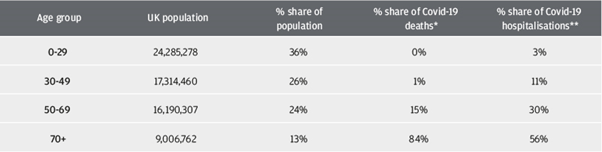
Governments around the world are adopting strategies to vaccinate the most vulnerable first, which should reduce mortality from the virus but also ease the burden on healthcare services. This approach makes sense given Covid-19 causes a disproportionate level of deaths and hospitalisations among older cohorts. In the UK, there are nine million people aged over 70, accounting for 13% of the total population, but 84% of the total Covid-19 deaths and over 50% of total hospitalisations (Exhibit 1).
Exhibit 1: Demographics and Covid-19 in the UK
Source: Office for National Statistics, British Medical Journal, J.P. Morgan Asset Management. *Based on deaths in England and Wales where Covid-19 is mentioned on the death certificate. **Based on an analysis of the first wave published in the British Medical Journal. Data as of 14 January 2021.
Throughout the Covid-19 pandemic we have seen how the health and economic crises have been inextricably linked. If vaccinating the vulnerable significantly reduces the number of new hospital admissions, then governments will feel more comfortable about relaxing restrictions, allowing economic activity to begin normalising.
The pace of vaccine rollout is key
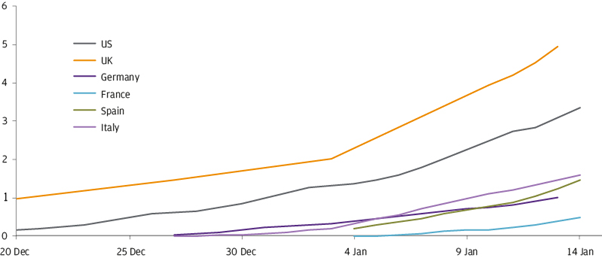
At the time of writing, the UK and US have made solid starts in vaccinating their populations, while the major European economies are off to a slower start (Exhibit 2).
Exhibit 2: Covid-19 vaccine rollout Cumulative doses administered per 100 people
Source: Our World in Data, J.P. Morgan Asset Management. Data as of 14 January 2021.
The UK government has announced an ambitious plan to offer vaccinations to its top four priority groups – amounting to 15 million people – by 15 February. These groups include those over the age of 70, frontline workers and those that are clinically vulnerable. The time between first and second dose of vaccines administered in the UK has been extended to 12 weeks to allow as many people as possible to receive at least the first dose, which the government’s advisers view as the best way to reduce mortality and the strain on the health system.
How feasible is it to vaccinate such a large group of people in such a short space of time? In the 2019-20 flu season, the UK vaccinated over 14 million people over a five-month period. The UK health system already has significant experience in vaccinating millions, but it needs to do it around five times as fast as normal. Several mass vaccination centres are planned around the country to meet this ambition, with some vaccinating 24/7. The government has expressed confidence that this will provide sufficient distributive capacity to allow it to meet its goal, and that distribution needs will be met by the supply of approved vaccines, of which the UK now has three.
We think the target is broadly achievable. Whether or not it is achieved exactly to the day is primarily a political concern, but the proposition of having the majority of the UK’s vulnerable with some protection by the beginning of March ought to be a game-changer (as Exhibit 1 suggests) and allow for a process of sustained economic recovery to begin in the second quarter.
The rollout in the US and EU is likely to continue to lag the UK, but both should still have vaccinated the most vulnerable in the first half of the year. Both the Pfizer and Moderna vaccines are approved in the US and the EU, and sufficient doses have been secured to vaccinate the vulnerable population.
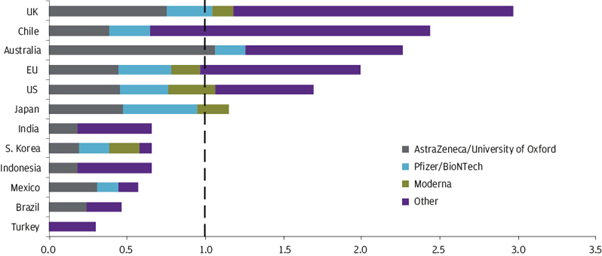
The EU, in particular, will benefit considerably if its regulators approve the AstraZeneca/University of Oxford vaccine in the coming weeks, since it has ordered doses to cover more than 40% of its population and this vaccine is logistically easier to handle (Exhibit 3).
Exhibit 3: Confirmed orders for vaccinations per head of population Complete vaccination courses per head of population
Source: Duke Global Health Innovation Center, World Bank, J.P. Morgan Asset Management. This chart shows the number of complete vaccination courses that a given country has confirmed orders for. Data as of 9 January 2021.
The success of the three pioneering Covid vaccines will have a huge impact in taming the pandemic, but there are also many other vaccine candidates that could be approved in the coming months that would bolster the world’s supply. Novavax and Johnson & Johnson (J&J) are two of 20 vaccine candidates currently in phase III trials, and have large orders confirmed.
However, it is clear that the vaccine rollout will be unequal. The deep pockets of developed governments have allowed them to secure vaccinations to more than cover their populations. Lower-income emerging market countries have order books that fall short of their populations, giving them less room for error in their rollout strategies. As a result, many will have to rely on the COVAX scheme – a consortium set up by the World Health Organisation and others to ensure that all countries have access to Covid-19 vaccines – and can expect a slower return to normality. COVAX has large orders for the AstraZeneca/University of Oxford and J&J vaccines.
One part of the emerging world is less reliant on vaccines for its economic recovery: North Asia. Through effective testing, contact tracing and strict border controls, the region has been able to recover quickly without the help of vaccines. For investors in emerging markets, this disparate outlook calls for a selective approach.
We are optimistic on the path of vaccine rollout, but mindful of tail risks
The rollout of vaccines in the developed world should allow economies to recover sharply in the second half of the year as normality returns and consumers are finally free to unleash their pent-up savings. We expect that the UK and US will have vaccinated over half their populations in the first half of the year, and the EU will reach that milestone during the summer.
The strong rebound in developed market activity should be supportive of risk assets, and in particular stocks that stand to benefit the most from a rotation from the Covid winners to those that lost out from the pandemic. Europe, the UK and the value style stand out in this respect. The emerging markets could also perform well in this environment, driven by continued strong economic performance in Asia and a gradual decline in the US dollar.
Of course, there remain risks. We are less concerned about the vaccine timetable slipping for logistical reasons, and think that plans could even be accelerated. Governments are under tremendous pressure to at least keep up with their neighbouring counterparts. And given the fiscal cost of maintaining economic restrictions, no expense will be spared in driving the rollout.
Uncertainty around take-up is a hurdle for all countries, and surveys suggest a significant degree of scepticism for the Covid-19 vaccine in Europe. Experience in the UK suggests that as the vaccine rollout is proceeding, public confidence is growing, and many may feel increasingly confident of taking up the vaccine as time progresses.
The key risk is that the virus mutates to a new variant that makes the currently approved vaccines ineffective. There is also the risk that vaccine efficacy is lower than initially reported, either among the older population, or across the population from altering the time between first and second doses. Data from trials hasn’t been completely comprehensive in these areas. Many of these risks could be addressed – and rather than derailing the recovery completely, could just provide a setback while new formulations are found. However, we think it prudent for investors to maintain tail-risk protection such as through long-duration government bonds or dynamic fixed income and macro strategies.
A good update from J.P. Morgan with more positive news on the vaccine roll out.
Vaccinating the most vulnerable should drastically reduce mortality and hospitalisations from Covid-19. Hopefully, once the most vulnerable are vaccinated, governments will feel more comfortable about relaxing restrictions, allowing economic activity to begin normalising.
Please continue to check back for our latest blog posts and updates.
Please see below article received from AJ Bell yesterday evening, written by their Investment Director, Russ Mould. The commentary indicates a positive start to 2021 in relation to UK equity markets and predicts market performance for the year ahead.
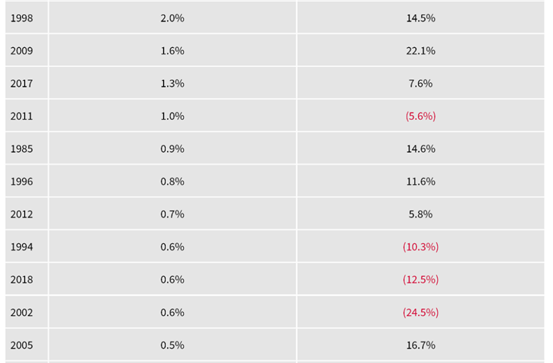
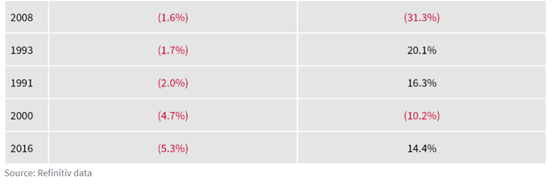
After a rotten showing in 2020, when the FTSE 100 ranked plumb last among major national indices on a local currency, total-return basis, the UK equity market is off to a flyer in 2021. Whether this is a simple case of every dog having its day or the start of a more fundamental turnaround will only become clear with the passage of time, but what is undeniable is that the FTSE 100 has just had its best start to a year in its history, using the capital return over the first five calendar days’ trading as a benchmark.
FTSE 100’s fast start looks promising for the rest of 2021, if history is any guide
“It is eye-catching to see how the FTSE 100 has generated positive capital returns on every occasion bar one when it has begun the year with an opening-week gain of 1% or more.”
The past is no guarantee for the future, as all advisers and clients know (and the numbers show that a bad start does not guarantee a bad overall outcome). Even so, it is eye-catching to see how the FTSE 100 has generated positive capital returns on every occasion bar one when it has begun the year with an opening-week gain of 1% or more. That exception was 1987 and even that year looked like plain sailing until October, although a nasty reckoning then followed with the Crash.
That episode shows that trouble can come when it is least expected and, as part of any risk-management review, advisers and clients will look at what can go wrong. There is a saying that “bull markets end when the money runs out” and, at the moment, there seems to be no shortage of cheap cash upon which financial markets can feast, as central banks continue to run ultra-loose monetary policy and governments around the world continue to provide fiscal support to their economies, racking up huge budget deficits in the process.
“Spotting misallocation of capital is important when it comes to market tops. In 1999–2000 and 2006–7, overpriced merger and acquisition deals had a role to play. So did a very active market for Initial Public Offerings (IPOs) and secondary sales of stock by either vendors or companies themselves.”
So perhaps advisers and clients need to start wondering where all of this money could go, or what could soak it up, to end the bull run. Spotting misallocation of capital is also key. In 1999–2000 and 2006–7, overpriced merger and acquisition deals had a role to play. So did a very active market for Initial Public Offerings (IPOs) and secondary sales of stock by either vendors or companies themselves. Many of those IPOs were in what turned out to be overpriced tech, media and telecoms stocks in 1999–2000, while miners and junior oil explorers, property stocks and financial investment vehicles took centre stage in 2006–7 (and more of the last-named in a moment), to eventual great cost to buyers of this new paper.
Some advisers’ and clients’ interest may therefore be piqued by the announcement of planned stock flotations by Moonpig, Foresight Group and Dr Martens at the start of 2021, even if the specifics of the individual companies will be left to their preferred UK equity managers to assess.
Functioning markets
In some ways, these new flotations could be a good sign.
They suggest that capital markets are working well and doing what they are supposed to do, which is provide capital that companies can use to invest and hire, create wealth and ultimately help the economy to grow.
Fund managers may also see them as a chance to buy into new, exciting stories that generate capital gains or welcome income over the long term for their clients, or at least offer the potential for a quick turn if a deal looks like it is going to be hot and the shares are going to spike.
However, a sudden flood of new market entrants might also be warning sign, on the grounds that you can have too much of a good thing.
“Not surprisingly given the circumstances, and especially last spring’s stock market rout, newcomers to the London market were relatively few and far between in 2020, although the pace did pick up in the second half and some deals, such as THG, proved to be absolute winners.”
Not surprisingly given the circumstances, and especially last spring’s stock market rout, newcomers to the London market were relatively few and far between in 2020, although the pace did pick up in the second half and some deals, such as THG, proved to be absolute winners.
Overall, the number of new issues and IPOs in London last year was the second-lowest since 2009 and the end of the Great Financial Crisis, according to data from the London Stock Exchange (only 2019 was lower).
New issue activity has been relatively quiet in the UK for some time
Source: London Stock Exchange
Over £7 billion was raised by primary offerings, the highest figure since 2017, and that exceeded the sums generated by market newbies in 2009, 2012, 2015, 2018 and 2019.
And with only a select number of names announcing plans for an IPO so far in 2021, it is too early to be pressing the panic button about a deluge of new issues swamping investors and snuffing out the UK market’s attempt to forge a sustained bull run.
The £7.3 billion raised in 2020 came nowhere near the £31 billion of 2006 and £27 billion of 2007, right before trouble hit and the bear market began, or the £18.7 billion peak of the prior cycle in 2000.
Warming up
But advisers and clients need to be on their guard. The US market has shown signs of an overheated new offerings market, especially given the post-listing surges in names such as Airbnb and DoorDash, the coming to market and the lofty valuations at which many new entrants have gone public and the torrent of Special Purpose Acquisition Companies (SPACs) that have listed, in a manner that is eerily reminiscent of 2006–7 on both sides of the Atlantic.
“The US market has shown signs of an overheated new offerings market. The UK is showing no real signs of any of those, which is reassuring, although advisers and clients will also want to keep an eye on secondary offerings too, since they can also soak up cash that could otherwise be deployed elsewhere.”
The UK is showing no real signs of any of those, which is reassuring, although advisers and clients will also want to keep an eye on secondary offerings too, since they can also soak up cash that could otherwise be deployed elsewhere.
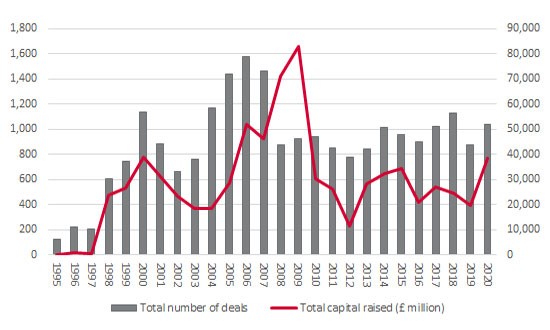
Over 950 secondary deals, including rights issues, placings for cash, open offers, subscriptions and further issues took place in 2020, perhaps understandably as many companies tapped their shareholders for fresh liquidity to help see them through the pandemic and the subsequent recession. London-listed and quoted firms raised over £31 billion, the highest figure since 2008–9 when companies were again in cash-raising, crisis-management mode.
Secondary issuance began to pick up in 2020 as many firms scrambled for cash
Source: London Stock Exchange
That meant the total cash raised across primary and secondary deals reached nearly £39 billion, again the highest mark since 2009. Couple that with hefty cuts to dividend payments and a collapse in share buyback activity and it is no surprise that the UK stock market’s headline indices struggled to make headway in 2020.
Total UK equity issuance picked up in 2020 just as dividends and buyback activity fell
Source: London Stock Exchange
Watch the flow
Dividend payments are expected to rebound this year and buyback activity could conceivably start to pick up, too, should the global economy really begin to gain traction in the wake of vaccination programmes.
This remains far from certain, however, and advisers and clients do need to be on their guard in case the steady flow of new deals becomes a flood, especially if deal quality starts to flag and certain hot or popular sectors witness very high levels of activity. This is not a problem in the UK, as Foresight Group, Dr Martens and Moonpig all come from different sectors and industries, but advisers and clients might like to make sure that their chosen fund managers bear in mind Warren Buffett’s warning, should copycat deals start to proliferate:
“First come the innovators, who see opportunities that others don’t. Then come the imitators who copy what the innovators have done. And then come the idiots, whose avarice undoes the very innovations they are trying to use to get rich.”
We will continue to publish relevant market analysis and news, so please check in again with us soon.