Please see below this week’s Blackfinch Group Monday Market Update received this morning– 23/05/2022.
Blackfinch Group Monday Market Update Issue 93 | 23rd May, 2022
UK COMMENTARY
Consumer Price inflation hit 9% in the 12-months to April, according to the Office for National Statistics (ONS). This was the UK’s highest inflation rate since 1982.
The ONS also reported that the UK’s unemployment rate dropped to 3.7% in the first three months of the year, its lowest level since 1974, as competition for workers pushed up job vacancies to record highs.
NORTH AMERICA COMMENTARY
The US Commerce Department reported a month-on-month rise in retail sales of 0.9% in April, despite inflation reaching a 40-year high.
Labour markets strengthened across the US in April as unemployment rates fell in most states and the District of Columbia. Encouragingly, labour force participation, which measures the percentage of the working age population either employed or looking for work, also increased in most states.
EUROPE COMMENTARY
The European Commission (EC) downgraded its forecasts for European growth in 2022 from 4.0% to 2.7%, citing the supply chain disruption and higher energy commodity costs driven by the war in Ukraine.
With some European countries heavily dependent on Russian energy exports, growth is expected to slow to 2.3% in the European Union (EU) and euro area in 2023.
The fastest-growing EU countries this year are expected to be Portugal at 5.8%, followed by Ireland at 5.4%. The weakest growth is expected from Estonia, with just 1%, followed by Germany and Finland, both with growth of 1.6% respectively.
According to the EC, inflation in the euro area is expected to average 6.1% this year, three times the European Central Bank’s target, having hit record highs of 7.5% in April.
ASIA COMMENTARY
Unemployment in China rose to 6.1%, while property sales saw their biggest fall since August 2006. Sales of new homes plunged 47% in April from a year earlier, according to the National Bureau of Statistics.
Please continue to check back for our latest blog posts and updates.
Please see the market update below received this morning from Brooks Macdonald – 19/05/2022
What has happened
The bounce in global equities that had buoyed sentiment on Tuesday, faded fast on Wednesday. Selling the previous day’s rally, investors seemed to focus back on concerns around near-term inflation pressures in particular. In company news, US general merchandise retailer Target missed estimates and the shares fell around 25%, but rather than a read on the health of the US consumer in aggregate, it looked more about the impact of a consumer shifting away from pandemic-driven elevated goods spend, which hit Target’s sales of goods outside of its grocery lines, such as TVs and kitchen appliances. Also on Wednesday, UK CPI data showed inflation rose to 9% Year on Year in April, slightly below a consensus estimate of 9.1%. Boosted by the 1st April rise in the energy price cap, the headline inflation rate reached a 40 year high. In currency markets, Sterling fell versus the Dollar on concerns that the Bank of England might have to tread more carefully around near-term inflation pressures, in order to guard against longer-term economic growth risks.
US retailer Target delivers an off-target negative surprise
US general merchandise retailer Target reported 1Q earnings on Wednesday, but missing estimates the stock fell around 25%. While the retailer was impacted by higher costs (including fuel costs), and supply chain troubles, the dominant impact seemed to be the company caught by a bigger than expected consumer shift out of goods (especially durable goods) such as TVs and kitchen appliances, that had done well during the pandemic, leaving the company overstocked and forced to mark down prices. Without stimulus cheques fuelling spending, combined with a return to more normal consumption patterns as consumers move back towards services, this was seen as a factor the company. As the Target CEO Cornell said on Wednesday, “three core merchandise categories, apparel, home and hardlines, we saw a rapid slowdown … while we anticipated a post-stimulus slowdown and we expected consumers to continue refocusing spending away from goods and into services, we didn’t anticipate the magnitude of that shift.”
Markets caught in an investor sentiment tug-of-war
Markets are caught in an investor sentiment tug-of-war battle at the moment, but relatively high levels of market volatility are likely to be with us for a while yet. For central banks, the challenge is getting the balance right between taming near-term inflation pressures while not impacting longer-term economic growth, but it’s a challenge that’s fraught with difficulty. With US Fed Chair Powell hoping for a “softish landing” and UK BoE Governor Bailey seeing a “narrow path” between the risks of inflation and growth, the question as to whether central banks can successfully thread-the-needle on policy unfortunately has no short-term answer.
How is the inflation picture shaping up?
The inflation picture is rightly dominating investors’ attention, but it can be unpacked into a number of different drivers currently. COVID has created price ‘disruption’ as a result of the post-pandemic restart and the imbalance in supply chains between both goods and services as well as demand and supply. War in Ukraine this year has complicated the inflation picture, adding significant price ‘shocks’ to energy and food in particular. But price ‘disruption’ and price ‘shocks’ are not enough by themselves to kick-start a multi-year inflation process. For that a necessary component would be a significant and sustained rise in inflation expectations (including wage expectations). However, analysis last week from the Peterson Institute for International Economics suggests that the big news in the US April jobs report published earlier this month was a potentially slowing wage growth picture. Looking at US average hourly earnings, the annualized rate of growth (once adjusted for compositional changes in the labour force), was 3.8% over the past three months, a pace considerably slower than in 2021, which saw peaks around 7%.
What does Brooks Macdonald think?
At Brooks Macdonald, we recognise that the current inflation picture is complex and multifaceted. On balance, we expect the current high inflation rates to start to ease over the remainder of this year and into 2023 – but how quickly (and how far) inflation drops back (as well as the impact to economic growth further out from interest rate hikes in the interim), remain difficult to gauge. Ultimately, it’s one of the reasons why, within equities, we continue to hold to our barbell balance between growth/defensive and value/cyclical investment styles at the current time.
Please continue to check our Blog content for advice and planning issues and the latest investment, markets and economic updates from leading investment houses.
Please see below ‘Markets in a Minute’ article received from Brewin Dolphin yesterday evening, which provides a global update on markets and economies.
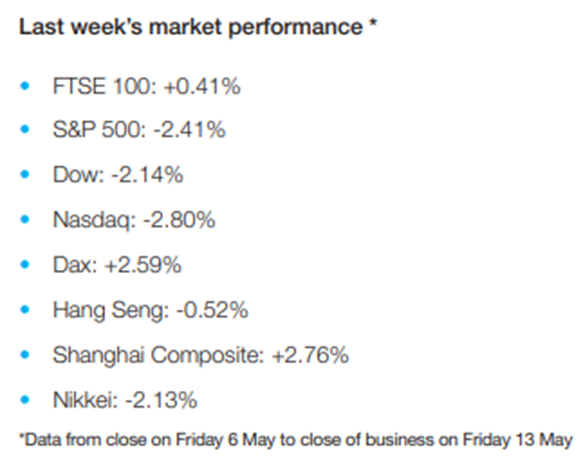
European indices rose last week despite heightened concerns about the economic outlook and inflation.
The pan-European STOXX 600 bounced back from its earlier losses to finish the week up 0.8%, while Germany’s Dax rose 2.6%. The FTSE 100 added 0.4%, notwithstanding data showing UK gross domestic product (GDP) unexpectedly contracted in March.
Chinese stocks also rose as the number of Covid-19 cases declined and the China Securities Regulatory Commission pledged to boost confidence in the Shanghai Composite, which is Asia’s worst-performing index so far this year. The index ended the week up 2.8%.
In contrast, US indices fell amid fears the Federal Reserve’s attempts to rein in inflation by increasing interest rates would spark a recession. The Dow fell 2.1% in its seventh consecutive week of losses, while the Nasdaq and S&P 500 slipped 2.8% and 2.4%, respectively.
China’s economy slows as lockdowns hit growth
Stocks were mixed on Monday (16 March) after data from China showed the country’s zero-Covid policy had hit economic activity. The Shanghai Composite slipped 0.3% as retail sales slumped 11.1% year-on-year in April – much worse than the 6.1% decline forecast by economists in a Reuters poll. Industrial production fell 2.9% from a year ago, while unemployment in China’s 31 largest cities jumped to 6.7%. US indices were mostly in the red on Monday, whereas the FTSE 100 managed to reverse earlier losses to finish the trading session up 0.6%.
The FTSE 100 was up 0.4% at the start of trading on Tuesday as investors mulled the latest jobs data from the Office for National Statistics (ONS). Unemployment fell to 3.7% in the first three months of 2022, the lowest level since 1974, while the number of job vacancies in February to April rose to a record 1,295,000.
UK economy shrinks as cost of living rises
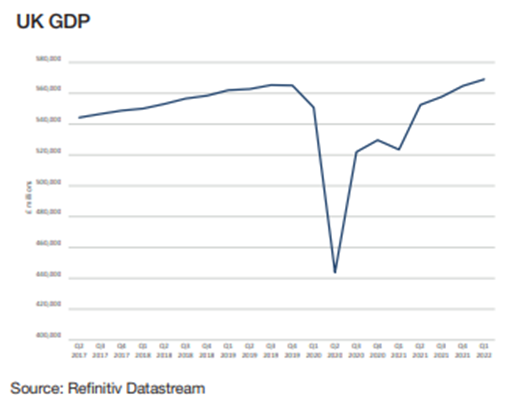
Last week’s economic headlines focused on the unexpected contraction in the UK economy. Figures from the ONS showed GDP slipped by 0.1% in March, driven by a 0.2% decline in services as consumers cut back on spending. Consumer-facing services plunged by 1.8%, led by a sharp 2.8% fall in wholesale and retail trade. Production also fell by 0.2%, whereas construction grew by 1.7%.
The fall in GDP came as a surprise to investors who had been expecting a small rise from the previous month. Figures for February were also revised down from 0.1% growth to no growth, which meant the economy expanded by just 0.8% in the first quarter, less than the 1.0% growth forecast by economists.
The data has exacerbated fears that the UK could slide into a recession – defined as two consecutive quarters of declining GDP – later this year. It comes as households face the biggest cut in real incomes since the 1950s as inflation outpaces wage gains. The ONS is expected to announce that inflation topped 8.0% in the 12 months to April when it releases the next consumer prices index report on Wednesday (18 May).
US inflation moderates less than hoped
Over in the US, inflation slowed in April to an annual rate of 8.3%, down from 8.5% in March, according to the Labor Department. While the data suggests price increases may be peaking, the rate of inflation was higher than consensus estimates of around 8.1%. Core inflation, which excludes food and energy, also pulled back less than expected to 6.2% versus estimates of 6.0%.
On a monthly basis, prices rose by 0.3% in April, the smallest increase in eight months. However, prices for services surged by 0.7% and airline fares jumped by 18.6%, the largest increase on record. The price gains mean workers continue to lose out, with real wages falling by 0.1% month-on-month despite a nominal increase of 0.3% in average hourly earnings. Over the past year, real earnings have dropped by 2.6%.
The inflation report came in the same week as data showing US consumer sentiment slumped to its lowest level for nearly 11 years in early May. The University of Michigan’s preliminary results showed the index of consumer sentiment fell to 59.1 in May from 65.2 in April. The gauge of current economic conditions dropped to 63.6, the lowest reading since 2013, with 36% of consumers attributing their negative assessment to inflation. Buying conditions for durables reached the lowest reading since the question began appearing on the monthly surveys in 1978, again primarily due to high prices. Meanwhile, the measure of consumer expectations fell to 56.3 from 62.5.
ECB could raise interest rates in July
Christine Lagarde, the president of the European Central Bank (ECB), said in a speech last week that she expected the bank to stop expanding its balance sheet through bond purchases early in the third quarter and to raise interest rates “some time” after that, which “could mean a period of only a few weeks”. The comments have led several economists to declare that the first rate hike for more than a decade will go ahead in July. A growing number of governing council members are calling for a 25-basis-point rise in the ECB’s deposit rate at the 21 July policy meeting. The deposit rate is currently -0.5% and has been negative since 2014.
It comes amid concerns that Russia’s invasion of Ukraine could keep inflation high for longer than initially expected. According to comments reported in the Financial Times, Lagarde said the war was “likely to accelerate two ongoing structural changes which, during the transition they entail, could lead to further negative supply shocks and cost pressures”. She added that the ECB’s new quarterly forecasts to be published in June were “increasingly pointing towards inflation being at least on target over the medium term”.
Please check in again with us shortly for further relevant content and news.
Please see this week’s Weekly Market Commentary update from Brooks Macdonald received late yesterday afternoon:
Hopes grow that China can turn a corner on COVID-19, as Shanghai authorities signal an easing of restrictions ahead
After a difficult week, markets managed a decent bounce on Friday but the mood has soured coming into trading on Monday, following a slew of weaker than expected data out of China. Amongst the data releases, China Industrial production fell -2.9% Year on Year (YoY) vs +0.5% expected, and retail sales was down -11.1% YoY vs -6.6% expected. Despite the disappointment, it’s important to keep in mind that COVID-19 lockdowns in April were the main culprit behind the weaker data, but the good news is that the virus situation looks to be improving. In Shanghai (home to the world’s biggest container port), on Sunday the city reported a second day of no COVID-19 infections outside government-mandated quarantine, and local authorities there have now signalled a timetable for the easing of restrictions and aim to return to normality as early as the start of June. Starting the return to more normal economic activity, on Monday, the city will begin to reopen supermarkets, convenience stores and pharmacies. Elsewhere in China, with the exception of Beijing, outbreaks in rest of the country look to have eased as well. Assuming this all proves durable, it paves the way for a possible rebound in the economic data going forwards.
Inflation on the radar as UK CPI data is due this week, but keep in mind the caveats with year on year comparisons
After last week’s focus on US CPI (Consumer Price Index data), this week sees more CPI prints for the month of April, including the UK on Wednesday. UK April Core CPI (excluding energy and food) is expected to rise to 6.2% YoY, up from 5.7% YoY in March. The UK headline CPI (including energy and food) is expected to grab most of the headlines however, with an expected print of 9.1% YoY, boosted in part by the 54% rise in the energy price cap set by Ofgem which was introduced on 1st April and which is expected to make its way into the latest reading. With inflation still the focus, markets will be trying to gauge whether the more hawkish cadence from central banks over the past few months has started to filter through into any changes in consumer activity. Taking a temperature-check on spending, we have retail sales data due from the US on Tuesday and the UK on Friday. When we look at UK CPI Year on Year inflation prints, it is important to keep in mind that these tell us just as much about what was happening to prices a year ago, as much as it does about what is happening to prices today. For the UK, this time last year, April 2021 YoY Core CPI was running at 1.3%. Back then, the UK economy was still in the process of coming out of lockdown, with non-essential retail shops only opening up midway through the month, and with restrictions on mixing between different households still in place. As such, the April 2022 CPI print due out on Wednesday is going to be comparing a reasonably ‘normal economy’ this year against a somewhat ‘restricted economy’ last year – as such, while the headline prints will undoubtably generate big headlines, we should treat YoY comparatives with a bit of caution.
Sterling is the pressure release-valve as the risk grows of a UK-EU Brexit bust-up over the Northern Ireland Protocol
Speculation is mounting that the UK government might be willing to unilaterally override parts of the Brexit Northern Ireland Protocol, and an announcement on this might come as soon as this week. In response, the EU has warned that the protocol is a ‘cornerstone’ of the wider UK-EU withdrawal agreement and renegotiation is not an option. The prospect of a possible UK-EU Brexit bust-up has fed into currency markets, with Sterling falling to around 1.22 vs the Dollar last week, levels last seen around May 2020 during the height of the pandemic. Expect Sterling to continue to be the immediate pressure release valve, but there is a potential knock-on factor for inflation also: should Sterling see sustained weakness, then this also risks adding to the current inflation pressures, by adding to import costs.
Please continue to check our Blog content for advice and planning issues and the latest investment, markets and economic updates from leading investment houses.
Please see the market update below received this morning from Brooks Macdonald.
What has happened
After a difficult week, markets managed a decent bounce on Friday but the mood has soured coming into trading on Monday, following a slew of weaker than expected data out of China. Amongst the data releases, China Industrial production fell -2.9% Year on Year (YoY) vs +0.5% expected, and retail sales was down -11.1% YoY vs -6.6% expected. Despite the disappointment, it’s important to keep in mind that COVID lockdowns in April were the main culprit behind the weaker data, but the good news is that the virus situation looks to be improving. In Shanghai (home to the world’s biggest container port), on Sunday the city reported a second day of no Covid-19 infections outside government-mandated quarantine, and local authorities there have begun to ease some restrictions and aim to return to normality as early as the start of June. Elsewhere in China, with the exception of Beijing, outbreaks in rest of the country look to have eased as well. Assuming this all proves durable, it paves the way for a possible rebound in the economic data going forwards.
Inflation and retail sales data due this week
After last week’s focus on US CPI, this week sees more CPI prints for the month of April, including the UK on Wednesday (along with Eurozone’s final revision), and Japan on Friday. For the UK specifically, April Core CPI (excluding energy and food) is expected to rise to 6.2% YoY, up from 5.7% YoY in March, and up 0.8% Month on Month (MoM), down slightly from 0.9% previously. The UK headline CPI (including energy and food) is expected to grab most of the headlines however, with an expected print of 9.1% YoY. With inflation still the focus, markets will be trying to gauge whether the more hawkish cadence from central banks over the past few months has started to filter through into any changes in consumer activity. Taking a temperature-check on spending, we have retail sales data due from the US on Tuesday and the UK on Friday.
Risks to Sterling (and inflation) from a possible UK-EU Brexit bust-up
Speculation is mounting that the UK government might be willing to unilaterally override parts of the Brexit Northern Ireland Protocol, and an announcement on this might come as soon as this week. In response, the EU has warned that the protocol is a ‘cornerstone’ of the wider UK-EU withdrawal agreement and renegotiation is not an option. The prospect of a possible UK-EU Brexit bust-up has fed into currency markets, with Sterling falling to around 1.22 vs the Dollar last week, levels last seen around May 2020 during the height of the pandemic. Expect Sterling to continue to be the immediate pressure release valve, but there is a potential knock-on factor for inflation also: should Sterling see sustained weakness, then this also risks adding to the current inflation pressures, by adding to import costs.
What does Brooks Macdonald think
With Year on Year inflation prints, it is important to keep in mind that these tell us just as much about what was happening to prices a year ago, as much as it does about what is happening to prices today. For the UK, this time last year, April 2021 YoY Core CPI was running at 1.3%. Back then, the UK economy was still in the process of coming out of lockdown, with non-essential retail shops only opening up midway through the month, and with restrictions on mixing between different households still in place. As such, the April 2022 CPI print due out on Wednesday is going to be comparing a reasonably ‘normal economy’ this year against a somewhat ‘restricted economy’ last year – as such, while the headline prints will undoubtably generate big headlines, we should treat YoY comparatives with a bit of caution.
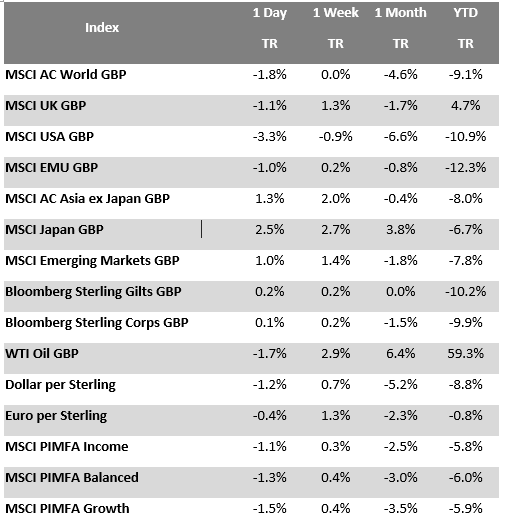
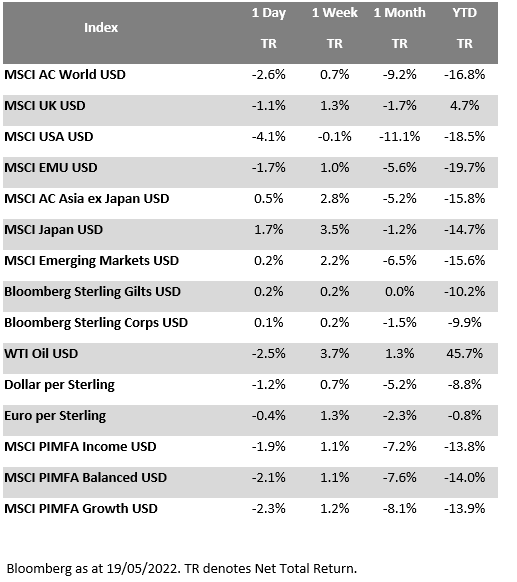
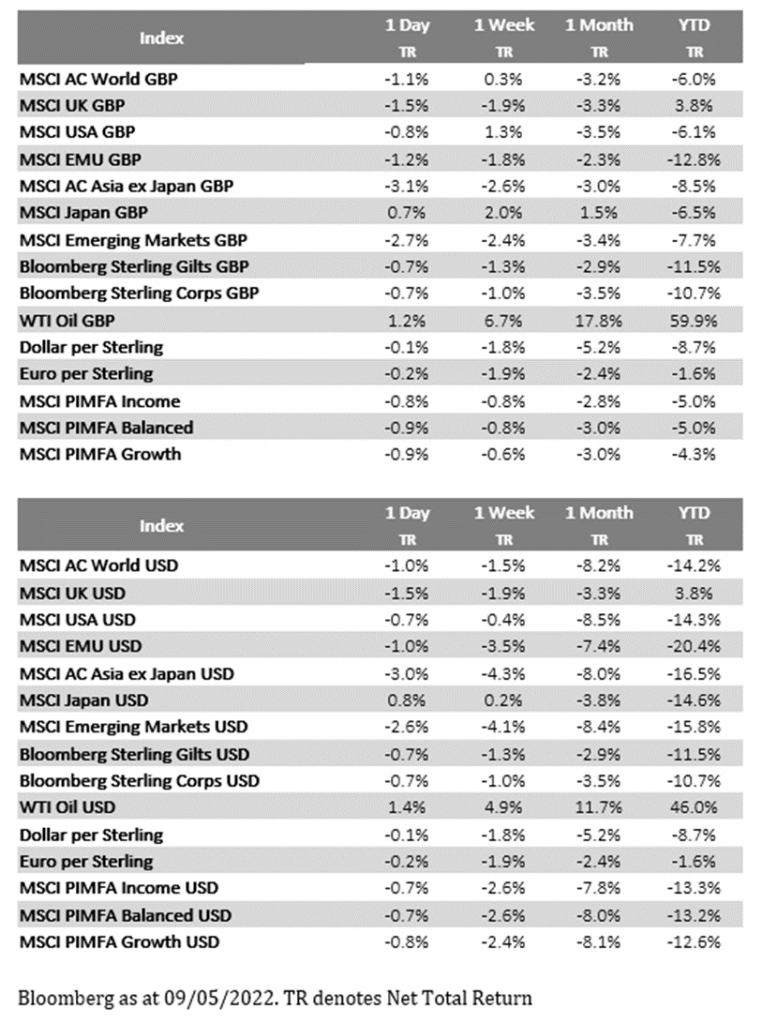
Bloomberg as at 16/05/2022. TR denotes Net Total Return.
Comment
It’s pretty volatile at the moment with the challenges to markets from inflation, global supply chain disruption, China’s policy on covid, the UK and the EU negotiating, and not least Central Banks policy changes. Brooks Macdonald’s comment on inflation is interesting, you need perspective on these figures.
Markets are forward looking and will be looking for glimmers of good news. We just need to be patient and remain invested whilst we wait for some positive news. Regular monthly funding is a good idea and if you have the risk appetite lump sum investing at this time could be good value.
Please see investment bulletin below from Brooks Macdonald received this afternoon – 13/05/2022.
What has happened
Intraday volatility continues to be a major theme, with a late US rally dragging the US index from almost 2% down last night to close broadly flat. Today’s initial market moves point to a more buoyant session however with the recent intraday swings and the index losses already seen this week, this needs to be kept in context.
Bond market moves
The sell-off at the start of 2022 was driven by inflation fears being priced into higher interest rate expectations which made high growth equities, in particular, less attractive. This current sell-off is dominated by economic growth fears as demonstrated by the US bond market which is starting to price in fewer rate hikes over the next year as investors conclude that the Fed is likely to blink in the face of lower growth. Yesterday Fed Chair Powell confirmed the market view that 50bp hikes were likely to be appropriate at the next two Fed meetings. When discussing the economic growth outlook, Powell appeared less bullish than in previous speeches saying that the interest rate path was likely to ‘include some pain’. Additionally, he said that whether a soft landing could be achieved was largely up to matters outside the Fed’s direct control such as broader supply chain issues and global growth momentum. This largely echoes the market’s conclusion that central banks are boxed in by economic data at this time.
China’s lockdown
The lockdown in Shanghai has shone a spotlight on China’s zero-COVID policy with the onshore and Hong Kong equity indices selling off aggressively after the region had outperformed earlier in the year. Today has started to see a strong rebound, driven in part by the better risk-on tone of the last 24 hours but also a recognition that the Chinese government’s move from a hard zero-COVID policy to a softer zero community-transmission policy is likely to limit the duration of the lockdown. On this basis, Shanghai officials have put forward a plan to start reopening the city on 20th May, buoying sentiment.
What does Brooks Macdonald think
Although the CPI figures (justifiably) have controlled the headlines this week, the PPI data which looks at producer rather than consumer prices reading was released yesterday. Headline PPI fell from 11.5% year-on-year in March to 11% in April, echoing the CPI theme of slower year-on-year growth but still very elevated levels of inflation. Producer prices are an important lead indicator for consumer pressures down the line so a rolling over of these annual figures will support the narrative that year-on-year inflation is showing signs of slowing.
Please continue to check back for our latest blog posts and updates.
Please see below article received from AJ Bell this afternoon, which informs investors of the key factors driving stocks, bonds and other assets in the markets currently.
Many investors are frustrated that a lot of the stocks, funds and bonds in their portfolios have fallen in value this year. It’s been a chaotic time on the markets and negative events keep unfolding.
Inflation is at levels not seen for decades, the first major European war of the 21st century has broken out, and after years of ultra-low interest rates central banks are starting to tighten monetary policy.
Inflation has accelerated over the past year
Investors face a tricky task of determining when things might get better and what they should do with their investments in the meantime. Sitting tight and staying invested is a good strategy, but more active investors might be interested in tweaking their portfolios based on the outlook.
In this article we look at what the experts are forecasting for inflation, economic growth and interest rates and what market observers think has already been priced in. Our aim is to give a picture of how bad life could get or whether things might already be starting to improve.
UKRAINE SHAPES THE OUTLOOK
There is one key source of uncertainty which makes gauging the outlook difficult, namely the progress of the tragic conflict triggered by Russia’s invasion of Ukraine.
As Andrew McCaffery, global chief investment officer for asset manager Fidelity, observes: ‘The war in Ukraine has already caused significant economic damage, and it will continue to shape the near-term outlook for global economies, particularly Europe. Outcomes over the coming quarter will be heavily influenced by the timeline to a resolution and the easing of trade disruptions.
‘In the meantime, any hopes for a moderation in energy prices and supply-chain disruptions have been dashed. Together, these dynamics will continue to dampen growth and put upward pressure on already high inflation.
‘This paints an extremely complex picture, both for policymakers and the markets. We believe the market has yet to reflect the full range of possible outcomes, which span extreme left and right tail risks.’
These ‘tail risks’ refer to more positive or negative outcomes than expected. In this context it’s useful to see what is being anticipated by forecasters and what are the best and worst-case scenarios.
Trying to second guess what happens next in Ukraine is difficult. Chief Europe economist at consultancy Capital Economics, Andrew Kenningham, says: ‘Unfortunately assumptions about the war have steadily got worse over the past two months. We were hoping and assuming the conflict would ease towards the end of the year.
‘Without forecasting exactly what will happen on the ground we are now working on the assumption the conflict will continue with no early resolution but also no major escalation.’
Assuming this reasoning proves correct, companies and countries may be able to adjust to the disruption but if the conflict widens or deepens in any way this could present a new risk for financial markets.
INFLATION
The supply chain issues and high food and energy prices which have contributed to rising prices remain in place. The reintroduction of Covid restrictions in China, the so-called factory of the world, has only added to these inflationary pressures.
UK consumer price inflation forecasts (Q4 2022)
However, there are reasons to think we are close to peak levels of inflation. Investment bank Berenberg expects US inflation to peak at 8.1% and UK inflation to peak at 8.6%, both in the second quarter.
Jennifer McKeown, at the consultancy Capital Economics, says: ‘Globally inflation is going to come down this year thanks to very strong base effects linked to the reopening of economies in the second half of last year.’
Saying that inflation has peaked, for now, is not the same thing as predicting a rapid fall in prices. Berenberg forecasts inflation will remain above 6% in the final quarter of 2022 in the US and the first three months of next year for the UK.
Consensus forecasts on UK inflation may not go far enough. Panmure Gordon chief economist Simon French was already on record as saying UK inflation could hit double digits in 2022 before the Bank of England surprised many observers with a prediction for inflation to peak above 10% at the end of this year.
This would represent the highest level in 40 years but doesn’t seem too extreme given UK inflation data, up to the end of March, is yet to reflect Ofgem’s lifting of the energy price cap by 54% at the beginning of April, with a further big increase expected in October.
The chances of wholesale energy prices easing substantially are limited by attempts on the part of European countries to wean themselves off Russian gas and oil. The US, which is effectively energy independent by comparison, is more insulated on this front.
Tight labour markets, particularly in the developed world, are also contributing to inflation as wages increase.
Eurozone unemployment hit a record low of 6.8% in March and the US reported record job openings for the same month.
GDP
Surging inflation is one of the key reasons economists have been busily revising down growth forecasts this year. In its latest World Economic Outlook, published in April, the International Monetary Fund lowered its global growth forecast to 3.6% in 2022 and 2023. This was 0.8 and 0.2 percentage points lower respectively than in the January report.
UK GDP 2022 forecasts
There is little debate over whether the post-Covid economic recovery has been hit by the Ukrainian conflict. The question is whether it could be derailed entirely. We are already facing stagflation, which is a toxic combination of slowing growth and rising prices.
The yields on two-year and 10-year US government bonds recently inverted, i.e., the longer-dated debt offered a lower yield than the more short-term debt, which is often seen as a signal of recession and US GDP unexpectedly contracted 1.4% in the first quarter.
Nonetheless, non-profit research organisation The Conference Board does not believe a US recession is likely in 2022 – even under its modelling of some extreme scenarios, including oil hitting $200 per barrel.
COVID STILL A PROBLEM
The two main risks to this view are policy mistakes on the part of the US Federal Reserve and mutation or resurgence of Covid-19. Remember the pandemic continues to rage in some parts of the world.
There seems to be a greater risk of recession in Europe. Russia and closely linked emerging European economies look particularly vulnerable to a downturn but developed Europe too could risk slipping into a slowdown.
Capital Economics’ Andrew Kenningham says: ‘For the Eurozone overall we are forecasting almost flat second and third quarters with Italy and Germany at risk of falling into technical recessions; France and Spain should avoid that.’
A technical recession is defined as two consecutive quarters of negative growth and while the Bank of England thinks this fate can be avoided, it is forecasting a 0.25% contraction in UK GDP for 2023.
Outside of the US and Europe, China may be on a different trajectory with the easing of restrictions as Covid cases come down, helping growth to increase through the course of the year. Whether it can hit Beijing’s target of 5.5% is open to question.
INTEREST RATES
The finely balanced outcomes on inflation and economic growth create a tricky backdrop for central banks. It seems certain the Federal Reserve, Bank of England and, even the laggard of the three, the European Central Bank will end the year with higher interest rates.
However, the exact pace and trajectory of those increases remains in question. In its latest update (4 May) the US Federal Reserve lifted rates by 0.5 percentage points for the first time since 2000 but signalled it was not considering a 0.75 percentage point increase in rates for now.
The central bank did nothing to suggest consensus expectations for rates to finish 2022 somewhere around 2.5% were out of whack.
Nick Clay, who runs investment manager Redwheel’s global equity income team, observes: ‘I think the Fed’s been boxed into a corner. It will lead on this, but bond yields particularly in America have already priced a lot of that in.
‘Corporates and governments because of their levels of indebtedness are going to find it difficult to suffer higher interest rates for any length of time. By the time we get to the end of this year we will look back at this period and realise this was the peak in interest rates within the bond yield even if the Fed is still raising rates.’
The negative economic assessment which accompanied the Bank of England’s latest rate hike to 1% (5 May) suggests it may look to avoid hiking rates materially from here. Consensus expectations are for UK rates to reach a high of 2% next year but not everyone agrees with this assessment.
Capital Economics’ chief UK economist Paul Dales says: ‘We think longer-lasting domestic price pressures will mean the MPC (Bank of England’s Monetary Policy Committee) ends up raising rates to a peak of 3% next year, which compares to the peaks of 2.5% priced into the markets and 2% expected by other analysts.’
The European Central Bank may not have moved on rates yet, but it opened to the door to a July rate rise at its meeting in April.
The central bank faces an even more difficult task than the Fed and Bank of England given it needs to balance the needs of economies with very different dynamics. Inflationary pressures are also more acute in the Eurozone given its heavy reliance on Russian energy imports.
Berenberg forecasts two 0.25 percentage point interest rate rises in the third and fourth quarter of this year which would still leave Eurozone rates a long way behind those in the US and UK.
WHERE WILL THE MARKETS END UP?
How much of the increase in rates, reduced growth prospects and higher inflation have been factored in by the markets?
There is no question that investors have reacted to these events. The first quarter saw bond and stock prices fall in tandem for the first time in nearly 30 years.
The table shows how global stock markets have performed year-to-date and it paints an ugly picture in most places. The UK’s FTSE 100 index is doing best thanks to its strong commodities exposure. In the US, the Nasdaq receives the wooden spoon as investors turn away from highly rated growth stocks.
Rupert Thompson, investment strategist at asset manager Kingswood, comments: ‘The falls in both bonds and equities have been driven by the move towards stagflation, the unpalatable combination of high inflation and stagnation in economic activity. Worries on this front have been bolstered by recent developments.’
How major stock markets have fared in 2022
Will there be more pain to come for stocks? In early April, investment bank Goldman Sachs updated its year-end forecasts for the S&P 500 index in the US for a closing level at the end of December of 4,700.
This would represent a modest drop versus 2021’s closing level of 4,766 and compares with a current level of 4,125. This represents its best-case scenario. In the event of a recession the bank thinks the index could fall to 3,600.
Bank of America says there have been 19 bear markets in the past 140 years. A bear market is a 20% decline or more from recent highs.
The average price decline in these 19 bear markets was 37.3% and an average duration of 289 days. It says: ‘Past performance is no guide to future performance, but if it were, today’s bear market ends on 19 October 2022 with the S&P 500 at 3,000 and the Nasdaq at 10,000. The good news is many stocks are already there, e.g., 49% of companies in the Nasdaq are more than 50% below their 52-week highs.’
S&P 500
Elsewhere, Morgan Stanley forecasts the S&P 500 to end 2022 at 4,200, JPMorgan predicts 4,900 and Barclays estimates 4,800.
Gains for US stocks have been driven by the big technology companies and as Redwheel’s Nick Clay says, ‘They are very expensive. Even the best company in the world at the wrong valuation becomes the riskiest company. Your expectations are so high they can’t even deliver on those extended expectations.’
Corporate earnings are holding up well. On 29 April Factset said that of the 55% of companies in the S&P 500 which had reported results for first quarter to that point, 80% had reported earnings per share above estimates, which was greater than the five-year average of 77%.
As we write, about half of the STOXX 600 companies in Europe have reported so far and 71% of those have topped analysts’ profit estimates according to Refinitiv IBES data. Typically, one might expect just over half of companies in this index to beat estimates in a quarter.
The question is whether results for the first three months of 2022 reflect the full impact of rising input costs and reduced consumer spending. After all, some businesses are still enjoying a post-pandemic recovery in demand and may also have been able to react to inflation by driving efficiencies.
It will be worth keeping close tabs on the second quarter and first half reporting season to see if earnings can continue to beat forecasts or if mounting inflation and weaker demand start to have a wider negative impact.
Clay at Redwheel says: ‘I think interest rates aren’t going to go up as much as people ultimately fear they might have to, and therefore by the end of this year we’re going to start talking about when they are going to stop raising rates and start cutting them again. The backdrop has plateaued. We’ve had the worst of it.’
WHAT SHOULD INVESTORS DO?
Many readers will be nursing portfolio losses but it is important not to panic. It is worth having a good look at your investments and if any specific holding has performed very poorly, particularly if it has fallen more than the 13.4% year-to-date decline in the MSCI World, then it is worth taking a good look at why.
However, unless anything fundamental has changed on an individual investment then it is worth staying invested and riding out the volatility if you have time on your side. Time in the market is better than trying to time the market.
Asset manager BlackRock found that if you had invested a hypothetical $100,000 in the S&P 500 index of US stocks between 1 January 2001 and 31 December 2020 you would be sitting on $424,760 if you stayed invested but by missing just the best five days that number dropped to $268,277. Often the best days follow some of the very worst.
One way of smoothing out the impact of volatility and remaining invested in the markets is to invest regularly. By doing so you benefit from an effect called pound cost averaging.
When markets rise, a monthly contribution buys fewer shares or units in a fund. When markets fall the same contribution buys more shares or fund units.
In terms of what you should invest in, Fidelity’s Andrew McCaffery says: ‘We believe focusing on high quality companies, rather than sector selection, is the best approach given the rising geopolitical and stagflation risks.
‘Companies with pricing power and the ability to protect margins should perform relatively strongly in this environment. Equities should still provide a robust source of income, now that balance sheets have been repaired following the worst of the pandemic.’
Please check in again with us soon for further relevant content and news.
Please see below last week’s Market Summary from Brewin Dolphin, which was published and received yesterday afternoon:
Please continue to check our Blog content for advice and planning issues and the latest investment, markets and economic updates from leading investment houses.
Please see below a Weekly Market Commentary, received from Brooks Macdonald, yesterday evening – 10/05/2022
Please continue to check our Blog content for advice and planning issues and the latest investment, markets and economic updates from leading investment houses.
Please see investment bulletin below from Brooks Macdonald received this morning – 09/05/2022.
What has happened
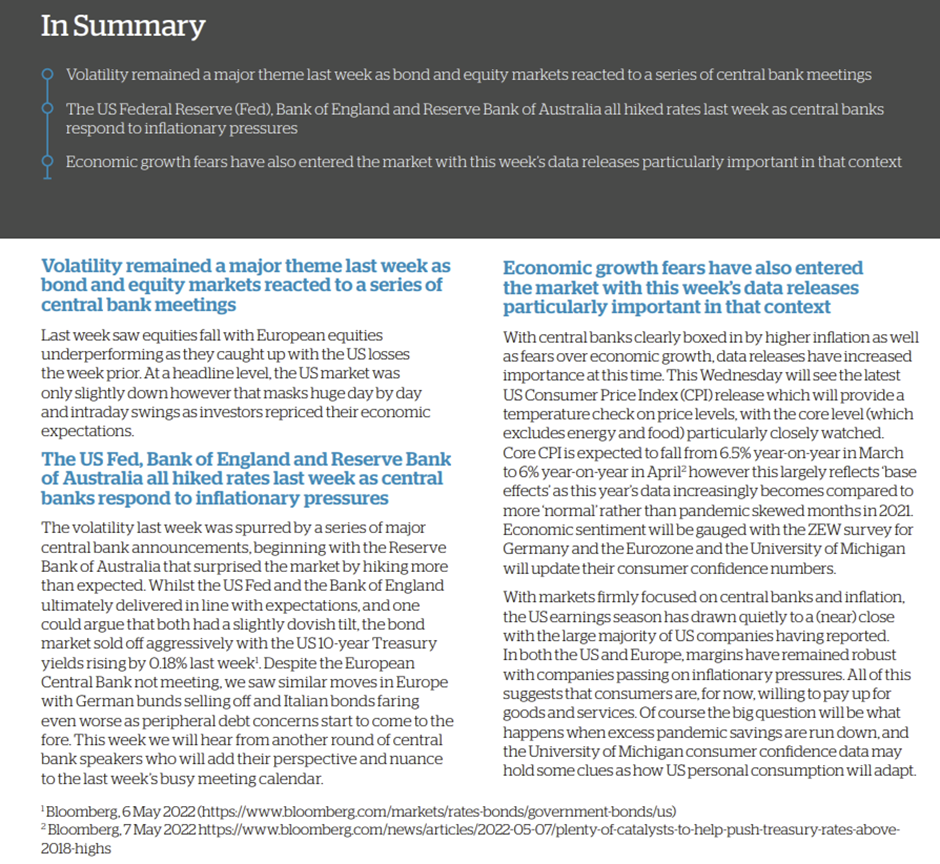
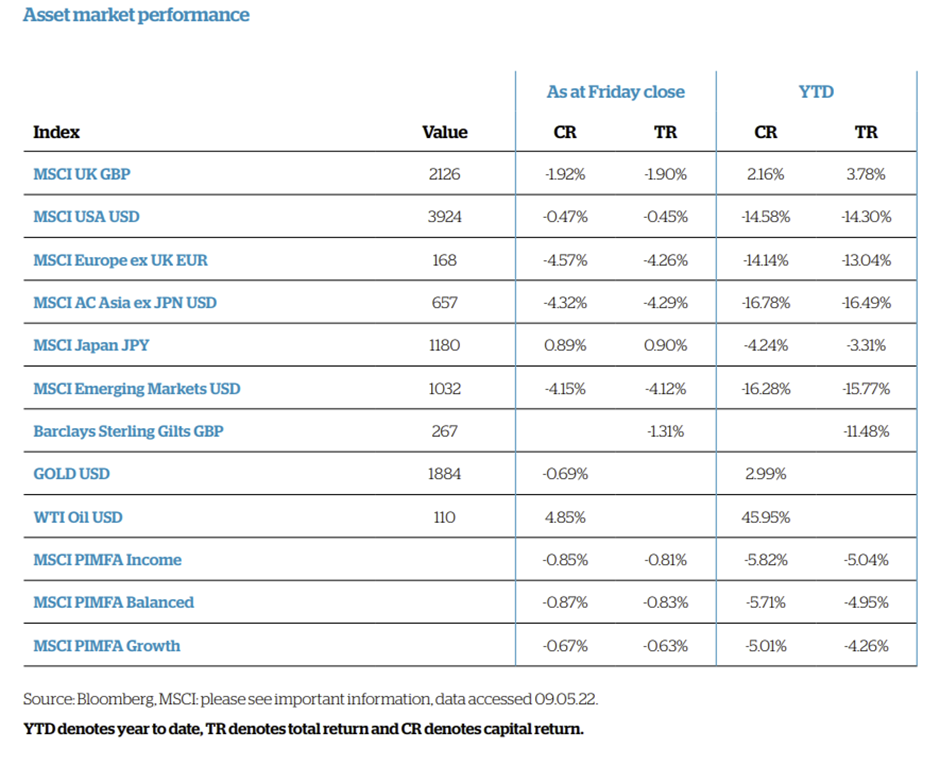
Last week saw equities fall with European equities underperforming as they caught up with the US losses the week prior. At a headline level, the US market was only slightly down however that masks huge day by day and intraday swings as investors repriced their economic expectations.
Central banks
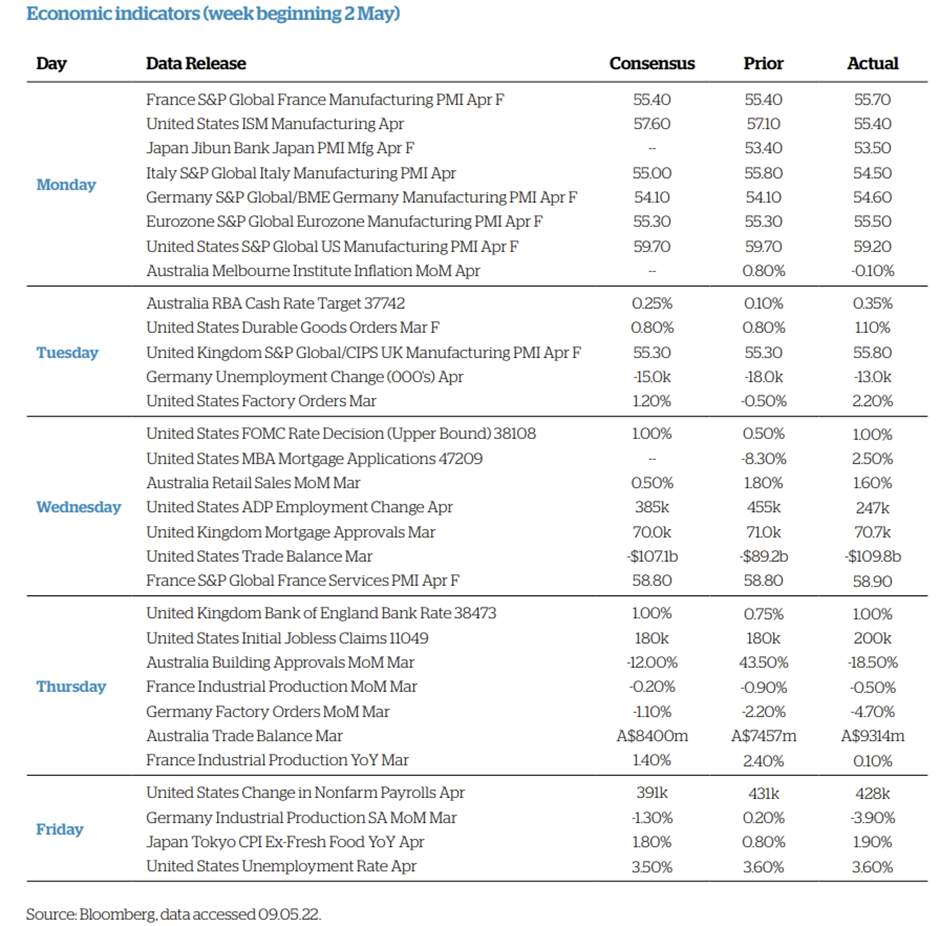
The volatility last week was spurred by a series of major central bank announcements, beginning with the Reserve Bank of Australia that surprised the market by hiking more than expected. Whilst the US Fed and the Bank of England ultimately delivered in line with expectations, and one could argue that both had a slightly dovish tilt, the bond market sold off aggressively with the US 10-year Treasury yields rising by 0.18% last week. Despite the ECB not meeting, we saw similar moves in Europe with German bunds selling off and Italian bonds faring even worse as peripheral debt concerns start to come to the fore. This week we will hear from another round of central bank speakers who will add their perspective and nuance to the last week’s busy meeting calendar.
Economic data
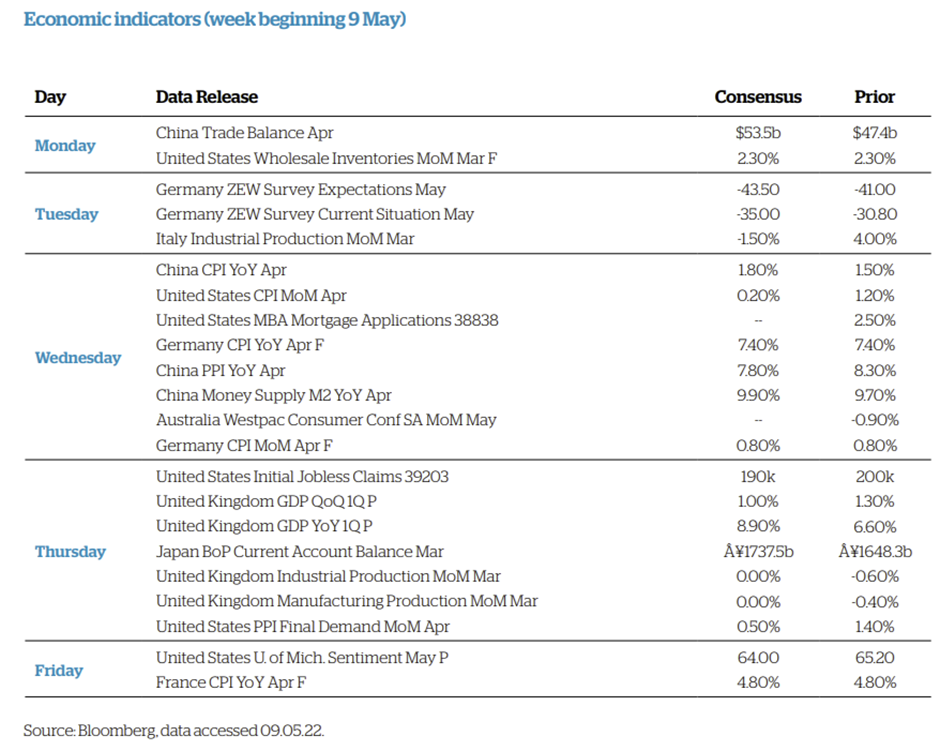
With central banks clearly boxed in by higher inflation as well as fears over economic growth, data releases have increased importance at this time. This Wednesday will see the latest US CPI release which will provide a temperature check on price levels, with the core level (which excludes energy and food) particularly closely watched. Core CPI is expected to fall from 6.5% year-on-year in March to 6% year-on-year in April however this largely reflects ‘base effects’ as this year’s data increasingly becomes compared to more ‘normal’ rather than pandemic skewed months in 2021. Economic sentiment will be gauged with the ZEW survey for Germany and the Eurozone and the University of Michigan will update their consumer confidence numbers.
What does Brooks Macdonald think
With markets firmly focused on central banks and inflation, the US earnings season has drawn quietly to a (near) close with 90% of US companies having reported. In both the US and Europe, margins have remained robust with companies passing on inflationary pressures. All of this suggests that consumers are, for now, willing to pay up for goods and services. Of course the big question will be what happens when excess pandemic savings are run down, and the University of Michigan consumer confidence data may hold some clues as how US personal consumption will adapt.
Please continue to check back for our latest blog posts and updates.