Team No Comments

Is my employer playing tricks with my pension?

Pensions, particularly Workplace Pensions, are quite often considered to be confusing.  Please see Tom Selby of A J Bell’s article below explaining a little about Auto-Enrolment contributions.

A reader wants to know why the sums don’t add up with retirement savings

Thursday 05 May 2022 Author: Tom Selby

I’m being automatically enrolled into a workplace pension scheme and was told this would be 8% of my salary. However, I’ve just done the sums and my contribution works out less than this – can this possibly be right? I also have a friend who hasn’t been auto-enrolled at all. Are we being shafted by our employer?

Spencer


Tom Selby, AJ Bell Head of Retirement Policy says:

Under auto-enrolment rules, all employers, regardless of size, are required to enrol staff in a pension scheme and pay a minimum level of contributions.

The reason for the reforms was simple – millions of people weren’t saving for retirement. While lots of organisations had a pension scheme, this wasn’t a legal requirement. Even where there was a scheme, plenty of employees simply didn’t join.

Auto-enrolment was first introduced in 2012 for the UK’s largest employers, with medium and smaller employers brought in and contributions scaled up until 2019.

AM I BEING SHAFTED?

While I cannot rule out the possibility your employer isn’t playing by the rules, the answer is likely a lot simpler.

Under auto-enrolment legislation, employees are required to contribute a minimum of 4% and employers 3%, with a further 1% coming via basic-rate tax relief – taking the total to 8%. Employees have the option to opt out of the scheme if they want to, although they miss out on the employer contribution if they do.

However, the minimum requirement is 8% of ‘band earnings’ rather than 8% of total earnings. For 2022/23, the earnings that qualify for minimum auto-enrolment contributions are those between £6,240 (the lower earnings limit for National Insurance contributions) and £50,270 (the upper earnings limit).

Take, for example, someone earning £20,000 a year. If their 8% contribution was based on their total earnings, they would expect £1,600 in total to go into their pension during the 2022/23 tax year.

But if the contribution is based on band earnings, then it will be 8% of (£20,000 – £6,240), which is £1,100.80.

WHAT ABOUT MY FRIEND?

There are various legitimate reasons your friend might not have been auto-enrolled.

If they are under 22 years old or over state pension age (66) then they will not qualify for auto-enrolment, although they have the option to opt-in.

If they have earnings below £10,000 (the auto-enrolment earnings ‘trigger’) they also will not qualify for auto-enrolment, although again they have the option to opt-in if they want to.

Furthermore, employers have the option of not auto-enrolling new joiners for the first three months of their employment.

As an IFA & Employee Benefit Consultant, and an employer, I understand both the value of pensions and how we need to clearly communicate with staff about pensions and employee benefits.  Pension contribution rates can make a significant difference over time to the value of your total pension funds on retirement.  And whether or not you can afford to retire early!

Communication can be key.  Employees need to know what pension provision they have got, what they might need to retire, forecast how it may grow, and how they can make up any potential pension fund shortfall.

Steve Speed 06/05/2022
Team No Comments

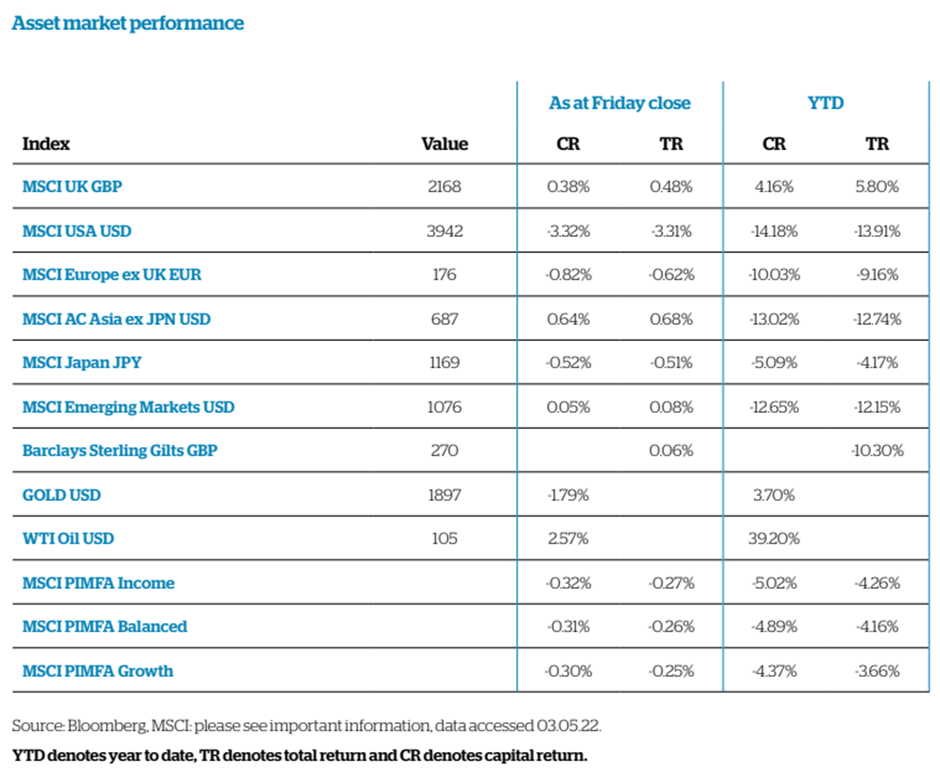
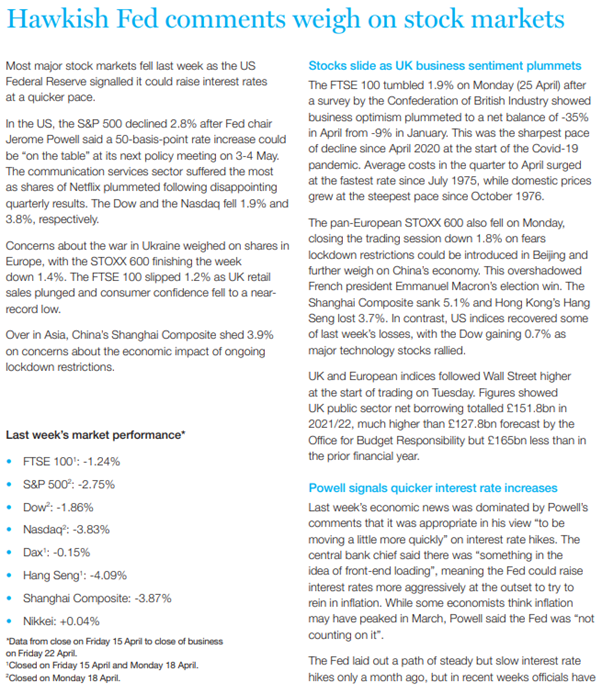
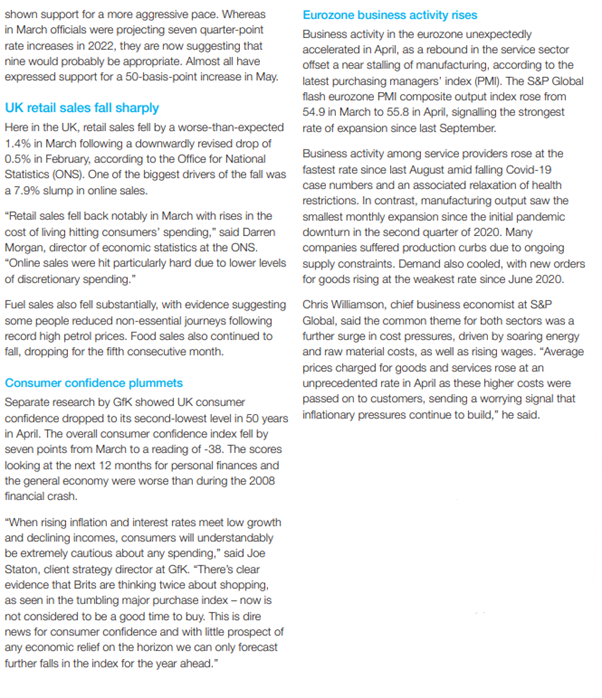
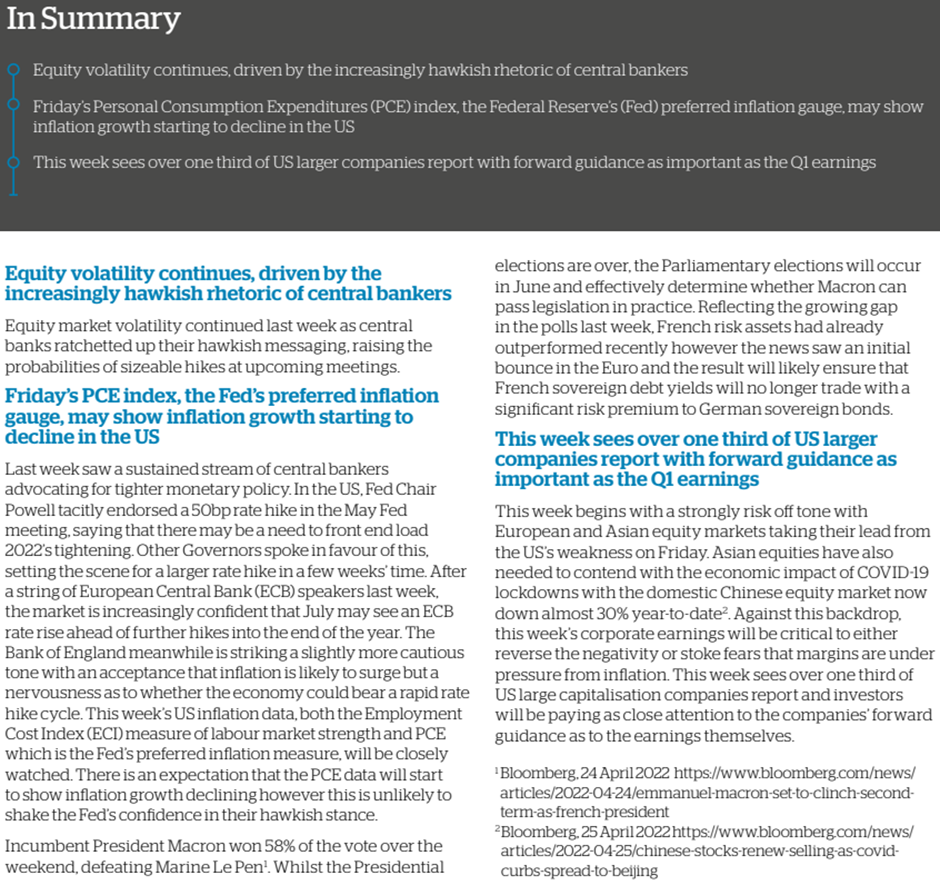
Brooks Macdonald – Weekly Market Commentary

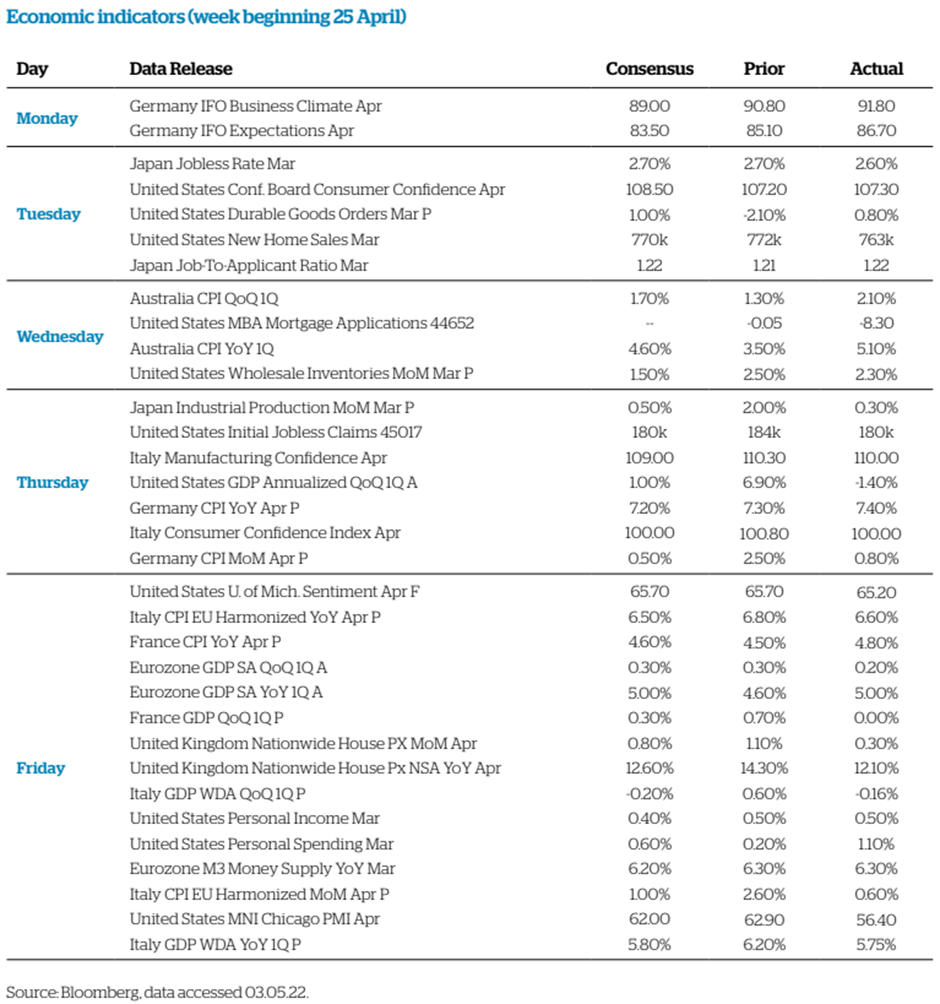
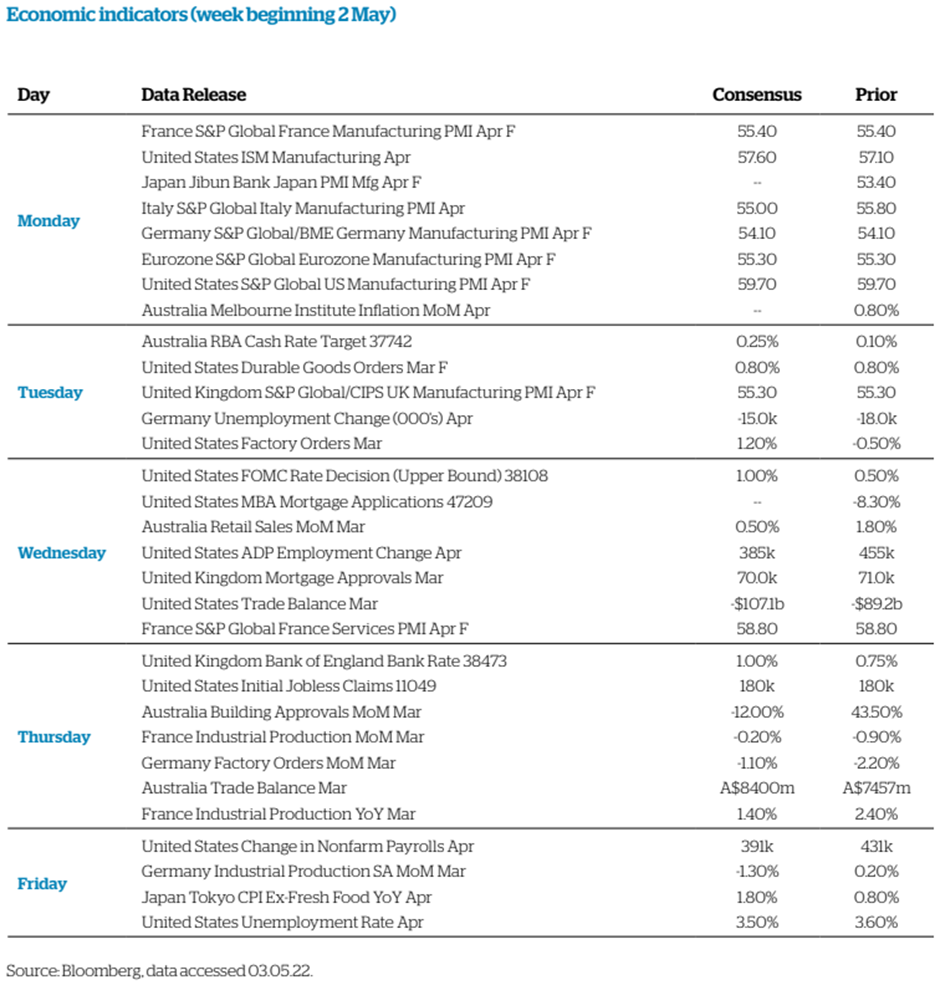
Please see below last week’s Market Summary from Brooks Macdonald, which was published and received yesterday afternoon:

Please continue to check our Blog content for advice and planning issues and the latest investment, markets and economic updates from leading investment houses.

Please keep safe and healthy.

Carl Mitchell – Dip PFS

Independent Financial Adviser

04/05/2022

Team No Comments

Blackfinch Group Monday Market Update (on a Tuesday!)

Please find below, an update on markets, received this morning from Blackfinch – 03/05/2022

Personal insolvencies have reached a three-year high, as the cost-of-living crisis has left more people unable to repay their debts. There were 32,305 individual insolvencies in England and Wales in the first quarter of 2022, according to the Insolvency Service, which was a 17% increase on insolvencies in the previous quarter.

April’s Industrial Trends Survey from the Confederation of British Industry, the first quarterly survey since Russia’s invasion of Ukraine, suggested a sharp fall in confidence from UK manufacturers. Business optimism fell to a net balance of -34% in April, from -9% in January.
 

The US Federal Reserve’s preferred measure of consumer inflation – the Personal Consumption Expenditures (PCE) price index – hit a 40-year high. It increased 6.6% in the year to March, with energy prices up 33.9% and food up 9.2%.

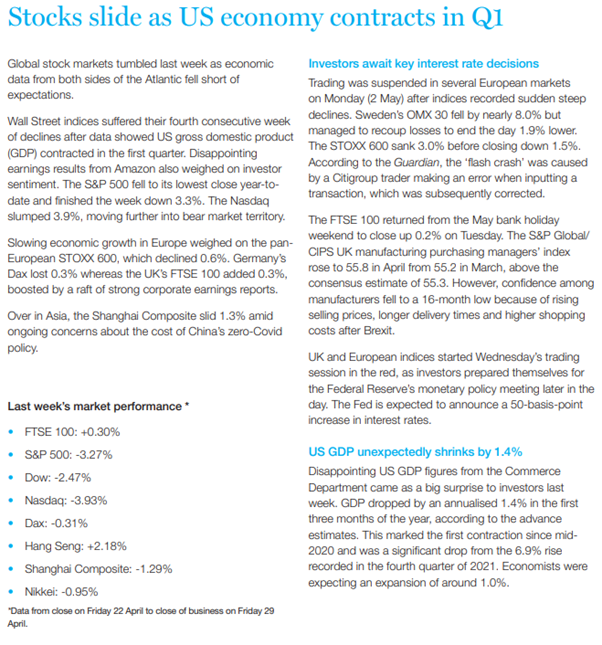
The US economy shrank unexpectedly for the first time since the initial COVID-19 outbreak. According to the US Bureau of Economic Analysis. US gross domestic product (GDP) in the first quarter of 2022 fell 0.35%, or at an annualised rate of 1.4%.

US consumer sentiment improved in April, according to a University of Michigan survey. Its index of consumer sentiment increased from 59.4 in March to 65 in April, but was still significantly below the 88.3 reported in April 2021. Most of the improvement came from gains of 21.6% in the year-ahead outlook for the US economy and an 18.3% jump in personal financial expectations.

The number of Americans filing new claims for unemployment support fell last week, according to the US Labor Department. There were 180,000 ‘initial claims’ filed, down from 185,000 the previous week, suggesting the jobs market remains solid.
 

The Eurozone faces stagflation (slowing economic growth and high inflation) after statistics agency Eurostat reported growth slowed to 0.2% in the first quarter of 2022 while inflation hit a record level of 7.5%.

Natural gas prices jumped as much as 20% as Russia’s energy company Gazprom cut gas supplies to Poland and Bulgaria, after both countries refused to pay for gas in roubles.

Consumer confidence in Germany has reached an all-time low, according to analytics firm GfK. Its confidence index, based on a poll of 2,000 Germans, fell from -15.7 in April to -26.5 in May, far worse than expected.
 

Russia’s central bank lowered interest rates from 17% to 14%. Economists had expected a smaller cut to 15%, but borrowing costs are still much higher than before the Ukraine war.

Please continue to check our Blog content for advice and planning issues and the latest investment, markets and economic updates from leading investment houses

David Purcell

3rd May 2022

Team No Comments

Invesco – Global growth, the French election and the Fed

Please see article below from Invesco received this morning – 29/04/2022

Global growth, the French election, and the Fed

Last week was another busy, momentous one. Below, we discuss three key topics: global growth, the French election, and the Federal Reserve’s hawkish comments.

Growth expectations fall for the globe

Not surprisingly, the International Monetary Fund (IMF) downwardly revised growth expectations due to Russia’s invasion of Ukraine and the consequences. The IMF now expects 2022 global growth of 3.6%, rather than the 4.4% it projected back in January, and it also expects 3.6% global growth in 2023.1 Drilling down into developed and emerging economies, growth expectations for developed economies were lowered to 3.3% in 2022 and 2.4% in 2023, down from January’s forecast of 3.9% in 2022 and 2.6% in 2023.1 Expectations for emerging economies were also downgraded to 3.8% in 2022 and 4.4% in 2023, from 4.8% in 2022 and 4.7% in 2023; however, this suggests a solid re-acceleration in growth in 2023 for emerging economies.

Russia’s invasion of Ukraine also caused the IMF to increase its inflation projections to 5.7% in developed countries and 8.7% in EM countries, which is 1.8 and 2.8 percentage points higher, respectively, than January 2022 inflation projections.1

However, the big news is around China and concerns about its growth. The IMF downgraded its estimate for China’s 2022 growth to 4.4% from 4.8%1 amid fears that Beijing will see lockdowns given a spike in COVID infections. Obviously concerns are growing about China’s ability to deliver anywhere near the official target of around 5.5% given the COVID lockdowns. Recent news of the variant spreading into China’s capital city and the resulting lockdown of an area on the eastern side of the city have led to domestic market jitters. Local residents in the area have been asked to stay at home until April 27, until two mandatory mass COVID tests have been completed.

It is clear that in March, COVID lockdowns impaired consumption, and that situation is only getting worse. In this environment, I wouldn’t be surprised to see China’s second-quarter gross domestic product (GDP) disappoint. However, that does not change my far more positive view of the back half of 2022, when we expect a rebound from COVID and more policy support, which should lead to strong growth in the second half of this year. That may not get us to 5.5% growth for the year, but it is likely to keep growth above 4.5% for the year. Furthermore, a second-half mid-cycle acceleration in China would also point to the potential for stronger growth going into 2023 – which would jive with the IMF’s view of a re-acceleration of broader emerging markets growth in 2023, given strong trade links between China and many other emerging market countries.

Market sentiment in China is understandably weak since the economy is facing many headwinds that have led to weak first-quarter earnings. However, domestic investor sentiment could be nearing a bottom. Looking at the recent trading data, the A-share average daily turnover rate was only 1.2% last week and margin trading is at significantly lower levels now compared to 2018’s rout.2 In addition, valuations are looking increasingly attractive.

Macron secures victory in France

Other big news of the week is not about the economy or markets – it’s about the French elections. Despite market concerns that Marine Le Pen would win in the second and final round of the presidential election, Emmanuel Macron was able to pull off a victory, with a spread that was wider than expected. I expect this to reduce fear and volatility in European markets, although a victory had already become priced in in recent days so there has been no “Macron bounce.” I think the takeaways are significant. This can be viewed as a victory for the European Union and NATO despite real consumer pain due to high inflation.

So for the time being, this election represents the maintenance of the status quo. Where there is more interest (and the potential for change) is the upcoming legislative elections (June 12 and 19). At the moment, Macron’s La Republique en Marche party holds 312 out of 577 National Assembly seats, hence Macron has been working with a friendly Parliament and has been able to appoint a prime minister from his own party, which has enabled him to realize more policy objectives, including economic reforms.

Given the presidential election results, with the success of the far-right and the far-left, it is possible that the legislative elections will be less clear cut this time. Recall that in 2017, Macron and his party were surfing a wave of enthusiasm; that is far from the case now, with many electors either abstaining during the second round of votes on Sunday or reluctantly voting for Macron to avoid a Le Pen presidency. Those dissatisfied voters may see the parliamentary elections as a way to deliver a rebuke to Macron without running the risk of an extreme change in leadership at the top.

Hence, the French Parliament could now be more fragmented, with the possibility that Macron has to choose a prime minister from outside his own party. If that is the case, we need to remember that the president controls defense and foreign policy, with the PM controlling domestic policy. For example, Lionel Jospin was a Socialist PM during the presidency of Jacques Chirac, and he’s the one who introduced the 35-hour work-week. A PM from the far-right or far-left could introduce a more expansive budget, in which case bond spreads versus Germany may widen and French equities may underperform. However, the key question of European Union (EU) membership would not be in question, as that is under the president’s control. There is an expectation on the international front that Macron will spearhead the further integration of Europe, stepping into Angela Merkel’s shoes. He already was instrumental in the debt mutualization behind the Recovery Fund and the long-term success of the euro is likely to depend on further fiscal integration of the member states. Macron is also committing to further defense spending and has been a proponent of greater cooperation in the EU on this matter. This should help to maintain market stabilization, in our view.

Taking a step back, we have to recognize that the establishment of En Marche in 2016, Macron’s centrist party, reshaped the political landscape in France. It effectively meant there are three voting blocs: far-left, center, and far-right. The traditional center-left and center-right parties have fallen away, being replaced by En Marche over the past six years. That creates a vacuum of eligible market-friendly candidates for the next election in 2027. Macron cannot run again, but Marine Le Pen can and probably will run (despite her protestations to the contrary). Having just registered a vote of 41%3 (the highest ever for a candidate from the far-right), she must be encouraged to believe that she is just one more push away from the presidency, especially if no other charismatic candidate from the center reveals themselves.

The Fed spooks markets


Also last week, markets were spooked by hawkish comments from the Federal Reserve (Fed). On Thursday, not only did Fed Chair Jerome Powell say that a half-point interest rate increase will be “on the table” when the Fed meets in early May, but he suggested there could be half-point hikes at the next several meetings, explaining “We really are committed to using our tools to get inflation back” to more normal levels.4 He made it clear that, “We are going to be raising rates and getting expeditiously to levels that are more neutral,”4 and then higher if needed. St Louis Fed President Jim Bullard was even more hawkish in his comments last week.

In our view, markets should not fear these aggressive comments but should welcome them; hawkish talk can help do the heavy lifting for the Fed and, in my opinion, shape consumer psychology around inflation. This is how the Fed – and other central banks — can potentially orchestrate a soft landing and avoid a recession.

With contributions from Paul Jackson, Arnab Das, Emma McHugh and David Chao

Please continue to check back for our latest blog posts and updates.

Charlotte Clarke


29/04/2022

Team No Comments

Here are some reasons to be more cheerful about your money

Please see below a positive article received from AJ Bell this afternoon, which reminds us of several things that have improved when it comes to managing our finances.

Whether it’s been tax hikes, the cost of living crisis, or the war in Ukraine, doom and gloom hasn’t exactly been hard to find in April. The downbeat mood around household finances is palpable, and understandably so, with the price of essential items rising so rapidly.

At tough times like these, we find it natural to focus on the problem at hand, and batten down the hatches. But it might also help to cheer ourselves up a bit by remembering the positive developments we have seen in the personal finance arena in recent times.

STRONG STOCKS

Let’s start with the stock market. It’s been a decent period for investors, with £10,000 invested in the average global fund 10 years ago being worth £28,230 today. Even an investment in the spluttering UK stock market would have more than doubled your money, turning £10,000 into £20,360, if you had purchased a typical UK equity fund.

Right now, there are quite legitimate concerns around the valuation of the US tech sector, and the potentially damaging effect interest rate rises and inflation may have on global economic growth.

These issues raise the question of whether a stock market correction is waiting in the wings. This is actually always a possibility, and simply part and parcel of stock market investing. But the good news is that even if share prices take a big tumble, many investors would still be sitting on a healthy profit, thanks to the returns made by the global stock market over the last decade.

FALLING COSTS

The cost of investing has also fallen significantly over the years. 1% used to be a fairly competitive dealing commission for stockbrokers to charge twenty years ago. So on a £10,000 trade, you might pay £100 in dealing fees. Now you’re more likely to pay a flat fee somewhere in the region of £10.

Indeed, some platforms don’t charge any commission for share deals. Annual fund charges have come down significantly over the years too. It’s now possible to invest in a plain vanilla index tracker fund for as little as 0.2% a year, including platform charges.

By way of contrast, consider that when the government introduced stakeholder pensions as a ‘cheap’ option for savers in 2001, the annual charges were capped at what was then a competitive 1% a year, and the funds on offer were largely passive.

PENSION FREEDOMS

Pensions themselves have also made great progress. The pension freedoms introduced in 2015 mean that savers have much more control over how they draw on their pensions, rather than being shunted into an annuity.

As interest rates have tracked lower, and taken annuity rates with them, the pension freedoms have undoubtedly helped many people avoid locking into a low income stream for life. It’s also almost ten years since automatic enrolment was introduced, which requires employers to set up, and pay into a pension for their staff.

Since the reforms were introduced in 2012, the proportion of private sector workers saving in a workplace pension scheme has more than doubled from 32% to 75%.

Critics will say that the 8% total contribution rate doesn’t go far enough to replace the final salary schemes of yesteryear. That may be so, but the cost of final salary schemes simply became unaffordable as life expectancy shot up. That was a good thing of course, but with financial consequences.

Detractors can also point to the fact that automatic enrolment doesn’t do anything for the self-employed, who have to fend for themselves on the pensions front. Again, that’s true, but the numbers show that automatic enrolment has still been a success story, and offers a good foundation from which it can be expanded.

That’s particularly the case when you consider that at the launch of the scheme, naysayers predicted automatic enrolment would simply flop, because workers would just opt out in their droves.

A MENTION FOR ISAS

The humble ISA is also worthy of an honourable mention. It’s a tax shelter that can all too easily be taken for granted. The £20,000 allowance is now extremely generous, and is supplemented by a £9,000 allowance for Junior ISAs too.

That compares to an annual allowance of £7,000 when ISAs were introduced in 1999. We often expect tax allowances to be uprated in line with inflation. Well, if that had been the case for ISAs, the annual allowance would now be just £11,350.

None of this is to whitewash the genuine financial pain that is being felt by people up and down the country, but if you want to read about that you have plenty of options right now. Hopefully some of the positive developments listed above might make you feel a bit more upbeat about the current state of personal finances, if only for a while.

Please check in again with us shortly for further relevant content and market news.

Chloe

28/04/2022

Team No Comments

Brewin Dolphin: Markets in a Minute

Please see this weeks Markets in a Minute update from Brewin Dolphin:

Please continue to check our Blog content for advice and planning issues and the latest investment, markets and economic updates from leading investment houses.

Andrew Lloyd DipPFS

27/04/2022

Team No Comments

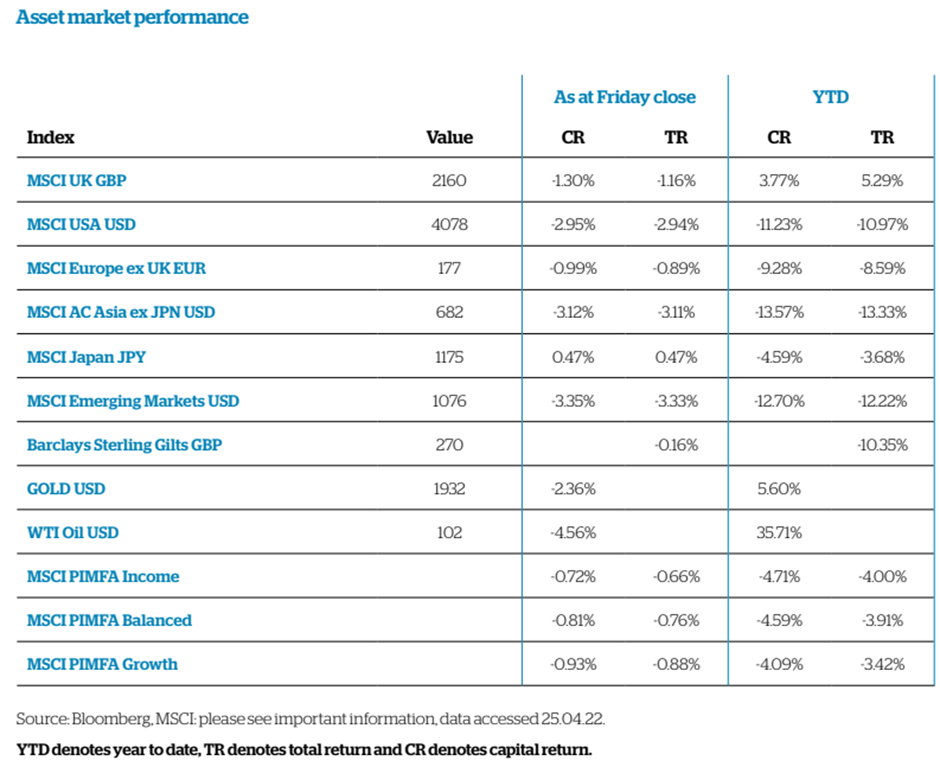
Brooks Macdonald – Weekly Market Commentary

Please see below last week’s Market Summary from Brooks Macdonald, which was published and received yesterday afternoon:

Please continue to check our Blog content for advice and planning issues and the latest investment, markets and economic updates from leading investment houses.

Please keep safe and healthy.

Carl Mitchell – Dip PFS

Independent Financial Adviser

26/04/2022

Team No Comments

Blackfinch Group Monday Market Update

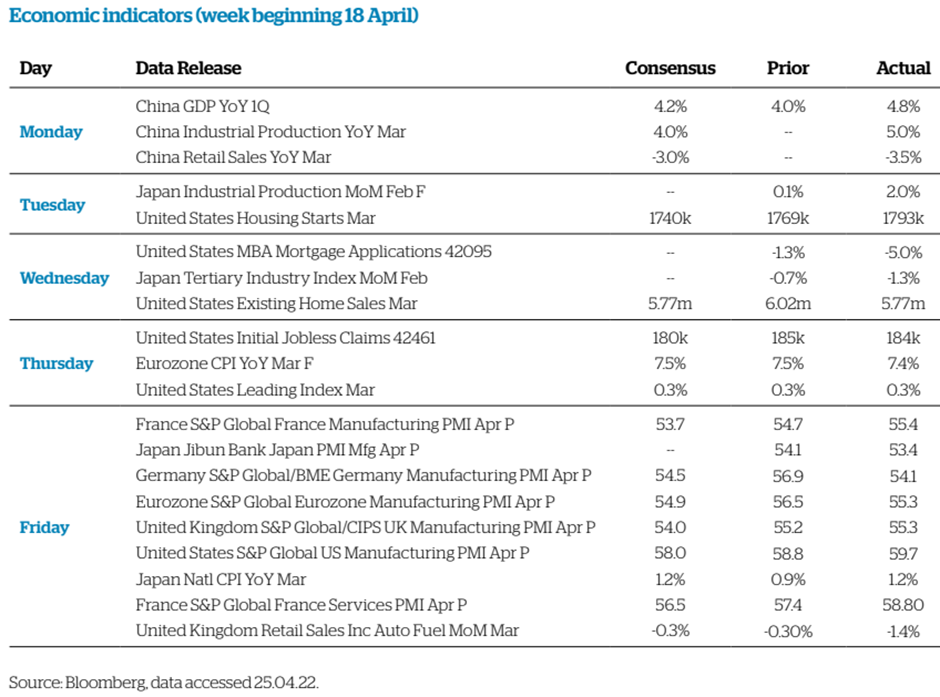
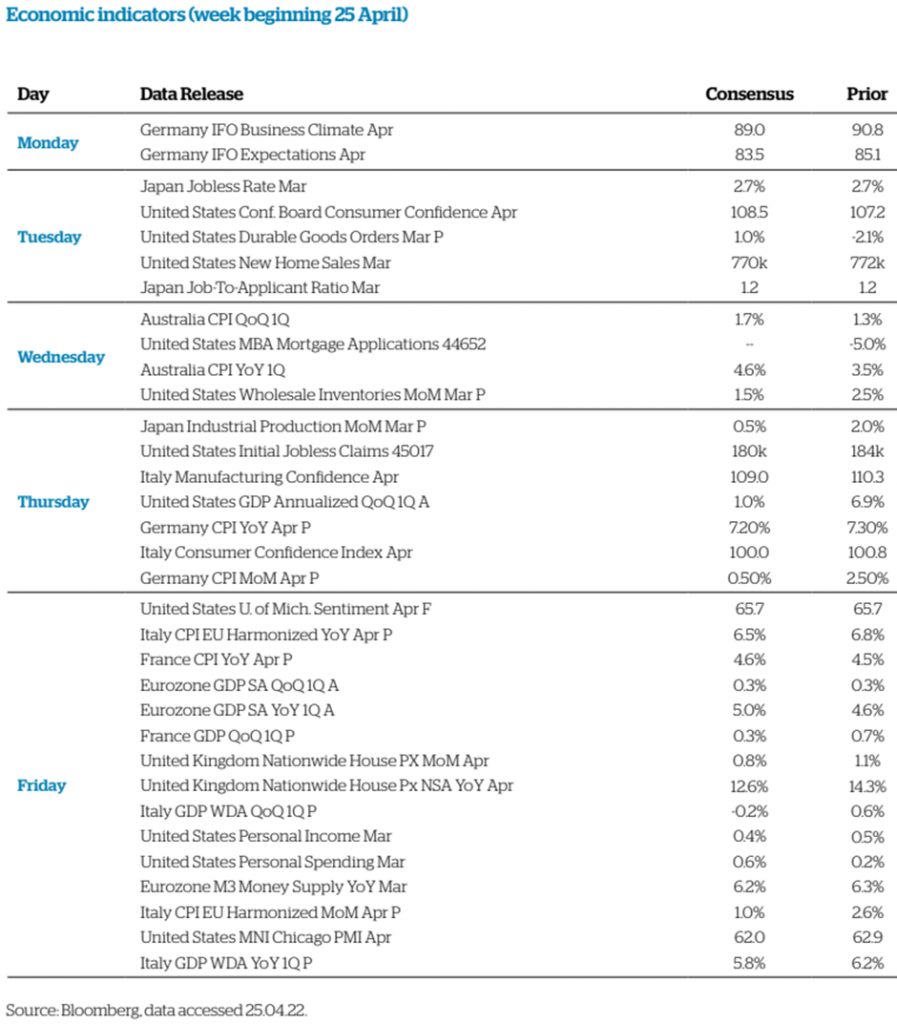
Please find below, an update on markets, received this afternoon from Blackfinch – 25/04/2022

  • Retail sales fell 1.4% in March, following a 0.5% drop in February, according to the Office for National Statistics, as people cut back on fuel and food spending amid soaring prices. Overall, sales volumes were 2.2% above pre-pandemic levels in February 2020.
  • 2,114 UK businesses became insolvent in March, more than double the figure in March 2021 (999), and 34% higher than the pre-pandemic figure of 1,582 in March 2019.
  • In April, the Purchasing Managers’ Index (PMI) for the UK services sector dropped materially from March’s 10-month high, while the new orders index plunged to 54.6, down from 60.4 in February. The slowdown also caused firms to slow their pace of hiring; the employment index fell to 55.8 – its lowest level since April 2021 –  from 58.4 in March.
  • The UK government set out 26 new sanctions against Russia over its invasion of Ukraine, including sanctions on military figures and defence companies.
  • The European Commission’s confidence indicator rose by 1.8 points to -16.9 in the eurozone, and by two points to -17.6 in the wider European Union (EU).
  • Consumer prices rose at an annual rate of 7.4% in March, rather than 7.5% as previously estimated, according to the EU’s statistics office Eurostat. Energy prices surged 44.4% in March, while unprocessed food cost 7.8% more. Even after stripping out these volatile components, annual inflation reached 3.2% in March, well above the European Central Bank’s 2% target.
  • Production in the 19 eurozone countries rose 0.7% in February from January, according to Eurostat. The biggest monthly increases were in Italy (up 4%), Croatia (up 2.7%) and Ireland (up 2.4%).
  • The International Monetary Fund (IMF) downgraded global growth forecasts with 2022 gross domestic product (GDP) growth revised to 3.6%, down from January’s prediction of 4.4%.
  • The IMF said UK economic growth was expected to match growth in US during 2022, but will slump in 2023, taking the UK to the bottom of the league table of comparable economies in the G7 group of countries. The UK is also expected to face the highest inflation.

Please continue to check our Blog content for advice and planning issues and the latest investment, markets and economic updates from leading investment houses

David Purcell

25th April 2022

Team No Comments

Brooks Macdonald – Daily Investment Bulletin

Please see investment bulletin below from Brooks Macdonald received this morning – 22/04/2022.

What has happened

US equities came under pressure late in the US session as further incremental tightening of monetary policy was priced into the bond market. Given its rate sensitivity, growth equities underperformed with the US technology market posting another loss yesterday after the Netflix earnings soured Wednesday’s trading session.

Central banks

Fed Chair Powell stuck to the Fed’s recent script, saying that the Fed was considering 50bp rate hikes to front end load the monetary policy tightening required to get inflation under control. Yesterday also saw President Daly and President Bullard both describe the need for 50bp rate hikes at upcoming meetings given the economic backdrop. The market is now expecting 50bp hikes at each of the next three Fed rate setting meetings. President Lagarde of the ECB also spoke on the same panel as Powell yesterday and whilst she stressed that the US and European economies were in very different places, Lagarde would not rule out an ECB rate hike as early as July which is the meeting hinted at by other ECB speakers this week. This backdrop catalysed a selloff in sovereign debt with the US 10-year Treasury yield closing above 2.9%, reversing the falls seen on Wednesday. It is increasingly clear that the Fed is keen to normalise rates sooner rather than later, before the Fed or the market truly knows what the post pandemic pace of economic growth and inflation is. This brings with it significant policy risk.

French election

This weekend sees the French presidential election run-off vote between President Macron and Marine Le Pen. Over the last week or so the gap between the candidates has increased with President Macron holding a polling lead of c. 10 points, outside the margin of error. The polling success for the incumbent has settled some of the fears earlier in the month that there could be a political upset spurred by the cost of living crisis in France. French government bonds and equities outperformed as yesterday’s polls reconfirmed the lead.

What does Brooks Macdonald think

Whilst polling suggests that a French electoral upset will be avoided, yesterday saw reports that the UK government is preparing legislation to give ministers the power to switch off key parts of the Northern Ireland protocol. Such legislation, if enacted, would lead to further confrontation between the EU and UK even as NATO allies pose a united front in the face of the Ukraine war.

Please continue to check back for our latest blog posts and updates.

Charlotte Clarke

22/04/2022