Team No Comments

JP Morgan: Will trade hostilities undermine the investment case for Chinese assets?

JP Morgan provides an interesting insight into China’s current trading conflicts and the effects of this on the investment market.

On 14 February 2020 the US and China agreed to a trade agreement, known widely as the “phase one trade deal”. As part of the deal, China agreed to increase purchases of US goods by USD 200 billion over the next couple of years, helping to defuse an escalating trade conflict between the two nations.

Although welcomed by markets as a first step to prevent further damage to world trade, the phase one deal was quickly overshadowed by the Covid-19 pandemic. However, trade data from the US Bureau of Census, which is tracking China’s compliance with the phase one deal, has recently raised concern, with China’s additional purchases of US goods standing at only 48% of the year-to-date target by the end of July (Exhibit 1).

Demand disruption due to the pandemic and rising political tensions have contributed to China’s non-compliance. However, in the midst of a polarised US election campaign, the trade truce could be more fragile than investors would wish, and new trade hostilities are an increasing risk for markets.

Exhibit 1: Phase one deal tracker

US goods exports to China with phase one deal targets for 2020 and 2021

USD billions

Source: USTR, US Census Bureau, J.P. Morgan Economic Research, Refinitiv Datastream, J.P. Morgan Asset Management. 2020 and 2021 targets are shown for illustrative purposes and we assume a smooth path toward the year-end target. Chart displays only goods exports and for goods not covered by the phase 1 deal we are assuming they remain at similar levels in 2020 and 2021 as they did in 2017. The phase 1 deal outlines an increase in US exports of $200bn over 2020 and 2021. The breakdown is for roughly $160bn additional goods exports and an additional $40bn of services exports. Past performance is not a reliable indicator of current and future results. Data as of 16 September 2020.

Could a renewed trade conflict undermine the investment case for Chinese assets? When considering this question, we think investors need to look at three aspects: China’s trade dependencies, the impact of an economic de-coupling, and structural growth opportunities.

Trade dependencies: A growing domestic economy overshadows possible trade disruption 

The trade conflict and the implementation of tariffs was a big topic and headline risk for markets in 2018 and 2019. However, when we look at equity market performance following the announcement of new tariffs by the US administration, the reaction appears to have been rather moderate. On the six occasions when the US announced new tariffs, the average drawdown of the local Chinese A-Share market was -2% in the five business days after the announcement, with a maximum drawdown of -3.9% in June 2018 (Exhibit 2).

The impact on global markets was also limited. One of the reasons for the lack of market reaction is that China’s dependence on global trade is in decline. Between 2010 and 2019, China’s share of exported goods and services relative to GDP fell from 28.5% to 18.8%, with the US share falling from 4.7% to 2.9%. China’s economy is increasingly driven by domestic consumption, which makes it less prone in total to export shocks, such as the imposition of tariffs.

Exhibit 2: Market impact of trade hostilities

Five-day equity market performance during trade hostilities

% price return

Source:  Bloomberg, MSCI, Standard & Poor’s, J.P. Morgan Asset Management. Time periods show the price change in the 5 trading days after a notable trade escalation. Past performance is not a reliable indicator of current and future results. Data as of 16 September 2020.

Nevertheless, vulnerabilities still exist at the sector level. For example, computer hardware, cell phones and telecommunication equipment, which make up the largest Chinese exports to the US, represent 9% of China’s domestic A-Share market, as represented by the CSI 300 Index. So, any further deterioration in trade relations could have a negative effect on these sectors.

The biggest threat to the Chinese economy is not to be found in its exports to the US, however. Instead, China’s most crucial trade dependency is its imports of US semiconductors, which by volume make up the third largest imported good from the US. Most of China’s technology industry, including its 5G, mobile internet and artificial intelligence companies, depend on US microchip technology. A full ban on technology exports to China by the US administration could be very disruptive for the Chinese economy and therefore would also likely cause significant disruption to equity markets. A US technology export ban is therefore probably the worst case in a rising trade conflict scenario.

Whether the current US administration is willing to risk a full escalation of trade tensions before the election in November, risking turmoil in capital markets, is at least questionable. Although surveys show that an increasing number of Americans have an unfavorable view of China regardless of their political preference, recent polls also show that China is a low priority with voters, far behind economic, health, and social issues.

Economic de-coupling: Assessing the risks and opportunities 

Despite rising trade tensions with the US, and Beijing’s push to be more self-reliant and de-couple from global value chains, investors should not overlook the investment opportunities presented by local Chinese assets, which look attractive relative to the rest of the world in the aftermath of the Covid-19 pandemic (Exhibit 3).

Following the opening of the USD 15 trillion local renminbi bond market to foreigners, yield starved international bond investors now have the opportunity to invest in government bonds with yields north of 3%. As well as providing access to higher yields, local renminbi bonds have a relatively low correlation to developed market bonds and zero return beta to global equities, helping investors to enhance diversification and target enhanced risk-adjusted returns.

In the past 12 years, monthly return correlations between renminbi bonds and global developed market bonds have been 0.06, compared to a correlation range of 0.43 to 0.72 between developed market bonds themselves. Just like with past performance, there is of course no guarantee that past correlations will be repeated. However, with China’s early success in containing the Covid-19 pandemic knocking its economic cycle out of sync with the rest of the world, and with the Chinese central bank providing a less expansionary central bank policy response compared to developed economies, we would expect correlations to remain low for the time being.

Exhibit 3: Relative attractiveness of China bonds

Fixed income yields

in %

Source: Bloomberg, Bloomberg Barclays, J.P. Morgan Economic Research, Refinitiv Datastream, J.P. Morgan Asset Management. Beta to MSCI World is calculated using monthly total returns since 2008. Indices used are as follows: Euro IG: Bloomberg Barclays Euro-Aggregate – Corporate; Global IG: Bloomberg Barclays Global Aggregate – Corporate; UK IG: Bloomberg Barclays Sterling Aggregate – Corporate; US IG: Bloomberg Barclays US Corporate Investment Grade; Euro HY: Bloomberg Barclays Euro High Yield; Global HY: Bloomberg Barclays Global High Yield Corporate; US HY: Bloomberg Barclays US Corporate High Yield; EMD Corporate: CEMBI Broad Diversified; EMD local: GBI-EM Global Diversified: EMD local – China: GBI-EM China: EMD Sovereign: EMBI Global Diversified. Past performance is not a reliable indicator of current and future results. Data as of 16 September 2020.

Structural growth opportunities: Chinese equities

After a period of strong outperformance investors might look at Chinese equities with a certain amount of skepticism, especially against a background of rising trade tensions and valuations. But in the short term the economic tailwind for the equity market is strong, particularly for domestic-oriented businesses.

China’s containment of the pandemic should enable its economy to recover faster than the rest of the world, and this relative advantage is likely to persist unless a medical solution to Covid-19 is found, which itself is still hard to predict (Exhibit 4a). However, the factor that makes the case for domestic China A-shares even more compelling is, counterintuitively, the fact that economic stimulus measures have been much smaller this round than in the past two downturns (Exhibit 4b). Therefore, we should not expect a massive stimulus-driven Chinese expansion to lead to stronger demand for imports from Asia and the rest of the world, making local Chinese investments relatively more attractive. 

Exhibit 4a: China’s recovery – earlier and faster

China vs. developed markets, real GDP

Index level, rebased to 100 at 1Q 2006

Source: BEA, Eurostat, National Bureau of Statistics of China, ONS, J.P. Morgan Economic Research, J.P. Morgan Asset Management. Forecasts are from J.P. Morgan Securities Research. Past performance is not a reliable indicator of current and future results. Data as of 16 September 2020.

Exhibit 4b: Less stimulus compared to prior downturns

China M1 money supply and import growth

% change year on year

Source: China Customs, IMF, PBoC, Refinitiv Datastream, J.P. Morgan Asset Management. Past performance is not a reliable indicator of current and future results. Data as of 16 September 2020.

In the long-term, China’s transition from the workshop of the world into the largest domestic market in the world still demands that Chinese equities are given a significant strategic representation in globally-diversified investment portfolios. And with corporate earnings growth in the China A-Share market providing a better representation of nominal Chinese GDP growth over the last 10 years than the MSCI China, investors may continue to look to domestic stocks for their Chinese exposure (Exhibit 5).

Exhibit 5: Domestic equity market earnings – a better proxy of gdp growth

China nominal GDP and equity market earnings

12 month forward EPS, GDP; Index level, rebased to 100 at start of 2006 

Source: Bloomberg, IBES, National Bureau of Statistics of China, Refinitiv Datastream, J.P. Morgan Asset Management. Fwd EPS is next twelve months’ earnings estimates in USD. China nominal GDP is in USD. Shenzhen and Shanghai include all listed A-share stocks and is combined using a market-cap weighted average. Past performance is not a reliable indicator of current and future results. Data as of 16 September 2020.

Summary

A trade conflict between the world’s largest economies is disruptive to established value chains and will certainly be negative for global growth. So, investors should rightly pay attention to any further escalation in tensions.

However, it would in our view be a mistake to single out China as the clear underdog in such a conflict and therefore shun investments into the local markets. As we have shown, the direct impact of the trade tensions on the Chinese economy is limited. Even if there is a further de-coupling between China and the US, the case for local investment in China may strengthen because of the diversification benefits provided by Chinese assets.

Equity investors should find comfort and confidence in the fact that in the past 10 years, Chinese A-share earnings have reflected the strong growth in China’s GDP. In contrast, a less cooperative international trade backdrop in the coming years could see non-Chinese companies lose out on some of their own profits from China’s economic expansion. 

We endeavour to publish the most up to date blogs and data on all things markets, advice and planning-related. Please check in again with us soon.

Stay safe.

Chloe

Team No Comments

Legal and General: Of Gilts and Gold

Please see below for the latest blog from Legal and General’s Investment Management Team regarding their ‘key beliefs’ in relation to the markets:

This week, we look at the investment case for three strategies that should in theory be defensive: holding UK sovereign bonds, owning gold, and diversifying by equity factor.

As with all Key Beliefs emails, this email represents solely the investment views of LGIM’s Asset Allocation team.

A furlough bar to clear

We have been tactically underweight UK gilts for almost exactly six months now. This has been largely based on our view that: (1) a furlough extension was inevitable; (2) negative rates were not on the cards; and (3) the distribution of potential returns was likely to be negatively skewed given those first two factors.

Thursday saw Rishi Sunak extend the furlough scheme for another six months, but the new version is considerably less generous than its predecessor. Employees must now work a minimum of a third of normal hours and employers and workers must bear a greater share of the burden. This incentivises companies to retain one full-time employee rather than two employees working reduced hours, and we believe it will result in further redundancies and pressure on household incomes in the coming months.

Meanwhile, the debate on negative rates has ebbed and flowed at the Bank of England without much clear direction. The latest hints from Governor Andrew Bailey have seen the short end of the curve price out negative rates in the near term, but the Bank’s inconsistent communication on this issue makes it hard to have much confidence in the outlook.

Given these two developments, the third argument above has become harder to defend. While we maintain a negative view on gilts over the medium term, the changing balance of risks has led us to call time on our tactical position.

Going for gold

Given its perceived status as a safe-haven asset, gold is never far from our thoughts when assessing the multi-asset opportunity set. While we maintain a positive long-term bias on the metal, we need to stay price sensitive too. Having closed a tactical overweight back in July, at current levels we believe it’s time to scale back in again.

With interest rates close to zero in most developed markets and increasingly limited space for monetary policy against an uncertain backdrop, finding candidates to diversify the cyclical nature of equities and other risky assets has rarely been more challenging. Gold is, in our view, less exposed than many assets to innovative, unconventional future measures to ease policy, and we therefore believe it offers something different from fixed-income assets in that regard.

No investment is without risk, however. Gold price movements have historically closely tracked a combination of real yields and the US dollar, but there is the possibility that this relationship could be changing. In particular, with yields pinned close to zero it could be that inflation expectations and realised inflation become the more important future drivers of fair value. Given inflation expectations have tended to behave similarly to equities, that would seem at odds with gold’s expected role as a safe haven and diversifier.

Factor fiction?

A wide range of equity risk factors (or styles) have been identified in the academic literature, yet there remain relatively few that are both compensated (i.e. deliver a positive risk premium over time) and transparent (i.e. there is a plausible and widely accepted rationale for their persistence). Five factors have historically exhibited both characteristics: value, low volatility, quality, size, and momentum.

While individual factors can go through sustained periods of relative under- or outperformance, they are likely to do so at different times, so it follows that a balanced portfolio of factor exposures should provide a diversified and cost-effective way to gain exposure to the range of equity risk premia over time.

This year has nevertheless been tough on US equity factor portfolios, largely because of the outsized influence of technology stocks. The outperformance of the largest stocks in the market-cap weighted index has weighed heavily on the returns of any diversified equity strategies which move away from the ‘tallest trees’ in the index. Some of that underperformance has reversed recently as some of the froth in tech has been removed, but we believe it is too early to call a sustained rotation in the US.

The same cannot be said of factor portfolios outside the US, however, where there is much less of a tech bias. The recent bout of risk aversion has seen non-US factors behave more in line with expectations, with quality and low-volatility stocks outperforming, while value has been relatively flat. Where we have allocated to a basket of non-US equity factors, their positive contribution has been an effective diversifier over the past couple of weeks.

Detailed and focused opinions from market leading investment managers such as Legal and General can be a useful addition to your overall view of the markets.  

Please keep reading our blogs to ensure your holistic view of the markets is well informed, diversified and up to date. 

Keep safe and well.

Paul Green

29/09/2020

Team No Comments

Tax & Politics

I listened to a technical webinar at the end of last week presented by Prudential and their senior political and technical staff here in the UK.  Following the cancellation of the Budget (was this previously a pre-Budget debate?) they were discussing what taxes might change when and the politics behind it.

Basically, it is a trade-off between what value any new tax might have (how much will it raise for the State?) balanced against the potential political damage any specific tax change may do.

Thankfully, on this basis a lot of the potential tax changes were discussed and dismissed as unlikely.  I don’t think this is the end of the matter, we will need additional tax for the State to pay for the support during the pandemic and strengthen our recently exposed weak spots, the NHS, residential care, social services etc.

We will also need more money to kick start the economy and help us deal with Brexit, fudged deal, or no deal.  As this is the case, when the economy is recovering, and the consumer is spending freely again (post vaccine?) we will see changes to the tax system.

Given the state of our economy and the outlook, the only thing we know with certainty is the tax position and legislation we have in place right now.  If you have the means, why not take advantage of the tax reliefs and planning opportunities that are available today?

It makes good sense to press on with any beneficial planning now using what reliefs are available today, we know the rules now.  For example, pension funding with higher rate tax relief within the pension contribution limits we have currently.

If you would like to discuss your own personal situation, please get in touch.

Steve Speed

29/09/2020

Team No Comments

Monday Market Update

Please see below weekly news update provided by Blackfinch earlier this afternoon, which provides a summary of current global events.

UK COMMENTARY
The UK Government lifted its COVID-19 alert system to its second-highest level following an announcement about a potentially tough autumn and winter period for the country 

New restrictions were imposed on business activity and movement of people, with PM Johnson confirming that they are ’likely to remain in force for six months’

The main restrictions are: office workers to work from home if they can; all pubs, bar and restaurants to operate a table service and close by 10pm; face coverings to be worn by retail staff, users of taxis and cabs, all staff and customers in indoor hospitality venues except when eating or drinking; COVID-secure guidelines to become legal obligations in all retail, leisure, tourism and ‘other’ sectors; no more than 15 people to attend weddings or wedding receptions; and that the ‘rule of six’ has been extended to all adult indoor team sports

The restrictions have more to do with social distancing and health precautions, and the economic impact is unlikely to be as bad as initially thought

The Rightmove House Price Index indicated house prices rose 0.2% in September from August and were up 5.0% on September 2019

The Flash UK Manufacturing Purchasing Manager’s Index (PMI) registered 54.3 in September, down from 55.2 in August

The Flash UK Services PMI had the weakest performance in three months, coming in at 55.1 in September, down from 58.8 in August

The latest data from the Office of National Statistics (ONS) suggests that around three million workers – around 12% of the workforce – were still on furlough or partial furlough in early September

Rishi Sunak, Chancellor, acknowledged that he cannot save every job as he announced a new support scheme to enable companies to save viable jobs 

Under the scheme announced, people can work a third of their normal hours and to be paid the normal hourly rate for those hours, with the Government and the employers covering lost pay. All employers will be allowed to apply for the new arrangements from November, regardless of whether they used the furlough scheme

The Government extended the 15% VAT cut for tourism and hospitality sectors to the end of March 2021

UK retail sales volumes grew at the fastest rate since April 2019 in the year to September, according to the Confederation of British Industry’s (CBI’s) Distributive Trades Survey

The Bank of England governor has ruled out negative rates in near future

National Savings & Investments announced a series of dramatic cuts to its rates and premium bond prizes. The premium bond prize fund interest rate is to be cut from 1.40% to 1.00% from December. Their income bonds will be cut from 1.16% AER to just 0.01% from 24 November.
US COMMENTARY
Technical changes to data methodology in Arizona and Texas for calculating confirmed cases and a rebound in testing activity helped explain a jump in cases at the start of the week

The latest US weekly jobless claims data showed a slight increase for the week ended September 19th, which showed that 870,000 Americans filed for unemployment. This was 4,000 higher than the prior week and in contrast to market expectations of a fall to 850,000.

Continuing jobless claims showed some more positive signs, falling to 12.58m from 12.75m but still above estimates of 12.28m

Goldman Sachs halved its growth forecasts for US economic growth in Q4 to 3% from 6%. This is in recognition of the fact that Congress is unlikely to attach additional fiscal stimulus to the continuing resolution. 

Federal Reserve chairman Jerome Powell conveyed yet another downbeat assessment of the US economy to Congress. US lawmakers are yet to push out fiscal changes that central bankers see as needed.

US housing sales hit a 14-year high as America’s housing market continues to shrug off the Covid-19 crisis, and high unemployment
EUROPE COMMENTARY
Indices struggled in Europe due to pandemic fears as there were a record number of cases reported in the Netherlands and France

Eurozone business growth ground to a halt as services data stumbled. The Markit’s flash Eurozone Composite PMI was just 50.1, barely above stagnation, from 51.9 in August. This suggests the summer recovery is petering out.

Markit’s flash German PMI report showed that service sector activity has hit a three-month low, while manufacturing is growing at the fastest pace in over two years.

The jump in Covid-19 cases in France over recent weeks has dragged Markit’s preliminary French PMI down to 48.5 for September, from 51.6 in August
ASIA COMMENTARY
Shares in Australia were buoyant as the two-week average of new infections in the city of Melbourne fell below 30

The Kospi in South Korea fell 2.61% in afternoon trade after South Korea’s defence ministry said North Korea had killed a missing official from the South earlier this week
GLOBAL COMMENTARY
With fears riding high of tougher lockdown restrictions returning and the corresponding effect on the economy, the oil price fell heavily
COVID-19 COMMENTARY
US firm Novavax is set to start late-stage trials for its COVID-19 vaccine candidate in the UK. It will enrol up to 10,000 participants aged 18-84 over the next six weeks, with half receiving the formulation and half receiving a placebo.

People & Business IFA Limited recognises the importance of communication in the ever-changing world we live in. Please continue to check in with us for the most up-to-date information and data.

Stay safe.

Chloe

28/09/2020

Team No Comments

Financial Advice and The Young Single Woman

Research conducted by Royal London found that people without a financial adviser were more likely to be female, single, earning around £20-£30,000, and under the age of 35. As a 27-year-old single woman, I fall smack-bang into the middle of this category and was disappointed (but not surprised) when the statement presented itself to me. After some research and a lot of self-reflection, I now feel obligated to provide an insight into the intricacies of this finding from a personal standpoint.

‘I don’t earn enough to seek financial advice.’

Talking about money does not come easily for most of us. It is a personal matter and can feel uncomfortable to discuss. Despite this, it is very important that we do talk about the ‘m’ word. At times, my perception of my own finances has made me feel that I did not earn enough money to warrant financial advice. I did not have enough self-confidence to approach a professional from the financial industry. I think my pre-disposed view of a testosterone-fuelled, overly male-dominated Wall Street had led me to believe that investing was not particularly catered towards women.

I am now aware, however, that specialised advice from a professional adviser can help me set realistic financial goals – and reach them. Ironically, my previous perception of my financial status meant that I denied myself the opportunity to strategically grow my wealth in the first place. To back this up, Royal London and the International Longevity Centre UK (ILC) found that, in the space of just 10 years, customers who had sought financial advice were, on average, £47,000 better off than those who had taken care of things themselves.

‘I don’t have time to seek financial advice.’

A young woman living in the 1950’s and 60’s was typically expected to marry, have children, and assume the role of primary caregiver. Times have (thankfully) changed and for the most part, women can now progress into further education and a career of their choice – should they wish to do so.  The ‘modern woman’ is her own person, has her own money, and can have it all. The only downside of this is that many women are required to perform a constant juggling act between family, friends, and career – often prioritising the needs of others before their own. Perhaps women of this day and age are just so busy living a full life, that they do not have time to seek financial advice?

As it turns out, we have plenty of time. On average, women live 5 years longer than men. Therefore, it makes sense for us to prepare for long-term financial stability and the best way to do this is with professional, preferably long-term, financial advice. One of Royal London’s key findings was that those who fostered an ongoing relationship with their adviser were up to 50% better off than those who had only received advice once.

‘I don’t believe that financial advice would benefit me.’

Money makes the world go round and most of us will experience ‘money worries’ at some point in our lives. New statistics from Fidelity International show that 47% of young women have had their mental health affected by financial worries, but only 12% surveyed would ask for help from a financial adviser. When I feel stressed or over-whelmed, I typically tend to seek advice from friends, family or even a work colleague. To improve my general well-being, I might go shopping, force myself to attend a spin class at the gym or perhaps even visit my GP if necessary.

This year, more than any other, has made me realise the importance of looking after my mental health. I recently realised that when I feel positive about my financial situation, I feel positive about myself. Good quality financial advice can improve emotional as well as financial well-being and the practice of sound financial planning in our 20’s and 30’s builds a strong foundation for a secure future.

And the uncertain times that we now find ourselves in makes the prospect of a secure future all the more appealing.

The year of 2020 has been challenging to say the least. Due to the Covid-19 crisis, the UK went into its first national lockdown on the 23rd March, and, by the end of April, my days had blurred into one self-isolated Groundhog Day. I had lost all sense of routine and was struggling to work productively from home. To add to this, my only form of contact with friends and family was via repetitive virtual quizzes. I was then furloughed and spent my days attempting DIY, and my nights battling anxiety caused by a looming threat of redundancy. It is now apparent that my concerns were not without rationale. New findings from the European Institute for Gender Equality and our Institute for Fiscal Studies indicate that women will be disproportionately affected by job losses as a result of the current economic conditions.

Bottom line; women have never been more in need of financial advice than they are now.

Women of the past fought for our right to vote. Today, we are still striving for equality in relation to the gender pay gap, and it now appears that we are stuck in a pensions gender gap too. Research undertaken by NOW: Pensions and the Pensions Policy Institute has revealed that women in their 60’s have an average of £100,000 less in their pension than men do. 

For me, when it comes to a lack of women receiving financial advice; the worst part of it is that this time, we have nobody to blame but ourselves. I, therefore, implore all women to seek financial advice. You may just unlock your financial potential…

Chloe Speed

24/09/2020

Team No Comments

As the midnight hour draws near, how will Brexit conclude?

Please see below the latest market insight from Karen Ward at JP Morgan, with particular reference to the ongoing complexities of Brexit.

An American colleague joined me on a call recently and was perplexed by the fact that I was talking about Brexit. “Isn’t Brexit done?”, he asked me. Alas, no. While the UK did officially leave the EU on 31 January, for the economy nothing actually changed since the UK entered into an 11-month period of transition. During this period, the UK and EU were supposed to agree on a future trade arrangement to commence on 1 January 2021. The clock is well and truly ticking.

Negotiations are proceeding slowly and significant differences still remain. At the root of the problem is the same issue that has plagued the discussion for the last four years. The UK wants to regain control – to become fully sovereign – setting its own rules and regulations overseen by British courts. However, the EU is not willing to grant significant access to the single market without guarantees that standards will not be undercut to gain competitive advantage.

So what happens next? Either the next six months will see a breakthrough and a free trade agreement (FTA) will be established or the UK will leave and trade on World Trade Organisation (WTO) terms.

Trading on WTO terms has been used synonymously with ‘hard Brexit’. What exactly does that mean? The short answer is potential tariffs, more customs paperwork for businesses that trade with the EU and potentially the need for the UK to be removed from EU supply chains if regulatory conformity cannot be guaranteed. It is these nontariff barriers that we would expect to have the most economic impact. There could also be significant ramifications for financial firms since the UK would lose its passporting rights – its ability to serve EU clients from the UK. Advocates for a hard Brexit argue that a clean break would allow the UK more flexibility in negotiating future trade deals with other trading partners, although any benefit from these agreements would still only be seen once these trade deals had been implemented, which is often a lengthy process.

What will happen and what will be the implications for markets? In our view, the announcement of a comprehensive FTA might see sterling rise to 1.45 against the US dollar. By contrast, in a no-trade deal scenario we see sterling closer to 1.10 against the dollar. Much weaker sterling would partially help the UK to cope with new trade frictions.

Our central expectation is that despite ongoing near-term sabre-rattling, by year end pragmatism will prevail and a relatively narrow trade deal will be agreed. When ‘Brexit’ was added to the English dictionary, the word ‘fudgery’ should also have been included.

We expect a significant amount of ‘fudgery’ in order to get a partial trade agreement done. This may, in fact, involve highlevel agreements that disguise what is essentially a transition to iron out the finer details. Such a narrow trade deal will likely still be disruptive to economic activity in the EU and the UK over the long term. But we expect various arrangements to ease the near-term burden of the change for both sides. We expect that both sides will want to minimise the day 1 disruptions given the extent to which both economies are still struggling to overcome the Covid-19 recession. Therefore, changes may well be phased in over time, spreading the economic cost over a number of quarters if not years. The UK could thus claim the sovereignty to set their own rules and standards without initially making substantial disruptive changes.

While this outcome is our central expectation, there are significant risks around it that investors should be mindful of. Sterling may be particularly volatile and, with almost 80% of revenues coming from abroad for the FTSE 100, this will also have implications for the stock market, since higher sterling could put downward pressure on earnings and vice versa should sterling fall, all other things being equal. However, we caution against relying too heavily on the FTSE rallying in the event of a hard Brexit as a disorderly Brexit would be likely to impact both UK and EU activity negatively, depressing some of the overseas earnings that matter to UK companies.

We will continue to provide the most up to date information on the markets and economy. Please check in with us again soon.

Stay safe.

Chloe

24/09/2020

Team No Comments

Legal & General Asset Allocation Team Key Beliefs Blog

Please see article below from Legal & General’s asset allocation team – received 14/09/2020.


Our Asset Allocation team’s key beliefs

Recurring patterns

The day after the UK voted to leave the EU – more than 1,500 days ago – we wrote in our Key Beliefs that “Brexit will now dominate markets for a while longer and be a market factor for years to come”. This week, we cover the latest developments in that ongoing saga and two other recurring issues for markets.

As with all Key Beliefs emails, this email represents solely the investment views of LGIM’s Asset Allocation team.

Rule Britannia, Britannia waives the rules

The result of last year’s election reduced the probability of a soft Brexit outcome, in our view. Since then there has been no real progress in discussions with the EU, so the chances of a comprehensive deal have dwindled further.

The new Internal Market Bill, and the news that the state-aid regime will not be ready until mid-2021, further lower the likelihood of securing a deal. This means that – barring a Parliamentary block, a policy U-turn, or a significant softening in approach from Brussels – we are probably now looking at a narrow range of outcomes between a hard exit and a slightly less hard exit. The difference in economic impact between the two is relatively small, and is likely to be swamped in the current environment by COVID-19 developments and fiscal and monetary policy.

This news is not particularly shocking, as negotiations with the EU have been going back and forth for a while, but investors have woken up to Brexit risks again in the past few weeks. With the market probability of a no-deal exit reaching approximately 80% in our estimates, sterling fell by around 4% against the euro and US dollar.

Looking forward, the narrowing Brexit outcomes should mean sterling’s range is more limited too, so we wouldn’t expect the wild swings in the currency of recent years. We believe the tail risks are also skewed to the upside from here: a no-deal scenario may see a touch more weakness, but a sniff of a deal could stoke a greater recovery.

Israel: the first domino?

The unsettling news for Israel is that COVID-19 dynamics in the country are deteriorating on all fronts, with the government announcing a second lockdown on Sunday. Many had supposed that the economic pain of shutdowns would deter politicians from re-imposing them, but Israel has demonstrated that we shouldn’t rely on that.

The question we need to ask ourselves is whether Israel is the first domino to fall and if Spain and France are the next ones to topple. There are some idiosyncratic differences between Israel and continental Europe, such as in party politics, demographics and behavioural tendencies, but equally it is possible to draw some parallels.

Spanish and French ICU capacity per person is greater than Israel’s but, at current rates of case-load expansion and growing ICU occupancy rates, Spain looks like it may become stretched by the end of September and France potentially a month or so later. That said, the head of the Spanish health-emergencies department believes Spain has already turned a corner for the better in its latest wave.

We believe further full-country lockdowns in Europe are not part of the consensus thinking in markets, so there is a downside risk, but more lockdowns could mean more stimulus too.

Fiscal fail

Hopes for any further fiscal stimulus in the US before the elections darkened last week as a deal proposed by the Republicans failed to pass a Senate vote. Negotiations have become increasingly difficult of late and a failure to pass a deal soon puts millions of Americans in jeopardy.

While there is a wide range of outcomes over the next few months, the risk of the economy stalling in the fourth quarter has risen. The consensus probability of a stimulus deal stood as high as 90% a month ago but, with those odds plummeting, economists will need to embark on a series of forecast downgrades if Congress fails to act. This was also a likely driver of weaker equity markets in the past week, hidden somewhat by the headline news of the technical squeeze in tech stocks.

Both sides still seem far apart on reaching agreement on another round of fiscal stimulus. Republicans do not wish to provide state and local government aid to ‘bail out’ Democrat states, while there is disagreement within the party on the type of stimulus and whether another round is even necessary. Democrats meanwhile voted against the proposals as they contained some ‘poison pills’, such as funds for the coal industry and a tax break for private school costs.

Additionally, the Federal Reserve is having problems with its Main Street Lending programme, designed to help small firms, with only $1 billion of loans out of a total capacity of $600 billion made so far. This means the central bank’s ability to offset an underwhelming fiscal stimulus could be reduced.

The drag on the economy is building, but not yet apparent in the data. The blockages in approving further stimulus should not be seen as a cliff, but an increasingly steep downhill ride the longer the standoff continues.

Another useful article from Legal & General covering the latest developments with regards to Brexit and other recurring issues for markets.

Please continue to check back for our latest updates and blog posts.

Charlotte Ennis

15/09/2020

Team No Comments

Aviva – Remote Control – Take control of your wellbeing in remote working environments

Please see article below from Aviva which is a guide to taking control of your wellbeing in remote working environments – received 02/09/2020.

Remote Control – Take control of your wellbeing in remote working environments

This short guide gives practical advice, helpful guidance and support to anyone working remotely during the coronavirus pandemic.

‘Social interaction increases the spread of the coronavirus pandemic as it passes from person to person, by touch and through droplets in the air. Social distancing can dramatically slow the spread. That’s why working remotely for many businesses has become essential, in locations that are very different from normal working environments.

Staying in control, maintaining your mental and physical wellbeing can be a high challenge in these extraordinary circumstances. That’s why we’ve published this easy-to-read guide of practical tips and guidance. Life is difficult enough right now, so we’ve kept things as light and breezy as they can be. Stay safe, stay healthy and stay connected. We’ll get through this together’

Dr Doug Wright, Medical Director, Aviva UK Health and Protection

Mental Wellbeing – Some Top Tips

Stay connected and keep talking

The key message is: don’t suffer in silence. The more open everyone is about their mental health – whether they’re doing ok or struggling a bit – the better things will become. One of the most important things you can do at times like this is to talk to people and share how you are feeling. Connect with your colleagues or your manager (and if you’re a manager, don’t forget this applies to you too) and explain how changes, work allocation or the situation is making you feel.

Use wellbeing apps

There are many apps you can use to support your mental wellbeing, to help with mindfulness, meditation and overall mental wellbeing.

It’s essential to select the best app for the task, and that’s where NHS Digital steps in. Although health apps are not supplied by the NHS, it’s widely accepted that the NHS Digital’s Apps Library is the ‘go to’ place for reliable, objective information. It’s here you’ll find trusted mental health and wellbeing apps that have been assessed using rigorous standards. And when an app is improved or modified, it is reassessed.

Change where you work in your home

Don’t work with your laptop facing a blank wall! Your connection with the outside world begins with what you can see outside, just above your screen. It might be a back garden, it could be rooftops, it might be a not-so-busy street, but it’s your physical window on the world. So where do you work in your home? Each home is different, but what you should look for is known as a ‘command position’ that puts you in control. It’s a concept from Feng Shui, the ancient philosophy of living in harmony with your immediate environment. Basically, choose a position in the room that you work in that is furthest from the door and that also enables you to look out of a window. You’ll feel better for it. And in a time of crisis, empowerment starts here. Try it!

Control your intake of negative news

Your home is your castle. And as you work from home, you might feel as if its walls are under siege conditions. With social media and new technology enabling a 24/7 news feed, we’re experiencing constant updates on coronavirus. While some information is useful, too much immersion to this type of news can fuel alarm and tension. As we piece together the progress of COVID-19, the result of being plugged-in to a relentless news cycle can generate negativity, fear and anxiety. In short, if you feel bad about being isolated, the news will make you feel worse.

There’s a simple answer to this: prioritise your mental health and switch off. A bombardment of negative news needs a cut-off point, and you can limit your input just as you’d do for children and screen time. Rolling news isn’t necessarily the most accurate. Take a deep breath and catch up with it tomorrow when the facts are known.

Physical Wellbeing – Some Top Tips

Keep in shape as best you can

Whether you are physically distancing yourself from others, and/or in self-quarantine, you still need to maintain your physical wellbeing. You might not be able to go to your usual classes, gym or exercise activity, but don’t stop all kinds of exercise.

Do something different to get the heart rate going – it could be a skipping rope session, football kick-about or star jumps in the garden or back yard, or inside if you can’t go outside. Go for a walk or a run around the block (not getting too close to anyone else). Fresh air is still very important.

Why not use YouTube or those old exercise DVDs to do a workout? Remember the Wii Fit or Dance Mat? Is it gathering dust in the back of a wardrobe somewhere?

How the pandemic might affect your sleep and how to stay in control.

Have you been having broken or disrupted sleep? Vivid dreams or nightmares?

It’s understandable and you’re not alone.

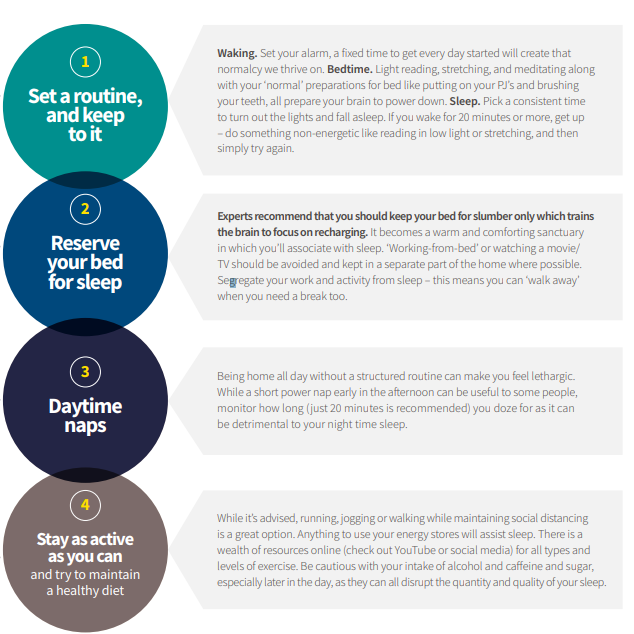
With such unexpected, unprecedented changes, how you sleep is so incredibly important. It plays a critical role in your physical health and an effective functioning immune system. Quality sleep is also a huge contributor in emotional responses, physical and mental health, helping deter the onset of stress, depression, or anxiety. Whether you’ve had sleeping problems before COVID-19 or if they’ve only come on recently, there are steps that you can take to try to improve your sleep.

Team working at a distance

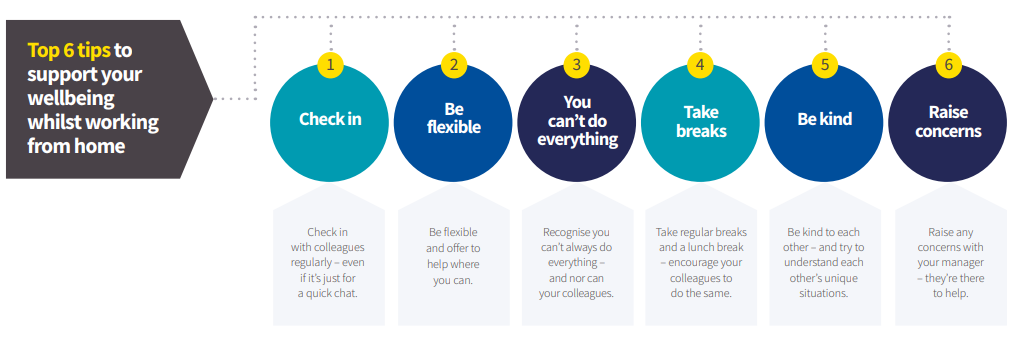
You can’t support the wellbeing of others if you don’t look after yourself To stay well, you need to consider your physical, mental, financial and social wellbeing – and there’s lots of support and advice available for everyone. Take a proper lunch break, get outside if you can (keeping your distance from others), practice mindfulness and make digital connections via social media and video chats. By doing these things to support your own wellbeing, and telling your colleagues about them, it can support everyone’s wellbeing.

Don’t let the fact that you and your team might be working remotely mean that it creates an ‘always on’ culture. Create working times to suit you and your colleagues, and stick to them. Perhaps create a routine that symbolises the end of your working day. Rest and recharging (physically and mentally) is really important to your wellbeing. If you are a manager and supporting your team, then you need to look after yourself too, giving yourself time to deal with the issues you yourself are facing.

How to lead virtual meetings

Establish virtual meeting principles with your team

• Does every meeting need an agenda?
• How often do we meet and when?
• How do we hear the voices of everyone?

Create a safe environment

By creating a few ground rules on how we interact with one another, such as not interrupting each other, accepting all ideas equally and not being judged, ‘out of the box’ suggestions are encouraged and listened to. Be a brilliant virtual meeting host

• Try and get familiar with the technology you are using.
• Bring energy and purpose to your gatherings, be ready to be flexible and adapt to the needs of the participants.
• Try and be the first in the room so you can meet and greet your participants.
• Consider adjusting start times to allow for things like comfort breaks and give the host space to be prepared and ready to go.

Keep the participants engaged

• Avoid the temptation to dive straight into business, a few moments of friendly chat before a meeting lightens the mood and strengthens the bonds of the group.
• Embrace check in’s and check out’s. Encourage everyone to contribute from the start.
• Listen out for the silence. Some characters are naturally more vocal and confident in these conditions than others. Invite contributions so everyone gets a say.
• Consider catching up 1-1 with anyone who appears to be struggling to contribute and establish a way that works for them and allows them to maintain a sense of belonging.

Following on from the Aviva – Looking after your mental health and wellbeing blog we posted last week (04/09/2020), this is another useful guide from Aviva with regards to our wellbeing whilst working remotely from home.

Working remotely may affect everyone differently but it could be particularly difficult for those who live alone. The tips above should prove useful in maintaining your mental and physical wellbeing.

Please continue to check back for our regular blog posts and updates.

Charlotte Ennis

09/09/2020

Team No Comments

Looking After Your Mental Health and Wellbeing in Difficult Times

Please see article below from Aviva which is a guide to looking after your mental health and wellbeing in these difficult times – received 02/09/2020.

Staying on track Looking after your mental health and wellbeing in difficult times

It’s OK not to be OK all the time

The past few months have been a strange and anxious time for many. And even though things may be gradually getting back to normal now, it’s hardly the same ‘normal’ we knew before.

Moving out of lockdown and getting used to new ways of working can bring challenges of their own, even if you’re moving back to a familiar environment. Just as importantly, the challenges don’t end when you go home. In these difficult circumstances, you may be worrying about the health of family or friends or finding it hard to relax when you’re staying mindful of social distancing. All of this can add up.

It is common to have times in our lives when we feel we just can’t cope. It’s nothing to be embarrassed about.

Thanks to national campaigns and changing attitudes, many people now feel more able to talk openly about mental health issues – and to pass on guidance about looking after wellbeing, both physical and mental.

This brief guide is designed to help you look after your mental health at work and in your home life – by pointing out some warning signs that might show if you’re struggling to keep stress at bay, as well as offering some suggestions on what to do if you’re feeling the strain, and how to get back to your best.

First steps

Before you return to the workplace, it’s a good idea to think about your job and any issues that apply to your own unique situation – all of us are individuals with our own priorities and commitments. Plan an initial conversation with your manager and think of the questions you’d like to ask in advance. These can cover practicalities, as well as more general concerns – knowing exactly how your return to work will be managed and the safety measures in place will increase your confidence and help you avoid anxiety.

Warning signs to look out for

It’s all too easy to tell ourselves we feel fine, or that we’re managing all right, when in fact stress could be affecting our wellbeing more than we realise. It’s only natural to have ups and downs from one day to the next. But there are a number of signs – both physical and behavioural – that might indicate that someone is struggling and could be at risk of developing poor mental health such as:

  • Frequently feeling more irritable, aggressive or feelings of nervousness of anxiety
  • Increased fatigue, poor sleep or nightmares.
  • Feeling overwhelmed by everyday tasks or commitments.
  • Lack of interest in personal appearance or hygiene.
  • Withdrawal from social and personal interactions with family or friends.
  • Drinking or smoking more than usual.
  • Increased physical symptoms such as headaches, aches or pains, or digestive problems. Loss of interest in work or leisure activities.

Working from home: Time to reflect on the positives

You may have heard that pressure is a motivator – and it’s true to say that a manageable level of pressure can improve productivity. But when the pressure is too high, or lasts too long, it can cause stress – which can eventually lead to poor mental health. The pressure of work can be especially strong now that many businesses and organisations are coping with the economic and practical implications of COVID-19. And if you’ve recently returned to the workplace after working from home, remember that a change back to something you did before is still a change – which can be stressful in itself.

Take work issues in hand

If a situation at work is affecting you and you can’t resolve it yourself, try talking to your manager about your concerns. Or, if you’re not comfortable taking the issue to your manager, try to find someone else in the organisation. You could try talking to your personnel department or a trade union representative. And if your organisation has an employee assistance programme (EAP), check if it offers access to counselling or other sources of specialist help. This can also be a good route to take if you just need to talk with someone.

Keeping on top of things

Even if you don’t have specific issues to discuss, it’s a good idea to have regular one-to-one talks with your manager to share how you’re feeling and whether the experience of returning to work has met your expectations. And, as well as your manager or other team members, there’s someone else you need to ‘check in’ with on a regular basis – yourself. Ask yourself how you’re coping, and what you could do for yourself to stay mentally healthy, as well as what might be done differently at work.

Putting work concerns into perspective

Sometimes, we can put ourselves under more pressure than we need to at work. It’s all too easy to worry that the boss would be less than happy if we need to devote more time to commitments outside work. But most employers are conscious of their duty of care, and increasingly recognise that flexible working can boost productivity as well as being positive for employees.

Thankfully, many would prefer their employees to go home on time, or work from home so they can meet family commitments, rather than putting in consistently long hours and compromising their wellbeing. By carefully apportioning your time and priorities, you may find that it’s possible to improve your work-life balance. In practical terms, you could try allocating specific times to individual tasks instead of just writing a ‘to do’ list at the end of each day. This can give you confidence that you’ll have time to get everything done instead of dwelling on the following day’s challenges even when you’re not working.

Think about your working environment

If you’re returning to the workplace after working remotely, this could be a good time to review your working environment. If you aren’t comfortable, or don’t feel at ease with your surroundings, you could risk harming both your mental and physical health.

When you get home

It’s easy to let worries about things we can’t directly influence encroach on time that could be devoted to relaxation or enjoying the company of loved ones. The ease of access to news through digital as well as traditional channels can be overwhelming – especially when the news is largely unsettling. You could think about taking in updates at specific times, rather than through an ‘always on’ approach. Being unable to talk about your worries can make them worse. Talk to someone you trust about anything that’s on your mind.

Taking the physical activity route to good mental health

Physical activity and exercise can help reduce the effects of stress. In addition to the obvious benefits to fitness, exercise releases hormones which can help you to manage stress and promotes better sleep. Taking the physical activity route to good mental health It’s easy to find ourselves becoming less active right now. More of us will probably continue to work from home after the pandemic has eased, and right now there are fewer opportunities to get out and about while restrictions are still in place. But there are plenty of ways to keep active at home, including online workouts, fitness apps and yoga routines. Or, if you have a garden, you could give it a makeover. If you can manage to exercise outdoors, this can help boost your vitamin D levels – and simply feeling that you’re surrounded by nature can also help to raise your spirits

Accept that things change… and change what you can

Change brings challenges – this is just as true whether we’re talking about the changes brought on by the COVID-19 pandemic or any of the big events that form part of regular life. Small steps are the way forward. Be calm, be prepared, don’t try to take on too much – and don’t be afraid to ask for help. If you’re experiencing persistent symptoms, or feel worried about your mental health, do make an appointment with your GP

At this strange time we are all in the same boat, adapting to circumstances which are difficult for everyone.

Some people may be starting to return to work whereas others may still be working from home, either way it is important to look after your mental health.

Charlotte Ennis

02/09/2020

Team No Comments

Blackfinch Weekly Market Update

Please see below for this week’s market update from Blackfinch Asset Management – received at lunchtime today.  

Blackfinch Group – Monday Market Update

In the ever changing world that we live in, we recognise the importance
of regular and current communication. This weekly news update from our
Multi-Asset Portfolio Managers provides you with a short summary of events
around the world which we hope you will find useful. 

Issue 6 | 1st September, 2020

UK COMMENTARY

• Speaking at the virtual Jackson Hole symposium, Governor of the Bank of England Andrew Bailey, states that central banks are ‘not out of firepower by any means’.

• Retail footfall in the UK rose by 4.1% from the previous week according to data from market research company Springboard. Retail parks have been the most resilient with numbers down only 10.6% from 2019 levels, whereas shopping centres and high streets have been hit harder, down 32.4% and 39.1% respectively.

• The Financial Conduct Authority announces that the option of a three-month mortgage holiday will end on the 31st October.

US COMMENTARY

• Sunday 23rd saw the US report 34,600 new cases of COVID-19, down 17.8% from the number reported a week earlier.

• Progress appeared to be made in US/China trade talks, as officials continued discussions. Improvements are reportedly being made on key issues such as an increase in number of US products purchased by China, intellectual property rights, and a reduction of tariffs levied by the US.

• Jerome Powell, chairman of the Federal Reserve, spoke at the Jackson Hole symposium, announcing a new monetary policy framework based upon average inflation targeting. Powell stated that should ‘excessive inflationary pressures’ build, the central bank would ‘not hesitate to act’.

• US gross-domestic product (GDP) was revised up from an annualised rate of -32.9% to -31.7% for the second quarter of the year.

EUROPE COMMENTARY

• Germany’s GDP reading for the second-quarter 2020 was revised upwards from -10.1% to -9.7%.

ASIA COMMENTARY

• Long-serving Japanese Prime Minister Shinzo Abe resigned due to ill-health. At eight years in office he is the country’s longest serving Prime Minister. He will remain in office until a successor is chosen by the Liberal Democratic Party.

COVID-19 COMMENTARY

• President Trump announces that his administration granted emergency use authorisation for COVID-19 treatment using blood plasma, although some medical authorities suggest that the data required to support the use of the treatment is still lacking.

• News from the US also suggests that President Trump is attempting to fast-track approval for the vaccine currently in development by Oxford University and AstraZeneca, with reports suggesting that approval could be granted before the presidential election in November.

• Cambridge University receives a £1.9mln from the UK government and plans to start clinical trials of its vaccine in autumn, or early next year. Representatives from the university claim that their approach will not only act as a vaccine against COVID-19, but is aimed at protecting humans from other related coronaviruses.

These articles are useful in providing a short summary of events from around the world over the past week.

Please continue to check back for our regular blog posts and updates.


Charlotte Ennis


01/09/2020