Team No Comments

Election Night 2020: Champagne and Cheers or Anxiety and Jeers

Please see below intriguing insight into US Government affairs published by Invesco. The commentary provides predictions relating to the ‘pivotal’ states and explains potential scenarios should the validity of the electoral result be challenged after the 3rd of November.   

In what many voters feel like has been a never-ending presidential campaign cycle, November 3 is finally close enough to touch. But will Election Day 2020 provide closure for a restless electorate?

As President Trump and Vice President Biden barnstorm a handful of battleground states the intricacies and mechanics of how a candidate becomes president are coming into light and all eyes are on the Electoral College. Consisting of 538 electors representing all fifty states and Washington D.C. and roughly allocated by population, the Electoral College, not the popular vote, ultimately decides U.S. presidential elections. To win, a candidate must secure an absolute majority – 270 or more electoral votes. Since most states – with the exceptions of Nebraska and Maine – assign electoral votes on a winner-take-all model based on state-wide vote totals, a small percentage of voters in key states can play a deciding role in the overall election outcome. Former Secretary Clinton learned this painful lesson when she captured the popular vote but fell short of the electoral vote four years ago.

In these final weeks of the campaign, candidates will continue to crisscross the country as they cobble together puzzle pieces of electoral math. With so few states actually in play (Florida, Michigan, Pennsylvania, Georgia, Ohio, Wisconsin, Arizona, Nevada, Minnesota, North Carolina, New Hampshire), political experts have started to take a deeper look at chaos theories and “what if” scenarios. What if results are contested? Could there be recounts, lawsuits or both? Will state legislatures have to get involved?

States in play

Political talking heads have focused on Bush v. Gore in 2000 as the precedent for presidential election chaos. That dispute, untimely decided by the Supreme Court, halted an ongoing recount and determined that President George W. Bush had won Florida by 537 votes. That victory meant that Bush won all 25 of Florida’s electors giving him a total of 271 votes in the Electoral College and, with that narrow majority, the presidency. Some experts have forecasted that several states in 2020 could see similar recount and courtroom drama leading all the way to the Supreme Court in deciding whether Trump wins a second term or Biden claims victory. Their predictions are based on the craziness of 2020: the pandemic, a record number of mail-in ballots, the polarization of America and President Trump’s characterization of the voting process.

However, famed Republican election lawyer Benjamin Ginsberg recently put the odds of the 2020 presidential election ending up in a legal battle that sprawls into January at just one percent citing more signs pointing to a smooth transition than a repeat of 2000. Keep in mind that only three of the 57 previous presidential elections have been contested.

But is history relevant in modern politics? Here are several variables to watch for to determine if this election will be decided within hours, weeks or months of the polls closing.

Vote Counting

Democrats have embraced vote-by-mail while President Trump has lambasted it as fraudulent despite casting his own ballot by mail. History will take a very close look at the encouragement – and discouragement – of mail-in and absentee voting on the results of the election both in terms of the presidential outcome but also the impact on down-ballot candidates.

Election Day and subsequent weeks could see voting result fluctuations as in-person votes are tabulated and mail-in and absentee ballots are counted. As of October 21, the US Elections Project counted 84.7 million absentee ballots that had been requested and 44 million people who had already voted. There will be confusion on election night as both political parties and news outlets grapple with reporting in-person votes versus absentee or mail-in as different states have different rules on when votes can be counted. Also, there are questions as to when mail-in or absentee votes are valid? Here are three different categories of how and when states can count early votes and they will be important to understand the differences as the results come in:

22 state election authorities and the District of Columbia start counting when the ballot is received. Among this group, Arizona, Georgia, Minnesota and Nevada are considered the most pivotal for the presidential election and could foreshadow a good night for President Trump or Vice President Biden. If Biden were to flip the red state of Georgia to blue and secure 16 electoral votes, it could prove be to be a tough road for Trump. Similarly, in 2016, Trump narrowly lost Minnesota – a state that has not voted for a Republican president since 1972. If the results look favorable for Trump there, it could not only put 16 critical electoral votes in his tally but foreshadow that the famous “Blue Wall” (Michigan, Wisconsin, and Minnesota) has crumbled. Arizona’s ability to count as the votes are received prior to November 3 could permit some early forecasting on whether Trump recaptures the Grand Canyon State’s 11 electoral votes or if Biden is well on his way to becoming the 46th President.

Before Election Day:

25 state election authorities can tabulate votes at a defined date by state law. Among this group, Florida, Iowa, Michigan, New Hampshire, North Carolina and Ohio are considered the most critical to election outcomes. But this group of states range in when counting is permitted. On one end there is Florida which started its tabulation on September 24 and on the other end is Michigan which starts counting 10 hours before Election Day. The early tabulation will allow states to report out November 3 numbers that could either spell doom and gloom or early moments of celebration for either party.

President Trump’s path to victory will be severely truncated if he cannot match his 2016 victories in Florida, Ohio, Michigan and North Carolina. Similarly, any victory by Biden in these same states will be a sign of optimism for Democrats. The ability for these states to count early should remove weeks of suspense as they will have a head start on tabulating votes while also counting in-person voting which is expected to lean Republican. Another important element to watch in Florida is that the state does not allow ballots to be counted if they are received after Election Day which should reduce election result delays.

On Election Day:

Four state election authorities can tabulate votes on the date of the election with Wisconsin and Pennsylvania by far the most important to determining election outcomes. President Trump shocked the political establishment in 2016 when he won both states and neither party is leaving anything on the table in 2020. Both Republicans and Democrats will be closely watching election night to see results in these battleground states. Wisconsin officials have said they expect to have their results completed the day after the election. The state has also permitted county clerks to verify signatures on the outside of the ballots early which should reduce dayof vote counting (and suspense) and reduce the number of questionable ballots.

What does this all mean? The ability for critical bellwether states to either tabulate ballots as they come in or on a certain date before November 3rd does provide some certainty that election results will come sooner rather than later. It is estimated that 40 to 50 percent of the projected 150 million votes could be cast by mail. Experts largely agree that early voting will favor Democrats and Election Day in-person voting will favor Republicans. Depending on when states begin counting mail-in votes and therefore which votes – mail-in or in person – are reported first, there could be several “blue or red shifts.” This could create the impression that one state is headed blue or red based on that state’s ballot counting requirements. The “blue and red” shifts may frustrate the candidates and create the appearance of “fraud” or gamesmanship but they are simply part of the process that will allow the results of the election to be made public faster.

Electoral College

With only a handful of truly competitive states, the path to either candidate securing the 270 electoral votes needed for victory hinges on election returns in Florida, Michigan, Pennsylvania, Georgia, Ohio, Wisconsin, Arizona, Nevada, and Minnesota. Contested or uncertain results in any of these states, as occurred in Florida in 2000, could prevent either candidate from reaching the 270-vote threshold. President Trump and some experts have raised concerns that delays in finalizing election results could run into the December 8th safe harbor deadline. This deadline, set by federal law, is the last day when states can appoint electors without interference from Congress.

Electors are set to cast their votes on December 14th. If a state’s results remain contested and without a clear winner past December 8th, there is no clear remedy. One option would be for the state’s legislature to name its own slate of electors regardless of the results of the state-wide vote. In states where one party controls the legislature and a different party holds the governor’s office, this could result in competing slates of electors being sent to Congress. In either case, a state government overriding the popular vote could lead to claims of a “stolen election” and push the losing party to not accept the results. Despite the possibility of these worse case scenarios, it is important to note that no state legislature has ever appointed a slate of electors supporting a candidate who lost that state’s popular vote, and this remains unlikely in 2020.

State Election Rules and Law

If election results in one or several states are in question this November, the vast majority of states have basic election safeguards already in place to create an orderly process to determine the legal electoral outcome.

As of October 2020, twenty states have a statutory provision allowing for an automatic recount of votes if the margin between the top two candidates is within certain parameters. Forty-three states have a statutory provision allowing for a requested recount of votes. It is highly unlikely that statutory requirements for a mandatory or requested recount will be triggered since it is improbable that those states’ results will be so narrow and are relevant to the Electoral College outcome that the country will see widespread vote recanvassing. The biggest hurdle for a contested election will be a few battleground states that have protracted election recounts that could see their results questioned.

The bottom line is that states have been preparing for a highly competitive presidential race and will be certain to ensure the results are accurate and timely. The rules of the road are clear in disputing election (allegations of fraud) results and requesting recounts and all eyes will be on those states if their results will determine the winner. While it could be a bumpy road over the next several weeks, it’s unlikely Americans will have to go too long before they know who will serve as president for the next four years.

How the US election result influences market performance is also to be seen. Please check in again with us soon for further relevant updates and articles.

Stay safe.

Chloe

29/10/2020

Team No Comments

Brooks Macdonald – Daily Investment Bulletin

Please see article below from Brooks Macdonald received today 28/10/2020.

Brooks Macdonald – Daily Investment Bulletin

What has happened

Coronavirus malaise continues to grip markets with European and US equities recording losses. European equities have been underperforming the US of late, in part due to Europe being the main focus of this second wave but also the cyclical tilt in the European indices which suffer as near-term economic activity looks more uncertain.

Coronavirus restriction update

The day by day movements in COVID-19 restrictions will likely dominate markets over the coming weeks, particularly if the US election proves to be a drawn-out affair. France and Germany are expected to move into a form of lockdown over the coming few days, this will represent the culmination of the relative willingness for tight restrictions on social activity and hospitality with bars and restaurants expected to be shut. The next step will be tough decisions over whether to close schools and businesses in a return to the restrictions seen earlier in the year, it is mainly this step that markets are worried about. Add in the fact we are moving into the colder months, and flu season, and the market is struggling to be optimistic about the coming 3/6 months.

‘Filibuster’ is the most important word in the US Election

With only a week to go until the US Election, much discussion focuses on the implications of any change at the White House. With Joe Biden’s current polling lead, and early polling which has likely already translated that into votes, the Senate is arguably far more important. Major legislative changes however require a House majority (which the Democrats have) and a filibuster-proof majority in the Senate. A filibuster is effectively a political procedure, through the medium of an exceptionally long speech, designed to slow down proceedings to a halt and prevent a vote on a piece of legislation. So, what can be done to prevent this? Either one party wins 60 Senate seats (highly unlikely), sufficient to pass a ‘cloture’ motion which effectively puts a time limit on any given debate or the new Senate votes to remove the filibuster for the entirely of the next session.

What does Brooks Macdonald think

Joe Biden has previously favoured a bipartisan approach to legislation and therefore may be intellectually against the idea of filibuster reform which hugely strengthens the incumbent party. That said, with the Supreme Court now having a 6/3 conservative majority, the Democrats may want the additional power to ‘pack’ the court to create a more balanced bench. This will arguably be the most important, and fascinating aspect of US politics in the coming months.

Source: Bloomberg as at 28/10/20

Philip Penrose
Business Development Manager

A good brief commentary from Brooks Macdonald giving updates on the latest Coronavirus restrictions and the US election.

Please continue to check back for our regular blog posts and updates.

Charlotte Ennis

28/10/2020

Team No Comments

Monday Market Update

Please see below update received from Blackfinch this morning. The bulletin provides world-wide commentary on market performance in response to events such as the ongoing Covid-19 pandemic and the upcoming US election.

UK COMMENTARY

The IHS Markit UK Household Finance Index for October was at 40.8. A value below 50 indicates that respondents believe their financial well-being is deteriorating.

UK consumer price inflation rose to 0.5% year on year in September, up from 0.2% in August. While the downward impact of the Eat Out to Help Out scheme was removed, the temporary VAT cut in the hospitality sector continued to help keep inflation low.

The Government borrowed £36.1bn last month, above consensus forecasts and bringing the total borrowing for the first half of the financial year to a record £208.5bn

Lancashire, Greater Manchester and South Yorkshire all joined Merseyside in tier 3 COVID-19 lockdown

The Business Impact of Coronavirus (COVID-19) Survey showed that 71% of businesses said they were at no or low risk of insolvency

Rishi Sunak announced the latest COVID-19 support package, including grants for businesses affected by tier-2 restrictions, a tweak in the job support scheme and extra support for the self-employed

UK retail sales rose by 1.5% in September from August’s level, the fifth consecutive monthly increase

The IHS Markit/CIPS Flash UK Composite Purchasing Managers’ Index (PMI) for October fell to a four-month low of 52.9

US COMMENTARY

Democrats and Republicans continued to debate the introduction of a further stimulus package ahead of the presidential election

First-time jobless claims fell to 787,000

Another presidential debate did little to clear up which candidate is likely to emerge victorious from next month’s election

Markit’s latest PMI survey showed that business activity rose at its fastest rate for 20 months in October

ASIA COMMENTARY

China’s third-quarter gross domestic product grew by 4.9% as compared to a year ago, falling just short of economists’ expectations

Retail sales of consumer goods in China rose by 3.3% in September

The International Monetary Fund downgraded its forecast for the Asia-Pacific region to -2.2% in 2020.

COVID-19 COMMENTARY

Pfizer said that it is ready to file for regulatory sign-off of its COVID-19 vaccine and has already manufactured ‘several hundred thousand doses’ to sell. This is if current clinical trials involving 44,000 people are successful.

Gilead Sciences’ COVID-19 treatment Remdesivir has been approved by the US Food and Drug Administration. The drug has now been renamed Veklury.

We will continue to source information from the research teams of reputable providers in order to publish the most relevant market data. Please check in with us again soon.

Stay safe.

Chloe

26/10/2020

Team No Comments

Brewin Dolphin: Markets in a Minute

Please see below market update received from Brewin Dolphin yesterday evening. The commentary focuses on Brexit, Covid-19 and US stimulus. 

Global equity markets were mixed last week. US indices eked out small gains, making it three positive weeks in a row for US shares. Chinese equities also moved higher on encouraging data.

Other markets struggled due to a worsening second wave of Covid-19 and associated containment measures restricting social and business activities.

However, Boris Johnson’s address to the nation on Friday, in which he suggested talks were “over” and the nation needed to prepare for a no-deal Brexit, was largely dismissed by markets; after an initial sell-off in the pound, it then recovered as investors recognised his speech as political posturing.

Indeed, UK shares finished higher on Friday and, at the start of this week, reports were suggesting it was Boris Johnson who is giving ground. He has reportedly agreed to water down parts of the controversial Internal Market Bill, a key part of the legislation governing the British withdrawal that was said to break international law.

Last week’s markets performance*

  • FTSE100: -1.61%
  • S&P500: +0.19%
  • Dow: +0.06%
  • Nasdaq: +0.79%
  • Dax: -1.08%
  • Hang Seng: +1.10%
  • Shanghai Composite: +1.96%
  • Nikkei: -0.88%

*Data for week to close of business on Friday 16 October.

Share markets start new week on back foot

Equity markets were mixed on Monday. Markets fell across Europe as Covid-19 restrictions continued to spread, and shares in the US were sharply down. At the close, the Dow had fallen 1.44%, and the Nasdaq was 1.65% lower.

Markets were worried by rising Covid-19 cases across the US, and investors are also sceptical about whether a new fiscal stimulus package will be agreed before the election. Democratic House Speaker Nancy Pelosi set a deadline of 20 October for progress to be made towards a deal in the long-running talks. While reports suggest that the “gap is narrowing” on many contested issues, time is running out.

Meanwhile, Donald Trump told a journalist that he was prepared to go higher than the $2.2trillion in fiscal stimulus proposed by the Democrats. If he is serious he will likely face stiff opposition from many Republicans in the Senate who oppose such a large package.

UK Brexit optimism

Currency traders seem to be pricing in a Brexit deal, as the pound rose against the euro and the dollar on Monday. The strength in sterling weighed on the FTSE100, which closed down by 0.6%. The more domestically focused FTSE250, however, gained 0.24% – more evidence that the market believes the UK will avoid a hard Brexit.

Businesses, too, are showing remarkable confidence in a deal. The last time a no-deal Brexit loomed, in March 2019, manufacturers stockpiled goods at record pace in case their supply chains were disrupted. Today, there is no evidence of any such cautionary measures.

Source: Refinitiv Datastream

A choppy outlook for markets

The largely downbeat news flow is causing anxiety for investors even after having been repaid for the courage they displayed in weathering March’s market storm. The prospect of a hard Brexit will be a worry for many, but it should be stressed that most portfolios will benefit from the weakness in sterling and strength in bonds that a no-deal Brexit would provoke. The bigger risk, paradoxically, is that a deal gets done and sterling rallies.

Rising Covid-19 case numbers and a potential disputed US election, however, have the potential to upset markets.

While the market is no longer likely to rise in a straight line, equities remain, perhaps more unequivocally than ever, the most attractive long-term savings vehicle available. There is a higher-than-average chance of volatility in the coming months, but that could lead to excellent buying opportunities and when they arise and we will be looking out for bargain buys on a stock-specific basis.

China revs up its recovery

Economic data out of China on Monday confirmed its recovery is continuing apace. The Chinese economy grew at an annualised rate of 4.9% in the third quarter. The expansion was below expectations but was still well above the 3.2% increase in the second quarter.

The recovery, which has been helped by generous state investment to its industrial sector, now looks to be broadening across the economy, as was hoped by policymakers. Industrial production grew by 6.9% in September, its highest level of the year and equalling the pace of expansion seen last December, before the pandemic began.

In addition, retail sales, which have lagged behind the broader economy, posted their best performance of 2020, rising by 3.3% in September. For context, that is up from growth of just 0.5% in August after seven months of declines.

We value the importance of communicating the most relevant data and information relating to the markets. Please check in again with us soon for further updates.

Stay safe.

Chloe

21/10/2020

Team No Comments

Daily Investment Bulletin

Please see below market update received from Brooks Macdonald this morning, which comments on the upcoming US election, the Brexit deadline and the rise of Covid-19 cases across Europe.

What has happened

Whilst we are only a few days into the earnings season it has been reasonably mixed with some idiosyncratic misses such as Bank of America, intertwined with cyclical earnings such as United Airlines which reference a still difficult economic backdrop. Once markets had added in another negative news day for fiscal stimulus, equities struggled and this weakness has followed into today.

The last nail in the fiscal coffin?

Treasury Secretary Mnuchin has been a key figure in the fiscal negotiations leading the White House administration in talks with the House Democrats. Yesterday Mnuchin said that he did not expect a stimulus package to be agreed before the election, this comes after extensive talks with House Speaker Pelosi. The issues appear to not just be the overall dollar number, but the policies included in the bill, suggesting that compromise will not be simple. As we have said before, whilst few investors were holding out hope of a full stimulus package, some were expecting a skinny deal ahead of the 3rd November. The market’s weakness post Mnuchin’s comments reflect the dying flame of a small package pre the election.

Brexit…

Today is the self-imposed deadline by Prime Minister Johnson to reach a trade deal with the EU. As widely expected, all reports are suggesting that Johnson will continue the talks post the EU Council meeting which is taking place today and tomorrow. With the Prime Minister under pressure due to the UK’s coronavirus response, adding the perception that he ‘chose’ a no deal route would just increase opposition. Last night a call took place between the EC President, EU Council President and UK PM which concluded with a comment that a decision on the continuation of talks would be made after the Council ends tomorrow. Sterling has taken this news positively, particularly in light of the progress seemingly made by both sides in recent weeks. Reports suggest an extension until early November could be the more realistic deadline.

What does Brooks Macdonald think

With COVID cases rising across Europe and governments taking increasingly tough measures including local and national lockdowns, a no deal Brexit added to the mix would be highly unwelcome. Our base case remains that a deal will be struck though our level of confidence in this isn’t high, this is the primary reason why we retain our underweight to both UK and European equities.

Source: Bloomberg as at 15/10/20

A succinct and interesting summary of the most relevant market information. Please check in with us again soon for further updates.

Stay safe.

Chloe

15/10/2020

Team No Comments

US earnings season gets underway, with Q3 reports to be revealed this week

Please find below a detailed economic and market news update from the research team at Brooks Macdonald, received yesterday afternoon. The article provides an insight into the markets’ response to Brexit developments and the ongoing Covid-19 pandemic.

  • US earnings season begins this week but with few companies guiding analysts ahead of the numbers, we expect surprises
  • The European Council meeting on Thursday and Friday was meant to be the deadline for a Brexit agreement but this is likely to be delayed
  • With a number of US data points being released this week, we will see whether the US economy is coping with its second COVID-19 wave

US earnings season begins this week but with few companies guiding analysts ahead of the numbers, we expect surprises

Risk assets continued their rise at the end of last week as markets looked through the doubtful state of pre-election stimulus and focused on significant aid post.

As is tradition, the US financials sector will kick off the Q3 reporting season and this week we will see earnings reports from JP Morgan, Wells Fargo and Morgan Stanley amongst others. According to Factset’s Earnings Insight, the expected US earnings per share decline is -20.5% year-on-year for Q3, with Energy and Industrials expected to lead the decline1. As with the second quarter, Technology and Healthcare are expected to be considerably more resilient, but all sectors are expected to see a year-on-year fall in earnings. As we know, earnings in aggregate are typically ‘beaten’ as analysts reduce forecasts ahead of the season and management keep something up their sleeve. A point of note is the small number of companies, compared to history, that have issued earnings guidance for Q3. This sets the scene for a surprise either to the upside or the downside. 

The European Council meeting on Thursday and Friday was meant to be the deadline for a Brexit agreement but this is likely to be delayed

The European Council summit takes place on Thursday and Friday of this week and was the previous deadline set by Boris Johnson for a deal to be agreed in principle. The last few weeks have seen improvements in rhetoric but we appear a while away from a comprehensive deal. Over the weekend, Prime Minister Johnson had talks with Macron and Merkel, so conversations are at least happening at a senior level. Given the timelines, we expect this week to end with an announcement of continued talks. Good progress has been made in recent weeks but for fishing rights and state aid remaining the key issues to thrash out. While Sterling (against the Euro) is off its lows, there is still considerable uncertainty baked into the UK’s currency, and foreign exchange traders expect this to continue for several months until the 31st December deadline looms large.

With a number of US data points being released this week, we will see whether the US economy is coping with its second COVID-19 wave

Some of the hard data from the US will be released for September this week, including Consumer Price Inflation, retail sales and industrial production. Markets will be watching these data sets closely to see if the US economy really has been insulated from the economic restrictions of the second COVID-19 wave, as some of the ‘faster’ data has suggested. Over the next few weeks, we will have a far richer US picture from both a corporate and economic perspective.

Please check in again with us soon for interesting market commentary and up to date information on world-wide events.

Please stay safe.

Chloe

13/10/2020

Team No Comments

Equity markets up on hope for US stimulus deal; Brexit optimism

Please see below ‘Markets in a Minute’ update received from Brewin Dolphin yesterday evening, which focuses on Brexit as well as the effects of Donald Trump’s positive Covid-19 test result on the markets.

Global share markets mostly rose over the last week as hopes increased that Democrats and Republicans will agree a new stimulus deal to keep the US recovery on track.  However, some of those gains were lost on Friday as markets fell on the news that President Trump had tested positive for Covid-19. The S&P500 fell by 1% on Friday, while the tech-heavy Nasdaq dropped by 2.2%. The news had less impact on the UK market where the FTSE100 closed up by 0.4%.

Last week’s markets performance*

  • FTSE100: +1%
  • S&P500: +1.5%
  • Dow: +1.87%
  • Nasdaq: +1.47%
  • Dax: +1.76%
  • Hang Seng: 0.96%**
  • Shanghai Composite: -0.04%***
  • Nikkei: -0.75%

*Data for the week to close of business, Friday 02 October.
**Market closed for holiday from close of business Wednesday 30 September until Monday 5 October.
***Market closed for holiday from close of business Wednesday 30 September until Friday 9 October.

Shares start week with gains on Trump prognosis

Global equities rose yesterday on news that Donald Trump was likely to be discharged from hospital.  The S&P500 closed up by 1.8%, the Dow gained 1.68% and the Nasdaq rose by 2.32%. In London, the FTSE100 gained 0.7% to close at 5,942.94.
In Europe, the benchmark Eurostoxx600 gained 0.81% and the German Dax closed up by 1.1%.
Donald Trump left hospital on Monday evening, telling Americans: “One thing that’s for certain – don’t let it dominate you, don’t be afraid of it,” even as his doctors warned that he was “not out of the woods” and could still be infectious.

Covid-19 resurgence; lockdowns increasing

Reports last week that the infection rate in the UK was falling appear to have been premature. The government has blamed an “IT issue” for failing to capture 15,841 infections that should have been added to the test and trace system.

The cases occurred between 25 September and 2 October. When incorporated into the published data, they reverse the trend of flat to falling infections and instead show cases in the UK continuing to rise, with the North of England and the Midlands worst affected, although London too is trending up. That can only increase the risk of more local lockdowns. On that note, a leak to the Guardian newspaper revealed a three-step government plan to reimpose tough restrictions if cases keep rising.

Some of the measures being considered are:

  • Closure of hospitality and leisure businesses.
  • No social contact outside your household in any setting.
  • Restrictions on overnight stays away from home.
  • No organised non-professional sports permitted or other communal hobby groups and activities, such as social clubs in community centres.

Numerous other countries are battling localised outbreaks with new containment measures. All bars have been ordered to close in Paris for two weeks from today (Tuesday) after the French government raised the city’s virus alert to maximum following a sustained rise in infections. Gyms and swimming pools will also be ordered to shut. In New York, schools and non-essential businesses have been ordered to close in a number of postcodes where cases have risen sharply. Over the weekend, residents of Madrid and nine towns in the regions entered a partial lockdownwhere they can’t leave their localities except for school, work or medical reasons.

Brexit and the pound

Sterling has been trending up on hopes that progress in Brexit talks will be enough for bureaucrats to enter the so-called “tunnel” (the media blackout period in which the detail of any high level deal gets worked out). That optimism proved well-founded as prime minister Boris Johnson met European Commission president Ursula von der Leyen on Saturday, and both agreed to work together to help resolve the final sticking points, mainly around state aid, dispute mechanisms and fishing rights. Negotiations are now entering an “intensified” phase and EU leaders will evaluate the progress at a summit on 15-16 October.

Housing

We have seen a strong performance in the UK housing market since Rishi Sunak announced a stamp-duty holiday until next year. Working from home has given many potential buyers more freedom about where they live. A survey last week from Nationwide showed prices rising at their fastest annual pace for four years.

As we have discussed before, the pandemic has given people genuine reasons to want to move, but lack of job security in the face of rising unemployment seems to be causing many to hold off, particularly younger buyers.

Mortgage conditions are also starting to tighten in the UK for higher loan-to-value home loans. So, the cut in stamp duty seems destined to help the better-off to further improve their quality of life, but will do less to help first-time buyers on to the property ladder. 

Employment

The employment market has on paper held up well due to the furlough program, but is set to get worse. Even with the furlough scheme, unemployment claims have increased by more than double the amount that took place during the financial crisis and as the furlough scheme winds down there is expected to be a further rise in the unemployment rate.

In the US, the employment data had been encouraging last week, with the ADP survey showing more jobs have been created. The Institute of Supply Management survey of the manufacturing sector also showed an improvement in its employment category.

Initial and continuing unemployment as measured by the US Labor Dept also improved. However, while the key non-farm payrolls report in the US did show the economy had created 661,000 new jobs in September, the figure was less than had been hoped for.

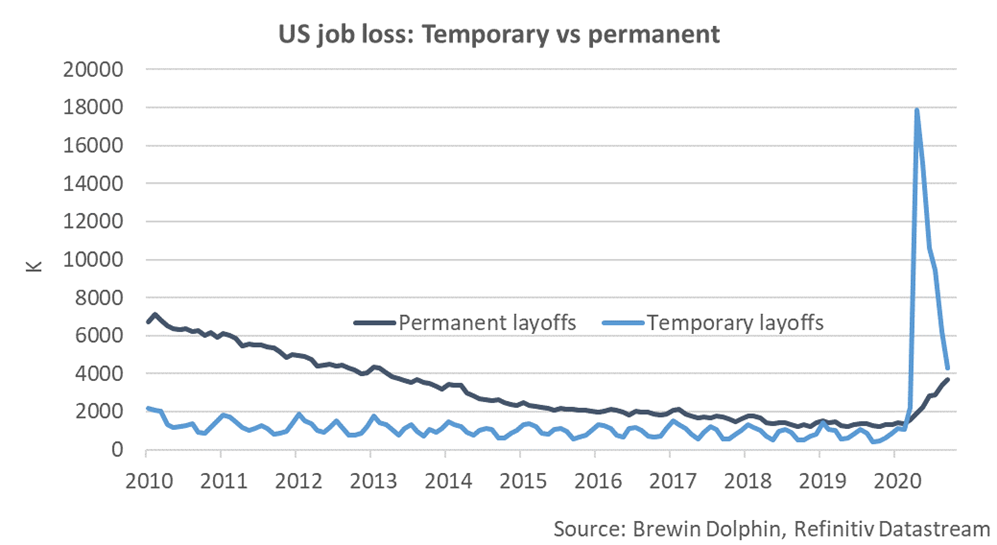
The most alarming feature of the report was the growing numbers of permanent job losses, which are now rising faster than they were during 2008.

Although the overall unemployment rate declined, this reflected people leaving the workforce – either retiring or giving up looking for work – rather than them finding jobs.

Communication has never been more important in the ever-changing world we live in. Please check in with us soon for further updates on world-wide events and the markets.

Stay safe.

Chloe

Team No Comments

Will Suga stoke returns from Japanese stocks?

Please see below insight received from AJ Bell yesterday evening in relation to Japan’s struggle to recover their economy and the effect of this on the financial markets.

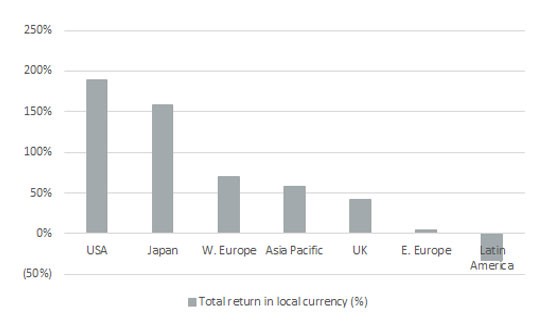
Investors with exposure to Japanese equities, following Tokyo’s Prime Minister Shinzō Abe departure for health reasons in September and his replacement by right-hand man and Liberal Democratic Party stalwart Yoshihide Suga, now have several questions to ponder. After all, the ‘Abenomics’ era – which began in December 2012 when Mr Abe returned to power five years after his first term ended with a sudden resignation – saw Japan’s headline Nikkei 225 index offer a total return (including dividend reinvestment) of 158% in local currency terms. That ranks Japan in second place out of the seven major geographic options available to investors over that time span, behind only the rampant US equity market.

Japan has been a strong performer during the Abenomics era

Source: Refinitiv data. Covers period of second Abe premiership, 26 December 2012 to 28 August 2020.

“Mr Suga has lot to live up to, and not just because he is replacing Japan’s longest-serving modern-day Prime Minister. The ‘three arrows’ of Abenomics are seen as having provided huge amounts of support to Tokyo’s financial markets.”

That leaves Mr Suga with a lot to live up to, and not just because he is replacing Japan’s longest-serving modern-day Prime Minister. The ‘three arrows’ of Abenomics – fiscal stimulus, monetary stimulus courtesy of interest rate cuts and Quantitative Easing (QE) from the Bank of Japan (BoJ) and widespread structural reform – are seen as having provided huge amounts of support to the Tokyo market. Investors will be wondering whether the new PM will keep on firing them, or whether he gets chance, since his term as leader of the LDP and Prime Minister only runs to September 2021, when elections are due on both fronts.

Bear case

Mr Suga therefore has work to do, especially as public satisfaction with the prior administration’s handling of COVID-19 had slumped by the time Mr Abe stepped down (even though the number of daily deaths had not exceeded 20 since May). Appeasing investors may be lower down his list of priorities and there are three reasons why investors may have doubts about building, or adding to, their exposure to Japanese equities.

1. The political situation is less clear. Mr Suga’s early pronouncements have focused on mobile phone charges and boosting Japan’s digital economy, while the ongoing global pandemic will also require attention. This may suggest that ongoing reform is not going to be top of Mr Suga’s list of things to do.

2. Abenomics may have boosted the stock and bond markets but it failed in its overall economic goals. The goal was to boost economic growth and drive inflation toward the BOJ’s 2% target but the programme’s success rate here is mixed, given that Japan is back in recession and headline inflation is 0.1%. In addition, the BoJ’s enormous QE scheme, which is running at ¥80 trillion (£588 billion) a year, is seen as distorting the markets by some. The central bank’s ¥683 trillion in assets represent around 125% of GDP and leave it holding some three quarters of all Japanese Exchange-Traded Funds (ETFs), more than half of the Japanese Government Bond (JGB) market and some 10% of the stock market, according to some estimates.

“The long-term bear case is still based on the assumption that Japan cannot break free from the legacy of the bursting of the debt-fuelled property and stock market bubble which peaked on 31 December 1989.”

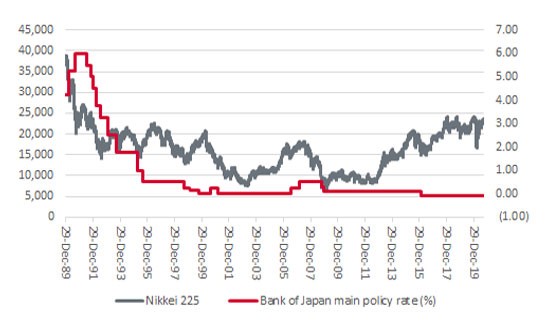
3. Japan’s economy is still bedevilled by poor demographics and huge public debts. This is the long-term bear case – namely that Japan cannot break free from the legacy of the bursting of the debt-fuelled property and stock market bubble which peaked on 31 December 1989. The economy has rarely gained sustained traction since and the Nikkei 225 still trades at 40% below its all-time high, despite 25 years or more of QE and zero or negative interest rates.

Zero or negative rates have not helped the Nikkei return to past highs

Source: Refinitiv data, Bank of Japan. Since Nikkei 225’s peak on 31 December 1989.

Bull case

Bulls of Japanese equities will sweep aside such concerns.

1. Debt and demographic concerns are neither new nor unique to Japan. As the US, UK and Europe all slip into the public debt mire, there may be less chance of the markets picking a fight with Japan’s bond market or currency. Nor have these issues stopped the Nikkei rising 5% over the past year, despite COVID-19, or advancing from a modern-day low of barely 7,600 in 2003 to more than 23,500 today. Ultra-loose monetary policy from the BOJ is helping here, as investors look for returns better than those available from cash or JGBs, and the BoJ seems unlikely to throttle back any time soon, either.

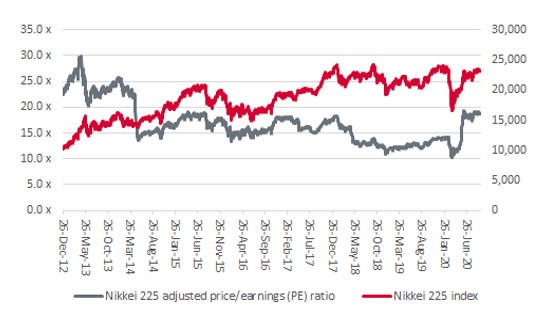
2. Japan could offer value. The fact that the bear cases are not especially new would suggest they are at least partly factored into valuations already. In addition, the Abenomics actively promoted corporate governance reforms and even prompted the creation of a new stock index, the JPX Nikkei 400, where return on equity, dividend and buyback policies and shareholder relations were key entry criteria. Before the pandemic, Japan was trading on a lowly price/earnings ratio (PE) relative to its history, thanks to Abenomics’ focus on profitability, and the latest spike in the PE simply reflects the hit to corporate earnings from the pandemic-related global recession.

Japanese stocks looked cheap before the pandemic

Source: Refinitiv data. Covers period since start of Abenomics, 26 December 2012.

“The Japanese market is packed with high-quality manufacturers and exporters, giving it leverage into whatever form of global upturn follows the pandemic.”

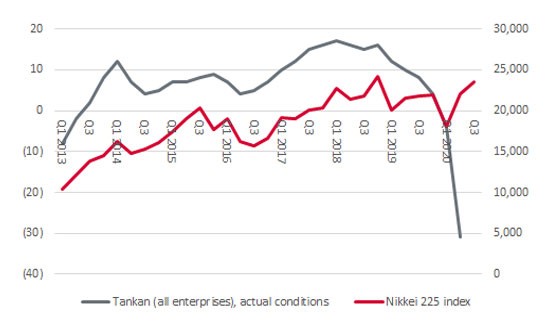
3. Japan provides exposure to a global recovery. The Japanese market is packed with high-quality manufacturers and exporters, giving it leverage into whatever form of global upturn follows the pandemic. Business confidence is currently low, using the quarterly Tankan – or the Business Short-Term Economic Sentiment Survey – as a guide, but any upturn could quickly feed through to share prices.

A global economic recovery could boost Japanese stocks

Source: Refinitiv data. Covers period since start of Abenomics, 26 December 2012.

We aim to communicate relevant content on a regular basis so please check in again with us soon. 

Please stay safe in these uncertain times.

Chloe 

05/10/2020

Team No Comments

Restart of dealings in Legal & General UK Property Fund and the Legal & General UK Property Feeder Fund

An update received today from Legal & General about their intentions to re-open their UK property fund:

We wrote to you on the 18 March 2020 to tell you that we had suspended dealings in our property funds. We are now pleased to say that we are intending to re-open the funds. We intend the timeline for re-opening to be:

1. From 12 October 2020, 12.00 noon – you will be able to place buy, sell or switch instructions through My Account or by calling us on 0370 050 2617;

2. On 13 October 2020 – the first trading in the funds will take place at the valuation point of 12.00 noon.

3. From 13 October 2020 – the funds will be open for dealing as normal. In line with our normal procedures, we will not be able to process online or telephone instructions submitted before 12.00 noon on 12 October.

If you send us postal instructions before the 13 October, we will hold these and trade them at the valuation point of 12.00 noon on the 13 October. After that, we will deal any postal instructions at the valuation point immediately after we receive your instructions.

We’ve provided some more information below about the funds. We recommend you speak to a financial adviser if you are unsure whether this investment remains suitable for your personal circumstances, investment goals and risk appetite.

Why did we suspend dealing in the funds? Given the global COVID-19 outbreak, on 18 March the funds’ independent valuer, Knight Frank LLP, introduced a “material uncertainty clause” to its valuations of the properties held in the funds. This meant we could not be confident about the value of the properties held in the funds and the prices we set to enable you to buy, sell or value your existing investments. Without a reliable price, we took the difficult decision to suspend dealing in the funds, taking into consideration our regulatory responsibilities and the overall best interests of investors. We wrote to all investors on 18 March to inform you of this decision.

Why are we re-opening the funds? As financial markets have begun to stabilise, the independent valuer has removed the material uncertainty clause from almost all properties. We are confident that the funds now meet the following key criteria. Providing no new material issues come to light and it remains in the best interests of investors, we can re-open the funds on 13 October:

1. Material uncertainty clauses now apply to well below 20% of the properties in the funds and the risk of going over 20% following re-opening is limited

2. We are satisfied that valuations from the independent valuer remain accurate and are supported by transactions taking place in the market

3. The funds’ available cash position remains well-placed to meet investor intentions and still has sufficient cash to manage the funds

IMPORTANT INFORMATION The value of an investment and any income taken from it is not guaranteed and can go down as well as up, you may not get back the amount you originally invested. Legal & General (Unit Trust Managers) Limited. Registered in England and Wales No 1009418. Registered office: One Coleman Street, London EC2R 5AA. Authorised and regulated by the Financial Services Authority.

Having considered all relevant factors, we now consider that the exceptional market circumstances that drove suspension no longer apply and that it is in the overall best interests of investors to re-open the funds. We are pleased to be in a position where we can again rely on the accuracy of property valuations from the independent valuer. These values reflect discounts arising from the impact of COVID-19. We decided to resume trading in the funds on 13 October 2020 so as to allow sufficient time to communicate the decision to all investors in the funds in writing, and particularly to allow you to consider and potentially take advice on your investments.

Cash levels Over the course of suspension, we have proactively engaged with many investors, whilst closely monitoring and recording their intentions to hold, redeem, or add units in the funds. In view of these conversations, we believe the funds are currently well placed to pay investors who wish to cash in their investments, and retain sufficient cash to manage the Funds on an on-going basis. Currently the funds hold 26% cash, in addition to 3% held in Real Estate Investment Trusts (shares in other property funds). We will continue to engage and monitor the amount of cash we need, reviewing this up to the point of re-opening the funds.

The funds’ investments We believe the funds are well placed for investors looking for long-term investment in the UK property market. They are well diversified across sectors and geography, with property in locations we believe to be strong. The funds’ investments are currently weighted more towards industrial and alternative properties which we believe to have better long-term prospects, and less weighted to retail properties, which is currently the weakest part of the market.

Our outlook for the funds Although COVID-19 has resulted in many short-term challenges, we believe that the vast majority of this has already been felt. Whilst some sectors will take longer to recover than others, the stimuli put in place by the UK government have served to limit the damage. The funds’ investment manager, Legal & General Investment Management Limited, has many on-going initiatives which we expect to create value for investors over the short-term and we expect UK property to continue to deliver positive returns over the next five years. We believe that property is still an attractive diversifier in any balanced portfolio and is well positioned for investors with long-term horizons. We will provide further information and inform you once dealing in the funds has resumed via https://www. legalandgeneral.com/investments/investment-content/property-fund-suspension-notice / our website

Not all Fund Managers are in the same position with their property funds in the UK.  A lot of ‘bricks and mortar’ funds are still suspended from trading to protect the underlying asset values for investors.

The other option is to buy a share based property fund but this does not have the same qualities for diversification, using a range of assets for volatility control/lower volatility overall.  Share based property funds correlate to typical equity funds and will demonstrate similar volatility to them.

Steve Speed

02/10/2020

Team No Comments

Surprising UK Statistics: Personal Debt & Savings

People in the UK owed £1,681 billion by the end of July 2020, according to The Money Charity’s September issue. These figures have crept up by £28.4 billion comparatively from £1,652 billion at the end of July 2019. This adds up to an extra £539 per UK adult over the past year.

Currently, in England and Wales, approximately 28 people are made bankrupt, 51 Debt Relief Orders are granted, and 159 Individual Voluntary Arrangements (IVAs) are entered into – every single day.

Although there are many contributing factors relating to the above statements, much can be attributed to the events that have unfolded world-wide this year. Restrictions imposed as a result of the Covid-19 pandemic have resulted in job losses which has subsequently affected many people’s financial situation. Addiction, over-spending, and poor money management are also common reasons why one might find themselves ‘in the red’.

From the start of this year until the end of July, the Citizens Advice Bureaux in England and Wales dealt with 2,124 debt issues every day. As the furlough scheme comes to an end over the coming months along with the ban on evictions and the halt on bailiff action, it is likely that these numbers will only increase. How the state of our economy recovers and the consequent effects of this is also to be seen.

According to DWP, 12.8 million households (46% of the total) had either no savings or less than £1,500 in savings. Furthermore, it has been revealed that 19.2 million households (68% of the total) had less than £10,000 in savings.

The reasons why we should save are obvious; comfort can be taken from having cash reserves, particularly in times of crisis. Getting married, getting divorced, having children, or getting onto the property ladder are some examples of milestone events in our lives which often incur considerable cost.

Despite good intentions, it appears that saving is easier said than done. The FCA has revealed that 9 million UK adults rate themselves as having low financial capability in relation to personal wealth, money management, knowledge of financial matters and confidence in buying financial services.

Financial education from an early age in life is vital. We believe this is the game changer and should be a focus of Government, education, and charities. In summary, financial understanding is empowerment.

Chloe Speed

01/10/2020