Team No Comments

Can ethical investing help narrow the gender investment gap?

Please see below article received from AJ Bell yesterday, whose research team have found that women are more inclined to invest in green policies when looking for investment opportunities.

Women invest less than men, that’s a fact. A new study* commissioned by AJ Bell suggests the average level of savings and investments held by women is less than half the amount held by their male counterparts.

To put a number on it, if you extrapolate the average difference in savings and investments between the men and women questioned and factor in the UK population then the gender investment gap comes in at a staggering £1.65 trillion.

There are many reasons for the gap from pay differences to maternity leave and the fact women simply think differently to men, but there could be one change that might start to make a difference.

SEEKING POSITIVE CHANGE

Chatting to two first time investors during research for our new Money Matters campaign it emerged that while both women had different reasons for starting their investment journeys both had really focused on the ability to have their money work for positive change.

31-year-old Dee told me: ‘When I first started investing… I was just happy to give it a go to see if it was for me. As I got more experienced it very much became a conscious decision of what company I invested in and any organisations that I would like to support.

‘I started reading an organisation’s green policies… and it actually did become an emotional decision and it still is. Now I will only invest in a company that I believe will do good for the planet or at least has a green initiative.’

Similarly, Georgia, who is 28, said, ‘I think the first time I looked at (investing) I was getting a sense of how it worked. I invested a small amount, but I got to grips with what all the different words meant. Now I’ve been able to use that information to make more ethical decisions about where I put money and decide the best options for me that fit my values as well.’

RESPONSIBLE INVESTING ON THE RISE AMONG MEN AND WOMEN

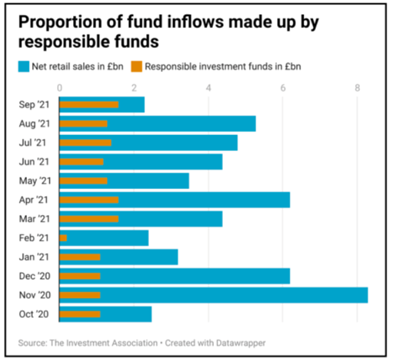
That’s not to say women are the only ones putting their money where their ethics are. Two thirds of fund inflows in September went into products that invest specifically according to ESG (environmental, social and governance) principles and over the past year most months saw around £1 billion of funds being invested in ‘responsible’ funds.

But as Dee says, at least among her friends, investing means different things to different people. ‘I’ve got a small circle of friends that invest. Some are female, some are male. Most of my female friends only invest in companies they believe in. Most of my male friends, in fact all of them, invest in the company they think will get them the most money or most reward. In return they very rarely look at the company as a whole.’

Ethics isn’t a barrier to rewards and when you look at AJ Bell’s most traded lists for this year and compare it with five years ago you can see change is coming, albeit slowly.

INVESTMENT APPETITES ARE CHANGING

Several high carbon emitters have slipped out of the top 10 most traded stocks, but BPremains a popular choice and its ESG credentials come with great big caveats.

Pre-packaged funds which tell investors exactly what’s ‘in the tin’ have become more popular, and making sure that investors have easy access to clear information might be the most significant thing to emerge from COP26, the Glasgow-based climate change summit of world leaders.

From April next year over 1,000 of the largest UK registered businesses will be required to disclose mandated climate-related financial information, and investment products will also come under the spotlight with the FCA, the financial regulator, due to consult on criteria for ESG labels.

It’s often said knowledge is power but there have been many complaints that ESG reporting has lacked clarity and a mechanism for judging whether all those net-zero promises are more than just lip service.

In this case the knowledge might make a double impact, helping make the UK and the world a cleaner, greener place and giving more women the impetus and the confidence to seek out investing for the first time. Helping the planet and helping themselves.

Please check in again with us soon for more relevant content and news as we approach the festive season.

Stay safe.

Chloe

12/11/2021

Team No Comments

Daily Investment Bulletin – Brooks Macdonald.

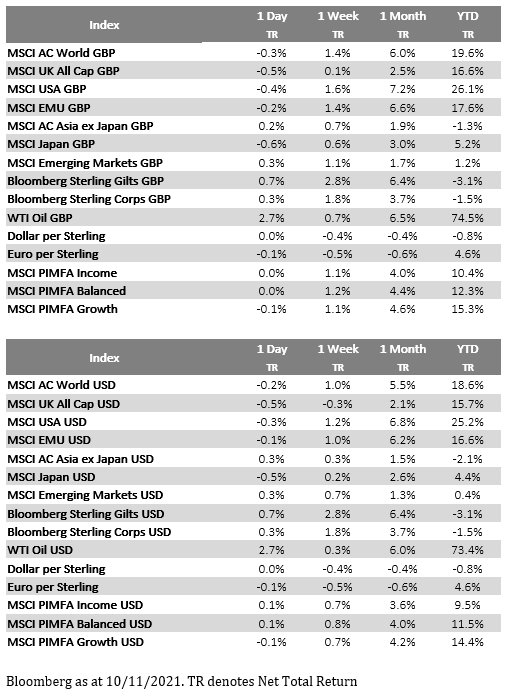
Please find below, a “Daily Investment Bulletin” received from Brooks Macdonald yesterday afternoon – 10/11/2021.

What has happened

Equities finally broke their winning streak yesterday with the US market down a third of a percent. Tesla dragged discretionary stocks lower as fallout continue from founder Elon Musk’s twitter poll proposing a partial sale of his Tesla stake.

Inflation

Today sees the long-awaited publication of the latest US CPI number. Whilst the headline number will drive the news flow, the true devil will be in the detail with the subcomponents scrutinised for signs of transitory versus persistent forces. Supply shock areas such as used cars and new cars are expected to show inflationary pressure given the ongoing global issues over semiconductor shortages. COVID reopening areas such as travel and hotel accommodation continue to be skewed by base effects from the pandemic last year and as such can be volatile. Finally, housing subcomponents will be a test of whether inflation is broadening. Housing, like all the sub-indices will be distorted by last year’s readings but given its importance in the basket it will be closely watched. Earlier today China’s Producer Price Inflation came in at 13.5%, the highest level in over 25 years which acts as a good indicator that upstream supply side issues are still rife. In better news for the transitory inflation camp, natural gas prices fell by over 8% in both the US and Europe yesterday.

Interest rates

Yesterday saw yields fall in the US and Europe and the yield curve flatten. One of the drivers of this is the expectation that any change at the Federal Reserve would likely favour a more dovish position. Fed Governor Brainard is being considered for the Fed Chair position alongside incumbent Powell, Brainard is considered to be more dovish so this offers the choice to markets of either the status quo or lower for longer. With additional Fed seats now vacant there is also more scope for the White House to propose more dovish candidates for the vacancies.

What does Brooks Macdonald think

Whilst the US market ended its extensive winning streak there was no clear catalyst to the change in mood so this likely reflects some gain fatigue rather than anything more concerning.

Please check back in again soon for a range of blog content from us and from some of the world’s leading fund management houses.

Alex Kitteringham

10th November 2021.

Team No Comments

Stocks rally as central banks maintain dovish stance

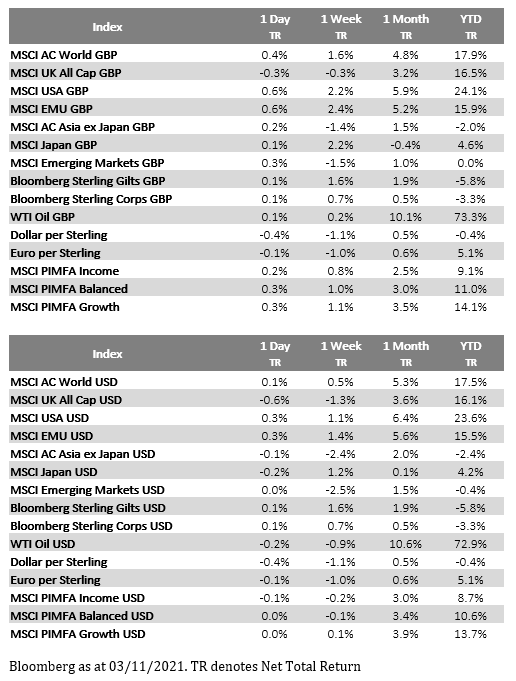
Please find below, a ‘Markets in a Minute’ update received from Brewin Dolphin late Tuesday afternoon – 09/11/2021

Global equities rose last week as major central banks struck a dovish tone on interest rates and US jobs data proved far stronger than expected.

 The FTSE 100 added 0.9% after the Bank of England surprised the markets by voting to keep interest rates unchanged. Germany’s Dax also rallied 2.3% as the European Central Bank (ECB) indicated that interest rates would stay low for some time.

In the US, the S&P 500, Dow and Nasdaq added 2.0%, 1.4% and 3.1%, respectively, as the Federal Reserve stuck to its view that high inflation would prove transitory and would not necessitate an immediate rise in interest rates.

Over in Asia, the Liberal Democratic Party’s solid win in Japan’s general election boosted the Nikkei 225 by 2.5%. In contrast, China’s Shanghai Composite lost 1.6% amid renewed Covid-19 restrictions and ongoing concerns about the country’s property sector.

Last week’s market performance*

• FTSE 100: +0.92%

• S&P 500: +2.00%

• Dow: +1.42%

• Nasdaq: +3.05%

• Dax: +2.33%

• Hang Seng: -2.00%

• Shanghai Composite: -1.57%

• Nikkei: +2.49%

* Data from close on Friday 29 October to close of business on Friday 5 November.

US stocks rise on passing of infrastructure bill

Wall Street stocks started this week on a strong footing, with Congress’ approval of President Joe Biden’s infrastructure spending package leading to gains across the industrial and material sectors on Monday (8 November). The $1trn package, which was passed by the House of Representatives late on Friday, will provide new funding for transport, utilities and broadband, among other infrastructure projects.

UK and European equities started the week on a more subdued note following a mixed session in Asia overnight. The FTSE 100 slipped 0.1% on Monday after a survey showed UK consumer confidence in October fell to its lowest level since March. However, the upbeat mood in the US boosted sentiment at the start of trading on Tuesday, with the blue-chip index managing a 0.1% gain.

 BoE holds rates at record low

The Bank of England surprised investors last week by voting to hold the base interest rate at its historic low of 0.1% despite surging inflation.

Andrew Bailey, the Bank’s governor, said he was ‘very sorry’ that households were feeling the impact of rising prices, but that the Bank wanted to see what impact domestic and global issues were having on the cost of living before deciding on whether to raise rates. He told the BBC that current conditions were different because inflation was being driven by global supply shocks rather than demand pressure in the UK economy.

The Bank signalled that the base rate could rise in the coming months amid forecasts that inflation is likely to hit 5% next year. Nevertheless, the pound fell against the dollar by 1.5% following the decision.

ECB rate hike ‘very unlikely’ in 2022

Investors were also speculating that the ECB would raise interest rates next year amid a 13-year high in the rate of inflation. However, ECB president Christine Lagarde said a rate increase would be ‘very unlikely’ to take place in 2022. She was quoted by Reuters as saying that despite the current surge in prices, the outlook for inflation over the medium term remains subdued, and therefore the ECB’s three conditions for a rate hike are unlikely to be satisfied next year.

Lagarde also pushed back on expectations of a tightening in monetary policy, saying the ECB would continue to use emergency asset purchases to keep borrowing costs down. “An undue tightening of financing conditions is not desirable at a time when purchasing power is already being squeezed by higher energy and fuel bills, and it would represent an unwarranted headwind for the recovery,” she stated.

Fed holds rates near zero

The Federal Reserve also announced it would keep its main policy rate near zero for now, but said it would begin scaling back its $120bn monthly bond-buying programme this month. The Federal Open Market Committee said it could start withdrawing stimulus because it had achieved ‘substantial further progress’ towards its twin goals of maximum employment and inflation that averages 2%. Fed chair Jerome Powell added that the bar for raising interest rates was higher than that for tapering.

“It is time to taper, we think, because the economy has achieved substantial further progress toward our goals,” Powell was quoted by the FT as saying. “We don’t think it’s time yet to raise interest rates. There is still ground to cover to reach maximum employment, both in terms of employment and in terms of participation.”

Economic data stronger than expected

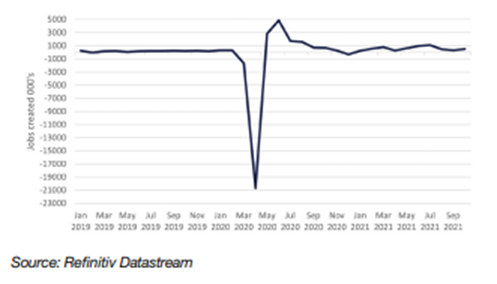
The policy meeting came a couple of days before the latest US nonfarm payrolls report showed the jobs market bounced back in October. Nonfarm payrolls increased by 531,000 from the previous month, according to the Labor Department, compared with the Dow Jones estimate of 450,000.

US non-farm payrolls

Private payrolls showed even stronger growth, rising by 604,000. This was far higher than 312,000 gain seen in September – a figure that was revised up from the Labor Department’s previous estimate of 194,000. Leisure and hospitality drove gains as the number of Covid-19 infections declined. Meanwhile, the unemployment rate fell to 4.6%, marking a new pandemic low. Elsewhere, figures showed US factory orders unexpectedly rose in September by 0.2% from the previous month. Economists polled by Reuters had forecast orders to remain unchanged. On a year-on-year basis, orders were up by 17.6%. However, manufacturing is still constrained by shortages of labour and materials, with manufacturing activity slowing in October, according to the latest survey from the Institute for Supply Management.

Please continue to check back for a range of blog content from us and from some of the world’s leading fund management houses.

David Purcell

10th November 2021

Team No Comments

Daily Investment Bulletin

Please see below article received from Brooks Macdonald yesterday, which provides an update on the markets as world leaders reconvene for a fifth day at the United Nations Climate Change Conference in Glasgow.

What has happened

Global equities continued their series of fresh highs yesterday with mild gains across the US and Europe. Earnings continue to be a driver of these gains, even if they look slightly less bountiful than at the start of the season, with c. 90% of US companies reporting yesterday beating their earnings estimates.

Central Banks

After the RBA decision yesterday we saw a rally in sovereign bonds as bond markets priced in the possibility of central banks’ bark being worse than their bite. The major event today will be the Federal Reserve decision which is widely expected to contain a reduction in the monthly asset purchases by the US central bank. It’s worth noting that this is tapering the pandemic quantitative programme i.e. until the middle of next year there is still pandemic era net stimulus being provided by the Fed, just every month it’s slightly less. The distinction between a withdrawal of pandemic era stimulus narrative versus the beginning of a tightening cycle will be a tightrope all central banks will need to walk. Meanwhile President Biden yesterday said that we would make an announcement ‘fairly quickly’ on whether Fed Chair Powell would continue in his post for another term.

US Politics

Voters have gone to the polls in Virginia and New Jersey to elect their new governors. Several news outlets have called Virginia for the Republicans and rumours are abound that New Jersey will follow the same path. Virginia saw a 10 point margin of victory for Biden in the Presidential Election so a defeat here will be politically difficult for the President and bode badly for the mid-terms next year. Whilst a year is a long time, the probability of legislative gridlock in the US after the midterms seems to be increasing.

What does Brooks Macdonald think

A tapering announcement at the Fed’s meeting today is very much in line with the market’s expectation, however what will be of more interest is whether the Fed push back against the interest rate pricing for 2022. The difficulty for Fed Chair Powell is the highly uncertain path of near term inflation, should the inflation issues prove transitory a 2023 rate rise is probably still the base case, should pressures continue into the middle of next year a 2022 rate hike (or two?) is on the cards.

The Fed did as expected yesterday and reduced asset purchases. It will be interesting to see what the Bank of England do today on interest rates.

Please check in again with us soon for further relevant news and content.

Stay safe.

Chloe

04/11/2021

Team No Comments

Market impact of company updates more obvious than economic data

Please see below article received from AJ Bell yesterday afternoon, which seeks to explain how economic set-pieces and corporate releases influence stocks.

You don’t need a degree in finance to understand that both company earnings reports and major economic indicators and events both influence the investing landscape.

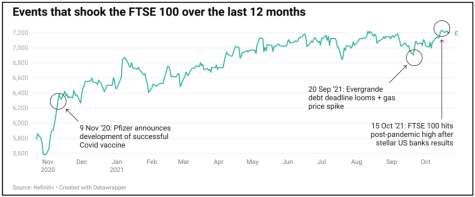
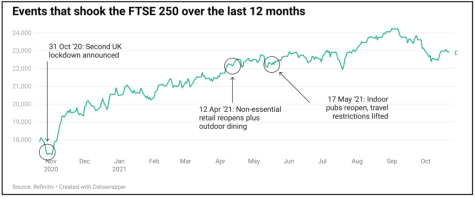
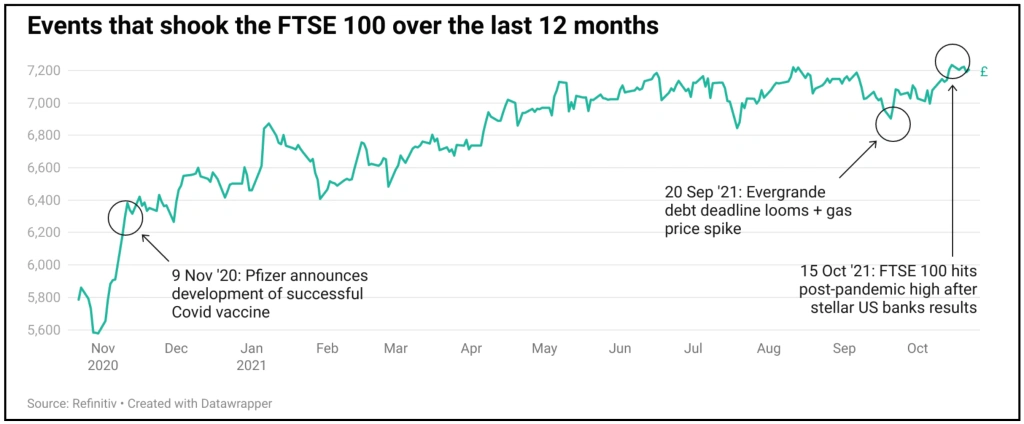
However, looking at how London markets have performed over the last, complicated, 12 months it’s interesting to dig into those peaks and troughs and explore trends.  Just weeks ago, at the start of the latest round of company earnings, the FTSE 100 surged to a pandemic high despite ongoing concerns about supply snarl ups and rising prices.

US banks in particular exceeded expectations, but it wasn’t just banks and it wasn’t just US companies reporting forecast busting figures. It’s not surprising that stellar results whet investor appetites.

They’re straightforward and immediate. If profits and earnings are up there’s an instant catalyst to buy and vice versa when the numbers disappoint.

The X-factor is surprise. Investors are pretty good at picking up cues and pricing them in, so often its more about how a company does relative to expectations rather than how it makes out in absolute terms. Sometimes just meeting expectations will disappoint investors.

Updates from individual firms may have a significant impact on their own share price but a limited one on the wider market in isolation. However, in combination a results season can set the tone for the markets.

MARKETS DON’T LIKE SURPRISES

Economic data typically acts more like a drip, drip of incremental news which gradually shifts investor sentiment in different directions. Often individual releases like GDP figures don’t tend to make big ripples unless there’s a major upset.

For example, China’s latest growth numbers unsettled many people but that’s because any slowdown seems unusual, and they came off the back of events which have already impacted sentiment towards China, from the tech crackdown in May to the Evergrande debacle which came to a head in September.

Both of those events in singularity took time to permeate through to big market movements, primarily because it was hard to know immediately what the situations might mean, it can take days or even weeks for the ramifications to really permeate.  It buys investors time, gives them breathing space to make adjustments in their portfolios and get comfortable with the winds of change.

It’s why the anticipated interest rate hike from the Bank of England which has received so many column inches has seemingly had a modest influence on markets so far.

Even when it comes it’s unlikely to merit much of a move, unless the MPC (Monetary Policy Committee) go bonkers and shoot for a whole 1% all in one go, but that’s about as likely as the UK experiencing a white Christmas in June.

The more UK-facing FTSE 250 index has endured a year of uncertainty. Covid hasn’t run in a smooth line, lockdowns have had to be re-implemented, ‘Freedom Days’ have had to be shifted and sometimes the expected benefits are undone by crises like the ‘pingdemic’ which saw many businesses scrabbling to find the staff they needed just to keep operations going.

When the economy has enjoyed a smooth run, when the recovery juggernaut ploughed through, the FTSE 250 soared; its domestic companies expected to benefit from a return to something like business as usual.

RISING PRICES NOT THE ONLY TROUBLE AHEAD

Gas prices on the other hand, they nestle between the two extremes. On the one hand rising prices and the impact they were having on energy providers could be clearly seen for some time. The energy cap was going up, small providers were dropping like flies.

But this impact was crystallised in a single day, a day of extremes, that made waves. After a 37% jump in 24 hours the gas price cooled as the Russian president stepped forward and seemed to imply more supply would be forthcoming to Europe.  

Forget the next 12 months, the next six months is shaping up to bring more of those heart stopping, unexpected moments that markets hate to love and many more of those priced in economic set pieces.

And the next quarterly results, the judgement is still out on that one… even among companies which have beaten analysts’ estimates, there have been warnings that margins are set to be eroded, that supply issues and inflation will take their toll.  Investors love certainty, but in the unexpected there are opportunities as well as potholes.

Please check in again with us soon for further relevant content and news as we approach the festive season.

Stay safe.

Chloe

29/10/2021

Team No Comments

Budget notes from Brewin Dolphin

Received last night, 27/10/2021.  Our thoughts added.

Chancellor Rishi Sunak has delivered his autumn budget, in which he announced a series of measures that aim to strike a balance between “preparing for a new economy post-Covid” and ensuring household wallets are not unduly squeezed by rising prices.

The budget came against a backdrop of unprecedented government borrowing, supply chain disruption, rising energy prices, and surging inflation that is forecast to reach 4.4%1 next year. Yet with economic growth forecasts more optimistic than six months ago, Sunak moved away from the March budget’s focus on protecting people’s jobs and livelihoods to one of investing in public services and infrastructure. 

After already freezing tax thresholds and increasing national insurance and dividend tax rates, the chancellor spared investors and pensioners from further tax hikes. At the same time, he proposed new fiscal rules that would commit the government to balance the books and reduce national debt. 

Here, we look at the main announcements and what they might mean for investors and the economy.

The economy 

The lifting of lockdown restrictions over the summer provided a much-needed boost to activity, with the latest figures from the Office for Budget Responsibility (OBR) providing a somewhat rosier picture of the economy. 

The OBR expects the economy to return to its pre-pandemic level by the turn of the year, six months earlier than previously thought, with gross domestic product (GDP) growing by 6.5% this year compared with the March forecast of around 4% growth. The OBR also revised down its estimate of long-term scarring to the economy from the pandemic to 2% from 3% previously. Meanwhile, unemployment is expected to peak at 5.25%, compared with the March forecast of 6.5%, suggesting the end of furlough will have a smaller impact than previously thought. 

At the same time, higher tax receipts mean government borrowing in 2021/22 is expected to be £183bn, some £51bn lower than the previous forecast of £234bn. However, with interest payments on borrowing revised up by £15bn, and the GDP growth forecast for 2022 lowered from 7.3% to 6%, the challenge of balancing the public finances is far from simple. Sunak proposed new fiscal rules whereby net debt as a percentage of GDP should be falling, and the government should only borrow to fund investment, with everyday spending funded by taxation. 

P and B comment:

This is a really difficult balancing act, with a lot to be taken into consideration.  For example, if interest rates increase too quickly the impact on the economy could be dramatic. Consumers are spending less, and the State is having to pay a lot more to service the interest on the covid debt in addition to other debt. Total debt in the UK c £2.2 trillion.

Investment in services and the economy 

A key area of focus was the announcement of additional investment in public services and infrastructure. This will include an extra £5.9bn to help the NHS tackle the backlog of non-emergency procedures and modernise digital technology; £5.7bn to transform transport networks outside London; £4.7bn for schools; £1.8bn for new housing; a £1.4bn fund to attract overseas investment into the UK; and increased spending on sports and youth clubs, support for families and children, and crime prevention. The government will also increase its investment into research and development to £20bn by 2024/25 as part of its goal to “drive economic growth and create the jobs of the future”.

P and B comment:

A very welcome investment into research and development for economic growth and future jobs.  Unfortunately the NHS and social care will need a lot more funding.

National living wage 

In an effort to help families who are struggling with rising prices, Sunak confirmed the national living wage would rise from £8.91 to £9.50 per hour for workers aged 23 and over from April 2022. This represents an increase of 6.6%, which is double the September inflation rate of 3.1%. 

Sunak also ended the public sector pay freeze introduced last November, cancelled the planned rise in fuel duty, and reduced the universal credit earnings taper rate from 63p to 55p in the pound.

P and B comment:

All of the above points are welcome but lower earners will need every penny as they combat inflation generally and in particular energy prices this winter.

Business rates 

The chancellor froze the business rates multiplier for a further year, which he said would be equivalent to a tax cut worth £4.6bn over the next five years, with bills 3% lower than without the freeze. He also announced plans to temporarily halve business rates for the retail, hospitality and leisure sectors, overhaul alcohol duties and reduce taxes on draught beer and cider.

P and B comment:

The business rates system in the UK is now out of date and doesn’t take into account the move to online shopping.  This system needs a complete overhaul but the problem is it’s worth c £25 billion a year to the Treasury.

Personal allowances

The chancellor previously announced in March that the personal tax allowance and higher-rate tax threshold would be frozen for five years from April 2021. The personal allowance, which is the amount you can earn each year before you start paying income tax, therefore remains at £12,570, while the higher-rate tax threshold remains at £50,270. By freezing these thresholds, more people could drift into higher and additional-rate income tax bands, and potentially see their personal allowance tapered once adjusted net income exceeds £100,000. 

The national insurance (NI) threshold was also frozen at £9,568. However, as announced in September, the rate of NI for employees and the self-employed will increase by 1.25 percentage points from April 2022 to help fund health and social care costs. Working pensioners will pay 1.25% on their earned income for the first time from April 2023.

P and B comment:

Effectively no real change from previous announcements.  As we get squeezed for more tax in all areas, it makes tax planning more important.

Dividend tax

As announced in September, the rate of dividend tax will also rise by 1.25 percentage points from April 2022 to 8.75% for basic-rate taxpayers, 33.7% for higher-rate taxpayers, and 39.35% for additional-rate taxpayers. The annual dividend allowance – the amount of dividend income you do not have to pay tax on – will remain at £2,000. The changes are expected to raise around £600m for the Treasury. 

Looking for ways to mitigate dividend tax, including investing through ISAs and pensions and taking a ‘total return’ approach to investments, could therefore become even more important when the tax hike comes into effect.

P and B comment:

As above.  Tax planning is more important.  Use the right products and allowances, plan ahead.

ISA allowance

Fortunately, for savers and investors, there were no changes to ISA allowances. The main ISA limit for 2022/23 will remain at £20,000, meaning a couple could invest up to £40,000 a year into ISAs to benefit from tax-free income and growth. The limit for Junior ISAs remains at £9,000. 

P and B comment:

ISAs still remain a very useful planning product alongside other assets.

Capital gains tax

There was some speculation that the chancellor would scrap existing rates of capital gains tax (CGT) and align them more closely with income tax rates. This was recommended by the Office of Tax Simplification in November 2020 and, if implemented, would have resulted in higher-rate taxpayers paying CGT at 40% on profits or gains exceeding the annual CGT exemption. 

Fortunately for investors, this did not come to fruition. CGT rates remain at 10% and 20%, or 18% and 28% on properties that are not a main home. The annual CGT exemption remains at £12,300 after being frozen in the March budget until 2026. 

P and B comment:

This is good news.  Any ‘simplification’ would have been penal.

Pensions tax relief

It was rumoured that the chancellor would look at overhauling pensions tax relief by, for example, moving to a flat rate of 25%. In the end, Sunak chose to leave current rates untouched, meaning higher-rate and additional-rate taxpayers can continue to benefit from tax relief of up to 40% and 45%, respectively. The pension annual allowance also remains at up to 100% of taxable earnings or £40,000, whichever is lower (this may be tapered for those with high incomes). 

As more people drift into higher tax bands due to the personal allowance and higher-rate tax threshold being frozen, these tax reliefs could make pensions an even more valuable financial planning tool.

P and B comment:

Pension tax relief rumours of change have been around for years.  Thankfully, no change here.  We need to maximise our pension funding whilst we have this tax relief available to us.

Pension lifetime allowance

The chancellor announced in March that the pension lifetime allowance, which is the total amount you can save into your pension before incurring tax charges, would be frozen until 2026. The allowance will therefore remain at £1,073,100 in the 2022/23 tax year. Any money withdrawn as a lump sum above this level will incur a 55% tax charge, while money withdrawn as income will incur a 25% charge, with the remainder then subject to income tax at the individual’s marginal rate. 

While the lifetime allowance might seem generous, pension contributions, tax relief and investment growth over several decades could mean those with seemingly modest pension portfolios could be at risk of exceeding the threshold. It is therefore crucial that savers seek expert advice on the best course of action for their individual circumstances. 

P and B comment:

As more people breach the Lifetime Allowance, I think it’s perceived as a target by some, an achievement. Having more pension than the Lifetime Allowance is not necessarily an issue, it means you have good pension assets and should be able to sustain a reasonable level of retirement income over the long-term.

Other tax planning vehicles are also available if you have good levels of pension provision in place.

Inheritance tax

The inheritance tax (IHT) thresholds remain the same and will be frozen until April 2026. Everyone is entitled to pass on assets of up to £325,000 on their death, free from IHT. This may be boosted by the residence nil-rate band, for passing on a property to a direct descendant – which remains at £175,000 per person. 

This means a married couple with children will be able to pass on a maximum of £1m in total without having to pay IHT – two lots of £325,000 (£650,000) and two lots of £175,000 (£350,000).

Although IHT thresholds have been frozen, there is still uncertainty around how the tax could be treated in the future following several reports from the Office of Tax Simplification and an All-Party Parliamentary Group. Seeking advice on IHT as early as possible, when there are more potential options to mitigate the tax, could therefore prove especially important in the years ahead.

P and B comment:

If you have an inheritance tax problem, start your planning now. This type of planning is a journey and can take many years to do. 

Budget – general comment from P and B:

An interesting Budget from Rishi Sunak as he tries to balance increasing tax receipts to pay for the NHS, social care, investment in the economy and servicing the massive debt we have in the UK, whilst getting the economy back to full growth following Covid and the impact of Brexit.

It’s a very delicate balance. We need the consumer to continue spending as c 60% of the UK economy is based on consumption, and too many tax rises and increases in the cost of living could reduce consumption as we become more cautious.

The last c 19 months has been difficult but this transition phase as we try to exit the pandemic and return to normal is very tricky too. Central Banks need to maintain the status quo and not raise interest rates too quickly and governments globally need to remain supportive.

Hopefully our government and the Bank of England will make the right decisions – we will see.

Steve Speed

28/10/2021

1 Source: CPI inflation. Office for Budget Responsibility: ‘Economic and fiscal outlook – October 2021’

Team No Comments

Stocks soar as US consumers splash the cash

Please see below Brewin Dolphin’s latest market summary, which was received late yesterday (20/10/2021) afternoon:

Global equities rose last week on the back of better-than[1]expected US retail sales and encouraging employment figures.

The S&P 500 and the Dow gained 1.8% and 1.6%, respectively, following a 0.7% jump in US retail sales in September and a decline in weekly jobless claims.

In Europe, the STOXX 600 surged 2.7% amid an encouraging start to the US earnings season. The FTSE 100 added 2.0% with airlines among the strongest performers after the US announced it would ease travel restrictions from 8 November.

Japan’s Nikkei 225 clawed back losses from the previous week to finish up 3.6%, as investors took comfort from new prime minister Fumio Kishida’s comments that he would not increase capital gains tax for the time being.

Last week’s market performance*

• FTSE 100: +1.95%

• S&P 500: +1.82%

• Dow: +1.58%

• Nasdaq: +2.18%

• Dax: +2.51%

• Hang Seng: +1.99%

• Shanghai Composite: -0.55%

• Nikkei: +3.64%

* Data from close on Friday 8 October to close of business on Friday 15 October.

Wall Street mixed as China GDP disappoints

Wall Street stocks gave a mixed performance on Monday (18 October) following disappointing gross domestic product (GDP) figures from China. The Dow slipped 0.1% whereas the S&P 500 and the Nasdaq gained 0.3% and 0.8%, respectively, as bond yields rose and data showed China GDP grew by 4.9% in the third quarter from a year ago, below the 5.3% growth expected by economists.

The sombre mood continued in London, where the FTSE 100 fell 0.4%. Figures from Rightmove showed average UK house prices jumped by 1.8% in October from the previous month – the biggest rise at this time of the year since 2015. On an annual basis, the average asking price is up 6.5% to £344,445. Meanwhile, the two-year gilt yield soared to its highest level since May 2019 – a sign that traders expect UK interest rates to rise soon.

The FTSE 100 was flat at the start of trading on Tuesday as investors awaited more earnings reports from the US.

US retail sales surge as prices rise

 Figures released by the Census Bureau last week showed US retail sales jumped by 0.7% in September, far better than the 0.2% decline expected by economists. Compared with a year ago, sales were up by 13.9%.

US retail sales – MoM change

 The increase came as the government ended the enhanced benefits it had been providing during the pandemic. It was thought this would depress sales, but instead spending accelerated as workers and students returned to offices and schools.

Much of the increase was driven by higher prices, as US retail sales figures are calculated according to receipts as opposed to volume. Indeed, separate data showed inflation, as measured by the consumer price index (CPI), rose by 5.4% in September from a year ago, slightly higher than the 5.3% increase expected by analysts. On a monthly basis, prices increased by 0.4%, following a 0.3% rise in August. Core CPI, which excludes food and energy, rose by 4.0% from a year ago – well above the Federal Reserve’s 2.0% target.

Meanwhile, the University of Michigan’s consumer sentiment index slipped in early October to 71.4 from a final reading of 72.8 in September, suggesting consumers remain anxious despite spending more.

UK GDP rises by 0.4%

Here in the UK, figures showed GDP grew by 0.4% in August from the previous month, as the hospitality industry benefitted from the first full month of coronavirus restrictions being lifted in England. Accommodation and food service activities were the main contributor to growth in the services sector, rising by 10.3%. This was followed by arts, entertainment and recreation, up 8.5%. Despite the increase, the Office for National Statistics (ONS) said GDP remains 0.8% below its pre-pandemic level, while consumer-facing services are 4.7% below their pre-pandemic level.

Investors were also cheered by data that showed UK employers added 207,000 staff to their payrolls last month, shortly before the end of the furlough scheme. This meant the number of payrolled employees surged to 29.2 million – the highest level since records began in 2001. However, the unemployment rate for June to August was an estimated 4.5%, higher than the 4.0% rate seen before the pandemic.

Germany’s GDP forecast slashed

Over in Europe, Germany’s GDP forecast for 2021 was slashed last week by a group of economic research institutes. The group’s biannual report said the German economy would grow by 2.4% this year, down from its previous forecast of 3.7% growth. The researchers said the reduction was driven by the ongoing impact of Covid-19 on the service sector, and continuing supply chain issues. GDP is expected to grow by 4.8% in 2022, assuming the pandemic and supply chain disruptions are resolved.

Supply chain issues are affecting the eurozone more broadly, with industrial production falling in August by 1.6% from the previous month. Eurostat said one of the steepest declines was in Germany, where output dropped by 4.1%

Please continue to check our Blog content for advice and planning issues and the latest investment, markets and economic updates from leading investment houses.

David Purcell

21st October 2021

Team No Comments

MPS Monthly Market Commentary

Please see below article received from Brooks Macdonald yesterday afternoon, which provides a succinct update on current market behaviour.

Global equities fell in September as inflationary pressures remained elevated and on further signs of a global economic slowdown. Continued anxiety about a possible bond default by Chinese property group China Evergrande also rattled markets. Major central banks, particularly the US Federal Reserve (Fed), drew closer to the point of tightening monetary policy. The news boosted the US dollar while yields on government bonds generally rose. Supply disruptions and drops in US crude stocks helped oil prices hit the highest levels in almost three years.

UK stocks declined as increasing energy costs, supply chain issues, (which led to motor fuel shortages) and worries about an economic slowdown dampened sentiment. Increasing pricing pressures – the annual inflation rate leapt to 3.2% in August from 2.0% in July – added further gloom. The Bank of England signalled that it could bring forward its plans to increase interest rates as it raised its inflation target. The UK’s second-quarter GDP growth was revised up to 5.5% from 4.8% previously, although the economy expanded by just 0.1% month on month in July.

US equities dropped on concerns about a weakening economy and moves by Democrats to raise corporate taxes. Inflation remained relatively high – consumer prices rose by 5.3% year on year in August, down slightly from 5.4% in July – further dampening the mood. The Fed turned more hawkish, with Chairman Jerome Powell hinting that the process of winding back the central bank’s asset purchases, known as ‘tapering’, could begin as early as November.

European markets were lower as worries about the economic recovery, the debt problems at Evergrande and high inflation unsettled investors. The European Central Bank said it would slow bond buying under its pandemic emergency purchasing programme over the rest of 2021. It insisted the move did not amount to tapering as it warned that the economic recovery remained nascent. The eurozone’s GDP growth over the second quarter was revised up to 2.2% from 2.0% previously.

Japanese stocks strengthened as the resignation of Prime Minister Yoshihide Suga sparked hopes that his successor would implement new fiscal stimulus measures. Former foreign minister Fumio Kishida was, by month end, expected to become the country’s new leader after winning a Liberal Democratic Party leadership contest. The continued roll-out of COVID-19 vaccinations, after a slow start compared with other developed countries, further boosted the market. Japan’s second-quarter GDP growth was revised up to 1.9%, on annualised basis, from 1.3% previously6.

Asia-Pacific equities (excluding Japan) weakened on concerns about a global economic slowdown. In China, worries about a weakening economy and Evergrande’s debt problems and power shortages (which shut a number of factories) dragged down stocks. The prospect of a slowdown in China also hurt Taiwan’s market. South Korean stocks declined as technology companies faced the threat of tightening regulations, sparking a sell-off in the economically important sector. Rises in COVID-19 infections hurt investor confidence in Australia and Singapore.

Emerging markets were down, overall, as the strengthening US dollar weighed on sentiment. India’s market remained strong, however, as the continued roll-out of COVID-19 vaccinations underpinned confidence in the economy’s recovery. Increased buying by foreign equity investors added further support. Brazilian shares fell sharply as disaffection over the leadership of President Jair Bolsonaro – and his defiance in the face of a number of scandals – increased political tensions. Russia’s market made gains as it benefitted from increases in energy commodity prices, while Turkish stocks slumped as the central bank surprised investors with an interest rate cut, despite concerns about soaring inflation. South African equities came under pressure from the stronger US dollar.

Yields on core government bond markets generally increased. The yield on US benchmark 10-year Treasuries rose (prices fell, reflecting their inverse relationship) as the Fed moved closer to tightening monetary policy, sparking a sell-off towards month end. The yields on UK 10-year gilts and German 10-year bunds also gained, although the latter remained in negative territory. In the corporate debt market, US investment-grade and high-yield spreads tightened.

We will continue to publish relevant content as we approach Halloween and edge nearer to the festive season.

Stay safe.

Chloe

20/10/2021

Team No Comments

Brooks Macdonald – Daily Investment Bulletin

Please see below Daily Investment Bulletin received from Brooks Macdonald yesterday, which provides a pertinent update on the markets, with reference to supply shortages and transitory inflation.

What has happened

US and European equity indices recorded small losses as investors looked ahead to today’s US CPI release and the start of the US earnings season. There was plenty of movement within government bond yields with the US 10-year Treasury yield now off its recent highs, trading at 1.58% ahead of the key inflation data point today.

Fedspeak and inflation

Vice Chair Clarida will shortly end his term at the Federal Reserve but yesterday signalled that the time was approaching for a tapering announcement. Clarida followed the transitory inflation narrative but recognised market concerns that inflation risks are now poised to the upside rather than the downside. Atlanta Fed President Bostic, who is known to harbour more hawkish views, said that price pressures were spreading amongst the CPI basket and that they looked more entrenched than previously believed. Today’s CPI figures are the last inflation release before the Federal Reserve considers monetary policy in their November meeting. Market expectations are for Core CPI to hold steady at 4% year on year and for CPI to also mirror the last release at 5.3%. It will take some months for the recent run up in energy, used cars and commodity prices to come into the data which may mean a downside miss on these numbers is shrugged off by a more hawkish market.

Apple and Semiconductors

One of the highest profile shortages during the pandemic has been semi-conductors and yesterday Bloomberg reported that Apple was struggling to acquire sufficient chips to meet its iPhone production targets. There was hope in recent months that more supply would come online to meet the surge in demand however this is yet to filter through to production creating fears that the problems will continue well into 2022. A lack of availability of chips has also catalysed another leg higher in used car prices over the last month and looks set to continue to cloud the inflation picture for Q4.

What does Brooks Macdonald think

The chip shortage is reducing the supply capacity of most technology hardware suppliers and auto manufacturers. The shortage risks reducing economic output as well as creating inflation which will place further pressure on central banks to raise rates ahead of the risk of stickier inflation.

Please check in with us again soon for more relevant content and news.

Stay safe.

Chloe

14/10/2021

Team No Comments

Stocks rise as wholesale gas prices hit record high

Please find below, an update received from Brewin Dolphin yesterday, on how the increase in prices for wholesale gas have impacted stock markets.

Most major stock markets ended last week in the green after a volatile few days that saw wholesale gas prices hit record highs.

 The S&P 500 gained 0.8% as the rise in UK and European gas prices boosted energy stocks. The Dow ended the week up 1.2%, with stocks rallying on Thursday amid reports that the Senate had passed a bill to raise the debt ceiling and enable the government to keep paying its bills through early December.

The pan-European STOXX 600 and the UK’s FTSE 100 both added 1.0% as fears about the impact of rising energy prices eased throughout the week.

In contrast, Japan’s Nikkei 225 slumped 2.5% on concerns that new prime minister Fumio Kishida would increase capital gains tax in an attempt to rectify wealth disparities.

 Last week’s market performance*

• FTSE 100: +0.97%

• S&P 500: +0.79%

• Dow: +1.22%

• Nasdaq: +0.09%

• Dax: +0.33%

• Hang Seng1 : +1.07%

• Shanghai Composite2 : +0.67%

• Nikkei: -2.51%

* Data from close on Friday 1 October to close of business on Friday 8 October.

 Closed Friday 1 October.

Closed Friday 1 October to Thursday 7 October.

Wall Street slips on inflation concerns

US indices fell on Monday (11 October) as fears about inflation and supply chain constraints continued to weigh on investor sentiment. The S&P 500, Dow and Nasdaq all lost 0.7% as the surge in oil prices fuelled concerns about tighter monetary policy. In contrast, the FTSE 100 gained 0.7%, boosted by strong performance in its large mining sector.

UK and European indices started Tuesday in the red, with the FTSE 100 and the STOXX 600 down 0.8% as investors mulled the latest UK jobs data. Figures from the Office for National Statistics showed that while unemployment fell to 4.5% in the three months to August, vacancies rose to a record high of 1.2 million, indicating that companies are struggling to fill jobs.

Investors are looking ahead to this week’s US inflation and retail sales figures, and for any signs of ‘stagflation’ – a period of high inflation and unemployment coupled with slow economic growth.

Wholesale gas prices soar

UK wholesale gas prices hit a new all-time high on Wednesday, surging by nearly 40% in just 24 hours. High global demand and reduced supply has seen prices soar this year, resulting in several UK energy firms collapsing. Prices subsequently fell back after Russia’s president Vladimir Putin said the country would help to ease the crisis by boosting supplies to Europe.

UK gas prices Markets

There are concerns higher prices will lead to unaffordable bills for some businesses, especially those requiring heat as part of their production processes. This could result in lower production, factory closures and unemployment. Businesses could also pass on higher energy bills to consumers, thereby squeezing household finances.

Europe has also seen rising gas prices, but European Central Bank president Christine Lagarde said last week that policymakers should not ‘overreact’ to rising energy prices or supply shortages because ‘our monetary policy cannot directly affect those phenomena’. Minutes of the ECB’s September meeting, reported by the Financial Times, showed some policymakers were concerned about ‘upside risks’ to inflation and had called for a bigger cut in asset prices than was ultimately decided. Policymakers said inflation could exceed the ECB forecasts ‘if a different path materialised for oil prices’ and if supply chain issues lasted longer than expected.

 US payrolls miss expectations

Last week also saw the release of the closely watched US nonfarm payrolls report, which showed payrolls rose by 194,000 in September – well below the Dow Jones estimate of 500,000. This followed an upwardly revised gain of 366,000 in August, according to the Labor Department.

Several newspapers are speculating about whether the jobs report could encourage the Federal Reserve to start tapering its support for the economy. The Fed previously said it would continue its current asset purchasing programme until there was substantial further progress on two goals: inflation averaging around 2% and maximum employment.

Although the headline payrolls figure missed expectations, other aspects of the jobs report were more positive. For example, whereas the number of Americans on government payroll fell by 123,000, there was a 317,000 increase among those on private payrolls, suggesting hiring strength in the private sector. Meanwhile, the unemployment rate fell to 4.8%, the lowest since February 2020 and better than the expected 5.1%.

New Japanese PM takes office

Over in Asia, Fumio Kishida, who won the leadership race for Japan’s ruling Liberal Democrat Party, was confirmed as the country’s new prime minister. This was thought to be one of the reasons behind last week’s slump in Japanese stocks, with investors rattled by suggestions that Kishida might push for an increase in capital gains tax. On Sunday, however, Kishida announced that he had no such plans for the time being, and that he would pursue other steps to rectify wealth disparities first.  To view the latest Markets in a Minute video click here

Please continue to check our Blog content for advice and planning issues and the latest investment, markets and economic updates from leading investment houses.

David Purcell – Operations Administrator

13th October 2021