Team No Comments

Stocks slump amid high inflation and slowing growth

Please see below ‘Markets in a Minute’ article received from Brewin Dolphin yesterday evening, which provides analysis of the markets’ reaction to high inflation, despite the widely held opinion that it is transitory and will subside.

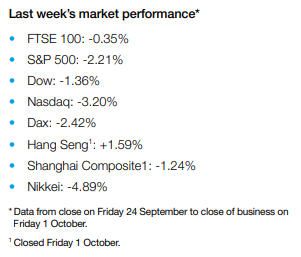
Most major stock markets fell sharply last week as fears about rising inflation and slowing economic growth weighed on investor sentiment.

The pan-European STOXX 600 tumbled 2.2% as eurozone consumer prices jumped to their highest level since September 2008. The FTSE 100 slipped 0.4% after the Bank of England’s governor said UK gross domestic product (GDP) would not recover to pre-pandemic levels until early next year.

In the US, the S&P 500 fell 2.2% amid uncertainty around the raising of the debt ceiling and difficulties surrounding the passing of the $1trn infrastructure bill. Reports of supply constraints also drove several companies’ share prices lower.

The gloomy mood spread into Asia, where Japan’s Nikkei 225 crashed 4.9% and China’s Shanghai Composite ended its holiday-shortened trading week down 1.2%.
Tech stocks drag Wall Street lower

Equities started this week in the red, with the S&P 500 and the Nasdaq down 1.3% and 2.1%, respectively, on Monday (4 October) driven by a rotation out of technology stocks and rising bond yields. Shares in Facebook tumbled 4.9% as its Instagram, WhatsApp and Facebook services suffered outages.

The selloff weighed on UK and European indices, which had already been dragged down earlier in the day by the announcement that trading in Evergrande shares had been suspended. The decision by OPEC+ to raise crude oil output by 400,000 barrels a day in November was also in focus.

On Tuesday, the FTSE 100 appeared to have shaken off Wall Street’s wobble, gaining 0.6% at the start of trading.

Eurozone inflation hits 13-year high

Figures released last week revealed the impact that soaring energy prices are having on inflation in the eurozone. In September, inflation accelerated to an annual pace of 3.4%, the highest level since 2008 and above the 3.3% forecast by economists. Energy costs were the biggest driver, soaring by 17% year-on-year. Core inflation, which strips out food and energy prices, also hit a 13-year high of 1.9%, according to the data from Eurostat.

Christine Lagarde, president of the European Central Bank, told the European Parliament earlier in the week that inflation could exceed the central bank’s forecasts, which have already been increased twice this year. “While inflation could prove weaker than foreseen if economic activity were to be affected by a renewed tightening of restrictions, there are some factors that could lead to stronger price pressures than are currently expected,” she said.

Nevertheless, Lagarde stuck to the official forecast that high inflation would prove transitory and that the rebound in energy prices and supply chain bottlenecks would ease in 2022.

It came after data showed German consumer prices rose by 4.1% in September from a year ago – the highest level in almost 30 years.

UK economic recovery delayed

The supply chain crisis means the UK’s economic recovery is likely to be delayed. Bank of England governor Andrew Bailey said GDP will not recover to pre-pandemic levels until early next year – up to two months later than was anticipated in August. He added that the Bank would keep a close watch on inflation expectations and the labour market.

Figures from the Office for National Statistics (ONS) showed GDP surged by 5.5% in the April to June quarter, better than its initial estimate of a 4.8% increase. The ONS said there were increases in all main components of expenditure, with the largest from household consumption following the easing of coronavirus restrictions.

However, monthly ONS figures showed the recovery largely stalled in July, growing by an estimated 0.1% from the previous month. There are concerns consumers will tighten their belts in the face of rising energy bills.

US consumer confidence falls

Over in the US, consumer confidence dropped in September for a third consecutive month, as the spread of the Delta variant and higher prices continued to dampen sentiment. The Conference Board’s index fell to 109.3 from a revised 115.2 in August, the lowest in seven months and far worse than the 115.0 expected by economists in a Bloomberg survey.
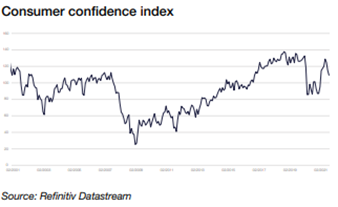
The present situation index, based on consumers’ assessment of current business and labour market conditions, fell to 143.4 from 148.9 and the expectations index, based on consumers’ short-term outlook for income, business and labour market conditions, fell to 86.6 from 92.8.

This came after the University of Michigan’s preliminary consumer sentiment index edged up in early September but remained close to a near-decade low. The report said high prices drove the declines in buying conditions for durable goods such as appliances and cars, adding “consumers have become much more concerned about rising inflation and slower wage growth and their negative impact on their living standards.”

Despite this, consumer spending rebounded by 0.8% in August following a 0.1% decline in July, according to the Commerce Department. The personal consumption expenditures (PCE) price gauge, which the Federal Reserve uses for its inflation target, rose by 0.4% from a month earlier and by 4.3% from a year earlier – the largest annual increase since 1991.

Please check in again with us soon for further news and relevant content.

Stay safe.

Chloe

06/10/2021

Team No Comments

Weekly Market Performance Update

Please find below, an update on market performance, received from Invesco yesterday.

A number of competing macroeconomic factors have been at play in recent months that have impacted financial markets. While vaccination rates continued to rise, the spread of the Delta variant has seen a large increase in new Covid cases, which saw further containment measures, notably in “zero-tolerance” countries, such as China. Despite that there was a general trend towards a further re-opening of economies and a return to normality. However, PMIs have been weakening as the pace of the recovery slows. Talk of a period of stagflation has increased, with inflation having risen sharply as base effects, supply chain issues and labour shortages have all impacted. While most Central Bankers and economists see the inflation risk as transitory, the underlying trend in monetary policy is for the removal of some of the extraordinary support that has been put in place over the past 18 months, led by tapering and ending of asset purchase programmes and rate hikes in due course. Concerns around US fiscal policy and the debt ceiling were increasingly in focus towards the end of the quarter. In China regulatory pressures and the fate of Evergrande, the second largest property developer, also weighed on investor market sentiment. Against this backdrop it was hardly surprising that financial markets have generally found it much tougher going as we approach autumn.

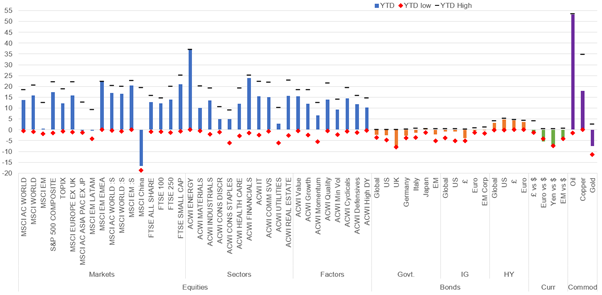
Not even a strong rally on Wall Street on Friday was enough to prevent global equities from having their worst week (MSCI ACWI -2.2%) since February. With China ending the week with small gains (MSCI China 0.4%) this limited EM losses (-1.1%) and ensured outperformance relative to DM (-2.3%). EM EMEA continued to benefit from rising Energy prices, rising 1.1% and leaving it up 22% YTD. Within DM weakness was across the board with Japan (-4.3%) and Europe ex UK (-2.6%) seeing the worst of the major market declines. Small Caps (-1.5%) outperformed slightly with DM and EM performing in-line. At a sector level performance was again dominated by Energy (4.6%) and it is now up 37.1% YTD, leaving it just over 13% ahead of the next best sector, Financials, which also had a good relative performance week (-0.1%). Underperformers were led by IT (-4.1%) and Health Care (-3.2%). Sector mix ensured that Value had a very strong week relative to Growth, falling just -0.9% compared to -3.4%. Rising yields have hurt long-duration assets. Quality (-3.4%) also had a tough week. UK equities had another strong relative week with the All Share down just -0.8% on the back of large cap outperformance (FTSE 100 -0.3%), as mid (FTSE 250 -2.7%) and small caps (FTSE Sm Caps -2%) struggled. Performance was boosted by a very strong Energy sector (6.9%), while Basic Materials (0.1%) also eked out a small gain. Industrials (-3.7%) and Utilities (-2.4%) were the main laggards.

Government bond yields were generally biased higher, albeit the moves in the UST and EZ bonds were marginal. The largest DM rise was in Gilts where the 10yr rose 8bp to close at 1%, its first time at that level since May 2019. It is now up 81bp since the start of the year. A further -1.5% for the Gilt index during the week left it down -7.6% YTD. Weak Gilts spread into £ IG with yields rising 10bp and the YTM above 2% for the first time since mid-2020. Yields rose less in US and Euro IG, with commensurate better relative performance. In HY, yields also rose 10-11bp across the board, but shorter duration meant that the sector outperformed IG, albeit still suffered small losses.

The US$ hit a one-year high during the week ending with the US Dollar Index seeing a gain of 0.8%, leaving it up 3.6% YTD. Both £ and the Euro lost 1%, with both close to their YTD lows. EM currencies also weakened with the JPM Emerging Market Currency Index down -0.5%, leaving it -4% YTD.

In commodities the Bloomberg Commodity Spot Index gained 2% and is now up 28.8% YTD. Energy (4.8%) and Softs (4%) led the gains again. While Oil prices saw a modest gain (1.5%) Natural Gas continued its sharp rise higher with an 8% gain. Industrial Metals struggled with Copper falling -2.2% and at 17.9% YTD is well below its 34.8% high. A contraction in the Chinese Manufacturing PMI for the first time in 19 months and a stronger US$ weighed. Gold eked out a small positive return (0.2%) its first in four weeks but is still down -7.5% YTD. Silver’s woes, however, have been far greater. It is down -14.6%.

Market performance last week (%)

Past performance is not a guide to future returns. Sources: Datastream as at 3 October 2021. See important information for details of the indices used.1

YTD market performance (%)

Past performance is not a guide to future returns. Sources: Datastream as at 3 October 2021. See important information for details of the indices used.1

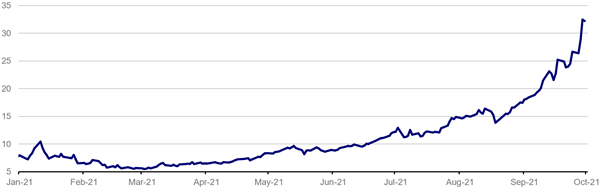
Chart of the week: ICE UK Natural Gas NBP Futures (US$/MMBtu)

Past performance is not a guide to future returns. Source: Datastream as at 2 October 2021.

  • There have been some spectacular moves in commodity prices this year and none more so than what has happened to natural gas prices, particularly in the UK and Europe. In the UK the ICE future for the current month has risen 490% YTD and 84% since the start of September.
  • This substantial jump matters for UK consumers and businesses given its importance as a source of power. EDF estimate that 78% of buildings are heated with gas. In the US by comparison it is just 50%. In terms of electricity generation, in 2020 35% came from gas, ahead of wind at 24% and nuclear at 14%. The impact on consumers is clear for all to see in Ofgem’s 12% and 13% hike to the energy price caps for default tariffs and pre-payment customers respectively, that took effect from last Friday. A further, potentially substantial, rise is likely when Ofgem reviews the cap again in February. Clearly this will have consequences for inflation with gas and electricity prices making up 3% of the CPI Basket. Deutsche Bank estimate that it could add 50-60bp to headline CPI. And household spending and industrial activity could also be impacted (fertiliser production being a recent example), so yet another headwind for an economy that is already showing signs of slowing.
  • Why have prices risen so much? A smorgasbord of factors have been at play. After a cold winter and spring, supplies have not been replenished as much as expected. The UK has the added problem compared to many other major European economies of having very little storage capacity, just 2% of its annual demand. Consequently, the country relies more on pipeline and LNG imports, with the UK importing more than half its gas (75% from Norway and Qatar). With competition for LNG supplies high due to elevated levels of demand in Asia, alongside restrictions to US LNG supply and the overall lack of LNG terminals and shipping, it is hardly a surprise that prices have surged. Pipeline flows from Norway, the biggest source of gas imports (55% of total in 2020), have also been under pressure due to higher levels of gas field maintenance this year and increased domestic demand due to water shortages for hydro. Nature hasn’t been helpful in the UK either with a lack of wind limiting the use of wind power.
  • How long will this surge in prices last? Some of the factors should be transitory; the wind will blow soon (!) and some shorter-term supply issues are likely to be resolved. However, key further out will be how long the surge in Asian demand continues and what sort of winter we experience. And while inventories remain depleted, prices could well remain elevated until well into next year. That’s certainly what futures are telling us in the UK with prices not dropping from current levels until the spring and then remaining well above pre-pandemic levels thereafter. This has obvious negative consequences for the growth/inflation outlook.

Key economic data in the week ahead

  • Employment data from the US will be the most scrutinised release of the week as the Fed has said the recovery in the labour market is key to its path towards tightening policy. Progress in Washington on the fiscal front and around the debt ceiling will be closely monitored. OPEC+ meets on Monday to review its output policy against the backdrop of an oil price that has recently risen above $80bbl for the first time since 2018.
  • In the US September’s ISM Service Index is released on Tuesday and although expected to remain strong at 59.9 this would be lower than August’s reading of 61.7. Before Non-Farm Payrolls, the ADP Employment Change published on Wednesday is estimated to show a 430k increase, higher than August’s 374k and the YTD average of 418k. Initial Jobless Claims unexpectedly rose for the third week in a row last week to 362k. Thursday’s reading is estimated to see a small decline to 350k. Friday’s September Non-Farm Payrolls are forecast to add 470k new jobs, an improvement on last month’s disappointing 235k. The unemployment rate is forecast to fall to 5.1% from 5.2% in August.
  • Although there will be no significant economic data released from the UK this week, the Chancellor of the Exchequer will speak at the Conservative Party conference on Monday and is expected to announce a package of grants to help households facing a cost-of-living crunch.
  • Retail sales in the EZ on Wednesday are forecast to have increased 0.9%mom in August following the 2.3%mom fall in July. This would leave it up 0.4%yoy, which would be the lowest rate of growth since March when the continent was emerging from stringent lockdown measures.
  • It is the Golden Week holiday in China. The Caixin Services Index for September is expected on Friday to show the sector still in contraction but improving to 49.2 from 46.7 in August.

Nothing of note from Japan this week.

Please continue to check our Blog content for advice and planning issues and the latest investment, markets and economic updates from leading investment houses.

David Purcell

5th October 2021

Team No Comments

Earnings squeeze?

Please see below article received from Legal & General yesterday afternoon, which provides a global market update and eases concern with regards to supply chain issues and inflation.  

Don’t worry (much) about supply chains

Industrial companies are talking a lot about issues with their supply chains. But they haven’t taken the opportunity to change their guidance or deliver profit warnings. And market reaction to their comments was relatively muted.

We had a few companies with early quarter-ends give a flavour of what to expect from the rest of the reporting season. Of those early reporters, 74% beat analyst estimates and 80% outperformed the market the day after their results were released. Their figures cover a slightly different period than Q3, and while the sample is small, it looks somewhere between normal and better than average.

It also suggests that the disappointments from companies like FedEx*, Adobe* and Nike* may get the most attention but are not the norm.

There is clearly an impact on earnings from the supply chain bottlenecks, but so far it seems that the impact:

1.is manageable for most companies
2.can be covered with their earnings buffer by most companies
3.is well anticipated and priced by the market

 
Bottom line: Indications so far are that we are heading for a fairly normal earnings season, which has little impact on markets at the aggregate level.

Germany’s election

Germans went to the polls on Sunday and granted the Social Democrats (SPD) a narrow victory, with almost 26% of the vote. Their leader, Olaf Scholz, said he had won a mandate to form the nation’s next government. Support for outgoing chancellor Angela Merkel’s CDU/CSU appears to have plunged to a historic low of 24%. The Greens secured almost 15% of the vote.

This will only mark the start of what will likely become lengthy coalition negotiations. Last time, this took a record six months, and this year’s prospect of a 3-party coalition across the political spectrum feels like a recipe for long rather than short negotiations.

There would have been really only one properly market-moving scenario: a left-wing, red-red-green government – but the Left party appears to have fallen just under the 5% hurdle.

The SPD and Greens had previously made it clear that they were leaning towards a more centrist, “traffic light” coalition with the Liberals (FDP), who won almost 12% of the vote.

Emerging market equities – what are we waiting for?

It’s easy to be bearish on emerging market equities amid double trouble from regulatory and growth risks. Increasing regulation in China across many industries is hitting the outlook for profits, and the uncertainty over the extent and duration of the crackdown means investors require an additional discount on top of their future earnings base case. At the same time, economic growth has slowed in tandem with the delta outbreak, and we expect an underwhelming rebound in Q4 as temporary regional lockdowns are likely to be required for some time. Then there’s the spillover from Evergrande’s* problems to the important property sector. Those are all drivers behind our below-consensus growth forecasts.

But equity markets have reacted…a lot.

The correction in Chinese equities (H-shares, not A-shares) is now one of the biggest in recent history. The HSCEI index is around 30% off its February peak, making it the third largest drawdown over the past decade. Emerging market equities have also been affected, having trailed developed markets by 20%, the third largest underperformance over the past 15 years.

Sentiment has turned very bearish. In an extreme reversal, emerging market equities have gone from everyone’s favourite long at the start of the year, in sell-side outlooks and investor surveys, to being the least popular in the latest fund manager survey since their low in 2016.

Valuations paint a similar picture. Relative to developed markets, emerging market equities are as cheap across many multiples as they have been in well over 10 years. Some of that clearly reflects falling earnings expectations, but earnings estimates have some way further to fall before catching up with what prices have already reflected.

Some of this sounds like a bull case in the making, but regulatory uncertainty and our below-consensus growth outlook are some of the factors holding us back — for now, at least. Nevertheless, we are watching a number of potential catalysts and signposts that could change our position:
 

President Xi or the Chinese government make a commitment to the private sector — and tech companies in particular.
Decreased sensitivity to regulatory news flow. We have seen some evidence of this in tech, but the price reaction to new sectors being targeted – e.g. casinos — remains severe.
A-shares selling off. The pain has so far been concentrated in H-shares. A-shares joining in the correction would be a sign of markets pricing the growth slowdown as much as the regulation theme, and a sign of domestic capitulation.
A larger-than-expected policy response to a slowdown. We expect policymakers to be slower than in the past in responding to stumbling growth, but evidence to the contrary would be a very positive catalyst.
Indications that our growth forecasts are too pessimistic and growth rebounds faster than we expect.
Vaccination convergence. Emerging market vaccinations are catching up with developed markets.

Bottom line: Emerging markets and China equities are becoming more interesting in some ways, but given our macro views, we believe it’s too early to buy.

We will continue to publish relevant content and news throughout the coming Autumn weeks, so please check in with us again soon.

Stay safe.

Chloe

28/09/2021

Team No Comments

Will food prices fuel inflation?

Please find below an article from AJBell Investcentre, received Sunday afternoon, exploring whether food prices could be a source of inflation.

“If music be the food of love, then play on; give me excess of it that, surfeiting, the appetite may sicken and so die,” is a very famous line spoken by The Duke of Orsino, in Shakespeare’s Twelfth Night.

Investors may or may not care for the work of the Immortal Bard. But they will be interested – even concerned – to ascertain whether food prices will be the source of a sustained bout of inflation and one which may do damage to consumers’ ability and desire to spend.

Central bankers will want to know too, in case inflation forces their hand and requires a tightening of monetary policy in the form of a tapering of Quantitative Easing and higher interest rates.

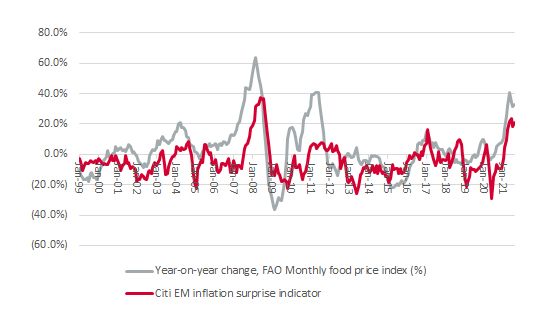
“The United Nations’ FAO Food Price Index requires attention. The benchmark, which spans key agricultural materials such as cereals, vegetable oils, meat, dairy products and sugar, is up 33% year-on-year. That is the fastest rate since 2011.”

In this context, the United Nations’ FAO Food Price Index requires attention. The benchmark, which spans key agricultural materials such as cereals, vegetable oils, meat, dairy products and sugar, is up 33% year-on-year. That is the fastest rate since 2011.

Global food prices are surging

Source: Food and Agricultural Organisation of the United Nations

History play

“There do seem to be some one-off factors involved in the food price surge. These range from global shipping and port bottlenecks, to a shortage of truck drivers, to bad weather in countries such as Brazil, where drought and then unseasonal frost is badly affecting supply of oranges and coffee to the global market.”

No doubt central bankers, to defend their view that the current spike in inflation is ‘transitory,’ will be keen to point out some of the factors involved in the food price surge. These could range from global shipping and port bottlenecks, to a shortage of truck drivers, to bad weather in countries such as Brazil, where drought and then unseasonal frost is badly affecting supply of oranges and coffee to the global market.

But even the comparison against two years ago, before the pandemic struck in 2020, shows a 36% increase, so the current surge may not just be the result of a (low) base effect, even allowing for the role of these one-off factors.

In many cases, the best cure for high prices of a product is high prices, as they either choke off demand or encourage additional supply. The latter may happen in time, if the weather helps, but it is not easy for people to stop eating, as they need their daily calorific intake. (In this context investors may need to keep an eye on the political situation too. Food shortages and soaring prices helped to spark the Arab Spring protests and uprisings in 2011, the Chinese Tiananmen Square protests in 1989 and before that the Russian and French Revolutions of 1917 and 1789).

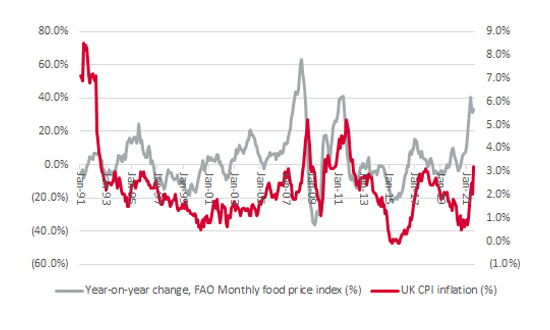
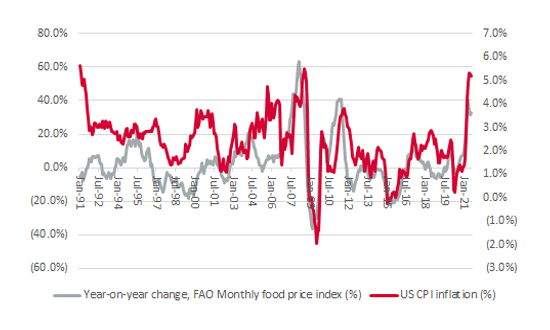
There appear to be some grounds for arguing that food prices are fuelling the current spike in inflation on both sides of the Atlantic, even if the UK CPIH inflation basket has a weighting of just 8.9% toward food and soft drinks (with a further 10.4% weighting toward alcohol, tobacco and restaurants and hotels), and the US equivalent weighting is 7.6% (with a further 6.2% from eating out and 1.6% from alcohol and tobacco). These weightings reduce food’s overall influence and that helps to explain why the UK headline rate of inflation is 3.2% and America’s 5.4%, along with how grocers and suppliers decide to handle cost increases, either by passing them or taking the margin hit themselves.

Rising global food prices may be nudging UK inflation higher…

Source: Food and Agricultural Organisation of the United Nations, Office for National Statistics

…and they could be fuelling US inflation too

Source: Food and Agricultural Organisation of the United Nations, US Bureau of Labor Statistics

Emerging problem

It may be of little comfort to consumers that the way in which baskets of goods are constructed to measure inflation is limiting the impact of rising food prices. Leave the economists’ desks behind and get out in the real world and this issue matters, especially to those who are less well off and where a greater percentage of income is spent on life’s essentials.

“The apparent correlation between the cost of foodstuffs and an indicator inflation may explain why emerging markets such as Brazil, Russia and Mexico are leading the charge when it comes to interest rates rises in 2021.”

Emerging markets are a case in point. It is possible to argue that food prices are a much bigger issue, if the apparent correlation between the cost of foodstuffs and an indicator inflation surprises is any guide. It is therefore no wonder that emerging markets such as Brazil, Russia and Mexico are leading the charge when it comes to interest rates rises in 2021. According to www.cbrates.com, there have been 52 individual hikes to borrowing costs around the world this year and all but two (first moves from Iceland and South Korea) have come from emerging markets.

Rising food prices are a big issue in emerging markets

Source: Food and Agricultural Organisation of the United Nations, Refinitiv data

End game

It may well be that the weather comes to the rescue and the combination of rising supply, an end to shipping chaos and 2021’s higher base for comparison means that food price inflation (and price rises more generally) ease in 2022, to the relief of investors and central bankers alike. But caution is needed. If consumers start to accept higher prices, and get higher wages so they can pay them, inflation can become entrenched.

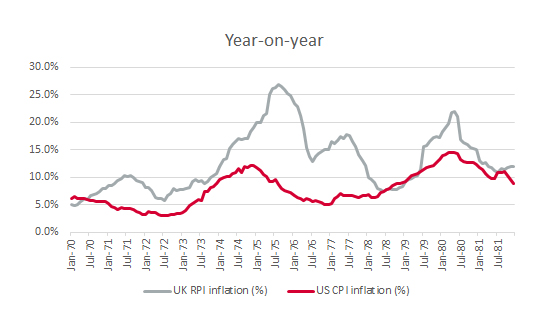
Inflation came in three waves in the 1970s

Source: Office for National Statistics, FRED – St. Louis Federal Reserve database

“There were three distinct waves of inflation in the 1970s and the last one was the worst of all.”

There were three distinct waves of inflation in the 1970s and the last one was the worst of all. Only then did the Paul Volcker-led Federal Reserve and the UK’s Conservative government set about dealing with inflation by jacking up interest rates to double-digit levels, something that neither consumers nor financial markets will want to see in a hurry.

Past performance is not a guide to future performance and some investments need to be held for the long term.AuthorProfile Picture

Please continue to check our Blog content for advice and planning issues and the latest investment, markets and economic updates from leading investment houses.

David Purcell

27th September 2021

Team No Comments

Evergrande a grand problem?

The impending default or restructuring of Evergrande, China’s second-biggest property developer, dominated China’s news last week. Please see below article received from Legal and General yesterday afternoon, which discusses the effects of this on the broader market.

Localised, so far

Evergrande accounts for 6.5% of liabilities in China’s property sector, and its sales make up roughly 10% of all property transactions in the country. Evergrande could therefore pose a systemic risk, but so far stress in the financial sector has been localised. Interbank spreads are not elevated and the renminbi has held up well.

After a string of incidents that have given equity investors concerns about China – such as regulation of tech, education and casinos – its stock market has slipped behind international peers, but over a longer-term perspective it remains close to recent highs.

Evergrande’s problems could still affect the broader economy beyond the financial channel. People are no longer buying off-plan properties from the company; if this feeds through to Evergrande’s building activity, it could leave a noticeable impact on GDP. August property sales and starts were already in contractionary territory, and GDP is under pressure from Covid-19 outbreaks and lockdowns.

We believe the authorities have the levers to steady the ship, however, and will do so soon. This would likely involve a liquidity provision via a reserve requirement ratio (RRR) cut, fine-tuning of property financing policies, and measures to ensure Evergrande can continue its regular operations.

There is a manageable path forward, in our view, but China’s history of managing delicate situations in financial markets is not unblemished, so this remains a risk to watch in the weeks ahead.

Blockages but not stoppages

The release of the Federal Reserve’s Beige Book earlier this month led to discussion about the effects of supply-chain disruptions on corporate earnings. Last week’s Goldman Sachs US Industrials conference was an opportunity to hear directly from the companies in the middle of the supply-chain issues.

Five things caught our eye:

1. Overall, there was a very consistent message across companies. All are dealing with supply-chain challenges, but all are also talking about strong demand and a growing order backlog, which bodes well for 2022.

2. There is no uniform picture of the disruptions across individual companies and sub-sectors. Some are reporting supply-chain issues getting better than they were in the second quarter; others are seeing things deteriorate. It really seems to depend on your very specific sub-sector.

3. Pricing-power optimism is high. That matches the strong pricing-power sentiment evident in other data sources, and suggests most companies think they can pass on higher input costs if needed.

4. Companies did not take the opportunity to guide lower or to issue a profit warning, so they seem confident they can hit third-quarter numbers despite supply-chain issues.

5. There was a muted market reaction to all the supply-chain commentary. Most stocks were down over the week, but that’s not materially different from the wider market. The comments didn’t shock investors, so expectations for the third quarter appear to have largely adjusted.

It’s too early to sound the all-clear on that front, as there are clear blockages, but it seems there are no economy-wide stoppages, which we believe makes for a good start to the traditional ‘profit warning’ season.

Currency market at a standstill

One of our currency traders told us last week that she has been seeing the same spot levels in developed currency markets for months now. It’s not that we love volatility, but there is a lack of action in the currency space. Idea generation is easier when prices are on the move as momentum traders will enforce the trend up to the point where positioning and sentiment become stretched, and a contrarian approach starts to look more promising.

We know volatility is low across financial markets, reflected in the realised volatility of assets and implied volatility in option markets having dropped sharply since the pandemic peak in March last year. But where equity volatility (e.g. the VIX index) and bond volatility (e.g. the MOVE index) have recently moved more sideways, currency volatility in developed markets continues to grind lower (e.g. the CVIX index).

The impact on prices of this low-volatility environment is quite different too. It’s a boon to equity markets, with one market after another reaching new all-time highs; a blessing for credit issuers keeping spreads historically tight; and a godsend to bondholders, with longer-end yields reversing much of the sharp increase from earlier this year despite high inflation prints. Stable spreads and yields may sound dull, but they allow fixed-income investors to continue earning that credit spread and capture the rolldown of longer-dated bonds.

In currencies, things are different. Carry is almost non-existent with interest-rate differentials at a historical bottom, while spot prices have stopped moving. To quantify our trader’s observation, we calculated the average distance between today’s spot price and the six-month trailing average across all 45 developed crosses. That average is just 1%, close to its lowest point over 20 years, which illustrates that developed currency markets are stuck.

We don’t have many active currency positions open and don’t take much risk in this asset class at the moment. It’s tempting to chase smaller and smaller movements, but in our view it wouldn’t be good portfolio management and so we prefer to be patient and wait for bigger opportunities to come.

We will continue to publish relevant content and news as we head into Autumn in the UK.  

Stay safe.

Chloe

21/09/2021

Team No Comments

Alibaba and Apple face increasing regulatory scrutiny

Please find below details in relation to the market values of Alibaba and Apple, received from AJ Bell, yesterday afternoon.

The tide seems to be turning against large tech no matter where they are listed as regulators hit back

Thursday 16 Sep 2021 Author: Martin Gamble

E-commerce giant Alibaba has lost roughly half its market value since founder Jack Ma criticised China’s financial regulators last October.

That has led to the current backlash against not just the technology sector but also the gaming, education and entertainment industries. A Goldman Sachs basket of US-listed Chinese shares has halved since peaking in early 2021.

For Alibaba, all roads seem to lead to its mobile payment platform company Ant whose initial public offering, thought to be worth around $37 billion, was suspended last November.

On 13 September 2021, Alibaba’s shares were again under pressure after state regulators said they wanted to break up Alipay, Ant’s leading mobile payment app which has over 1 billion users.

Beijing wants to create a separate independent app for the loans business which issued around 10% of the country’s non-mortgage consumer loans last year.

In addition, it is requiring Ant to share user data in a new credit scoring system which would be partly state-owned, according to the Financial Times.

The real issue for the regulators is maintaining control of the monetary system, argues current affairs magazine The Diplomat.

Alipay customers use a currency issued by the platform’s parent company Alibaba, rather than the state currency renminbi, when they use their phones to make a transaction.

It just happens that the Alipay currency has a one-to-one exchange rate with the state currency (renminbi) and is backed by reserves held by Alibaba. The problem is that Alibaba isn’t regulated as a commercial bank and therefore operates outside the financial system.

The Chinese central bank is looking to solve this problem by being one of the first to issue its own digital money and integrating Alipay and other private payment systems, regaining control of the currency.

It’s not just China cracking down on large technology companies. Phones and computer giant Apple lost a pivotal case against gaming company Epic Games, maker of the hugely successful Fortnite. Apple had blocked the game after Epic tried to bypass the Apple app store payment system.

While US District Judge Yvonne Gonzalez Rogers stopped short of calling Apple a monopolist and found that the commission it charged app developers (30%) wasn’t a violation of competition law, Rogers said Apple’s conduct was anti-competitive.

The ruling means Apple is forbidden from stopping other companies’ apps including buttons or external links that direct customers to purchasing mechanisms as well as in-app purchases.

Benedict Evans, an independent technology analyst, says Apple generated around $15 billion last year from app commissions which only represents 5% of company revenue, so even if they were to eventually disappear it would be small beer in the bigger picture.

Please continue to check our Blog content for advice and planning issues and the latest investment, markets and economic updates from leading investment houses.

David Purcell

17th September 2021

Team No Comments

Watch margin debt as tech giants keeps powering S&P 500

Please see below article received from AJ Bell yesterday afternoon, which examines which factors could disrupt the stocks currently leading the US market to record highs.

The S&P 500 index continues to barrel higher, setting fresh peaks as it does so. The American benchmark has advanced for seven straight months, its best run without a loss since its 10-month romp between April 2017 and January 2018, even if some of the market technicals have not convinced everyone.

As this column noted last month, the small-cap Russell 2000 index and the Dow Jones Transportation index have yet to set fresh peaks, to imply the current advance lacks the breadth that provides confidence in the foundations of the upward move.

In this context it is interesting to note the first dip in US margin debt since February 2020, just as the pandemic hit and investor confidence quickly drained away.

Margin debt is the amount of money an investor borrows from their broker via a margin account to buy shares (or even short sell them).

This looks smart when markets are rising (as the investor or trader can get more exposure) but looks less clever when markets are falling. Indeed, falling asset prices can force so-called margin calls where the investor or trader must start repaying the loan – and sometimes they must sell other positions to fund that repayment, creating a negative feedback loop in markets.

This first dip in margin debt must be watched, especially in light of Securities and Exchange Commission queries about regulatory filings from the investment platform Robinhood and questions about its business model and whether payment for order flow is appropriate.

It remains to be seen whether this dampens some of the liquidity flow which has done so much to elevate certain sections of the US stock market but it may be no coincidence that what looked like some of the frothier areas have started to flag.

HOT AND COLD

Whether trading losses are sparking a slight decrease in risk appetite or whether a more cautionary approach (perhaps considering Federal Reserve reverse repo operations and talk of tapering) is lessening demand for initial public offerings, cash shells known as SPACs and growth and tech stocks is hard to divine.

But what is clear is that some of the hottest areas of the US market are showing some sign of cooling.

New market entrants have started to lose their appeal, judging by the performance of the Renaissance IPO ETF and Renaissance International IPO ETF. The former is currently tracking the performance of 72 American new floats, the latter 62 global ones.

The International vehicle may be suffering owing to its 44% weighting toward China and the US-oriented version is at least trying to claw back lost ground.

Enthusiasm for cash shells set up to acquire what they fancy is also waning. The Next Gen Defiance SPAC Derived ETF, which tracks a basket of nearly 300 SPACs is down by more than a third from its high.

This is perhaps less of a surprise when you consider the data from SPACinsider.com which shows how 308 SPACs are looking for a target even though 263 have already floated. In the end, supply may be outstripping demand.

Even Cathie Wood’s ARK Innovation ETF, the darling of growth and momentum-seekers, has found the going to be a bit tougher of late. The $22 billion behemoth, whose biggest holdings are Tesla, Teladoc and Roku, trades a fifth below its high (although supporters will counter that it is up by a quarter from its spring lows).

None of this is conclusive and the attempted rallies in the ARK Innovation ETF and the Renaissance IPO ETF could yet signal the next upward surge in US equities. Investors would do well to keep an eye on them and trends on the monthly margin debt figure from FINRA as useful indicators of market sentiment.

Yet for the US market to really roll-over its leaders must falter. And in fairness there is little sign yet of investors falling out of love with Facebook, Apple, Amazon, Netflix, Google’s parent Alphabet and Microsoft.

Their aggregate $9.8 trillion market cap is the equivalent of more than three times that of the FTSE 100 and they represent a quarter of the S&P 500’s value between them. If the S&P is to stumble, these names will have to do so.

Spotting what could cause that is the hard bit, such is their dominance, and in the absence of regulation it may take a jump in interest rates or a wider, unexpected shock to prompt investors to sell such core holdings, just as happened with the oil price shock and inflation in 1973-74.

This did for the previously unassailable ‘Nifty Fifty’, an informal designation for 50 popular large-cap stocks in the 1960s and 1970s.

Please check in with us again shortly for further news and market analysis.

Take care.

Chloe

13/09/2021

Team No Comments

Daily Investment Bulletin

Please see below, Daily Investment Bulletin, received from Brooks Macdonald yesterday afternoon, which provides information on economic developments impacting European and US markets.

What has happened

Monetary policy and COVID provided the drum-beat for investors on Tuesday. In Europe, markets fell as investors appeared to be nervous around the chances that the European Central Bank (ECB) might taper from its current ‘significantly higher’ level of PEPP (Pandemic Emergency Purchase Programme) asset purchases when ECB governors meet on Thursday. Meanwhile, over in the US, markets were similarly weak as the COVID delta variant continued to weigh on sentiment in the wake of last week’s weaker US jobs report. At a sector level, technology stocks were a relative outperformer on the day.

UK government signals tax rise on workers, businesses and shareholders

UK prime minister Johnson announced a tax hike for workers, businesses and shareholders on Tuesday. Billed as necessary to help support the NHS as well as social care spending needs, national insurance, which is tax on earnings, will rise by 1.25% from April 2022 for both employees as well as employers. As the Institute for Fiscal Studies noted on Tuesday, ‘it is really a 2.5 per cent tax rise on earnings … today’s announcements constituted a Budget in all but name’. The Institute of Directors also rounded on the tax plan this week, calling it ‘an extraordinary time to be considering adding to the cost of employing people’. As well as the increase to national insurance tax, there is also a hike on dividend tax with an increase of 1.25%. According to the plans announced, from April 2023, national insurance tax rates will revert back to the current level and the rise will be replaced by a new dedicated ‘health and social care levy’, which will become a separate tax on earned income from April 2023. Separately, the government also confirmed on Tuesday that the ‘triple-lock’ formula for annual state pension increases would be suspended for one year. Instead, the calculation will be based on the greater of 2.5% or inflation, while the third component of average wage increases would be disregarded for one year.

US plans COVID ‘six-pronged strategy’

On Tuesday it was confirmed by White House press secretary Psaki, that US President Biden would later this week on Thursday outline a ‘six-pronged strategy’ and which would involve ‘working across the public and private sectors to help continue to get the pandemic under control’. The announcement is likely to include an update on the plans, initially announced in August, around delivering COVID vaccine ‘booster jabs’ likely later this month. According to US CDC’s vaccine tracker (US Centers for Disease Control and Prevention), 75% of US adults have now had at least one vaccine dose.

What does Brooks Macdonald think?

The UK rise in national insurance contributions breaks a key Conservative manifesto pledge not to increase any of the main rates of tax. That said, it’s worth remembering that this promise pre-dates the COVID pandemic which went on to up-end many governments’ spending plans around the world. In terms of what it means for markets, perhaps more significant is the broader cadence from policy makers, in that following the unprecedented levels of fiscal support during the pandemic last year, this year, fiscal prudence seems to be the dominant theme. At the edges, this also perhaps adds a bit of a headwind for those investors looking for a sustained fiscal impetus to drive a durable reflationary narrative. As we have said before, with 2021 being a year of transition, this is not the year to try to decisively swing the asset allocation ‘bat’ behind any one particular investment style. Instead, balance in portfolios remains key.

Source: Bloomberg as at 08/09/2021. TR denotes Net Total Return.

Please check in with us soon for further relevant content and market news.

David

9th September 2021

Team No Comments

Weekly Market Commentary – Spanner in the works from the US Jobs Report

Please see below commentary received from Brooks Macdonald yesterday evening, which presents market analysis following the European Central Bank’s latest monetary policy meeting. 

This week begins with a holiday Monday in the US for Labor Day, with markets closed in the country. In reality, this is just a brief respite before the pace picks up a gear, and there’s quite a lot to keep investors focused. 

The big event this week is the ECB’s latest monetary policy meeting due on Thursday, where attention will be on whether or not they decide to start to taper back their recent higher-level of asset purchases. Elsewhere, we also have central bank policy decisions from Australia (on Tuesday), and Canada (on Wednesday). 

The recent US Jobs Report significantly missed expectations

In the US, investors will be trying to figure out what last week’s US jobs miss means for the Federal Reserve (Fed) and for the timing of any tapering decision. Later this week, the US Producer Price Index (PPI) is due on Friday, which sets up the inflation-focus ahead of US Consumer Price Index (CPI) due the following week. Finally, according to recent reports from Bloomberg, US President Biden might decide this week who is going to be the next Fed Chair. Powell’s current term as Chair ends in February next year, but expectations are that he is likely to get a second term, not least given reports last month that US Treasury Secretary and former Fed Chair Janet Yellen has endorsed Powell’s renomination.

Just as markets had digested Fed Chair Powell’s Jackson Hole script, Friday’s US jobs report has put a bit of a spanner in the works. A week ago, Powell had indicated that with an inflation goal already met and an employment goal in sight, the Fed might soon start to taper its $120bn a month of asset purchases. But then Friday happened, and US non-farm payroll data showed just 235,000 jobs added in August. This is a big miss, given markets had been expecting a print more than three times bigger, versus 725,000 expected1

It was also well outside of the bottom of the forecast range (of 400,000 to 1 million). To put it in context, despite a positive revision to July, this was the lowest monthly jobs add in seven months. Behind the weakness, there was a sharp slowdown in hospitality and retail job creation. Employment in ‘retail trade’ declined over the month by 29,000 jobs, and there was also a loss of 42,000 jobs in ‘food services and drinking places’2. As the US Bureau of Labor Statistics report noted, ‘employment in leisure and hospitality is down by 1.7 million, or 10.0 percent, since February 2020.’ All in all, it’s hard not to see how this report will give some support to the view that the COVID-19 Delta variant is having an impact on both the pace of the economic recovery and the labour market recovery. In terms of how it might influence Fed-thinking, it will be interesting to see what Fed members say about the jobs report, and this week, we have a number of scheduled Fed-speaker events worth keeping an eye on. 

Investors will look to see if the ECB will slow down the Pandemic Emergency Purchase Programme (PEPP)

The highlight for markets this week will be the ECB’s latest monetary policy decision due on Thursday, along with ECB President Lagarde’s press conference that follows the statement as usual. The big question for investors is whether or not the ECB will decide to slow down the recent ‘significantly higher’ rate of Pandemic Emergency Purchase Programme (PEPP) purchases into calendar Q4. In the last week or so, we’ve seen a more public airing of views from both hawkish and dovish ECB governing members. On the outlook for inflation, on the one hand we’ve seen Germany’s Bundesbank chief Weidmann saying ECB members shouldn’t disregard the risk that inflation could accelerate faster than currently anticipated. Against this, ECB chief economist Philip Lane, who recently argued that inflation surprises still did not challenge his views about the temporary nature of price pressures as wage growth, remained muted in his view. All in all, it’s difficult to come down on one side or the other ahead of Thursday.

With the miss in the US jobs report, it is perhaps inevitable that investors will worry that a resurgent COVID-19 infection picture is impacting on the pace of the US economic growth recovery. As for the monetary policy outlook, for the Fed to green-light a future taper programme, the labour market needs to show continued improvement, and Friday’s print won’t have helped that cause. At the end of the day, we have to keep in mind that it’s only one data point. Instead, it now leaves the focus for markets on the Fed’s next monetary policy meeting later this month, on 21 – 22 September. However, the odds that the Fed will press the button on a taper start-date at this September’s meeting are now a little bit longer.

Please check in again with us soon for further news and relevant content.

Stay safe.

Chloe

07/09/2021

Team No Comments

Powell reassures markets that the Fed wont rush rate hikes

Please find below an update from Invesco, received late on Friday, reassuring markets that the Fed won’t rush rate hikes.

Kristina Hooper, Chief Global Market Strategist, Invesco Ltd

Key takeaways

Some Fed officials took a hawkish tone

At Jackson Hole, several Federal Reserve officials were emphatic that tapering needs to begin – and soon.

Powell’s remarks calmed markets

But Powell offered a kinder, gentler view of tapering, declining to establish a timeline.

No rush on rate hikes

Powell also noted that rate hikes have a more stringent set of conditions and are uncoupled from tapering plans.

Last week — in the dead of August — the Kansas City Fed held its annual Jackson Hole Symposium. In a true sign of the times, the symposium was not actually held in Jackson Hole this year, as had been originally planned; instead, it was held virtually. This underscored the reality that things are not back to normal.

Some Fed officials took a hawkish tone

In the run-up to Federal Reserve Chair Jay Powell’s speech, several Fed officials were emphatic that tapering needs to begin soon. Kansas City Fed President Esther George said she expects the Fed to start tapering shortly. Dallas Fed President Robert Kaplan called for tapering to be announced by September and to begin by October or soon thereafter. Perhaps most surprising — and most hawkish — were the words of St. Louis Fed President James Bullard.

Bullard worried that the Fed’s balance sheet expansion is creating a housing bubble. He said that the tapering process should be finished by the end of the first quarter. What’s more, he articulated serious concerns about inflation; he seems sceptical that inflation is actually transitory and argued that by March 2022, the Fed would be able to assess whether inflation had moderated. He suggested that if inflation hadn’t moderated, the Fed would have to get “more aggressive,” which I would presume to mean rate hikes, and that would be sooner than expected. Not surprisingly, these hawkish comments rattled markets.

Powell’s remarks calmed markets

But then came Powell’s speech, and markets breathed a sigh of relief.  It’s true that things are certainly not back to normal, and Powell made that clear. He recognized that the pace of the recovery has exceeded expectations — and has been far swifter than the recovery from the Great Recession, with even employment gains having come faster than expected. However, he underscored the unusual nature of the recovery – he described it as “historically anomalous” — with personal income actually having risen. He said that while labour conditions had improved significantly, they were still “turbulent.” And of course, he pointed out that the economic recovery is being threatened by the resurgence of the pandemic.

Powell also underscored the unevenness of the economic recovery, that the Americans least able to carry the burden are the ones who have had to do just that. He emphasized that the services sector has been disproportionately affected, noting that total employment “is now 6 million below its February 2020 level, and 5 million of that shortfall is in the still-depressed service sector.”1

A kinder, gentler tapering

While George, Kaplan and Bullard took a more hawkish stance on tapering, Powell offered a kinder, gentler view. He recognized that the “substantial further progress” test for inflation had been met, but did not announce the start of tapering, or even call for it to be announced by September. He acknowledged that at the July Federal Open Market Committee (FOMC) meeting, most participants believed it would be appropriate to taper this year. And he recognized that in the month since the last FOMC meeting, there has been more progress on the economic front — but that there has also been further spread of the COVID-19 Delta variant. My read on this is that tapering is likely to be announced soon, but that Powell would like to maintain some flexibility given the uncertainties presented by COVID.

Powell seemed more certain in his assessment that inflation is largely transitory. He offered up compelling arguments to support that view, especially pointing to longer-term inflation expectations remaining anchored. I found this gave credibility to his more dovish stance.

The key takeaway: A ‘conscious uncoupling’

Powell channelled his inner Gwyneth Paltrow in asserting that rate hikes are uncoupled from tapering. In other words, he suggested that we shouldn’t expect rate hikes to begin just because tapering has ended. He asserted that rate hikes have a different and far more stringent test: “until the economy reaches conditions consistent with maximum employment and the economy is on track to reach 2% inflation on a sustainable basis.”1 This was perhaps the most important takeaway from the speech, given that markets seem far more concerned with when rate hikes will begin rather than when tapering will begin.

Looking ahead

All eyes will be on the August jobs report, due out at the end of this week. There are whispers that this could be a blowout with more than 1 million non-farm payrolls created. If that happens, I believe the Fed would be even more comfortable announcing tapering in September and starting to taper in October.

Further off into the distance, questions are swirling about whether Powell will be re-nominated as Fed Chair. While I suspect there may be a little grumbling from the extremes on both aisles of Congress, my money is on his re-nomination. However, speculation about this — and the future of the vice chairs (the vice chair and the vice chair for supervision) — will certainly occupy some markets watchers’ time in the coming months.

Please check in with us soon for further relevant content and market news.

David

6th September 2021