Team No Comments

Covid trumps inflation at the top of investor concern for 2022

Please find below an article detailing the impacts of Covid on stock markets and investments, received from AJ Bell yesterday – 19/12/2021

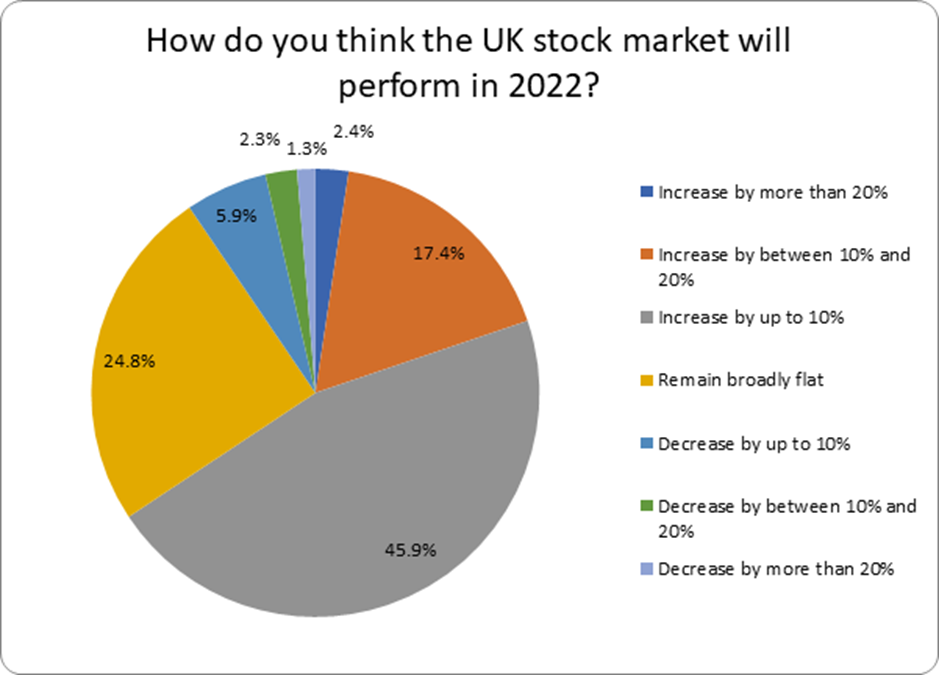
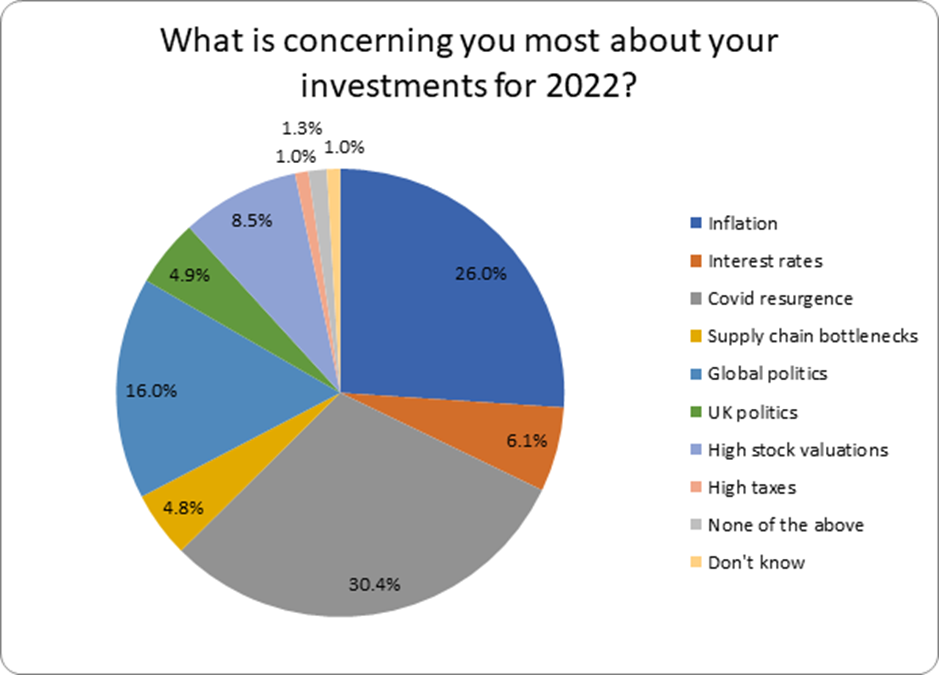
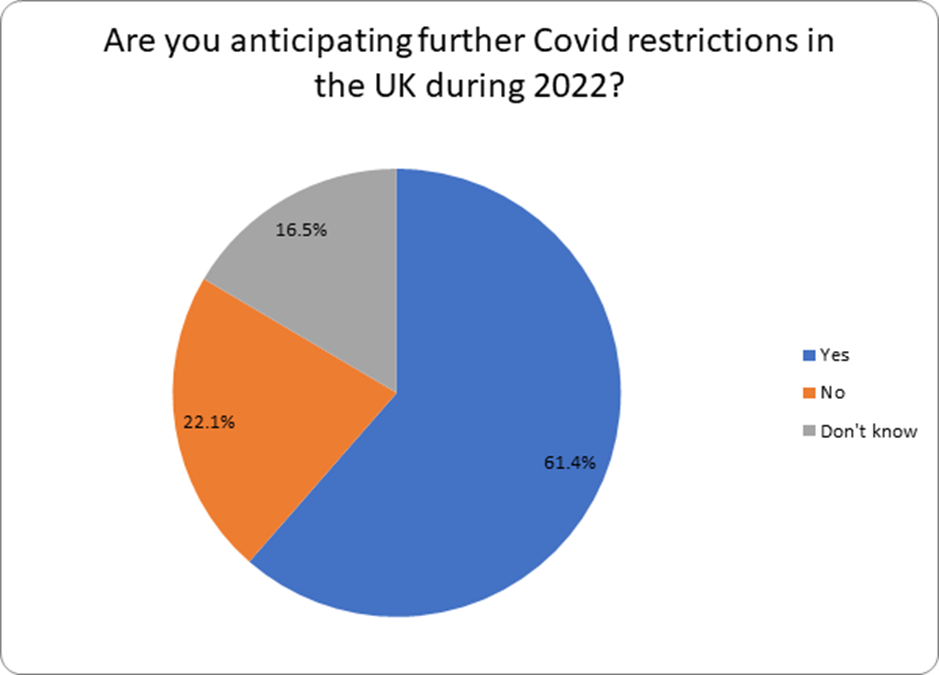
DIY investors are entering 2022 in a mood of constructive realism, recognising market risks, but also largely confident in their investments. Six in ten expect further covid restrictions in 2022, and a resurgence in the pandemic is the number one worry for investors as we head into the new year. Indeed, covid is seen as a greater risk than inflation, which makes sense seeing as the stock market provides some protection from price rises. Inflation comes a close second in the list of concerns for 2022 though, which shows investors are wary of price rises and the effect this may have on their portfolios. Global politics and high stock valuations are also cause for concern for some investors. 

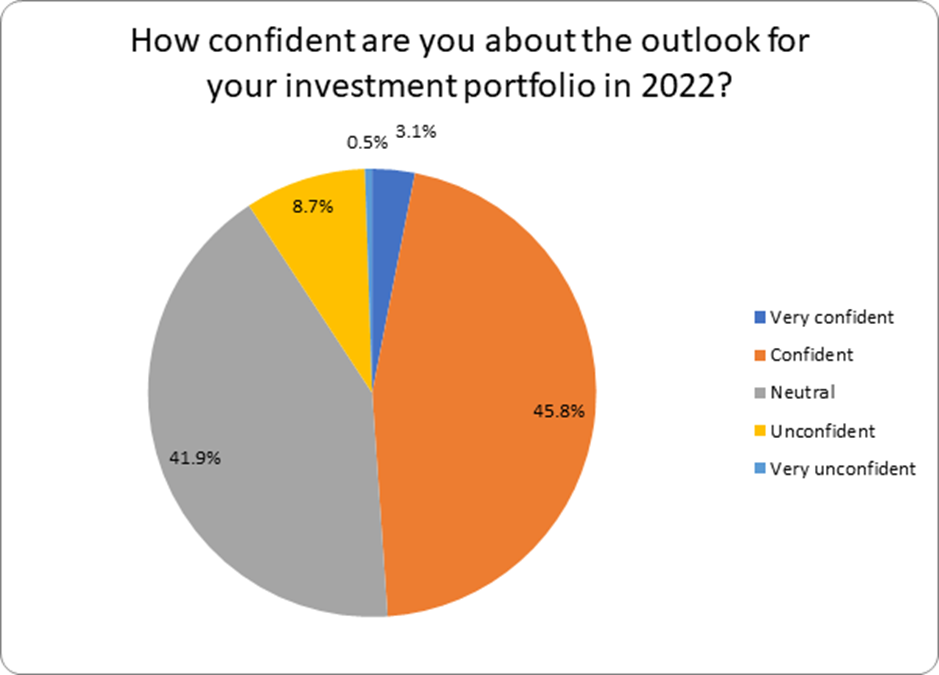
On the whole though, investors see the glass as half full rather than half empty. About 50% were confident or very confident about their investments in 2022, and around four in ten were neutral. That’s also reflected in forecasts for the Footsie, with two thirds of investors (65.7%) expecting the UK stock market to make further ground over the course of the coming year. Almost half of investors expect single digit returns in 2022, which suggests investors aren’t getting carried away, and are settling in for a more modest year for growth than 2021.

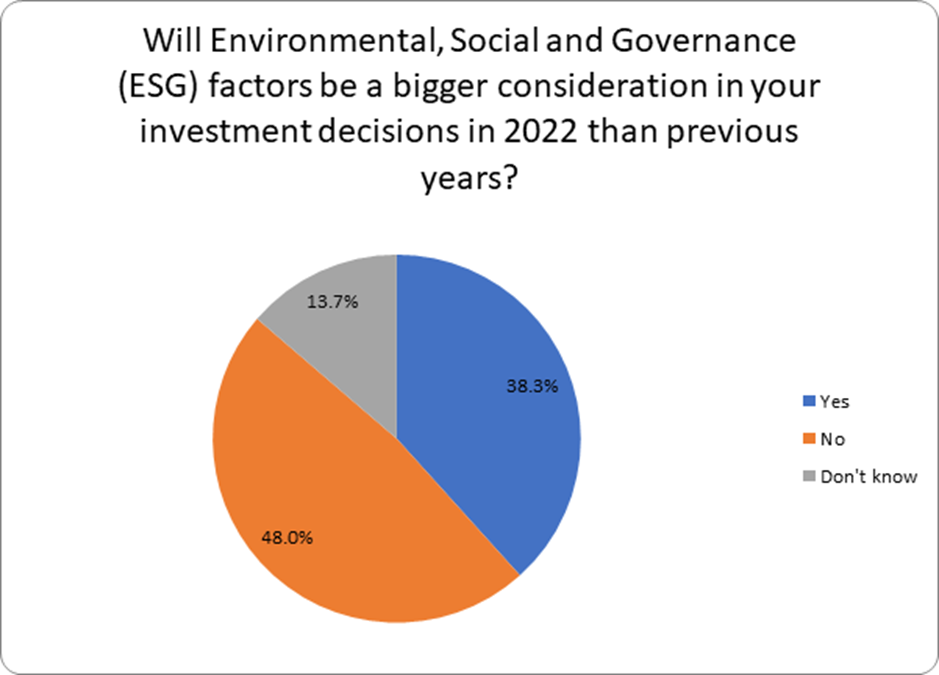
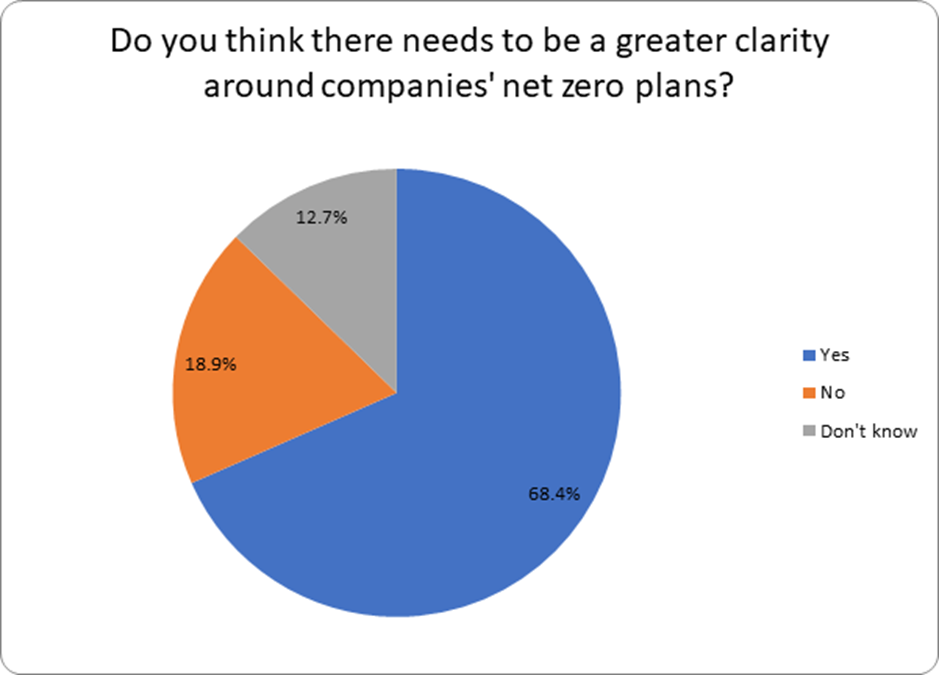
Investors are also becoming more attuned to ESG considerations, with four in ten (38.3%) saying these were going to play a bigger part in investment decisions in 2022. There’s already been a groundswell of interest in ethical funds in the last two years, and our survey suggests this isn’t going to abate in 2022. More than two thirds of investors also said they think there should be grater clarity over companies’ net zero plans. 

The ESG agenda has developed so rapidly across the investment industry that the information available to investors is struggling to keep up. The FCA is formulating proposals on a new green labelling regime, expected in the first half of 2022, which should help make things a bit easier for investors seeking ESG investment options.

Please continue to check back for a range of blog content from us and from some of the world’s leading fund management houses.

David Purcell

20th December 2021

Team No Comments

Five key charts for 2022 (and beyond)

Please see below an interesting article received from AJ Bell this afternoon, which offers key potential market-related scenarios for the 12 months ahead as we approach the end of this year.

No-one, not even central bankers, knows what is ahead of us in 2022, and whether inflation, stagflation or deflation will result from the combination of the pandemic, lockdowns and supply-chain chaos on one side, and massive amounts of fiscal and monetary stimulus designed to boost demand on the other.

Going ‘all in’ on one scenario is probably not going to be good idea and portfolio construction will need to address range of outcomes, as frankly anything is possible (especially given the likelihood of central bank and government interference action). Keeping an eye on the following charts – and investment decisions – may help investors sense which way the wind is blowing so they can try to obtain the best possible risk-adjusted returns for their portfolios

‘Value’ versus ‘growth’

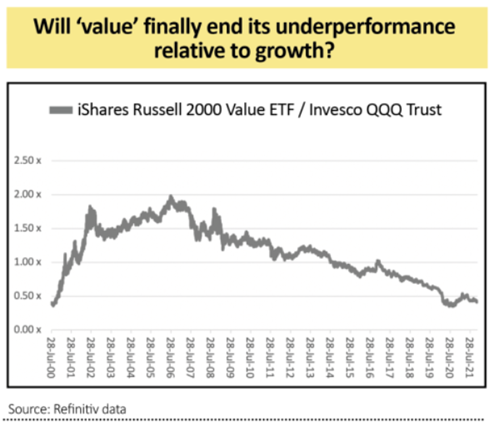
For want of a better turn of phrase ‘growth’ has outperformed ‘value’ for the thick end of a decade, thanks to the prevailing, low-growth, low-interest-rate, low-inflation fog which has enveloped the globe.

If that environment persists, firms which are seen as capable of providing secular trend increases in sales, profits and cash flows (or maybe even just the first one) will remain highly prized. If it changes, and inflation and strong nominal GDP growth take over, then there would be no reason to pay high multiples for secular growth when cyclical growth (or ‘value’) would be available at much lower valuations. Industrials and banks could then lead the charge.

One way of measuring whether this shift in leadership is happening is by comparing the performance of the Invesco QQQ Trust, packed with growth stocks, against the iShares Russell 2000 Value ETF. If the line goes up, value is doing better, and vice-versa. Value’s latest attempt for glory is petering out a little, perhaps owing to worries over Covid variants and the effects of higher prices and clogged supply chains on economic activity.

Developed’ versus ‘emerging’ markets

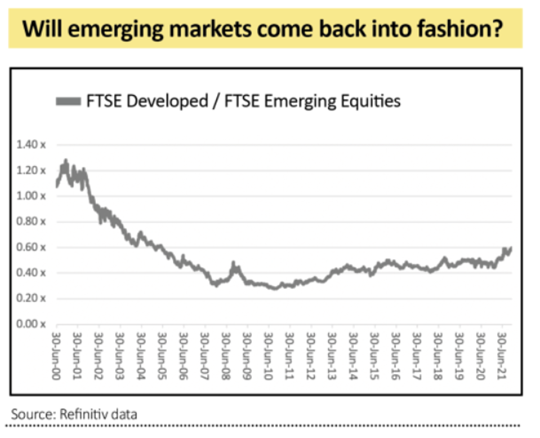
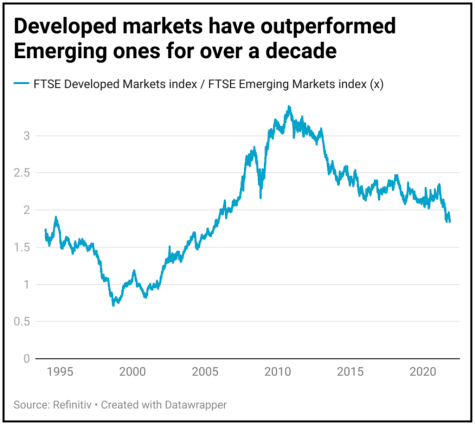
Emerging markets dominated for the first decade of this millennium but developed ones have subsequently ruled the roost. Demographics, debt-to-GDP ratios and the possible trend toward ‘onshoring’ in the West are all factors here but it seems reasonable to expect export-driven emerging markets to fare relatively well if global growth rates pick up. Any attempts by China to loosen monetary policy and stoke growth could also help emerging markets, where the Shanghai market has a big weighting.

Real and paper assets

Looking at the relative performance of the Bloomberg Commodity and the FTSE All-World (equity) index, commodities and ‘real’ assets outperformed between 2000 and 2010 but equities and ‘paper’ assets have dominated since.

Again, this trend could be reasonably expected to continue if we stay stuck in a low-growth, low-rate, low-inflation world. But if inflation (or maybe stagflation) take hold, ‘real’ assets could come to the fore for three reasons: they could be stores of value; central banks may keep printing money but they cannot print oil, gold or property; and investment in finding new resources is dwindling thanks to pressure from politicians, investors and the public alike amid environmental concerns.

All that glitters

The subject of ‘stores of value’ and ‘haven assets’ can lead to heated debate. It is hard to argue that Bitcoin is a store of value, given the wild price swings of the last five years, and the same accusation can be levelled at gold. Neither produces a yield. And both trade way above their marginal cost of production.

Yet rampant deficit creation by governments and money printing by central banks (in an attempt to effectively monetise and fund the extra debt) do persuade many to make an investment case for one or the other (although rarely both).

Gold did next to nothing and underperformed Bitcoin again in 2021. But its role as a haven during times of great uncertainty – when it looks like the authorities are not in control – could come into play if inflation gallops higher. The gold price relative to Bitcoin makes for an interesting chart but the metal may remain dormant if inflation fizzles out.

Chop and change

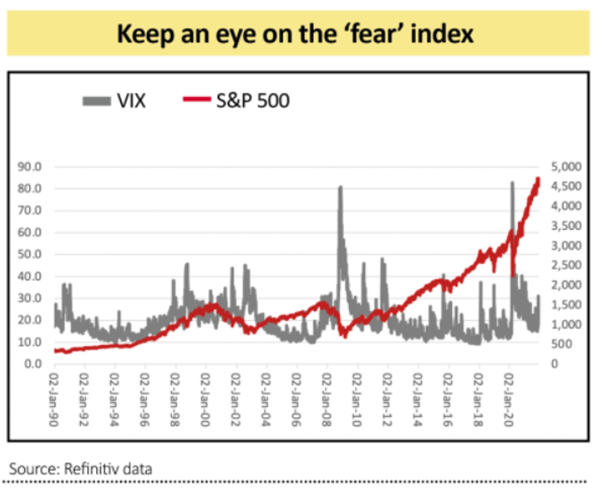
After a brief foray to 30 on news of the Omicron variant, the VIX, or ‘fear,’ index which gauges future volatility in the US stock market, is trading pretty much in line with its long-run average of 19. If markets retain their faith in central bank control, inflation remains subdued and the variant passes by, fear will likely dissipate. But if inflation takes hold and confidence in policy makers ebbs, volatility may make its long-awaited comeback.

Please check in again with us shortly for further relevant content and news as we countdown to Christmas and the New Year.

Stay safe.

Chloe

16/12/2021

Team No Comments

Stock markets stage full recovery after Omicron fears

Please see below article received from AJ Bell yesterday afternoon, which suggests that investors appear to have decided the new Covid-19 variant won’t derail economic growth.

Stock markets hate uncertainty, and the arrival of Omicron has created an information vacuum which is likely to persist until scientists and economists get to grips with the likely health and economic effects caused by the latest variant of concern.

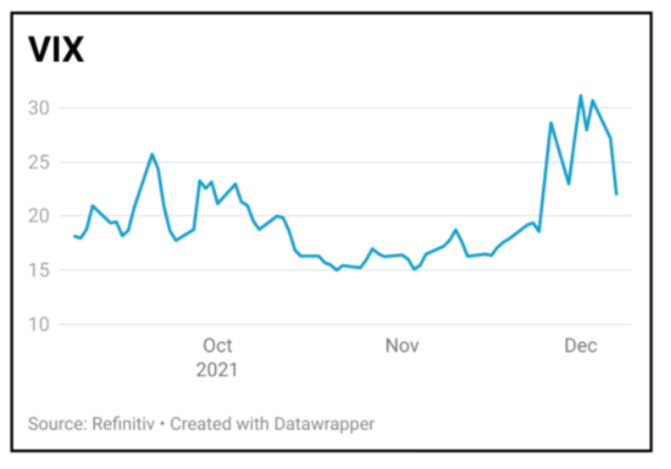
On 26 November, the so-called fear gauge, the VIX index, spiked higher as investors scrambled to hedge their portfolios, sending US markets down by around 2%.

UK and European markets dropped by more than 3% with travel related shares and economically sensitive stocks, such as banks, taking the brunt of the fall.

British Airways owner International Consolidated Airlines dropped by as much as 20% and Lloyds dropped by close to 10%.

Commodities like oil and copper sank as markets moved to price in lower global growth, while interest rates dropped.

Comments from Moderna chief Stephane Bancel prompted another sell-off in markets on 1 December after he predicted a ‘material’ drop in effectiveness from current vaccines against the new variant.

Fed chairman Jay Powell added to uncertainty on the same day after he surprised markets by saying the US central bank would discuss an increase in tapering (removing stimulus) at the December meeting, which sent bond yields higher and prices lower.

Elevated volatility saw the VIX index climb from 18.58 on 24 November to 31.12 on 1 December. Historically, large spikes in the VIX index have been associated with ‘market capitulation’ and higher future stock prices.

Sentiment already appears to be shifting. The VIX has since dropped back to 22.02 and at the time of writing (7 Dec), the FTSE 100 index had recovered all its losses since the variant first dominated the headlines, and was trading slightly above pre-Omicron levels.

The index has been helped by a strong rebound in index heavyweights Royal Dutch Shell and BP.

After falling as much as 15% on Omicron worries oil prices have staged a recovery rally following a meeting of oil producers’ cartel Opec+ (Dec 2) where Saudi Arabia and its allies agreed to press ahead with efforts to increase production by 400,000 barrels a day each month.

Opec+ also hinted it would adjust production if necessary, which seems to have provided support to prices. Brent Crude has risen by around 8% to $71.70 per barrel since the meeting.

Before the Opec+ meeting several countries including the US, China and the UK had indicated they would release supplies from their strategic oil reserves to help curb prices.

We endeavour to publish relevant content and market news regularly throughout the festive period, so please check in again soon.

Chloe

10/12/2021

Team No Comments

Could Omicron derail the US equity bull market?

Please find below a ‘Markets in a Minute’ update, received from Brewin Dolphin, yesterday evening – 07/12/2021

The S&P 500 has surged over the past 20 months. Could the spread of the Omicron variant spark the first correction of the bull market? Paul Danis, our Head of Asset Allocation, provides context and discusses the outlook.

Last Friday saw a sell off in higher risk asset classes when the Omicron variant of Covid-19 suddenly landed on everyone’s radars. The news was poorly received as many investors had become quite relaxed about the virus. The S&P 500 fell 2.3% – its biggest one-day loss in nine months – while the pan-European STOXX 600 slumped 3.7% in its worst session since June 2020.

Economic growth-sensitive plays like small caps underperformed. At the industry level, it was the travel[1]sensitive airline, hotel, restaurant and leisure sectors, oil-sensitive energy plays, and yield-sensitive banks that were among the worst hit.

Where do we stand now after the Omicron[1]induced sell off?

Notwithstanding Friday’s selloff, global equity markets have surged over the past 20 months, led by the US. As of the end of November, the MSCI All Country World Index is up 89% (in US dollar terms) from the March 2020 low. The US large cap benchmark, the S&P 500, is up 104%. We focus on the S&P 500 in this article because it represents over 60% of the global equity market cap, it acts as a bellwether for equity bourses around the world, and US equities constitute our largest overweight position.

Although there have been several US equity bull markets that have seen much greater total price appreciation than what has occurred so far this cycle, what has made this cycle’s bull market stand out is the intensity of the rally. This cycle, the S&P 500’s annualised performance since the bull market began is just over 62%. Looking at all the bull markets where the total gain has been at least 100%, one must go back to the early 1940s to find rallies that have been as intense.

What’s more, we have now gone much longer than the average length of time without seeing a 10% correction in the S&P 500. Since the late 1920s, the average time between the start of a bull market and an S&P 500 decline of 10% or more is about a year and two months. This cycle, we’ve gone about a year and eight months without a 10% correction. The worst we’ve had was a 9.6% decline in September last year, and a milder 5.5% pullback in September this year.

Is Omicron enough to spark the first 10% correction of the bull market?

It’s possible. How much downside we get will be determined by what the data show in terms of Omicron’s ability to evade vaccines and natural immunity, as well how dangerous it is. The good news is that a lot of work has already been done to find solutions to Covid-19. As such, if it turns out that Omicron poses a new serious challenge, the world is in a better place now to address it.

Preparing new vaccines is not trivial, but it would be a shorter and more certain process than the development of the original vaccines. Furthermore, we also have some effective treatments for Covid-19. These are not expected to be impaired by the new variant.

When compared to the historical averages cited above, the S&P 500 bull market is looking long in the tooth. Other concerns include extended valuations, profit margins that are at risk of turning lower, and the likelihood that we may soon enter a slower growth phase in the global economic cycle. With all this in mind, the next 12 months are likely to prove bumpier than the past 20 months for equity investors. Nevertheless, it looks like the equity bull market is still on a solid foundation. Importantly, The S&P 500 has surged over the past 20 months. Could the spread of the Omicron variant spark the first correction of the bull market? Paul Danis, our Head of Asset Allocation, provides context and discusses the outlook. Could Omicron derail the US equity bull market? 01 December 2021 we believe the economy will continue to expand at a healthy pace. Based on cycles from 1990, the S&P 500 peaks on average two months after the unemployment rate begins to rise.

 Is there continued scope for the labour market to improve?

 The US unemployment rate has already dropped a lot. It is currently at 4.6%, significantly lower than the April 2020 high of 14.8%. The Omicron variant creates new uncertainty, but most of what we are seeing suggests it will go down further. Importantly, US households are still sitting on roughly $2.5trn in excess savings built up during the pandemic. True, there have been signs of weakness from the all-important US housing market, such as housing starts. But that does not appear to be because of weak demand. Rather, supply bottlenecks appear to be the problem, with homebuilders struggling in terms of hiring workers and with the high price of building materials. Housing units authorised in the US have attained new highs, which likely indicates some pent-up demand.

Is there anything else supporting the equity market?

 There are some silver linings to the Omicron-induced sell off. On the greed and fear spectrum, the Omicron news turned the dial meaningfully toward the latter. On that front, the market’s ‘fear gauge’, the VIX index, hit the highest level since February on Friday. A healthy level of fear in the market tends to be more supportive of future gains compared to a backdrop of greed/complacency.

In addition, the market is now pushing back expectations of Federal Reserve interest rate hikes. The Fed’s continued willingness to stimulate the US economy, by keeping interest rates low, is also something that should support equities.

Aren’t equities now just too expensive?

It is true that equities are expensive by historical standards. But so are bonds, and investors are disincentivised to hold cash, thanks in large part to the Fed’s accommodative policy stance. The inflation-adjusted ‘federal funds rate’ is currently below -4%. This means investors’ cash holdings are depreciating in real terms at an annualised rate of over 4%. These low real yields on cash and bonds combined with solid corporate profits growth are keeping the yields on equities at relatively attractive levels even after such a strong rally.

So, you remain bullish – what are the risks?

Omicron is clearly a big one. Another is that the Fed will end up tightening policy sooner than most expect. This could happen if long-term inflation expectations change. While ten-year inflation expectations implied by US inflation-linked bonds are elevated, they are not at extreme levels. Other measures of inflation expectations also suggest the market is not overly concerned about inflation over the longer-term. While there’s no room for complacency on inflation, the data are not behaving in a way that would make one believe the Fed will imminently pull the rug out from under the equity market.

Conclusion

The emergence of the Omicron variant is undoubtedly a concern. Nevertheless, on a 12-month view, we believe that a continued overweight in equities and underweight in bonds is appropriate. Equity investors are likely to be in for a bumpier ride over the next year. But with the economic outlook still largely positive and given the Fed’s currently supportive policy stance, it looks like the equity bull market remains on a reasonably solid foundation.

Please continue to check back for a range of blog content from us and from some of the world’s leading fund management houses.

David Purcell

8th December 2021

Team No Comments

Flexibility will be key in 2022

Please see below article received from Jupiter yesterday afternoon, which reviews a tumultuous period for markets and looks ahead to 2022, where flexibility will be essential in a volatile investing environment.

“Life moves pretty fast. If you don’t stop and look around once in a while, you could miss it.” – Ferris Bueller, Ferris Bueller’s Day Off (1986)

We leave it to the readers’ imagination why a film about a high school slacker resonates with the Multi-Asset team. But the post-pandemic period has been one of the most intense of our careers – it’s all too easy for investors to get caught up in the market narrative. Our job is to take a “day off” from the hyperbole and make sense of what’s happening. We predicted back in April 2020 that the sugar rush of pandemic stimulus would kickstart a warp-speed business cycle, and it did. After the fastest recession there was the fastest recovery in history, and now markets are worried things are moving too fast. The market narrative has flipped from deflation to reflation to stagflation to inflation in a matter of weeks.

Don’t rely on inflation fading next year

The Federal Reserve (Fed) has allowed monetary policy to run looser for longer, as we expected after the structural shift of its 2020 framework review1. There has been an even faster rebound in demand than the Fed expected, driven by vaccines, rising household wealth, and stimulus cheques. Demand has outstripped supply resulting in inflation levels we haven’t seen for nearly 40 years.

The Fed is banking on inflation fading next year, but it may be more persistent . We analyse current inflation across four key buckets: reopening-related sectors, housing, wages, and expectations. All are moving higher. Inflation in rents is sticky and can contribute to higher inflation expectations, which reinforce longer term inflationary dynamics. Central bank policy is running a risk of going too slowly now, and having to move at a faster pace further down the line, choking the recovery.

Heading into 2022, we think growth can be sustained and support markets. Supply bottlenecks have left inventories low, and restocking can sustain industrial production. Accumulated savings (of around 10% of GDP in the US) can continue to support consumption. As we head towards the middle of next year, restocked inventories, slowing consumer demand, tighter policy and stretched valuations will make life more difficult. Conclusion: one can continue to ride the wave in equities and hold fewer bonds for now, but the likelihood is the flexibility to cut risk and add duration later next year will be needed.

Job openings are outstripping the supply of unemployed workers, putting upward pressure on wages

Looking beyond the horizon

Looking out into the more distant future, structural shifts point to a modestly stronger growth and inflation environment. Pandemic stimulus cheques and asset price rises allowed an increase in retirements, reducing labour supply, but lifting wages. The pandemic and trade wars exposed global supply chains, leading to a structural shift from “just in time” to “just in case”. We have seen increased capital expenditure and in particular increased spending on research and development since the pandemic, which can drive productivity and growth. Last but not least, the need to fund climate transition can unlock additional fiscal spending and potentially forms of ‘green’ stimulus. There seems to be little chance of a return to the austerity of the previous decade.


These factors will take some time to play out, but the sum of their impact is likely to be a modestly higher growth and higher inflation environment over the next decade, particularly compared to the previous one. Shifting policy is also likely to lead to higher volatility, and more frequent, sharper crises. Simple balanced portfolios of higher quality equities and longer duration bonds are unlikely to work as well as they have.


This doesn’t necessarily mean investors can’t make decent returns, but it will call for different approaches. As Ferris said, “you’re not dying: you just can’t think of anything good to do”. We think this sentiment applies to investing: you can still perform, but you will need more flexibility and a wider range of return sources.

Please check in again with us soon for further relevant content and news as we continue through the festive season.

Stay safe.

Chloe

02/12/2021

Team No Comments

Omicron and Markets – Our Asset Allocation team’s key beliefs

Please find below a insight into the impact of the Omicron variant on world markets, received from Legal & General yesterday afternoon.

 The COVID-19 situation had not been looking good across Europe anyway, but at least there was the hope that the shift into an endemic scenario was not far away, especially with a re-acceleration in vaccinations, boosters and the availability of antiviral drugs. This may well still be the case, but the emergence of a new variant of concern has added to the tail risk that it won’t be.
 
Déjà vu all over again

We are neither virologists nor epidemiologists. But from a market perspective, there are a few things we can say about the virus without their expertise.

It’s still very early and there is little data about B.1.1.529, now known as ‘Omicron’, but it appears to be spreading faster than the Delta variant did in South Africa. It has many mutations that in other variants have been associated with greater transmissibility and evading immunity.

The variables we will be watching most closely are:
Is it more transmissible?
Is it more likely to lead to hospitalisation and is it more lethal?
Do vaccines and antivirals still work against it, and how well?

We must also consider the response of policymakers. It’s relatively easy for major central banks to do nothing for the time being, should market worries intensify. Rates are already at zero with some tapering underway. It’s a bit trickier for the Bank of England, given expectations of a December hike, but the Federal Reserve (Fed) does not have to speed up tapering in December.

Fiscal support, if needed, should be no different than in previous waves. In Europe, the past few weeks have shown that countries increasing restrictions are just as willing to renew fiscal support measures as previously. In the US, Democrats being in control of both the House and Senate – and with an election coming up next November – should make building consensus to support the economy easier than in 2020.

Restrictions have already been ramping up in Europe in response to the winter wave. New variant concerns could accelerate this dynamic. The US faces a different situation, as a new variant would require a greater shift from the status quo. China’s zero-COVID strategy would be more difficult to maintain with a more transmissible variant.

Mandatory vaccination has already become more likely in several European countries, and a new variant could push more towards this step. This would have little immediate impact on markets, but could potentially be positive for 2022.

Markets will clearly remain sensitive to news on the variables mentioned above. But our initial line of thinking is that, should market weakness around a new variant intensify, similar to geopolitics, it could create an opportunity to increase risk in portfolios.            

M&A: here to stay?  

Until Omicron, the most interesting financial story in late November was merger and acquisition (M&A) activity, sparked by KKR’s* bid for Telecom Italia*.

From an equity perspective, we see M&A as a coincident indicator rather than a leading indicator in the market cycle. It’s more the case that M&A is up because markets are up, rather than markets rallying because of M&A, in our view. Business confidence has typically been the main driver of corporate M&A. Of course, cheap financing also helps, especially for private-equity transactions. Interestingly, M&A activity tends to be highest when share prices are highest. M&A happens not when it’s cheapest to buy, but when management teams feel confident about the future.

We therefore agree with our colleagues’ argument that headline-grabbing M&A can be a late-cycle indicator, but is not necessarily a leading indicator of the end of the cycle. We expect the M&A theme to be with us for the duration of this cycle and bull market, even if financing conditions become less favourable as the cycle matures. One precedent is the Fed rate-hiking cycle from 2004 to 2006, when M&A activity accelerated and kept going until the economic cycle and bull market ended.

Another macro factor that could become less favourable, but seems unlikely to derail overall activity, is US regulation. The Department of Justice and Federal Trade Commission, under new leadership, are trying to enforce antitrust rules more strictly than in the past. This is probably mostly targeted at big tech, but might also put off some other acquisitions that are borderline on antitrust and industry concentration. Aon* and WTW* was one recent example.

For equities, actual deals don’t typically have a positive first-round effect. The shares of the acquirer typically trade down, and the shares of the target trade up, but the target is usually smaller. So, if anything, it’s generally better for small-caps than large-caps. We had a good example in the telecoms sector last week. Telecom Italia was obviously up significantly following the KKR bid. But on the same day, Ericsson’s shares fell 5% on its planned acquisition of Vonage in the US.

Private equity aside, there is another incentive for corporate buyers to consider M&A. For most of this year, companies that have undertaken cash or debt-financed M&A have outperformed companies using cash for buybacks and capex. So, for management whose compensation is linked to the share price, M&A has a definite appeal.    

Earnings 2022  

Of course economic data matter. Of course COVID-19 matters. But for equities, the main reason they matter is because of what they tell us about corporate earnings.

Coming out of a solid third-quarter 2021 earnings season and heading into year-end, it’s a good time to think about what earnings will look like in 2022. The obvious caveat to all of the below is that a dangerous variant would change everything.

Our economics team’s roadmap is consistent with US earnings growth in the high single digits, more specifically around 9% by the end of 2022. That would be a slowdown from the post-recession extremes, but solidly positive and a bit above trend.

The 9% estimate is unusually close to the bottom-up consensus of 8.5%. Bottom-up forecasts were too pessimistic about the post-recession rebound, but our own analysis suggests that the big upward revisions to analyst expectations should soon come to an end. It’s too early to tell for sure, but the top-down numbers from sell-side outlooks also appear to sit in the high single-digit area.

The biggest swing factors to next year’s earnings, COVID-19 aside, are US corporate taxes. Assuming about half of the initial proposals from the Biden administration become law, that would take around 5% off earnings growth estimates. The latest proposals, however, have come in a bit smaller than previously. It’s possible the statutory tax rate could stay unchanged, with reforms focusing instead on foreign income, a minimum tax rate and a buyback tax. So the hit to US profits could end up being smaller than 5%.

Another factor to consider is slower economic growth in China, given that we are at the bearish end of forecasts for the country’s GDP. However, the first-order impact on US profits should be manageable. We estimate that 1% off Chinese GDP growth takes a bit less than 1% off S&P 500 profits. Given the other uncertainties around earnings growth, this should not be a dominant driver of the US earnings debate next year.

*For illustrative purposes only. Reference to a particular security is on a historical basis and does not mean that the security is currently held or will be held within an LGIM portfolio. The above information does not constitute a recommendation to buy or sell any security.    

Please continue to check back for a range of blog content from us and from some of the world’s leading fund management houses.

David Purcell

30th November 2021

Team No Comments

Myth Takes – Legal & General

Please see below article written by Legal & General’s Asset Allocation team, whose research suggests that the current rise of inflation is due to a mixture of positive demand shocks as well as negative supply shocks. Please read on for full details.

The unwinding of negative supply shocks should temporarily lower inflation next year, while some rotation away from goods back to services might help reduce inflation too – but not as much as central banks expect, in our view, as we see less labour market slack.

Some of the demand shocks are expected to prove longer-lasting as well, aided by excess saving and wealth, easy financial conditions and stronger wage growth and pricing power. So, despite uncertainty around the output gap, we see the risks as skewed towards inflation being positive in 2022 – which will be inflationary in itself.

Icarus’ flight may go higher this time

If the above thesis holds, the Federal Reserve (Fed) is behind the curve. Rates should be at neutral as the economy reaches full capacity, but it is still doing quantitative easing (QE).

The Fed will need to move faster, we believe, and to a higher peak than the market expects. The ultimate peak will be a function of how neutral rates have changed since the last cycle. The market seems confident that they have not risen much – and may have even fallen since 2019. Given the change in fiscal policy, we’re less convinced that will prove to be the case.

Of course, the market is likely to price in a lower path because of the asymmetry of the Fed’s reaction function: a negative demand shock could be met by sharp rate cuts (back to zero), while the Fed will likely be slow to react to further negative supply shocks, arguing they are temporary. In the medium term, we expect the Fed to learn from its mistakes and raise rates sufficiently to prevent a prolonged and serious inflation outbreak.

This implies we want to keep a negative duration bias, but with positioning still short, we don’t think it’s sensible to be holding short tactical views during periods in which there is no catalyst for repricing.

Clash between currency titans

In currency markets, the US dollar and the euro are the titans. Movements in their exchange rate are important, as the euro and dollar are the centres of gravity for the euro-bloc and dollar-bloc currencies.

The US dollar has been strengthening across the board in 2021 (the DXY dollar index is up 6.6%), with many market observers expecting further appreciation. With US inflation on the rise, rate hikes by the Fed are likely to be brought forward into 2022. That’s reflected in the short end of the interest rate curve, while in the long end, the gap with the Eurozone is widening too. Purely looking at nominal rates, US dollar strength seems obvious.

Today, not many investors are worried about a lack of inflation anywhere – not even in the Eurozone – so without much inflation, differentiation between nominal rates is in the driving seat. Over shorter time periods, we agree that nominal rates are a better predictor for currencies than real rates, at least for developed currencies, but over longer time periods this is not true and real rates form the better anchor.

With expectations for rate hikes by the Fed brought forward, while rate hikes by the European Central Bank remain much more conservatively priced, we believe the bar for surprises has been lowered. This will make it harder for nominal rates to continue pushing the US dollar stronger, while it gives more confidence that currencies cannot de-anchor from real rate moves much longer.

Given this outlook, recent euro weakness appears overdone, in our view. We’re turning more positive on the euro versus the US dollar and are ideally looking for negative sentiment and positioning as a potential opportunity.

We’re not there yet, but as the pandemic rears its ugly head again in Europe with the Austrian lockdown, it may not take long. A period of speculation about who is next feels inevitable. Given how unpredictable COVID-19’s trajectory has been, we have no idea where a new round of lockdowns might end, but rates and currency markets have proven to be quite sensitive to coronavirus waves over the last 12 months.

Minotaur’s labyrinth

There is a light election calendar in emerging markets for 2022, with fewer pivotal votes than we will see the year after. There are general elections in Hungary and Poland early next year, followed by a presidential election in South Korea, and then general and presidential elections in the Philippines, Colombia and Brazil.

Will we see an end to Orban’s rule in Hungary? Despite a competitive opposition candidate putting Fidesz on the back foot, an Orban victory remains the base case. In Poland, the Law and Justice party might try to rebuild its majority with a snap election. The outcome depends on the opposition uniting. The task is hard, but not impossible. This matters more broadly as the current government’s spat with the EU is getting more serious.

In South Korea we could see a conservative turn in politics that would result in closer relations with the US and Japan against China, and could lead to a greater risk of miscalculation with North Korea or China. The geopolitical consequences will be the most significant for markets. A generationally divided electorate in South Korea could signal instability and political turbulence in the years ahead.

In the Philippines, the election will be a test for dynastic political machines and the winning president will get substantial powers. This is important for the relationship with China and the US in the Pacific, but we only see limited market impact as most candidates favour broad policy continuity. In Colombia, fiscal constraints are starting to bite, so if the new president is uninterested in fiscal discipline or economic reform, markets are likely to panic.

In Brazil, the current right-wing president Bolsonaro is under strain, increasing the likelihood of a turn to the left with the return of former president Lula. Either way, the constitutionally enforced spending gap, the country’s only fiscal anchor, is under threat. That’s keeping financial markets on their toes. Another key threat comes from the potential inflating away of outstanding public sector debt. Volatility is likely to be high in the runup to the election, and potentially afterwards if institutions are tested. This will be reflected principally in the real, in our view, but also in domestic bond yields and equities.

Please check in again with us soon for further relevant content and market updates as we approach the final month of 2021.

Stay safe.

Chloe

23/11/2021

Team No Comments

Five reasons not to be fearful of inflation

We don’t normally do two blogs in a day but this one came in this morning from Invesco and I thought it was an important one for you to understand on Inflation

Everywhere I go, every channel I turn to — it seems all I hear is the “i” word. Yes, inflation. And the data is ugly right now:

  • The headline US Consumer Price Index (CPI) rose 0.9% for October, while core CPI (which excludes food and energy) rose 0.6% for the month. For the first 10 months of the year, headline CPI was up 6.2% versus the same 2020 period — well over expectations of 5.8% — and core CPI was up 4.6%.
  • China’s Producer Price Index (PPI) for October rose 13.5% year over year, which is well above expectations. This is up from 10.7% year over year in September and represents the fastest pace in 26 years. (China’s PPI measures the cost of goods as they leave the factory gate, before transportation or other costs are factored in.)

The data and the media attention around inflation has altered market-based inflation expectations:

  • The 5-year breakeven inflation rate finished the week above 3% for the first time in more than 10 years.
  • Even the 10-year breakeven inflation rate has been impacted. As of Nov.12, it was 2.73%. That’s up from 2.33% two months ago (as of Sept. 14).

It is also having an impact on shorter-term consumer inflation expectations:

  • Last week, the Federal Reserve Bank of New York released its Survey of Consumer Inflation Expectations for October. Median inflation expectations increased to 5.7% for one year ahead, which is a series high (although keep in mind the inception of the survey only goes back to June 2013) and the 12th consecutive increase. The survey had some positive takeaways: After increasing for three consecutive months, median inflation expectations for three years ahead stayed the same for October (4.2%).
  • The University of Michigan released its preliminary survey results for November on Nov. 12, and the findings are very similar to that of the New York Fed. US inflation expectations for the year ahead edged up to 4.9% in early November of 2021 from 4.8% in October, the highest since July 2008.However, five-year inflation expectations are unchanged since the previous reading at 2.9%.

Reasons to remain calm about inflation

Most of the questions we are receiving from clients are on the topic of inflation. Financial advisors are sharing with me that most questions they are receiving from clients are on the topic of inflation. Older clients in particular are fearful that this is the 1970s all over again.

So why shouldn’t investors be fearful of inflation? I see five reasons to remain calm.

  1. Inflation is a necessary evil as countries emerge from the pandemic, especially for the many countries, such as the United States, that provided adequate fiscal stimulus this time around (as opposed to during the Global Financial Crisis). Household savings is elevated, there is pent-up demand, there are labour shortages and there are supply chain disruptions. We’re facing a perfect storm — but it’s better than still being in the depths of the pandemic. As I say each birthday, as I grimace about the growing candles on my cake, “This is better than the alternative.” And so it is with high inflation.
  2. While the tunnel may be a bit longer than first expected, I do see light at the end of it. The public has come to realize that inflation likely won’t be over in a few months — but I believe it is likely to peak in mid-2022 and then start to recede. There are multiple reasons for elevated inflation, and some factors, such as pent-up demand, will dissipate sooner than others, but the general trend should improve in the back half of 2022.
  3. Tolerant central banks. The Federal Reserve will not overreact to the inflation data, in my view. The Fed recognizes that the factors causing high inflation will not easily be remedied through aggressive rate hikes. Raising the fed funds rate will not force more people back into the workforce or get ships unloaded in the port of Long Beach any faster. Under the leadership of Chair Jay Powell, the Fed seems hyper-aware of not making a policy error. And I think the Fed would only get more dovish if Lael Brainerd were appointed the new Fed Chair. (Brainerd, a member of the Federal Reserve Board of Governors, recently interviewed for the post.) While other developed central banks may feel more pressure to tighten, I don’t expect overly aggressive tightening. It is also worth noting that the People’s Bank of China is actually in easing mode. And so, all in all, the environment should remain supportive of risk assets given positive economic fundamentals
  4. Longer-term inflation expectations remain relatively well-anchored. Consumers seem to understand that while inflation might be very elevated in the shorter term, it will come down. We saw this in both the Michigan and New York Fed surveys released last week. This helps provide the rationale the Fed needs to avoid a hastening of its rate hikes.
  5. Inflation is not making much of a dent in profit margins. Yes, companies are talking a lot about inflation on their earnings calls, but it hasn’t had much of an impact on earnings. The earnings season in Europe has been better than expected. And thus far, the net profit margin for S&P 500 Index companies in the third quarter is 12.9%, which is near a record-high. And the fourth quarter net profit margin is estimated to be 11.8%, which is still robust.In this quarter’s earnings calls, a number of companies reported being able to pass increased costs onto customers, which helps explain the very healthy profit margins. And while this is not positive for consumers, it should be positive for equity investors.

So what’s the bottom line? I believe we need to expect inflation to remain high — and likely move higher — as we head into 2022. However, I am confident that inflation will peak by mid-2022 and that the Fed will not make a policy error — and that’s the real fear for investors with regard to inflation. I believe investors should remain well-diversified and focused on longer-term goals. I favour maintaining exposure to equities, including dividend-paying equities, inflation-protected securities, and other asset classes that have historically performed well during inflationary periods, including real estate and commodities.

I have just been listening to Brooks Macdonald on Inflation too, amongst other market input. Wage inflation is an area of concern and to precis, Brooks Macdonald say that whilst we might have some Job Movers inflation, for example HGV Drivers, we don’t see much inflation on Job Stayers, the majority of the working population in the UK.

Steve Speed

19th November 2021

Team No Comments

Does Wall Street fail the Gordon Gekko test?

Please find below, an update on markets received from AJ Bell yesterday afternoon – 18/11/2021

The factors which could knock a 10-year trend of developed markets outpacing emerging markets off course.

Gordon Gekko, the insider-trading corporate raider of 1987’s Oliver Stone film Wall Street, may have been a villain but that did not stop him talking a degree of sense. Quite what he would have made of Rivian’s $100 billion-plus market value after its first day of trading we will never know, but we can probably guess, given his comment that: ‘The mother of all evil is speculation.’

After all, that price tag values Rivian more highly than rival (and backer) Ford, even though Ford is forecast by analysts to generate more than $120 billion in sales and $6 billion in net profits. By contrast, Rivian is going to be in loss this year, not least as it only began to ship its first vehicles in September.

Whatever you think of Rivian’s potential, its valuation now prices in an awful lot of good news and not much bad. This is not to say anything bad will happen. But if it does, well, watch out as the valuation offers little or no downside protection.

By contrast, investors can protect their downside, and leave scope for upside, by looking at assets which may be out of favour and could therefore be undervalued as a result. The danger is that something is underperforming and cheap for a perfectly good reason, so careful research is needed. But one trend which catches this author’s eye is the 10-year underperformance of emerging equity markets relative to developed ones.

CLEAR TREND

This can be seen by simply dividing the value of the FTSE Emerging index by that of the FTSE Developed index. If the line rises, emerging markets are outperforming and if it falls then developed arenas are doing better.

Developed markets ended the 1990s on a high as the Asian and Russian currency and debt crises hammered emerging markets, only for them to recover just in time for the technology bubble bust to hobble the developed ones for the best part of a decade. It has been one-way traffic since 2010, however, as developed markets have proved to be the better portfolio pick by far.

The questions to ask now, therefore are ‘why?’ and ‘what could change’?

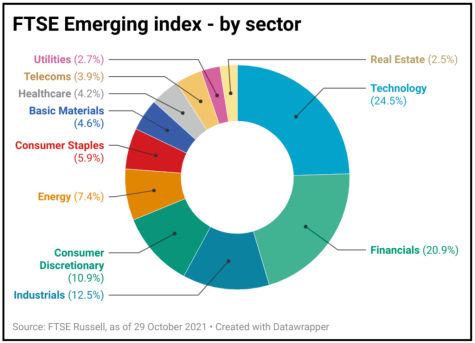
One good guess as to the reason for the performance disparity would be the sector mix of the indices. But they are not as different as you might think. There is a similar representation in technology and the percentage weighting toward cyclical sectors such as financials, industrials and consumer discretionary. Emerging markets’ greater weighting toward financials in a margin-crushing, zero-interest-rate environment may not help, and nor may the higher weighting toward energy and basic materials (mining) during a low-growth, low-inflation decade, but neither looks conclusive.

NEW YORK, NEW YORK

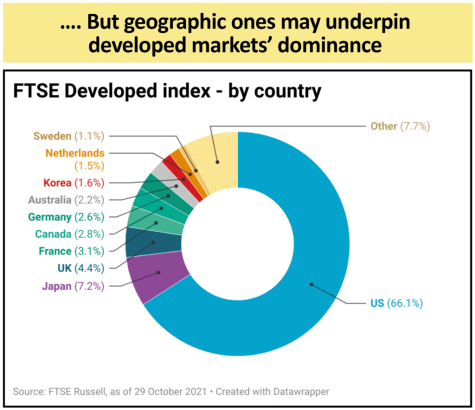
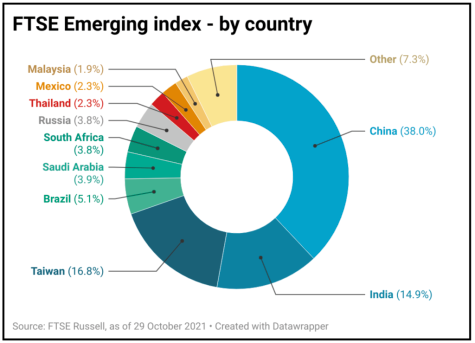
A more convincing explanation comes in the form of geographic exposures. The runaway US equity market represents two-thirds of developed market capitalisation and China more than one third of emerging markets.

This is not the only reason – China’s weightings have increased over time as overseas listings and the domestically-traded stocks have entered global indices – but the S&P 500 is up by more than 300% since January 2010 and the Shanghai Composite by just 7%.

After a long and loud clamour for their inclusion, index compilers are now busily excluding Chinese stocks owing to US sanctions, governance issues and more besides. That may appeal to contrarians, who will also baulk at the valuation attributed to US stocks.

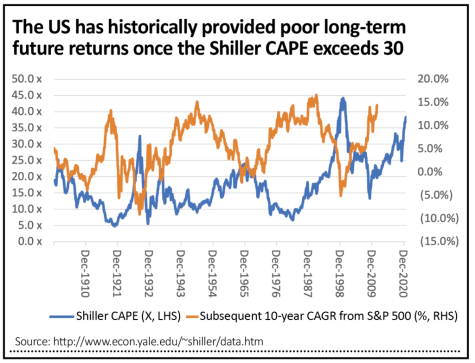
The Case-Shiller cyclically adjusted price earnings ratio – also known as CAPE – is no use at all as a near-term timing tool. But the two previous occasions when the CAPE exceeded 30 times, and the four prior times when 10-year historic compound returns from the S&P 500 have exceeded double-digits in percentage terms, have all seen the next decade’s returns from US equities tail off very badly indeed.

FRIEND OR FOE

Some investors will be happy to stick to the maxim that ‘the trend is your friend’ and row in with the US and developed markets over China and their emerging counterparts. Others will keep the combination of Gekko and Shiller’s CAPE in mind.

China is trying to support its economy while managing a huge debt mountain and attempting to stop financial speculation from derailing its economy through poor capital allocation. But you can argue the US faces the same challenge, even if it comes with far superior corporate governance and investor protection.

China is acting and could be running monetary policy that is too tight as a result. That leaves it room to loosen. The Federal Reserve might just be ducking the challenge and running policy that is too loose, with the result it will have to tighten in time whether it likes it or not in a reversal of fortune that could, one day, break a 10-year-plus trend in relative share price performance.

Please continue to check back for a range of blog content from us and from some of the world’s leading fund management houses.

David Purcell

19th November 2021

Team No Comments

Numbers Game

Please see below article received from Legal & General yesterday afternoon, which provides an update on China’s high-yield bond market and Chinese equities, and how they may affect currency, commodity, and Western equity markets.

Four is the magic number

Throughout the rout, our emerging-market economists have maintained a very consistent line of argument: the consensus is underestimating the likely hit to growth associated with this squeeze on property developers, and the government’s threshold for intervention is further away than the market thinks.

That changed last week. The consensus seems to have finally capitulated, with a number of high-profile downgrades to growth outlooks. We think that we are now nearing the 4% line in the sand for the government: growth below that level puts long-term prosperity goals at risk, and is not consistent with the need to maintain a robust jobs market.

With the market having finally adjusted enough, we are also seeing the first signs of a policy response in relaxed restrictions for homebuyers’ access to mortgage finance and a dilution of the “three red lines” policy that has constrained highly leveraged developers.

On Wednesday, the People’s Bank of China took the unusual step of publishing monthly mortgage lending data for the first time, seemingly to highlight the nascent recovery at the start of the fourth quarter. The state-owned Securities Times opined that “for real-estate developers, the feeling of the recovery of the financing environment will become more and more obvious” going forwards.

For us, that all adds up to a signal that we are hitting a policy inflection point. That encourages us to dial up exposure to the theme: either directly through China’s high-yield bond market, or indirectly through Chinese equities. We might find the intentions of the authorities hard to understand at times, but we don’t think it’s sensible to doubt their ability to underwrite the near-term growth outlook when they see fit.

At sixes and sevens over US inflation

We learnt last week that US inflation hit 6.2% in October. That’s the highest rate since November 1990, the month “Home Alone” was released in cinemas. However you choose to slice and dice the data (core, median, trimmed mean, etc), inflation pressures look to be broadening.

On the Atlanta Fed’s underlying inflation dashboard, there are now a lot of red lights flashing and there are growing warnings of a peak at or above 7% in the months ahead.

But the bond market has been a fickle friend to the vigilantes this year. Anyone who sold out of the longest-maturity bonds in the spring in anticipation of the string of upside inflation surprises has been disappointed, with 30-year futures rallying over 10% since March. The financial media have been full of anecdotes in recent weeks of storied macro hedge funds suffering gut-wrenching losses on bond trades gone awry. Recent price action suggests that, in the wake of those losses, there has been considerable forced liquidation of positions.

For us, that “cleaning up” of the market makes it interesting to sell duration again. Last week, we did exactly that in both the US and Europe across dynamically managed portfolios.

When Kevin McCallister was busy defending his home against the Wet Bandits in 1990, 10-year US Treasury yields were above 8.5%. The contrast with today could barely be more different, with yields now at the dizzy heights of 1.5%.

In the US, we think that some sterner words from the Federal Reserve await in the weeks ahead. In Europe, bond scarcity has driven the short end of the German curve below money-market rates. Risks are never entirely one-sided, but we’re happy to run with tactical duration shorts against that backdrop.

Can a stitch in time save nine?

The University of Michigan survey of consumer sentiment has tumbled to levels rarely seen outside recessions. The survey’s chief economist noted: “Consumer sentiment fell in early November to its lowest level in a decade due to an escalating inflation rate and the growing belief among consumers that no effective policies have yet been developed to reduce the damage from surging inflation.”

And it’s not just US consumers feeling the pinch. In the face of tumbling approval ratings, Joe Biden has suddenly propelled inflation-fighting to the top of his economic agenda, arguing that “reversing this trend is a top priority for me”.

It’s unclear what that means. Throwing federal money around like confetti is a strange way to fight inflation, but the administration continues to insist that the recently signed Infrastructure Bill and the larger “Build Back Better” agenda have nothing to do with the price pressures in the economy. They even have the chutzpah to argue that these programmes – aimed at tackling a host of other pressing challenges – will help pull down inflation by bolstering the supply side of the economy.

Perhaps the most obvious inflation-fighting tools in the administration’s arsenal are releasing oil from the Strategic Petroleum Reserve (SPR) and cutting tariffs on Chinese imports. The SPR contains the equivalent of 600 million barrels of oil in underground tanks in Louisiana and Texas. It was used to lean against oil prices in 2011 under the Obama administration (with Joe Biden in the Vice President’s office) and has been under discussion by the administration over the past month. This obviously wouldn’t be a long-term fix to cool oil prices, but it would represent a short-term supply boost of up to 4.5 million barrels per day.

Tariffs have been frozen since the Trump presidency at an average rate of just above 19% (up from 3% before the trade war started). It would have seemed unthinkable a few months ago that Biden would consider rolling back tariffs given the political danger of being outflanked by the Republicans on this issue.

However, maybe that calculus is changing with the growing inflation concerns. Tariff reduction would offer marginal relief on the outlook for both US inflation and Chinese growth. It would be very warmly welcomed by financial markets as a result. A virtual summit between Presidents Xi and Biden is scheduled for this week. We’ll be watching closely for any hints of a thaw in relations.

Please check in again with us soon for more relevant content and news.

Chloe

16/11/2021