Team No Comments

Will US dollar weakness last?

Please see below for Invesco’s article regarding the US Economy, received by us late Friday 05/02/2021:

A weak US dollar is commonly seen as a benefit to international stocks as foreign companies’ returns appear more attractive in dollar-denominated terms. So it’s no surprise that, as an equity strategist, I’m often asked about my outlook for the US dollar.

After a dramatic “risk-on” rotation beginning in early 2020, we greet the new year with a technically oversold US currency and overbought stock market. In other words, investor positioning has become lopsided, arguing that a countertrend bounce in the “greenback” and near-term drawdowns in stocks may be in store.

Looking further ahead, however, I believe the “buck” should continue to depreciate for a host of reasons, and expect the current weak dollar cycle to last for years to come.

A history of US dollar cycles

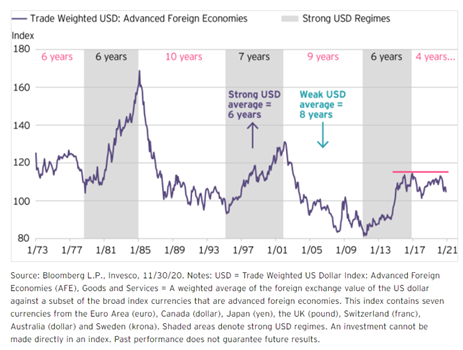
The trade-weighted US dollar Index measures the value of the United States dollar relative to other major world currencies. Since the early 1970s, the relative value of the US dollar has ebbed and flowed between long and well-defined periods of strength and weakness. As illustrated in Figure 1, it seems the “greenback” is only four years into the current weak dollar cycle. On average, such cycles have lasted about eight years, the longest having been roughly 10 years.

Figure 1. It seems the “greenback” is only four years into the current weak dollar cycle
Factors that support a weak US dollar

While past dollar cycles can offer clues about what the future may hold for the currency, history isn’t enough on its own. As such, I assembled a number of other factors that I believe support a weak dollar, including:

  • Valuations suggest that a swath of international currencies are trading at substantial discounts, especially in emerging markets (EM), meaning that they may have more room to strengthen compared to the dollar.
  • The Federal Reserve remains firmly in  monetary easing mode, which means the path of least resistance seems to be downward for the US currency. If quantitative easing (QE) represents a choice between the economy and  the “greenback,” the Fed has opted to save growth and jobs by opening the spigots and inflating the monetary base at the expense of the currency. From a long-term perspective, I think it’s reasonable to expect the US dollar to weaken further should the Fed keep such an abundant supply of currency in circulation.
  • The deep economic impact of the coronavirus pandemic has necessitated counter-cyclical government support to an unprecedented degree. In turn, ballooning twin deficits have become stiff fundamental headwinds for the US dollar. Why? When the US spends more than it earns, it floods the global financial system with US dollars, placing downward pressure on the value of its currency.

My recent chartbook – Seven reasons for a weaker US dollar and stronger international stocks – takes a deeper dive into these factors, as well as other reasons why I believe we may only be halfway through the current weak US dollar cycle.

Investment implications

In a global context, currency dynamics are an important component of investors’ total returns. For example, EM currency strength (the flipside of US dollar weakness) has boosted dollar-based investors’ returns on EM stocks (priced in US dollars).

Why have EM stocks moved in the same direction as their currencies? It’s a virtuous, self-reinforcing “flow” argument. Before foreign capital can flow into EM stocks, foreign currency-denominated assets must be sold in exchange for EM currencies.

Apparently, improving fundamentals versus 2015/16 have made the emerging market economies a more attractive destination for foreign capital, and the Fed’s dovishness is helping the situation.

For investors, this isn’t just an EM story. It’s a bigger message — one that I believe has positive ramifications for international stocks more broadly.

Learning about major players in the markets such as the US and their effect on the global markets as a whole can be useful and keep your holistic view of the markets up to date.

Please continue to check our blogs section for articles like these.

Keep safe and well.

Paul Green
Team No Comments

Pfizer sales boost puts vaccine economics under the spotlight

Please see the below article from AJ Bell received late yesterday afternoon:

AstraZeneca and Johnson & Johnson say they don’t intend to profit from the pandemic.

The price of Covid-19 vaccines have been put under the spotlight after Pfizer said it should generate around $15 billion in sales during 2021 from its Covid-19 vaccine, higher than its previous estimate. Pfizer’s global vaccine sales before the pandemic were around $33 billion.

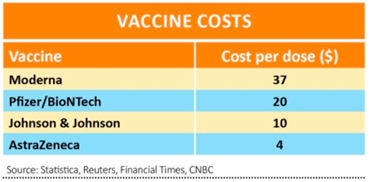
AstraZeneca (AZN) has always maintained that it will supply its vaccine at cost in perpetuity to low and middle-income countries. For other countries, the company has priced its vaccine at under $4 per dose, the cheapest of the three approved mainstream drugs, although South Africa revealed it had paid $5.25 compared with the $2.15 paid by the EU.

Johnson & Johnson’s vaccine has a price tag of $10 a dose which is competitive with AstraZeneca if only one dose is needed.

The Pfizer/BioNTech vaccine is priced at $20 a dose while Moderna’s is the most expensive at around $37 or close to 10 times the cost of AstraZeneca’s.

Rich nations would reap huge economic benefits if they paid the approximate $27 billion costs to vaccinate developing nations against Covid-19, according to a study commissioned by the Chamber of Commerce Research Foundation.

The report concluded that failure to act would cost the global economy $9.2 trillion, half of which would fall on rich nations.

This puts into perspective the spat between the UK and the EU over a shortfall in deliveries of AstraZeneca’s Covid vaccine.

AstraZeneca warned the EU that it could only supply a quarter of the initial 100 million doses in the first three months of the year due to supply chain issues. The EU has ordered 300 million doses with an option for a further 100 million. The EU Medicines Agency approved the AstraZeneca vaccine for emergency use on 29 January.

US biotech firm Moderna caused dismay after it told France and Italy it was delivering 20% fewer doses than promised. Similarly, the UK’s first approved vaccine from Pfizer/BioNTech has suffered delivery delays highlighting the logistical challenges faced by companies in meeting demand.

The good news is that two new vaccines could be available soon after Johnson & Johnson’s vaccine showed 66% effectiveness in phase three trials and Novavax’s vaccine was said to 89% effective according to interim trial data.

The Johnson & Johnson vaccine is potentially game changing because it only requires one dose and can be stored and transported at normal refrigerator temperatures. Novavax said its vaccine performed well against the new, more virulent strains.

Data from the National Audit Office shows the UK has secured 267 million doses of five different vaccines at a cost of $2.9 billion.

Please keep checking back for more updates.

Andrew Lloyd

05/02/2021

Team No Comments

Brooks Macdonald – Daily Investment Bulletin

Please see investment bulletin below from Brooks Macdonald received this afternoon – 04/02/2021

What has happened

After a volatile week where vaccine news varied and retail trades in specific stocks raised concerns of bubbles, global equities had a relatively quiet day. Risk sentiment was helped with growing expectations that former ECB President Draghi would succeed in forming a government and this heralded a significant outperformance from both Italian bonds and the Italian equities index.

Stimulus update

US Treasury yields continued their rally yesterday with the 10-year nudging up to 1.137% as expectations for stimulus increased and therefore expectations for, on the margin, higher inflation and higher interest rates down the line. President Biden told House Democrats that his concern was that the next round of stimulus would risk under-stimulating rather than over-stimulating the economy. This comes as Democrats have opened budget reconciliation measures to put pressure on Senate Republicans to revise their stimulus proposals. Biden’s comments suggest that should the Democrats be forced to the use the reconciliation process, knowing that this is probably their only chance for significant stimulus in 2021, they may increase the size of the stimulus. Despite the relatively quiet market at an index level, these comments helped support cyclical equities, which were previously out of favour due to the mixed COVID narrative, with Energy and Banks performing strongly.

European inflation

Inflation data from the Euro Area surprised to the upside yesterday with headline inflation up 0.9% year on year (vs 0.6% expected) and core inflation up 1.4% (against 0.9% expected). This brings an end to the deflationary period that the Euro area has been experiencing for more than half a year, but this data did support a pro-cyclical tilt to yesterday’s markets. This surprise pick-up in inflation led to the market revising expectations of future inflation levels with the 5y5y (expectations of 5-year average inflation levels in 5 years’ time) up to 1.38%, the highest level since the pandemic begun.

What does Brooks Macdonald think

We would be wary of reading an excessive amount into the inflation data from the Euro Area yesterday. There are some specific factors at play here such as the end of a temporary VAT cut in Germany and equally 0.9% headline inflation is not a particularly exciting number. Looking forward we see COVID as having created a significant output gap due to higher unemployment rates, indeed in some countries stimulus measures have masked the true level of unemployment. Until there is active competition for labour driven by fuller employment, wage inflation will remain subdued and that should calm expectations of a rapid and sustained rise in inflation above the ECB’s target.

Source: Bloomberg as at 04/02/2021

Please continue to check back for our latest updates and blog posts.

Charlotte Ennis

04/02/2021

Team No Comments

Daily Investment Bulletin

Please see below Daily Investment Bulletin received from Brooks Macdonald earlier this afternoon. The commentary provides analysis of the markets following a promising start to the mass-vaccination rollout in the UK.

What has happened

Equities continued their positive start to the week as critical earnings beats justified another leg higher in valuations. Alphabet (Google) and Amazon both beat market expectations with the latter rising in after-market trading despite CEO Jeff Bezos announcing that he will step down to become executive chairman. Even Exxon, which had its first annual loss in 40 years, saw its shares rise as it recommitted to its dividend pay-out in a yield hungry world.

Italian twist

The market’s base case was that former Italian Prime Minister Conte would be able to form a new Italian government by utilising a range of independents and a myriad of smaller parties. In fact, the former ECB President Mario Draghi is reportedly in line for the role and is meeting President Mattarella to discuss the formation of a new government. Betting odds have also shifted with Draghi now the front runner. Draghi’s tenure at the ECB is most famous for embarking the ECB on its quantitative easing programme as he pledged to do ‘whatever it takes’ to save the Euro during the European sovereign debt crisis. As a result, markets have taken this news quite positively as it suggests a maintenance of the political status quo between Italy and the EU, a perpetual tail risk for European politics.

Vaccine news

There were two big unknowns around the vaccine rollouts, would the vaccine be effective after one dose and would the vaccine slow transmission rates. A study yesterday showed positive news on both of these points. The study showed that the Oxford/AstraZeneca vaccine had 76% efficacy after a single dose (day 22-90 after vaccination) and that the level of protection was fairly constant. This builds the narrative for a quicker reopening of national economies even as the rollout is still continuing. Secondly, test results showed a 67% reduction in positive COVID-19 PCR tests amongst those vaccinated addressing a key concern that the vaccination might not slow the speed of transmission.

What does Brooks Macdonald think

Yesterday’s report on the ongoing efficacy of the AstraZeneca vaccine provides some comfort to markets that are struggling to effectively price in the risks of the new variants. We expect this tug of war to continue however if the variants are emerging within the context of higher vaccination levels (the vaccine still being effective against the South African variant of the virus, but less so) and continued COVID restrictions, the probabilities of a more normal state by the summer rise.

Source: Bloomberg as at 03/02/2021

Please check in again with us soon for further market analysis and news.

Stay safe.

Chloe

03/02/2021

Team No Comments

Brewin Dolphin Markets in a Minute

Please see this weeks Markets in a Minute update from Brewin Dolphin:

Trading frenzy sees US equities post worst week since October.

Global equities posted sharp declines last week, as heightened volatility added to fears about the efficacy of the vaccine roll out. The S&P 500 recorded its worst week since October, falling 3.74%. The trading frenzy in GameStop and other targeted stocks led to the VIX, or ‘fear gauge’, ending the week at 32.4, well above its historical average. This fed through to Europe, where the VSTOXX, another measure of volatility, climbed to its highest level in almost three months. The FTSE 100 slid 4.3%, while the Dax declined by 3.79%. Investor jitters also affected stock markets in Asia, with the Nikkei down 4.63% and the Hang Seng down 4.39%. In China, where there are growing fears of a stock market bubble, the Shanghai Composite slipped 3.61%.

Last week’s markets performance*

  • FTSE100: -4.30%
  • S&P500: -3.74%
  • Dow: -3.70%
  • Nasdaq: -3.91%
  • Dax: -3.79%
  • Hang Seng: -4.39%
  • Shanghai Composite: -3.61%
  • Nikkei: -4.63%

*Data from close on Friday 22 January to close of business on Friday 29 January.

Markets rebound from last week’s rout

US equities rounded on Monday, posting their biggest rally in ten weeks, after analysts said the explosion of speculative buying would not cause a significant setback for markets. Tech stocks performed particularly strongly ahead of Tuesday’s earnings figures from Amazon and Alphabet. The S&P 500 climbed 1.6% and the Nasdaq jumped 2.6%.

Wall Street’s strong open led to the FTSE 100 closing up 0.9% on Monday, with JD Sports Fashion rising 7% to 799p on news it has agreed to buy American rival DTLR Villa. Retail investors turned their attention to silver, which hit $30 for the first time since 2013. The pan-European STOXX 600 increased 1.2%, with shares of miners surging by between 5% and 20% on the back of silver’s rise.

The FTSE 100 was up 0.6% in early trading on Tuesday, on growing hopes the US will agree an economic stimulus package. Virgin Money was one of the strongest gainers, rising 2.7% after announcing it had returned to profit in the first quarter.

Short squeezes dominate the headlines

In ordinary circumstances, last week would have been dominated by the raft of quarterly financial results from major S&P 500 stocks. Instead, the bulk of investor and media attention was on extreme fluctuations in the prices of small retail stocks. GameStop posted a weekly gain of 400%, resulting in major losses on short positions.

Trading in heavily shorted names resulted in historic trading volumes, with more than 23.6 billion shares of US stocks exchanged on Wednesday, according to Bloomberg. The Goldman Sachs Hedge Industry VIP index, which seeks to replicate the favoured long positions of hedge funds, suggests hedge funds have had to trim their longs to cover losses or deleveraging on their short books.

After Robinhood and other brokers restricted trading on Thursday, the US Securities and Exchange Commission announced it would review the restrictions and that it was “closely monitoring and evaluating the extreme price volatility”.

The trading frenzy overshadowed the generally good start to the US earnings season. We are about a third of the way through the season and, so far, 80% of companies have beaten expectations. Microsoft, Apple and Facebook all released strong quarterly results, yet Apple and Facebook declined by around 5% last week, while Microsoft edged up 2.4%.

Economic data continues to disappoint

Last week saw grim economic data from several countries around the world. Although the US economy experienced a strong rebound in the second half, this wasn’t enough to prevent it shrinking in 2020 for the first time since the financial crisis. Growth is expected to pick up once the pandemic is under control, but there is still a long way to go. Consumer spending slowed to 2.5% in the fourth quarter, down from a 41% rebound in the third quarter. Overall spending on goods also slowed.

Across the pond, UK retail sales for December were lower than expected, rising by just 0.3% versus a 1.2% forecast. In 2020 as a whole, retail sales plunged by 1.9%, marking the worst year for consumer spending on record. The strong pound also weighed on the FTSE 100, which derives around 70% of its earnings from overseas. Pearson was one of the few bright spots, rising by 13.7% last week.

Continuing lockdowns resulted in the German government cutting its 2021 GDP growth forecast from 4.4% to 3%, despite the economy expanding by 0.1% in the fourth quarter. France’s economy shrank by 1.3% in the fourth quarter, but this was better than expectations of a 4.1% contraction.

Vaccine roll out in jeopardy

Concerns about the economic impact of the pandemic and slow vaccine roll out continued to weigh on major European stock markets last week. The EU’s vaccination strategy is in disarray and many countries have had to suspend vaccinations because of shortfalls. Rolling out the vaccine is seen as a critical part of global economic recovery.

The World Bank has warned of double-dip recessions in Japan, the eurozone and the UK, partly because of ongoing lockdown measures. In Japan, three quarters of companies across 32 industries have trimmed their capital expenditure plans by an average of 2.9%, and manufacturers have reduced their forecasts by 3.8%.

Data released yesterday also signalled a slowdown in China’s economic recovery, with the Caixin manufacturing PMI falling from 53 to 51.5 in January, the lowest level since July. The official manufacturing and non-manufacturing PMIs also fell by more than expected. This came after a week in which a senior adviser to China’s central bank warned of the increasing risk of an asset bubble unless monetary policy was not tightened.

More positively, the International Monetary Fund has upped its global economic growth forecast by 0.3 percentage points to 5.5%, although it warned emerging markets’ limited access to vaccines could harm global financial stability.

As market volatility continues, please keep checking back for further market commentary and updates shared by us to help keep you informed.

Andrew Lloyd

03/02/2021

Team No Comments

Brooks MacDonald Weekly Market Commentary | Vaccine distribution continues to be key focus for investors

Please see below for the latest Brooks MacDonald Weekly Investment Bulletin received by us yesterday 01/02/2021:

Vaccine nationalism raises its head as competing contracts and supply issues collide

A bout of risk off sentiment hit equities, bringing most European and US indices slightly negative for the first month of 2021. The risk of a vaccine trade war, less positive data from Johnson & Johnson’s vaccine and the risk of further COVID-19 restrictions all dampened the mood. Friday saw a bubbling over of increasingly hostile words between the EU and AstraZeneca. In short, the EU imposed the right to ban vaccine exports outside of the EU (and select countries) and effectively imposed a hard border between Northern Ireland and the Republic of Ireland. This proved only temporary, with the hard border reversed and the prospect of export bans to the UK played down as Friday and the weekend progressed. So called ‘vaccine nationalism’ has been a threat for several months as issues over regional supply chains combine with the sequencing of competing contracts and an increasingly frustrated populace. On Sunday, the UK announced that it had provided almost 600,000 vaccinations in one day (over 1% of adults), which may suggest that as supply increases, countries will be able to work quickly to inoculate their populations.

Markets look ahead to Friday’s US employment data after last month’s disappointment

This Friday sees the important non-farm payroll US employment figures released. Last month saw a decline of 140,000 jobs1 , the first decline since the first wave of the pandemic. This month economists are expecting a 50,000 increase and therefore for the headline 6.7% unemployment rate to remain stable2 . US economic data has shown resilience in the face of the current COVID-19 wave but there is still a large amount of spare capacity in the labour market, something that may curb any bubbling inflationary pressures. With employment a major item on President Biden’s agenda, it seems likely that the US Stimulus Package will move through Congress under the Budget Reconciliation rules. The downside of using this process is that there is a limit on the scope of the legislation and a limit on the number of times the process can be used.

US stimulus may progress using the budget reconciliation process but this has limits

The prospect of using the budget reconciliation process has dampened expectations of a bipartisan agreement that could leave the door open for further stimulus over the coming months. The reconciliation process means that the bill can pass with a simple majority in the Senate rather than being held up by the filibuster. The reconciliation process has historically only been used once per calendar year due to its inbuilt limitations, so there will be additional scrutiny on the proposed package if it is expected to be the only US stimulus in 2021.

Weekly investment bulletins like these are a good way to get regular input from market experts. 

The mass rollout of the vaccine is set to cause gradual change to the market outlook, hopefully life and economies will improve.

Please keep up to date with our blogs.

Keep safe and well.

Paul Green 02/02/2021

Team No Comments

Blackfinch – Monday Market Update

Please see below this week’s Monday Market Update from Blackfinch Investments – received today 01/02/2021


Blackfinch Group – Monday Market Update – Issue 27 | 1st February, 2021

UK COMMENTARY

• The International Monetary Fund (IMF) downgraded its forecasts for the UK economy for 2021, revising its previous prediction of 5.9% to 4.5%. This follows the contraction of 10% in 2020, the biggest fall of any G7 economy.
• According to the Office for National Statistics (ONS), the unemployment rate in the three months to November 2020 was estimated at 5.0%, 1.2 percentage points higher than one year ago and 0.6 higher than the previous quarter. Over the same period, the redundancy rate hit a record high of 14.2 per thousand.
• The Prime Minister said there is “not enough data to know when it will be safe to reopen our society and economy”. MPs will set out a plan to exit lockdown when they return from the half-term break on 22nd February, based on the number of infections and vaccinations. As a result, children in England are not expected to return to the classroom until 8th March.
• Footfall at UK retail locations recovered, up 9% on the previous week. Data revealed that footfall over the whole of 2020 was down 39.1% on 2019.
• The UK Government introduced its ‘red list’ for mandatory hotel quarantine, which will mostly affect UK citizens and residents, since nationals from most high-risk countries are not allowed to enter Britain. It will apply to inbound travellers from 22 countries including South Africa, several countries in South America and also Portugal, because of its ties with Brazil.

US COMMENTARY

• Market commentators relished a widely publicised battle between multi-billion-dollar hedge funds and a group of retail traders from a Reddit chat room. The latter have been pumping the price of GameStop (and others), which some hedge funds had heavily shorted. The result was a ‘short squeeze’ resulting in extraordinary moves in share prices.
• US lawmakers continue to debate the $1.9 trillion stimulus plan put forward by President Biden.
• The declining trend rate of COVID-19 cases remains steady, with cases falling by about 22% per week. The seven-day average has fallen 32% from its 8th January peak, and is now below its pre-Thanksgiving level.
• GDP data showed the US economy grew 4% in the fourth quarter, but shrank 3.5% for the whole of 2020, its worst annual performance since 1946.

EUROPE COMMENTARY

• The European Union (EU) warned it will tighten exports of COVID-19 vaccines to non-member countries, such as the UK. The warning came after AstraZeneca, which was due to provide 80 million vaccine doses to EU member countries in the first quarter of 2021, announced it would only be able to deliver around half of the agreed quantities. The row comes amid a fall in supplies of the Pfizer/BioNTech vaccine, which is also slowing down the European rollout.
• France and Germany announced their fourth quarter GDP flash readings. The French estimate showed a contraction of 1.3% on a quarterly basis, but economists were expecting a decline of 4.0%, a drop from the 18.5% growth registered in the third quarter of 2020. Over the same period, the German economy expanded 0.1%, just topping the 0.0% consensus estimate. This was also a fall from the 8.5% growth posted in the third quarter.

GLOBAL COMMENTARY

• The IMF revised its 2021 global growth forecast to 5.5%, up from its 5.2% prediction in October, but cautioned that new variants of the virus are a concern for 2021’s outlook.

COVID-19 COMMENTARY

• Johnson & Johnson announced its vaccine candidate was 66% effective in preventing moderate to severe COVID-19, 28 days after vaccination. Although it falls short of its competitors in terms of efficacy, the Johnson & Johnson vaccine only needs to be administered with one shot, making its rollout easier.
• The row between AstraZeneca and the EU over COVID-19 vaccines culminated in approval on Friday afternoon as the European Medicines Agency recommended granting conditional marketing authorisation for use in adults aged 18 or over. It is the third COVID-19 jab approved in the bloc.

A good input from Blackfinch, providing a summary of global events over the past week. These updates are useful for keeping up to speed with developments in the markets.

Please continue to check back for our latest blog posts and updates.

Charlotte Ennis

01/02/2021

Team No Comments

A.J. Bell – US stocks as expensive as before the 1929 and dot-com crashes

Please see below an article published by A.J. Bell on Thursday, 28th January and received Sunday morning which provides an overview of the U.S. Stock Market:

As you can see from the above, U.S. equities remain expensive and there are arguments for both holding and not holding U.S. Equities. There could still be some upside to be captured in this market, but it is worth reminding you of the importance of holding a diversified portfolio, which is invested in multiple sectors and geographies so that all your eggs are not in one basket.

Please continue to check our Blog content for advice and planning issues and the latest investment, markets and economic updates from leading investment houses.

Please keep safe and healthy.

Carl Mitchell – Dip PFS

IFA and Paraplanner

01/02/2021

Team No Comments

Normality might come slowly, but sustainability is here to stay

Please see below articles received yesterday afternoon, written by the Head of Sustainable Investing at Jupiter and Head of Strategy at UK Alpha. The first commentary offers tips on investment opportunities for the year ahead and the second provides an update on the UK’s economic recovery.

Abbie Llewellyn-Waters, Head of Sustainable Investing, noted that in recent months the largest impact on sustainable investing, including her own strategy, was the value rotation. Abbie believes that the most attractive sustainability investment opportunities are to be found in high quality stocks. Reporting season is starting soon, and that will provide more context about how these quality stocks are navigating this environment.

From a broader perspective, Abbie doesn’t share the optimism in the market based on an economic reopening, which has been in full swing since the first vaccine announcements in November last year. She’s concerned that a normalisation is further away than the market is currently pricing in. In recent discussions with a world-leading company in the field of viral vaccines, they pointed to more prolonged timeframes, with normalisation closer to years rather than months away.

As such, Abbie believes it is important for investors to be disciplined and focused on businesses that can survive and prosper through this period and into the longer term, especially in defensive sectors such as healthcare and consumer goods. Among the more cyclical parts of the market, Abbie continues to see strong sustainable investing opportunities within the digitalisation theme.

Fundamentally, however, Abbie sees sustainable investing as a structural theme and many of the drivers that emerged in 2020 (including addressing climate change, where Biden’s appointment of John Kerry as special climate envoy shouldn’t be underestimated, in her view) will continue throughout 2021 and beyond.

Market whipsaws as recovery optimism weakens

At the start of the year, the market trusted in the post-vaccine recovery trade and expected that by the summer the economy would be getting back to normal, noted Richard Buxton, Head of Strategy, UK Alpha. That view has been undermined by a complicated pandemic with new virus variants and data suggesting some people are reluctant to be vaccinated, he said.

Now the market is whipsawing daily, he said. He cited a company that operates concessions in airports and train stations that said two weeks ago it was expecting a strong summer of trading as consumers rush back to travel after the lockdown. That outlook now seems overly optimistic, he said, noting that testing requirements would complicate a family of four’s holiday to Spain, for example.

Richard said he is following closely the debate about reopening UK schools. The government will be forced to make a political judgement about when to ease the lockdown and let students return to the classroom in order to end potential long-term damage to young people, especially those in disadvantaged areas, whose education has been disrupted, he said.

While a return to normal will take longer, it makes sense on a 2-year view to invest in companies that will benefit from the economy reopening, Richard said. In the meantime, his investment team is looking at adding to defensive holdings, such as including pharmaceutical companies, he said.

The recovery will happen, but like in comedy, it’s all about the timing, Richard said.

It will be interesting to see where opportunity presents itself as we make positive strides to achieve mass vaccination in the UK and worldwide.

Stay safe.

Chloe

29/01/2021

Team No Comments

Market Update: Economic headwinds pressure the US, UK and Europe

Please see the below market update from Invesco received late yesterday afternoon:

Overview

Europe: Europe is clearly at risk of a double-dip recession, albeit a modest one.

The UK: The UK appears to be at even greater risk than the eurozone of a double-dip recession in the current quarter.

The US: US markets seem to have focused recently on the potential for additional fiscal stimulus.

What a week — both the S&P 500 and NASDAQ Composite Indexes reached all-time highs last Thursday, but we also saw a reversal of the rotation from growth/defensives to cyclicals in both European and US markets. Markets are clearly reacting to the problems that many economies are facing as COVID-19 continues to impact growth. Recent data shows evidence of these problems.

Europe may face a modest recession

Europe is clearly at risk of a double-dip recession, albeit a modest one. The IHS Markit Flash Eurozone Composite PMI (Purchasing Managers Index) clocked in at 47.5, down from December’s 49.1.1 And it’s not just services that drug down that number; there was also a decline in manufacturing PMI, which actually fell to a seven-month low. And the weakness was spread throughout Europe.

This should come as no surprise. The Oxford Blavatnik Stringency Index, which tracks the level of economic lockdowns in various countries, indicates that stringency in many European countries is at or near the highest levels that have been experienced since the start of the pandemic. In other words, first-quarter economic activity could contract again, although if it does, I would expect this to be a very shallow contraction. More fiscal support is coming, and I expect the European Central Bank to remain supportive.

And so Europe just needs to get through this “fifth quarter of 2020,” and then I expect the situation to improve. I think that by later in the second quarter we will see improvement in economic activity as vaccine distribution becomes widespread.

The UK get more bad news

The UK is in a worse situation, at an even greater risk than the eurozone of a double-dip recession in the current quarter. The preliminary reading of the IHS Markit/CIPS UK Composite PMI fell like a lead balloon, dropping from 50.4 in December to 40.6 in January.1 Chris Williamson, chief economist at IHS Markit, explained the drop in the composite: “Services have once again been especially hard hit, but manufacturing has seen growth almost stall, blamed on a cocktail of COVID-19 and Brexit, which has led to increasingly widespread supply delays, rising costs and falling exports.”

What’s more, on Friday UK Prime Minister Boris Johnson shared more bad news: 1) the UK strain of the virus is not only more contagious but appears to be more deadly; 2) lockdowns might last until this summer. And so we should not expect economic strength in the near term, although I maintain that the economy is very likely to rebound substantially as vaccines are distributed.

Japan suffering too

Flash PMI readings for January indicate Japan is facing some headwinds too. Also last week the Bank of Japan warned of increasing risks to the economic outlook for Japan, and that efforts to control the virus could have impact beyond just the services sector. And while COVID-19 has been well-controlled in Japan relative to many Western countries, Japan has not yet rolled out any vaccines. They are still in clinical trials, but rollout is expected to start by late February

The US awaits the fate of fiscal stimulus

The US is also facing serious economic headwinds due to COVID. US markets seem to have focused recently on the potential for additional fiscal stimulus. Janet Yellen, President Joe Biden’s nominee to be US Treasury Secretary, made a strong case for more fiscal stimulus last week. She recognized concerns about growing debt levels, but also argued that there’s no time like the present to borrow since rates are so low. However, by the end of the week there was concern that President Biden would not have enough support to get his proposed $1.9 trillion package passed.

On days when markets are encouraged by the likelihood of more stimulus and a stronger rebound, cyclical stocks have outperformed. But when markets are worried that no more stimulus is forthcoming, or when economic data disappoints, secular growth stocks — especially tech — have outperformed.

Key takeaways

I expect this “seesaw” stock market behavior to continue in the near term. While I still believe a strong economic rebound is in the offing later in 2021, there are likely to be glitches before we get there, as I have warned before. The tech sector has recently exhibited defensive qualities that I expect to continue and which I believe could be valuable in the next few months as we slog through what is likely to be a difficult time for the economy. Low interest rates help this situation given that tech valuations are admittedly stretched; investors have historically been more forgiving of valuations with rates so low.

The other side of the seesaw is exposure to cyclicals. I am most excited about one sector in particular: consumer discretionary. I think the global economic recovery will be robust and inclusive, creating and restoring jobs — and spurring consumers to spend. And in many countries, consumers have built up impressive savings because of a lack of spending during the pandemic. This could be deployed rather quickly once vaccines are distributed broadly and there is a return to something akin to “normalcy.”

I expect that, in a world awash in monetary stimulus, with significant fiscal stimulus as well, there will continue to be an upward bias for stocks. That doesn’t mean we won’t see a stock sell-off in 2021. It could be triggered by the 10-year US Treasury yield rising (we could see a sell-off if it rises too quickly) or fears about inflation increasing — even though I expect the Federal Reserve to reiterate this week its commitment to remain very accommodative and tolerant of a spike in inflation over its target. There could be other triggers — a continued rise in infections, especially more serious strains, or a slowdown in vaccine rollouts. We don’t know when this could occur — and while I believe it would be short-lived, I also believe it’s very important to be broadly diversified both across and within stocks, bonds and alternatives.

While broad diversification is critical, investors could consider overweighting both the technology and consumer discretionary sectors within their equity sleeve. Both could serve different purposes in a portfolio — one offering some defensive qualities while the other offering the potential to participate in the recovery.

Please keep checking back for more market updates, investment commentary and a range of different blog content from us.

Andrew Lloyd

28/01/2021