Team No Comments

Invesco Investment Intelligence Update

Please see below this weeks Invesco Investment Intelligence update – received this morning  – 22/02/2021

Monday 22 February 2021 – update

The diverging impact of virus containment measures on individual economies and the differing levels of fiscal stimulus was plain to see in US and UK January Retail Sales last week. The former exceeded expectations materially, growing 5.3%mom (see chart of the week), while the latter fell -8.2%mom, far worse than expected. With the vaccination rollout proceeding at a faster path in the UK (nearly 25% of the population have received a first shot compared to 12% in the US) and new cases, hospitalisations and deaths all declining sharply, the worst of the impact of the current lockdown may well be behind us, driving an easing of lockdown restrictions and some form of return to normality. Certainly, February’s Flash PMIs provided a more encouraging picture with the Composite rising from 42.6 to 49.8 on the back of a strong recovery in the dominant Services sector, hardest hit by recent lockdowns. Unfortunately, progress has been not as fast in other DMs, particularly Continental Europe (the weakening of the EZ’s Flash Services PMI reflected that) and prospects for EM look even less promising with vaccinations rates at just 0.1% across Africa and nearly 130 countries have yet to administer a single dose.


Money continues to flow into equity markets, but rising bond yields last week put a halt to progress in DM (-0.5%), which weighed on overall global returns (MSCI ACWI -0.4%). EM held up better and managed to eke out a small gain (0.1%). Weakness in DM was led by the US (-0.7%). YTD, EM (11.2%) have delivered more than double the return of DM (4.7%) and the region remains comfortably the most preferred market in the latest BofAML Global Fund Manager Survey. Small caps also declined (-0.5%), but here also performance diverged between DM (-0.7%) and EM (1.5%). They are up just under 10% YTD. At the sector level, commodity sectors made gains on rising oil and metals prices, with Energy (2.7%) ahead of Materials (1.3%), while Financials (1.8%) benefitted from rising bond yields and steeper yield curves. The reverse was true for defensive long duration sectors, such as HealthCare (-2.2%) and Consumer Staples (-1.2%), while IT (-1.2%) and Utilities (-1.8%) also underperformed. Against this backdrop Value (0.5%) was comfortably ahead of Growth (-1.2%), while Momentum (-1.8%) gave back some of its strong YTD outperformance. Despite a strengthening £, outperformance of the commodity and Financials sectors ensured that the UK outperformed (All Share 0.5%) on the back of a good relative week for large caps (FTSE 100 0.7%).


Upward momentum in government bond markets continued last week. The largest moves have been in the UST and Gilt markets, where the 10yr rose 15bp and 13bp respectively to their highest levels since last February (1.35% and 0.70% respectively). Yields are up 43bp and 50bp from their start of year levels and 85bp and 62bp from last year’s all-time lows. 10yr Bunds pushed higher too and after a 7bp rise to -0.31% are now up 26bp YTD and 53bp from their all-time lows. Even Italian BTPs, the star performer in recent weeks, saw yields rise 9bp. Unsurprisingly returns were negative with the Gilt index hit hardest due to its longer duration (12.4 years). IG suffered against a backdrop of higher government yields with weakness across the board, again led by longer duration £ markets (8.5 years). Globally spreads narrowed 3bp, but yields rose 6bp. HY continued to outperform in credit, as spreads narrowed 8bp and the YTM fell 2bp to an all-time low 4.6% (Yield to Worst is 4.05%).

The US$ was broadly flat on the week with the US$ Index down just 0.1%, leaving it up 0.5% YTD. Vaccination progress helped £ to its best week versus the US$ since mid-December, breaking through the $1.40 level for the first time since Q2 2018. It also gained against the Euro, moving above the €1.15 level for the first time since last March. Economically sensitive commodities continued to make gains. The Texas storm’s impact on US production helped push oil to new post-pandemic highs and it is now up 23% YTD. Copper, up 7.1% for the week, extended its surge to a new nine-year high amid warnings of a historic shortage as the global economy starts to recover. After its best year for a decade last year, Gold is off to its worst start in 30 years, falling further last week (-2.3%) and down just under 6% YTD. Rising UST yields aren’t helping as investors take profits and rotate into economically sensitive commodities. Even rising inflation expectations aren’t helping the metal.

Market performance last week (%)

Past performance is not a guide to future returns. Sources: Datastream as at 21 February 2021. See important information for details of the indices used.1

YTD market performance (%)

Past performance is not a guide to future returns. Sources: Datastream as at 21 February 2021. See important information for details of the indices used.1

Chart of the week: US Retail Sales (mom%)

Past performance is not a guide to future returns. Source: Datastream as at 18 February 2021.

• The direct impact of fiscal stimulus on the US economy was clearly highlighted in last week’s surge in Retail Sales for January. The headline number rose 5.3%mom – the first monthly gain since September, the largest rise in seven months and beating consensus expectations of a 1.1%mom rise by a considerable margin. Only last May have expectations been beaten to such a degree. This leaves them 5.8% higher than a year ago (and remember that was compared to a pre-pandemic economy) and a far faster recovery than in previous cycles.


• What drove the strong rise in sales? There was a seasonal boost following weaker than normal holiday spending in December, while the easing of virus restrictions clearly played a role too. However, the general consensus is that the renewed income support from the $900bn end of year fiscal package has been the dominant factor as the income dispersion of the spending was mainly driven by lower-income groups, the main beneficiaries of that package and historically where the propensity to spend any stimulus is the greatest. In that package most Americans received payments of $600 (up to $75k income and then tapered to no payment at $99k) with eligible families also receiving $600 per dependent child. These payments were made in early January. Monthly unemployment payments were also boosted by $300 per week for 11 weeks.

• And this is not the end of support for US households and consumption. Biden’s $1.9trn “American Rescue Plan”, currently going through Congress, is likely to see further payments to individuals of up to $1400 and $400 per week in additional unemployment payments. On current expectations these are likely to be paid out from mid-March. And on top of that, with “excess” savings as a consequence of the pandemic estimated by Goldman Sachs to hit $2.4trn by the middle of the year, there should be a further boost to spending from this source as the economy returns to some sort of normalcy. Even if Goldman’s estimate that under 20% of that will be spent, partly down to a large proportion of those “excess” savings being held by higher income groups, who are far less likely to spend it, that would still be enough to contribute roughly 2% to GDP growth, although Goldman’s attach a high degree of uncertainty to this number.

• It’s perhaps no wonder that consensus expectations for consumer spending are higher in the US (5.2%) in 2021 compared to both the EZ (3.9%) and UK (4.3%), which in turn should underpin a stronger recovery in Real GDP.

Key economic data in the week ahead

• Not a lot on the data front this week, so focus may well be elsewhere: on progress of the upcoming US stimulus package, Powell’s testimony to the US Congress and developments on the virus front, where the PM will be announcing his roadmap for easing restrictions in England and the EU Council meets at the end of the week.

• In the US on Tuesday the Conference Board Consumer Confidence index for February is forecast marginally higher at 90 from 89.3, but remains close to post-pandemic lows and a long way below the 133-level seen last February. Last week’s Initial Jobless Claims were higher than expected at 861k, a sixth consecutive week of more than 800k despite a drop in coronavirus cases. Thursday’s reading is expected at 840k, a modest improvement. Friday’s Personal Income data for January is estimated to have had a strong boost from additional stimulus payments. Incomes are estimated to have increased 10%mom. Friday also sees PCE Inflation data released with the closely watched Core reading expected to show a 0.1%mom increase, leaving it at 1.4%yoy.

• In the UK the Unemployment rate is forecast to have increased to 5.1% at the end of December when data is released on Tuesday, up from 5% in November. This would be the highest level of unemployment since October 2015.

• In the EZ, Germany’s Ifo Business Confidence for February is released on Thursday. After last week’s Flash Composite PMI showed a marginal improvement, a similar outturn is expected with a rise to 90.5 from 90.1, led by future expectations rather than current conditions.

• In Japan Industrial Production and Retail Sales for January are published on Thursday. The former is forecast to show a rebound to 3.9%mom, leaving it down -5.4%yoy, while the latter is expected to see a -1.3%mom decline, leaving it down -2.6%yoy. The expansion of the state of emergency beyond Tokyo the main culprit there.

• In China the Loan Prime Rate, the reference point against which banks price loans, is set on Monday. It was last changed in April 2020 and is expected to remain unchanged at 3.85% and 4.65% for the 1-year and 5-year rate respectively.

Please continue to check back for our latest updates and blog posts.

Charlotte Ennis

22/02/2021
Team No Comments

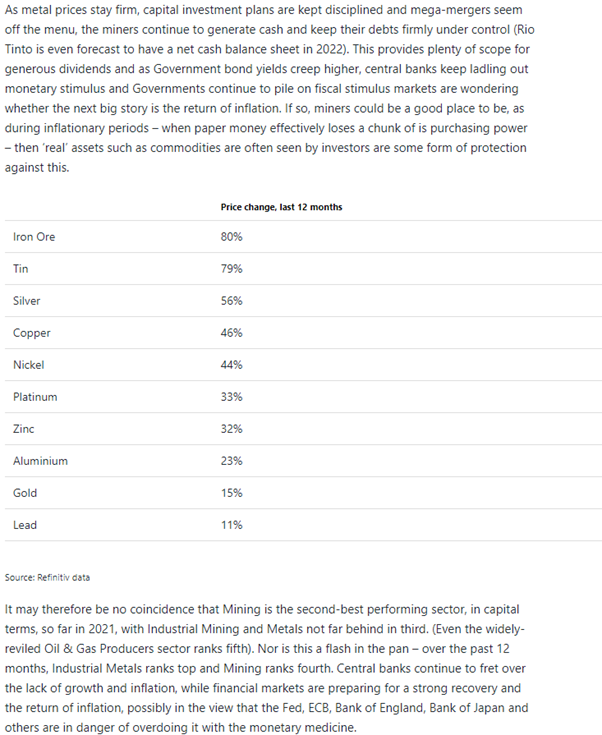
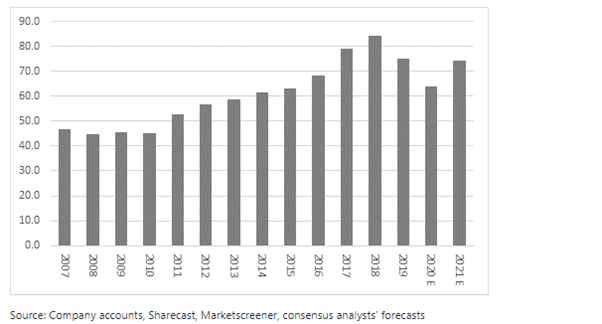
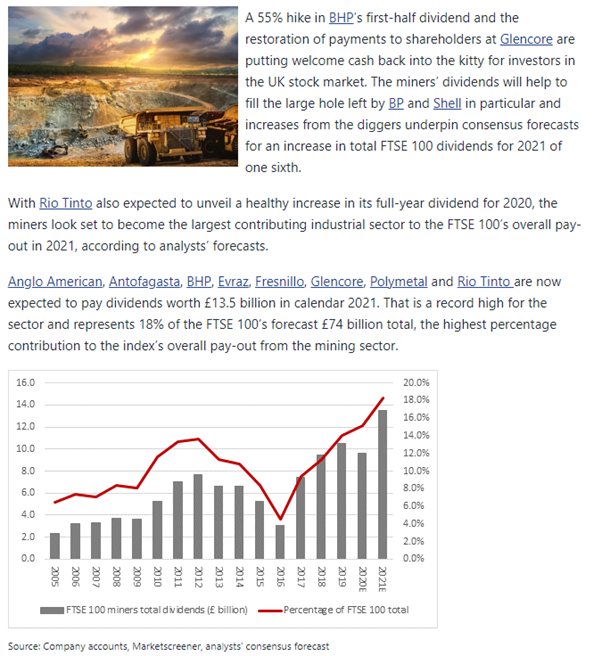
A.J. Bell – Can the miners dig the FTSE 100 out of its dividend hole?

Please see below an article published by A.J. Bell last Tuesday (16/02) and received yesterday afternoon, which details the role Miners could play in plugging some of the dividend gap:

Please continue to check our Blog content for advice and planning issues and the latest investment, markets and economic updates from leading investment houses.

Please keep safe and healthy.

Carl Mitchell – Dip PFS

IFA and Paraplanner

22/02/2021

Team No Comments

1 year since the market crash: What’s changed and are there any bargain stocks left?

Please see below article received from AJ Bell yesterday afternoon, which explains how the events of the past 12 months have had major implications for consumers and companies, and how we now move forward.

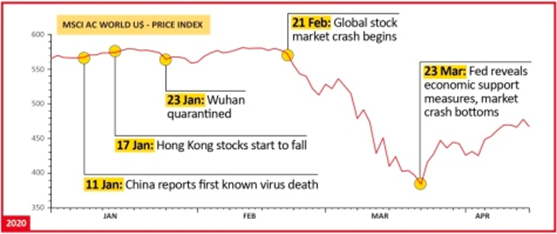
Despite all the upheaval of the past year, anyone glancing at the financial markets today might find it hard to believe investors were in the throes of despair 12 months ago.

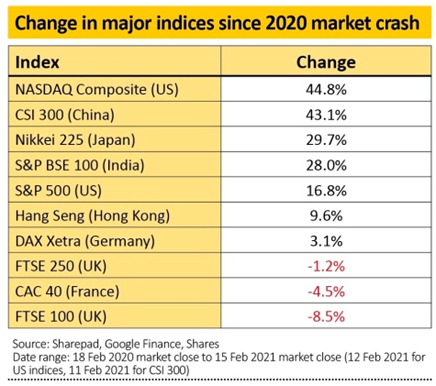
Following the global markets crash in February 2020, the recovery has been spectacular. The US Nasdaq 100 and S&P 500 indices are at all-time highs, Japan’s Nikkei index is at a multi-decade high, China’s Shanghai index is at a multi-year high and the MSCI All Countries World Index is at a record high.

In the UK the FTSE 100 and FTSE 250 are still in negative territory since February 2020 although the losses aren’t nearly as extreme as they were when the pandemic first took hold.

Markets have been fuelled by support from central bank and government stimulus measures, low interest rates and optimism over the pace of economic recovery thanks to the creation of Covid vaccines.

Risk appetite is alive and well as shown by the surge in crypto currencies, the volume of investment grade bonds now trading with negative yields (bond yields fall when prices rise), herd behaviour on social networks regarding stocks, the deluge of cash shells to acquire businesses, the warm reception for new stock market listings and the race by private equity firms to deploy their mountains of cash through acquisitions.

Later in this article we look for cheap stocks that have still to play catch-up.

First, we explore what’s changed in terms of how companies do business and how we manage our money.

STRUCTURAL CHANGES

It almost seems as though nothing has changed; in fact, everything has changed. Much of what might be called ‘new’ isn’t new at all – many of the biggest trends to emerge in 2020 had been waiting in the wings for several years, the pandemic just brought them centre stage much earlier than expected.

The greatest change has been the shift to remote working (see When will we return to the office – if at all?), which had always existed on the fringe but had never been considered viable on a large scale. The surprise for many business owners was how off-the-shelf technology enabled them to quickly move to remote working without a hitch.

Moreover, remote working has brought benefits to many firms including cost savings, and it has improved the work/life balance for their employees. The flip side is that it is bad news for owners of city centre offices, transport companies and anyone who relies on either – or worse, both.

Companies with large central offices are mostly looking to downsize while those which were planning to expand have realised they can increase their staff numbers while staying in the same office and rotating their teams.

Those with several smaller regional offices may look to do away with them altogether and concentrate on making the working from home experience more fulfilling for their staff.

Bus and rail firms, which will have budgeted for a given level of revenue before the pandemic, now have to go back to the drawing board and rethink their plans, not least for capital spending, given they are likely to see far fewer passengers using their services in the future.

PERSONAL FINANCIAL HABITS HAVE CHANGED

The pandemic has brought behavioural changes, too. Ian Mattioli, co-founder and chief executive of wealth manager Mattioli Woods (MTW:AIM), says his firm has found that many people who, prior to last year, thought nothing of spending their disposable income on two or three holidays a year, are now saving the bulk of their surplus wages to give themselves a buffer in case they lose their jobs.

Recent announcements by holiday companies such as TUI (TUI) confirm that holidaymakers are being more selective. The ‘return to normal’ has failed to happen so far, with TUI reporting a 44% reduction in summer bookings compared with pre-pandemic (2019) levels, well short of its earlier expectation for a 20% drop.

WHEN WILL WE RETURN TO THE OFFICE (IF AT ALL)?

The latest AlphaWise survey from investment bank Morgan Stanley makes sobering reading for those hoping for a reopening of the economy by Easter.

According to the bank’s monthly telephone survey of 12,500 European office workers, despite the rollout of vaccines since its previous survey, employees’ expectations of when they can return to work have slipped from April to June.

As the survey says, ‘Clearly, this will not only impact office utilisation in 2021, but also leisure and retail property that depends upon the return to normal commuting patterns.’

Across Europe, 73% of office workers have been working remotely compared with half that proportion pre-Covid. Of these, 80% would like to work from home more in the future, with 51% happy to work out of the office one or two days a week, 29% three to four days a week and 14% every day of the week.

Chris Herd, founder and chief executive of remote infrastructure firm Firstbase, says remote work is ‘the biggest workplace revolution in history, and nothing will deliver a higher quality of life increase in the next decade than this’.

Herd believes new companies will be ‘remote first’, without the need for a corporate headquarters. Aside from the obvious cost savings, this allows them to hire the best people wherever they are in the world, not just within a certain radius. At the same time, companies which want to retain their staff will have to offer remote working as an option or risk losing them.

We are also becoming more discerning when it comes to shopping online for fashion. Gone it seems is the habit of picking six dresses for an event and sending five back, with retailers such as ASOS (ASC:AIM) noting a steady decline in the volume of returns throughout the past year.

If we aren’t getting dressed up and going out, or planning several trips to foreign climes, what are we spending our money on?

The latest Barclaycard study shows overall UK consumer spending fell 16% between 25 December and 22 January. Spending on essentials was up roughly 4%, with supermarket spending up 17% and online grocery spending up 127%, which is positive news for companies such as Ocado (OCDO).

Spending on non-essentials fell almost 25%, with health and beauty sales down 27% and clothing sales down 25%. With restaurants closed, takeaway and delivery sales jumped 33%, the highest growth on record for the category.

Total online spending was up 73% on the same period a year earlier and now accounts for a remarkable 55% of all retail sales, a genuine paradigm shift for the retail sector which has struggled to keep up with changing demand.

Moreover, most consumers believe they will stick with online shopping once vaccinations are commonplace as they now prefer the experience of ordering via their phone or computer and having their items delivered rather than schlepping to the shops in all weathers.

A SHRINKING HIGH STREET

Sadly, the flip side of this shift to online shopping is the high street as we knew it becoming a thing of the past. Footfall in January 2021 was down a staggering 77%, according to the British Retail Consortium, and the outlook for February is not particularly encouraging.

Few chains look to have the right financial strength and proposition to sustain a town centre presence long-term, with the list of likely survivors (among companies whose shares trade on the
UK market) more or less measurable in single figures, principally Greggs (GRG)JD Sports (JD.)JD Wetherspoon (JDW)Marks & Spencer (MKS)Next (NXT), Primark-owner Associated British Foods (ABF), Sports Direct-owner Fraser (FRAS) and WH Smith (SMWH).

And, where previously an empty shop might have been turned into a café, bar or restaurant, the decimation of the hospitality industry means there are few players with the financial wherewithal to step in and take up the space, especially if footfall is permanently reduced.

According to the Coffer Peach Business Tracker survey, turnover for the hospitality industry was down 54% last year from £133.5 billion to just £61.7 billion. If anything, the fourth quarter trend was worse than the annual average, down 57% from £33 billion to just £14.3 billion.

All of this bodes poorly for commercial property companies for the next few years. Strong retailers will have their pick of the best sites and will likely demand low rents with much of the responsibility for upkeep passed onto the property owners.

STOCK MARKET WINNERS AND LOSERS

When sifting through what worked and what didn’t work over the past year in stock market terms, we have looked at both the broader FTSE 350 sector indices and individual stocks.

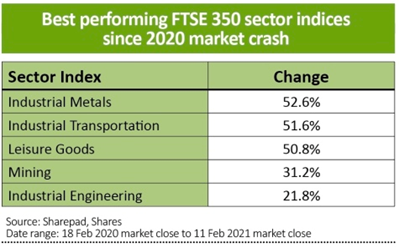
Unusually, industrial metals, mining, industrial transportation and industrial engineering have been the leaders in terms of performance, even though the global economy took an enormous hit during the pandemic and by most estimates it will take three to five years for world output to return to ‘trend’.

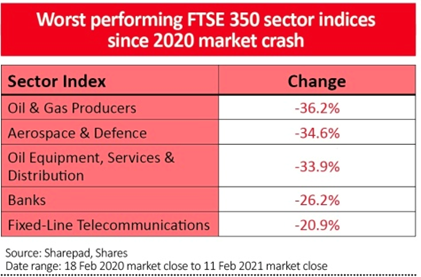
On the other hand, considering the devastation wrought on the hospitality industry, it’s somewhat surprising travel and leisure or pubs, restaurants and hotels weren’t among the worst FTSE 350 sector performers.

Instead, the worst sectors have been aerospace and defence, banks, fixed-line telecommunications, oil and gas producers, and oil and gas equipment and services, the last two despite a sharp rally in crude oil prices since the start of 2021.

STOCK-LEVEL ANALYSIS

It won’t be a surprise to investors that companies which were either already largely online or shifted their business model to online were among the biggest winners. The top performing FTSE 350 stock since the start of the Covid sell-off is AO World (AO.), up 307%. The online retailer of unglamorous items such as freezers, microwaves and washing machines became a stock market darling as domestic appliances became hot property during lockdown.

Spread betting firms like CMC Markets (CMCX) and Plus500 (PLUS) as well as gambling firms like 888 (888) and Flutter (FLTR) posted exceptional gains thanks to a surge in new account openings as those cooped up at home found new ways to entertain themselves by betting.

Savvy investors played the strong performance of overseas markets through collective investments, especially those with a US/technology bias, with Baillie Gifford US Growth Trust (USAand Scottish Mortgage (SMT) clocking up gains of more than 100%.

Asia-focused trusts also found favour with Fidelity China Special Situations (FCSS) almost doubling and JPMorgan Japanese (JFJ) rising by two thirds.

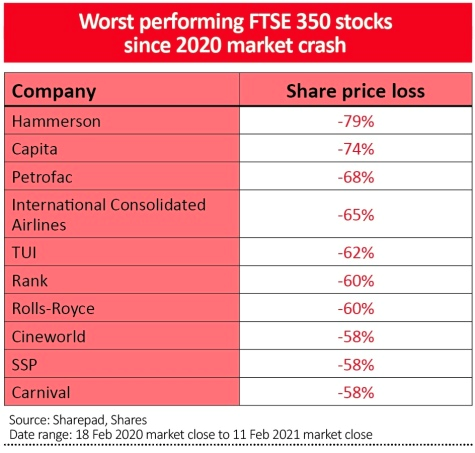
Interestingly, less than half the constituents of the FTSE 350 index trade above their February highs today, and a third are still lagging the benchmark with losses of more than 10%.

The list of big losers is littered with travel and leisure, aerospace, financial and industrial stocks, along with real estate investment trusts (REITs). Curiously, many of the housebuilders are still heavily in negative territory with losses of 30% or more despite the continued strength of demand in the housing market – as shown by their recent results – and a clutch of technology stocks are also nursing heavy losses which seems counter-intuitive.

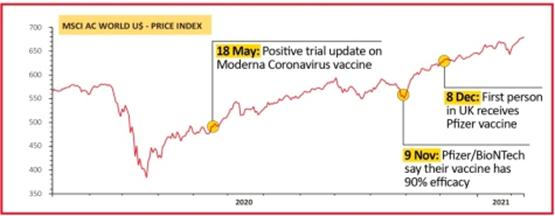
It is worth noting that since 9 November when Covid-19 vaccines started to be confirmed, recovery plays have been in fashion, with travel and leisure stocks such as Cineworld (CINEpicking up, and more defensives such as Unilever (ULVRlagging the wider UK indices.

3 STOCKS TO BUY NOW

We have chosen three stocks which we think have been overlooked, with varying degrees of risk attached.

THE ‘SAFE’ ONE

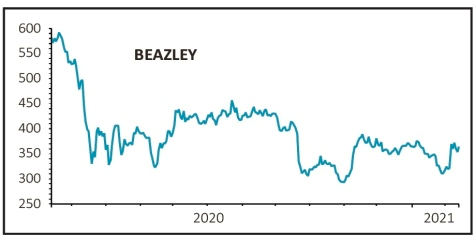
Beazley (BEZ) 350p. Market cap: £2.2 billion. 12-month forward PE: 11.7

Shares in Lloyd’s market insurer Beazley (BEZare trading 38% below their pre-pandemic levels, which seems to us as though the market is driving with the rear-view mirror.

he firm may have posted a $50m loss for last year due to claims for cancelled events and other Covid effects, but this was half the amount analysts were expecting.

What excites us is the 15% increase in renewal rates as the insurance market tightened conditions in response to the pandemic. Chief executive Andrew Horton described himself as ‘very positive about the year ahead’, as having raised capital in May the firm is well placed to capture the strong rate tailwind.

With its strong underwriting discipline and focus on capital returns, Beazley can cover the same risks this year with a much greater profit margin which should lead to earnings upgrades and a sharp rerating of the shares.


THE ‘CHEAP’ ONE

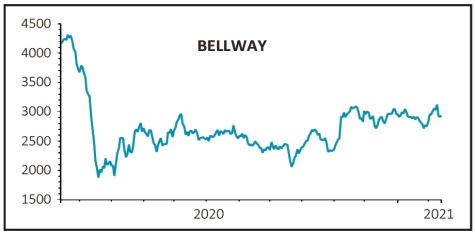
Bellway (BWY) £28.84. Market cap: £3.6 billion. 12-month forward PE: 9.2

Trailing 12-month price to book value: 1.2

Mid-market housebuilder Bellway (BWY) posted a record build volume for the six months to the end of January, and what it called a robust forward sales book with orders for almost 5,900 new homes or 28% more than the same period a year earlier.

It also pointed to full year completions of 9,800 homes, an increase of 30%, and an improvement in its underlying operating profit margin of ‘at least 200 basis points’ (2%) over last year’s 14.5% margin.

Given how much brighter the outlook appears, it seems odd that the shares are still some 30% below their February 2020 level. Moreover, the valuation gap between Bellway and the rest of the sector seems abnormally wide.

We can only assume that investors are worried the end of Help to Buy and/or the stamp duty holiday will lead to disappointment, yet the valuation offers a healthy margin of safety in our view.


THE ‘RACY’ ONE

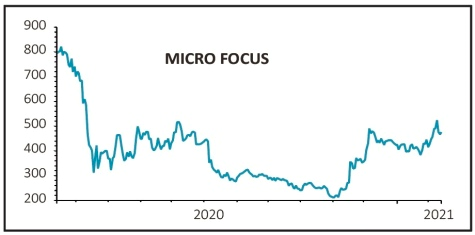
Micro Focus (MCRO) 466p. Market cap: £1.6 billion. 12-month forward PE: 4.5

Infrastructure software supplier Micro Focus (MCRO) divides opinion like few other stocks. ‘Cheap for a reason’ is a typical response, which given its debt level and a surprise $2.8 billion writedown of goodwill in the 2020 results doesn’t seem unjustified.

The firm began its three-year turnaround plan in January last year, which was unfortunate timing, but if anything, the pandemic has forced it to grasp the nettle and cut down on unnecessary spending while focusing on key areas of opportunity.

The firm’s new guidance is for revenues to stabilise in the 2023 financial year, while its in-house IT infrastructure plan starting this year will generate further operational improvements and efficiencies.

For us, with the shares down 40% since last February, it’s a binary bet. Either the firm does what it promised which means the shares rerate, or it keeps disappointing and gets taken over by a private equity firm. This is a high-risk investment and investors should only get involved if they have money they can afford to lose.

Please check in again with us soon for further market analysis and news.

Stay safe.

Chloe

19/02/2021

Team No Comments

Seven Habits of Highly Effective Investments

Please see the below article from Invesco received yesterday afternoon:

1. Growth

Over the years we have found we are much more likely to find attractive investment opportunities in healthy, growing companies – regardless of whether they are “growth” or “value”. A company that grows is not about investment style, it’s a fundamental building block of almost all of our good investment ideas. There are several ways in which companies can grow: new markets, new customers, new products, value accretive M&A etc.

In our experience, businesses that aren’t growing, tend to be going backwards. Not all growth opportunities enhance shareholder value, therefore it is important to understand the track record of the company and the management team and their ability to deliver an economic return from such ventures. We look for companies that are sustainably growing shareholder value through the cycle and can deliver returns above the cost of capital.

2. Price

Price isn’t about value investing. In our experience it is often the lowest multiple (“cheapest”) companies that prove to be value traps. Paying the right price is about understanding what a company is worth: it’s intrinsic value. It is only by doing the fundamental analysis and gauging the intrinsic worth that you can make a judgement on what is the appropriate price to pay for the asset. We want to pay less than what we believe the company is worth and will wait for the market to provide this opportunity.

3. Margins and moats

Most Investors want to invest in high margin businesses; it often infers the company is unique in the product or service that it offers. Apple would be a good example of this: a loyal customer base, who are embedded in their ecosystem, have no choice but to be loyal – giving Apple high margins. This ecosystem provides a wide investment moat. However, businesses that can sustain high margins while growing sales are rare and they tend to attract competition. Companies that have low margins can be attractive also, as long as they have a moat which is defendable. In fact, sometimes having low margins can be an effective competitive strategy and enable a company to take market share from less effectively run competitors.

Ryanair is a great example of a low margin businesses, that has been successful; its moat is its lower cost base than competitors, this in turn drives volume growth which allows them to drive supplier costs down further. Customers ultimately win as they receive lower prices. The key is determining which companies can maintain their moats, allowing them to achieve future growth.

4. Owners and management

We want management to act like owners of a company; they should be aligned with us as investors; both in how they are remunerated and how they deploy capital. Some of our best investments have been in family and founder owned enterprises. These agents act as owners on our behalf and act in the best interests of the business for the long term, rather than trying to meet next quarters earnings.

In the absence of material share ownership (the gold standard in our view) management teams should have clear, simple and measurable financial targets that incentivise good capital discipline, with particular focus on cash generation and returns on capital. Companies need to clearly define hurdle rates of return for capital investment and acquisitions, ensuring that they are value accretive for shareholders.

5. Balance sheet and leverage

While leverage can provide increased returns, it also comes with added risk. Taking on balance sheet risk in economically cyclical companies is particularly high risk. Leverage should be used in a risk conscious way that is appropriate to the individual company and industry. Conversely, those companies with net cash, which they are able to deploy at attractive rates should be seen as desirable; while returning cash to shareholders is another lever to add value.

We’ve found that many of our founder owner businesses run with net cash, oftentimes indicative of their prudence and focus on cash generation. The combination of cash to deploy in the hands of aligned management team can provide both optionality and potentially greater downside protection.

6. Cash flow and dividends

Our preferred metric for valuing companies is free cash flow; it is less easily manipulated than earnings. Quite simply cash is the best measure of a company’s health; without being self-financing from a cash flow perspective, the business cannot be a going concern for any material period of time. Cash flow allows the company to pursue those opportunities which enhance shareholder value: investing at attractive rates, paying down debts, buying back shares or paying a dividend. We believe that investing in companies that can sustainably grow their dividends over time will not only provide an important contributor of return, but provides an important discipline for companies in managing their cash flow.

7. Different lenses

We believe that the fundamental analysis we do is exhaustive: we read a great deal of both recent and historic annual reports , listen to management earnings calls, speak to analysts and experts, as well as competitors and customers. We try to build a deep, holistic understanding of the business, the opportunities and risks that it faces. Ultimately, we seek to make a judgement on how the business will fare in the future, versus the price we are being asked to pay for it today.

However, as investors we are not all knowing; we all have our inadvertent biases. We therefore also evaluate companies through independent lenses, for instance EVA (understanding a firms economic rather than accounting profit) and QRR (assessing accounting and earnings quality). Our best investments tend to survive not only our scrutiny, but those of our independent partners as well.

This is an interesting article giving in an insight into how some of the big investment firms choose the right investments for their funds.

Please continue to check back for a variety of blog content from us.

Andrew Lloyd

18/02/2021

Team No Comments

Brewin Dolphin – Markets in a Minute

Please see below this week’s Markets in a Minute update from Brewin Dolphin – received late yesterday afternoon – 16/02/2021

Equities reach record highs as vaccine roll out accelerates

After a volatile few days, global equities reached record highs last week as the vaccine roll out gathered pace and data revealed a decline in coronavirus cases.

The S&P 500 ended the week up 1.23%, with the communication services sector outperforming following strong gains in Twitter and video gaming shares. Energy stocks climbed higher after front-month Brent futures prices reached more than $60 per barrel, up from less than $20 last April.

The STOXX Europe 600 gained 1.09% last week, although performance was mixed in Europe with Germany’s Dax largely flat, France’s CAC 40 up 0.78%, and the UK’s FTSE 100 gaining 1.55%. Hopes of a large US economic stimulus package drove gains, but these were hampered by poor GDP data from the UK and eurozone.

In Asia, markets in China and Hong Kong rallied ahead of the Lunar New Year holiday, with the Shanghai Composite surging 4.54% and the Hang Seng gaining 3.02%.

Last week’s markets performance*

  • FTSE 100: +1.55%
  • S&P 500: +1.23%
  • Dow: +1.00%
  • Nasdaq: +1.73%
  • Dax: -0.05%
  • Hang Seng: +3.02%
  • Shanghai Composite: +4.54%
  • Nikkei: +2.57%

*Data from close on Friday 5 February to close of business on Friday 12 February.

FTSE surges higher as oil price nears $65 per barrel

The FTSE 100 enjoyed its best day in more than a month on Monday, ending the day up 2.5% to 6,756.11 following positive news on the vaccine front. More than 15m people in the UK have had their first jab, and it is now being offered to the over-65s and clinically vulnerable.

Oil majors BP and Royal Dutch Shell surged 6.5% and 6.1%, respectively, on Monday after oil prices were further boosted by supply concerns. The oil price is now nearing $65 per barrel.

Positive sentiment led to a sell-off in UK government debt. The yield on the 10-year gilt rose to 0.57%, its highest level since March 2020.

After a shaky start, countries in Europe are also starting to ramp up inoculations. The STOXX Europe 600 finished Monday 1.3% higher, while Germany’s Dax gained 0.4%.

Elsewhere, Japan’s Nikkei 225 surged past 30,000 for the first time since 1990, after data showed its economy grew 3% in the fourth quarter, far higher than analysts had predicted. The US stock market was closed on Monday for Presidents Day.

Rising commodity prices and coronavirus optimism continued to boost UK stocks on Tuesday morning, with the FTSE 100 up 40 points in early trading to 6796 – its highest level since 15 January. HSBC topped the leader board with a 3.2% gain.

After closing for the Lunar New Year holiday, Hong Kong’s Hang Seng surged 1.8% in its first session in the Year of the Ox.

Sharp drop in coronavirus cases

A drop in new Covid-19 cases and hospitalisations helped to drive global equities to new highs last week.

In the US, the seven-day average of new coronavirus cases has fallen by nearly 64% since its January peak, while the number of hospitalisations has fallen from 130,000 to 67,023. UK data shows the R number is below one for the first time since July, with the number of cases down 18% week-on-week.

According to the World Health Organization, there has been a 17% decline in new Covid-19 cases worldwide, although it warned data from smaller countries may be incomplete. Experts said the emergence of more contagious variants poses continued risks, and that ongoing travel bans and lockdowns in many countries show the disruption is far from over.

Economic woes continue

Although there is more optimism about the end of the pandemic, US consumer sentiment fell unexpectedly in February, demonstrating that households are still worried about the economy. The University of Michigan’s preliminary Consumer Sentiment Index declined from 79 to 76.2, while the measure of what consumers expect in the next six months dropped to 69.8, the weakest reading in half a year.

A Reuters poll showed the US economy is expected to reach pre-Covid-19 levels within a year as the proposed $1.9trn fiscal bill helps to boost economic activity. However, employment will likely take more than a year to fully recover.

Meanwhile, figures from the Office for National Statistics showed the UK economy contracted by 9.9% in 2020 – the largest drop since 1709 – although it avoided a double-dip recession with 1% growth in the fourth quarter. The fall in output was more than twice as deep as during the global financial crisis of 2009.

The third lockdown is expected to cause the UK economy to shrink further in the first quarter of 2021, but the Bank of England forecasts a rebound in the spring as restrictions start to be lifted. In the eurozone, the economy is expected to grow by 3.8% in 2021 and 2022. Although the forecast for 2021 is lower than the previous projection of 5% growth, the European Commission expects the economy to return to pre-pandemic levels in 2022, earlier than previously anticipated.

Gold price holding up

Last week saw softer-than-expected inflation data from the US, with the core consumer price index unchanged in January – below estimates of a 0.2% increase. This pushed down Treasury yields in the middle of the week, but they increased again on Friday to the highest levels seen since March.

The price of gold is holding up fairly well against a backdrop of rising bond yields and a surging stock market. This is because real bond yields, the most important macro variable for the gold price, have moved a bit lower.

Another quick update from Brewin Dolphin, these updates are a good way of keeping up to speed with developments in the markets.

Please continue to check back for our latest updates and blog posts.

Charlotte Ennis

17/02/2021

Team No Comments

Legal & General Investment Managers Blog

Please see below an article received from Legal & General yesterday afternoon, which outlines their market views on Europe, the U.S. and the U.K:

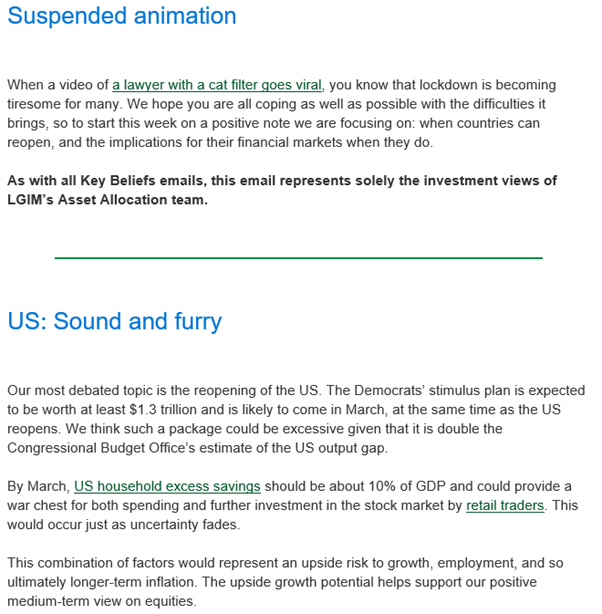
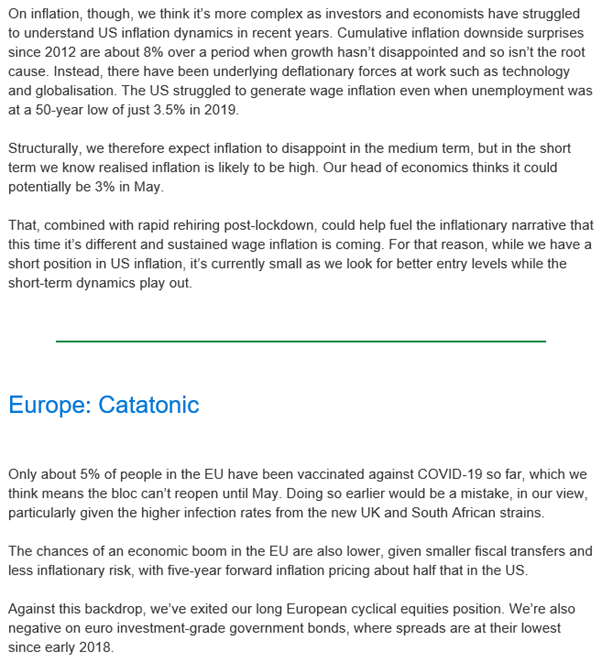
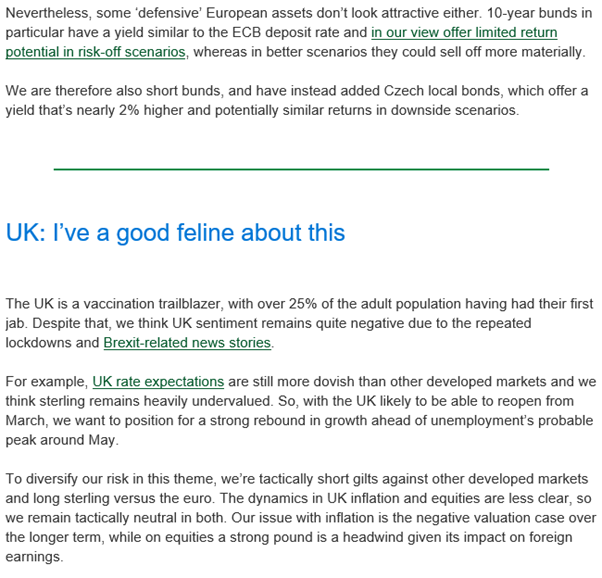
As you can see from the above, the U.S. has a couple of key themes to keep an eye on namely the scale of the stimulus package that will be announced and inflation. It looks like L&G are positioning for a potential correction in U.S. equity prices. On Europe, they see less opportunity in the short-term and this won’t be helped if their economies have to remain in lockdown until May. Their views on the U.K. are more optimistic, although they remain cautious over potential inflationary pressures.

I think the key note here is that as lockdowns are eased globally, there is scope for economies to rebound and it will be important that you are invested appropriately to catch this potential upside. These are Legal & General’s Fund Managers views and other fund managers views will differ.

Please continue to check our Blog content for advice and planning issues and the latest investment, markets and economic updates from leading investment houses.

Please keep safe and healthy.

Carl Mitchell – Dip PFS

IFA and Paraplanner

16/02/2021

Team No Comments

Why the inflation debate is more than just hot air

Please see below article received from AJ Bell yesterday which explains what rising prices could mean for different asset classes.

There is a general rule that the most vituperative arguments are those that take place between academics, because the stakes (and the implications for the real world) are so small.

Usually, such debates can be watched with detached amusement, but there is one current spat which does command attention, especially from an investment perspective.

Larry Summers – former US Treasury secretary under president Bill Clinton and former economic adviser to Barack Obama – is involved in a fierce set-to with current Treasury secretary and former US Federal Reserve chair Janet Yellen. To add spice to proceedings, Summers was reportedly an unsuccessful candidate when Yellen got the post at the US central bank in 2013.

Yellen is actively endorsing the Biden administration’s fiscal stimulus plans, arguing that spending too little could do more harm than spending too much.

Judging by his columns in The Washington Post, Summers seems to disagree, in the view that too much stimulus could unleash inflation.

Yellen, perhaps conveniently ignoring how her four years as Fed chair employing ultra-loose policies employed by both her predecessor, Ben Bernanke, and her successor, Jay Powell, cannot point to any sustained progress in stoking inflation. She asserts that any such threat is being monitored and can be swiftly contained.

Cue much eye-rolling from Summers, whose antipathy to the quantitative easing (QE) policies used as ‘temporary’ measures by the Fed since 2008 is also well known.

If Yellen is right, then investment portfolios can stay slanted toward momentum and growth strategies and long-duration assets such as government bonds with a decade or more to maturity and technology and biotechnology stocks – in other words, what has a great track record over the last decade will keep delivering, if history is any guide.

But if Summers is right, then the whole game changes. If inflation pops higher and stays that way, then history suggests investors need to be exposed to short-duration assets such as ‘value’ equities (cyclical growth and recovery stocks), emerging markets and ‘real’ assets such as commodities and precious metals.

BASE EFFECT OR BOUNCE?

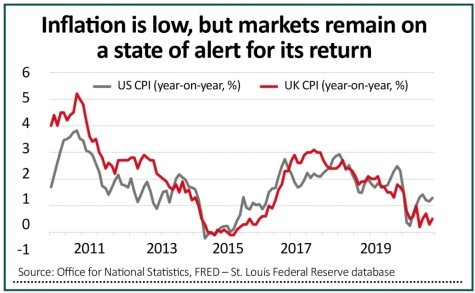
Again, the headline inflation numbers are benign. There will be a base effect for the rest of 2021, as the pandemic-induced recession comes up as a comparator.

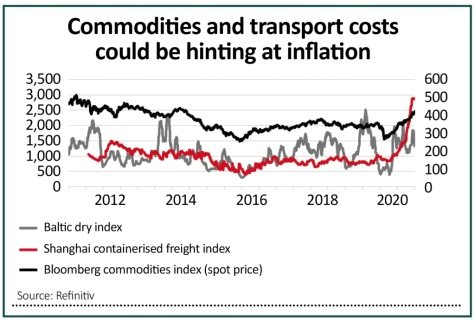
Doubtless central banks will dismiss that as transitory rather than signs of a fundamental cost pressures, even if the price of vital raw materials from oil to metals and crops is on the march if the Bloomberg Commodity index and shipping’s Baltic Dry benchmark are any guide.

If there is any good news here is might be that the Shanghai Containerised Freight index is maybe topping out after a stunning run, but all these trends are indicators of cost pressures building in the pipeline.

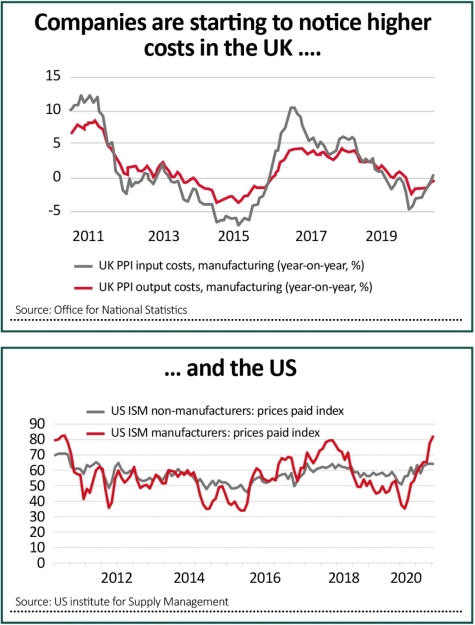
Companies are already paying attention – because they must. Input costs and output prices are showing some momentum in the UK, while American firms are flagging a sharp increase in their costs in the latest purchasing managers’ indices.

Muted demand, owing to the pandemic, lockdowns and increased unemployment, could keep a lid on this trend but a strong bounce back at a time when supply is crimped by company closures and supply chain disruption remains a possibility, too.

FRETFUL FIXED INCOME

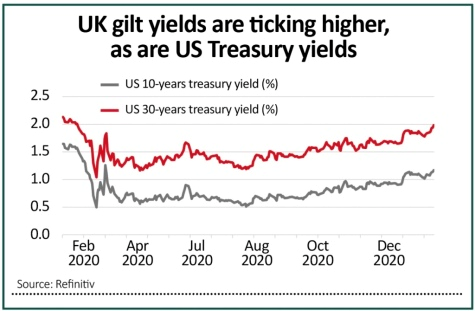
Fixed-income investors are paying attention because government bond yields are rising. They still stand at what are historically low levels, so it would be wrong to say bond investors are in a tizzy.

They still seem to believe the Yellen narrative that inflation can be managed and that central banks can just keep throwing money at fixed-income markets via QE to put a lid on bond yields. That would keep bond prices high but gilts’ and treasuries’ skinny yields would offer holders little or no protection if the inflation genie finally pops out of the bottle.

Please check in again with us soon for further analysis and related market content.

Stay safe.

Chloe

15/02/2021

Team No Comments

Six potential takeover targets as M&A heats up

Please see the below article from AJ Bell received yesterday evening:

UK shares are in the sweet spot with relatively low valuations and an advanced vaccination programme offering more visibility.

UK firms have been subject to around £28 billion of mergers and acquisitions deals so far in 2021, the highest level since 2009 according to data from Dealogic. Investors are now trying to work out which UK stocks could be next.

Temporary power supplier Aggreko (AGK) surged 38% on 5 February after a consortium of private equity groups TDR Capital and I Squared Capital made a possible all-cash offer of 880p per share.

TDR was also behind a 305p per share proposal for specialist distressed debt manager Arrow Global (ARW), pushing the shares up 26% (8 Feb).

Increasing interest from private equity buyers shouldn’t be a surprise as collectively they have around $1.5 trillion of cash to invest, according to data provider Preqin.

In addition, UK shares have lagged other developed markets due to Brexit limbo over the last year, making them cheaper in relative terms. Asset manager Schroders says UK stocks have rarely been cheaper based on a price to sales multiple.

The pandemic has created a polarised market with the leisure, hospitality and travel sectors becoming casualties while the computer games and gambling sectors have seen a significant boost. Private equity and trade buyers are looking at both losers and winners of the pandemic as they seek to take advantage of strong trading or expect a bounce from the UK economy reopening.

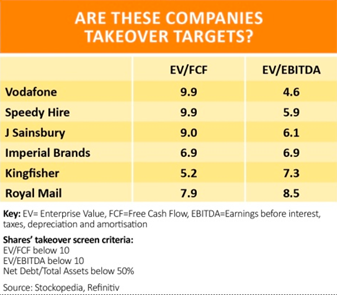
Investors looking for potential targets might want to focus on companies with good asset backing and reliable cash flows, as well as undemanding valuations. Shares ran a screen on the market for such stocks and interestingly Aggreko made the original list.

Of the names on the list excluding Aggreko, UK food retailer J Sainsbury (SBRY) has good asset backing and reliable revenues. The company has been reducing its debts, leaving scope for a buyer to increase leverage should a takeover happen.

Home improvement retailer Kingfisher (KGF) has benefited from the pandemic as people spend more cash on their home which is likely to remain a key driver of growth. Foreign private equity buyers could view Kingfisher as a strategic entry into the UK.

Tool hire firm Speedy Hire (SDY) is also on the list and has been increasing market share.

Please continue to check back for regular updates from us.

Andrew Lloyd

12/02/2021

Team No Comments

Brooks Macdonald – Daily Investment Bulletin

Please see investment bulletin below from Brooks Macdonald received yesterday afternoon – 10/02/2021

What has happened

After a strong start to the week, equity gains calmed yesterday with risk assets taking a pause. Technology outperformed on the margin with a slight weakness in the pro-cyclical trade, though this is within the context of the recent rally.

US Stimulus

One of the factors leading to a more subdued market yesterday was investors attempting to calculate the inflationary impact of the proposed US stimulus package. This is a big unknown as it dependent on questions such as how large the current output gap is once near-term fiscal support fades. Should US Fiscal Stimulus be ‘too big’ this may lead to some short-term inflationary pressures, but we think this is unlikely to upset the medium-term narrative of low growth and low inflation that existed prior to the pandemic. Whilst US politics is somewhat distracted with the impeachment trial of President Trump, the more important area is the progression of the Biden Administration stimulus package. The White House Press Secretary said yesterday that the latest round of stimulus would most likely be passed through a reconciliation process as tacit confirmation that President Biden is moving away from his bipartisan request. We were given several timelines for the completion of the bill via this process yesterday but late February to early March appears to be the target window.

Viral news

The good news yesterday was the increasing quantity of data from countries that are well progressed in their vaccination programme. Israel PM Netanyahu said yesterday that of the fatalities due to COVID in the last 30 days, 97% of those fatalities were people that had not received a vaccine. The UK is also nearing its target to have vaccinated the most vulnerable segments of society by 15th February, a group that has made up the vast majority of fatalities.

What does Brooks Macdonald think

When talking about the US unemployment outlook last week we spoke of the need for a goldilocks level of employment that didn’t quash hopes for either an economic recovery or the need for further stimulus. Markets are now applying this same logic to US Fiscal Stimulus hoping that the package is not ‘too big’ as to create inflationary issues. Since the Financial Crisis, governments and central banks have struggled to create inflation despite highly accommodative policies. With the US economy still suffering from the effects of COVID, and any boost to inflation through one off stimulus likely to be looked through as temporary, we suspect the risk of ‘too cold’ a stimulus is far greater than ‘too hot’.

Source: Bloomberg as at 10/02/2021

Please continue to check back for our latest updates and blog posts.

Charlotte Ennis

11/02/2021

Team No Comments

Royal London – Is financial advice the secret to feeling good about your money and yourself?

The below thought-provoking article, published by Royal London, reveals the results of a survey conducted with over 4,000 customers to find out how financial advice has a positive impact on their finances, their well-being, and their futures.

‘It’s no secret, there’s always been a link between emotional and financial wellbeing. For those receiving financial advice, it’s always been more than just the practical and financial benefits. But how does financial advice improve emotional wellbeing?

Our research into how customers with an adviser could be better off financially also showed a number of ways talking to an adviser helps financial welling. We were also able to dispel a money myth and prove better knowledge of financial matters can play an important role in feeling good about your money.

Financial advice improves emotional wellbeing and financially security.

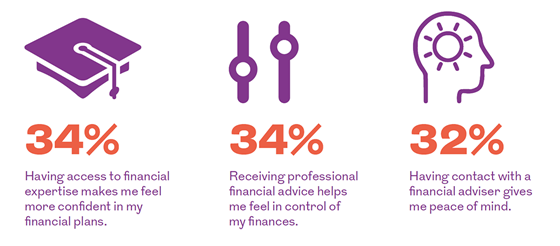
The control you have over your money and how you continue to manage it will change over time. Our findings show that talking to a financial adviser makes people feel more confident and financially resilient, especially in times of crisis. Those receiving advice have a greater feeling of being in control and have peace of mind. Our customers told us:

34% – Having access to financial expertise makes me feel more confident in my financial plans.

34% – Receiving professional financial advice helps me feel in control of my finances.

32% – Having contact with a financial adviser gives me peace of mind.

Myth busting: financial wellbeing is for the wealthy

The more money you have, the better you feel about money, right? Not so. From our research results we can see wellbeing and happiness isn’t based on how much money you have. While confidence increases in line with income, there’s still a difference between customers who are advised and those that aren’t advised. Even those surveyed on a lower household income, receiving advice, still feel more confident than those who don’t receive advice.

Does cost affect the emotional benefits of advice?

No. In balancing the cost and the benefit of advice, our customers are telling us that what they pay their adviser doesn’t diminish the emotional benefits. We found that customers with an ongoing relationship with their adviser are twice as likely to agree that the emotional and financial benefits of having an adviser outweigh any costs (38% compared to 16% of advised customers).

Having an adviser also helps boost knowledge

In our research, we found that customers with an adviser feel they have a much better understanding of financial matters, compared with people who don’t have an adviser. A greater understanding of the unknown or complicated leads to feeling more in control.

Customers without an adviser are 3 times more likely not to know where to start when it comes to saving for retirement and nearly twice as likely not to understand inheritance planning.

Feeling good about the future

Customers who receive financial advice trust their adviser and are happy with the advice they get. Satisfaction also increases over time, where there is an ongoing relationship in place. Customers who receive financial advice feel more confident about their future, and feel more financially resilient. Advised customers enjoy psychological and emotional benefits – not just any financial gains.

However you’re managing your money, our research shows how financial advice could go some way to pave the way for a happier financial and overall outlook. You’ll find more help with feeling good about your money and prepared for what might lie ahead in our financial wellbeing section.’

Over the past year, the challenges brought by the Covid-19 pandemic have highlighted the importance of mental health. The year of 2020 sparked a realisation; that we never know what’s coming around the corner, so it makes sense for us to financially prepare for life’s future potential trials. This study confirms that quality financial advice and effective financial planning improves emotional wellbeing and financial security over the long-term. If you are ready to organise your finances and improve your outlook on life, please feel free to get in touch with us here at People & Business IFA Limited.

Stay safe.

Chloe – 10/02/2021