Please see below the latest ‘Markets in a Minute’ article from Brewin Dolphin received late yesterday afternoon – 16/03/2021.
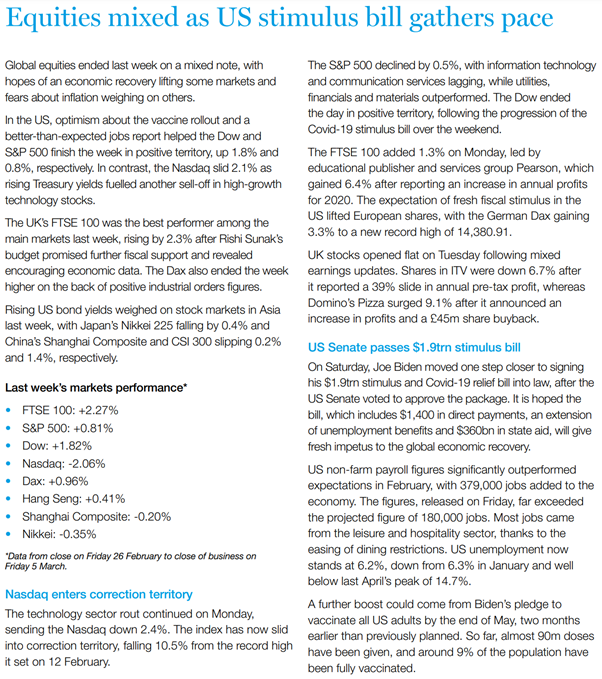
Equities reach new highs as bond yields retreat
Global equities performed strongly last week, as bond yields retreated and investors turned their attention to encouraging economic data.
Most of the major US benchmarks reached new all-time highs. The Dow soared 4.1%, while the Nasdaq gained 3.1% and the S&P 500 added 2.6%. Tesla and other high-growth stocks enjoyed strong gains as fears about higher interest rates subsided.
Stocks in Europe were boosted by the passing of US president Joe Biden’s $1.9trn stimulus bill, as well as the European Central Bank’s pledge to speed up its emergency bond purchasing programme to counter rising borrowing costs. The pan-European STOXX 600 gained 3.5% and Germany’s Dax surged 4.2%.
The FTSE 100 ended the week nearly two percentage points higher, after data showed UK economic output fell by 2.9% between December and January – less than economists’ forecasts of a 4.9% contraction. Over in Asia, China’s Shanghai Composite slipped 1.4% amid concerns that authorities could reduce stimulus measures as the economy recovers.
Last week’s market performance*
FTSE 100: +1.97%
S&P 500: +2.64%
Dow: +4.07%
Nasdaq: +3.09%
Dax: +4.18%
Hang Seng: -1.23%
Shanghai Composite: -1.40%
Nikkei: +2.96%
*Data from close on Friday 5 March to close of business on Friday 12 March.
Wall Street rallies ahead of consumer spending spree
US stocks rallied on Monday as the roll out of stimulus cheques over the weekend fuelled expectations of a consumer spending spree. After a whipsaw session, the S&P 500 ended the day up 0.64%, reaching a new all-time high of 3,968.77. The Nasdaq rose 1.1% after technology shares recovered lost ground.
European shares ended Monday on a mixed note, following negative headlines around the Continent’s vaccination efforts and the safety of the AstraZeneca-Oxford vaccine. The STOXX 600 was flat at 423.1, while Germany’s Dax slipped 0.3%.
The FTSE 100 dipped 0.2% as commodity stocks, including BP, Royal Dutch Shell and BHP, underperformed. Bank of England governor Andrew Bailey said he expected inflation to approach the 2% target soon, but that he was cautious about whether the trend was sustainable amid continuing economic uncertainty. Ipsos MORI’s latest political monitor found 43% of Britons think the economy will improve over the next 12 months, while 41% think things will get worse.
The FTSE 100 was up 0.6% at Tuesday’s open, with investors optimistic that the US Federal Reserve will maintain a dovish stance on interest rates at its meeting this week.
US economic data cheers investors
Last week saw a raft of encouraging economic data from the US. Initial weekly jobless claims fell to their lowest level since November, at 712,000. Continuing claims dropped to 4.1m, their lowest level in a year. This helped to fuel a jump in the University of Michigan’s preliminary consumer sentiment index from 76.8 at the end of February to 83.0 in March.
The US is also progressing well in its roll out of Covid-19 vaccines, administering a new high of five million doses over the 6-7 March weekend. On Thursday, Biden told states to make all American adults eligible for vaccines by 1 May and set a goal of 4 July for gatherings to celebrate ‘independence’ from the pandemic. On the same day, Biden signed into law the $1.9trn American Rescue Plan Act, which provides $1,400 direct payments to individuals making up to $75,000 annually, $350bn in aid to state and local governments, and $14bn for vaccine distribution.
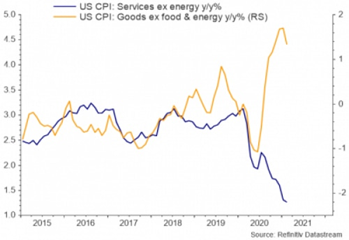
Last week’s US consumer price index (CPI) revealed an acceleration in the headline CPI, driven by rising commodity prices. Goods inflation rolled over slightly on a year-on-year basis in February, but services inflation continued to move lower.
The data highlights how the pandemic has, in aggregate, negatively impacted services demand while bolstering demand for tangible goods.
UK economy shrinks less than expected
The UK economy shrank by less than feared in January, despite the country re-entering lockdown. Gross domestic product was 2.9% lower than in December, according to the Office for National Statistics. Economists polled by Reuters had expected a contraction of 4.9%.
Following the latest data, economists are now predicted a 2% contraction in the first quarter of 2021 – half the 4% hit forecast by the Bank of England only last month. Retail sales figures also brought some cheer, with sales growing by 1.0% year-on-year in February following a 1.3% decline in January.
On the flipside, exports of goods to the EU slumped by 40.7% in January, while imports plunged by 28.8%. These are the largest drops on record, although there was a delay in gathering some data and there were signs of a pick-up towards the end of the month.
Chinese market continues sell-off
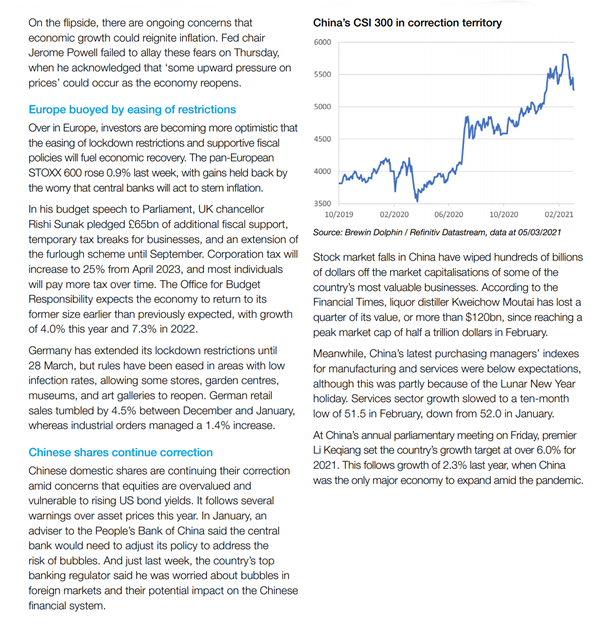
The sell-off in Chinese stocks continued last week, resulting in the CSI 300 posting its sharpest correction since the height of the Covid-19 crisis in March last year.
Alongside this sell-off has been a global rotation away from growth stocks into value stocks. In the last couple of years, China has increasingly become a growth-exposed equity market. Electric vehicle maker NIO has sold off almost 40%, and ecommerce companies Pinduoduo and Meituan have both sold off more than 30%.
Concerns about liquidity and credit stimulus are driving the sell-off. To prevent asset bubbles and contain ballooning debt, it is expected that the authorities will raise interest rates and restrict credit. However, with China heading into the centenary of the Chinese Communist Party in July, it is likely that the authorities will go slow in terms of withdrawing stimulus.
The so-called ‘national team’, which includes the sovereign wealth fund, state affiliated brokers, and the national social security fund, will also be on hand to limit the downside to major corrections.
Another quick update from Brewin Dolphin, regular market updates like this are useful for keeping up to speed with developments in the markets.
Please continue to check back for our regular blog posts and updates.
Please see below a blog received yesterday afternoon from Legal & General Investment Managers, which details their views on China and the bond markets in the US and Europe:
Please continue to check our Blog content for advice and planning issues and the latest investment, markets and economic updates from leading investment houses.
Please see the below article from JP Morgan received early this morning:
‘By 2030, we expect the increase in annual Chinese spending power to be larger than the current size of the German and UK economies combined.’ – Mike Bell & Tilmann Galler
Rising incomes in Asia will probably be the most important economic and investment story of the 2020s. Asia is home to 60% of the world’s population, with China and India each accounting for about 18% of the global total. As incomes rise, the Asian middle class is expected to grow by about 1.2 billion people by 2030, significantly boosting consumption. As a result, we think Asia is an investment opportunity that’s simply too big to ignore and warrants a larger place in many portfolios.
China
Visitors to Shanghai would be forgiven for thinking that China’s development is mostly behind it. Growth has already been spectacular, with China’s share of global GDP rising from just 2% in 1990 to about 16% in 2020. What’s more, China is responsible for 35% of global demand for luxury goods. So it’s understandable that there’s a common perception that China is already rich.
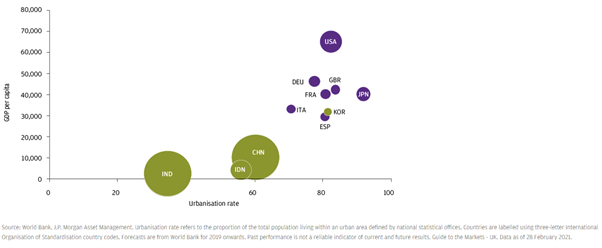
However, travelling east of the developed coastal regions provides a very different picture of the country – and the ongoing potential for economic catch-up is clear. While there are certainly many Chinese billionaires, average GDP per capita is only around USD 10,000 (Exhibit 1).
Ongoing urbanisation will drive further increases in productivity and incomes
Exhibit 1: Urbanisation, nominal GDP per capita and population size
Urbanisation rates, %, and GDP per capita, USD, bubble size is population
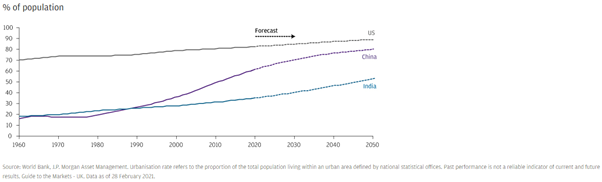
That figure represents impressive growth, from only USD 1,000 in 2000, but remains a long way behind developed economies such as the US. As inland regions urbanise (Exhibit 2) and develop, productivity will rise, such that China is expected to grow by about 4.4% per year on average in real terms over the next decade, despite an outright decline in the working age population. That means GDP and incomes should be about 50% larger by 2030.
There’s still plenty of urbanisation ahead in Asia
Exhibit 2: Urbanisation rates over time
% of population
An expected increase in incomes from about USD 10,000 per person to USD 15,000 per person may not sound that much by western standards. But multiply that increase in incomes by 1.4 billion people and you get an idea of the scale of the opportunity: a real increase in consumption of about USD 7 trillion. That’s an increase in annual Chinese spending power larger than the current size of the German and UK economies combined. This presents considerable growth opportunities in a wide range of goods and services — from premium food brands to insurance, healthcare and online tutoring.
Trade tensions are likely to persist between the US and China, and China is likely to be under increasing pressure to meet higher environmental and labour standards. But Beijing’s most recent five-year plan demonstrates the action the Chinese government is already taking in these areas, including an ambition to be carbon neutral by 2060. It’s also worth remembering that exports to the US account for only 3% of Chinese GDP. Investors who refrain from investing in China because of trade tensions are likely to be waiting a very long time, and risk missing out on the bigger picture of rising Chinese consumption.
India
While China’s economy is likely to grow by the largest amount in absolute terms, India is likely to deliver the fastest growth rate of any major country over the next decade. With over 480 million Indians under the age of 20 — considerably more than the entire 370 million population of North America — the working age population of India is set to grow strongly. From a much lower base of GDP per capita of only around USD 2,000 (Exhibit 1), we expect real growth of 6.9% per year on average over the next decade. That should lead real incomes to approximately double over the next decade. Again, while that may not sound like much, it could mean there are about a billion Indians in the middle class in 10 years’ time, with incomes increasing to a point at which many more households can afford higher-quality food products and financial services such as life insurance.
Overall, we think investors with a long-term investment horizon will benefit from focusing on the incredible opportunity presented by rising incomes and consumption in China, India and the rest of Asia.
The income opportunity
The global financial crisis followed by the Covid-19 pandemic pushed developed market bond yields significantly lower. Investment grade bond yields in the US and Europe are close to historical lows and 26% of developed market government bonds have a negative yield.
As a consequence, an increasing number of investors need to look beyond their home region to find positive real yields for the fixed income part of their portfolios. From that perspective, Asian bond markets look compelling. Asian investment grade bonds offer a yield pickup of between 2% and 3% over US and euro bonds, while fundamentals look relatively robust.
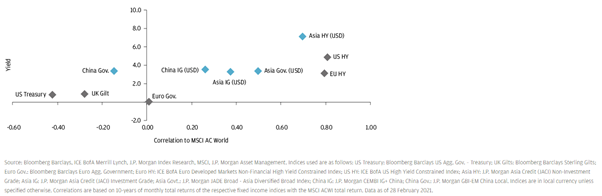
As in the developed world, debt in Asia has increased because of the pandemic, but total debt to GDP is still close to or below the level of most G7 countries. So investors willing to take the currency risk can add higher-yielding Asian bonds with an average rating of single A. Despite a higher correlation to equities than developed market government bonds, Asian bonds are still able to provide diversification benefits for portfolios (Exhibit 3).
Asian bonds provide higher yields, while still offering some diversification
Exhibit 3: Yields and correlations of fixed income returns to equities
% yield and 10-year correlation of monthly returns with MSCI AC World
Chinese renminbi bonds look particularly appealing. China’s early success in containing the Covid-19 pandemic knocked its economic cycle out of sync with the rest of the world, and with the Chinese central bank providing a less expansionary monetary policy response compared to developed economies, we would expect correlations with developed market assets to remain low for the time being.
In the past, restricted access and limited currency convertibility prevented Asian bond markets from playing a major role for global investors. But with the rising financing needs of the region, this is changing rapidly. Following the opening of the USD 15 trillion local renminbi bond market to overseas buyers, yield-starved international bond investors now have the opportunity to invest in Chinese bonds with yields north of 3%. Net cumulative foreign purchases of Chinese bonds have already accelerated by over USD 400 billion in the past four years. As has been seen since the opening of the local equity markets, index providers are beginning to reflect the growing importance of Chinese bonds, with increasing weights in bond indices likely to generate significant amounts of passive inflows in the coming years. For investors, it might be worth getting ahead of those flows.
Equity valuations
It’s not only within fixed income that valuations look more attractive in Asia than in the developed world. MSCI Asia ex Japan trades on a forward price/earnings ratio (PE) of about 16x, below Europe and significantly cheaper than the 22x earnings for the US. Valuations in India are similar to the US, but we expect the Indian economy to grow at 6.9% over the next decade, compared with 1.8% for the US. China, on about 16x earnings, is cheaper than Europe, despite the fact that we expect China’s economy to grow at 4.4%, compared with 1.3% for Europe, over the next decade. In short, long-term growth is available at a more reasonable price in Asia than elsewhere in the world.
The growth opportunity in equities
The combination of favourable demographics and fast-growing incomes continues to support the strategic investment case into Asia. Nevertheless, sceptics could argue that over the past 10 years Asian equities have not lived up to the high expectations investors had for this fast-growing region. Asian equities ex Japan have underperformed developed market equities by more than 2% per annum since 2011 – proof that high GDP growth doesn’t always translate into superior equity market performance. So why should it be any different in this new decade?
After a period of disruptive forces including the end of the commodity supercycle, trade conflict and a strong US dollar, fundamentals are shifting significantly in Asia’s favour.
We identify three structural trends that should support Asia:
Technology adoption. Worldwide technology spending is projected to reach USD 3.9 trillion in 2021. IT hardware and semiconductor companies in China, Taiwan and Korea have become global market leaders in their industries. The rise of artificial intelligence, the move to electrical vehicles and autonomous driving, and the global rollout of 5G technology will keep demand for hardware made in Asia high. India has become a hub for the market-leading IT services companies, benefiting from an estimated 6-8% increase in digital transformation spending worldwide per year over the next four years. Outside the US, Asia is the only region with a large representation of the tech sector in its equity markets. The IT sector and the communication sector combined represent a third of the overall market cap.
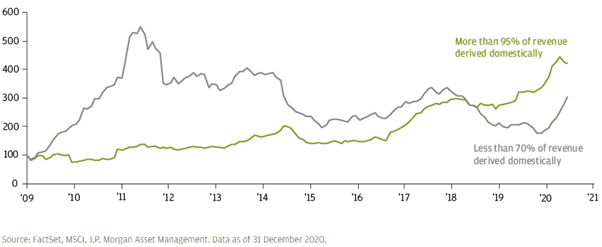
Middle class miracle. By 2030, roughly two thirds of the global middle class will live in Asia, and they are projected to spend an additional $18 trillion annually. Since 2009, Asian companies with a strong domestic focus have quadrupled their earnings, outperforming more export-oriented businesses. It’s also remarkable that domestic-focused earnings have shown significantly less volatility (Exhibit 4). Policymakers in the region will be eager to ensure that Asian companies get their fair share in satisfying future domestic demand. The new RCEP (Regional Comprehensive Economic Partnership) free trade agreement, which covers 10 ASEAN countries and China, Japan, Korea, Australia and New Zealand, can be seen as one step towards incentivising more intra-regional trade and production.
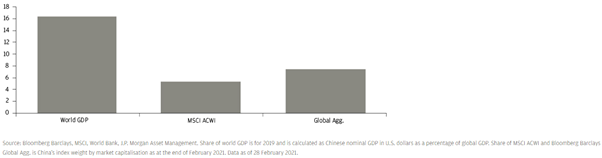
The A-share opportunity. In equity markets, China is still punching below its weight (Exhibit 5). By the end of the decade, China will likely be the largest economy in the world. One of the main obstacles for foreign investors used to be the lack of access to the full opportunity set of listed Chinese corporations. But the opening of the local stock market to foreign investors in August 2016 propelled inflows from foreign investors. Foreign ownership of onshore Chinese equities has increased to 3.8% of total market cap. Although this represents an almost trebling in foreign equity holdings in the past four years, foreign ownership levels are still way below the 27% seen in the US or 55% in the UK. So China A-shares still have a lot of catching up to do. A fast-growing domestic economy and the prospect of higher index inclusion in the future will likely continue to attract foreign capital and support demand for A-shares in the coming years.
Domestic-focused earnings have grown strongly
Exhibit 4: Domestic vs. Exports-Oriented Asian companies
MSCI AC Asia Pacific ex-Japan, earnings per share, Jan. 2009 = 100
China’s weight in bond and equity benchmarks is well below its share of global GDP
Exhibit 5: China’s weight in global GDP, equities and bond markets
% of world GDP and market capitalisations
Conclusion
Favourable trends in urbanisation and the rapid growth of the middle class provide a strong growth backdrop for the region. Better containment of the pandemic and a more moderate policy response mean investors can access higher bond yields and superior earnings growth potential within equities at more reasonable valuations than elsewhere.
The improving accessibility of local Asian bond and equity markets, together with the growing depth of investable securities and liquidity, is further enhancing the attractiveness of the region for investors. Our 2021 Long-Term Capital Market Assumptions suggest Asian equities have the potential to outperform developed markets by 2.2% a year over the next 10 to 15 years. Mounting signs that the US dollar bull market is fading further reinforce our view that the next 10 years might go down as the Asian decade.
Please continue to check back for more of our regular blog content including market updates and insights like this article.
Please see below market update received from Brooks Macdonald yesterday afternoon. The commentary provides investment analysis linked to global news.
What has happened
Whilst there was a cyclical tilt to yesterday’s equity moves, it was a far calmer backdrop with sub 1% moves for most headline US and European markets. Technology pulled back a little, however this is within the context of Tuesday’s exuberance. The US market is within a hair’s breadth of hitting an all time high which is quite remarkable given the amount of ink that has been expended talking about market volatility.
US Auction and Inflation update
The auction of $38 billion of US 10 year bond yields followed in the footsteps of the 3 year and was well received by the market. Bond yields fell again as bond investors had a sigh of relief albeit a more modest sigh after imminent fears of an auction inspired spike had subsided earlier in the week. The core (ex Energy and Food) US CPI figures came in modestly below market expectations at 1.3% year on year gain. Of course, as we have said on multiple data points, this data is arguably less useful as we haven’t yet seen the recovery or impact of the latest round of stimulus and equally the comparable a year earlier was muddied by the beginning of COVID restrictions. That said, investors were comforted that inflation remains under control for the time being.
US/China
In 2018 and 2019 one of the largest geopolitical risks was the ongoing trade war between the US and China. Whilst the Biden administration is expected to take a less antagonistic stance with China, it is not expected to entirely retreat from the battle. Yesterday the White House announced a summit with Chinese officials in Alaska in a weeks’ time. The agenda for this hasn’t been announced but Secretary of State Blinken said topics would include areas ‘where we have deep disagreements’, so the meeting isn’t merely to exchange pleasantries. This latest development is a reminder to markets that a change in the US Presidency has not removed the risk of a ‘tough on China’ stance that has bipartisan support from Congress.
What does Brooks Macdonald think
With yesterday’s inflation data and auction results giving investors little to worry about there was a sense of calm in markets. It is far too early for us to conclude that inflation will remain under control as the key data points will arrive when the recovery kicks into gear.
Please check in again with us soon for further updates.
Please see the below article from Invesco which we received late yesterday afternoon:
Key takeaways
Investing in stocks which have the right ESG momentum behind them can be a positive way for our funds to potentially generate alpha
We draw upon ESGintel, Invesco’s proprietary tool, which helps us to better understand how companies are addressing ESG issues
Engaging with companies to understand corporate strategy today in order to assess how this could evolve in the future
Our focus as active fund managers is always on finding mispriced stocks and ESG integration underpins our investment process at every stage.
The incorporation of ESG into our investment process considers ESG factors as inputs into the wider investment process as part of a holistic consideration of the investment risk and opportunity, from valuation through investment process to engagement and monitoring.
The core aspects of our ESG philosophy include materiality; ESG momentum; and engagement.
Materiality refers to the consideration of ESG issues that are financially material to the corporate or issuer we are analysing.
The concept of ESG Momentum, or improving ESG performance over time, indicates the degree of improvement of various ESG metrics and factors and help fund managers identify upside in the future. We find that companies which are improving in terms of their ESG practices may enjoy favourable financial performance in the longer term.
Engagement is part of our responsibility as active owners which we take very seriously, and we see engagement with companies as an opportunity to encourage continual improvement.
Dialogue with portfolio companies is a core part of the investment process for our investment team. As such, we often participate in board level dialogue and are instrumental in giving shareholder views on management, corporate strategy, transparency, and capital allocation as well as wider ESG aspects.
ESG integration is an ongoing strategic effort to systematically incorporate ESG Factors into fundamental analysis. The aim is to provide a 360-degree valuation of financial and non-financial materially relevant considerations and to help guide the portfolio strategy.
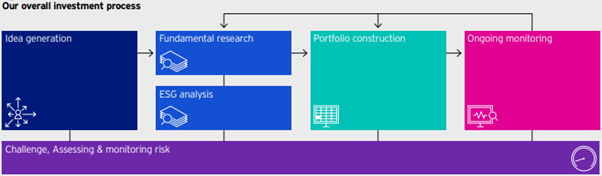
Our investment process has four stages. In this note we go through in detail how ESG is integrated into each stage of our process.
Idea Generation
Ideas come from many sources – our experienced FMs, other team members or investment floor colleagues, various company meetings, and by exploiting the intellectual capital of our sell side contacts. We see it as important to spread our nets as wide as possible when trying to come up with stock ideas which may find their way into our portfolios. We remain open minded as to the type of companies we will consider. This means not ruling out companies just because they happen to be unpopular at that time and vice versa.
ESG can create opportunities too – for example, the benefits of moving towards more sustainable sources of energy like wind, solar and hydroelectric power generation. This was one of the reasons we became interested in some of our utility holdings which are held across several portfolios. This highlights the importance of opportunities brought about by ESG and not just the risks. ESG can also influence the timing and scale of a mispricing being corrected in the market.
To be clear, at this early stage of the investment process we typically would not rule out companies with a sub-optimal ESG score. Investing in stocks which have the right ESG momentum behind them – by focussing on fundamentals and the broader investment landscape – can be a unique way for our funds to potentially generate alpha.
Fundamental Research & ESG Analysis
Research is at the core of what we do and is what the investment team spends most of its time doing. The key is to filter out those ideas which aren’t aligned with our investment philosophy and concentrating on those where we see the strongest investment case. Our fundamental analysis covers many drivers, for example, corporate strategy, market positioning, competitive dynamics, top-down fundamentals, financials, regulation, valuation, and, of course, ESG considerations, which guide our analysis throughout. The key drivers will differ according to each stock.
We use a variety of tools from different providers to measure ESG factors. In addition, at Invesco, we have developed ESGintel, Invesco’s proprietary tool built by our Global ESG research team in collaboration with our Technology Strategy Innovation and Planning (SIP) team. ESGintel provides fund managers with environmental, social and governance insights, metrics, data points and direction of change. In addition, ESGintel offers fund managers an internal rating on a company, a rating trend, and a rank against sector peers. The approach ensures a targeted focus on the issues that matter most for sustainable value creation and risk management.
This provides a holistic view on how a company’s value chain is impacted in different ways by various ESG topics, such as compensation and alignment, health and safety, and low carbon transition/ climate change.
We always try to meet with a company prior to investment. Based on our fundamental research, including any ESG findings, we focus on truly understanding the key drivers and, most importantly, the path to change. This helps us better understand corporate strategy today and how this could evolve in the future. Today, the subject of ESG is increasingly part of these discussions, led by us.
Portfolio Construction
We aim to create a well-diversified portfolio of active positions that reflect our assessment of the potential upside for each stock weighted against our assessment of the risks. Sustainability and ESG factors will be assessed alongside other fundamental drivers of valuation. The impact of any new purchases will need to be considered at a fund level. How will it affect the shape of the portfolio having regard to fund objectives, existing positions, overall size of the fund, liquidity and conviction?
We do not seek out stocks which score well on internal or third party research simply to reduce portfolio risk. We ask the question, “Why does the idea deserve a place in the portfolio?” We ask this because there is a competition for capital, a new idea will require something else to be sold or reduced so that it can be included.
Ongoing Monitoring
Our fund managers and analysts continuously monitor how the stocks are performing as well as considering possible replacements. Are the investment cases strengthening or weakening? Are their valuations reflecting the companies’ prospects appropriately? Is the company performing from an ESG perspective and are the valuations fairly reflecting the progress being made or not? Are the anticipated key drivers playing out or not? These questions, and their answers, are all of equal importance to us.
How do we monitor our holdings from an ESG perspective? Again, the same resources used during the fundamental stage are available to us. Our regular meetings with the management teams of the companies we own provides an ideal platform to discuss key ESG issues, which will be researched in advance. We draw on our own knowledge as well as relevant analysis from our ESG team and data from our previously mentioned proprietary system ESGintel which allows us to monitor progress and improvement against sector peers. Outside of company management meetings we constantly discuss as a team all relevant ESG issues, either stimulated internally or from external sources.
Additional ESG analysis is carried out by the team, when warranted, on particular companies. Depending on the particular case this is often in conjunction with the ESG team. Such cases would be those that are more controversial, considered to be higher risk and viewed poorly by ESG providers, resulting in a valuation discount. We don’t just look at the specific issue considered to be higher risk either, for example the environmental risk of an oil company, but all areas of ESG. This means undertaking extensive analysis of social and governance policies and actions at the same time. We would note that this analysis is an ongoing process, typically involving multiple engagements with the company over a long period of time. All ESG discussions and interactions are written up – including our views and thoughts – with a section solely dedicated to ESG. Likewise, research undertaken by the ESG team is available to the entire Henley investment floor, and wider business. Further analysis could be warranted as a result of these discussions.
Challenge, Assessing & Monitoring Risk
In addition to the above, there are two more formal ways in which our funds are monitored:
There is a rigorous semi-annual review process which includes a meeting led by the ESG team to assess how our various portfolios are performing from an ESG perspective. This ensures a circular process for identifying flags and monitoring of improvements over time. These meetings are important in capturing issues that have developed and evolved whilst we have been shareholders. It is our responsibility to decide if it is appropriate, or not, to investigate these issues in more detail. We may ask the ESG team to assist in undertaking more analysis or discuss such issues with the company themselves or external brokers.
There is also the ‘CIO challenge’, a formal review meeting held between the Henley Investment Centre’s CIO and each fund manager. Prior to the meeting, the Investment Oversight Team prepare a detailed review of a portfolio managed by the fund manager. This review includes a full breakdown of the ESG performance using Sustainalytics and ISS data, such as the absolute ESG performance of the fund, relative performance to benchmarks, stocks exposed to severe controversies, top and bottom ESG performers, carbon intensity and trends. The ESG team review the ESG data and develop stock specific or thematic ESG questions. The ESG performance of the fund is discussed in the CIO challenge meeting, with the CIO using the data and the stock specific questions to analyse the fund manager’s level of ESG integration. The aim of these meetings is not to prevent a fund manager from holding any specific stock: rather, what matters is that the fund manager can evidence understanding of ESG issues and show that they have been taken into consideration when building the investment case.
Conclusion
The regulatory landscape is rapidly evolving, which increasingly compels organisations and investors alike to clearly demonstrate their awareness of ESG issues in their decisions. Landmark initiatives such as the European Union’s new Sustainable Finance Disclosure Regulation (SFDR) are at the forefront of this shift.
We believe that our approach is honest, coherent and pragmatic. The principles behind ESG deserve to be embedded in an investment framework which encourages positive change. Coupling this with a focus on valuation is, to our minds, the best way to deliver strong investment outcomes for our clients’ long term. This reinforces our fundamental belief that responsible investing demands a long-term view and that a stakeholder-centric culture of ownership and stewardship is at the heart of ESG integration.
This is a good article and insight into how Invesco integrate ESG into their investment process. We would expect more fund managers to start publishing their ESG process (if they haven’t already!).
Please keep an eye out for further ESG related content from us, along with our usual market commentary and blog updates.
Please see below an article received from Brewin Dolphin yesterday (09/03/2021), which details their views on markets:
As you can see from the above, markets remain positive, although some are seeing corrections. The fiscal stimulus from governments around the world should help economies recover.
Please continue to check our Blog content for advice and planning issues and the latest investment, markets and economic updates from leading investment houses.
Please see below market analysis received from Brooks Macdonald yesterday evening. The article comments on how the continuous rise in yields is affecting market volatility and refers to political developments during Biden’s first 100 days in Office.
The US Federal Reserve (Fed) enters its communication blackout period at a crucial time for sentiment
European and US equities had a pretty subdued Friday until after the European close, when US equities picked up to close higher for the day and the week. Market expectations are now for the first Fed rate hike to occur in early 2023 and with the Fed now absent due to the communications blackout, further assumptions could be baked in given the policy void1.
Rises in yields continue to drive market volatility
US 10-year yields are now over 1% higher than their lows last August2. This is a testament to the dramatic moves seen over the last few months. Of course, for context, a circa 1.6% yield is still on a par with the lowest rates seen in 20193, so perhaps it’s remarkable that rate expectations had stayed so low in Q4 2020 when more economic optimism was being priced in. In Q2 and Q3 last year, the equity market was drawing its optimism from the low rate environment and the relative support this gave to high growth equities. Since November 2020, and the first vaccine efficacy trials, we have seen a boost to economic expectations which brought cyclical equities into vogue and has catalysed this reappraisal of bond yields. The big question in markets is whether the Fed are comfortable with this rapid rise, albeit only to 2019 lows, and to find that out we need to wait another week.
The Senate passes President Biden’s $1.9 trillion US fiscal stimulus package
The Senate passed President Biden’s $1.9 trillion package on Saturday meaning it will now move to the House for a final vote before going to the White House for Biden’s signature. The economic growth expectations that have been revised up since November 2020 take account of both the expected post-COVID-19 recovery but also the size of US stimulus. With the package’s total size having survived Congress intact, despite some concessions to moderate Democrats, we are likely to see a supercharged period of economic growth and short-term inflation.
With the Democrats only able to use the budget reconciliation process for a fiscal stimulus package once in 2021, the instinct was always to ‘go big’. Market concerns that the support would be too large and therefore inflationary has been one of several factors being priced into equity and bond markets this year. With the package likely to enter law early this week, and the Fed blackout period ongoing, rising inflation expectations could be a major driver of volatility this week.
Please check in again with us soon for more news updates and interesting analysis.
Please see the below article from JP Morgan received this morning:
‘Emerging markets pose particular ESG challenges. But factoring ESG considerations into decision making can benefit performance, and demand for more sustainable investments is helping to drive change.’ – Tilmann Galler
In our 2021 Investment Outlook, we outlined that one of the key imperatives for investors in 2021 was to understand how the global policy and regulatory initiatives behind environmental, social and governance (ESG) factors are likely to increasingly affect the macro landscape and financial sustainability of companies.
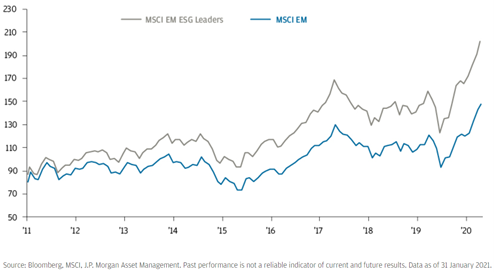
In this context, should investors shy away from investing in emerging markets given lower standards? In this piece we consider the diverse array of ESG challenges that exist in emerging markets and argue that selecting companies that are rising to the challenges and navigating a changing ESG landscape can lead to significant return opportunities, as we have already seen in recent years (Exhibit 1).
Exhibit 1: ESG leaders outperformed in emerging markets
Index level in USD, rebased to 100 at December 2010
Environment (E):
Preserving the environment and fighting climate change are becoming increasingly pressing global policy priorities. With President Biden now in the White House, the Paris Climate Agreement has been invigorated, and the discussion is likely to intensify ahead of the important regroup at the COP26 meeting in November.
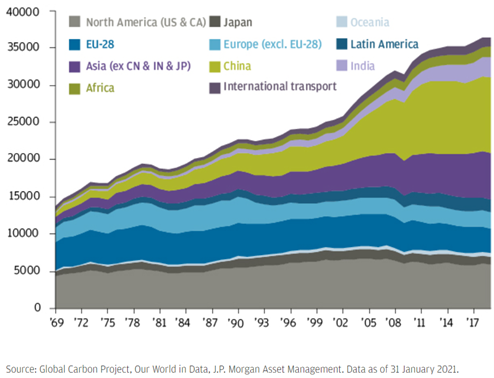
Reducing carbon emissions and aiming for carbon neutrality have been identified as important milestones. Fifty years ago, today’s developed countries contributed two thirds of global carbon emissions and emerging markets only one third. Today, total CO2 emissions have tripled, but the ratio has reversed and emerging markets contribute almost 70% (Exhibit 2).
Exhibit 2: Emerging markets are the biggest contributor to CO2 emissions
Annual total CO2 emissions by region from fossil fuels and cement production only; million tonnes
Europe and the US have committed to achieving carbon neutrality by 2050, while China has given itself an additional 10 years. Reaching these goals will require a significant alteration to the business fundamentals of corporations in carbon- intensive sectors such as energy, materials and utilities, but also for fossil fuel-dependent economies such as Russia, Saudi Arabia and South Africa. Business and economic models that fail to adjust will likely face increasing sanctions from investors and climate-committed governments.
A prominent example is the carbon border adjustment mechanism, which is currently being discussed in Europe and the US with the aim of avoiding regulatory arbitrage.
The adjustment would take into account the carbon intensity of goods sold. Countries that did not set a sufficient carbon price would be perceived to be gaining a competitive advantage and so would face tariffs at the border. But implementation is complex. Any carbon border adjustment has to be embedded into existing obligations under the World Trade Organisation and should also relate to local emissions trading schemes. There is also a risk that such a mechanism could fuel further trade conflicts and in the end evolve as a new frontier in the US-China trade war.
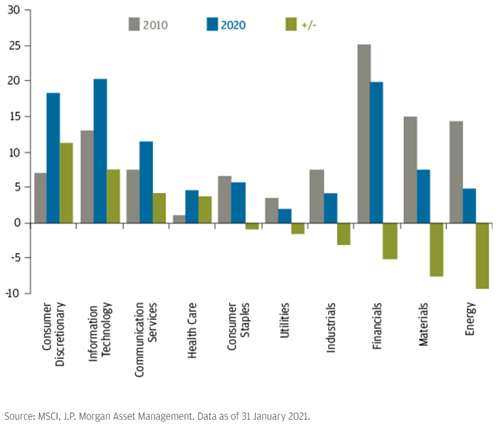
As emerging economies mature and services become a larger part of their economies, their CO2 footprints will naturally improve. We have already seen a significant decline in the market cap weighting of carbon intensive sectors in the MSCI Emerging Markets Index (Exhibit 3). Nevertheless, challenges remain, particularly in manufacturing, food processing standards, and water and waste management. Governments may be resistant to change if it is perceived to be an impediment to GDP and income growth. But emerging market companies that are part of an international supply chain will have to improve their standards, because large multinational companies are beginning to optimise their value chains for ESG criteria. Failing to adapt will be a significant disadvantage in the global competitive landscape. We therefore expect that transition will, in many cases, be faster on a corporate level than in government policy.
Exhibit 3: MSCI Emerging markets sector weights
Social (S):
Human rights, labour and health conditions, and diversity are social criteria on which businesses operating in emerging markets are facing increased scrutiny. Growing awareness from consumers and investors worldwide is putting governments and corporates under pressure to improve – with social media bringing increased visibility of the issues. The Foxconn labour abuse controversy is a good example. Reports of poor working conditions in the company’s Chinese factories, where it manufactures products for Apple, created a very negative global feedback loop. Companies exploiting employees and the communities they operate in are risking significant reputational damage on a global basis.
Governance (G):
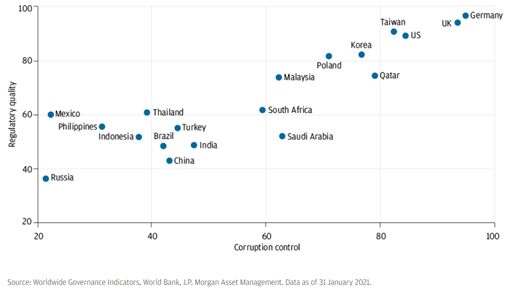
While environmental and social factors are gaining prominence, governance issues such as regulation, corruption, transparency and share-/bondholder rights have long been important considerations for investors in emerging markets. World Bank Indicators provide a useful top-level indication of the countries that require particular investor vigilance and those that already have higher standards in place (Exhibit 4). However, it’s important to keep in mind that these indicators provide just a snapshot of the current status and that the dynamics in corruption and regulation are quite different across the regions. In the past 10 years, Asian countries, on average, have showed significantly more improvement than Latin American, where the situation has deteriorated. Even if countries are engaging in more sustainable policy and introducing stewardship codes, like Korea,Taiwan, and Brazil in 2016, results can differ widely. The investment world will watch China’s next five-year plan closely to see whether financial sector reform and stricter environmental regulation will also improve government stewardship.
Exhibit 4: Corruption control and regulatory quality per country
Percentile rank indicates the country’s rank among all countries covered by the aggregate indicator, with 0 corresponding to lowest rank, and 100 to highest rank.
A key issue in emerging markets on a corporate level is ownership. The free float of the MSCI Emerging Markets is only 50%, compared to nearly 90% for developed markets. Investing in emerging markets generally means that you are in a minority position, because the entity is controlled by either the state, individuals or families. The risk for investors is that the company management is not only pursuing economic goals. Close relationships to government officials are also detrimental to efforts to fight anticompetitive practices, corruption and bribery and protect shareholder rights. Engagement is crucial to get a clearer picture of the management’s commitment to improving governance. Compared with developed markets, the power to induce change through voting in shareholders’ meetings is more limited.
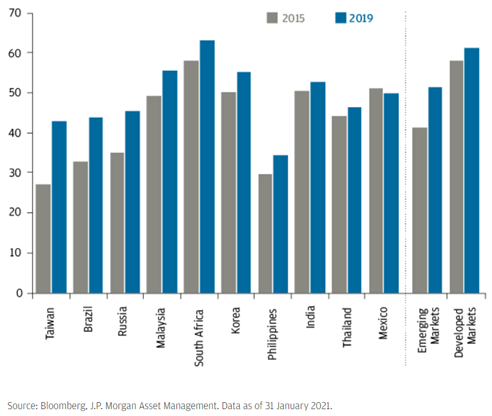
However, policymakers in emerging markets are reacting to the increased demands for better governance. For instance, the introduction of corporate governance codes in Taiwan (2010), Brazil (2016), and Russia (2014) improved the representation of independent directors on boards. In emerging markets overall, such representation has increased by 10 percentage points to 51% in the past four years. Governance standards in South Africa are already close to those in developed markets.
Exhibit 5: Governance is improving in emerging markets
Average % of independent directors in selected emerging markets
Conclusion
Emerging markets and ESG represent the place where two investment mega-trends come together. The dynamic growth of emerging markets will lead to a significantly higher representation in portfolios in the next 10 years. At the same time, due to investor preferences and developed world capital regulation, we are seeing a growing preference for investments that meet ESG criteria.
Emerging markets are not homogenous on a country nor a corporate level. But growth and sustainability can be reconciled through careful company research and engagement. Companies that are the beneficiaries of fast growth in their local markets, but which at the same time demonstrate an awareness and desire to meet global ESG standards, have sustainable business models. Indeed, ESG characteristics often serves as a proxy for quality, since companies that screen well are often managed with a long-term view, with higher levels of broad R&D and innovation.
In summary, we do not see that investing in emerging markets sits in opposition to the world’s broader ESG ambitions – the opposite might be the case. By demanding higher ESG standards, investors are helping to accelerate the pace of change. The scope for improvement in sustainable outcomes is significant and the consideration of ESG factors in this asset class provides ample return opportunities for long-term investors.
Please continue to check back for more ESG related insights along with our usual market updates and commentary.
Please see the below article received by AJ Bell late last night:
On average a Tory occupant of Number 11 has been better for ‘real returns’.
The Conservative Party’s Benjamin Disraeli, twice prime minister and thrice chancellor of the exchequer, once said of his bitterest political rival, who held each post on four occasions: ‘Well, if Mr Gladstone fell into the Thames that would be a misfortune; and if anybody pulled him out, that would be a calamity.’
The Tories’ latest Chancellor, Rishi Sunak, will be hoping for a warmer welcome for Wednesday’s Budget (3 March) and he is likely to measure success in terms of jobs, economic growth and ultimately opinion polls and votes.
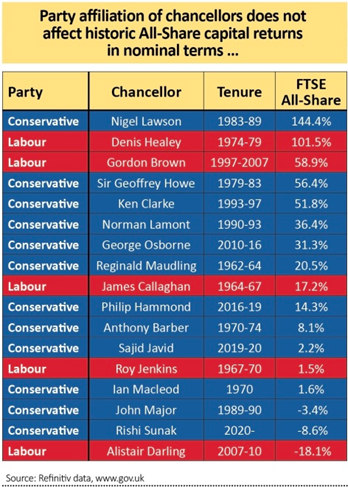
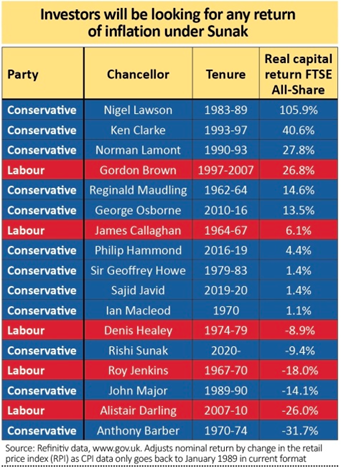
Investors will be looking to their portfolios to gauge the effect of his policies and history suggests that the UK stock market has, for whatever reason, done better on average under Conservative chancellors than Labour ones, at least once inflation is taken into account.
Party On
Since the inception of the FTSE All-Share index in 1962, the UK has had 17 chancellors, 12 of whom have been Conservative and five Labour.
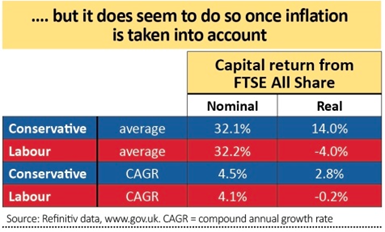
At first glance, there is nothing in it between the two parties. Under Conservative chancellors, the FTSE All-Share has chalked up a total capital gain of 355%, in nominal terms.
That equates to an average advance per chancellor of 32.1% (including Macleod’s brief term with that of his successor, Anthony Barber), while under Labour the benchmark has risen by 161% for an average gain of 32.2%.
Across 34 years of Tory chancellorships that is a compound annual growth rate (CAGR) of 4.5% against 4.1% under 24 years of Labour in 11 Downing Street and two of the top-five best spells under a single chancellor actually come under Labour, again in nominal terms.
However, the picture changes profoundly when inflation is taken into account and capital returns from the FTSE All-Share are assessed in real (post-inflation) terms rather than nominal ones.
Here, Conservative chancellors come out well on top, as the withering effect of inflation upon investors’ returns from the stock market under Labour’s Healey chancellorship of the mid-to-late 1970s comes into play.
It must be noted that inflation also chewed up the nominal gains made by the FTSE All-Share under the Tory chancellors Sir Geoffrey Howe (1979-83) and Tony Barber (1970-74).
Beware A Return to Barber
As financial markets today ponder whether inflation is about to make a return, and the yield on the benchmark UK ten-year bond, or gilt, rises as prices fall, a repeat of the ‘Barber Boom’ is something that Sunak will be determined to avoid, even if he will be looking to support and boost growth as best he can, as the economic fall-out that followed was very painful for the UK and so painful that the Tories fell from office after a pair of general elections in 1974.
Not all of the inflation that tore through the British economy could be laid at the door of Barber’s policies, as the 1973 oil price shock had a huge amount to do with it, and this highlights the importance of factors which are beyond the control of any chancellor, no matter how diligent or skilled.
Alastair Darling could hardly have expected to inherit the 2007/8 financial crisis which prompted a deep recession and a wicked bear stock market. Norman Lamont inherited British membership of the Exchange Rate Mechanism, fought to defend the pound and a policy in which he did not believe and oversaw a devaluation of sterling which actually helped the FTSE All-Share to rally.
Sunak has had to contend with Covid-19 and the worst recession for three centuries, so perhaps he has been given the worst hand of all.
Even so, investors, looking at the world through the narrow perspective of their portfolios, will be wanting Sunak to think back to Barber. Inflation mangled portfolio returns for much of the 1970s and all the way through to the Thatcher-Howe prime Minister-chancellor team of 1979-83. Bizarre as it may sound, markets may therefore want to see a little inflation – and growth – but not too much, especially as any sustained surge in prices could force bond yields higher and even oblige the Bank of England to act and raise interest rates.
Markets came close to falling out of bed last week, as they pondered such a prospect, so as ever Sunak has a difficult balancing act going forward, as he juggles growth, jobs, the deficit and inflation, as well as votes.
Please continue to check back for more of our regular blog content.
Please see below article received from Jupiter yesterday evening, which analyses whether the measures announced by Rishi Sunak in Budget 2021 will sustain the UK’s economic and financial market recovery in the years ahead.
In every downturn, the UK Government’s finances turn down sharply. Tax receipts fall as job losses, bankruptcies and subdued spending impact the three big sources of revenue for the Treasury – income tax, National Insurance and VAT. But Government spending must rise to cushion the impact of a recession, through unemployment benefits and welfare payments.
There is always a moment at the depths of a downturn when the Government’s budget deficit looks awful and the prospect of a return to more balanced books nigh impossible.
Clearly this pandemic has a rather different dynamic, as the Government measures to support the economy from complete collapse during extended lockdowns, has pushed their spending to levels unprecedented outside wartime. Roughly 75% of the increase in the budget deficit has arisen due to these support measures – about £200bn. Today’s extension of such support until September will only increase the scale of this spending, all funded through borrowing.
Whilst tax receipts have fallen during the pandemic, they have done so only modestly – testimony to the success of the support in limiting the rise in unemployment and bankruptcies thus far. Tax receipts as a percentage of GDP have remained roughly in line with their long run average of 37% of GDP.
Government spending, by contrast, has risen from its more usual level of 40% of GDP to 55% and rising. Hence the Chancellor’s desire to ‘level with the British people’ on the unsustainability of current levels of borrowing and spending by Government and the need to rebuild public finances in the future.
The risk of raising taxes too soon into the post-pandemic recovery is that it saps the strength of the recovery. I believe there is bound to be a surge in consumer spending as individuals and families enjoy their freedom from lockdown to shop, eat out and holiday. But it won’t be until well into 2022 before we know the full scale of the likely bankruptcies to come, the peak levels unemployment will reach – today’s more upbeat forecast notwithstanding – nor the longer-term psychological impact on consumers of the pandemic on spending and saving habits.
Crucially, though, the Chancellor needs to remember the lesson of all his predecessors in the depths of a recession. The cyclicality of Government finances means that as the economy recovers, automatically Government spending will fall and tax receipts will rise. The end to Government support measures and a resumption of consumer spending will boost VAT receipts just as the support cheques cease to be written; in this regard, I believe the transition measures announced today are to be welcomed.
Clearly though, one of the most significant of today’s announcements is the planned increase in Corporation Tax as of April 2023 from the current 19% to 25%. While this does indeed give businesses clarity, it is nevertheless a substantial increase, which will in time impact on companies’ ability to return profits to shareholders, and at variance with widely held expectations that such hikes would begin sooner and would be more gradual in their introduction.
Investors will be considering the impact of this pending rise and will be asking themselves to what extent it can be offset by the generous-sounding 130% “super deduction” on business investment. While this is, in my view, an innovative and progressive policy, taken together with the upcoming rise in Corporation Tax, it is likely to mean that the economic growth benefits resulting from the policy will be somewhat front loaded.
Meanwhile, the decision to maintain income tax, National Insurance and VAT at their current levels should provide some support consumer confidence and household budgets as the country emerges from the pandemic. Nevertheless, the Chancellor’s explicit announcements of upcoming fiscal drag – the result of not adjusting taxation thresholds to take account of future inflation – reflects the reality of the situation of the post-pandemic economy. Although this is undoubtedly a progressive policy, put simply, the higher inflation rises, the more the Treasury is likely to benefit. Over time, should we enter a more inflationary environment, in public finance terms this may well turn out to have been a prudent decision, given the impact of rising inflation on the cost of servicing our national debt.
Turning to the UK equity market, it was no surprise to see rising share prices among those businesses that should be beneficiaries of further support to the domestic economy, such as banks and leisure stocks, alongside housebuilders. The latter may well benefit from the extension of the stamp duty holiday and mortgage guarantee programme, as well as a more benign backdrop through the extension of Government support through the summer’s transition from lockdown and re-opening to the end of measures such as the furlough scheme.
Looking to the longer term, to my mind, the truly prudent but wise Chancellor will not risk the upturn by setting out a plan for increased taxation in the years ahead, but keep his powder dry to see just how radically Treasury finances improve over the coming year, without any action on his part whatsoever. While today’s Budget announcements appear well placed to support the transition to life after the pandemic over the next couple of years, it remains to be seen whether the “front-loading” of business incentives to spend now but be taxed later leads to a slowdown in growth thereafter which might not have been necessary.
We will continue to publish relevant content and news as the vaccine roll-out in the UK continues to expand and the light at the end of the tunnel brightens. Please therefore, check in again with us soon.