Team No Comments

Invesco – Why investors both love and fear the Fed

Please see article below from Invesco received this morning – 31/03/2021

Why investors both love and fear the Fed

Kristina Hooper – Chief Global Market Strategist, Invesco Ltd

Key takeaways

Investors fear the Fed
Stocks have been volatile due to fears about what the Fed would do if inflation rises.

But they also love its policies
While stock market investors fear the Fed, they also love its easy money policies.

If you had to quickly describe the relationship status between investors and the Federal Reserve, your best bet might simply be: “It’s complicated.”

Stocks are moving up and down, and leadership in the stock market is rotating, based on market fears of inflation — or, to put it more accurately, fears about what the Fed will do if inflation does rise. But while stock market investors fear the Fed, they also love all the good things it has done for them. After all, the great stock market rally that began in March 2009 can be largely attributed to the Fed’s extraordinarily accommodative monetary policy — especially its quantitative easing. And the year-long rally that began in March 2020 has the Fed’s easy money fingerprints all over it. In other words, investors have developed a powerful bond — some might say a dependency — with the central bank.

The Fed’s reassurances have fallen flat

Now the good news is that the Fed is trying to be sensitive to investors’ wariness about what it might do next. Fed Chair Jay Powell doesn’t want stock market investors to worry. At every turn, he has tried to reassure them that the Fed will maintain its easy money policies for some time to come and that any rise in inflation will be transitory. Last week, for example, Powell was on Capitol Hill, providing comfort and reassurance. He made it clear that he wasn’t concerned about the rise in long-term bond yields, suggesting that they reflect growing optimism: “It seems that rates have responded to news about vaccination and ultimately about growth.” 1 Powell stressed that it has been orderly and that the Fed would only react if it is disorderly.

Powell reiterated that he doesn’t believe long-term price trends will be changed by the most recent fiscal stimulus package, supply-chain bottlenecks, or a surge in consumer demand, which is widely expected to come later this year as the economy re-opens. Powell said that while the Fed expects upward pressure on prices, he expects it will be transitory. He was emphatic: “Long term, we think that the inflation dynamics that we’ve seen around the world for a quarter of a century are essentially intact. We’ve got a world that’s short of demand with very low inflation … and we think that those dynamics haven’t gone away overnight and won’t.” 1. But investors didn’t believe him, based on the stock market reaction that day — they’re still wary that inflation will go up and the Fed will be forced to tighten.

It seems that market participants want to believe the worst of the Fed. They don’t believe Powell when he utters dovish words, but they latch onto any comments that can be perceived as hawkish. On Thursday, Powell gave an interview to NPR. He reiterated many of the reassurances he provided on Capitol Hill earlier in the week. He also shared his optimistic economic outlook for 2021. However, he also tried to be honest and transparent by stating the obvious: “… as we make substantial further progress toward our goals, we will gradually roll back the amount of Treasuries and mortgage-backed securities we’re buying.”2 He talked about raising interest rates in the longer run, but said that such tightening would be very gradual and transparent. However, that sent stock market investors into a panic. The NASDAQ Composite Index, S&P 500 Index, and Dow Jones Industrial Average all dropped significantly in just a few hours before investors regained their senses and started buying.

Investors have to wait and see how the Fed would respond to inflation

My best advice is that investors shouldn’t let the Fed — or any central bank — overly influence their long-term investment strategy. I believe the Fed will honor Powell’s pledges, but many market participants are clearly skeptical. These participants must come to terms with the fact that they won’t know if Powell will follow through on his assurances until inflation actually spikes and the Fed has the opportunity to insist it is transitory and sit on its hands. They won’t know if the Fed has really abandoned pre-emptive tightening until it proves to us that it has.

The silver lining of this environment — in which so many investors have allowed themselves to be dependent on the Fed — is that other investors can take advantage of “Fedspeak”-related sell-offs, which can create tactical buying opportunities for investors with a longer time horizon. And if markets actually become disorderly, I believe Powell will likely step in.

Is the Fed the only source of concern for investors? No, there are others. But the lesson is the same: Instead of parsing — and panicking about — every utterance from Powell and others, I believe investors’ time would be better spent focusing on fundamentals and long-term goals.

Looking ahead

In the coming week, I’ll be paying close attention to COVID-19 infections in Europe. The region is in the throes of a third wave of infections, which threatens to be the worst of the waves. This is not dissimilar to the third wave that the US experienced several months ago, which was its worst wave. Unfortunately, Europe’s vaccine rollout has been disappointing to say the least, and more infectious strains of the virus are spreading quickly. Lockdowns are being extended and could become more stringent as government officials warn that hospitals are being overwhelmed. This could further delay the eurozone’s economic recovery, which has already been delayed by the slow vaccine rollout. The ability to control infections in the eurozone is critical.

I’ll also be paying attention to China’s economy, with the government’s manufacturing and non-manufacturing Purchasing Managers’ Indexes (PMI) and the Caixin manufacturing PMI being released this week. China’s economic recovery has been strong thus far this year, and I want to make sure there are no negative surprises in the offing.

I’ll also be following the volatility in stocks created by the fallout from the Archegos hedge fund unwinding. I think this is not dissimilar to the volatility created by Reddit-related stocks such as GameStop that we experienced earlier this year: I don’t see this as a source of widespread contagion, although it will likely weigh down some specific stocks over the shorter term. 

And finally, I will be paying attention to Friday’s US jobs report. I suspect non-farm payrolls will be very strong for the month of March, beating expectations, but could trigger a rise in the 10-year yield and concerns about inflation — and therefore stock market jitters — as investors are likely to worry again about whether the Fed will really sit on its hands …  

Please continue to check back for our regular blog posts including market updates and insights like this article.

Charlotte Ennis

31/03/2021

Team No Comments

Equities mixed as third wave undermines recovery

Please see below article received from Brewin Dolphin yesterday evening, which analyses the performance of markets in relation to the big news events of the past week. 

Global equities were mixed last week after renewed lockdown restrictions in Europe dented hopes of a broad economic reopening.

Stock markets in Asia suffered the most, with Japan’s Nikkei declining 2.1% and Hong Kong’s Hang Seng falling 2.3%. In Japan, the recent lifting of the state of emergency in Tokyo provided some optimism, but this was outweighed by concerns that Europe’s third wave of Covid-19 infections could delay the global economic recovery.

France’s CAC 40 ended the week in the red after the country extended its lockdown to cover a third of the country. Germany’s Dax and the UK’s FTSE 100 posted gains of 0.5% and 0.9%, respectively, following a rebound on Wall Street and positive UK retail sales data.

In the US, the S&P 500 edged up 1.6% following Joe Biden’s pledge to vaccinate 200m Americans in the first 100 days of his administration – double his previous target. Energy stocks performed particularly strongly after the closure of the Suez Canal boosted oil prices. The Nasdaq declined 0.6% amid ongoing interest rate and inflation concerns.

Stocks flat after hedge fund fire sale

Stock markets were largely flat on Monday as investors turned their attention to the fall-out from the collapse of family office hedge fund Archegos Capital Management.

Archegos was forced to sell billions of dollars’ worth of shares after its positions turned sour, prompting a margin call from its prime brokers. Nomura and Credit Suisse, who were among the banks handling Archegos’ trades, warned of significant losses after Archegos defaulted on the margin calls, forcing brokers to dump shares.

So far, the impact of the fire sale has been limited to the stocks that were part of Archegos’ portfolio and its banking and brokerage partners. The Dow edged up 0.3% on Monday, while the S&P 500 and the Nasdaq ended the day down 0.1% and 0.6%, respectively.

European shares also managed to brush off the fall-out from Archegos, with the STOXX 600 adding 0.1% and Germany’s Dax gaining 0.5%. The FTSE 100 closed down 0.1% as the pound gained 0.03% on the dollar.

The FTSE 100 was up 0.7% in early trading on Tuesday, following encouraging news about the vaccine roll out in the UK and the US.

Suez Canal blockage disrupts trade

Last week’s headlines were dominated by the blockage of the Suez Canal – one of the world’s busiest trading routes. On 23 March, the 200,000-tonne ship Ever Given ran aground, resulting in a queue of approximately 370 ships either side. Some ships resorted to rerouting around the southern tip of Africa.

Around 12% of world trade flows through the canal, carrying more than $1trn worth of goods every year. Delays can cause severe disruption to supply chains, ultimately leading to a shortage of goods and higher prices. On the day after the ship ran aground, there was a 5.8% spike in the price of Brent crude oil.

The Ever Given was finally freed yesterday (29 March), but clearing the backlog of container vessels, tankers and bulk carriers is expected to take several days.

Europe extends lockdown restrictions

Last week also saw renewed lockdown restrictions in several European counties, as a third wave of Covid-19 infections spreads across the continent.

Data released on Sunday revealed the number of new Covid-19 patients in intensive care units in France has risen to 4,872 – close to the November peak but below the high of 7,000 in April 2020. In Germany, the incidence of the virus per 100,000 rose to 130 on Sunday, from 104 a week ago.

Rising infections, a slow vaccine rollout and renewed lockdown measures are threatening Europe’s economic recovery. The European Commission is calling for tougher controls on vaccine exports, after its own data suggested 77m doses have been exported outside the bloc, while 88m doses have been delivered to its members.

Vaccine rollout affecting services recovery

The speed at which vaccines are being distributed is having a profound effect on the recovery of the global services sector. In the eurozone, the manufacturing PMI has surged to a three-year high, whereas the services PMI is stuck in contractionary territory below 50. The recovery in services is expected to be pushed back because of delays in issuing the vaccine and the surge in new coronavirus cases.

In contrast, the UK’s services sector is outpacing manufacturing for the first time since the start of the pandemic. In March, the services PMI rose to a sevenmonth high of 56.8, while the manufacturing PMI stood at a three-month high of 55.6. The rebound in services suggests businesses are getting ready for a reopening from mid-April.

Meanwhile, the US manufacturing PMI rose to 59.0 in March, while the services PMI increased to 60.0 from 59.8. The University of Michigan revised its gauge of March consumer sentiment to 84.9, its highest level in a year, while weekly jobless claims fell more than expected to 684,000. Sales of existing and new homes tumbled in February, but this was largely because of severe winter weather.

We will continue to publish relevant content as lockdown restrictions begin to ease over coming the coming weeks. Please check in again with us soon.

Stay safe.

Chloe

31/03/2021

Team No Comments

LGIM Blog

Please see below the latest article received from Legal & General Investment Management’s Asset Allocation Team which was received yesterday afternoon and covers their views on a number of topics:

Please continue to check our Blog content for advice and planning issues and the latest investment, markets and economic updates from leading investment houses.

Please keep safe and healthy.

Carl Mitchell – Dip PFS

IFA and Paraplanner

30/03/2021

Team No Comments

Invesco – China to see significant growth in ESG investments

Please see the article below from Invesco which we received on Friday afternoon – 26/03/2021

China to see significant growth in ESG investments

Highlights

+ Invesco Fixed Income expects responsible investing to accelerate in China in 2021.

+ Recent developments have encouraged Chinese issuers and investors to adopt social investing principles, including growing Chinese government support, large-scale green financing needs, and evidence that ESG-related investments have performed well relative to non-ESG investments.

+ Europe and the US have been early adopters of ESG principles, but we expect Asia, and especially China, to gain ground in the coming year.

Responsible investment has taken centre stage in the global investing and finance arena after years of evolution. The number of global investor signatories to the United Nations Principles for Responsible Investment (UN PRI)1 topped 3000 in 2020, up from 63 in 2006 (Figure 1). Total assets under management represented by the signatories exceeded USD100 trillion in 2020 (Figure 1). We expect responsible investment to grow exponentially in the next few years, reshaping the landscape of the global financial industry. Europe and the US currently play leading roles, but we believe 2021 will be an important year for environmental, social, and governance (ESG) adoption in Asia, especially in China.

In this article, we take a detailed look at the top-down drivers of growth in ESG adoption in China and their potential impact in the coming year.

Key themes for 2021

We have identified three key themes likely to drive momentum in responsible investing in China in 2021:

1. Chinese government and regulator-led efforts will likely gain traction among fixed income issuers and investors. An estimated USD100 trillion2 of climate-compatible infrastructure investment is required globally between now and 2030 to meet Paris Agreement greenhouse gas emission reduction targets. A large portion of these investments will likely take place in Asia and in China, in particular. We expect 2021 to be an important year in this effort. According to Governor Yi Gang of the People’s Bank of China (PBoC), the value of China’s onshore green lending and green bond issuance reached record levels in the third quarter of 2020, totaling RMB11.6 trillion3 (USD1.8 trillion) and RMB1.2 trillion4 (USD186 billion), respectively. Chairman Xi Jinping set a key milestone in September 2020 when he announced China’s objective to meet stricter greenhouse gas emission standards by 2030 and intentions to achieve a zero-carbon economy by 2060. This is the first time the Chinese central government has committed to a zero-carbon target. PBoC Governor Yi Gang later stated that China would work to enhance its green finance standards and explore the introduction of mandatory reporting of environmental risks by financial institutions. These announcements coincided with the government’s mid-year announcement of its economic stimulus package to combat the COVID-19 crisis. It emphasized advancing the adoption of green technology and upgrading urban infrastructure to mitigate the risks of pollutants and contaminants to the general public. Chinese regulators also set a goal for mandatory ESG disclosure by listed companies by the end of 2020, now expected to be 2021 due to the pandemic. These are major steps toward the development of ESG principles in China and the building of a green financial and clean energy system, especially since China’s state-owned enterprises and central planning play a significant role in the nation’s economic and financial activities. These PBoC and regulator-led efforts could narrow the gap that currently exists between Chinese domestic and international ESG reporting standards, which could attract international ESG investors.

2. Total ESG investment and financing will likely continue to set records globally. The issuance of green bonds will likely overtake the social bond issuance that took place following the impact of COVID-19 in Asia. The value of global assets that apply ESG data to drive investment decisions has almost doubled over the last four years to USD40.5 trillion in 2020, according to research firm Optimas.4 Morningstar has reported that sustainable funds broke records in Europe, the US, and Asia in the first nine months of 2020 (defined as ESG integration, impact, and sustainable-oriented funds) in terms of net inflows and total assets under management. Europe and the US attracted USD61.6 billion5 and USD30.7 billion6 in inflows, respectively, reaching USD1 trillion and USD179.1 billion in net assets (Figure 2). In terms of ESG bond issuance (green, social, sustainable, and sustainability-linked securities), the European, US, and Asian markets issued USD254 billion, USD79 billion, and USD77.2 billion, respectively (Figure 3), breaking records in their corresponding regions. These figures demonstrate a strong and consistent global trend in ESG asset growth and the potential for Asian nations, especially China, which is the largest ESG bond issuer in the region, to catch up with global leaders.

In 2020, Asia saw a pause in green bond issuance, largely due to the shift toward social bond issuance, as many countries issued social bonds to finance COVID-19 containment. We expect the decline of green bond issuance to reverse in 2021 as environmental issues and goals return to the forefront of long-term societal objectives. The sustainable investment think tank, Climate Bonds Initiative, expects China to require RMB3 trillion to RMB4 trillion6 (USD462 billion to USD620 billion) in green investment annually by 2030. Over the longer term, we expect China to play a leading role in green financing, especially considering the government’s commitment to carbon neutrality and clean energy in the coming decades.

3. ESG investments will likely be more resilient than, or outperform, non-ESG investments in 2021, based on empirical research. In a 2020 study, Invesco Fixed Income found that Asian green bonds outperformed the BofA Asian Corporate Bond Index by 120 basis points during the four-month window surrounding the March 2020 market sell-off.7 The general outperformance of green bonds globally has been studied by numerous other institutions as well. The Climate Bond Initiative, which published a quarterly study on green bond markets as early as 2016, found a general green bond premium across corporate bonds denominated in different currencies. A study by MSCI looked at corporate bond data from January 2014 to July 2020 and concluded that companies highly rated for ESG factors outperformed companies with low ESG ratings.

The outperformance of ESG-themed investments is broad-based and not limited to fixed income investments. ESG equity funds have generally outperformed in the Chinese domestic market, for example. The Ping An Insurance Group found that the annualized returns of ESG and pan-ESG concept equity funds were 47.1% and 56.4%, respectively, both outperforming the average return of 42.2% for overall equity funds.9 In the past 12 months, the MSCI China Environment Index rose 109%,10 driven by its holdings of electric vehicle makers.

We believe the growing empirical evidence of past outperformance of green bond and ESG-based investments will motivate investors to focus greater attention on responsible and ESG-themed investments. PricewaterhouseCoopers has suggested that ESG investment is likely to be the most significant development in money management since the creation of the ETF two decades ago. It forecasts that ESG will reshape finance and make up 41%-57% 11 of total managed investments by 2025. Given Asia’s potential to catch up to global peers, we believe ESG investing and finance will present a particular opportunity in Asia, and especially China.

Conclusion

We expect the trend toward responsible and ESG investment to accelerate globally, especially in China, over the next five to 10 years due in part to the world’s large-scale green financing requirements and a growing investor base and awareness. A high growth phase of responsible and ESG investment in China will likely be fueled by Chinese government policy support, substantial green financing requirements and the growing empirical evidence that ESG investments may be more resilient than and potentially outperform non-ESG investments.

A good input from Invesco, looking into ESG investment in China which is expected to increase significantly over the next 5 to 10 years, especially with evidence that ESG-related investments have performed well in relation to non-ESG investments.

Please continue to check back for further ESG related content, along with our usual market commentary and blog updates.

Charlotte Ennis

29/03/2021

Team No Comments

Why emerging market financials are different

Please see below article received from AJ Bell yesterday afternoon, which presents the advantages of investing in emerging markets. The commentary advises that there is more scope for growth in this area due to large populations having no access to banking services.  

In the developed world the banking and wider financial industry is very mature with limited avenues for rapid growth and the focus from an investment perspective is typically on the income they pay out – subject to regulators’ approval.

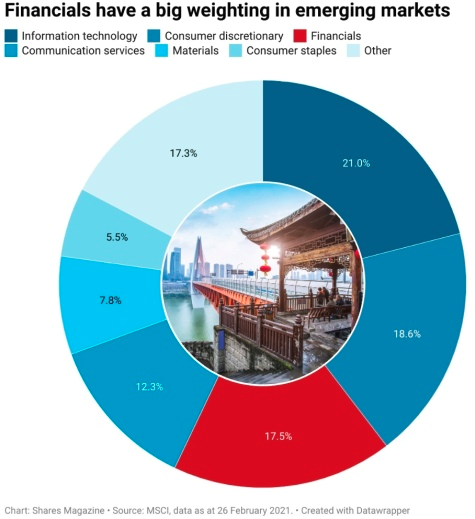
Financial stocks in emerging markets are, on the whole, quite different. While technology firms have increased in importance in recent years, financial stocks remain a key component of the emerging markets story with the MSCI Emerging Markets index having a 17.5% weighting to this sector.

In contrast the MSCI World developed markets index has a weighting of 13.6% to the financial sector.

According to a 2017 report from the World Bank about 1.7 billion adults globally and 58% of people in developing nations remained ‘unbanked’ – although there is considerable diversity across different geographic regions.

Capturing these customers should allow emerging market financial firms to grow more rapidly than their counterparts in the West. It explains why Prudential (PRU) has pivoted away from markets in Europe and the US to focus more on Asia.

The question of how these unbanked customers are reached is an interesting one with financial technology and mobile payments, in particular, likely to play an increasing role.

The same 2017 World Bank report commented: ‘The benefits from financial inclusion can be wide ranging. For example, studies have shown that mobile money services — which allow users to store and transfer funds through a mobile phone — can help improve people’s income earning potential and thus reduce poverty.’

Please check in again with us soon for further market analysis and news.

Stay safe.

Chloe

26/03/2021

Team No Comments

Brewin Dolphin – Markets in a Minute

Please see below this weeks update on markets from Brewin Dolphin. This update was received late yesterday afternoon:

Please continue to check our Blog content for advice and planning issues and the latest investment, markets and economic updates from leading investment houses.

Please keep safe and healthy.

Carl Mitchell – Dip PFS

IFA and Paraplanner

24/03/2021

Team No Comments

Brooks Macdonald – Weekly Market Commentary

Please see below this week’s Market Commentary from Brooks Macdonald, received late yesterday afternoon – 22/03/2021

Weekly Market Commentary | EU leaders to meet this week as concerns continue over vaccination pace

  • Weekly Market Commentary
  • COVID-19 updates

By Edward Park

  • Bond yields remain the primary driver of risk assets as central bank meetings conclude
  • Purchasing Managers’ Index (PMI) data to be released on Wednesday will highlight the relative successes between Europe and the US
  • Thursday’s European summit is likely to focus on the vaccine rollout and COVID-19 cases

Bond yields remain the primary driver of risk assets as central bank meetings conclude

Bond yields continued to climb last week with the effect that the US index closed marginally down but the European market, with a greater weighting to cyclicals, eked out a small gain for the week.

Purchasing Managers’ Index (PMI) data to be released on Wednesday will highlight the relative successes between Europe and the US

With a week of major central bank meetings behind us (though Powell and Yellen are speaking to Congress on Tuesday and Wednesday), markets are likely to start taking their direction from economic data. On Wednesday, flash PMI (economic survey) data will be released from around the world. Of note will be the headline differential between the US and European PMI data. US data is expected to be helped along by imminent stimulus cheques and loosening COVID-19 restrictions. By contrast, European countries are moving the other way with their COVID-19 cases and lockdowns are being announced across the continent.

Thursday’s European summit is likely to focus on the vaccine rollout and COVID-19 cases

On Thursday, EU leaders are holding their latest European Council summit in Brussels and, more than likely, COVID-19 and the vaccine rollout will feature heavily on the agenda. Having previously been held as a beacon of European solidarity during the COVID-19 pandemic in 2020, the European Commission’s strategy of joint vaccine procurement and delivery continues to be judged by many as being too slow and bureaucratic. The shortfall of pace of immunisation among the EU member countries versus the likes of the US and UK remains stark. Risking a rise in vaccine nationalism, the European Commission President von der Leyen has refused to rule out using Article 122 of the EU treaty. Article 122 would, in theory, allow the EU to take control of the production and distribution of vaccines, potentially placing export controls on vaccines that had been destined elsewhere, such as the UK.

While ultimately our expectation is that the vaccine lag for the EU will last maybe one or two quarters at most, it risks keeping EU member countries’ economies in various degrees of more stringent lockdown. At the same time, the length of time it is taking to effect fiscal spending disbursements from the EU’s Recovery Fund, which was agreed in July 2020, is also risking a later recovery path than what is currently expected in some other countries globally.

A good update from Brooks Macdonald on recent economic data and market news.

Please continue to check back for our latest updates and blog posts.

Charlotte Ennis

23/03/2021

Team No Comments

Lessons one year on from the low

As we reach the anniversary of the UK’s first national lockdown, please see below article received from AJ Bell yesterday, which reflects on how different parts of the market performed during the pandemic.

It was Warren Buffett’s mentor, Benjamin Graham, who once wrote: ‘The intelligent investor is a realist who sells to optimists and buys from pessimists.’ Such plain-speaking, common sense has yet again proved its worth over the past 12 months to offer a timely lesson to us all.

It is almost a year to the day (23 March 2020) since the FTSE 100 bottomed at 4,994 amid widespread fear over what the pandemic could do to global growth and corporate profits. 

A year later and the picture is very different. Anyone brave enough to have started to take on more risk a year ago would have done remarkably well, as four data sets show. Investors now must decide whether these trends will continue, further changes in performance trends since ‘Pfizer Monday’ on 9 November will dictate or that a further shift in gear is imminent.

GLOBAL ASSET CLASSES

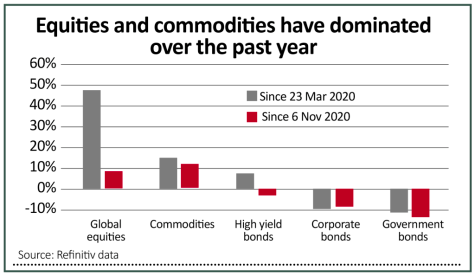
Fear may have dominated a year ago, but equities have been the best place to be over the past 12 months. As benchmarked by the MSCI All World index, global stocks have beaten commodities and bonds. Government bonds, in theory a port in a storm, have provided no shelter with capital losses more than offsetting any yield that they offered.

There have been subtle changes since November. Commodities have taken the lead from equities and high yield bonds have started to flag. Meanwhile, the rout still seems to be on when it comes to investment-grade corporate and government bonds.

STOCK MARKETS

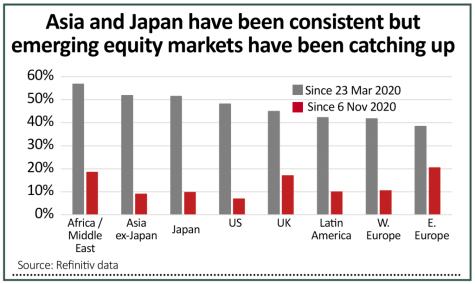
Unlike bonds, where all major categories have fallen on a one-year view, all geographic equities options have gained. Asia and Japan have performed consistently well, perhaps thanks to the relatively low number of pandemic cases they have suffered and their rapid, robust approach to test, track and trace as well as containment.

America’s domination of early 2020 has faded and it is prior laggards who have come to the fore – emerging markets and even the unloved UK equity market has put on a spurt, finding itself outpaced by just Eastern Europe and the Africa/Middle East region since November. This may be down to the perception that the UK is ahead of the game when it comes to vaccination programmes, having previously struggled to contain the virus.

EQUITY SECTORS

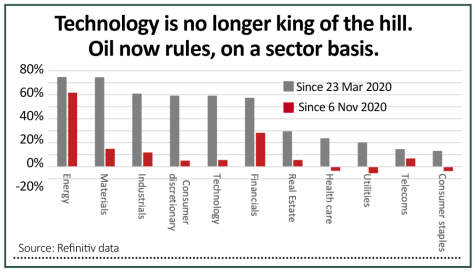
Technology continues to grab the headlines, especially as a raft of new initial public offerings tempts investors’ wallets. But miners, industrials and consumer discretionary stocks have all beaten tech over the past 12 months and oil has been the best performer of the lot, to reaffirm the adage that the darkest hour is before the dawn. 

Meanwhile, sectors that looked reliable going into a pandemic – utilities, consumer staples and even healthcare – have lagged, a trend that has become ever-more noticeable since the Pfizer-BioNTech announcement of last autumn.

UK STOCKS

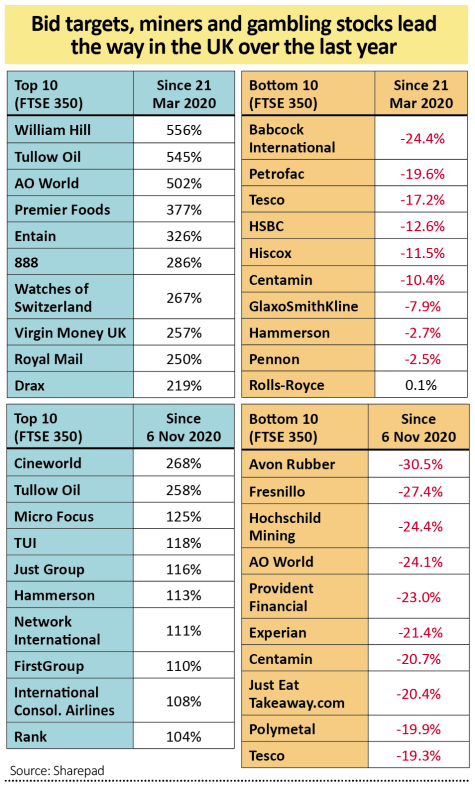
These ‘big picture’ trends – a switch from defensives to turnaround plays, from ‘growth’ (and promises of long-term secular growth, or ‘jam tomorrow’, almost regardless of the economic backdrop) to ‘value’ (cyclicals that offer growth now, or ‘jam today,’ in the event of a recovery), from pandemic winners to bounce-back candidates can be seen on a bottom-up basis in how individual UK-quoted stocks have performed

That said, it has been hard to lose money since last year’s panic. Just nine of the FTSE 350’s current membership have lost ground over the last 12 months.

These trends have become even stronger since Pfizer Monday. Beneficiaries of an economic reopening dominate the leaderboard, notably travel and leisure stocks. The laggards include online delivery plays, precious metal miners, pharmaceutical plays and previously dependable names where investors may have paid too high a valuation, and thus mistaken reliability of earnings for safety of share price. Pay the wrong valuation and nothing is safe.

CONCLUSION

No-one will time a market bottom or top perfectly and trying is a mug’s game. But the trends of the past year show how investors can calibrate risk and earn rewards over time by going against the crowd, focusing on valuation and not getting carried away.

The best approach now could be to heed the words of another investment legend, Sir John Templeton: ‘Bull markets are born on pessimism, grow on scepticism, mature on optimism and die on euphoria.’ It is perhaps time to once more research those areas of which investors are frightened and tread carefully where fear of missing out predominates.

It will be interesting to see how markets and economies react to the easing of restrictions over the next few months. Please check in again with us soon.

Stay safe.

Chloe – 22/03/2021

Team No Comments

VW charges up for electric vehicle push

Please see the below article from AJ Bell received late yesterday afternoon:

German auto maker has grand plans for global EV market

In August 2020 we flagged German auto maker Volkswagen as a value play at €139, since when the stock has gained more than 40%.

Its shares have been particularly strong this year as the firm rolls out its electric vehicle strategy, culminating in this week’s ‘Power Day’.

In contrast, electric vehicle specialist Tesla has had a torrid time this year with shares tumbling from $900 in January to a 2021 low of $563.

VW has grand plans for a big electric vehicle push. As well as reducing the cost of ownership in the space it is investing heavily in new battery technology to improve range and in new charging networks to improve ease of use.

The company aims to reduce battery prices to below €100 per kilowatt hour through a combination of advanced cell design and lower manufacturing costs, all while using green energy.

Beginning with a €14 billion investment in Sweden with partner Northvolt, VW aims to have six gigafactories in Europe by 2030 with a combined capacity of 240 gigawatt hour.

More significantly, VW has partnered with BP, Spanish utility Iberdrola – a world leader in green energy – and Italian utility ENEL to install 18,000 new high-power charging stations across Europe.

The current lack of infrastructure is seen as a key reason for the slow mass adoption of electric vehicles. By working jointly to create a network of renewable-powered rapid-charging stations, each company gets closer to its net-zero goals to boot.

However, VW has even grander plans. All of its electric vehicles come with a home-charging station called Elli. When parked and connected to the Elli Cloud, a VW ID.3 becomes a ‘mobile power bank’ capable of feeding power back to the house for up to five days.

Using intelligent management systems, energy could be transferred to the vehicle during off-peak hours and transferred back to house when needed.

Not only would this save wasting renewable electricity – last year Germany wasted 6,000 gigawatt hours of renewable energy due to lack of storage – when rolled out to commercial and industrial customers it could drastically reduce the cost of expanding transmission networks.

Renewable energy is likely to be an area of rapid growth over the next few years. As the world navigates its way out of the Covid-19 pandemic, the world has been left with food for thought about how to make the planet better and how to sustain it. Companies around the world are adapting to renewable energy sources.

We regularly post a variety of ESG content, both our own and articles from a range of fund managers, and renewable energy is a key consideration in this (the E in ESG, E – Environmental).

This is definitely an area to watch!

Keep checking back for a range of blog content from us, from ESG outlooks, to market updates and insights, both our own original content and input from a wide range of fund managers and investment houses.

Andrew Lloyd

19/03/2021

Team No Comments

Jupiter Merlin Weekly: Cracks appearing in the central banks’ wall?

Please see below article received from Jupiter Asset Management yesterday afternoon, which comments on how major central banks are grappling with their reaction to rising bond yields, with the European Central Bank being the first to break ranks.

UK GDP shrank 2.9% in January, rather better than the 4.5%-5% contraction feared in the consensus estimate, bearing in mind not only the first full month of new Covid restrictions after Christmas but also the dislocation in the movement of imports and exports following Brexit on December 31st. The anecdotal ‘fast’ data, monitoring day-to-day consumer patterns (e.g., traffic congestion, credit card usage, electricity consumption etc) had suggested that Lockdown 3 would be less economically sensitive than its predecessors, and while a near 3% decline in normal circumstances would be a horror, it says much that it is a relative triumph of resilience when compared to the 20% economic decline recorded in April 2020.

Andrew Bailey, Governor of the Bank of England, still believes the economic outlook is good (the Bank’s “coiled spring”) but speaking at a symposium this week, he said that he would need to see evidence of prolonged excess inflation above 2% to require interest rates to be raised to cool any potential heat. In the meantime, he is still preparing the implementation of negative interest rates should the economy falter again. Among many mixed messages here, and despite markets’ scepticism reflected in higher bond yields (and therefore more expensive financing costs), he is effectively saying “I have all bases covered, and until anyone says otherwise, I propose to do nothing”.

The ECB, on the other hand, has broken ranks with the US Federal Reserve and the Bank of England and has responded to the challenge of rising bond yields (or more accurately, less negative yields in the case of Germany and Holland) and borrowing costs in the eurozone: it pledged to step up its QE programme with yet more incremental bond purchases on the simple premise that if demand exceeds supply, prices will rise and yields will fall. For the first time in two months eurozone yields have responded by moving in the opposite direction to their Anglo-Saxon counterparts.

The geopolitical risks of decarbonisation

As US Congress passes President Biden’s $1.9 billion Covid-recovery package, on top of the equally massive programmes implemented last year under Donald Trump’s administration, the political and fiscal spotlight is falling on the budgets of those departments which can be used to help fund such expenditure while relieving the pressure on government finances. Much the same is happening here in the UK, and in both instances defence spending is in the rifle crosshairs. As a barometer of the passion the subject excites, Bernie Sanders’ senate performance a few days ago was instructive: on full tub-thumping form, he made the social case for slashing defence dollars to “feed our people, put clothes on the backs of poor Americans”, to help realise their “expectations of, their right to, a better standard of living and higher wages!”. With Biden more understatedly making much the same case, the Chair of the Senate Budget Committee is clearly pushing on an open door among the Democrat leadership.

In the UK, Boris’s announcement in December of an additional £16 billion of spending on cyber and space defence comes at a price, largely thanks to the £17 billion ‘black hole’ in the MoD accounts. Robbing Peter to pay Paul, hence yet another Treasury-led defence review in the offing and a suggested reduction in the establishment of the Army from 82,000 to 72,000 (not quite enough soldiers to fill Old Trafford, let alone Wembley).

Why is this of relevance? Defence strategists are pointing to the opportunities and threats arising from the global decarbonisation programme. As the ice caps shrink at both poles thanks to global warming, Greenland and the Antarctic become viable for mining, being rich in the rare-earth minerals and ores increasingly in demand as the digital and decarbonisation revolutions gather pace. Not only those landmasses: it has also been suggested that mining the seabed in the deep, deep ocean, particularly in regions of high tectonic and volcanic activity where those same ores and minerals abound, is now a commercial possibility. And returning to the far north, as the pack ice retreats and becomes less enduring, so there is the possibility of year-round trans-polar maritime routes. The US, China and Russia are all sizing up the opportunities and the threats, each keeping a beady eye on the others’ movements, reading the signals of intent. Both China and Russia are investing heavily in naval capabilities (China now has the largest navy in the world, though lags well behind the US in aircraft carriers) and, while nobody is predicting a hot war, the potential for diplomatic or military stand-offs over strategic maritime assets is only likely to grow. While many treated Donald Trump’s unsubtle overtures to ‘buy’ Greenland from Denmark as a joke, in reality he was deadly serious. In the North Atlantic, Denmark becomes a key strategic player through its ownership of both Greenland and the Faeroe Islands, the latter already becoming one of the most secretive and sensitive of NATO’s watching and listening posts, keeping tabs on both the Russians and Chinese.

From an investment standpoint, while peripheral to current events and pre-occupations, however glacially and imperceptibly, these new and growing risks will be factored into longer-term risk premia.

We will continue to publish market updates and analysis, so please check in again with us soon.

Stay safe.

Chloe

18/03/2021