Team No Comments

EPIC Investment Partners – The Daily Update

Please see the below article from EPIC Investment Partners detailing their thoughts on the Economic Resilience and Cultural Innovation of Abu Dhabi. Received this morning 13/08/2024.

In the face of global economic challenges, Abu Dhabi continues to serve as a beacon of stability and growth. The emirate’s recent economic performance and strategic investments paint a picture of a forward-thinking, diversified economy that’s propelled the wealthy emirate’s ascent to the global stage.

Since the beginning of the month, amidst market turbulence, Abu Dhabi’s sovereign and quasi-sovereign holdings have demonstrated remarkable resilience, outperforming expectations in the EPIC Fixed Income strategies. This performance is no surprise to those who have long recognised the value of Abu Dhabi’s Aa2 rated bonds. The emirate’s journey in the international bond market, which began in 2007 with its first USD denominated bonds, has been a testament to its financial acumen and long-term vision.

Abu Dhabi’s economic prowess was further underscored by its impressive GDP growth of 3.3% in the first quarter of 2024 compared to the same period in 2023. What’s particularly noteworthy is the stellar performance of the non-oil sector, which grew by 4.7% and now accounts for 54.1% of the emirate’s economy – its highest share since 2015. This shift clearly demonstrates Abu Dhabi’s successful efforts to diversify its economy beyond hydrocarbons.

The growth story spans across multiple sectors, with construction, finance and insurance, telecommunications, and hospitality all showing significant upticks. The transport and storage sector, in particular, exhibited a remarkable 14.4% growth rate, highlighting the emirate’s increasing importance as a global logistics hub.

Ahmed Jasim Al Zaabi, chairman of Abu Dhabi Department of Economic Development, attributes this success to the emirate’s resilience and its journey towards becoming a smart, diversified, and sustainable economy. The numbers speak for themselves – the construction sector alone contributed 8.8% to the overall economy, reaching its highest level in five years.

Moreover, Abu Dhabi is expanding its global ambitions beyond traditional economic sectors. The emirate’s sovereign wealth fund, ADQ, is set to acquire a minority stake in Sotheby’s, a world-renowned auction house, in a USD 1bn deal. This strategic investment underscores Abu Dhabi’s commitment to becoming a global cultural hub.

By partnering with a 280-year-old institution like Sotheby’s, Abu Dhabi is bridging the gap between East and West. This collaboration not only promises to strengthen Sotheby’s presence in the Middle East but also positions Abu Dhabi as a key player in the global art world. The investment signifies more than financial gain; it represents Abu Dhabi’s vision to be at the forefront of cultural innovation and exchange.

As the world grapples with economic uncertainties, Abu Dhabi stands out as a model of sustainable growth and strategic diversification. From its robust non-oil economy to its bold investments in global cultural institutions, the emirate is crafting a future that’s not just prosperous, but also culturally rich and globally connected. Abu Dhabi’s journey is a testament to what can be achieved with vision, resilience, and strategic planning. 

Please continue to check our blog content for advice, planning issues and the latest investment, market and economic updates from leading investment houses.

Alex Clare

13/08/2024

Team No Comments

Tatton Investment Management – Monday Digest

Please see the article below from Tatton Investment Management providing an insight into the markets over the past week.

Market correction turns into pothole

Last week started with some of the worst stock market losses in nearly two years – prompted by recession fears and Japanese liquidity problems – but ended with most of those losses recovered. Volatility spiked across most regions and almost all asset classes. The sell-off proper started in Japan (where stocks were routed last Monday) after higher interest rates unwound the ‘carry trade’ (borrowing where rates are cheap and investing where yields are higher) but US liquidity has also been under pressure for a while, which suddenly became apparent. We suspect the growth of high-frequency trading amplified volatility, since it shortens the timeline between trades and increases market sensitivity.

US recession fears are arguably overdone, considering that corporate credit remained relatively stable – and in fact corporate cost of finance fell thanks to sharply lower ‘risk free’ government yields. Recession risks are certainly higher than a few months ago, but our base case is still a ‘soft landing’. Business sentiment in the services sector continues to be strong, for example, counteracting weakness in manufacturing unemployment. Even Bitcoin (a fairly reliable risk indicator) recovered strongly into the end of the week.

There is still much to be positive about. Lower yields should help US mortgage rates, for example. The gap between mortgage rates and long-term treasury yields has come in from the highs of 2023, but it still has a way to come down in terms of historical averages. That should support growth. 

The market shakeout was brewing for weeks, judging by the positioning activity of some hedge funds. This need not threaten stability (volatility settled down pretty quickly) but we seem to be in a different phase, in terms of medium-term outlook. Equity valuations have fallen but still look pretty optimistic in terms of expected earnings growth. Falling yields will help those valuations – but probably at the expense of the expected earnings growth they are based on. That could mean higher valuations but slightly soggier profits. Decent returns perhaps, but with a different set of winners.

Japan’s carry-trade catharsis

The Bank of Japan’s rate rise has unwound the yen ‘carry trade’ (borrowing cheaply in Japan and investing in high-yield assets like US stocks) and knocked markets everywhere in the process. Japanese stocks had their worst day since 1987 last Monday, erasing all of the TOPIX’s year-to-date gains. It regained ground in the following days, after dovish comments from the BoJ. This volatility is bad for confidence: Japanese risk appetite is slow to build and quick to collapse, and there is little economic momentum to fall back on. 

The BoJ felt it had to dial back rate rise talk, but it will be wary of staying too easy. The problem for policymakers is that international hedge funds have been much more willing to take advantage of cheap Japanese rates than domestic investors. The carry trade grew massively this year, with money flowing out of Japan and into the US and Mexico – sinking the value of the yen. The BoJ probably turned hawkish because it saw the small impact its easy policy was having on the domestic economy, compared to the huge impact it was having on the yen. This hurt hedge funds involved in the carry trade, amplifying volatility across global stocks.

Domestically, volatility could spook Japanese investors, but the long-term case for Japan remains strong. Recent corporate reforms are a positive for profitability – one of the reasons Japanese stocks broke all-time highs earlier this year. And the yen is extremely cheap on a purchasing power parity basis (even with the currency’s sharp recent gains) making Japanese exports extremely competitive. The ingredients are all there for profit growth over the long-term – exemplified by Honda’s strong Q2 earnings against a difficult backdrop for carmakers. If that comes through, Japanese stocks will start to look very cheap. Hopefully, the carry-trade shakeout is a much needed catharsis.  

Interest rate expectations

Interest rate expectations have moved down sharply after capital market turbulence. The US Federal Reserve has a rate cut pencilled in for September, which the Fed all but confirmed in its July meeting. Recent job market data was disappointing, and the acceleration in unemployment has now triggered an historic recession indicator (the ‘Sahm rule’). Markets now expect the Fed funds rate to be 4.5% by January (down from current 5.25-5.5%). The Fed will have to do something extraordinary to meet current market expectations – but we doubt it will. Recession fears are arguably overplayed, and Jerome Powell has proven his willingness to stick to the plan, even if markets don’t like it.

The Bank of England cut rates in July, but cautioned against further cuts. The sell-off since has moved down markets’ rate expectations – but not as sharply in the UK as elsewhere. Bond traders see the BoE settling on 3.5% rates in 2026, much later than the US and Europe. This is partly cyclical: the UK economy is improving, unlike most developed countries. But it is also structural: the BoE’s 2% inflation target is written in law, unlike its peers who have more discretion. With talk about changing targets globally, we think that makes the BoE structurally more hawkish.

The ECB cut in June and is expected to do so again in September. Markets now put Eurozone rates at 3% by January and close to 2% by the end of 2025. Even though growth and inflation recently beat expectations, forward looking economic indicators are weak and Europe faces many headwinds. If the ECB cuts in line with market expectations, it would mean a rate-lowering cycle almost as aggressive as the pace of hiking before. Europe’s ailing economy might need it.

Please continue to check our blog content for advice, planning issues and the latest investment, market and economic updates from leading investment houses.

Charlotte Clarke

12/08/2024

Team No Comments

EPIC Investment Partners – The Daily Update | Unwinding of the Yen Carry Trade

Please see the below update from EPIC Investment Partners on a current focus point for global markets, the rise in Japan’s interest rates and the implications for the Yen carry trade. Received yesterday – 08/08/2024

Please see the below update from EPIC Investment Partners on a current focus point for global markets, the rise in Japan’s interest rates and the implications for the Yen carry trade. Received yesterday – 08/08/2024

The recent volatility in the Japanese yen, culminating in a sharp appreciation against the dollar, has sent shockwaves through global markets. While some have interpreted the Bank of Japan’s (BOJ) recent comments as dovish, a closer look reveals a different picture. BOJ board members, including Naoki Tamura, have indicated that the neutral interest rate in Japan is likely above 1%, suggesting that the central bank has ample room to tighten monetary policy further. This revelation should have triggered a reassessment of the yen’s trajectory and the viability of the long-standing yen carry trade. Unfortunately, some have misinterpreted the recent BoJ comments as dovish, adding to their short yen positions. 

The yen’s recent strength signals an end to the era of the yen carry trade, a strategy built on the flawed premise that Japan’s low interest rates would persist indefinitely. This trade, where investors borrow yen to invest in higher-yielding assets elsewhere, has always been a house of cards, propped up by investor naivety and a misunderstanding of economic fundamentals.

Japan’s persistent trade surpluses and vast net foreign assets (NFA) paint a different picture. These assets, representing Japan’s claims on the rest of the world, have long suggested that the yen was undervalued. Yet, the allure of easy profits blinded many investors to this reality. As BOJ board member Toyoaki Nakamura put it, “The real effective exchange rate of the yen is still weak compared with its long-term average.”

The carry trade’s unwinding isn’t merely a technical adjustment; it’s a long-overdue reckoning. As investors repatriate capital to Japan, seeking the safety of a creditor nation with a strong economic foundation, the yen’s appreciation is set to continue. The BoJ’s path towards policy normalisation, even if gradual, further reinforces this trend.

The fallout of this unwinding is already evident in the Tokyo stock market’s recent tumble. However, the implications extend far beyond Japan. The dollar, as the world’s reserve currency, has been artificially propped up by the carry trade’s distorted incentives. As the yen strengthens and the carry trade unwinds, the dollar faces a looming reckoning, especially as the Federal Reserve signals a potential easing of its monetary policy.

The yen’s ascent is a harbinger of a broader shift, a signal that the era of easy money in Japan and distorted valuations is coming to an end. The fact that the Fed is set to ease will further undermine the US dollar, accelerating this shift. Investors who fail to heed this warning do so at their own peril. 

Please continue to check our blog content for the latest advice and planning issues from leading investment firms.

Alex Kitteringham

9th August 2024

Team No Comments

Invesco: Why are global stocks selling off?

Please see the below article from Invesco detailing their thoughts on the latest bout of market volatility. This article is from their Multi Asset team on the reasoning behind the ‘global sell off’:

Global stocks have fallen sharply from their all-time highs in the last few weeks.

It appears we are on the brink of that next broad-based 10% decline as the economy weakens, the Federal Reserve passed on lowering interest rates at the July meeting and investors continue to lighten their holdings in expensive tech stocks.

It is hard to say with precision how long this bout of volatility will last for, and even though market participants appear to have quickly moved from pricing an overly rosy picture to an overly negative one, we think that at this stage, investors shouldn’t necessarily throw in the towel.

The current state of play of financial markets

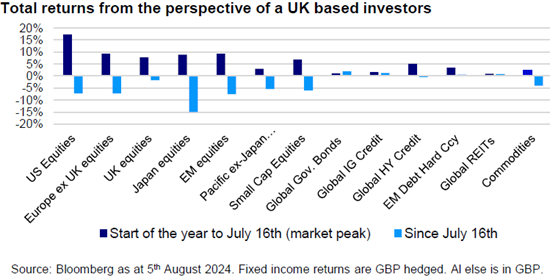
Risk assets performed strongly since the start of the year, driven by hopes for a goldilocks economic scenario and a rush into US tech stocks fuelled by enthusiasm for artificial intelligence technology. At their peak on July 16th, global equites were up 14% in GBP terms.

In the last few weeks however, sentiment started to shift, with global equities giving back half of their year-to-date gains. Bonds on the other hand have offered multi-asset investors some reassurance as this more classical growth-driven sell-off has seen government bonds cushion part of the blow in equities by moving in the opposite direction.

Notwithstanding the alarming moves, investors should note that most markets are still up for the year as shown below.

What has triggered the sell-off?

It’s hard to pin this on any single event. Below we list what we think are some of the key culprits.

1. Recession fears?

After several months of stability, economic data around the world has started to soften with the most noticeable decline being in the US – evidenced by last Friday’s unexpected 114k new jobs added (lower than the 215k average of the last year) and the unemployment rate jumping to 4.3%, the highest since October of 2021. Although that’s not in and of itself an unhealthy unemployment rate, its sudden march higher has raised concerns for a potential recession.

2. Fed too slow to act?

Post the 2022 pull-back, equity markets have been unstoppable, buoyed by falling inflation and growing expectations of rate cuts, particularly from the US Fed. But during last week’s meeting, the Fed didn’t cut rates as many had hoped triggering fears that the Fed may be too late to act before a slow in hiring turns into rampant layoffs.

3. AI trade losing steam?

After benefitting from stellar returns, investors started to unwind big positions in the likes of Apple, Nvidia, Microsoft, Meta, Amazon, Alphabet and other tech stocks. Warren Buffet, Berkshire Hathaway’s CEO for instance recently sold half of Berkshire’s stake in Apple, which many see as a troubling sign for the health of the tech sector. Because these companies make up an enormous chunk of the overall value of the S&P 500, when investors sell off tech stocks, that has a massive detrimental effect on the broader market.

4. Unwinding of the Japanese yen carry trade

While less structural in nature, the mayhem that swept across world markets was amplified by a market strategy known as the “carry trade.” Japan’s benchmark Nikkei 225 plunged 12.4% on Monday and markets in Europe and North America suffered outsized losses as traders sold stocks to help cover rising risks from investments made using cheaply financed funds borrowed mostly in Japanese yen. Markets recovered much of their losses on Tuesday. But the damage lingers.

More common than you think

Drawdowns (a decline of less than 10%), are always coming. Since the early 1980s, there has been a greater than 5% drawdown in the S&P 500 Index in every year but two (1995 and 2017). Even in this year, which had felt relatively benevolent until the past few weeks, the S&P 500 Index experienced a 5% drawdown in April before climbing to an all-time high in the middle of July.

On the other hand, corrections (declines of greater than 10%) happen less frequently. Corrections typically don’t just emerge out of nowhere. Often, they’re the result of policy uncertainty and/or surprising weakness in economic activity. The market has currently gone since Nov. 2, 2023, without an official correction, representing a 188-day period of a resilient economy and declining inflation.

Reasons to remain constructive as the dust settles

We appear to potentially now be on the brink of that next 10% decline as the economy weakens, the Federal Reserve passed on lowering interest rates at the July meeting and investors continue to lighten their holdings in expensive tech stocks.

It is hard to say with precision how long this bout of volatility will last for, and even though market participants appear to have quickly moved from pricing an overly rosy picture to an overly negative one, we think that at this stage, investors shouldn’t necessarily throw in the towel.

Growth slowdown is not the same as recession

In our opinion, this macro backdrop is consistent with an incoming deceleration but not indicative of imminent recession risks given:

  • Ongoing resilience in consumer and corporate balance sheets
  • The labour market is cooling, but not falling off a cliff
  • Banks do not appear to be tightening lending standards significantly
  • There does not appear to be significant excess in the economy

As of today, growth is solidly in positive territory on a global basis, with developed markets growing between 1-2% and consensus expectations signalling similar growth rates over the next two years.

The Fed should join the rate cut party soon

Last week, the Fed kept its main interest rate between 5.25 per cent and 5.5 per cent. However, the combination of a slowing jobs market, cooling inflation and the negative market reaction should lead the central bank to finally act. Historically, markets tended to perform well in easing cycles that were not associated with recessions. All eyes are therefore set on the Fed’s next meetings scheduled for September, November and December.

Tech stocks may be falling out of favour, but we don’t think this is their end

Tech stocks are still trading at lofty valuations, and while this may temper future upside potential, we don’t think investors will completely shy away from the sector. To evaluate the sustainability of their performance, investors should eschew reliance on charts of share price performance and focus instead on business fundamentals and valuations. While not unassailable these companies have large moats, very strong balance sheets, and many have revenue streams that are far less cyclical than tech companies of the past.

Please continue to check our blog content for advice, planning issues, and the latest investment, market and economic updates from leading investment houses.

Andrew Lloyd

08/08/2024

Team No Comments

The Daily Update – The Market’s Roller Coaster Ride

Please see below article received from EPIC Investment Partners this morning, which provides a global market update.

The global market rout that began on Monday showed signs of easing on Tuesday, with the Nikkei 225 rebounding more than 8% after its worst day since 1987. However, investors remain on edge as they grapple with the implications of a potential US economic slowdown and the Federal Reserve’s policy stance. 

The catalyst for the sudden risk-off sentiment appears to be growing fears of a “hard landing” as central banks, particularly the Fed, attempt to tame stubborn inflation without tipping economies into recession. Friday’s shockingly weak U.S. jobs report crystallised these concerns. It raised doubts about the health of the economy and the Fed’s ability to engineer a soft landing while keeping rates at 23-year highs. 

According to Mohamed A. El-Erian, the market turmoil can be attributed to five key factors: worries about a US growth slowdown undermining “American exceptionalism”, concerns that the Fed’s policy stance is too restrictive, crowded investment positions being caught offside, geopolitical risks in the Middle East, and domestic political developments ahead of the US presidential election. 

Nonetheless, the volatility outburst underscores the precarious and non-linear path to policy normalisation. As central banks attempt to delicately balance cooling demand whilst avoiding a hard landing, markets are prone to air pockets. Investors should brace for choppy and potentially divergent conditions across asset classes in the coming months. In this environment, selectivity and relative value are crucial. 

Within equities, companies with pricing power and resilient margins are likely to weather the storm better. In fixed income, high-grade credit offers attractive yields with lower default risk. Wealthy nations’ bonds are a strong addition to the portfolio aside from plain vanilla US Treasuries given global recessionary risks. 

Looking ahead, incoming US inflation and jobs data, as well as the Fed’s Jackson Hole Symposium, will be key watchpoints for any hints of a monetary policy pivot. More broadly, staying nimble and reactive will be critical as even small data surprises can spark outsized market moves in this fragile environment. While the path ahead might remain bumpy, the volatility spike does not fundamentally alter the broader macroeconomic backdrop at this stage. 

In this “middling” macro regime, a focus on quality, value, and resilience across asset classes remains the prudent approach. If the market’s ups and downs leave you feeling a bit queasy, just remember: every roller coaster eventually comes to a stop. 

Please check in again with us soon for further relevant content and market news.

Chloe

07/08/2024

Team No Comments

Brooks Macdonald Daily Investment Bulletin

Please see below the Daily Investment Bulletin from Brooks Macdonald, which was received on 06/08/2024:

What has happened

What a difference 24 hours makes. The big takeaway coming into today’s trading session is that markets, for the time being at least, appear to have found their footing. This comes after markets over the past week hit by a triple whammy of weaker economic data, mega-cap US technology results disappointments, and the surprise interest rate hike out of Japan. Much of the rebound from yesterday’s lows is stemming from a better-than-expected US ISM (Institute for Supply Management) Services PMI (Purchasing Managers’ Index) which has in part pushed back some of the fear that the US economy was about to tip into recession. Arguably the epicentre for the wave of selling over the last few days, Japan’s TOPIX has this morning posted a gain for the day of +9.30% and has as a result pushing the index for the whole of 2024 to date back into positive territory (just) of +2.33%. Otherwise, the other news out overnight is that Australia’s central bank (the RBA), has left interest rates unchanged at a 12-year high (of 4.35%) for the sixth meeting in a row.

A better US services PMI pushes back on fears of impending recession

After the weaker US manufacturing PMI and weaker US non-farm payroll jobs data last week, the markets were desperate for good news. For near-term investor sentiment, coming to the rescue was yesterday’s US services PMI print. The July reading saw a rise to 51.4 from 48.8 in June (and better than the 51 expected). Importantly, it put the index into expansionary territory (over 50). Beneath the headline, the ISM employment sub-component saw a bounce up to 51.1 (against 46.4 expected) and reaching its highest level since September 2023. While the data also showed some degree of sustained inflationary pressure, with the ‘prices paid’ sub-component up to 57 (versus 55.1 expected), markets were yesterday understandably more focused on the economic growth side of the equation.

Latest US Fed survey on credit conditions sees continued improvement

Also supporting a more constructive picture yesterday was the latest (calendar-quarterly) US Federal Reserve Senior Loan Officers’ Opinion Survey (SLOOS). While credit standards for commercial & industrial loans were still tightening, they were doing so at their slowest pace for 2 years, since Q2 2022, while standards for mortgages moved back to neutral. Reflecting the more market-friendly nuance, the US S&P500 banks sector index marginally outperformed the wider market yesterday. Historically, there is quite a good correlation between the SLOOS and trailing 12-month corporate earnings growth, so as the SLOOS continues to see a turn away from relatively tighter credit conditions, so this might bode positively for the earnings picture more broadly.

What does Brooks Macdonald think

Yesterday’s wild swings in markets has seen volatility return with a vengeance. At one point intraday yesterday, the so-called ‘fear gauge’ (the VIX index which measures the volatility of the US S&P500 equity index) was trading at 65.73, up 42.34 points and up +181% from Friday’s close. To put that in context, the largest full day move since the VIX index was first calculated back in 1990 was the 21.57-point increase on 12 March 2020 at around the time of the initial Covid-19 wave. After yesterday’s part-recovery in investor sentiment, last night the VIX index closed at 38.57. Whether the latest 24hours marks a slow return to some degree of relative market calm, or whether it is just the opening bout of more volatility to come, it is impossible to say. However, what we do know is that, as we said in our recent July edition of our Quarterly Market Overview, in an uncertain world, diversification remains key, enabling us to position our asset allocation settings for more than just one central forecast economic and market scenario.

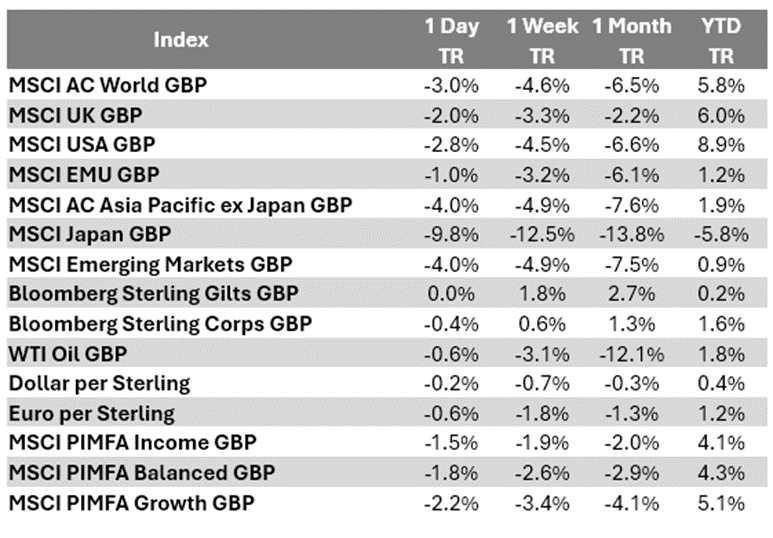
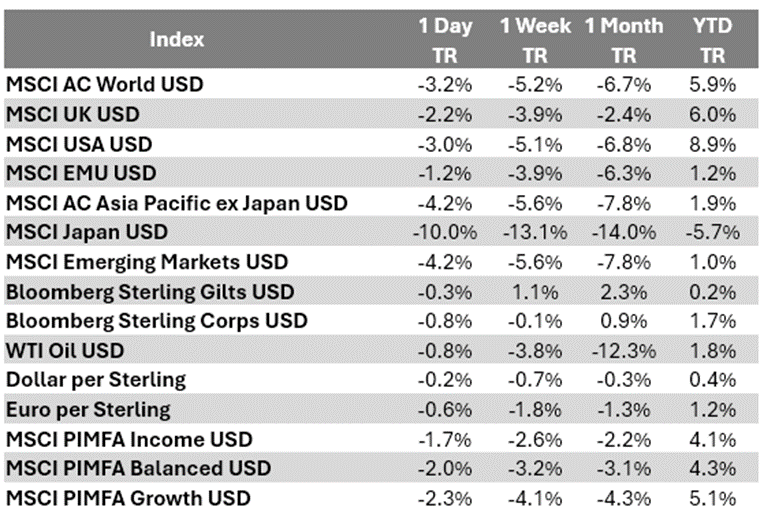
Bloomberg as at 06/08/2024. TR denotes Net Total Return.

Please continue to check our blog content for advice, planning issues and the latest investment, market and economic updates from leading investment houses.

Charlotte Clarke

06/08/2024

Team No Comments

EPIC Investment Partners – The Daily Update, Payrolls Boost Rate Cut Expectations

Please see the below article from EPIC Investment Partners detailing their thoughts on the labour market upon receipt of recent payroll statistics. Received last week.

A week is a long time in politics, but it can feel like an eternity in financial markets. In our recent piece, “The Mirage of Western Prosperity” (Markets – EPIC Investment Partners (epicip.com) we highlighted the concerning debt levels of G7 nations, concluding that the question wasn’t if interest rates would fall, but how far and how fast. Recent events have provided a resounding answer.

The precipitous drop in global bond yields, notably a 45 basis point decline in the US 10-year since our daily, can be partly attributed to Federal Reserve Chair Powell’s hints that payroll data might be overstating job growth, suggesting a September rate cut is on the horizon.

Today’s payroll figures further solidified this expectation, with the headline number falling well short of forecasts (114k versus expectations of 175k). Crucially, the unemployment rate has risen to 4.3% from its low of 3.4% in January last year. Models like the McKelvey Rule and Sahm Rule, which use changes in unemployment to predict recessions, are flashing warning signs. Adding to the unease, Intel’s announcement of a 15,000-person workforce reduction suggests trouble brewing within certain US companies.

However, jobs aren’t the sole driver of this rapid shift in interest rate expectations. The US ISM manufacturing survey, while indicating contraction, isn’t new news, as the survey has shown contraction for 20 of the past 21 months. What is noteworthy is the sharp decline in household expectations of future income. Last week, the University of Michigan’s Consumer Confidence report, while weaker than last month, masked a concerning trend buried within its data. A survey question on expected income changes has seen one of its sharpest declines ever, suggesting that people are bracing for reduced incomes or job losses. This implies weaker demand going forward, which in turn could lead to more job cuts, creating a potentially vicious cycle. Watch for larger rises in the unemployment rate going forward.

This raises questions about the seemingly strong job gains in recent payroll data. It’s important to remember that payroll figures measure the number of jobs, not individuals employed, and incorporate a statistical adjustment called the birth/death model. This model, based on historical data, can overestimate job creation, particularly at economic turning points. Therefore, the unemployment rate provides a more reliable picture of the labour market’s true state.

Today’s payroll data and the further rise in the unemployment rate reinforce our earlier assertion: the question isn’t if interest rates will fall, but how far and how fast. Moreover, today’s figures raise the alarming possibility that we may already be in the midst of a recession. 

Please continue to check our blog content for advice, planning issues, and the latest investment, market and economic updates from leading investment houses.

Alex Clare

05/08/2024

Team No Comments

Brooks Macdonald Daily Investment Bulletin

Please see below article received from Brooks Macdonald yesterday, which provides a global market update as we enter August.

What has happened

If, like me, you had holiday and time away from markets in July, then you probably missed something of a game of two halves in markets in the month that wrapped up yesterday. Early on in July, markets at an index level were doing well, with the US S&P500 equity index hitting a succession of record highs. We also saw government bond prices up (and bond yields down) during the month, on the back of hopes that interest rate cuts would increasingly start to filter through, especially in the case of the US on the back of a softer US inflation print. But about half-way through July, equity market leadership shifted, as tech stocks fell. The so-called ‘Magnificent 7’ group of US megacap tech stocks were down over -10% from peak to trough, entering technical correction territory. Given their weight in US equity indices, that was a big headwind for larger-stock index performance. Instead, we saw a meaningful rotation into the smaller capitalised end of the stock market, as rate cut hopes lifted the outlook for smaller companies who are generally much more sensitive to funding and credit conditions. Indeed, the outperformance in July of the US Russell 2000 small cap equity index over the US Nasdaq technology equity index was the largest in any month since February 2001. Coming back to tech, it was a better day yesterday, with good results from Meta after the US close driving the company’s shares up over +7% in after-market trading. Nvidia shares meanwhile staged an impressive one-day rally up +12.81% yesterday.

US job data points to further cooling, supporting Fed rate cut hopes

A broad gauge of US labour cost growth closely watched by the US Federal Reserve (Fed) cooled in the calendar Q2 by marginally more than analysts had been forecasting.  Out yesterday, the US Employment Cost Index (ECI) a broad measure of labour costs, increased by +0.9% in Q2 sequential quarter on quarter (QoQ). This was weaker than the +1.0% expected, after rising +1.2% QoQ in Q1. In year-on-year terms, the ECI was up +4.1% in Q2. Separately, a report from the US-based ADP Research Institute showed US companies added the fewest number of jobs in July since January, while wage growth fell to the slowest pace since 2021 for both so-called ‘job-changers’ and ‘job-stayers’ alike. That was a constructive backdrop for the Fed meeting later in the day, where rates yesterday were kept on hold as expected, but Fed Chair Powell pointed markets in the direction of a first US rate cut in the current cycle to likely come in September. Specifically, Powell said that if the Fed get the data that they hope to get, then a reduction in the policy rate could be on the table at the September meeting.

Investors are proving to be less forgiving

The current calendar Q2 corporate reporting season is seeing a somewhat mixed picture unfold, and in turn it is prompting a somewhat mixed reaction in markets. We highlighted this in our post-Asset Allocation Committee meeting communication out earlier this week. That is to say, according to Factset who have reviewed the latest US S&P500 company reports, while the percentage of companies reporting positive earnings surprises is above average levels, the magnitude of earnings surprises is below average levels. Furthermore, while the aforementioned index is reporting its highest year-over-year earnings growth rate since Q4 2021, the market has been rewarding positive EPS surprises reported by companies less than average and punishing negative EPS surprises reported by companies more than average.

What does Brooks Macdonald think 

The market reaction to the latest round of US quarterly earnings results makes sense. Mindful that we are roughly only coming up towards half-way through the results season, nonetheless, these results are landing having followed a period of very strong equity market performance, where the US S&P 500 equity market had notched up fresh record highs as recently as mid-July. As a result, there is a lot less room for manoeuvre left in equity valuations should company results, or their outlooks not beat expectations, in particular focused around megacap US tech stocks. In valuation terms, the MSCI USA equity index 12-month forward Price-to-Earnings Per Share ratio is currently 21.00x versus the past 30-year average of 16.98x. Interestingly, such a valuation gap versus historical averages is virtually non-existent when looking at equity markets on a global ex-US basis. Here, the MSCI All Country World excluding US equity index trades on 13.48x versus the average since 2001 of 13.44x.

Index 1 Day1 Week1 MonthYTD
 TRTRTRTR
MSCI AC World GBP 1.6%2.2%0.1%12.4%
MSCI UK GBP 1.1%2.7%2.5%10.5%
MSCI USA GBP 1.6%2.5%-0.3%15.4%
MSCI EMU GBP 0.5%0.6%-0.3%5.7%
MSCI AC Asia Pacific ex Japan GBP 1.2%0.9%-1.4%8.0%
MSCI Japan GBP 4.1%2.2%4.2%11.8%
MSCI Emerging Markets GBP 1.2%0.9%-1.2%7.1%
Bloomberg Sterling Gilts GBP 0.5%1.3%1.9%-1.1%
Bloomberg Sterling Corps GBP 0.3%0.9%1.8%1.4%
WTI Oil GBP 4.2%1.1%-5.9%8.1%
Dollar per Sterling 0.2%-0.4%1.7%1.0%
Euro per Sterling 0.1%-0.3%0.6%3.1%
MSCI PIMFA Income GBP 0.9%1.6%1.3%7.0%
MSCI PIMFA Balanced GBP 1.0%1.7%1.2%8.0%
MSCI PIMFA Growth GBP 1.1%1.9%1.0%9.9%
Index 1 Day1 Week1 MonthYTD
 TRTRTRTR
MSCI AC World USD 1.6%1.5%1.6%13.1%
MSCI UK USD 1.2%2.0%4.1%11.2%
MSCI USA USD 1.6%1.8%1.2%16.1%
MSCI EMU USD 0.6%-0.1%1.3%6.3%
MSCI AC Asia Pacific ex Japan USD 1.2%0.2%0.2%8.6%
MSCI Japan USD 4.2%1.5%5.8%12.4%
MSCI Emerging Markets USD 1.2%0.3%0.3%7.7%
Bloomberg Sterling Gilts USD 0.6%0.7%3.5%-0.3%
Bloomberg Sterling Corps USD 0.4%0.3%3.4%2.2%
WTI Oil USD 4.3%0.4%-4.5%8.7%
Dollar per Sterling 0.2%-0.4%1.7%1.0%
Euro per Sterling 0.1%-0.3%0.6%3.1%
MSCI PIMFA Income USD 0.9%0.9%2.9%7.6%
MSCI PIMFA Balanced USD 1.0%1.0%2.7%8.6%
MSCI PIMFA Growth USD 1.2%1.2%2.6%10.6%

 Bloomberg as at 01/08/2024. TR denotes Net Total Return.

Please check in again with us soon for further relevant content and market news.

Chloe

02/08/2024

Team No Comments

EPIC Investment Partners – The Daily Update

Please see the below article from EPIC Investment Partners detailing their thoughts on the renewable energy market and discussions on a potential rise in nuclear energy. Received this morning 01/08/2024.

Before we look at the nuclear option, we note that a subsidiary of Zhejiang Akcome New Energy Technology Co has become the latest solar panel manufacturer to declare bankruptcy.  This follows quickly after another smaller manufacturer, Gansu Golden Solar Co, entered a pre-reorganisation process earlier this month.  Expect many, many more to fall by the wayside.

This is not because China is holding back on rolling out renewable, quite the reverse. An interesting article published by The Guardian recently compared global solar and wind power projects currently under installation.  China accounted for a staggering 64.5% of the total with the US next at 7.6%. No other country accounted for more than 2.5%.  Indeed, the Asia Society Policy Institute recently suggested that China’s National Bureau of Statistics is severely underreporting renewables power generation as it does not include, amongst other things, rooftop solar.

A recent survey, attributed to the OECD, asked the question “Would you be willing to live near a …..”  Over 80% of respondents replied “no” to landfill sites, waste incinerators, large airports and chemical facilities.  Interestingly nuclear, at 35%, recorded the lowest “no” vote among the nine other options which included wind farms, high voltage transmission cables and mobile relay stations.

Oklo Inc, an advanced nuclear technology company based in California, estimates that a 15MW (scalable to 50MW) reactor with a 40 plus year life could be installed on just a two-acre site within 12 months and cost just $70mn. Oklo provides nuclear fission reactors which can be fuelled by recycled nuclear waste. We understand that spent fuel, similar to naturally occurring uranium, only contains around 1% of the all-important U-235 isotope (capable of sustaining a chain reaction in a thermal-neutron reactor) compared to the 5% needed for a traditional pressurised water reactor.

If ‘nimbyism’ is not a problem, as the OECD survey suggests, watch out for a small nuclear power plant in your neighbourhood! For the adventurous investor Oklo is New York listed.

Please continue to check our blog content for advice, planning issues and the latest investment, market and economic updates from leading investment houses.

Alex Clare

01/08/2024

Team No Comments

Brewin Dolphin: Markets in a Minute

Please see the below article from Brewin Dolphin which provides a brief analysis of the key factors currently affecting global investment markets. Received late last night – 30/07/2024

A challenging week for the equity market’s hottest stocks

Last week was challenging for investors, with the so-called “pain trade” hitting hard. Pain trade is a term used in financial markets to describe a scenario where the market moves in a direction that causes the maximum discomfort or losses to the largest number of market participants.

The pain trade has been building for a few weeks since the improvement in small-cap stocks. A couple of weeks ago, we described how semiconductor stocks had been hit by political pressure from both sides of the aisle – the Biden administration threatening to clamp down on companies facilitating the use of U.S. technology in the Chinese chipmaking industry, and former President Donald Trump casting doubt over the willingness of the U.S. to defend Taiwan against Chinese aggression.

Last week saw some of the biggest technology companies reporting earnings, which weren’t taken well. On the face of it, with 40% of the S&P 500 having now reported, the headlines will seem familiar: 79% of companies have exceeded analysts’ estimates of their earnings. The average company has beaten earnings estimates by 4% and been rewarded by a 0.5% share price fall. The market has seen the earnings glass as half empty over the past few weeks.

As the week ended, the technical outlook for equity markets remained challenging. They fell through key support levels and have not yet fallen into oversold territory.

Beyond tech

The majority of the market’s recent declines seem to relate to profit taking and sector rebalancing. Technology and associated stocks became the clear outperformers, and many sectors were left behind.

The prospect of an interest rate cut is seen as a boost to small caps, real estate, and other forgotten sectors, and investors have begun to look for less crowded ways to play the spread of artificial intelligence (AI).

Within real estate, data centres are perhaps the most obvious beneficiaries of AI, but focus has also shifted to their power needs. Utilities have staged a few rallies during 2024 as beneficiaries of the increased electricity demand from data centres. The International Energy Agency estimates electricity consumption demand for data centres could double over the next two years to 1000 TWh, the equivalent of Japan’s power needs.

The current wave of technology-led returns has prompted some challenges of course, but some of these are quickly dismissed. Is this like the technology bubble of the late 90s and early noughties? No, because these companies are very profitable and seem to be on relatively sensible valuations in many cases. Challenges remain nonetheless.

Are we heading for an anticlimax?

We’ve all seen the incredible rise of Nvidia, with its sales doubling over the last two years – but can those sales be maintained? Inevitably, there will be a cycle of investment in demand for computing capacity. But the questions remains, how long will the current upswing last and how severe will the subsequent downswing be?

This comes down to the strength of the use case for AI. If AI is used widely and effectively in the economy, the demand will remain. Alternatively, if it proves to be more hype than reality, cloud providers may find themselves with too much computing capacity, leading to a lack of demand for new semiconductor investment.

We are quite hopeful of the potential of AI because, unlike other general-purpose technologies, there are relatively few barriers to use. The venues for many AI implementations are computing clouds, which are accessible to all. For many medium-sized companies, it’s possible to develop AI applications in-house. For those without the capability, providers are deluging them with offers of service.

At the same time, the potential applications of AI seem broader than for the internet, which was essentially a communication mechanism. This seems quite different from the early days of the internet when development expertise was scarce, technology hardware was expensive, connections were slow, and not all customers were online.

Unlike previous general-purpose technologies such as rail, electricity, telecommunications, and the internet, a viable infrastructure for widespread adoption of AI already exists.

What do we know about Kamala Harris?

Another major development last week was that the Democrats were on the brink of formally confirming Vice President Kamala Harris as their U.S. presidential election candidate. Even before President Joe Biden stepped down, it was clear she would be the only viable candidate. Harris has access to existing campaign funds, which were raised for her and Biden, although funds swelled upon confirmation that Biden would no longer run.

The best guess is that she would provide a degree of continuity with the Biden administration, although the role of vice president essentially means deferring to the president’s agenda, so it can serve to mask her own preferences.

Harris is considered to come from the progressive (meaning left wing) side of the party. She also hails from California, which has a poor reputation for having a high cost of living, heavy tax burden, and burdensome regulation, while also struggling to address issues of homelessness.

Republican attacks blame her for the increase in illegal border crossings, which is perhaps unfair given this didn’t fall within her area of responsibility. She also has a reputation for being prone to gaffes.

The biggest challenge Harris faces may be found in her failed attempt to run against Trump in 2020. She wasn’t able to generate much enthusiasm and was fairly easily beaten in the primaries by Joe Biden. Of course, this is a competition against former President Trump rather than President Biden, who has endorsed her, so her ability to appeal to neutrals is in focus.

It will take some time for the American public to form a view on Kamala Harris. In the meantime, election forecasts, in terms of the presidency and the U.S. Congress, will be unusually uncertain.

China holds third plenum

It would be easy to overlook the Chinese Communist Party’s third plenum, which took place the week before last and was reported to the public over that weekend. These party meetings are held every five years and map out the general direction of the country’s long-term social and economic policies.

Understandably, the plenum ends up being a little vague. The important point is that there would be no material clarification of the role of Chinese-style modernisation, or so-called socialism with Chinese characteristics.

This essentially means continuing with the common prosperity principles that President Xi Jinping has been espousing, while recognising a greater role for markets in the economy, but confusingly, still committing to a model in which assets are state-owned or state-directed.

It’s a model that must be concerning for Chinese investors because it leaves companies unclear on the extent to which profit motives should be balanced against social goals, and whether something might be socially desirable one year and less desirable the next.

If the concern is that this might lead to poor allocation of investment, then bear in mind that China’s commitment to invest and build capacity in certain key industries has seen huge overcapacity in solar and is now doing the same in battery technology. It’s unclear whether this strategically guided investment has resulted in the kind of technological advantage the Communist Party was aspiring towards. Many of the most efficient solar panels are built by non-Chinese companies across a range of jurisdictions. However, they have resulted in substantial declines in costs and seem to be doing the same for battery cells.

The tension here is between patient capital deployed by China and the Western model. The former works on the basis that companies can develop a strategic competitive advantage through state ownership, whereas in the Western model companies are assumed to be more nimble, motivated, and efficient if they are pursuing a profit motive.

Please continue to check our blog content for the latest advice and planning issues from leading investment firms.

Alex Kitteringham

31st July 2024