Team No Comments

EPIC Investment Partners – The Daily Update | Mind the Fiscal Gap

Please see below article received from EPIC Investment Partners this morning which provides an economic update for the UK ahead of the Autumn Budget on the 26th of November.

The UK economy is misfiring, posing a severe challenge for Chancellor Rachel Reeves ahead of the Autumn Budget. Latest data shows that growth slowed sharply to just 0.1% in Q3, with real GDP per head flat, confirming that the recovery remains weak and uneven. This sluggish performance leaves the UK lagging behind its G7 peers as it struggles with stubborn inflation, weak investment, and strained public finances.

The weakness is broad-based. Business investment fell by 0.3%, while consumer spending remains subdued amid the ongoing erosion of household purchasing power. The lingering effects of last year’s employers’ National Insurance rise continue to weigh on firms, while a temporary cyber-attack on Jaguar Land Rover significantly dragged down Q3 output, suggesting a one-off shock but not disguising the underlying fragility of the economy.

With unemployment now at a four-year high (5.0% in September) and inflation still running at 3.8%, nearly double the Bank of England’s 2% target, the BoE has held rates at 4.00% to maintain a tight stance against inflation. However, expectations are mounting for a December rate cut, with markets pricing in an ~86% probability following the latest weak GDP figures, contributing to renewed Sterling weakness against major currencies.

Amid this slowdown, the fiscal backdrop has darkened. Government borrowing reached roughly £100 billion in the first half of FY2025/26, pushing public sector net debt to around 95% of GDP. The Office for Budget Responsibility (OBR) is expected to downgrade productivity and fiscal headroom estimates, creating a “fiscal hole” of around £30 billion, and prompting warnings of a potential “doom loop”: the risk that fiscal consolidation to satisfy bond markets and control debt could further choke off already weak growth.

Faced with this dilemma, the Autumn Budget on 26 November will be a high-stakes balancing act. Reeves is boxed in by the need to restore fiscal credibility while supporting a faltering economy. While headline tax rates such as National Insurance, and VAT may remain unchanged, additional revenue could be raised through “fiscal drag”, the freezing of thresholds that quietly lifts the tax take as wages rise, and potential increases to income tax. Targeted spending cuts and the reprofiling of investment may also feature as the Treasury seeks to plug the shortfall.

The Budget’s success will depend on Reeves’s ability to rebuild confidence without stifling activity. With growth stagnating, inflation still elevated, and fiscal space narrowing, the UK finds itself on a tight policy tightrope, one misstep away from a deeper slowdown.

Please check in again with us soon for further relevant content and market news.

Chloe

13/11/2025

Team No Comments

Brewin Dolphin – Markets in a Minute

Please see this week’s Markets in a Minute update below from Brewin Dolphin, received yesterday afternoon – 11/11/2025.  

Could this be the end of the U.S. shutdown?

We examine the potential breakthrough to the U.S. government shutdown and the positive news from earnings season.

Key highlights

  • U.S. government shutdown breakthrough: after a record-breaking 41-day shutdown, U.S. senators vote in favour of a resolution.
  • All eyes on tariffs: the U.S. Supreme Court heard evidence related to the legality of President Donald Trump’s sweeping global tariffs. A ruling is expected sometime in December or early 2026.
  • A fractured look into the U.S. jobs market: while official data is still limited due to the government shutdown, independent figures showed an uptick in layoffs in October.
  • Strains in the credit market: a widening credit spread raises companies’ cost of capital, prompting them to cut investment and output growth. Is there reason for concern?

Shutdown end in sight

After a record‑setting 41‑day impasse, the Senate voted 60‑40 on Monday in favour of a stop‑gap spending bill that keeps most of the federal government funded until January 30, 2026 (a subset of agencies are funded through to September 30, 2026).

The bill pays back furloughed workers and prevents layoffs but defers the decisive vote (which the Democrats had been holding out for), on extending the Affordable Care Act premium subsidies. The deal, brokered by a bloc of centrist Democrats who dropped the subsidy renewal demand in exchange for a promise of a mid‑December Senate vote, sparked an intra‑party backlash but secured the crucial Freedom Caucus Chair’s conditional support.

House Speaker Mike Johnson has signalled a swift floor vote on Wednesday, and with the Grand Old Party‑controlled chamber expected to approve the measure, the bill should soon land on President Trump’s desk for signature. Equity markets seem buoyed by the news. Nevertheless, analysts warn that air‑travel disruptions and SNAP (food stamps) benefit backlogs will linger, and the ultimate fate of the Obamacare subsidies remains uncertain.

Tariffs are back in the spotlight

The Supreme Court of the United States (SCOTUS) was in focus last week as it heard oral arguments on the legality of President Donald Trump’s sweeping global tariffs. You‘ll recall that these measures were the subject of legal challenges that were originally heard by the U.S. Court of International Trade, then moved to the Courts of Appeal, and eventually to SCOTUS. The tariffs were imposed under the International Emergency Economic Powers Act (IEEPA).

The challengers argue that the IEEPA doesn’t grant the president authority to impose tariffs; that power is reserved for Congress according to the U.S. constitution.

The session seemed to favour the complainants. A majority of the justices – including Chief Justice John Roberts and Justice Neil Gorsuch – appeared deeply skeptical. They focused heavily on the separation of powers and the “major questions doctrine,” questioning whether a law intended for emergency sanctions could be twisted to impose a massive, sustained, global tax (i.e., a tariff). This signals that SCOTUS is likely to rule that the president exceeded his legal authority under IEEPA.

What happens next?

The consensus among observers is that SCOTUS will strike down the IEEPA‑based tariffs, with a ruling expected sometime in December or early 2026.

The administration has said it will immediately try to reimpose the tariffs using alternative statutory tools, such as:

  • Section 232 (National‑Security Tariffs)
  • Section 301 (Unfair‑Trade‑Practice Tariffs)

However, the short‑term fix most likely involves Section 122 (Temporary Balance‑of‑Payments Tariffs). Legal experts believe the administration has the authority to use these provisions, so the substantive outcome may not change dramatically.

One important consequence of SCOTUS upholding the lower‑court decision is that the Treasury would have to refund all duties collected under the IEEPA authority – which is estimated at $90 billion to $130 billion (plus interest). This amount is roughly 5% to 7% of the federal budget deficit. The refund would go to the parties that paid the duties directly – primarily U.S. importers.

Much debate took place in the immediate aftermath of ‘Liberation Day’ over whether the taxes were borne by exporters or U.S. consumers. In reality, both groups shared the burden, but only importers would receive the refund. Consequently, the net effect is a wealth transfer from consumers and exporters to importers.

Broader economic context

The event is significant, but it doesn’t appear to be systemic in the short term.

However, assessing its impact is complicated by the record‑breaking federal government shutdown. Assuming this now ends, as seems likely, the U.S. economic data series will begin to resume.

A fractured look into the U.S. jobs market

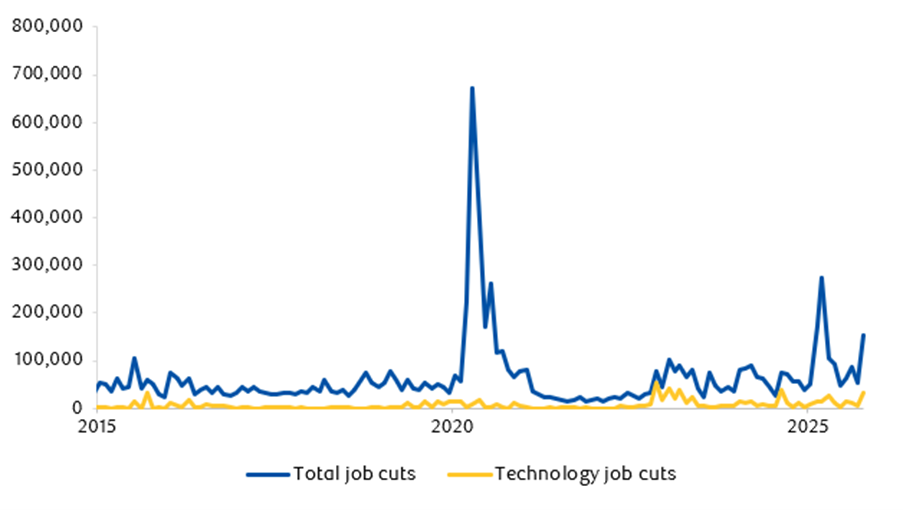
Because of the shutdown, there’s limited data on the broader U.S. labour market. Some private sector sources, such as the Challenger Job Cuts report, continue to track announced layoffs.

Employment is highly seasonal, a nuance that’s obscured in seasonally adjusted data series like non‑farm payrolls or the unemployment rate.

The Challenger report highlighted an unusual uptick in job cuts during October, a month when companies typically avoid layoffs to preserve goodwill before the holiday season.

The second most cited reason for October cuts was artificial intelligence (AI). Most of these cuts came from the technology sector, which has experienced the largest amount of private sector job losses over the past two years (though the public sector surpassed it after the Department of Government Efficiency (DOGE) cuts earlier this year).midst concerns over their investment plans.

U.S. job cut announcements have picked up but are still dwarfed by the DOGE cuts earlier this year
Source: LSEG Datastream

AI‑related layoffs in 2025 total under 50,000 – a relatively small figure, especially given that most of those cuts occurred in the last month. At present, this looks more like a blip than a trend.

Strains in the credit markets

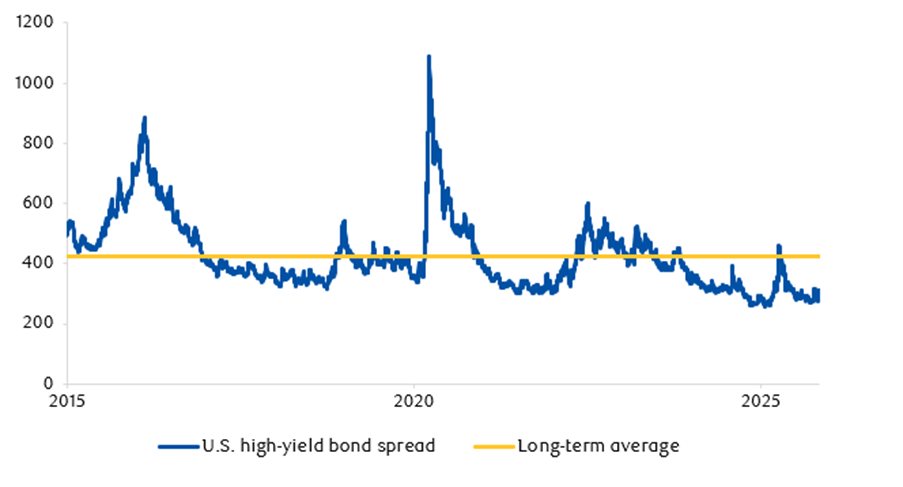
The high‑yield (HY) credit spread remains a robust leading indicator for both real economic activity and equity market performance.

A widening spread raises companies’ cost of capital, prompting them to cut investment and output growth. HY spreads are also predictive for equities; historically, high‑yield returns correlate with equity returns at a range of 66% to 92%. Essentially, equities and high-yield bond returns have a strong positive correlation.

Spreads have risen recently, but they started from a low base, so they’re not yet prohibitively high. A handful of credit concerns have emerged in recent weeks, involving names such as First Brands, Tricolor, Western Alliance, Zions Bancorp, Broadband Telecom, and Bridgevoice. This follows JPMorgan Chase CEO Jamie Dimon’s comment that the first credit worries, “like cockroaches”, often signal the presence of many more.

How to view the credit market

The recent uptick in credit spreads has been modest, and spreads remain relatively low in a long‑term historical context.

High-yield bond credit spreads have widened but don’t appear attractive on a long-term basis
Source: LSEG Datastream

High‑yield investors accept higher default risk in exchange for extra yield; even with the recent spread widening, the overall yield on high‑yield bonds is still modest compared with safer credit.

There’s room for defaults to increase without indicating a systemic financing crisis – this is what we would expect in a normal credit cycle.

Consequently, we can tolerate a further widening of spreads or additional distressed credit cases before becoming overly concerned about an economic slowdown.

Please continue to check our blog content for advice, planning issues and the latest investment market and economic updates from leading investment houses.

Charlotte Clarke

12/11/2025

Team No Comments

Brooks Macdonald The Daily Investment Bulletin

Please see the below article from Brooks Macdonald detailing their discussions on Markets, US Government Shutdown and the UK Labour Market. Received this morning 11/11/2025.

What has happened?

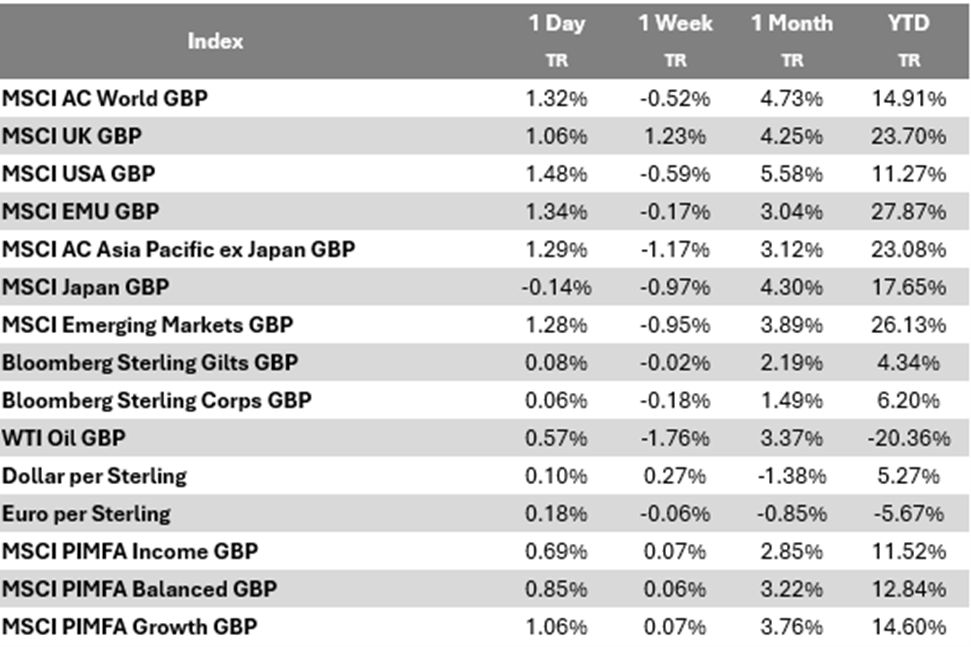
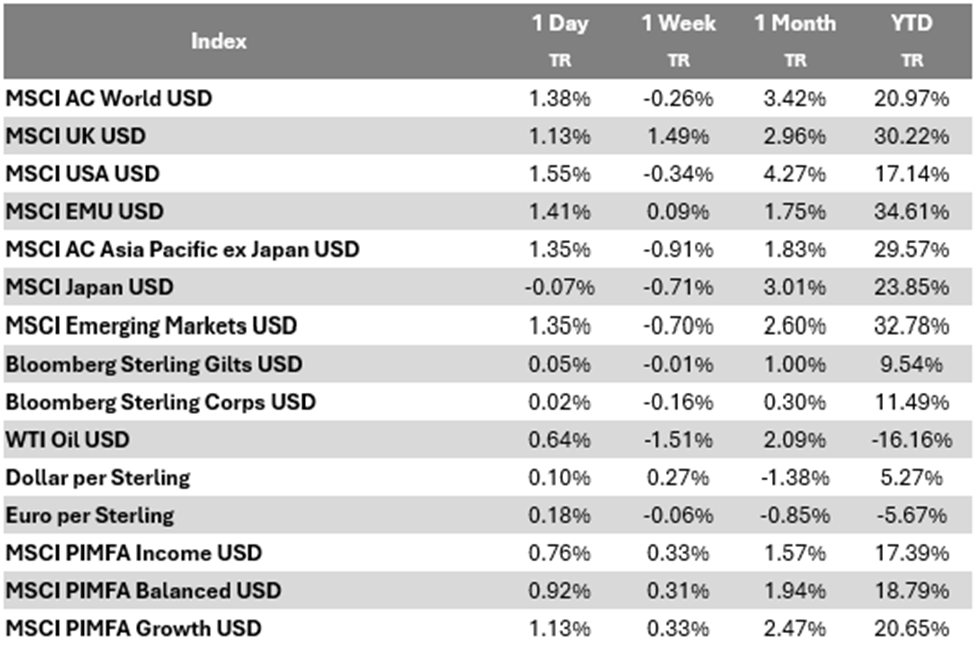
The S&P 500 staged a strong rebound with a +1.54% gain—its best day in four weeks—lifting it about +3% above Friday’s lows. Tech stocks drove the rally, as the NASDAQ advanced +2.27% and the Magnificent 7 jumped +2.79%, fuelled by Nvidia’s standout +5.79% rise. After dropping -13.6% from recent highs, Nvidia is now just -3.9% off those peaks, highlighting a mega-cap skew in the recovery. Broader indices also participated, with the equal-weight S&P 500 up +0.52% and the Russell 2000 gaining +0.94%. European benchmarks outperformed too, including the STOXX 600 (+1.42%), and the DAX (+1.65%). The uplift spread to other assets, with gold climbing +2.86% in its best session since May.

US government shutdown edges towards resolution

The Senate passed a stopgap funding bill by a 60-40 vote, with some Democrats crossing party lines to support Republicans, setting the stage to end the longest government shutdown on record. President Trump endorsed the deal earlier, and House Speaker Johnson expects swift passage tomorrow, despite delays from shutdown-related airline disruptions. Once resolved, a flood of delayed US economic data will follow—potentially including the September jobs report as early as next week, based on the 2013 precedent where similar backlogs cleared quickly. This could provide fresh insights into the economy amid ongoing volatility.

UK unemployment hits 5% as Labour markets weaken, strengthening BoE easing bets

UK unemployment climbed to 5% in the three months to September—the highest since early 2021—while payrolls dropped by 32,000 in October, the steepest decline since November 2020. Private-sector wage growth slowed to 4.2%, its weakest since the pandemic, amplifying signs of labour market deterioration. Markets now price an ~85% chance of a 25bps Bank of England rate cut in December. Governor Bailey has signalled openness to easing from 4% if inflation cools, supporting dovish views after last week’s narrow 5-4 vote to hold rates.

What does Brooks Macdonald think?

As the US shutdown appears poised for resolution, we’re closely monitoring the upcoming backlog of economic data releases, which could offer clearer signals on labour market trends and broader growth. Meanwhile, the recent market rebound has been heavily skewed toward mega-cap tech stocks, which may continue to amplify overall volatility if broader indices like the equal-weight S&P 500 and small caps fail to sustain their gains.

Bloomberg as at 11/11/2025. TR denotes Net Total Return.

Please continue to check our blog content for advice, planning issues and the latest investment, market and economic updates from leading investment houses.

Alex Clare

11/11/2025

Team No Comments

Tatton Investment Management: Monday Digest

Please see below, an article from Tatton Investment Management, analysing the key factors currently affecting global investment markets. Received this morning – 10/11/2025

Liquidity, actually  

After stocks sold off 2-3% last week, with big tech particularly vulnerable, Monday morning has seen a decent bounce. S&P 500 futures are now only 1% down from a week ago. The US Senate’s Sunday vote to push on with the bill for 2025’s government funding could mean an end to the current shutdown this week. While this will help the economy, the market’s weakness hasn’t been about a fear of a recession; this is a liquidity and volatility story.

Starting with the UK, the Bank of England’s (BoE) 5-4 vote to keep interest rates steady was closer than expected. Unless anything remarkable happens, the BoE will cut in December – and may even repeat in February. The chancellor’s pre-budget briefing (and leaks on Friday) confirm tax rises ahead, but UK stocks held up better than most and UK bond yields fell more sharply. This was helped by weaker sterling (making our markets more attractive and overseas revenues higher). The Chancellor’s fiscal discipline is attracting bond managers too.

European data was lacklustre (covered below) but Eurozone loan demand is improving, thanks to the ECB allowing greater liquidity than the Fed.

The media put US tech’s wobble down to valuation vertigo – fear that profits won’t live up to the hype. The longest US government shutdown in history, and a surge in layoffs (according to Challenger, Gray and Christmas) didn’t help. However, the overall data is more mixed; ADP reported stronger hiring than expected; the ISM purchasing manager surveys were stronger; growth was resilient enough to keep inflation on the high side of expectations.

But big tech is relatively insensitive to US growth. We agree that the sell-off has been shutdown-related, but for a different reason: reduced federal spending means less liquidity in the financial system. That means fewer asset buyers and greater volatility.

Investors have sold equities (and speculative assets like crypto) to raise cash. The effects spread all over the world, thanks to interconnectedness (Japan’s Nikkei sold off sharply). Amid the jitters, we should remember that the long-term outlook is solid. That suggests that an end to the shutdown could mean an end to the cash squeeze and, perhaps slowly at first, investors may return to the markets. When liquidity loosens, we expect more buyers than sellers again. So, we’re in the same position as we have been for weeks: volatility is a bumpy ride to a good destination.

October Asset Returns Review 

Global stocks gained 4.8% in October in sterling terms, but it was a bumpy ride. The US government shutdown had minimal impact on equities – at least initially. It did prevent economic data releases and eventually weighed on activity, hurting small caps.

Large cap tech stocks rallied 7.3% after solid quarterly earnings, a strong antidote to fears of an ‘AI bubble’. The shutdown also compounded tight liquidity conditions (the US treasury is collecting and not spending money) which increased volatility. We saw this in a $19bn ‘flash crash’ for cryptocurrencies mid-month. Heightened nerves also amplified discussion about private credit lending standards. Recent defaults have tightened credit conditions.

Falling bond yields provide some offset – though they bumped up after the Fed’s hawkish meeting. UK bond yields fell particularly sharply (gilt prices up 2.7%), which helped UK equities gain 4.1% and remain one of 2025’s best performers.

Japanese stocks had their best month (in local currency terms) in 35 years, as investors approved of new Prime Minister Takaichi’s policies. The yen’s fall crimped sterling returns to 5.9%. Emerging markets surged 6.7%, despite the largest EM, China, falling 1.2% amid tighter liquidity. South Korea was by some distance the standout EM, and is going through a corporate revival similar to Japan.

South Korea hosted the APEC summit and a nerve-wracking Trump-Xi meeting. It ended better than expected, with a mini-deal pausing tariffs and export restrictions and assuring investors that geopolitics isn’t as bad as feared. Dissipating risks might be related to gold prices coming off their highs, or that the rally might just have ran out of steam.

Q3 corporate earnings reports were strong, not only for US tech but for global banks too. When fundamentals are solid but volatility is high, investors tend to see opportunity in the dips.

Germany engineers a recovery 

Markets aren’t as enthusiastic about Germany as they were in early 2025, but we see improvement coming next year.

Europe’s largest economy was in recession from late 2022 to Q4 2024 (the longest concession since WWII), thanks to global manufacturing woes and high energy prices. It climbed out of recession just as the CDU-SPD government removed Germany’s constitutional debt brake for defence and infrastructure investment, but is contracting again. Many doubt the government’s fiscal follow-through; reports suggest some of the €500bn infrastructure spend will just be re-allocated from existing plans to make the core budget look better.

Still, we always knew stimulus wouldn’t come until 2026, and it will significantly boost activity when it does. Conditions are already improving: businesses are feeling more confident, due to efficiency gains and expanding profit margins (counteracting sluggish revenues). German corporates usually save when growth is weak and spend when it’s strong – but they’ve been investing even through recent struggles. This investment will result in higher revenues, particularly when combined with the public spending boost. Higher revenues and higher margins is a powerful combination, and we expect more investment as profits strengthen.

The profit and margin story isn’t unique to Germany. European companies are improving, industrial orders are on the rise and European loan demand is strong (as noted by the ECB). Germany was previously a passenger in this revival, rather than a growth engine (a historical role reversal) but now it is joining in the fun. Europe’s growth renaissance needs its largest economy firing. We expect that to happen next year. Businesses and households are getting more confident, and will get a shot in the arm from fiscal spending. In 2026, we expect Germany to be at the heart of Europe’s growth story.

Please continue to check our blog content for the latest advice and planning issues from leading investment management firms.

Marcus Blenkinsop

10th November 2025


Team No Comments

EPIC Investment Partners | The Daily Update

Please see below, an article from EPIC Investment Partners which details their predictions for the impact of AI on the labour market. Received today – 07/11/2025

Chris Rea didn’t have artificial intelligence in mind when he wrote his 1989 hit The Road to Hell, but his warning, “This ain’t no technological breakdown. Oh no, this is the road to hell”, has found new resonance in the age of generative AI. The latest employment data seems to vindicate the pessimists: Challenger, Gray & Christmas reported more than 153,000 job cuts in October, the highest for that month since 2003. Companies are restructuring at speed, with AI adoption frequently cited as the cause. The image of automation devouring jobs fits neatly into a familiar narrative of economic collapse, where technology hollows out livelihoods and destabilises society.

Yet that view is dangerously incomplete. The anxiety over shrinking pay packets captures only one side of the ledger, ignoring the countervailing force that will shape the century: the collapsing cost of living driven by demographics and AI-powered deflation.

Across the developed world, fertility rates have fallen below replacement levels, and workforces are shrinking. Without a productivity shock, this demographic implosion would mean chronic shortages, rising costs and a slow-burn inflation trap. The real “road to hell” would be a world short not of jobs, but of workers.

AI’s arrival therefore marks not an existential threat to labour but a reprieve from demographic gravity. Automation has appeared at the moment it was needed, not to replace a surplus of people, but to substitute for their absence. As ageing populations drain the supply of human labour, intelligent systems and robotics are taking up the slack, allowing economies to sustain output and living standards.

The result is a new, structural form of deflation—not the demand-crushing kind of recessions, but cost-deflation born of efficiency. AI drives the marginal cost of producing complex goods and services ever closer to zero. Nominal wages may stagnate as human output becomes replicable, but the price of what those wages buy collapses in tandem.

For most consumers, wealth is better measured by purchasing power than by salary size. When the price of core goods and services plunges, a modest pay cheque can still buy more comfort and convenience than at any point in history. Even those outside the AI capital elite stand to gain from the abundance it unleashes and the erosion of scarcity in many sectors.

The politics of this transition will be turbulent. Redundant job titles make headlines; invisible price declines do not. Yet, in time, AI’s deflationary engine may prove the most benign disruption of all, rescuing ageing economies from inflationary paralysis and transforming scarcity into surplus.

This ain’t no technological breakdown, nor the road to hell, this is the road to salvation.

Please continue to check our blog content for the latest advice and planning issues from leading investment management firms.

Alex Kitteringham

7th November 2025

Team No Comments

EPIC Investment Partners – The Daily Update | Energy Issues

Please see below article received from EPIC Investment Partners this morning, which reviews the differing approaches to renewable energy globally.

The United States is the world’s largest producer of oil (although it only ranks 9th in terms of reserves, roughly one quarter of top ranked Venezuela). The US also holds the largest share of global coal reserves (just over 20%). In this sense it is not surprising that the Trump administration considers that fossil fuels should remain the ‘backbone’ of energy generation. Likewise, China – which lacks significant oil reserves – continues to invest in new coal plants given their substantial coal reserves, some 13% of global reserves.

The different approach to renewable energy, however, is startling. China has embraced hydroelectric, solar and wind power generation while close to half of passenger vehicles sold are either outright EVs or hybrid EVs.

The White House declared a national “energy emergency” in January, taking aim at high energy prices and a lack of affordable power. In an earlier daily we covered the enforced closure of the Ørsted’s Revolution Wind LLC in August. The project is a joint venture with Global Infrastructure Partner’s Skyborn Renewables and was approved by the Biden Administration.

The project was 80% complete with 45 of 65 planned wind turbines installed. On 3 November a Federal Judge ruled that Ørsted and its partner could resume construction. We will see how the Trump administration reacts.

This is not the only strange decision taken by the Trump administration. A coal plant in western Michigan was due to be retired a few months ago. The company that owns and runs it had concluded that consumers would be better served by a mix of other energy sources. The administration barred the plant from closure. The operator has been spending almost $1mn per day to keep it running.

Who bears the cost of running this inefficient plant? Consumers across the Midwest of America. All of this is occurring as the construction and operation of data centres shift overall electricity demand upward.

A 2022 study by the Department of Energy found that more than 300 existing and retired coal plants could be turned into advanced nuclear power plants. The coal plants are already connected to the electricity grid and some of the skills needed to operate nuclear plants are similar, thereby possibly creating job opportunities for existing and former employees.

Please check in with us again soon for further relevant content and market news.

Chloe

06/11/2025

Team No Comments

Brewin Dolphin – Markets in a Minute

Please see this week’s Markets in a Minute update below from Brewin Dolphin, received yesterday afternoon – 04/11/2025.  

Investor sentiment boosted by earnings season

We examine how earnings results from some of the ‘Magnificent Seven’ have reassured investors worried about an AI bubble.

Key highlights

  • Justifying the AI investment surge: Four of the ‘Magnificent Seven’ released earnings reports last week, which revealed an aggressive ramp-up in infrastructure investment due to relentless demand for artificial intelligence (AI) computing capacity.
  • A tactical China-U.S. truce: The China-U.S. trade war has seen a temporary respite. China agreed to a one-year suspension of its more restrictive rare-earth export control measures, while the U.S. agreed to reduce existing tariffs by 10% on certain Chinese goods.
  • What’s the latest on interest rates? The Federal Reserve cut interest rates by 25 basis points while both the European Central Bank and Bank of Japan held rates steady.

Last week was a busy one for markets, with a combination of factors to absorb.

The market narrative was dominated by three key themes:

  • Unprecedented capital expenditure (CapEx) commitments from the largest technology firms.
  • Various monetary policy decisions from heavily scrutinised central banks.
  • A tactical de-escalation in the protracted China-U.S. trade conflict, which saw a major pivot in advanced chip technology speculation.

‘Hyperscaler’ earnings: Justifying the AI investment surge

‘Hyperscalers’ reported results last week amidst concerns over their investment plans.

Source: LSEG Datastream

The week’s earnings reports from the major “hyperscalers” – Alphabet (which owns Google), Microsoft, Amazon, and Meta – revealed a collective and aggressive ramp-up in infrastructure investment, with 2025 CapEx guidance being raised across the board. The collective spending is now estimated to exceed previous forecasts, driven almost entirely by the relentless demand for AI computing capacity.

The size of the short and longer-term investment commitments is unnerving for investors, as it reminds them of previous investment cycles where long-term demand was slower than expected. This led to longer periods of underused capacity.

Large investments in telecommunications infrastructure during the late 1990s, or mining capacity during the early 2000s, led to correspondingly high depreciation charges, with little offsetting revenue and, often, asset writedowns (when the recorded value of an asset is reduced because the market value has fallen below its book value). This is why people worry about an AI investment bubble.

Instead, companies reported that their spending is based on the concrete evidence of robust, immediate demand – mitigating concerns over a potential AI spending bubble.

Executives were unanimous in reporting that AI demand continues to exceed available capacity. Microsoft’s CFO Amy Hood noted that the company is still operating from a “constrained capacity place,” primarily in power and data centre space, rather than just chip supply. Amazon CEO Andy Jassy echoed this sentiment, stating that despite aggressive building, “as fast as we’re bringing it in, right now, we are monetising it,” indicating a rapid and visible return on deployed assets.

Crucially, Microsoft disclosed that it still has a remaining performance obligation (RPO) backlog of $392 billion, an increase of 51% year-on-year. This represents the revenue that Microsoft expects to earn from services or products it has yet to deliver to clients and customers. This figure, which is expected to take about two years to realise, proves that Microsoft has committed customer contracts and a certainty of near-term revenue, which directly supports its elevated CapEx roadmap for the forthcoming years.

Alphabet raised its 2025 CapEx forecast and signalled a “significant increase” expected for next year, driven by a $155 billion backlog in demand for cloud business.

Central banks: Policy divergence and political scrutiny

The Federal Reserve cut interest rates

Source: LSEG Datastream

Central bank activity underscored a notable divergence in global monetary policy, while the U.S. Federal Reserve and the Bank of Japan continued to face unique political pressures.

  • Federal Reserve (the Fed): The Federal Open Market Committee (FOMC) cut the federal funds rate by 25 basis points to a range of 3.75% to 4%. The cut was characterised as a pre-emptive easing measure designed to address rising downside risks to the employment mandate (its mandate from Congress to promote maximum employment). Fed Chair Jay Powell affirmed that future policy would remain data-dependent, even as the narrative continues to focus on the administration’s strategy of using political appointments to the Board of Governors to pressure the rate-setting process.
  • European Central Bank (ECB): The ECB held its key interest rates steady, keeping the deposit rate at 2% for the third consecutive meeting. With Eurozone inflation stabilising near the ECB’s 2% target, it provided minimal forward guidance, suggesting a prolonged pause. Market expectations are pointing to rates staying unchanged well into 2026. No new economic forecasts were issued at this meeting.
  • Bank of Japan (BoJ): The BoJ also held its main interest rate unchanged at 0.5%. At the subsequent press conference, Governor Kazuo Ueda was inevitably asked about the stance of the newly installed prime minister, Sanae Takaichi, who’s known to favour accommodative monetary policy.

Ueda made it clear that while the bank would “stay in close contact with the government and maintain necessary communication,” the BoJ’s decision to maintain its current stance was based solely on the need to evaluate more data, particularly concerning domestic wage trends and the impact of U.S. tariffs. He pledged to “adjust the degree of monetary accommodation when we are convinced, irrespective of the political situation”, an explicit verbal defence of the central bank’s independence against both domestic and external (U.S. Treasury) pressure to quicken its tightening pace.

Trade spats: A tactical China-U.S. truce and chip policy volatility

The last few weeks have seen an intensification of trade stresses between the U.S. and China, with tech restrictions and tariffs from the U.S. prompting rare-earth metal export restrictions and other countermeasures from China.

But more recently, relationships seemed be thawing, resulting in a temporary de-escalation. However, volatility in the semiconductor sector underscored the fragility of the tech relationship.

The rare-earths and tariffs deal

Beijing secured short-term relief for key industries by agreeing to a one-year suspension of its latest, more restrictive rare-earth export control measures, and committing to resuming large purchases of American agricultural products (notably soybeans).

In return, the U.S. offered tangible concessions, agreeing to reduce existing tariffs by 10% on certain categories of Chinese goods. This marks a tactical retreat by both sides to stabilise markets, though the underlying structural controls remain in place.

The Blackwell chip drama

Market attention was intensely focused on the potential relaxation of export controls on Nvidia’s advanced Blackwell AI chips (B-series).

Speculation began when U.S. President Donald Trump publicly signalled he might discuss the sale of a downgraded variant (e.g., the B30A) with Chinese President Xi Jinping. This talk ignited a massive rally in semiconductor stocks, driving Nvidia’s market capitalisation briefly toward the $5 trillion mark on Wednesday, as investors anticipated access to the vast Chinese market.

However, the market impact proved short-lived. On Thursday, President Trump clarified that while semiconductors were discussed broadly, the advanced Blackwell chips were not specifically on the table, instantly cooling market optimism. Analysts and U.S. lawmakers had vehemently opposed any relaxation, arguing that exporting even a scaled-down Blackwell chip would functionally end the existing export control regime and severely erode America’s critical advantage in AI computing power.

Technology remains the dominant force behind the economy and the market, with technological supremacy becoming the prevalent geopolitical issue.

Please continue to check our blog content for advice, planning issues and the latest investment market and economic updates from leading investment houses.

Charlotte Clarke

05/11/2025

Team No Comments

Brooks Macdonald Daily Investment Bulletin

Please see the below article from Brooks Macdonald detailing their discussions on the AI Arms Race. Received this morning 04/11/2025.

What has happened?

Markets kicked off November with familiar patterns: the S&P 500 edged up +0.17%, but the Magnificent 7 gained +1.18% while the rest of the index (S&P 500 ex-Mag-7) slipped -0.30%. Small caps and equal-weighted shares echoed the caution, with the Russell 2000 and equal-weighted S&P 500 down -0.33% and -0.30% respectively. Investors wrestled with hawkish Fed signals, and a government shutdown now tied for the longest in history and set to claim the record at midnight tonight. Amongst mega-caps, Amazon stole the spotlight, jumping +4.00% after striking a seven-year deal with OpenAI. The ChatGPT creator will pay Amazon Web Services for Nvidia chips and data-centre access in a deal valued at up to $38 billion.

Fed speakers turn up the hawkishness

Treasury yields climbed as several Fed officials sounded cautious. Chicago Fed President Goolsbee (a 2025 voter) said he’s ‘not decided’ on December and is ‘nervous’ about inflation trending the wrong way after four-and-a-half years above target. San Francisco’s Daly urged an ‘open mind’ for the next meeting. Governor Cook noted rising employment risks but stopped short of backing December easing. The hawkish chorus, building on Chair Powell’s comments last week, pushed the 2-year yield +3.1 bps to 3.61% and the 10-year +3.3 bps to 4.11%.

What does Brooks Macdonald think?

The AI arms race is accelerating. OpenAI’s Amazon deal pushes its recent pledges toward $1.5 trillion when combined with prior Nvidia and AMD deals. At the same time, Alphabet joined the funding frenzy by announcing ~$22 billion in new to fuel AI buildout, mirroring Meta’s more aggressive borrowing strategy. The AI investment boom continues to split the market: mega-caps with direct AI exposure race ahead, while the broader economy faces cross-currents from sticky inflation, Fed restraint, and fiscal gridlock. We remain vigilant as tides can turn quickly.

Bloomberg as at 04/11/2025. TR denotes Net Total Return.

Please continue to check our blog content for advice, planning issues and the latest investment, market and economic updates from leading investment houses.

Alex Clare

04/11/2025

Team No Comments

Tatton Investment Management: Monday Digest

Please see below, an article from Tatton Investment Management, analysing the key factors currently affecting global investment markets. Received this morning – 03/11/2025

Faster change, stronger growth, bigger risks

Stocks climbed last week, yet again hitting various new highs although, again ending with a sense of anticlimax. The narratives didn’t change. UK markets did well across the board, reflecting an improving economy.

The US Federal Reserve cut interest rates but warned that a December cut is not a “forgone conclusion”. The rate-setting committee is split between hawks and doves, partly thanks to Trump’s recent appointees. The US government shutdown also means there’s little data to go on (and the available data is mixed) so policymakers rely more on judgement. Job postings are falling, and now layoffs are increasing too (with some high profile tech layoffs). A weaker labour market ahead of the year’s most important retail period could hurt sentiment, so it’s the Fed’s hawkish turn is strange timing. That’s why small caps stocks were poor.

While the ECB kept rates unchanged, its lower inflation forecast means December’s meeting should be interesting. There’s a small chance of a Bank of England cut this week, but a higher chance of a December cut, after the budget.

Trump and Xi’s mini-deal to suspend tariffs and restrictions for a year helped the mood, even if it’s only a pause. Tariff de-escalation allows investors to focus on strong corporate earnings – including for European banks. Tech stocks reported strength, but not enough to boost share prices. Investors are worried about how much they’re spending on AI infrastructure.

More AI spending means less money for shareholders – as discussed below. But even if the AI capex race doesn’t help tech stocks, it should boost global growth. Big companies are investing heavily and shifting resources. There will be losers, but it’s a positive for growth and profits.

That does mean proportionally less money for risk assets, though, which adds to the tightening of global liquidity. Indeed, there was increased attention on the rise in US interbank rates amid comments of (mild) concern from the Fed. That’s why recent volatility could continue, even if the outlook is getting better. The risks could feel riskier ahead.
Renminbi is a power tool

China’s renminbi (RMB) has strengthened against global currencies. The government fixes its currency value against a basket of currencies, but changes its fix depending on the market exchange rates – so the fix is sometimes more about guiding markets. From 2023, currency markets pushed RMB weaker but the fix remained stable. Beijing wanted a stable RMB, but markets didn’t agree, due to weak growth. At points since, RMB devaluation has looked likely, but never came. In 2025, however, Beijing has guided RMB stronger and markets have gone along with it – thanks to signs that China’s economic stimulus is working.

At the same time, China is ramping up RMB’s internationalisation. It’s now world’s second-largest trade finance currency, and third largest payment currency. By guiding RMB higher against the dollar, Beijing is also counteracting the gap in interest rates between the US and China (higher US rates pushes capital to the US). RMB gains are gradual, consistent and it has been the least volatile of any major economy recently, which encourages companies to use RMB for trade and reserves. China is also presenting itself to major trading partners as open and reliable – in contrast to volatile US leadership.

A strong RMB isn’t good for China’s short-term growth. Exports are a huge part of the economy, and have been hit by US tariffs. A stronger currency makes them even less competitive. But it isn’t about growth; it’s about proving RMB’s worth as a global reserve. Beijing sees an opportunity to capitalise on the world falling out of love with the dollar this year. Something similar happened in 2023, when everyone thought RMB devaluation was on the cards but the opposite happened. China gambled that internationalisation was more important than export growth, and it paid off. It would be a brave trader to bet against RMB again now.

Why does tech want private debt?

Meta’s $25bn bond issuance comes just after it was part of a $27bn private debt deal – a joint venture with Blue Owl to build an AI datacentre. It’s part of a splurge of debt-raising from tech firms in 2025, with $175bn raised so far.

Meta’s private deal would have got more attention if it was a public bond. It got an A+ credit rating, but yielded 6.58% at issue – more like a junk bond yield. Trading in secondary markets drove prices up 10% after issue. If this was a public bond, whoever arranged the deal would be embarrassed. The price jump means Meta never had to pay that high interest in the first place. Shareholders don’t like unnecessary payments.

The whole point of public bonds is that lenders compete to give you the best rate, so why keep the deal private? The standard reason is to keep details under wraps but, as a publicly listed companies, Meta has to publish its financial details anyway. We suspect companies will see the deal as an incentive to avoid private credit – which might end the dearth of high-yield corporate issuance this year. We can’t forget private credit’s current PR headache, of course. A high-profile mispriced deal won’t help that mood.

On the flipside, why are AI-related companies issuing so much debt when so many think there is a bubble? We think bubble talk is overstated, and it’s not unreasonable for these cash-rich companies to borrow if they expect AI-fuelled expansion. But the timing is a little strange.

Capital spent building AI capacity is capital not returned to shareholders. Big tech has been using its cash on share buybacks for years, benefitting equity valuations, but that has tailed off as AI investment eats into cash. It’s an interesting trade-off, showing AI growth is no longer the gift that keeps giving.

Please continue to check our blog content for the latest advice and planning issues from leading investment management firms.

Marcus Blenkinsop

3rd November 2025

Team No Comments

EPIC Investment Partners – The Benchmark Illusion: When Arithmetic Undermines Credit Reality

Please see the below article from EPIC Investment Partners detailing their discussions on the emerging-market bond landscape. Received this morning 31/10/2025.

The emerging-market bond landscape harbours a distortion so large it hides in plain sight. Nearly two-thirds of the USD-denominated universe now trades with spreads below 150 basis points (bps), with one in six below 50 bps. Some of this reflects genuine progress—Qatar, for instance, has earned its place among near-developed credits—but much of it is mechanical, not merit-based.

JPMorgan’s EMBI Global Diversified (EMBIGD), the benchmark dominating EM debt investing, was built on a sound premise: limit each issuer to twice the index country average to avoid concentration risk. Yet this safeguard has become a machine for mispricing, channelling passive capital not to the best credits, but to the smallest. In this world, allocation is determined not by fiscal strength or market depth, but by a spreadsheet formula.

The absurdity is clearest when comparing Mexico and the Dominican Republic. Mexico’s economy, at roughly US$1.8 trillion, is fourteen times larger than the Dominican Republic’s US$126 billion, and its bond market vastly deeper. Yet both sit almost side by side in the benchmark: about 3.8% for Mexico and 3.5% for the Dominican Republic. A Latin American heavyweight and a lower-rated Caribbean island command near-equal access to global passive capital. This is distortion masquerading as diversification.

The consequences are tangible. Capped giants like Mexico face a structural overhang—index capital cannot fully absorb their issuance—while smaller, uncapped names see their spreads crushed to unsustainable levels. This week, the BB-rated Dominican Republic sold a new 10-year bond at 177 bps over Treasuries, while Mexico’s state-owned utility CFE (rated BBB) trades wider at 204 bps. Why purchase the weaker credit at a tighter spread? The correlation to the index is 85%, so even the diversification argument fails.

Stress only magnifies the irony. When risk aversion hits, passive funds are forced to dump the same small credits simultaneously. Liquidity evaporates precisely where it is most needed, punishing investors who mistook benchmark exposure for safety. Larger, capped issuers such as Mexico remain tradable, preserving price discovery and resilience. In downturns, the illusion of diversification turns into a liquidity trap.

What starts as an index rule ends as an investment philosophy. When scarcity, not solvency, drives allocation, markets cease to price risk and begin to simply replicate it. Benchmarks no longer measure reality—they manufacture it.

Our models are explicitly designed to avoid this trap, bypassing the fiction of benchmark parity to seek genuine value. Ultimately, the choice for investors is stark: trust an index that rewards scarcity over solvency, or trust the simple arithmetic of value. Because when a BB borrower yields 5.875% and a BBB borrower offers 6.1%, the maths, not the marketing, reveals where prudence and opportunity truly lie.

Please continue to check our blog content for advice, planning issues and the latest investment, market and economic updates from leading investment houses.

Alex Clare

31/10/2025