Team No Comments

EPIC Investment Partners – The Daily Update: Emerging Markets Take the Wheel

Please see the below article from EPIC Investment Partners detailing their discussions on global market growth and emerging markets. Received this morning 04/12/2025.

The OECD’s latest Economic Outlook presents a global economy that remains resilient, though increasingly strained by rising trade barriers and persistent policy uncertainty. Global growth is forecast at 3.2% in 2025, easing to 2.9% in 2026, with the OECD warning that this path is vulnerable to escalating trade tensions and possible market corrections if current AI-related optimism does not fully materialise.

In the United States, the OECD expects growth to slow to 2% in 2025 and 1.7% in 2026 before edging back to 1.9% in 2027. The moderation reflects cooling employment growth, sharply lower net immigration, the tariff-induced rise in consumer prices, and significant cuts to non-defence discretionary spending. As these effects fade and disinflation resumes, activity is projected to move back toward potential. A key downside risk is an equity market correction, given valuations supported by expectations of strong AI-driven earnings, though genuine AI breakthroughs could deliver upside. With labour market risks rising and underlying inflation appearing contained, some monetary easing in 2026 may be warranted. Fiscal policy remains on an unsustainable trajectory, requiring a multi-year consolidation alongside reforms to increase housing supply, upgrade infrastructure, and ease labour shortages.

China’s growth is projected at 5% in 2025, slowing to 4.4% in 2026 and 4.3% in 2027. Consumption is expected to soften due to elevated precautionary savings and the unwinding of recent durable goods incentives. Property investment and prices are likely to decline further as excess capacity is absorbed. The government’s anti-involution campaign is set to moderate business investment, though infrastructure spending should strengthen under the new Five-Year Plan. Export performance will remain constrained by higher US tariffs. Key risks include industrial overcapacity and persistent trade uncertainty, while new reforms could bolster private investment. Monetary policy remains supportive but constrained by pressure on bank profitability, leaving fiscal policy to play a larger role.

Emerging Markets remain the brightest part of the global outlook, with Emerging Market and Developing Economies projected to drive nearly two thirds of world growth over the next decade. Improved policy frameworks, stronger reserves, favourable demographics, resource endowments, and rapid digitalisation continue to support competitiveness, led by India, the fastest-growing major economy.

This environment continues to support our EPIC Fixed Income strategy, which favours wealthy, undervalued EM sovereign and quasi-sovereign bonds. Notable examples include Pemex 2050s, up roughly 29% year-to-date (end-Nov), supported by strong government backing; similarly, Mexican utility CFE 2052s, have rallied 19%; the Saudi PIF-issued green bond, GACI 2052s, returned ~15%; and the strategically important Abu Dhabi Crude Oil Pipeline 2047s, up about 12%. Even credits that have moved closer to fair value, such as Chile’s state-owned Empresa Metro 2050s, have posted gains exceeding 14%. Taken together, these results highlight the compelling opportunities still available in select EM credit, particularly where balance-sheet strength and sovereign support remain under appreciated by global markets. By comparison, the Bloomberg Global Aggregate Index has returned 5.08%, underscoring the relative strength of select EM credit opportunities.

Please continue to check our blog content for advice, planning issues and the latest investment, market and economic updates from leading investment houses.

Alex Clare

04/12/2025

Team No Comments

Brewin Dolphin – Markets in a Minute

Please see this week’s Markets in a Minute update below from Brewin Dolphin, received yesterday afternoon – 02/12/2025.  

What the Autumn Budget means for the UK economy

We dissect the Autumn Budget and how it’s impacting investor sentiment.

Key highlights

  • Stocks rebound: Renewed expectations of a Federal Reserve rate cut supported stocks.
  • UK Autumn Budget: Markets welcomed the enlarged fiscal buffer, which shows Chancellor Rachel Reeves’ commitment to her fiscal rules.
  • U.S. data weakens: Economic data came in softer than expected across several fronts, including retail sales and consumer confidence.

Markets regained momentum last week, with global equities rebounding.

Sentiment was supported by renewed expectations of monetary easing in the U.S., as incoming data pointed to a softer economic backdrop.

While the overall market tone remains one of caution due to lingering concerns over high U.S. artificial intelligence (AI) stock valuations, investors cheered on improved rate cut expectations and signs of near-term fiscal clarity.

In the UK, all attention was on the Autumn Budget, which highlighted the government’s efforts to balance fiscal responsibility with the need to sustain near-term activity.

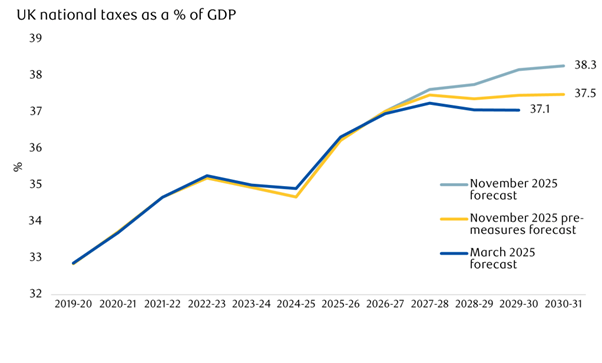
The Budget was broadly viewed as fiscally conservative. Chancellor Rachel Reeves announced a much larger fiscal headroom of £21.7 billion, a figure more than double the £9.9 billion previously projected. This headroom was achieved by a combination of more favourable forecasts from the Office for Budget Responsibility (OBR) and a sizeable package of tax rises.

Source: OBR Economic and fiscal outlook, November 2025

Markets interpreted this larger fiscal buffer as a signal of discipline, particularly at a time when gilt investors have been wary of potential policy slippage. Gilt yields fell modestly after the announcement, and the pound edged higher, reflecting a constructive reaction to the government’s strengthened capacity to meet fiscal rules.

Autumn Budget shows fiscal pain to be backloaded

It was well known that the chancellor would need to cut spending or raise taxes, as changes to the OBR’s growth forecasts meant she was no longer on track to meet her fiscal rules.

In response, she is increasing borrowing in the near term, while raising the tax burden later. In practical terms, this means ‘pain is backloaded.’ This will mainly be achieved through £26 billion in tax increases, three quarters of which won’t be implemented until April 2028.

Amongst the main measures announced were:

  • Freezing income tax thresholds until April 2031, which will raise an estimated £8 billion in the 2029/30 tax year.
  • Subjecting salary sacrificed pension contributions above £2,000 to both employer and employee National Insurance contributions from April 2029, which will raise an estimated £4.7 billion in the 2029/30 tax year.
  • Increasing income tax rates on dividends, property, and savings by 2%, which will raise an estimated £2.1bn in the 2029/30 tax year.

On top of these revenues of almost £15 billion from personal tax increases, a further estimated £11 billion in revenue is to be achieved from a series of smaller measures.

While fiscal tightening is backloaded, spending measures were frontloaded, consisting mainly of £10 billion of welfare measures (including the expected removal of the two-child benefit limit).

Overall, the Budget remains modestly contractionary for growth across the forecast period. There’s frustration amongst businesses over the lack of a pro-growth spirit or constructive strategies to tackle dire productivity growth.

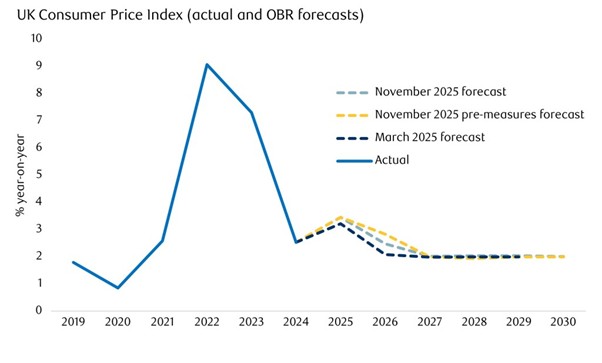
While the Budget isn’t expected to materially reshape the interest rate outlook, it also doesn’t stand in the way of the Bank of England (BoE) cutting rates in December. Against the mildly growth-supportive loosening of policy in the near term, the package announced also included measures which the OBR estimates will reduce Consumer Price Index (CPI) inflation by 0.5% in Q2 2026. This includes freezing rail fares, extending the fuel duty freeze, and an energy bills package that aims to reduce bills by an average of £150 per year from April 2026.

Source: OBR Economic and fiscal outlook, November 2025

Encouragingly, the OBR’s inflation forecasts show CPI inflation at 2.4% in Q2 2026, an improvement to the BoE’s forecast of 2.9% year-on-year made in its November Monetary Policy Report. Financial markets continue to price in a high probability of a BoE rate cut in December, citing muted growth and moderating inflation trends.

Looking beyond the near term, longer-term fiscal challenges remain. The OBR now projects the UK tax-to-GDP (gross domestic product) ratio to reach a new all-time high of 38.3% in 2030-31, markedly above its projection in March.

While the chancellor’s efforts may offer short-term reassurance to investors, structurally higher tax burdens risk reducing incentives for both businesses and workers. That could weigh on investment decisions and growth trends over time, particularly if economic momentum weakens more than anticipated. If tax receipts fall short because of weaker growth, this may reignite concerns for higher taxes or increased borrowing in the future.

For detailed commentary on the Budget and its implications for personal finances, please refer to our accompanying insight article here.

Weak U.S. data fuels December rate cut bets

Turning to the U.S., recent economic data came in softer than expected across several fronts, reviving expectations of a December rate cut.

September retail sales increased by just 0.2% month-on-month, which was much lower than both experts’ anticipations and August’s figures. Weakness was seen in motor vehicle sales and discretionary categories.

November data from the Conference Board showed that consumer confidence saw its highest decline since April, with forward-looking measures falling to their lowest in over a year. Part of that could be related to the prolonged government shutdown, but it also revealed rising concerns around income security and the labour market. For instance, the share of consumers that expect their incomes to rise in the next six months fell to the lowest level since February 2023. The views on current and future business conditions deteriorated.

In addition, U.S. regional manufacturing surveys like the Richmond Fed Manufacturing Index pointed to further moderation in activity. Meanwhile, producer prices came in below expectations, which indicated that tariffs haven’t materially impacted factory gate prices.

The broad U.S. data tone suggests that the economy is still expanding, but at a slower pace, and that price pressures will continue to ease due to the cooling labour market.

The Federal Reserve (the Fed) won’t receive another employment report before its December meeting, and visibility on inflation will also be more limited than usual. Traders initially viewed a December pause as the most sensible course of action. But last week’s range of weaker-than-expected data changed that narrative. The market is now pricing in an over 80% chance of a December rate cut.

Please continue to check our blog content for advice, planning issues and the latest investment market and economic updates from leading investment houses.

Charlotte Clarke

03/12/2025

Team No Comments

Brooks Macdonald – Daily Investment Bulletin

Please see below, an article from Brooks Macdonald, outlining the key factors currently impacting global investment markets. Received this morning – 02/12/2025

What has happened?

Markets stumbled at the start of December, with equities, bonds, and crypto all under pressure. Bitcoin slumped -5.2%, while the S&P 500 fell -0.53%, snapping a five-day winning streak. The Russell 2000 dropped -1.25%, and nearly three-quarters of S&P constituents ended lower. Tech held up better, with Nvidia rebounding +1.65%. The sell-off was driven by a surge in global bond yields, sparked by hawkish comments from Bank of Japan Governor Ueda that pushed 10-year JGB yields to their highest level since the Global Financial Crisis. US Treasuries followed suit, with 10-year yields jumping +7.2bps, which was the biggest daily rise in nearly four weeks. Stagflation fears added fuel, as the US ISM manufacturing index disappointed and higher oil prices compounded concerns.

Japan triggers global bond repricing

Ueda’s remarks have investors pricing in a near-certain December rate hike from the BoJ, sending Japanese yields to multi-decade highs. The 10-year JGB closed at 1.86%, its highest since 2008, while the 30-year hit 3.37%, a record since issuance began in the late 1990s. Even the 2-year breached 1% for the first time since the Global Financial Crisis.

Europe and UK also under pressure

European markets mirrored the global risk-off tone. The STOXX 600 slipped -0.20%, while the DAX fell -1.04%. Bond yields climbed across the region, with 10-year Bunds up +6.1bps and OATs up +7.5bps. Data offered little relief as Eurozone manufacturing PMI was revised down to 49.6, still signalling contraction. In the UK, the FTSE 100 eased -0.18%, broadly in line with European peers. The head of the OBR resigned following a premature release of budget analysis.  However, that wasn’t a market moving story, and the rise in 10yr gilt yields (+4.1bps) was more muted than in other countries yesterday. Data-wise, UK mortgage approvals for October came in at 65k, slightly above expectations but still within the 18-month range of 60–70k, underscoring a housing market that remains subdued amid higher borrowing costs.

What does Brooks Macdonald think?

Today’s focus may shift to geopolitics, as Trump’s envoy meets President Putin in Moscow to discuss US proposals for ending the war in Ukraine. While recent talks have been described as “productive,” Kyiv remains firm on territorial issues, suggesting any breakthrough is still some way off. Markets will watch closely for signs of progress, but for now, rate expectations and growth concerns remain the dominant drivers.

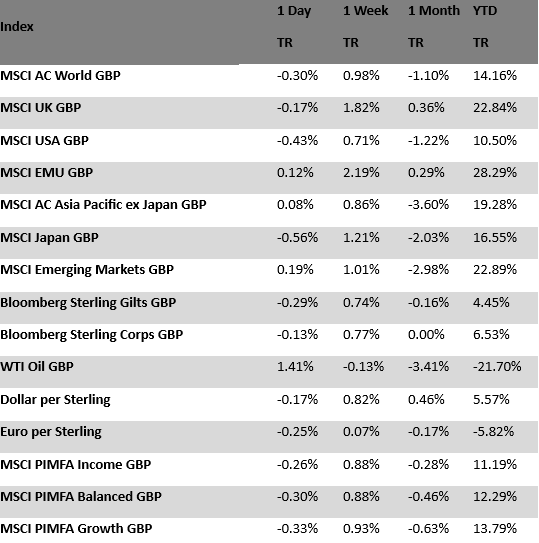
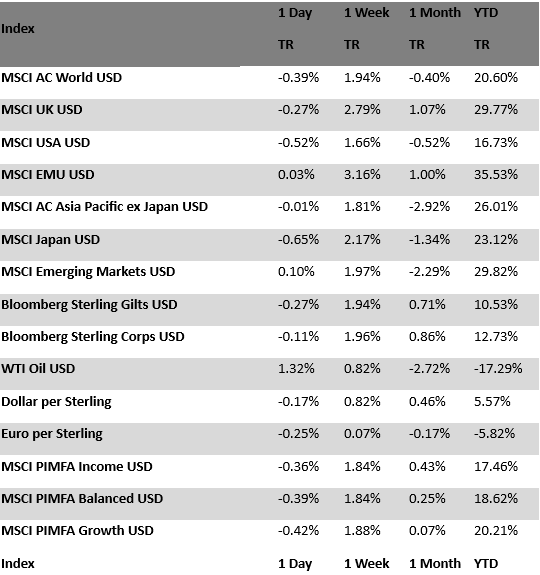
Bloomberg as at 02/12/2025. TR denotes Net Total Return.

Please continue to check our blog content for the latest advice and planning issues from leading investment management firms.

Marcus Blenkinsop

2nd December 2025

Team No Comments

Tatton Investment Management: Monday Digest

Please see below, an article from Tatton Investment Management, analysing the key factors currently affecting global investment markets. Received this morning – 01/12/2025

Markets give thanks to central banks

Capital markets had a good week. Headwinds are abating and optimists see a Santa Rally building, while pessimists see only markets not going higher.

We talk more about the UK budget below, but in short, markets took it well. Significant capital came out of UK portfolios in anticipation of wealth tax changes that never came. If that returns, it’ll boost UK assets. We also note that international investors see the UK as a better destination than many Britons. With the budget over, the government can issue more bonds and it’s skewing issuance towards the short end – taking pressure off long-term yields. Yields are also helped by the Bank of England’s likely interest rate cut in December.

Yields fell in most markets, thanks to a dovish Federal Reserve. Fed officials are still divided, but the dovish members are getting more airtime and recent consumer weakness has pushed the implied probability of a December cut up to 80%. The ECB is also split, but recently weak economic data suggests it will cut rates next year. Japan and China are the outliers: the BoJ disagrees with Prime Minister Takaichi’s wish for yen weakness, and Beijing is intent on pushing its own currency higher. That’s surprising, given China’s weak economy, but renminbi strength is more about status than economics.

US monetary policy is looser and the government reopening means its money will flow into the system again. This improves liquidity, helping risk sentiment. The good mood has spread beyond the big tech names – with smaller companies benefitting more from upcoming rate cuts. For most of the year, retail investors were bullish and institutional investors were nervous. Now, those roles have flipped: retail fears an end to the three-year bull market, while institutional investors see strong earnings, supportive policy and strong AI capex. This could create a capital rotation to the lesser loved stocks – as institutional investors tend to prefer a bargain to the momentum factor. That broadening of the market wouldn’t be a bad thing.

Don’t bet against the budget

The Office for Budget Responsibility’s (OBR) accidental early release of its assessment was an appropriate finish to a leaky autumn budget buildup. We’ll keep our analysis to how the budget might affect UK growth and assets.

The budget aims to raise £26bn in extra revenue, with the biggest share coming from a freezing of income tax bands until 2031. The tax take will be delayed; no rises now but higher real (inflation-adjusted) costs later on. Other measures include a raid on pension contribution tax breaks and higher dividend taxes, while there was some relief for benefits and small businesses. The OBR now predicts £22bn fiscal headroom for Chancellor Reeves, but downgraded its 2026 UK growth forecast to 1.5%.
Markets considered this a decent growth-deficit compromise. Gilt yields were volatile on Wednesday – falling on the OBR’s early release then rising on fears of delayed fiscal consolidation (and the possibility the government might later cave on fiscal discipline). Yields ended the week significantly lower, proving the OBR’s mishap was much ado about nothing. The fact stocks rose and sterling strengthened proved markets approved, on balance.

We’ve written about the UK market’s liquidity problem before, and on the face of it you would think pension raids and dividend taxes might exacerbate it. But higher dividend taxes will likely encourage share buybacks. These are systemically liquidity-neutral but can be an important source of short-term liquidity.

Because UK investors aren’t lately heavily investing in their own assets anyway, Britain’s markets are more sensitive to international investor sentiment, which tends to be more positive than domestic sentiment. For international asset holders, the government’s aim of getting interest rates down and containing the deficit is a positive. It hasn’t been a smooth ride, but the market reaction suggests the Chancellor is getting there.

US earnings: supportive or overexcited?

Almost all S&P 500 companies have reported Q3 earnings, and the blended average shows 13.4% year-on-year growth. The ‘Magnificent Seven’ tech stocks posted their lowest growth since Q1 2023, but the 18.4% profit expansion is still higher than the rest of the index. Future earnings forecasts show an acceleration for the Mag7. There’s life left in the AI boom yet.

Other American companies have closed the gap, with the so-called S&P 493 (500 minus Mag7) comfortably beating expectations to post 11.9% growth. Many thought the last quarter would be tough, with looming tariffs and unhappy US consumers, so the earnings beat is welcome.

Q4 looks tougher for the S&P 493, with only 3.4% year-on-year growth expected. It’s a crucial time for retailers, as tariff and consumer spending doubts remain. It was also the quarter of US government shutdown, hampering economic activity. We could get another surprise, though. Companies usually lower their earnings guidance to generate an earnings ‘beat’ and boost their share price – but that didn’t happen for Q3. Analysts downgraded forecasts after ‘Liberation Day’ but then many companies stopped issuing guidance altogether, so forecasts stayed static. We wondered if that sapped potential for a ‘surprise’ but Q3 delivered one anyway.

Q4 and Q1 2026 forecasts haven’t moved much either – perhaps because tariff effects are still uncertain and the government shutdown has prevented data releases, or perhaps because analysts are fed up of the old ‘downgrade and beat’ routine. It’s hard to know what the static forecasts mean: are companies more resilient than expected, or will future earnings not beat as usual (or perhaps even disappoint)? If Q4 earnings came in as they are forecasted now, it would be weaker than recent quarters. That would certainly add to the current ‘AI bubble’ fears. Fortunately, there’s not much evidence that will happen in the earnings reports themselves. Overall, it’s been a good earnings season for investors.

Please continue to check our blog content for the latest advice and planning issues from leading investment management firms.

Andrew Lloyd

1st December 2025

Team No Comments

Post Budget market input from W1M received today 28/11/2025

The recent UK budget has seen both taxes and government spending increase significantly; this has contrasted with last year’s stated aims of the Chancellor to reform welfare spending and not to increase tax thresholds. Labour Party MPs have, perhaps, forced a more Rayner-esque approach on Rachel Reeves. So, even with the pandemic in recent memory, the UK is seeing higher taxes on “working people”, and on employers, while the welfare bill is rising significantly after the Prime Minister and Chancellor failed to get their MPs to back modest cuts. As a result, The Office of Budget Responsibility (OBR) has downgraded its growth expectations for the rest of this parliament; this is consistent with the despondent mood of British businesses which have been shedding jobs in response to higher minimum wage and national insurance costs. It is not just businesses which are feeling the pinch but wage costs impact, of course, all employers including hospices, churches, care homes and GP surgeries. In addition to this, we are seeing a significant “brain drain”; not just billionaires are leaving.

Growth 

For investors wanting to see election promises about going for growth materialise, there is little about which to get excited. The UK and large western European peers face strong competition from the US and emerging markets while being relatively expensive and highly regulated markets.

  • Global competition is intensifying: Europe also has to deal with the rapid development of and growing competition from China, India and other emerging markets while lagging the largest developed market’s performance. The US economy has delivered far superior growth compared to Europe this century (and last) which leaves the average American earning around $86k while the average German or British worker makes around $30k less; Europeans on average wages maybe don’t realise that their American counterparts are paid 35%+ a year more than them. Large European democracies have good intentions, no doubt, with their higher taxation and welfare availability than the US but are not so good at making a bigger GDP cake to share nationally, perhaps. Maybe higher taxation deters investment. Higher welfare availability potentially distorts labour markets. Whatever the reasons for European growth lagging the US, it does not seem that the UK, Germany, France or Italy are moving towards their more “capitalist” model.
  • Energy policy continues to give UK industry and homes very high costs relative to peers;  this hits investment plans, production and the consumer. While subsidising the purchase of electric cars mostly made elsewhere, UK car production is at a multi decade low.
  • Attracting  foreign capital: The UK has seen the loss significant capital investment projects to other countries with more business friendly taxation systems. London remains a leading global financial centre but faces competition from around the world as well as “AI” impacting service sectors.
  • National debt levels are high in the UK, post pandemic, and set to grow. We are promised deficits may be smaller which means the total national debt still grows over this parliament. If inflation falls and interest rates (bond yields) decline, the approximately £100bn annual interest cost facing UK taxpayers can ease. But if growth is lower than hoped and if there is any inflation shock, that interest bill can grow painfully. Currently, the UK borrows around £150bn p.a. while paying two thirds of that away to cover existing debt interest; perhaps not a great inheritance to pass on to future taxpayers. Having said that, the UK fiscal situation may be improving more quickly that G7 peers.
  • More positively, Global economic performance remains robust; it is important to keep the bigger picture and context in mind. GDP growth may be sluggish in the UK, Germany and other parts of the world, but we are not in recession. Interest rates are expected to fall here and in the US. Companies are expected to improve their earnings in all regions globally in the next few years.

What does the Budget mean for Investment Strategy? 

  • The first thing to say about the budget and investment strategy is, be global; the opportunity set we have is bigger than just the UK. At the asset allocation level, we remain positively positioned in our chosen equity exposures, encouraged by a positive global earnings growth outlook.
  • Secondly, being active and direct allows us to find many good ideas both in the UK and around the world. We have written recently about how we select stocks globally and find many very interesting ideas. At W1M, our research team finds many interesting ideas with strong prospects, on a three year or longer time horizon, all over the world. The US may have a more pro-business  government than the UK but we are able to find investment opportunities both there and here.

Inflation

  • Thirdly, while weaker growth not be welcomed by most of us, it can be a positive for gilts (government bonds) if it means inflation is not as strong as it might be and the Bank of England could have a chance to cut interest rates more than currently expected. A record high tax burden is in the end a type of austerity for those impacted; it might dampen consumption and investment plans. The UK labour market is already under massive pressure; even the US is seeing weaker job creation now. If weaker labour markets reduce inflationary pressures, the bond market can benefit. As inflation is generally expected to go down, central banks are expected to be able to cut interest rates  and that means bond prices can go up. Having a preference for gilts (UK government bonds) over credit (company issued debt) in our diversified solutions currently could therefore benefit from weaker UK growth now predicted by the OBR if we see, as consensus expects, lower inflation numbers over the next year.

Real Assets & Absolute Return


  • Fourthly, while we see a global macro picture with positive earnings growth across regions and the prospect of interest rate cuts in the US and elsewhere, given some concern in markets regarding “AI bubbles” and ongoing tariff war impacts maybe yet to be felt by consumers and in inflation numbers, we diversify with much more than just equities and bonds.  Including real assets in portfolios (such as gold, copper, uranium, property) adds both greater diversification, upside potential and a greater degree of inflation resilience to portfolios.


In summary, it is undeniable that all the major economies have to think seriously about how to deal with their long term growth rates, spending, debt, taxation and regulation issues in an increasingly competitive world, but we are not in a UK or global recession. Consensus expects inflation to fall and interest rates to be cut in the next year. Being global, well diversified and active gives investors a wide opportunity set with which to seek consistent returns over the medium to longer run.


Comment

The growth outlook following the Budget on Wednesday doesn’t look too good in the UK.  However, markets react differently to economies, and most fund managers nowadays are extremely well diversified by geography and asset.  Only higher up the risk scale will you be equity only investors.

The opportunity for growth remains, we are just likely to see more volatility.  In the circumstances, for most of us, we just need to remain invested as we are and continue with any regular monthly funding of pensions and investments.

Hopefully global momentum will help the UK economy recover.

With the impact of the additional taxes in the UK over the next few years it’s more important than ever to use your allowances and maximise your tax efficiency where you can.

Have a good weekend.


Steve Speed

28/11/2025


Team No Comments

EPIC Investment Partners – The UK budget has few surprises but plenty of tax rises

Please see below, an article from EPIC which provides some analysis of the possible economic effects of yesterday’s Autumn Budget, with our own thoughts at the end:

There were few surprises left for the budget after such extensive briefing beforehand of what we should expect. The forecasts are a bit more pessimistic, and the government did need to raise considerable extra tax revenue to help pay for its substantial increases in public spending. They plan to spend £185 bn more next year than in 2023-24, the last full year of the previous government. The budget has added to the costs with the announcement of ending the two-child limit on additional benefits and some other smaller items.

The 2024 budget put up taxes on employing people and on people with savings and investments. As a result, more people left the UK over the last year to seek a job or set up a business in a lower tax jurisdiction, or to take their current wealth to somewhere where they will keep more of it. Dubai, Italy and the US have been attractive places for people both with talent and with wealth. This budget mainly aims for more Income tax revenue in the later years of their forecast from continuing to freeze the tax thresholds. This means 780,000 more people will have to pay 20% tax, 920,000 more people will be pushed into the 40% tax band, and 4,000 more into the highest 45% band.

The strict limitations now imposed on salary sacrifice will bring in £4.7 bn of extra National Insurance. Taxes on dividends, property and savings will go up by an additional 2%, raising an extra £2.1bn. There will be a £5.6bn bonus for the government next year by valuing up the student loan book, given the policy of easier terms for repayment leading to an OBR improved eventual repayment level.

There will be a tax on driving an EV car at 3p per mile, a higher Council tax charge on homes over £2m in value following revaluations for Council tax purposes, an increased gambling tax for online betting, a reduction in writing down allowances for Corporation tax and less capital gains tax relief on employee ownership trusts.

The Office for Budget Responsibility sets out forecasts for the economy that determine how much the Chancellor needs to raise in taxes to keep the deficit under some control. They have downgraded their forecast of future productivity growth after years of overestimating it.

The government rightly wants to help create faster growth, as that brings in more tax revenues and cuts down on benefits for the unemployed. The bond market too wants faster growth to help bring down the deficit it has to finance. This budget is not helpful to growth with further tax rises on property, gambling and some processed foods with Income tax restricting real income growth in spending. The bond markets may be temporarily pacified by the fact the government sees the need to collect more revenue to pay for its higher spending and does not want to rely on more borrowing. It will however be concerned in case the same thing happens this year as last, leading to the need for even higher taxes in 2026.

The government will continue to seek growth from more defence orders with a benefit for domestic armaments manufacture. It will continue to run down the oil and gas industry faster, ban all new diesel and petrol cars from 2030 leading to rapid factory closures in vehicle making, and will see further decline in petrochemicals, steel and other high energy using businesses. It will promote more investment in renewables and grid. The public accounts will see further and bigger steel, rail, Post Office and Bank of England losses to pay for.

The UK economy has been performing well in business and financial services, legal and other professional advice, where exports have been growing strongly. These will continue to supply some offset to the bad news from industry and farming. The UK has been a ‘cheap’ equity market for some time, putting in a better performance this year as investors came to see some of the potential of the more successful companies. UK government bonds offer a better yield than other advanced countries, making them relatively attractive. Whilst the UK has budget deficit and spending issues, so do most of the other advanced countries.

This budget will disappoint many small business owners, property owners and savers who wanted some relief from high taxes. It does enough to avoid a market meltdown, leaving investors free to examine the pockets of value that are apparent in little loved UK sectors. The government has a productivity problem to resolve and needs to rebuild confidence after the damage done by tax rises and fears of more tax rises. Its growth strategy rests heavily on capital investment led by the public sector, concentrated on energy and transport. The OBR forecasts reveal that they do not think the government will achieve its 1.5 m new homes target in five years, given the sluggish state of the property market for its first two years in office. The jury remains out on how the UK economy can grow at a faster rate and this Budget does not make the way forward any clearer.

Comment

The Chancellor yet again opted for the ‘Smorgasbord’ approach to revenue raising in this Budget, making lots of adjustments across a wide range of taxes. The worry is that the tax rises will suppress economic growth, cancelling out any uplift in productivity or output from the spending increases.

The OBR’s downgrade of productivity growth reflects years of stagnation and overoptimism on their part, but the changes announced yesterday are unlikely to have any real positive impact. The Chancellor’s munificent tone in the first half of her speech was not backed up by the policies.

The bond markets weren’t spooked by the Budget and focused on the fiscal prudence, but without any broader changes to improve growth and productivity, we will be beholden to ever rising taxes to keep them in check.

With tax thresholds frozen, planning to maximise tax efficiency is more important than ever. Making use of all available allowances, as well as structuring assets across a range of tax wrappers, will help to preserve our assets against this backdrop.

With sound planning, we can navigate the changes and put ourselves in the best financial position.

Alex Kitteringham

27th November 2025

Team No Comments

AJ Bell Budget Update – How Budget changes might impact your money

AJ Bell Budget Update – How Budget changes might impact your money

Please see below, AJ Bell’s Technical Analysis of yesterday’s Autumn Budget, with a comment from us at the end:

Among a raft of changes, chancellor Rachel Reeves announced reforms to salary sacrifice as well as increases to income tax on savings and dividends as she attempts to bridge the gap between spending and revenue in the UK’s finances.

The protracted leadup to the Budget included rumours around gifting limits and a hike in employee income tax. However, these were not introduced. Instead, tax rises are centred on dividends, interest on savings, and additional council tax for high-value properties. Tax threshold freezes will also continue, and the rules around salary sacrifice are set to change so that contributions over £2,000 will be subject to national insurance.

The subscription allowance for Cash ISAs has also been reduced to £12,000 each year for those under age 65. Stocks and shares ISAs remain at the £20,000 limit.

Here’s a breakdown of the main policy changes in the Budget, when they come into play, and how they could affect your finances:

Limit on salary sacrifice

Beginning in April 2029, salary sacrifice will have a £2,000 limit on pension contributions each year that are not subject to national insurance. After this point, both employees and employers will face national insurance on their contributions. Salary sacrifice currently helps workers save up to 8% in employee national insurance on the cost of their pension contributions. The below table shows the impact on employee’s pay packets per year, assuming the employee has agreed to exchange 6% of their notional salary for a pension contribution, with a 6% matched contribution from their employer.

Despite the new national insurance cap, pension contributions will still be exempt from income tax and workers can continue to enjoy pension tax relief up to their marginal rate of tax. Plus, making pension contributions to schemes like SIPPs will still reduce a taxpayer’s ‘adjusted net income’, pulling them out of higher rate tax while also boosting their retirement savings.

Rather than making a formal arrangement to keep their salary below a certain level, workers will need to work out what extra contributions they need to make to reduce their ‘adjusted net income’. This will involve a little bit of extra admin but will still be well worth it when you consider the potential tax savings on offer.

Lifetime ISA scrapped

The government will be making a new product available in early 2026 to replace the Lifetime ISA. It will attempt to create a simpler ISA product, focused on helping first-time home buyers. The Budget does not mention if the refreshed vehicle will encompass the other main purpose of Lifetime ISAs, which is as a means of building a retirement pot.

In the 2024/2025 tax year, 87,250 individuals took money out of their Lifetime ISA to purchase a home and about 960,000 people subscribed to a Lifetime ISA, according to the Office for National Statistics. These wrappers currently allow for subscriptions of up to £4,000 each year with a 25% government top up.

Withdrawals can be used to buy a first home with a value of £450,000 or less or for an income in retirement after the age of 60. Withdrawals for any other reason are subject to a penalty charge except in a few exceptional circumstances.

Reduction of Cash ISA allowance

While Stocks and shares ISAs will maintain their £20,000 annual subscription allowance, Cash ISAs will have a £12,000 subscription limit each year beginning in April 2027. This limit will not apply to those over the age of 65.

For those searching for cash alternatives following the policy change, there are ways to create cash-like holdings within a Stocks and shares ISA. These include money market funds, treasury bills, or low-risk, multi-asset instruments which have large cash holdings.

Tax threshold freezes

Tax threshold freezes have been extended for another three years until 2031, meaning income bands will be on track to stay the same for the best part of a decade. The cumulative effect of the freeze means people are seeing their tax bills rise dramatically when compared to a scenario in which thresholds had increased in line with inflation each year. Extending the freeze until 2031 will cost individuals up to £1,293 in extra tax over the next three years, according to AJ Bell’s calculations.

The extent of the tax hit is dictated by how much you earn, with an extra tax bill of £683 over the three years for someone on £45,000 or £1,293 for someone on £70,000.

More than 8.3 million people are now paying higher or additional rate tax, up by 45% since 2021, and extending the freeze will push even more working people and pensioners into higher tax bands.

If there had been no freeze, the OBR estimates that the personal allowance would have been £17,470 by 2030/31 and the higher rate threshold would have been a whopping £20,100 higher – standing at £70,370.

If you take Reeves’ extension to the freeze alone, the personal allowance would have stood at just over £13,353 by the 2030/31 tax year – instead it will remain stuck stubbornly at £12,570.

Increased tax on dividends

Both basic and higher rate taxpayers will face an increase of two percentage points in the amount they pay on dividend income starting in April 2026. This means that basic rate taxpayers will now face a 10.75% tax while higher rate taxpayers face a 35.75% tax. There is no tax increase for additional rate taxpayers from their current 39.35% rate.

If dividend-paying investments are held in an ISA or pension, there will be no dividend levy to pay. Outside of these wrappers, investors will have a £500 tax-free dividend allowance before they begin to be taxed at the above rates.

For example, if a basic rate taxpayer was earning a 4% yield on a £100,000 portfolio, their tax bill would increase from £306.25 at the current 8.75% rate to £376.25 at the new rate (10.75% of £3,500).

Increased tax on savings income

Savings income will also see a 2% tax increase for all levels of taxpayer beginning in April 2027. Basic rate taxpayers will pay 22%, while those in the higher and additional rate brackets pay 42% and 47% respectively.

Thanks to the extended freeze on income tax bands, more people will be pushed into a higher tax band, resulting in a cut to or loss of their tax-free savings allowance. Basic rate taxpayers have a tax-free savings allowance of £1,000, but it decreases to £500 for higher rate taxpayers and there is no allowance for additional rate taxpayers.

For someone with £5,000 of savings interest above their personal savings allowance, the tax increase will cost them an extra £100 a year in tax.

Over 10 years, a higher rate taxpayer with a £50,000 savings pot earning 4% interest (£2,000) will face £380 of additional tax thanks to the increase. A basic rate taxpayer will face £135 in extra tax across the same period.

Additional tax for high value properties

Starting in April 2028, owners of properties valued at more than £2 million will be subject to an additional yearly charge on top of their existing council tax bill in a so-called ‘mansion tax’.

The surcharge will begin at £2,500 and scale in bands to £7,500 for those with properties valued at £5 million or more. These levies will increase over time on an annual basis in line with consumer price inflation.

OBR estimates that this tax will be factored into the price of properties over time and result in price bunching below each band on the scale.

Stamp duty waived for new shares

In a rare bright spot for investors, the Budget introduced an exemption of stamp duty for newly listed stocks in the UK for the first three years. Investors currently pay stamp duty of 0.5% on share purchases. The waiver aims to boost demand for new additions to the market and thereby increase the appeal of London to businesses considering a stock market listing.

Our Comment

From my point of view this Budget did not focus enough on growing our economy here in the UK.  Unfortunately, the factions within the Labour party appear to be constraining any real focus on business growth.

The impact of this Budget over the next few years is that we are all going to be paying more taxes.  This includes the core Labour voters.  As a result, domestic consumption could be impaired.

Businesses and individuals will need to plan to alleviate the impact of some of the Budget measures.  It is more important than ever that we use the allowances and reliefs available to us while we have them.

I’m hoping for more output focused on economic growth, we will see.  This morning I’ll be listening to a technical review of the Budget.  We will keep you posted.

Steve Speed

27/11/2025

Team No Comments

Brewin Dolphin – Markets in a Minute

Please see this week’s Markets in a Minute update below from Brewin Dolphin, received yesterday afternoon – 25/11/2025.  

Stocks rebound despite AI bubble concerns

Markets responded positively to new AI applications and tech firm earnings results following last week’s performance slump.

Key highlights

  • Artificial intelligence (AI) bubble concerns grow: Nvidia’s earnings report impressed, but valuation concerns dominate sentiment.
  • Foggy view of U.S. data: Markets think a December interest rate cut is less likely, as limited data visibility favours a pause.
  • Nerves ahead of the Autumn Budget: Weak UK economic data lays bare the challenging backdrop that’s confronting the chancellor.

Markets hit a wall last week

Markets traded with a more cautious undertone last week, as concerns around stretched AI valuations linger despite Nvidia once again reporting an outstanding quarter. U.S. economic data provided little clarity ahead of the December Federal Reserve (the Fed) meeting, while UK indicators weakened further ahead of this week’s Autumn Budget.

Let’s kick off with AI, and markets were nervous ahead of the highly anticipated Nvidia earnings results on Wednesday.

As the poster child and arguably one of the biggest beneficiaries of AI, Nvidia is in a position to make or break the AI enthusiasm that has propelled global stock markets to record highs this year. But it once again beat high expectations and delivered a stellar report card. Revenue increased 62% year-on-year (YoY), and earnings per share surged 67% YoY against a tremendous base, both handily above expectations.

In terms of outlook, Nvidia highlighted continuously strong demand for AI data centres, high utilisation rates, and continued momentum in new platform deployment. CEO Jensen Huang said demand for Blackwell (its top AI chip infrastructure) is “off the charts”. Broader integration across software and networking reaffirms Nvidia’s competitive advantage. As a result of its moat (its long-term competitive advantage), the business is highly profitable, with an impressive 75% gross margin guided for Q4 2025, despite the surging cost of memory chips.

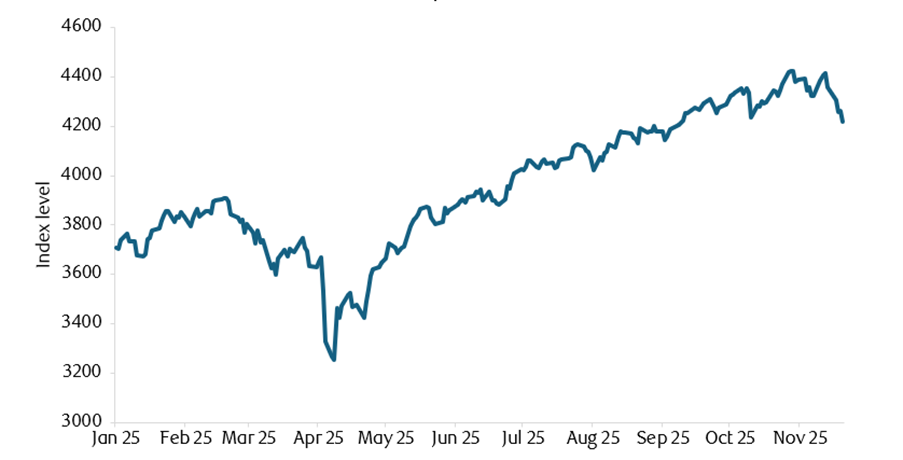
MSCI World Index showed a decline in performance

Source: Bloomberg

However, market reactions show sentiment has turned fragile on AI. Nvidia and the broader AI-related stocks initially rallied but reversed intraday to end the session lower. With Nvidia now comprising around 8% of the S&P 500 index, its price movement has a significant influence on the broader market. This behaviour suggests even companies with exceptionally strong fundamentals and growth prospects face a valuation reality check. It could simply come down to investors taking profits before year-end across a sector that has performed so well.

It’s too early to say that the AI rally is over, but we’re entering a stage where investors are putting more scrutiny on aspects such as return on investments and valuations.

The long-term AI opportunity remains intact. Demand for compute capacity (the total amount of computing resources available to process data), infrastructure upgrades and AI adoption continues to accelerate. However, the market discussion has shifted from pure growth momentum to valuation and over-investment risks.

While we believe that AI will be a transformative technology, there are lingering questions about whether the returns generated by providers of AI services will be high enough to justify both the massive levels of investment, and the extended valuations the AI picks and shovels plays trade on. In addition, the S&P 500, excluding the so-called ‘Magnificent Seven’, also trades on a large price-to-earnings premium compared to the World ex U.S. market. Therefore, we hold a neutral view of U.S. stocks for now.

The U.S. unemployment rate rose

Another highly anticipated event last week was the release of the September U.S. employment report, which was significantly delayed due to the U.S. government shutdown.

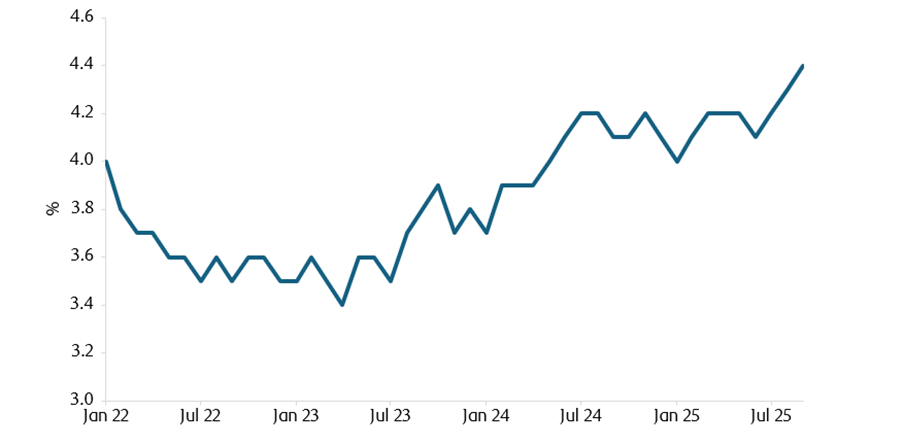
The report showed 119,000 new jobs were created over the month, well above the 51,000 expected. However, the unemployment rate edged higher from 4.3% to 4.4%. This was the third consecutive monthly increase, defying expectations of no change. This is likely to add to the dovish view within the Fed.

U.S. unemployment rose to 4.4%

Source: Bloomberg

However, the Fed will not receive another jobs report before its December meeting, and visibility on inflation data is expected to remain more limited than usual due to the previous government shutdown. With the labour market a bit weaker (but still generating jobs), and conditions not deteriorating sharply, most investors now view a Fed pause in December as the most appropriate and likely scenario.

Markets have reduced expectations for a December interest rate cut, and further policy easing is considered more likely from 2026 if inflation and growth slow.

Economic trouble for the chancellor

In the UK, the data flow remained weak ahead of this week’s Autumn Budget. October retail sales fell by 1.1%, while the private sector business survey (PMI) suggested the economy was stagnant. Fiscal indicators have deteriorated, with the fiscal deficit widening more than expected in October.

This is an economic backdrop that makes it hard to raise taxes without further dampening growth, but it’s widely speculated that this is what Chancellor Rachel Reeves will do.

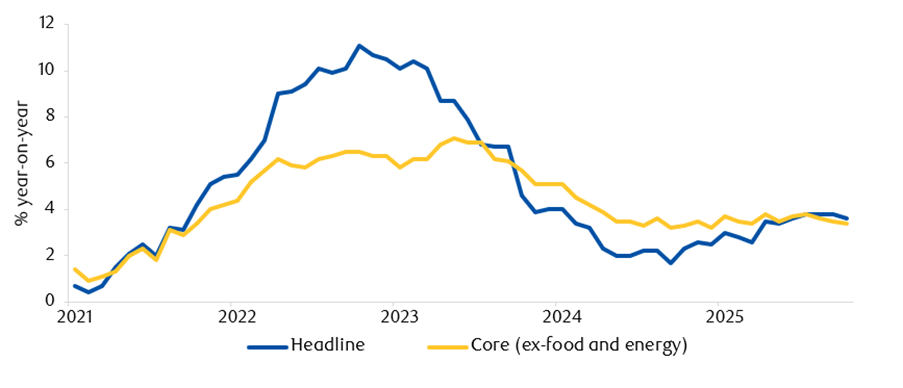
One silver lining is that inflation is heading in the right direction, albeit slowly. Headline UK CPI (Consumer Price Index) slowed from 3.8% to 3.6% while core inflation slowed from 3.5% to 3.4% in October. Services inflation, which is closely monitored by the Bank of England (BoE) as a measure of domestic price pressure, softened from 4.7% to 4.5%, falling below expectations.

The UK Consumer Price index slowed to 3.6%

Source: Bloomberg

A lower inflation trajectory helps support the case for a rate cut in December. Markets are pricing in a very high chance of that happening. Ultimately, whether the BoE will proceed with that depends on Governor Andrew Bailey’s swing vote. The latest inflation figure probably ticked a box, but we still need to see how the Budget goes.

Overall, last week’s market action reflected a more cautious stance. AI remains the dominant structural theme, but greater scrutiny is being applied now, so the bar for a further rally is high at this stage.

In the U.S., job growth continues, but there are signs of cooling. In the UK, data confirms a weakening backdrop ahead of significant fiscal decisions that ultimately impact growth.

Staying diversified remains highly relevant in this environment.

Please continue to check our blog content for advice, planning issues and the latest investment market and economic updates from leading investment houses.

Charlotte Clarke

26/11/2025

Team No Comments

EPIC Investment Partners – The Daily Update

Please see the below article from EPIC Investment Partners detailing their discussions, pre-Autumn Budget. Received this morning 25/11/2025.

On Wednesday, the UK Chancellor, Rachel Reeves, has the unenviable task of delivering a budget that achieves fiscal stability while actively reducing the official inflation forecast provided by the Office for Budget Responsibility (OBR). This challenge is framed by the political reality that the economy “feels stuck” for too many and that rising prices “hit ordinary families most.” As Ms. Reeves wrote in The Sunday Times, “Delivering on our promise to make people better off is not possible if we don’t get a grip on inflation,” adding that it is “a fundamental precursor to economic growth. It is essential to make families better off and for businesses to thrive.”

The Chancellor has two principal routes to lower inflation: first, by announcing measures that directly weigh on consumer prices within the CPI basket, and second, by heavily front-loading the fiscal adjustment to dampen aggregate demand. Given the urgent political pressure, the former approach, direct intervention, is seen as the most likely and impactful strategy. Ms. Reeves emphasised, “There is an urgent need to ease the pressure on households now. It will require direct action by this government to get inflation under control.”

This direct intervention could lead to the BoE’s headline inflation forecast easing by 0.4% from April of next year. Measures being considered include freezing regulated rail fares, abolishing the reduced 5% VAT rate on domestic energy bills from April 2026, and another annual freeze on fuel duty. The combined effect of these steps is estimated to lower annual CPI by 0.4% in the second quarter of 2026 (2Q26), reducing the forecast to 2.5% compared to the BOE’s current 2.9% projection.

Despite the focus on relief, the Chancellor is simultaneously expected to raise taxes when she sets out economic policies on 26 November as she seeks to bridge a multibillion-pound gap in her spending plans. While immediate, heavy fiscal tightening to directly impact demand is seen as less likely, the budget must still signal a credible plan.

Beyond these potential price-cutting policies, the government may also address long-term structural issues that plague the economy. Ms. Reeves indicated that reforms would change the welfare system from “trapping millions of people on benefits” to one “designed to help people succeed,” suggesting a focus on increasing the workforce and national productivity. These supply-side efforts, if judged credible by the OBR, could help lower future cost pressures by boosting the economy’s capacity to grow without generating inflation. Ultimately, by combining immediate cost reduction designed to tame the headline CPI figure with pledges for long-term growth and responsible fiscal management, the Chancellor aims to create the necessary conditions to help the BoE achieve its 2% inflation target. Not a tall ask!

Please continue to check our blog content for advice, planning issues and the latest investment, market and economic updates from leading investment houses.

Alex Clare

25/11/2025

Team No Comments

Tatton Investment Management: Monday Digest

Please see below, an article from Tatton Investment Management, analysing the key factors currently affecting global investment markets. Received this morning – 24/11/2025

Ripe for a rotation 

Last week ended with lower stock prices and a cryptocurrency sell-off – despite a bump midweek from Nvidia’s better than expected profits (and news that Warren Buffet bought into Alphabet).

Deep divisions at the Fed – likely due to Trump appointee Stephen Miran – have thrown a December interest rate cut in doubt, although quantitative tightening (QT) will stop on Dec 1st, which should ease near-term liquidity pressure. The US economy is itself divided: some fear a rate cut could exacerbate the supposed ‘AI bubble’, but consumer-focussed companies show a weak outlook. US growth will likely come through its soft patch but may need policy support, perhaps from Trump’s promised ‘tariff dividend’.

Bond markets didn’t move much in response to stock volatility, suggesting bond investors see a growth bounce back ahead. The equity sell-off is likely down to profit-taking after a tremendous post-April rally. Investors around worried about fundamentals; they just need liquidity. The nosedive in cryptocurrencies (which are liquidity sensitive) is a clear sign of this. Cryptos could fall further but the knock-on effects to other markets could be muted – since the total crypto market cap, relative to equities, has fallen.

Liquidity will come back in the short-term, thanks to money flowing out of the US Treasury General Account and the reduction in QT. But US policymakers are moving to a lower liquidity provision over the medium-term (‘abundant’ to ‘ample’). That could cause a capital rotation to ‘value’ stocks, as people tend to prefer money now to growth later when there’s not much cash around. If so, there could be greater opportunities for active investors in 2026.

Lastly, a little note on this week’s UK budget: taxes will go up in some form, and the more straightforward the better for the economy. We just hope there’s some relief for small businesses. The government has sent mixed messages in the buildup, but has consistently prioritised a stable bond market. That should keep UK a lid on UK bond yields, which is important for the economy even if it’s uninspiring.

Renewable energy: profitable, not fashionable 

The US government is openly antagonistic towards renewable energy and ESG investing. And yet, renewable energy stocks are some of the best performing in 2025. L&G’s renewable energy ETF has outperformed even Nvidia this year and is far ahead of oil companies. Performance isn’t uniform; US fuel cell producer Bloom Energy is up nearly 350% year-to-date while Dutch wind farm specialist Oersted is down 30%, largely thanks to president Trump’s suspension of new licenses. But the sector is doing well, despite political challenges and bearish investor sentiment (investors pulled $5.7bn out of sustainable funds in Q2 alone).

Interestingly, oil and gas stocks have underperformed this year, as Trump’s “drill baby drill” promise isn’t as good for oil profits as hoped. There’s a strong push to upgrade energy infrastructure, but 93% of US energy capacity growth this year has come from renewables. Trump’s removal of future tax credits may have encouraged this, by forcing developers to rush projects. Renewables are also benefitting from the surge in AI capex, with Bloom Energy (which makes fuel cells for data centres) the clearest example. Renewable energy has now become one of the most efficient ways of expanding energy capacity, largely thanks to past investment (like China’s overproduction of solar panels).

ESG investing is in a difficult spot, but the fact renewable stocks are still performing so well suggests we are in a new phase, where the “E” has been spun out as a specific economic theme, rather than a background investment trend. That’s a sign of maturity. When ESG was a growing rapidly, renewable stocks were popular but people doubted their profitability. Now they’re profitable, but unfashionable. That’s ultimately better for the industry’s long-term growth and the energy transition overall. Whatever politicians say, renewable energy is good business.

Why is Britain’s energy so expensive? 

Britain has some of the most expensive energy in the world. It’s politically popular to blame this on net-zero targets and ‘green levies’ on energy bills, but these are realistically a small part of overall costs. Wholesale energy costs are by far the biggest component. Britain’s marginal pricing system means national costs are set by the most expensive generator – overwhelmingly natural gas. The energy operator pays all producers the highest price regardless of their costs, which is why UK energy providers (particularly renewables and those involved in grid provision) did so well when gas prices spiked in 2022.

The government plans to reform the balancing mechanism for supply and demand, but has declined to switch to a system where prices vary zonally. Zonal pricing was rejected on the basis that it would be unfair and introduce uncertainty – which is a barrier to investment – but it’s hard to overcome the marginal pricing problems without some zonal pricing, which proponents argue would incentivise energy users moving closer to cheaper sources, and energy producers building closer to high demand areas.

There are also regulatory costs along the chain that increase our energy costs, a key one being how transmission charges are implemented. The government says it wants to reform these, but we don’t know what the reformed system might look like. Removing certain energy taxes would be difficult, as all the talk is that higher taxes are needed to balance the budget. However, recent suggestions that green levies should be scrapped does not have the support of the majority of stakeholders.

Energy costs are a headwind for businesses and prevent international companies setting up in the UK. Reforming the pricing model will help, but it’s likely that the system needs bolder long-term solutions (like investing in better storage or nationalising the expensive marginal producers) than current budget realities allow.

Please continue to check our blog content for the latest advice and planning issues from leading investment management firms.

Marcus Blenkinsop

24th November 2025