Team No Comments

Brooks Macdonald – The Daily Investment Bulletin

Please see the below article from Brooks Macdonald detailing their discussions on global markets. Received this afternoon 18/12/2025:

Growing unease over AI spend

The US market was down for a fourth day as AI valuation fears hit tech stocks. Oracle dropped to a six‑month low, having fallen almost 46% since their September peak, after reports of a failed $10bn data‑centre deal sparked concerns over soaring spending by AI companies and the debt that is funding it.

Central banks take centre stage

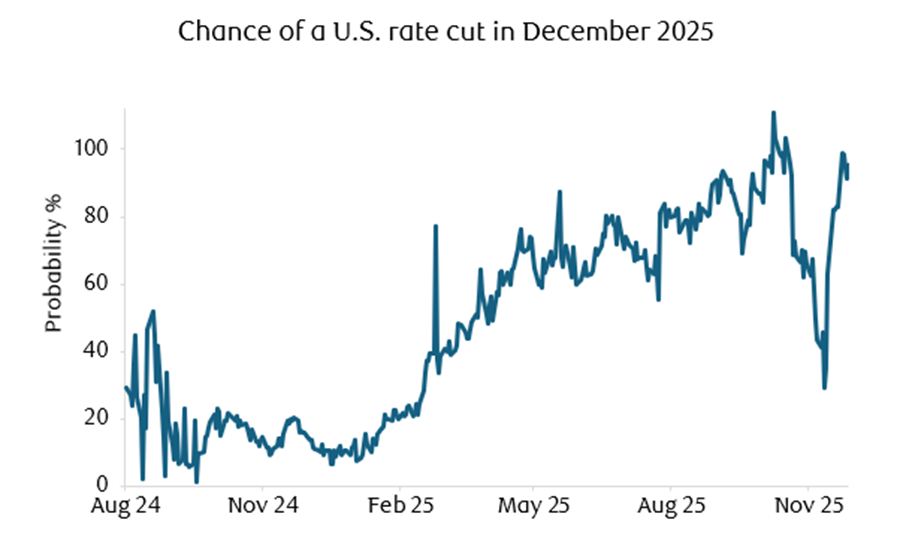
Central banks remain in focus. The Fed’s delayed CPI release out today will guide 2026 rate‑cut expectations, while speculation continues over Trump’s choice of Fed Chair with Kevin Hassett currently seen as the frontrunner. In Europe, the ECB is expected to hold rates, though talk of future hikes has grown, and the Bank of England is set to cut by 25bps to 3.75% later today after softer UK inflation.

Brooks Macdonald thoughts

Markets face a dual challenge of equity weakness driven by valuation concerns and economic softness, alongside uncertain monetary policy trajectories. Looking forward, this likely means heightened volatility with a balanced approach to portfolio construction appropriate.

Please continue to check our blog content for advice, planning issues and the latest investment, market and economic updates from leading investment houses.

Andrew Lloyd

18/12/2025

Team No Comments

Brewin Dolphin – Markets in a Minute

Please see this week’s Markets in a Minute update below from Brewin Dolphin, received yesterday afternoon – 16/12/2025.  

Equities soar to record highs

Global stocks outperformed last week, driven largely by the Federal Reserve’s third consecutive rate cut.

Key highlights

  • The Fed cuts: Global equities reached record highs as the Federal Reserve (the Fed) rate cut and upgraded U.S. growth forecasts supported a broadening market rally.
  • AI capex concerns: Technology stocks lagged last week, reflecting concerns over AI capital expenditure (capex) and stretched valuations.
  • Weak UK GDP: Last week provided yet more evidence of weak UK economic growth, reinforcing expectations of a Bank of England (BoE) rate cut this week.

Fed rate cut and growth upgrade support market sentiment

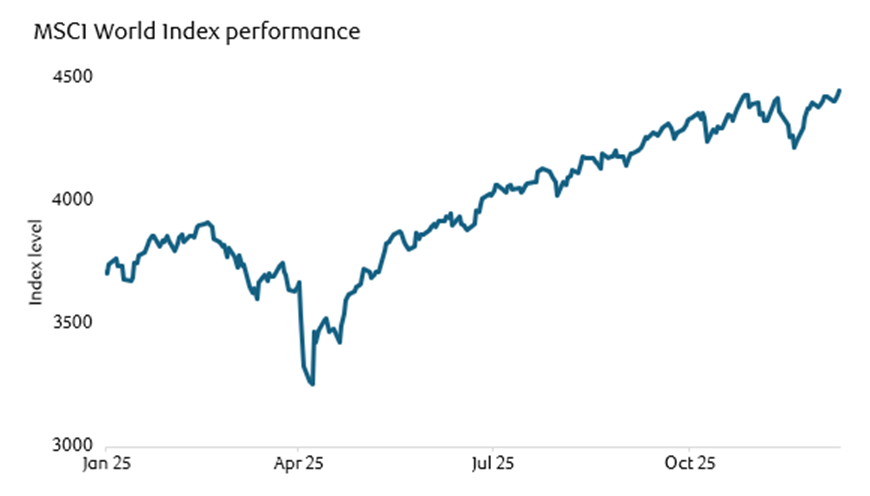
Global equity markets reached record highs last week, with gains broadening beyond the largest technology names.

Source: Bloomberg

Support has come from a third consecutive interest rate cut by the Fed, alongside an upward revision to its growth forecasts, reinforcing its confidence in the economic outlook. This combination has helped broaden the rally in the U.S. equity market beyond the usual AI darlings.

Meanwhile, markets are becoming more critical of the scale of capex into AI and the stretched valuations across parts of the AI ecosystem. Concerns are particularly focused on the capability of those laden with high debt to finance infrastructure build outs.

The focus last week was the Fed’s latest decision for a widely expected rate cut. More important than the move itself was the message from the updated projections. The Fed revised its growth outlook higher, reflecting resilience in domestic demand, and it continues to expect the labour market to remain relatively steady. Inflation forecasts for next year were revised modestly lower, but policymakers still don’t expect inflation to return to target until 2028. This highlights that the final stage of disinflation is likely to be gradual rather than straightforward.

Source: The Federal Open Market Committee

That guidance also highlights the limits to further easing. The Fed’s projections point to just one additional rate cut in 2026, compared with market expectations of closer to two cuts. This suggests there’s limited scope for rate expectations to fall much further – unless the data weakens materially. This has fuelled debate around how much policy support the economy actually needs if growth remains firm.

Speculation continues regarding the future leadership of the Fed, with some assuming that a chair appointed by President Donald Trump could lean more dovish. However, the chair is only one of twelve voting members on the Federal Open Market Committee, and policy outcomes ultimately reflect the balance of views across the committee. Recent projections suggest this balance remains cautious rather than aggressively accommodative.

Concerns over AI capex

Against the backdrop of improved market sentiment, technology stocks underperformed last week, even as interest rates moved lower. Ordinarily, easier financial conditions would support valuations across growth sectors. Instead, the relative weakness reflects elevated valuations and growing investor unease around the scale and returns of capex tied to AI.

One example is cloud computing provider Oracle, an important player in the AI data centre build-out. Despite a strong pipeline from its AI business, Oracle shares fell sharply after the company signalled a significant increase in capital spending. Investors are scrutinising Oracle because it’s taken out significant debt to fund its ambitions. Investors are concerned about its balance sheet pressure, the long lead time before revenues fully materialise, and its worsening credit quality. In short, despite strong orders and promising prospects, there are signs that investors are getting impatient for AI’s return on investment.

Meanwhile, chip designer Broadcom delivered another strong set of results and reaffirmed robust AI demand. Yet its shares failed to excite investors, partly because expectations were already high following a strong rally this year. These moves don’t suggest the AI theme is fading, but they do indicate that markets are becoming more disciplined, with a sharper focus on execution, corporate leverage, free cash flows, and valuations, rather than exciting headlines or headline demand growth. These moves reinforce the importance of diversification and selectivity in the current environment.

Weak UK GDP supports Bank of England rate decision

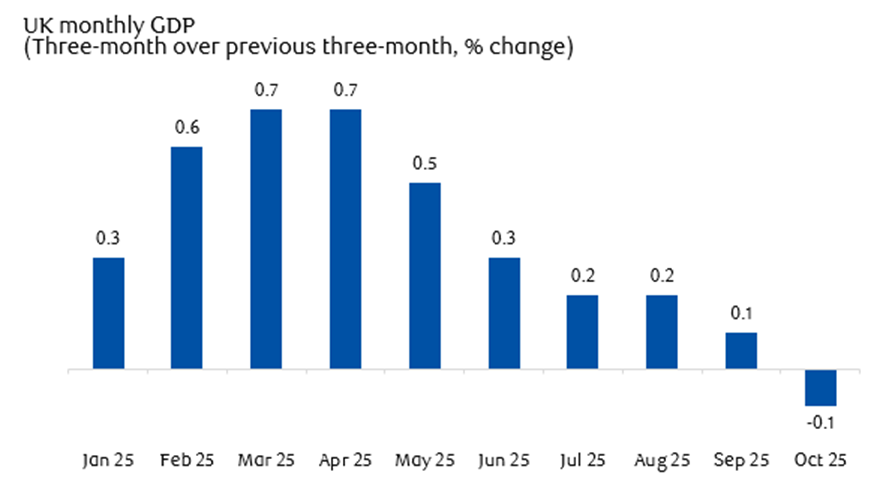
Turning to the UK, the latest economic data reinforces the picture of a stagnant economy. Gross domestic product (GDP) contracted by 0.1% in October, and on a three-month-on-three-month basis (May to July vs August to October), output was also down 0.1%.

Source: Bloomberg

In fact, the UK economy has expanded in just one of the past seven months, underlining how fragile growth has become. The weakness has been broad-based, particularly across services sectors such as retail and construction, reflecting ongoing pressures on household spending and cautious business behaviour.

Some of this softness may reflect uncertainty ahead of the Autumn Budget, as firms and households delayed decisions in the face of potential tax changes. However, the medium-term outlook remains challenging.

Further tax rises are expected over the coming years, which risk weighing on consumption and investment at a time when growth is already struggling to gain traction. This leaves the UK economy vulnerable to prolonged stagnation rather than a clear recovery.

Encouragingly, UK inflation dynamics are moving in a more favourable direction. The Bank of England (BoE)’s latest survey shows a further easing in households’ inflation expectations, suggesting that underlying price pressures are expected to become more manageable. Combined with weak growth momentum and a peak in inflation, this provides a substantive argument for policy easing.

Against this backdrop, the case for a BoE rate cut at its next meeting has strengthened and is now mostly priced in by markets.

Please continue to check our blog content for advice, planning issues and the latest investment market and economic updates from leading investment houses.

Charlotte Clarke

17/12/2025

Team No Comments

Brooks Macdonald – The Daily Investment Bulletin

Please see the below article from Brooks Macdonald detailing their discussions on global markets. Received this morning 16/12/2025.

What has happened?

Yesterday saw divergent returns in European equities relative to US equities. European exchanges were buoyed by the positive rhetoric around the Russia/Ukraine conflict and a fall in energy prices (Brent crude oil closed at a 7 month low), whilst the US market was on the backfoot due to some softer economic data. Although most of the key data comes out from today, with the focus on the latest employment reports, the release yesterday of the Empire State manufacturing survey challenged sentiment. This lead indicator fell by more than expected to -3.9 in December (vs. 10.0 expected), which was beneath every economist’s estimate on Bloomberg. Asian markets are weak this morning. Indices that have the greatest exposure to Tech are seeing the biggest drops as nervousness around the AI theme persists, with the Hang Seng down -2.09%, followed by the KOSPI at -1.85%, and the Nikkei at -1.47%. Chinese markets, including the CSI (-1.41%) and Shanghai Composite (-1.25%), are also falling for a second day after yesterday’s weak November activity and real estate data releases.

Payrolls data in the US will be the focus

As noted yesterday today sees the beginning of a raft of data that may give investors and policy makers greater clarity on the state of the economy and hence policy as we move into the new year. The US employment report has not been available for several months due to the Federal Government shutdown and todays release may still be somewhat clouded by the fact that several of the recent monthly releases are not being referenced.  Although we will get the payrolls numbers for both October and November, there’s only going to be an unemployment rate for November. What will be key is the markets interpretation of future policy as this will help shape sentiment – markets have been pricing 2 further rate cuts from US rate setters in 2026 with the expectation of a march easing gaining momentum yesterday on the back of the softer data.

What Brooks Macdonald think

We remain relatively optimistic but with a heightened degree of caution around our positioning in risk assets. Policy makers in the US, and the UK to some extent, are getting close to a point where late cycle economic data may determine further policy easing but this maybe offset by concerns around stickier price inflation, especially as the effects are Tariffs may begin to filter into the inflation data in coming months. Therefore we feel a prudent, selective and balanced approach to asset allocation is merited.

Please continue to check our blog content for advice, planning issues and the latest investment, market and economic updates from leading investment houses.

Alex Clare

16/12/2025

Team No Comments

Tatton Investment Management: Monday Digest

Please see below, an article from Tatton Investment Management, analysing the key factors currently affecting global investment markets and an outlook for 2026. Received this morning – 15/12/2025

Powell offers some liquid cheer

Stocks were mostly solid last week but tech was weak, culminating in a mild US sell off late on Friday. Oracle revealed ostensibly very strong numbers, but this wasn’t enough to beat analysts’ stretched forecasts. With the debt expansion outstripping sales growth, the cloud computing giant’s shares initially slumped 10% and ended 15% lower on the week. Broadcom then also disappointed on Friday, proving how difficult it is for anyone other than the ‘Magnificent Seven’ to keep investors happy.

Substantially higher prices for all manner of computer chips are also impacting sentiment about big tech’s capex splurge. Tech/AI optimism is not unwarranted, but reality checks are limiting its extent.

Before that, the Fed’s expected rate cut, and liquidity adjustment pushed US stocks up across the board. The Fed’s new $240bn bond buying isn’t quite quantitative easing: it’s time limited (QE was open ended) and focussed on short-term bonds, and there is no intention to drive down risk premia. But it will improve market liquidity nonetheless. Markets now see the Fed as less hawkish than expected, benefitting small and midcap stocks, while lowering bond yields and the dollar. Notably, cryptocurrencies didn’t benefit as some thought they might.

The US is now clearly disengaging from Europe and focussing on Latin America, which has boosted European defence stocks and forced European leaders into more urgency on stranded Russian assets to help finance their Ukraine support. European stocks are doing better in general, buoyed by joint-enterprise fiscal spending. European bond yields have shifted up while US yields have fallen, and the euro is on a better trajectory.

UK budget talk has thankfully subsided and domestic investors are putting money back into risk assets.

Read on for a condensed version of Tatton’s 2026 outlook.

The outlook for 2026 – overview

Based on the aggregate global earnings outlook, investment returns should be positive in 2026 but we expect significant change and rotation. The positive case is based on interest rate cuts, fiscal stimulus and a wave of AI capex – boosting corporate earnings in the first in H1 2026 at least. The risks are mainly geopolitical (Russia-Ukraine, China-Taiwan – but US-Venezuela is unlikely to move markets) or policy-related (tariffs).

Global trade growth will continue to be curtailed by the Trumpian backlash to globalisation. But the world’s biggest economies are investing to build infrastructure and domestic demand, so aggregate growth will still be supported. There is a strong investment drive coming from individual countries (European defence spending, Chinese stimulus and US fiscal support) and from private AI capex. Rapid geopolitical and technological change raises risks, but the investment drive should keep profits ticking. The big tech firms are expected to win out from the AI race, but we don’t know whether future profits will live up to expectation.

The investment drive underlies our rotation thesis: previously unloved parts of the market improving while previous outperformers struggle to maintain their advantage. The infrastructure buildout requires capital, which requires central banks staying accommodative. If they turn restrictive, capital could get dragged away from ‘growth’ assets, meaning less liquidity and more volatility. That’s a constructive environment for active investment managers.

H2 2026 is less clear. Growth could disappoint and AI capex run out of steam, or it could be so effective that inflation resurges and the Fed turns hawkish – causing markets to tighten up. There’s also a risk price controls in reaction to the US consumer unaffordability disquiet. Unaffordability is why many feel gloomy about the economy while investments look a lot more optimistic. Hopefully next year’s changes rectify some of that gap.

2026 Outlook by region


US
stocks will be supported by rates cuts, a fiscal boost and AI capex in H1 2026. The so-called ‘K-shaped economy’ (growth driven by AI asset returns, while the old economy and those without assets struggle) makes it difficult to assess growth. Companies aren’t firing much, but they aren’t hiring either, which is why the Fed’s dovish stance will continue. Trump’s appointments to the Fed will increase the dovish tilt too – pushing down short-term bond yields. Trump is also likely to boost fiscal policy ahead of the midterm elections, pushing up long-term yields, meaning a steeper yield curve.

This could overheat the economy in H2, causing the Fed to tighten and possibly spook investors. The dollar could keep weakening, as Trump attempts to address external trade imbalances. As that correction goes on, the US is a less attractive place to invest. It still has the biggest companies with the strongest profit growth, so we shouldn’t be too negative – but the K-shaped narrative makes things murkier.

UK assets are decently placed for 2026, but a strong year in 2025 might dull future returns. Britons’ negative perceptions of the recent budget don’t match up with the view from international investors: stocks gained, bond yields fell and sterling strengthened. The low rate of domestic ownership means international sentiment is more important for UK assets, and we expect that to remain in 2026. The Bank of England will cut rates this week and likely further next year, as inflation slows from sterling’s strength and less pressure on regulated prices. The global capital shift away from the US could also benefit the UK.

Europe has promise but, as usual, division could get in the way. Defence spending will boost growth but markets have already front run much of the benefit. Stock valuations have room to catch up with the US, but earnings growth momentum would have to catch up too. Financials have done well this year and will likely buyback their own shares – but this alone can’t power outperformance. The best thing for European assets would be a single financial market, which we hoped Chancellor Merz would push for but the jury is still out. German politicians are already talking about tightening belts, so Europe could be more fiscally prudent than the US. With no ECB rate cuts expected, that will flatten the yield curve. That is unless Russia becomes an even greater threat and Europe has to loosen the fiscal purse-strings.

Japan has strong long-term prospects, owing to corporate reforms and the cheapness of the yen. Prime Minister Takaichi isn’t taking advantage of the yen’s competitiveness, instead raising tensions with China and putting pressure on long-term bond yields. That’s why the yen will stay weak, despite the Bank of Japan likely raising rates. The flipside to persistent inflation is stronger growth and higher wages – which Japanese are now using to buy their own assets. That flow will support stocks in 2026.

China has a strong outlook, but restrictive economic policies could dampen returns. Beijing has been forcing the renminbi stronger, which isn’t good for the weak economy but is good for the renminbi’s international status. China is presenting itself as a reliable trade and finance partner to emerging markets in particular and they seem to agree. Beijing is also avoiding getting dragged into fights with the West, which is why it probably won’t invade Taiwan for the time being.

Emerging Markets have varied prospects for next year. Commodity exporters (particularly metals) will benefit from a surge of AI-fuelled infrastructure building, and Asian EMs stand to gain from China’s increasingly important regional economic hub. India’s service sector will be challenged by AI replacement. The reverse correlation between Indian and Chinese equity will likely continue.

2026 outlook by asset class
Bond and money markets
will vary by region. Fed cuts will push down short-term US bond yields, while resurgent growth and potentially higher inflation will push up long-term yields – a steepening of the curve, which would extend the funding pressures for smaller companies. European yield curves will likely flatten, as the ECB holds short rates steady and fiscal policy looks less expansive than expected this year (unless Russia gets more aggressive and Europe has to fund even greater defence spending). UK bond yields depend on the government’s stability, but investors like Britain’s higher yields and strong currency. On corporate credit, default rates will likely rise amid a capital rotation, with more capital required in the real economy to build infrastructure. That healthy churn doesn’t mean systemic credit risk, though.

Equities are well supported for H1 2026, but the demand for capital to build infrastructure could mean rotation into previously unloved stocks. Rate cuts, fiscal spending and AI capex will boost earnings growth. Profit growth disproves that an ‘AI bubble’ is about to burst, but it will be difficult for big tech to outperform, given high equity valuations and the demand for capital. The wave of AI-related and state-led investment will create new opportunities. That’s healthy, but excess liquidity being soaked up by infrastructure investment means less liquidity in markets – making the risks feel riskier.

Commodities and cryptocurrencies: Industrial metals will be supported by infrastructure investment. Gold and cryptocurrencies are challenged by the fact that China’s renminbi has emerged as another alternative to the dollar, though gold should still be supported by central bank buying. Leveraged cryptocurrency traders have often been marginal equity buyers too, so crypto volatility matters for stocks.

Please continue to check our blog content for the latest advice and planning issues from leading investment management firms.

Marcus Blenkinsop

15th December 2025

Team No Comments

Brooks Macdonald | Daily Bulletin

Please see below, Brooks Macdonald’s Daily Bulletin which focuses on the US equity market and today’s data release for UK growth. Received today – 12/12/2025

What has happened?

The headline event yesterday centres around the US equity market again hitting new highs. The S&P 500 rose 20bp on the day pushing it through the 6900 level. This though masks a continued pick up in volatility within stocks related to the AI theme. The market is beginning to differentiate more and more on perceived winners and losers rather than a “rising tide lifts all boats” mentality.  We touched on the disappointing results from Oracle yesterday, and the softness in their share price continued to weigh on the sector throughout the trading day. In addition, we had results from Broadcom, a company that has very much increased its stature within the AI cohorts of stocks this year. Initial earnings releases showed current quarter revenue guidance ahead of expectations, causing their share price to rally c.4% initially. However, failure to give further guidance for the next 12 months, specifically around AI revenues saw the shares flip over 8% to be down c.4.5%. This volatility in the tech sector is likely to continue into 2026 as markets digest the outcomes from the lofty capex spend firms are undertaking.

UK Growth disappoints (again)

The Office for National Statistics this morning released October GDP data showing a 0.1% decline, repeating the previous months decline. This is in fact the 4th monthly reading in a row where no growth has been logged. Many economic forecasters were expecting a slight tick up of 0.1%. Given the uncertainty in the run up to the November budget it is probably not surprising that the data was on the weaker side.  The GDP figures are the first in a run of data that sets the stage for the BOE’s final meeting of the year on December 18th. Policymakers, heading into what’s expected to be a knife-edge call on a rate cut, will get fresh jobs and inflation readings in the days leading up to that meeting.

Brooks Macdonald’s thoughts

Whilst the momentum behind the AI trade has been a major force during 2025 the last few weeks has seen the market recalibrate and become more discerning within the theme. We still believe this is a multi-year structural theme but investors will have to be more selective in asset or stock selection, particularly as we are yet to see the outcomes from the interplay of the huge amounts of capital expenditure within the sector. Volatility will remain within this space as the market reacts to perceived winners and losers of the AI theme.

Please continue to check our blog content for the latest advice and planning issues from leading investment management firms.

Alex Kitteringham

12th December 2025


Team No Comments

EPIC Investment Partners: The Daily Update – Japanese Debt

Please see todays EPIC Daily Update with their thoughts on Japan’s Debt and Bond Market:

The Japanese bond market has been spooked by the new Prime Minister, wishing to put through further fiscal stimulus measures. Posing as some new Maragaret Thatcher, she did not read about the Iron Lady’s insistence on living within your means, controlling debt by the sale of state assets and applying discipline over spending. Japan’s state debt is a massive 1,324 trillion yen (£6,400  bn), more than double the UK’s. For years this has been affordable as for much of that time Japan has been able to borrow at rates below 1%. Now alarmed by both the enormous stock of debt and by future high borrowing requirements, the markets have put the cost of 10 year borrowing for the state up to almost 2%. As the old debt matures the government has to replace it with new borrowing at much higher interest cost, with further strains on the Japanese budget and taxpayers.

Current debt interest costs are around 10 trillion yen a year (£48 bn), a manageable cost. Were the whole 1,324 trillion yen to be refinanced at 2% in due course, that would be an interest cost of 26 trillion yen (£125 bn). If this takes place at the same time as the government seeks to borrow a larger share of its current budget each year, the compound effects become more serious. The Japanese bond market will experience big demands and further strains. The pressure is on the Prime Minister to reduce her additional demands to spend more and cancel proposed tax cuts.

The absolute level of debt interest is still modest compared with the UK. With much higher interest rates – in excess of 4% – the debt service costs in the UK have already exceeded £105 bn and are on course to reach £131 bn by the end of the decade according to the official forecasts. Over the next five years on current government plans, the UK needs to raise £628 bn for additional spending and £675 bn to replace retiring debt. Both these fund raisings will add to the interest burden. That is why UK 10-year rates are at 4.4%.

Japan authorities can say that debt interest levels are still low by comparison, and will take time to get above the UK level in cash terms. Markets however are also motivated by sentiment and can suddenly decide a government’s past and future indebtedness is a problem. Japan today is the advanced country in the firing line of the bond vigilantes. They can rightly point to excessive reliance on debt for many years of reflationary packages, and to the future threat from the need to replace old debt with much dearer new debt.

Japan for years craved some inflation. Now it has some, the country is discovering why western countries have been struggling to control their price levels. Higher inflation brings higher interest rates, and   with higher interest rates come the bond vigilantes, raising uncomfortable issues over how affordable all the growing debt will prove to be. Bond traders can move interest rates against their victim country if they want a change of policy. That is self-validating, making future debt dearer and making the budget sums look worse, just when a government wishes to present an improving picture.

For a long time, Japanese debt has been offering too low an income return to make it worthwhile as an investment. The yen has also usually been weak, though there have been rallies when investors could make money by holding the Japanese currency. The bond markets may have their way and get the PM to curb some of her fiscal stimulus.

Please continue to check our blog content for advice, planning issues and the latest investment, market and economic updates from leading investment houses.

Andrew Lloyd

11/12/2025

Team No Comments

Brewin Dolphin – Markets in a Minute

Please see this week’s Markets in a Minute update below from Brewin Dolphin, received yesterday afternoon – 09/12/2025.  

Markets await key interest rate decisions

Bonds started the week slightly on the back foot as markets await the interest rate decisions of three central banks.

Key highlights

  • U.S. interest rates to be cut? Weakness in the U.S. jobs market fuels bets on a Fed rate cut this week.
  • The race for the Fed chair: Kevin Hassett emerges as frontrunner for Fed chair, but his White House ties spark independence concerns.
  • Germany’s pension showdown: The German coalition government passed its pension bill despite a rebellion by 18 younger members of Chancellor Friedrich Merz’s own party.

Federal Reserve rate cut expectations

Source: Bloomberg

U.S. investors returned from their Thanksgiving holidays with a focus on this week’s Federal Reserve (the Fed) interest rate decision. Bets on a rate cut have been bolstered by tentative evidence of job market weakness. The official non-farm payrolls report for November wasn’t released on Friday as the Bureau of Labor Statistics is still catching up from the government shutdown. In its stead, evidence has had to come from private sector studies, like the ADP Employment Report and the Challenger Report.

The S&P 500 has been hovering near all-time highs but struggling to gain significant traction. It has benefitted from the anticipation of lower interest rates and most investors expecting slower jobs growth. Meanwhile, other risk assets have found the going harder.

Cryptocurrencies recovered a little after their precipitous falls during October and November. The more conventional limited supply asset, gold, recovered much sooner and continued that recovery last week.

In the aftermath of the UK Autumn Budget, gilts and the pound have broadly held on to their gains, outperforming most other government bond markets. The exception would be Japanese government bonds (JGBs), whose yields have continued to rise, bucking the trends of other government bond markets. Thirty-year JGBs have fallen in price by about 20% this year.rowth-supportive loosening of policy in the near term, the package announced also included measures which the OBR estimates will reduce Consumer Price Index (CPI) inflation by 0.5% in Q2 2026. This includes freezing rail fares, extending the fuel duty freeze, and an energy bills package that aims to reduce bills by an average of £150 per year from April 2026.

Race for the Fed chair heats up

Source: Bloomberg

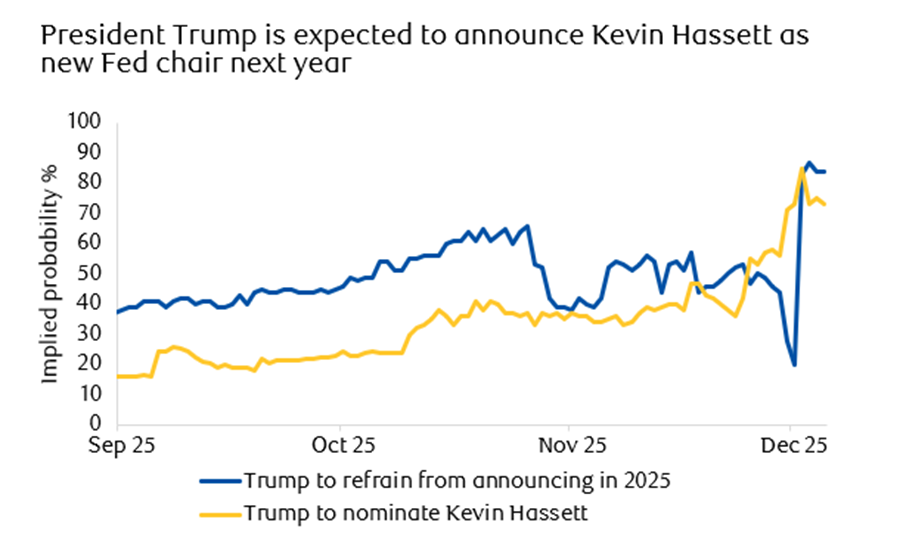
Speculation remains rife about who will succeed Jay Powell as the next Fed chairman, with the prediction markets now firmly favouring Kevin Hasset.

As director of the National Economic Council, Hassett forms part of the White House economic team. While this demonstrates his suitability based on knowledge and experience, it also raises questions over his independence. Those questions are added to by his recent assertions that the Fed should be cutting interest rates more, a view shared with President Donald Trump.

Hassett’s also likely to be remembered for his co-authorship of the infamous Dow 36,000: The New Strategy for Profiting from the Coming Rise in the Stock Market. The book, published in October 1999, argued that the Dow Jones Industrial Average would triple in value over the coming two to four years – however, over that time period, it barely grew and was at one stage 30% down.

The prediction markets indicate that Hassett is the frontrunner, but that he’s unlikely to be named as Powell’s successor until next year or assume the position until May 2026. He would be joining a Fed that has historically operated by consensus but has recently become more divided – this is due to the injection of Stephen Miran as a governor, who joined directly from the White House alongside two more explicitly dovish Fed members.

By May, the Supreme Court will likely have ruled whether President Trump could fire Fed Governor Lisa Cook. If the court rules in the president’s favour, he would be able to name a third governor and increase his influence on the committee, although probably not decisively.

Pensions threat to German defence spending

Source: RBC Brewin Dolphin

In Germany, Fredrich Merz’s coalition government passed its pension bill. This was achieved despite a rebellion by 18 younger members of his own party, who argued that the increased spending was shifting the burden of pensions spending to future generations.

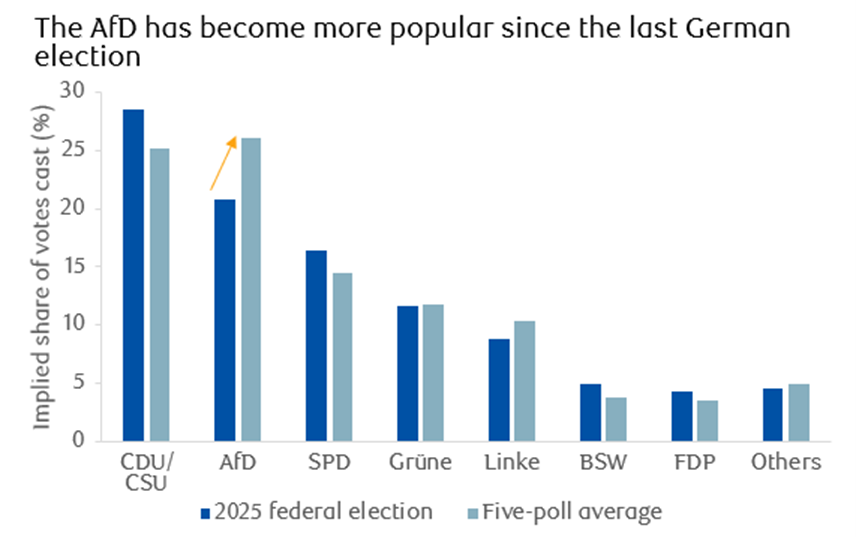
This example of politics reflecting intergenerational interests threatened to derail one of the policies the Social Democratic Party had brought to the coalition. Had it failed, the coalition may have collapsed, raising the prospect of further elections. Current polling indicates the right-wing Alternative for Germany (AfD) party might attract the most votes, which would have made it harder still to exclude it from government.

The AfD is less keen to loosen Germany’s restrictive debt break policy and increase defence investment. However, even though the AfD’s popularity has continued to grow, its path to power still seems elusive. It’s currently only the second largest party, with no new elections due until 2029. If the collapse of the coalition triggered new elections, AfD still seems short of a majority, and would likely be excluded from government by the other major parties.

Please continue to check our blog content for advice, planning issues and the latest investment market and economic updates from leading investment houses.

Charlotte Clarke

10/12/2025

Team No Comments

EPIC Investment Partners – The Daily Update

Please see the below article from EPIC Investment Partners detailing their discussions on Politics and foreign assets driving South Africa’s rebound. Received this afternoon 09/12/2025.

For much of the past decade South Africa seemed stuck in a slow-burn deterioration, reliant on patches rather than progress. As 2025 draws to a close, the mood has shifted. The country is no longer clinging to stability; it is beginning to rebuild it. Two forces sit at the heart of this change: a marked improvement in South Africa’s net foreign assets and a steadier political landscape under the Government of National Unity. Together, they have provided a degree of resilience that is starting to reshape investor expectations.

Net foreign assets seldom receive the prominence they deserve, yet they have become one of the economy’s most reliable sources of strength. For decades after 1970 South Africa lived with a structurally weak external balance sheet. Foreign liabilities exceeded foreign assets through apartheid, the democratic transition and well into the 2000s, leaving the country viewed, rightly, as highly exposed to shifts in global liquidity.

The picture began to change around 2015. A gradual strengthening of the external position accelerated, and by 2020 South Africa held net foreign assets worth more than a quarter of GDP. Those levels have largely been maintained. By 2025 NFA stood at record highs in rand terms, placing the country close to what analysts describe as a five-star external profile. Historically, sovereigns with this degree of external strength tend to receive credit upgrades, making a return to investment-grade status a plausible and increasingly likely outcome rather than a distant hope.

A stronger external balance matters because it alters how an economy absorbs shocks. Countries burdened with large foreign liabilities often struggle when global rates rise or risk appetite fades: currencies weaken, and capital flows reverse. South Africa’s position now works in the opposite direction. A weaker rand lifts the local currency value of foreign assets held by pension funds, insurers and corporates, offsetting external liabilities. The national balance sheet acts as a natural hedge, reducing the likelihood of the familiar emerging-market cycle of currency pressure and funding strain. This structural shift helps explain why the country has weathered tighter global conditions without experiencing an external squeeze.

The political backdrop has added its own support. When the Government of National Unity formed after the 2024 election, expectations were muted. Instead, the arrangement has delivered a more predictable policy environment than anticipated. Fiscal pressures have been contained, and the Treasury has been able to keep consolidation on track. These factors, combined with stronger external metrics, underpinned the recent sovereign upgrade by S&P from BB- to BB. With a third consecutive primary surplus expected in 2025/26, South Africa’s credit trajectory looks more resilient than at any point in recent years.

Improving confidence is beginning to surface in household sentiment. Consumer confidence remains negative but is at its highest in a year. Load shedding has been absent for more than 200 days following reforms in the energy sector. Inflation has eased enough to allow interest rate cuts, while a firmer rand has reduced the cost of fuel and imported goods. These gains look fragile but represent a notable improvement in day-to-day conditions.

The real economy, however, has further to travel. Growth of around 1.1 per cent in 2025 will not markedly reduce unemployment or poverty, and investment that raises productivity remains limited. Yet the foundations of stability are firmer than they have been for many years. The strength of South Africa’s net foreign assets signals a structural realignment: countries with this level of external resilience typically regain credit standing over time. If the political centre holds and fiscal discipline is maintained, an eventual return to investment-grade status looks not only credible but increasingly probable.

Please continue to check our blog content for advice, planning issues and the latest investment, market and economic updates from leading investment houses.

Alex Clare

09/12/2025

Team No Comments

Tatton Investment Management: Monday Digest

Please see below, an article from Tatton Investment Management, analysing the key factors currently affecting global investment markets. Received this morning – 08/12/2025

Waiting for a Santa Rally

Capital markets felt slightly better last week, with incremental gains. Underlying these moves was a genuine improvement in the outlook. Increased expectations of a Federal Reserve rate cut for December – a near certainty after ADP’s weaker-than-expected employment figures – were a big part of that.

Former Fed governor Rob Kaplan has argued that the Fed should wait until January, since it is better to move too late than move in the wrong direction. We could still find out the labour market is tighter than expected, given the White House’s deportation drive and lack of skilled labour. The Fed is struggling with internal division (Miran cuts a lone dovish figure, but could be joined by Trump ally Kevin Hassett as Fed chair) and a mixed “K-shaped economy”, as discussed below.

US companies, particularly small and mid-cap, are already revising earnings upwards – prompting outperformance of smaller stocks this week. Investors are still worried about valuations. These are stretched almost everywhere relative to history, but after a long upward trend, historical comparisons might not be the best guide. The fundamentals are improving but retail investors still aren’t buying the dip. The cryptocurrency sell-off might have something to do with that, since crypto owners have often been marginal equity buyers. Institutional investors that feel schadenfreude at crypto sell-offs should bear in mind that billions in lost value will inevitably impact stocks too.

Many UK investors that moved to cash ahead of the budget still haven’t bought back into markets – perhaps due to negative budget perceptions in Britain. That’s at odds with the market reaction; UK yields are below pre-budget levels and stocks are holding up decently. Retail stockbrokers have are concerned that those sitting in cash could miss out on the next leg up in global stocks.

The ingredients for a Santa rally are still here, but it’s not happening yet. Thankfully, after such a strong run for most of 2025, it isn’t needed.

November Asset Returns Review

Global stocks were volatile in November but ended just 0.9% down in sterling terms. The longest US government shutdown ever ended midmonth – a relief for market liquidity, as it means money flowing back out of the Treasury General Account (TGA). US stocks recovered somewhat late November but still finished 0.6% down.

The lack of liquidity earlier in the month forced many retail investors to sell assets and crystallise profits from a strong post-April month. The sell-off was clearest in cryptocurrencies, but even Bitcoin stabilised into the end of the month. The Federal Reserve also helped by ending its quantitative tightening (QT) and signalling an interest rate cut in December. The Fed’s minutes suggested “strongly differing views”, but weak consumer data turned the balance dovish. The Bank of England and ECB also signalled lower rates.

That pushed down bond yields, with global bond prices (inverse of yields) gaining 0.2%. UK bond prices gained 0.1%, but with significant variation around the autumn budget (particularly the OBR’s accidental early release). There’s a disconnect between Britons’ negative view of the budget and positive reception from international investors: UK stocks gained, yields fell and sterling strengthened.

Nvidia posted strong Q3 earnings, calming AI bubble fears. They were replaced by fears of weak US consumer-focussed companies and the supposed “K-shaped economy”.

Japanese stocks lost 1.5% last month, yields rose and the yen weakened. This came after Prime Minister Takaichi’s tensions with China and pressure to loosen fiscal and monetary policy. But the Bank of Japan looks more likely to raise rates. China is keeping policy tight too, to strengthen the renminbi. Given Chinese weak economy, stocks fell 3.4%.

Overall, there was a notable role reversal from retail and institutional investors. Unlike earlier in the year, institutional investors are bullish while retail is nervous.

K-shaped economy

Everyone’s talking about the “K-shaped economy”. It’s the idea that most growth is coming from AI, while the rest of the economy languishes. You can see this in the stock outperformance of the ‘Magnificent Seven’ and the recent struggles of consumer-focussed US companies.

It’s not just about tech versus old industry; it’s also about improved spending power of high earners versus stagnation for lower earners. The FT questioned this aspect of the K-shaped economy (US wealth inequality hasn’t moved much in the last few years), but inflation affects lower income consumers differently – typically more – due what gets included in the headline price index. We suspect the popularity of the K-shaped narrative is that this disparity also ties into increasingly polarised politics.

It’s not just the US that’s K-shaped. Global manufacturing has struggled for years while global tech reaps the rewards of AI investment. The headache for monetary policymakers is that the struggling industries need lower rates, but that could overheat the debt cycle for tech companies. Trump’s tariffs are aimed at rebuilding that old industry. The AI capex race could bridge the divide itself, by dragging money from financial assets into the real economy. AI buildout requires significant infrastructure investment which we are already seeing – already benefitting energy companies, for example.

The AI capex race won’t magically fix political division and inequality (neither will tariffs) but in terms of the AI-v-others, the prospects are better. We’re already seeing a big infrastructure push, particularly in Europe, while AI-related profits are seemingly plateauing (at a high level) as tech competition intensifies.

The change of fortunes could also be helped by the recent role reversal from institutional and retail investors – the former now feeling more bullish than the latter. Institutional investors tend to prefer a bargain, which benefits lesser loved stocks. Markets, at least, might not stay so K-shaped.

Please continue to check our blog content for the latest advice and planning issues from leading investment management firms.

Marcus Blenkinsop

8th December 2025

Team No Comments

EPIC Investment Partners | The Daily Update

Please see below, an article from EPIC Investment Partners which discusses the opportunities for investing in sovereign debt of the Gulf States. Received today – 05/12/2025

The way global markets classify countries is looking increasingly detached from economic reality. Nowhere is that clearer than in the Gulf, where Saudi Arabia, the United Arab Emirates and Qatar remain grouped with emerging markets despite having balance sheets that many developed economies would struggle to match. The label has persisted largely through convention, and the result is a consistent mispricing of sovereign risk.

The characteristics usually associated with emerging markets—weak currencies, reliance on foreign lending and chronic external deficits—bear little relevance to these states. Saudi Arabia and the UAE run structural surpluses, maintain stable dollar-linked exchange rates and hold some of the strongest external positions in the global economy. Saudi Arabia’s net foreign asset position is roughly 140 per cent of GDP, while the UAE and Qatar both exceed 250 per cent. These are creditor nations: they have accumulated large external surpluses over decades and continue to compound them through sovereign wealth funds that rank among the world’s largest.

The comparison with much of the G7 is stark. The United States, despite acting as the world’s reference borrower, holds a net foreign liability position of around 75 per cent of GDP and carries a gross public debt burden of roughly 120 per cent of output. The UK and France run persistent primary deficits and face debt paths that have become increasingly sensitive to interest rates. If the IMF applied the same solvency tests to advanced economies that it routinely applies to emerging ones, several developed nations would find themselves in uncomfortable territory while the Gulf would pass without debate.

Yet the market continues to price these creditor states as though they share the vulnerabilities of far weaker peers. Saudi Arabia, rated A+, trades at a spread over US Treasuries despite having a cleaner balance sheet by almost any measure. Abu Dhabi’s yields routinely move with broader emerging-market sentiment even though its external position is stronger than that of Germany, France or Japan. Qatar’s bonds can be caught in the same swings despite its substantial excess of assets over liabilities.

Index construction plays a significant role in this anomaly. Passive flows are driven by benchmark classification, and if a benchmark groups these names with more troubled sovereigns, they will move together regardless of underlying strength. But the deeper issue is that the term “emerging market” has not kept pace with the economic transformation of the Gulf. When a country such as Saudi Arabia—with net foreign assets well above 100 per cent of GDP—is priced at a spread of about 70 basis points over a US sovereign that carries one of the world’s largest external liabilities, something has gone awry in the market’s calibration of risk.

The arbitrage window, however, will not remain open indefinitely. The sheer weight of capital recycling in the Gulf is creating a local bid that dampens volatility, gradually decoupling these bonds from broader EM betas. We are witnessing a slow-motion repricing where the market acknowledges that the safest credits in the emerging world are, in fact, safer than much of the developed world. Until the major indices redraw their maps to reflect this solvency reality, the Gulf will remain a singular opportunity: a region of fortress balance sheets trading at a discount, simply because the labels haven’t kept up with the money.

Please continue to check our blog content for the latest advice and planning issues from leading investment management firms.

Alex Kitteringham

5th December 2025